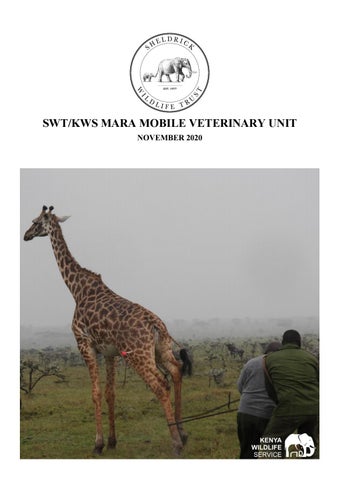
SWT/KWS MARA MOBILE VETERINARY UNIT NOVEMBER 2020
Introduction
8 Cases in November
3 Poaching Cases
62% Success
November Report by Dr. Campaign Limo During November, there was moderate rainfall that was evenly distributed within the conservation area creating plentiful food and water for all wildlife species to utilize. The Unit rescued an elephant bull that was stuck for more than 36 hours after slipping into a poorly secured sewage pit, treated an elephant and a giraffe for spear wounds and a giraffe for an arrow injury. A young male lion was treated after being bitten by a cobra and another for bite wounds. A case of Human-wildlife conflict resulted in 3 dead vultures after they fed on a poisoned carcass and 2 vultures that were found alive, treated and released. Acknowledgement The Mara Mobile Veterinary Unit would like to thank all stakeholders who assisted them during interventions on cases that were reported during the month. Many thanks to the Mara Elephant project team, Masai Mara National Reserve management and Siana Conservancy teams for their tireless efforts while rescuing the male elephant bull from a sewage pit. Many thanks to Olarro Conservancy Management for providing machinery with very competent technicians who helped drain the sewage pit and guide the trapped elephant out of the pit. The Veterinary Unit also appreciate the support through facilitation given to it by Minara Foundation through the SWT. Thanks to KWS management for their technical advice to the unit.
Case Details Date
Species
Area Found
Reason for Intervention
Outcome
09-Nov-20
Elephant
Ololaimutiek, Masai Mara
Rescue
An elephant bull fell into a sewage pit in Sidai camp
Task Successful
10-Nov-20
Lion
Masai Mara NR
Natural Causes
A member of the famous ‘Black Rock’ pride was filmed fighting with a black spitting cobra and was bitten
Successfully Treated
10-Nov-20
Elephant
Naboisho Conservancy
Spear
Had a small spear injury on her left carpus
Successfully Treated
13-Nov-20
Vulture
Ol Kinyei Conservancy
HWC
2 dead white backed vultures and one lappet faced vulture were found dead
HWC Death
13-Nov-20
Vulture
Ol Kinyei Conservancy
HWC
1 white back and 1 lappet faced vulture were found alive near a poisoned carcass, treated and released
Successfully Treated
15-Nov-20
Lion
Masai Mara NR
Natural Causes
Had several fight wounds and appeared to be in great pain
Successfully Treated
17-Nov-20
Giraffe
Olare Orok Conservancy
Arrow
The arrowhead could be seen protruding from the right side of the neck
Successfully Treated
23-Nov-20
Giraffe
Ol Chorro Conservancy
Spear
She appeared lethargic with a spear firmly attached to her left abdomen
Poaching Death
SWT/KWS Mara Mobile Vet Unit Treatment Locations November 2020
Case 1 – 9th November 2020 Elephant
Rescue
Ololaimutiek, Masai Mara
Members of the public reported an elephant bull trapped in a sewage pit in a tourist facility, (Sidai camp) just outside the Masai Mara National Reserve in the Ololaimutiak area. Rescue This bull was found submerged in a very sewage pit struggling to even raise his head above the water. The locals heard a commotion the night before when several other elephants trumpeted but they only realised the elephant had fallen into the pit several hours later. After thorough assessment of the situation, the teams felt that the only feasible way to rescue this elephant was to partially drain the sewage. A backhoe was provided by Olarro Conservancy and the sewage was partly drained by demolishing one side of the wall to create an escape tunnel. The elephant was guided out of the pit through the demolished wall, after several hours of effort. It took the teams approximately 12 hours to rescue this elephant who had been trapped in the pit for close to 36 hours. Prognosis The elephant was relieved but exhausted after rescue. He was monitored for a week and fully recovered. The success of the rescue is attributed to the team work between the SWT Vet Unit, the Mara National Reserve, Mara Elephant Project, Siana Conservancy teams and the Olarro Conservancy.
Case 2 – 10th November 2020 Lion
Natural Causes
Masai Mara National Reserve
This lion, a member of the famous ‘Black Rock’ pride was filmed by a visitor fighting with a black spitting cobra. He was bitten by the cobra which slithered away after the encounter. The lion was found lying close to another lion with the rest of the pride close by, lethargic with labored breathing but conscious. Immobilisation, examination and treatment The vet darted the lion from a vehicle with 4mgs Medetomidine and 200mgs Ketamine. It took eight minutes for the drugs to take effect then a blindfold was applied and the lion repositioned in a comfortable posture. An appropriate antivenom was reconstituted and given slowly intravenously for one hour with continuous monitoring of his vital parameters. The eyes were cleaned and antibiotic ointment applied given that most spitting cobras in addition to bites can spit directly into a victim’s eyes. Dexamethasone anti-inflammatories and Amoxicillin antibiotics were also given intramuscularly. Prognosis He was monitored for one hour after treatment without reversal of the anaesthetic so as to remain calm for the longest time possible. He was able to metabolise the anaesthetics and woke up after two hours. He joined the rest of the pride members and was monitored for a week. He made a full recovery.
Case 3 – 10th November 2020 Elephant
Spear
Naboisho Conservancy
This young female was seen moving with difficulty by Naboisho Conservancy Rangers. The Vet Unit found her alone hiding in a small bush with a swollen left front leg which made her walk with difficulty.
Immobilisation, examination and treatment The elephant was immobilised with 13mgs Etorphine and darted from a vehicle. She appeared nervous and elusive as she kept running into bushes but was eventually darted. It took ten minutes for the elephant to be fully narcotized and examination revealed a small spear injury on her left carpus. Probing of the wound was negative for any foreign object and the joint capsule was not affected. The wound was debrided with Hydrogen peroxide and rinsed with clean water before tincture of iodine was applied for disinfection. The elephant was also given Amoxicillin antibiotics and Flunixin meglumine anti-inflammatories. Reversal and prognosis The anaesthetic was reversed with 36mgs Diprenorphine given intravenously through a prominent ear vein. She rose up two minutes after reversal and walked away. Prognosis for full recovery is good.
.
Case 4 & 5 – 13th November 2020 Vultures
Human-wildlife Conflict
Ol Kinyei Conservancy
The management of Ol Kinyei Conservancy called to report an incident of suspected poisoning at the edge of their Conservancy involving several vultures and a hyena. Examination and treatment On arrival, a devoured spotted hyena carcass was found with three dead vultures; 2white backed and one lappet faced. A white backed and a lappet faced vulture were found alive, but recumbent, and given Atropine sulphate as an antidote and Dexamethasone sodium anti-inflammatories. Samples were collected for toxicology from the vulture carcasses before they were destroyed with the hyena carcass. The treated vultures were closely monitored in an enclosure for a week with regular antidote top up. They greatly improved and when fully recovered they were released. Cause of death and management The vultures were poisoned due to human-wildlife conflict. A sensitization meeting was convened by the Conservancy Management, KWS and conservation partners (Nature Kenya, Masai Mara Conservancies Association, Peregrine fund, Mara Predator Project) with the local community to try and educate them on the dangers of poisoning. This was the second poisoning at the same location in a period of less than a year.
Case 6 – 15th November 2020 Lion
Natural Causes
Masai Mara National Reserve
This lioness was involved in a fight with other lions and was found lying down by the Masai Mara National Reserve Rangers who called the Mobile Veterinary Unit. The Vet Unit found the lioness lying under a big tree away from the other pride members. She had several fight wounds and appeared to be in great pain. When urged to stand, she did got up but was clearly in a lot of pain from the fight wounds. Immobilisation, examination and treatment The lion was darted from a vehicle with 6mgs Medetomidine and 220mgs Ketamine hydrochloride. It took eleven minutes for this lioness to be fully anaesthetized. She had wounds which were relatively fresh and caused by fights with other lions. Examination also revealed she was heavily pregnant. All the wounds were cleaned with Hydrogen peroxide, rinsed with water then disinfected with Iodine. Cloxacillin ointment was infused into all the wounds before Oxytetracycline wound spray was applied topically. The lion was also administered Amoxicillin antibiotics and ivermectin parasiticide. Reversal and prognosis The anaesthetic was reversed, she woke up, then moved to hide at a base of a small hill. Prognosis is good.
.
Case 7 – 17th November 2020 Giraffe
Arrow
Olare Orok Conservancy
This giraffe was seen with an arrowhead lodged in the right side of her neck by Olare Motorogi Rangers. The Unit found the giraffe with a group of other giraffes browsing within the Conservancy. Immobilisation, examination and treatment The giraffe was darted from a vehicle with 11mgs Etorphine hydrochloride and 60mgs Azaperone. The drugs took effect after ten minutes then the giraffe was roped to the ground and the anaesthetic immediately reversed with use of 30mgs Diprenorphine hydrochloride. The barbed arrowhead was gently worked back. The arrowhead appeared to have been there for less than 24 hours. Luckily this was a non-poisoned arrow. The resultant wound was cleaned with water and disinfected with tincture of Iodine before being infused with Cloxacillin antibiotic ointment. The giraffe was also administered with Amoxicillin antibiotics and Flunixin meglumine anti-inflammatories. Reversal and prognosis The giraffe was released after treatment and she rose up without any difficulty to join the nearby herd of giraffes. Prognosis is good.
.
Case 8– 23rd November 2020 Giraffe
Spear
Ol Chorro Conservancy
This giraffe was seen by visitors with a spear lodged in the left side of her abdomen. The Vet Unit found this giraffe isolated from the rest of the herd under a tree. She appeared lethargic and the spear was clearly seen firmly attached in her left abdomen. She appeared stressed and moved with difficulty. Immobilization, examination and treatment The giraffe was darted with 10mgs Etorphine hydrochloride and 50mgs Azaperone tartrate and fell to the ground after eight minutes on her right side. The spear was retrieved gently with examination revealing up to two feet of the spear had gone into the abdomen. Unfortunately, this giraffe succumbed as soon as the spear was removed and the anaesthetic was reversed. Cause of death Post-mortem revealed severe damage had been caused by the spear. The spear penetrated the diaphragm, punctured the liver and uterus which was gravid. This giraffe could not have survived due to the extent of the damage to the organs.