SWT/KWS MARA MOBILE VETERINARY UNIT MAY 2020
Introduction
4 Cases in May
1 Lion Case
3 Elephant Cases
May Report by Dr. Campaign Limo. There was continuous precipitation throughout the month, though with decreased intensity towards the end. There is plenty of food and water for large herbivores to utilise. Most areas remain inaccessible due to damaged roads and bridges. Due to the current COVID 19 pandemic challenges being experienced, visitation to the Conservation Areas within the Mara area has stopped, with only a small number of staff deployed to carry out patrols. As tourists and tour guides contribute significantly to reports, the decrease in tourism has directly affected the number of cases reported. Acknowledgement The Mara Mobile Veterinary Unit would like to appreciate all stakeholders for their support towards saving wildlife within the conservation area. Thanks to Minara Foundation through The SWT for their continued facilitation to the unit. Thanks to KWS for partnering with other stakeholders to enhance wildlife safety and for its technical guidance to the unit.
Case Details Date
Species
Area Found
08-May-20
Elephant
Naboisho Conservancy
Postmortem
09-May-20
Lion
Masai Mara NR
Rescue
09-May-20
Elephant
Naboisho Conservancy
Natural Causes
Elephant
Kitengela, Central Kenya
HWC
19-May-20
Reason for Intervention This collared female christened ‘Caroline’ was found dead but the autopsy was inconclusive This lion cub was found perched up a tree. He climbed down on his own after two days with hyenas chasing after him. No other lion was seen within the vicinity Previously treated for spear injuries and given a guarded prognosis. Sadly was then attacked by 2 young bulls leaving him with severe injuries These three stray bulls were first seen in Ololung’a in Narok County near settlement areas and needed to be relocated
Outcome Died
Taken to Orphanage
Died
Task Successful
SWT/KWS Mara Mobile Vet Unit Treatment Locations May 2020
. Case
1 – 8th May 2020
Elephant
Post-mortem
Naboisho Conservancy
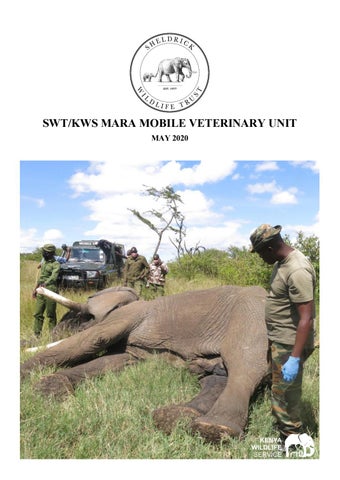
This collared female christened ‘Caroline’ was found dead within the Conservancy and immobility alert signals were transmitted prompting KWS, Mara Elephant Project and Conservancy Security teams to respond. She was found dead in a shallow muddy pool. The Mara Veterinary Unit was called to help find the cause of her death. Examination This elephant was found on left lateral recumbency position with the collar intact. She was pulled out of the pool and rolled over for better examination. There was no sign of struggle at the point of death. The following observations were noted• • • • •
This elephant was in a fair body condition with a score of 3 in a scale of 1 – 5 (1 is poor and 5 perfect) Rigor mortis was beginning to develop and time of death estimated to be less than 8 hours Apart from a small septic wound on posterior left carpus, no other injury was evident externally The abdomen was slightly extended The collar was perfectly fitted with no signs of it interfering with her activities
• •
Her mammaries appeared engorged but no milk was seen on expression, a sign of pregnancy Reproductive organs appeared normal bur she was carrying a male calf estimated at 16 months. The uterus was normal with good placentation. The calf appeared to have died after the mother’s death as he appeared fresh and at the right position for its gestational age The trunk was patent and clear. The left lung appeared normal; however, the right lung was frothy with sections displaying red hepatisation and ventral lobes congested. Changes seen within the system were attributed to usual post mortem occurrence rather than from pathology. The tongue and oral mucosa appeared jaundiced with no structural abnormality seen. All the teeth
•
•
• • •
• •
were intact. She had scanty food within her digestive system. No formed faecal balls were evident with a lot of water found in her stomach; both her small and large intestines displaying a yellow colouration, with some sections displaying petechial and ecchymotic haemorrhages. The heart was flaccid with its chambers having small amount of clotted blood. The chambers were structurally sound with the size of the heart considered grossly normal for this elephant. Blood volume was considered low for this sized elephant and this was a sign of anaemia. The liver appeared normal in size but without the usual firm consistency with pitting on mild digital pressure. When sectioned, it appeared mottled with accumulation of significant amount of bile within the canaliculi. Other areas of the liver parenchyma had yellowish colouration The kidneys appearing normal in colour and size. The bladder empty with much of its contents already voided. The urethra was patent Notably, the peritoneal cavity had an abnormally large volume of fluid which was tinge coloured. This was a clear manifestation of ascites. All other organs appeared normal.
Cause of Death The above post-mortem picture shows this elephant had a problem with her liver. The pathological changes including ascites, jaundice encountered are signs associated with liver failure.The gross picture of the liver itself shows that it was damaged, however the cause of the liver damage could not be ascertained grossly. The tusks were removed and handed over to KWS security team for accounting and safe custody .
Case 2 – 9th May 2020 Lion
Rescue
Masai Mara National Reserve
This cub was found perched up a tree by Rangers on patrol. No lions were seen around and the cub looked scared. They were advised to leave him alone and monitor him just in case his mother turned up.
Immobilisation, examination and treatment He climbed down on his own after two days and hyenas were chasing after him ready to kill him. There were still no other lions within the vicinity. It was decided that he needed to be rescued and he was manually restrained as he was weak after going without food for some days. He was taken to the Mara Triangle Conservancy where there is a carnivore enclosure while the Rangers searched for his pride. The search for his pride was futile and after three days he was relocated to the KWS Nairobi Animal Orphanage. By the time of recapture, he was stronger having fed well. He was chemically restrained and placed into a small cage then reversed with Atepamezole. He was then transported to the Nairobi animal orphanage and arrived safely, where he is now doing well. Prognosis The lion was successfully revived and prognosis for full recovery is good.
Case 3 – 9th May 2020 Elephant
Natural Causes
Naboisho Conservancy
This big bull, regularly seen within the Conservancy, was described as a peaceful massive old bull who rarely wanders outside of the Conservancy. He was reported to be a lone bull who stays by himself. However, he was seen with septic injuries on the 22nd April 2020 at the border of the Conservancy and community. The vet team immobilized him and examination revealed at least two deep sharp object inflicted injuries on his right thorax and right withers area. Another injury was found on his right ear pinna. All these wounds were septic and infested with maggots which were removed manually and the wounds cleaned before the elephant was given antibiotics and anti-inflammatories. His prognosis was considered guarded and follow up treatment was scheduled for three weeks later. However, two young bulls crossed into the Conservancy from the National Reserve on the morning of 8th May 2020 and found this vulnerable bull. For unknown reasons they fiercely attacked him, piercing his rump and perineal area with their tusks. Immobilisation, examination and treatment He was found near a swampy area a few meters away from the two bulls who had chased him for about 1 kilometre. The two bulls were chased away before the old bull was immobilized. Observation before immobilization revealed a very weak bull hiding in bushes and unwilling to come into the open. He was limping with fresh tusk inflicted bleeding injuries on his perineal area and the right rump. After darting he lay on his right side with a lot of straw coloured fluid gushing out from a septic wound on the right side of his chest. Though most of the original wounds were healing, the fresh wounds and the septic wound on the right thorax were a challenge. There were signs of hydrothorax with fluid accumulating within the thoracic cavity. During expiration, air with fluid could be seen escaping from the opening, compromising the elephants breathing. Further examination revealed complete sloughing off of the left front sole with the right one partly affected and in the process of peeling off. Prognosis Prognosis of this elephant was considered grave and treatment was unlikely to change the outcome. The team agreed to end further suffering of this elephant and sadly decided to euthanize him.
Case 4 – 19th May 2020 Elephant
Human-Wildlife Conflict
Kitengela, Central Kenya
These three stray bulls were first seen in Ololung’a in Narok County near settlement areas. An attempt to drive them towards the nearest Conservancy was futile as they went ahead and followed the main tarmac road towards Suswa. Eventually they were seen in Kitengela on the outskirts of Nairobi and a decision was arrived at to capture and return them to Narok County; specifically to the Masai Mara National Reserve where they were thought to have originated from.
Immobilisation and relocation They were darted with Etorphine from a helicopter and all were immobilized within close proximity of each other. They were then loaded in turns to spacious, well ventilated and secure crates and then revived. They were transported overnight to the Masai Mara National Reserve arriving in the morning where they were released. One was collared with a telemetric device for ease of monitoring. Prognosis They were released at a convenient place within the reserve where they could easily access water and forage. They remained calm and started feeding as soon as they stepped out of their crates. Monitoring with the help of the deployed collar has revealed they are settling down well and are intermingling comfortably with the other resident elephant herds. Monitoring is still ongoing.