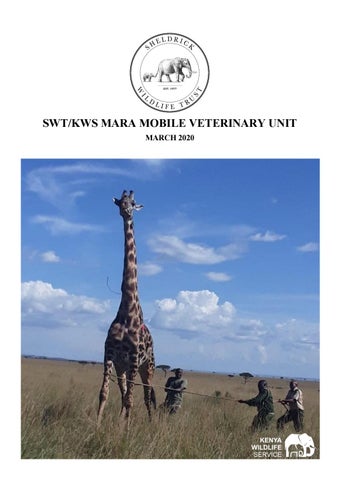
SWT/KWS MARA MOBILE VETERINARY UNIT MARCH 2020
Introduction
6 Cases in March
3 Poaching Cases
3 Elephant Cases
March Report by Dr. Campaign Limo The month under review was characterised by decreased precipitation compared to the previous month with plenty of food and water for most browsers and grazers to utilize. There were few conflict cases reported. There was decreased visitation to the conservation area by tourists and this partially led to decreased sightings of animals in need of help. The following cases were handled during the month. Acknowledgement The Mara Mobile Veterinary Unit would like to thank all stakeholders who helped in reporting cases requiring help during the period. Many thanks to Minara Foundation through SWT for their continued facilitation to the unit. Thanks too to KWS management for their technical guidance to the unit..
Case Details Date
Species
Area Found
11-Mar-20
Zebra
Naboisho Conservancy
11-Mar-20
Reason for Intervention
Outcome
Snared
This zebra was seen with a tight snare round her left hind leg at fetlock joint
Successfully Treated
Giraffe
Mara Triangle, NR
Snared
Had a snare around the neck that was not strangulating, but had created cutaneous abrasions
Successfully Treated
12-Mar-20
Zebra
Naboisho Conservancy
Snared
This zebra was found with a snare on his right hind leg
Successfully Treated
14-Mar-20
Elephant
Mara North Conservancy
Rescue
26-Mar-20
Elephant
Olarro Conservancy
Postmortem
26-Mar-20
Elephant
Olarro Conservancy
Rescue
This baby elephant, a few days old was seen by community members abandoned in a small but muddy pool . She was seen in good health with her small calf and other members of her family within the conservancy three days prior to her death Mother died and her calf needed to be rescued
Taken to Orphanage
Died Taken to Orphanage
SWT/KWS Mara Mobile Vet Unit Treatment Locations March 2020
. Case
1 – 11th March 2020
Zebra
Snared
Naboisho Conservancy
This zebra was seen with a tight snare round her left hind leg at the fetlock joint. She was in immense pain with limited ambulation. The Conservancy Management notified the Mobile Veterinary Unit or intervention. The Vet Unit found the zebra grazing a distance away from a mixed herd of wildebeests and zebras. She appeared restless and in pain. The wire was tight and partially buried. Immobilisation, examination and treatment The zebra was approached with a vehicle and darted with 5mgs Etorphine hydrochloride and 50mgs Azaperone. The zebra took off briefly before being overwhelmed by the drugs four minutes later. Examination revealed a tight wire snare round her left hind leg at the fetlock joint. The plain wire snare could have been in place for more than two weeks. The snare was deeply embedded and was cut loose before the resultant wound was debrided with Hydrogen peroxide and rinsed with clean water. Tincture of iodine and Tetracycline wound spray were applied for disinfection and to prevent bacterial infection respectively. The joint integrity had not been damaged. Other treatments given include parenteral administration of Amoxicillin antibiotics and Flunixin meglumine anti-inflammatories. Reversal and Prognosis The anaesthetic was reversed by administration of 18mgs Diprenorphine through the jugular vein. She rose two minutes after revival to join the rest of the zebras grazing at a distance. Prognosis is good.
Case 2 – 11th March 2020 Giraffe
Snared
Mara Triangle
This big male in company of another four big bulls was seen with a relatively tight snare round his neck by a visiting tourist. She informed the Conservancy Management who called the Mobile Veterinary Unit for help. The four bulls were found near a swampy area with the snare discernible from a distance. The giraffes were slowly driven away from the swamp on foot by the Conservancy Rangers.
Immobilisation, examination and treatment The giraffe was darted from a vehicle with a combination of 12mgs Etorphine hydrochloride and 60mgs Azaperone. The drugs took full effect after ten minutes, then he was roped down for maximum restraint before examination. The snare, which was a braided wire snare, was cut loose and removed. Though not strangulating, this snare had created cutaneous abrasions which were treated with topical application of Oxytetracycline wound spray. Prognosis Prognosis is good. He was seen browsing comfortably with other giraffes two days later.
. Case
3 – 12th March 2020
Zebra
Snared
Naboisho Conservancy
This male was seen by the Naboisho Conservancy Rangers dragging a snare on his right hind leg. They notified the Conservancy Management who called the Mobile Veterinary Unit for help. The Unit found the zebra with a herd; he appeared uncomfortable, occasionally lifting the affected limb. Immobilisation, examination and treatment The zebra was approached with a vehicle and immobilised with a combination of 5mgs Etorphine hydrochloride and 50mgs Azaperone delivered through a 1.5ml dan-inject dart. The zebra tried to run into a thicket but was overwhelmed by the drugs after four minutes. After being placed in a comfortable position, examination was carried out. The tightly attached snare was a plain wire around his right hindleg fetlock joint. It had created a wound which appeared clean. The snare was unknotted and the resultant wound rinsed with clean water, wiped dry with sterile gauze swab and disinfected with tincture of Iodine. Oxytetracycline spray was applied topically. Other treatments given include parenteral administration of Amoxicillin antibiotics and Flunixin meglumine anti-inflammatories. Reversal and Prognosis The drugs were reversed by administration of 16mgs Diprenorphine hydrochloride through the jugular vein.
He rose up to join the rest of the herd two minutes post revival. Prognosis is good.
. Case
4 – 14th March 2020
Elephant
Rescue
Mara North Conservancy
This baby elephant, just a few days old, was seen by Community Members abandoned on a small but muddy pool. They informed KWS rangers on patrol, Mara North Conservancy Rangers and Mara Elephant project teams for action. The teams contacted the Mobile Veterinary Unit for assistance. Rescue This baby was found recumbent after being taken out from the pool. Close examination indicated she was hypothermic and hypoglycaemic. This baby was a few days old with the umbilical cord stump still wet. She appeared not to have suckled for some time and the situation was complicated by prolonged recumbency on a wet environment. She had aspirated dirt from the pool as evidenced by her struggle to breath with audible respiratory sounds. The right nostril was partially blocked by aspirated mud which was cleared as she was being stabilized. She was covered with a warm blanket then given intravenous administration of Dexamethasone sodium to prevent shock and as an anti-inflammatory. She was also given dextrose intravenously to boost energy and Polyionic ringer’s lactate. Management After being stabilized, a decision was arrived at to airlift her to the SWT elephant orphanage in Nairobi for more specialised care under close observation.
Case 5 and 6 – 26th March 2020 Elephant
Post-mortem/Rescue
Olarro Conservancy
This elephant named ‘Namunyak’ was collared in February 2016 by KWS and WWF for research and monitoring. Since then, monitoring revealed she hardly wanders far from the Olarro Conservancy where the collar was fitted. She has been sighted regularly within the Conservancy with her herd. Namunyak was described as a peaceful elephant with no known farm raiding or human elephant conflict. Examination She was found dead on the morning of 27th March 2020 in an open plain within Olarro conservancy. She was seen in good health with her small calf and other members of her family within the Conservancy three days prior to her death. Information relayed by the tracking device revealed nothing unusual in the pattern of her movement. She spent most of her time within the Conservancy boundaries days preceding her death. The carcass was found intact, relatively fresh on the left side, with the following general observations; • • • • • •
The collar was in place and still transmitting. Both tusks were intact There were no signs of struggle at the scene of death. The picture was that of sudden drop. Age of the carcass was estimated to be less than twelve hours with rigor mortis not yet fully developed Her body condition was estimated to be 3.5 on a scale of 1 - 5 (1 being poor and 5 perfect) Her mammaries were engorged with signs she was actively lactating. Milk could easily be expressed No physical injuries were seen on any part of her body
Digestive system; Nothing unusual was detected within the gastrointestinal tract. This elephant had been feeding before it died. The stomach and intestines were full with ingesta and the rectum had fully formed faecal balls. The liver appeared normal in size and shape though with some sections appearing slightly pale. Renal system; Both kidneys were normal in shape and size with clear demarcation of medulla and cortex. The ureters and renal vessels appeared to have been functioning well before death. The bladder was partially full with urine which were normal in colour and consistency. The entire renal system appeared normal. Integumentary system; The skin appeared normal with good elasticity. There was evidence of generalised petechiations within the sub cutis. Musculo-skeletal system; Nothing unusual was detected within this system. All bones were intact. Respiratory system; The upper respiratory tract system airways were patent. However, there was abnormal accumulation of fluid within the lungs. Both lungs were affected with froth and fluid. Two emboli were found in one of the pulmonary arteries of the left lung and this was considered as an abnormal finding. Cardiovascular system; The spleen appeared normal in size but had a large ruptured abscess at the point of attachment to the stomach wall, with adhesions involving much of the gastro splenic ligament. The heart was normal in size and shape, but had a clot within its chambers. Much of the clot was found on the left ventricle and atrium. Streak haemorrhages were discernible within the endocardium with petechiae on the epicardium. These changes especially the haemorrhages were considered pathological.
Cause of Death Of great significance is the ruptured abscess at the gastro splenic attachment. This abscess had created extensive adhesions within the abdominal cavity. Some pus from the rupture had seeped into the peritoneal space leading to severe sepsis with possible dissemination of the infective material from the primary foci via circulation into the lungs. This resulted in septic pulmonary emboli with associated complications including cardiac arrest. This elephant died from complications arising from rupture of a long-standing abscess. Pulmonary emboli encountered within the lungs could have been from dissemination of bacteria from the abscess leading to septic emboli. The male calf was subsequently rescued and taken to the Sheldrick Wildlife Trust elephant orphanage in Nairobi.