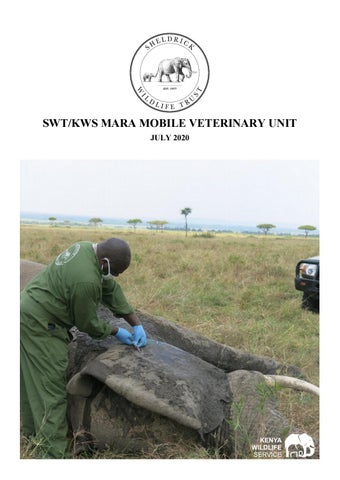
SWT/KWS MARA MOBILE VETERINARY UNIT JULY 2020
Introduction
4 Cases in July
4 Poaching Cases
2 Elephant Cases
July Report by Dr. Campaign Limo
The month was characterised by decreased precipitation compared to the previous month across the entire ecosystem. There was limited visitation to the area owing to current restrictions of movement due to the COVID 19 pandemic. Patrols have also been scaled down therefore fewer cases were reported and handled. Follow up on the previously treated bull at Olarro Conservancy revealed he was doing well and the spear wounds on his trunk were healing well and the swelling of his left front leg is resolving. The Unit also removed a spear from the ear of an elephant in the National Reserve and two snares from zebras in Olarro Conservancy Acknowledgement The Mara Mobile Veterinary Unit would like to acknowledge support from various stakeholders who made it possible to handle the cases requiring intervention. Thanks to Minara Foundation through the Sheldrick Wildlife Trust (SWT) for their facilitation to the Unit. Thanks to KWS Management for their technical advice to the Unit.
Case Details Date
Species
Area Found
09-Jul-20
Zebra
Olarro Conservancy
Snared
09-Jul-20
Zebra
Olarro Conservancy
Snared
12-Jul-20
Elephant
Masai Mara NR
Spear
Examination revealed an old spear wound which was slowly healing
Successfully Treated
Elephant
Mara Triangle
Spear
A whole metal spear firmly planted embedded in his left ear pinna after piercing it at the base
Successfully Treated
22-Jul-20
Reason for Intervention A loose plain wire snare around his neck with minimum damage to the tissues around the neck He was seen dragging a plain wire snare firmly attached to his left hind leg. He walked with difficulty as the wire appeared tight
Outcome Successfully Treated Successfully Treated
SWT/KWS Mara Mobile Vet Unit Treatment Locations July 2020
. Case
1 – 9th July 2020
Zebra
Snared
Olarro Conservancy
This zebra was seen dragging a plain shiny wire round his neck by Olarro Conservancy Rangers on their normal patrol. They called the mobile veterinary unit for help. The Unit found the zebra in an open plain with other zebras. He looked nervous and the wire snare could be seen loosely attached to his neck.
Immobilisation, examination and treatment The zebra was darted from a vehicle with a combination of 50mgs Azaperone and 5mgs Etorphine hydrochloride. It took seven minutes for the drugs to take full effect and the zebra assumed sternal recumbency. Examination revealed a loose plain wire snare round his neck which caused minimum damage of tissues around the neck. This snare was removed and the wounds cleaned with water before Oxytetracycline spray was applied topically. In addition, this zebra received a dose of Amoxicillin antibiotics given intramuscularly. Prognosis The anaesthetic was reversed with 15mgs Diprenorphine hydrochloride given through the jugular vein. He was up on his feet in two minutes and took off to join the rest of the zebras. Prognosis is good.
. Case
2 – 9th July 2020
Zebra
Snared
Olarro Conservancy
This young male was seen with a snare on his left hind leg by Olarro Conservancy Rangers whilst on their patrol. He was in the same herd as the previously treated male and both cases were handled the same day. He was dragging a snare firmly attached to his left hind leg and walked with difficulty as the wire was tight.
Immobilisation, examination and treatment The zebra was darted from a vehicle with a combination of 3.5mgs Etorphine hydrochloride and 40mgs Azaperone tartarate. The zebra was fully narcotized after four and a half minutes. Examination revealed a tight snare round his left hind leg slightly above the fetlock joint which could have been in place for a week. The snare had caused slight damage to the tissues but no sepsis was detected. The wire was removed and Hydrogen peroxide applied to remove debris. Clean water was used to rinse before tincture of Iodine was applied for disinfection. Oxytetracycline wound spray was then applied topically. The zebra was also given Amoxicillin antibiotics and Flunixin meglumine anti-inflammatories. Prognosis The anaesthetic was reversed and he was up in two minutes to join the rest of the zebras. Prognosis is good.
Case 3 – 12th July 2020 Elephant
Spear
Masai Mara National Reserve
This big bull was seen alone and walking with difficulty by the Mobile Veterinary Unit as they came from assessing a previously treated animal. He had a small suppurating swelling on the cranial aspect of his right elbow. A decision to immobilize him for closer examination was arrived at. Immobilisation, examination and treatment The elephant was immobilised with 17mgs Etorphine hydrochloride. He was darted from a vehicle then the elephant was guarded to make sure it stayed within an open area as the anaesthetic took effect, which took eight minutes. Examination revealed an old spear wound which was slowly healing. No foreign body was detected when probed. The wound was debrided with Hydrogen peroxide and rinsed with clean water. Tincture of iodine was applied for disinfection before Oxytetracycline antibiotic spray was applied topically. He was additionally given Amoxicillin antibiotic parenterally to prevent sepsis. Prognosis The anaesthetic was reversed and he rose up in 3 minutes, and moved to a nearby bush. Prognosis is good.
Case 4 – 22nd July 2020 Elephant
Spear
Mara Triangle
This bull was seen with a spear hanging from his ear by the Conservancy Rangers on patrol. They informed their warden who called the Mobile Veterinary Unit for assistance. The Unit found the elephant alone with the spear still hanging from his left ear pinna. He appeared uncomfortable and nervous on approach. Immobilisation, examination and treatment The elephant was darted from a vehicle with 17mgs Etorphine hydrochloride. It took seven minutes for the drugs to take full effect with this elephant assuming left lateral recumbency. He had to be turned over in order to access the spear and the injury. A whole metal spear was firmly embedded in his left ear pinna after piercing it at the base. The spear could have been in place for a day with minimal damage observed. The spear was gently removed and the wound was debrided with Hydrogen peroxide, cleaned with water and disinfected with tincture of iodine. The wound was then infused with Cloxacillin antibiotic ointment and sprayed with Oxytetracycline wound spray. The elephant was also given Amoxicillin antibiotics and Flunixin meglumine anti-inflammatories. Prognosis The anaesthetic was reversed and he rose up after 3 minutes and moved away with ease. Prognosis is good.