SWT/KWS MARA MOBILE VETERINARY UNIT FEBRUARY 2020
Introduction
6 Cases in February
2 Poaching Cases
5 Elephant Cases
February Report by Dr. Campaign Limo The month was characterised by precipitation which subsided towards the middle of the month. Vegetation and water have been abundantly available for wildlife utilization. Few conflict cases were recorded as competition for resources has been at a minimum. The following cases were handled during the period; Acknowledgement Mara Mobile Veterinary Unit would like to thank all stakeholders for helping report and monitor cases that required intervention. Thanks to Minara foundation through SWT for their continued facilitation of the unit. Thanks too to KWS for partnering with the stakeholders and their technical support to the unit.
Case Details Species
Area Found
Elephant
Mount Elgon National Park
Snared
10-Feb-20
Lion
Mara North Conservancy
Human Wildlife Conflict
15-Feb-20
Elephant
Mara North Conservancy
Postmortem
23-Feb-20
Elephant
Masai Mara National Reserve
Spear
24-Feb-20
Elephant
Masai Mara National Reserve
Postmortem
24-Feb-20
Mara North Elephant Conservancy
Human Wildlife Conflict
Date
05-Feb-20
Reason for Intervention This elephant, approximately fourteen years old, was seen dragging a snare attached to a wooden pole around her right front leg. This big male was seen by with an injury after he was speared following predation of livestock The carcass was found intact with moderate bloating on his right lateral recumbency. No external injury was evident Examination revealed an old spear injury which had since healed. No other injury was seen apart from usual abrasions commonly found in wild elephants The carcass of this elephant was found intact. No external injury was detected. There was no evidence of struggle at the scene of death This young female was seen lethargic with profuse salivation and diarrhoea. She was found on sternal recumbency, unable to rise up with obvious dyspnoea
Outcome Successfully Treated Successfully Treated
Died
Successfully Treated
Died
HWC Death
SWT/KWS Mara Mobile Vet Unit Treatment Locations February 2020
. Case
1 – 5th February 2020
Elephant
Snared
Mt Elgon National Park
This elephant is approximately fourteen years old and was seen dragging a snare from her right front leg that was still attached to a wooden pole. She had difficulties moving as the pole kept getting trapped by trees and bushes. She resorted to carrying the pole with her trunk while navigating bushy areas. Immobilisation, examination and treatment This elephant was traced to a very forested and slippery part of the mountain late in the evening. She was in distress though was still browsing. The elephant was darted from foot due to the difficult terrain. After making sure she was stable, examination revealed a deeply embedded thick manila snare attached to a heavy wooden pole round her right carpal joint. Snaring could have happened two weeks before treatment. The manila rope was cut loose and the wound, which appeared septic, was debrided with Hydrogen peroxide, rinsed with clean water, disinfected with Iodine then packed with green clay for toxin absorption and prevention of further sepsis. Luckily the joint structures were not affected. The elephant was also given Amoxicillin antibiotics and Flunixin meglumine anti-inflammatories. Prognosis Prognosis is good. She woke up 4 minutes after the anaesthetic was reversed and moved deeper into the forest and joined a herd.
. Case
2 – 10th February 2020
Lion
Human-wildlife conflict
Mara North Conservancy
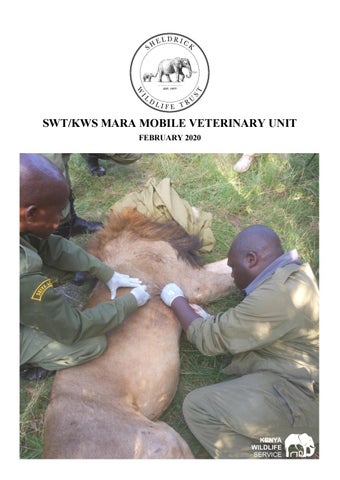
This big male was seen by Enonkishu Management with an injury to his chest after being speared at night by the community following predation of their livestock. However, he disappeared the next day and a frantic search was conducted over the next week to trace his whereabouts for treatment. Immobilisation, examination and treatment He was found with his brother and the rest of the pride feeding on an impala. He had lost condition but appeared active. A gaping wound could be seen on the left side of his sternum. The lion was approached with a vehicle and immobilised with 6mgs Medetomidine hydrochloride and 260mgs Ketamine hydrochloride. Examination revealed an open spear wound to his left sternum with three ribs partially broken. Luckily there was no communication with the pleural cavity but the integrity of the rib cage was compromised. The wound, though deep, appeared clean. The area was shaved, the wound edges refreshed and rinsed with clean water then disinfected with tincture of iodine. The deeper wound margins were stitched with absorbable vicryl suture using a simple interrupted pattern with the skin and subcutis being closed similarly. Cloxacillin antibiotic was infused into the wound to prevent sepsis. Other treatments included Amoxicillin antibiotic and Ivermectin parasiticide all given parenterally. Prognosis Prognosis is good.
Case 3 – 15th February 2020 Elephant
Post-mortem
Mara North Conservancy
The carcass of this big bull was seen by Conservancy Management. There was no history of this bull being sick or weak before the carcass was discovered. He was not commonly known to the Conservancy Rangers. General examination The carcass was found on the right side with moderate bloating. Part of the sternal and perineal areas had been mauled by scavengers. No external injury was evident but there were signs of a mild struggle before death. Body condition appeared average with ingesta regurgitates seen around the mouth and along the medial side of the trunk On opening the carcass, the following observations were made; • • • • •
Hypostatic congestion was evident on the right sided organs because of recumbency position The lungs, the entire respiratory tree, heart, kidneys and liver appeared normal Spleen appeared slightly engorged There were faecal balls in the rectum but none close to being expunged A big bleeding ulcer was found in the stomach. Further examination revealed this was a longstanding ulcer with perforations into the peritoneal cavity and extensive adhesions.
Cause of Death This elephant died from a perforating gastric ulcer. The seepage of ingesta through the ulcer led to other complications including peritoneal contamination. Blood was also lost as the ulcer was actively bleeding.
Case 4 – 23rd February 2020 Elephant
Spear
Masai Mara National Reserve
This elephant was spotted with a swelling on the left side of her abdomen by the Mara Mobile Veterinary Unit as she came close to the station with a herd of ten elephants with calves. This was assumed to be a family, with her being the matriarch. From a distance, the swelling appeared like an abscess and a decision was made to immobilize this elephant for examination and possible treatment. Immobilisation, examination and treatment The elephant was darted from a vehicle with 15mgs Etorphine hydrochloride. It took eight minutes for the drugs to take full effect after which the elephant assumed right lateral recumbency. The family members stayed to protect her and had to be pushed away with vehicles. Examination revealed an old spear injury which had since healed with granulation. No other injury was seen apart from abrasions commonly found in wild elephants. She was given Amoxicillin antibiotics parenterally. Prognosis The anaesthetic was reversed with 42mgs Diprenorphine hydrochloride through a prominent ear vein. She woke up three minutes after reversal to join the family members who were waiting close by.
. Case
5 – 24th February 2020
Elephant
Post-mortem
Masai Mara National Reserve
The carcass of this elephant was seen by the Mara National Reserve Rangers while on their morning patrols. General examination The carcass of this elephant was found intact and on her left side. No external injury was detected. There was no evidence of struggle at the scene but she appeared to have stumbled before collapsing. On opening the carcass, the following findings were noted; • •
She appeared dehydrated The entire respiratory system including the lungs appeared normal
• • •
The liver and spleen appeared congested. The kidneys appeared normal in size and colour The stomach and intestines appeared bloated with mesenteric vessels grossly engorged with haemorrhagic mesenteric lymph nodes There were streak haemorrhages on the mesentery and clear evidence of intestinal torsion affecting the small intestines mainly Lower large intestine had scanty food materials and there were no faeces ready for expulsion as peristalsis had been hindered by torsion
• •
Cause of Death This elephant died from complications of intestinal torsion.
. Case
6 – 24th February 2020
Elephant
Human-wildlife Conflict
Mara North Conservancy
This young female was seen lethargic with profuse salivation and diarrhea. She was reported to have been wandering around aimlessly before becoming recumbent in a marshy area. General examination She was found on sternal recumbency, unable to rise with obvious dyspnoea. There was evidence of mucoid diarrhoea and hypersalivation with occasional tremors. She was handled without anaesthesia as she appeared extremely lethargic. The mucous membranes were slightly cyanotic. Symptoms were consistent with intoxication from an unknown source, either a toxic plant or synthetic poison (agricultural pesticides) accidentally ingested through sprayed crops. The area is close to an agricultural community. No external injury was found. The elephant was given Atropine sulphate to try and neutralise the effects of the toxins and Dexamethasone sulphate to reduce inflammation. Antibiotics were given intramuscularly then rehydration with Polyionic ringer’s lactate solution was given over two hours to try and stop her from sliding into shock. Despite all these efforts, she showed little improvement and died a few hours later Cause of Death A post-mortem revealed an almost empty stomach with eroded gastrointestinal mucosa. There were petechial haemorrhages on the surface of the intestinal mucosa with other areas displaying ecchymosis. Subcutaneous tissue had petechial haemorrhages with the liver and kidney appearing slightly enlarged. The heart wall also had petechiae and the lungs were frothy and filled with fluid which could have led to death.