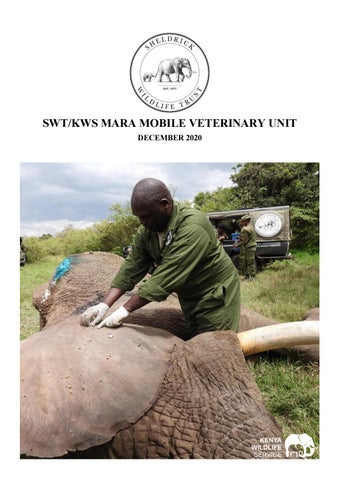
SWT/KWS MARA MOBILE VETERINARY UNIT DECEMBER 2020
Introduction
7 Cases in December
5 Poaching Cases
4 Elephant Cases
December Report by Dr. Campaign Limo The Conservation area received scanty and poorly distributed rainfall during the month. Water and fodder are still available across the ecosystem with a large number of elephants seen outside the Reserve mostly within the surrounding Conservancies. Human-wildlife conflict and poaching cases were reported with many of the injured animals sustaining spear and arrow wounds. Of these cases there were two elephant spear wounds, 1 arrow wound and 1 elephant treated for natural causes. One giraffe was treated for an arrow wound and a snare removed from a zebra’s chest as well as a lion for fight wounds. Acknowledgement The Mobile Veterinary Unit would like to appreciate help offered to it by various stakeholders by reporting and participating in actual intervention of cases handled during the year. Thanks to Minara Foundation through SWT for the continued facilitation to the unit. Thanks to KWS management for offering guidance to the Unit. The Unit wishes all partners and friends of wildlife and environmental conservation a prosperous New Year.
Case Details Date
Species
Area Found
10-Dec-20
Elephant
Lemek Conservancy
Spear
10-Dec-20
Elephant
Olarro Conservancy
Spear
11-Dec-20
Lion
Masai Mara NR
Natural Causes
This lion was attacked by rival males and took refuge in a lodge, refusing to move
Successfully Treated
11-Dec-20
Elephant
Olkinyei Conservancy
Arrow
Had a big abscess on the right side of his lower abdomen it appeared like it had been caused by an arrow
Successfully Treated
12-Dec-20
Giraffe
Olarro Conservancy
Arrow
The arrowhead was visible protruding from his right hind leg from a distance
Successfully Treated
16-Dec-20
Zebra
Naboisho Conservancy
Snared
Examination revealed a tight cable snare around his chest creating a big wound
Successfully Treated
Elephant
Masai Mara NR
Natural Causes
All the wounds were septic and maggot infested. His left knee appeared slightly swollen. No fracture was detected. most likely caused by a fight with another bull
Successfully Treated
18-Dec-20
Reason for Intervention A deep spear wound on his left upper flank. The peritoneum was punctured and left kidney damaged Had an arrow wound to the left side and a spear wound to the right side becoming septic
Outcome Poaching Death Successfully Treated
SWT/KWS Mara Mobile Vet Unit Treatment Locations December 2020
Case 1 – 10th December 2020 Elephant
Spear
Lemek Conservancy
This big bull was seen with a big spear wound on his left flank by KWS, Mara Elephant Project and Lemek Conservancy Rangers on their normal patrols. The Unit found this bull alone in thick bush and unwilling to move. After some disturbance, he moved to the edge of the bush and a big wound was discernible. Immobilisation, examination and treatment Immobilization was achieved using 17mgs Etorphine hydrochloride with the dart delivered from foot. The elephant was prevented from going back to the thicket with vehicles until drugs took full effect. He assumed left lateral recumbency in 8 minutes and had to be flipped over to lie on his right side to access the injury He was given Doxapram and Dexamethasone to stabilize breathing and prevent him from going into shock because he was severely compromised with collapse of peripheral blood vessels. After he was stabilised, examination revealed a deep spear wound on his left upper flank approximately three days old. The peritoneum was punctured and the left kidney was damaged. There were signs of severe peritoneal contamination with several abdominal organs damaged. The wounds were cleaned with water and disinfected with Iodine. Chlotetracycline boli were introduced into the wound which was then packed with green clay. He was also given long acting Tetracycline and Clindamycin antibiotics. Prognosis His prognosis was considered poor to guarded and the next 48 hours were considered critical due to abdominal organ damage. He succumbed 18 hours post treatment the tusks were removed and handed over to a KWS security team.
Case 2 – 10th December 2020 Elephant
Spear
Olarro Conservancy
This big bull estimated to be 40-45 years old was seen with a big wound on the right side of his body. The herd was new in the Conservancy and comprised of approximately 100 elephants. The Unit found this bull with the herd at the edge of a bushy hill. The herd were nervous and were prevented from going up the hill by strategically placed vehicles. Immobilisation, examination and treatment The elephant was darted from a vehicle with 18mgs Etorphine hydrochloride. It took ten minutes for the drugs to take full effect and this elephant fell on the left side after which an arrow injury was found on the left thigh. The injury on his right side was treated before the bull was flipped over for management of the arrow wound. The spear wound on the right side was relatively deep and becoming septic. The spear did not go past the external intercostal muscles. The wound was treated with Hydrogen peroxide, water, iodine and chlortetracycline boli. Oxytetracycline wound spray was applied and green clay packed. This elephant was then rolled over to access and asses the arrow wound on the left thigh. This was a relatively fresh wound about three days old with foamy discharge. On deep probing of this wound, an arrowhead was deeply embedded within the muscle which was barbed and nonpoisoned and removed. This wound was treated the same as the spear wound. The elephant was also given Clindamycin and Oxytetracycline antibiotics as well as Flunixin meglumine anti-inflammatories. Prognosis His prognosis is good.
Case 3 –11th December 2020 Lion
Natural Causes
Masai Mara National Reserve
This male lion took refuge within the compound of this lodge after being attacked at night by rival males. For the next 24 hours, he refused to move out of the compound and there were clear signs he had severe injuries. The lodge management notified the Mobile Veterinary Unit for action. This lion had moved to a thick bush within the lodge compound close to a river bank. He appeared to be having great pain. He could hardly stand.
Immobilisation, examination and treatment The lion was darted with 6mgs Medetomidine and 230mgs Ketamine from a vehicle. After 12 minutes, the lion was loaded onto a padded truck and taken to an open place under a shade outside the lodge compound. Examination revealed several bite wounds from other lions with a deep one on the lumbar section of his spine. Luckily the spinal cord was not severed. Other bite wounds were found on the thighs of both hind legs. The wounds were relatively fresh and were cleaned with water and disinfected with Iodine then infused with Cloxacillin antibiotic ointment. He was also given Amoxicillin antibiotics and Dexamethasone antiinflammatories. Prognosis Prognosis for a full recovery is good.
.
Case 4 – 11th December 2020 Elephant
Arrow
Ol Kinyei Conservancy
This big bull was seen with a large abscess on the right side of his lower abdomen by Olkinyei Conservancy Rangers. The Unit found the injured bull with other seven mature bull elephants. This was a magnificent bull herd, very defensive and in good shape. As the team arrived, they started moving up a bushy hill. The abscess had partially ruptured and was discharging purulent stuff. Immobilisation, examination and treatment The bulls were driven back down the hill by Rangers on the foot so the vet could dart the elephant from a vehicle with 17mgs Etorphine hydrochloride. It took ten minutes for the drugs to take full effect with this elephant with this elephant being overwhelmed by the drugs after taking refuge in a small thicket. He assumed right lateral recumbency and given the abscess was on lower right abdomen, it was still accessible. The abscess was fully drained and debrided with Hydrogen peroxide. No foreign body was detected though it appeared like it had been caused by an arrow. The wound was rinsed with clean water and disinfected with Iodine. He was also administered with Amoxicillin antibiotics and Flunixin meglumine anti-inflammatories. Prognosis His prognosis is good.
Case 5 –12th December 2020 Giraffe
Arrow
Olarro Conservancy
This male was seen with an arrowhead lodged in the lateral side of his right ankle by Olarro Conservancy Rangers. The Unit found him in an open area moving with difficulty trying to catch up with the other giraffes who were nearby browsing. The arrowhead was visibly protruding from his right hind leg from a distance.
Immobilisation, examination and treatment Immobilization was achieved with a combination of 11mgs Etorphine hydrochloride and 60mgs Azaperone from the vehicle with drugs taking full effect after ten minutes. The giraffe was roped down and the head held against the ground before the anaesthetic was reversed immediately to avoid anaesthetic complications. The barbed arrowhead was gently removed and the resultant wound debrided with Hydrogen peroxide and rinsed with copious amount of water. This was a poisoned arrow. Tincture of iodine was used for disinfection before Cloxacillin antibiotic ointment was infused into the wound. Other treatments given included intramuscular administration of Amoxicillin antibiotics and Flunixin meglumine anti-inflammatory. Prognosis He was then released and he rose up, much relieved, to join the other giraffes. Prognosis for recovery is good.
.
Case 6 –16th December 2020 Zebra
Snared
Naboisho Conservancy
This zebra was seen with a snare round his chest by the Conservancy Warden on patrol. He notified the Mobile Veterinary Unit for action. He was found isolated from the rest of the zebras with a visible tight snare round his chest making him uncomfortable.
Immobilisation, examination and treatment The zebra was darted from a vehicle with 5mgs Etorphine hydrochloride and 50mgs Azaperone tartarate. The zebra was fully anaesthetized after seven minutes and assumed sternal recumbency. Examination revealed a tight cable snare round his chest creating a big wound. The wire was cut loose and the resultant wound was debrided with Hydrogen peroxide and rinsed with clean water. It was then wiped dry and applied with Iodine disinfectant then sprayed with Oxytetracycline topical wound spray. Other treatments given included administration of Amoxicillin antibiotics and Flunixin meglumine antiinflammatories. Prognosis He rose within two minutes of reversal and joined the rest of the zebras. Prognosis for recovery is good.
.
Case 7 – 18th December 2020 Elephant
Natural Causes
Masai Mara National Reserve
This big bull was seen with wounds on his back and moving with difficulty within the Mara Triangle Conservancy. However, this bull crossed the river and was found in the Musiara area of the Mara National Reserve. He was alone splashing his wounds with water and unwilling to move. Open wounds could be seen on either side of his rump and on the left side of his chest. He also walked with a limp on his left hind leg. Immobilisation, examination and treatment The elephant was darted from a vehicle with 17mgs Etorphine hydrochloride. After making sure he was stable, examination revealed rough edged wounds on either side of his rump off the spine and two communicating ones on the left side of his chest. All these wounds were septic and maggot infested. His left knee appeared slightly swollen, likely as a result of a sprain as no fracture was detected. These wounds seemed to be caused by tusks, likely from a fight with another bull. He could have also suffered a sprain during the fight. He had slightly melanic faecal balls with bleeding was from lower gastrointestinal tract. The maggots were manually removed before the wounds were debrided with Hydrogen peroxide. The wounds were rinsed with clean water, disinfected with Iodine and packed with Green Clay. He was also given Clindamycin and long acting Oxytetracycline antibiotics as well as Flunixin meglumine anti-inflammatory. Prognosis Favourable. The rangers were asked to monitor and report his progress for the next two weeks.