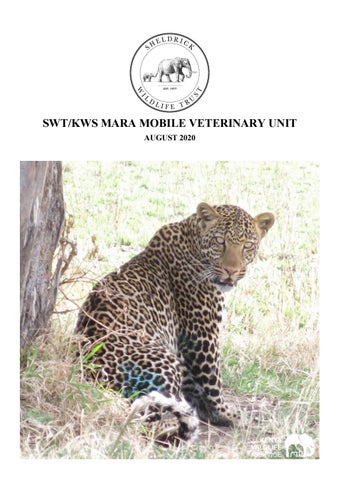
SWT/KWS MARA MOBILE VETERINARY UNIT AUGUST 2020
Introduction
7 Cases in August
4 Predator Cases
100% Success
August Report by Dr. Campaign Limo The area received minimum sporadic precipitation over the month with annual wildebeest migration picking up. Water and fodder for grazers is available for utilization with large carnivores and scavengers benefitting from migrating wildebeests. The Unit attended to 7 cases involving 3 lions, 1 leopard, 2 elephants and a zebra. Two of the lions were treated for natural causes and another was collared. One elephant was speared during human-elephant conflict and other for a spear wound likely caused by poaching. The leopard was treated for a bite wound and the zebra for injuries inflicted during a predation attempt. Acknowledgement Mara Mobile Veterinary Unit would like to thank all stakeholders who helped notify them of wild animals in need of assistance. The unit also appreciates facilitation and other logistical assistance by Minara Foundation through SWT. Thanks too to KWS management for the technical help offered to the unit.
Case Details Date
Species
Area Found
06-Aug-20
Lion
Masai Mara NR
11-Aug-20
Elephant
16-Aug-20
Reason for Intervention
Outcome
Collared
This lioness was selected for collaring to inform management about her movements in and outside the reserve
Task Successful
Mara Triangle
Spear
A septic wound likely caused by spearing
Successfully Treated
Elephant
Siana Conservancy
Human Wildlife Conflict
17-Aug-20
Lion
Masai Mara NR
Natural Causes
The injury appeared to have been caused by a recent spearing. Spearing could have been as a result of conflict A deep septic wound that was heavily infested by maggots caused by warthog tusks during a kill
22-Aug-20
Leopard
Masai Mara NR
Natural Causes
A deep bite wound on his left elbow likely caused by another leopard during a fight
Successfully Treated
24-Aug-20
Lion
Masai Mara NR
Natural Causes
Scar Face had a fresh wound which appeared to have been caused by a fight with other lions
Successfully Treated
25-Aug-20
Zebra
Mara North Conservancy
Natural Causes
Septic laceration wounds with heavy maggot infestation caused by attempted predation
Successfully Treated
Successfully Treated Successfully Treated
SWT/KWS Mara Mobile Vet Unit Treatment Locations August 2020
. Case
1 – 6th August 2020
Lion
Collared
Masai Mara National Reserve
This lioness was selected for collaring to inform the management about her movements in and outside the reserve. This monitoring is aimed at mitigating conflicts as management is able to notify surrounding community and at the same time deploy rangers to avert potential conflicts. This female was found with her pride members close to a kill. A wound on her tail could be seen although her body condition appeared good. Immobilisation, examination and treatment The lion was darted from a vehicle with a combination of 5.6mgs Medetomidine hydrochloride and 230mgs Ketamine hydrochloride. Cloxacillin eye ointment was applied on both eyes and blindfold put in place. After all parameters were taken and confirming she was stable, treatment of the wounds and deployment of the collar were carried out simultaneously. The open septic wound just below her tail had been caused by a fight with other lions. It was estimated to be less than one week old and was a relatively clean wound. The wound was debrided with Hydrogen peroxide and injected with clean water, then Iodine was applied for disinfection before Cloxacillin antibiotic being infused. The lion was also given Amoxicillin antibiotics and Ivermectin. Meanwhile the GPS/Satellite collar was being deployed as the treatment was going on. Prognosis The lion was successfully revived and the Collar is working.
Case 2 – 11th August 2020 Elephant
Spear
Mara Triangle
This big bull was spotted by a visitor to a camp near Mara River with an injury below his tail. The elephant was drinking water from Mara River. The veterinary unit were alerted for action. Immobilisation, examination and treatment The SWT helicopter located this bull as the ground team could not find him as he had crossed the river. On approach by the helicopter, he crossed the river back to his initial location. The dorsal perineal area, just below his tail, was swollen with a slightly discharging wound. Immobilization was achieved with 18mgs Etorphine hydrochloride and induction time was seven minutes. Examination revealed a septic wound, likely caused by spearing, and maggots were already infesting. This was likely a conflict incident. All the maggots were manually removed and the wound debrided with Hydrogen peroxide, cleaned with water and disinfected with Iodine. Oxytetracycline wound spray was applied topically then green clay was packed to absorb toxins and prevent further sepsis. Other treatments given include parenteral administration of Amoxicillin antibiotics, Flunixin meglumine anti-inflammatories and ivermectin parasiticide. Prognosis The anaesthetic was reversed and he got up and moved to a nearby bush. Prognosis is good.
Case 3 – 16th August 2020 Elephant
Human-Wildlife Conflict
Siana Conservancy
This elephant calf was seen by Siana Conservancy Rangers with an injury on his left front limb and walking with difficulty. This young bull had gone up a rocky bushy hill and it was difficult to locate him on the ground. After a few frustrating hours, helicopter services were requested to help. He was located up in the bushy hill with a few members of his family and was gently pushed down the hill to the edge of the thicket. Immobilisation, examination and treatment The elephant was immobilised with 8mgs Etorphine hydrochloride from foot. This young bull only moved 10m after darting, he then stood still until he was overwhelmed by anaesthetics. He appeared to be in good condition and the injury was caused by a recent spearing. Spearing could have been as a result of conflict. The deep spear wound was on the lateral side of his left knee but luckily did not damage the joint capsule. This was an approximately 3-day old wound. The wound was cleaned with water, disinfected with Iodine and packed with green clay to prevent sepsis and help in toxin absorption. Other treatments given include parenteral administration of Clindamycin antibiotic and Flunixin meglumine anti-inflammatories. Prognosis The anaesthetic was reversed and he got up and joined his family up the hill. Prognosis is good.
Case 4 – 17th August 2020 Lion
Natural Causes
Masai Mara National Reserve
This lion ‘Sikio’ is one of the famous lions in Mara. It was seen with a big wound on his forehead by Reserve Rangers. They requested the Veterinary Unit for assessment. Sikio was found alone near the Mara River, lying down in a shade. He held his face against the ground so as to avoid flies getting into the wound. Immobilisation, examination and treatment Immobilization was achieved with 6mgs Medetomidine hydrochloride and 250mgs Ketamine hydrochloride delivered in a dart from a vehicle. He was fully anaesthetised after eleven minutes whereupon a blindfold was put in place. Cloxacillin ointment was applied to both eyes to avoid desiccation and corneal damage. Examination revealed a deep septic wound heavily infested with maggots. This wound is reported to have been caused by warthog tusks in predation attempt. All maggots were manually removed and the wound debrided with Hydrogen peroxide. After rinsing the wound with clean water, iodine was used for disinfection. Additionally, Cloxacillin antibiotic ointment was infused and topical Oxytetracycline spray applied. Other treatments given include Amoxicillin antibiotics and Ivermectin parasiticides parenterally. Prognosis The anaesthetic was reversed and he moved slightly before resting under another tree. Prognosis is good.
Case 5 – 22nd August 2020 Leopard
Natural Causes
Masai Mara National Reserve
This leopard was seen limping by visitors to the Mara. They informed staff of Matira camp who in turn called the Vet unit for action. This sub adult leopard was traced to a bushy Lugga within the reserve. Though elusive, He was finally seen with a wound on his left leg at the level of his elbow. He walked with an obvious limp. Immobilisation, examination and treatment The leopard was darted from a vehicle with 1.5mgs Medetomidine and 120mgs Ketamine. He was monitored closely as he moved to a small depression and was fully anaesthetized after 12 minutes. A blindfold was put in place before this leopard was carried to a shady open area. Examination revealed a deep bite wound on his left elbow likely caused by another leopard during a fight. The elbow joint was affected with slight damage to the joint capsule. The wound was cleaned with water, disinfected with Iodine and infused with Cloxacillin antibiotic ointment. Finally, Oxytetracycline antibiotic spray was applied topically. Other treatments given were Clindamycin antibiotic and Dexamethasone sodium anti-inflammatories all given intramuscularly. Prognosis Though he will take a while to fully recover and use the limb, he is expected to make a complete recovery.
Case 6 – 24th August 2020 Lion
Natural Causes
Masai Mara National Reserve
This famous lion christened ‘Scar face’ was seen by visiting tourists with a fresh deep wound on his right eyebrow. They informed the reserve management who notified the mobile veterinary unit for action. Scar face is among the remaining members of the marsh pride. He has been immobilized on several occasions before for various reasons including a near fatal spearing into his chest. Immobilisation, examination and treatment Scarface was found alone hiding in a small shrub with the gaping wound discernible from a distance. He was nervous on approach. Restraint was achieved chemically with 6mgs Medetomidine hydrochloride and 240mgs Ketamine. He was darted from a vehicle and it took eleven minutes for the drugs to take full effect. Examination revealed a fresh wound on his right eyebrow above the existing scar. The wound appeared to be caused by a fight with other lions. His right hind leg also appeared wasted from earlier injuries. The wound was cleaned with water and disinfected with Iodine. Oxytetracycline spray and Cloxacillin antibiotics were applied to prevent sepsis. Scarface also received Amoxicillin antibiotics and Ivermectin parasiticide. Prognosis The wound will heal in time. However, Scarface shows signs of geriatric complications and old age.
Case 7 – 25th August 2020 Zebra
Natural Causes
Mara North Conservancy
This male zebra was seen by a Lodge Manager within the Conservancy. He was found grazing with another male in a shrubby area. He had open wounds on both sides of his rump likely caused by attempted predation by a large carnivore, presumably a lion. His body condition was satisfactory and the wounds appeared septic.
Immobilisation, examination and treatment The zebra was darted from a vehicle with 5mgs Etorphine and 60mgs Azaperone. The zebra took five minutes to be narcotized. Examination revealed septic laceration wounds with heavy maggot infestation. These wounds were caused by attempted predation. All the maggots were manually removed and the wound debrided with help of hydrogen peroxide and clean water. Tincture of iodine was used for disinfection with Oxytetracycline antibiotic spray applied to prevent sepsis. Other treatments given include parenteral administration of Amoxicillin antibiotics, Ivermectin parasiticide and Flunixin meglumine anti-inflammatories. Prognosis The zebra was successfully revived and he moved off to join his herd. Prognosis for full recovery is good.