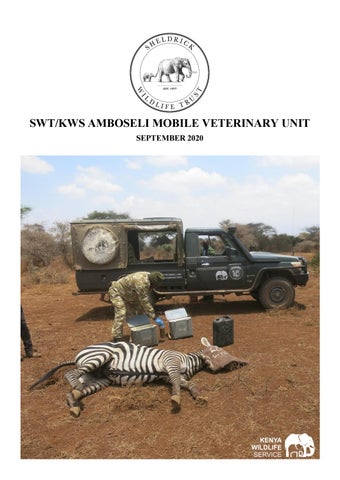
SWT/KWS AMBOSELI MOBILE VETERINARY UNIT SEPTEMBER 2020
Introduction
5 Cases in September
2 Lion Cases
80% Success
September Report by Dr. Kariuki Edward During September 2020, the SCA-Amboseli Mobile Veterinary Unit (SCA-AMVU) attended to five veterinary clinical cases. The cases included an elephant, two lions and two zebras. A lion cub from Kuku Group Ranch was examined for cause of death, which was likely a spearing due to human-wildlife conflict while the second lion was treated for injuries sustained in a territorial fight. One of the zebras was also treated for injuries caused by territorial fights whilst the other was treated for a fracture; likely to have occurred due to the very rocky terrain at Osoit. Acknowledgement We thank Sheldrick Wildlife Trust (SWT) for material support and Mobile Unit funding. The KWS rangers at Amboseli National Parks, Amboseli Elephant Research, Management of Polini Camp, Management of Tawi Lodge, and Biglife Foundation scouts are acknowledged for their support and company during the clinical interventions. All other people who supported the monitoring of the distressed animals in areas of interest during the month are equally highly appreciated.
Case Details Date
Species
Area Found
Reason for Intervention
08-Sep-20
Zebra
Amboseli Environs
Natural Causes
09-Sep-20
Lion
Amboseli National Park
Natural Causes
16-Sep-20
Elephant
Eselenkei Conservancy
Spear
22-Sep-20
Zebra
Amboseli Environs
Natural Causes
22-Sep-20
Lion
Kuku Group Ranch
Human Wildlife Conflict
An open wound around the knee joint caused significant pain to the zebra leading to limited mobility The lion had two bite wounds on either side of the right foreleg. The wounds were fresh and not infected. The wounds had been inflicted by another male during a fight A wound on the right foreleg with secondary bacterial infection and signs of inflammation. The injury was old, deep, and extended to the joint. The zebra was lame and had a right forelimb injury. The other limbs had bite wounds and a tendon tear caused by another zebra The cub had a deep cut on the right side through to the left side of the abdomen, cutting through into the stomach and to the rear leg caused by a sharp object
Outcome Successfully Treated Successfully Treated
Successfully Treated Successfully Treated
HWC Death
SWT/KWS Amboseli Mobile Vet Unit Treatment Locations September 2020
. Case
1 – 8th September 2020
Zebra
Natural Causes
Amboseli Environs
The management of Biglife Foundation (BLF) reported a lame zebra at Osoit village to the AMVU team. A BLF game scout and two community members assisted the vet team in locating the injured zebra Immobilisation, examination and treatment The zebra was darted from foot and immobilization was achieved after using two darts. The first dart landed on the shoulders and bounced back there it was unsuccessful. A second dart landed on the intercostal area which immobilized the zebra in 4 minutes. Immobilization was attained using 5mg Etorophine hydrochloride and 100mg Azaperone. The zebra presented with lameness attributable to a right forelimb injury. Examination revealed an open wound around the knee joint which caused significant pain to the zebra leading to limited mobility. The zebra was treated with 30ml Oxytetracycline to cover for bacterial infection and Dexamethasone to cover for the inflammatory reaction. Prognosis Prognosis for full recovery is good.
Case 2 – 9th September 2020 Lion
Natural Causes
Amboseli National Park
Amboseli Elephant Research team reported a lame lion to AMVU. The lion was identified as Loonkito (The dominant lion in the Park).
Immobilisation, examination and treatment The lion was darted from a vehicle. The dart landed well at the hind quarters and the drugs worked effectively after 11 minutes. Immobilization was achieved with 300mg Ketamine hydrochloride and 6mg Medetomidine. The lion had two bite wounds on either side of the right foreleg. The wounds were fresh and not infected. The wounds had been inflicted by another male during a territorial fight; both males were fighting to take over a female for mating. The injuries were treated by irrigating liquid iodine on the wounds. Amoxicillin (BetamoxÂŽ 20ml) and 10ml Dexamethasone were systemically administered using the intramuscular route to cover for the bacterial infection and inflammatory reaction. Prognosis The lion was revived using 3ml intravenous Yohimbine. The revival was sudden, but the lion was wobbly and unstable to stand for about 10 minutes, after which he rested in a bush for more than 3 hours. Prognosis is good.
Case 3 – 16th September 2020 Elephant
Spear
Eselenkei Conservancy
Polini camp reported a lame elephant seen close to the camp airstrip. Three additional vehicles monitored the elephant and assisted in locating her sub-adult calf after treatment Immobilisation, examination and treatment The elephant was darted from the AMVU vehicle using 20mg Etorphine hydrochloride. The dart was placed well in the thigh muscles and worked effectively (11minutes post darting). The elephant had a wound to the right foreleg. The wound had pus indicating secondary bacterial infection and marked signs of inflammation. However, the injury was old, deep and extended to the joint. With this kind of wound, it was hard to determine the cause of the injury but a spear injury was suspected due to its nature. The involvement of the joint helps explain the lameness in this elephant cow. Hydrogen peroxide was used to debride the dead tissue, topical irrigation with iodine together with systemic Amoxicillin (BetamoxÂŽ 80ml was used to control the secondary infection. Dexamethasone (25ml) was used to manage the inflammatory reactions. Oxytetracycline spray was additionally applied to the wound. Prognosis Prognosis for full recovery is good.
Case 4 – 22nd September 2020 Zebra
Natural Causes
Amboseli Environs
The management of Tawi lodge (Kiltome Conservancy) reported the lame zebra to the Amboseli National Park Senior Warden who informed the AMVU team.
Immobilisation, examination and treatment The zebra was darted from foot and the dart landed in the thigh muscles. The immobilization worked well, and the zebra attained full immobilization after 5 minutes. The dart was filled with 6mg Etorophine hydrochloride and 70mg Azaperone. The zebra presented with lameness and a right forelimb injury. The other limbs had bite wounds and a tendon tear that caused significant amount of pain to the zebra. These wounds were inflicted by another male zebra in a territorial fight. The wounds were topically irrigated with Iodine and covered with Oxytetracycline spray. Intramuscular injections of 30ml Oxytetracycline and Dexamethasone were also administered to cover for bacterial infection and inflammatory reaction. Prognosis Prognosis is good.
Case 5 – 22nd September 2020 Lion
Human-wildlife conflict
Kuku Group Ranch
A lion cub, approximately 5 months old, was reported to have been speared to death in Kuku Group Ranch. The carcass was moved to Maasai wildness then delivered to Amboseli National Park for a post-mortem. Immobilisation, examination and treatment The lion presented with a deep penetrating wound on the right side that went through to the left side of the abdomen; cutting through into the stomach. The stomach content was however intact and not found in the abdominal cavity. The intestines had leaked out of the abdomen through the deep wound. A second injury cut through the tibia and fibula on the right rear leg. The injuries were clean cuts and likely inflicted by a sharp object. Minor injuries were observed around the face near the eyes. The liver and spleen looked congested but were intact. No blood was found in the abdominal cavity. Necrosis was mild and building up. The carcass was examined after rigor mortis had elapsed. Cause of death This lion cub died from severe spear injuries, most likely due to human-wildlife conflict.