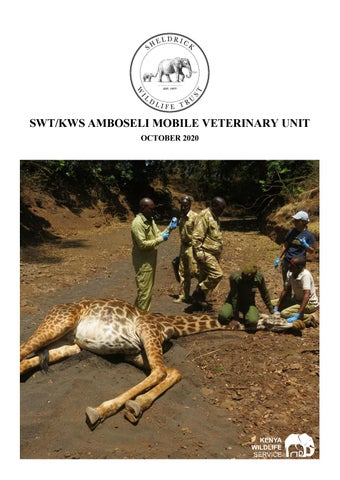
SWT/KWS AMBOSELI MOBILE VETERINARY UNIT OCTOBER 2020
Introduction
9 Cases in October
2 Poaching Cases
3 Elephant Cases
October Report by Dr. Kariuki Edward During October 2020, the SCA-Amboseli Mobile Veterinary Unit (SCA-AMVU) attended to nine veterinary cases. This included three elephants, two zebras, a giraffe, a lion, a leopard and a lesser kudu. Two elephants, a zebra and the lesser kudu were treated for injuries. The third elephant and a lion were examined for cause of death. A leopard was captured and moved following livestock predation, while a second zebra at Kipini Conservancy was reported with a snare wound but could not be traced for treatment. Acknowledgement We thank Sheldrick Wildlife Trust (SWT) for material support and Mobile Unit funding. Staff and Rangers at Amboseli National Parks, Amboseli Elephant Research, Masai Wilderness Trust, Kipini Conservancy and Biglife Foundation are acknowledged for their support and company during the clinical interventions. All other people who supported the monitoring of distressed animals in areas of interest are highly appreciated.
Case Details Date
Species
Area Found
08-Oct-20
Giraffe
Rombo, Group Ranch
Natural Causes
The giraffe presented with purulent discharge from the eyes attributable to the partial blindness
Prognosis Poor
12-Oct-20
Zebra
Diani, South Coast
HWC
The zebra was found in a town and had a limb injury which was likely a bite wound
Successfully Treated
12-Oct-20
Elephant
Tsavo East National Park
Arrow
The injury was old, shallow and not expansive to the general area, likely caused by an arrow
Successfully Treated
12-Oct-20
Lesser Kudu
Kaluku HQ, Tsavo
Natural Causes
Presented with a stiff and swollen neck. The swelling had no fluids on aspiration
Successfully Treated
12-Oct-20
Lion
Amboseli Environs
Human Wildlife Conflict
The lion showed no external injuries before death. Suspected Poisoning
HWC Death
13-Oct-20
Zebra
Kipini, North Coast
Snared
The zebra had a snare injury
Not Located
15-Oct-20
Elephant
Tsavo West National Park
Natural Causes
The elephant was found disabled and had no injury despite a short, twisted limb. The elephant is naturally lame but able to survive
Successfully Treated
17-Oct-20
Elephant
Lake Jipe, Tsavo West
Postmortem
No bones were available except a part of the skull that had been truncated
Died
18-Oct-20
Leopard
Kasala, Tsavo
HWC
The leopard killed one goat and was trapped in the Boma
Task Successful
Reason for Intervention
Outcome
SWT/KWS Unit Mobile Vet Unit Treatment Locations October 2020
Case 1 – 8th October 2020 Giraffe
Natural Causes
Rombo Group Ranch
The management of Maasai Wilderness Trust reported a blind giraffe at Rombo area to AMVU team. MWT game scouts and a group of community members assisted the vet team in locating the injured giraffe.
Immobilisation, examination and treatment The giraffe was darted from foot with a cocktail of 15mg Etorophine hydrochloride and 50mg Azaperone. The drug combination worked well and the giraffe attained full immobilization in 10 minutes. The giraffe presented with purulent discharge from the eyes attributable to the partial blindness. The giraffe couldn’t move or exhibited limited mobility. The giraffe had little reaction and did not move after darting. The giraffe was treated with 30ml Oxytetracycline to cover for bacterial infection and 20 Dexamethasone to cover for the inflammatory reaction. Amoxicillin Opticlox was also applied to the eyes to prevent eye infection. Prognosis The prognosis is poor.
.
Case 2 – 12th October 2020 Zebra
Human-Wildlife Conflict
Ukanda Town, Diani, South Coast
The Management of Shimba hills National Park reported a zebra found in Ukunda town. A KWS aircraft was used to collect and fly the vet team to the site. The zebra had escaped from Bora Bora Wildlife Sanctuary.
Immobilisation, examination and treatment The zebra was darted from foot with 5mg Etorophine hydrochloride and 70mg Azaperone. The dart landed in the thigh muscles and the zebra attained full immobilization after 7 minutes. The zebra was manually pulled to the ground after it became drowsy. The zebra presented with a right rear limb injury. The limb wound was likely a bite wound and a tendon tear. The wound was topically irrigated with Iodine and covered with Ox tetracycline spray. The zebra was also given intramuscular injections of 30ml Amoxicillin and Dexamethasone to cover for bacterial infection and inflammatory reaction Prognosis The zebra was relocated back to the Sanctuary and the prognosis for a full recovery is good.
.
Case 3 – 12th October 2020 Elephant
Arrow
Tsavo East National Park
SWT reported the injured elephant to AMVU. The team was collected by an SWT aircraft to site. A joint SWT and KWS team monitored the elephant and assisted in locating the male for treatment. Immobilisation, examination and treatment The elephant was darted from a vehicle. The dart landed well on the thigh muscles and worked effectively within 10 minutes. Immobilization was achieved with 22mg Etorphine hydrochloride. The elephant had a wound on the left side of the abdomen suspected to be an arrow wound. The wound had pus indicating secondary bacterial infection and marked signs of inflammation. However, the injury was old, shallow and not expansive to the general area. Hydrogen peroxide was used to debride the dead tissue then the wound was disinfected with Iodine. Oxytetracycline spray was additionally applied to the wound. Systemic 80ml Amoxicillin was administered to control for secondary infection and 25ml Dexamethasone was given to manage the inflammation. Prognosis The elephant was successfully revived and prognosis for full recovery is good.
Case 4 – 12th October 2020 Lesser Kudu
Natural Causes
SWT Kaluku HQ, Tsavo
Frans at the SWT HQ reported an injured lesser kudu at Kaluku, Tsavo East National Park to AMVU. The kudu was hand raised at Kaluku and is now wild, but remains in the area. Immobilisation, examination and treatment As the kudu was relatively tame it was easily darted from foot with a cocktail of 4mg Etorophine hydrochloride and 100mg Azaperone. The dart landed well in the thigh muscles and the kudu attained full immobilization after 5 minutes. The kudu presented with a stiff and swollen neck. The swelling had no fluids on aspiration and when manually manipulated by hand, the swelling felt normal in texture. The kudu was administered with an Intramuscular injection of 20ml Oxytetracycline and 10ml Dexamethasone to cover for bacterial infection and inflammation. Prognosis The prognosis for a full recovery is good.
.
Case 5 – 12th October 2020 Lion
Human-wildlife Conflict
Amboseli Environs
A lion, aged approximately 2 years, was reported sick in Olgulului Group Ranch. The lion was, unfortunately, dead by the time the AMVU team arrived to check on the cat. Post-mortem examination The lion showed no external injuries before death. The mouth had whitish foam dried on the lips and mouth. On opening the carcass, • • • • • •
the intestines were bloated and normal in colour The spleen was normal in size and colour The liver had bile colouration but nothing major There was a little blood-coloured fluid flowing from the mouth Normal fluids were in the abdominal cavity and the stomach was full, with normal looking contents Lungs were excessively bright and pink coloured
Cause of death and recommendation Suspected poisoning. Stomach content to be analysed for possible chemical toxicants.
.
Case 6 – 13th October 2020 Zebra
Snared
Kipini Conservancy, Lamu, North Coast
The Management of Kipini Conservancy reported the snared zebra to AMVU. AMVU team traveled by road to Lamu for the zebra treatment. Search The zebra could not be traced even after more than 24 hours search. Lions are known to exist in the Conservancy and could have taken the zebra as easy prey even though no remains were found. It’s also likely that the zebra could have moved out to the nearby thick Witu forest. No Photographs available
Case 7 – 15th October 2020 Elephant
Natural Causes
Tsavo West National Park
SWT reported the lame elephant to AMVU. An SWT pilot and SWT/KWS field team monitored the elephant and assisted in locating the male for treatment.
Immobilisation, examination and treatment The elephant was darted from foot with 20mg Etorphine hydrochloride. The dart landed well at the shoulder muscles, and full immobilisation was achieved within 7 minutes. The elephant was found disabled and did not have an injury despite a short, twisted limb which causes the elephant to limp. The elephant is naturally lame but clearly able to survive. He had previously been darted in Manyani a year ago. The elephant was administered 100ml Amoxicillin intramuscularly to control for secondary infection due to the dart wound and 25ml of Dexamethasone in case of any inflammation. Prognosis As the elephant has survived to adulthood with this deformity, the prognosis for a full recovery is good.
.
Case 8 – 17th October 2020 Elephant
Post-mortem
Mkwanjini, Lake Jipe, Tsavo West
AMVU received a report of a dead elephant from the Assistant Directors office, Tsavo Conservation Area. KWS rangers guided the AMVU team to the site of the carcass in Mkwanjuni area, adjacent to Lake Jipe. Post-mortem examination The elephant carcass was in a Mathenge (Prosopis juliflora) thicket, near Lake Jipe. This was in a community area around the boundaries of Tsavo West National Park and adjacent to Lake Jipe. The area is inhabited by a fishing community forming a small suburban estate around the lake. No bones were available except a part of the skull that had been truncated. The skin was removed and the meat deboned. Available abdominal contents were partially eaten by maggots and deficient of any helpful pathology. The piece of skin available was damaged and could not show any pre-death injuries or marks on the external surface. Fluids were oozed from the carcass remains and spread on the ground. Cause of death Could not be determined. There was no history of this elephant to determine if it had been sick or injured prior to death and the carcass remains had already decomposed which yielded inconclusive results. .
Case 9 – 18th October 2020 Leopard
Human-wildlife Conflict
Kasala, Tsavo
A leopard attacked goats in a homestead at Kasala near Ithumba on the night of the 17th October. The leopard killed one goat but became trapped inside the boma. Rangers attached to Mutomo station assisted in keeping the cat calm. The team also controlled the Community from causing any harm to the animal
Immobilisation, examination, treatment and relocation The leopard was darted from foot while in the boma. Immobilization was achieved with 150mg Ketamine hydrochloride and 4mg Medetomidine. Response to the drug was reasonable and the leopard was fully immobilized in 10 minutes. The leopard was a huge healthy adult. The male was active and had all canines and other associated teeth. The leopard had minor fight wounds, which could have been a reason for displacement from its usual habitat and into the community homesteads. Release site: The male leopard was released in Roka area along Tiva River, Tsavo East National Park Prognosis It is hoped the leopard will settle well into its new habitat. Prognosis is good.
.