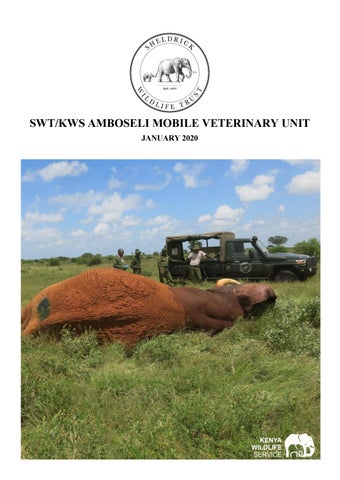
SWT/KWS AMBOSELI MOBILE VETERINARY UNIT JANUARY 2020
Introduction
12 Cases in January
5 HWC Cases
5 Elephant Cases
January Report by Dr. Edward Kariuki During January 2020, Amboseli Mobile Veterinary Unit (AMVU) attended to 12 cases that required veterinary intervention. The cases included, 5 elephants, one wounded and four examined after death, a lion collaring, rescue of a zebra foal, treatment of a wounded giraffe and the post-mortem of a Lesser kudu. African White Backed vultures were examined for suspected poisoning in two localities within Amboseli Ecosystem, in one location all were found dead, whilst in the second, one bird was treated and eventually released into the wild. Acknowledgement We thank Sheldrick Wildlife Trust (SWT) for material support and Mobile Unit funding, KWS rangers at Amboseli, Shimba hills, Tsavo East and West National Parks, Big life Foundation, Rukinga Ranch for logistical support and security. We also thank all people who supported monitoring of distressed animals in all areas of interest. Olgulului Group Ranch, Tawi and Kiteden rangers are also thanked for their assistance.
SWT/KWS Unit Mobile Vet Unit Treatment Locations January 2020
Case Details Date
Species
Area Found
11-Jan-20
Elephant
Tsavo East National Park
Arrow
Had an infected arrow wound to the left side of the body about 5 inches deep
Successfully Treated
13-Jan-20
Lion
Chyulu Hills
Human Wildlife Conflict
The lioness was trapped in a boma and relocated after attempts to attack livestock
Task Successful
14-Jan-20
Elephant
Rukinga Ranch, Taita
Postmortem
A post-mortem to confirm cause of death was inconclusive but most likely natural
Died
15-Jan-20
Elephant
Kuranze, South Coast
Postmortem
A post-mortem to confirm cause of death was inconclusive but most likely natural
Died
15-Jan-20
Elephant
Lualenyi Ranch, Taita
Postmortem
The carcass had was deflated and postmortem lesions completely obscured
Died
20-Jan-20
Zebra
Kuku Group Ranch
The foal was rescued from young boys that were mistreating the foal by trying to ride on it
Taken to Orphanage
20-Jan-20
Vultures
Amboseli Ecosystem
Human Wildlife Conflict Human Wildlife Conflict
White backed vultures were found dead after feeding on a poisoned cow carcass
HWC Death
Postmortem
The carcass was relatively fresh and bloated. The perineum was soiled with diarrhea
Died
Postmortem
The carcass was relatively fresh but bloated. Cause of death most likely bacterial related
Died
Amboseli National Park Amboseli National Park
Reason for Intervention
Outcome
20-Jan-20
Elephant
23-Jan-20
Lesser Kudu
23-Jan-20
Giraffe
Ilbissil, Kajiado
Natural Causes
This was a second treatment to the animal for the infected wound at the perineum
Prognosis Poor
30-Jan-20
Vultures (x2 Cases)
Amboseli Ecosystem
Human Wildlife Conflict
The vulture carcasses were scattered in a radius of 20metres roundabout. About 10 birds died on top of trees.
HWC Death/ Successful
Case 1 – 11th January 2020 Elephant
Arrow
Tsavo East National Park
The SWT Kaluku HQ reported a wounded elephant that had been sighted around Ngutuni lodge. The AMVU team prepared to attend and was airlifted to the location of the sighting using an SWT aircraft. Immobilisation, examination and treatment The elephant was located in a bushy plain but easily darted from the helicopter. It was active and looked healthy besides the wound. The elephant was separated from the main herd of 4 and darted. The dart was well placed, adjacent to the backline, and the drugs took effect after 8 minutes. Immobilization was attained using 20mg Etorophine hydrochloride. The elephant had a wound on the left lateral side of the body suspected to have been caused by an arrow. The wound was about 5 inches deep, infected and was oozing pus. The wound was punctured using scissors and all the pus removed. No foreign body was found. Hydrogen peroxide was used to debride the dead tissues while Iodine was irrigated into the wound to cover for bacterial infection. A 100ml of long acting Oxytetracycline was injected intramuscularly to cover for systemic bacterial infection. Prognosis The prognosis was good
Case 2 – 13th January 2020 Lion
Human-Wildlife Conflict
Chyulu Hills
The lioness was trapped at Oltiasika in a boma after attempts to attack livestock and the vet unit were asked to attend, to anesthetize the lion, check on condition and assist in relocation to reduce human-wildlife conflict. The lioness together with others in her pride are habitual livestock predators in and around Oltiasika.
Immobilisation, collaring and relocation The lion was chemically restrained using 6mg Medetomidine and 260mg ketamine. The animal was fully immobilized in approximately 12 minutes. A VHF collar was fitted which will be used by management to monitor the lioness to make sure she thrives in her new environment and reduce chance of future human-wildlife conflict should she stray back into populated areas. The lioness was then moved to Tsavo West National Park and released at Murka area.
Case 3 – 14th January 2020 Elephant
Post-mortem
Rukinga Ranch, Taita
Report of a dead elephant was received from the management of Rukinga Ranch. The elephant had been sighted by the resident pilot during an aerial patrol in the Ranch on the 14th at 7.00 am. General examination The elephant was on the lateral side and exudate fluid flowed around the carcass. The carcass was bloated, decomposed and had maggots in the groin, shoulder, mouth and anal region. Scavengers had fed on the abdominal region and trunk. A minor wound observed on the head was subcutaneous and probably due to broken skin after post-mortem edema and bloat. A land cruiser turned the carcass for examination on the alternate side, but no significant finding was revealed. No open wounds or any other broken skin was found on the carcass. The carcass was opened through an incision on the right lateral flank area. Internal organs were exteriorized and examined for disease condition. The liver had adhesions to the lateral body parts and covered with fibrin. Other abdominal organs were moderately decomposed and not much could be observed. Cause of Death Non-conclusive but liver adhesions and fibrin deposits could be related to a chronic problem resulting from a non-infectious disease.
Case 4 – 15th January 2020 Elephant
Post-mortem
Kuranze Ranch, South Coasr
The Unit received a report of an elephant carcass and attended to ascertain cause of death. General examination The carcass was on sternal recumbency and decomposed. Few dipteral flies could be located on the carcass, suggesting that the volatile molecules that attract flies were actively produced and most likely diminishing, a natural sign of the carcases being more than seven days old. Scavenging activity was absent or very little and obscured by decomposition and maggot activity. Maggots, mostly on the head, shoulder, and the ventral aspect of the abdomen, sufficiently invaded the carcass. The skin on the left forelimb had completely sloughed off and the bones exposed. Gases and liquids maximally produced and wetted the area around the carcass. Internal tissues were fully destroyed by bacterial and maggot activity. Cause of Death Non-conclusive. The available carcass remains were damaged and decomposed to a level that it lacked reasonable findings that could lead to a definitive cause of death.
Case 5 – 15th January 2020 Elephant
Post-mortem
Lualenyi Ranch, Taita
The Unit received a report of an elephant carcass and attended to ascertain cause of death. General examination The elephant carcass was fully decomposed. The post-mortem exudate fluids around were completely drained and dried. Recovered tusks weighed 24 and 25kgs each, suggesting that the bull could have been an adult but not very old. The carcass was deflated and post-mortem lesions completely obscured. All the internal organs were maggot invaded and eaten up. Cause of Death Non-conclusive. The available carcass remains were completely decomposed, eaten up and could not support any logical cause of death.
Case 6 – 20th January 2020 Zebra
Rescue
Kuku Group Ranch
The zebra foal was rescued by a tour driver from young boys that were mistreating the foal by trying to ride on it. General examination The foal was transported in a vehicle from the Masai wilderness Trust to the Umani SWT Stockade at Kibwezi Forest. The dehydrated foal was stabilized using intravenous fluids and handed over to the care of professional animal keepers at the stockade for feeding.
Case 7 – 20th January 2020 Vultures
Human-wildlife conflict
Mbirikani Group Ranch
Big-life Foundation Rangers reported carcasses of two Vultures at Oldonyo Sambu area, in Mbirikani Group Ranch. Further searching revealed another very weak vulture but no more deaths or sick vultures could be traced after a day long search. On investigation, a predator (presumed lion) had killed a cow at Oldonyo Sambu, Mbirikani area. The community retaliated and poisoned the cow carcass in target of the cat predators before the birds consumed the cow remains. General examination The sick vulture died soon after discovery and all three were examined for cause of death. The three birds demonstrated good body condition. Two of the carcasses were fresh and one moderately decomposed with maggots in the cloaca. Two of the birds had meat remains hanging from their beaks. The carcasses were placed on their back and opened using a ventral midline incision which revealed the crop was filled with brown coloured ingesta. The crop mucosa was congested in all vultures and black tinged in one. The superficial intestinal and mesenteric vessels were congested in all the three vultures. An intestinal worm was found in one of the vultures. Cause of Death Suspected poisoning.
Case 8 – 20th January 2020 Elephant
Post-mortem
Tawi area, Amboseli
A male elephant at Amboseli National Park was observed unwell, stayed standing for long and not feeding. It bathed in muddy pools and was observed throwing dust and leaves on its body. General examination The elephant was found on lateral recumbency and signs of a struggle were visible at the site. The carcass was relatively fresh and bloated. The perineum was soiled with diarrhoea, around the anal area. It had ulcerations on the buccal mucosa, which also had ecchymotic hemorrhages. The carcass was opened for further investigation. An incision was made on the ventral part of the abdomen and the spinal area from the thoracic region to the lumbar area. The incision revealed pus on the sub cutis of the thoracic region, an indication of low immunity and infected wounds. The subcutaneous vessels were heavily congested. There were pinpoint and ecchymotic hemorrhages on the intestinal serosa. The mesenteric vessels were heavily congested. The peritoneal cavity was filled with straw coloured fluid around the intestines and on exteriorizing the intestines there was a large amount of serous peritoneal fluid. There was a fibrionous exudate on the intestinal serosa. Some purulent deposits were also noted on the serosa. Exploration of the intestines exposed torsion between the large and small colon. This had resulted to massive bowel necrosis of the strangulated portion. Cause of Death Endotoxemia and shock as a result of the colon torsion.
Case 9 – 23rd January 2020 Lesser Kudu
Post-mortem
Amboseli National Park
The Unit were called to investigate the death of a Lesser Kudu at Mada Hotels in Amboseli National Park. General examination The Lesser Kudu was found on right lateral recumbency. One leg had a plastic pipe capping fixed in place. The carcass was relatively fresh but bloated. The carcass was opened for further investigation. An incision was made on the ventral part of the abdomen. The internal organs were exteriorized and examined. There was Blood tinged exudate around the heart and liver. The gall bladder was also enlarged. Cause of Death Nonspecific but likely of bacteria origin
Case 10 – 23rd January 2020 Giraffe
Natural Causes
Ilbissil, Kajiado
The Unit were called to attended to a wounded giraffe in Ilbissil, Kajiado area. This is the second treatment of this giraffe.
Immobilisation, examination and treatment A cocktail of 15mg Etorphine and 50mg Azaperone,It was fully immobilized after 6 minutes. This was a second treatment to the animal for the infected wound at the perineum. The wound was heavily infested with maggots and the hind limbs were black due to urine burn. The wound was cleaned with Hydrogen peroxide and the area irrigated with iodine. Additionally, the wound was sprayed with antibiotic spray and systemic antibiotics were administered (Amoxicillin 12000mg). Prognosis The prognosis is guarded.
Case 11 and 12 – 30th January 2020 Vultures
Human-Wildlife Conflict
Olgulului, Amboseli Ecosystem
Olgulului management reported death of vultures at Imarba area, in Olgulului Group Ranch. This incidence followed the death and scavenging of a calf that died on Tuesday 28th January by dogs, hyenas and vultures. The vulture carcasses were scattered in a radius of 20metres. About 10 birds died on top of trees. A total of 18 carcasses were recovered for a post-mortem. One weak bird was given Atropine sulphate by injection and kept in captivity for treatment. It recovered well and after two days it was released back into the wild. Post-mortem examination The birds’ body condition was rated good. All carcasses were fresh and two of the birds had meat remains hanging from their beaks. One birds was found alive, retching and had pasted vent with whitish diarrhea. Dead flies were found next to meat pieces retched out by birds before death-The weak bird could not fly on approach and hence easy to capture. The bird was examined and injected with atropine sulphate: Cause of Death/Intervention Suspected Poisoning with 18 deaths and 1 recovery.
Other Activities A lion case reported at Oltiasika was attended but it could not be found even after an intensive search that took AMVU team up to 1.00 o’clock at night. The area is thick and covered with dense forest. With the characteristic hiding of this cat in the area, capture by direct darting is less likely to be possible and especially when desired unless baited capture traps are used lure the predators in.