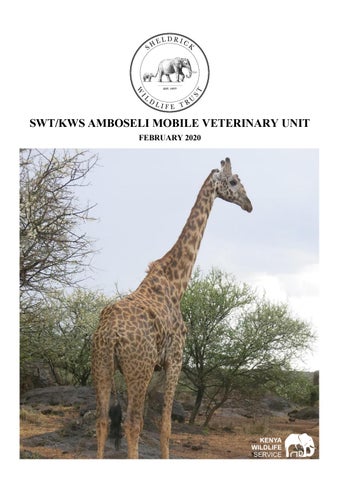
SWT/KWS AMBOSELI MOBILE VETERINARY UNIT FEBRUARY 2020
Introduction
4 Cases in February
1 Poaching Case
2 Lion Cases
February Report by Dr. Edward Kariuki During February 2020, SCA-Amboseli Mobile Veterinary Unit (SCA-AMVU) attended to four cases that required veterinary intervention. The cases included a male elephant, two lions and a baboon. The elephant bull had suffered a hind leg fracture and was euthanized as its injury was severe, it was in extreme pain and could not stand. A baboon notoriously known for stealing food from hotel guests attacked and injured a tourist in Oltukai Hotel while snatching food from her. The habitual attacker was captured and euthanized. The hotel management was advised on future baboon management in and around the hotel. One lion was treated for fight wounds then collared, whilst a tight snare was removed from a second lion and the resultant wound treated. Acknowledgement We thank Sheldrick Wildlife Trust (SWT) for material support and Mobile Unit funding. KWS rangers at Amboseli, Tsavo West National Parks, Big life Foundation, Lion Guardians, Maasai Wilderness Conservation Trust, Kuku ranch for logistical support and security. All people who supported monitoring of distressed animals in all areas of interest.
Case Details Date
Species
Area Found
16-Feb-20
Elephant
Tsavo East National Park
23-Feb-20
Lion
23-Feb-20
Lion
25-Feb-20
Baboon
Chyulu National Park Chyulu National Park Amboseli National Park
Reason for Intervention
Outcome
Natural Causes
The elephant had a fractured and swollen left hind limb. The swollen limb could not support any weight and the elephant was euthanised due to a grave prognosis
Died
Natural Causes
The lion was treated for wounds caused during a territorial fight
Successfully Treated
Snared
The lion had a snare around the neck that caused serious injuries
Successfully Treated
Human Wildlife Conflict
A male baboon attacked a tourist who had to be hospitalised. The baboon was baited with bread, darted and moved from the hotel then euthanized
HWC Death
SWT/KWS Amboseli Mobile Vet Unit Treatment Locations February 2020
Case 1 – 16th February 2020 Elephant
Natural Causes
Makindu, Chyulu Hills
The SWT Headquarters at Kaluku reported a recumbent elephant at Makindu near Karlo Farm. The elephant was lying down in a swamp, could not stand, and appeared injured. The AMVU team prepared for treatment and drove to the location. Immobilisation and examination Straps were attached to the elephant and it was pulled from the swamp to dry ground where it was darted with 20mg Etorphine. The elephant responded well to the drug and was fully immobilized in 10 minutes. The bull was inactive and weak. Examination revealed the elephant had a fractured and swollen left hind limb. The swollen limb could not support any weight. No external wound or foreign body was found. Prognosis The prognosis was grave and the animal was euthanized on welfare grounds.
Case 2 – 23rd February 2020 Lion
Natural Causes
Chyulu Hills
A lion at Oltiasika was reported wounded, inactive, and presumably sick. The lion is known to be part of a pride that are particularly skilful at digging to gain access to livestock bomas. The lion pride have been tracked, but are elusive and evade darting. In January 2020, a female belonging to the pride was caught in a trap while two males were speared to death by the community because of habitual livestock predation. Immobilisation, examination and treatment The exercise was challenging due to darkness and think vegetation, but eventually the lion was chemically immobilized using 6mg Medetomidine and 300mg Ketamine at approximately 1am. 2mg Medetomidine was added by hand injection after capture. The lion had serious fight wounds which were treated with Hydrogen peroxide to debride dead tissue in the maggot-infested wound and Iodine to control and treat bacterial infections. Amoxicillin 30ml was administered to cover for bacterial infection. Oxytetracycline spray was applied on the other minor wounds. A VHF collar was fitted and the lion was released in the same area. The collar will be used for monitoring of the male and the entire pride. Prognosis The prognosis was good and the animal should make a full recovery.
Case 3 – 23rd February 2020 Lion
Snared
Chyulu Hills
A lion at Oltiasika was reported wounded and found with a snare around its neck. The lion is part of a pride of known livestock raiders. The lions have been tracked but are very elusive. AMVU team left on 22 February at 5:30am and the lion was tracked and treated on the 23rd Feb at 3:25 am after 24 hours surveillance. Immobilisation, examination and treatment The lion was captured using a cocktail of 8mg Medetomidine and 300mg Ketamine. The lion was successfully immobilized approximately 15 minutes after darting. The exercise faced many difficulties due to darkness and the thick vegetation in the area. The lion was treated for the snare wound and released in the same area. Hydrogen peroxide was used to debride the wounds and iodine irrigated into the wound to control bacterial infection. Systemic Amoxicillin was administered for bacterial treatment. Prognosis Prognosis for recovery is good as the lion demonstrated excellent body condition.
Case 4 – 25th February 2020 Baboon
Human-wildlife conflict
Amboseli National Park
A male baboon attacked a female visitor on 21st Feb 2020. The injury was severe, and she was treated at the Oltukai dispensary and later hospitalized at Mater Hospital. The case was reported to AMVU on the 25th Feb 2020 so the Unit could assist with capture of the baboon Immobilisation and management The baboons were baited with bread then two baboons were darted using 100mg Ketamine Hcl from foot on the grass lawns adjacent to the visitor houses The male baboon that attacked the visitor was moved from the hotel and euthanized.