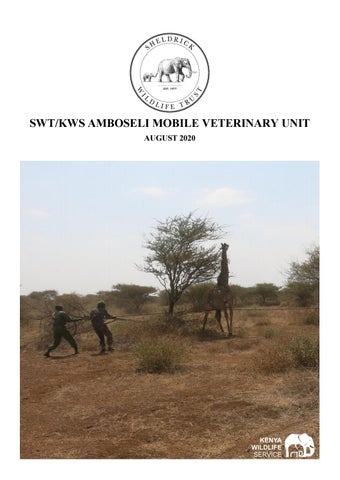
SWT/KWS AMBOSELI MOBILE VETERINARY UNIT AUGUST 2020
Introduction
6 Cases in August
3 Poaching Cases
3 Elephant Cases
August Report by Dr. Kariuki Edward During August 2020, SCA-Amboseli Mobile Veterinary Unit (SCA-AMVU) attended to six cases that required veterinary intervention. These included 2 elephant cases, as well as the collaring of 3 elephant bulls and a lion, giraffe and zebra treatment. Necropsy helped determine the cause of death in an elephant carcass in Amboseli National Park. The elephant died of causes related to a male mating territorial fight. Both the giraffe and zebra were de-snared. The zebra had a nylon rope snare while the giraffe had a wire snare. The lion was treated for wounds that resulted during a hunting attempt. Acknowledgement We thank the Sheldrick Wildlife Trust (SWT) for material support and Mobile Unit funding. KWS Rangers at Amboseli National Park, Amboseli Elephant Research, Save The Elephants, Mwatate Team, Kitenden Conservancy Rangers and Elephant Research Team are acknowledged for their support and company. All other people who supported the monitoring of distressed animals in areas of interest are highly appreciated.
Case Details Date 03-Aug-20
08-Aug-20
Species
Area Found
Kipini Zebra Conservancy, North Coast Amboseli Elephant National Park
Reason for Intervention Snared
Arrow
Had the remains of a nylon rope on the hind limb. The snare was found fresh and had inflicted insignificant injury The wound had no pus and almost no sign of infection but was old, deep and extended to the joint Collaring of eight young males were targeted for a behavioral study was initiated. Five males were collared in 2019 but collaring of the other three postponed due to heavy rains All wounds were suspected to have been inflicted by a large herbivore (maybe a buffalo)
Outcome Successfully Treated Successfully Treated
12-Aug-20
Elephant
Amboseli National Park
Collared
13-Aug-20
Lion
Amboseli National Park
Natural Causes
15-Aug-20
Giraffe
Tawi Hotel, Amboseli
Snared
A wire snare was hanging from the neck but had not caused any wounds
Successfully Treated
Elephant
Amboseli National Park
Postmortem
Exhibited two fight wounds on the body. The rest of the carcass had been scavenged upon
Died
18-Aug-20
Task Successful
Successfully Treated
SWT/KWS Amboseli Mobile Vet Unit Treatment Locations August 2020
. Case
1 – 3rd August 2020
Zebra
Snared
Kipini Conservancy, North Coast
The Management of Kipini Conservancy reported the snared zebra to AMVU. A KWS aircraft at Tsavo Conservation area airlifted the AMVU team from Amboseli to Lamu for the zebra treatment.
Immobilisation, examination and treatment The zebra was darted from a vehicle with a 6mg Etorphine and 70mg Azaperone. Unfortunately, the zebra turned to face the veterinary vehicle due to the unusual activity and the dart landed near the jaw. The immobilization worked well and the zebra attained full immobilization after 10 minutes. Examination revealed the remains of a nylon rope around the hind limb of the zebra. The snare was relatively fresh and had not inflicted any insignificant injury to the zebra. A pocket knife was used to cut the rope which was then removed by hand. Prognosis Prognosis for full recovery is good.
Case 2 – 8th August 2020 Elephant
Arrow
Amboseli National Park
SWT reported a lame elephant at Mwatate. The SWT aircraft picked AMVU team from Amboseli while an SWT helicopter was used for darting. A second aircraft monitored and assisted in locating the bull. Immobilisation, examination and treatment The elephant was darted from a helicopter with 20mg Etorphine. The dart was placed well at the backline and worked effectively (11 minutes post-darting). Examination revealed the elephant had a wound on the right foreleg. The wound had no pus and almost no secondary bacterial infection. However, the injury was old, deep and extended to the joint. It was hard to determine the cause of injury but it could be an arrow wound. Joint involvement helps explain the lameness. The wound was debrided with Hydrogen peroxide and irrigated with Iodine. The elephant was administered 80ml Amoxicillin for secondary infection and 20ml of Dexamethasone to manage inflammation. Prognosis Prognosis for full recovery is good.
Case 3 – 12th August 2020 Elephant
Collared
Amboseli National Park
Eight young males were targeted for collaring to assist with a behavioral study. It was initiated in July 2019 and five males were collared. However, the exercise was postponed due to heavy rains between the end of the 2019 and start of 2020. The collaring of the remaining three males was later planned to be part of the Elephant Day celebrations in August 2020.
Collaring Exercise The first elephant was immobilized with 15mg Etorphine while the other two males were immobilized with 18mg Etorphine each. The STE team in collaboration with KWS fixed the collars. All collared elephants were revived smoothly and got up to join their respective herds shortly. The collaring exercise for each elephant was approximately 20 minutes. Prognosis The task was successful.
Case 4 – 13th August 2020 Lion
Natural Causes
Amboseli National Park
KWS Amboseli Research team reported the lame lion to AMVU.
Immobilisation, examination and treatment The lion was darted from a vehicle with 300mg of Ketamine hydrochloride and 6mg Medetomidine. The dart was placed well at the shoulders and worked effectively after 12 minutes post-darting. Examination revealed the lion had a wound on the left hind leg and a second one at the backline. The wounds were fresh and not infected. All wounds were suspected to have been inflicted by a large herbivore (maybe a buffalo) during a hunt. The wound was topically irrigated with liquid iodine. 20ml Amoxicillin (Betamox) and 10ml Dexamethasone were systemically administered using the intramuscular route. Prognosis Prognosis for recovery is good.
Case 5 – 15th August 2020 Giraffe
Snare
Tawi Hotel, Amboseli Environs
The Amboseli National Park reported the snared giraffe to AMVU on 15th August 2020. Big Life Foundation and Kiltome Conservancy rangers assisted in tracking the snared giraffe.
Immobilisation, examination and treatment A drug cocktail composed of 15mg Etorphine and 50mg Azaperone was used to immobilise the giraffe. The giraffe went down 10 minutes after darting assisted by ropes and the vet team. While on the ground, the giraffe was immediately revived with 36mg Diprenorphine, then physically restrained by hand to keep the animal on the ground. A wire snare was hanging from the neck but it had no wound or any tissue reaction. The snare was cut with a wire cutter. Amoxicillin (6000mgs) was administered through the intramuscular route to cover for bacterial infection. Prognosis Prognosis for recovery is good.
Case 6 – 18th August 2020 Elephant
Post-mortem
Amboseli National Park
AMVU received a report of a dead elephant from Katito, a scientist at Amboseli Elephant Research. Post-mortem Examination The elephant carcass was located in open grassland. Approximately 200 vultures were on the spot when the vet arrived. Actual count resulted in 217 vultures on the carcass. The trunk was squeezed below the tusks. Additionally, the carcass exhibited two fight wounds on the external surface. The carcass was deflated and vultures and other scavengers had fed on all the internal organs of the carcass. Blood oozed from the body broken parts. The tusks were intact and the carcass showed no signs of any human interference. No struggle marks were observed on the ground next to the carcass. The penis shaft was observed removed from the body sheath. Fighting during a mating fight with another male could help explain the retrieved penile shaft. Cause of Death Ultimately the elephant died of respiratory failure due to fight wounds.