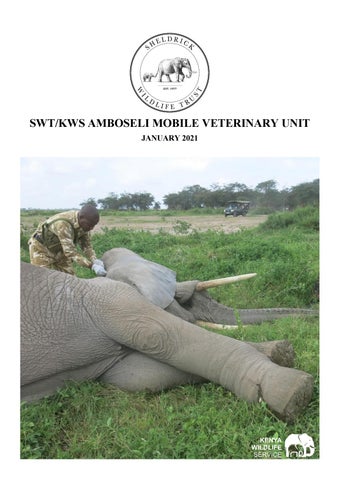
SWT/KWS AMBOSELI MOBILE VETERINARY UNIT JANUARY 2021
Introduction
15 Cases in January
4 Poaching Cases
7 Elephant Cases
January Report by Dr. Edward Kariuki SCA-Amboseli Mobile Veterinary Unit (SCA-AMVU) attended to 15 veterinary cases during January 2021. Seven elephants were treated for injuries including three snare wounds. Three giraffes, two zebras and a lion were treated for a variety of injuries. A buffalo calf was rescued after being abandoned by the parent herd. Two domestic tracker dogs were treated for prevention of trypanosomiasis Acknowledgement We thank Sheldrick Wildlife Trust (SWT) for material support and Mobile Unit funding. Staff and rangers at Amboseli National Parks, Amboseli Elephant Research Team, Law Enforcement Academy Manyani, Manyani Prison Staff, Big Life Foundation, Mgeno ranch staff, Kasigau ranch staff and Wildlife Works are acknowledged for their support and company during the veterinary interventions. All people who supported the monitoring of distressed animals in areas of interest are highly appreciated. Pilots and Biglife are thanked for their assistance in the aerial surveillance of the elephants after darting.
SWT/KWS Amboseli Mobile Vet Unit Treatment Locations January 2021
Case Details Date
Species
Area Found
Reason for Intervention
Outcome
03-Jan-21
Giraffe
Chyulu Hills
Snared
The giraffe had a tightly fixed cable wire around the fetlock joint
Successfully Treated
07-Jan-21
Elephant
Rukinga Ranch
HWC
The elephant had a wound at the elbow joint on the forelimb
Prognosis Poor
08-Jan-21
Zebra
Manyani, Tsavo West
Natural Causes
The zebra had a compound fracture of the right rear leg
Died
08-Jan-21
Buffalo
Manyani, Tsavo West
Rescue
The calf had been left behind by the herd after grazing near the Prison camp
Taken to Orphanage
08-Jan-21
Security Dog
Kaluku, Tsavo
Technical Cases
The treatment is routine for control of Trypanosomiasis.
Task Successful
11-Jan-21
Elephant
Amboseli Ecosystem
HWC
The elephant was injured after forcing its way through metal fence barriers
Successfully Treated
12-Jan-21
Elephant
Taita Ranches
Snared
The elephant had a cable wire around the head and neck
Successfully Treated
20-Jan-21
Giraffe
Shimba Hills Reserve
Natural Causes
Swelling due to arthritis resulting from excess high energy pellet consumption
Successfully Treated
20-Jan-21
Zebra
Borabora Sanctury
Natural Causes
The zebra was weak with high tick and internal helminths infestation
successfully Treated
21-Jan-21
Elephant
Mwaluganje, Shimba
Snared
The elephant had no a malformed foot pad due to an earlier snare wound
Successfully Treated
22-Jan-21
Giraffe
Taita Ranches
HWC
Compound fracture of the rear limb possibly caused due to human wildlife conflict
HWC Died
25-Jan-21
Lion
Olgulului Group Ranch
HWC
The lame lion followed livestock causing fear for predation.
Task Successful
25-Jan-21
Elephant
Amboseli NP
Snared
the elephant calf had a cable wire around the limb
Successfully Treated
26-Jan-21
Elephant
Mgeno Ranch, Taita
HWC
Compound fracture of the femur possibly caused when being chased from farms
HWC Death
28-Jan-21
Elephant
Amboseli NP
HWC
The bull was a habitual raider of villages for crops and required relocation
Task Successful
Case 1 – 3rd January 2021 Giraffe
Snared
Chyulu Hills
The Big Life Foundation(BLF) scouts spotted and reported the snared giraffe to the AMVU. BLF scouts monitored the candidate and the herd until the vet team arrived.
Immobilisation, examination and treatment The giraffe was darted from a vehicle with 14mg Etorphine HCL and 40mg Azaperone. Hyaluronidase was added to the cocktail to facilitate quick immobilisation. The giraffe had a cable wire snare tightly wound around the fetlock joint leading to a wound and a swollen limb. The snare was removed prior to treatment. Once the snare was removed, the wound was debrided with Hydrogen peroxide to remove the dead tissue then irrigated with iodine and sprayed with Oxytetracycline wound spray to cover for local bacterial infection. The giraffe was also given 80ml Amoxicillin (Betamox) to prevent bacterial infection and 15ml Dexamethasone to help with inflammation. Prognosis Good.
.
Case 2 – 7th January 2021 Elephant
Human-wildlife conflict
Rukinga, Taita Ranches
The management of Wildlife Works reported the injured elephant to AMVU. The Wildlife Rangers at Rukinga Conservancy assisted in locating the elephant and monitored him for progress after treatment.
Immobilisation, examination and treatment The elephant was darted from a vehicle with 15 mg Etorphine hydrochloride. Examination revealed the elephant had a wound at the elbow joint on the forelimb. Hydrogen peroxide was used to debride the dead tissue then the Iodine solution was irrigated into the wound to control bacterial infection. Additionally, Oxytetracycline was sprayed onto the affected wound area. Finally, 100ml Amoxicillin (Betamox) and 15ml Dexamethasone were given through the intramuscular route to cover for bacterial infection and the inflammatory reaction. Prognosis Good.
.
Case 3 – 8th January 2021 Zebra
Natural Causes
Manyani Prison, Tsavo
AMVU received the report of an injured Zebra from the Senior Warden of Manyani LEA.
Immobilisation, examination and treatment The zebra was darted on foot using a combination of 5 mg Etorophine hydrochloride and 70mg Azaperone. Examination revealed the zebra had a compound fracture of the right rear leg. The wound was infected and had no chance of recovery. Prognosis The zebra was euthanized on welfare grounds as it was unable to survive in the wild.
.
Case 4 – 8th January 2021 Buffalo
Rescue
Manyani, Tsavo
Prison Management reported a buffalo calf that was found alone to AMVU. The calf had been left behind by the maternal herd after grazing at night close to the Prison camp. The calf later joined a herd of grazing cows shortly after they left the camp but none were the mother and the calf wasn’t suckling.
Immobilisation, examination and treatment The buffalo was restrained physically by two rangers and put in a vehicle for transportation to the SWT Headquarters at Kaluku for care and had raising. The buffalo was well hydrated and healthy on examination. Prognosis As the calf was in good condition, prognosis for a full recovery is good.
. Case
5 – 8th January 2021
Security Dog
Technical Case
Kaluku, Tsavo
These security dogs work within the Tsavo Ecosystem as a deterrent against poachers. Trypanosomiasis is prevalent in the area and spread by Tsetse flies.
Immobilisation, examination and treatment The dogs were normal and healthy but required a routine prophylactic treatment against trypanosomiasis. Prognosis The dogs were injected with 0.8ml of Triquin.
Case 6 – 11th January 2021 Elephant
Human-wildlife conflict
Amboseli National Park
The Elephant Research Team at Amboseli reported the injured elephant to AMVU. Eric -OLkarama helped in keeping the elephant in a good position for darting. Immobilisation, examination and treatment The elephant was darted from a vehicle using 20mg Etorphine hydrochloride. Physical examination revealed the elephant had a deep penetrating wound into and through the right foreleg. The wound likely resulted from the elephant forcing its way through metal fence barriers. Systemically, the elephant was given 120ml Amoxicillin (Betamox) and 30ml Dexamethasone intramuscularly to cover for bacterial infection and inflammatory reaction respectively. Additionally, Iodine solution and Oxytetracycline wound spray were applied directly to the wound. Prognosis Prognosis is good.
Case 7 – 12th January 2021 Elephant
Snared
Taita Ranches, Tsavo
Wildlife Scouts at Rukinga Conservancy reported the injured elephant to SWT & AMVU.
Immobilisation, examination and treatment The elephant was darted from a helicopter with 20mg Etorphine hydrochloride. The elephant had a cable snare around the head and neck. Dragging of the cable wire through the bush for a long time led to damage of the right ear lobe and fly strike into the wound. The necrotic areas of the wound were removed with a scalpel blade and scissors.The screw worms were removed by hand with forceps and Hydrogen peroxide. To reduce inflammation and to protect against bacterial infection the elephant was also given 25ml Dexamethasone and 120ml Amoxicillin (Betamox®). The wound was disinfected with Iodine solution and sprayed with Oxytetracycline wound spray. Prognosis The prognosis for recovery is good.
Case 8 – 20th January 2021 Giraffe
Natural Causes
Shimba Hills, South Coast
The Elephant Research Team at Amboseli reported the injured elephant to AMVU. Eric -OLkarama helped in keeping the elephant in a good position for darting. Immobilisation, examination and treatment The elephant was darted from a vehicle using 20mg Etorphine hydrochloride. Physical examination revealed the elephant had a deep penetrating wound into and through the right foreleg. The wound likely resulted from the elephant forcing its way through metal fence barriers. Systemically, the elephant was given 120ml Amoxicillin (Betamox) and 30ml Dexamethasone intramuscularly to cover for bacterial infection and inflammatory reaction respectively. Additionally, Iodine and Oxytetracycline wound spray were applied directly to the wound. Prognosis Prognosis is good.
Case 9 – 20th January 2021 Zebra
Natural Causes
Borabora Sanctuary, South Coast
KWS management at Shimba Hills National Park reported the zebra to the AMVU. The animal keeper at BoraBora sanctuary monitored the candidate until the vet team arrived.
Immobilisation, examination and treatment The zebra was darted on foot using a cocktail of 5 mg Etorophine hydrochloride and 70mg Azaperone. The zebra presented with weakness and high tick and internal helminths infestation. The foal was treated with Ivermectin and antibiotics. Prognosis The zebra foal was reversed from the anaesthetic and re-joined its mother. It has a good prognosis for a full recovery.
.
Case 10 – 21st January 2021 Elephant
Snared
Mwaluganje Sanctuary, Shimba Hills
The Elephant Research Team at Amboseli reported the injured elephant to AMVU. Eric -OLkarama helped in keeping the elephant in a good position for darting. Immobilisation, examination and treatment The elephant was darted from a helicopter using 20mg Etorphine hydrochloride. Examination revealed the elephant did not have a snare around the limb but had a malformed foot pad due to an earlier snare wound. Poor posture due to the snare lead to lameness and the poor gait in this case was attributed to be the cause of the foot injury. The elephant was given 120ml Amoxicillin (Betamox®) and 30ml Dexamethasone through the intramuscular route to cover for bacterial infection and the inflammatory reaction. Additionally, an Iodine solution and Oxytetracycline wound spray were applied directly to the wound. Prognosis Prognosis is good.
Case 11 – 22nd January 2021 Giraffe
Human-wildlife conflict
Taita Ranches, Tsavo
The Wildlife Works Scouts reported the giraffe to the AMVU. The scouts monitored the giraffe until the vet team arrived.
Immobilisation, examination and treatment The giraffe was found recumbent following a compound fracture of the rear limb. The giraffe was restrained manually using 5 rangers. Cause of fracture was not clear but is likely related to human wildlife conflict. Prognosis The giraffe couldn’t rise up or stand and hence was euthanized on welfare grounds.
Case 12 – 25th January 2021 Lion
Human-wildlife conflict
Olgulului Group Ranch
The Lion Guardian Team followed and identified a male that was found emaciated and lame. The lame lion followed livestock and it was feared the lion would start preying on them causing human-wildlife conflict with the community. The lion was located outside but adjacent to the Amboseli National Park.
Immobilisation, examination and treatment The lion was immobilized using 250mg Ketamine hydrochloride and 4mg Medetomidine. The darting exercise was done from a vehicle that was then used to follow the lion until the drugs took effect. The lion had a broken left forelimb that was old and had healed with deformities. The lion was emaciated and weak which could have arisen from poor nutrition due to inability to hunt for wildlife in the area. The lion as given 30ml Amoxicillin to cover for bacterial infection. Prognosis The lion was moved from the livestock inhabited areas into Amboseli National Park where he could get access to smaller ungulates for food.
.
Case 13 – 25th January 2021 Elephant
Snared
Amboseli National Park
Amboseli Elephant Research reported the injured elephant calf to AMVU. Immobilisation, examination and treatment The elephant calf was with the natal herd and was followed while they were leaving the swamps in the evening. The elephant cow (mother) was darted from foot using 20mg Etorphine hydrochloride. Once the drugs took affect and the mother was recumbent the calf was restrained manually. Examination revealed the elephant calf had a cable wire around the limb. The wire was removed and the wound cleaned with Hydrogen peroxide to remove the dead tissues. The wound was also disinfected with an Iodine solution and sprayed with Oxytetracycline. The elephant was also given 60ml Amoxicillin (Betamox®) and 15ml Dexamethasone through the intramuscular route to cover for bacterial infection and inflammatory reaction respectively. Prognosis Prognosis is good.
Case 14 – 26th January 2021 Elephant
Human-wildlife conflict
Mgeno Ranch, Taita
Management of Wildlife Works reported the injured elephant to AMVU. Immobilisation, examination and treatment The elephant was darted from a vehicle using 20mg Etorphine hydrochloride. Physical examination revealed the elephant had a compound fracture of the femur and could hardly raise up after reversal of the anaesthetic. It would have taken a lot of force to cause the injury and it could have occurred when the elephant was being chased out of farms which is a regular occurrence. Prognosis The elephant was in extreme pain and was euthanized on welfare grounds.
Case 15 – 28th January 2021 Elephant
Human-wildlife conflict
Amboseli National Park
A report of an elephant regularly involved in conflict with the local human community was made to AMVU. The bull is a well-known crop raider in villages bordering Tsavo East National Park. Attempts to drive the elephant back into the park were not successful since the bull consistently moves back into the farms as the bull had a special inclination for crops in addition to natural vegetation. Due to an elephant-human incident resulting in the death of an old man in Ngiluni village, the communities are not comfortable with the visiting elephants. In order to avert further conflict, there was need to move the bull from the area. Immobilisation, examination and treatment The elephant was massive, old and in good body condition. The bull was pushed by a helicopter from the village into the Tsavo East National Park to facilitate immobilization. The bull was translocated in an open bed truck while immobilized. However, the bull experienced bloating on the way to the site and had to be revived to avoid complications. The bull was huge and advanced in age therefore prone to anaesthesia complications. Conclusion Future translocation of such old bulls in the area shall require movement of a revived elephant to avert complications. Movement to areas much further away should always be considered for such bulls.