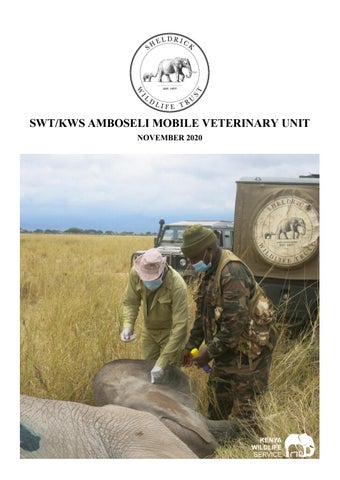
SWT/KWS AMBOSELI MOBILE VETERINARY UNIT NOVEMBER 2020
Introduction
3 Cases in November
3 Poaching Cases
3 Elephant Cases
November Report by Dr. Kariuki Edward The SCA-Amboseli Mobile Veterinary Unit (SCA-AMVU) attended to three veterinary cases during November 2020. All the three were elephants. The first elephant was located at Kitirua, Amboseli National Park and had a wire snare removed. The second and third elephants were males and were examined for cause of death at Kuku Group Ranch. The two elephants had penetrating injuries suspected to have been inflicted by a spear and possibly poisoned. In the first male, there was adequate spleen damage to cause severe bleeding and death discovered during the post-mortem, and the second male also succumbed to the spear injuries. Acknowledgement We thank the Sheldrick Wildlife Trust (SWT) for material support and Mobile Unit funding. Staff and Rangers at Amboseli National Parks and Masai Wilderness Trust are acknowledged for their support and company during the veterinary interventions. All other people who supported monitoring of distressed animals in areas of interest are highly appreciated.
Case Details Date
Species
Area Found
Reason for Intervention
Outcome
10-Nov-20 Elephant
Amboseli National Park
Snared
the elephant had a tight wire snare that inflicted superficial damage on her skin
Successfully Treated
14-Nov-20 Elephant
Kuku Group Ranch
Spear
The carcass had a penetrating wound on the flank area caused by a spear
Poaching Death
14-Nov-20 Elephant
Kuku Group Ranch
Spear
A penetrating wound on the flank was observed caused by a spear
Poaching Death
SWT/KWS Amboseli Mobile Vet Unit Treatment Locations November 2020
Case 1 – 10th November 2020 Elephant
Snared
Amboseli National Park
The elephant research team at Amboseli reported an injured elephant to AMVU. The team assisted in locating the sub adult female and monitored her progress after treatment.
Immobilisation, examination and treatment The elephant was darted from a vehicle with 13mg Etorphine and the dart was placed well on the thigh muscles. Examination revealed that the elephant had a tight wire snare that inflicted superficial damage to her skin. Blood vessels were prominent around the wire, showing initial stages of inflammatory reaction. However, the reaction was minor and no wound was inflicted. The wire is suspected to be from a broken fence and not a poaching attempt. 80ml Amoxicillin (Betamox) was administered intramuscularly to cover for bacterial infection. Additionally, Oxytetracycline wound spray was applied on the affected area Prognosis The elephant was given a good prognosis and should make a full recovery.
.
Case 2 – 14th November 2020 Elephant
Spear
Kuku Group Ranch
AMVU received the report of a dead speared elephant from the management of the Tsavo West National Park. Masai Wilderness Rangers guided the AMVU team to the carcass area at Kuku group Ranch. The elephant died a night after the herd entered the area.
Post-mortem examination The elephant carcass was located in a dense acacia thicket within the Ranch. The area is prescribed for conservation activities, uninhabited and far from farm lands. The carcass was bloated and had no tusks which were removed for safekeeping the previous night. The carcass had a penetrating wound on the flank area. Internal examination revealed a penetrating wound through the skin into the abdominal cavity. Pre-death struggle marks were visible on the ground next to carcass. Spleen and adjacent blood vessels were damaged. Dead flies were observed on the carcass but no maggots were found Cause of Death Excessive bleeding due to damaged spleen and crucial blood vessels due to spearing.
Case 3 – 14th November 2020 Elephant
Spear
Kuku Group Ranch
The AMVU team received a second report of another dead speared elephant from the management of the Tsavo West National Park. Masai Wilderness rangers guided the AMVU team to the carcass area at Kuku group Ranch. The elephant carcass was probably 4 days old. Post-mortem examination The elephant carcass was located in a river bed, in Kuku Group Ranch. The carcass was bloated and the tusks had been removed for custody. A penetrating wound on the flank was observed. The carcass had a lot of flies and fluids exudates flowed from the carcass remains and spread on the ground. Abdominal contents were partially eaten by maggots. Cause of death Excessive bleeding, probably due to a poisoned spear.