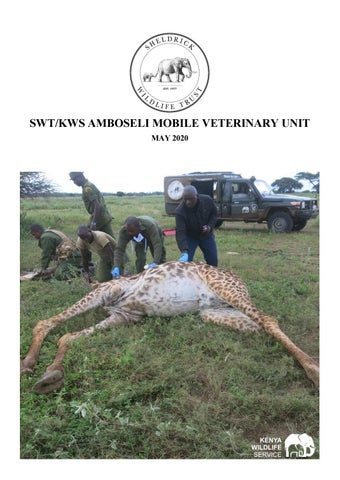
SWT/KWS AMBOSELI MOBILE VETERINARY UNIT MAY 2020
Introduction
6 Cases in May
2 Poaching Cases
4 Elephant Cases
May Report by Dr. Kariuki Edward During May 2020, SCA-Amboseli Mobile Veterinary Unit (SCA-AMVU) attended to six cases that required veterinary intervention. These included four elephants, a giraffe and a lion. Necropsy helped determine the cause of death in one elephant and a lion. However, the cause of death could not be determined for the elephant due to advanced decomposition of the carcass. The lion died from severe haemorrhage following a spear injury. One elephant was treated for lameness, another for a suspected spear injury and the third treated for a bullet wound. All three were given a favorable prognosis and should recover fully. Acknowledgement We thank the Sheldrick Wildlife Trust (SWT) for material support and Mobile Unit funding. KWS Rangers at Amboseli National Parks, Biglife Foundation Rangers and Elephant Research Team are acknowledged for their support and company. All other people who supported monitoring of distressed animals in areas of interest are highly appreciated.
Case Details Date
Species
Area Found
06-May-20
Elephant
Kimana Ranches, Amboseli
Postmortem
09-May-20
Lion
Oltiasika, Chyulu Hills
HWC
15-May-20
Giraffe
20-May-20
Elephant
26-May-20
Elephant
Elephant
27-May-20
Kimana Sanctuary, Amboseli Amboseli National Park
Reason for Intervention
Natural Causes
The carcass exhibited no abnormal external injuries or marks on the external surface The lion had 10 deep penetrating wounds confirmed to be inflicted by a spear, most likely due to HWC The giraffe had a wound, but with minimal damage to the outer parts of reproductive organs
Outcome Died
HWC Death Successfully Treated
Spear
The elephant had an external injury to the backbone area likely caused by a spear
Successfully Treated
Amboseli Environs
Natural Causes
The elephant had an external injury to the left foreleg of unknown origin and it was emaciated
Successfully Treated
Amboseli National Park
Bullet Wound
The elephant had an external injury to the right forelimb caused by a bullet
Successfully Treated
SWT/KWS Amboseli Mobile Vet Unit Treatment Locations May 2020
. Case
1 – 6th May 2020
Elephant
Post-mortem
Kimana Ranches, Amboseli
AMVU received the report of an elephant found dead in Kimana Group Ranch from KWS Warden at Loitoktok station. Big Life Foundation Rangers conversant with the area guided the AMVU team to the site of the carcass.
General examination The elephant carcass was located in a forested thicket hardly accessed by herders or any other group of people in the Ranch. The carcass exhibited no abnormal external injuries or marks on the external surface. Physical examination; the elephant carcass was advanced in decomposition and fluids marked the ground. Body fluids wetted the area around the carcass. A biomass of maggots was actively involved in eating the carcass. The skull was fully eaten and the mandibles and maxilla exposed. The muscles, skin and internal organs were also eaten by maggots and the carcass remained hollow from the rear side. The tusks were easily removed by hand from the skull. Right tusk weighed 2.5Kgs while the left one weighed 2.0kgs. Cause of Death Non-conclusive due to advanced decomposition
Case 2 – 9th May 2020 Lion
Human-Wildlife Conflict (Spear)
Oltiasika, Chyulu Hills
Young Masai men speared a collared lion at Oltiasika to death. The lion carcass was delivered to Amboseli National Park by KWS rangers on a vehicle.
General examination The lion had deep penetrating wounds at the level of the thoracic region. Injuries were also observed around the neck and pelvic region. The injuries were confirmed to be spear inflicted and there were ten in total on the lion body. The tail and paws had been removed but were retrieved from the community. It is suspected that the young Masai Moran had killed the lion as exhibited by the nature of killing and paws removal. Cause of Death Traumatic shock following excessive bleeding after vital organ damage.
Case 3 – 15th May 2020 Giraffe
Natural Causes
Kimana Sanctuary, Amboseli
Big Life Foundation rangers at Kimana Sanctuary reported the injured giraffe to AMVU. The giraffe located at the sanctuary had a wounded perineum and exhibited bleeding marks.
Immobilisation, examination and treatment The giraffe was darted from a vehicle and responded well to the drugs, becoming fully immobilized in 15 minutes. Immobilization was attained using a cocktail of 15mg Etorphine hydrochloride and 50mg Azaperone. The giraffe’s perineal area was wounded but there was minimal damage to the outer parts of the reproductive organs. Ox-peckers had fed and debrided the wound area leading to constant bleeding which was hindering healing. Ox-peckers are attracted to ticks and filarial worms in wild animals. The wound was cleaned with Hydrogen peroxide and the area irrigated with Iodine. Additional treatments included 100ml of injectable Oxytetracycline and Oxytetracycline aerosol spray on the wound to cover for bacterial infection. Prognosis The prognosis is favourable.
Case 4 – 20th May 2020 Elephant
Spear
Amboseli National Park
Elephant Research Team at Amboseli National Park reported a wounded elephant at Nkongo Narok area. The elephant was separated from the main herd and reluctantly grazed on her own.
Immobilisation, examination and treatment The elephant was located in the wetland and seemed reluctant to move. The elephant was darted from foot with 15mg Etorphine hydrochloride. The elephant responded well and was fully immobilized in 12 minutes. Examination revealed an external injury to the backbone area possibly caused by a spear. She was emaciated and most bones were significantly prominent on the skin surface. A pair of forceps was used to open up the pus-filled wound. The wound was cleaned with Hydrogen peroxide and the area irrigated with Iodine. The wound was sprayed with Oxytetracycline spray then the elephant was given 100ml of injectable Oxytetracycline to protect against infection. Prognosis The prognosis is good.
Case 5 – 26th May 2020 Elephant
Natural Causes
Amboseli Environs
A member of the Masai Community around Amboseli Primary school reported a wounded elephant at the Primary school area. Immobilisation, examination and treatment The elephant was located in an open area feeding away from the family herd. It exhibited a high degree of lameness and was reluctant to move. The elephant was darted from a vehicle with 20mg Etorophine hydrochloride. The dart was well placed in the gluteal muscles, working effectively and immobilising the elephant within 15 minutes. The elephant had an external injury to the left foreleg and was emaciated. The wound was old and partly healed. No infections were eminent on and around the wound area. The wound was cleaned with Hydrogen peroxide and the area irrigated with Iodine. The elephant was also administered with 100ml of injectable amoxicillin to cover for bacterial infection. Prognosis Prognosis for full recovery is good.
Case 6 – 27th May 2020 Elephant
Bullet Wound
Amboseli National Park
The management of Kitenden Conservancy reported a wounded and lame elephant at the Kitirua basin. The elephant had been reported to move from Tanzania across the border. The elephant was treated in Tanzania and it moved into Kenya a month later. Immobilisation, examination and treatment The elephant was located in a wetland in Kitirua basin on the Southern part of the Park. She was separated from the family herd and exhibited lameness while walking. The elephant was darted from a vehicle with 15mg Etorophine hydrochloride. The dart was well placed adjacent to the ear flap at the scapula and the drugs took effect 8 minutes post-darting with the elephant becoming fully immobilized in 10 minutes. The elephant had an external injury at the right forelimb. The wound was partly healed and had no discharge or any sign of extensive infection. The wound was debrided with Hydrogen Peroxide and the area irrigated with Iodine. The elephant was also given 100ml of injectable amoxicillin to cover for bacterial infections. Prognosis Prognosis for full recovery is good.