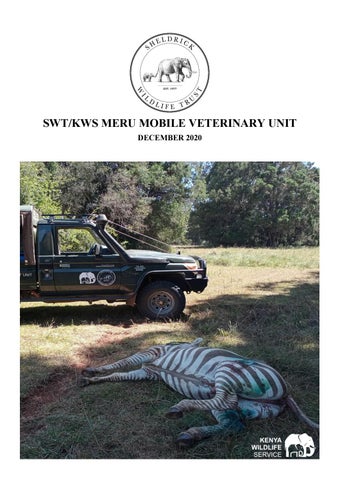
SWT/KWS MERU MOBILE VETERINARY UNIT DECEMBER 2020
Introduction
10 Cases in December
5 Lion Cases
100% Success
December Report by Dr. Campaign Limo December witnessed favourable weather conditions throughout. There is full vegetation regeneration making animal health splendid. This will ensure there are abundant reserves of forage going forward. The Unit attended to 10 cases, including collaring of one lion, treatment of two lions for natural injuries and contraceptive implantation of two lionesses for population control. The Unit also vaccinated a security dog and rescued a python from a building. An elephant, bongo and zebra were also treated for natural injuries. Acknowledgement We hereby appreciate the bountiful support and full sponsorship offered to The Mobile Vet Unit by The Sheldrick Wildlife Trust. This has enabled the Unit to timely intervene as shown below offering pain relief and comfort to wildlife in need. We would also like to thank all other partners who in one way or another contributed to the success of the above interventions.
Case Details Date
Species
Area Found
07-Dec-20
Lion
Borana Ranch
Collared
The lioness collar life time had expired and needed to be removed
Task Successful
07-Dec-20
Lion
Borana Ranch
Technical Case
Contraceptive implantation was done on a lioness due to overpopulation
Task Successful
09-Dec-20
Security Dog
Meru NP
Technical Case
The KWS tracker/ sniffer was due for vaccinations as routine practice.
Task Successful
12-Dec-20
Elephant
Mpala Ranch
Natural Causes
A foot-long piece of wood was found embedded in the knee and protruding
Successfully Treated
14-Dec-20
Python
Meru NP
HWC
A 30cm long rock python was spotted under a cabinet and needed to be removed
Task Successful
17-Dec-20
Lion
Borana Ranch
Natural Causes
The hip joint seemed to have undergone trauma which had healed. This caused the limb to heal slightly shorter than the other
Successfully Treated
17-Dec-20
Lion
Borana Ranch
Technical Case
The last lioness among the six candidates chosen for contraceptive population control
Task Successful
22-Dec-20
Lion
Meru NP
Natural Causes
There was a wound around the neck that looked like abrasive/friction wound
Successfully Treated
27-Dec-20
Bongo
Mt Kenya NP
Natural Causes
The three months old was reported to have a swelling just below the right ear base
Successfully Treated
27-Dec-20
Zebra
Mt Kenya NP
Natural Causes
A deep wound to the right leg and several skin lacerations caused in a territorial fight
Successfully Treated
Reason for Intervention
Outcome
SWT/KWS Meru Mobile Vet Unit Treatment Locations December 2020
Case 1 – 7th December 2020 Lion
Collaring
Borana Ranch
The lioness had been collared in 2017 to assist in monitoring her prides movement to assist with controlling cattle predation in the Conservancy and the surrounding communities. The collar life time had expired and needed to be removed. Fortunately, another lioness within the pride was targeted for Contraceptive Implantation. Luckily this gave an opportunity to dart the two candidates almost simultaneously. Immobilisation, examination and treatment The lioness was with five subadults, two lionesses and a lion lying on a plain tall grass savannah. They were approached by the vehicle carefully. She was darted after the Implant candidate. The lioness darted from a vehicle at the right side of the neck with 500mgs Ketamine and 8mgs Medetomidine. It was startled but did not move away. It was completely sedated in 11 minutes and was probed using a stick to verify plain of anaesthesia after which she was blindfolded. The collar was severed using a Leatherman and taken off. The dart was retrieved from the neck and the wound infiltrated with Cloxacillin Cream to prevent abscess formation. Prognosis Prognosis is good as the pride would still be monitored effectively by the other newly collared lioness.
Case 2 – 7th December 2020 Lion
Technical Case
Borana Ranch
The Unit was requested to do contraceptive implantation on a lioness. This project had been projected to implant six lionesses within the vicinity of Lewa-Borana environs to control lion population growth after establishing that other ways of controlling population proved highly unsuccessful. One such intervention has been translocation which has proved unsuccessful. This particular candidate was the fifth to be operated on. Immobilisation, examination and treatment The candidate was darted with 500mgs Ketamine and 8mgs Medetomidine. It was completely immobilized within 10 minutes. It was approached using a vehicle and probed using a stick from the vehicle. The implant is a synthetic Gonadotropin Releasing Hormone (GnRH) synthetic analogue. It is effective because GnRH agonists act by causing failure of treated animals to synthesize and/or release both FollicleStimulating Hormone and Luteinizing Hormone, the hormones responsible for maintaining fertility. The cylindrical implant is deposited under the skin at the shoulder using a preloaded syringe and needle. A single interrupted stitch was made to completely close the skin puncture site. It should be redone after six months. Prognosis A satellite collar was fitted to monitor the pride and also her fertility status and effectiveness of the implant.
Case 3 – 9th December 2020 Security Dog
Technical Case
Rhino HQ, Meru National Park
The KWS tracker dog was due for vaccinations as routine practice. The canine aids in rhino monitoring particularly during poaching incidences when it is deployed to track down the culprits.
Immobilisation, examination and treatment The canine is usually covered against tryps which have proven to be deadly in the past for the KWS canine population. This is usually done every three months as a prophylaxis measure due to tsetse presence in the working environment. This was accompanied by deworming which is also done every three months. The anti-tryps used was Quinapyramine Sulphate and Q. Chloride in ratio of 3:2 for injection prophylactic which is highly active against both Trypanosomes and Babesia spp. It was administered by subcutaneous injection at the rate of 0.03ml per kg bodyweight following 20ml reconstitution. The canine was in good health and prompted no any other treatment. Prognosis The canine was recommended to be on light duty for 72 hours to help it recover smoothly. The anti-tryps and deworming will be done after three months which will be on 09/03/2021.
Case 4 – 12th December 2020 Elephant
Natural Causes
Mpala Ranch
An adult bull elephant was noticed and reported to be walking around with a leg lifting lameness of the right hindlimb. There was a lodged foreign body in the injured limb just below the knee and slightly medial. Immobilisation, examination and treatment The animal was darted with 19mg Etorphine using a Dart-inject gun on the left for limb halfway. The animal went down on left lateral recumbency which allowed for treatment and examination. The general body condition was not good with a body score of 2 out of 5 as the spine was very visible. This could be because of the stress and pain. The right hindlimb was examined and a piece of wood (Acacia melifera) was embedded in the muscle just below the knee about half a foot long with equal length coming from the skin. The piece of wood was removed in one piece carefully without causing further tissue injury. The wound was checked using forceps for any remaining foreign object. The wound was flushed and cleaned with 6% Hydrogen Peroxide to remove dead tissue, disinfected with Iodine, packed with Oxytetracycline pessaries and smeared with Green Clay. The elephant was given 15000mg Amoxicillin antibiotic, 200mg Dexamethasone as a painkiller/anti-inflammatory and 25ml Catosal as a metabolic stimulant/multivitamin. Prognosis The prognosis was favourable as the wound had not become infected. However, the pressure of the piece of wood had caused a local swelling and difficulty with movement hence the lameness. Since treatment was done early enough, then healing should go smoothly.
Case 5 – 14th December 2020 Python
Human-wildlife Conflict; relocation
Meru National Park
A crowd was witnessed gathering at Meru N.P. Senior Warden’s office door. This attracted the Vet Units from the nearby Research Scientist’s Office. The Unit walked to join the rest of the staff to witness what was going on. A snake had been spotted by the Senior Warden under one of his cabinets and that it needed to be removed. As Meru is a natural snake habitat this was not unusual. Clearing mission started immediately by moving away the said cabinet. This exposed the 30cm long serpent which was identified as a young rock python.
Capture A piece of stick was used to pin its neck area gently to limit its movement and ensure safe neck holding. It was cautiously held manually by hand at neck level just behind the mandibles. This restricted head movement and the tail was grabbed by the other hand. It was lifted from the floor and taken out of the office. Release and prognosis It was transported to the release site while coiling around the hand holding the neck. This made it calm and relax all the way to release sight. It was gently uncoiled and placed on the ground deep inside the park at signage No.15 away from residential area. Good prognosis unless risk of predation by other meat eaters in the vast ecosystem.
Case 6 – 17th December 2020 Lion
Natural Causes
Borana Ranch
The lioness was observed to have an uneven gait when walking and a very poor body condition. Immobilisation, examination and treatment After the Unit located the lioness, the team then moved away to prepare a dart with 300mg Ketamine and 5mg Medetomidine, then darted the lioness from the vehicle. The animal went down within 11mins whilst the supporting ground teams dispersed the 15 members of the pride. The lioness had a poor body condition of 2 out of 5. Her ribs, hip bones and spine could be seen and felt easily. Her body was full of ticks. Her teeth were all intact, clean and very sharp meaning her dentition was healthy. The limb of concern was the right hindlimb and on examination and manipulation, the bones were found to be intact with stable joints. However, the hip joint seemed to have undergone trauma which had already healed. This caused the limb to heal slightly shorter than the other. The musculature on this limb was very thin compared with the other limb. The lioness was given an intramuscular injection of 1,500mg of Amoxicillin, a subcutaneous injection of 20mgs Ivermectin to cover for the external parasitism as well as any internal parasites and a subcutaneous injection of 15ml Multivitamin to act as a metabolic boost against poor body condition. Prognosis The prognosis was fair as she has survived since sustaining the injury. Her body condition may be because she arrives to a carcass last due to the injury. The treatment will hopefully give her strength, thus improving her health status.
Case 7 – 17th December 2020 Lion
Technical Case
Borana Ranch
The lioness was last among the six selected as candidates for contraceptive population control. She was part of a pride made of several members, a mix of sub-adults and young ones, the majority of which were males. Immobilisation, examination and treatment The team arrived on site where the pride was resting and sleeping in a grassy field under some trees and bushes. The lioness was darted from a vehicle with 500mg Ketamine and 8mg Medetomidine. The supporting ground teams moved in to help disperse the members of her pride by chasing them off using vehicles. The lioness was healthy with a good body condition of 3 out of 5. A small area between the shoulder blades was shaved and cleaned as the site for the implant hormone deposit. A small incision was made so as to allow for the depositing needle (implanter) to fit easily through, for a subcutaneous deposit. The implant contained 4.7mg Deslorelin and for this particular case, two were used. Once the implants were in place a simple suture was used to seal the incision. Prognosis The exercise was successful and the lioness was in good health and condition. This made the prognosis good as there were no arising complications and no significant health concerns.
Case 8 – 22nd December 2020 Lion
Natural Causes
Meru National Park
The lion was reported to have been seen with a snare by the patrol team. He was in a pride composed of two adult females and five subadults. Immobilisation, examination and treatment The lion was darted from the vehicle with 850mg of Ketamine and 10mg Medetomidine. He was startled and ran for quite a long distance before finally going down. This meant that the lion was in a hyperactive state. A few things were required and so the team went to get them. However, on arrival back the anaesthetic had become light and required a top up. An intramuscular injection of 300mg Ketamine and 5mg Medetomidine (1%) was given and the team waited 15 minutes to let the drug take effect before treatment and examination. His teeth were worn out with some canines cracked, indicating this was an old lion. He also had heavy infestation of ticks and a slightly poor body condition. The neck was examined but there was no snare. However, there was a wound around the neck that looked like it was caused by abrasions. Since the wound was not deep or infected, it was cleaned with Iodine. One of the paws had an injury and the left hindlimb had a bleeding tumour like growth. These were treated with Opticlox and Oxytetracycline spray. The lion was also given 30mg Ivermectin, 2,250mg Amoxicillin and 20ml of Multivitamin. The vet treated for trypanosomiasis with Murtrp and Phenazone as the lion was vulnerable to infection. Prognosis Prognosis is good as there were no arising complications and treatment should improve his health and condition.
Case 9 – 27th December 2020 Bongo
Natural Causes
Mount Kenya Wildlife Conservancy
The three-month-old bongo was reported to have a swelling just below the right ear base. The in-charge animal keeper also said that it had another swelling on the right cheek which was lanced on 15/12/2020. The swelling was visible from afar and a thorough examination had to be done. Immobilisation, examination and treatment It was darted from foot with 1mg Etorphine and 10mgs Azaperone after stalking it in the bush where it was by several adult females, infants and a breeding male. It took of into the thickets but it was kept in sight until it stood still and could be manually restrained then the anaesthetic reversed immediately The abscess was palpated and was tender. It was then incised to draining as much of the creamy foul-smelling pus as possible. It was flushed with Hydrogen Peroxide followed by Iodine. This was followed by inserting Oxytetracycline pessary into the empty pouch and topical Tetracycline spray. It was also given Enrofloxacin and multivitamin intramuscularly and Ivermectin subcutaneously Prognosis It was relieved of manual restraint and immediately got up and ran into the bush. Prognosis is good.
Case 10 – 27th December 2020 Zebra
Natural Causes
Sirimon Gate, Mount Kenya National Park
The zebra was reported severely lame on the right hind limb by a Ranger. The Unit responded immediately because it had just successfully attended to bongo. There was a deep penetrating wound at the right hock which was septic and discharging copious reddish pus. There were several superficial skin lacerations on the gluteal, chest and shoulder regions. All these were attributed to territorial aggression by another zebra. Immobilisation, examination and treatment The zebra was approached with a vehicle and immobilized with 5mgs Etorphine and 50mgs Azaperone. It ran for five minutes eventually falling down on its left side. It was positioned on its right side to fully expose the injury for treatment. It was blind folded and the dart removed from the left rump. The discharging wound was cleaned and disinfected with Hydrogen peroxide and Iodine. An Oxytetracycline pessary was inserted into the cavity then sprayed with Tetracycline spray. The zebra was also given Tetracycline antibiotic, Cyanocobalamin metabolic stimulant, Dexamethasone anti-inflammatory and Ivermectin parasiticide. All the skin lacerations were dry and sprayed topically with Tetracycline wound spray. Prognosis Prognosis is good as the exercise was carried out smoothly.