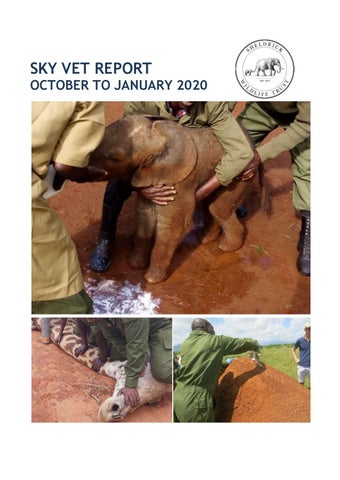
SKY VET REPORT OCTOBER TO JANUARY 2020
OCTOBER TO JANUARY 2020
THE SHELDRICK WILDLIFE TRUST
www.sheldrickwildlifetrust.org
SKY VET QUARTERLY OVERVIEW During October to January 2020 the SWT/KWS Sky Vet program was called to handle 14 wildlife cases. Most of these cases were supported by the SWT helicopter as well as one outsourced aircraft to help with elephant darting operations as well as search and monitoring operations. 9 of these cases attended to involved elephants, whilst Sky Vets attended to 1 rhino and 4 giraffes. Of these, there were 7 poaching cases involving 3 arrowed elephants and 4 giraffes, as well as 4 elephant rescues and 3 cases attended to for natural causes. 72% of the cases were successful including another 21% taken to an orphanage, 7% died from their injuries. Without rapid veterinary response, the majority of these cases would have died from their injuries
The Sky Vet program has deployed KWS vets to the following locations during this reporting period
OCTOBER TO JANUARY 2020
THE SHELDRICK WILDLIFE TRUST
www.sheldrickwildlifetrust.org
OCTOBER TO JANUARY 2020
THE SHELDRICK WILDLIFE TRUST
www.sheldrickwildlifetrust.org
CASE 1: 7th October 2019
TAITA RANCHES
ELEPHANT RESCUE (NASIPA)
INTRODUCTION Early in the morning of the 7th of October we received reports of an orphaned baby elephant in the safe custody of Big Life Rangers on Rombo. The rangers had discovered this emaciated calf wandering alone not far from where they had camped. They took the calf into their care as it was just weeks old, and very thin and weak. The mystery surrounding why this calf would be abandoned is not yet clear, but he did have signs of being stuck in muddy water with the dried remnants of both still on his body. After the relevant authorities had been advised the SWT helicopter based at our Kaluku headquarters was mobilized to rescue the baby. This was the quickest way to help with the least stress placed on the already weak baby, removing the necessity to drive the baby to the closest airstrip.
THE RESCUE The helicopter had to be stripped of all seats except the pilots and all the relocation gear was loaded. Keeper Justus had mixed a couple of bottles of milk and had packed a box of medications and drips so as to be prepared for a dehydrated case, and together Andy Payne and Justus head on their way. The route took them over Tsavo West flying towards Mt. Kilimanjaro, which on this day was crystal clear after a few days of rains and made for a spectacular half an hour flight there. The helicopter landed on a dusty clearing close to the Big Life outpost, not far from the Tanzania border. The little elephant was following the rangers and walked over to the helicopter once the engines such down. At this point all the children from the local school rushed over to see what the commotion was all about. Justus was able to feed the desperate calf a bottle of warmly mixed milk and then carefully lay the baby down into a canvas stretcher, covered his little head with a blanket to help calm him down and then together with the help of Big Life rangers the baby was lifted carefully into the helicopter. All the while the inquisitive Maasai onlookers was requested to move back in order to give the crew and rangers enough space to work with which they kindly did. It was requested that the calf be named Nasipa after the prominent hill which lends its name to the area. The flight back to Kaluku was uneventful and after landing the elephant was quickly unloaded and immediately got to its feet and began following Justus. Two drips were infused into his ear veins to help hydrate him because he was very thin, and obviously had been without Mum for well over 24 to 48 hours.
PROGNOSIS Nasipa sadly did not make it through his terrible ordeal having been in too poor a condition and having suffered great loss.
No images available
OCTOBER TO JANUARY 2020
THE SHELDRICK WILDLIFE TRUST
www.sheldrickwildlifetrust.org
CASE 2: 7th October 2019
MBIRIKANI RANCH
INJURED ELEPHANT
INTRODUCTION The large bull has been spotted multiple times over the years with a growth in his preputial region and treated each time he was found. The vet team was alerted that he had been spotted with the same wound, so the team was airlifted by the SWT fixed-wing aircraft to the Ol Donyo Wuas lodge within Mbirikani Ranch
CHEMICAL IMMOBILIZATION & TREATMENT The elephant was approached and darted using the SWT chopper with 18mg of Etorphine HCl. Once darted, the elephant went down in about four minutes in a sitting position that could compromise his breathing. The vet team rushed to him and manually pushed him to lay on his side in order to restore optimum breathing. An ulcerated growth on his preputial region was observed. To aid in diagnosis of the chronic condition, tissue samples of the growth were collected to be assessed for possible causes of infectious origin. Once samples were collected, the wound was lavaged with Hydrogen peroxide to cauterize the wound and reduce bleeding as well as help void any purulent material and foreign bodies such as maggots. It was then disinfected with iodine and finally packed with a thick layer of green clay to keep it protected from the elements and allow it to heal. A separate wound was observed on his back. Once examined, the wound was suspected to be an old injury potentially caused by a spear. It has been healing well so it was disinfected with iodine followed by an application of green clay. The bull was also given Flunixine meglumine as an anti-inflammatory and pain relief.
PROGNOSIS At 44 minutes after darting, the anesthesia was reversed with 24mgs Diprenorphine HCl and 25mgs of Naltrexone. He rose in five minutes and slowly walked away. Prognosis is good.
THE SHELDRICK WILDLIFE TRUST
www.sheldrickwildlifetrust.org
CASE 3: 9th October 2019
NDIA NDAZA, TSAVO EAST
SNARED GIRAFFE
INTRODUCTION The giraffe bull was spotted with a snare around the neck that had snagged a tree branch. Once the vet team was alerted, the proper equipment was prepared, and the team airlifted by SWT to save on the time needed to get to the patient.
CHEMICAL IMMOBILIZATION & TREATMENT The giraffe was approached on foot and darted with 14mg of Etorphine HCl and 50mg of Xylazine HCl in a 3-cc Dan-Inject barrel. The giraffe went down after about ten minutes and fell down on his own. The anaesthesia was immediately reversed with the antidote consisting of 42mgs of Diprenorphine HCl and 2.5mgs Atipamezole HCl. Once reversed, the bull was kept restrained using manual pressure applied to the neck. With successful restraint achieved, the removal of the snare was carried out. As the snare was not embedded in the tissues or skin of the neck, treatment comprised of severing the snare and removing it as well as the tree branch from the neck of the animal.
PROGNOSIS Once complete, manual pressure on the neck was released and the giraffe was assisted to get up. He was able to move away from the vet team and a good prognosis is expected
THE SHELDRICK WILDLIFE TRUST
www.sheldrickwildlifetrust.org
CASE 4: 16th October 2019
CHYULU GATE, TSAVO WEST
ELEPHANT CALF RESCUE (ROHO)
INTRODUCTION In the early hours of 16th October our SWT/KWS Canine Unit headed to Tsavo West National Park to help track down two suspected poachers, who had been spotted the evening before. The team convened with KWS and Tsavo Trust rangers to coordinate a search, and it was a patrolling aircraft had just sighted a tiny elephant calf standing beside the body of his deceased mother.
THE RESCUE The team immediately changed tack and headed in the direction of the calf and the mother’s carcass. Given the dense bush and jagged lava, the helicopter couldn’t even attempt landing in the area, and it quickly became clear that the only option was to descend the hill on foot with the calf. Although he was small, the orphan had lots of adrenaline pumping through his veins and vigorously resisted all efforts to shepherd him down the hill, although they finally arrived. The SWT helicopter landed with Justus, a very experienced Keeper, to bring the baby to the Nursery. They strapped in their passenger and headed in the direction of Nairobi. With a successful rescue under their belts, the SWT/KWS Canine Unit resumed their original mission of searching for signs of the poachers who had been reported the previous day. At the Nursery, meanwhile, the Keepers were ready to meet their new arrival. As soon as the helicopter’s rotors stopped spinning, they ferried the precious bundle to his stockade. They had to make a hasty retreat after helping him to his feet because, despite being little, he still had a lot of fight in him. Over the intervening weeks, he has settled in beautifully and is enjoying all the attention lavished on him by the Keepers and the rest of the Nursery herd. We named him Roho, which means “spirit” in Swahili — an apt name for this brave little boy.
THE OUTCOME We can’t fathom why Roho’s mother climbed to that inhospitable place. An autopsy was inconclusive, so this particular mystery may remain unsolved. Given the reason that our teams had assembled there in the first place, however, it’s very possible that she brought her baby there in a desperate bid to retreat from poachers. Although she lost her own life, her efforts to protect her baby were not in vain. We’re immensely proud of our team’s heroic efforts to rescue little Roho, and we’re pleased that we can offer him a new family, and a future.
THE SHELDRICK WILDLIFE TRUST
www.sheldrickwildlifetrust.org
CASE 5: 22nd October 2019
OL DONYIRO, SAMBURU
SUB ADULT ELEPHANT RESCUE
INTRODUCTION This was a case of a lone sub-adult female elephant found lying on a sternal recumbency in a very deep gorge of about 40 feet deep. It was quite weak and exhausted unable to stand or walk. It could only be hoisted and removed out of the gorge using a helicopter. Meanwhile it was put on 50% dextrose and Ringers solution i.v to try to re-energize and make it stand up. Water was also given orally to relieve dehydration.
INTERVENTION AND TREATMENT Through a combined effort of Sheldrick Wildlife Trust, KWS veterinary teams and Reteti and Northern rangeland Trust (NRT) rangers and Tropical-air helicopter teams, the elephant was safely tied on a long strap and hoisted out of the gorge to an open area for further treatment and stabilization. The elephant still could not stand or walk after hoisting and remained recumbent for several hours over night, it was put under lots of dextrose I.V and Ringers solution i.v, oral milk and water for several hours unsuccessfully. It had white froths coming out of the trunk and was groaning with a whizzing sound while breathing, it was severely starved and was quite emaciated. Later it had difficulty in breathing and died of asphyxia.
POSTMORTEM Post-mortem examination revealed severe internal injury to the lungs which were necrotic with pus and were foul smelling, the lung tissues were heavily congested with whitish froth that looked like pus exudates. The elephant succumbed to internal injuries sustained from falling into the gorge and prolonged starvation and dehydration.
THE SHELDRICK WILDLIFE TRUST
www.sheldrickwildlifetrust.org
CASE 6: 7th NOVEMBER 2019
WANANICHI RANCH
INJURED ELEPHANT
INTRODUCTION This was a case of an adult male elephant in Wananichi Ranch (Kasigau) conservancy which had a deep arrow wound on the left side of the abdomen. The elephant was in deep pain and the wound was swollen and full of pus and necrotic debri. It require a very urgent intervention to save it from pain and suffering hence a vet was flown from Nanyuki to Tsavo and managed to treat the elephant quite successfully.
INTERVENTION AND TREATMENT The injured elephant was found in a fairly thick area where it was approached and darted by a helicopter using 18mgs of etorphine Hcl in a 3ml Dan-inject dart. The elephant got adequately immobilized after about 6 minutes and went down on lateral recumbency. The wound was probed using sterile gauze swabs attached to long forceps to remove all the necrotic debri and pus. Then cleaned with copious amounts of water then debrided with dilute hydrogen peroxide then cleaned with tincture of iodine and chlortetracycline pessaries inserted into the wound. The wound was further treated using Opticlox® ointment applied topically. Other treatments were intramuscular injection of Amoxicillin Trihydrate (Betamox®) and dexamethasone (Colvasone®) to support the wound healing process. The wound was finally plugged with green clay and topical application of oxytetracycline spray. Soon after treatment the elephant was revived from anaesthesia using 60mgs of diprenorphine Hcl combined with 50mgs of naltrexone administered intravenous through the superficial ear-vein, it rose up and walked away feeling relieved. PROGNOSIS The prognosis given was good and it is hoped the elephant will make a full recovery
THE SHELDRICK WILDLIFE TRUST
www.sheldrickwildlifetrust.org
CASE 7: 13th NOVEMBER 2019
ITHUMBA, TSAVO EAST
INJURED ORPHAN ELEPHANT
INTRODUCTION Orphan elephant, Barsilinga, was seen to be limping with a leg lameness. Once notified of the problem, the vet team drove to Kaluku SWT field office and was then airlifted to Ithumba by the SWT helicopter.
INTERVENTION AND TREATMENT Barsilinga with 8mg of Etorphine HCl and 20mgs of Azaperone. Once anesthetised, the trunk was positioned correctly to aid in breathing and a large amount of water was used to cool him down during the treatment. Examination of the limb revealed a wound on the sole suspected to have been inflicted by a sharp object, possibly from standing on a stick. To reduce the bacterial load, the wound was flushed with normal saline mixed with Hydrogen peroxide. Following this, the wound was disinfected with tincture of Iodine then sprayed with Oxytetracycline and packed with green clay. The bull also received a dose of supportive antibiotics and Dexamethasone HCl.
PROGNOSIS The anaesthesia was reversed with the use of 75mgs of Naltrexone. He was standing within two minutes and slowly walked away. Recent reports of the elephant putting weight on the limb are consistent with the good prognosis that was given.
THE SHELDRICK WILDLIFE TRUST
www.sheldrickwildlifetrust.org
CASE 8: 15th November 2019
KASIGAU, TSAVO EAST
SNARED GIRAFFE
INTRODUCTION The male giraffe was spotted during routine aerial surveillance with a snare around the base of the neck. Once the vet team was alerted, the proper equipment was prepared, and the team rushed to the Wildlife Works Offices by road and they were airlifted to Kasigau due to impassable roads in the area. IMMOBILISATION, EXAMINATION AND TREATMENT The giraffe was darted with 15mg of Etorphine HCl and 30mg of Xylazine from a helicopter and went down in 30 minutes with the aid of ropes used by the team. He was immediately reversed with the 2.5mgs Atipamezole HCl and 150mgs of Naltrexone HCl. Once reversed, he was restrained using physical restrained. The snare was embedded into the subcutis and superficial muscle layers of the dorsal neck. Once removed, using wire cutters, the wound was cleaned with dilute Hydrogen peroxide, followed by disinfection with tincture of Iodine, Oxytetracycline spray, and finally an application of green clay. The bull also received supportive treatment with long-acting antibiotics and Dexamethasone HCl as an anti-inflammatory. PROGNOSIS Once the treatment was completed, he was released. He required some assistance to his feet but immediately walked off once up. A good prognosis is expected.
THE SHELDRICK WILDLIFE TRUST
www.sheldrickwildlifetrust.org
CASE 9: 15th NOVEMBER 2019
RUKINGA RANCH, TSAVO
SNARED GIRAFE
INTRODUCTION The giraffe was spotted with a snare around the neck during a routine aerial surveillance. As the vet team was already in Kasigau treating another giraffe, once finished, they were airlifted by SWT chopper to Rukinga Ranch.
INTERVENTION AND TREATMENT Darting equipment was prepared with 15mg of Etorphine HCl (M99) and 30mg of Xylazine HCl in a 1.5-cc Dan-Inject darting syringe. The giraffe was approached by the SWT chopper and darted, going down after about 10 minutes with the aid of ropes used by the team. He was immediately reversed with the antidote consisting of 2.5mgs Atipamezole HCl and 150mgs of Naltrexone HCl. Once reversed, he was kept restrained with manual pressure applied to the neck. With successful restraint achieved, the removal of the snare was carried out. As the snare was not embedded in the tissues or skin of the neck, treatment comprised of severing the snare and removing it from the neck of the animal.
PROGNOSIS Once complete, manual pressure on the neck was relieved and the giraffe got up unassisted and moved away from the vet team. A good prognosis is expected.
THE SHELDRICK WILDLIFE TRUST
www.sheldrickwildlifetrust.org
CASE 10: 21ST NOVEMBER 2019
LEWA CONSERVANCY
INJURED WHITE RHINO
INTRODUCTION On the 18/11/2019 a white rhino bull called Marti in Lewa conservancy was reported to have injured its right eye in a territorial fight and required urgent veterinary attention. This rhino was immobilized for examination and treatment on 21/11/19.
INTERVENTION AND TREATMENT Due to hilly terrain a helicopter was obtained for darting. A combination of 5mg Etorphine hydrochloride and 80mg Azaperone tartate was delivered in a Dan-Inject dart was used for immobilization. The first dart failed to discharge but a second dart given 10 minutes later was effective and it went down in 5 minutes. Respiration rate and temperature were monitored and 10mg Butorphanol was given intravenously through the ear vein as soon as the animal was recumbent. The rhino was positioned on left lateral recumbence for examination. Although the team were unable to reposition the rhino from facing downhill, to prevent pressure of abdominal organs on the chest cavity, it remained stable through the procedure. Examination revealed a swelling and deep laceration with blood oozing from the lower eyelid of the right eye. The eyeball and its orbit were intact. Lacerations were also found on the sternum and the head. The wound was washed with normal saline to remove debris, then a suture vicryl in a simple interrupted pattern was applied. Topical antibiotics (Opticlox), Betamox and Flunixin meglumine were given via the deep intramuscular route.
PROGNOSIS Naltrexone 120mg was given by the intravenous route to reverse the effect of the Opioid. Three minutes later this rhino was standing. Prognosis for recovery is good and no loss of vision is expected.
THE SHELDRICK WILDLIFE TRUST
www.sheldrickwildlifetrust.org
CASE 11: 28TH NOVEMBER 2019
TSAVO WEST
SNARED GIRAFEE
INTRODUCTION The female giraffe was spotted during routine patrols by KWS rangers with a snare around the neck. Once the vet team was alerted, the team travelled by road to Manyani then airlifted to Finch Hattons by the SWT helicopter as it was getting late. The giraffe was easily spotted on the road near Finch Hattons tented camp.
INTERVENTION AND TREATMENT The giraffe was darted from a vehicle with 15mg of Etorphine and 30mg of Xylazine and went down after about 30 minutes with the aid of ropes used by the team. The anaesthesia was immediately reversed with 2.5mgs Atipamezole and 150mgs of Naltrexone and the giraffe was manually restrained. The snare was embedded into the subcutis and superficial muscle layers of the dorsal neck. Once removed using wire cutters, the wound was cleaned with dilute Hydrogen peroxide, followed by disinfection with tincture of Iodine, Oxytetracycline spray, and finally an application of green clay. The bull also received supportive treatment of long-acting antibiotics and Dexamethasone as an anti-inflammatory.
PROGNOSIS Once the treatment was complete, manual pressure on his neck was relieved. He required some assistance to his feet but immediately walked off once up. A good prognosis is expected.
.
THE SHELDRICK WILDLIFE TRUST
www.sheldrickwildlifetrust.org
CASE 12: 2nd JANUARY 2020
MASAI MARA
ELEPHANT RESCUE (NALEKU)
INTRODUCTION A report was received from the KWS on the 2nd January 2020 about an orphaned baby elephant whose Mum had died the previous night in the Masai Mara. Scouts from the Mara Elephant Project (MEP) had been monitoring her and her baby for a few days prior to her passing, concerned by her poor condition. The mother died on the 1st of January at night, but the reasons for her death remain unclear as sadly an autopsy was not possible given that not much of her was left after predators had their fill that night. The decision was made to rescue the young baby, who at approximately six months old could simply not survive without her mother’s milk or protection from the very same predators.
INTERVENTION AND TREATMENT KWS Veterinary officer Isaac Lekelol was mobilised to travel down with the SWT Keepers in the rescue plane to facilitate the rescue. In the meantime, MEP rangers were keeping an eye on the calf until the team arrived. The plane flew directly into the Mara North Conservancy airstrip, which was about thirty minutes from the calf, who was thankfully in the company of another adult female elephant and her calf. Thankfully it did not take long to safely capture the baby and this was done by sedating the protective adult female so that the ground teams could move in to capture and restrain the orphaned baby who was much smaller than the female’s own calf, and then immediately set about preparing her for the journey in the back of a land cruiser to the airfield, and the onward flight to Nairobi. The baby was given a tranquilliser to manage stress levels and no time was wasted because it was literally last light. The calf arrived at the Nursery close to 9 o’clock. She was placed in a stable that had been especially prepared for her arrival.
PROGNOSIS Naleku as the calf has since been named is thriving at the Nursery.
THE SHELDRICK WILDLIFE TRUST
www.sheldrickwildlifetrust.org
CASE 13: 11TH JANUARY 2020
NGUTUNI, TSAVO EAST
INJURED ELEPHANT
INTRODUCTION The SWT Kaluku HQ reported a wounded elephant that had been sighted around Ngutuni lodge. The Amboseli Vey Unit prepared to attend the case and was airlifted to the location using an SWT aircraft.
INTERVENTION AND TREATMENT The elephant was located in a bushy plain but easily darted from the helicopter. It was active and looked healthy besides the wound. The elephant was separated from the main herd of 4 and darted. The dart was well placed, adjacent to the backline, and the drugs took effect after 8 minutes. Immobilization was attained using 20mg Etorophine hydrochloride. The elephant had a wound on the left lateral side of the body suspected to have been caused by an arrow. The wound was about 5 inches deep, infected and was oozing pus. The wound was punctured using scissors and all the pus removed. No foreign body was found. Hydrogen peroxide was used to debride the dead tissues while Iodine was irrigated into the wound to cover for bacterial infection. A 100ml of long acting Oxytetracycline was injected intramuscularly to cover for systemic bacterial infection.
PROGNOSIS A good prognosis was given
THE SHELDRICK WILDLIFE TRUST
www.sheldrickwildlifetrust.org
CASE 14: 16TH JANUARY 2020
KALUKU, TSAVO EAST
INJURED ELEPHANT
INTRODUCTION This was a case of an adult male elephant in Kaluku, Tsavo which had two deep wounds on the left side of the abdomen suspected to have been caused by an arrow. The elephant was in deep pain and the wounds had become infected with lots of pus and necrotic debris. This required urgent treatment to save it from pain and suffering.
INTERVENTION AND TREATMENT The injured elephant was found in a fairly thick area where it was approached by a helicopter and darted using 18mgs of etorphine Hcl in a 3ml Dan-inject dart. The elephant got adequately immobilized after about 5 minutes and went down on lateral recumbency. The two wounds were probed using sterile gauze swabs attached to long forceps to remove all the necrotic debri and pus. The wounds were then cleaned with copious amounts of water then debrided with dilute hydrogen peroxide then cleaned with tincture of iodine and chlortetracycline pessaries inserted into the wounds. The wounds were further treated using OpticloxÂŽ ointment applied topically. Other treatments were intramuscular injection of Amoxicillin Trihydrate (BetamoxÂŽ) and flunixin meglumine to support the wound healing process. The wounds were finally plugged with green clay and topical application of oxytetracycline spray.
PROGNOSIS Prognosis was good after treatment and the elephant was expected to make good recovery