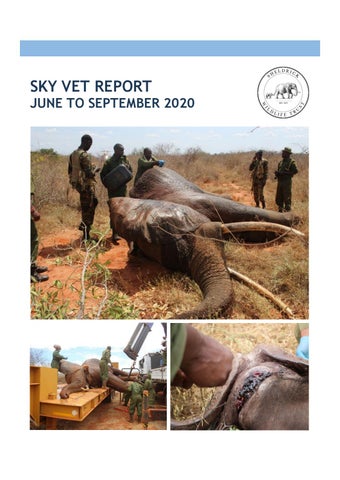
SKY VET REPORT JUNE TO SEPTEMBER 2020
THE SHELDRICK WILDLIFE TRUST
www.sheldrickwildlifetrust.org
SKY VET QUARTERLY OVERVIEW During June to September 2020 the SWT/KWS Sky Vet program was called to handle 10 wildlife cases all of which were supported by the SWT helicopter and fixed wing aircrafts to help with elephant darting operations, a translocation as well as search and monitoring operations. 8 of these cases involved elephants including, 5 poaching cases and 1 HWC case where a young baby elephant was hit by an electric fence and was rescued and taken to the orphanage. There was also 1 relocation of 7 elephants out of the IPZ Rhino Sanctuary as they were destructive to the habitat. Of the elephant poaching cases there were 1 bullet wound case, 1 spear case and 3 arrow cases The other 2 cases included 1 lion human-wildlife conflict case where a lion was relocated with the help of the SWT helicopter after 1 lion was killed by the community in retaliation for livestock predation. The Unit also treated one snared buffalo. Out of the 10 cases treated there was an 70% success rate. Without rapid veterinary response, the majority of these cases would have died from their injuries. The Sky Vet program has deployed KWS vets to the following locations during this reporting period
THE SHELDRICK WILDLIFE TRUST
www.sheldrickwildlifetrust.org
THE SHELDRICK WILDLIFE TRUST
www.sheldrickwildlifetrust.org
CASE 1: 12th JUNE 2020
AMBOSELI NATIONAL PARK
INJURED ELEPHANT
INTRODUCTION The report of an injured elephant bull was received from the senior warden of Amboseli National Park. The Vet travelled by road to Kaluku HQ then was airlifted by the SWT Helicopter to Amboseli for the operation. The helicopter searched for the elephant which was easily found near the original location.
CHEMICAL IMMOBILIZATION & TREATMENT The helicopter approached the bull that was obviously lame on the left front limb. The bull was pushed to a clearing where he was darted with 18mgs Etorphine. He went down after 9 minutes and the ground teams secured the elephant whilst the helicopter and vet landed. The bull had a penetrating wound on the lower left front limb with pus oozing out. The wound was probed, and no foreign object was found. The wound was cleaned with Hydrogen peroxide and tincture of Iodine then covered with green clay. The elephant was also administered with long acting antibiotics and anti-inflammatory drugs intramuscularly and intravenously respectively.
PROGNOSIS Prognosis is guarded due to joint infection.
THE SHELDRICK WILDLIFE TRUST
www.sheldrickwildlifetrust.org
CASE 2: 23RD JUNE 2020
TSAVO WEST
INJURED ELEPHANT
INTRODUCTION The report of an injured elephant bull at Kenani area of Tsavo West was received from the SWT field office at Kaluku after being seen during an aerial recce. The Vet Team found the big bull and was joined by the SWT helicopter to aid in darting as the area is bushy with no off-road tracks
CHEMICAL IMMOBILIZATION & TREATMENT The elephant was approached with the helicopter and pushed towards the road for easy access by the ground teams then darted in the rump with 18mgs Etorphine. He barely moved a few hundred meters before going down on lateral recumbency. The elephant was secured, and water poured on the ears to keep him cool. There was an arrow wound to the left rump that was in the process of healing after the arrow had come out. The wound was flushed with Hydrogen peroxide then doused with Iodine before being packed with green clay. The elephant was also given long acting antibiotics and anti-inflammatory drugs.
PROGNOSIS After treatment, the anesthesia was reversed, and the bull stood up and walked away calmly. The wound was caused by suspected territorial fight with another bull. Prognosis is good
THE SHELDRICK WILDLIFE TRUST
www.sheldrickwildlifetrust.org
CASE 3: 23RD JUNE 2020
KIBOKO, CHYULU HILLS
LION TRANSLOCATION
INTRODUCTION Some lions were reported to be preying on livestock in a Community Village near Masimba township along the NairobiMombasa highway. After several failed attempts by KWS rangers to try and solve the problem, a decision was made to translocate the lion to southern Tsavo West. Due to the thick bush that was inaccessible to vehicles, assistance was sought from the SWT helicopter to assist in darting the lion
IMMOBILISATION AND RELOCATION The lion was darted from the helicopter with 300 mgs of Ketamine mixed with 4 Mgs of Meditomidine Hcl. The lion was darted after it was tracked through the thick bush and he went down but was still alert and it had to be darted again from the ground. She was then blind folded and loaded into a cage trap after which the anaesthesia was reversed with Atipemazole Hcl.
PROGNOSIS The lion was transported about 250kms away to southern Tsavo West National Park and released calmly at night.
THE SHELDRICK WILDLIFE TRUST
www.sheldrickwildlifetrust.org
CASE 4: 2ND JULY 2020
RUKINGA RANCH
SNARED BUFFALO
INTRODUCTION The report of a snared buffalo was received from Wildlife Works Rangers patrolling the ranch. Due to the thick habitat in the area the SWT helicopter was called in to assist. The Vet Unit joined the Wildlife Works Rangers who were keeping an eye on the buffalo herd.
INTERVENTION AND TREATMENT The buffalo was approached with a vehicle and darted in the rump with 8mg of Etorphine and 80mgs Azaperone. He went down after 6 minutes and was quickly secured, placed in a sternal position and a blindfold placed over the eyes. The tight wire snare around the neck was removed and the neck injuries treated with dilute Hydrogen peroxide and tincture of Iodine, then sprayed with Oxytetracycline. Wetted green clay was smeared on the wounded neck. Long acting antibiotics and anti-inflammatory drugs was administered parenterally
PROGNOSIS The anaesthetic was reversed with Diprenorphine at 3 times the Etorphine dose. Prognosis is good.
THE SHELDRICK WILDLIFE TRUST
www.sheldrickwildlifetrust.org
CASE 5: 3rd JULY 2020
GALDESSA
ELEPHANT RESCUE
INTRODUCTION A report was received concerning a lone elephant orphan in Tsavo East National Park not far from the Galdessa area.
RESCUE One of the Trust’s helicopters assisted in the rescue of a young elephant calf that had been separated from its mother. After a stressful attempt was made to reunite the calf with the herd that it was believed to belong to, it was determined that a rescue was necessary. Unfortunately, the calf was very weak and succumbed shortly after being rescued.
THE SHELDRICK WILDLIFE TRUST
www.sheldrickwildlifetrust.org
CASE 6: 30TH JULY 2020
GALANA CONSERVANCY
INJURED ELEPHANT
INTRODUCTION The report of an injured elephant bull in the Galana Conservancy, bordering Tsavo East National Park, was received from KWS Rangers manning the eastern park boundary. The Vet Team responded the day before, but the bull vanished into thick bush. The next day the elephant was seen by the rangers who reported it promptly. The SWT helicopter was on standby to airlift the Vet to the area as they were 120kms away.
TREATMENT The elephant was approached with the helicopter and darted in the rump. The helicopter pushed the elephant towards a road for easy access by the ground teams. There was an arrow wound to the right knee joint with marked swelling and infection making the joint inflexible. A small incision was made to the medial aspect of the limb and an arrowhead pulled out with difficulty. The elephant was administered with long acting antibiotics and anti-inflammatory drugs intramuscularly and intravenously respectively
PROGNOSIS The bull was given a clean bill of health and the anesthesia was reversed. He stood up and walked away calmly. Prognosis is good.
THE SHELDRICK WILDLIFE TRUST
www.sheldrickwildlifetrust.org
CASE 7: 8TH AUGUST 2020
AMBOSELI NATIONAL PARK
INJURED ELEPHANT
INTRODUCTION SWT reported a lame elephant at Mwatate. The SWT aircraft picked AMVU team from Amboseli while an SWT helicopter was used for darting. A second aircraft monitored and assisted in locating the bull.
INTERVENTION AND TREATMENT The elephant was darted from a helicopter with 20mg Etorphine. The dart was placed well at the backline and worked effectively (11 minutes post-darting). Examination revealed the elephant had a wound on the right foreleg. The wound had no pus and almost no secondary bacterial infection. However, the injury was old, deep, and extended to the joint. It was hard to determine the cause of injury, but it could be an arrow wound. Joint involvement helps explain the lameness. The wound was debrided with Hydrogen peroxide and irrigated with Iodine. The elephant was administered 80ml Amoxicillin for secondary infection and 20ml of Dexamethasone to manage inflammation.
PROGNOSIS Prognosis for full recovery is good
THE SHELDRICK WILDLIFE TRUST
www.sheldrickwildlifetrust.org
CASE 8: 11TH AUGUST 2020
MARA TRIANGLE
INJURED ELEPHANT
INTRODUCTION This big bull was spotted by a visitor to a camp near Mara River with an injury below his tail. The elephant was drinking water from Mara River. The veterinary unit were alerted for action.
INTERVENTION AND TREATMENT The SWT helicopter located this bull as the ground team could not find him as he had crossed the river. The dorsal perineal area, just below his tail, was swollen with a slightly discharging wound. Examination revealed a septic wound, likely caused by spearing, and maggots were already infesting. This was likely a conflict incident. Oxytetracycline wound spray was applied topically then green clay was packed to absorb toxins and prevent further sepsis. Other treatments given include parenteral administration of Amoxicillin antibiotics, Flunixin meglumine anti-inflammatories and ivermectin parasiticide.
PROGNOSIS The anaesthetic was reversed, and he got up and moved to a nearby bush. Prognosis is good.
THE SHELDRICK WILDLIFE TRUST
www.sheldrickwildlifetrust.org
CASE 9: 25TH AUGUST 2020
LUALENI RANCH
ELEPHANT RESCUE
RESCUE The Vet Team sent the nearby SWT de-snaring team to check out the calf’s condition. The calf was found weak and could not stand up prompting an emergency rescue operation to be initiated. The calf was rescued and taken to the Voi SWT Stockade. It was stabilized by IV infusion of Dextrose, Ringers lactate and normal saline. He was also administered with Dexamethasone and long acting antibiotics. The treatment continued the next day and the calf was deemed stable enough to be airlifted to the SWT orphanage in Nairobi. Sadly, after arrival the calf was too weak to pull through and died at the nursery.
THE SHELDRICK WILDLIFE TRUST
www.sheldrickwildlifetrust.org
CASE 10: 26TH AUGUST 2020
IPZ, TSAVO WEST NP
ELEPHANT RELOCATION
INTRODUCTION The remnant elephant population that was left inside Ngulia Rhino Sanctuary and other elephants who broke into the sanctuary, increased in number and began breaking the infrastructure put in the sanctuary to supply water to the rhinos and also sanctuary staff. The elephants, particularly notorious bulls, were earmarked for translocation out of the Sanctuary to reduce the damage to the sanctuary facilities. The entire operation took two days.
IMMOBILISATION, EXAMINATION AND TREATMENT The first bull was darted with 18mgs of Etorphine but the dosage was upped to 20mgs for the other bulls after the initial dose didn’t work well. 40mgs of Azaperone was added into the darts to stabilise the blood pressure. The elephants were darted from a helicopter and pushed to areas easily accessed by ground teams, then loaded into open trucks on lateral recumbency and transported out of the Sanctuary.
PROGNOSIS They were then placed on the ground and the anaesthesia reversed before the elephants were left to walk away. Water was splashed on the body and ears to keep them cool. The journey took between 1 and 3 hours depending on the route taken.