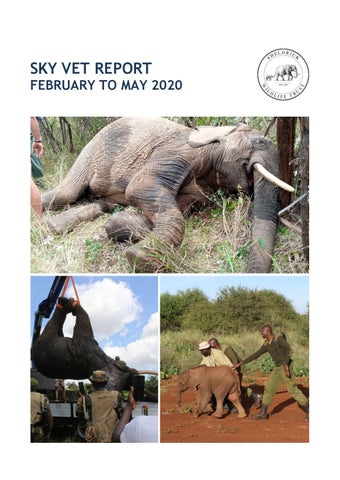
SKY VET REPORT FEBRUARY TO MAY 2020
February to May 2020
THE SHELDRICK WILDLIFE TRUST
www.sheldrickwildlifetrust.org
SKY VET QUARTERLY OVERVIEW During February to May 2020 the SWT/KWS Sky Vet program was called to handle 12 wildlife cases most of which were supported by the SWT helicopter as well as one outsourced aircraft to help with elephant darting operations as well as search and monitoring operations. 11 of these cases attended to involved elephants including 1 HWC case where 2 elephants were relocated from Kibwezi town. There was also 1 lion human-wildlife conflict case where a lion was relocated with the help of the SWT helicopter after 1 lion was killed by the community in retaliation for livestock predation. Of the elephant cases there were 2 snares, 1 bullet wound, 1 spear, 2 rescues, 1 HWC and 4 cases relating to natural causes. Out of the 12 cases treated there was an 67% success rate. Without rapid veterinary response, the majority of these cases would have died from their injuries. The Sky Vet program has deployed KWS vets to the following locations during this reporting period
February to May 2020
THE SHELDRICK WILDLIFE TRUST
www.sheldrickwildlifetrust.org
February to May 2020
THE SHELDRICK WILDLIFE TRUST
www.sheldrickwildlifetrust.org
CASE 1: 4th FEBRUARY 2020
SHIMBA HILLS
INJURED ELEPHANT
INTRODUCTION A report was made of a seriously lame elephant bull in the Mwaluganje Wildlife Sanctuary, Shimba Hills National Reserve, by the warden in charge. Due to the long distance and the difficult terrain in the reserve, the team was airlifted by the SWT helicopter to the area. After more than 30 minutes of searching the young bull was located alone and limping badly.
CHEMICAL IMMOBILIZATION & TREATMENT The ground teams were directed to an area near where the animal was sited. The helicopter approached the bull and pushed him to a clearing where he was darted in the rump. There was a deep cutting wire snare around the hind right limb which was bleeding and infected. The snare had cut through the tissues causing a deep wound around the lower leg. The snare was a high tensile wire with multiple strands, commonly used to lift heavy loads on cranes or in pulleys in vehicle winches. Attempts to cut loose the wire using a wire cutter were unsuccessful and a Leatherman was used instead to loosen the woven wires strand by strand. The wound caused by the snare was cleaned with Hydrogen peroxide and tincture of Iodine then covered with green clay. The elephant was administered with long acting antibiotics and anti-inflammatory drugs
PROGNOSIS Having administered the treatment, the bull was given a clean bill of health and a good prognosis
February to May 2020
THE SHELDRICK WILDLIFE TRUST
www.sheldrickwildlifetrust.org
CASE 2: 22ND FEBRUARY 2020
SALA, TSAVO EAST
INJURED ELEPHANT
INTRODUCTION The elephant was seen with a snare along the Galana River by tour drivers who reported to the honorary warden who conveyed the same to the SWT pilot. Due to the distance and time, the SWT helicopter was dispatched to collect the vet from Voi and fly to the area, approximately 100kms away. The elephant was located leaving the river and she tried to run back but the helicopter pushed her onto open ground.
CHEMICAL IMMOBILIZATION & TREATMENT The wire snare around the neck had cut through the tissues causing a deep wound around the upper neck, ear and lower neck. The snare was a high tensile wire commonly used to lift heavy loads and in pulleys in vehicle winches. Attempts to cut the wire with a wire cutter was unsuccessful and a knife had to be used to cut loose the wires strand by strand. The wound caused by the snare was cleaned with Hydrogen peroxide and Iodine, then sprayed with Oxytetracycline spray and finally covered with green clay. The elephant was administered with long acting antibiotics and anti-inflammatory drugs both intramuscularly and intravenously respectively.
PROGNOSIS After treatment, the bull was given a clean bill of health and the anaesthesia was reversed. The cow stood up and walked away calmly. Prognosis is good
THE SHELDRICK WILDLIFE TRUST
www.sheldrickwildlifetrust.org
CASE 3: 24TH FEBRUARY 2020
KIBWEZI, TSAVO EAST
INJURED ELEPHANT
INTRODUCTION It was reported that two elephants broke out of Chyulu Hills National Park and entered a small forest near Kibwezi town causing human-wildlife conflict within the local community. There were several failed attempts to push the animals back into Chyulu National Park and authorization was sought to immobilise and translocate the animals back to the Park. The Tsavo Veterinary Unit teamed up with the SWT Aerial Unit and translocation team for the exercise.
RELOCATION The SWT helicopter searched for and easily located the elephants in thick bush within the forest. Several attempts to drive the two bulls into an open area failed. Eventually, the helicopter drove the bigger tusked bull was into an open area near the edge of the forest where it was darted with 18 mgs of Etorphine and 50 mgs of Azaperone. The helicopter kept the bull in the open area until the drugs took effect. Water was poured onto the elephant whilst the self-loading lorry was moved into place. The elephant’s feet were secured by straps and it was lifted by a crane into a flat-bed trailer. The elephant was transported into Chyulu Hills National Park and released in good health. The second bull vanished deep into the forest and could not be located.
THE SHELDRICK WILDLIFE TRUST
www.sheldrickwildlifetrust.org
CASE 4: 25TH FEBRUARY 2020
LAIKIPIA
INJURED ELEPHANT
INTRODUCTION A lame elephant was reported at the Laikipia Nature conservancy. The veterinary team attended to the case. Darting was done from a helicopter using 16 mg etorphine. The elephant went down in about 7 minutes.
POSTMORTEM On examination, the elephant was observed to have had a multiple, open, compound fracture on the proximal left fore limb. A decision was made to euthanize the elephant to alleviate suffering and pain.
The left fore limb had suffered an open, multiple, compound fracture and dark tinted blood was oozing from the wound. The wound was fresh probably about 2 days old. Bone fragments were retrieved from the fractured region. The fracture was located on the humerous and scapular.
PROGNOSIS A bullet head suspected to be from an AK 47 rifle was also retrieved from the wound.
THE SHELDRICK WILDLIFE TRUST
www.sheldrickwildlifetrust.org
CASE 5: 11TH MARCH 2020
ITHUMBA, TSAVO EAST
INJURED ELEPHANT
INTRODUCTION The report of an injured elephant bull was received from the SWT HQ of an injured elephant bull that is a former orphan near the Ithumba area of Tsavo East. The vet travelled by road to Kaluku then was airlifted by the SWT helicopter to Ithumba for the operation. The elephant was searched for using the helicopter and fixed wing plane for nearly one hour before finally being located
INTERVENTION AND TREATMENT A dart was prepared and filled with 18 mgs of M99 and 40 mgs of Azaperone. The ground teams were directed to an area near where the animal was sited. The helicopter approached the bull, that had an obvious injury, and pushed him to a clearing where he was darted. There was a deep spear wound to the left rump going in a caudal direction. The wound was fresh and must have been inflicted less than 2 days before. The wound was cleaned with Hydrogen peroxide and tincture of Iodine, then finally covered with green clay. The elephant was administered with long acting antibiotics and anti-inflammatory drugs intramuscularly and intravenously respectively. Throughout the treatment, the elephant was kept cool with copious amounts of water poured on the ears to cool the elephant.
PROGNOSIS Having administered the treatments, the bull was given a clean bill of health and the anaesthesia was reversed. The bull stood up and walked away calmly. Prognosis is good.
THE SHELDRICK WILDLIFE TRUST
www.sheldrickwildlifetrust.org
CASE 6: 14TH MARCH 2020
MARA NORTH
RESCUED ELEPHANT
INTRODUCTION This baby elephant, just a few days old, was seen by Community Members abandoned on a small but muddy pool. They informed KWS rangers on patrol, Mara North Conservancy Rangers and Mara Elephant project teams for action. The teams contacted the Mobile Veterinary Unit for assistance.
RESCUE This baby was found recumbent after being taken out from the pool. Close examination indicated she was hypothermic and hypoglycaemic. This baby was a few days old with the umbilical cord stump still wet. She appeared not to have suckled for some time and the situation was complicated by prolonged recumbency on a wet environment. She had aspirated dirt from the pool as evidenced by her struggle to breath with audible respiratory sounds. The right nostril was partially blocked by aspirated mud which was cleared as she was being stabilized. She was covered with a warm blanket then given intravenous administration of Dexamethasone sodium to prevent shock and as an anti-inflammatory. She was also given dextrose intravenously to boost energy and Polyionic ringer’s lactate.
MANAGEMENT After being stabilized, a decision was arrived at to airlift her to the SWT elephant orphanage in Nairobi for more specialised care under close observation
THE SHELDRICK WILDLIFE TRUST
www.sheldrickwildlifetrust.org
CASE 7: 28TH MARCH 2020
CHYULU HILLS
INJURED ELEPHANT
INTRODUCTION The elephant was spotted by SWT teams based at Kenze, Chyulu hills who conveyed the information to the Kaluku field office. The Tsavo Veterinary Team drove to the area which is about 140Kms away from their station. On the ground we were met with a team of SWT teams and shortly after the SWT helicopter arrived. Darting accessories were prepared and the vet boarded the helicopter to dart the elephant.
INTERVENTION AND TREATMENT A dart was prepared with 18mgs of Etorphine and 60mgs of Azaperone. The elephant was searched for briefly and easily found and darted from the air and went down in 9 minutes. Once immobilized, the elephant was pushed to lateral recumbency. Examination revealed a lesion around the prepuce and the base of the penis with pus and tissue debris covering it. This elephant bull had been treated 3 times previously near Oldonyo Wuas lodge in Chyulu and the injury now showed signs of healing. The condition was diagnosed as squamous cell carcinoma of the prepuce. The wound was cleaned with Hydrogen peroxide and Iodine. Oxytetracycline spray was applied and then covered with green clay. The elephant was further administered with long acting antibiotics and anti-inflammatory drugs intramuscularly and intravenously respectively.
PROGNOSIS Having administered all the treatments, the bull was given clean bill of health the anesthesia was reversed
THE SHELDRICK WILDLIFE TRUST
www.sheldrickwildlifetrust.org
CASE 8: 28TH MARCH 2020
ITHUMBA, TSAVO EAST
INJURED ELEPHANT ORPHAN
INTRODUCTION An urgent flight was needed to attend to one of the Trust’s orphan elephants named Barsilinga who is based at the Ithumba stockades in northern Tsavo East.
INTERVENTION AND TREATMENT Barsilinga had an accident where the sole of his foot came off during a day in the bush. Specialist medical supplies were desperately needed to be sent down on a flight from Nairobi. As well as flying in the veterinary officer to carry out the procedure. The operation went well.
PROGNOSIS Good. Barsilinga is recovering well from the incident.
THE SHELDRICK WILDLIFE TRUST
www.sheldrickwildlifetrust.org
CASE 9: 5TH MAY
AMBOSELI
ELEPHANT RESCUE
RESUE At the water hole, a herd of elephants gathered for a drink. A tiny baby elephant attempted to join them, but was repeatedly pushed away. Eventually, the herd started to move on, and when the calf attempted to follow, he was rejected again, pushed back and abandoned, left al alone. At this point, the owners of the Amboseli Bush Camp, who had been observing the interaction, realized that something was very wrong and called Big Life for help. Nearby Big Life rangers were dispatched immediately on a motorbike to survey the area, and they confirmed that the baby elephant was lost, and that his family was nowhere to be found. He was very thin with his cheek bones evident and was very young despite being a leggy large baby. The Kenya Wildlife Service was alerted, and the Sheldrick Wildlife Trust was called in for assistance. He was feisty and strong throughout the rescue process, refusing any of the water offered. But once in the care of the highly experienced keepers at the Sheldrick’s Kaluku Field Headquarters, he took four bottles of milk. He wa then prepared for the flight back in the helicopter to Kaluku. He’s been named Sabuk, meaning big/large in Maa, as they believe that he’s only 4 weeks old despite being som big for his age. Big Life rangers have since done a thorough search of the area and found a female elephant carcass not too far from where the baby was discovered, that is suspected to be his mother. It was lucky he was discovered before lions found him.
MANAGEMENT Once at the Kaluku stables he was very restless and distressed and his body temperature soaring. This what was attended to first trying to get his temperature down to an acceptable range. This was done dowsing water behind his ears and eventually he calmed down. Later he took some more milk and was settled in a stable after medication was administered. By the next morning he was glued to his keepers absolutely convinced that he might be abandoned again - he had to have his forehead touching them at all times trailing them constantly in such close contact. He has since been named Sabuk.
THE SHELDRICK WILDLIFE TRUST
www.sheldrickwildlifetrust.org
CASE 10: 15TH MAY 2020
KIASA, TSAVO EAST
INJURED ELEPHANT
INTRODUCTION The report of an injured Elephant cow was received from DSWT field operations office in Kaluku where an aerial recce had spotted a lame Elephant cow in Kiasa area of northern Tsavo East. The Vet travelled by road to Kaluku then airlifted by SWT Helicopter to Kiasa for the operation. The Elephant was searched using Helicopter and easily spotted nearby.
INTERVENTION AND TREATMENT The chopper approached the Elephant cow that had an obvious injury on the left front limb, they separated her from the rest of the herd and pushed her to a clearing where she was darted. She went down after 6 minutes and the ground teams were called in to secure the Elephant before the vet could land and join them few minutes later. There was a penetrating wound on the lower area pf the left front limb with pus oozing out. The wound was probed and a foreign object which happened to be a sharp wooden stick was removed. The wound was cleaned by use of dilute hydrogen peroxide then splashed with tincture of iodine and finally covered with green clay. The Elephant was administered with long acting antibiotics and anti-inflammatory drugs.
PROGNOSIS The cow stood up and walked away calmly. Prognosis is guarded due to joint infection.
THE SHELDRICK WILDLIFE TRUST
www.sheldrickwildlifetrust.org
CASE 11: 15TH MAY 2020
MTITO ANDEI
LION TRANSLOCATION
INTRODUCTION After the killing of a young Lion near Mtito Andei, the mother was also reported to be predating on livestock in nearby community village. After several attempts to by KWS rangers to try and solve the problem in vain, a decision was made to capture and translocate the Lioness to southern Tsavo West. Due to the thick bush which was inaccessible to vehicles assistance was sought from the SWT helicopter to aid in darting.
INTERVENTION AND RELOCATION The Lioness was immobilized by use of 300 mgs of Ketamine mixed with 3 Mgs of Meditomidine Hcl in a 3 cc Dan inject dart. Chopper darting was employed, and the Lioness was darted finally after 2 failed attempts. She was loaded into a cage trap and anaesthesia reversed by use of Atipemazole Hcl then transported 150 KMs away to southern Tsavo West National Park and released. The Lioness was colored hence so that her movements could be monitored.
THE SHELDRICK WILDLIFE TRUST
www.sheldrickwildlifetrust.org
CASE 12: 26TH MAY 2020
EMUSAYA, TSAVO EAST
INJURED ELEPHANT
INTRODUCTION A call was received from KWS rangers based in the Emusaya area on the eastern border of Tsavo East near Sala gate that an Elephant bull had been seen with pus oozing from the upper part of the right front limb. He was in company of 2 other bulls. The Vet team was airlifted to by SWT Helicopter to the area. On arrival the bull was quickly located as the rangers were observing him.
INTERVENTION AND TREATMENT A dart was prepared and filled with 18 mgs of M99. The Elephant was approached using a Helicopter and darted on the rump. He moved away but was controlled by the chopper and fell on the road. This bull was a natural tuskless bull. The Elephant was secured, and water poured on the ears to cool down. There was a penetrating wound on the upper side of the right arm and another on the perineal area below the anal opening with pus oozing out from both wounds. The wounds were flashed with dilute hydrogen peroxide and with tincture of iodine to remove pus and necrotic tissue debris before a final cover with green clay applied. The Elephant was administered with long acting antibiotics and anti-inflammatory drugs intramuscularly and intravenously respectively. All this time copious amounts of water was poured on the ears to cool the Elephant down. Having administered all the treatments, the bull was given a clean bill of health and anaesthesia was reversed by use of M5050 at three times the Etorphine dose.
PROGNOSIS The wound was caused by suspected territorial fight with another bull. The bull stood up and joined his mates. Prognosis is good.