AERIAL SURVEILLANCE UNIT MONTHLY REPORT
SEPTEMBER 2020
AERIAL STATISTICS
HOURS FLOWN
KMS COVERED
AREAS PATROLLED
SEPTEMBER 2020
214
27,650
Tsavo East, Tsavo West, South Kitui National Reserve, Chyulu Hills National Park, KARI ranch, Mwambeje Ranch, Galana Ranch, Kulalu Ranch
SEPTEMBER 2020
MONTHLY AERIAL PATROL MAP
MONTHLY AERIAL SUMMARY September was another month dominated once again by fires and firefighting. This season continues to be one of the most challenging fire seasons in decades. The primary cause of these fires is the abundance of fuel left over from some of the best rains that Tsavo has seen since 1998. It is no coincidence that if was after the 1998 El Niùo rains when Tsavo last saw fires on a similar scale. For our fixed wing aircraft fires mean a combination of scouting for and assessing ongoing fires whilst helping to direct ground and helicopter efforts to combat the outbreaks. In many of Tsavo’s fires, fixed wing aircraft have been instrumental in identifying roads and natural fire breaks from which to backburn. These operations require a huge amount of coordination to communicate with several different participating stakeholders to get the right resources and personnel in place to achieve successful backburns. Where possible, fires can be directly fought by ground teams either alone or with support from the helicopter making water drops.
.
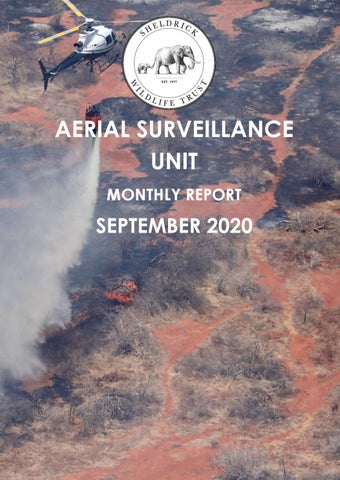
In September, our own helicopter, as well as helicopters hired from Tropic Air, which also used our bambi bucket, were successful in extinguishing several fires. The most serious of these fires was one which was started in the Tsavo triangle to the south of our Field HQ and posed a significant threat to life and property. This fire, in the end, consumed 6 days of efforts with support from KWS, Wildlife Works, Tsavo Trust, Tropic Air, and volunteers from Teita Sisal Estate and Team Tsavo. SWT contributed 6 pilots, 5 aircrafts (including the hiring of a second helicopter), 54 personnel and 13 vehicles, including a grader, truck and 4 water bowsers. Between all of the pilots, nearly one hundred hours were flown on this fire alone. Another fire in the Chyulu Hills National Park consumed similar levels of resources, and was fought over 5 days, eventually requiring assistance from 2 helicopters, both hired from Tropic Air, as our helicopter was unavailable at the time. The helicopters were funded by the Chyulu Hills REDD+ project, of which SWT is a partner member, and their water drops were directed by aircrafts from SWT and Big Life Foundation. Several other fires, mostly in the Chyulus, required aerial coverage and water drops by helicopter, with well over half of the month being dedicated to fire-related flights.
As so much time was spent in service of fire-fighting this month, few general patrols were conducted in areas which might have yielded evidence of poaching. However, the airwing was still able to assist with several charcoal operations in and out of the Park. Most notably, large charcoal surveys were conducted on Mwambeje Ranch to the south and in the north-eastern corner of TE where a commercial operation from South Kitui had returned after several months. Due to the remoteness of the location and difficulty to access, progress by KWS ground teams was slow. The initial ground operation was responded to by the charcoal burners simply moving further east along the northern boundary, eventually straddling the border between Tsavo East and South Kitui National Reserve. In this time, the operation grew to a considerable size, with 28 kilns being recorded on a single flight, and it wasn’t until early October when a multiday operation was able to remove them completely. Elsewhere, small numbers of charcoal burning and logging instances were recorded, such as in the Gazi area, KARI Ranch and in Chyulu Hills National Park. Generally, however, activities in these areas were relatively low for this time of year. Only 1 new elephant carcass was recorded in the month. It was an old carcass, with 1 intact tusk visible from the air. Upon follow-up from a ground team, the 2nd tusk was located nearby, and both were handed over to KWS to be kept in safe storage.
Livestock remains a problem in both Tsavo East and Tsavo West. In Tsavo East, a fairly significant increase in livestock was noted along the Tiva River approaching Ndiandaza, and then a decrease in response to a KWS ground operation. On KARI Ranch, bordering the Chyulu Hills, over a dozen camel bomas were noted, and we eagerly await the correct steps to be undertaken by various government entities to remove any non-KARI livestock and officially close the gates, which now form the only legitimate access into the ranch through SWT’s new elephant exclusion fence. Although very few patrols were conducted in Tsavo West, and almost all of these being conducted in a relatively small area along the Rombo and Ziwani areas, there was a steady increase in livestock observed here, with 20 livestock enclosures being recorded on the last patrol in September. Other activities carried out by the helicopter in September included the delivery of medical supplies to a ground team atop the Yatta Plateau. Highlights included the usual sightings of charismatic carnivores, including wild dog, many sightings of lion and one cheetah.
Photographs copyright © 2020 The David Sheldrick Wildlife Trust