AERIAL SURVEILLANCE UNIT MONTHLY REPORT
MARCH 2020
AERIAL STATISTICS
HOURS FLOWN
KMS COVERED
AREAS PATROLLED
MARCH 2020
134.50
17,424.60
Tsavo East, Tsavo West, Chyulu Hills, South Kitui National Reserve
MARCH 2020
MONTHLY AERIAL PATROL MAP
MONTHLY AERIAL SUMMARY The unusually long November-December rainy season ended up blending into the March-April rainy season, so most of the Park remained green through March, with some areas experiencing huge amounts of rainfall in January and a February. This year, Tsavo has experienced one of the best and widespread ipomoea blooms in recent history. In some places, swathes of white flowers are visible as far as the eye can see. With the continuation of rain, poaching has also remained relatively absent from the Park. In addition to wildlife and particularly elephants still being spread out over a large area, the bush has become almost impenetrable. Many wouldbe poachers appear to be planting their farms for a second time in just a few months, which is not typical in this part of the world, this will also keep the community busy and more importantly well-fed for a little longer. There were, however, a few illegal activities to report, including a spear injury on one of the ex-orphans raised by the Trust.
.
Challa appeared at the Ithumba stockade with what resembled a fresh injury caused by a spear. The following day a search for Challa was conducted by fixed wing aircraft and once he was located, a Trust helicopter assisted the vet in darting Challa so that he could be treated. From the trajectory of the injury, it would appear that the spear was launched from above, possibly from a shooting platform. Several follow-up aerial patrols as well as ground patrols did not turn up any other human activity in the area, so it is hoped that this was an isolated incident. There were another two carcasses that were discovered during the course of the month in the vicinity, however, both appear to have died of natural causes. One was a known, older, bull elephant that had been monitored for several days prior to passing away. It was obvious that he was unwell, but he did not have an external injury that could have been treated. The other carcass was severely decomposed and so a definitive cause of death could not be determined, though the ivory was found intact and it is therefore assumed not to have been poaching related.
A fixed wing aircraft also searched the area ahead of apparent drag marks that had been left by an elephant, but no injured elephants were discovered, nor did tracking the elephant yield any findings. Helicopter patrols similarly did not yield any active poaching activity, but multiple charcoal camps were found and destroyed on a group ranch bordering Tsavo West NP, whilst there is a high probability that charcoal burners were also engaging in bush meat poaching. A total of 5 camps were discovered, along with 54 charcoal kilns and 10 charcoal sacks. These were all attended to either by rangers aboard the helicopter or a multi-day operation conducted by the ground team in the following days. In addition to the treatment of Challa, the helicopter also assisted in the darting of a large bull elephant found by ground teams in the Kibwezi Forest with an infected growth. He is a known bull that has been treated on several occasions in the past due to the recurrence of the same injury. Despite the obvious discomfort, he was treated successfully and was given a good prognosis. He will likely develop an infection again in the future, however, since the growth cannot be removed in its entirety. Three successful HWC cases were attended to by the helicopter around KARI Ranch and the Kibwezi Forest. A total of 4 elephant bulls were successfully moved back into protected areas and out of farmlands. Another HWC callout near Musuuni was unsuccessful because by the time the helicopter arrived, the reported elephants could not be located. One final callout on Wundanyi Hill had to be cancelled due to the precarious position that the elephant had found himself in, in a small patch of forest on a steep incline. There was little room to manoeuvre the helicopter, and upon arriving it was discovered that another elephant that had also been in the area had tragically fallen off a cliff to its death.
There was an influx of cattle in Tsavo West, attracted by thick green grass, and these were the focus of several fixed wing aerial patrols. Although the cattle were not removed completely, there was a decrease in movements observed as a result of aerial patrols and subsequent action by KWS teams on the ground. In Tsavo East, only a small number of cattle were observed and dealt with swiftly by KWS. The Chyulu Hills were cattle free for the entire month, as well as on KARI ranch, where operations are just beginning to remove livestock (primarily camels); a general reduction and migration north was observed by fixed wing and helicopter patrols. Several trips were also made to South Kitui National Reserve, which is in the process of being reclaimed by KWS, including one trip on the ground by an SWT pilot to site the location of an airfield for improved access in the future. Aerial patrols revealed a return of several large camel herds and bomas along the north and south banks of the Thua River in the north of South Kitui. Coordinates of these were passed on to KWS who has a presence on the ground and can respond.
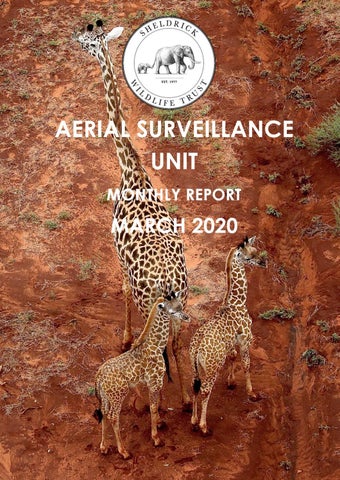
Otherwise, all is generally calm in the Parks at the moment, with most of the area still being relatively green (some places very and other places starting to dry off). For the time being, we will enjoy the lull in illegal activity, but the expectation is that as the economic impact of COVID-19 begins to be felt across Kenya, that there will be increased pressure on the Parks. Fortunately, our work is continuing, and we have taken significant steps to protect ourselves from infection and prepare for the coming months. Highlights for the month included separate sightings of what appeared to be a pair of elephant twins (seen on two different aerial patrols), and a pair of giraffe twins.
Photographs copyright © 2020 The David Sheldrick Wildlife Trust