AERIAL SURVEILLANCE UNIT MONTHLY REPORT
JANUARY 2020
AERIAL STATISTICS
HOURS FLOWN
KMS COVERED
AREAS PATROLLED
JANUARY 2020
108
14,395
Tsavo East, Tsavo West, Chyulu Hills National Park, South Kitui National Reserve, KARI Ranch Kiboko, Lamu
JANUARY 2020
MONTHLY AERIAL PATROL MAP
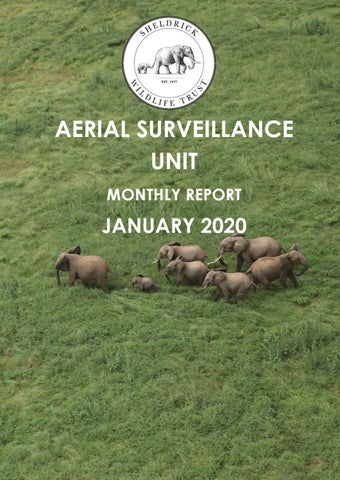
MONTHLY AERIAL SUMMARY Incredibly, the short rains continued throughout January with most of the Park remaining green and experiencing several heavy rainstorms, whereas in a typical year most of the Park has usually dried off by the end of January. This of course has had a favourable impact on poaching activity, since wildlife is still spread out over a large area and has remained difficult to target. Large numbers of elephant were sighted at the furthest reaches of the Park and even far into South Kitui National Reserve. This observation was of particular importance, as South Kitui has been dominated by both charcoal burning activities and livestock for several years and elephants in ones and twos have only seldom ventured in. There has been a huge push by the government to sort Kitui Reserve out and rid it of all illegal activities ensuring this beautiful place becomes a haven for wildlife once more. This year, several breeding herds as well as small groups of bull elephants were seen in the Reserve. This follows the successful push only a few months ago by the government, with aerial assistance from the Trust, to remove all the illegal, human settlement. .
Only one major poaching incident was witnessed in January; an elephant carcass was discovered by one of our ground teams. Although the tusks were recovered, during a follow-up visit by the SWT helicopter, a small arrow wound was noticed and later confirmed during an autopsy by the KWS/SWT Voi Mobile Vet. Fortunately, we were able to remove the tusks before they could be retrieved by the poachers and checks both on the ground and by air along nearby elephant paths and at waterholes did not turn up any other human activity. There was also a small number of incidents of logging activity noted in and outside of the Park. Along a valley that runs parallel to the Yatta Plateau in Tsavo East, 3 cut trees and 3 cooking fires were noted on a helicopter patrol. Of the cut trees, 2 of them were recent and 1 was old and only one of the cooking fires appeared to be recent.
In KARI Ranch, Kiboko, a number of camel bomas as well as one charcoal kiln were sighted and later responded to by ground teams. No illegal activities were noted in the Chyulu Hills, except for an area of settlement in the north of the Park, which is being contested by a local ranching group who claims ownership. The SWT helicopter conducted 2 surveys of the existing settlements and participated in a joint effort with KWS and Big Life Foundation to setup a patrol base from which to operate joint patrols with the aim of addressing potential illegal activities in the area. Surprisingly, cases of human-wildlife conflict were limited in January, with the Trust helicopter only responding to 3 callouts to push elephants back into protected areas from community land. Three elephants were successfully removed from farmland near Ndii, and 1 of 2 reported herds were located and pushed out of communities near Mtito Andei back into the Tsavo Triangle.
Veterinary cases were also minimal during the month, with our Aerial Unit assisting in 2 cases, including one elephant with a suspected arrow wound, which was first sighted by Keith Hellyer from Wildlife Works near Ngutuni. An SWT fixed wing aircraft collected and transported the Amboseli vet from Amboseli Headquarters to Voi where he was transferred into the SWT helicopter so that the bull elephant could be darted and treated. The wound was inspected and cleaned out by the vet before the elephant was given a good prognosis for recovery. A second elephant was first sighted by the SWT K9 Unit and then over the course of 2 days was monitored from the air until a vet could be flown in from Nanyuki since the Amboseli Vet was tied up on a number of other cases on the Taita Ranches. This large bull had been spotted with a huge festering abscess on its abdomen, which was producing large amounts of pus and blood which posed a significant risk to his life. Fortunately, having moved into very thick bush, the helicopter was able to push him back to towards a nearby road after he was darted, and he went down within view of a waiting vehicle and the treatment went ahead without a hitch. After the wound had been properly cleaned and the elephant had been administered with antibiotics, he was also given a good prognosis for recovery. A third elephant was sighted near Ithumba with what appeared to be an arrow wound where the trunk attaches to the face; however, it was apparent to the veterinarian in close-up photographs that the wound had a very good chance of healing on its own, so a treatment was deemed unnecessary.
Livestock activity remained minimal in Tsavo East, with only a few herds coming in only a short distance into the Park to the south of Kone and from the town of Maungu on the Mombasa highway. However, later in the month, a larger incursion of cattle was caught early as herders attempted to move further into the Park towards Ndiandaza. Coordinates were provided to KWS and they responded to this threat with ground teams. In Tsavo West, large numbers of cattle persisted in the southern most extent of the Park between Kasigau Gate and Kivuma Hill, and a fresh incursion of cattle was detected to the south of Lake Jipe, with around 8 bomas located and reported to KWS for action. Elsewhere in Tsavo West, cattle operations in recent months seem to have been successful. Highlights in January included the usual sightings of Tsavo East’s remaining Rhino residents as well as multiple sightings of honey badgers and equally elusive aardwolf. An hours-old elephant calf was also spotted within metres of a fresh placenta a few kilometres from the SWT field HQ at Kaluku.
Photographs copyright © 2020 The David Sheldrick Wildlife Trust