AERIAL SURVEILLANCE UNIT MONTHLY REPORT
JANUARY 2021
AERIAL STATISTICS
JANUARY 2021
182 HOURS FLOWN
22,792 KMS COVERED
AREAS PATROLLED
Amu Ranch, Rukinga, Mwaluganje Elephant Sanctuary, Tsavo East and West, Chyulu Hills
JANUARY 2021
MONTHLY AERIAL PATROL MAP
MONTHLY AERIAL SUMMARY A staggering 20 human-elephant conflict cases were responded to by the SWT helicopter in January. The majority of these cases occurred in the communities along the Mtito River in Tsavo East. This has been a hotspot for humanelephant conflict in the past but conditions this year have brought large numbers of elephants into the area, with several groups of bulls choosing to remain permanently. On one occasion as many as 48 elephants were driven by the helicopter back into the Park. Unfortunately, even the efforts of the helicopter provided only temporary relief, with elephants moving back into the community in as little as a day. One particular bull was causing so much stress to the members of a village, that KWS requested SWT to assist with his immobilization and translocation. The morning of the operation, a helicopter was used to push the bull back into the Park to avoid any immediate threat from attack, either to or from the elephant. The KWS/SWT mobile vet from Amboseli was shortly on his way by vehicle and a fixed wing aircraft was deployed to monitor the bull’s location. Once all teams were in place, including the SWT Translocation Unit and crane truck, the elephant was darted from a helicopter, fitted with a satellite tracking collar provided by Save the Elephants, and loaded on the crane truck to be moved to Tsavo West, on the other side of the Mombasa highway and the new standard gauge railway. He could only be moved asleep due to the infrastructural challenges of railway underpasses Inhibiting a container truck’s passage so he could not be transported awake. These Infrastructural obstacles apparently did not provide enough of a barrier, and within 24 hours the elephant was already back into the community and has remained there ever since. While not ideal, with the collar fitted, he is now much easier to keep tabs on, and if necessary, it will be much easier to locate and move him again in the future.
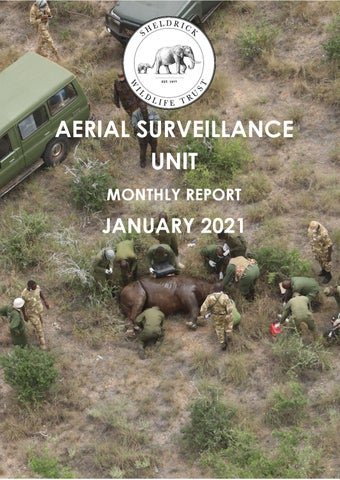
Two other veterinary cases were attended to in January with helicopter assistance. One case was an elephant on Rukinga Ranch that had been spotted by a Wildlife Works pilot with a terrible snare wound. Fortunately, once darted from the helicopter, the vet was able to swiftly remove the snare and clean the wound and had given the elephant an excellent prognosis for recovery. The second veterinary case was a repeat patient in the Mwaluganje Elephant Sanctuary, which the Sheldrick Trust also supports. The young bull had previously been treated for a snare wound, and was this time found with an injury to his foot pad. Once again, he was darted from the helicopter and treated, and is expected to make a full recovery. Both fixed wing aircrafts and helicopter were instrumental in support of a rhino ear notching operation in Tsavo East towards the end of the month and beginning of February. For purposes of identification, almost all rhinos in Kenya are marked with unique ear notches to help rangers identify them in the wild. Over the course of several days, 2 SWT Super Cubs and the helicopter, as well as 2 KWS fixed wings searched the Tsavo East Rhino IPZ for unmarked rhinos that have been born since the last operation was conducted almost a decade ago. From a total of 10 possible candidates, 8 were located. 2 of these were mothers with young calves and were not interfered with; however 6 candidates were successfully darted, notched and fitted with radio transmitters. It should be noted that 1 of the young calves sighted during the operation was less than a week old and previously unrecorded. Its birth brings the Tsavo East population up to 19 from a low of only 9 individuals. There are a number of young females that are coming of age, so the population is expected to continue increasing exponentially.
Livestock activity essentially remained unchanged since December, with small incursions being identified during aerial recces in predicable areas of both Tsavo East and West and responded to by KWS. There was a slight uptick in Southern TE, but with an increase in aerial patrols in that area, and several successful arrests by KWS, this was brought under control relatively quickly. Charcoal activity was also minimal in January with only a small number of charcoal kilns identified, mostly in South Kitui National Reserve. One of the larger, ongoing charcoal operations in SKNR, on the northeast corner of Tsavo East seems to have been suspended for now. It is an extremely difficult corner of the Park to access regularly by vehicle so increased aerial coverage is essential to keep this operation from starting back. Although no fresh activity was observed here, some recent lorry tracks were noticed on one patrol, along with several charcoal kilns that had been partially prepared. Marijuana cultivation has increased slightly in Chyulu Hills NP, with growers abandoning large, expansive plots for smaller, better concealed plots under forest canopy. Although more difficult to spot, 7 small plots were identified during aerial recces and responded to by ground teams who were able to uproot these crops before they could be harvested. Continuing a downward trend, poaching activity was minimal in January. Three (3) cooking fires were spotted during a helicopter patrol, 2 of which were active. The helicopter also responded to a callout from one of the ground teams that found a poacher’s hideout in the Northern Sector and one poacher was successfully captured. One elephant carcass was discovered in January, along the banks of the Galana River; however, its tusks were intact and there was no evidence of poaching, leading to the assumption that it died of natural causes.
Sadly, our helicopter was also called to assist in the search for survivors after a Kenya Defence Force aircraft crashed into Irima Hill. Upon arrival, it became apparent that there would be no survivors. The large, twin engine plane had been flying low-level in poor weather and flown straight into the side of the Irima Hill, killing all on board. While locusts have been plaguing the north of Kenya for almost a year, Tsavo has been largely spared; however, there are an increasing number of desert locust swarms being observed in Tsavo. Two swarms were followed by SWT aircraft, originating to the north of our Tsavo HQ and moving southwest through the Tsavo Triangle. Fortunately, they were immature locusts and would not have been laying eggs, but we will continue to monitor any additional swarms as they obviously pose a significant threat to the Park and to the neighbouring communities who are comprised predominately of subsistence farmers. There were a number of interesting sightings in January, including the elusive caracal, as well as more commonly sighted leopard and cheetah. Several sightings of wild dog were also made.
Photographs copyright © 2021 The David Sheldrick Wildlife Trust