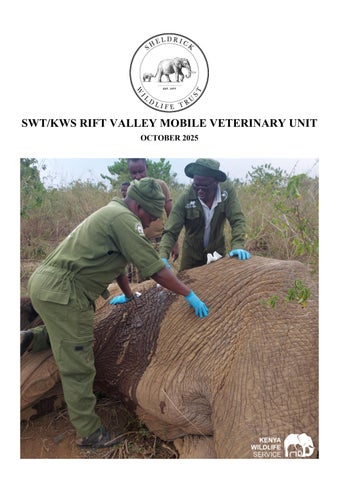
SWT/KWS RIFT VALLEY MOBILE VETERINARY UNIT OCTOBER 2025
Introduction
20 Cases in October 2025
10 Poaching Cases
2 Elephant Cases
October Report by Dr. Titus Kaitho The Unit attended to 20 cases during the month of October including 10 poaching cases. Both elephant cases involved an elephant with a spear injury, including its subsequent postmortem. The other poaching cases were 7 zebras and 1 waterbuck which were caught in snares. The HWC cases involved 2 zebra and 1 giraffe. Acknowledgement We sincerely thank Sheldrick Wildlife Trust (SWT) for support, resources & sponsorship of the Unit. Angela Sheldrick SWT CEO, we acknowledge your unwavering support in the work undertaken by the Unit. KWS is acknowledged for general operational & leadership. Wildlife Research & Training Institute (WRTI) supported the activities by hosting staff. We sincerely thank all everyone who reported wildlife cases in distress.
SWT/KWS Rift Valley Mobile Vet Unit Treatment Locations October 2025
Case Details Date 6-Oct-25 7-Oct-25 7-Oct-25 8-Oct-25 8-Oct-25 9-Oct-25 9-Oct-25 10-Oct-25 10-Oct-25 12-Oct-25 12-Oct-25 13-Oct-25 21-Oct-25 22-Oct-25 22-Oct-25 24-Oct-25 26-Oct-25 28-Oct-25 29-Oct-25 30-Oct-25
Species
Area Found
Reason for Intervention
Outcome
Zebra
Lentolia Conservancy
Snared
The zebra had been snared by a long winch wire on the neck
Successfully Treated
Zebra
Hells Gate NP
Snared
Had been snared and severely wounded by a winch wire on the right hind leg
Successfully Treated
Zebra
Kedong Ranch
Snared
Had been snared and severely wounded by a winch wire snare on the left hind leg
Successfully Treated
Zebra
Soysambu Conservancy
Snared
The zebra had been snared and wounded by wire snare on right hind leg
Successfully Treated
Zebra
Soysambu Conservancy
Snared
The zebra had been amputated by a wire snare at the front left leg
Prognosis Poor
Giraffe
Naivasha
HWC
The male giraffe had slipped and fallen into open moat/trench filled with water
Task Successful
Zebra
Hells Gate NP
Rescue
The foal’s mother had died from a snare injury and required rescuing
Taken to Orphanage
Giraffe
Naivasha
Natural Causes
The giraffe had suffered severe myiasis affecting the entire lower lip of the mouth
Successfully Treated
Zebra
Naivasha
HWC
The zebra had been knocked down by a vehicle on Naivasha-Nakuru Highway
Prognosis Poor
Zebra
Kedong Ranch
Snared
The zebra had been snared and wounded by wire snare on the neck & leg
Successfully Treated
Zebra
Naivasha
HWC
The zebra had been hit a moving vehicle at old Mahimahiu Highway
Prognosis Poor
Giraffe
Naivasha
Natural Causes
On examination the female giraffe had suffered dystocia
Successfully Treated
Elephant
Kedong Ranch
Spear
The elephant had suffered a stab wound caused by a spear
Successfully Treated
Other
Naivasha
Research/ Survey
To address the concerns of loss of wildlife due to habitat loss, road kills and poaching
Task Successful
Zebra
Lentolia Conservancy
Snared
A female zebra had been severely wounded by a wire snare
Prognosis Poor
Giraffe
Naivasha
Natural Causes
A male giraffe calf was heavily infected on lower jaw & infested by maggots
Died
Elephant
Kajiado
Spear
Repeat treatment for a deep thoracic spear stab wound which was pus filled
Poaching Death
Giraffe
Loldia Conservancy
Natural Causes
A male giraffe had been wounded on the rump by a sharp object – wooden stump
Successfully Treated
Other
Naivasha
Natural Causes
Daisy had suffered a self-inflicted injury of the 3rd claw – right front leg
Successfully Treated
Waterbuck
Naivasha
Snared
On examination the female waterbuck had been snared by a wire on the neck
Successfully Treated
Case 1 – 6th October 2025 Zebra
Snare
Lentoila Conservancy
The zebra was darted using 5mg Etorphine plus 60mg Azaperone. On examination the zebra had been snared by a long winch wire on the neck which was strangulating the neck. Fortunately, the zebra had minor lacerations on legs & neck injuries so once the snare was removed no further treatment was required and the anaesthetic was reversed.
Case 2 – 7th October 2025 Zebra
Snare
Hells Gate National Park
The male zebra was darted using 5mg Etorphine plus 60mg Azaperone. On examination the zebra had been snared and severely wounded by a winch wire on the right hind leg. The wound was deep, exposing the leg bone, bleeding and infected. We cleaned the wound using water and rinsed the same using tincture of Iodine. A fly repellant (Alamycin Aerosol) was applied. The following was also administered 9,000mg Betamox (Amoxicillin), 300mg Flumeg (Flunixin), and 40ml Butasal by IM route and 6ml Noromectin by SQ route. Prognosis of the case is favourable.
Case 3 – 7th October 2025 Zebra
Snare
Kedong Ranch
The male zebra was darted using 5mg Etorphine plus 60mg Azaperone. On examination the zebra had been snared and severely wounded by a winch wire snare on the left hind leg. The wound was cleaned with water and rinsed with Iodine then sprayed with Alamycin spray. The following was also administered 9,000mg Betamox (Amoxicillin), 300mg Flumeg (Flunixin), and 40ml Butasal by IM route and 6ml Noromectin by SQ route. Prognosis of the case is good.
Case 4 – 8th October 2025 Zebra
Snare
Soysambu Conservancy
The male zebra was darted using 5mg Etorphine plus 60mg Azaperone. The zebra had been snared and wounded by wire snare on right hind leg. The wound was bleeding & infected. The snare was removed and the resultant wound cleaned with water and rinsed with tincture of Iodine. A fly repellant (Alamycinl) was also applied. The zebra was also given 9,000mg Betamox (Amoxicillin), 300mg Flumeg (Flunixin), and 40ml Butasal by IM route and 6ml Noromectin by SQ route. Prognosis is good.
Case 5 – 8th October 2025 Zebra
Snare
Soysambu Conservancy
The male zebra was darted using 5mg Etorphine plus 60mg Azaperone. The zebra had been amputated by a wire snare at the front left leg at P2 region. The wound was hemorrhagic, exposing the leg bone & infected. We cleaned the wound using water and rinsed the same using tincture of iodine. A fly repellant (Alamycin) was applied. We adminstered 9,000mg Betamox (Amoxicillin), 300mg Flumeg (Flunixin), 40ml Butasal and 6ml Noromectin. Prognosis of the case is guarded.
Case 6 – 9th October 2025 Giraffe
Human-Wildlife Conflict
Soysambu Conservancy
The male giraffe had slipped and fallen into open moat/trench filled with water. He had tried to walk out of the moat but failed. We opened the trench using a JCB tractor – digger reducing the walls and then using ropes, we pulled the giraffe out the trench. We supported the exhausted giraffe to stand up. Marula Estates & management staff supported the rescue. Prognosis of the case is good.
Case 7 – 9th October 2025 Zebra
Rescue
Hells Gate National Park
The mare was dead due to a leg fracture caused by a bad wire snare, and the foal decided to stay around the dead mare. The zebra foal was darted using 1mg Etorphine plus 5mg Azaperone. We captured the orphan foal and the anesthesia was reversed. We translocated the orphan foal to Nairobi for advanced care. The foal was received by Nairobi Animal Orphanage and has a good prognosis for survival.
Case 8 – 10th October 2025 Giraffe
Natural Causes
Hippo Point, Naivasha
The male giraffe calf was darted using 2mg Etorphine plus 10mg Azaperone. On examination the giraffe had had suffered severe myiasis affecting the entire lower lip of the mouth. We surgically trimmed off the dead lip and controlled hemorrhage by ligating bleeders. The wounds were cleaned with water and rinsed with tincture of iodine then sprayed with Alamycin spray. We also administered the following; 9,000mg Betamox (Amoxicillin), 20,000mg Genta (gentamicin 10%), 250mg Flumeg (Flunixin) 40ml Butsal and 6ml Noromectin (Ivermectin). Prognosis of this case was guarded to favorable. It was reported to have healed on a second visit to Hippo Point by the monitoring team.
Case 9 – 10th October 2025 Zebra
Human-Wildlife Conflict
Naivasha-Nakuru Highway
This zebra case was reported KWS Naivasha Station security staff. Immobilisation, examination and treatment The zebra was darted using 3mg Etorphine plus 40mg Azaperone. Examination revealed that the zebra had been knocked down by a vehicle on the Naivasha-Nakuru Highway. The zebra had suffered a head concussion and other internal injuries. The foal was moved from Delamere Petroleum to Marula Estate for safety. Naivasha PAC team supported the translocation. The bleeding wounds were cleaned with water and rinsed with tincture of Iodine. A fly repellent (Alamycin Aerosol) was applied. We also administered the following; Betamox (Amoxicillin Trihydrate 150mg/ml) injection 9,000mg by IM route, Flumeg (Flunixin Meglumine 5%) 250mg by IM route, 40ml Butasal and Noromectin® 1% w/v (Ivermectin) 6mL by SQ route. Prognosis Prognosis is guarded.
Case 10 – 12th October 2025 Zebra
Snared
Kedong Ranch
The zebra was darted using 5mg Etorphine plus 50mg Azaperone. On examination the zebra had been snared and wounded by a wire snare on the neck & leg. The wounds were bleeding & infected. We cleaned the wounds using water and rinsed the same using tincture of iodine. A fly repellant (Alamycin® Aerosol) was applied. The zebra was also given Betamox (Amoxicillin Trihydrate 150mg/ml) injection 9,000mg by IM route, Flumeg (Flunixin Meglumine 5%) 250mg by IM route, 40ml Butasal and Noromectin® 1% w/v (Ivermectin) 6mL by SQ route. Prognosis is good.
Case 11 – 12th October 2025 Zebra
Human-Wildlife Conflict
WRTI Annex, Naivasha
The zebra was darted using 3mg Etorphine and 40mg Azaperone. On examination the female zebra had suffered a complete open fracture of the left hind leg. The zebra had been hit a moving vehicle at old Mahimahiu Highway. The case had a poor prognosis. The zebra was put to rest and the carcass disposed safely at WRTI main Campus.
Case 12 – 13th October 2025 Giraffe
Natural Causes
Mundui Estates, Naivasha
This case was reported by Mundui Estates security staff. Immobilisation, examination and treatment The giraffe was darted using 14mg Etorphine plus 60mg Azaperone. On examination the female giraffe had suffered dystocia. We performed a standard obstetric examination using lots of lubricant – liquid paraffin. The foetus was dead on head presentation with flexion of the hind leg at the vulva. The dead foetus had a severe malformation and emphysematous. We aligned the foetus and skilfully removed it by alternating pulling and retropulsion of the limbs and neck we expelled the foetus. We cleaned the birth canal by lavage with dilute Iodine solution. We also administered12,000mg Betamox (Amoxicillin Trihydrate 150mg/ml), 3,000mg Genta – 100 (gentamicin 10%), 1,000mg Flumeg (Flunixin Meglumine 5%) AND 80ml Butasal by IM route and 10ml Noromectin by SQ route. Prognosis We reversed the giraffe from anaesthesia using 250mg Naltrexone given by IV and ¼ of the dose by IM route Prognosis is good.
Case 13 – 21st October 2025 Elephant
Spear
Kajiado County
This case had been reported by our SWT Office at Kaluku. Immobilisation, examination and treatment The male elephant was darted on foot using 17mg Etorphine. On darting the elephant remain immobile. On examination the elephant had suffered a stab wound caused by a spear, which was septic with purulent exudate. The depth of the wound was about 15cm into the rib cage. The wound was cleaned with water and rinsed with Hydrogen peroxide and tincture of Iodine then sprayed with a fly repellent (Alamycin). We also administered the following; • • • •
Betamox ® (Amoxicillin Trihydrate 150mg/mL) injection 12,000mg by IM route Ceftionel® - 50(Ceftiofur 50mg/mL), 4000mg by IM route Flumeg (Flunixin Meglumine 5%) 1000 mg by IM route Butasal® 80mL by IM route
Prognosis Following reversal, we used a vehicle and ropes to assist the elephant to stand. Prognosis is guarded.
Case 14 – 22nd October 2025 Elephant
Research/Survey
Manera Farm
Manera farm is 1.5 km on the outskirts of Naivasha Central Business District. Manera farm is a private property farmland and for many years been a serene residence of many migratory wildlife around Lake Naivasha. However, in the last 3 months land use changed drastically from an open land into intensive agricultural crop land. Further the farmland has metamorphosed into to export processing zone, prime residential property area and heavily moated/trenched and fenced off developed land. To exacerbate the problem further movement of wildlife, the waters of Lake Naivasha have flooded the remaining riparian land. The wildlife are now stranded in the pipeline reserve land, along the highway - road reserve and the railway line. The displacement of the stranded wildlife has exposed them to increased risk of being poached or killed by vehicles and trains. The zebras have started losing body condition due to lack of pasture. The growing human population and increased urbanization within the Naivasha area has led to immense loss of wildlife habitats. The wildlife dispersal areas have diminished and migratory corridors blocked. Flooding of Lake Naivasha and loss of riparian land and other effects of climate change have also led to the deteriorating quality of the remaining wildlife habitat within the area. All these has led to isolation of populations of wildlife taking refuge within the settled and build up areas. The situation has led to rise of human-wildlife conflict(s) and increase in bush meat poaching. This is a conservation crisis which needs to be addressed urgently so we conducted a census to confirm the status of wildlife at Manera farm, railway and Highway Road Reserve while taking note of the species at potential risk of decimation living along the railways and highways
The team constituting of a Wildlife Veterinary Officer, Wildlife Research & Training Security Warden and Rangers undertook the rapid assessment at Manera farm & Manera farm Prime Residential area on 22nd October, 2025. This involved driving along the Naivasha – Nakuru Highway. The team also undertook off road driving into Manera farm in order to accurately estimate wildlife numbers. The team recorded all wildlife sighted, observed threats, general body condition and presence or lack of pasture.
Wildlife species in Manera farm and grazing along the highways road reserve and in build area(s) . Species Name
Number Estimates/seen
Common zebra (Equus quagga)
120
Masai giraffes (Giraffa tippelskirchi)
15
Cape buffalo (Syncerus caffer)
0
Total
135
Case 15 – 22nd October 2025 Zebra
Snared
Lentolia Conservancy
The zebra was darted using 5mg Etorphine plus 50mg Azaperone. On examination the female zebra had been severely wounded by a wire snare, had lost suspensory ligaments and leg muscles exposing the bones. The large wound was maggot infested and infected. The case had a poor prognosis. The zebra was put to rest.
Case 16 – 24th October 2025 Giraffe
Natural Causes
Hippo Point, Naivasha
The giraffe was darted using 2mg Etorphine and 10mg Azaperone. On examination the male giraffe calf was heavily infected on the lower jaw which was infested by maggots – Myiasis - on the lower jaw. The case had a poor prognosis. Sadly, the calf died during reversal of anesthesia.
Case 17 – 27th October 2025 Elephant
Spear
Kajiado County
The male elephant had been treated on 21st October 2025 for deep thoracic spear stab wound which was pus filled with a guarded prognosis. KWS reported that the elephant had succumbed on the 26th October. Postmortem examination • • • •
The elephant carcass was on right lateral recumbency Dehydrated carcass The elephant had a poor body condition (body condition score of 2) The elephant tusks were present and had been recovered by PAMU
• • • • •
Stab wound had massive pus – purulent discharge greenish in colour with a pungent smell The wound was on the 6th rib into the chest cavity and the tissues around the edges were gangrenous The pus was all over the serosa and lungs leading to severe pleurisy The depth of the wound was about 30cm in the thoracic cavity Serosa of the intestines had paint brush haemorrhages
Cause of death Death was caused by sepsis due to severe pyemia inflicted by a spear stab wound into the thoracic cavity.
Case 18 – 21st October 2025 Giraffe
Natural Causes
Loldia Wildlife Conservancy
This case was reported by Loldia Wildlife Conservancy Owner Hon. Warden Gary. Immobilisation, examination and treatment The giraffe was darted using 15mg Etorphine and 80mg Azaperone. On examination the male giraffe had been wounded on the rump by a sharp object – likely a wooden stump. The wound was healing with lots of granulating tissues. The wound with cleaned with water and liberally rinsed with tincture of Iodine. A fly repellent (Alamycin® Aerosol) was applied. We also administered the following; • • •
Alamycin LA 300 ® (Oxytetracycline) injection 12,000mg by IM route Flumeg (Flunixin Meglumine 5%) 1000 mg by IM route Noromectin® 1% w/v (Ivermectin) 12mL by SQ route
Prognosis Prognosis is good.
Case 19 – 29th October 2025 Security Dog
Natural Causes
WRTI Canine Unit, Naivasha
Daisy had suffered a self-inflicted injury of the 3rd claw on the right front leg due to jumping and getting injured by mesh wire door of the kennel. The claw was removed and the wound shaved then cleaned with Iodine and sprayed with a fly repellant ( Alamycin). Daisy was then given 3ml Penstrep (Procaine penicillin G & dihydrostreptomycin) which needed to be continued 3 day and 2mg Colvasone (Dexamethasone). Prognosis is good. Monitor the patient for 3 days and reexamine
Case 20 – 30th October 2025 Waterbuck
Snared
Deas Garden, Naivasha
The waterbuck was darted using 6mg Etorphine and 60mg Azaperone. On examination the female waterbuck had been snared by a wire on the neck. We promptly removed the neck wire snare. Fortunately, the waterbuck had only suffered minor skin lacerations so no further treatment was required. We reversed the waterbuck from anesthesia and it moved off with a good prognosis.