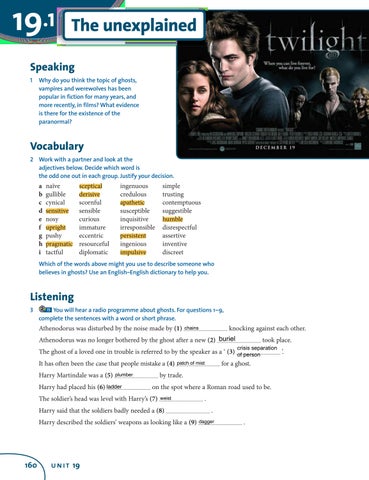
19.1 The unexplained Speaking 1
Why do you think the topic of ghosts, vampires and werewolves has been popular in fiction for many years, and more recently, in films? What evidence is there for the existence of the paranormal?
Vocabulary 2 Work with a partner and look at the adjectives below. Decide which word is the odd one out in each group. Justify your decision.
a naïve b gullible c cynical d sensitive e nosy f upright g pushy h pragmatic i tactful
sceptical derisive scornful sensible curious immature eccentric resourceful diplomatic
ingenuous credulous apathetic susceptible inquisitive irresponsible persistent ingenious impulsive
simple trusting contemptuous suggestible humble disrespectful assertive inventive discreet
Which of the words above might you use to describe someone who believes in ghosts? Use an English–English dictionary to help you.
Listening 3
2 15 You will hear a radio programme about ghosts. For questions 1–9, complete the sentences with a word or short phrase.
Athenodorus was disturbed by the noise made by (1) chains
knocking against each other.
Athenodorus was no longer bothered by the ghost after a new (2) buriel
took place.
crisis separation The ghost of a loved one in trouble is referred to by the speaker as a ‘ (3) of person
It has often been the case that people mistake a (4) patch of mist Harry Martindale was a (5) plumber Harry had placed his (6) ladder
for a ghost.
by trade. on the spot where a Roman road used to be.
The soldier’s head was level with Harry’s (7) weist Harry said that the soldiers badly needed a (8)
. .
Harry described the soldiers’ weapons as looking like a (9) dagger
160
u n it 19
.
’.
4 What do you think about Harry’s experience? Do you think it has the ring of truth about it or not? Why? / Why not?
Style extra In the listening passage, what was described as ‘rattling’ and ‘murmuring’? Words like these are called onomatopoeic words because they seem to sound like their meaning. Below are verbs connected with types of sound. Using an English–English dictionary, decide what you would use these words to describe. EXAMPLE:
creak tinkle squelch
howl the noise made by an unhappy dog, also by the wind rumble crunch slash
slap slam click
hiss growl screech
drip peal slither
Complete the sentences below with one of the verbs above. creaked a The stairs as she tiptoed up to her room. b The farmer’s shoe squelched as he pulled it out of the mud. c Hooligans have pealed my car tyres with a knife. d The snake slither across the floor. e You always know when the postman comes because he across the gravel. crunches f I was kept awake last night by the tap dripping . g The glass slashed as it broke on the floor. h Steam hissed as it came out of the pipe. Write a paragraph about one of the following, using some of the verbs above to give a suitable atmosphere. • Alone in a haunted house • The Titanic sinking • Home alone in a storm
5 For questions 1–8, read the text below and decide which answer (A, B, C or D) best fits each gap.
POLTERGEISTS Poltergeists have always been with us; there are (1) cases as far back as AD 530, and from all parts of the world. The German word poltergeist means (2) ‘noisy spirit’, and that describes the behaviour of this phenomenon very well. Among its manifestations are banging noises, things being thrown around, furniture being (3) and other destructive behaviour; but it also (4) itself in other, quieter ways, such as hiding things or writing messages. It is seen as a mischievous spirit because that is what the behaviour suggests; a disembodied spirit that enjoys upsetting people. It is clear that many poltergeist activities do by science; not follow the rules (5) things move without being touched, objects move slowly through the air, solid objects pass through other solid objects, (6) fires occur, water appears from nowhere, and so on. It is possible that these paranormal events are (7) by powers and energies we have not yet recognised, but which everyone has the (8) to use.
1 A inscribed B recorded C minuted D registered 2 A literally B exactly C accurately D plainly 3 A loaded up B set in C turned over D stood out 4 A intimates B divulges C signifies D reveals 5 A brought out B laid down C carried out D put down 6 A spontaneous B instinctive C impulsive D voluntary 7 A triggered B derived C evolved D extorted 8 A proficiency B competency C accomplishment D potential
19.1 t h e u n e x p l a i n e d
161
19.2 Word order and adverbs Work in a group. Decide where to put the adverbs or adverbial phrases in the following sentences.
1
Yesterday, I went home on foot a I went home. (yesterday, on foot) b She walked to where another coach was waiting. (up the later walked up the hill, where luckly, hill, briskly, later, luckily) Sheanother coach was waiting briskly Last night I hardy in the mood c I was in the mood to go swimming. (hardly, last night) was to go swimming Of course he is still lying d He is lying. (of course, still) e Stephen spoke to me. (the other day, in a friendly way, in fact) The other day in fact, Stephen spoke to me in a friendly way Strangely enough, it rained heavily, non-stop all day f It rained. (non-stop, all day, heavily, strangely enough) Apparently, people rarely g People hide things of value. (apparently, in the attic, rarely)hide things of value in the attic the dance far h She performed the dance. (far, slowly, too) She perfirned too slowly i I think you should get out of the house. think you should get (to be honest, more often) outtbh,ofI the house more often j I saw the comet. (only, in the sky, yesterday) I only saw the comet in the
G
pages 187–188
sky yesterday
NORTHERN TERRITORY Alice Springs ULURU
2 Put the sentences, or parts of sentences, in order. The last word of each sentence is given in bold and capital letters are given. Then put the sentences in order to make an extract from an article about how Uluru, or Ayers Rock, in Australia came to be created. You will also need to add punctuation.
example: central a or Ayers huge Uluru mound sandstone Rock is in Australia … Uluru, or Ayers Rock, is a huge sandstone mound in central Australia … a tells a Another terrible after how battle … b originally One Uluru legend that a was states lake. c … that been to the for Aboriginal sacred has hundreds people of years. d tell Earth paintings Many Aboriginal important stories. e … world when the was the time created. f … at to Earth rose up the blood-coloured revolt the form the great bloodshed in rock. g in that was made They by it spirits the believe ‘Dreamtime’…
162
u n it 19
Corpus spot Correct the mistakes in the word order of adverbs that exam candidates have made, making any other changes necessary. Two sentences are correct. a He slumped into the nearby velvet armchair, holding tightly his briefcase in his hands. tightly b Statistically looked at, however, the centre has attracted more people, spending more money than before. looked at statistically c Being rather into contemporary than old-fashioned art I don’t find the good old Tate Britain a place I would visit too often. d A lot of people actually do travel abroad, but apparently only a few return home with more knowledge and better understanding. e I have always wanted to remember perfectly every movie I see and every book I read. perfectly f It goes without saying that seldom you will see a very shy person wearing a bright orange shirt. g Kerry is a very green county: you hardly can find a road where two cars pass each other. you can hardly find h Most of us are aware of the fact that not always is this solution economically viable. this solution is not always i Before he appeared on the music scene, there hardly existed ‘Pop’ music. this solution is not always j Oddly enough, she never seems to be really angry and perhaps that is the reason why I like confiding in her.
r *U JT QPTTJCMF UP DIBOHF NPTU adjectives into an adverb with the addition of -ly, for example happy to happily. r 4PNF BEKFDUJWFT EP OPU IBWF BO adverb, for example friendly, lonely, silly. In this case you need to use an adverb phrase, for example He looked at her in a friendly way. r 4PNF BEWFSCT IBWF UIF TBNF GPSN BT the adjective, for example hard. He works hard. He’s a hard worker. r 4PNF BEWFSCT NBZ IBWF UXP GPSNT – one which looks like an adjective and the other with -ly. There is usually a difference in meaning.
3 Use one of the words from the box to complete each sentence below.
hard hardly short shortly right rightly high highly late lately wrong wrongly a I hardly ever see her nowadays – she’s so busy. highly b Sally thought very indeed of the gypsy’s fortune-telling powers. c The interviewer rightly claimed that the house was haunted. d Sue thought long and hard about whether to take part in the experiment. e Tell Marje I’ll see her shortly . f You’ve done this calculation wrongly . g They were just saying that they hadn’t seen you lately . h The car turned right round and went back the way it came. i The article stopped short of accusing anyone of a hoax.
4 For questions 1–8, read the text below and think of the word which best fits each space. Use only one word in each space. There is an example at the beginning (0).
Carrying out a ghost hunt SHOULD (0) a visit to a house convince you that there may be something worth investigating, follow these simple steps. There is much you can do in the way of preliminary research before you (1) make any serious attempt to (2) carry out any practical investigation. Documents devoted to the area can often be (3) of interest and a visit to the local museum will be invaluable. Maps can also provide information on the whereabouts of underground water. Water running underground through streams, old sewers and so (4) on beneath or close to the foundations of a house may subject it to spasmodic thrusts. (5) when the water builds up, such jolts cause objects in the house to move, increasing the general strain on the house, (6) to produce noises that sound eerie at night. Such possibilities have to be (7) taken into account, depending on the reported paranormal activity. In (8) such event, knowledge of previous buildings in the area may produce a clue to any apparitions seen.
the unexplained
163
19.3 Reading into Writing: Full Task 2 Read these facts about two former American presidents, Abraham Lincoln and John F. Kennedy.
1
A
braham Lincoln was elected to Congress in 1846. John F. Kennedy was elected to Congress in 1946.
Abraham Lincoln was elected President in 1860. John F. Kennedy was elected President in 1960. Both were particularly concerned with civil rights. Both Presidents were shot on a Friday. Both were shot in the head with one bullet.
Both were rumoured to be killed in a conspiracy. Neither was confirmed to be a conspiracy. Both successors were named Johnson. Andrew Johnson, who succeeded Lincoln, was born in 1808. Lyndon Johnson, who succeeded Kennedy, was born in 1908.
Some sceptics say that you could take any two famous people and find a number of similar-type coincidences between them. The only problem with that theory is that there really haven’t been any listings of such comparisons. And certainly none has been as extensive as the Lincoln–Kennedy similarities. Do you think this is pure coincidence or do you think there is more to it than that? 2 Can you explain the following expressions? Have you any experience of the situations they would be used for?
r Talk of the devil! r To have a guardian angel r It’s a small world r To have second sight
r Female intuition r A feeling of déjà vu r A sixth sense
3 Read the texts below.
Text 1
Text 2
a reasonable E X P L A N AT I O N ?
Coincidence
or evidence of the paranormal?
An investigation of coincidences should be primarily designed to get at the truth, or at least make progress towards it. The moment that chance ceases to be a convincing explanation, uneasiness sets in. Most people are embarrassed to speak out in case they are thought of as eccentrics. Their experiences may be commonplace enough – the occasional precognitive dream; a feeling of déjà vu or thinking of somebody a moment before they ring up – but they still feel the need for anonymity. But a surprising number of people who clearly regard themselves as free from irrational fears are ready to admit that even mundane coincidences can be disturbing.
164
u n it 19
I
t is in the imagery of sight, hearing, touch, smell or temperature that paranormal cognition often emerges into the conscious mind. There may be no more than a sudden impression that something has happened, even no more than an unaccountable impulse to act; to cancel a seat eat at on a flight which will shortly crash, for example. mp ple e Even now, of course, such happenings are often dismissed as superstitious nonsense. In n the same way, the report that the inhabitants ts of the island of St Kilda only got colds when n a ship came in was said to be contrary to alll common sense by critics in the seventeenth h century, only to be accepted as a statementt of fact when the germ theory of disease wass established in the nineteenth.
4 Look at the following words from the texts. What part of speech is each word in the text? What other forms of the word are possible?
Text 1 speak out anonymity disturbing
Text 2 conscious impression dismissed
5 Use an appropriate form of the words in capitals to complete the sentences. outspoken a He is a very critic of what he calls ‘paranormal geeks’. SPEAK b The newspaper article was dismissive of the possibility DISMISSED of ESP (Extra-Sensory Perception). c Her one wish after her experience was to remain anonimous . ANONYMITY d There was a rumour of some sort of a disturbance at the DISTURBING cemetery last night. e Children of primary school age are very impressionable and IMPRESSION tend to believe what they are told. f You may not be aware of things happening but your subconsious probably registers events. CONSCIOUS
6 Look at the essay below, which is an attempt at the following exam task. Write an essay summarising and evaluating the key points from both texts. Use your own words throughout as far as possible, and include your own ideas in your answers. Write your answer in 240–280 words. The essay is a poor attempt. With a partner, decide what you think needs to be improved and then rewrite it so that it fully answers the question.
The two texts contrast the pros and cons of coincidences, whether they are evidence of the paranormal or can be explained on a purely rational level. Text 1 argues that people are often embarrassed by unusual happenings and prefer not to tell anyone about it. If they think of a person just before that person rings up then they don’t tell them because they are worried that that person will think they are stupid. My feeling is that it is wrong to feel embarrassed as, in fact, there is always a rational explanation for nearly everything that happens. Text 2 says that we shouldn’t believe in superstition because most things can be explained by science. Everyone thought that the people on St Kilda got colds for some paranormal reason when a ship came in. In fact, it was easily explained once the theory of germs was discovered. I totally agree with this as I think that science is showing us new things all the time. During my short life many things have been discovered which we would never have dreamt of in the past – e.g. the mobile phone, etc.
the unexplained
165
Exam folder 10 Paper 4 Speaking The standard format for the Speaking paper is for there to be two candidates and two examiners. It is also possible to have three candidates and two examiners. One examiner, called the interlocutor, asks the questions while the other only listens. Both examiners will assess you. They are looking for accuracy of grammar, a wide and appropriate range of vocabulary and the ability to express opinions and abstract ideas. Your pronunciation should be clear and you should be able to interact well with your partner(s). There are three parts to the test and it lasts for 16 minutes (24 minutes for groups of three). Part 1 is two minutes (three minutes for groups of three), Part 2 is four minutes (six minutes for groups of three) and Part 3 lasts for 10 minutes (15 minutes for groups of three).
EXAM ADVICE ● Don’t worry if you think you do badly in
one part of the test. You are assessed on the complete test. ● If the other candidate is better than
you, or not as good, you shouldn’t worry. You are assessed on what you do, not in relation to the other candidate. ● It’s important to show sensitivity to the
other candidate during the test. This means allowing the other candidate to speak and responding to what they say. ● Remember this is your opportunity to
show you can speak English – use it! ● Do ask if you are unclear about what
you have to do.
In Part 1 you will be encouraged by the interlocutor to talk about yourself and give some personal opinions. In Part 2 you and the other candidate have a decision-making task consisting of visuals (up to seven pictures or photos) and/or a written prompt. In Part 3 you will have the chance to speak for about two minutes on a topic given to you and then have a discussion with the other candidate, developing the topic you have been given. Do this complete Speaking test with a partner, taking it in turns to ask and answer the following typical questions. (Remember that in the exam the interlocutor will be asking the questions.)
Part 1 Ask each other these questions. Questions for Student A to ask Student B
Are you working or studying at the moment?
How do you spend your leisure time?
What would be your ideal job?
Questions for Student B to ask Student A
How do you travel to work/college every day?
What are your plans for the future?
How important are computers in your life at the moment?
166
e x am f o l d e r 10
Part 2
Student A
Here are some photos of useful inventions. Look at pictures A and E and talk together about whether you could live without them. You have about one minute to do this. A
How has life changed in the past hundred years? ●
work education ● family life
B
●
Student B is now asked a question. Do you think marriage is as important today as in the past? C
D
Student A is then asked what they think about this topic. Now the roles are reversed and Student B has the chance to speak, using the prompts below if he or she wishes. Student B What changes do you foresee in the future?
E
●
accommodation ● fashion ● transport Student A is now asked a question. Does the future worry you at all? Now look at all the pictures. Imagine that an exhibition is going to take place on the theme of ‘Essential Inventions’. All these objects are to be included. Talk together about the importance of the inventions shown in the pictures. Then suggest two other inventions you would like to see included in the exhibition. You have about three minutes to do this.
Part 3 In this part of the test you have to speak by yourself for about two minutes. You should listen carefully while your partner is speaking because you will need to comment afterwards. Both students should look at Student A’s card. There is a question written on it and Student A has to give his/her opinion on it. There are some ideas on the card for you to use if you like.
Student B is now asked to comment on this topic. To finish the test both candidates have to talk about changes to our lives in general. This section lasts about four minutes. Discuss together the following questions.
:KDW FDQ ZH GR WR PDNH WKH ZRUOG a better place to live in?
$UH ZH ORVLQJ WRXFK ZLWK WKH QDWXUDO world?
$UH SHRSOH EHFRPLQJ OHVV LPSRUWDQW than machines?
e x am f o l d e r 10
167