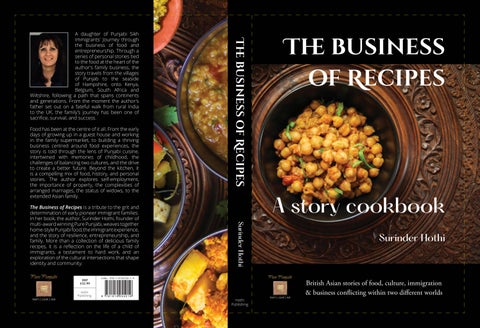
A daughter of Punjabi Sikh Immigrants' Journey through the business of food and entrepreneurship. Through a series of personal stories tied to the food at the heart of the author's family business, the story travels from the villages of Punjab to the seaside of Hampshire, onto Kenya, Belgium, South Africa and Wiltshire, following a path that spans continents and generations. From the moment the author's father set out on a fateful walk from rural India to the UK, the family's journey has been one of sacrifice, survival, and success.
Food has been at the centre of it all. From the early days of growing up in a guest house and working in the family supermarket, to building a thriving business centred around food experiences, the story is told through the lens of Punjabi cuisine, intertwined with memories of childhood, the challenges of balancing two cultures, and the drive to create a better future. Beyond the kitchen, it is a compelling mix of food, history, and personal stories. The author explores self-employment, the importance of property, the complexities of arranged marriages, the status of widows, to the extended Asian family.
The Business of Recipes is a tribute to the grit and determination of early pioneer immigrant families. In her book, the author, Surinder Hothi, founder of multi-award winning Pure Punjabi, weaves together home-style Punjabi food, the immigrant experience, and the story of resilience, entrepreneurship, and family. More than a collection of delicious family recipes, it is a reflection on the life of a child of immigrants, a testament to hard work, and an exploration of the cultural intersections that shape identity and community.
The business of Recipes
The business of Recipes
A story cookbook
Surinder Hothi
British Asian stories of food, culture, immigration & business conflicting within two different worlds
'Help us to donate the book to schools, colleges & libraries for the next generations to have access to original Punjabi recipes and the immigrant stories of business, culture and perseverance'
This book is an original work created entirely by the author and is based on her own personal memories and perspectives as a child, teenager, and adult. No artificial intelligence, templates, or external sources were used in its creation.
All photographs in this book are the sole work of Safia Hothi-Bellamy (also known as Safia Bellamy), unless otherwise indicated. Any additional photographs are by Surinder Kaur Hothi (Bellamy).
All intellectual property in this book, including text and images, remains the exclusive property of Surinder Kaur Hothi (Kaur Bellamy) and Safia Hothi-Bellamy (Bellamy).
No part of this publication may be reproduced, distributed, or transmitted in any form or by any means, including photocopying, recording, or other electronic or mechanical methods, without the prior written permission of the copyright holder, except in the case of brief quotations used for review or scholarly purposes.
Disclaimer: This book is a work of personal memory and reflection of the author. The events are described as the author recalls them and represent her own perspective. While real individuals may be mentioned, their inclusion is incidental to the author’s story. Names, details, or identifying characteristics may have been changed to protect privacy.
The author makes no claims as to the accuracy of others’ recollections, no claims to represent their perspectives or viewpoints and does not intend to defame, misrepresent, or cause harm to any person, living or deceased.
The advice, content and opinions herein are not intended to replace the advice of health professionals or replace medical advice. You are advised to consult with your own health professional for any matters relating to your health or medication. The information in this book is the recounting of a personal journey and not intended to be replicated by any other individual.
ISBN: 978-1-9192550-1-9
First Edition
Formatted and printed by www.beamreachuk.co.uk
The Business of Recipes
An Indian cookbook of Punjabi home recipes wrapped within British Asian stories of food, culture, immigration & business conflicting within two different worlds.
Surinder Hothi
Hothi Publishing
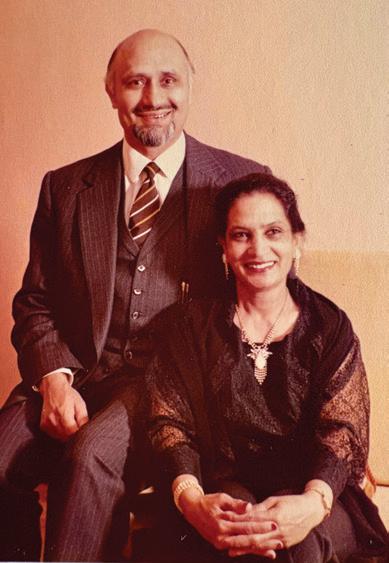
In memory of my parents
Early Reviews...
…as a lifetime BIG reader I think it's marvellous. It just is! What you have done is reinvent the cookbook to be so much more – social commentry, social history, autobiography, family history. At least this is new to me. Occasionally people say things like 'I love these pancakes because I used to have them at my Nan's house' or something like that – that's usually all you get in terms of autobiographical stuff. Much as I have read over the years, I'm not a big reader of cookbooks! It may come as a surprise to people who have only ever read traditional cookbooks but it's I believe it's GREAT to challenge people's expectations!
Suzanna Winter
BA Hons, PGCE, MA, Dip. Psychology, MSc
I think this is a stunning idea – an autobiography and cook book combined – unique – so you arouse the reader’s curiosity on two or rather three counts, basic things – food and life and business. The recipes and the photos are stunning – mouth-watering. And the essential simplicity plus depth of the recipes, which you emphasise, is a real selling point as well as really authentic. And actually it is the authenticity of these recipes that is a winner… it is frankly business orientated – as your culture makes you – and this is a new angle. I loved the way that your family life and culture emerges slowly as you read – never being hit (wonderful – and I bet you didn’t hit your own children either – goodness gets handed on) – your father’s character – the intensity of the love. How lucky you were.
The written style. it is lively and intense and very alive. I love it. I think your English is very vivid and very you. This is such an original VIVID book.
Professor Isobel Armstrong
Emeritus
Professor of English, Birkbeck, University of London and Fellow of the British Academy
The Business of Recipes is a refreshing and thoughtful blend of culinary creativity and practical business insight... recipes beautifully explained, accessible, and rooted in real family cooking... Readers aren’t simply shown how to create memorable dishes – they’re invited to understand the mindset, organisation, and processes behind a culture of cuisine... a wider message of resilience, intention, and the value of doing things properly... A thoughtful, grounded and uplifting read – one I would happily recommend.
Jo Reynolds Justelle Marketing
This is far more than a cookbook. The Business of Recipes blends stunning food photography, deeply authentic Punjabi recipes, and a powerful family story... a story of resilience, entrepreneurship, identity, and love. You’re not just learning recipes, you’re being invited into a kitchen, a culture, and a life... deeper lessons about building something from very little, about values, legacy, and creating a life and a business. If you’re interested in stories of family, culture, and entrepreneurial spirit, it will stay with you.
Joe Gregory Entrepreneur,
Author and Publisher
A fascinating read! Wonderfully written...a deeply personal journey of one migrant family... exploring the challenges of preserving tradition while integrating in the West. Through life lessons, relationships, and resilience... Punjabi culinary heritage shines throughout, with beautifully illustrated recipes that preserve and pass on treasured traditions.
Amanda Wood BA
(Hons), PGCE, MEd, MA
Credits
I wasn’t commissioned to write this book, didn’t have an agent or any publishing house, so it was a struggle and a learning process, so it will not be perfect, or anywhere near.
All the credits go to my three shining lights, Samir, Safia and Arun, just for being them… and to my dughter and Pure Punjabi business partner Safia for helping me in getting the recipes checked and for the fantastic photography.
Food styling and photography: Safia Hothi
Recipe arrangements: Safia Hothi
Beta Readers
Sincere thanks to my beta readers, who took the time to read this book.
Professor Isobel Armstrong Emeritus Professor of English, Birkbeck, University of London and Fellow of the British Academy
Suzanna Winter
Jo Reynolds
BA Hons, PGCE, MA, Dip. Psychology, MSc
Justelle Marketing
Joe Gregory Entrepreneur, Author and Publisher
Amanda Wood BA (Hons), PGCE, MEd, MA
Suzanne Watret
Early Sponsors
Thank you to the following sponsors of this project, without whom this book would not be possible...
Hilary Linssen
Mark, Pamela, Isabel & Felicity Zakers
Jo Reynolds
Cherry Saunders
Jim Mackay
Jamie Allen
Nathan Morgan
Chapter 7 “Don’t let the bastards bullshit you” 139 …Fire! The rebellious teenage years
Chapter 8 In hiding 159 …the business of arranged marriages…
Chapter 9 “They were right, but they were wrong” 175 …failures…
Chapter 11 “Mummy went to the restaurant and no one’s there” 215 …international dining
Chapter 12 “If you don’t eat Indian food, you’ll lose your Indian blood” 233 …returning home…
Chapter 13 “Mum, we can’t eat the bricks!” 249 The Post Office… ‘Bent or incompetent?’
Chapter 14 …and then the penny dropped…I was my own answer 273 …Pure Punjabi is born
Chapter 15 Closure 287 ... Moving on What’s next, reviews, social media, contact 308
Masala Cha – Punjabi
–
– ‘Bombay
–
Introduction
The Business of Recipes is a cookery book about the world of home-style Punjabi food and recipes, but more than that, it is also about growing up as a child of immigrants, our work ethic, self-employment and the business of making money, the importance of the acquisition of property, Sikhism, family life and arranged marriages, the social standing of girls and the social ostracising of widows.
This story, through the recipes, takes us from the time that my paternal Grandfather took my 16-yearold father for a walk, from which he did not return… that walk took him from the villages of Jalandhar, Punjab, and ended up in Bristol.
This walk caused my Punjabi-speaking mother to be running an English guest house in Southsea, Hampshire, throughout my primary school years, and is the reason I am here today.
With my mother running a Bed & Breakfast business, all the while that I was at junior school, so I saw food cooked and served and eaten from two different cultures in two different ways… or three ways if you count school-dinners. Her delicious Punjabi food, her excellent British food cooked for the guest house, and the school dinner version of British food!
From Bristol our recipes and stories travel between Portsmouth, Heathrow, Mombasa and Nairobi, Southampton to Brussels and Johannesburg, to The New Forest/Wiltshire, onto South Somerset.
Food and bricks have been a constant theme in our working and business life. We’ve made a good and hardearned living from the tough business and long hours of food and hospitality. As a child, the guest houses turned into acquiring more property, those properties became what we would now call HMO’s (houses of multiple occupation). Six commercial property acquisitions turned the small corner shop into the first big Indian-owned supermarket in the area to be open 7 days a week from 7am-10pm, a super ‘corner shop’, that produced income and jobs, off the back of our non-stop work and collective non-salaried family labour.
Later, as an adult, for a further 20 years, I ran a very successful health and wellness business as a private personal trainer and life coach, that again involved food – changing the diets, health and lives of hundreds of people. That business, alongside using bricks and mortar as investment and income, enabled me to single-handedly raise and support three children.
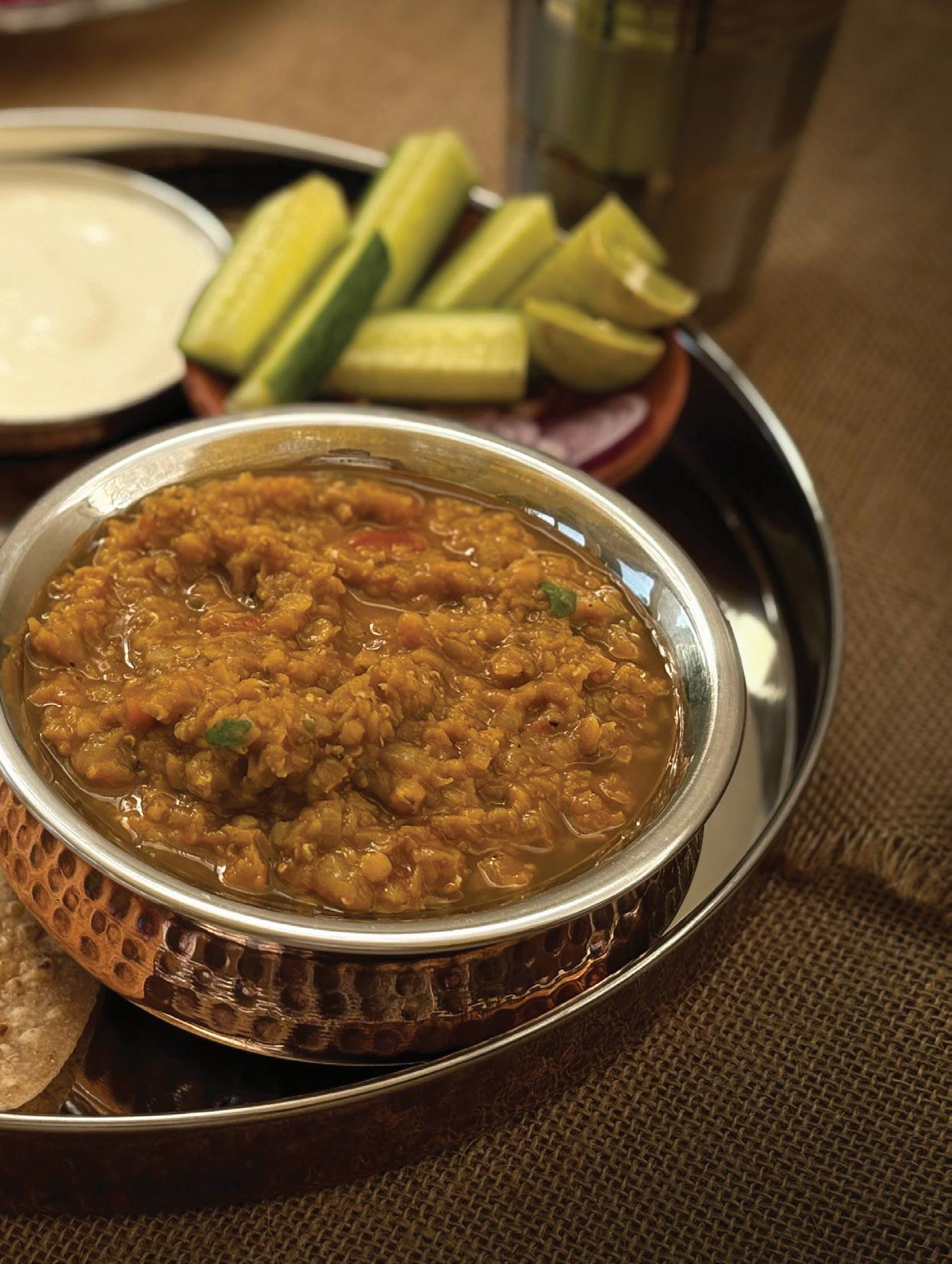
You may be surprised at the simplicity, purity and goodness of traditional Punjabi home-cooking, and in the recipes will discover that the secrets to the taste and flavour are all in the methodologies and key principles we give you. Here you can discover how we really cook and eat at home. It’s not complicated, but it does require care and patience.
As you read through the stories around the recipes in this book, I hope you will enjoy the background to the food, understand more about the culture and heritage of our region and about the remarkable hardworking, extremely brave and pioneering people like my parents who ventured into new and often hostile worlds, with language and cultural barriers, and paved the way for the 1st and 2nd generations born and living in countries like Britain, The USA, Canada and Australia.
They also lay the groundwork to later pave the way for the very soft-landing of those migrants who followed, often exploiting and living off the backs of these first generations.
As well as the wonderful, difficult, and conflicted upbringing that children of very different cultures juggled, managed and mostly resolved, and the background of so many British Asians in business.
This is the story of very many of us, who… in the words of Satnam Sanghera, “are here because you were there”.
A bit about Punjab
Punjab is a farmland region in the north of India, and the heritage and background is in farming and from farmers. The name Punjab means The Land of Five Rivers, (Panj means Five, and Ab, means River), so it is a region of abundant irrigation. The British divided Punjab in 1947, and three rivers now sit in The Punjab of Pakistan and two in The Punjab of India. (Panjab is the correct spelling but changed by The British to be pronounced correctly as Punjab – it’s something we didn’t change back, as the pronunciation of it as ‘pan, as in frying pan, is too much to bear).
The agricultural prosperity of the region is greatly due to these rivers, and it is a major food producing region of India. For this reason, Punjab is known as the ‘Bread Basket’ of India. The food is hearty, nutritious, food of the land and full of goodness. Punjab is also homeland to the Sikhs, a warrior race, and Punjabis are known to be very formidable and tough, yet friendly and hospitable people. Note… Women wear (the) trousers.
About the author
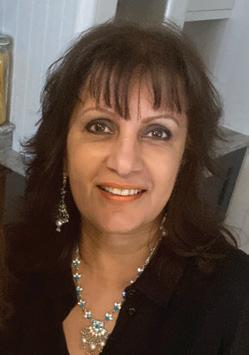
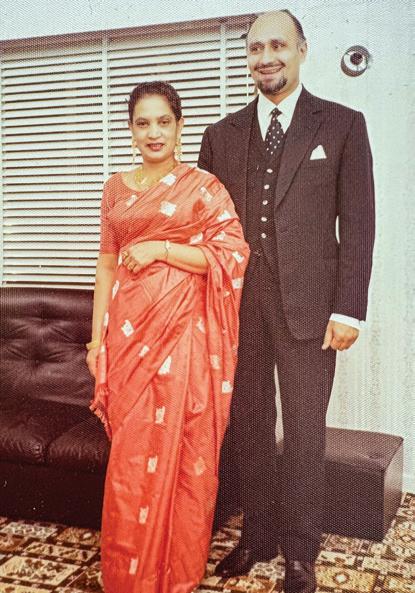
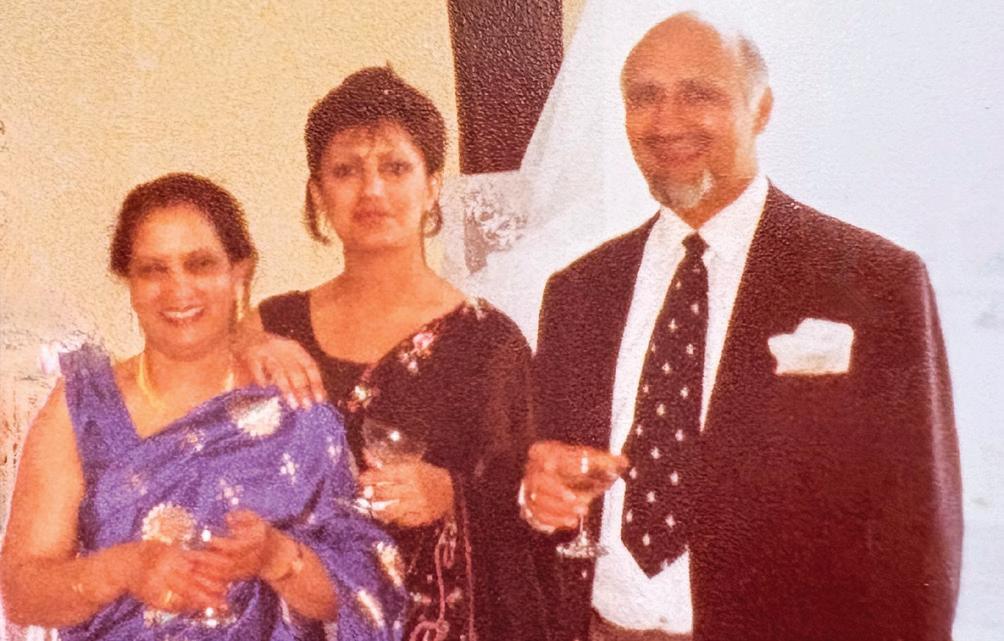
Surinder, the founder of Pure Punjabi, embarked on this culinary journey to honour the memory of her extraordinary parents. Her beloved, kind yet feisty, mother’s delicious home-cooked food and her father’s fearless and often harsh entrepreneurial spirit are the cornerstones of her business.
Born and raised in Hampshire, Surinder’s childhood revolved around the warmth and love of her mother’s traditional Punjabi food, the British food of the Bed & Breakfast business her mother ran, and her father’s business and property ambitions. Both parents instilled in her a deep work ethic. Her mother, Seso, teaching her to cook from scratch, making, creating and multi-tasking across food, business and home, passing down generations of traditional skills.
From a very young age, Surinder was kept at her mother’s side, helping with jobs for the Bed & Breakfast her mother ran, being taught to cook, sew and knit and watching her prepare delicious meals and sweets, a skill that would later become a contributing factor of her successful ventures. All the while being heavily encouraged by her father to succeed in school and pursue academic achievements.
After a diverse career spanning retail, property, personal training and life coaching, hospitality and events, Surinder’s passion for preserving her mother’s legacy and her culinary heritage led her to establish Pure Punjabi in 2010. Initially focusing on producing the Garam Masala taught to her by her mother. In 2013, she partnered with her daughter, Safia, to expand the business and offer a wider range of products, with the twist of culinary and cultural experiences. This led to becoming a multi-award-winning business comprising a cookery school, meal kits, and food events. This unique venture focuses on preserving and sharing the original recipes of her mother’s, and the grandmother’s cooking, from the region of Jalandhar, Punjab, North India, with the wider UK population and beyond, and, increasingly for the British-born Punjabi children who are losing the original culinary traditions.
From founding Pure Punjabi in 2010, both Surinder and the business, along with her daughter and business partner Safia, have been recognised for the integrity of the food offering, by… The Telegraph and other publications, named a Top 8 UK cookery course by Olive Magazine, won Great Taste Awards, and were winners of the Federation of Small Business ‘Family Business of the Year’, South West, with Surinder named on the F’Entrepreneur list of female founders. Today, Surinder continues to uphold the legacy of her parents and the preservation of artisan production, through cookery workshops, no-waste Indian meal kits systems and creation of unique cultural events, combining hospitality, property, and business from the Pure Punjabi HQ in the South-West of the UK. She has three adult children: Safia, and two sons Samir and Arun. In Punjabi extended-family tradition she also lives with two of her three adult children.
About this book
For whom is this book intended? Well, firstly it might not be for Indian restaurant food fans.
Not because there’s anything wrong with that – it’s just that rich sauces and gravy are not what we eat at home – it’s just not our daily home food. If you want the wedding food, celebration foods, treat food and more complex dishes that we eat occasionally, then that is not in this book, but will be more so in the next one.
This book is for the family, for home cooks, Asian and British, people who want good simple old-school Punjabi… ‘Ma’s food’.
And even more so, it’s for children and grandchildren of Punjabis – those who now eat mainly Western foods. It’s also for those Punjabis, adults younger than me, who suddenly have to be able to or now want to cook for their elderly parents and don’t know or are not sure how to make them their traditional foods – they’ve forgotten how or never learned.
This is for ‘apne’ (our people), and for all people who are interested in nutritious food, original Punjabi village cookery, and the stories of the immigrant journey.
My food business, Pure Punjabi, and this book immortalise my loving mother and her food and it keeps her alive for me. It is also my parent’s legacy and recognises how hard they tried, not only to teach, but to support, more than I even realised, even though for an Indian parent that is in a controlling way.
They were better than their parents in accepting changes and a new life, so they probably felt they had made enough adaptations. In the conflict of growing up in Britain, I did not feel that they had… back then, and this book recognises that in my youth, I didn’t always understand the conflicts they faced.
Finally, if my mother hadn’t taught me herself… this is the book she would give me. If I hadn’t taught my children, this is the book I would give them, to understand some family background and the journey that originally brought our food to this country.
Foreword
Why did I write this book? It was always there, waiting to be written, and something I often thought about. However, for a lot of reasons, including feeling a conflict with the formation of my business Pure Punjabi, in partnership with my daughter, it didn’t seem right.
Then I joined a global business group and realised I was wrong. Some things should be documented, and some stories should be told. It was a quick process to get the basics drafted out, as they were already in my head and waiting. It’s been more complicated to organise and make it presentable! The person I was most worried about, my daughter, wasn’t keen on a cookbook, but has since been instrumental in helping to complete this book. She is the sole provider of all the food imagery, photography, and greatly contributed to the visual identity that I wanted in honour of my mother’s food.
When you lose your mother, as a young adult and a young mother of babies, watching her slowly die, when she was still too young, the effect, certainly on me, was catastrophic. I felt I would die from the grief and yet still had 2 babies to care for. It was the beginning of the end of my marriage and the path to increasing self-reliance and preparation for my own end. The grief manifested itself physically after her death in the form of terrible chest pains in my heart. It sounds ridiculous, but my heart was broken and heart break, at least for me, was a physical pain.
In defence of those around, they were mostly unaware of my internal devastation, and for my father and the one other person, who was also devastated and deeply affected, they were dealing with their own grief in their own way, which divided us all. The thing I learned about death, is that it is divisive. It does not bring people together, but breaks them apart, and everyone handles it in their own way.
Around a year or so after her death, I felt that almost everyone carried on as if she had never existed, and I found this impossible.
I saw her everywhere – in bright colours and jewellery, in every rose, and in every marigold. I couldn’t visit a garden centre for years.
Dedication
To my late mother, a loving angel who lived her life for her children and always tried her best – super-strong, super-loving and a gutsy little firecracker! She had a spark and an energy – eternally optimistic and hopeful – always interested and so positive, and forgiving… even against the horrible treatment she often received…
…and even when she wasn’t always right, her intentions always were. She was a good woman.
To my late father: an amazingly conflicted, brilliant and awfully difficult man, equally domineering, aggressive, as well as loving, who without doubt gave me the foundations to achieve and, who paradoxically, gave me the lessons to rise-up and stand against him from controlling my life. He had a drive and determination to progress but somehow lost a bit of his soul in that quest, but despite that he never flagged in his ambitious outlook.
As the saying goes ‘your parents did the best job they knew how to do’.
… and to my own three musketeers and my complete life purposes, standing by me through thick and thin… willingly, and also unwillingly, and that’s when you know the love…
They are my most delicious dishes – I could eat them all up – though some are saltier than others and quite often hard to digest! No matter… they have the Punjabi essentials deep within them… ‘sugar and… quite a bit of spice!
Chapter 1 – Everest
… ‘A mountain to climb’
Why were strangers in my house?
Why did we give them dinner in a dining room we weren’t allowed to eat in and to sleep in bedrooms we weren’t allowed to use? I was very little, maybe 6 or 7 years old, and I wondered this…
We lived in a 3-storey house, in a seaside town called Southsea, in Portsmouth, Hampshire, which my mother ran as a guest house, offering bed, breakfast and evening meal throughout my infant and junior school years.
In the entrance hallway hung a black and white photo of Mount Everest, along with another of the Taj Mahal. It was called ‘Everest Guest House’, because my father had decided to name our guest house after the mountain. Looking at the framed black and white picture of Mount Everest in the entrance hallway, my father would proudly tell us the story of how great this mountain was and that was why our business was called Everest! This was an early indication of my father’s pride and the contrast between his very confident attitude, what British people would regard as ‘boastful’ against their British reserve.
Most of the house was given over to the guests and was therefore the rental income from which my mother brought in some of the family income. Meanwhile, my father worked at Heathrow, doing double the work shifts of every other worker, 7 days on, then 4 days off, when he would return home. During this time, he would sort out all manner of issues, such as repairs, and do all the paperwork and admin as my mother didn’t read or write much English.
The downstairs part of the house that we occupied, was 3 steps down from the entrance and hallway and was the small back room, with a tiny kitchen off the back, and an outside toilet and garden. This tiny and basic kitchen was from where my mother produced fantastic food, an English menu for the B&B guests and our family food – of two types. Our English family food varied between sausage and mash, chips and fish-fingers for when we came home from school, but before my father would be returning, a great variety of Indian dishes were prepared, not only savoury dishes, but also Indian sweet treats and savoury snacks.
The back room was our little world. It was a small room with a sofa, a small table and chairs were opposite, under a little window, with a small TV in the corner. There was a little paraffin heater, which my mother was always anxious about us going anywhere near, and from a very young age, I knew to stay well-away from it! I remember it as a warm, cosy, happy place, and our safe place. We were never cold. My mother was always cooking or making, whether for the guests, or for us as a family.
Our guest house provided bed, breakfast and evening meal. I can still remember parts of the menu. There was always a weekly roast, with all the trimmings, although I remember wondering why British people had a sweet apple sauce with their roast pork. I also thought it was the best bit! My father at some point in my junior school years had told me that the menu had been written with what I would now later see as professional help, and that my mother had attended a cookery course to learn how to cook traditional British food. I remember my parents belonged to an organisation called something like ‘The League of Friendship’, which I think was an organisation that welcomed new immigrants and helped them to settle in and integrate into a new way of life. They had a friend called Mary through this connection, who was very active in all sorts of Rotarylike activities. She was sophisticated and glamorous and supremely confident. She looked and behaved like a Hollywood film star, of the ‘Rita Hayworth type”, and I greatly admired her!
One of my earliest memories is standing on my tiptoes, with arms reaching up overhead, folding the sheets to help my mother change the rooms over, and do the laundry. I was probably around 4 years old and remember struggling to keep my arms up and trying my very hardest. One day I recall my mother looking at me as she held the other end of the sheets... I was stretching and trying to be as tall as I could, and she was smiling at me, and my efforts, her eyes full of love.
I was always around her in the kitchen, doing small jobs and tasks, one of which was being sent to lay the table in the guests dining room. Sometimes I would have to take something into the dining room when guests were eating and I was always very self-conscious about it, but also remember, even at that age, telling myself not to be.
My mother also had girls that came in to help her in the kitchen and to serve the food to the guests in our front dining room. I particularly remember Coleen, who was tall and slim, with very long straight blonde hair – a sort of ‘cool hippy chick’, and she had a baby boy called Samuel, who she frequently brought with her during the long hot summer holiday months. Samuel was a delicious 6-month-old with coffee coloured skin. I remember my knowing that Samuel’s father was not English, and the implication seemed to be that they were not married.
It was my first awareness and observation of a baby with parents of different colour. I played peek-a boo with Samuel on the grass, and made him laugh and laugh, his baby gurgles delighting me so much that I carried on to the point that he almost tipped backwards. Looking up I saw my mother and Coleen, both watching us through the kitchen window, and both smiling in the exact same way – with their eyes full of love and kindness.
The front room of our house was the dining room for the B&B guests, where breakfast and evening meal were served, and there was another room which was a guest’s bedroom, often an ongoing ‘lodger’. Up the stairs was another guest/lodger bedroom and a small toilet, a sort of mezzanine/landing floor. Then up again, was another bedroom, and the main big bedroom in which the five of us all slept.
Then up again, right at the top of the house, and what felt a very long way up to me, was a small attic type bedroom, next to the main bathroom.
It was an impressive size house for an immigrant boy from the rural villages of Jalandhar.
When my father first arrived in Portsmouth, he took lodgings in a small guest house somewhere near Albert Road in Southsea. He never spoke of any difficulty getting lodgings or ever mentioned the ‘no blacks’ etc. rule of many lodgings’ houses, so from his references to the character of the landlady, she was a good woman. This was where he was living, when he sent for my mother to join him from Punjab.
Years later I learned that many immigrant men never sent on for their wives and cruelly abandoned them in the villages and took second wives in the new lands – something my father’s parents tried to pressure him to do. He told me that because she had borne no children, they wanted him to leave her and take another wife –something which he refused. He said, “you married me to her… and now I will stay with her”. Her fate… had he done otherwise would have been to remain in the home of her in-laws as a ‘servant’ with no status, having produced no children for 11 years.
My mother told me stories of her arrival to England and to these lodgings as a young foreign woman who spoke no English and had never left the rural villages of Punjab. As my father would be away at work, she was by herself, however, as luck and the kindness of a stranger, would have it, not left alone all day. She spoke with very, very fond recollections of the landlady of this house – the good woman who took my mother under her wing and looked after her. My mother use to say … “she so good to me”. The lady took her to the greengrocers, and out and about shopping for whatever she needed, and treated my mother with such kindness that my mother never forgot her.
This was obviously where my father first saw the dual use of a property as home as well as potential for income and came up with the idea of using their first property as a guest house – a home and a business combined! That first lodging with the kind landlady made him realise that the acquisition of property, served not only the purpose of providing ‘a roof over the head’, but was also a means to earn income, and was an early ‘working from home’ option, which of course he knew my mother would be able to do. There’s something in the pioneer and early immigrant mentality that is always looking and learning from the new ways of the new life and new world and exploring the possibilities. How to be creative, how to make more of every potential avenue and see beyond their upbringing.
In our guest house, the small attic type room at the top of the house, was for a long time, the room of our long-term lodger Charles. Charles came from South India and was a very quiet and gentle young man. Occasionally, he would come into our family ‘back room’, which was always a time of interest, meeting one of the ‘guests’. On one occasion, discussing the differences between ‘curries of our different regions of India, he offered to cook a South Indian curry for my parents. I remember vividly the sweat on my father’s forehead as he alone persevered with eating the very hot curry!
It was very different from our chicken ‘curry’ that we would find a little bit hot, but fine when mixed with rice on the plate and yoghurt on the side. I remember not being allowed to try it, because it was so chilli hot!
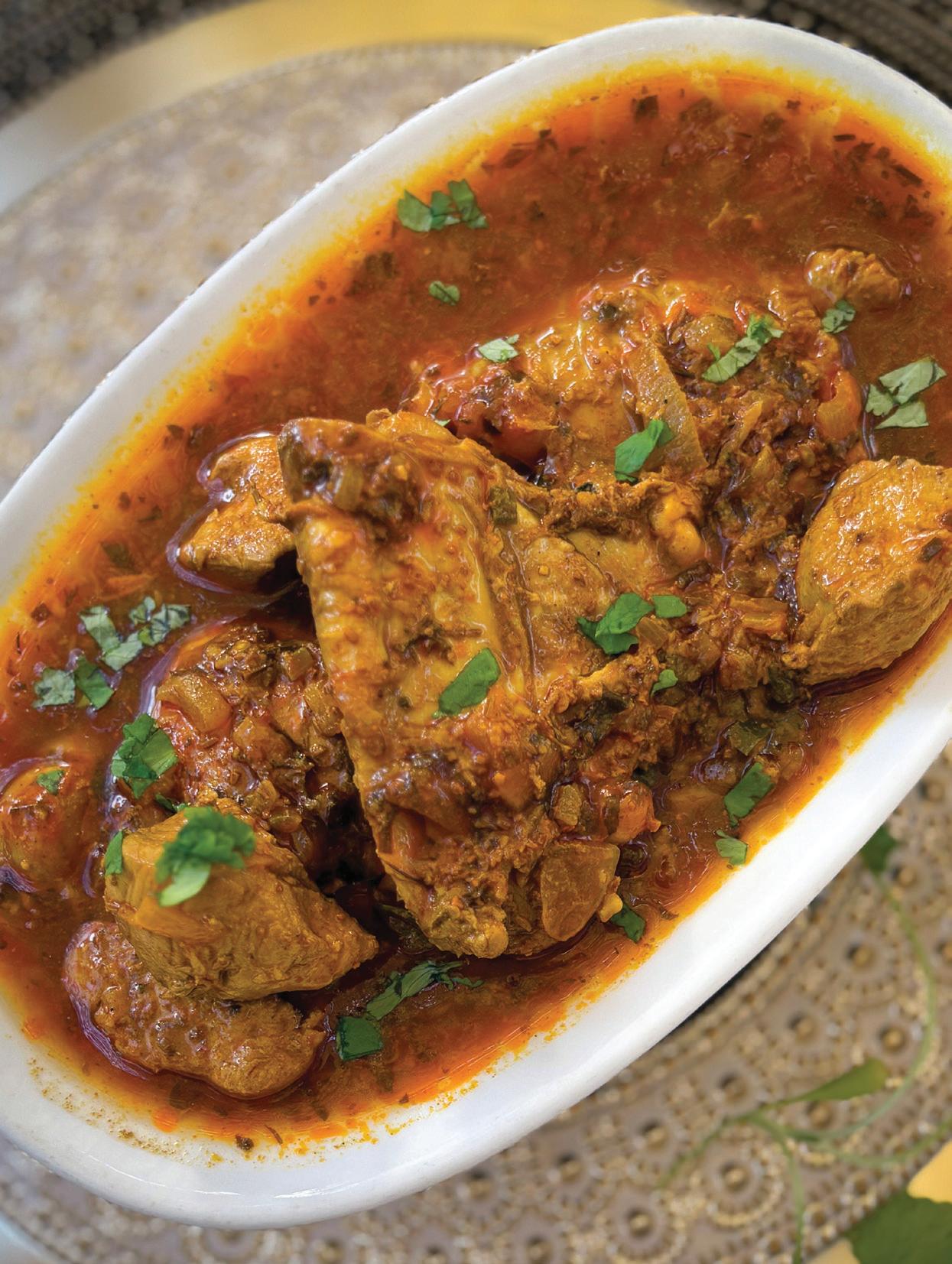
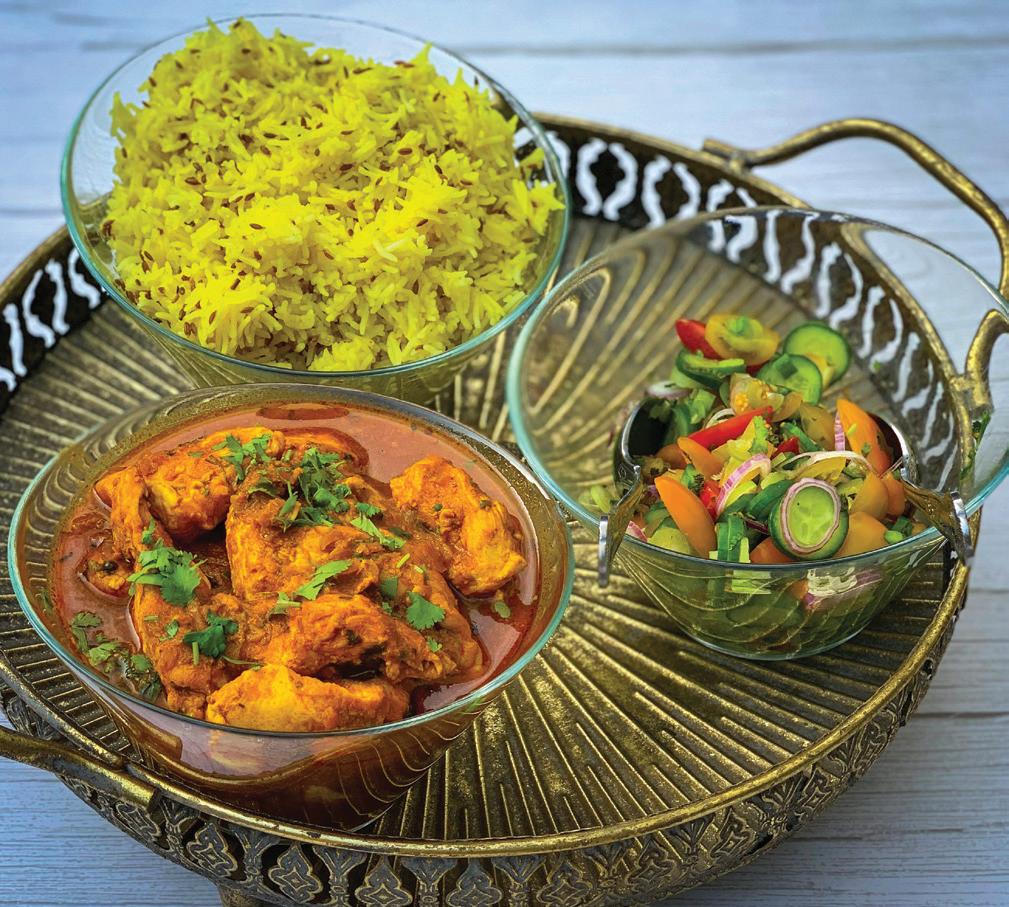
Murgh – Chicken ‘Curry’
This was our Saturday night chicken ‘curry’.
For Punjabi cooking you must remember – giving it proper time to cook gently is essential. Cook over a low heat. This brings out the natural sweetness or flavour in the ingredients. Much like the process of marinading – the magic happens when you give it time.
I’d recommend starting to cook this after you’ve eaten lunch so that it can just slow cook until dinner time. Alternatively, something my daughter now does, is to make the base/sauce in a saucepan, and then at the point of adding the chicken, she transfers the entire dish to a slow cooker.
Ingredients
1 batch of Tarka starter (see page xxv)
1 heaped teaspoon ground Cumin
1 teaspoon ground Coriander
½ teaspoon Garam Masala – see Garam Masala page
½ teaspoon Turmeric
1 heaped teaspoon Paprika*
1 teaspoon Salt
a big pinch of dried Fenugreek Leaves
20g Tomato Purée
Approximately 200ml recently Boiled Water
Approximately 600g of a mix of Chicken breast and thigh or drumstick
300g Chicken breast, cut into bite size pieces
300g Chicken thigh or drumstick – skinless on the bone. This is because bone meat enriches the flavour and gives a depth to the gravy that isn't the same without the bone. If you only want to use breast, see if you can put some bone in for the 'stock'.
2 or 3 Coriander leaves, roughly chopped (optional garnish, please note, this really would be a very small amount).
Optional: a couple of Potatoes (cut these into quite small bite-size pieces and add raw when adding the chicken)
*Note – Paprika – use an Indian brand, not smoked or supermarket varieties
Method
Begin with the Tarka starter of onion, garlic, ginger and chilli (see The Tarka page xxv).
Now add the spices and salt to the warm Tarka starter, stir them well and cook for 2 to 3 minutes. Then add the tomato purée and incorporate it well into the spiced onions
Add the recently boiled water a bit at a time, to loosen the base and create a sauce for the chicken. Add the chicken to the saucepan. If using a mixture of breast meat and bone meat, put the bone meat in the saucepan first, and then lay the breast meat on top as the bone meat will take longer to cook. This way the bone meat is closer to the base of the pan (the heat) so it will balance out the rate of cooking (as the chicken breast will cook through faster).
Put the lid on the saucepan, leaving it at a slight angle so that it’s not completely covered. Let the chicken slowly cook through, turning it every 10 minutes or so, so that all of the chicken cooks through evenly. It will take approximately 25-40 minutes for the chicken to cook through. It is done when the chicken is cooked all the way through to the centre.
Note: The lower the heat, the more tender the meat will be once it is cooked, you just need to allow more time for it to cook through.
We often cook this on a weekend and start cooking it in the morning, (often making a double or triple batch), and just let it slow cook. Then when it is cooked, we turn it off and let it cool. You can then gently re-heat dinner portions when you want them. We then tub up leftovers and freeze them so we can always have home-cooked food mid-week.
Tips: Using bone meat (such as chicken drumsticks or thighs) will add extra flavour to this dish. We would recommend using a mixture of bone meat and chicken breast.
Tips: Try to always cook meat dishes in a pan with a wide base. This allows you to put the heat really low but for the meat to cook our evenly, whilst also cooking gently. Do not use a narrow/tall pan as this won’t let the heat circulate properly in the pan.
Tips: For really tender meat once you have made the base/sauce, put the flame/heat as low as possible and very, very gently cook through.
This was also my first realisation that the people and the food from different parts of India, were different. In contrast, our own home-made ‘chicken ‘curry’ although it had chilli, had nowhere near the heat level of the South Indian version.
We always referred to that Saturday night dinner as ‘Chicken and Rice’ as kids and even still as grown-ups. Of course, it should be ‘Murgh for chicken and Chawl for Rice.
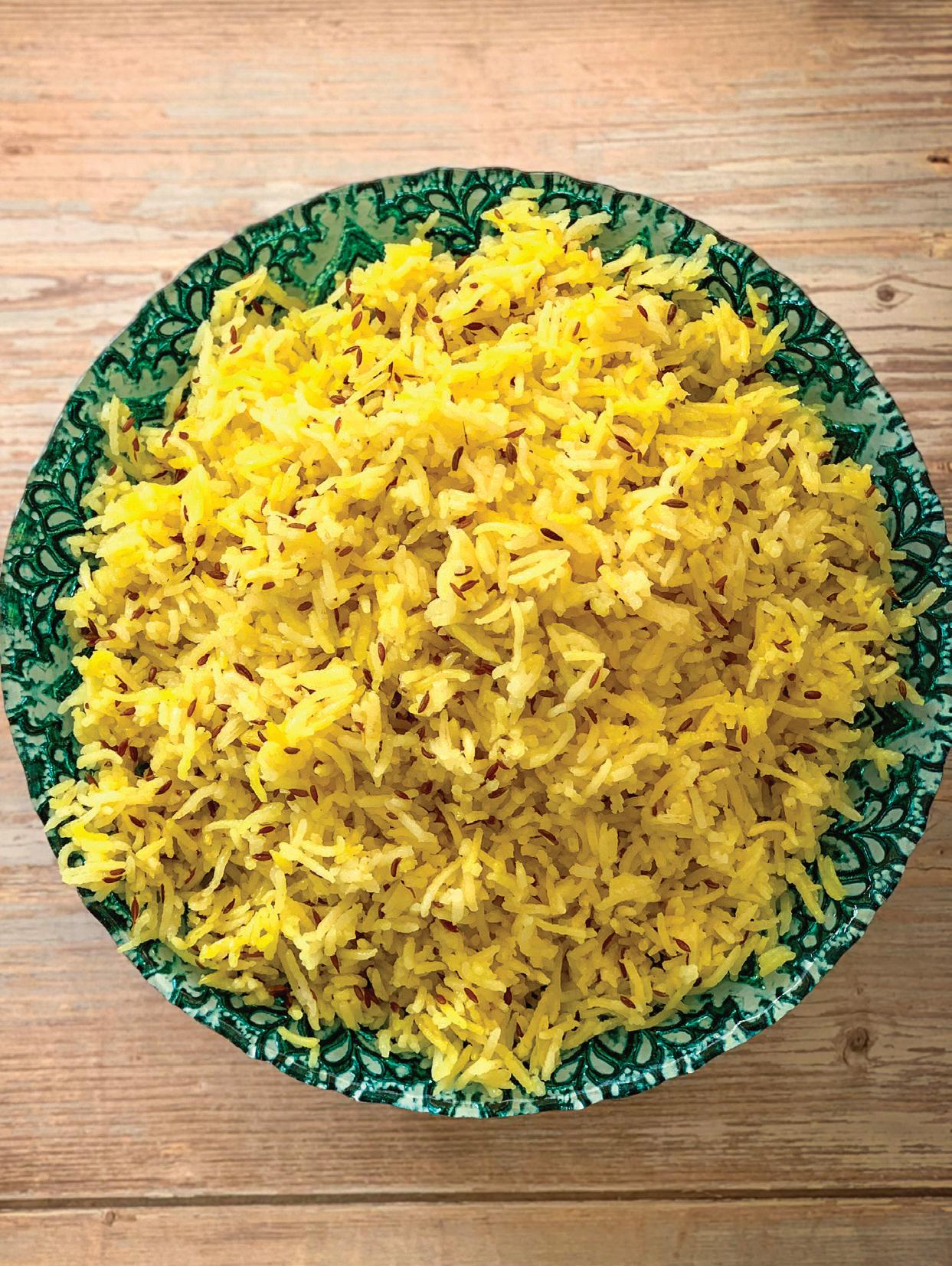
Jeera Chawl – Cumin Rice
Ingredients
1 large teaspoon Ghee (or Sunflower Oil)
1 tablespoon Cumin seeds
¼ teaspoon Turmeric
¾ teaspoon Salt
1 mug white Basmati Rice (approx. 250g) – we always use white Basmati Rice.
1 ¾ mugs Water (cold tap water) (approx. 475ml)
Some people do also add a handful of peas to this dish when making it, but that is optional.
Method
Wash the rice 5-6 times (or till the water runs clear). Once the water runs clear, drain the rice well and set aside. You must not skip this step.
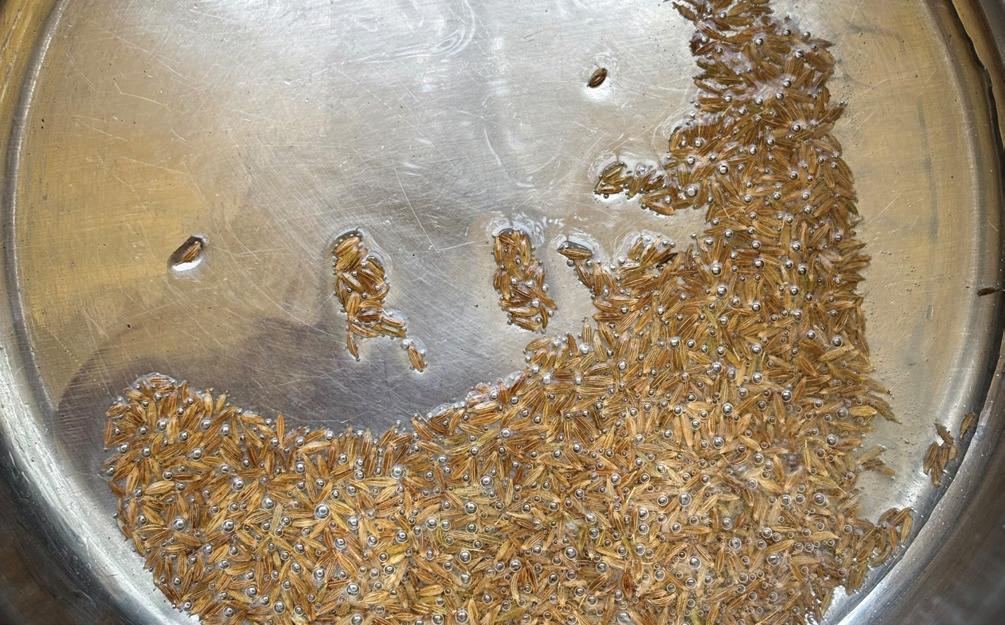
Heat a saucepan over a low heat. Add the ghee to the pan. Once the ghee has melted, add in the cumin seeds. Stir and gently cook for a couple of minutes. They burn very easily, so keep the heat low.
Add the turmeric, salt and drained rice, and dry cook the rice over the heat for 1-2 minutes to make sure all the grains are coated in the spiced ghee. The rice will almost become sticky – this is normal. Keep the rice constantly moving during this dry cooking process.
Add the water and stir. With the saucepan uncovered, turn the temperature to the highest setting to bring the rice to the boil. As soon as it has come to the boil, turn the temperature to the very lowest setting and put the lid on the saucepan.
As soon as all the water has been absorbed into the rice, it is cooked. Run a fork through the rice, this stops it from going sticky and forming a solid clump at the bottom of the saucepan and keeps it light and fluffy. Serve hot.
The ratio of rice to water is essentially: two-parts water, to one of rice, however we always knock off a bit of water in the second mug, as we find doing double the water volume can end up a bit mushy, so experiment with this. If you find that the rice is not quite cooked, then slightly increase water.
One thing to note, is that if you double up on the quantity of rice – say 2 cups of rice, you should slightly reduce the water again, so say, 3 ½ cups water. For some reason, as you make a larger quantity, you need a little less water.
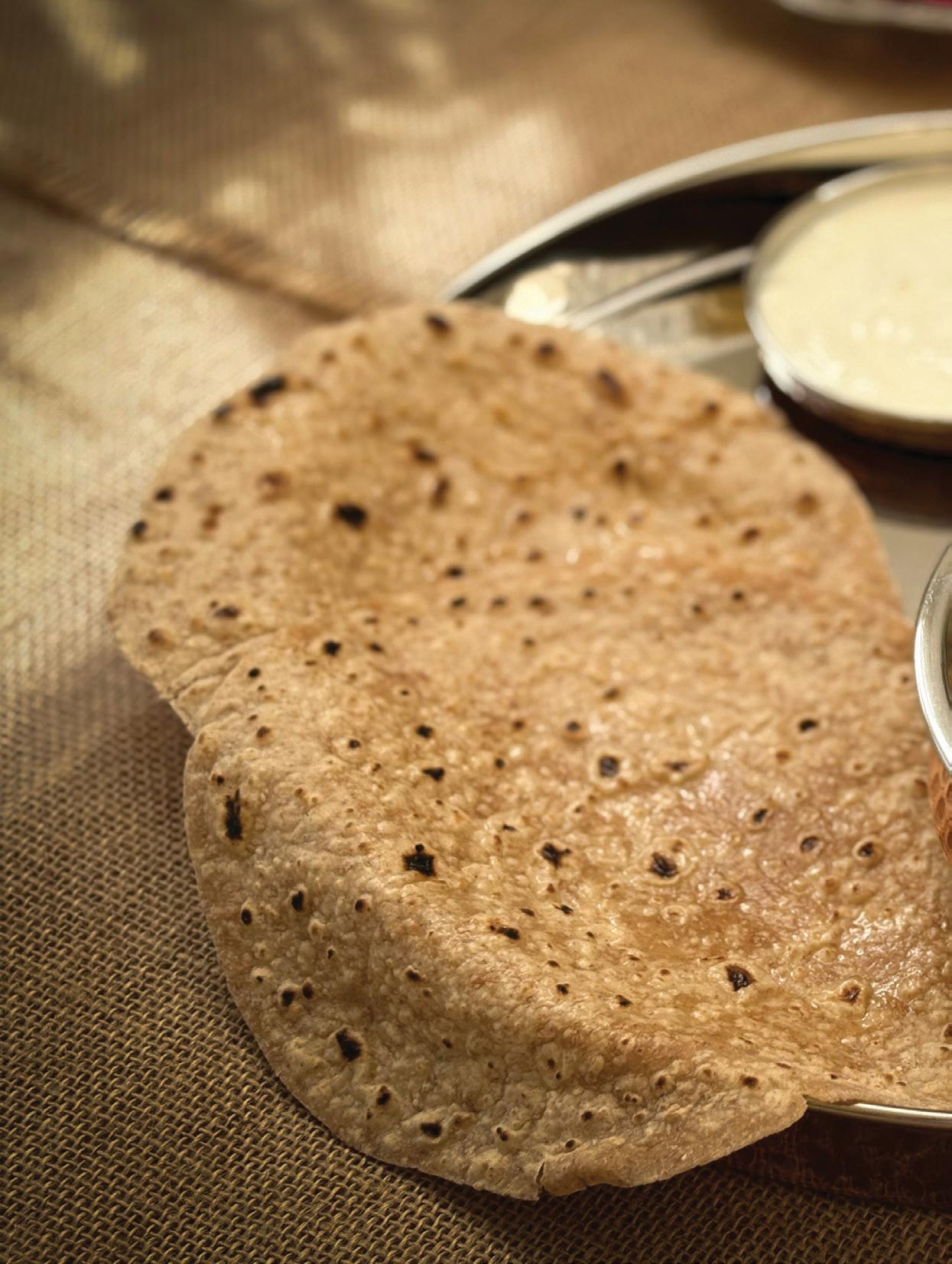
Another thing to note, is that rice is not the standard daily accompaniment to main meals in Punjab and the north, whereas that is more so in South India. For us the daily staple and side dish is Roti.
We use the absorption method for cooking the rice. I have seen some other Indians pour on a lot of water and boil away until the rice is cooked and then drain it off. It’s not a method I like, but if your mother did that and it works for you, then stay with that.
However… horrors, I have then seen that method of drained rice being… rinsed!!!! Under cold water for some bizarre reason. Now this was not in real life, but on a TV cooking show! If you follow Uncle Roger on YouTube, you will know what I mean, and in fairness, that was later addressed.
Now everyone’s mother is always correct – your own mother’s way is the right way… if you use a good quality Asian brand of Basmati rice and two-parts water to one part rice, you should have a great result. It’s always a mystery to South Asians and South-east Asians, (so basically Indians and Chinese), why the British can’t make rice?? In fact, we were told that it is in the top 10 most frequently asked culinary questions. In fact, someone told me after using our dry-frying method – “it’s a gamechanger!”
Cook the cumin seeds for a couple of minutes
Our rice was always made with cumin seeds, ‘dry frying’ the rice in ghee and using the absorption method, and I never knew any other way to make it. It’s fragrant, light and delicious.
Then I tasted school dinner – plain white boiled rice – badly-cooked, bland and stodgy!
Who knew you could take the same food ingredient and by a process and a methodology totally transform, or destroy the resulting dish.
Every so often I would hover on the stairs, usually when my father was home, listening to my parents talking at night, and I would hear the sound of the 10 o’clock news! The familiar gongs of the clock striking 10 meant my parents were sitting down – my father watching the news and my mother always knitting, sewing or ironing.
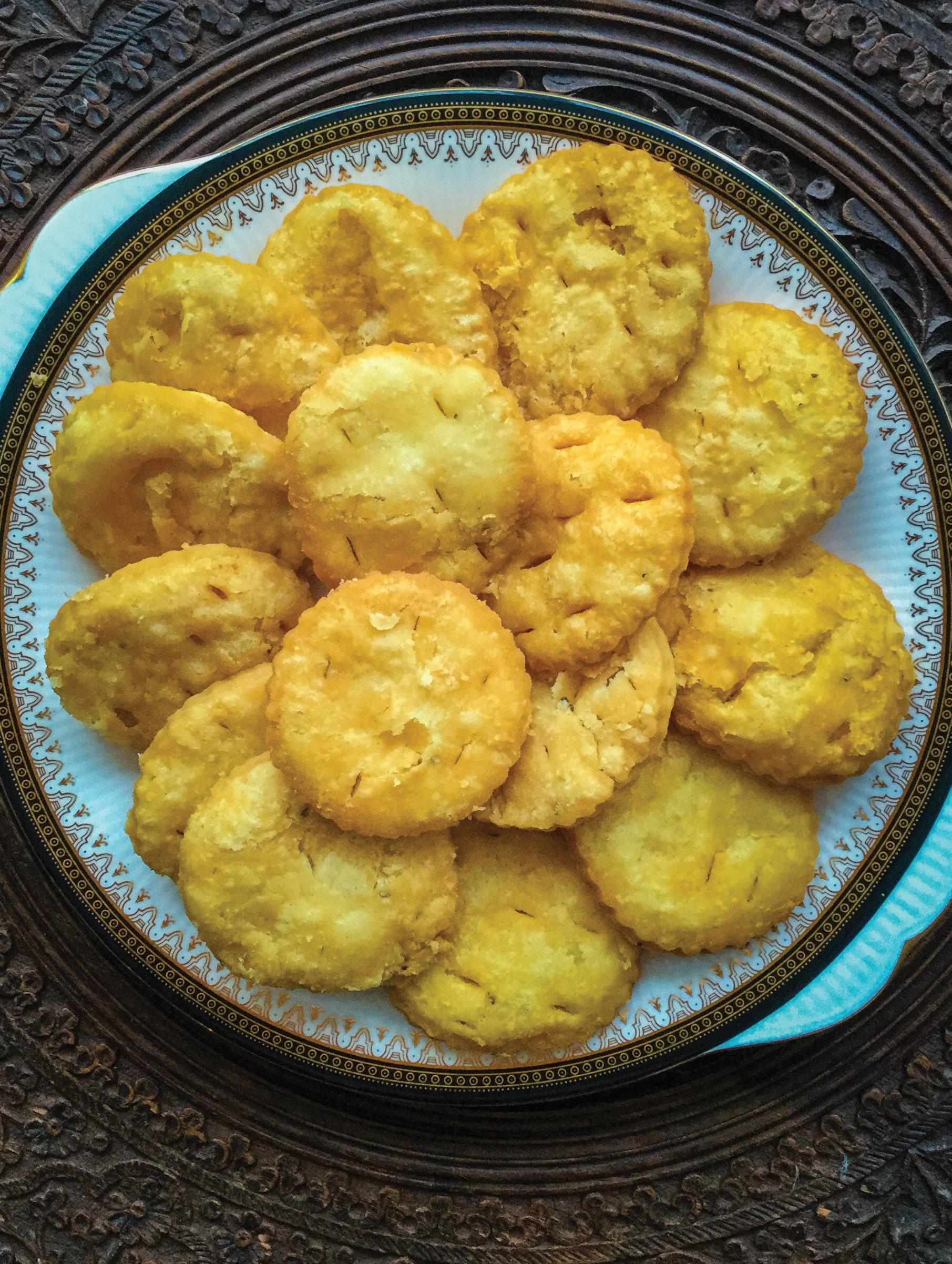
The lure was the sweets that she would have made earlier – namely Shakkarpara! These sweet diamondshaped tea-time treats are delicious. They are a sort of biscuit with a pastry/doughnut-like sugary coating quality.
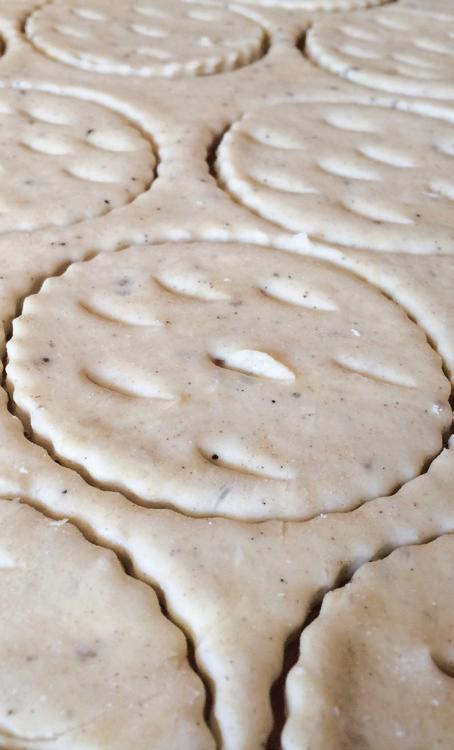
Simply made from pastry rolled out, pressed into a large round stainless-steel tin and cut into diamond shapes as she did, (or more often seen nowadays, shaped into cubes,) then carefully lifted out and fried until golden then dipped and coated into sugar syrup and laid out to dry and for the sugar to crystallise.
The traditional diamond shape requires more processes, which could be why nowadays one more often sees the cubes. This only requires making the dough and cutting or shaping by hand, into cubes. Whether diamonds or more cube-like, either shape is fine.
I do indeed remember the process seemed lengthy – making the dough, rolling out, pressing into a couple of round stainless tins, cutting into triangles, frying the pastry diamonds, preparing the sugar syrup, soaking the pastries in syrup.
Maybe it was the fact that my mother made what seemed to be vast quantities. In fact visiting other Indian households, this seemed common practice and the huge quantities seemed to be universally made and then stored in tins.
When it came to the frying and also the process of boiling the syrup, my mother would always urgently instruct me to move away from her and stand well-back, such was her fear that I should even slightly be splashed by boiling oil or syrup. I always wanted to see these dramatic moments up close but could only stand next to her by the cooker, when it was on a low heat.
I learned early on that Indian parents and culture prize their children, and the protection and fear of harm and of ‘going wrong’, would later become over-sheltering and a conflict in a Western world.
Ingredients
Shakkarpara – Sweet Biscuit
1 cup Maida (Plain Flour – approximately 250g)
¼ cup of melted Ghee*
½ teaspoon Baking Powder
¼ teaspoon Baking Soda
Tap Water
Sunflower Oil, for frying (1 to 1 ½ litres)
Method
Put the Maida, baking powder and baking soda into a mixing bowl. Pour in the melted ghee and rub it into the flour until it’s been completely rubbed in/mixed through.
Add water little by little until you have a firm dough – the sides of your bowl should also be ‘clean’ (i.e. No sticky dough left around them). Cover with a tea towel and leave to rest for 10 minutes. As the dough is resting, pour the sunflower oil into a Karai (or wok) and heat over a medium to low flame –the heat for frying these is much lower, so the heat should be on the lower side.
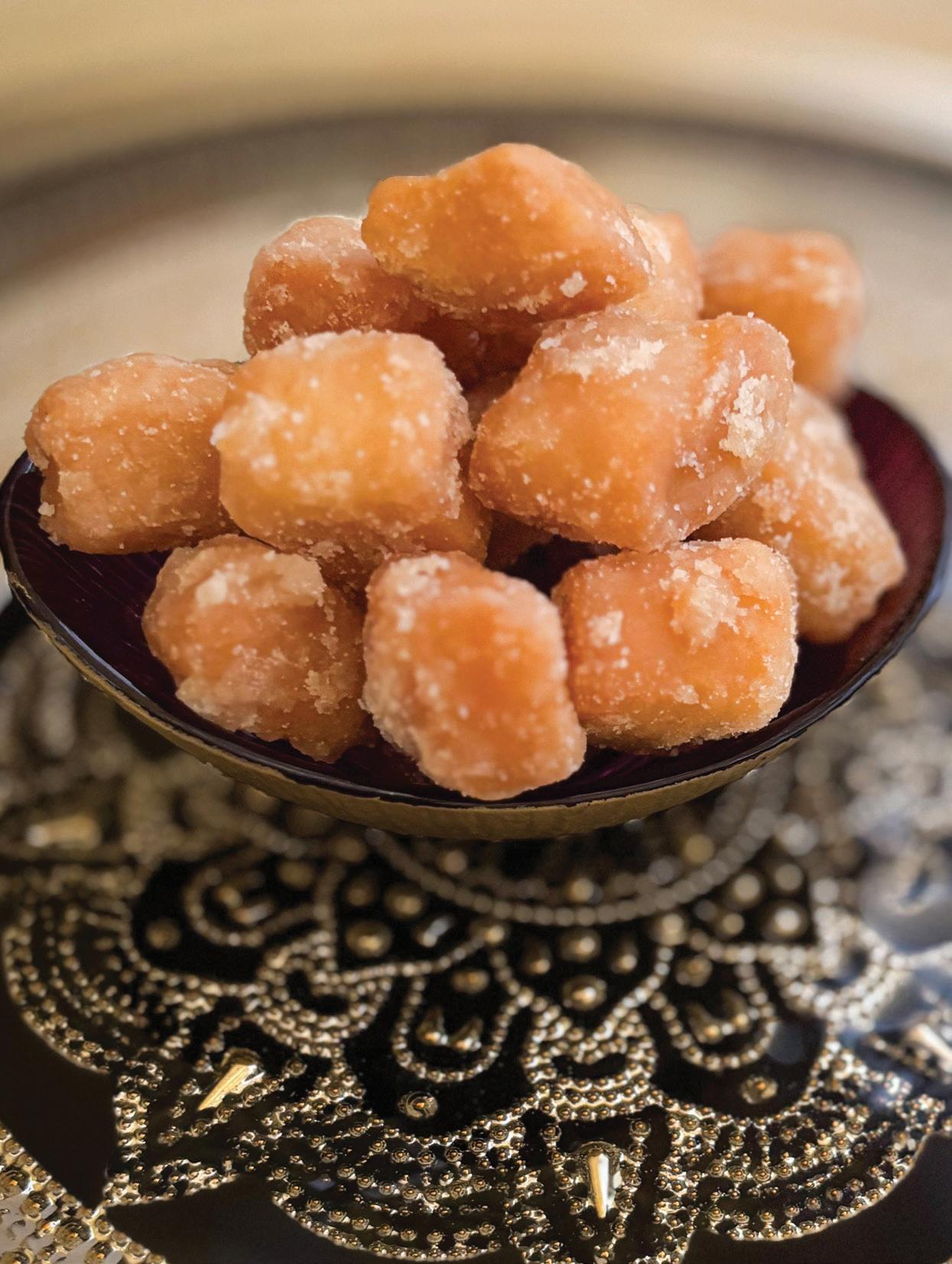
After is has rested, uncover the dough and roll out to a half inch thickness with a rolling pin, then cut either into squares to make chunky cubes, or cut criss-cross to make diamond-shapes. Whether you roll out a thicker dough, and cut them fatter and more cube-like, (as pictures), or as diamond shapes, is your preference, and you will see Punjabi women making both types. My mother preferred diamond shapes, and I still have the stainless-steel platters in which she lined the pastry, with the knife marks from scoring the shapes.
Once you have your shapes, use a spatula to carefully lift them and lower them into the oil. The oil is warm, and they should look fairly still when you put them into the Karai. The lower temperature allows for the ‘Pare’ pronounced paa-reh (biscuits) to cook out and expand/swell as they cook – if the oil were too hot it would set their shape almost instantly, whereas they’ll now slowly puff out a little as they cook. Fry them for about 10 minutes over this medium to low heat until they are golden brown.
*Note – You can replace Ghee with sunflower oil, if vegan or dairy-free, otherwise don’t.
To make the syrup
1 cup Sugar
½ cup Tap Water
Put the water and sugar into a heavy based saucepan and turn the heat on to medium. Let the sugar dissolve into the water to form the syrup. Once it is bubbling, dip a spoon into the syrup, and very carefully dip your index finger into the syrup. Press your index finger against your thumb and as you separate them, a thread of syrup should remain – the syrup is now thick enough.
Add the fried ‘pare’ into the syrup and gently toss them around to make sure they are completely coated in the syrup. Now pour the ‘Pare’ (biscuits) out into a tray, and over the next 5-10 minutes, the syrup will crystallise over them – and you will have Shakkarpare (sugar biscuits!).
Shakkarpara, (plural Shakkarpare), is a sweet snack that is universally seen across India as well as the wider diaspora, and not only Punjab. They are also known as Shankarpali in other areas of India.
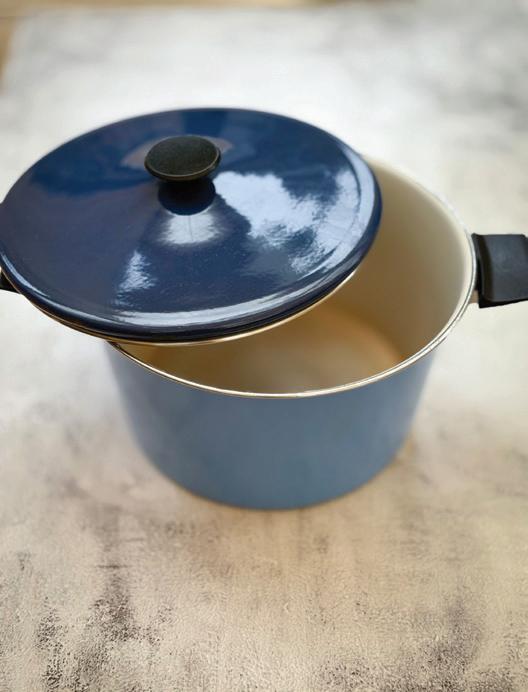
For the heavy based saucepan that Safia and I used to make this syrup... this was my mother’s blue saucepan, which she only ever used for making the syrup for sweets, and for making any kind of sweet or dessert, and which I still have and cherish and use for all of our sweet making.
My mother kept separate saucepans for particular dishes and was very strict about this. It was an unbreakable rule, and her blue saucepan could never be used for anything else. I was told quite firmly that even after washing, saucepans could never be used for different dishes! Savoury dishes or meat of any kind could never, ever be cooked in this blue saucepan, or vice versa… using any other saucepan for sweet making.
I remember the first time my father’s accountant and his family came for dinner.
They were Jewish and my father told me, quite pleased with himself, that they could only come and eat with us, because we kept different saucepans for different dishes, as did they! I remember noting and processing this culinary and religious fact. To learn of these wider cultural rules was interesting and also made me think about what was deemed to be cross-contamination of flavours or odours of any kind. As a teenager, on the one hand I dismissed it and thought it was a bit unnecessary, but on the other hand, I didn’t even want to break this rule and still do not, for the home! For some things, your parents are always right and custom prevails!
Another one of my childhood jobs was the task of removing the skins’ of Badams, (almonds). My mother used to buy large bags of everything – I think that must have been possible with my father working at Heathrow, as we certainly couldn’t buy Asian size bags at the Co-op.
It was always a marvel to me as a small child, having the comparison of English families all around me, to note how large the sizes of all of our dried ingredient’s supplies were, as compared to my friend’s mothers, who had dainty packets and small bags of flour and sugar – the standard size of the 1kg or 1.5kg supermarket packet. We had, and still do, enormous sacks of 10kgs bags, and even 20kgs.
From her stash of bulk provisions, my mother would produce a large bag of whole almonds in their skins, ready for me to do the necessary skinning. She would pour the required amount into a bowl, then I would watch as she poured boiling water over the almonds to cover them. When the water had cooled enough to place my hands into it, she would tell me to remove all of the skins from the almonds – it was a fun process. My mother showed me how to slide the Badam through your fingers so that the skin slid off with almost no effort. In a jiffy I would have a bowl of white shiny peeled almonds.
Sometimes I would be required to split them – I could double up on this job by pressing harder on the split line, when removing the skin, to also split them at the same time!
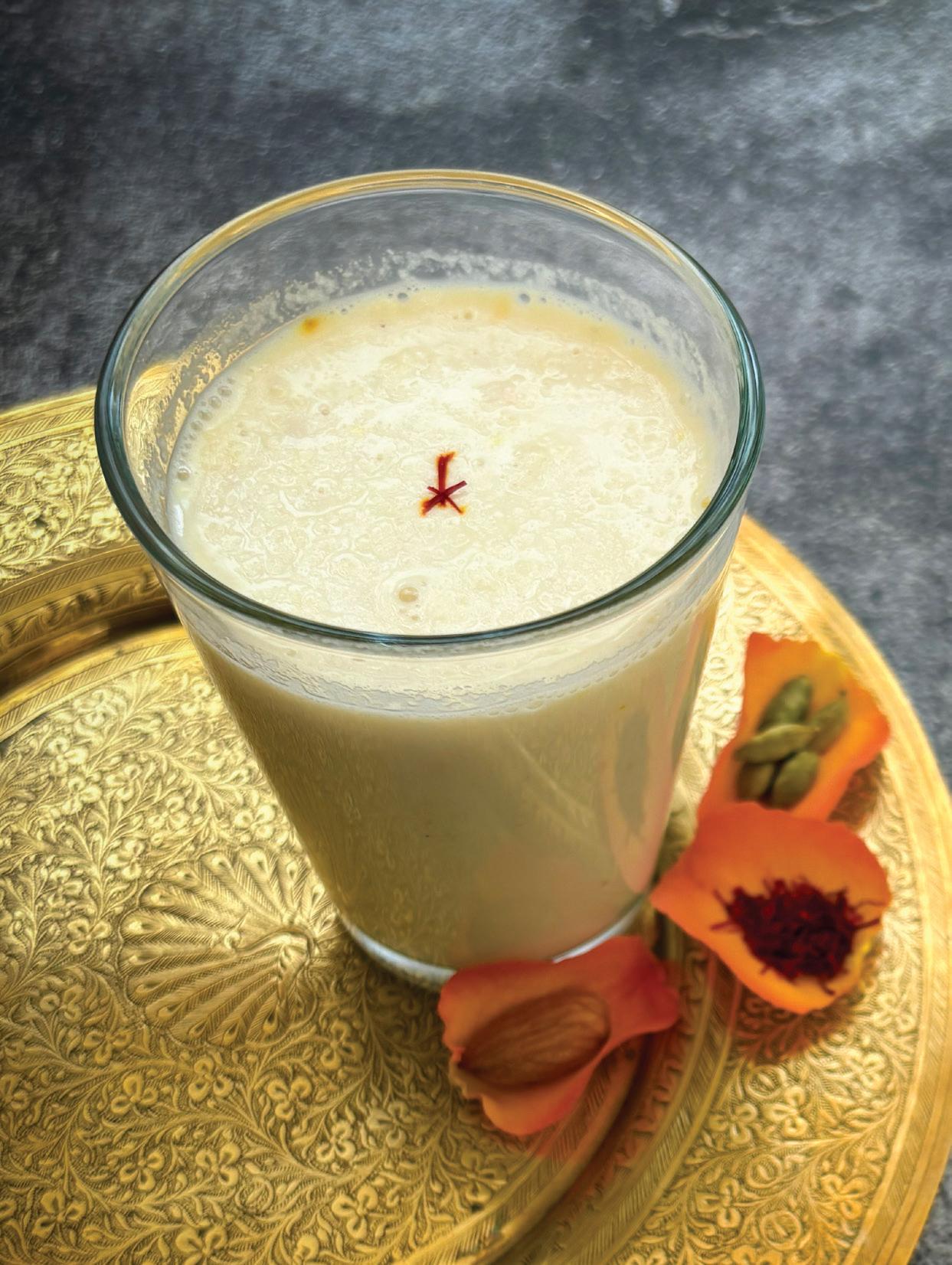
From this point, almonds were on hand for almost any and every sweet dish being made at the time, however one of the regular things it was used for was Badam Dudh – the hot milk she would make at night – bringing the milk gently to the boil, then adding almonds that had been crushed and ground to a paste.
She would make me drink this, and one of the reasons for this, was her insistence that it was for brain health. She knew that this was a culture where girls were being educated equally with boys and also with high expectations and she was very keen that I get a good education, and this meant feeding of the brain!
She knew that I absolutely loved my primary school and loved reading, and my father was delighted with my school reports and read them out proudly. My mother in her sweet and loving way contributed by feeding me with nutritious goodness and love, and her way was of doing this was with Badam Dudh.
Ingredients
Badam Dudh – Almond Milk
20-24 Almonds (about ½ cup)
500 ml (2 cups) Whole Milk
2-4 tablespoons Sugar (or any sweetener of choice, to taste)
1 pinch Saffron Strands (optional)
⅛ teaspoon Green Cardamom powder (from about 2-4 shelled pods)
Optional: chopped Almonds or Pistachios for garnish, a few drops of Rose Water
Method
Soak the almonds in water off the boil in a heat-proof bowl. When the water is tepid, test whether you can slide an almond between your fingers and 'slip' the skin off. It should slide off easily. If it doesn't then leave to soak for longer. Put the skins in your food recycling.
Making the paste
Grind the almonds down to a paste. My Mother used to use a pestle and mortar, but you can use a blender or small food processor. If you are adding the cardamom, throw in 1-2 small green cardamom (the seeds inside the outer green pods), to grind and blend down into a paste with the almonds.
Add in the sugar and saffron strands (if using). Add about ¼ cup of the total milk and blend into a very smooth, fine paste.
Making the milk
In a heavy-bottomed pan, bring the remaining milk to a boil over a medium flame, stirring occasionally to prevent burning.
Once the milk is boiling, stir in the almond paste completely. Add any extra sugar if desired. Reduce the heat down to low and let the milk simmer for about 2-3 minutes, (don’t boil at this stage), or until it is slightly bubbly and the flavours have infused well, then turn off the heat.
Badam Dudh can be served hot, and we always had it this way but nowadays, you can chill it and serve it as a cold milk drink. You can also garnish with slivered almonds or pistachios before serving.
Food for thought ... Business & money
‘We’re here to make money’
This was something my father said to us from as long as I could remember as a child. Making money from long hours, doing more and extra, no set hours, no work/life separation.
I learned from my parents at an early age, that there is a living in food and bricks, and that they are both a source of income. It was more learning by absorption, but I saw that immigrants must come and set up a business… or two, or more, and all the family must work and have input – we were a collective unit. Asian families get ahead this way.
I grew up not seeing any end or divide to my parents’ working day, and that I was a big part of that, whereas I saw that British children had parents who went to work Mon to Fri 9-5pm. Weekends for British families were strictly for leisure, and their children had no part of their working world.
Another reason for this was that my parents came from rural farming communities from the region of Jalandhar, Punjab. They weren’t city people, and the educated middle classes in India would have probably also had 9-5 admin office jobs, and something nearer to a British or middle-class lifestyle.
My parents and grandparents were used to rising with the sun and not with the alarm clock and similarly the working day and routine followed the seasons, the animals and the weather, making money from and around these factors.
They were a product of their time and culture, and I was a product of my time and culture which was evolving and questioning, but still complying, for the most part. There is not and should not be any judgement, as we each adapted to changing environments.
A working way of life, from its time, but is it relevant anymore for the grandchildren of the Punjabi immigrants of the 50’s and 60’s to immerse themselves in the ‘family business’, additionally when the digital age and tech options increasingly exclude their parents and grandparents?
... Reflections on two worlds and cultures
Immigrant & British
perspectives
‘On the one hand… but on the other?’
The early first generations Punjabi immigrants were built of strong stuff! They had a strong backbone, determination and perseverance, as well as extraordinary entrepreneurial drive. Those first arrivals contributed value to the economy and society. It should be noted that my fathers route to the UK was not the typical one of coming straight from the villages, but via 11 years in the navy, so he was already quite westernised, as well as experienced in navigating two worlds and cultures.
When you look at a country like the USA, built almost entirely off the backs of early pioneers and immigrants, these were people who took risks, faced fears, left the familiar to head out into strange and hostile worlds where they would have to fight, (and in some countries, wrongly appropriate/steal the lands of the indigenous population), to gain a place and forge a life.
Is it a wonder it’s known for success and strength?
In the US, Indians are one of the highest earners out of all ethnic groups, as well as across most of the diaspora. Is this due to the Asian model of working? The hierarchy of elders, the clear and strict rules of the home and the ‘we’ before ‘me’ culture. This has changed and evolved somewhat now, and the first generations of children born here fought for the freedom to choose their own path yet still hold onto the principles of the extended family.
In stark contrast… are later 2nd and 3rd generations getting a much softer lifestyle, and the recent immigrants getting a very soft landing? Whether that is from the ready-built infrastructure and network of the early immigrants, or the state? Generations who benefit greatly from the sacrifices and graft of their pioneering ancestors, through access to superior education and standards of living, yet often take this for granted.
Much like the older ones always pave the way for the younger ones… often to their annoyance.
Food for thought ...
Cultural, parenting & family observations
‘British work vs Indian work habits’
I grew up, even as a small child, seeing the very opposing lifestyles of mine and my friends and that our family norms and dynamics were very different.
My experience as a small child was that playing and working were both activities and were intermixed. I was happy ‘playing’ and happy ‘working’ at my mother’s side. I didn’t really know the difference, as our kitchen was also our business, and our home was also our business, with most of the bedrooms occupied through the Bed & Breakfast business… so we were at home and at work.
The key theme for South Asians seemed to me as a child, that family is at the core of the ‘wheel of life’ and the details around that are revolving and mingling, lines merging and blurring between work, family, and relatives, whereas I noticed that British people had a very strict routine and that they get upset if this is broken. There were set times for everything, and a separation to many of the components of life, although this was possibly because we were living in a very middle-class area, and I hadn’t yet seen any other aspects of British family life – that exposure to British regional and class differences was to come!
The whole concept of work/life balance isn’t something that Asian parents understood back then, and still today, is something that is seen as ‘lazy’ by older generations, though many now are addressing the popular and all-pervasive phrase of ‘mental health’.
Many South Asians are increasingly afflicted with this ‘Western condition’, something that would have confounded Asians only a generation ago?
Good or bad... excuse or justification… or just confusing?
... Reflections on two worlds and cultures
Nutrition & health notes
‘Something sweet’
After the end of every Indian dinner, my father would often say…
“Bring me something sweet Putt (darling child)”
… and so, in my mind, the contrasting flavours of the sweet treat would be to offset the chilli of the main dish, but in addition it was the appropriate time to consume something sweet, as in simple carbohydrates – when the body was replete and the stomach lined with proteins, fats and carbohydrates.
I always noticed that the something sweet was a very small quantity – more for the palate than the stomach, and very often, now living in the Western world, my father would often ask for a coffee with sugar, or our sweet masala cha, always with or after food, which would sometimes suffice in place of Indian sweets.
This was something I always told my personal training clients later in my life – don’t deny yourself that sweet thing but think of your blood sugar levels and don’t release sugars into the blood stream on an empty stomach – you’ll eat an endless quantity and wreak havoc upon your body.
Consuming a sweet treat after having ‘fed’ the body with nutrition, automatically reduces the amount that is eaten. There’s nothing worse than denying yourself that treat, but knowing when and how to consume it is a key factor in health and weight control.
Funnily enough as our family diet gradually changed to incorporate more of a Western diet, we all started to gain weight, and for the first time… we all undertook that Western habit, so curious to the rest of the world… and would announce…
‘I’m going on a diet’…
Chapter 6 – Open all hours
Fairdeal… or an ordeal!
One of the reasons that we went to India was that my father wanted to get that trip done as he had plans to open a shop on our return. Asians were known for the ‘corner shop’, which was ‘open all hours’. He bought the first small shop in our road, then the one next door, and then the one next door to that. One had previously been a greengrocer’s shop, and I recall that the other two had been some kind of small shop.
Once he had acquired those three properties, he set about doing what he most loved to do with property… knock down walls and build an extension – the bigger the better.
Whenever he saw a building or room, he would always want to knock down the walls and generally open up any space that he could. I don’t know it this was coming from the open-air living in Punjab with vast open spaces. Houses having a large courtyard, and the kitchen having an opening to the courtyard, instead of the fourth wall? The typical layout of British terraced housing was quite tight and ‘walled-in’ and probably felt quite restricting. It wasn’t just a peculiarity I noticed in him but in most Punjabi people we visited in England – they had all, in some way, extended their houses or knocked down internal walls.
When my father talked about this shop, one of the things he always said, was… “people will always need to eat, people will always need food – no matter how rich you become, and what else you don’t need, you still need three meals a day”.
He set about getting the necessary planning to extend all three shops and so ended up with a super-shop – a vast space which housed our supermarket, which after a family meeting to consult and deliberate on a name for the shop, he disregarded all input and pronounced that the name should be ‘Fairdeal Shopping’.
In true ‘Father Hothi’ style he had to do it bigger and better than everyone else, and that we were soon to discover would include the opening hours. Builders coming and going, and all sorts of activity were going on as the rear of all three buildings were removed and extended, not just outwards, but also three storeys upwards. Meanwhile internal walls were being removed and the internal shop-fitting process underway in the planning. Deliveries were coming all the time and plenty to be done.
One day I remember standing at the back in the new rear extension, high up above was an open section of roof, where two builders were manoeuvring a steel girder. Lots of people were there and I had papers or a clipboard doing some kind of stock admin task. I’m not sure how it happened, (and health and safety would have been very relaxed back then, to the much stricter rules now), and that section should and would have been cordoned off nowadays, but it wasn’t. Somehow the two men dropped the steel girder directly over my head from the roof above.
At exactly that moment, busy with whatever job I was doing, I stepped aside to reach for something. Suddenly next to my feet, there was an almighty crash and the whole building shook as the steel girder fell to my side. The clanging and reverberating from this huge steel bar shook the building. I looked up to the open roof structure above to see the faces of the two men. Their expressions said it all – my third near death experience, and once again I didn’t even feel it – but looking at my father’s face – he did! I’m not sure what he did or said to those men, but I wouldn’t have wanted to be them. I wasn’t especially bothered and carried on with my work.
As building works were nearly done, my father announced that we would open our new shop at 7am in the morning and close at 10pm at night, apart from Sunday (because at that time, Sunday opening was limited to 10-4pm), and this would be 7 days a week. The only day we would close was Christmas Day, (and if he could have opened that day he would have). I think, had he said that in these times, there would have been mutterings about work/life balance, time-off etc. but we didn’t even think about that – he said it, and so it was.
Consequently, most of my A-level revision was done on the shop till, with the exception of the Indian trip, pre-the shop, when it was done on the go. However, this was only probably a small factor in the fact that I didn’t do very well. I was just plain bored throughout the process of A levels, and did the minimum of schoolwork, which I used to think was the lazy streak that I have nowadays managed to squash. This was because teachers told me I was lazy. This wasn’t true – in fact I was acutely and chronically bored!
As our supermarket opened from 7 am in the morning till 10 pm at night, 364 days of the year, so it was a requirement that after school and at weekends, we had to work.
Growing up in an Indian family, there was no exchange of money as such. If I wanted something and my parent thought I should have it, then money was no issue. With free access to any amount of stock, and parents who were generous in the giving of material things like clothes and food, temptation was all around me. Thankfully my parents’ concerns with weight and obesity kept this all in check… one day idly sitting on the till reading a magazine, (I had a veritable library of trivia to read from the magazine racks, being very careful to keep it clean, and return for sale on the shelf), it was my turn to be on checkout. I idly reached for a bag of chocolate Maltesers. Then another… and then… another – just small bags you understand. Absent-mindedly, my hand reached out for yet another… 4th bag, when a voice interrupted my chocolate reverie….”my god!’’ I heard… to turn and look at my father looking at me laughing and feigning mock horror! “you pig”… I sheepishly returned 4th bag to its rightful home – note to self – don’t be a piggy!
I always remember a customer coming in the shop quite late one night, around 9pm, and I had my books out on the counter. He asked me what I was doing and I told him my A level work. His reaction was quite severe and both surprised and amused me.
He was almost outraged, which took me quite by surprise as it wasn’t his business! I remember him saying something about how terrible it was that I was having to do my school-work while working on a shop counter late at night on a school night. I was quite bemused, as well as amused at his Western indignation. How did he think immigrants progressed? With hindsight, he was probably right, as it wasn’t conducive to good results, though it was fine for just getting homework done!
Working in the shop meant meeting a lot of people and became a sort of controlled and restricted social life, supervised by my father’s regular shop floor patrols. We already knew those customers who were local, as times were so different and everybody generally nodded and greeted each other locally, especially in a compact place like Southsea, where everything is in walking distance. We also got to meet many new people from around the area and also attracted a gaggle of local boys who congregated outside the shop, (a different sort to those mentioned in a later chapter, though with the same raging hormones). They would use any pretext to come in and purchase something small. It also meant meeting many other young people and getting ‘asked out’. If my parents were present, I had to feign ignorance of their interest and dreaded that they might actually start the ‘chatting up’ process. All male customers, quite quickly learned to avoid all eye contact with me if I were not alone, say as little as possible to me, not make any friendly overtures and get out fast for fear of my father’s deathly glares and towering and aggressive demeanour. They scuttled out quickly when he was there, glaring ominously at them.
It was still awkward if my mother were there. One day a regular customer – a handsome young blond man, came in. He had been coming into the shop after work quite regularly, always very polite, saying hello to me and also to my mother, who obviously thought he was a nice young man. One day he came in to buy chocolates for Mother’s Day. As he approached the till, he handed me a big expensive gift-wrapped box saying they were for his mother… but then he handed me a second one – I looked up, and he said… “and these are for you”. I froze, my brain scrambling at this publicly open approach of showing his interest and quickly trying to process what to do and how much trouble I would be in for receiving such a blatant show of attention. I hesitated and holding onto the box, turned to look at my mother with a questioning look. I waited for her to intervene and say no thank you, she can’t accept. To my astonishment, she looked at me, not smiling but also not angry, and said, “take it”.
I did… and she not only didn’t make me put them back on the shelf for re-sale, but she also never told my father! There was always a part of her that wanted me to have and live my own life, as she could never do, and so she was torn between reprimanding me for always pushing the boundaries of an Asian girl’s life, and the side that saw the potential freedom I could have and she never had.
The shop was a lot of hard work, and I would say that the hard work, along with the pioneering character of Indian immigrants of this era, really did earn them their money and success. Long hours, hard physical work, but rarely any moaning. The shop was really big, and we used to get huge deliveries. We had one regular member of staff for quite a long time during the time I was in sixth form, and she was a treasure. A young girl probably in her early twenties, and my mother was very fond of her. She was that old-school type of worker – a real little grafter, and, respectful too. She always called my mother Mrs Hothi, never overstepping the boundaries. My mother loved it when she and the young girl were working together, as she was cheerful and willing. My mum was a little chatterbox and loved to meet and talk with people, and the girl was good-natured and engaged with my mother even if she didn’t always understand her broken English. Huge deliveries of
goods arrived in the large metal cages, and it was ‘all hands to the deck’ to carry everything in. The girl ‘shifted it’, as if she were one of us or a family member, working at speed and getting that stock unloaded and on the shelves.
For a period of time one of my school friends worked on the till with me and it was a time of endless giggling and silliness. Another friend was the recipient of all my secret letters and communications between boys, and she would pop in and hand me notes when no one was looking. During this period, someone I was seeing said – “it’s like going out with a married woman!” We happened to be meeting in a pub in Southsea, carefully selected by me, as one that I knew my father would never go in, and then… suddenly, I thought I saw him, or perhaps someone he knew, walk into the pub, so mid-chatting, I very suddenly disappeared under the table!
The number of near escapes I had were terrifying but equally exhilarating, and, if nearly caught when I was with my friends, we would re-live the panic the next day at school,… ”oh my god that was so close”, “Oh he nearly caught us”… which would then turn to hysteria – laughing till we cried, and once laying on the floor of a shop, tears rolling down our faces, unable to breathe we were so convulsed with laughter at the near-death moment of being ‘found out’.
Laughter aside, there was a real fear of being caught, and I suppose it must have been the permanent situation that young gay people from the previous era must have experienced – that living on the edge of ‘the forbidden’ and almost always nearly being caught… except, at that time, those consequences would mean a judiciary punishment! In the case of girls coming from very religious, extremist or ultra-traditional households which did not integrate – there was a very real risk of death, in the obscene and idiotic process that is an... ‘honour killing’ always by men who themselves have no honour, and shamefully aided and abetted by women who raised this type of son! They facilitate their behaviour and contribute to the oppression of the girls. Every abusive male was most likely raised by a woman, so where does the cycle begin and end?
Yet… some people in these situations, continue to defy and take the risks, and sadly others, nearly always females, are squashed and trapped and subjugated, whether through forced marriages, controlling of their finances and their autonomy or the hidden scandal of modern-day slavery…
and so, in my case, without any real risk of actual death itself, I merrily continued… … and, so, I was eventually going to be caught!
I did the usual thing during A-levels which was to apply to go to university but truthfully, although I sort of thought I did want to go, (because that was the conditioning that we all did go to university), a big part of it was the opportunity for the freedom to be able to legitimately leave home. Indian girls could not leave home before marriage, and the only exception was to go to university.
One day I was working in the shop, it would have been the summer holidays because it was the daytime, so I wasn’t at school (and I never missed school).
It was before my father was aware of my complete and spectacular lack of effort and ‘soon to be announced’ bad results in 2 of the 3 A levels, (good result in English, because that was easy and didn’t require much effort,
plus I had a good tutor, arranged for me by my father, because I had explained to him that the A level English teacher was terrible – she was!)…
… and so it was, before I was in my father’s bad books, there was an occasion where a marriage was unexpectedly arranged for me, and this came about by chance.
It was a hot summer’s day, and I was working alone, at the shop till, behind the counter area. Several cars – three or four maybe – pulled up outside the shop, with… an unfamiliar sight in white Southsea… a party of Indian people!
Now this type of convoy for Asians was not unusual in those days, though mostly seen in less non-immigrant areas. In fact, occasionally and suddenly, several carfuls of visitors would descend upon the house which would always cause some panic as everybody scuttled around quickly, and my mum would quickly order us to make tea and produce snacks or something to eat.
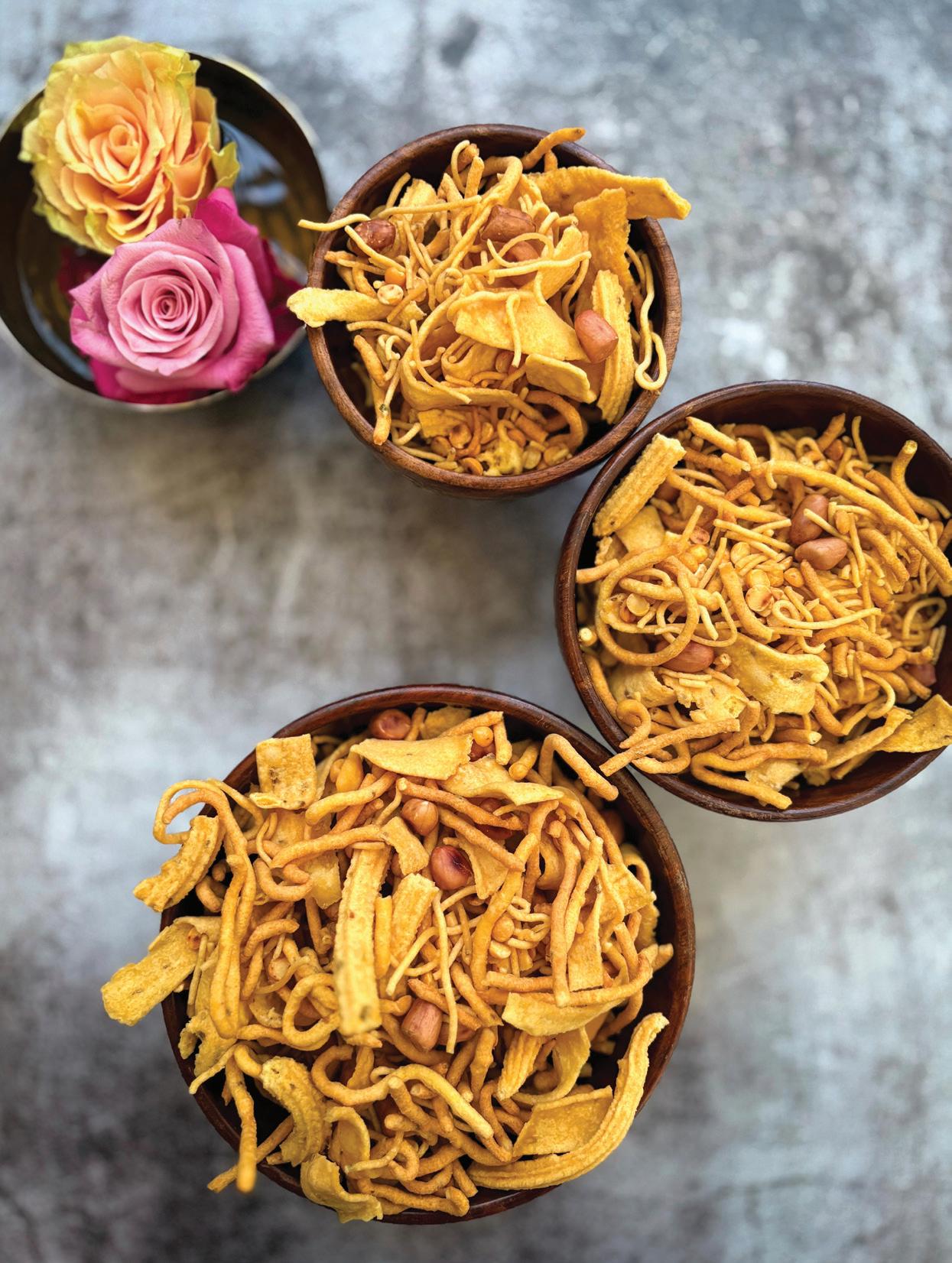
Indian households back then, and still today will keep food – snacks such as Chevdra, (pronounced Ché-brah, known as Bombay mix), or Matiyan, (pronounced Mutt-ee-ahh, a flaky type of biscuit), pre-made in batches and stored in tins, to be able to serve unexpected callers.
On this particular day, my father was away on a business trip. The cars had obviously called at our house, which was in the same street, to find no one in, and so had driven down the road to our shop. Two older gentlemen came in and a younger male, who was about my age, was standing behind them. They spoke to me enquiring whether my father was home.
I recall that I was my normal self with them. I didn’t really think much of it but was very polite as I always was when I spoke to anybody and explained that my father was away for the day, and I would be sure to give him the message that they had called and went through all the pleasantries and smiles. They all smiled and departed, and I thought no more of it.
Upon my father’s return that evening I gave him the message that these people had called and of course he knew who they were and if I recall correctly, gave them a call on the old dial up phone.
A few days later on I learned that the conversation that took place between these friends and my father was that the young man, who was standing behind the older men, on leaving the shop walking back to the car with his father and his uncle, had said to his father, “I want to marry that girl”.
Thereupon my father and his father, obviously with the young man in the know, set about making the deal. The next thing I knew, I was informed that they were coming to visit and as always there were about 8 to 10 people that would arrive in convoy.
To say I was not happy would be an understatement and my face was like thunder, however I couldn’t really say much and had to be there all present and correct and wearing whatever outfit I had been instructed to wear.
My father was in an extremely jovial and relaxed mood. He was very pleased with himself and chatting with his friends. Now the young man had a brand-new Mercedes, (THE car of choice for Asians, along with BMWs), and it turned out that these people were, according to my father, millionaires, having done very well in property investments I believe. This probably explained the buoyant and celebratory mood of my father –he was already thinking ‘ka-ching’, the £££ signs showing in his eyes, and therefore supremely confident that this moneyed deal would of course be something that would sway me. How could I not want all that money? Error No 1.
The conversation led to talking about the boy’s brand-new Mercedes car and about showing me the car, and then my father made the suggestion of the young man taking me out for a drive in the swanky new car. Now the father of the boy was surprised at this offer and stated, that of course he would never expect or presume that I would be allowed to go on my own in the car with this boy… his son, unaccompanied.
However, my father wished to show an indulgence and magnanimity, that he was a modern man and of course it would be absolutely fine. He was in a confident mood and said… “no no no… of course absolutely fine… no problem! Let the young people go for a drive and get to know each other”. He was keen to show that not only did he trust them and their son, but he had also assessed the boy… as had I... no risk there!
He also probably calculated that, let me get chauffeured around and chatting with the young man, and I might become all starry-eyed at the prospect of having this lifestyle…, and most hopefully, be swept off my feet by the expensive swanky car and the prospect of oodles of cash to fund my shopping habit!
So, it was cordially agreed that the young man and I should go for a drive. Error No 2.
I silently followed the young man and got into his brand-new Mercedes. He started to make conversation and as he was speaking, regardless of what subject he brought up, no matter what he said, I made sure to take the opposite stance and to be as objectionable as I possibly could. I contradicted everything he said, and I was as outright rude and unpleasant and aggressive as I could be. He endured about 30 minutes of this unpleasantness, before he cut short the drive and we made it back.
When we returned to my house, my father opened the door, and the boy… by now quite ashen, entered the house first, and walked straight back into the living room without a word. I followed in behind him, but as I entered and went to walk past my father, he stopped me, and looked at me, having noticed the less-than happy, face of the young man, and said to me, in a slightly embarrassed, but also faintly amused and intrigued voice… in exactly these words… “What did you do to him?”
I just looked at my father and said very coldly “well, you shouldn’t have left me alone with him”. And walked on past him. My father didn’t’ reply. He didn’t even look angry. He just looked completely unprepared and at a loss.
The family left quite quickly, and strangely nothing was said. There was no Spanish inquisition from my father, just the strange and silent void of nothing being said or asked.
I did my usual escape to my room.
The next day my father received a phone call from the family, to say that they would not be proceeding and that they didn’t think it was a suitable match.
As my father walked into the main family living room having taken the call in his office front room, he delivered the news in a quiet, matter of fact, and almost resigned way, as he looked at me with a sort of amused exasperation. There was almost a part of him that admired my defiance.
I grinned.
Once A Level results came out, I hadn’t done enough to get required points for university and ended up applying for an external degree at a college. This still required living onsite exactly like going to uni. There was a conversation between my parents about getting me a car so that I could commute daily between Portsmouth and Southampton. I then said I wouldn’t go if I couldn’t live in ‘halls’.
My father was absolutely set upon my gaining a degree, so he agreed once he had discovered that the hostel was ‘girls only’, and because most of the courses were teacher training, it was probably an overall intake of 80% female, so this swayed him, and it was agreed I could go in the September.
I was elated!
Matiyan – Flaky Savoury Biscuit
My mother made these biscuits quite frequently when I was small, probably because of my father returning home from his 7 days on, 4 days off shifts at Heathrow. They have a really lovely aroma, and the savoury ajwain flavour is just delicious. We started making them for some of our Pure Punjabi private dining and wedding bookings and they are a wonderful variation and addition to the biscuits on a cheese board. You will also see them called and spelt differently: Matiya, Mathri or Mathari.
Ingredients
225g Maida (Plain Flour)
½ teaspoon Ajwain (Carom seeds/Caraway)
¼ teaspoon Black Pepper
½ teaspoon Salt
125g Butter, salted (and must be room temperature)
1/4 green Birds Eye Chilli, finely minced
Approximately 40ml Water (tap water is fine, and room temperature)
Sunflower Oil, for frying
You will also need a cookie cutter to make these. The one we use is 8cm wide (at the widest part).
Method
Put the flour, ajwain, pepper, green chilli and salt into a mixing bowl. Cut the butter into cubes and add it to the mixing bowl – rub the butter completely into the spiced flour with your fingers, in the same way you would make crumble topping.
Now add the water, a little at a time, until a dough has formed – you may not quite need all the water.
Note: Do not over handle the dough once it has formed. Like most forms of dough/pastry, you want to keep it as cool as possible and don't handle it needlessly once it has come together. Avoid holding it too much in the palms of your hands, try to keep it in the fingers as there is less heat in the fingers.
You do not need to let the dough rest at this stage (we will do that later).
Roll it out to approximately 7cm wide and roughly 3mm thick. Take your cookie cutter and start 'cutting' the Matiyan. Once you 'cut' as many as you can, put the left-over dough back together and re-roll it out to 3mm thick and 'cut' as many as you can again (you may need to do this process a third time).*
*If you have a little piece of dough left over at the end, keep this for testing the temperature of the oil).
Once this has been done, take a knife, and make little incisions in each uncooked Matiyan. This allows them to cook properly when frying.
Put them on a plate and put the plate in the fridge to chill for 20 minutes before frying. As with any dough, you do not want them to be too warm before cooking them.
Now pour some sunflower oil into a wok or saucepan, and warm this over a medium flame (approximately 180 degrees celsius), as this should take rough 15-20 minutes for it to warm through and reach the correct temperature. Never leave oil unatended whilst heating!
Note: you can slightly overlap the edges of the uncooked matiyan on each other, but don't stack them in one single pile one of top of the other.
After roughly 20 minutes of refrigeration time, the oil should be at the right temperature. Take the piece of left over dough and drop a marble-sized piece into the oil. It should sink to the bottom of the pan/wok and then rise back up and bubble/fry (not ferociously, but at a regular and steady pace)... when you see this, the oil is ready. If you put the piece of dough in the oil and it sinks to the bottom, it is not warm enough. Leave it for a couple more minutes and then test it again.
Now that the oil is at the right temperature, gently lay the uncooked matiyan into the oil to fry. They will take around 5-6 minutes to cook. Whilst cooking, you will need to turn them over every couple of minutes to ensure both sides cook evenly. Once they are a golden-brown colour, they are ready to be drained – the better you drain them, the lighter and flakier they will be. Use a slotted spoon to take them out of the oil and shake well to remove excess oil and place on kitchen roll to drain. Allow to cool and serve. Note: Matiyan will store in an airtight container for a week or two.
I used to watch my mother spending hours making the various foods and snacks not only for my father’s return home, but always to be ready for the unexpected arrival of guests. All Indian households back in the 60’s, 70’s and even 80’s, kept tins and tubs of home-prepared Matiyan and Chevdra snacks to be able to instantly produce for any guest.
Pre-mobile phone days, when people suddenly arrived– cars being spotted pulling up outside our house –it was usually always more than one car and whole families! My mother, rushing to find her Chunni – the long scarf worn with the Salwaar kameez, to cover her head, (as often there would be elderly people there, and having her head uncovered would be disrespectful, though in later years this became more relaxed). She would quickly command – “Cha Banaa”…Make tea!
To only have given a guest a cup of tea would have been unthinkable and never ever happened. The ‘guest is God’ belief was strong and still is in Eastern culture, and as I was making the Cha, my mother would be opening her tubs of snacks and sweets and we would lay them out on plates and bowls, to be placed before lots of strangers all watching as I carried the tray in and placed it on the table. You almost never went to anyone’s house or they to yours without these two snacks being offered, along with Mithai (sweets). This typified a traditional Punjabi home teatime table, reliable, and always ready.
This readiness to properly receive and host guests was something I observed, and I noted how much this meant to my parents especially my mother, in the early days. I often couldn’t understand the fuss but still ‘jumped to it’ with tea and food preparation because I did understand the urgency. Now looking back, I do understand that it must have been so hard to be constantly trying in another language, as an immigrant in a foreign culture, and so there would have been great excitement at ‘apne’ our people coming – the chance to talk and chatter away in your mother tongue without having to concentrate on the words. The social importance of these visits meant catching up on news – who had moved where, what had been happening and to be kept in the loop of the ‘goings-on’ in other Asian communities such as Southall and Birmingham.
Occasionally, more so in my senior school years, a phone call would be received, giving a couple of hours’ notice or sometimes even a day or so, that ‘guests were coming’. This then meant my mother had a chance to plan ahead and make a full dinner, and so more of the other recipes would be prepared.
Both of these snacks are somewhat time-consuming to prepare, and, in all honesty, we rarely have the time, however, to hold on and preserve these recipes and traditions is important, and for those who have the time for entertaining and hosting – they are well worth it.
Chevdra – ‘Bombay Mix’
This is pronounced as Ché-brah and was another snack food made regularly by my mother when I was small and we lived in the guest house. I was fascinated by the old-fashioned, heavy brass gadget she had for making the different strands and lengths of Sev, the long crispy shapes, where dough is pressed through the gadget, by turning the handle.
I would watch as she changed the plates so that she could change the shapes. It took quite a while to make all of the different items to finally mix and add them all together. She would finish, always by adding in the peanuts and this was also another bit I loved.
When she had finished and I had patiently waited, she would smile at me and would let me pick out the bits I liked… peanuts first!
Ingredients
1 bowl of Besan/Gram Flour
(approximately 300g)
¾ teaspoon Salt
¾ teaspoon Ajwain
1 Green Chilli, very very finely chopped
Tap Water
Sunflower Oil, for frying (around 1 to 1 ½ litres, depending on the size of your Karai/wok)
Additionally, you’ll also need…
A handful of Peanuts (pink peanuts
– with the skins still on)
A handful of raw yellow Split Peas
A pinch of Salt
Note: You will need the traditional brass press to make Chevdra (my mother’s original one is pictured here).
Method
Begin by heating the frying oil – take a Karai (Indian wok, or a saucepan with a depth of about 10-15 centimetres) – and heat the oil over a medium flame. Whilst this is heating, you will mix the batter together…
Sift the gram flour into a large bowl (we use stainless steel), and then add the ajwain seeds, salt and green chilli and mix together to incorporate everything into the gram flour as evenly as you can.
Cultural note: traditionally, the right hand is used for ‘clean’ or food-based tasks, so don’t dive into the bowl with both hands or you’ll end up in a sticky mess… use only your dominant hand for mixing, and your non-dominant hand for holding the edge of the bowl and for pouring water.
Now, using a tablespoon, take 2 spoonfuls of warm oil from the Karai, and add them to the spiced gram flour, start mixing this oil into the flour with your dominant hand, and then slow add a little water at a time. We don’t measure the water but add enough so that the batter looks like a thick peanut butter (it will be sticky and firm).
Now, take a small piece of the batter, and test if the oil is ready. The piece of batter should drop into the oil and rise back up fairly quickly and there should be nice, clean bubbles that come away from the sides of the batter at a steady pace. If not, wait a few more minutes, and test with another small piece of the batter.
Once the oil is ready, you will need to grease the brass press. Pour a little extra sunflower oil into a small dish and use it to coat your hands in the oil. Now grease the inside of the brass press, the ‘lid’ of the press, as well as each of the 4 plates. Place the first plate into the base of the press.
With your oiled hands, take roughly ¼ of the batter, and roll it into a rough sausage shape, that matches the shape of the brass press. Don’t worry if the batter looks sticky, with your oiled hands, it will be surprisingly easy to do so. Drop the batter into the press and screw the brass lid on.
Hold the brass press over the Karai, and start turning the handle, the batter will start to drop out into the oil. You can allow the batter to fall as a continuous piece. Fry for a few minutes, until the batter is a nice gold colour. Drain well and sit it on a plate lined with kitchen paper, whilst you fry the rest of the batter.
Now, open up the brass press and change the plate at the base (I’d recommend soaking the used plate in water, so the washing up isn’t tricky later on!). Before you add the next plate into the base, re-oil the inside of the brass press, then you can drop the next plate into the base. Repeat the process for each of the different shapes.
Once you have fried all the batter and have the 4 shapes draining on the lined plate, allow these to cool a little, whilst you pan toast the other ingredients.
Heat a small pan over a medium flame and toast the raw yellow split peas until they are golden. Take them out of the pan, a very lightly salt them. Now toast the pink peanuts until they are also golden –once they are done, also very lightly salt them.
Now you will assemble the Chevdra… break up the shapes by lightly pressing on the long continuous fried strands, and they will naturally start breaking up. They will break into different lengths, which is perfect. Now mix in the toasted yellow split peas and pink peanuts. It is ready to serve/eat.
Chevdra will store in an airtight container for 4-5 months, and for this reason, women used to make large batches, and my aunt often makes a triple batch and keeps it in the cupboard (she still has a way of life where guests call upon her house unannounced and so she then always has something to offer them!)
Food for thought ... Business & money
‘Payment in kind’
The 70’s and 80’s were an age when the supermarket did not reign supreme. People shopped daily and locally and small shops thrived. The Asian supermarket really thrived because Asians didn’t understand, let alone actually accept the concept of working Monday-to Friday, 9-5pm to make money. Money making is a 24-hour business and so customers flooded to shops that were open early in the morning, late night, and all weekend.
For the age and times, we lived in it was the right business model at the right time and at a stage when children were old enough to be useful, big enough to potentially be trouble unless fully occupied, and still young enough to be at home, and so the two biggest overheads – rent and staff were not a problem as we weren’t paid.
Having said that we also never paid for anything, other than with our time, our labour, our duty and our fidelity. This system of non-financial transactions – give and take is one of the reasons Asians were and are able to build wealth, and a solid foundation in those early days.
In its day that business model of the small shop opens all hours was just at the right time – not a model that is so easy now and is it even relevant with online shopping?
The only reason Pure Punjabi grew through the early years is because of the foundations of this lifestyle, then further supported by endless input of the above-mentioned style of ‘giving’. Both sons, (not overjoyed but dutiful), provided, along with the two of us, endless hours of unpaid labour, support and graft. The early days of building traction, gaining customers and building a brand would not have been possible without a collective effort.
Alone we can go far, together we go further…
... Reflections on two worlds and cultures
Immigrant & British
perspectives
‘White Sheep’
The National Front were growing in popularity in the 70’s.
We started to receive occasional racist abuse, more from crowds of young white males who gathered together, disenfranchised, bored, envious and idle – as well as mindless – many of those boys were just followers – they just went with the herd… or, more the racist baa-ing of the flock! Amusingly, many of them would follow the leaders of the flock, gathering outside our shop, but then see me and gawp at me, open-mouthed... conflicted in the dilemma of their raging hormones!
We would get these occasional gangs of silly young men gathering outside our shop chanting racist rubbish, which didn’t last long, firstly because my father was an intimidating man, but also, we were all strong and confident, not particularly disturbed by it and not easily frightened. Eventually, they got bored, disappeared, and possibly grew up.
Of course, this has left a lasting and unfortunate taint on the purity of a national flag – both the St Georges Flag and the Union Jack. The sight of the flags still has connotations of that movement, and it’s a terrible shame as all countries should hold their flags up high with pride, as a representation of the entirety of their nation, but having a flag hijacked by racist thugs of low intelligence to such an extent, has left a surprisingly long-term mark.
The ridiculousness of people nowadays not being permitted to hang their national flag and having local authorities remove them is bizarre! Obviously, those authorities see it as an incitement to violence, and what a tragedy that a national flag has become spoiled in this way.
A reversal of that situation would be the answer, an ‘undoing’ of that sullying of both of the national flags and a return to the proper respect for them, but how?
Food for thought ...
Cultural observations
‘Changing times… or time warp’
Many Asian immigrants, especially those first arrivals back in the 50’s and 60’s, became locked in a time warp. They held in their heads a memory of home as it was when they left with the same way of life, acceptable behaviours and even home and kitchen ware. They didn’t even think that life back home had moved on without them.
This came to be something that I noted, not just with Indians who had left India but it’s a general trend that those people who left their home countries, particularly from quite a different culture or standard of living, seem to be stuck in this time warp and the country, in their own minds, had not progressed from when they had left.
It was only on making a return trip home, that they saw a new way of life – people had moved on, and it was quite a culture shock for them, as they tried to raise children according to the ways back then, only to find that their children were different, and back home was different. They were being left behind.
Nowadays, a further change in culture – as 2nd and 3rd generation British Asians have changed and adapted lifestyles, have corporate jobs or relocate, this ‘modern living’ means, there are now more Indians not living with in-laws and extended family. The evolution and adaptation of buying a house next to or very near each other, seems to me the perfect way to retain both the extended Asian family, and have the privacy of Western couples. The knocking through of the garden walls, so that children can run freely between the houses, is something which I find quite lovely.
The contrast in this, is with British attitudes, towards the close proximity of extended family. The thought of an in-law coming to live in the same street, never mind next door, evokes horror. I used to laugh when I would see or hear of people’s extreme reactions – grimacing at the thought of having them ‘too near’!
... Reflections on two worlds and cultures
Nutrition & health notes
‘Mindless munching of the masses’
The late 70’s was the start of a time when vast quantities of Western convenience food and high sugar, empty calorie snacks became widely available and of course we had a shop full of it.
The influence of the USA on the national British diet was everywhere with colourful and exciting food adverts on TV. New types of sugary cereal and wonderful packets of cake mix and all sorts of convenience food. I was especially fond of Birds Eye Trifle packet mix, and ecstatic when I discovered Cheesecake mix! It never even occurred to myself or to my parents that this was at complete odds with our natural diet.
And so, we faced the problem of a society where food was not just in abundance, but junk food was proliferating, and TV bombarded us with temptation. Without the checks and balances of my parents, (and the happy fact that they came from rural farming communities), who cooked the nutritious mostly plant-based super-foods from scratch, our health and bodies could have gone the wrong way. It was interesting to note that when my parents helped themselves to food from the shop, they very often took fruit, or nuts. It is in fact something I always noted, not only about Indians, but anyone from Arabic countries, was the plates piled high with fruits, nuts and especially dates.
The savoury snacks of Chevdra and Matiyaan, contain gram flour, nuts, spices, butter, and the Mithai, (sweets), were also nutrient dense, with gram flour, or milk and healthy fats, so balancing the simple carbs of sugar and release into the blood stream.
Fortunately, the goodness of Punjabi food prevailed, rather than being lost as it is now in so many British Asian households, and my parents determined the weekly menu and so Punjabi food managed to maintain its position at least 3-4 times per week, ousted often by good British fare, a favourite being a Mixed grill dinner – a speciality introduced to my father in the pub, and which I had to replicate at home for him – a good old mix of proteins, fats and flavour.
Surinder Kaur Hothi Qualifications & Awards
Personal Trainer Diploma. ETA (Exercise Teachers Academy), South Africa. Qualified through SSISA, (Sports Science Institute South Africa) 1999
Weight Management | Concepts of Health and Fitness | Psychological Benefits of Exercise
Principles of Motivation and Adherence | Communication Skills | Screening and Assessment | Fitness Testing
Exercise Programming and Prescription | Exercise for Special Groups (bad backs, knees, ante-natal, post-natal)
Children's Exercises and Workshop | Exercise Technique | Gym Equipment | Circuit and Interval Training
Stretching (static, ballistic, PNF, mobilisation, assisted) | Motivation and Communication
CPR Injuries and Emergency Management | Exercise Modification | Sales, Marketing and Customer Service
Legal Issues | Professional Responsibilities
UK qualifications – circa 2003
• Freestyle Fitness Yoga
• Certificate in Life Coaching
• Diploma in Life Coaching
• Diploma in Performance Coaching and Conflict Resolution
Client Exercise Experience 2001-2021
Weight Loss and Fitness | Strength Training | Running Training | Rugby Training | Parkinson’s Disease | Hip Replacement | Knee Replacement | Ante Natal | Post Natal | Back Pain | Blood Pressure Management | Life Coaching | Conflict Resolution Coaching | Parent/Child Coaching
Awards – Pure Punjabi Ltd.
2026 – Global 100 – Most Outstanding UK Indian Cookery School.
2026 – LUXLife Global Wedding Awards. Best Indian Catering Business 2026 – South West England.
2024 – Great Taste Award – 1 Gold Star for our Adraki chicken.
2023 – Our Bed & Breakfast named winner in the Channel 4 hospitality TV Show ‘Four in a Bed’(Now selfcontained letting)
2023 – Surinder appointed as judge for BBC Radio Somerset Make a Difference Awards
2022 – LuxLife Global Wedding Awards – Best Indian Wedding food caterers – South West England.
2022 – LuxLife Travel and Tourism Awards – Best Traditional Food Events and Experiences Company –Wiltshire.
2022 – Surinder listed in the #ialso 2022 which celebrates and showcases amazing female entrepreneurs from all over the UK and is brought to you by the f:Entrepreneur campaign, run by Small Business Britain.
2022 – Great Taste Award – 2 Gold Stars for our Butter Chicken.
2022 – Surinder appointed as judge for BBC Radio Somerset Make a Difference Awards.
2021 – Major relocation of business and family home from Wiltshire to South Somerset.
2020 – Selected for the NatWest Entrepreneur Accelerator programme.
2020 – Winners of – Family Business of the Year 2020 South West of England awards from The Federation of Small Business.
2020 – Finalists of – Wiltshire Life Awards 2020 – ‘Food and Drink Producer’, achieving 2nd place in the county final.
2019 – Theo Paphitis #SBS Winners 2019.
2019 – Great Taste Award for our Tikka Paste.
2019 – Great Taste Award for our Punjabi Chicken.
2019 – LuxLife Food and Drink Awards – ‘Best Indian Cookery School UK’ and ‘Leading Purveyors of North Indian cuisine UK’.
2019 – Through to first round of The Pitch in London in October 2019 to pitch for potential investment and business growth.
2019 – Selected by a Los Angeles marketing company GroundSwell, on a worldwide search for a chef of Indian origin or descent. This was to lead and provide an authentic culinary experience for their international client’s conferences Freshworks on a 10 City European Roadshow Experience: A culinary experience, headed up by Safia, across London, Manchester, Madrid, Paris, Berlin, Munich, Bornem, Amsterdam, Stockholm and Helsinki. Read about it here: https://purepunjabi.co.uk/were-on-a-european-roadshowfollow-us-on-our-culinary-journey/
2019 – Trip Advisor Certificate of Excellence for consistently excellent reviews.
2017 – Olive Magazine – Named Pure Punjabi as one of the Top 8 Indian cookery courses in the U.K. with consistently high reviews and bookings.
2017 – Safia appointed as an international ‘Gourmet Guru’ by the Love Pulses/ United nations initiative declaring 2017 “The Year of the Pulse”.
2017 – FreeFrom Food Awards – Bronze in the ‘No Top 14” allergens for Pure Punjabi Masoor di Dhal. Launch of the Meal Kit Boxes at This Morning TV Show at the NEC – created to enable customers to prepare and eat traditional, authentic Punjabi food, as taught on the workshops, but conveniently prepared and packaged to be quick and simple.
2016 – Great Taste Award – 2 Gold Stars for our Tandoori Masala.
2016 – Future growth and expansion of the business saw the filming of the traditional cookery courses in 7 dietary versions, as an e-learning video course, to enable everyone to access the traditional learnings.
2016 – Pure Punjabi were selected as one of the ‘Small Biz100’, in The Small Business Saturday campaign – 100 small businesses selected every year to represent small business across the U.K.
2014 – Pure Punjabi in a National Lottery diversity project to ensure that children in the New Forest area grow up with cultural and gastronomic awareness, through teaching about traditional food, cultural similarities and celebrations.
2014 – Safia selected as finalist in ‘The Young Entrepreneur of the Year’ category, in the Enterprising Wiltshire Awards.
2013 – The food events launched with the first pop-up restaurant. An Indian food experience evening of traditional North Indian food, layered with professional Indian dance performance between the courses, each one having a charity and community fundraiser. Private event bookings followed, and the pop-ups later evolved into weddings
2013 – Great Taste Award – Gold Star for our Tandoori Masala.
What’s next?
Our next book will explore the more complex and luxury dishes of Punjabi food, continuing on with Surinder’s journey and the theme of food, bricks, business, immigration and cultural conflicts. This is being written now by co-authors Surinder & Safia.
If you like to join the waitlist for the next book, scan the QR code (right).
Reviews...
If you have enjoyed reading this book, scan the QR code (right) to leave a review on Amazon.
You can also leave reviews on the social media channels below.
Social Media...
You can follow Surinder and Pure Punjabi...
Surinder’s Channels here:
YouTube surinder_hothi
TikTok surinder_hothi
Instagram surinder_hothi
Contact...
Pure Punjabi Channels here:
YouTube purepunjabiltd
TikTok purepunjabiltd
Instagram pure_punjabi_ltd
Facebook purepunjabiltd
Pinterest purepunjabiltd
X PurePunjabiLtd
Pure Punjabi websites, newsletter/mailing list and contact forms:
purepunjabi.co.uk
– For weddings, private dining, corporate and media enquiries indianmealkits.co.uk
– For our range of Indian meal kits, spice jars & gift boxes purepunjabicookeryschool.co.uk
– For cookery workshops availability and to join the waitlist