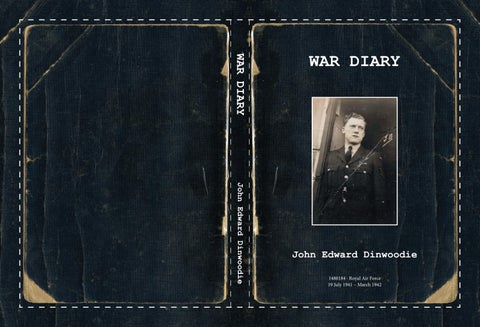
WAR DIARY
WAR DIARY
Left: Dad, John, aged about five, with his sister Olive, aged about two. Right: John (Young Dinny) aged eighteen as at 3rd December 1939.
John Edward Dinwoodie
Left: An old Arab told John’s fortune and drew four circles in the sand, meaning John would have four children; John jokingly asked how many wives he would have; “Just one” he indicated, “only one”. That was everything he wanted” – lucky guess or what? Right: Back home in uniform with Sergeant’s stripes, 1944.
John Edward Dinwoodie 1480184 · Royal Air Force 19 July 1941 – March 1942
12
WAR DIARY
Left: Dad, John, aged about five, with his sister Olive, aged about two. Right: John (Young Dinny) aged eighteen as at 3rd December 1939.
n old Arab told John’s fortune and drew four circles in the sand, meaning John would ur children; John jokingly asked how many wives he would have; “Just one” he d, “only one”. That was everything he wanted” – lucky guess or what? Back home in uniform with Sergeant’s stripes, 1944.
John Edward Dinwoodie 12
1480184 · Royal Air Force 19 July 1941 – March 1942
© John Edward Dinwoodie Published by Dorothy Dinwoodie in 2026 The rights of the author to be identified as the Author of this Work have been asserted in accordance with the Copyright, Designs and Patents Act 1988. All rights reserved. No part of this publication may be reproduced, stored in a retrieval system or transmitted, in any form or by any means, electronic, mechanical, photocopying or otherwise, without the prior permission of the publisher. The publishers cannot accept responsibility for errors, omissions, inaccuracies or for changes in the details given. These diaries have been faithfully reproduced from the originals in a full and unedited format. Reproduced and formatted by Beamreach Book Printing (www.beamreachuk.co.uk) Printed and bound by Beamreach Book Printing (www.beamreachuk.co.uk)
ii
In Memory of Alan Dinwoodie 5 January 1950 – 9 February 2019
Introduction In Memory of Alan Dinwoodie (5 January 1950 – 9 February 2019) This book is lovingly dedicated to our Dad, Alan Dinwoodie, whose enthusiasm for family history inspired its creation. As children, we grew up with Dad’s endless stories. Some were drawn from his own childhood, some from the lives of those who came before him, and others were the wonderfully imaginative tales he invented for us. Through them, he taught us that family history is not simply a record of names and dates, but a collection of people, memories, characters and moments that deserve to be remembered. His gift to our family was preserving those memories. He wrote Glimpses for Grandad’s seventieth birthday, beginning with the lives of his grandparents before telling the story of John’s own life. Many years later he continued that legacy with More Glimpses, recording his own life and memories for future generations. Together, those books created a priceless bridge between the past and the present. With Grandad’s wartime diary, we knew Dad would have wanted it to be preserved in the same spirit. Although he did not live to see this book completed, it exists because of the example he set and the value he placed on ensuring that family stories were never lost. We hope this volume stands alongside Glimpses and More Glimpses as part of the family’s shared history. It is dedicated with love, gratitude and affection to a wonderful husband, father and grandfather, whose curiosity, humour and devotion to family continue to shape the generations that follow. This book is dedicated, with love and gratitude, in memory of Alan, by his wife, Dorothy, and their children, David, Peter and Julie.
v
A Personal Note
We have had this diary reproduced so that John Edward Dinwoodie’s own account of his wartime service can be preserved for his family and for the generations that follow. For those who knew him, Grandad is part of living family memory. Inevitably that will change. In years to come, his descendants may know him only through photographs, family stories and the records that survive him. This diary offers something rather different: his own words, written in his own hand – even during a sandstorm – when he was a young man experiencing these events for himself. He was twenty when he began writing it. That is worth remembering. We know that he survived the war and returned home; he did not know that as he wrote. Nor could he have known that, many decades later, his grandchildren, greatgrandchildren and generations beyond them might read what he had written. We have deliberately resisted trying to interpret the diary for him. The notes that follow are intended to give enough family and historical context to make the people, places and events more intelligible to readers increasingly removed from them. The diary itself should remain Grandad’s. Our reason for preserving it is simple. Families inevitably lose things with the passage of time: memories become less certain, stories change in the telling and connections with earlier generations become more distant. Here, unusually, we have something contemporary and personal that does not depend upon anyone else’s recollection. We hope that whoever reads these pages in the future will value them in that spirit: not simply as a record of the Second World War, but as the words of a member of their own family, written more than eighty years ago, whose life forms part of the history from which theirs has grown.
vii
John Before the War John Edward Dinwoodie was born in Liverpool on 15 January 1921. He grew up in a close-knit working-class family, the son of John “Jack” Dinwoodie and Olive “Dolly” Dinwoodie, in a household that also included his grandmother, Jane Morris. At eighteen he joined his father working on the Liverpool docks, where he was known as “Young Dinny”. Family accounts remember a tall, confident and outgoing young man who enjoyed the camaraderie of dock life and the ritual of sharing a pint with his father after work. The diary begins only a few years later, but in a very different world. John entered full-time RAF service on 16 July 1941 and began writing three days afterwards, on 19 July, aged twenty.
John and Mary Running alongside John’s wartime story was his relationship with Mary McMaster (“Nana Din”), his sweetheart and future wife. Surviving letters written to Mary provide a second contemporary voice from these years. Where the diary records service life, travel, discomfort and events around him, the letters reveal the private concerns of a young man separated from the woman he hoped to marry. They speak of missing home, waiting anxiously for letters, imagining their wedding and honeymoon, and thinking about the family they might one day have. In a letter of 27 December 1942, for example, John wrote of hoping for “a quick victory and also a quick re-union, so we can get married”, and went on to imagine their future children. Read now, knowing that John and Mary did marry and built the family he imagined, those words have particular poignancy. John and Mary married on 24 June 1944 at Christ Church. The more intimate wartime letters have been preserved separately as inserts to this family edition. They form an important part of the archive, but their personal nature means they need not form part of the diary itself.
viii
John’s RAF Service and the Diary John’s surviving RAF Service and Release Book provides the official framework around the much more personal record contained in the diary. His service number was 1480184. His RAF service extended from July 1941 until July 1946, and his recorded overseas service included the Middle East and Iceland. He was awarded the Africa Star and clasp. The diary covers only the opening part of that service, from July 1941 to March 1942. It should therefore not be read as a complete account of his war. Its value lies precisely in its immediacy: a new recruit recording training, travel, people, routine, uncertainty and the unfamiliar world around him as he encountered them. During his Middle East service, John served in an RAF unit supporting the Eighth Army, and family records also describe his work as a gunnery instructor. The surviving correspondence supports the latter: in a wartime letter to Mary he wrote that a corporal had said he would make a good gunnery instructor and was trying to put him through for it. His surviving release papers record his trade at the end of his service as Embarkation Assistant. These entries reflect different stages of a wartime career that lasted five years. On release, his commanding officer described John as “a hard working and intelligent NCO who can be relied upon to perform his duties with initiative.”
The Historical Situation: 1941–1942 When John began his diary on 19 July 1941, Britain had been at war for almost two years and stood at a particularly uncertain point in the conflict. France and much of Western Europe were under German occupation. Britain had survived the Battle of Britain, but German aircraft were still attacking British cities and the Battle of the Atlantic threatened the shipping upon which the country depended. Germany had invaded the Soviet Union less than a month earlier. The United States had not yet entered the war, and the Japanese attack on Pearl Harbor was still nearly five months away. There was no certainty that the Allies would ultimately prevail. ix
For Britain, the Middle East and Mediterranean were of enormous strategic importance. The Suez Canal connected Britain with its interests and forces further east, while the region contained vital oil supplies and communications routes. Egypt consequently became a principal base for British and Commonwealth forces fighting the Axis powers in North Africa. The desert war had begun in 1940 when Italian forces advanced from Libya into Egypt. British and Commonwealth forces counter-attacked with considerable success, but the situation changed in early 1941 when Germany sent the Afrika Korps under General Erwin Rommel to reinforce its Italian ally. Axis forces drove eastwards across Libya, leaving the strategically important port of Tobruk isolated and under siege. Only weeks before John joined the RAF, British forces had attempted to relieve Tobruk in Operation Battleaxe. The offensive, launched on 14 June 1941 with RAF and Commonwealth air support, failed at considerable cost. The failure demonstrated both the strength of the Axis position and shortcomings in the coordination of British land and air forces. The RAF’s responsibilities extended far beyond air combat. Fighting a modern war across North Africa and the Middle East required an enormous organisation to move, maintain and supply aircraft and the people who operated them. Aircraft, engines, fuel, ammunition, vehicles, spare parts and personnel had to travel great distances through difficult conditions. The military situation changed again in November 1941 when British and Commonwealth forces launched Operation Crusader. After weeks of confused and costly fighting, the siege of Tobruk was broken and Axis forces withdrew westwards. The success was not decisive: the North African campaign remained unusually fluid, with long advances followed by equally rapid retreats. Beyond North Africa, the war became truly global while John was writing. Japan attacked Pearl Harbor and British possessions in Asia in December 1941, bringing the United States formally into the conflict. British forces then suffered a succession of defeats in the Far East, culminating shortly before the end of John’s diary in the fall of Singapore in February 1942.
x
The world described in these pages should therefore not be viewed through knowledge of the Allied victories that followed. Between July 1941 and March 1942 the eventual outcome remained profoundly uncertain. That is the setting in which John wrote: the great campaigns and strategic decisions in the background, but the war experienced by one young RAF serviceman one day at a time.
What Happened Afterwards John’s war continued for more than four years after the diary ends. He returned to Britain, married Mary in June 1944 and continued his RAF duties. His later service included guard work at a secret base at Wigan and then embarkation work at the Liver Building in Liverpool, a posting which allowed him to return home each night. He later served in Iceland, supervising dock operations during the final phase of the war with Japan. Their first son, John, was born on 6 June 1945. While John was later serving in Iceland he was promoted to Sergeant. A family story from that posting captures something of the spirited character remembered by those who knew him. After an ill-timed incident involving a burning chair and a confrontation with an officer, he was reduced to Corporal. The surviving release papers record Corporal as his final rank. Whether every detail of the story can now be documented is less important than being clear about its status: it is part of the family account of his service, rather than an entry in the surviving official papers. John was demobilised in July 1946 and returned to Liverpool and civilian life. He went back to the docks and, with Mary, raised four children: John, Kenneth Albert, Alan and Doreen Elizabeth. The young man writing these pages could not have known any of this. For his descendants, that knowledge gives the diary an added dimension. We are reading the words of someone before he became the husband, father and grandfather through whom we came to know him.
xi
The Diary of John Edward Dinwoodie 19 July 1941 – March 1942
Left: Dad, John, aged about five, with his sister Olive, aged ab Right: John (Young Dinny) aged eighteen as at 3rd December 1
Left: An old Arab told John’s fortune and drew four circles in the sand have four children; John jokingly asked how many wives he would hav indicated, “only one”. That was everything he wanted” – lucky guess Right: Back home in uniform with Sergeant’s stripes, 1944.
12
RAF Service and Release book John Edward Dinwoodie
Every family has a history... The greatest gift one generation can give to the next is to preserve it.