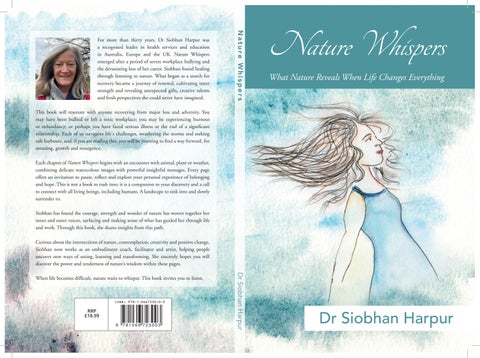
Nature Whispers
For more than thirty years, Dr Siobhan Harpur was a recognised leader in health services and education in Australia, Europe and the UK. Nature Whispers emerged after a period of severe workplace bullying and the devastating loss of her career. Siobhan found healing through listening to nature. What began as a search for recovery became a journey of renewal, cultivating inner strength and revealing unexpected gifts, creative talents and fresh perspectives she could never have imagined.
Nature Whispers What Nature Reveals When Life Changes Everything
This book will resonate with anyone recovering from major loss and adversity. You may have been bullied or left a toxic workplace; you may be experiencing burnout or redundancy; or perhaps you have faced serious illness or the end of a significant relationship. Each of us navigates life's challenges, weathering the storms and seeking safe harbours, and, if you are reading this, you will be yearning to find a way forward, for meaning, growth and resurgence. Each chapter of Nature Whispers begins with an encounter with animal, plant or weather, combining delicate watercolour images with powerful insightful messages. Every page offers an invitation to pause, reflect and explore your personal experience of belonging and hope. This is not a book to rush into; it is a companion to your discovery and a call to connect with all living beings, including humans. A landscape to sink into and slowly surrender to. Siobhan has found the courage, strength and wonder of nature has woven together her inner and outer voices, surfacing and making sense of what has guided her through life and work. Through this book, she shares insights from this path. Curious about the intersections of nature, contemplation, creativity and positive change, Siobhan now works as an embodiment coach, facilitator and artist, helping people uncover new ways of seeing, learning and transforming. She sincerely hopes you will discover the power and tenderness of nature’s wisdom within these pages.
ISBN: 978-1-0667230-0-3
RRP £18.99 9
781066 723003
Dr Siobhan Harpur
When life becomes difficult, nature waits to whisper. This book invites you to listen.
Dr Siobhan Harpur
Nature Whispers
Written by Siobhan Harpur Published in the UK by www.sharpurthink.com in 2026 Copyright © Siobhan Harpur 2026 All rights to the content of the book belong to Siobhan Harpur and cannot be reproduced or copied without permission of the Publisher. All rights reserved. No part of this publication may be reproduced, stored in a retrieval system, or transmitted, in any form, or by any means, mechanical, electronic, photocopying, recording, or otherwise without the written consent of the author, nor be otherwise circulated in any form of binding or cover other than that which it is published and without a similar condition being imposed on the subsequent purchaser. All images by Siobhan Harpur Formatted, printed and bound by www.beamreachuk.co.uk
2
Nature Whispers What Nature Reveals When Life Changes Everything
Dr Siobhan Harpur
‘We love the healing qualities of Siobhan’s drawings, and it is exciting to see some of them together in this book. The powerful use of messages from nature ignites hope and the day to day integration of quiet spiritual practice’ Esther Hill, Principal The Friends' School, Tasmania, Australia ‘This is beautiful and soulful, inspiring us to be our authentic selves.’ Dr. Susan Magsamen, Neuroaesthetic Scholar and Author. ‘Siobhan’s paintings and reflections speak to something many of us know, but may struggle to name: that the living world can become a bearer of memory, relationship and renewal. Emerging from her own journey through adversity and transformation, this book invites us to pause, listen and become attentive to the forms of companionship and wisdom that nature may offer. Tender, deeply human and quietly hopeful, it may help readers discover their own pathways towards healing, connection and a renewed sense of belonging.’ Professor Scherto Gill, Director at Global Humanity for Peace Institute, University of Wales Saint David
4
To Paul These pages are dedicated to my dear husband, Paul. When we married in the Manchester Quaker Meeting House more than 30 years ago we had faith to live adventurously and we did! We have learnt much from each other over the decades and each of us knows we are blessed because of the love we have shared. Paul was my rock when my world became so uncertain. He stopped working and devoted his time to caring for me each day. I am forever grateful because his business went on hold and he could not earn anything for months. He never complained about the loss of work, but he would like to have been able to represent his experience to the government. There is no place for a partner in a workplace injury case. Dearest Paul. Thank you. This book carries something of the tender journey we have travelled together. Your strength and compassion are my inspiration to keep going. With all my love, always.
5
A Quiet Voice Emerging
In early 2020, my life shattered. I was catastrophically bullied at work, and the weight of that trauma nearly crushed me. I was a highly regarded health services executive with decades of experience when suddenly my core sense of identity was replaced by a deep and unsettling depression. My capacity to work, to be around people, and even to recognise myself dissolved over a few short months. I experienced a rupture to the whole of my existence with physiological as well as psychological consequences. Trauma is, at its core, an experience of being torn apart from reality and the loss of control can become chronic if recovery does not occur naturally in a few days or weeks. When stress reactions persist, they affect our physical health and relationships, as well as our emotional and spiritual well-being. If trauma becomes imprinted, it literally reshapes our brains and bodies over time. Stress permeates our nervous system, and we over-react to otherwise modest events because of the unresolved sensations that continue to circulate. I was aware of being bullied and that the heightened levels of stress in my body were causing me harm. I was working long hours and increasingly feeling restless, replaying difficult scenarios, losing track in meetings, lacking focus on the task at hand. I was sleeping and eating badly, and I developed a lack of confidence and tearfulness. I could not control the feelings of overwhelm and rapidly declined. After just a few months I collapsed and was unable to return to work. Over the first weeks and months I felt bleak and my world view narrowed. I became nervous and anxious without apparent reason, suddenly wrenching
7
out of sleep from a nightmare, or feeling suffocated in the confusion of a panic attack during the day. I felt listless and numb, and yet I would suddenly sense my heart racing and my breath tightening in my chest when I was too exhausted to stand up or unable to get out of bed. I regularly felt lonely with the people I loved because I knew I was safe, but I just could not believe it. Regardless of the nature of the adversity we face, the timing of its occurrence or the extent of our response, the journey to healing is the same. It takes time and effort to regain control of our reactions, we need to be tender and compassionate with ourselves, to listen to the hurts, to face the sorrow and loss, and to establish new stories of futures that cannot yet be imagined. Within that time of loss and darkness, there were threads of clarity that started to give me forward momentum. I remembered that Parker Palmer, the American Quaker teacher referred to his experiences of periodic depression in several of his books. Considering depression as a gift that brings us closer to our deeper self, he imagined being pressed into the dark void by the hand of a friend. This change of perspective enabled the experience of depression as more of a liminal, in-between space than the desolate one we otherwise inhabit. From this wilderness of nothingness, Palmer describes the necessity to be patient. This, he says, is a time for quiet and stillness, waiting and listening for the shy soul that has been crushed. If, he encourages, we can get outside, no matter how pointless that may seem, we can literally stand on the ground we have been crushed into. When we know its certainty beneath our feet, we can acknowledge the hopelessness, knowing there is no place lower we can fall. Willing to allow whatever will emerge next. I listened to these concepts and identified with them, and so I ventured outside in trust. In the depths of hopeless darkness, feeling so paralysed by the pain, I started to feel the earth beneath my feet. Tentatively, I could believe there was a spark of life that may eventually reveal itself. I was taking the first steps of my journey to healing. 8
The natural world began to call me. At first, it arrived quietly. My perseverance, with the trusting support of my beloved husband, to get dressed to walk outside, to breathe, and to listen, really listen, as if for the very first time. I listened with all my body, and I heard the whispers of the trees, the waves, the birds and the wind reaching out and offering solace when I felt nothing. Slowly I realised that the whispers had form and shape and I wrote down what I heard. There were distinct messages that would arrive in my mind as gentle impressions or envelop me in vivid images as I sat outside. I was discovering that nature is as much inside as outside of me if I open to its many voices. The process of letting go into nature was the beginning of my integration with life, and the start of a new relationship with myself. Blackthorn railed with my despair, panther ran with me in the dark, daisy asked me to lighten up and smile, and one day, I dropped deep into the sea to look into the eye of a whale.
9
What to expect in the pages ahead
Each chapter begins with an encounter. Sometimes this emerged as I was walking, sometimes in a lucid daydream, and sometimes as I sat quietly, watching and contemplating. Whether it was an animal, plant, landscape or weather, each part of nature became a messenger that I needed at that particular time. Nature has become my teacher and my healer. The authority and wisdom of barn owl and the determination of wind. These are not fantasies, they are metaphorical truths that have shaped themselves into my being through imagination, presence and attunement. I did not recognise the power of the messages as I heard and experienced them, but I was driven to record them, and I read them out loud. I read and reviewed the words, letting them live in me. I continued to seek healing, and I discovered new creative expression in painting. Watercolour became a lifeline to expand the whispers I had recorded, and I discovered painting could express more than the words alone could hold. I delight in the fluidity of pigment reacting with water and spreading on paper. Watching colours merge, reform and dissolve in ways that cannot be completely controlled. Research increasingly confirms that art has the power to stimulate emotional processing as well as creativity. Water based media allows for softness and surrender, countering the rigidity and stiffness that the trauma response embeds in the body. My work with the colour and nature imagery became a form of connecting with myself and a remembering of my inner world and its hope and possibility. Combining the words from nature whispers with watercolour painting became a whole discovery of joy.
10
In these pages, I share my stories, my paintings, and nature’s wisdom as she spoke to me. Each of these voices from nature, real and imagined, resonates with a lesson and a message that offers purpose, future and forward movement. Watching the flow of the seasons and the diversity of life and expression helps me recognise the balance between action and reflection, and to remember that everything is connected. Nature reminds me that meaningful human relationships – with ourselves, one another and with all living beings - requires presence, humility, deep listening and the courage to step into our own wilderness. The messages reflect on the symbolism of each aspect of nature, and the strategies and insights they offer that are grounded in lived experience and myth or history. Let your imagination take you into the being of each voice and hear what they say to you. Each section of this playbook includes prompts for you to reflect on, consider and practice. Be curious and playful with your responses. I invite you to walk with me through these stories and practices. Whether you are seeking comfort, healing from trauma, ill health, searching for purpose, or curious about the messages nature has to offer, I know you will find something here that resonates. We all face challenges at different times in our lives and respond to them in different ways. I have written this book to share my story to healing and I sincerely hope it will spark your creativity and forward movement too. Let nature speak to you, as it has to me, and may you discover the quiet, enduring strength as I have. This is not a book to rush into; it is a companion to your own journey of healing and discovery and a call to the connect with all living beings, including humans. A landscape to sink into and slowly surrender to.
11
Frog
Frog Speaks ‘I am waiting for the right time. And when the rains come, you will hear me sing.’
Frog Reflection: Walking in Two Worlds Frog is a creature of transition, starting as a tiny, delicate tadpole, fully at home in the water, before sprouting legs and moving onto land. Frog teaches me about transformation not as a moment, but as a process of becoming. Frogs are represented across cultures, and they symbolise adaptability, healing, and renewal. In Australian Indigenous stories2, Tiddalik the frog drinks all the water in the land until an eel, through sheer frustration, makes him laugh and in his laughter, the water flows out, bringing life back to the rivers. This story stayed with me. Sometimes, it is not gentle persuasion that brings about change but something unexpected, something raw. Frog reminded me that I had been holding on so tightly to my responsibilities in public service that I was blocking my own life force. Even though I knew I was being targeted and it was damaging, there was a metaphorical armour that I could put on each day and believe that I was able to wear the pain. We become stuck if we hold onto grief, suffering or unspoken words until we can no longer hold them inside. We may experience an explosion of anger, or a flood of tearful anguish. In my case, I experienced a total collapse into despair, unable to sleep, eat or function for several months. Imagine if I had listened earlier to the calling from frog? I held on fiercely to
2 The story of Tiddalik is found in many places around Australia but is often attributed to the Gunaikurnai people in Gippsland, Victoria.
16
my suffering, thinking myself as courageous, but getting increasingly stuck. Frog changes completely from life as a tadpole, growing legs and shedding their tail until one day they leap from the water. With a single shift, leap, a croak of release, we can move. With change there is transformation. Who could imagine moving out of the water to breathe the air?
Strategies for Navigating Transformation 1. Recognising the Moment to Leap The shift from tadpole to frog is gradual, but the moment of stepping onto land is a leap. • What is calling you forward? • Where in your life do you sense a readiness, even if fear accompanies it? Sometimes, we hesitate because we want certainty. But frogs do not wait for every detail to be perfect; they leap when the moment is right.
Try this: Identify one area where you are hesitating. What small, courageous leap could you take?
17
2. Letting the Tears Flow Frogs are reservoirs of water, and they remind us that tears, too, are a cleansing force. Suppressing emotions only leads to stagnation, just as Tiddalik dried up the rivers by holding onto the water. • What emotions have you been holding back? • How might releasing them create space for renewal?
Try this: Find a quiet space and feel the reservoir of unspoken emotion. Let yourself cry or rage. If the feelings do not come, write or paint something that expresses more than the words. Imagine yourself as frog, croaking out your truth.
3. Embracing Change as Whole, not Pieces In leadership and systems practice, Alastair Mant contrasted mechanistic thinking to the metaphor of a bicycle where change is managed in separate, controlled parts. In contrast he invites us to ‘frog’ thinking and to understanding organisations as interconnected, living systems. The mistake we often make is to look at all the different issues in detail but completely fail to see the connections between them. When we work more holistically deeper and more sustainable change can occur. In our lives, healing, like frog transformation, will unfold when we let go to the flow of life itself. • Where in your life are you trying to control change rather than allowing it to unfold naturally? • What can you say out loud that you are holding onto?
18
Try this: Spend time in nature and notice the organic changes water erodes rock, trees shed leaves, ants come and go.
Closing Thought Frog looks at us with wide, blinking eyes and reminds us: ‘I have been tadpole and now I know land and water. Listen and be ready to leap. Your own transformation is already in motion.’
Frog themes are waiting, renewal, and transformation
19
Snowdrop
Snowdrop Speaks ‘I push through the darkness and lead the way to new life and hope.’
Snowdrop Reflection: Breaking Through The snowdrop is the first flower to break through the hard ground when it is still cold winter, a delicate yet determined promise that spring will come. Snowdrops were often cultivated in monastery gardens and they are found in churchyards today, representing resurrection. One German legend is that all the flowers were asked to lend their colour to a new creation called snow. None were willing except the little white flower. This created a bond and a promise between snowdrop and the snow. They became good friends and each year snow allows the little flower to be the first to bloom. Snowdrop defies the cold, hard ground and darkness of an often bleak winter to push through to the light. Like snowdrop, I felt buried, weighed down by the cold and heaviness of life. In those first months after I left work I wandered slowly in the dark. Being deeply depressed I did not feel lost because I felt very little at all. I went outside because I understood intellectually that it was good for me to walk, but I found no pleasure in it and regularly lost track of time and place. Deep within, there must have been a small voice inside of me that knew I could push through and rise again, and, despite my not hearing it at the time, I thank snowdrop for sharing her message and I am grateful that I wrote it down.
24
There are many other stories about snowdrop as a symbol for new life. The Celtic celebration of spring is called Imbolc and it is symbolised by the milk-white snowdrop that promises nourishment and health. In Romania spring is recognised by the colours of red and white together. The story began when the sun reached out in the form of a girl named Spring to chase away the winter. Winter captured Spring and the people had to find a hero to save them from winter’s clutches. The young hero battled with winter and set Spring free. As his blood melted the snow, a little flower grew, as pure as the hero’s love for Spring. Red is the ‘blood’ of the hero who banishes winter, and there is a tradition to gift snowdrops tied with red ribbon to celebrate new life.
Strategies for Emerging from Hard Times 1. Remembering That Nothing Stays Frozen Winter is a time to rest and renew, but it can feel relentless. The cycle of nature turns with each year. Even the longest winters end. • Where in your life are you feeling stuck? • Can you trust that this, too, will pass? • Can you imagine the joyful colours, the light and the warmth of Spring, and pull yourself forwards?
Try this: Write a letter from Spring. What would she say?
25
2. Moving Forward, Even When It Feels Hard Snowdrop does not wait for spring, for warm days of perfect conditions; she pushes through the hard ground regardless. • What small step can you take today toward something brighter? • Do something that brings you joy. It might be baking something, writing down three things you are grateful for, or calling a friend.
Try this: Write down one tiny action you can take. Do it.
26
3. Trust That You Are Stronger Snowdrops bloom despite the cold. You are more resilient than you realise. • What challenge have you faced and what did you do? • When did you think you could not go on any further, but you did, what helped you?
Closing Thought Like the snowdrop, you are already finding your way back to the light.
Snowdrop themes are hope, trust, perseverance.
27
Blackthorn
Blackthorn Speaks ‘When the night presses in and sorrow tightens your breath, I am here. I will protect you and hold the weight of your grief.’
Blackthorn Reflection: Guardian of Grief and Endurance Blackthorn stands where winter is deepest with strong and twisted branches, stark against the grey sky. Across Celtic traditions, she is the tree of thresholds, a protector at the boundary between the seen and unseen worlds. Blackthorn embodies a duality of life giving and destructive forces and is a powerful symbol of spiritual challenges. Her ancient name is Straif, found in the medieval Irish alphabet and the root of “strife,” yet she is also known for resilience and strength. Cailleach is the Celtic goddess of winter, seen as a blue veiled old woman with a raven on one shoulder and a blackthorn staff. She is deeply associated with sorrow and mourning. While she holds grief, she also embodies endurance and retreat. She sustains the life force of the earth deep underground so it can be reborn in the spring. Companioning grief is a practice of staying with pain and walking with it, listening deeply and creating a safe space for the emotions to be expressed. Blackthorn mirrors this concept, as Ceilleach, by being present to the depth and truth of the grief, and by providing a sanctuary in time and place without judgement.
32
When I was in my own deep winter of depression, blackthorn stood beside me like an unmovable sentinel. I was aware of the desire for a companion, and my human friends were with me, but the dark strength of blackthorn was, in hindsight, the sanctuary I yearned. She simply stayed, holding me in the silence. I felt bleak and hopeless, too exhausted to find words or even tears to express my sorrow. And in that stillness and protection I found my breath again.
Strategies for Navigating Endurance 1. Staying Present with Pain Grief is not a problem to solve but a landscape to move through. Blackthorn teaches that presence is powerful.
Try this: Sit in stillness. Name one sorrow, not to be fixed but to be acknowledged. Rest your hand over your heart and whisper: “I can stay with this.” Imagine Blackthorn’s branches enclosing you in a protective circle.
33
2. Knowing When to Retreat Blackthorn trees are found in hedgerows and have dense, unapologetic boundaries, providing nesting places for birds and food for caterpillars and insects. Making time and space for recovery is known to prevent burnout and support clearer thinking. Retreat and rest provides protection.
Try this: Create a “blackthorn boundary.” Choose a time this week when you step away from demands, opinions, or noise. Let this time be a sanctuary where you tend to your energy.
3. Transforming Pain into Power The fruit of the blackthorn are sloe berries, and they require frost to ripen. Similarly, the challenges we endure shape our depth and resilience.
Try this: Write down one painful experience and, beside it, something that you have realised as a result. Do this as many times as feels right for you and put each of the papers folded into a small jar with something symbolic and sweet like a gemstone. Let time transform what is inside.
34
Closing Thought Blackthorn whispers: ‘Do not fear the dark season. My thorns protect you while you heal.’
Blackthorn themes are: sanctuary, protection, strength
35
Panther
Panther Speaks ‘I wait silently, watching. Come when you are ready. Your shadows are waiting to be reclaimed, and I am the keeper of the dark.
Panther Reflection: Keeper of Shadow and Strength Panther moves in silence, a creature shaped by mystery, intuition, and power. Panther is not a distinct species. Rather, she is a black leopard with a genetic variation that causes an excess of dark pigmentation. If you look closely, you can see faint rosette markings in her black fur. The darkness of panther gives her the sense of stealth, moving silently, she is solitary and elusive. Panther appears in Egyptian stories as a symbol of divinity and as the protective spirit of the night in Celtic lore. In each of these histories she is known as both guide and guardian. Panther represents the courage to inhabit the darkness and emerge with clarity, transformed. I first met panther in a dream state as I sat on a rock at the top of the hill looking over the bay toward my home. I felt I was on a high mountain ridge, the world stretched out beneath me with the wind pushing at my back. I felt the strength of the big cat, and realised a black panther sat steady at my side. I knew no fear and I knew that panther was here to be with me. I experienced her as a noble and courageous witness to the darkness that I experienced. She was not calling me to bravery in the conventional sense, but she was asking me to face my own fear and be honest about it. To be alive in all the dark places I had been too and not abandon myself. When I reflect on this time, running with panther and dreaming about her self-confidence and sense of purpose, I know that I was wanting to remember these traits in myself. But I also wanted to allow the despair I had been in to be part of me, to carry the wounds with me. I was reaching an important milestone in integration and consequently discovering new strength and clarity.
40
The panther blends into the background and invites us to see with new eyes. To track the quiet wisdom that emerges when the world goes dark and the only thing left to trust is our inner knowing.
Strategies for Meeting Your Power Through Shadow
1. Facing the Shadows Without Fear Psychologists describe darkness and shadow healing as the process of acknowledging and integrating the disowned parts of ourselves. Panther embodies this integration and nothing is hidden from her. • What parts of you are hiding that you do not want others to see? • What are the things that get in the way of you doing what you want to?
Try this: Sit in a quiet, dimly lit space. Imagine Panther beside you: calm, steady, unafraid. Allow one fear or avoided truth to rise. Say it softly aloud. Notice how your body responds. Put your hands on the middle of your chest and say thank you. You are learning to face the unseen.
41
2. Listen with Intention Panther never rushes. She reminds us that slowing down is not failure but giving time for patience, purpose and discernment. • What decisions do you avoid making because they are too big or overwhelming? • What, when you think of it, leaves you feeling bleak and miserable and you would rather it went away all together?
Try this: Write down something that is overwhelming or leaves you feeling miserable, acknowledging there may be more than one thing. Beneath it, write: “I choose the right moment to face this.” Feel how your breath shifts when the urgency is softened by intention.
3. Embrace Strength and the Freedom to Be Fully Yourself Panther moves through the world without apologising for her size, presence, or power. She teaches us to inhabit our full selves. • What is roaring inside you wanting expression?
42
Try this: Stand tall. Roll your shoulders back and open your arms wide. Take one step as if Panther’s confidence is flowing through you, and you are centre stage. Let your body remember its own strength. What are you saying to the world?
Closing Thought Panther reminds us: ‘You are shadow and light, mystery and power. Walk with me and see through panther eyes. Nothing you carry is too much. Nothing you fear is beyond your strength.’
Panther themes are courage, shadow and freedom
43
Whale
Whale Speaks ‘Let yourself flow and trust that it is enough to be here. The oceans are vast and we can dissolve all your sorrow and tears.’
Whale Reflection: When We Are Stranded Whales have shaped the art forms of many coastal civilisations, and cave drawings can be found across the world. It is likely that humans were uncertain about this leviathan of the sea and they were seen to be somewhat mythical and as such they were either revered or feared. One of the indigenous creation stories in North America is that big raven found a stranded whale which he knew would cause disaster unless she was returned to the sea. Raven found and ate special mushrooms that gave him the strength to take the whale across the land so that order could be returned to the world. Overwhelm can feel like being stranded, unable to move, with waves of emotion crashing relentlessly over us. Like a beached whale, we might feel as though life’s tides have abandoned us far from the comforting depths of peace and safety. When I was navigating the aftermath of being bullied at work, I regularly experienced a sense of overwhelm. I would replay situations and remember hurtful words or actions and the distress made it difficult to imagine a future. I realised I was trying to carry too much: the weight of what had been, what might never be again, and what I imagined the world expected of me. Whale teaches us something essential: to survive, we must allow the oceans currents to carry us. Overwhelm is not permanent. It is a signal, urging us to pause, let go, and trust the vastness of life to hold us until we regain our strength to take the next step forward.
48
In an area of South Australia called the Mirning, the Kondoledjeri people talk of whale as Numbadda, who is also the sacred Rainbow Serpent, the Creator of all life. Those who are initiated sing the whale song and these sites correspond to the coastal locations where the Southern Right whales return to breed and calf each year. Immersed in the still gaze of that huge eye, I feel myself dissolve. I reach into the vast oneness of life and love, and know that all my pain washes through me into the water around me. It is as if she has gentle hands all over me, soothing, stroking, embracing me, holding me up. She touches the divine energy in my very centre. My heart expands with joy and hope, and I am fluid, resonating with love. I am sacred consciousness. This was my waking whale encounter as I sat by the sea.
Strategies to Lighten the Feeling of Overwhelm 1. Stand in the Present Moment Overwhelm often grows when our minds are split between regrets of the past and fears of the future. To ground yourself: • Sit quietly and focus on your breath. • Use your senses: What can you hear, see, smell, taste, or touch right now? • Repeat whale’s words: “Be in now.”
49
2. Break It Down into Smaller Waves When life feels like a tidal wave, remember you don’t have to tackle everything at once. • Make a list of what is weighing on you. • Identify one small thing you can do today to ease that weight: drink a glass of water or step outside.
3. Release What You Cannot Control Just as the ocean holds what the whale cannot, remind yourself that some things are beyond your power to fix. • Write down your worries and identify the ones you cannot change. • Imagine placing these worries into the ocean, allowing the tides to carry them away.
4. Lean on Connection Whales thrive in pods, and so do we. Being overwhelmed can feel isolating, but reaching out to a trusted friend, counsellor, or loved one can provide relief. • Share your feelings openly, even if it’s just, “I feel overwhelmed right now.” • Allow others to remind you of your strength when you cannot see it yourself.
50
Closing Thought Overwhelm may feel like the end, but the whale teaches us that it is simply a moment in the vast journey of life. By staying present, releasing what we cannot control, and leaning on our inner and outer resources, we can return to the depths where we are strong, steady, and whole.
‘Let yourself flow and trust that it is enough to simply be here. I am beside you and the oceans are vast enough to dissolve your sorrow and your fears.’
Whale themes are presence, love and connection
51
Dandelion
Dandelion Speaks ‘I am strong and determined. I am sun and sunshine yellow. I survive to grow again.’
Dandelion Reflection: Strength in the Ordinary Dandelion is one of the most unassuming yet strongest beings in nature. It thrives in cracks, in neglected corners, in places where nothing else seems to grow. It does not wait for ideal conditions it simply adapts, spreads, and keeps growing. I have admired the dandelion, even though it is often dismissed, there is something remarkable in its defiance. Despite every effort to control it, dandelion persists not as an act of rebellion, but as an act of quiet, unwavering strength. Dandelion does not seek permission to grow. It simply does. Dandelion was the first aspect of nature to speak to me when I was in the heart of my breakdown. Her first words were ‘you can’t get rid of me you know’. I was stopped in my thoughts because the message was so strong, and even though it did not resonate to me personally straight away, I knew it to be important. When I got home I wrote down her words. As with all the words from nature, I am deeply grateful that they have continued to reveal to me the possibilities to find a way forward when everything feels completely worthless. Like dandelion, we, too, are often underestimated. We learn to be acceptable, and we are discouraged from taking up too much space, from being too silly or too bold. And yet deep inside, we hold the same unshakable spirit. Mine is both creative and bold. Even though I had forgotten, dandelion reminded me that in the harshest conditions, we can find a way through.
56
Strategies for Cultivating Strength 1. Rooting Yourself Dandelion roots run deep. Even when they are cut back, they regenerate from what remains beneath the soil surface. • What are the deep roots that sustain you? • What inner strength have you forgotten but still carry inside you?
Try this: Write down five things about yourself that have helped you withstand difficult times. Acknowledge the strength that keeps you rooted into the ground.
2. Finding Beauty in the Unexpected Dandelions are often dismissed because they are common. Yet they have bright yellow sunshine flowers, and seeds to blow wishes and possibility. • Where in your life have you overlooked your own beauty, simply because you thought it was too ordinary? • What part of yourself deserves to be seen in a new light?
57
Try this: Stand in front of a mirror and say aloud: I am strong. I am beautiful. I am exactly where I need to be. I belong here. Notice how it feels to claim your own worth.
3. Letting Go Like a Dandelion Seed Dandelion seeds do not resist the wind; they surrender, trusting that they will land where they are meant to grow. • What are you holding onto that no longer serves you? • Can you trust the unknown, allowing your future to unfold without grasping for control?
Try this: Go outside and find a dandelion puff seed-head. Hold it gently in your hands. As you blow the seeds into the air, whisper a wish, a release, or a hope for the future. Let it go.
58
Closing Thought Dandelion reminds us: ‘You cannot get rid of me and I will not disappear. They call me a weed, but I am bold and strong. I am wild, untamed defiance and I am not afraid. I belong, and I am hope.’
Dandelion themes are strength, belonging, and adaptability.
59
Daisy
Daisy Speaks ‘We are small, and we are many. Step back, lighten up and smile.’’
Daisy Reflection: The Power of Lightness Daisy is a flower of joy. She grows abundantly, brightening meadows and gardens, always cheerful, no matter how many times she is trampled or cut back. Daisy is a reminder of summer days, of laughter, of the simple pleasure of sitting on the grass and weaving daisy chains. In Norse mythology, daisy is Freya’s sacred flower. Freya is goddess of love, beauty, and fertility, and can also represent the selfless devotion and passion for life. Daisy invokes purity, innocence, playfulness, and positive perspectives. She is a happy looking flower and it is easy to understand why she is symbolic of uplifting themes. My friend Debbie told me she loves daisies because they make her smile. No matter how many times they get ripped out of a lawn, they pop back up again at the earliest opportunity, just laughing and dancing with the world. That exuberance is gentle yet unyielding, and it is what makes the daisy so special. As I was beginning to take my first tentative steps into recovery, Daisy came to me and reminded me to look up and breathe. I remember that I am strong in my vulnerability and I would be delighted if I could open my petals to greet each day as if it is my first, feeling the warmth of the sun.
64
Daisies do not force their way through the earth; they simply bloom where they are, greeting each new day with quiet optimism. They remind us that strength does not always come from pushing harder. Sometimes, it comes from softening, from trusting in renewal, from knowing that bending does not mean breaking.
Strategies for Finding Joy and Balance 1. Embracing the Present Moment Daisies open their petals with the rising sun and close them as the night falls, fully embracing each moment of light and rest. • How often do you truly pause to appreciate the simple joys of the present moment? • Where and how can you bring more light and ease into your day?
Try this: Take a walk and find a small, unnoticed detail in your surroundings that brings you joy. It may be a tiny flower, a pattern in the clouds, the warmth of the sun on your skin. Let yourself experience the delight of simply being.
65
2. Recognising Strength in Softness Daisies may appear delicate, but they are remarkably strong. They bend with the wind rather than resisting it. • Where in your life are you pushing too hard? • How might softening and allowing the flow, help you navigate challenges today?
Try this: Practice mindful breathing. As you inhale, imagine yourself opening like a daisy to the warmth of the sun. As you exhale, release tension and allow yourself to bend with the wind, letting your body find its own natural dance and movement.
66
3. Setting Boundaries for Energy and Enthusiasm The daisy cautions against overextending, reminding us that even joy needs balance. • Are you giving too much of yourself to your work or responsibilities? • Where do you need to step back and recharge?
Try this: Write down three things that bring you joy and three things that drain your energy. How can you shift your focus toward what replenishes you?
67
4. Finding the Innocence Daisies have long been symbols of innocence, purity, and light heartedness. They remind us to see the extraordinary in the everyday. • What simple pleasures have you overlooked lately? • How can you bring more wonder and delight into your routine?
Try this: Think back to a childhood memory where you felt pure joy. Perhaps you are playing outside, making daisy chains, or lying back watching the clouds. How can you bring that same sense of playfulness into your life today?
Your Turn to Reflect Daisy teaches us that joy and renewal go hand in hand. Use these journaling prompts to explore your own lightness and strength: • Write down at least five simple pleasures that make you feel alive • What is one small, joyful ritual you can introduce into your day? • How can you honour both your enthusiasm and your need for rest? Write freely, without pressure. Like a daisy opening to the sun, allow your thoughts to unfold naturally. 68
Closing Thought
Daisy whispers: ‘What would it be like to greet each day as if it were your first? To stretch toward the light, to laugh easily, to bloom without hesitation?’
Let yourself be daisy soft, joyful, bending and dancing with the breeze.
Daisy themes are joy, playfulness, and renewal.
69
Dragonfly
Dragonfly Speaks ‘I am here to let you know that change is coming. I am here to remind you that you already know.’
Dragonfly Reflection: Dancing with Transformation Dragonfly moves with lightness, shifting directions effortlessly. Never rigid, never stuck; she flies with freedom and grace. The iridescent colours of her wings and body change with the light, as if they are peeling back layers of doubt to reveal the beauty of the real self. Dragonfly is a symbol of new beginnings and change, and her scurrying flight sees beneath the surface and dives into the deeper implications of life. Dragonfly comes when we are on the verge of transformation. She tells us that resisting change is what creates discomfort. True freedom comes when we stop fighting and start flowing. This takes me back to the very beginning of my shattered life, when my dear friend Ian helped me invite my sub-conscious to go and explore my distress for herself. Many months went by before I wanted to venture anywhere near those discoveries, but the sight of a dragonfly at the edge of my vision made me wonder if it was time. Dragonfly was unsettling me in the night, because she wanted me to have choice. “I am in your dreaming because I have been unravelling the layers of your pain. Yes there has been turmoil and there may be more, and you are ready to take a look”. She is inviting me to embark on the discovery of what will be next.
74
I so much prefer the word ‘discovery’ which means to reveal or unveil rather than ‘recovery’ which limits the process to a return to where I was before. We are travelling through the wonders of our lives, and with the event of a major illness or other trauma, there can only be more to realise and to treasure, or else what is the point? Dragonflies live most of their life as nymphs, flying for only for a fraction of their whole lifespan. This reminds us to be aware of the here and now. Being present is a virtue to be cultivated and I can stand still for a moment asking what am I doing? why? and who for? Can I make an informed choice to keep doing more of the same or to do something else?
Strategies for Embracing Change 1. Trusting Your Own Knowing Dragonfly sees beyond the illusion. She asks: • What truth have you been avoiding? • Where is your intuition nudging you to go?
Try this: Close your eyes. Imagine Dragonfly landing lightly on your hand. What is she whispering to you?
75
2. Letting Go of Overthinking Dragonfly moves with ease, not overanalysing every step. • Where in your life are you holding too tightly to control? • How would it feel to trust that the right path will appear?
Try this: Take a blank page. Write the word surrender in the centre. Around it, write all the things you can let go of.
3. Moving with Lightness Dragonfly reminds us that we do not need to carry the past heavily. • What if moving forward felt like dancing rather than struggling? • How can you bring more joy into your transformation?
Try this: Put on music and move your body. Let yourself be as light as Dragonfly, shifting, flowing, and adapting.
76
Closing Thought Dragonfly flits and darts inviting the freedom dance of change. ‘Yes’ she says, ‘change is unsettling, and you may be afraid. But we all have our fears, and we have the choice to jump right into them and see what comes next’.
Dragonfly themes are shifting, lightness, freedom.
77
Barn Owl
Barn Owl Speaks ‘I navigate the darkness, I am with you and I can teach you to fly in the stillness.’
Barn Owl Reflection: Watching out of the Silence In the deepening shadows of dusk, a haunting call pierces the silence, the distinctive cry of the barn owl. This enigmatic creature has fascinated humanity for centuries, his presence weaving through cultures and mythologies, embodying everything from wisdom to foreboding. With his heart-shaped face, ghost white feathers, and silent wings, the barn owl flies through the night like a spirit. His presence feels both intimate and otherworldly. Across cultures, the barn owl has been both revered and feared. In ancient Greece, the owl was sacred to Athena, the goddess of wisdom. In English folklore, the owl’s cry near a sickbed foretold death. In other traditions, barn owl symbolises freedom, prosperity, spiritual protection, and insight. I sat with barn owl and felt a deep sense of trust; the kind that arises in silence, stillness, and darkness. Barn owl told me that darkness is full of mystery and that if I listen closely, I can calm my racing thoughts and be open to what cannot be immediately understood. This quiet strength reminded me of the words ‘be still and know that I am’ from Psalm 462. Barn owl invites us into a spiritual quest and a journey toward deeper selfdiscovery. With extraordinary hearing and night vision, barn owl reveals that clarity often comes when we turn inward and listen for the truths that live below the surface. Wisdom is not loud, but deeply rooted in awareness, perception, and reflection. As a spirit animal, barn owl teaches humility, perseverance, and the power of adapting to change. Its silent watch is not passive, but intentional. Barn owl models the strength of stillness, the vision to see what others overlook, and the courage to fly through the unknown.
2 The complete biblical phrase is ‘be still and know that I am God’. I prefer to end with ‘I am’ because it has a more universal resonance.
82
Strategies for Cultivating Inner Wisdom 1. Listening to the Silence Barn owl moves through the night in silence, relying on sensing rather than noise. To connect with your own wisdom, you must first create quiet. Stillness is not emptiness; you are cultivating presence.
Try this: Sit in a quiet place and close your eyes. Breathe slowly and ask yourself: ‘What is it I am seeking?’ Wait. Let the silence respond. Do not force an answer. Trust that your inner owl will speak when the time is right.
2. Seeing in the Dark Barn owls are masters of navigating darkness. They see clearly in conditions where others cannot. This ability reminds us to trust our vision during uncertain times, to believe in what we sense, even when the path may not be obvious. Wisdom often arises not in clarity, but in the courage to be with the unknown.
83
Try this: Recall a moment in your life when things felt uncertain, but you kept going. What helped you move forward? Write down three ways you have navigated darkness before and let these remind you of your strength and inner sight.
3. Embracing Change with Grace Barn owls thrive in a variety of habitats, adapting to both wild and humanshaped landscapes. They teach us that adaptability is not about compromise; it is about resilience. Wisdom is not rigid; it learns, adjusts, evolves. Let the barn owl remind you that flexibility is a form of strength.
Try this: Think about a current change or transition in your life. Ask yourself: What is this change trying to teach me? Write down one small step you can take today to move with it, not against it.
4. Honouring Your Inner Vision Barn owls have an extraordinary ability to focus in low light. This symbolises our own power of foresight and our ability to see possibilities beyond the immediate. They urge us to look beyond distractions and reconnect with what matters. Let your inner owl guide you toward long-term clarity.
84
Try this: Visualise where you want to be one year from now. What is one truth you need to hold onto in order to move in that direction? Write it down and keep it as a talisman of your vision.
Closing Thought In the silence of the dark, barn owl whispers: ‘Call for me in the moonlight, and I will come. I am your silent guide, keeper of ancient knowing. Let your fears rest now. Trust the shadows. I see you. I walk with you. You are never alone in the dark’.
Barn owl themes are insight, bravery, awakening
85
Wind
Wind speaks ‘When the world tells you to stop, pause and feel me dancing on your skin.’
Wind Reflection: Messenger of Freedom Wind is the force that cannot be seen yet it is always felt. It moves through the world with freedom, unpredictability, and strength. Wind teaches us that movement does not always look like progress, sometimes, it is about persistence through invisible currents. Across time and cultures, wind has carried the voices of gods and spirits. It has been personified in ancient mythologies, as fierce warriors, playful spirits, and wise elders. The Greeks named four Gods of the wind, each of whom has their own direction and temperament - Boreas, Zephyrus, Notus, and Eurus. The Māori speak of Tāwhirimātea, God of weather, whose winds were born of rage as well as of love. In every tradition, wind is seen as something beyond human control, combining power with being elusive and sacred. My friend Maggi once watched seagulls trying to cross a windy bay. Their wings barely moved forward, their progress painfully slow. Yet they did not turn back. Even held in place, they were in motion with each beat of their wings a testimony to their determination. When I was held motionless in the grip of depression, feeling as though nothing was changing, I remembered those birds. Movement is not always visible. Endurance is still active. Wind surrounds me. It fills my lungs with breath and my day with sound. It can soothe or shriek, sing or scream. It has many voices and many moods. And it carries transformation with it. We know the presence of wind even when we cannot see its form. In that, it reminds us of our own inner strength; unseen, but alive and shifting.
90
Strategies for Navigating Invisible Movement 1. Trusting Progress Even When You Can’t See It Like the wind, your forward motion may not always be visible. There will be times when it feels as if you are standing still or even being pushed backwards. But movement can be internal. Just as the wind reshapes the landscape over time, your persistence is shaping your future. Let go of the need for proof. Trust in the quiet momentum.
Try this: Think of one area of your life where you feel stuck. Write a list of small things you have done recently that show strength, even if they did not produce obvious results. Keep this list visible and add to it daily. Let it be your evidence of unseen progress.
2. Embracing the Many Voices of Wind Wind whispers, roars, and everything in between. It changes direction. It surprises. Your emotions, too, are varied and shifting. Just as no one questions the wind’s right to howl, you are allowed to express your intensity, your softness, your shifts in mood. There is power in letting yourself be fully felt without needing to explain or apologise.
91
Try this: Find a quiet place outside. Listen to the wind. What is the mood today? Let it be a mirror. Then write or speak freely: what is your inner wind saying right now? Let it howl, whisper, sing or rage.
3. Resisting Force With Flexibility The fable of the North Wind and the Sun teaches us that harsh force rarely creates real change. It is warmth, gentleness, and persistence that wins hearts and shifts the outcomes. When you feel yourself pushing too hard, pause. Ask whether another way might be more powerful. Wind does not argue, it changes direction. It adapts. That, too, is a strength.
Try this: Think of one situation where you are meeting resistance. Instead of pushing harder, imagine being like the wind: flexible, flowing, even playful. What might a gentler approach look like? What would it feel like to move around the obstacle instead of against it?
92
Closing Thought Wind reminds us to be free, wild, and unwavering in our path.
Wind themes are lifeforce, inspiration, messenger
93
The Power of Nature
A psychoanalyst in the 1960s called Harold Searles argued that nature is of primary importance to humans because we mature within a matrix of non-human elements - trees, clouds, birdsong, the changing weather of the seasons. We grow not only in relationship to other people, but in relationship to the landscapes around us. Victorian hospitals were designed with gardens and natural light, because of the pioneering observations of Florence Nightingale and confirmed by psychology, that nature stabilises the nervous system. Quaker hospitals in both Pennsylvania in the USA and York in the UK encourage patients to walk outdoors for their mental health, recognising that the simple act of stepping into fresh air can shift something deep inside a suffering mind. Nature has the power to interrupt the repetitive loop of trauma if we spend time outside. We can walk in a park or sit in a garden, especially where there are trees, water and birds. Nature offers a form of companionship that asks nothing in return. Birds fly and call to each other, the wind blows through the leaves and trees stand tall, breathing steadily in and out. There are no demands or judgement, and if we allow the time and space, we instinctively understand that the nervous system will settle, we will begin to remember safety, and maybe our shy soul will reveal herself. Spending time each day in nature released me from racing thoughts as I listened to the repetitive rhythm of my feet walking the local shoreline I knew so well. I found a mindfulness in the calm, and a feeling of being gently returned to the world. Watching the sea birds and the open sky, I
94
was reminded that life moves in cycles and seasons. Each day, week, month and year has a rhythm and a time, and it will repeat the same pattern; day and night, spring, summer, autumn and winter. There is birth and death, waxing and waning, abundance and barrenness, stillness and storms. I could see my suffering mirrored in the patterns all around me, see how tiny I am in the bigger pattern of things, and I could know that my despair is a moment in time that would pass. Listening to waves is like listening to the earth breathe. The steady rise and fall mirrors the kind of breathing we lose touch with when we are agitated and dis-regulated. Breathing with a horse has the same effect, slow and deep. When I watch the tide move, or the steady breath of the horse, I witness the truth that nothing remains fixed. There is continuity and certainty to the pull back and the return, softening fear, and reminding my body and mind that there is constant movement and flow. Standing in the wind brings movement to moments when I feel stuck and takes my attention from my inner voices to the external world. Being near to water invites release. Flowing water encourages my mind to loosen its grip, to soften its edges. Sitting beside a river allows my tension and anxiety to wash away and dissolve. Nature does not take away suffering; it holds it alongside the sound of the birds and the movement of the sky. I can see pain and death around me, and I know this is part of life. I am weaving the threads of myself into a new cloth and aligning to rhythms older and steadier than I can understand. Spending time listening, courting and deepening my relationship to nature continues to be important to me. I walk in nature every day and I know that I am not alone. I know that all of life is connected, and the ebbs and flows are cyclical. Every day, one step at a time, I am finding my way back home. I hope you are finding your way too.
95
Bibliography
Baird, Julia, 2021. Phosphorescence: On Awe, Wonder and Things that Sustain us When the World Goes Dark. William Collins. Bateson, Nora, 2023. Combining. Triarchy Press. Bessel A. Van der Kolk, 2015. The Body Keeps the Score. Penguin. Livingstone, Louise, 2025. The Heart Sense Journey: Your Heart’s Invitation to Deeper Living. Heart Sense Research Institute, Malvern UK. Oliver, Mary, 2023. Devotions. Corsair. Magsamen, Susan and Ross, Ivy, 2025. Your Brain on Art; How the Arts Transform Us. Canongate. Mant Alastair, 1997. Intelligent Leadership. Allen & Unwin. Palmer, Parker J., 1999. Let Your Life Speak. J Jossey-Bass. Walsh, Mark, 2021. The Body in Coaching and Training: An Introduction to Embodied Facilitation. Open University Press. Yunkaporta, Tyson, 2024. Sand Talk: How Indigenous Thinking Can Save the World. Text Publishing Company.
96