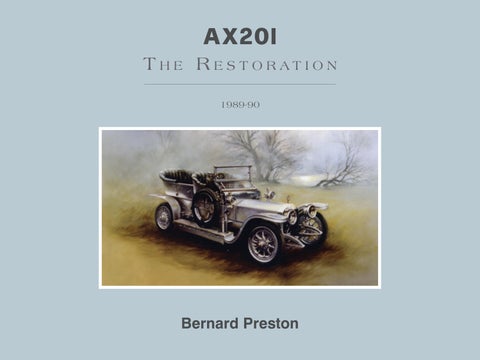
A X20l T h e R e s t o r at i o n 1989-90
Bernard Preston 1
End paper - plain grey
2
End paper - plain grey
3
End paper - plain grey
4
AX20I T h e R e s t o r at i o n 1989-90
Researched and written by Bernard Preston in association with Andrew Wood and Alan Hobbs. The book has been written with the express permission of the owner of the Rolls-Royce Silver Ghost AX201, The Honourable Sir Michael Kadoorie. Many of the photographs in this book are by kind permission of the Heritage Centre at Rolls-Royce Ltd Derby. Other photographs are from the private archives of Bernard Preston, David Preston and of P&A Wood. © 2026 Bernard Preston ISBN978-1-0369-5122-1 All rights to the content of the book belong to Bernard Preston and cannot be reproduced or copied without the express permission of Bernard Preston. All rights reserved. No part of this publication may be reproduced, stored in a retrieval system, or transmitted in any form, or by any means, mechanical, electronic. photocopying, recording or otherwise without the written consent of the author, nor be otherwise circulated in any form of binding or cover other than that in which it is published and without a similar condition being imposed on the subsequent purchaser. The image of the Silver Ghost used in the introduction to this book and on each chapter page is by the kind permission of Almany Limited of Abingdon, Oxfordshire. The image is used as originally provided. The opinions expressed within are those of the author and editors. Edited by the Preston family. Formatted, printed and bound by www.beamreachuk.co.uk
ii
T h e S i lv e r G h o s t
iii
iv
The Rolls-Royce Silver Ghost AX201 and the AUTOCAR The Rolls-Royce Silver Ghost AX201 at the Cat and Fiddle, near to Buxton, on its way to Glasgow and then on to compete in the Scottish Reliability Trial. Claude Johnson at the wheel, in 1907. AX192, in the picture, was driven by Mr Harry J Swindley a journalist from the AUTOCAR, a motoring journal of the time, which is still a weekly publication today . He drove the complete journey, including the Reliability Trial, in AX192. He accompanied both Claude Johnson, driving AX201, and Charles Rolls in a second 40/50hp AX205. He took part in all activities associated with the Trial and then drove with them all the way back to the RAC Club in London. He wrote enthusiastically about the Silver Ghost, and his escapades with Claude Johnson and Charles Rolls, in an article in the AUTOCAR. Comments courtesy of the Autocar
v
This famous picture shows Claude Johnson storming up ’Rest and be Thankful’ on the Scottish Reliability Trial in 1907. After returning to London, Claude Johnson then set about beating the long distance reliability record. AX201 then journeyed between London and Glasgow, 27 times, night and day. Claude Johnson and Charles Rolls drove for the early trips, but then a team of drivers took over, including Eric Platford and Alec McCready. As the trial was coming to an end Claude Johnson sent a telegram to the AUTOCAR, ‘All going well. The Silver Ghost will beat the world’s reliability record in the early hours on Friday morning next. Will you come? I shall be driving.’ Accordingly, Harry J Swindley from the Autocar, driving another 40/50 provided by the company, drove to meet Claude Johnson and accompanied him to the end of the trial. It is said that Lord Northcliffe, proprietor of the AUTOCAR, possibly encouraged by Harry J Swindley, then called the Silver Ghost AX201, “The best car in the world”
vi
AX20I T h e R e s t o r at i o n 1989-90
Bernard Preston In Association with
Andrew Wood and Alan Hobbs
vii
Contents The Author
xi
Forward
xii
Introduction
xiii
Bernard Preston - Personal Notes
xiv
Chapter 1
Preparing the Ground
1
Chapter 2
The Years before Restoration
7
Chapter 3
The Realisation that AX201 was Broken
23
Chapter 4
Building the Case
27
Chapter 5
Originality
31
Chapter 6
The First Shock
33
Chapter 7
The Second, even Bigger Shock
37
Chapter 8
More Flying Visits
39
The Making of AX201
43
Chapter 9
Alan Hobbs - The S C Gordon Ltd., story
75
Chapter 10
Andrew Wood - The P & A Wood story
97
Chapter 11
Reunited - Back as One.
123
Chapter 12
The Silver Ghost Charity Tour
131
Appendix I More about the Author
137
Appendix II Acknowledgements
140
This book is dedicated to the memory of that most famous, enigmatic and brilliant engineer, Sir Henry Royce. Henry Royce was the inspiration and driving force behind the creation of the Rolls-Royce 40/50 hp motor car which became renowned for its attribution as ‘The Best Car in the World.’ It is also dedicated to Claude Johnson, known as ‘The Hyphen’, in the name Rolls-Royce. Johnson used his supreme organisational, marketing and business skills to realise the potential of the 40/50 hp, and through it create the great engineering company we know today. Lastly, it is dedicated to The Honourable Charles Rolls, who sought out the northern engineer Henry Royce in order to establish a partnership and marriage to build the best car in the world. In doing so, they established the now world-famous Company, Rolls-Royce Ltd. This book tells the story of the great motor car these three famous men created, the Rolls-Royce Silver Ghost AX201, and how it came to be restored in the years 1989 and 1990. We also must not forget the modern men, Paul Wood, Andrew Wood and Stuart Gordon, who with their teams were able to restore AX 201, the Rolls-Royce Silver Ghost, to the same exacting standards as those followed by the original engineers and coachbuilders. Stuart and Paul, so unexpectedly, have left us. We honour their lives and outstanding contribution to the success of Rolls-Royce and Bentley Motor Cars, and to the superlative restoration of this world-famous motor car that became known as ‘The Best Car in the World.’
ix
The Author I joined Rolls-Royce as a 15 year old apprentice in 1953, starting as an office boy. I served my apprenticeship and went on to do my National Service in the Royal Electrical and Mechanical Engineers. On returning to Rolls-Royce and Bentley, I began a steady rise through the ranks, mainly in the service department, before becoming the Product Planning Director in 1985. I then became the Director of UK Operations. In this latter role, I was responsible for the restoration of the Silver Ghost AX201, and this book tells the story.
Thank you to everyone listed below for your encouragement, support, suggestions, alternative approaches, and for reading the early and later drafts. Sir Michael Kadoorie Andrew Wood John Ashford Alan Hobbs Marinus Rijkers Roy Dempsey Hugh Hadland Mark Luscombe Simon Curzon Stephen Smith Warren Allport Mermie Karger
While being the principal author, the book could not have been written without the help, support and knowledge of Andrew Wood. It was Andrew’s intervention that prompted the restoration to be considered in the first instance. The Company and I owe him our thanks for his knowledge, foresight and courage.
And very special thanks to:My wife Irene My son Mark My son David.
Later, as the Director of Quality, I was responsible for the restoration of one of the first Rolls-Royce cars to be produced, the Rolls-Royce 10 hp SU13 (known affectionally as Suzie) again with the support of Andrew Wood.
And a very special thank you to my former colleague, David Preston, who helped with stories, pictures, and gave his time to sort photos and offer advice. David was the driver and keeper of AX201 at Crewe for ten years.
I began my retirement on the day the Company was taken over by the Volkswagen Group in June 1998. Throughout my career, I sought to remember the three great men who founded the Company, and I took actions to make sure that the heritage of Rolls-Royce and its principles played their part in latter day motor car operations. The last office boy to become a director of Rolls-Royce and Bentley Motor Cars. xi
F o rwa r d I am very conscious that the stewardship of AX201 is both a privilege and a responsibility, a piece of automotive heritage which resonates with every Rolls-Royce enthusiast and child alike. This car, the original Silver Ghost, was re-acquired by Rolls-Royce in 1948, and it became an iconic and much-loved ambassador for the marque: indeed, I recall seeing it when it visited Hong Kong in the 1990s. Just prior to that, the car had been restored by P & A Wood and S C Gordon Coachworks under the aegis of the then Rolls-Royce Director of UK Operations, Bernard Preston. His vision gave it a new lease of life, and we owe him a debt of gratitude that this finest of Rolls-Royce ambassadors continues to perform with elegance and aplomb well into the 21st Century. I have always believed that cars are to be driven, and AX201 has given many miles of motoring pleasure. During one recent outing, on a lovely summer’s day in the Cotswolds, I came to a T-junction opposite a pub. While waiting for the traffic to clear, the patrons in the garden stood up as one and applauded the Silver Ghost, a touching appreciation of its unique heritage and appeal. That it can still be driven in modern traffic is testament to those who have undertaken its restoration, maintenance, and repair. For many years this has been the responsibility of P & A Wood, a role they have performed with competence and sensitivity, both keeping the spirit of the car alive and also ensuring that its mechanics are in first class working order. AX201 will no doubt continue to give great pleasure for many decades to come… ‘The Best Car in the World’.
The Hon Sir Michael Kadoorie.
xii
I n tr o d u ct i o n The story of the restoration of the Company’s historic 1907 Rolls-Royce Silver Ghost AX 201, chassis number 60551, is a fascinating one. As the Company Director responsible for the restoration, it was time to tell the story whilst the memories of the people involved remain intact. The Silver Ghost, famed for completing the 1907 Scottish Reliability Trial and the 15,000 mile non-stop run between London and Glasgow, was feeling its years. It was therefore decided in 1989 to undertake a major restoration. Rolls-Royce, chassis number 60551 with the registration AX201, is the only Rolls-Royce that can truly be called the Silver Ghost. All the other 40/50 cars were later called Silver Ghosts by clients and others because of the fame of AX201. It was also to distinguish them from the Phantom launched in 1925. How the restoration came about, and the people involved, is the subject of this story. The Silver Ghost AX201 was a hard-used motor car, travelling the world to promote the Company’s motor cars and products. Before 1983 no dealer in the Authorised Rolls-Royce and Bentley Dealer Network had the necessary skills to undertake the restoration. Unknowingly, however, and for quite different reasons, steps were taken in 1983 to bring dealers who had the necessary skills into the Official Dealer Network. This story explains how things changed. It also explains how we discovered the extent of the work necessary to carry out the restoration. It then tells how this was done by the Company with its chosen restorers. The story is a mixture of the author’s memories when managing the project, with perspectives from those directly involved in the restoration. It deals with making the case for the restoration, the actual work involved and culminates in the John O’ Groats to Land’s End Charity Run to celebrate the completion of the restoration. While researching the book, I came across a number of photographs from the early years at Cooke Street in Manchester and Nightingale Road in Derby. I have included them as they tell a wonderful story of those early years of Roll-Royce Motor Cars. Throughout this book, I have capitalised the word Company whenever I have referred to Rolls-Royce and Bentley Motors at Crewe. I have done this as a mark of respect for the company I loved and where I worked, boy and man, for 46 years.
xiii
Bernard Preston – Personal Notes
I worked at Rolls-Royce and Bentley Motor Cars in Crewe for 46 years from 1953 until I retired on 1 June 1998. I was sixty years of age, and it was the day the Company was taken over by the Volkswagen Group.
The story is well known, Rolls and Royce meeting at the Midland Hotel in Manchester in 1904 and agreeing to build and sell cars under the name of Rolls-Royce. The encounter has been written about in many books, articles and extensively in Wikipedia. As the person who became responsible for the renovation of the Silver Ghost AX201 in the late nineteen eighties, I wanted to add some personal notes as a prelude to the story of the restoration of this wonderful motorcar. My notes are intended to give readers a better understanding of some of my experiences during a forty-six year career with the Company.
While there were days or periods that were stressful or anxious I, nevertheless, enjoyed every minute, Of every hour, Of every day, Of every week, Of every year, the Company employed me.
My career in the Company started as an office boy and then an apprentice. Henry Royce became my first hero. In 1953 there was still a strong spirit of Royce in the factory. He was often spoken about in reverential terms by some of the engineers and skilled men who were teaching me my trade. I remember three particular occasions very clearly.
I worked with some wonderful people, drove and was involved with some fantastic motor cars, and had some amazing experiences with more extraordinary people. I worked extremely hard for the Company that I loved for all those years. I was a Rolls-Royce man, through and through, and exclusively, a Crewe factory man. Royce’s (as it was known) was my home for 46 years and I was immensely proud of it.
The first was when I was being trained as an apprentice in the machine tool repair department. I was put to work with Jack Caine on the automatic machine bay. Sid Slaney was the machine tool repair superintendent, and he always sought to encourage the apprentices. One day I was working with my fitter on a complex automatic machine when Mr Slaney came along. He explained to me that the ability to repair machine tools was especially important to the Company, as the machines had to produce components to the very high standards set by Henry Royce. He told me that to maintain the machines was the most highly skilled fitting job in the company. He then personally showed and taught me how to scrape a machine bed, with beautiful feather scrapes, using engineers blue and standard room gauges.
This book, however, is about one amazing motor car, AX201, and the joy and wonderful times I had with it. The Rolls-Royce Silver Ghost, Chassis Number 60551 and Registration AX201, is probably the most famous motor car in the world. It was imagined, designed, and built by Henry Royce, marketed by Claude Johnson, and sold by the Honourable Charles Rolls. This triumvirate of great men created the Company that became known for the excellence and quality of its products throughout the world. Others called The Silver Ghost ‘The Best Car in the World’, and Rolls-Royce became the superlative attributed to other products such as - the Rolls-Royce of [vacuum cleaners, bicycles etc.]
xiv
What he was really trying to do was to encourage and persuade me to stay on as a machine tool fitter at the end of my five years of training. I had expressed a preference to go back to the car side after my spell in machine tool repair. I rejected his overtures and went back onto the car side. The second occasion was when I was working in Product Development under Fred J Hardy (FJH). Fred was one of two brothers, with Bill Hardy, Fred’s older brother, being the Chief Designer at the time. As a young apprentice I was asked to work on the bolt-breaking test rig. We were evaluating one and a half inch long, quarter inch diameter bolts: comparing thread cut bolts made in our own machine shop with thread rolled ones made by GKN. The test rig comprised two convex plates bolted together with the bolts on test. An electric motor drove one end of the rig, and a spring balance applied a set load to the other end. A rev-counter was used to record how many revolutions each bolt lasted on the test. When the bolt failed it went off with a huge clang, and everyone in the workshop cheered. On one occasion, Fred Hardy was in the shop. On hearing the clang and laughter, I saw him smile and then he came over to me. In his low, gravelly voice, he explained how Henry Royce tested important components to destruction. He would then find out how they had failed. Once he knew how a component had failed, he could then develop means to improve it. Fred explained that fixing bolts were a critical component, and what we were doing was exactly what Henry Royce would have done. I remember that conversation as if it were yesterday.
A relaxed Henry Royce, foot on the stepping board of a Goshawk cabriolet, discussing issues with colleagues Charles Jenner and Arthur Elliot
I started to reflect on a most remarkable man: a man whose vision, energy, determination, quite brilliant management and organisational skills, charted its course. This man, Claude Johnson, became my second hero. I believe that, without Johnson’s marketing and business acumen, the Company would not have developed in the way it did. Interestingly, while the spirit of Henry Royce was present in the factory during my early days, the name Johnson was never ever mentioned.
The third occasion was when I was working on the engine line, weighing conn-rods to ensure a uniform set of six for the S series engine. My fitter remarked in typical workshop language, and with an intense look, that Royce would have made sure all six were exactly the same weight, absolutely no f…ing discrepancy. This may sound rather low key now, but I can tell you that the language used, and the look given, were more severe than described here. It made me feel that I would get the sack immediately if I got it wrong.
Later in my career, after being in the Service Department and responsible for World-Wide Service, I became Director of Product Planning, and shortly afterwards, Director of UK Operations. Conduit Street became my London home and office. I walked in the footsteps of Charles Rolls, Claude Johnson, David Plastow, and many other great men. What an honour! Imagine, if Charles Rolls had not lost his life so early, what an even more powerhouse group of men they would have been in those early days of motorcars and aircraft.
As I learned more of the history of Rolls-Royce, in particular how this small Company grew from its infancy into a major world player,
As Product Planning Director my role was to look forward to the product range beyond the cars we were producing at that time. I
xv
felt that to look forward it was important to look back first. Doing so would help me to understand how all the previous cars the Company had produced had been devised, planned, engineered, and then marketed. Of course, the first car I looked at was the Silver Ghost. The thing that interested and intrigued me was how Claude Johnson, as the Commercial Managing Director, was able to influence Henry Royce into creating a larger six-cylinder car than the 30 hp already in production. Then, later, how he brought about the major product planning decision to produce only one type of motor car, the 40/50 hp. This, seemingly, as a result of informal conversations. I have many books on the early history of Rolls-Royce and of Claude Johnson. It is said that the decision was made at a board meeting. However, I cannot find any reference to the details of this board meeting, or any formal decisionmaking process in which this new car was discussed and agreed. For example, I cannot believe Charles Rolls acquiescing so readily to building only one model of car.
Charles Rolls loved the 20 hp. Here he is competing hard to win. Isle of Man Tourist Trophy 1906.
A good account comes from books by W J Oldham…. The Hyphen in Rolls-Royce and The Rolls-Royce 40/50 hp, Ghosts, Phantoms and Spectres. I also loved Peter Reese’s brilliant book…. Sir Henry Royce, Establishing Rolls-Royce from Motor Cars to Aero Engines. The detail and research were truly outstanding, adding elements, and reminding me of things that I had forgotten.
It seems Charles Rolls was keen on the 20 hp, as he had considerable competitive success with the car, both here and in the USA. Claude Johnson liked the six cylinder 30 hp but felt it could be improved. Henry Royce was at his most prolific, having designed four motor cars and a V8 engined car all in three years. As a great engineer and relatively new to motor car design, he was just itching to do more; improve the cars in production and create new models. Claude Johnson, who was already a motor industry expert, with more knowledge than most, then suggested a larger car. An inspirational idea; something bigger and better than anything else on the road or produced by any other manufacturer.
These books and notes, together with my own knowledge from fortysix years with the company, lead me to believe that it was an informal conversation between the three men that contributed to the decision to build the 40/50 hp. Then, later, when Claude Johnson realised what a superb car it was, he proposed to the board that they build only one model of car. The quality of the 40/50 hp had set his creative juices flowing. It has been suggested that the decision was made to simplify the manufacturing process: fewer models, less complexity. It all makes good business and manufacturing sense, but I do not believe that it was the real reason.
A true visionary leader’s suggestion and a marketing man’s dream. Henry Royce agreed instantly, because it was also his ambition to build a car larger than the 30 hp. He was very happy to go along with the idea to develop a larger six- cylinder car. The idea was born, and the 40/50 hp Rolls-Royce was devised, designed, engineered and
xvi
royalty, aristocrats, potentates and wealthy individuals from all levels in society. The car set new lofty standards of excellence, silence, and reliability in motor car design and manufacture. This car, the 40/50 hp Rolls-Royce, set such high standards that other manufacturers of the time were forced to follow. However, with Henry Royce’s philosophy of continuous improvement, the 40/50 hp’s technical advantage continued for many years. This informal approach soon became formal with Royce and his team designing improved features, new cars and then aero engines. First in Cooke Street and Derby, and then, after ill-health, in the South of France at Le Canadel. The First World War forced him to return to England and to the Dover area. Later he found West Wittering, and after the war ended his design work took him to West Wittering in the summer and Le Canadel in the winter.
Claude Johnson in the driving seat with the team for the Reliability Trial 1907.
built. On Claude Johnson’s instructions, the 12th car off the production line, chassis number 60551, was painted bright silver with silver plated fittings. The name ‘The Silver Ghost’ was emblazoned on the bulkhead.
The designs they produced at distance were then translated into detail drawings back in Derby. It was there that everything required to build a new feature, or new car, was detailed and production engineered using further teams of brilliant designers and engineers. They translated the ideas coming from Royce and his designers into the detail processes required for the designs to be built. I find it extraordinary that this distant design process worked as well as it did - the original WFH (working from home) scenario. Imagine, cars designed in France, detailed, production engineered, developed and then built in Derby, all in 1906/7. This distant process then generating motor cars that earned a world-wide reputation for quality and reliability. Quite extraordinary, but a remarkable success!
This car became the vehicle to power Johnson’s visionary promotional ideas to demonstrate the sublime qualities of the 40/50 hp. I personally believe, from what I have read and from my own experiences in the company, that Johnson soon realised what a wonderful car Henry Royce had created. He could then see, in his visionary mind’s eye, how he could create, with Royce’s design genius, a great motor car and engineering company. Johnson had that ability to see beyond the here and now, and where, with judicious planning, he could see what the future might hold. I witnessed the same thing with Peter Ward during my years with him. Thus, from a seemingly informal conversation, one of the most significant motor cars in history came into being, sought after by
xvii
Claude Johnson was an organisational genius, and Henry Royce was one of the most revered and brilliant engineers in the world. It was this inspirational partnership which led to Royce’s design and engineering approach on both cars and aeroengines. It determined the way the Company developed. Royce designing the cars and engines: Claude Johnson organising the means by which these designs could be engineered and manufactured. And all this to a standard of quality and reliability that was way ahead of its time.
many times to attend car launches, but that this was the best. It made him feel immensely proud to be British and to represent RollsRoyce. A big thumbs up from Peter Ward. I felt that we had paid a retrospective, and proper tribute, to The Hyphen. See more about Claude Johnson in a later section, ‘The Making of AX201’. However, now let me get back to the early years of the Company.
As a personal aside, I always felt annoyed that Claude Johnson was never given the same respect or credit as Rolls and Royce for the success of the Company. During my career l always sought to pay him proper respect but never seemed to get much chance.
Following the huge success of the first aero engine, the Eagle, during the 1914 - 1918 War, attention returned to cars. Royce and his design team were then responsible for the six-cylinder twenty. This was a smaller Rolls-Royce model but built to the same standards as the 40/50 hp. Then came the Phantom motor cars, as well as the Hawk, Kestrel, Buzzard, and ‘R’ aeroengines. The last named one, the ‘R’ engine, was unquestionably one of his greatest achievements, powering the seaplanes that won the Schneider Trophy in 1929 and 1931.
In my later years, as Director of UK Operations, I got the opportunity to pay a proper tribute to Claude Johnson. We were launching the Silver Spirit II in the UK at the Turnberry Hotel in Ayrshire. After the formal dinner there was usually some form of entertainment, and I chose to pay a tribute to Claude Johnson. We engaged Jon Rollason, an actor and scriptwriter, to produce a short play about Johnson as The Hyphen, and the role he played in the early years of the Company. A huge amount of research was done into Claude Johnson’s career, starting when he was at the RAC and running through to Le Canadel and the distant design process. Much of it into his character, personal traits and mannerisms. Jon produced a wonderful script, about thirty -five minutes long. Glyn Houston, a famous Shakespearian and TV actor, was engaged to play Claude Johnson. A theatrical set was arranged in the hotel dining room with statuettes of Rolls and Royce on each side.
The ‘R’ engine laid the groundwork for the famous Merlin engine which contributed to him being awarded a baronetcy. Even though his health was failing, and at 74 years of age, he then laid out all the key mechanical details of the next major new car, the Phantom III. Sir Henry Royce died in early 1933 and never saw his designs for the Phantom III realised. Royce was never replaced as Chief Engineer, but his engineering-led approach was by now ingrained in the Company; an engineering company run by engineers and it continued during the pre-war years, driven by Earnest Hives, later Lord Hives, and many outstanding, brilliant engineers.
I was concerned as to how this piece of entertainment would be viewed by both the dealers, and the Board of Directors, who were all present. On the night, Glyn Houston stole the show. He was word perfect! As Claude Johnson, he told the story of the early years, speaking to Rolls and Royce in turn and then speaking and engaging the audience in brilliant fashion. What a triumph! Richard Martin, the CEO of the largest dealer network in the UK at the time, commented that he had been to California, South Africa and the South of France
Post war, the philosophy and engineering approach continued with Chief Engineer Harry Grylls (Gry). Harry Grylls was another revered engineer and was held in high esteem by all the other senior engineers in the Company, as I can attest to personally. After the war, Crewe was chosen to be the motor car manufacturing centre, and all activities became concentrated on Crewe. In the early
xviii
This famous picture, painted by Stan Kaminski, shows Henry Royce on the beach at West Wittering. With his stick, he is sketching the outline of the world beating ‘R’ engine which powered the Schneider Trophy winning aircraft. The Supermarine seaplanes, designed by Reginald Mitchell, won the trophy three times. The Supermarine S.6B won the trophy outright on the third occasion in 1931. Ernest Hives is looking out, with designers Lovesey and Routledge on each side. Routledge designed the Napier Lion engine under the guidance of Arthur Elliot, who later became Henry Royce’s Principal Chief Design Assistant. The Company commissioned this picture to be used in a historical article in the dealer magazine.
xix
1960s the Service Department was relocated from Hythe Road in London to Crewe, with Stanley Bull becoming the Service Director. SB, as he was referenced, created a Service Engineering Department and I became part of it. Stanley Bull had joined the company in 1919, and from what I gathered from him, had worked mainly in the engineering department. He became a Technical Production Engineer and then a Service Engineer. During the war years he was responsible for the repair of Merlin engines. In 1947 he had become the General Service Manager at the Hythe Road Service Centre in London. Although Service Director at Crewe, he was still very much a service engineer at heart, and when he could he liked to get away from Mahogany Row. If there was a new problem that interested him, he would come down to the Service Engineering Office and get directly involved. Over a cup of tea, he would tell us stories of Henry Royce at West Wittering and Le Canadel. Apparently, there were times when he had driven cars to the South Coast of England or to the South of France. Harry Grylls, Chief Engineer, responsible for the design and development of the V8 engine and the Silver Shadow motor car.
As part of the new service engineering arrangements a monthly meeting was held in Harry Grylls’ office to discuss service problems. The job of the Service Engineering Team was to describe the service problems of the day to the meeting. There were three of us. Mike Parsons dealt with production and quality issues, the brilliant Chris Evans dealt with electrical and electronic complaints, and I handled all mechanical problems. Imagine, Bernard Preston, a time served apprentice, night schooled HNC student, attending such a meeting.
then finally expressing his views. The respect from the others, all great engineers, was palpable; it was a very intense feeling and a wonderful experience for a young engineer. It was easy to see during these meetings why the engineering-led approach, created by Royce and Johnson, had been successful for the Company. Harry Grylls commanded huge respect, was thorough, original in his thinking and decisive in his approach. I learned a very great deal from attending those meetings.
I was extremely nervous and found it awe-inspiring sitting in Grylls’ office with Fred Murray, Fred Hardy, Jack Phillips, Geoff Bastow, MacCraith-Fisher and others, mostly ex Derby men. Those attending the meeting would vary depending on the items to be discussed. On occasions, Gry would appear to lose interest, eyes closed, hands in front of his chest or face. The meeting went on as normal and nobody batted an eyelid. As the debate on a particular subject was drawing to a close, Gry would suddenly interject. He would then give his views on how the problem should be resolved. So, while appearing to lose interest, he had been listening intently, considering all the options and
This engineering-led approach, to my knowledge, continued right up to the Rolls-Royce Silver Spirit launched in 1980. It did however, lead to some problems, particularly with the introduction of new designs onto production. I remember clearly
xx
the issues being freely discussed when the sales and service teams met. My sales colleagues complaining that they had no say in any new cars they would eventually have to sell. Also, many managers in Production Engineering and Manufacturing felt that they did not have information early enough. The data coming too late to achieve a seamless introduction of any change to the manufacturing programme.
onwards then became critically important to the Company’s future. As the Company was in profit, it then allowed the Receiver of Rolls-Royce Ltd, Rupert Nicholson, and the new Motor Car Division’s Managing Director, David Plastow, to create a new independent Company. The new Company, Rolls-Royce Motor Holdings Limited, was floated on the London Stock Exchange in 1973, a separate and new independent company to bear the famous name.
In particular, this was an issue when the Silver Shadow was introduced after many years of development. The Silver Shadow was a vastly different motor car from previous cars built by the company. It had monocoque construction and Rolls-Royce engineered hydraulic powered braking and suspension systems. It emerged in 1965, and production issues arose immediately which led to output targets not being met.
The date, 4 February 1971, the day Rolls-Royce Ltd was declared bankrupt, and the period afterwards is seared into our mindset and memory. Despite these changes the engineering-led approach to the development of new models continued as before, with Camargue and the Silver Shadow replacement being the focus of the engineering and styling programmes.
Rolls-Royce Ltd, the parent Company, was not happy. It had supported the huge development costs on a replacement for the ‘S’ Series cars and expected a financial benefit when the Silver Shadow was launched. However, the early production issues put a quick return to profitability in jeopardy.
In the early 1980s, shortly after the launch of the Silver Spirit, Richard Perry became the Managing Director at Crewe. He was a real car man and had been the Chief Executive at the Rover Group, Longbridge, during the 1970s. He preferred the more modern and all-encompassing Product Planning approach. A Product Planning department was subsequently formed at Crewe led by John Stevenson, hired from the Rover Group.
Rolls-Royce Ltd acted decisively and Managing Director, Dr Llewellyn Smith, was replaced with Geoffrey Fawn. A little later, Chief Engineer Harry Grylls became the Technical Director and John Hollings became Chief Engineer in his place. Fawn resolved the production issues, and we started to produce cars to programme. Fawn’s approach was brutalist, replacing people, slashing costs, improving efficiency, resolving service problems and driving everyone hard. He became a hated figure, but his methods worked and soon the Company was back in profit.
The Product Planning approach was to develop company-wide short and long term product and business plans for Rolls-Royce and Bentley Motor Cars. Fundamental to this approach were procedures to ensure that everyone knew what was being planned in detail, particularly with regard to the timing of change. This was to ensure that there were no surprises, with procedures designed to result in a smooth and seamless introduction of new features or completely new cars.
Later Geoffrey Fawn was recalled to Derby to help with the issues caused by the RB211 engine turbine blade problems, and the Nationalisation of Rolls-Royce Ltd.
This Product Planning approach led eventually to the Project Team approach of organising any new product development programme. The Rolls-Royce Silver Seraph and Bentley Arnage, the last motor cars designed by the old Company, were developed using these techniques, with Tony Gott being the Project Manager.
In February 1971 the future of the Car Division was in doubt. The fact that Fawn’s efforts had returned the Company to profit from 1968
xxi
After that lengthy and roller coaster sojourn into the engineering-led Product Planning approach, let us now get back to those early years of 1906/7, when the simple conversational approach to new model introduction was used. The conversations between the three men worked well, and the 40/50 hp emerged. Claude Johnson christened the 12th car The Silver Ghost and history was made. Commenting on my feelings about this simple approach, my business consultant son said, ‘But dad, the Company was a start-up. That’s how start-ups do things, have a chat and get on with it’.
seamless progressive pick up and exceptionally smooth refinement. This is allowed by the Royce designed ignition and carburation systems. Royce was ahead of his time in carburation. He devised the automatic air valve which weakens the mixture during the enrichment period associated with a simple carburettor. He also became a leading expert on crankshaft vibrations, commonplace with six-cylinder engines of that period. This expertise resulted in a super sweet flexible engine…way ahead of its time and vastly superior to other cars of the same period’.
So, after the chat in which Claude Johnson had suggested something larger should be the next project, let us consider the man who made it all possible, Henry Royce, later Sir Henry Royce.
Andrew also commented, ‘When I see AX201 now, after not seeing it for some time, it gives me goose bumps and makes my hair stand on end.’
Henry Royce was an amazing engineer, and when he decided to make a motor car, he designed and built a 10 hp, a 15 hp, a 20 hp, a V8 engined car and then the 40/50, all in the space of three years, 1903 to 1906. Quite astonishing! However, it was the superb 40/50 that truly inspired and galvanised the then Commercial Managing Director, Claude Johnson. He believed that, with this car, they had the quality and potential to attract a great deal of publicity, which would allow and help them build a Company of great note. Claude Johnson was in awe of Henry Royce’s brilliant design prowess and realised that managing him carefully would be the key to the Company’s future progress and success.
Thank you, Andrew, and this sweet running of the engine was confirmed during my time as a service engineer for the Company. Dennis Miller-Williams, our Publicity Officer at the time, was in the north of England on some promotional activity when he brought AX201 into the Repair Shop complaining of poor running. Ronnie Reade, the leading hand tester, was given the job of sorting it out. Ronnie had been in the Repair Shop from when it was established after the 1939-1945 war and had become the expert on pre-war cars. As you can imagine, it caused quite a stir, and when things had quietened down, I went over to Ronnie to have a look at this beautiful car. The engine was always exceptionally clean and polished, and I commented that it was a beautiful engine. Ronnie agreed. He then pointed to the carburettor and said, ‘But that’s the piece of magic!’ Afterwards he described how you could get the engine to run and idle super smoothly, and this allowed the car to be driven smoothly. This amazed journalists of the time, and others who drove or rode in the car. Of such simple observations great reputations are made!
My great friend Andrew Wood says, ‘Royce was an amazing, unique engineer who followed his own ideas. We all know that Royce was the ultimate perfectionist, but what is not so well known is that he was such a clever man and could do things in his head that today you would need a computer for. He had an outstanding intellect, and the Silver Ghost was a development born of previous cars he had made.
This car, probably the most famous of all cars, was developed in a year, maybe 18 months. Amazing! Such was the man who had perfectionist ideals and the great energy to develop the latest ideas so quickly.
The engine is a six-cylinder side valve of 7.3 litres in capacity with extremely low compression ratio, dual ignition and a huge heavy flywheel. It has superb slow running due to Royce’s own carburation,
xxii
However, in 1989, AX201, after over eighty years and many miles of promotional activity for the Company, was showing signs that it needed some tender loving care. A programme of restoration was started. The story of that restoration is the subject of this book.
these two men, together with Charles Rolls, created a world-famous engineering Company famed for its motor cars and aero engines. In this story AX201 is described as the Silver Ghost, the Rolls-Royce Silver Ghost or quite simply as AX201. They are all the same car, and the different references usually refer to different periods in the car’s life.
After the restoration was completed in 1990, AX201 was used, as before, for Company promotional purposes. This went on until June 1998, when the Rolls-Royce and Bentley Motor Cars Company was sold. Following the purchase of the Crewe factory of Rolls-Royce and Bentley Motor Cars by the Volkswagen Group in 1998, the Silver Ghost AX201 and the 10 hp SU13, were part of the fixtures and fittings. As they were now owned by the Volkswagen Group, the cars could not be used to promote Bentley motor cars. The two cars were put into storage and were lost to us for over twenty years. The Rolls-Royce Silver Ghost AX201 had already celebrated its century and was still in pristine condition when, together with its sibling SU13, it was sold by the Volkswagen Group. Both cars are now in the hands of a private owner, The Honourable Sir Michael Kadoorie. They are regarded by the British Government as ‘National Treasures’. As such they have to remain in the United Kingdom. Sir Michael has graciously and kindly written a forward for this book. The story of the restoration in 1989/90 is of modern and passionate men restoring this venerable old lady. While doing so, they paid tribute to two great The Honourable Sir Michael Kadoorie men, Sir Henry Royce, that enigmatic and brilliant engineer who conceived the car, and Claude Johnson who had the marketing and business skills to realise its full and outstanding potential. Through their efforts
xxiii
Chapter 1
P r e pa r i n g
the
This Chapter tells the story of how the dealer network changed, from the early days after the war to the network required for later market conditions. Changes were made to the dealer network in the early 1980s, fortuitously, as it allowed us to restore AX201 within our authorised network of dealers. I had the experience of being a Service Engineer, the Technical Service Engineer and the Manager of the Crewe Service Centre. The experience I gained in these roles influenced the type of dealer network I felt we needed to suit the prestige and brand of Rolls-Royce and Bentley Motor Cars.
Ground
where there was a mixture of main distributors and retailers. All had the ability to sell the cars they were allocated. Things worked well, particularly when the Silver Shadow was introduced, and in the final years of the 1970s, the sale of over one thousand cars was achieved in the United Kingdom. However, during this period the country was beset with high inflation, the pound being devalued and car manufacturing troubled by industrial relations problems. Many in the car industry will remember ‘Red Robbo’ who paralysed production at the Rover Group. Later strikes by refuse collectors led to rubbish and waste being piled up on the streets of villages, towns, and cities across Britain. The
Following the decision to relocate the Car Division to Crewe after the 1939-1945 War, the UK dealer network had developed to a point
1
Labour Government, under Jim Callaghan, seemed quite incapable of resolving any of these issues which lead to a General Election.
With no Marketing Director, or Sales Manager, my colleague Nigel Cornelius was running the sales department, and I was in charge of UK Service. On the Monday Dick arrived we were called to see him at 10.30am sharp. Without any niceties he said, ‘We have too many dealers making too little money. The network is too large. Sort it out!’.
Following the 1979 election, Margaret Thatcher became Prime Minister, and with her Chancellor, Geoffrey Howe, resolved to tackle the serious financial situation the country was in. Interest rates were raised and other financial strictures were put in place to bring the economy back under control.
Working with our respective teams, we carefully put together a network of thirty-eight dealers, reduced from seventy-one. Then we had the challenging task of telling some very longstanding Dealer Principles that they had lost the franchise. This was a time of heartache and tears, but the reorganisation went ahead, with the new Sales and Marketing Director, Peter Ward, arriving in the middle of the process.
The effect on the economy of the Government’s actions was immediate. By the early 1980s, the UK was in recession, and the sale of new Rolls-Royce and Bentley cars was severely affected, critically impacting the Company’s finances.
However, the reorganisation left large areas of the country devoid of service cover, and it was this restructuring of the UK network that created the need for a network of Authorised Service Dealers.
Rolls-Royce and Bentley Motor Cars had been taken over by Vickers in 1980 in a strange reverse takeover. The entire Crewe Board of Directors, under David Plastow, transferred to Millbank Towers in London to run the Vickers Group. This now included Rolls-Royce and Bentley Motor Cars as one of its companies.
Working with the DVLA, the outstanding and brilliant, Giles Fry, our Service Co-ordinator, tracked where all post-war Rolls-Royce and Bentley cars were residing. This helped us to locate where we needed dealerships.
Vickers were not happy with how the Board of Directors at Crewe were responding to the recession in the early nineteen eighties. I clearly remember visiting all the major dealers with Sales Director John Carpenter and Sales Manager Peter Hunt, trying to convince them to take more cars. With the market in a major downturn, they resisted all our efforts. The Company’s financial position was slowly deteriorating.
The following paragraphs come from a presentation made by Bernard Preston at the P&A Wood book launch on 10 September 2022. It summarises how we tackled one part of the country, and the company we appointed as an Authorised Service Dealer. One area we identified was northeast of London. Service Engineer Keith Davies was tasked with finding a possible Service Dealer, but we could not find anyone suitable.
Things came to a head at the 1982 Motor Show when a redundancy programme was announced, and the entire Board of Directors of Rolls-Royce Motor Cars lost their jobs. This ‘Night of the Long Knives’ was a profound shock for everyone at Crewe.
Then Keith phoned me to say, ‘I have found the perfect company to represent us, P&A Wood in Great Bardfield’. ‘Where?’ I asked. After consulting the map I said, ‘Keith, but it’s in the middle of nowhere, miles from anywhere,’ and the idea was rejected.
It was then announced that Richard (Dick) Perry had been appointed as the new Managing Director, and that he would be taking over on the following Monday. Dick had been Managing Director at Rover Longbridge, and immediately prior to coming to Crewe, had been Managing Director at Mulliner Park Ward at Hythe Road in London.
Keith was persistent, and eventually I relented and it was arranged that we would meet Paul and Andrew Wood in Great Bardfield.
2
As we drove to the meeting, through Duck End and Oxen End, my worst fears were being confirmed. Paul and Andrew met us very graciously and their slow smiles and friendly nature soon put us at our ease. We looked around the workshop and saw some wonderful examples of their work, all encapsulated by their ethos of ‘Attention to Detail’, clearly following in the spirit of Henry Royce. In the office we saw the components of a clock. We were curious. When we enquired, we were told that it was to go on top of the new building. We were then shown architectural drawings of a new showroom and workshop to be erected at some point in Great Easton. By this time all my worries had dropped away. I thought they would be the most perfect Information used in the Presentation to all dealerships regarding the changes to the UK Dealer Network. Service Dealers. As we continued to talk we became four friends, talking cars, their problems, and independent shops to do paint work repair for them. This meant about the Company we loved. It became extremely easy to appoint that any paintwork problems we authorised under warranty were them, there and then, as Authorised Service Dealers for Rolls-Royce corrected in facilities where we had no control over the methods, and Bentley Motor Cars. materials, or the time it took. At the time, paintwork rectification was the most expensive warranty problem we were facing. We were not The reorganisation of the dealer network, and the ongoing recession, happy about it, so we created another group of specialist companies had created another problem for us. To reduce the running costs of within our franchise. their businesses during the recession, many dealers had dispensed with their paint shops. They were now relying on non-franchised
3
We called them Authorised Coachwork Repairers (ACRs). They could be an independent company, or a coachwork facility attached to one of our dealers. Any paintwork repairs on a car, or rectifications under warranty, would have to be carried out at an Authorised Coachwork Repairer where we had some control over the repair procedures and cost. At the same time, we appointed a paintwork specialist from the production paint shop, David Williams, and we ran paint courses to support and ensure proper procedures within this new group of ACRs. Most of the warranty paint work repairs in the London area had been going to one particular independent paint shop, S C Gordon Ltd in Luton. I was anxious to meet Mr Gordon and have a look around his facilities. A meeting was arranged, and we got on like a house on fire. The facilities were impressive, and the work we saw was also of an extremely high standard. S C Gordon Ltd were appointed as Authorised Coachwork Repairers in March 1984 and agreed to comply with all the requirements of the franchise. Andrew and Paul Wood in the showroom at Great Easton.
And so (although unknown to us at the time) we were creating the facilities and relationships, within the dealer network, to ensure that they were ready, when required, to restore that most famous of motor cars, the Rolls-Royce Silver Ghost AX201. This was something that was particularly important to me, and that is the focus of the following chapters.
What was also important was that we had made friends with some wonderful people. Paul and Andrew, Rolls-Royce through and through, utterly sincere, so knowledgeable and such great people.
Then Stuart – a great man and friend, leading light in the Vehicle Builders and Repairers Association - what he didn’t know about coachbuilding was not worth knowing.
Stuart Gordon with David Preston inspects AX201 before the restoration
5
Chapter 2
T h e Y e a r s B e f o r e R e s t o r at i o n
The following is taken from an article by Warren Allport which he wrote for Queste Magazine in 1990 after the Silver Ghost Charity Tour. It is only a small part of the article. It deals with the years after the Silver Ghost was seventy-five years old. It is intended to give an indication of the demanding work the car undertook, promoting the Company and its products, even at a venerable age. This part of the article deals with only five years of promotional activity.
550 miles. In October the Post Office issued a special Silver Ghost stamp, and AX201 carried the first day covers in London, and also conveyed the first day covers from the factory to the Crewe sorting office. In between the two events was a trip to the USA, with appearances in New York, Chicago, Boston, San Francisco and Los Angeles, culminating in a starring role at the Rolls-Royce Owner Club’s National Meet in Florida.
In 1982 the Silver Ghost was seventy-five years old, and among the June celebrations was a run from Glasgow, via Edinburgh, Leeds, Manchester, and Crewe, to the RAC Club in London. It was conducted in very wet weather with no mechanical problems in
On 9 July 1983, seventy-five years to the day after transporting guests to the opening of the Derby factory, the Silver Ghost was back at Derby to transport Lord Montagu to the unveiling of a plaque on the spot in Number One Shop where Henry Royce’s office had been situated.
7
Early in 1984 came a first visit to Australia, with an appearance at Melbourne’s Motor Show, followed by visits to Brisbane, Sydney, Adelaide and Perth. Back in the UK, there was a second RollsRoyce pageant at Duxford in June.
particular, the entire Service Centre was transferred to the London approaches at School Road, out on the Western Avenue. At this point, and because of the closure of the Hythe Road Service facilities, responsibility for looking after AX201 was transferred from John Rowe in London to David Preston at Crewe. David was a Press Officer in the Publicity Department and became solely responsible for AX201.
The major event of 1986 was a first visit to Canada, where, as well as dealer displays and Rolls-Royce Club events, AX201 was exhibited in a glass showcase outside the British Pavilion at Expo ‘86 in Vancouver. The Silver Ghost’s proudest moment came on 24 July 1987 when she transported Her Majesty the Queen and the Duke of Edinburgh during a visit to the factory at Crewe. That made national television news reports.
A little piece about David Preston, Press Officer at Crewe: David Preston was another time served apprentice who rose through the ranks. After serving his time, David did various fitting jobs but eventually became a tester on the engine test beds. As an ambitious young man, David later became a Technical Author, which he enjoyed for a number of years.
A busy year lay ahead in 1988, starting with a visit to Japan for the opening of the new showroom of Cornes and Co. in Tokyo in March. In May ‘Rest and Be Thankful’ was climbed at the start of the Rolls-Royce Enthusiasts’ Club Scottish Tour to celebrate the gold medal in the 1907 trial. Continental dealer appearances were followed by a leading role in the floodlit cavalcade at Blenheim Palace for the Rolls-Royce UK dealers’ summer ball.
The history is that another David, David Roscoe, had joined the Company in the mid-seventies as the Public Relations Director. David Roscoe was seeking to build a Public Relations Department at Crewe, rather than operating from Conduit Street, as had been done in the past. He started to build a team of Press Officers and Graphic Designers who could promote the Company professionally to the trade press, general press, customers and public alike.
On 21 September 1988, the Duke of Kent rode in AX201 to open the new headquarters of Rolls-Royce Motor Cars International at Saint-Prex, Lausanne, Switzerland.
David Preston was approached to be part of that team. He accepted the offer and became a press officer, a role he held until he retired in 1992.
As you can see, AX201 was a hard used motor car. All this travel and being driven by drivers not familiar with the controls, was having an effect. This was not immediately obvious, because the car was always kept in pristine condition at the factory and by P&A Wood, who were now responsible for carrying out any work on the car.
David Preston writes of the period he was responsible for AX201: Rolls-Royce Motors Holdings and Vickers merged in 1980. The whole of the Rolls-Royce Motors Holdings board and the Public Relations Director transferred to Vickers. AX201 remained the responsibility of Dennis Miller-Williams at Conduit Street for public relations activity, and John Rowe at Hythe Road for maintenance and preparation for events.
Before the 1980s, AX201 was looked after by the Hythe Road Service Centre. Dennis Miller-Williams was the chief driver helped by John Rowe, both driving but with John looking after maintenance. These two were the people who drove the car most of the time. In the early 1980s the manufacturing facilities at Hythe Road were being reduced. Many workshops were being closed, and the site was in transition. In
With the retirement of Dennis Miller-Williams and John Rowe from Hythe Road, the remaining responsibilities for AX201 were
8
effectively transferred to Crewe. I started to take on the responsibility for driving and preparing the car for events.
photograph of Claude Johnson storming up the hill in 1907. (See photo a little later.) These were moments to be immensely proud of the Company, and that beautiful car, AX201.
A little later, Bob Cartwright was appointed as Public Relations Director, and all public relations activity was now passed to Crewe from Conduit Street. By now the Hythe Road Service Centre had been relocated to School Road, out on the Western Avenue, and that meant that the responsibility for maintenance of AX201 was also transferred to Crewe.
The photos on the following pages show AX 201 being used for promotional purposes by the Company, mainly in the United Kingdom and Europe, but with excursions to Hong Kong and the United States.
During this period, the general appearance and mechanical condition of AX201 was sufficient for most purposes. Successive new Public Relations Directors, Bob Cartwright and T John Foster, were not fully aware of the need to undertake the work necessary to keep the car in the required superb condition for its world-wide promotional role. As I was now fully responsible for all aspects of AX201, I had a conversation with Bernard Preston, who suggested that I approach Andrew Wood to see if they could manage the maintenance of the car on behalf of the Company. Andrew was delighted and thus started a mutually beneficial relationship which culminated in the restoration of the Silver Ghost AX201 in 1989/1990. I had many proud moments driving AX201, but probably the proudest time was when, in 1987, the car was used to transport Her Majesty Queen Elizabeth 11 and His Royal Highness Prince Philip, Duke of Edinburgh on a tour of the factory. It was my job to drive their Royal Highnesses around the factory in AX201. The Queen and Prince Philip stepped into the car and settled down for the start of the factory tour. Peter Ward indicated that I should move off but the engine promptly stalled. I hopped out, cranked the engine, got it started and then hopped back into the car. I was very embarrassed, but the Queen smiled and Prince Philip was quite amused. Fortunately, the rest of the tour went very well. Quite a memory! In 1988, I led a cavalcade of Rolls-Royce motor cars, in AX201, to the summit of the ‘Rest and be Thankful’ at the commencement of the Rolls-Royce Enthusiasts’ Club Scottish Tour. During the drive up ‘Rest and be Thankful’ we sought to recreate the famous
9
AX201 in good company. M9974 is the Rolls-Royce 20hp which Stanley Sears bought as scrap in Australia and then restored to the condition you see here. Stanley Sears at the wheel. Early 1960s.
10
Dennis Miller-Williams driving AX201 at a Rolls-Royce event at Hucknall in the 1970s.
A young Prince Charles riding in the back of AX201 in the early 1970s.
The artist, David Weston, showing off his painting of AX201 which graces the cover of this book.
11
AX201 at the Geneva Motor Show in 1979. I wonder what was said about the positioning of AX201 in relation to the brand signs.
Mr Roy Dyer being presented with a one gallon bottle of Glenmorangie for winning the Rolls-Royce Scottish Reliability Trial in 1982.
12
Johnny Rowe giving customers a ride in AX201 at a combined event at the Gleneagles Hotel. Partners at the event were Mappin and Webb, Louis Feraud and Seagram’s Champagne. Early 1983.
AX201 being loaded at Schiphol Airport for a flight to Hong Kong.
AX201 being driven by David Preston, with the Duke of Kent and David Plastow on board, to the opening of the St. Prex facility in Lausanne. Late 1980’s.
13
AX201 attracting large and excited crowds in Hong Kong.
Lars Bang, Rolls-Royce dealer, riding in AX201 in Copenhagen. Car driven by David Preston.
David Preston hurries AX201 up ‘Rest and be Thankful’ seeking to replicate Claude Johnson storming up the hill in 1907. This event took place in 1987.
14
Boca Roton – Dennis Miller-Williams driving AX201 at the RROC meet in Boca Roton in 1982, to celebrate the 75th Anniversary of The Silver Ghost. Passengers in the car are - Ted Reich, passengers’ seat, former President. Behind the driver, Bloor Reading, President at the time and behind the passenger, Jack Scheve, head judge at the time. In the second picture are the two 40/50s belonging to Millard Newman. The car on the right is chassis number 60553, built just two chassis numbers after AX201.
15
AX201 on display at a Rolls-Royce Owners’ Club of America event in Pennsylvania. Looking on are Ralph Lindquist, Ed Ardis, Ozzie Lyons, (we think) and Mort Stork all officials of the RROC.
The 1977 Silver Jubilee at Windsor Castle. Dennis Miller-Williams again driving AX201 at the Jubilee celebrations.
16
The photos on this page show the three keepers and drivers of AX201 over the years from the 1960s to the 1990s.
Dennis Miller-Williams with Lord Montagu and Prince Michael of Kent. Dennis was the keeper of AX201 at Conduit Street until the early 1980s. This photo also pays tribute to Lord Montagu’s family who were closely involved with the RollsRoyce Company over the years. Photo courtesy of the National Motor Museum
Another photo of John Rowe driving customers at Gleneagles. John was responsible for the upkeep and maintenance of AX201 at the London Service Centre, from the early 1960s to the early 1980s.
17
Dennis Miller-Williams in his element. Glass in hand extolling the virtues of AX201.
Opositte Page – This most famous photo of David Preston cranking AX201 when it stalled with Her Majesty the Queen and Prince Phillip on board. David Plastow and Peter Ward laughing, or is it grimacing? David was the keeper of AX201 from the early 1980s until the early 1990s.
18
19
A pictorial tribute to the long-lasting association between the Lords Montagu and Rolls-Royce.
The plaque to denote where Henry Royce had his office in No.1 Shop in the new Derby factory.
Lord Montagu unveiling the plaque, in the exact spot where Henry Royce had his office. 9 July 1983. He is accompanied by Jim Keir, Director, Rolls-Royce Ltd.
Right (main): The plaque unveiling party – Mike Evans, Chairman Heritage Trust; Jim Rigg, Financial Director; Trevor Salt, Director; Lord Montagu; Frank Turner, Director and Jim Keir, Director who responded to Lord Montagu. At the front, hand on the wing, is Tony Broome who transferred from Manchester to Derby in 1907. Behind him is Harry Cumley, whose career spanned the 40/50 hp motor car to the RB211aero engine. Right (inset): Lord Montagu with Frank Shaw, founding member of the Henry Royce Memorial Foundation. Frank worked with Henry Royce in the 1920s.
20
21
Chapter 3
T h e R e a l i s at i o n t h at AX 2 0 1 wa s B r o k e n
The latter half of 1988, to the spring of 1989, was a busy period as we tried to sell as many cars as possible to ensure we achieved the year’s financial targets. Mid-year 1988 was most important, as Rolls-Royce and Bentley Motor Cars’ results were crucial to Vickers’ end of year performance. They impacted on how Vickers was seen in business circles and in the City of London. I travelled to dealers all over the country, paying personal visits, on a sales drive to try and persuade them to buy more new cars.
One afternoon, I found myself with Bill Slater, the Southern Area Sales Manager, at P&A Wood, seeking to persuade Paul Wood to buy and stock one or two more cars in that fiscal year. During the meeting, Andrew Wood popped his head into the office and asked if I could see him in the workshop after the meeting. We failed to persuade Paul to stock more cars. After the meeting had ended, I walked over to the workshop to see Andrew.
23
To my surprise, Andrew was there with AX201. He said he was very worried about the car as it was in poor condition, although its appearance belied Andrew’s concerns. I explained that I was not responsible for the car and that AX201 was the responsibility of the Publicity Department. Andrew said he knew that, but as a service man at heart, perhaps I would better understand.
Although I was not responsible for the car, I was determined that I would be the one to carry the project forward, but still the questions remained: •
Was it right to ask my friends, Paul and Andrew, to carry the whole responsibility for the restoration?
He then asked, ‘Have you driven the car recently?’ I indicated that I hadn’t. The last time I drove the car was when I was Manager of the Crewe Service Centre nearly fifteen years earlier. Andrew was determined that I should drive the car, so I drove AX201 out of the workshop and onto the roads around Great Easton. I was immediately concerned about how poorly the car rode and steered. It was all over the place, following white lines or ridges in the road, and not how I remembered AX201 at all. We later drove another Ghost, which was like chalk and cheese. It had a much nicer ride and steered positively over even the roughest surfaces.
•
Could we do some parallel processing and ask S C Gordon Ltd to bear some of the responsibility? I knew they had a brilliant coachbuilder, Fred Luscombe, who would be involved.
•
How could we justify the work, and how could I build a case to convince the Board?
The Board at this time consisted of men from within the motor industry. There were no true Rolls-Royce men. Peter Ward was from Triumph, Mike Dunn from Ford, Malcolm Hart from Rover, Ray Enticott from Sentinel and Peter Hill, the Manufacturing Director, had previously been the Human Resources Director. All were high-flying young men, but they might not be as sympathetic to the restoration of AX201 as men from a Rolls-Royce background.
Back in the workshop, both with pinch bars, Andrew and I started to examine all the usual points of wear. I was shocked! There was wear and loose play everywhere on the chassis. We also examined closely the crack in the chassis just behind the steering box. It was very severe and needed immediate attention. Andrew and I made the decision, there and then, that AX201 needed to be fully restored. We felt that if AX201 was going to be used by the Company for promotional purposes, over many years to come, it was imperative to act now.
The following day, I spoke to John Bodie, the head of the Publicity Department. John was not a long-term car man. He had worked at the National Coal Board before coming to Crewe, but he was professional and had great integrity. I was able to convince him that AX201 needed to be restored. We then had a good discussion about time scale and cost, and John agreed that I should become responsible for the project going forward. Even though we did not have any estimates for the restoration, we both agreed to identify as much funding as possible in our current budgets and create more funding in the following year’s accounts.
However, I was not responsible for AX201, nor was I was sure how the Board of Directors would react to a lengthy and expensive restoration of this incredibly famous old motor car. I could not say any more to Andrew, but I promised to let him know as soon as possible about any decision made. On the three-hour drive from Great Easton to my home, I pondered all these things and wondered how I was going to persuade the Board to agree to the restoration.
24
At this point, I had to let Peter Ward know what we were up to. Peter was surprised, but sympathetic, and stressed timescale and cost would be the key factors if the project was to go ahead. I had now decided that we would go with the two-company approach, so the work could be done in a timescale acceptable to the Board. I spoke with Andrew Wood, and he seemed pleased in his quiet, noncommittal way. I then spoke to Stuart Gordon. He was ecstatic and very happy to be involved with the project. Both were delighted that we had taken this approach, as it was a responsibility shared. When we received the final estimates from both P & A Wood and S C Gordon we applied a 60% contingency. As we all know, when you take one of these old cars apart you are never sure what you will find!
25
Chapter 4
Building
the
When I was with Andrew Wood, he was genuinely concerned that if we did nothing there was a possibility that the cracked chassis might give way while on the road. Worse still, it might fail on some important promotional duty. Having seen the crack, I agreed with him, so that was one particularly good justification to do the work. Beyond that, how could I build a case for spending close on £150,000, with a 60% contingency on top, for the whole vehicle restoration.
Case
car insured for and spoke to our insurance expert. To my surprise, it turned out that AX201 was lumped into a fleet category, alongside transport lorries, fleet cars, experimental cars, demonstration cars, and so did not have a specific value. In short, that was no help. I then spoke to an owner who was a collector of vintage and specialist cars. He gave me the name of a professional valuer. I asked our insurance expert if our insurance company could approach the valuer to obtain his views on the value of AX201. Sometime later we got his answer; his valuation was between £10 million and £12 million. We were all shocked but pleased, as this figure would help in convincing the Board to agree to the project.
I needed a better understanding of the value of the car. I asked around. I spoke to the RREC, other Silver Ghost specialists, and one or two specialist dealers that I knew in the trade. There were a variety of answers, from £500,000 to two or three million pounds, but no conclusive figure. I then wondered how much the Company had the
27
I mentioned it to Peter Ward and his response when I told him the value was, ‘Bloody hell!’ I had never heard Peter swear before, or indeed afterwards. He said, ‘Bring it to the Board on Monday.’
One of the directors, and I cannot remember which one, asked whether we should have an observer from the RREC or the Sir Henry Royce Memorial Foundation, to ensure that all things Royce were properly observed. I was not keen on this idea as I felt it would be seen as an insult to the two restorers we had chosen and inevitably slow things up.
The case to the Board was based on the following criteria: •
•
•
The importance of the Silver Ghost AX201 to the Company. The vehicle on which the Company’s name and reputation was created. It was known world-wide and was used extensively by the Company for promotional purposes.
Nevertheless, I was elated, and after the meeting I spoke with, and wrote letters to, both P&A Wood and S C Gordon Ltd to let them know about the decision.
The last time it had received any major work was in 1951/52, and before that a complete overhaul in 1948.
THE PROJECT WAS ON!
That the chassis could fail at any time due to the large crack in the sidemember.
•
The suspension and steering systems were heavily worn.
The decision to restore AX201 was made by the Crewe Board, and not Vickers, as mentioned in the P&A Wood book and in the Rolls-Royce & Bentley Driver magazine.
•
The engine was clattery and showed signs of wear when running at all times.
AX201 still had some promotional duties to perform, so the start of the restoration was delayed until these were completed.
•
AX201 was worth £12 million, and we had to protect such a valuable and famous motor car. It was a great historic asset to the Company.
•
That we were going to use a two-company approach to ensure the restoration could be completed within 18 months.
Once done, a meeting was convened to let Andrew Wood and Stuart Gordon get to know each other better. It was also to discuss how best to co-ordinate the various activities involved in the twosite restoration of AX201. That meeting occurred in January 1989 and was attended by Andrew Wood, Stuart Gordon, Bernard Preston and David Preston.
After the presentation, in which I explained the estimated costs and approach to contingency, there was no comment except from Peter Ward, who said, ‘Well you had better get on with it, but make sure it is on time and cost’.
We got through the co-ordination aspects of the restoration fairly quickly. We then discussed the idea of an observer to ensure that all things ‘Royce’ were properly observed. We all felt that the appointment was not necessary and would devalue the reputation of
28
both companies as members of the official network. At the time, the Company’s policy was to ensure that we had a network of Distributors and Authorised Dealers who were able to maintain Rolls-Royce and Bentley motor cars to the highest standards. The idea of an observer was rejected unanimously. What I did not reveal during the meeting, so as to not to sway the decision either way, was that I had spoken to Frank Shaw of the Sir Henry Royce Memorial Foundation, with whom I had become friendly. His view was that he would love to see the work going on from time to time. However, he thought the two companies chosen were excellent, and that they both had more experience of restoring classic and RollsRoyce motor cars than anyone in the Foundation or the RREC. During the restoration, David Preston was asked to act as the liaison between the Company, S C Gordon Ltd and P & A Wood. Arrangements for the work to start were made by delivering the car to S C Gordon for the body to be removed, and then for the chassis to be transported to P & A Wood for the mechanical restoration to start. The Silver Ghost AX201 was delivered to S C Gordon Ltd on 22 February 1989. The chassis and engine assembly were transported to P and A Wood for the mechanical restoration to commence on 4 April 1989.
29
Chapter 5
O r i g i n a l i ty
Originality was key to the success of the restoration. From the start, we decided that originality did not mean recreating everything as it would have been when the car was built in 1907, but to also take account of its early history. If any changes were made for good reason by the Company, then they should also be regarded as an original feature. It was, after all, a trials car. Even in modern times early cars are subject to change and modification, and as a former service engineer, that is something I knew all about. In essence, this meant that we would regard the car as original, as it would have been in 1910.
This was mainly about components that were unusable, either due to extreme wear, or having rotted away completely, as in the case of woodwork and trim materials. ‘Restore, not replace’ was to be our watchword, and originality became our guiding principle throughout the whole restoration. It was most important that we followed the teachings and guidance of Henry Royce while restoring AX201. See below, his most famous quote, and my personal favourite saying. ‘Strive for perfection in everything you do. Take the best that exists and make it better. If it does not exist, design it. Accept nothing nearly right or good enough.’
The Silver Ghost AX201 was sold to Daniel Hanbury in 1908 but we know that the factory did work on the car after that. 1910 was somewhat arbitrary, but we had to fix a date which would help us determine how we regarded the originality of individual components. Originality was a subject we discussed at various times during the restoration.
‘Small things make perfection, but perfection is no small thing.’ Henry Royce, Mechanic
31
Chapter 6
The First Shock
Some days after delivery of AX201 to S C Gordon Ltd, I was in London at Jack Barclay’s, meeting with Victor Barclay and Bob Mclean (Mac). We were discussing sales and service performance of our largest dealership in the UK, Jack Barclay Ltd. In fact, they were doing rather well at the time and were the world’s top-selling Rolls-Royce and Bentley dealer.
Grouped around AX201, with a crane standing by and a sling around its body, was a group that included Stuart Gordon, Hugh Hadland, Alan Hobbs, Fred Luscombe, David Preston and a number of others. Talking in that gruff voice of his, Stuart said something like this, ‘Bernard, we have a problem, every time we try to lift the body off the chassis, dust and wood debris fall all over Fred’s face. We wanted you to see it before the body came off.’ What he was really saying was that they had not estimated for extensive frame repairs, and the repair costs would probably now have to rise significantly. For this, he needed my agreement.
During our meeting, Victor Barclay’s secretary came in to ask if I could call into S C Gordon Ltd on my way home, as they had a problem with AX201. She let Stuart Gordon know that I could stop by, but that it would be about 6pm to 6.30pm before I arrived.
What a blow! Right at the start of the restoration too! This was one of my most significant worries. Having managed the Service Centre, and having done countless restorations, I knew the risk of finding
I left Jack Barclay’s in the usual very heavy London traffic and arrived in Luton just after 6pm.
33
AX201 on the lift with the body separated from the chassis, awaiting the final lowering of the lift platform to complete the removal of the body from the chassis frame.
34
something that had not been seen during the estimating process. However, in my best Louis Feraud suit, and on a crawling board alongside Fred, we slid under the car and gave instructions to lift the body. Every little jerk of the crane produced dust and wood debris. The higher it rose, the more the lower parts of body frame came into view. We could then get our hands in to feel the woodwork. Our worst fears were confirmed, much of the ash frame in the lower part of body had rotted badly. It was something that definitely would have to be addressed. At this point, we decided that the crane removal process was unsafe and could cause severe damage if we continued. Fred Luscombe then suggested that the body be wedged off the chassis and supported on a steel frame on the lift ramp walkways. We could then slowly raise the body off the chassis without damaging it. This was done successfully the following day, to great relief! As we had tried to lift the body, it had become very obvious that those lovely panels, pinned on by coachbuilder Barker in 1906/7, would have to come off for the frame to be repaired. Stuart Gordon and I made that difficult decision there and then. About ten days later, Fred Luscombe came up to Crewe with the body frame in the Gordon’s van. We had a good look round the frame and agreed which areas of woodwork would need to be replaced. We then assessed the sections we could restore and save for originality reasons. Fred had made a number of sample pieces to show how old timber could be married to new, which gave me greater confidence from an originality point of view. After the initial shock of the rotten woodwork, and then the decision to remove the original Barker panels, we could now go ahead with the restoration of the body frame. However, I could see my contingency fast disappearing.
Master coachbuilder, Fred Luscombe inserting new ash body legs into frame.
35
Chapter 7
T h e S e c o n d , E v e n B i gg e r S h o c k
I was in the office one morning, with a full day of meetings and planned activities ahead of me, but I was about to receive another big shock. Around 8.30am I had a call from Andrew Wood asking if I could get down to Great Easton straight away. I said that I could not as I had a full business day. He then explained that there was a problem with the chassis, and if necessary, he could fly up to collect me, even if it was late in the day.
that he would pick me up at 4pm in a field in Weston, about four miles from the Crewe factory. Later in the day, I was parking my car in a layby and waiting for Andrew to land in the field nearby. Just before 4pm, I saw the P&A Wood plane, in corporate colours, coming in low and landing. Andrew taxied across the field, under the telegraph wires, spun the plane round, threw open the door and in I jumped. He threw a set of headphones across to me and off we went. We tracked southeast across the country and landed five miles away from Great Easton about two hours later.
I said I would try to make time, and after re-jigging meetings and working through the lunch hour, I spoke to Andrew. It was arranged
37
Low res picture - do you have a replacement?
This was one of those moments when time seemed to stand still and freeze. A time when minds wander, and mine wandered to Madrid and our dealer, Salamanca. In the 1960s, I had to travel to Madrid to help with problems on a Phantom V, poor 2-3 up and down gear changes, a problem of which I had significant experience. As I entered the workshop in Madrid and gazed around, I was conscious of a chassis frame on the wall above the Parts Department. Yes, it was a brand new Silver Ghost chassis and had been there from the early twenties. In 1989, with Andrew in the workshop in Great Easton, with a cracked Silver Ghost chassis, and an image from Madrid in my mind’s eye, I wished, and I wished! The Cessna 180, flown by Andrew Wood, and used for swift trips to Great Easton to enable decisions to be made on AX201 restoration matters.
But putting our thoughts aside, Andrew and I wandered around the chassis for a little while. We did not say much, each knowing what we had to do, but with Andrew worrying about the task ahead and me worrying about the cost. We had not estimated for the chassis to be dismantled completely to component parts. Eventually, and after a little time pondering, we both knew that we were taking a profoundly significant step. We agreed to do the job properly and take the chassis apart. We shook hands vigorously, and Andrew then flew me home with very little being said on the way.
In the workshop, the chassis was up on stands with a red alignment cord around the key points. The right-hand chassis leg was badly out of line, lozenged by nearly two inches and with a twist downwards. The crack in the left-hand leg looked a lot worse than when we had seen it on the fully assembled car. Andrew was worried that it could not be repaired. When I looked closely at the right-hand leg, it was not only lozenged and twisted, but it also looked slightly bent to my eye. The chassis was in an extremely poor state with enlarged bolt holes and slack rivets.
What a man! Such dedication and what a friend to have! During the repair of the chassis, Andrew consulted with engineers at Crewe to determine how best to proceed. Specialists from Crewe were involved throughout the restoration. We consulted with the Metallurgical Laboratory and the Engineering Department to make sure we complied with Rolls-Royce engineering practice. A true partnership developed between the Company and those responsible for the restoration. An extremely big thank you must go to Tom Creer (Chief Metallurgist), Doc Roe, John Minshull, Ian Baker, John Humphries, and many others in the laboratory, production engineering and engineering departments. See section on the work at P&A Wood for more details.
We knew the chassis had been damaged in 1952 at the Brussels Motor Show. Andrew and I wondered whether the damage had been present since then, but too much time had passed to worry about 1952. We had to deal with what we could see in front of us. But what to do? We could have agreed to correct the misalignment as a complete chassis using hydraulic equipment, or we could do it properly and disassemble the chassis. We could then deal with each chassis leg and put the frame back together properly aligned, with the crack securely plated and welded.
38
Chapter 8
M o r e F ly i n g V i s i t s
During the restoration, I visited Great Easton and Luton as often as I could to check on progress, and to make decisions relating to specific troubling issues.
I asked the Laboratory at Crewe for advice. Chief Metallurgist, Tom Creer, with Ian Baker, visited Great Easton to assess the crankcase, but could not offer an immediate solution. They asked for the crankcase to be returned to Crewe for further examination. We talked about modern glues or sealers, but we were not sure about any of them. Again, the P&A Wood plane was put to beneficial use, and Andrew flew the crankcase to Crewe, once more landing in the field at the top of Weston Lane. Andrew then joined in the discussions in the Laboratory.
There were at least two more flying visits to Great Easton to discuss problems. The first visit was to inspect the long-term crack in the engine crankcase which had been leaking oil for some time. We looked at the crankcase in the workshop at Great Easton and discussed how it might be repaired. Low temperature welding could have been an obvious solution, but far too risky on such an old crankcase.
39
With the crankcase back at Crewe, Tom Creer and his team inspected the crack to see how best it could be repaired. It was decided that applying any sort of heat to the crankcase would be far too risky, and an alternative method of repair was necessary. Modern anaerobic sealers were considered, and then the best one was evaluated. It was applied by the laboratory on all small cracks in the crankcase and the results observed. Unfortunately, they were inconclusive.
the machine would automatically create the form required and bore it to suit. Best of all, we would have a new camshaft follower in about five minutes at the most. All he needed to know was the material and the precise bore of the follower. The laboratory would ensure the correct heat treatment once the parts had been produced. I had known John from our apprenticeship days. He was an impressive character with great energy and a real get up and go attitude. I trusted him and thought that Sir Henry would have loved the idea of his 1906/7 parts being made on the latest 1989 machining centre. ‘Strive for Perfection in everything you do, take the best that exists and make it better.’ It seemed perfect, so I asked John to go ahead.
After more consultation with various specialist companies, it was decided to repair the crack using a slightly risky metal-stitching technique. This was done superbly. The repair not only looked good but is still holding to this day. Later, and following another flying visit, Andrew showed me the very worn camshaft followers which had undoubtedly contributed to the clattery and noisy engine. We could buy new ones from a specialist manufacturing company producing early Roll-Royce parts. However, with originality being a guiding principle, we resisted that approach and thought we could find some original ones somewhere. After searching everywhere, Andrew had no luck.
About three weeks later, I had a box of brand new, beautifully machined and heat-treated, Silver Ghost camshaft followers which were fitted in the engine of AX201. They are still there today, thirty-five years later. Thank you, John. (As an aside - John attended a conference on machine tools, in either Germany or Switzerland, and the entrance fee included a ticket in the raffle. The prize was a Ferrari and John won it. When he returned to Crewe there was a lot of fuss - who owned the car? The Company had paid the travel and entrance costs, so was it the Company’s car?...... In the end John was allowed to keep the car but sold it shortly afterwards).
With permission, we decided to have a look at the Silver Ghost engine on display at the Rolls-Royce Enthusiasts’ Club at the Hunt House, Paulspury, Northamptonshire. When I got there, Andrew already had the engine in pieces and had found that the camshaft followers were even worse than those from the AX201 engine.
Separately, and on another visit to Great Easton, David Preston, (I know it is confusing), was shown the very worn camshaft timing gear made from compressed paper fibre with steel keeper plates on either side. David consulted the Laboratory staff who suggested that ‘Tufnol’, a phenolic resin-based material, could be used to make a new gear. The tool room at Crewe made a superb new timing gear for us.
I then decided that if specialist companies could make parts for early Rolls-Royce Motor cars, we could make them at Crewe. When back with Tom Creer in the Laboratory, I asked him to determine the material and heat treatment applied to the original camshaft followers.
On one quite early visit to Luton with Stuart, I was able to confirm the very bright silver paint to be used on all mechanical and body parts. Andrew and Stuart had selected the colour already. Stuart had painted a test panel that could be used to compare with both the original chassis and the body parts. The chosen colour was a near perfect match with the paint on AX201, and was the paint used by both companies.
As we discussed what we could do, John Moores, Head of Production Engineering, walked in, saw the camshaft followers, was curious and asked about them. When I told him, he said, ‘I can make some of those for you.’ He added, ‘One of our suppliers in Liverpool has just installed the very latest CAD/CAM machining centre’. He went on to describe how a laser device would track the shape to be machined, and then
40
During these visits, we discussed a variety of other issues: corrosion, dings and dents on front the wings, treatment of the rear doors and fittings, and many details that would affect the final appearance of the car.
Stuart had assembled three different hides, all in the same dark green as the original but in three different shades. We chose a slightly lighter Connelly hide than the one we had taken from the car. This would allow for the ageing that had taken place.
Hugh Hadland, Sales Director at S C Gordon, took responsibility for the silverware, and you will read later of the efforts to repair the severely damaged rear light. A careless driver had reversed into AX201 sometime earlier at a promotional event.
The other major issue I was asked to look at and decide about was the condition of the bonnet. I had looked at the bonnet at S C Gordon’s at the start of the project, but now I was with Andrew in Great Easton. The bonnet panels had suffered from eighty years of being opened and closed. They were distorted, with the odd small dent and ding here and there. The piano hinges were very badly worn, and we made the immediate decision to restore them. The bonnet panels really needed to be replaced, but for originality reasons we agreed to retain them. They were Royce panels made in Cooke Street. We decided to do what we could to remove the distortion and get the panels looking as original as possible.
On another occasion, I was asked to call in at Luton on a return home from London, but this time to choose the hide to be used for the trim restoration. The original hide was in a poor state: stained, dark, and torn along some of the stitching lines.
To improve the fit adjacent to the radiator shell, we discussed welding an additional small fillet on to the leading edge of the bonnet panels. Paul and Andrew undertook this task themselves. See more about this in the comments by Andrew Wood.
The green Connolly hide chosen for the complete retrim of AX201
41
Chapter 8.1
The Making
During the research needed in order to write this book, I came across some wonderful early photographs, courtesy of the Rolls Royce Heritage Trust and the Image Resource Centre at Rolls-Royce Ltd, Derby. While not related to the restoration of AX201, they paint a picture of those early years that adds considerably to the story of this famous old car. I felt that it was important to show these pictures in a sequential layout to illustrate how Rolls-Royce cars were built in those early years, including AX201.
of
AX201
So, before we get into the conversations with Alan Hobbs, representing S C Gordon, and Andrew Wood, about the detailed repairs conducted on AX201, let us learn how AX201 was made. The pictorial layouts shown later explain some of the build processes employed at Cooke Street and Derby. These pictures help us to understand how AX201 and all Roll-Royce 40/50 hp cars were built. Some of the pictures have been seen before, but many are new to me and will be new to the many Rolls- Royce enthusiasts around the world. More importantly, they give an indication of how the distant-design process was made to work by Claude Johnson and his management team at Derby.
My apprenticeship, my National Service, my roles in Service Engineering, the years as manager of the Crewe Service Centre, and my later roles being responsible for service world-wide and Director of Quality, taught me many valuable lessons. One was, that to properly repair something you need to understand how it was made and how it operated.
This pictorial layout contains some remarkably interesting pictures. The quality of some is poor, nevertheless they tell a story of how AX201 and other 40/50 hp cars were designed, built and finally tested. All this was
43
done to ensure they complied with the physical and dynamic standards set by Henry Royce. This section of the book acts as a reminder of those early years, right at the very start of the motor industry. I find these pictures most evocative and I hope others do too.
car each to travel back and forth from Knutsford to Cooke Street, Manchester. The model of car they bought was a two-cylinder Decauville, a small, well-regarded French car. The cars served their transport purpose well, but Royce was not entirely happy. With his perfectionist ideals, he could see many ways in which the little car could be improved. He determined to build his own motor car, to his own standards, and decided to produce three experimental Royce cars.
The pictures are courtesy of Mr Stephen Smith of The Image Resource Centre at Rolls-Royce Ltd, Derby. I thank him most sincerely for his patience, generosity, help and support. But first – a brief history.
The cars, 10 hp with two cylinders, were an immediate success, and showed significant improvements in terms of quality and silent running over all other cars on the market. Those who drove the cars were extremely impressed.
Henry Royce and Manchester Henry Royce started his business in Manchester at the age of twentyone, in 1884. He invested capital of £20, with a further £50 coming from his friend and partner, Earnest Claremont. They manufactured small electrical fittings to start with but soon developed a range of dynamos and electric motors. The dynamos were an enormous success, being used in cotton mills and the many burgeoning small businesses around Manchester. They provided power for their lighting systems. Royce products earned a well-deserved reputation for high quality.
A colleague, Henry Edmunds, drove one of the cars and told his acquaintance, The Right Honourable Charles Rolls, how good it was. Rolls, who had a business selling cars in London, was interested. Rolls met Royce at the Midland Hotel in Manchester and a motor car with the name Rolls-Royce was born. A little later, the Rolls-Royce Company was created, with Henry Royce, Charles Rolls, and Rolls’ partner, Claude Johnson becoming the key directors. Earnest Claremont was appointed Chairman. The Company started to produce motor cars in variety.
Electric travelling cranes were added to their portfolio, and a great deal of work was done with the Manchester Ship Canal Company. From a very tough beginning, business improved to the extent that, by 1898, both partners were able to build swanky new homes in the upper crust, lovely, small town of Knutsford, some fifteen miles from Manchester.
The Move to Derby Rolls-Royce motor cars started to be manufactured in Cooke Street, Manchester, in 1904, but by 1906, due to the success of the early cars and the 40/50 hp in particular, the factory was becoming very crowded. It was not even large enough to cope with the then production volumes, let alone any projected increase in numbers, or expansion of the product range. They started to look for alternative sites.
In the early 1900s, recession caused the business to suffer, and Royce became unwell. His fellow directors recommended a break to recuperate. Royce took a ten-week holiday in South Africa, visiting his wife Minnie’s relatives. Royce was rejuvenated by his break from the business. Then, either just before his trip or immediately afterwards, he and his business partner, Claremont, bought a motor
44
Charles Rolls, Henry Royce and Claude Johnson travelled to Derby where land to build a factory was being offered on advantageous terms. They bought sufficient land on which to build a new works, with further land to allow for expansion in future years.
Losing his friend and business partner affected Henry Royce profoundly. He was again taken seriously ill. Claude Johnson then did something of great significance. First of all, he effectively saved Henry Royce’s life by urgently getting him to a leading medical consultant in London. It is thought that Royce was suffering from colon cancer and he was operated on immediately. The operation was successful, but Royce was not given long to live. However, Royce rallied, and the medical team suggested that he recuperate in a warmer climate. With great foresight, Claude Johnson then recruited Ethel Aubin, a nurse, to look after Henry Royce.
Henry Royce designed the factory and the pictures, shown later illustrate the opening of the new factory in July 1908.
Derby Manufacturing Rolls-Royce motor cars started to be manufactured in Derby in 1908. During 1907, Henry Royce suffered ill-health and could not attend a number of board meetings. However, he had recovered sufficiently to attend the opening of the Derby factory in July 1908. Claude Johnson then became genuinely concerned that the company could lose Royce, their design genius, to ill health. Using his friendship and relationship skills during 1909 and 1910, Johnson, now Commercial Managing Director, persuaded Henry Royce to give up his stressful role as Works Director. He convinced Royce that he should become the Chief Engineer and Designer. Charles Rolls by this was becoming more interested in aviation than motor cars. In 1910, shortly after completing his historic two way crossing of the English channel in his Wright Flyer, Charles Stewart Rolls lost his life in an aeroplane crash. During a flying display in Bournemouth, the tail of his Wright Flyer became detached causing Rolls to lose control and crash.
Charles Rolls in his office in Conduit Street. Note all the latest communication devices.
45
I believe, it was possibly during this period in Egypt, that Royce and Johnson discussed and devised - ‘The distant process of design and engineering’. Claude Johnson realised that to keep Henry Royce in good health and without stress was the key to him continuing to produce high quality designs for motor car production. That meant Royce living and working in warmer climes away from the Derby factory. He had already spent some time in Norfolk, but Johnson had other ideas … They discussed plans whereby Royce would collaborate with senior designers, producing design schemes at a venue away from the factory. These schemes would then be delivered to a further team of designers at the factory. The role of the team at Derby would be to translate the scheme drawings down to detail and manufacturable components. They would be drawn in the detail drawing office by a team of draughtsmen, and then production engineered so that experimental components could be made. Experimental components would then be built up into assemblies or complete cars, tested, The Wright Flyer belonging to Charles Rolls, shown here being towed by a Rolls-Royce 40/50. developed and then signed off by the development What a man! What energy and ambition! engineers responsible for that feature. A complete car, or one with the new feature fitted, would then be driven to the Johnson then did something even more astounding and with huge original design venue for Henry Royce to sign it off. risk, he handed control of the company to his fellow director, Captain Lord Herbert Scott. Tom Haldenby, Arthur Wormald, Eric Platford and Author - This process of design and engineering methodology Earnest Hives, all men Royce knew well and trusted implicitly, would intrigued and fascinated me throughout my whole career at be entrusted with the day-to-day running of the factory and build the the Company. Even now, I have to admire the sheer brilliance 40/50s to programme. of all those involved, who made it work so successfully, with superb organisation, superb design and with utterly superb Having resolved how the factory could continue in his absence, Claude communication. Johnson then arranged for himself, Henry Royce and Nurse Aubin to travel to Egypt, so that Henry Royce could recuperate in the warm It all sounds extremely complicated, but it then became even more Egyptian sunshine. complicated. On their return trip from Egypt, and after stopping at
46
Claude Johnson’s house, Villa Jaune, in the lovely village of Le Canadel in Provence, Henry Royce decided that he too would like to live in the South of France.
Le Bureau, was built close by. In this studio, the attendant designers could work under the watchful eye and guidance of Henry Royce. The designers lived in a second house, Le Rossignol (French for The Nightingale), and so the connection to Nightingale Road in Derby was complete.
Without further ado, Johnson bought more land. He then had a home built for his friend which Royce called Villa Mimosa. A design studio, Low res picture - do you have a replacement?
This legendary famous home of Henry Royce and his associated design team was now created… Le Canadel. It was about 1912, and apart from one visit to look at a Mercedes-Benz aero engine, Henry Royce never returned to the factory again. Royce and his design team started work as soon as the house and studio were built and preparations were complete. All the arrangements to receive and translate designs into working assemblies, or completely new features, were put in place at the factory in Derby. The process settled down very quickly, and this new, audacious, but fraught-withrisk methodology soon became successful. When the First World War broke out, Henry Royce and his design team had to return to England. Claude Johnson found them a new home in St. Margaret’s Bay, between Deal and Dover. Royce and the design team were installed there. Design work continued but now with the emphasis on aero engines, and the famous Eagle engine was born. This engine started the long and famous line of Roll-Royce aero engines. A successful dynasty was created! As the war progressed, St. Margaret’s Bay, with its many army camps close by, became a busy, noisy and uninviting place in which to conduct secret design work. In 1917, Royce, with Nurse Aubin, who was now his constant companion, set out to find somewhere more suitable. After a day’s searching, they found Elm Tree Farm in West Wittering. This proved an ideal location with all the right, if sparse, facilities. Preparations were quickly made and Royce and the whole design team moved in. It was renamed Elmstead, and they started work immediately.
This modern picture is from the balcony of the Villa Mimosa. It was this view of the Le Canadel countryside that captivated Henry Royce.
47
Henry Royce with colleagues, Charles Jenner and Earnest Hives. This famous picture shows them sitting in the garden at Elmstead, West Wittering under the Mulberry Tree.
48
Thus, the second great name in the history of the Rolls-Royce distant design process came into being… West Wittering.
The pictures on the following pages show some of the manufacturing processes. You can also see the very advanced motor car testing techniques put in place in 1908. These techniques undoubtedly contributed to the reputation that the Company earned for the quality and reliability of its products.
Two names, Le Canadel and West Wittering, so evocative that they set grown men off into deep, respectful, and enthusiastic conversation about the great feats conducted there. Historic places, places to be visited and revered. They talk about Ghosts, Eagles, Phantoms, ‘R’ Engines and yes, Merlins. Names to be conjured with and to make men and an entire nation proud.
I have also tried to show the process by which the distant-design methodology was managed. This unusual procedure was conceived to ensure that Royce’s design intent was achieved successfully, on both cars and aeroengines.
Author Request - Finally, I want to pay a very personal tribute to those great men, Henry Royce and Claude Johnson. Royce, the superb genius-designer; Claude Johnson, who pulled it all together. Johnson, the modern day CEO who effectively saved Henry Royce’s life and, together with Royce, created the distantdesign methodology. The person who established the organisation at Derby where all those wonderful motor cars and aero engines were built. What a man! Rather more than a hyphen! He was a dominant, all-action figure who everyone respected. Please, anyone reading this book, just take a moment to pay your respects, and extend a proper tribute, to these two great figures.
49
Cooke Street
This is the Cooke Street factory during the period Royce Ltd occupied it.
A Royce Letterhead. Note the reference to ‘Rolls-Royce Petrol Motor Cars’about halfway down, nestled amongst dynamos and cranes.
50
The corner shop on Cooke Street where employees bought cigarettes and other supplies.
The famous picture of the first Royce two-cylinder engine.
51
This is the first 10 hp chassis to be produced. Three were built.
52
A different view of the chassis. Lovely overhead shot.
53
This group of workers is manufacturing parts for the gearbox. Love the caps!
54
A really good shot of the machining area at Cooke Street.
A general view of the assembly hall at Cooke Street. Presumably 20 hp cars being assembled. Possibly 1905. Picture spoiled by the sunspot.
55
This is one of the first three 10 hp cars produced by Royce Ltd. The driver is Eric Platford, with Tommy Haldenby in the passenger seat.
A finished chassis of the new 40/50 hp car ready to go to the coachbuilders.
56
One of the first three 10 hp cars produced. It was later used to carry the mail around the factory at Derby. The workforce had various names for it depending upon where they worked. It was eventually scrapped. The 40/50 parked behind it shows its comparative size.
During the Cooke Street days, Henry Royce designed and built a V8 engine. It was fitted into a car described as a Landaulette par Excellence (left). The car was known as ‘The Legal Limit’ because it travelled at the legal speed limit. Parts were made for the build of three chassis; however, it is believed only one was completely finished. The project was abandoned as it was not considered a success, and none of these engines survive.
57
This is SU13, known as Sue or Suzie. This photograph was taken in 1997 following a complete restoration by P&A Wood. Author, Bernard Preston, and Andrew Wood in attendance.
Finally, a sketch published in the Autocar, showing men in the workshop trying to persuade Henry Royce to eat something. He was known to work for days on end without eating or sleeping as he concentrated on his designs. Published with kind permission of the Autocar.
I am not sure about this photo. It is definitely Manchester and definitely AX201. The occupants appear to be enjoying themselves.
58
Derby Factory Opening - 9 July 1908
Eric Platford is manoeuvring the Silver Rogue in readiness for the procession.
This shows the new factory layout designed by Henry Royce. The Equipment Department probably drew this later schematic.
59
The procession is in place: Silver Rogue first, Silver Ghost second, and others following.
Henry Royce (in the light suit) guiding guests to the Visitor Centre where the opening ceremony was to take place. Royce had been ill before the opening but had recovered sufficiently to attend this especially important event.
60
Lord Montagu delivering the opening address at the factory, with AX201 and Silver Rogue in the background. July 1908.
As you can see it was a large factory, but it was built and equipped remarkably quickly. In April 1907, the Autocar reported that Rolls-Royce had bought land in Derby on which to build a new factory. It was opened just over a year later in July 1908, although it was not completely finished.
61
Derby Factory Processes
Claude Johnson’s office in Derby, 1908. It is very tidy, with a relatively small desk. The fireplace and other pieces now reside in The Hunt House, Paulspury, the former home of the RREC. The Sir Henry Royce Memorial Foundation continues to occupy The Hunt House.
Here we see Claude Johnson’s office two years later. It has a much larger desk with more filing trays. He is obviously much busier as he drives the company forward.
62
Right: This is the most important picture of the series. On the right, it shows Arthur Elliot, Principal Chief Design Assistant to Henry Royce. He has brought a design scheme from West Wittering, or Le Canadel, to discuss with the design team at Derby. The other gentleman is, I believe, Robert Harvey-Bailey, a senior engineer. His job for many years was to translate the distant designs coming from West Wittering, or Le Canadel, into manufacturable components and assemblies. Robert Harvey-Bailey was a great hero of all his Rolls-Royce colleagues. From these components and assemblies, experimental cars could be built, or series-production cars modified and improved. This piece of communication between senior engineers was the key to the distantdesign process working successfully.
63
The picture shows a draughtsman working to reduce the scheme drawing to detail drawings of components. This is the first key element in the translation process from design to real pieces.
My elder sister worked as a tracer in the design department at Crewe making permanent drawings of all the design schemes, first as blueprints and later as ozalids. This picture shows a Roll-Royce drawing office either just before or just after the Second World War. The young lady in the picture is probably a tracer. This was an important process as it enabled drawings to survive long term when pencil drawings would not. This picture is a tribute to my elder sister, Margaret.
64
View of components being manufactured. Skilled centrelathe turner, Harry Wheatman, turning a crankshaft.
40/50 hp cylinder blocks stacked, awaiting boring.
65
Members of the chassis assembly area taking a break. Foreman Billy Roger is on the right. Examples of Royce’s exhortations are on the wall.
This Becker-Brainard milling machine was bought for Joe Penny, the milling machine setter and operator. His job was to machine crankcases and sumps for the 40/50 hp.
66
Picture of the assembly hall in about 1909/10. Note the parallel bonnet apertures and then check out the following picture.
After the chassis were assembled and fitted with their springs, they were tested using heavy weights. This was to determine the spring deflection and ensure that the standing height was correct when the chassis was fully assembled. This may have been a random test on the chassis line, or one conducted on every chassis built.
67
This is the assembly hall in No.1 Shop in about 1911/1912. Note the parallel and tapered bonnet apertures. Tapered apertures denoting later specification cars.
Completed chassis awaiting rolling road testing.
68
Completed chassis being tested on the rolling road. This was a very advanced testing technique for this incredibly early period at Derby.
A second excellent picture of rolling road test facilities.
69
This photo from 1910 shows weighted body boxes being fitted to chassis before testing on the company test track. I remember this type of test body continuing to be used after the Second World War to evaluate the chassis and engine assembly on early chassis built at Crewe.
70
A picture of a 40/50 hp on the banked corner of the company test track in Derby. A test track facility was something that we never had at Crewe.
71
Other Interesting Pictures
This complete 40/50 hp, shown parked outside at the Derby factory, was one of the cars destined for the 1913 Alpine Trial in Austria.
This iconic photograph depicts Charles Rolls driving the Wright brothers in Silver Rogue, to a demonstration of the Wright Flyer. This was the start of Charles Rolls becoming more interested in aircraft than motor cars.
The car, shown in the previous picture, is now on the trial in Austria. The driver is probably Ernest Hives, who is unfortunately stuck in the snow.
A 40/50 hp staff car on duty, believed to be in Egypt.
72
This picture shows six 40/50’s cars en route to Buxton. I have been unable to ascertain the occasion, or when and where this picture was taken. Perhaps others can help.
73
Chapter 9
The
A l a n H o bb s S C G o r d o n s L t d S t o ry
Please note that the next two chapters are written, firstly as a conversation between Bernard Preston and Alan Hobbs, and secondly with Andrew Wood. Quotation marks, normally used to reference speech, have been omitted so that the text is cleaner and easier to read.
Alan Hobbs was the Works Director at S C Gordon Ltd at the time of the restoration of AX201. He was born and raised not far from The Hythe Road Service Centre in London. He would often see Rolls-Royce cars out on test as the road they lived in was part of the test route. His father worked opposite Park Ward, in Church Road, Willesden. Alan would often meet him when he was coming out of work. He would then take the opportunity to peer through the Park Ward doors to see coachbuilt cars of all varieties being manufactured. It was such a thrill for him!
It comes as no surprise that Alan Hobbs, on leaving school, became an apprentice at Hythe Road. After the requisite five years, he was a fully time- served coach builder. He spent three years repairing many varieties of Rolls-Royce and Bentley motor cars. He then left the Company to go into business with his brother, specialising in the repair of Rolls-Royce and Bentley cars for various companies in London. These included Frank Dale & Stepsons, Coys Vintage Cars, Deansbrook Garage and many others.
75
Bernard – When we were talking on Zoom, you told me that you saw a lot of AX201, from your apprentice days right through to the time of the restoration. Can you tell me a little of what you saw and how you reacted?
Alan parted company with his brother in 1975 and went to work for Gordon Coachworks in Luton. At this time, Gordon’s was an accident repair company dealing with a wide range of cars. In addition, it had a contract to paint various commercial vehicles for Vauxhall Motors. RollsRoyce was only a small part of the business in 1975. It was mainly fitting Everflex roofs to Silver Shadow II’s and preparing various cars for sale for the Jack Barclay sales department. This activity expanded rapidly until about 1980, when it became a solus Alan Hobbs Rolls-Royce and Bentley Company. Gordon Coachworks had a great reputation for quality work, driven by its proprietor Stuart Gordon, and the excellent team of people he had recruited.
Alan - I first saw the car in 1965 when I was an apprentice and entering the reception area to go to my place of work. AX201 was parked in the reception indoor car park, jacked up on axle stands, with the wheels soaking in horse trough-like aluminium boxes. Obviously, this was to keep the wheels wet to stop them shrinking and creaking. Funnily enough, I never saw the wheels being turned, but I assumed that it was someone’s job to turn the wheels every couple of days or so to keep them evenly wet. It always looked very odd to me. Looking back, it strikes me how low profile AX201 was at Hythe Road. In all my apprentice training school days I cannot remember AX201 being mentioned. It seemed that it was almost an embarrassment. We never saw the car in the paint shop or coach building areas. I can only assume, that as it was a coachbuilt car, we were not allowed to work on it because of strict union demarcation rules. Both Mulliner and Park Ward coachbuilding companies, taken over by Rolls-Royce, were now firmly entrenched at Hythe Road. Strict, very strict, ‘who does what rules.’ were in operation. These applied to almost everything we did. It made life difficult and inefficient. Bernard – Then you left Hythe Road and came across AX201 when you were working for Gordon’s Coachworks. Tell me a little about that, Alan.
Alan joined Gordon’s as a body fitter, became foreman after about a year, and was promoted to Works Director in 1984. It became S C Gordon Ltd when they were appointed as an Authorised Coachwork Repairer for Rolls-Royce and Bentley Motor Cars.
Alan - In the early 1980s, Hythe Road was in transition. John Rowe asked if Roll-Royce could park AX201 at S C Gordon’s until things sorted themselves out. No one at the time knew what was going to happen to the car. We were keen and happy to take on this role. I became involved and transported AX201 to many of the events that happened during this time, so I got to know the car very well. We stored AX201 at our premises for a number of years.
The story continues - Alan Hobbs in conversation with Bernard Preston.
76
Alan, let us now get to details of the restoration undertaken by S C Gordon Ltd. We had held the meeting on 31 January 1989, and the car came to you on 22 February 1989.
The biggest job we did was to replace the wheels. We repainted them and fitted new tyres. After the wheels had been remade with better quality wood, we never had to soak them again. I was not aware of any creaking wheels whenever I drove the car. I am afraid that I cannot remember who remade the wheels, whether we did it, or whether John Rowe made the necessary arrangements.
Alan - First, we had an excellent team: Fred Luscombe was our coachbuilder, Jim Bowler our paint specialist, and Bill Chapman did all the trim work. While they each had a specific title, they helped each other and were a perfect team to restore AX201, but it was Fred who was the star. Stuart used to say, ‘Give Fred an ash tree and a coil of aluminium and he will build you a car body.’ Fred was well known in RREC circles as he had a lovely Armstrong-Siddeley Whitley which he had restored. Later, he restored a Phantom which he had bought ‘in a box.’ This car won many concours at RREC events. Both cars are still in the Luscombe family.
When we did the wheels, we also did other work under John Rowe’s direction, mainly to the bodywork. We made new toolboxes and recovered them with white ribbed rubber material. We did some work on the rear seats and renewed the number plates. In addition, we fitted anti-theft screws to the mascot, rear lamps and bulkhead lamps, in readiness for the events AX201 was about to attend. The front axle was repainted to improve its appearance. All this was done prior to the appearance of AX201 at the ‘RollsRoyce on Wheel and Wing’ event held in 1979, at Duxford Airfield, Cambridgeshire, celebrating 75 years of the Company. That same year we were at the ‘Rolls of Munford Event’ along with the 10 hp SU13. Then in 1985, we were at Wembley for the 40th anniversary celebrations of V-J Day. I transported AX201 to all these events and John Rowe was the official driver. The car meant a lot to me. I respected the engineering, its longevity, and was constantly impressed with how it started. It ran so smoothly in all these unusual circumstances.
Back to AX201 - our first job was to strip off all the body parts in order to get the chassis over to P & A Wood for their section of the restoration to begin. The wings, which still looked in reasonable condition, came off first. They were then put on one side so that we could tackle them later. We removed all ancillary parts, and now we were down to the body itself. Fred Luscombe prepared the body in readiness for its lifting off the chassis. All the mounts were released. Lifting tackle was fitted around the body and attached to the crane. By this time a small crowd had gathered: David Preston from RollsRoyce, Stuart Gordon, Hugh Hadland, me, and one or two others. Fred was on a crawling board beneath the car as he instructed the crane to lift. The body came free instantly, but Fred was showered with rotten wood dust and larger pieces of the frame wood. Stuart immediately called, ‘HALT!’, had a closer look and chatted with Fred. It appeared that the frame was much worse than we thought, and much more importantly, would cost far more to repair than we had estimated. Stuart went very white and dashed off to see if he could talk to you, Bernard. Luckily, you were in London with Victor Barclay and Bob McLean, and you promised to call in on your way home, but that it would be after 6pm.
Oh, just one more thing you may be interested in, S C Gordon Ltd assisted The Franklin Mint over a three-day period in which they measured, photographed, and assessed AX201, in readiness for the making of the Silver Ghost model. This included a prolonged period checking how various components could be replicated on the model. Bernard - Wow, Alan! I did not realise that you were so involved, but it made S C Gordon Ltd the perfect company to undertake the restoration. I bought one of those models: unfortunately, it is now lost in a storeroom.
77
We all hung around, but as promised, you arrived just after 6pm. What I remember most clearly is Stuart saying a few words, and then you disappear under AX201 in your smart suit, on a crawling board alongside Fred. We gently raised the body a bit at a time and more dust and bits kept dropping. We could see hands reaching up to feel for the extent of the rot. At this point we felt that we might cause damage if we continued. We abandoned the crane lift and decided to use the ramp to raise the body off the chassis. This we did successfully the next day, as the photographs will show.
timber as possible. He marked up the frame and produced some sample ‘repaired’ pieces to show you when he came to Crewe with the complete frame. Bernard - I remember that well, Fred and I had a really good look at all the issues. I am not a woodwork or frame expert, but I was impressed with how Fred had made sample pieces, with new timber spliced in, to retain as much original wood as possible. I was happy, and could now see how we were going to have a successful outcome.
During the failed crane lift, it had become evident that to restore the frame, we would have to remove those beautiful panels, pinned on possibly by Barker all those years ago. We were not daunted by this as we had done it many times before, but this time it was AX201, and the stakes were much higher. I admired the way you and Stuart quickly made the decision to go ahead, without recourse back to Crewe, or anyone else.
Alan - After that, things started to go well. Fred got on with the frame repair and in the meantime, other body fitters restored the door hinges and catches ready for later. You and Stuart had agreed on the hide and Bill Chapman started on the trim work. Fred finished the frame and re-pinned the ‘Barker’ panels in place. Such relief and such joy!
The chassis then went off to P&A Wood, and we started on the bodywork.
Bernard – You seemed to be getting on so well at this stage, so what happened next?
Bernard - Thank you, Alan. At the time, although I was very concerned, I thought there was enough headroom in the budget, with the contingency we had allowed, to cover this extra work. It was a shock, however, coming right at the start of the restoration. What happened next Alan?
Alan - At this stage, the four wings, which had been put to one side whilst we sorted the frame, were brought out to start the repair on them. When we did the original estimate, all we thought that we would have to do would be to strip the paint, repair one or two dents, correct the alignment, and repaint ready for fitting back on the car. I remember John Rowe telling me that the majority of the dents on the wings were caused by people sitting on them for photographs at various events.
Alan - Well, it was Fred Luscombe’s turn to shine. He very, very carefully removed all the pins securing the aluminium panels, which took an age. Everyone worried in case the panels were damaged in any way, but success, they came away beautifully and were carefully stored in readiness for refitting.
But what a shock! When we removed the paint, we found many old repairs, plastic filler, and extensive corrosion, mainly on the underside adjacent to the raised beads. This meant that the wings were beyond repair. The main problem with the wings was that they had been formed from two pieces of aluminium, beaten over steel wire to form the raised beads which characterised the wings on AX201. As you
With the panels off, we could see the degree of the rot. It was extensive in many parts of the ash frame, both upper and lower. As you know, Fred spent some time analysing what he could do, and how he could restore the frame, retaining as much of the original
78
Bernard - I know the feeling well, Alan, because immediately after the Silver Ghost Charity Tour, the financial downturn in the market was affecting sales badly. With the dictum from Vickers, ‘Keep their feet to the bleep, bleep fire!’ all efforts from myself, and the entire sales team, were to achieve car sales. I never had the time to collect my thoughts and put together a Silver Ghost specific file of all the papers, letters and notes to keep for posterity. I have some material of course but there was so much more. Having remade the wings, what was the next step?
know, ferrous and non-ferrous materials are not good bedfellows, and the corrosion was so extensive that repair was impossible. If they were the original wings they had done very well to last for eightythree years. We then had the unenviable job of telling you about it. I can also tell you that I got the mother of all castigations, with much choice language from Stuart, for not finding the corrosion earlier, and for my tardiness in this matter.
Alan - We got on with painting and preparing to refit the body and wings. We had agreed with Andrew Wood to do a trial refit of the body to ensure that all the repairs had not distorted any of the attachment points. This seemed sensible. The chassis came over from Great Easton, so that was the next step.
The wings were completely remade using all non-ferrous metals. Fred and the panel beaters working above and beyond to get the project back on track. Whilst doing this work, we much admired the wing supports. They were beautifully forged and the craftsmanship superb, and so, ‘A very well done’ to Barker from a modern coachbuilder to one from the past history of AX201.
Bernard - Thank you, Alan, for that. It is surprising how clearly we all remember these events, but it is such a special car, and was such a special project, that it is impossible to forget. Even at this time, thirty-five years since we did the restoration, may I now offer you a big, big thank you from myself and the proud Company I represented.
Bernard - I remember it well, Alan. Stuart phoned me and for the first few minutes he did not seem to know what to say: just a few pleasantries. Then he blurted out very quickly that the wings would have to be remade and explained the reasons why. I was annoyed and concerned, as originality and cost went out with a bang, but Stuart was at his most emollient. Stuart was a proud man, and to have to admit this mistake was difficult for him. However, I had to go along with it. Stuart closed the phone call with, ‘I’ll move hell and high water to get back on track.’ You know, Alan, I do not think we were charged for the remake of the wings; certainly, it did not spring out from the invoices. Alan - My one big regret was, that when S C Gordons later went into administration all the invoices, including those from AX201, went into the skip, and so these matters cannot be confirmed.
79
Coach Work Restoration Phase 1 Removing the Body
The Coachwork Restoration Team at S C Gordon took the coachwork of AX201 apart, restored all the component parts, then skilfully rebuilt the body and coachwork to its former glory. The following pictures show the first and most important start of the restoration process, removing the body. This was important as it would allow the two parts of the restoration, coachwork and mechanical, to progress in parallel. Earlier in the book, you will have read that we had to abandon the idea of lifting the body off by crane in case we damaged the body frame. Unfortunately, as it was late in the day, no photographs were taken. In the following photographs you will see Fred Luscombe, master coachbuilder, assisted by workshop foreman, Colin O’ Brien, remove the body by using a workshop lift. Supervised by Alan Hobbs, standards set by Stuart Gordon
80
81
82
83
Coach Work Restoration Phase 2 Rebuilding the body frame and restoring all aspects of the coachwork
After finding the ash body frame very rotten in places, these pictures show the body limbs and legs being remade, and the body frame being restored as to how it was in 1907. Fred Luscombe, the principal coachbuilder at S C Gordon, is shown in many of the pictures making and fitting new ash pieces to the frame. Colin O’Brien again assists him. Steve Battam is seen stripping paint from the front wings. A little later, extensive corrosion was found where the steel core, used to create the classic beads along each wing, had reacted with the aluminium wing material. The corrosion was so extensive that all the wings had to be remade. Master coachbuilder, Lionel Dorsett, is shaping the body panels after being refitted to the body frame. This is a most important procedure as modern paint processes show up all the blemishes in panel shape, so it had to be done perfectly. Supervised by Alan Hobbs, standards set by Stuart Gordon
84
85
86
87
88
Coach Work Restoration Phase 3 Trial fit of unpainted body to unpainted chassis
This was an important moment in the restoration. The restored body is being trial fitted to the restored chassis. Any distortions or misshapen parts of the body could be corrected at this stage. Colin O’Brien was in charge of the trial fit, assisted by Bill Chapman. Bill was a master trimmer and did all the trim work on AX201. However, Bill was also an all-round restoration expert. He could turn his hand to most jobs and was helping Colin with the trial fit. Supervised by Alan Hobbs, standards set by Stuart Gordon
89
90
Coach Work Restoration Phase 4 Complete retrim of all seating and leatherwork
Some trim work had been done by S C Gordon in the early 1980s, but there were areas of discolouration and torn stitching which needed to be replaced. As it was a complete restoration, it was decided to retrim the whole car. Bill Chapman, the master trimmer at S C Gordon, retrimmed the complete interior of AX201. The pictures show this trim work in progress. The large colour photograph is of the completed front seat ready to be refitted to the car. Supervised by Alan Hobbs, standards set by Stuart Gordon
91
92
93
Coach Work Restoration Phase 5
These four photos show the finished car, both inside and outside the S C Gordon facilities. The body work, beautifully painted by Jim Bowler, looked stunning. Final checks were being undertaken by the staff from Stuart Gordon’s team, and by technicians led by Andrew Wood from P&A Wood.
Finished and Final Checks It was a moment of great relief and of immense pride for both teams who had undertaken this monumental task.
94
95
Chapter 10
Andrew Wood T h e P & A W o o d S t o ry
Bernard - Before any decisions had been made to restore AX201, what were your thoughts about the car?
This section of the story is written as a conversation piece between Bernard Preston and Andrew Wood, with some interjections by John Ashford. Thirty- five years ago, John was the technician who carried out most of the mechanical work on AX201. This interview took place in June 2025, but surprisingly, memories were remarkably clear, and it was a thoroughly enjoyable 4 or 5 hours, supplemented by phone calls and messages.
Andrew - I first heard about Rolls-Royce from my father who served in the REME during the Second World War. He told me exciting stories about Rolls-Royce engines and how good and dependable they were. As a result of this, I decided that I would like to be an apprentice at Rolls-Royce. I was living in Nottingham with my mother, and Rolls-
97
Royce had a factory nearby in Hucknall, their test aerodrome. My mother knew the apprentice supervisor and got me an interview. I was nervous but got the apprenticeship at Rolls-Royce in Hucknall. I started my apprenticeship on engine installations. Paul, in the meantime, was working in London and doing all sorts of exciting things on cars. I then asked if I could be transferred to the Service Centre at Hythe Road to continue my apprenticeship and be reunited with Paul. It took some time, but it was eventually agreed, and off I went to work on cars - something I had always wanted to do. After a brief time in general repair, I asked if I could work in the pre-war car section, and again it was agreed. That is where I saw AX201 close up and was able to examine it properly. I had been reading about Henry Royce and learned that he was an amazing and brilliant engineer. AX201 confirmed everything I had read. From that time, I always wanted to work on the car but never thought I would get the chance to fully restore it. Later, Paul came to work at Hythe Road as a welder. We were now fully reunited; we were both in London, both working for Rolls-Royce, and able to progress our futures together. Bernard - When I was discussing new car sales with Paul, what prompted you to approach me and ask me to pop into the workshop to look at a car with you? Andrew - As you know, we were appointed Authorised Service Dealers by you in 1983, and shortly afterwards David Preston asked us to look after AX201 from a general service point of view. We also attended Service Conferences and were being constantly asked to keep as much service work in the official network as possible. We were told not to let the non-franchised trade steal it from us. At the same time, I had started to hear rumours that Jonathan Harley had been approached to restore AX201. I thought this was wrong, as we were in the network and he was not. If anyone was going to restore AX201, I felt it should be us, and that’s why I asked you to look at the car. Andrew Wood
98
I knew about the severe crack in the chassis, and general poor condition of the steering and suspension, but thought that with your service background you would be more sympathetic to a full restoration.
John Ashford interjects, ‘But, Andrew, we did find a brass shim behind the steering box, which we thought was put there some time in the past to achieve better alignment of the steering, probably by Hythe Road. We thought that this explained the poor steering before restoration.’
Bernard - Thank you Andrew, and of course I agreed when I saw the car. I then decided to ask S C Gordon to do the coachwork, in order to limit the time, the restoration would take. It took a little time, however, to get the estimates and approval to go ahead from the Board of Directors at Crewe. The Jonathan Harley suggestion was not true, as far as I knew, but he was a fine Silver Ghost expert and restorer with a great reputation. If you had not been in the dealer network, we might have gone to him. In spite of all this, what did you think of these early decisions?
Andrew - There were also things relating to the engine which we will come to later, but it was the chassis which gave us the greatest concern. It was an incredibly old motor car, so all the wear in the steering and suspension components was to be expected. Bernard - Back to the chassis then, and the occasion when you flew me down, very urgently, to look at the chassis. I remember most clearly that, having discussed what we would have to do to repair the crack and straighten the chassis frame, we both went silent for what seemed like an age. I know I was very worried about the extra work, extra time, and cost issues. I had been at Stuart Gordon’s two weeks earlier and had seen how the wood rot had encroached much more seriously than anyone expected, so cost was my first worry. However, I think we both knew all along that there was only one solution. What were your thoughts, Andrew, at that time?
Andrew - Look, I was totally amazed and delighted that AX201 was going to be restored. I would have preferred to do all the work ourselves, but we would have wanted three years. I judged that the Company would have found that unacceptable. We also knew Stuart Gordon. We respected him and his team as well as the quality of the work they were capable of. We understood the timescale issue, so we were happy to go along with the decision. Bernard - You never mentioned Jonathan Harley at the time we met, all those years ago, why was that?
Andrew - Well, it was a long time ago. I remember pondering how we were going to tackle the problems with the severely cracked and distorted chassis. As you know, one leg of the chassis was severely cracked, and the other leg was twisted and bent to an extent that surprised us both. To correct it properly, the complete chassis would have to be stripped to component parts. To my knowledge, that had never been done before or since. It was going to be a test, both of mine and the team’s expertise and skill.
Andrew - Well, I was in awe of you and did not want to say too much, but as soon as you saw the cracked chassis, you understood the problems and were on board. When I saw that you understood the severity of the issue, my other previous worries did not seem to matter. Bernard - When the work got under way to strip the chassis and various components, did you find anything unexpected?
What I do remember is the relief when you said, ‘Andrew, we have to do it properly and strip the chassis down’. It was going to be a challenge, but I knew we could do it. I also remember a vigorous handshake, a sign that a crucial decision was being taken.
Andrew - As we had inspected the car thoroughly during the time we had estimated it for restoration, we knew very much what to expect, so there were no surprises.
99
Bernard - I remember that too, Andrew. Like you, I knew we had the one chance to do it properly, and we needed to start from scratch. I think that very positive handshake was a ‘like-minds’ moment. Now let’s get back to the chassis repair. What actions did you have to take to repair the chassis?
However, when we came to assemble the chassis frame, we had real problems. We couldn’t maintain the correct alignment as we tried to attach the various components. It was most frustrating. In the end we bought two RSJs. We bolted them to the floor in the workshop, carefully levelled them, and attached lugs to position the chassis. We then clamped the chassis legs, perfectly level and aligned, on to the RSJs.
Andrew - We always used a highly skilled local blacksmith named Wally for chassis repairs. (Sorry I can’t remember Wally’s surname.) I was confident that he could straighten and untwist the righthand chassis frame. Wally used his experience and time-honed blacksmithing skills to straighten it. I was delighted with the beautifully presented, perfectly straight chassis leg. Wally had done it again!
We could now assemble the chassis. We actually enjoyed the hot riveting. We had machined a dolly with the original rivet head shape, so the finished riveting looked exactly as it would have done in 1906 a most pleasing result. When we had riveted or bolted all the chassis components in place, we had a beautifully aligned chassis ready for painting. We painted the chassis in red lead paint, and it went off to Gordon’s for the first trial fit.
However, the cracked left-hand leg posed a more complex and different problem. I spoke to the Metallurgical Laboratory at Crewe and told them what we were planning to do. This was to make an internal reinforced steel fillet and fit it inside the cracked chassis leg, then weld it in position. They approved but advised that we MUST NOT weld edge to edge. We must use a technique called rosette welding. It was explained that metal near to the crack in the chassis frame would have been stressed and therefore weakened. Welding edge to edge would have produced a fragile joint. Rosette welding through holes away from the original crack would produce a much stronger joint; therefore, it would create a more robust chassis frame. This worked beautifully. So, now that we had two straight and repaired chassis legs, we were able to put the chassis together again. That is where our problems started!
In co-operation with S C Gordon Ltd, we had found a very bright silver paint that would be used for the whole car. When the chassis was returned from Gordon’s, we painted it with the chosen silver paint. It looked superb, and was probably the best aligned, beautifully painted Silver Ghost chassis we, or anyone else, had seen. Bernard - When we checked the car over, we found wear in many chassis’ components: steering, suspension, springs, and shackles. What gave you the biggest problem, and what, if any, specific measures had to be taken?
We were planning to rivet the front crossmember into the chassis legs using the shipbuilding ‘hot rivet’ technique. We believed hot riveting was the strongest method we could employ and the same as the original method of fixing. A test piece was produced and sent off to Crewe to be tested by the Metallurgical Laboratory. This test piece was cut through and examined very carefully. The test was a success, and we got the go ahead.
Andrew - There were no real problems. It was all fairly uncomplicated, just working through each component and replacing bushes and kingpins, restoring track rod ends and checking all control rods. No big issues or problems, but it takes time to clean, prepare, restore and repaint ready for refitting. Remember, everything had to be done to the highest possible standards.
100
Andrew - When we stripped the engine, we found the main components in relatively good condition. All we did with the crankshaft was to tape polish all the bearing surfaces. The crankshaft was then within specification to be used again. The main and bigend bearings were white metalled. The pistons were aluminium and in good condition. We replaced the piston rings and lightly honed the cylinder bores, and they were good to go. It was the valve gear that was badly worn and was producing all the clattery noise that we heard before restoration.
We had the springs restored by the same blacksmith who did the chassis, and Wally made another superb job. He did not use any heat but restored the original shape of the springs by bending cold, under a press. We achieved the standing height I wanted; even now, thirtyfive years later, the car stands well. The Crewe Laboratory technicians were great. They crack-tested the front axle and all the various steering and chassis components. This was a huge help. Bernard - Can we now turn to the engine and drive train. The engine was very noisy when we evaluated the car all those years ago. What did you have to do to correct the engine noise, and what was the condition of the engine and gearbox?
The fibre (compressed paper) camshaft timing gear was badly worn. It appeared to have been running on the steel keeper plates and was making a hell of a clatter. With David Preston’s help, we spoke to the metallurgical technicians at Crewe. They examined the gear and recommended a new gear made from ‘Tufnol’, a phenolic resin plastic material, which was strong and would produce the silent running we were looking for. A superb new straight- cut gear was made for us in the Tool Room at Crewe.
Andrew - Let us deal with the gearbox and back axle first. John, can you explain? John Ashford - I did both the gearbox and the axle. The gearbox was in reasonably good condition, but we replaced all the bearings and bushings as a matter of course. I also stoned all the gears very carefully, which took ages, but which we felt was necessary to ensure better engagement of the gears once the car was on the road.
John Humphries, of the Design Office at Crewe, visited us in Great Easton. He came with the necessary tools and measuring instruments to supervise the correct fitting of the gear, ensuring the correct timing of the engine. This co-operation was absolutely wonderful, and I was very grateful for everything Crewe was able to do.
When it came to stripping down the axle, something seemed wrong. On inspection, we found that the side cover was badly distorted. How it had happened, and how the axle had survived without problems, was hard to understand. However, the side cover could not be reused, so we had a new one made. Our friend and engineer, Arthur Archer, had a new side cover cast and machined to the correct specification. It fitted perfectly.
The camshaft was in relatively good condition, and with careful stoning of the edges of the cams, it was ready for re-use. I thought the manufacture of the cam-followers, using the latest CAD/ CAM machining centre, was a splendid example of the co-operation with Crewe. It was also a terrific story. Like you, I thought Henry Royce would have jumped at the chance to use the absolute best and latest machine tools to make his engine components. We were all extremely grateful to John Moores.
The axle, like the gearbox, was a case of replacing all the bearings, including rear hub bearings and bushings, and carefully stoning the gears. Stoning the gears was a really boring job, but I believe it made such a difference to how the restored components operated. Anyway, it was a philosophy we believed in and felt was necessary.
101
Co-operation with Crewe
We spent a long time preparing the radiator shell for re-silvering, carefully smoothing the surface to achieve a final stunning finish. We wanted to silver plate both components separately, but for some reason it proved difficult. Johnson Matthey, who were going to do the work, advised that it would be better to silver plate them as an assembly. We took their advice, and if you recall, Bernard, we both went to the factory to inspect the job. They did an absolutely superb piece of work. Even now, thirty-five years later, the radiator shell looks stunning. I saw it recently and it stood out from other cars. I felt so proud.
At this point, I have to thank you, Bernard, David Preston and all those in the Crewe Metallurgical Laboratory and Design Office: Tom Creer, Doc. Rowe, Ian Baker, John Minshull, John Humphries, and all the team who were able to offer such professional and highly technical help. We asked a whole range questions, and every question received a very appropriate answer. The practical help offered for making items like the camshaft followers and timing gear was exceptional. When we rebuilt the engine, we took great care with the valve gear, making new valve guides and making sure valve clearances were adjusted correctly. I personally believe that adjusting the valve clearance is the key to a silent-running engine; people can be very slapdash with these things.
Bernard - We were so lucky to have been involved in such a fantastic project. Now, Andrew, what do you remember about the bonnet fitting and how was Paul involved? Andrew - The final piece of the jigsaw was the fit and shape of the bonnet. The bonnet panels were showing their age after eighty-three years and were no longer in perfect shape. They had depressions and dents which would spoil the finished car. I remember that we discussed replacing the panels. However, we both agreed that we should retain them as they were the original panels made by RollsRoyce in 1906.
Bernard - When you had rebuilt the engine did you run it on a test bed or was it run in the car first? Andrew - We ran it in the car when fully rebuilt. The chassis was tested, and we checked over the engine to ensure it was running nicely before the body was refitted. The complete chassis went off to Gordon’s so that they could do a final trial refit of the body. When it came back, we fitted two seats to the chassis. John then did 300/400 miles to let everything settle down and to correct any problems we might find.
We also discussed the hinge. It was badly worn, and very creaky and crackly when opening the bonnet. For the sake of originality, we retained the main components of the hinge. We replaced the worn hinge rod and tightened up the end float, which produced the desired result.
Bernard - Andrew, we are almost through now. However, there are still one or two things we have not yet covered: particularly the radiator, the silvering of the radiator shell, and the fit of the bonnet.
Paul, as you know, was employed as a welder at Hythe Road. He then produced his magic. Using his panel shrinking skills, and panel beating expertise, he soon had the panels back to their original shape. He did a superb job, which shows on the car today. He then welded a small fillet on the front edge of each panel to increase its length. This improved the fit and appearance of the bonnet to both the bulkhead
Andrew - The biggest and most difficult job was the fitting of the bonnet, so let us deal with the others first. We had a new core fitted to the radiator by a company we always used, Anglia Radiators of Cambridge. They made their usual superb job.
102
and radiator shell. What a superb job he made, and I am enormously proud of him! I miss him so much, we thought the same way, did the same things in slightly different ways, and were great brothers and friends. Bernard - Thank you, Andrew, beautiful words. Even though it was thirty-six years ago, may I say a big, big thank you from myself and the proud Company I represented. Thank you for your dedication, and the extraordinary workmanship and beautiful finish you achieved. The quality of the work was quite outstanding on everything you undertook. The job was almost done now; the restoration of the various components was completed; all we had to do was marry the body back to the chassis. We will deal with that in the next chapter – Reunited, Back as One
103
Mechanical Restoration Phase I Dismantling the Chassis
The Mechanical Restoration Team at P&A Wood took the chassis and engine of AX201 to pieces, restored all the component parts and then skilfully rebuilt the chassis and engine to their former specification. P&A Wood then lead the reuniting of chassis and body. The photographs on the following pages depict the dismantling of the chassis. John Ashford was the senior technician doing the dismantling, assisted here by Andy Pritchard. John still works for P&A Wood and is now the Workshop Manager. The mechanical restoration was supervised, and standards set, by Andrew Wood
104
105
106
107
108
Mechanical Restoration Phase 2 Restoring components and starting to rebuild chassis
It was the Mechanical Restoration Team at P&A Wood who took the chassis and engine of AX201 to pieces and restored the various components. In this series of photos, we show components in various stages of restoration and then the start of the chassis reassembly. In the early photos, you can see the crankcase being checked for distortion in the Tool Room at Crewe. The Tool Room inspectors are identified by the RR badges on their breast pockets, not on their sleeves. Another example of the cooperation between factory and restorer. John Catt is assembling the crankshaft, and Steve Best is working on the front of the engine. Dave Nichols is making leather protective parts for the steering and suspension. Matthew Pike and John Catt are working on the wheels which have been fully restored. Gary Thrustle is seen carefully restoring the window frames which were fragile to handle. Craig Manning is working on the centre lathe, making new components, probably bearings, and then preparing gears for reassembly in the gearbox.
The mechanical restoration was supervised, and standards set, by Andrew Wood
109
110
111
112
113
114
115
116
Mechanical Restoration Phase 3 Final inspection and testing
These photographs show the completed chassis, looking absolutely stunning, and ready for the body to be re-installed. As you can see, a board was installed to allow a driving seat to be fitted. John Ashford tested the chassis in this state for nearly four hundred miles to allow everything that had been restored to settle in before the body was reinstalled. The final pictures: Enormously proud men, Paul and Andrew Wood and the whole team.
The mechanical restoration was supervised, and standards set, by Andrew Wood
117
118
119
120
121
Chapter 11
Reunited, Back
It was now June 1990, the chassis from AX201 was complete, and the body had been trial fitted. The chassis looked superlative and could have formed an exhibit in an art gallery, such was the degree of engineering excellence and finish on display.
as
One
known jeweller in Weymouth. The bulkhead lights were stripped, repolished and re-silvered, as were the main lights. The taillight had been damaged on a car park by someone reversing into the car. It had to be unsoldered and taken to pieces, piece by piece. The lenses had not been damaged, so all the parts were stripped, carefully straightened, and made flat. They were then polished, resoldered, silvered, and the lenses repositioned. The restored taillight looked quite beautiful - superb work - another piece of 1906 art.
The body was complete, stunningly painted in the bright silver paint. The new seats, now in position, looking absolutely sumptuous. The newly made wings, looking utterly superb, waiting at the side ready to make AX201 fly away to new heights.
Later, one bulkhead light was damaged in New Zealand while AX201 was on a promotional tour. Hugh Hadland arranged for the same jeweller to repair the lamp. He told Hugh that the lights were unique and different from similar lights. He said that the striations in the
Then there were the lights - the lights attached to the bulkhead, the main lights and the smaller taillight. Hugh Hadland, Sales Director of S C Gordon Ltd, had arranged for the lights to be restored by a well-
123
Alan Hobbs commented: AX201 looked absolutely superb, like a brand new motor car. In my opinion over restored. I suppose when looked at from the Company’s viewpoint it was a wonderful job, very well done, to the highest standards, and matching the Strive for Perfection ethos. P&A Wood had the majority of the work, and we worked really well together, despite the logistics involved towards the end. Working with Andrew and his team increased my admiration for them considerably.
reflector, used to direct the beam, were an equal number of degrees in most lamps, but those fitted to AX201 were unequal. His research led him to believe that the instructions to make these striations unequal were those of Henry Royce. The main lights, when restored, made you gasp when you saw them, almost too beautiful to be put back on the car. The workmanship to restore the lights was, like the lights themselves, dazzling. When in position, the lights added that silvery sparkle that AX201 is noted for.
It was great that Bernard, Andrew, David Preston and I were all timeserved Rolls-Royce trade apprentices, bringing this beautiful historic and wonderful motor car back to pristine condition, ready to serve whatever duties were required of it.
Chassis and body came together and AX201 was starting to look finished.
Andrew Wood commented: What a proud moment when the car was finished! I had dreamt of this moment from when I first saw AX201 as an apprentice. What an amazing project, working with the best of people, all with the same ambition to do their best for this famous motor car; the car which had played such a fundamental part in creating one of the most prestigious engineering companies in the world. My grateful thanks to our forebears: Henry Royce, Charles Rolls and Claude Johnson, and to Bernard for bringing this project together.
At this point, Andrew Wood and a his team went over to Luton for a number of days to finish fitting chassis parts. The two teams worked happily together to make sure everything was complete and finished to the highest standards. AX201 was now ready for the road. The work completed, Hugh Hadland liaised with Queste, the Roll-Royce in-house magazine, and arranged for AX201 to be photographed at Brocket Hall in Hertfordshire. Superb photographs were taken which appeared in the Autumn issue of Queste. These photographs began the official relaunch of AX201 back to promotional duties.
The restoration was now complete. AX201 looked fabulous and was ready for any promotional work the Company required. Now it was time to put AX201 back to work. What we did is explained in the next Chapter.
The completed car was back at Crewe on 14 August 1990 and was displayed in the New Car Bond area. This gave all employees the opportunity to see AX201 fully restored; the car which was such an important part of the Company’s history and heritage. The work had started on 22 February 1989 and finished in August the following year: just eighteen months for a complete, literally downto-nuts-and-bolts restoration of The Silver Ghost. A quite remarkable feat by two outstanding companies and two even more outstanding teams of people.
124
So how did we do?
While the costs over-ran the original budget significantly, everything we did was absolutely necessary, and done to the highest standards. The restoration was an enormous success. We had preserved possibly the most famous car in existence, enhanced its asset value, and protected the heritage of one of the most famous engineering companies in the world. We ‘Strove for Perfection’ and achieved it.
Peter Ward gave permission for the restoration on the basis of Time and Cost. Well, we achieved the time target; the restoration was completed in eighteen months as promised.
To put it into context - after the restoration AX201 was valued at £20 million. When set against this value, the restoration costs looked reasonable.
The estimated costs were circa £150,000, plus a contingency of 60%, so around £230.000 in total. However, the necessity of having to completely rebuild the body’s ash frame, strip the chassis to component parts and then rebuild them both, created a huge increase in costs.
I was proud to be associated with the restoration of AX201 and feel a profound sense of pride when I see the car, or pictures of it.
Our desire for originality caused extra costs too. For example, it would have been less costly to build a completely new ash frame than to use the original one. Splicing new wood into the old frame took an enormous amount of time and cost. However, we all believe that we took the right stance on originality and therefore justified our decisions.
What now for AX201? It is now in a safe place and a National Treasure. I believe that the owner of AX201, all the enthusiasts’ clubs, specialist companies, brand owners, and the government will work together to keep the car in the United Kingdom. It is a cherished representative of those early years of the motor industry, and as such will remain a treasured and muchloved motor car. It will forever be known as ‘The Best Car in the World’.
During the restoration, it quickly became obvious that we were going to spend more on the restoration than we had planned or anticipated. With careful planning, and in conjunction with the Finance Department, we built the budget for AX201 using diverted and unspent funds from the UK Marketing and Public Relations programmes. In the end, we spent over £400,000 on the complete nuts-and-bolts restoration of AX201.
125
The Rolls-Royce Silver Ghost AX201 outside the Midland Hotel, Manchester, where Charles Rolls met Henry Royce in 1904. Here, they agreed to make and sell a motor car which they would call a Rolls-Royce. Driving - John Ashford, Technician who worked on AX201, P & A Wood Passenger Front – David Preston, Publicity Officer, RollRoyce Motor Cars Rear Seat Left - John Bodie, Head of Publicity, Rolls-Royce Motor Cars Rear Seat Right – Bernard Preston, Director of UK Operations, Rolls-Royce Motor Cars
Photographed for Queste – Brocket Hall.
126
The Henry Royce designed carburettor
Andrew Frankel from the Autocar testing AX201. Shown here outside Buckingham Palace, the author in the rear seat.
127
Outside the Showroom at P&A Wood
AX201 and Dunrobin Castle
Stuart Gordon was driving AX201 on the way down from John O’ Groats and we were approaching Dunrobin Castle. I was leading the convoy in a Silver Spirit II, 2000TU when I noticed signs advertising a vintage car rally at the castle. Various veteran and vintage cars could be seen turning down the drive. I signalled to Stuart Gordon that we should go to see what was going on. Our little convoy - a Silver Spirit II, Silver Ghost AX201, and a Corniche, followed the other cars down the drive. The organisers were stunned and delighted when we turned up and gave us pride of place. We explained all about the Charity Tour, and how we were supporting the Royal Scottish Society for Prevention of Cruelty to Children (RSSPCC). AX201 was admired by all those present and was awarded First Prize at the Rally. Stuart Gordon and the Trophy at Dunrobin Castle
128
129
Chapter 12
T h e S i l v e r G h o s t C h a r i ty T o u r fr o m J o h n O ’ G r o a t s t o L a n d ’ s E n d
During the restoration of AX201, we asked ourselves how we could best use the car to publicise the Company and its products. Our initial instinct and logic said to do the same thing as in 1907: do a ‘Claude Johnson’. Repeat the famous London to Glasgow run. It would surely create a lot of valuable publicity and probably good TV coverage. However, it might also attract some of the more outrageous coverage, as seen in the press and on TV at the time. This might not have helped our sales efforts.
showrooms. The new and used car market was showing signs of softening in early 1990. We needed something to drive sales because our Company’s and Vickers’ results depended on them. Such a promotional event should help us to sell more cars. Would, however, a series of local events attract the nationwide publicity we were seeking? The UK market for both new and used cars was being affected by the financial markets around the world. The markets were worried about the effects of the First Gulf War following Saddam Hussain’s invasion of Kuwait. We had to do something to counter these effects.
Different minds and different heads then intervened, suggesting we keep it simple and use the car to attract customers to our dealer
131
By early 1990, we had decided to create a Silver Ghost Charity Tour designed to raise money for the RSSPCC in Scotland and the NSPCC in England, both being major children’s charities. We believed that such a countrywide event would provide the publicity we desired and provide much needed support for the children’s charities. The UK Marketing and Sales Teams then came together to devise a scheme that would attract maximum publicity for the Company, dealers and charities alike.
very enthusiastically. Again, local press and regional and national TV were invited to record this historic event. In the evening, AX201 was positioned in the showroom of Gauld’s of Glasgow. Stanley Gauld and his team had invited their customers to view the car, along with (of course) their entire range of new RollsRoyce and Bentley motor cars. This evening gathering was a lovely social event for our Glasgow customers. It was very well attended and resulted in much interest in the new cars on display. This pattern of events happened at all the major dealerships and in many major cities of the UK.
The plan the team devised was to drive AX201 from John O’ Groats to Land’s End, attracting local, regional, and national publicity as we passed through each major town or city. On the way, we would attend dealer sales evenings. We would then use AX201 to attract potential customers to the events.
The one exception was in Manchester. Here the Company created a unique event at The Midland Hotel. This is where history was made when the Hon. Charles Rolls met Henry Royce. It was here they agreed to work together and build a car called the Rolls-Royce. The meeting of these two great men in 1904 resulted in the formation of the RollsRoyce Company.
It’s probably best explained by looking at what happened in one major city: Glasgow. The car had been in Edinburgh the day before and was driven early in the morning across to Glasgow. The first event, organised by our local dealer, Gauld’s of Glasgow, with Regional Sales Manager, Bob Lyell, was to take AX201 to two local schools. At each school, chosen children were given rides in the car by David Preston our Publicity Officer. They were allowed to ask as many questions as they wished about AX201 and could enter a road safety competition. One lucky winner would then receive a Franklin Mint model of AX201.
A reception was held for all the local dignitaries and the customers of the local dealer, Stratton of Wilmslow. Dinner and speeches followed, and the event was an outstanding success. AX201 continued on its journey to Land’s End calling at dealerships and interesting venues on the way. Excellent national and regional publicity was created.
This was a remarkable success. We had invited local press and television to witness and record these lovely events with the children. Three local papers published articles, and we were on regional TV that night.
The full story of the Rolls-Royce Silver Ghost Charity Tour was recorded in the internal VOICE company newsletter of October 1990. It is reproduced on the following pages.
In the afternoon, we positioned AX201 in George Square, Glasgow, where we were received by the Lord Provost of Glasgow and local dignitaries. The Rolls-Royce team collected for the RSSPCC. They offered T-shirts and mugs for sale and gave away free badges. The car attracted many members of the public and AX201 was received
132
133
134
Irene Preston toasting the success of the Silver Ghost Charity Tour in front of the Midland Hotel
135
More
about
the
Author
My Working Timeline
Post-National Service: I went back to Roll-Royce and Bentley in Production Development, but now I was a fully-fledged fitter/tester.
1953 - 1961 I joined Rolls-Royce and Bentley Motor Cars on 3 January 1953, starting as an office boy in the Progress Office, under Manager Alan Brogden.
1961 - 1971 1961: Chancellor Selwyn Lloyd changed the rules on Company car tax. Company chairmen could no longer offset their Rolls-Royce car against tax. This change affected sales adversely and took a detrimental toll on the financial situation of the Company. A redundancy programme was declared, and my job was made redundant. I went to work in engine repair. I was not happy and sought a new role.
Five-year apprenticeship: This commenced in November 1953 in the Experimental Department. There I was trained to operate lathes, milling, boring and grinding machines. Finally, I spent time in the fitting bay.
Technical Publications: Here, with colleagues, I helped to write the Silver Cloud III Handbook and the Silver Cloud III engine workshop manual.
Machine Tool Repair: Valuable skills were learned, particularly about the production need for non-stop machine tool operation. I was taught many basic hand fitting skills: fitting, filing, scraping and care with assembly.
Service Engineering Department: Stanley Bull had joined the Crewe Board as Service Director. I was then asked to join the Service Engineering Department that he had created. We worked on customer complaints affecting cars in service. I attended major meetings with senior staff which helped my confidence and understanding of the Company ethics and policy. Working on service problems was very enjoyable, and eventually I became the hydraulic expert on the Silver Shadow. This involved visiting many dealers to help diagnose hydraulic issues. I attended the first three reported brake failures on Silver Shadows in the UK and Europe. In these situations, it was necessary to speak directly to the customers to explain and resolve the issues.
Production Development: Back to cars. Working with engineers on development cars, dealing with problems experienced on production. This involved going out on test with experienced testers. Problem solving and how to diagnose issues became part of the training. A great learning experience. Apprenticeship ends: 14 November 1958 National Service: I served with the REME in a Light Aid Detachment attached to 1st The Queen’s Dragoon Guards in Wolfenbuttel, Germany. The QDG was an armoured regiment. I gained valuable experience on vehicles with powered hydraulic systems. This was very important for my future career. I had great technical training in the Army. Like many others, I didn’t want to do National Service, but I thoroughly enjoyed the experience. As they say, ‘It makes you or breaks you’. It made me, and I am eternally grateful to the British Army.
1971 - 1980 1971: Manager of the Crewe Service Centre A most interesting and valuable time, particularly in relation to communication with customers. I was Manager on 4 February 1971 when Rolls-Royce Ltd. was declared insolvent and was nationalised. A new independent company was formed.
137
At this time, as Service Centre Manager, I was responsible for the final preparation and testing of the Corniche, Camargue, and Silver Shadow II launch cars.
1993: Director of Quality My specific responsibility was to bring the voice of the customer into the Company. This was to create a greater awareness of Quality issues across the whole Company. We developed teams of in-company trainers who helped deliver quality training to the whole workforce. This programme, based on the ethos of ‘Total Quality’, called Strive for Perfection, was delivered in two waves over the period 1993 to 1995. Later, the Strive Team helped with projects across the company. During this period, I was responsible for the restoration of Suzie SU13, one of the original 10 hp Rolls-Royce cars.
1977: Product Assurance Manager In this role, I was responsible for ensuring that our cars met customer expectations. I was also able to help the transfer of important drawings and chassis record details to the RREC and the Bentley Drivers Club. 1980 - 1992 1980: UK Market Service Manager
1998: I retired from the Company on 1 June 1998, which was the day the Company was taken over by the Volkswagen Group.
This was added to my Product Assurance role. 1983: Helped revise the whole UK Dealer Network and introduced the concept of Authorised Service Dealers and Coachwork Repairers.
In some way or another, I was involved with every new car launched during my entire career, from the S Series in 1955 to the Rolls-Royce Silver Seraph and Bentley Arnage in 1997/8.
1984: Group Service Executive - responsible for service strategy across all world markets. It was an interesting and challenging role.
An interesting, challenging, wonderful and successful career spanning 46 years.
1985: Product Planning Director Every week, on a Monday morning, an Operations Meeting was held at 10 am sharp chaired by the Chief Executive. It was attended by Directors and their teams, representing all the key activities of the company. The sales team, of which I was part, always had a pre-meeting. This was to assess the sales figures which had come in over the weekend from all the overseas markets. We were therefore always the last group to enter the boardroom. As we entered, we were greeted with raucous calls from the Engineering and Manufacturing teams of, ‘ Here come the Champagne Charlies!’ We took it in good part and tried to respond in kind, so a moment of levity before the important discussions of the day.
This was a was a fantastic position. I worked with wonderful people, both within the Company and at external design groups. It was a great learning experience as we sought to develop a Product Plan for the future of the Company. Late 1986: Director of United Kingdom Operations Now responsible for all Sales, Service, and Customer operations in the UK. A big role! 1986 - 1992: Developed promotional and marketing programmes which increased sales, particularly Bentley products. I was responsible for the co-operation with Lalique to create Lalique Spirit of Ecstasy. In this job I Project Managed the restoration of the Silver Ghost AX201.
138
This sketch was presented to me at the time of my retirement by Graham Morris OBE, the then Chief Executive of the Company. It was created by my great friend George Telford, who was the Head of the Publication Department, and a well-known sketch artist. The sketch is based on a story I had told George during one of our many conversations.
139
A c k n o w l e d gm e n t s I have read many books on the subject of the history of the Rolls-Royce Company and the cars it has produced. I thank all the authors for their passionate interest and the words they have written. These have both informed and reminded me of matters of great interest about the Company I loved. They have all added to the knowledge that I gained during my 46-year career at Rolls-Royce and Bentley Motor Cars.
I acknowledge and thank my friends and colleagues Andrew Wood, Alan Hobbs, and David Preston, for all the help and support they have provided while I have been researching and writing this book. I thank Mr Stephen Smith of The Image Resource Centre at Rolls-Royce Ltd., Derby, for his patience, generosity, help and support.
In particular, I wish to thank Peter Reese for his wonderful book, Sir Henry Royce ‘Establishing Rolls-Royce from Motor Cars to Aero Engines’. I found the balance between design, organisation and people made a fascinating and informative read.
My grateful thanks also go to David Exley of Beamreach Book Printing for his expertise, advice and great help with the preparation and printing of this book. I thank everyone I have chatted to over the years about Rolls-Royce, for their interest and genuine love of all things Rolls-Royce and Bentley.
My thanks must also go to Wilton John Oldham for his remarkable books, The ROLLS-ROYCE 40/50 hp – Ghosts, Phantoms and Spectres and The HYPHEN in ROLLS-ROYCE. The technical details and chassis drawings in these books take you right back to those early years of the Company, and to the superb engineering, of Rolls-Royce motor cars. His details of the lives led by people in that early era of the motor car are intriguing and salutary. They make you realise just how far the motor industry has come in the past 100 years.
Finally, many thanks to my wife, Irene, and my family for all their help and support during the time spent researching and writing this book; and also, for their love and patience while I was away from home for long periods on behalf of the Company.
140
“Small things make perfection, but perfection is no small thing” Henry Royce Mechanic
141
142
143
144