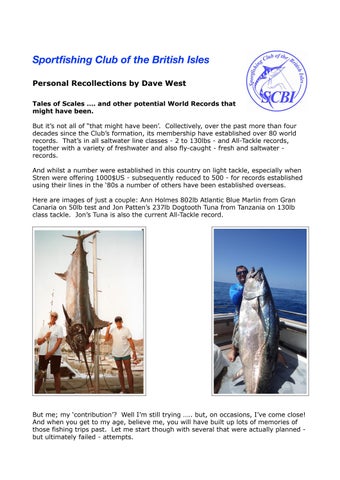
Sportfishing Club of the British Isles Personal Recollections by Dave West Tales of Scales …. and other potential World Records that might have been. But it’s not all of “that might have been’. Collectively, over the past more than four decades since the Club’s formation, its membership have established over 80 world records. That’s in all saltwater line classes - 2 to 130lbs - and All-Tackle records, together with a variety of freshwater and also fly-caught - fresh and saltwater records. And whilst a number were established in this country on light tackle, especially when Stren were offering 1000$US - subsequently reduced to 500 - for records established using their lines in the ‘80s a number of others have been established overseas. Here are images of just a couple: Ann Holmes 802lb Atlantic Blue Marlin from Gran Canaria on 50lb test and Jon Patten’s 237lb Dogtooth Tuna from Tanzania on 130lb class tackle. Jon’s Tuna is also the current All-Tackle record.
But me; my ‘contribution’? Well I’m still trying ….. but, on occasions, I’ve come close! And when you get to my age, believe me, you will have built up lots of memories of those fishing trips past. Let me start though with several that were actually planned but ultimately failed - attempts.
Faial, Azores.
This incident is from August 1999.
I’d arrived - minus my luggage that got ‘left’ on the carousel in Lisbon airport - and immediately went out that evening fishing on John Gill’s boat where it’s co-owner’s girlfriend - was targeting a record; a Bluefish on 6lb test. And it worked, she caught a 17 pounder, together with what she’d also at my suggestion submitted, a record European Barracuda. John had invited me to target Blue Marlin, but in the intervening days all I’d managed was releasing a few Whites. Not much fun on 80s and 130s. Anyway my thoughts turned back to Bluefish and a possible crack at the men’s 6lb record. It was one of the oldest ‘in the books’ having been established in Montauk - 20lb 1oz - back in 1977. So, the ‘cunning plan’, I was to fish the same reef on the same set of gear, having tested the drag - 2.2lbs - against a litre bottle of water. Rigorous preparation, but ….. and I’ll come to that later. Firstly I caught a bigger - well it was 1/2lb bigger than Jennifer’s one - Barracuda on a small Chicharro livebait. (They’re baby, Blue Horse Mackerel.) Then I hooked what we were hoping for, a decent Bluefish, and after approaching half an hour it surfaced in the darkness. How big? Well it was long and, as Ted Legg gaffed it, we thought it might make 24/25lbs. Boarded though it was quite lank - spawned out - but was registering, allowing for the swell, between 20 and 22lbs on a set of - 1/2lb increment - scales. We immediately up-anchored and run back for weighing on a set of accredited scales but, and we come back to the BIG but. The scales were on one of the other boats. Banging on the cabin door - we suspected one of the crewmen might be ‘entertaining’ a young lady on board - didn’t evoke a response. So we spent the next hour and a bit fruitlessly wandering around all the local bars, but finally were forced to wrap the fish - both the Barracuda and Bluefish in wet towels until the morning. Well the European Barracuda would have broken Jennifer’s All-Tackle record but I really didn’t want my name associated with a …… Barracuda. But the Bluefish? On the scales it weighed 19lb 14oz, three ounces short for a tie. Deflated just about sums it up. It was a bit over two pounds heavier than the current European record, but I decided not to claim it. I didn’t even bother to take a picture of it and we went out fishing again on the Condor Bank ….. but still no Blue on this trip. PS. Yup, that 20lb 1oz record caught from Montauk in 1977 is still standing as is Jennifer’s Ladies record! And the image? That’s actually of Ann Holmes who held the original ladies 6lb record before the category was withdrawn …. and subsequently reinstated! Ann caught that in Gran Canaria before the Club’s formation. Then moving on to …..
Isla Coiba, Panama. As a lead-in to this story, one of the Club’s now ex-members a German angler, Hermann Fehringer - had submitted a record claim for a fly-caught 66lb Amberjack on a 16lb tippet from the Pacific coast of Costa Rica, but it had been rejected. It had been incorrectly identified, it was in fact an Almaco Jack. That started me thinking, in that on previous trips to Coiba we’d caught what we’d assumed were also Amberjack, but were they all proverbial ‘reef donkeys’: AJs? Some certainly were ‘deeper’ in profile and might they have been Almaco Jacks? So on my next, and as it turned out last trip to Coiba and yes, it was still a penal colony - we took a set of accredited scales with us. One day whilst fishing for bait, John Bowman hooked a Black Skipjack only for it to be immediately taken by a 50lb ….. Almaco Jack. Elation! The species had only just been included in the IGFA’s record listings and this would have established the 50lb line class record. Onshore that evening I started documenting John’s catch, and even managed to have the details certified by a Canadian doctor who’d just ‘happened’ by with a group of other tourists. Then it was obtaining the line sample & trace, and it was then that my doubts crept in. Even though the fish had been caught on a single lure there were three lures on the trace, and unfortunately Rule G - Hooks and Lures - point 4 clearly states ‘only one lure
containing hooks may be used at a time.’ Oh, bother! I subsequently checked with the IGFA but, ‘rules are rules’. Ascension Island. This was another planned attempt. Three game-boats Andromeda, Harmattan and Shy 3 - had recently transferred from Ghana and six of us were fortunate to have been invited to fish there in December 2002. (God’s Favor/ God’s Will, the recently re-named Madam & the Hooker operation, was also there.) Our primary targets were its essentially ‘unexploited’ Blue Marlin fishery plus the prolific numbers of Yellowfin Tuna. But what else was also present? Well lots including Broadbill, massive SixGill Sharks and, once there, we even encountered an isolated shoal of Bluefin Tuna migrating through. However, having examined the IGFA Year Book, there appeared to be real opportunities of having a crack at a HorseEye Jack record. Several records had earlier been established there, presumably by military personnel. The Marlin fishing certainly lived up to its potential; Dick Clack released one that the crew called ‘950 plus’ - the crew’s ‘code’ for a potential ‘grander’ - and an angler on God’s Favor - the 48’ G & S - weighed an 1146 pounder. My thoughts kept coming back to the Jacks though but there was one ‘small problem’. Whilst we saw big, cruising Horse-Eyes in small pods they were out-numbered (and often surrounded) by ….. Black Jacks. The latter were unfortunately present in ‘plague’ proportions! Still, after one evening’s chunking for Yellowfin on the ‘mooring’ - one put down by the crews on the edge of a 600’ dropoff - and having slowly trolled back for Broadbill, our crew wanted to target the Horse-Eyes. They were often encountered in the lee of the anchored (static) oil tanker just offshore. So Peter Gurd and I
using 6lb tippet fly gear were speculatively, ‘blind’ casting into the darkness. I got a solid hook-up and the full fly line ‘rattled’ through the rings. It then became a battle of attrition, approaching a stalemate; it being impossible to apply too much pressure given the resistance from the fly line and with the fish literally ‘bumping’ along the bottom. (Whilst this was being played out it was fascinating, with the deck lights now on, to see Dolphin ‘spooking’ Flying Fish and watching a hapless one gliding to ‘splash down’ and its inevitable ‘doom’ with the Dolphin tracking it throughout its flight.) Any rate finally I managed to ‘coax’ the fish to the surface and of course it was a bl**dy Black Jack! Writing this I noticed the current 6lb tippet record is still a ‘miserly’ 11 pounder, but Hermann again subsequently established the 12 and 16lb tippet records there in 2005 with fish of 25lb 9oz and 28lb 14oz respectively.
So they were the planned attempts but, in addition, there were these few near misses. Gran Canaria, Canary Islands. A few years after catching my first Blue Marlin on John Holmes’ boat White Striker in 1979 I returned to the island. The fishing proved slow. I’d caught a 180lb BigEye Tuna on our first day out, but then “NADA”, blank after blank. And all the boats were trolling over the same bit of ocean, so I suggested to our skipper – Francisco Ortaga, an ex-commercial hand-liner – that we started an hour earlier the next day and he readily agreed. We were out there trolling by ourselves, with the sun just coming up, when the dorsal fin of a Blue Marlin surfaced behind my lure. It just held position for what seemed like an eternity when, and perhaps the swell had imperceptibly altered the way the lure was tracking, up came her bill – at that size it was undoubtedly a ‘she’ – and she took it. All then seemed to happen in ‘slow motion’; the rubber bands on the end of the stinger line stretched and snapped and then, nothing – we’d failed to hook up. (Subsequently, when we’d retrieved the lure, you could see all the abrasion on the tape used to ensure the two 12/0 hooks were held at 180 degrees to each other.) Well the cursing soon stopped for within perhaps only ten seconds or so the other outrigger-ed - a friend’s - lure similarly got hit. We suspect it was the same fish. This run was no where near as fast as a Bluefin, but it was stripping the 130lb line off the spool effortlessly. Then nothing, which was odd, as it had seemed a really good hookup.
When we retrieved the line the lure, that was being fished on a 600lb mono leader, had gone. On inspection it literally looked as if with the angled cut it had been cut with a knife just inches from where the lure’s head had been. All I can speculate is that there must have been a longliner’s (or other) hook embedded in its bill and that, as the pressure had built up, its edge had cut through the leader like the proverbial ‘knife through butter’. So how big was it. It was massive! We asked Francisco’s son, Francisco junior, who was working the deck how big it was. He came out with the classic – “Big fish, bigger than 500lbs!”. We got him to ask his dad who was on the flybridge and had obviously got a much better view. How big? 650 …. Kilos was the reply. Around 1450lbs! That’s BIG and, at the time if we’d been successful, would have been a World record. And I was inclined to believe Francisco senior. The biggest Blue Marlin he’d caught on a handline – Hemingway’s the Old Man of the Sea style – had seized a 65lb Yellowfin Tuna he was playing. That fish, one of the biggest I’ve heard of, weighed in excess of 1800lbs. Madeira. On this occasion, again in the early ‘80s, we were fishing an international competition and set out, trolling from Funchal across to the Desertas Islands. I didn’t really expect much so I’d put out a small 5” hexhead lure, rigged on just 3’ of light single strand wire, on 30lb class tackle. It would have been fine for any of the Skipjack Tuna we were likely to encounter. Well something took the lure and I can remember at the time thinking that the boat was taking a long time slowing down. Starting to fight the fish with just a butt pad I soon revised my estimate, thinking it was perhaps a 50lb BigEye Tuna or equivalent. But a stand-off started to develop, the fish wasn’t taking line nor, for that matter, was I retrieving any. That’s when you forget the pre-set drag setting and I started pushing the lever forward until, having taken all the stretch out of the line it was starting to ‘sing’. Then I eased it back a fraction. This seemed to work and I eventually forced the fish, which was significantly bigger than I had thought, to the surface about 70 yards back. I explained to the translator on board that I wanted to quickly reverse towards the fish, whilst it was exhausted. But then I understood part of the reason why we’d taken quite so long to stop initially. The controls on the fly bridge where the crew had been sitting didn’t work! So I was now left with the skipper steering the boat from the cabin completely ‘blind’ and relying on my directions via the translator. Definitely too risky, so I decided to continue the fight from a ‘dead’ boat. I continued to slug it out, with the only excitement coming when we had to power forward, parallel and just 30 feet from the fish, whilst it was running sub-surface. You could see a ‘rooster-tail’ coming off the line. After what was an hour and three quarters I got the fish beaten and was pumping it towards the boat when, with it in full view less than 20 feet away, the line literally ‘exploded’. Whether the line had been abraided by its tail or with less line off the spool I should have eased back the drag I’ll never know. One of the crew, who’d fished Tuna on a commercial vessel, reckoned it was around 120 kilos, 250lbs. And I suspect, although we were uncertain whether it was a BigEye or small Bluefin Tuna, it would have broken either existing world record at the time.
Key West, Florida. I’d first fished the ‘Keys in late 1979 when, surprisingly, the exchange rate was hovering around 2.40$US to the pound. A great time to buy tackle on ‘the cheap’! However, it wasn’t to be until the summer of 1991 when I would next return. Our daughter had finished her GCSEs so what was to be a family holiday started in Orlando (and Cape Canaveral) before flying South to Key West. (I had wanted to combine Disney with Cozumel but my wife wasn’t ‘wearing’ that, so Key West was the ‘compromise’.) On that previous visit as well as targeting offshore species I fished the Flats for Bonefish and Tarpon, but to complete the ‘skinny water’ trio I needed a Permit. So I ended up ‘gravitating’ to a fascinating tackle store on Duval; H.T. Chittum’s. (Hal Chittum was one of the iconic ‘Keys guides who subsequently collaborated in the design of the Hell’s Bay skiffs.) Could they recommend a guide? Yes, and the following morning Bob - RT Trosset picked my up from my hotel’s pier. But this wasn’t to be a classic shallow water Flats trip. At this time of the year Permit have migrated offshore to spawn and we ‘gunned out’ to fish a shallow water wreck. ‘Mr P’ was immediately ‘ticked off the list’, but we continued further offshore into the Gulf to target yet more shoaling, just subsurface, around one of the array of radar towers. (It’s an area the US Navy use to hone the skills of their ‘top gun’ pilots.) “Did I want to try for something else?” Well of course! Even though we were 40 odd miles out it was only 65’ deep and the bottom largely devoid of structure. So we spent the next 10 minutes or so circling an area until up popped a turtle’s head. We’d found our rock pile. And fishing light tackle jigs on 8lb test we started catching an array of smallish Amberjack (AJs), fish in the 20lb to 25lb range. Then the first ‘happening’. A fish I’d hooked dived back to the bottom and everything ‘locked up’. Bob started to laugh. It was apparent to him that the AJ had been taken by a really big Grouper, a Jewfish or, in more politically correct terms, a Goliath Grouper. Well, on 8lb test, there was no way it even knew it was hooked! I could do absolutely nothing as it sedately cruised around the structure, until the line eventually wore through. How big was it likely to be? Well Bob said they can grow up to at least 700lbs. Yup, definitely no contest! A little later on I hooked another AJ and, looking over the side, I could see it spiralling up accompanied by 5 or 6 others. At this point Bob started to get very excited and, with a 30lb rod he’d got rigged for this very purpose, he hooked a Blue Runner
through the back and was ‘dapping’ it on the surface. The others came rushing up trying to grab it. And Bob had the mini shoal going frantic as he ‘figure of eight-ed’ the bait just in front of them. The majority were in the 20lb range, but one was much bigger and looked to be around 60lbs or so. Now Bob’s shouting at me at me – “Get the other rod!”. Get the other rod? But Bob had some 10 others rigged up in holders. With my fish, its swim bladder blown, on the surface I put that rod in a holder and grabbed another spin rod. And, of course, as soon as the jig touched the surface one of the smaller fish grabbed it. “Break it off, break it off!” which I duly did, but unfortunately the shoal spooked and went down. After all that excitement RT explained that whilst attempting to ‘isolate’ the big fish from the others he’d then wanted me to use the fly rod rigged with a 16lb tippet. In that IGFA had only just introduced that class into their lists, the bigger fish would definitely have been a world record. Hindsight’s a wonderful thing, but it certainly demonstrates a need for planning. The day didn’t end there though. Soon after there was an opportunity to deploy the 16lb tippet fly gear for a record …. but more in hope than expectation. Another AJ surfaced followed by a large Barracuda which lazily ‘chopped’ its tail end and just lay there. Sometimes with Barracuda you can provoke a reaction by landing the fly heavily several times and stripping fast, really fast but this one, presumably sated, ignored my ‘best’ efforts and returned to the depths. Well RT wasn’t quite finished and on the way in we stopped by a derelict, partly demolished concrete structure and there amongst a jumble of rocks we spotted a really big Permit actively hunting for crabs. Another record opportunity, this time on 16lb spin gear? Bob certainly thought so. However given the force of the current and despite a number of attempts it unfortunately proved impossible to get the crab down into the Permit’s sight line. Weighting the line would have just caused it to snag. A frustrating end to the day! (Bob’s approaching 70 now but his desire to establish World Records for his clients hasn’t dimmed. It’s going back several years but, by then in 2018, as you’ll see from this article, he’d been instrumental in racking up 238 records for his clients.)
A number of years after that Charles Reaves and I were targeting sharks on the fly with the guide - Ted Lund - who wrote that article around the Marquesas, about 20 miles West of Key West. A tip, first catch and fillet a Barracuda. If there’s one thing that attracts sharks it’s a Barracuda, and we had hook-ups from Nurse & Blacktips, and Charles successfully landed a Lemon. But part way through the day we’d had a Hammerhead come into the trail and Ted deployed a set of 4lb test - after a record. The ‘fight’ if I could describe it as such on ultra-light lasted all of two minutes. It wouldn’t leave the chum trail and with my touching the spool ….. ping. Andros, Bahamas. It’s surprising just how shallow a water fish will come into in the search of prey, especially on a making tide. And on this particular trip in the ‘80s I can recall one seven pounder that took a fly, just 9’ – literally the length of my tippet – from the rod top in ankle deep water. Its back and tail were out of the water as it struggled to seize the shrimp pattern. However this is about BIG fish and, on one particular day, I was fishing alone with an old guide whose eye sight was completely ‘shot’. But he really knew these waters and where the Bonefish would be at any particular state of the tide. And, unlike the younger guides, who’d go zooming around the countless shallow water flats, he concentrated on just one small island – Big Wood Cay. It was the nearest island to the Tongue of the Ocean - that deep water channel that runs through the Bahamas’ chain – and just 800 yards away. Unlike most, you tended to get waves, albeit relatively small ones on those ocean-side flats, and the Bonefish push up in the channels between the ridges of hard packed sand. This is where we started – wading, rather than fishing from the skiff - and with me doing the spotting. And the second fish we encountered looked big, certainly over 10lbs. I cast and started stripping the weighted Crazy Charlie fly with the Bonefish following. He was interested, but wouldn’t take. Then with the fly just 25’ away I decided to stop the retrieve so as not to spook the fish. It swam away and I cast again and it followed again, but still wouldn’t take. Of course the third time there was no interest at all! Then I checked the fly and discovered a small piece of weed on the hook. Big fish aren’t stupid. We continued along the flat and I spotted what I initially thought was a Barracuda working inshore of us along the beach. It was over 3’ long and looked black in the water, so it had to be a Barracuda. (John Goddard had had us tape out 35” on our rods. We were told everything over that mark was a potential World record.) Sticking
my rod in front of the guide’s eyes to point it out I got him to confirm - “Yes, it’s a Barracuda”. Except when the ‘Barracuda’ turned I could tell from its swimming motion it was a very big Bonefish. I cast in front of it and it was all over the fly - I was waiting for the tell-tale pluck but it suddenly turned and swam purposely away. Casting again brought no response and I can only assume that an American military helicopter - the island’s a drug’s surveillance base clattering along nearly a quarter of a mile away had in fact disturbed it. That was a really big fish; potentially record-sized. We carried on picking up fish all around the island and I was amazed by his water craft. Then right at the end of the day he wanted to fish an area of mangroves. It started with just isolated shoots here and there in the shallow water, but then got much denser. Bonefish will often feed on crabs - they up-end to take them. And I spotted the flash of a tail waving above the surface. Moving towards it I tried to point it out to the guide but he couldn’t, at least initially, see it. We got closer and the Bone went into a smallish ‘clearing’, not much more than 70’ or so across, where it was feeding happily. Like many Bahamian guides he started to get very excited and was hissing – “Cast mon, cast!’ But how? We had a mangrove tree right behind us. The first ‘flip’ caught a leaf, but then I managed a ‘steeple’ cast – the fly fishers amongst you will know what I mean – and the fish confidentially took the fly and panicked. Where was it to go? I’d clamped my hand on the reel and dragged the rod tip round low. It sensed the gap before I could release the spool and the 12lb tippet snapped. That again was a fish over 10lbs. So three big fish in one day and 10lbs is still a mark I‘ve yet to achieve. The best I’ve had, from the fabled West side of Andros - the ‘Land of Giants’ went 9 and the largest on bait 9 1/2lbs from Islamorada in the ‘Keys. Concluding. What do they say? Well “never say never” and of course “always be prepared”, you never know when the unexpected might happen. Or perhaps in my case “Nil Desperandum”?