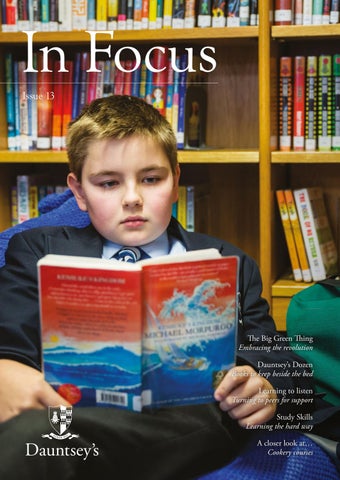
In Focus Issue 13
The Big Green Thing Embracing the revolution Dauntsey’s Dozen Books to keep beside the bed Learning to listen Turning to peers for support Study Skills Learning the hard way A closer look at… Cookery courses
From the Head Master The news that Covid-19 meant that it was necessary for us to close back in the spring was very sudden, bringing with it shock and a sense of disbelief.
whether they choose to be green campaigners or learn how to cook, stretch their boundaries in our adventure programme or take part in sport, drama or music.
Our teachers immediately stepped up to provide remote learning and, in some ways, it had advantages – fewer interruptions, more intense concentration and the opportunity for pupils to move on rapidly with their work. Academically, things kept moving forward.
Schools are about relationships too: about friendships, about care for each other, about working together to reach our goals. The media may say that the pandemic has proved how well we can live online. For me, it has highlighted how much better we can teach, learn and live when we see each other face to face.
But a Dauntsey’s education isn’t just about exam results. It’s about the things we all missed: the friendship and support, the community and the opportunities outside the classroom. The fact that our pupils were quick to adapt, is I believe, at least in part down to the resilience they build through the challenges they take on when lessons are over –
On screen, you are an isolated individual. In person, it’s far easier to see when someone is struggling, when to offer help, when to give space. Our pupils are very much part of this process, through their social networks, the house system and initiatives such as the Listening Service, where anyone can talk to a specially trained peer about whatever’s worrying them.
I have never experienced anything like the excitement and exhilaration when we reopened in September. Whilst there were face masks, hand-sanitising and social distancing, spirits lifted when one saw the sheer pleasure that returning to this new normal brought to staff and pupils alike – and when one is able to witness children who can behave like children again. Absence really has made our hearts grow fonder. The appetite for learning has grown but the sheer pleasure of playing a full part in the Dauntsey’s community, and all it provides, is stronger still.
Mark Lascelles Head Master
In Focus |
Issue no. 13
The Big Green Thing A recent Cambridge Global Perspectives Survey of 11,000 13-19 year-olds revealed that they believe that climate change is the single most important issue confronting humanity, above poverty, pollution and other issues. Driven in large part by students’ concern for the environment, schools are embracing the green revolution and developing strategies to reduce their carbon footprint. Learning to live sustainably is not a new concept at Dauntsey’s. In 2008, pupils set up The Big Green Thing (BGT) – a society whose aim was to raise awareness of green issues and encourage the School to work towards becoming carbon neutral. Here, Riya and Niamh, (OD’s 2020), who led BGT, write about creating a sustainable school.
W
e have found it so rewarding to carry on the work started by the pupils who set up the BGT all those years ago. Their first initiative persuaded the School to invest in 10 thermal solar panels to heat the swimming pool showers. It was the start of a move towards renewable energy that has seen photovoltaic panels installed on one of the boarding houses, the sports hall and swimming pool complex, as well as the Memorial Hall. During daylight hours, when energy requirements are at their peak, these generate a maximum 138 kilowatts, offsetting our electrical consumption. Just a year after the BGT started, two Fourth Formers made an impassioned case for integrating eco-friendly
values into the fabric of the School. The last slide of their presentation showed a building with its lowest storey sunk into the ground, a living roof and a ground source heat pump providing renewable energy. The pupils’ vision was realised in our Pavilion, opened in 2016. Heat and hot water are provided by a ground source heat pump that extracts heat from the ground via 12, 100-metre bore holes. The heat is then augmented by a series of “slinkies” set one metre below ground. In addition, the sedum roof ensures that the building blends into the landscape. There is another lasting legacy from that pupil presentation. A “Green” Governor was appointed in order to ensure that the pupils’ voice on environmental issues would continue to be heard loud and clear and that their concerns will be reflected in the School’s policies.
3
Dauntsey’s
The number of Green initiatives underway at Dauntsey’s today is testament to the pupils’ continuing passion for the environment and the School’s practical and financial support: •
•
Following a presentation we made to the School Governors, funding was provided for new bins across the campus that have several compartments to split out rubbish for recycling and it has made a big difference to the amount we can recycle. The catering team are working hard to reduce the volume of waste which is now sent to a commercial biodigester in Warminster
•
Over 80 per cent of day pupils travel to and from School by bus, eliminating thousands of individual car journeys.
•
All lighting in the School is migrating to LED fittings, which last longer and use significantly less energy.
•
The School is rolling out a programme where external lighting will be on sensors which go off between the hours of 10pm and 6am.
•
A new energy-efficient cover has been acquired for the swimming pool in order to reduce heat loss, and the gas boilers for the pool have been recalibrated in order to reduce energy consumption.
•
The School is in the process of a major tree planting programme around our newly completed running track. Some 110 established trees have already been
4
planted and a further 12,000 whips of native varieties will be going in, 400 of which have been donated by the Woodland Trust. Within 15 years, the track will be completely surrounded by trees. •
As a lasting tribute to the 38 Old Dauntseians who died during World War One, we have planted an avenue of 38 mature oak trees.
•
The School has recently created a wellbeing area for pupils and staff, which is planted with trees and has a seating area where people can relax.
•
Sports teams are no longer provided with plastic bottles of water at matches. Every team sheet has a reminder to bring refillable bottles to the match, significantly reducing single-use plastic across the School and making us all think about changing our habits
Future plans include an apiary made up of three hives, which will be viewed from a classroom with a glass wall. It will be a great educational resource as well as a benefit to the environment. Richard Sandbrook, co-founder of Friends of the Earth, was an old Dauntseian and the School benefits from an award in his name that promotes sustainable development. He would undoubtably be proud to see the passion shown by pupils and staff at Dauntsey’s for protecting our planet and the continuing momentum behind BGT.
In Focus |
Issue no. 13
ECO WEEK We recently put together Eco Week with the support of Anais Seager, Head of Complementary Curriculum. Events included: •
Setting up an Upcyling Club, with the first project helping Lower School pupils to make reusable face wipes to take home
•
A swap shop for clothes where pupils paid £1 to bring any unwanted clothes and swap them
•
A Tutor Group quiz on eco facts
•
A speaker from Pure Planet, a green energy provider
•
A screening of The Island President – a documentary about OD Mohamed Nasheed, formerly president of the Maldive Islands
•
Presentations to First and Second Formers about small changes making a difference, looking at labelling, exploring where our food comes from and thinking about the benefits of buying British when we can
•
Building eco themes into biology, geography and languages lessons
•
A vegan cookie bake sale
One of the objectives of Eco Week was to encourage younger pupils to get involved in the BGT and understand more about creating a sustainable School. We have a lot of support and enthusiasm for green issues in the Upper School but it is important to build this awareness throughout Dauntsey’s. We want to ensure we have a new generation of eco warriors to take on the running of the BGT in future years and we need to encourage everyone to do their bit. Small changes really can make a big difference.
5
Dauntsey’s
DAUNTSEY'S DOZEN
6
In Focus |
Issue no. 13
Keeping a book beside your bed… Dauntsey’s Dozen are 12 books the English Department would like pupils to have read independently during their time at Dauntsey’s
E
nglish teachers are asked one question more often than any other by anxious parents: “Can you help to get my child reading again? They used to read all the time, but recently…” The timing varies, but it usually happens at some point in the Lower School and blame is usually targeted at smartphones, friends, or Netflix. The fact is that the image of the teenage bookworm is a bit of a myth. A few lucky teens make the time to read a lot; some go to the library and curl up on a beanbag during Long Break; some have to be asked to put their book down at the dinner table; one or two might even read with a torch under the covers long past their bedtime. But I suspect that not many ever have. I suspect that reading less when you are 14 than you did when you were 9 is quite normal and not something to be too worried about. What we hope for at Dauntsey’s is that our pupils will carry on reading: not a lot, but just a little. Of course, in the English Department, we have a soft spot for those who are fanatical about it and are always happy to hear about their latest discoveries. The majority, though, we hope will not break the reading habit completely. Keeping a book beside your bed to read for 10 minutes before lights out, regularly reading the sports pages of a daily newspaper, or even just getting a weekly fix of a columnist like Caitlin Moran is enough to keep the reading flame alive. To help with the idea of keeping a book beside the bed, we thought that we would
compile a list of 12 books to read during one’s seven years at Dauntsey’s. It’s not quite Mark Zuckerberg’s one every two weeks, or Bill Gates’ 50 a year, but it’s a start. So, the English Department set ourselves the task of agreeing on the 12 books that we would recommend that pupils read independently (as well as the ones that we are going to study in class) during their time at Dauntsey’s. We were fools. There are ten of us, who find it hard to agree about things like semi-colons. So, having failed at that impossible task, we limited our ambition and tried to agree on 12 books that we would like pupils to have not not read during their time at Dauntsey’s. The discussions were slightly less acrimonious, and we did eventually agree.
There is a mixture of fiction and non-fiction and even a collection of poetry by the current Poet Laureate. Publishing for young people is a booming industry at the moment and excellent novels are published every month. Therefore, most reading lists have to be updated on a regular basis. We have tried to go for books that have been around for a little while and still stand up to scrutiny. However, only one or two of them are what might be described as “classics”. The list is in roughly the order that we would recommend reading them: number one is a great novel to read when you are in the First Form; number 12, pretty essential for a Sixth Former. However, we feel that they are all suitable for all ages.
7
Dauntsey’s
8
In Focus |
Issue no. 12
DAUNTSEY'S DOZEN
I AM MALALA:
NOTES FROM A SMALL ISLAND
The Story of the Girl who stood up for Education and was shot by the Taliban Malala Yousafzai
Bill Bryson
Malala’s story is well-known: shot by people who were opposed to the idea of girls attending school, she recovered and went on to not only return to school but to become a campaigner for education throughout the world. This memoir discusses questions of identity and nationality and is a great way to start thinking about some of the world’s more complex questions.
THE WOLF WILDER Katherine Rundell
Katherine Rundell, like Frances Hardinge below, is a very exciting writer. Her novels are beautifully written, ambitious, often magical and loved by her readers. She is an excellent journalist too, with an outstanding online archive of reviews and nature writing. This novel is set in Russia and a wolf wilder is the opposite of a wolf tamer. It develops from there.
CUCKOO SONG Francis Hardinge
Cuckoo Song is a few years old now and Hardinge has written some amazing novels since. Those of you aiming to read more than 12 books in seven years could make a worse start than reading all the novels written by Rundell and Hardinge. This is a weird tale, set in 1920s England, full of references to early jazz music and cinema, but, most importantly, it’s about a little girl whose doll starts to talk to her.
NOUGHTS AND CROSSES Malorie Blackman
I haven’t yet met anyone who did not love reading this novel. It deals with adult themes of racism and teenage self-harm but opens the discussion of those themes in a sensitive and provocative style. Blackman has received an OBE for services to children’s literature and was for a while the Children’s Laureate.
This is the sort of book that makes people laugh out loud while reading on the train. Bill Bryson is American and lived in Britain for many years. This is the book he wrote about Great Britain as he found it in the 1990s. Not much has changed really.
The English Department believe that any book might just change your life, but this exploration of intuition and instinct, delivered in Gladwell’s compelling and engaging style, is as good a place to start as any.
THE HITCHHIKER’S GUIDE TO THE GALAXY Douglas Adams
THE CURIOUS INCIDENT OF THE DOG IN THE NIGHT-TIME Mark Haddon
The narrator of this detective novel, Christopher, is autistic. He doesn’t see the world as most others do. The events of the novel take him out of his comfort zone and challenge him in unexpected ways. Readers are divided over its overall quality, but everyone agrees that it is a pacy, original story, with some really engaging characters.
KID Simon Armitage
Armitage is the current Poet Laureate. This is one of his earliest collections and, we think, his most successful. Reading a poetry collection is quite an unusual thing to do but can be hugely rewarding. Keep this by your bed and read the odd poem every now and again. Don’t be afraid to re-read poems that you like, or that you weren’t quite sure of first time through.
JANE EYRE Charlotte Brontë
The only real “classic” on our list. Austen, Dickens and Hardy all have their place, but this is the one that we managed to agree that we had all enjoyed as teenagers ourselves, or at least that we knew plenty of teenagers who had loved it.
BLINK Malcolm Gladwell
The market in pop psychology or self-help books is enormous. Esquire magazine says that this book “might just change your life”.
Never bettered as a piece of comic English writing. The story of Arthur Dent, who is rescued from Earth as it is destroyed to make way for a hyperspatial express route, is told with a measure of insanity and weirdness that has made this collection of novels one of the most popular to have ever been written. Don’t panic!
BRAVE NEW WORLD Aldous Huxley
This is one of the very first novels in the dystopian genre that has taken over publishing in the last few years. Originally written in 1932, it still feels relevant today, exploring how control over reproduction and the use of psychological manipulation techniques create a terrifyingly ‘perfect’ society.
A ROOM OF ONE’S OWN Virginia Woolf
This is an extended essay about the role of women in the world. Woolf writes about women’s need for financial independence as well as the need for a room of their own in which to write. Her argument expands to explore women’s education and their roles in history and literature. Sixth formers trying to find an essay-style can learn a lot here.
Our list of a dozen books is not meant to be exhaustive. We hope that there is enough variety here to please everyone. Any of the titles above could be seen as a starting point for a whole journey in literature that could lead who knows where. We hope that you enjoy them. 9
Dauntsey’s
Learning to listen
Ann Jackson Deputy Head Pastoral
Good mental health and wellbeing must be embedded into the culture of all our schools. With high-profile campaigns encouraging us to talk about how we feel, it is important that pupils can access the support that they need. Here at Dauntsey’s, pupils know that they can turn to their Housemaster or Housemistress, their tutor, their teachers, a school counsellor or, alongside these, our peer Listening Service.
T
he Listening Service at Dauntsey’s started 15 years ago. The concept was developed by a group of Upper School pupils, who wanted to receive training in order to be a first point of contact for other pupils to talk through any problems or worries. It is well known that young people often turn to each other as their first line of support. There can be many reasons that young people may not feel that they want to approach an adult initially and that talking to a fellow pupil can sometimes be easier, and therefore it is vital that we equip our pupils with the tools to do this. Today, we have 28 volunteer listeners ranging from those in the Fourth Form to Upper Sixth pupils. Each volunteer receives three one-hour training sessions, plus a one-to-one interview led by one of our counsellors. The training sessions focus on issues surrounding safeguarding and confidentiality, they give guidance on how to provide support and when to refer pupils to a counsellor or a member of the pastoral team. Each listener is assigned a buddy within the group so that there is someone with whom they can discuss individual cases and agree the best course of action. Nobody is left to deal with anything on their own. Listeners wear a silver badge on their jacket or blazer to help identify them. Posters are displayed around the school with contact details for all the listeners, along with the school safeguarding leads and counsellors. Pupils can chat to listeners anywhere in the school and there is also a small meeting room dedicated to the service where they are able to meet. Topics vary widely, but often relate to stress and anxiety, homesickness and friendship issues. These can often be dealt with by the listener, but staff will step in if necessary. The listeners are helpful in feeding back to us on common threads that might emerge. 10
As well as the initial listener training, we hold regular meetings, dinners and workshops with outside speakers. A recent speaker was Fred Coombs who publishes a regular podcast called Dead Dad, which tries to dispel some of the taboos around talking about death. Some of our listeners recently attended a pupil-led mental health conference that provided useful insights. We hope that the skills that they learn with us will also be put to good use once they leave school. It is very encouraging that the conversation around mental health is growing nationally and it is reassuring for pupils and parents to see that talking about worries and emotions is part of the culture at Dauntsey’s. Pupils are made aware of the Listening Service as soon as they arrive, and it is very much part of the fabric of School life.
In Focus |
Issue no. 13
STUDENT LISTENERS Ben, a boarding pupil in the Upper Sixth, leads the Listening Service, supported by deputies Hal and Clemmie. “We find it a really rewarding thing to do. The training was enormously helpful in showing us how to listen, how not to step in with solutions and how best to lead pupils to the right resources,” says Hal. “Sometimes it can be as simple as a First Form pupil coming to us because they have lost their gym kit and are really worried about what will happen. It may seem a small thing but it’s a big worry to them, particularly at that age. We can help them deal with that.” “At other times it can be something bigger, such as stress caused by divorce or changing circumstances at home. We can link them up with a counsellor – taking the first step with a peer can feel less of a big deal and, once they have spoken about what’s on their mind, it becomes a lot easier to open up to professional support,” says Ben.
“Our main objective is to provide a safe space where anyone can come and talk to us. We won’t tell them what to do but talking about things can make a real difference. We sometimes feel we have nipped a problem in the bud just by having a conversation.
“Being part of the Listening Service has been really rewarding. I have learnt a lot about how to listen, which is such an important life skill, both at home and in the workplace,” says Clemmie.
“But it’s also important to look after the Listeners. I see my role as being a support to them, ensuring they are not overwhelmed by, or worried about, the information they are receiving. I aim to check in with them regularly and I am supervised myself each month by an external counsellor.
contribution feeds through the school, so that when other pupils come up to Fourth Form, they are keen to get involved. It can sometimes become stressful for them though and they can, at any time, ask to come off the list of Listeners for a week or two. They just remove their silver badge until they are ready to come back on board.”
CAROLE COUPE & HOLLIE Carole Coupe is one of the qualified school counsellors who oversees and trains the Listeners. She has been at the school for 23 years. Her cavapoo, Hollie, who is a trained therapy dog, is much loved by all. “The students who volunteer for the Listening Service are often already very good listeners and used to being there to support friends and fellow students. By nature they are people you would want to talk to and therefore pupils find them very approachable. I like to think of them as a First Aid team – often they can help resolve worries that pupils might have. If not, they can refer them to any member of the pastoral support team – a tutor, housemaster or housemistress, or me and my colleague. “It’s important for the Listeners to realise they are not there to provide solutions but to help their peers find the answers for themselves. Often it is a case of just talking things through and being helped to see a different perspective.
“The listeners do an amazing job and their
11
Dauntsey’s
WHY IT’S BEST TO LEARN THE HARD WAY Research shows that we remember things better if we’ve had a harder time learning them, says Deputy Head (Academic) Jon Tyler
I
t’s sometimes said that there is nothing worth having that comes easy. As a pedantic bore, I can’t help but think that might not be quite true. A cup of tea. Sleep. A Netflix binge. All worth having; all rather easy.
But, as a teacher, I have to admit that there might be something to the idea I’ve tried every shortcut imaginable to help pupils to learn more easily. Activities, games, videos and more; enough tricks to resemble a party more than a lesson (albeit perhaps not the most exciting party, unless you’re Monica from Friends). While making learning more “fun”, they did not make it more effective. I’ve tried turning to technology for help. In one ill-fated experiment, I used a piece of software that guaranteed results by flashing facts up on the screen so fleetingly that your conscious mind can’t even register them. Unfortunately, it turns out your unconscious mind can’t either.
LEARNING AND MEMORY I’ve tried learning the techniques of memory champions and teaching those to my pupils. But unless exams become about remembering the order of a pack of cards, those techniques won’t provide any kind of quick fix. So where to turn? Well, much as it pains me to say it (especially in this “on demand” age where we tend to want everything quicker and easier), the truth is that learning is most effective when it is not easy.
12
In Focus |
Issue no. 13
“ Research shows that the most effective learning depends on desirable difficulty”
13
Dauntsey’s
Agonising though it may be, there is no better way to create that desirable difficulty so important for long-term memory than by testing yourself.
14
In Focus |
Issue no. 13
“ My favourite method for learning? Write what you know on a blank piece of paper, then look at your notes to remind yourself of what you’ve missed, then put your notes way and add more..”
What research has shown us is that the most effective learning depends on something known as desirable difficulty. We remember things better if we’ve had a harder time learning them. The term is associated with psychologist Robert Bjork, but has been proven by numerous others. It’s been shown that we remember more when we have to work things out through an active process, like a puzzle, than when we just passively read it (McDaniel et al, 1994). It can help to learn from material that’s less clearly organised (McNamara et al, 1996). It can even be beneficial to use fonts that are slightly harder to read – much to the chagrin of Comic Sans-loving teachers like me (Diemand-Yauman, Oppenheimer and Vaughan, 2011).
TESTING, TESTING And the real kicker? What’s the essential to effective learning? It’s the hardest method of all, so often derided as the enemy of schoolchildren everywhere: testing. Yes, testing. Sorry.
Agonising though it may be, there is no better way to create that desirable difficulty so important for long-term memory than by testing yourself. What this really means is not necessarily formal exams but so-called retrieval practice. As the name suggests, this is where you practise retrieving memories – focusing on getting information out of your head rather than into it. There is a variety of ways to do this. Perhaps complete past papers or plan answers to possible questions, or try using flashcards. Or have a go at explaining the topic you’re trying to learn out loud, even if only to yourself (best done alone, unless you think it might be kind of fun to be seen as mad). Or my favourite method: write what you know on a blank piece of paper. Then look at your notes to remind yourself what you’ve missed. Then put them away and add more. It’s not easy to remember everything when you’re staring at a blank piece of paper. But if you’ve been paying attention, that’s the point. The harder it is to dig out a memory, the better it is for learning.
15
Dauntsey’s
A closer look at… cookery courses More than 150 pupils have launched themselves into the world of gastronomy since Dauntsey’s introduced cookery courses for Fourth, Fifth and Sixth Formers in 2016.
T
he courses are run by Vaughan’s Cookery School, and led by Michelinstarred and award-winning executive chef Peter Vaughan, who is a member of the Royal Academy of Culinary Arts, Britain’s leading cuisine association.
Award in Culinary skills is validated by the Confederation of Tourism and Hospitality (CTH), whose qualifications are regarded as the gold standard for the hospitality, tourism and culinary industries. It is led by Peter Vaughan himself, with the
The course for Fourth and Fifth Formers covers all the basic cooking skills, and after 16 sessions pupils are able to cook a range of breads, pastries and cakes as well as make a two-course supper for their families and friends. The Kitchen Essentials professional cookery course for Sixth Formers offers an internationally recognised qualification, which helps pupils to secure holiday and gap-year employment as hosts in ski chalets or holiday villas, or as yacht crew or junior chefs in a commercial kitchen. The Level 2
course curriculum set by CTH to national standards. Vaughan’s Cookery School is one of just seven UK CTH-validated centres. Lasting 100 hours, it covers all commercial kitchen practices. A food safety certificate validated by the Chartered Institute of
“ At a time when so much of the food we eat is overly processed, denatured and packaged, it is imperative that young adults learn some kitchen navigation. By preparing food from scratch, students know exactly what is in their food. By the end of the courses, they are able to transform basic ingredients into delicious dishes and serve them with pride.” Peter Vaughan, Michelin-starred chef and leader of the Dauntsey’s cookery skills courses
Environmental Health (CIEH) is awarded to successful candidates. The course is taught in a series of three-hour sessions at Dauntsey’s, along with four lengthy stints of six-and-ahalf hours in Vaughan’s commercial kitchens. After completing the course, pupils are able to prepare, cook and present a diverse mix of meat, poultry and fish dishes, vegetables and soups as well as bake cakes, pastries, biscuits and breads, all to restaurant standards. This year, the Sixth Form course will culminate in pupils turning the school Pavilion into a pop-up restaurant for an evening, cooking a delectable dinner for invited guests and showing off their skills to parents and house staff.
West Lavington, Devizes, Wiltshire. SN10 4HE 01380 814500 marketing@dauntseys.org www.dauntseys.org