THE HERTFORDSHIRE FREEMASONS
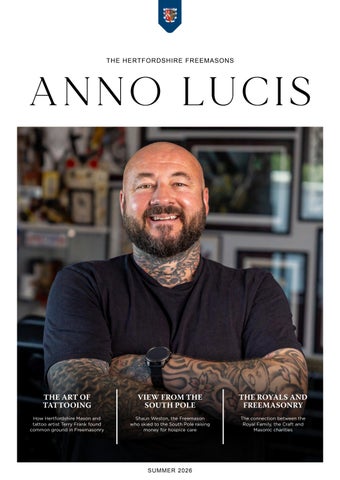
THE ART OF TATTOOING
VIEW FROM THE SOUTH POLE
THE ROYALS AND FREEMASONRY
How Hertfordshire Mason and tattoo artist Terry Frank found common ground in Freemasonry
Shaun Weston, the Freemason who skied to the South Pole raising money for hospice care
The connection between the Royal Family, the Craft and Masonic charities
SUMMER 2026
2
ANNO LUCIS
CONTENTS
Scan the QR Code
THE STRUCTURE OF THE UNITED GRAND LODGE OF ENGLAND............................................
4
‘WHY WOULD YOU LEAVE A STORY THREE-QUARTERS READ?’.............................................
8
YOU GO INTO THE UNKNOWN............................................................................................................
11
“ONE OF THE PROUDEST MOMENTS OF MY LIFE”.......................................................................
14
MORE THAN A HOBBY...........................................................................................................................
16
THE CALM CONDUCTOR.......................................................................................................................
18
A FORCE FOR GOOD.............................................................................................................................
20
ROYAL ORDER OF SCOTLAND............................................................................................................
22
INK, IDENTITY AND BROTHERHOOD.................................................................................................
24
“YOU DISCOVER WHAT REALLY MATTERS”....................................................................................
26
MORE THAN MEETING PLACES...........................................................................................................
28
TIME TO CHANGE....................................................................................................................................
32
MORE THAN JUST ANOTHER DEGREE.............................................................................................
34
PROVINCIAL GRAND LODGE: DIGNITY AND TRADITION............................................................
36
DISCOVER SOLOMON............................................................................................................................
39
THE ENDURING STORY OF THE MASONIC LODGE BANNER......................................................
40
THE ROYAL FAMILY AND MASONIC CHARITIES.............................................................................
42
WHY DIGITAL MATTERS........................................................................................................................
45
HERTS FUTURE........................................................................................................................................
46
THE THREAD THAT KNITS US TOGETHER the other for “positive reinforcement” of football team results!), clear and timely communication encourages, supports and reinforces our sense of belonging.
Communication lies at the heart of Freemasonry. Our order has always thrived through the sharing of knowledge, the exchange of ideas and the bonds of friendship. In an increasingly busy and digital world, effective communication is important now more than ever.
It also enables us to preserve the traditions and principles that define our Craft.
Good communication strengthens our Lodges, ensures members feel informed, valued and included. Whether through individual conversations, announcements at meetings, our provincial newsletter and social media, emails, text messages, phone calls or formal and informal WhatsApp groups (one for Lodge business,
Beyond our own membership, communication plays a vital role in shaping public understanding of Freemasonry. By speaking openly about our charitable work, the money we raise, the hours we spend volunteering, our values and the positive impact we have within our communities, we help dispel misconceptions and demonstrate that Freemasonry remains a relevant and vibrant force for good. We are all taught about, and constantly reminded of, the importance of brotherly love, relief, and truth. Meaningful communication is the thread that binds these principles together and ensures they continue to flourish for future generations. Enjoy the issue, Andy Jackson and Dan O’Connell Editors, Anno Lucis comms@hertfordshiremasons.org.uk
CONTENTS
3
THE STRUCTURE OF THE UNITED GRAND LODGE OF ENGLAND PROVINCIAL GRAND MASTER NEIL CONNOLLY SHARES A DEEP DIVE INTO OUR ORGANISATION As we know, Freemasonry in its current form was established in 1717 and the Book of Constitutions of 1723 determined the rules under which we operate.
4
ANNO LUCIS
This has naturally evolved in the intervening two centuries and as such currently includes a structure of boards, committees and working parties covering the many facets of our organisation.
Board of General Purposes
Some of these have formed a permanent place within the structure and governance of UGLE and others are established for a particular reason or purpose.
Generally, the Board takes due cognisance of all the matters in any way relating to the Craft. (Rule 227 Book of Constitutions).
These are generally all run by volunteers drawn from our rank-and-file members and senior Masons who are chosen for their relevant Masonic and professional experience. The following gives a brief overview of the current structure and its purpose. It goes without saying that ‘as some must of necessity rule and teach so others must learn, submit and obey’ remembering that humility in us all is an essential qualification! So, the Grand Master gives his authority to the following and de facto presides over the whole structure. Grand Master’s Council This is the primary executive and advisory body that supports the Grand Master and the Pro Grand Master in the governance and strategic direction of the Provinces and Districts under the United Grand Lodge of England (UGLE). Grand Master’s Council Charity Committee Provides a link between Grand Master’s Council, and thereby UGLE, and The Freemasons’ Charity (formerly the MCF).
The Board has the control and administration of the property of Grand Lodge, and also the regulation of all the affairs of Grand Lodge.
Committee of General Purposes The Committee has control of the finances of the Supreme Grand Chapter and the same duties and powers in the Royal Arch as are conferred on the Board of General Purposes in the Craft (Royal Arch Regulations 79 and 81). Strategy Working Party Sets the strategic direction of the organisation – plans speakers for Quarterly Communications/Supreme Grand Chapter/Light Blues Club annual event and the Pro Grand Master’s Business Meetings. This working party also receives and collates the updates from the various other Working Parties. Community Engagement Working Party (Districts) Develop and foster greater community engagement in Districts. Community Engagement Working Party (Provinces) Develop and foster greater community engagement in Provinces.
THE STRUCTURE OF THE UNITED GRAND LODGE OF ENGLAND
5
Trustees of “The Library and Museum Charitable Trust of the United Grand Lodge” Commonly known as “The Library and Museum of Freemasonry” looks after the archives and collections of UGLE and facilitates access to the public via museum exhibitions or research. Centenary Buildings Fund A subcommittee of the Board of General Purposes that decides on funding applications for the non-charitable buildings fund. Book of Constitutions Review Working Party A special Working Party set up to revise the Book of Constitutions and to encompass all of the amendments and bring the existing clauses up to date with evolved good practice. Communications Working Party Oversees the communications strategy of UGLE and Supreme Grand Chapter. Reports to the Board of General Purposes and Strategy Working Party. Membership Working Party Oversees the coordination and projects of the various Working Parties that report directly. Reports into the Board of General Purposes and Strategy Working Party. Community and Heritage Buildings Fund A subcommittee of the Museum and Library Trust – decides on funding applications for the Charitable Buildings Fund. Freemasons’ Hall Enhancement Working Party Advises on the plans for the enhancement of FMH to reflect the evolution of freeMasonry to meet the needs of the next 100 years. Fundraising Advisory Committee Advises on the appeal to raise money for the Centenary Benevolent Fund. Universities’ Scheme To support the Universities’ Scheme Lodges and Chapters throughout the Constitution. Reports to the Members Working Party. Royal Arch Focus Group As the name suggests it is charged with delivering the connectivity of the one journey between Craft and Royal Arch Masonry. Light Blues & Royals Advisory Group Supports Light Blue Freemasonry to provide an inclusive and developmental support for New & Young Masons Clubs within UGLE. Reports to the Membership Working Party. Learning & Development Core Group To coordinate, implement, track and grow Learning & Development across the Constitution. Reports into the Membership Working Party.
6
ANNO LUCIS
Building Together Delivery Group Supports the implementation of Building Together materials throughout the Regional Communications Groups (Provinces are grouped in clusters to share ideas and report into UGLE. Hertfordshire is in RCG7 comprising Hertfordshire, Cambridgeshire, Norfolk, Suffolk and Essex). Works with SPoCs (Single Point of Contact) within each Province. Reports into the Membership Working Party. Armed Forces Committee To support the engagement with the Armed Forces Community both within and beyond our membership. Reports to the Membership Working Party. As you can see there is an extensive series of groups that operate to inform and implement the various demands of our organisation in order to ensure that it evolves and maintains its relevance whilst serving its members. Through our Province we have members who sit within the Regional Communications Group (RCG7), the Members Working Party, the Board of General Purposes, Building Together Delivery Group and the Enhancement Working Party and as such we are very well represented. At a Provincial level we also need volunteers to take on roles under the following teams: Almoner including visiting volunteers to assist with applications to the MCF. Charity in support of grant applications and supporting the 2030 Festival (see Page 20). Membership assisting Lodges and members across the province with retention and recovery
of members. Assisting with the process of seeking to surrender a warrant when a Lodge is no longer considered viable and reallocate members and the associated governance. Mentor assisting generally those in progressive office with their Masonic journey through engagement. Visiting Officer scheme supporting the Executive with Lodges under their responsibility and to assist where necessary on matters of governance or general membership issues. Volunteers in the Provincial office as and when necessary with general administration or the regalia service. This is just a general overview of how our organisation is structured and how it serves our membership. There is much to be involved with across our Province and beyond and if you are inclined then there are opportunities to become more engaged with ensuring that the grand design of being happy and communicating happiness prevails whilst making a daily advancement that serves our wider community.
If you are interested in assisting and believe that you have the time and requisite skills, then please contact the Provincial Office. Address: Fleet House, 10 Parkway, St Albans AL3 6PA Phone:
01727 833061
Email:
provgsec@pglherts.org
THE STRUCTURE OF THE UNITED GRAND LODGE OF ENGLAND
7
‘WHY WOULD YOU LEAVE A STORY THREEQUARTERS READ?’ David Hampton’s mission for Freemasons’ to complete their journey in the Royal Arch. For David Hampton, Most Excellent Grand Superintendent of Hertfordshire, the Royal Arch has always been intended as a fourpart journey. The problem, he says, is that too many members still think it ends after three. “We’ve got to get to the root of all of this,” says David, who is completing his first year in the role. “We’ve got to convince the Lodges that when they’re interviewing, it is a four-part process, not a three-part process.” The three Craft degrees, he argues, should naturally culminate in the Royal Arch. Yet more than two centuries of tradition, culture and habit have left many Freemasons’ regarding the two bodies as separate worlds.
8
“We are all in this together,” David says. “It is a four-part harmonisation process.” His comments come as Freemasonry continues to pursue its One Journey strategy, aimed at strengthening ties between Craft and Royal Arch and encouraging members to view them as parts of a single experience. “The attitudes and the scenarios that individual units have been working towards before are being broken down,” he explains. “As part of “One Journey”, we are bringing forward Craft Masons into the Royal Arch to complete the story” There are reasons for optimism, he says. “In Hertfordshire, we’re very buoyant at the minute.” Numbers are looking very good.
ANNO LUCIS
We are seeing those shoots of revival coming.” But he is also realistic about the obstacles. “One of the big hurdles we’ve got to get over is the fact that we are an aged organisation. The majority of my members are in 60+ groups, and the Craft are in the 50+ groups. So we’re getting them approximately about ten years later.” For David, the answer lies in changing perceptions from the very beginning, although faster progress is preferred. “I’d like to turn the tap on and it happens today,” he admits. Part of the challenge stems from history itself. “The fact that our forefathers did us a great
disservice by removing the Royal Arch as a separate entity, rather than keeping it as part and parcel, is where the Ancients kowtowed to the Moderns. Over many, many years – and we’re talking 200+ years here, the scenario has changed.” Today’s leadership, he says, is firmly behind the attempt to reunite the strands. “They have done some great work. They are pushing forward the harmonisation in terms of education. But we have all got a long way to go.” Changing culture is perhaps harder than changing structures. His answer is to turn every Royal Arch member into an advocate. “We are instilling in every Royal Arch companion the fact that they are representatives, indeed, ambassadors, in their respective Lodges. They should be talking to those that haven’t actually taken that fourth ceremony and extolling the virtues of the Royal Arch and how it completes the story.” “A lot of people do not understand the story of the three degrees, let alone coming into the Royal Arch. If they can start to understand what they’ve been through and what potentially they’re finishing, why would you want to leave a story only three-quarters read?” Attraction, too, remains central. “Our companions have a
responsibility to attract people into their Lodges in order that others can then progress not only into Royal Arch, but of course our companion orders as well. Those that have retired have lost the ability to recruit from people they meet in the workplace environment, where a lot of our members come from.”
now sitting on three committees and I’m now secretary of one.” The schedule can be relentless.
If members are to stay, however, they need memorable experiences. “First impressions count. The individual who’s being exalted has to have a wow-factored ceremony.” Delivering exceptional ceremonies remains the movement’s greatest strength. “We’re about delivering a wonderful, wonderful ceremony,” he says. “The individual getting that experience and wanting more.”
Yet despite the pressures, his message remains uncomplicated. “My simple message is certainly find out more,” he says. “Use the resources available to you.”
“We exalted somebody in September 2023. Since then, he has brought seven other brethren into Dacre Chapter and he’s working on more. He was so enthused with it that he was selling it to anybody and everybody. That’s what we’ve got to create – the want to actually be involved, be part of, but also enjoy it.” The role of Grand Superintendent has proved demanding: Although he served as Deputy for a decade, some responsibilities only became visible after taking office. “I didn’t realise and appreciate just how much more there is,” he says. “I’m
“It’s four to six occasions in any given week normally,” he says, encompassing meetings across Hertfordshire, London and visits to other Provinces. “We’re twinned up with 14 other Provinces,” he notes.
He describes the Solomon website and Building Together material as “a minefield of useful information” (see page 39). Above all, he urges curiosity. “If you’re a brother looking to progress, ask a companion what it’s like, what it’s about,” he says. And after all the strategies, committees and constitutional debates, Hampton insists the most important principle is also the simplest. “Have fun and enjoy it,” he says. “We’re in this as a hobby,” he adds. “So go out and enjoy it.”
‘WHY WOULD YOU LEAVE A STORY THREE-QUARTERS READ?’
9
The tried & tested tree company At Evolution Tree Works we provide a high quality tree surgery service, including crown reductions, pruning to BS3998, and stump removals. Established in 1993, our experienced and qualified arborists have gained a reputation for reliability, honesty and excellence.
Our tree works service includes: • Specialists in large and ornamental trees • Fully insured • Pruning to BS 3998 • Recycling 95% of tree waste • Free no obligation quote • Local authority approved • Qualified tree surgeons • Crown reductions • Tree removal • Stump removal • Private homes and public spaces
Suppliers of processed Firewood & Mulch
T: 01462 637357
M: 0796 805 7010
RADLETT MASONIC HALL
The Masonic Hall, The Rose Walk, Radlett, Herts WD7 7JS
THE DINING HALL
Available to hire for Events & Functions Temple & L of I Rooms for hire Central location Close to Radlett Centre & Train Station Ample Parking on Site
THE BAR
THE LOUNGE
Catering and Events: Mike Podemsky 07941 306045 Masonic Hall Bookings: Bookings Secretary Gareth Huxtable 07941 523272 Masonic Hall (Radlett) Ltd: Company Secretary Michael Bayes 07508 434417
10
ANNO LUCIS
YOU GO INTO THE UNKNOWN A brand-new Freemason reflects on his first night as a brother. When 27-year-old Kyran Gates walked into his initiation ceremony on 4 June, he knew little about what was going to happen. That was entirely by design. “I was quite anxious because obviously you’re going into the unknown,” the security guard who works in Westminster says. “You don’t know what’s going to happen. But ultimately it was fun. It was enjoyable looking back at it. I think in the moment you’re a bit like, ‘What’s going on?’ You’re a bit all
over the place. I really enjoyed it and I’m looking forward to learning more about it.” Kyran had first looked into Freemasonry a couple of years earlier before life intervened. “I was in a bit of a profound situation, with a lot of things going on, so I didn’t really have enough time to invest in it,” he explains. “Then I revisited it recently, three or four months ago. I started looking it up again and found one of my work colleagues was involved. Then we sort of
YOU GO INTO THE UNKNOWN
spiralled from there really.” Rather than being recruited through personal contacts, Gates took a straightforward route into the organisation. “There was a part on the website that you can go on to,” he says. “Then I got a WhatsApp message from Bob (Barnard of Waltham Cross Lodge) soon after.” Before joining, his knowledge of Freemasonry was shaped largely by popular culture. “I didn’t really have much of an idea other than
11
what’s put into mainstream media: your typical films, they hint at these sorts of things,” he says. “But I was told by my friend who was involved: don’t do any research beforehand. Come into it openminded. There are so many ‘isms’, so many different things. Come in, experience it, and then you can make your own decision based on what you’ve experienced and how you feel, as opposed to having any outsider’s perspective on it.” That approach paid off. “I think a lot of the symbolism that I’ve seen now clicks. I’ve seen it in quite a few places. You don’t really think about it until you make the connection, which was a really big ‘Oh, okay’.” Following the ceremony at Halsey Masonic Hall, Cheshunt, he attended his first festive board, another aspect of Masonic life that left an impression. “It reminds me of what you’d have in a 15th or 16th-century hall, back in Tudor times,” he laughs. “The food was excellent.” More importantly, he says, it was the atmosphere that stood out. “It’s nice to be in a room of people that have all got the same outlook on life, that are all looking to go in the same direction.” Working in Westminster has given Kyran an appreciation for tradition and ceremony, something he now sees echoed in Freemasonry. “I saw the last State Opening of Parliament and seeing the bits and pieces they still carry on with, all those positions and the history that’s in Westminster itself, you can definitely see that it links across.” History has always interested him. “I love history. It’s very interesting, so I’m looking forward to learning more about it.” Only a few hours into his Masonic journey, Gates is careful not to claim too much understanding. There is still plenty to discover, he says, but that sense of mystery is part of the attraction. For now, the experience has replaced uncertainty with curiosity. “I’m excited!”
12
ANNO LUCIS
We are a Full Service Agency Here to support your brand, every step of the way. Datum is a full-service creative agency specialising in Creative, Print and Digital solutions that help businesses communicate more effectively and achieve their marketing goals. With over 35 years of experience, we partner with organisations of all sizes, from ambitious start-ups and local SMEs to nationally recognised brands, delivering tailored solutions backed by strategic thinking and exceptional service.
What we do Our expertise spans branding, graphic design, artwork, print production, direct mail, point of sale, event graphics and exhibition materials, alongside website design, SEO, PPC, social media and digital marketing. By bringing these services together under one roof, we provide a seamless, efficient experience that saves time, maintains brand consistency and delivers measurable results.
Building Graphics and Design, Hertfordshire Zoo
Expo Design, Titchfield Media,
Brochure Design, Icely Done
Event Management, Pay by Phone
Conference, Royal Bank of Canada
Videography, Aston Martin x Champagne Bollinger
Why not pop in for a chat, or drop us a line to see how we may be able to support you. Scott Pearce scott.pearce@datumcp.com 07711 347984 I 01707 251222
ANNO LUCIS
13
“ONE OF THE PROUDEST MOMENTS OF MY LIFE” On 9 May at Freemasons’ Hall, London, Provincial Grand Steward Nick Tessier initiated his 18-year-old son Michael into the British Sub Aqua Lodge. Nick, one of the founders of the Fleet House Light Blues Club (FHLBC), was assisted by fellow founders Tom Golds and Dan O’Connell. The presentation of the gloves was carried out by Glyn Parry, who had taught Michael science at school, and Lodge organist Alex Handley also tutored Michael during his GCSEs. Anno Lucis posed a few questions to them both.
WHAT FIRST SPARKED YOUR INTEREST IN FREEMASONRY? My grandfather was a Freemason but died before I was born. My first manager when I trained to be a radiographer was also a Mason. Unfortunately, he died before I was ready to join, I then spent the next six years thinking about it. I became interested in the values behind it: friendship, integrity, self-improvement and helping others. When the opportunity came to join, it felt like something that connected me to both family history and a wider community.
WHAT MISCONCEPTIONS DID YOU HAVE BEFORE BECOMING INVOLVED? Like many people, I assumed it was far more secretive than it really is. I imagined closed doors and hidden agendas. What I discovered was a group of ordinary people from all walks of life who were focused
14
on friendship, personal development, charity, and supporting one another.
WHAT SURPRISED YOU MOST ONCE YOU ENTERED THE ORGANISATION? The genuine friendships. I expected a formal organisation, but I didn’t expect the depth of support and camaraderie. Some of my closest friends today are people I met through Freemasonry. I was also surprised by how much emphasis is placed on personal growth and mentoring.
WHAT DOES IT MEAN TO SHARE THIS TRADITION ACROSS GENERATIONS? It’s incredibly special. Freemasonry is built around passing on knowledge, values and traditions. To be able to share that journey with my son gives those traditions a new meaning. It’s not just something I participate in anymore; it’s something we can experience together as father and son.
ARE THERE CONVERSATIONS YOU NOW HAVE THAT YOU WOULDN’T HAVE HAD BEFORE? Absolutely. We talk much more about values, leadership, responsibility, and personal development. Freemasonry encourages reflection, and that naturally
ANNO LUCIS
leads to conversations about life, character, and how we can become better people.
WHAT’S SOMETHING EACH OF YOU HAS LEARNED FROM THE OTHER THROUGH THIS EXPERIENCE? Michael has reminded me how important it is to look at traditions with fresh eyes. His enthusiasm and curiosity have made me appreciate things I might otherwise take for granted. I hope I’ve shown him that leadership is about service, humility and helping others rather than titles or positions.
WHY DO YOU THINK ORGANISATIONS LIKE FREEMASONRY STILL APPEAL TODAY? In a world where people can feel increasingly disconnected, Freemasonry offers genuine human connection. It provides friendship, mentorship, purpose, and a sense of belonging. People are looking for meaningful communities, and Freemasonry offers that.
diverse backgrounds. The values of integrity, kindness, tolerance, and service are timeless. If future generations continue to embrace those values, Freemasonry will remain relevant for many years to come.
HOW HAS FREEMASONRY CHANGED SINCE YOU FIRST JOINED? It has become much more open and accessible. There is a greater focus on explaining who we are and what we do. Membership is becoming more diverse, and organisations are embracing technology and modern communication while still preserving the traditions that make Freemasonry unique.
WHAT LESSONS OR VALUES FROM MASONRY HAVE STAYED WITH YOU MOST STRONGLY? Integrity and service. Freemasonry constantly reminds us that our actions matter and that we should strive to leave things better than we found them. It encourages humility, respect for others, and a lifelong commitment to learning and self-improvement.
WHAT WOULD YOU SAY TO SOMEONE CURIOUS BUT HESITANT ABOUT JOINING?
WHAT WAS IT LIKE SEEING YOUR SON DECIDE TO JOIN?
Talk to a Freemason. Ask questions. Most of the concerns people have disappear once they understand what Freemasonry actually is. If you’re someone who values friendship, self-improvement, charity, and being part of something bigger than yourself, it’s worth exploring.
As a father, it was an incredibly proud moment. Not because I wanted him to become a Freemason, but because it was entirely his decision. He had seen the friendships, the values, and the enjoyment I had gained from Freemasonry and chose to explore it for himself.
HAVE EITHER OF YOU HAD A PARTICULARLY MEANINGFUL MOMENT WITHIN THE LODGE? Without question, initiating my son into the British Sub Aqua Lodge was one of the most meaningful moments of my Masonic life. Standing in the Lodge and sharing that experience with him, surrounded by so many friends and brethren, is something I’ll never forget.
WHAT DO OUTSIDERS MOST OFTEN MISUNDERSTAND ABOUT FREEMASONS’? They often think Freemasonry is about influence, business networking, or secrecy. In reality, it’s about building better people and stronger communities. The ceremonies are private because they are personal and meaningful, not because there is anything sinister to hide.
WHAT DO YOU HOPE THE FUTURE OF FREEMASONRY LOOKS LIKE FOR FUTURE GENERATIONS? I hope it remains rooted in its traditions while continuing to evolve and welcome people from
Watching him take that first step was emotional. As parents, we spend years trying to pass on values and life lessons. Seeing him choose a path that reinforces many of those same values was deeply rewarding. Sharing his Initiation with more than 70 brethren, many of whom had watched him grow up, made it even more special. It is a memory I will treasure for the rest of my life.
MICHAEL I’ve been looking forward to joining Freemasonry for a long time and now that I’m old enough, I’ve finally had the opportunity to become a member. My first impression and instruction from Dad was just to go with the flow, as I had no real idea what was happening. However, as the ceremony progressed and I learned more about it, everything started to make much more sense. Being only 18, most people my age don’t know very much about Freemasonry and often have misconceptions about it. I think that if more young people took the time to learn what it is really about, many of them would be far more interested in joining than they might expect.
“ONE OF THE PROUDEST MOMENTS OF MY LIFE”
15
MUCH MORE THAN A HOBBY Carl Lindley is the Provincial Senior Grand Warden and Graham Raven the Provincial Junior Grand Warden. They reflect on their duties, what Freemasonry means to them, the harmony of Lodges and the challenges facing them. In an era when many long-established organisations are grappling with declining membership and changing social habits, Freemasonry faces many of the same questions confronting clubs, societies and voluntary groups across Britain. Yet for Carl Lindley and Graham Raven, Hertfordshire’s Provincial Senior and Junior Grand Wardens, the future depends not on looking backwards but on making the organisation more visible, more welcoming and more relevant than ever before. Both men occupy senior representative roles within the Province, acting on behalf of the Provincial Grand Master at Lodge meetings across Hertfordshire. Their responsibilities range from supporting Lodges and communicating provincial strategy to helping ensure that members feel connected to a wider organisation. “The Wardens are representatives of the Provincial Grand Master at Lodge meetings,” explains Lindley. “We ensure that Lodges are kept up to date with what is happening across Hertfordshire Freemasonry and are there to support and assist wherever we can.” Alongside those ceremonial duties, each has a distinct area of responsibility. Lindley is part of the Herts Future programme and supports the Province’s membership team, while Raven has become a passionate advocate for Freemasons’ with military backgrounds. “Having a Forces background, it amazes me that we as a Province don’t know who our Armed Forces brethren, serving or veteran, are,” Raven says. “They are pretty much invisible and I want to change that.” He is encouraging veterans to wear their official Veterans Badge when attending Lodge meetings, hoping it will help build connections between members with shared experiences. “I really want us all out of the shadows and visible,” he says. Beyond the formal duties, both men see their role as one of leadership by example. “I guess above all being a Provincial Warden is to try to be a bit of a role
16
model,” says Raven. “To be the face of an inclusive organisation and to live and breathe the values at all times.” For Lindley, Freemasonry has been a constant companion for more than four decades. He admits he joined largely through family expectation and initially had little understanding of what lay ahead. “I candidly had no idea what it was about,” he says. “There are many benefits to Masonry that have helped me throughout my life, from the challenges of learning and delivering ritual, public speaking and trying to live up to the principles of conduct to which we should seek to aspire.” Those benefits have often extended beyond the Lodge room. During periods of personal stress, he says, Freemasonry provided an opportunity to focus on something entirely different, while the friendships have proved invaluable. “Mainly though, I think the companionship and enjoyment of being in such a friendly and welcoming environment is the part of Masonry I have found most rewarding.” Raven goes further still, rejecting the common description of Freemasonry as simply a pastime. “You often hear Freemasonry described as a hobby,” he says. “Well, I think that in my case, and for many thousands of others, it’s more of a way of life. “There are very few days when I do not have a conversation or email on a Masonic topic. My hobby, by the way, is fishing, and I only do that once every so often. I don’t think Masonry has influenced my life as such; it’s more taken over, in a thoroughly good way.” The pair also speak candidly about one of the less visible aspects of leadership: maintaining harmony when disagreements inevitably arise. Lindley believes perspective is essential. “The commitment we are able to give is different,” he says. “Lodges are independent units and I am only there to advise, never to dictate.”
ANNO LUCIS
He argues that patience and understanding should underpin every decision. “We are all human, so patience, tolerance and understanding of the points of view of others is ever the best approach. They say that the only advertisement a Freemason needs is to be found in his conduct, and this is something I believe should underpin all we do.”
themselves should evolve. “Break up the ritual, hear some different voices, get more people involved. Liven up the Festive Board with more guests, tweak the menus, play some games, have some fun.” His message to members who have drifted away is simple: “Get back into the habit of attending your Lodge. They will have missed you.”
Raven’s approach is equally straightforward and energetic. “Dispel gloom and discord when you see it,” he says. “Have positive conversations, explain where the Province is going and how it’s getting there. Celebrate every success and achievement. Get involved with people and be visible and genuine.”
Ultimately, both Wardens return to the same theme: that Freemasonry is about personal growth through friendship and service. Lindley points to the organisation’s four core values: integrity, friendship, respect and service – as the foundation on which everything else is built. “Freemasonry gives you an opportunity to explore your potential through improved knowledge of yourself and increased selfconfidence,” he says. “Our values provide a basis for making better life choices and living a more purposeful and fulfilling life.”
The greatest challenge, however, lies beyond internal harmony. Like many membership organisations, Freemasonry is working to reverse decades of decline. Lindley points to changing social priorities and ageing demographics as major factors, but believes the Province is beginning to make progress. “It is saddening to see people leave Freemasonry through lack of support from their Lodges,” he says. “They might have missed the life-enriching benefits that membership can bring.” Through the United Grand Lodge of England’s Building Together strategy and Hertfordshire’s own Herts Future programme, he says Lodges are adopting better ways of retaining members, strengthening community links and encouraging new people to join. “We are now beginning to see growth. This is hugely positive.” Raven believes attracting new members is only half the battle. Re-engaging existing members is equally important. “The biggest challenges facing Freemasonry today, in my view, are membership and attendance,” he says. “We must all play our part by having conversations with people we think might enjoy it.”
“And lastly,” he adds with a smile, “Masonry is great fun and will lead to lifelong friendships.” Raven echoes that sentiment while focusing on the organisation’s wider impact. “I want people to understand that we are a force for good,” he says. “Everything we do has the betterment of others as its aim.” He hopes prospective members will see not only the charitable work carried out in communities but also the support available to every individual member. “If times are difficult, there are people out there ready to help and share the load,” he says. “All they have to do is knock on the door.”
His advice for improving attendance is practical rather than philosophical. “If a brother can’t drive himself at night, pick him up. If your start time is too early, push it back. Be agile with your agendas. Don’t do things just because that’s how you’ve always done it.” He argues that meetings
MUCH MORE THAN A HOBBY
17
THE CALM CONDUCTOR Provincial Grand Director of Ceremonies Paul Fairhurst on the art of directing a Lodge meeting and a Provincial Grand Lodge meeting. When hundreds of Freemasons’ gather beneath the ornate ceilings of Great Queen Street for Provincial Grand Lodge, most notice the dignity of the ceremony, the smooth choreography and the sense that everything simply unfolds as it should. That’s exactly how Provincial Grand Director or Ceremonies Paul Fairhurst wants it. “If the Director of Ceremonies (DC) does their job well,” he says with a smile, “then you shouldn’t really notice them. The evening just kind of flows and just feels right.” Paul is responsible for ensuring that one of the Province’s biggest annual occasions runs seamlessly, a role that demands meticulous planning, calm leadership and the ability to think several steps ahead. “I kind of see the DC as a conductor of the orchestra,” he explains. “You organise who’s doing what, you organise movements on the floor and you make sure the meeting moves along at a good pace and finishes on time.” It sounds straightforward, but behind every polished ceremony lies months of preparation. “We have a detailed running order,” he says. “We conduct walkthroughs a few weeks beforehand. We get the DCs together and just walk through the floor movements. Then on the morning of the meeting, we’ll get there early and rehearse everything again.” His responsibility extends far beyond directing ceremonial movements. Working alongside deputy and Assistant DCs, Provincial Stewards and a wider
18
administrative team, Paul describes himself as “just one cog in the machine”. “My job is to manage the big picture from the ceremonial perspective so that the Provincial Grand Master and everybody else in the room can simply enjoy the day.” For visitors, the ceremony may appear effortless. For the man directing proceedings, it’s anything but. “You never really relax as a DC,” he says. “You’re always thinking about the next thing that’s coming. You’ve always got one eye looking around to make sure everybody’s where they should be and doing what they should do.” That intense concentration begins long before the opening gavel. “The final procession is the Provincial Grand Master coming in,” he recalls. “We’re all lined up in that big corridor and that’s the moment you feel that distinct hum of adrenaline because you’re laser focused.” “Everybody’s a little bit nervous in that room, no matter what they’re doing, but you’re focused on doing the best job you can.” The tension doesn’t lift until the meeting concludes. “When the meeting ends and we all process out and the aprons come off, it’s a mixture of profound relief and immense pride in what everybody’s achieved. You can sense it in the room. The brethren come out saying, ‘That was a great meeting,’ or ‘That was lovely.’ That’s months of planning coming together.” He pauses before adding what, for him, is the real measure of
ANNO LUCIS
success. “If everybody comes out of the meeting feeling good, if they all feel like that was an enjoyable meeting, that’s the best reward you can get.” Like many experienced DCs, Paul laughs at how strangely time behaves during a ceremony. “You lose track of time completely,” he says. “One minute you’re processing in, the next minute the Provincial Grand Master is asking everyone to assist him in closing Provincial Grand Lodge. You don’t look at your watch. You just get on with it.” His Masonic journey began in 2002 after a conversation with his uncle, himself a longserving
Freemason. “He said to me: “Have you ever thought about joining Freemasonry?” I said not really but he told me he thought I’d enjoy it. “He reminded me that my father had been a Freemason before he passed away. I remembered visiting the Masonic centre as a child, although all I really remembered was that it had a very long bar.” His uncle, then serving as Worshipful Master, invited him to join his Oxfordshire Lodge. “During my Initiation I saw my uncle with a beaming smile on his face, even though I didn’t know what was going on!” After completing his three degrees there, Paul transferred to East Herts Border Lodge, where he has spent the rest of his Masonic career. He became Worshipful Master in 2010 before progressing through Provincial office as Steward, Assistant DC, Deputy DC and ultimately Provincial Grand Director of Ceremonies. For all the logistics and organisation, Paul believes the role is fundamentally about people. “A DC isn’t just there to run ceremonies,” he says. “There’s almost a mentor’s role as well.” Newer members often arrive unsure of where to stand, when to salute or how to move around the Lodge.
“They’re going to look to the DC and ask, ‘Where do I stand? How do I salute?’ You’ve got to be that person who supports them, encourages them and builds confidence.” He is particularly passionate about removing the fear of making mistakes. “If somebody makes a mistake, make light of it. That’s why we come to rehearsals - to learn and to make mistakes. It’s not about catching people out. It’s about helping them become the best they can be.” He knows that feeling personally. “When I was first appointed Inner Guard, I was nervous. You’re standing there speaking in front of fifty people and all eyes are on you.” Confidence, he says, develops with every office. “You come out of the chair as Worshipful Master and look back at where you started, and you’ve improved so much. You’ve become much more confident.” One lesson took him longer to learn than simply memorising ritual. “When I first started, I focused on learning the lines. I delivered them in a very robotic fashion. It was accurate, but I thought, ‘If I was the candidate listening to me, I’d find that a bit dull.’” Only later did he appreciate the importance of meaning. “Once
THE CALM CONDUCTOR
you’ve learned your lines properly, you can think about delivery. There are places where you can pause, slow down or emphasise certain words. It makes the ritual much more interesting and much more meaningful.” Looking ahead, Paul believes every DC should also be planning for the future of the Lodge. “You need to be encouraging officers to think about the next role they’ll hold,” he says. “At Lodge of Instruction we’ll often ask a younger brother to have a go at being Junior Warden. They usually say, ‘What? No!’ But afterwards they come away saying, ‘That was brilliant.’” Watching that confidence grow remains one of the greatest satisfactions of the office. “The DC’s job is honestly multi-faceted,” he reflects. “It’s not just about the ceremony. There’s the people management side, the mentoring side and the organisation.” Then, characteristically, he returns to the quality that underpins everything. “If you’re thinking about becoming a DC, you need to be organised. But if you can inspire people, build their confidence and help them achieve more than they thought they could, it’s one of the most rewarding jobs you can do.” 19
A FORCE FOR GOOD Provincial Grand Charity Steward Brian Handley talks about the importance of the 2030 Hertfordshire Festival from start to finish. 2030 MAY SOUND A LONG WAY OFF, BUT WHY IS IT SO IMPORTANT TO BUILD MOMENTUM FOR THE FESTIVAL NOW?
£143,943 was also given to charities in Hertfordshire.
The year 2030 is the culmination of the Festival, but we are in Festival from the moment it is launched. Year one is just as important as year five, because it lays the foundation for our commitment throughout the whole Festival period. We have a target to reach and, hopefully, exceed. That is why, especially in the current economic climate, it has been even more important to marshal our efforts from the very beginning and continue to the very last hour.
• £6,501 helped to improve the health and wellbeing of older people;
• £87,948 supported children with special educational needs and disabilities;
WHAT DIFFERENCE HAVE PREVIOUS APPEALS MADE TO THE PEOPLE, CHARITIES AND COMMUNITIES HERE IN HERTFORDSHIRE? It is important to understand the Festival system in order to appreciate its impact. The system gives Freemasonry a continuous ability to support communities and charities. To understand how this developed, we need to go back to the time when there were four main charities supported by Freemasonry. These were the Royal Masonic Trust for Girls’ and Boys’, Masonic Samaritan Fund, RMBI and the Grand Charity.
• £39,494 was given to various hospices; • £10,000 was divided between nine other Hertfordshire charities. And it does not stop there. We have received roughly the same level of support each year since the last Festival and grants are already being received for this year. It cannot be denied that our Province receives back a great deal more than we raise.
HOW CAN THE 2030 FUNDRAISING FESTIVAL INSPIRE FREEMASONS’, LOCAL COMMUNITIES AND THE WIDER PUBLIC TO GET INVOLVED?
Of the 48 Provinces, 44 were placed within the system, with four Provinces in Festival at any one time. Over a Masonic lifetime, this should give every Mason the opportunity to be part of supporting one of the charities. In 2019, they were brought together under the umbrella of the Masonic Charitable Foundation, which has now become the Freemasons’ Charity. These four charities are still very much in existence, but the change has given us, as a fraternity, the opportunity to assist other worthy causes too. It also allows us to fulfil the obligation we took in our First Degree, not only to become better people, but to think of others and try to assist those at their lowest ebb, as well as those who are in need. The impact can be seen clearly in just one year, 2024/2025. The Freemasons’ Charity supported Hertfordshire Freemasons’ and their dependents with grants and support of £346,335.
20
ANNO LUCIS
The 2030 Festival recognises that many people are facing financial pressures. For that reason, the message is simple. People should give what they can, in whatever way they can and never beyond their means. A key part of engaging Freemasons’, local communities and the wider public is finding fundraising challenges that people feel excited to support. These are not restricted to Freemasons’. They are opportunities for family, friends and members of the public to take part and sponsor others, allowing them to feel connected to the Festival. For example, I will be joining the Provincial Grand Master, an Assistant Provincial Grand Master, and the member who organised the challenge to take part in a sponsored zip wire event in Wales. This is something that both Masons and non-Masons can support.
HOW ARE WE OPENING THE FESTIVAL TO THE WIDER COMMUNITY Across the Province, Lodges are already organising a range of activities, including: •
Darts nights
•
Quiz nights
•
Sponsored events
•
Individual challenges from members
These events help make the Festival more visible, more inclusive and easier for the wider community to support.
CHARITY HAS ALWAYS BEEN AT THE HEART OF FREEMASONRY. HOW IS THAT TRADITION BEING BROUGHT TO LIFE IN A MODERN WAY THROUGH THIS FESTIVAL?
There is no real need to find a balance between Freemasonry’s traditions and a modern approach to fundraising and philanthropy. Freemasonry has stood the test of time because it has always been able to evolve and adapt, whilst remaining true to its core values. Charity has been central to the fraternity from its inception. Likewise, our obligation is to be honest and upright, to help others where we can and to remember those who may be at their lowest ebb. Every one of us has taken that obligation and we are also reminded to give only what we can and importantly, never to our own detriment. Further, support does not have to be financial. Practical help, time and personal effort have always been part of the Masonic approach to charity. What has changed is our willingness to be more open about that contribution. In the past, for a variety of reasons, Freemasonry often remained modest about its charitable work and community involvement. However, today, with social media and a growing public understanding of who we are and what we do, we have an opportunity to be more visible and open about the good work we are achieving in the wider community. Freemasonry is and always has been, a ‘force for good’. Everyone who has contributed, or who will contribute to the Festival should be able to hold their head high, knowing they have played a part in helping others.
HOW TO DONATE There are multiple ways to contribute to the 2030 Festival Appeal, making it easy for members and Lodges to participate. Use the QR code to visit the 2030 Festival website to make a one-off donation or to set up regular giving. You can also call the dedicated phone line on 0203 146 3345, MondayThursday 9.30am-4.30pm, Friday 9.30am3.30pm to donate by bank transfer, debit or credit card. For taxpayers, don’t forget to claim Gift Aid for your donation to increase the value of your donation by 25%.
A FORCE FOR GOOD
21
ROYAL ORDER OF SCOTLAND Peter Hawken, Provincial Grand Master of the Royal Order of Scotland in Hertfordshire, tells Andy Jackson about a much-loved and revered Christian Order. HOW WOULD YOU DESCRIBE THE ROYAL ORDER OF SCOTLAND TO THOSE UNFAMILIAR WITH IT? The Royal Order of Scotland (ROS) is an ancient Christian Order, with records showing it was worked as early as 1743. A charter was granted to The Hague in 1750; today it has around 95 Provinces worldwide. Since 1753 its base has been Edinburgh, where the Grand Lodge was formed in 1767. Its headquarters are at the Chapel of St John, considered by many the world’s oldest purpose-built Lodge Room, dating from 1735. The Hereditary Grand Master is the King of Scots, with a vacant seat and robes maintained for him. In his absence, the Order is headed by the Deputy Grand Master and Governor, Ewan Rutherford. To join, you must have been a Master Mason for five continuous years and follow the Trinitarian Christian faith .
22
The Order has two degrees, conferred on the same occasion: Heredom of Kilwinning, followed by the Knighthood of the Rosy Cross. Its ritual is rhythmic, rhyming and beautiful.
WHAT DOES BELONGING TO THE ORDER MEAN TO YOU PERSONALLY? I am extremely proud to belong to one of the most Christian Orders in Freemasonry.
WHAT MAKES THE ROYAL ORDER OF SCOTLAND UNIQUE? Tradition connects the Order with the Battle of Bannockburn in 1314, when Robert the Bruce is said to have conferred its Degrees upon knights who came to his aid. For me, its appeal is that it takes Masonry back to strong Christian foundations. There is a depth, history and character which members value enormously.
HOW CAN THE ORDER PRESERVE ITS TRADITIONS WHILE REMAINING RELEVANT TO FUTURE GENERATIONS? Like all Masonic Orders, we rely upon the Craft for future membership. We must continue attracting good men into Freemasonry and, when the time is right, make them aware of this wonderful Order.
ANNO LUCIS
We must preserve what makes the Royal Order distinctive while keeping meetings welcoming, enjoyable and accessible.
WHAT ARE YOUR HOPES FOR THE PROVINCE OVER THE COMING YEARS? To maintain our meetings with goodwill, understanding and a little humour, while demonstrating the ritualistic skill needed to uphold the dignity and splendour of an Order we love and revere deeply. Provincial Grand Secretary Andrew Clarke adds that the Province meets three times a year at Ashwell House in St Albans: the first Friday in January and April, and the second Friday in September for Installation. Despite the name, you do not have to be Scottish to join, although many members have a Scottish connection. Tartan is actively encouraged. Members do not automatically progress through offices. Those wishing to become involved can take speaking or non-speaking roles, while ritual books are encouraged so members can follow and learn the ceremonies. The £100 annual subscription includes fees and dining, including whisky at the January Burns Night meeting. With around three candidates progressing at each meeting and a waiting list of approximately a year, interest remains strong.
We are proud to support Anno Lucis and support our team members in their work for the Province
A reputation built on providing first class, professional, service & care. Pleased to serve the provinces of East Anglia for over 130 years
• Local funeral homes, with all facilities • 24-hour family careline, with qualified funeral directors available at all times
• A friendly, experienced and dedicated team
• Prepaid funeral plans / Recording of Funeral Wishes
• Mercedes fleet, horse-drawn funerals & specialist vehicles
• Full range of traditional and contemporary services
Our funeral homes are located in:
Bishop's Stortford, Sawbridgeworth, Harlow, Epping, Loughton, Waltham Abbey, Great Dunmow, Braintree & Halstead Our sister company, Peasgood & Skeates:
Saffron Walden, Duxford, Cambridge & Haverhill peasgoodandskeates.co.uk
E: enquiries@drobinson.co.uk • T: 01279 655477
drobinson.co.uk
ANNO LUCIS
23
INK, IDENTITY AND BROTHERHOOD How Hertfordshire Mason and tattoo artist Terry Frank found common ground in Freemasonry. Walk into Electric Punch Tattoo in Hoddesdon and you are as likely to find a solicitor, a police officer or a teacher sitting in the chair as you are a biker or soldier. For owner and tattoo artist Terry, whose studio has become one of Hertfordshire’s most respected, stereotypes dissolve almost as quickly as the ink settles beneath the skin. “It’s about treating everyone the same,” he says. “I’ve tattooed barristers, lawyers, councillors, criminals, police officers – anyone that wants to come in and get tattooed. They’re all treated equally.”
For someone whose entire career revolves around permanent marks, Terry is surprisingly reluctant to label people. His own story is one of unexpected turns rather than careful planning. His fascination with tattooing began at 18, shortly after joining the Army. “I got my first tattoo when I was doing my driver training,” he recalls. “One of my best friends growing up became a tattooist. We lost touch for a while, then became friends again later in life, and that’s probably where the interest really started.”
It is a philosophy that has shaped both his career and his life in Freemasonry, where he believes many of the same misconceptions persist.
After leaving the Army, he found himself working in construction before chance intervened. While having one of his own arms tattooed, he joked to the artist that the job looked easy.
“I think people don’t understand with Freemasonry that it is non-judgmental. It’s about the betterment of yourself rather than the judgement of others.”
“I was gobbing off about how easy it looked,” he laughs. “He just said, ‘Do you want to learn how to do it?’” The timing could hardly have been better. Television shows such as Miami Ink had sparked an explosion in demand. “People were queuing down the road to get tattooed. I was just fortunate. Timing really was everything.” After working in Australia and honing his craft in several studios, Terry opened Electric Punch Tattoo in 2012. Fourteen years later, the studio employs seven artists, each specialising in their own distinctive style.
24
ANNO LUCIS
The success, he insists, was built slowly. “I wouldn’t compromise the art or the standard of the tattooing for the sake of making money. I waited until I had the right people with the right skills at the right time. That’s why the shop has the reputation it has now.” While many tattooists develop broad portfolios, Terry found his passion in Japanese tattooing, spending more than a decade studying its traditions, symbolism and composition. “I personally specialise in largescale Japanese work,” he says. “Full bodysuits, back pieces, dragons, samurai. I’ve probably studied Japanese style for 12 years.” That fascination eventually took him to Japan itself, a trip that exceeded every expectation. “It’s the most amazing place on the planet.” Rather than simply ticking off tourist attractions, he immersed himself in the country’s tattoo culture, extending his stay to witness Sanja Matsuri, one of Tokyo’s largest festivals. “It was incredible,” he says. “It’s one of the few times heavily tattooed Japanese people will openly display their tattoos. Traditionally tattoos have been associated with the Yakuza, but during the festival people proudly carry the shrines through the streets with their tattoos on display. It almost feels like an act of defiance.” Standing six feet tall and covered in tattoos himself, he expected to attract attention. “I stand out
everywhere,” he says with a smile. “But most people were really open. Japanese people are so polite that even if they don’t like tattoos, you wouldn’t necessarily know. They’d still bow and say hello.” Only the country’s famous public baths remained largely off limits. “There were a lot of onsen I couldn’t use, but that’s changing too.” That sense of changing attitudes is something he has also witnessed within Freemasonry. Introduced to the Craft by an Army friend, he joined Hertfordshire Regiment Lodge nearly a decade ago. “We were sitting in the car and he mentioned he’d become a Freemason through his dad. I remember thinking, ‘You’re a Freemason? If they let you in, they’ll let anyone!’” The joke quickly became curiosity. “I think because we’d served together I missed that sense of structure and purpose after leaving the Army.” Once initiated, his progress was swift. He moved steadily through the offices, became Worshipful Master and now serves as Treasurer. More recently, he received an appointment as Provincial Grand Steward, an honour he describes with characteristic humility. “I know it’s early,” he says. “I feel very fortunate.” He has also joined the Royal Arch and become a familiar face across Hertfordshire, regularly visiting other Lodges and supporting provincial events. For Terry, the parallels between tattooing and Freemasonry are more numerous than outsiders might imagine. The most obvious is symbolism. “I’ve tattooed quite a few Freemasons’ now. Square and compasses, the letter G, Royal Arch symbols. More and more people are comfortable having those tattoos.” He believes both communities have suffered from public misunderstanding. “I think it’s being open and being seen that changes perceptions.” He points to recent initiatives highlighting the diversity of modern Freemasonry. “It really represents how diverse it is. That’s exactly what I see in my studio every day.”
INK, IDENTITY AND BROTHERHOOD
Tattooing itself demands more than artistic talent. Success depends on listening, interpreting and understanding another person’s story. “You’re working to somebody else’s brief rather than your own artwork,” he explains. “A lot of tattoos are deeply personal. Someone else might look at it and wonder why they’ve got it, but to that person it represents a memory or someone important.” The responsibility of permanently marking another human being is enormous, but experience has transformed anxiety into confidence. “When you first start tattooing you overthink everything,” he says. “But after nearly twenty years it’s very rare I’m going to mess anything up.” Preparation, he says, is everything. “A custom tattoo might be drawn fifteen times before it ever touches skin.” The comparison with Masonic ritual comes naturally. “It’s exactly the same as learning ritual. You spend hours sitting at your dining room table practising. By the time you stand up on the night, you’re ready.” Even now, despite his experience, he refuses to become complacent. “I always want to get better.” Looking back at body art completed five years ago, he often sees details he would now approach differently. “I don’t really reflect backwards because I think I can always improve.” His favourite maxim captures both his career and his approach to Freemasonry. “Look back, but don’t stare.” Perhaps that philosophy also explains why he speaks so warmly about the fraternity. For all the ceremony and tradition, he believes its greatest strength lies in the support members offer one another. “Motivation comes and goes,” he reflects. “Life takes over sometimes. People shouldn’t dwell on that because there’s always someone else there to help you.” It is an observation that applies equally well to a tattoo studio or to a Masonic Lodge. “As long as you keep going,” he says, “that’s what matters.”
25
“YOU DISCOVER WHAT REALLY MATTERS” Shaun Weston is a managing director and Freemason who skied to the South Pole raising money for hospice care. For nine days, there was nothing but white. No roads. No trees. No birdsong. Just an endless Antarctic horizon stretching into the distance as Shaun Weston hauled a heavily laden sled across ice in temperatures that plunged to -35°C. Every step demanded effort. Every morning began with frozen boots, numb fingers and the knowledge that another dozen kilometres lay ahead. By the time he reached the South Pole, Shaun had skied 110 kilometres across one of the harshest environments on Earth. Four of the seven people who began the final stage of the expedition made it to the finish. But for the managing director of Essex-based construction company British Offsite, reaching 90 degrees south was only half the achievement. The journey has so far raised more than £113,000 for St Clare Hospice in Hastingwood, enough to fund hundreds of nights of specialist end-of-life care for patients. “It’s a bucket list achievement,” Shaun says, a member of Stortford and Provincial Grand Stewards. “But what made it meaningful wasn’t simply standing at the South Pole. It was knowing why I was there.” The expedition capped an extraordinary 18 months of fundraising that included charity walks, golf days, boxing endurance events, gala dinners and tackling the Yorkshire Three Peaks.
26
Together they formed part of a campaign inspired not by adventure for adventure’s sake, but by the quiet work carried out every day by a local hospice. St Clare’s has long been connected with the wider Weston Group through colleagues, friends and family members who have received its care. Like many hospices across Britain, it faces growing financial pressures at a time when demand for services continues to rise. Government funding covers only around 30% of what it costs the charity to operate, leaving the organisation dependent on donations and community fundraising. That reality stayed with Weston throughout the expedition. “Hospices are an emergency service,” he says. “They support people and families through the hardest moments imaginable, yet they’re often overlooked and significantly underfunded. If this expedition helps people appreciate what hospices do, then it’s achieved something beyond fundraising.” The challenge itself demanded almost military levels of preparation. For months, Shaun immersed himself in learning the specialist skills required to survive in polar conditions. There were cross-country skiing lessons, training in cold-weather camping, instruction in recognising frostbite and other cold-related injuries, and expeditions in Scandinavia where temperatures dropped below -20°C.
ANNO LUCIS
The physical preparation was equally relentless. Running up to 70 kilometres each week was combined with strength and conditioning sessions designed to prepare him for dragging his equipment across Antarctic ice while burning as many as 8,000 calories a day. The logistics of simply reaching Antarctica were almost as remarkable as the expedition itself. Five international flights took Weston from Britain through Miami, Santiago and Punta Arenas before he arrived at Union Glacier, a temporary camp that exists for only a few months each year during the Antarctic summer. From there, he and his fellow adventurers were flown to a remote starting point roughly one degree from the geographic South Pole. The final journey was organised by specialist polar expedition company Adventure Peaks, but success ultimately depended on each individual. Out on the ice there were no shortcuts. No hot meals waiting at the end of the day. No comfortable beds. No mobile phone reception. Just tents, freeze-dried food and the relentless rhythm of skiing across snowfields under an immense, silent sky. “It became as much a mental challenge as a physical one,” Shaun reflects. “You strip life back to the basics. You focus on taking the next step, then the next. You realise how much we take ordinary comforts for granted.” Those comforts assumed almost mythical status by the
end of the expedition. After more than a week without modern facilities, one thought occupied his mind as much as the finish itself. “I couldn’t stop thinking about having a hot shower.” The staff at St Clare Hospice followed his progress closely. Rosie Knowles, the hospice’s deputy chief executive, says Shaun had already become something of a local legend long before he reached Antarctica. During one fundraising event he dressed as a penguin while carrying a boombox during the hospice’s Penguin Icy Walk, bringing energy and humour to a campaign that would eventually culminate thousands of miles away on the frozen continent. “Shaun has inspired everyone here,” she says. “The scale of his commitment has been extraordinary. Fundraising of this level genuinely changes what we’re able to provide for patients and families. Every pound raised helps us continue delivering specialist care, free of charge, to people who need it most.” Weston admits the South Pole had been a lifelong ambition. As someone determined to visit all seven continents, Antarctica represented the final frontier. Yet, having stood at the southernmost point on Earth, the destination itself seems less important than the purpose behind the journey. Extreme expeditions inevitably celebrate individual determination. But this one also highlights something quieter: the dependence of Britain’s hospice movement on ordinary people willing to do extraordinary things.
“YOU DISCOVER WHAT REALLY MATTERS”
27
MORE THAN MEETING PLACES The people helping to keep Hertfordshire’s Masonic centres alive. For many people, a Masonic centre is simply where meetings happen. But behind every dinner, ceremony, wedding reception or community event is a small team of professionals and volunteers juggling finances, staffing, catering, maintenance and customer service. Across Hertfordshire, Masonic centres are evolving into busy community venues, opening their doors to local groups, businesses and families alongside their traditional role in Freemasonry. It’s a balancing act that requires equal measures of hospitality, business sense and commitment. We spoke to four people responsible for running Masonic centres across the Province. Their experiences differ, but they share a common goal: ensuring their centres remain welcoming, financially sustainable and relevant for the future. For Tom Johnston, who manages Ashwell House in St Albans, success comes down to consistency. “We focus our combined efforts
28
on three things,” he says. “Providing excellent facilities, outstanding service, and a strong financial performance.”
line monthly. We’re consistently looking at other income opportunities and how to limit our costs.”
Those standards begin long before members arrive. The building is professionally cleaned every morning before 9am, rooms are prepared in advance, even down to matching napkin colour, and staff know exactly who is expected through the doors.
Strong finances, Johnston argues, allow Ashwell House to give something back. The centre offers subsidised lunches for community groups, free meeting space for coffee mornings and the Stroke Association, and even serves as an emergency location for a nearby nursing home if residents ever need to be evacuated.
“Our service levels are already highly regarded,” Johnston explains, “but that means we must work harder to maintain and exceed those levels wherever possible.” That attention to detail extends to the food, bar service and pricing. Drinks are deliberately kept well below comparable high street prices, while careful budgeting allows the centre to absorb rising costs wherever possible.
At Mayflower Place in Hertingfordbury, operations manager Vicky Marriott sees a different set of challenges. “Our primary challenges involve communication with Lodges,” she says. “Late replies and delayed details for catering choices, dining numbers and timings make it difficult to manage staffing levels and ensure high service standards.”
“We maintain very tight control of our costs,” he says. “We forecast our financial performance annually and review every income and cost
The consequences are practical rather than administrative. “Our main concern is always the quality of the food that we provide and
ANNO LUCIS
poor timing can massively affect this. Staffing is also a problem due to poor timekeeping, which often causes us to incur additional staffing costs when meetings run late.” Yet Vicky has also seen enormous opportunity as the venue has expanded beyond its Masonic roots. “We are heavily focused on weddings this year,” she says. “We have eleven weddings booked between May and October.” The building’s historic setting has become one of its biggest assets. “As a beautiful and historic building, Mayflower Place is exceptionally well suited to weddings, which have become a significant success for the venue.” That diversification reflects a wider shift taking place across many Masonic centres, where commercial events increasingly help support the buildings’ long-term future. At Cheshunt’s Halsey Masonic Centre, chairman Bob Barnard believes engaging with the wider community is essential. “The volunteer directors have been engaged in restructuring and improving the centre,” he says. “We have introduced a regular Friday night activity in the bar, including bingo, quizzes and karaoke, with the aim of reaching out to the local community, so
MORE THAN MEETING PLACES
that our centre is not only used for Masonic meetings.” The centre itself has undergone significant investment, with redecorated public areas, refurbished facilities and new carpets planned throughout the building. Perhaps the biggest change has been catering. “We have taken catering in-house,” Barnard says. “We have a consultant, a Michelinstarred chef, a resident head chef and a contingent of serving staff. We are very confident that the centre is moving forward and the future is looking bright.” Like many venues, Halsey is also developing comprehensive event packages aimed at corporate clients and the general public. “These packages will include hall hire prices, menu choices, equipment such as stage, backdrop and lighting options, tables, linen and chair covers,” Barnard explains. “We offer two bars, projectors and screens, a Bluetooth audio system, as well as recommended suppliers such as artists, musicians, DJs and Masters of Ceremonies.” Even practical considerations matter. “Our car park can hold up to 100 cars with no parking charge or restrictions.”
29
For Steve Woodward, secretary of Royston Masonic Hall, the biggest challenge is perhaps the one familiar to volunteer organisations across the country. “Finding volunteers to help with running the bar, finding outside caterers for the festive boards and then clearing up after the meeting has finished.” His hall may be smaller than some of the Province’s larger centres, but its appeal lies in simplicity and accessibility. “The hall has its own tables and chairs plus kitchen facilities and free Wi-Fi,” he says, while its town-centre location offers “easy parking on most days.” Each venue has developed its own approach to attracting bookings. Ashwell House hosts funeral receptions, school reunion dinners and Provincial events alongside community organisations. Mayflower Place has become increasingly known as a wedding venue. Cheshunt is building its reputation through entertainment evenings and enhanced hospitality, while Royston continues to provide a flexible local venue. Technology has also transformed how centres promote themselves. “The rise of social media has been the most significant change,” says Marriott. “We now generate more customer enquiries through our social media posts than any other channel.” For potential customers, the ability to see a venue before visiting has become invaluable. “This digital presence has vastly improved our booking outcomes by providing the public with immediate information and visuals of what we offer.” Johnston believes some things, however, remain unchanged. “Change is constant,” he says, “but so is the customer’s expectation for excellent facilities, outstanding customer service and value for money.” Taken together, these conversations reveal that today’s Masonic centres are about far more than preserving tradition. They are businesses, community hubs and event venues, supported by dedicated staff and volunteers who understand that sustainability depends on opening their doors ever wider. Whether hosting a Lodge meeting, a wedding, a charity coffee morning or a Friday night quiz, their aim is remarkably consistent: to create welcoming spaces where people want to return. And as these four make clear, that takes far more work behind the scenes than most brethren and visitors will ever realise.
30
ANNO LUCIS
FROM CREATION TO COMPLETION We are not your average estate agents. Trident Estates offers a fully integrated sales and marketing service designed to showcase properties, maximise exposure and attract the right buyers. • GRAPHIC DESIGN
• ADVERTISING
• PHOTOGRAPHY & VIDEOGRAPHY
• SALES & MARKETING SUITES
• SITE & FLOOR PLANS
• CGI
• EVENTS & PROMOTIONAL ITEMS
• WEBSITE DESIGN & BUILD
• DIGITAL MARKETING
• SIGNAGE
T 01473 823700 WHY CHOOSE TRIDENT ESTATES
LOCAL EXPERTS
PROFESSIONAL MARKETING
PERSONAL SERVICE
TRUSTED ADVICE
Masonic Regalia at Fleet House
Here at Fleet House we are pleased to offer a complete regalia service. We provide a reliable, cost effective and speedy service with both new and high quality used items. For special requirements and further information please contact: Provincial Grand Lodge of Hertfordshire Fleet House, 10 Parkway, Porters Wood St Albans, Herts, AL3 6PA. Email: provgen8@pglherts.org Telephone: 01727 833 061
The Provincial Office is Open: Monday to Friday 09:00 to 15:00
ANNO LUCIS
31
TIME TO CHANGE Jim Harrison looks at daytime meetings, units for brethren who are unable to meet in the late afternoon or evenings. Most of us are used to attending our Masonic meetings in the evening. Indeed, reference is made to this fact immediately prior to the ceremony of Passing. However, did you know that there are Lodges and Chapters that meet in the morning, typically followed by a lunchtime Festive Board? These units are generally known as Meridian, or daylight Lodges, and there are a number of them working in Hertfordshire across our Orders. They offer a number of benefits to prospective members and visitors, such as those who are not comfortable driving at night, especially during the winter months, or those with work and family commitments that can make weekday and evening meetings harder to attend regularly. In the Craft, Hertfordshire has several Lodges that meet during daylight hours. Firstly, Michael Batham Jones Lodge meets on Tuesdays at three different centres around the Province: Letchworth, St Albans and Cheshunt. Secretary Ian Roberts said: “the original idea for the Lodge was that it would be a Meridian Lodge aimed at older Freemasons’ who were becoming less keen on driving
32
at night, and for older brethren who might have left it rather late to become Freemasons’.”
• Old Albanian Chapter meeting at St Albans on Saturdays in February, April and October
There is also The Lodge of True Aim, a special interest Lodge dedicated to the sport of shooting. It meets at Hertingfordbury on weekdays in March, June and September, starting with a clay pigeon shoot at 10am followed by the meeting and Festive Board.
• Cloisters Letchworth Garden City Chapter meeting at Letchworth on Saturdays in January, May and November, followed by the Festive Board and then Prince Hamlet Lodge
And the Prince Hamlet Lodge meets at the Cloisters centre in Letchworth, following the daytime meetings of Cloisters Letchworth Garden City Chapter on Saturdays in January, May and November. The two units share a lunchtime Festive Board. There is a range of Meridian Royal Arch Chapters meeting across Hertfordshire, including: • King Harold Chapter meeting at Cheshunt on Saturdays in February, July and November • Sprig of Acacia Chapter meeting at Radlett on Saturdays in April, September and December • Gaddesden Chapter meeting at St Albans on Saturdays in January, April and November
ANNO LUCIS
• Priory Chapter meeting at St Albans on Saturdays in February, May and November • Verulam Chapter meeting at St Albans on Tuesdays in January, April and October (the only Meridian Chapter meeting on a weekday) • Michael Batham Jones Chapter meeting at Cheshunt on Saturdays in May and October. The Mark degree includes: • Gladsmuir Lodge, meeting at Letchworth on Saturdays in April, August and November. This is part of a group of units across a number of Orders linked to the Salisbury Union Lodge, a member of the Universities Scheme. These units are open to all qualified candidates and visitors, but are particularly geared to the
needs of younger members, and especially those students and past students at the University of Hertfordshire.
William Turner Tabernacle meets at Watford, on Saturdays in March and October
• Sprig of Acacia Lodge, meeting at Radlett on Saturdays in February, June and November. • The John Burr Lodge meeting at St Albans on Wednesdays in March and May and Thursdays in September (the only Mark Meridian unit meeting on a weekday). All of these Lodges have Royal Ark Mariner Lodges attached, which share most of their meeting dates. Meridian units also exist in the other Companion Orders, and have proved very popular, especially those meeting on a Saturday. They include: • Knights Templar: Melita Preceptory meets at Cheshunt on Saturdays • Knights Templar Priests: James
• Rose Croix: Ravenscroft Chapter meets on the 1st Saturday in July at Letchworth. The Chapter is also linked to the Salisbury Union Lodge and shares its meetings on 2nd Saturday in August at Letchworth, and second Saturday in February at Hertingfordbury • Allied Masonic Degrees: Hertfordshire Council meets at Watford on Saturdays; Millennium Council meets at Letchworth and Watford on Saturdays, and Brian Blanchard Council which meets at Royston on Saturdays • Red Cross of Constantine: Rose Walk Conclave meets at Radlett on Saturdays in April and November; Hertfordshire Conclave meets at Royston on
Saturdays in February, June and November; Conclave of Albanus meets at St Albans on Thursdays in March and September. • The Operatives: St Albans Assembly meets at St Albans on Saturdays in March, May, and either September, October or November. • Pilgrim Preceptors: Prince Edwin Conclave meets at Radlett. • The Societas Rosicruciana in Anglia meet on Saturday mornings at Ashwell House, St Albans and The Gables, Leighton Buzzard. All of these units would very much welcome visitors, or expressions of interest from potential joiners. Full details of their locations and dates, as well as the contact details of Secretaries and Scribes can be found in the Provincial Yearbook.
specialists in honouring time
Andrew Charles Watch & Clockmakers Servicing | Repairs | Restoration | Retail
Antique pocket watches Masonic fobs & chains Clocks & barometers Luxury precision wristwatches Oris | Omega | Tag Heuer | Rolex | & more www.actimepieces.co.uk
Stevenage Road, Little Wymondley, SG4 7HY | 01438 728430
TIME TO CHANGE
33
MORE THAN JUST ANOTHER DEGREE Why Mark Masonry calls itself Freemasonry’s ‘friendly degree’. There are few things in Freemasonry that inspire quite as much affection among their members as Mark Masonry. Mention it in any Masonic dining room and you’re likely to hear the same phrase repeated with a smile: “It’s the friendly degree.” For those unfamiliar with it, the Order of Mark Master Masons occupies a significant place within the wider Masonic family. It is the third largest Masonic order after the Craft and the Royal Arch, yet many Master Masons know relatively little about what it offers until they experience it themselves. Its roots stretch back to the earliest traditions of speculative Freemasonry, expanding the story of the building of King Solomon’s Temple and drawing inspiration from the working practices of the ancient stonemasons. It is often described as offering members a deeper understanding of themes first encountered in the Craft. But ask a Mark Mason what keeps him coming back, and the answer is unlikely to begin with history. Instead, he’ll probably talk about the atmosphere. “As well as the perennial virtues of Brotherly Love, Relief and Truth, the Mark is proud to be known as ‘the friendly degree’,” explains Mark’s
34
Provincial Grand Master Jim Harrison. “We work hard to communicate that.” That welcoming reputation is no accident. While the ceremonies are rich in symbolism and tradition, they are equally remembered for the enjoyment they bring. “Our ceremonies are meaningful, but also very enjoyable,” he says. “I regularly leave the Lodge with a broad smile on my face.” That combination of serious moral teaching and genuine camaraderie has helped the Order build a loyal following across England and Wales. Unlike the Craft, where members experience several ceremonies during their progression, Mark Masonry centres on one principal ceremony known as Advancement. It is here that the Order’s distinctive lessons are conveyed. “The candidate is actively involved in the ceremony from the outset,” Jim explains. “It teaches both perseverance and self-belief, as well as the important part each individual plays as part of their Lodge.” Rather than simply observing events unfold, candidates become central participants in a story that encourages them to reflect on personal responsibility, the value of honest work and the contribution every individual can make to a larger whole. For many members, it is this highly personal experience that makes the degree especially memorable. Mark Masonry is well established throughout Hertfordshire, with Lodges meeting at every Masonic centre across the county. Recognising that modern life doesn’t always fit traditional meeting patterns, Lodges now offer a variety of meeting times. “There are Mark Lodges meeting at all the Masonic Centres in Hertfordshire, both during the week and on Saturdays,” he says. “We also have several Lodges that meet in the morning for those who find evenings or weekdays more difficult.”
ANNO LUCIS
Anyone already familiar with Craft Freemasonry will quickly recognise the structure of a Mark Lodge. “The format of our meetings will, with a few differences and additions, be very familiar to any Craft Mason,” he explains. “We have a Worshipful Master, Wardens, Deacons, all with very similar duties.”
Joining Mark Masonry is refreshingly straightforward.
Yet life in the Mark extends well beyond formal meetings. Like many Masonic orders, charitable giving forms an important part of its identity. Nationally, members support the Mark Benevolent Fund, which distributes more than £1 million annually to charitable causes.
a proposer and seconder once they have identified the
Locally, Hertfordshire’s Mark Lodges maintain longstanding relationships with charities across the county, supporting community organisations through both financial donations and practical involvement.
Arch Chapter who can tell you more and answer any
“We support a wide range of local charities,” Jim explains, “many of whom we have built a close and long-standing relationship with.” Social life is equally important. Family events throughout the year ensure that partners, relatives and friends remain part of the wider Mark community. “We have a range of social events to which family and friends are invited,” he says. “I believe, as I am sure we all do, that we should share as much as we can with those we love.”
“The only qualification to become a Mark Mason is to be a Master Mason and a subscribing member of a Craft Lodge,” he explains. Like joining any Lodge, prospective members will need Lodge that best suits them. For many, the easiest introduction comes through fellow members already involved in the Order. “There may well be Mark Masons in your Craft Lodge or Royal questions you may have.” For those without an existing connection, Hertfordshire’s Provincial team is readily available to help prospective candidates understand more about the Order and find a suitable Lodge. If the Mark prides itself on being Freemasonry’s friendliest degree, that openness seems entirely fitting. The ritual may be rooted in ancient craftsmanship, but its appeal remains strikingly modern. www.hertsmark.org
JOIN THE CLUB MORE THAN JUST ANOTHER DEGREE
35
PROVINCIAL GRAND LODGE: DIGNITY AND TRADITION For many Freemasons’, holding a Provincial Grand Lodge meeting at Freemasons’ Hall in London is a particularly significant occasion. But what is the significance of the building? As the headquarters of the United Grand Lodge of England (UGLE), Freemasons’ Hall is regarded as the spiritual and administrative home of English Freemasonry. Meeting within its historic surroundings provides members with a tangible connection to the wider organisation and to the traditions that have shaped the Craft for generations. A Provincial Grand Lodge meeting is one of the most important events in a province’s annual calendar. It brings together the Provincial Grand Master, provincial officers, Worshipful Masters, and members from Lodges across the province. During the meeting, the Provincial Grand Master addresses the brethren, reflecting on the past year, celebrating achievements, and outlining priorities for the future. Provincial officers are appointed or invested, recognising members who have given distinguished service to Freemasonry and their communities. The meeting also provides an opportunity to celebrate charitable work, acknowledge milestones and long service, and strengthen the bonds of friendship between members from across the province.
36
ANNO LUCIS
While the proceedings are conducted with dignity and tradition, the occasion is equally one of fellowship, with members enjoying the opportunity to meet, renew acquaintances, and share in the unique experience of gathering at one of the most iconic Masonic buildings in the world.
THE HEART OF ENGLISH FREEMASONRY At the heart of Freemasons’ Hall in London’s Great Queen Street lies one of the most impressive ceremonial spaces in the world of Freemasonry – the Grand Temple. Combining magnificent Art Deco architecture with rich Masonic symbolism, it has served for almost a century as the principal meeting place of the United Grand Lodge of England and remains one of Britain’s finest ceremonial halls.
A MEMORIAL IN STONE The present Freemasons’ Hall was conceived after the First World War as the Masonic Peace Memorial, dedicated to the more than 3,000 Freemasons’ from England and Wales who lost their lives during the conflict. Construction began in 1927, and the building was completed in 1933. The building was designed by architects Henry Victor Ashley and Francis Winton Newman, whose winning competition entry embraced the then-modern Art Deco style while incorporating classical proportions and timeless craftsmanship. The result is a Grade II* listed building that continues to fulfil the purpose for which it was created.
AN INSPIRING INTERIOR Entering the Grand Temple is an unforgettable experience. Massive bronze doors, designed by sculptor Walter Gilbert, open into a chamber measuring approximately 123 feet long, 90 feet wide and 62 feet high, with seating for around 1,700 people. Every aspect of the room was carefully designed to convey dignity, permanence and symbolism. The Temple’s magnificent mosaic ceiling is particularly striking. Alongside traditional Masonic emblems are representations of the Four Cardinal Virtues: Prudence, Temperance, Fortitude and Justice, which have long served as moral guides within Freemasonry. Also incorporated is the coat of arms of HRH Prince Arthur, Duke of Connaught and Strathearn, Grand Master from 1901 to 1939, whose vision inspired the creation of the Masonic Peace Memorial. The Temple also houses a magnificent pipe organ built by Henry Willis & Sons, one of Britain’s most celebrated organ builders. Restored and enhanced in 2015, the instrument continues to accompany major ceremonies and concerts with remarkable power and clarity.
DIGNITY AND TRADITION
37
Throughout the Temple, decorative motifs blend Art Deco styling with Masonic symbolism, reflecting themes of enlightenment, harmony, strength and moral virtue. Rather than overwhelming the visitor, the decoration creates an atmosphere of solemnity and aspiration, reminding all who enter of the principles Freemasonry seeks to uphold.
THE CENTRE OF MASONIC LIFE The Grand Temple serves as the ceremonial heart of the United Grand Lodge of England. It hoststhe Quarterly Communications of Grand Lodge, meetings of Supreme Grand Chapter and Metropolitan Grand Lodge, and the annual gatherings of many Provincial Grand Lodges from across England and Wales. Thousands of Freemasons receive honours, appointments and promotions beneath its magnificent ceiling each year, making it one of the most significant Masonic meeting places anywhere in the world.
BEYOND FREEMASONRY Although designed primarily for Masonic purposes, the Grand Temple has long welcomed a variety of public events. Its exceptional acoustics and dramatic architecture have made it a venue for concerts, lectures, award ceremonies, charity events and cultural performances. One particularly notable occasion came during the 1993 Covent Garden Festival, when British Youth Opera staged Mozart’s The Magic Flute in the Temple, the first time women had performed in the Grand Temple. The production, conducted by Jane Glover, marked an important moment in the building’s history while demonstrating its versatility as a performance venue. Freemasons’ Hall has also become one of London’s most sought-after filming locations. While many productions use other parts of the building rather than the Grand Temple itself, its magnificent interiors have appeared in numerous films and television series, including The Crown, Sherlock Holmes, Spooks, Johnny English, Assassin’s Creed, and several James Bond productions, introducing the beauty of Freemasons’ Hall to audiences around the world.
A LIVING LEGACY Nearly a century after its dedication, the Grand Temple remains exactly what its founders intended: a place of remembrance, fellowship and inspiration. Every meeting held beneath its soaring ceiling connects today’s Freemasons’ with generations who have gone before, while its continuing use for civic, charitable and cultural events ensures that this remarkable space remains not only the heart of English Freemasonry but also one of London’s great architectural treasures.
38
ANNO LUCIS
DISCOVER SOLOMON
Visit Solomon
Freemasonry’s Online Learning Platform If you haven’t logged into Solomon yet, you’re missing the best-kept open secret in Freemasonry. As Freemasons’, we all promise to make a “daily advancement in Masonic knowledge,” and Solomon is a fun, easy tool to help you do exactly that. Whether you’re a newly initiated brother or a seasoned Past Master, Solomon offers something for everyone.
WHAT IS SOLOMON? Solomon is essentially a virtual library of Masonic education. It’s a central repository of informative material to guide you along the path of Masonic learning. The platform contains hundreds of bitesized “nuggets” and longer papers on topics from ritual symbolism to Masonic history. You can access it on any device, any time, and new content is added regularly. Best of all, Solomon is completely free for all Freemasons’, just register an account to start your journey.
HOW TO REGISTER FOR SOLOMON Getting started with Solomon is simple. Just follow these steps: 1. Visit the Solomon website: Open your browser and go to www.solomon.ugle.org.uk (type it directly into the address bar; Solomon won’t usually appear via search). 2. Create an account: Click “Log in” then choose “Create new account.” Fill in the registration form with your details and set a password. 3.
erify your email: You’ll get a confirmation email; V click the link in that message to activate your new account.
4.
Log in and explore: Once verified, log in and start exploring. A great first stop is the Getting Started with Solomon module, which offers a handy video tour of the platform.
•
earn at your own pace: Solomon is available L 24/7 on your PC, tablet or smartphone, so you can study whenever it suits you, at your own pace.
•
U nderstand ritual and symbolism: Solomon’s materials explain why we do what we do and the meanings behind our symbols, helping you appreciate the ritual on a deeper level.
•
Free & easy to use: Solomon is free for all members, and it’s user-friendly. The site is intuitive to navigate, and no technical expertise is needed.
JOIN THE SOLOMON ADVENTURE TODAY! In Hertfordshire, we pride ourselves on our enthusiasm for Masonic learning. Our Provincial leaders encourage every brother to use Solomon to deepen their engagement with the Craft. By joining Solomon, you’ll gain valuable insights into Freemasonry. So why wait? Give Solomon a try and take your Masonic journey to the next level. It’s simple, it’s free, and it’s made for you. As the saying goes, “wisdom dwells with Solomon.” Log in, explore, and enjoy the journey!
KEY BENEFITS OF USING SOLOMON Why should every Hertfordshire Mason give Solomon a try? Here are some benefits: •
xpand your knowledge: Access hundreds of E learning items covering almost every aspect of Freemasonry, from clear explanations of ritual and symbolism to fascinating pieces of Masonic history.
•
or all experience levels: There’s something for F everyone, no matter your rank or years in the Craft. An Entered Apprentice can learn fundamentals while a Master Mason or Royal Arch Companion explores deeper insights.
DISCOVER SOLOMON
39
THE ENDURING STORY OF THE MASONIC LODGE BANNER Walk into almost any Masonic Lodge room and your eye is naturally drawn to the banner. Or, in centres such as Ashwell House in St Albans, the walls of banners surrounding the temple. Hanging proudly alongside the national flag and other symbols of the Craft, it is far more than a decorative piece of embroidery. A Lodge banner is a visual expression of identity, heritage and values, connecting today’s members with those who came before them while presenting a lasting symbol of the Lodge’s place within Freemasonry. The tradition of banners stretches back thousands of years. Military units, guilds, religious organisations and civic bodies have all used banners to proclaim who they are and what they stand for. Freemasonry naturally adopted this custom during its development in the eighteenth century, with Lodges commissioning beautifully
40
crafted banners to represent their unique character and aspirations. Early Masonic banners were often hand-painted or embroidered by skilled local craftsmen and women, making each one distinctive. They were proudly carried during processions, dedications of Masonic halls and important civic occasions, demonstrating the visibility of Freemasonry within the wider community. While modern Lodges are less likely to parade through town centres, the banner remains a familiar sight at installations, centenary celebrations, church services and provincial gatherings. Every Lodge banner tells a story.
ANNO LUCIS
At its heart is usually the Lodge’s name and number, establishing its official identity. Surrounding this are carefully chosen symbols that often reveal something about the Lodge’s origins, geography or purpose. A Lodge founded in a cathedral city, such as St Albans, may incorporate local landmarks, while one established by members of a particular profession may include references to their trade. Maritime Lodges frequently feature anchors or ships, agricultural Lodges may display sheaves of wheat, and military Lodges often include regimental insignia where appropriate.
Central to almost every banner are the timeless emblems of the Craft itself. The Square and Compasses remain the most recognisable symbols of Freemasonry, representing morality, integrity and self-discipline. Columns, the All-Seeing Eye, the blazing star, the working tools and geometric designs may also feature, each carrying layers of symbolic meaning familiar to every Mason. Colour is equally significant. Deep royal blue, associated with Craft Freemasonry in England and Wales, often dominates the design, symbolising truth, fidelity and universality. Gold embroidery adds dignity and permanence, while crimson, white and other colours may reflect specific traditions or additional Masonic orders. Rich silks, bullion fringe and intricate needlework elevate many banners into genuine works of textile art. Creating a Lodge banner is rarely a casual undertaking. New banners are often commissioned to mark significant milestones such as centenaries, sesquicentenaries (150th anniversary) or the consecration of a new Lodge. Members usually spend months discussing the symbolism, approving artwork and selecting materials before the finished piece is unveiled in a ceremony that reflects its importance. Once dedicated, the banner becomes part of the Lodge’s permanent heritage, often serving generations of members. Many older banners become treasured historical artefacts in their own right. Their fabrics may fade and their embroidery may show signs of age, yet these imperfections speak of decades of faithful service. Many banners have witnessed two World Wars, survived the closure of Masonic halls and accompanied countless Worshipful Masters through their year in office. Careful conservation ensures that these irreplaceable pieces of Masonic history continue to inspire future generations. In an increasingly digital age, physical symbols perhaps matter more than ever. While meetings may be organised through email, social media or Lodge websites, it is the banner hanging in the temple that reminds members they belong to something enduring. It represents continuity in a world of constant change. For newer members especially, the banner provides an immediate sense of belonging. It embodies the shared principles of Brotherly Love, Relief and Truth while reinforcing that every Lodge has its own personality within the wider family of Freemasonry. It becomes a focal point for ceremonies, photographs and anniversaries, quietly witnessing the friendships, charitable work and personal development that define Masonic life. A Lodge banner cannot speak, yet it communicates powerfully. It reflects the pride of its members, honours the vision of its founders and offers a visible reminder that Freemasonry is built not only on ancient traditions but also on living communities. Rich in symbolism and steeped in history, the Lodge banner remains one of the Craft’s most enduring and meaningful treasures.
THE ENDURING STORY OF THE MASONIC LODGE BANNER
41
THE ROYAL FAMILY AND MASONIC CHARITIES The connection between the Royal Family, the Craft and companion orders is well known, even being mentioned in TV programmes about Freemasons’. King Edward VII, King Edward VIII, King George VI and King George V served as Grand Masters of the United Grand Lodge of England (UGLE), and the most famous active Royal Freemason is the Duke of Kent, who has served as UGLE’s Grand Master since 1967. Dr John Hawkins shares what he describes as the equally important connection between the Royal Family and the Masonic Charities.
In 1815, two years after the merger of the two Grand Lodges, both of these came under the patronage of the Duke of Sussex, the Grand Master of United Grand Lodge, but they did not formally merge until 1817. King William IV and his consort, Queen Adelaide, agreed to become Royal Patron and Royal Patroness in 1832, the institution being allowed to add Royal to its name.
This was the subject of a Canon Portal Memorial Lecture, delivered to the Hertfordshire Masters Lodge 4090 by Dr Hawkins. The lecture series is sponsored by the trustees of the Mark Benevolent Fund, named after the Revd George Raymond Portal, who was influential in the foundation of the fund in 1867. The first member of the Royal Family to be initiated into the Craft was Frederick Lewis, Prince of Wales, in 1737, only twenty years after the founding of premier Grand Lodge. Frederick died in 1751 and the first of the Masonic charities only came into existence in 1789, by which time the Duke of Cumberland was Grand Master. Both he and his wife were supporters of the new venture, which they allowed to be named the Royal Cumberland School for the Daughters of Indigent Free Masons, the predecessor of what later became the Royal Masonic Institution for Girls. The Duke and Duchess also agreed to become the Royal Patron and Royal Patroness, considerably adding to its prestige, both continuing as such until their respective deaths in 1790 and 1808.
HM Queen Elizabeth II visiting the RMIG, 1961 #1 Royal Masonic School for Girls ©
Thereafter a succession of Royal Princes and Princesses and their spouses accepted the roles of Royal Patron and Patroness, not to mention ruling monarchs including Queen Victoria, King George V and Queen Elizabeth II. The first Masonic charity to clothe, feed, educate and train the sons of indigent Masons did not come into existence until 1798, under the sponsorship of the Antients Grand Lodge. A similar institution was formed by premier Grand Lodge in 1808.
42
Illustration of HRH Albert Edward, Prince of Wales, presenting RMIG festival jewel to King Oscar II
ANNO LUCIS
Illustration of the Prince of Wales, with Hugh Levy-Lawson
HM Queen Elizabeth II visiting the RMIG, 1961 #2 Royal Masonic School for Girls ©
Sussex was implacably opposed to spending money on ‘bricks and mortar’ and it was only in 1857, many years after his death, that the first boys’ school was opened, in Wood Green in north London.
The first occasion on which a member of the Royal Family presided over one of these was at the inaugural RMIG festival in 1814, with the Duke of Kent as Chairman. From 1815 to 1833, the Duke of Sussex presided at more than a dozen festivals of the girls’ and the boys’ institutions.
Meanwhile, proposals were being discussed to open an asylum for aged and decayed freeMasons. Sussex was again adamantly opposed and as an alternative supported the proposal for a Masonic Benevolent Annuity Fund, which was duly set up in 1842. Sussex died in 1843 and the proposals for an asylum gained momentum, with land being purchased in Croydon in 1847. Common sense eventually prevailed and the two organisations merged under the name of the Royal Masonic Benevolent Institution. Both the boys’ school and the Benevolent Institution continued to benefit from Royal Patronage following the death of the Duke of Sussex. It was not just in England that the Royal Family supported Masonic charities. The Masonic Female Orphan School of Ireland, which was founded in 1792, only four years after the girls’ school in London, followed much later by the Masonic Boys Orphan School of Ireland in 1867. These schools, both located in Dublin, were visited by both Queen Victoria and her third son, the Duke of Connaught, who had a close relationship with freeMasonry in Ireland. The year 1887 was marked by the formation of the Victoria Jubilee Masonic Annuity Fund, which still exists. The first fundraising festival dinners to mark the foundations of the three original charities were held in 1790 for the RMIG, 1814 for the RMIB and 1836 for the Annuity Fund, thus beginning a tradition that continues to this day and has been an important source of funds for the institutions.
Between the death of Sussex and the initiation of the Prince of Wales, later King Edward VII, in 1868 there were no Royal freeMasons, although Queen Victoria continued to extend her patronage, as we have seen. With Albert Edward’s initiation, the tradition of members of the Royal Family presiding over festival dinners resumed. Two of these in particular were outstandingly successful. At the centenary festival of the Royal Masonic Institute for Girls in 1888, the principal guest of the Prince of Wales in his capacity as Grand Master and Royal Patron was Oscar II, King of Sweden and Norway, who had participated in the ceremonies undergone by the Prince of Wales during his initiation, passing and raising in Stockholm twenty years before. In a contemporary image from The Graphic, the Prince of Wales is seen pinning the festival jewel (shown inset top right) on the lapel of the King. The Prince of Wales’s personal RMIG centenary festival jewel survives in the Museum of Freemasonry. The Prince’s efforts on behalf of the centenary appeal resulted in £51,500, equivalent to in excess of £5 million in today’s money. The success was reported by the general press as well as the Masonic journals. The Graphic was not the only newspapers to notice the event. The enticingly named Illustrated Bits showed the Prince challenging his friend Edward Levy-Lawson, proprietor of the Daily Telegraph and later Lord
THE ROYAL FAMILY AND MASONIC CHARITIES
43
Burnham, that the sum was then an amount unparalleled in having been raised at a charity dinner. Even the amount raised for the RMIG centenary festival was exceeded by that raised for the RMIB centenary festival in 1898, with the Prince of Wales again presiding, the total exceeding £141,000 (over £15 million today). Since 1870, ten members of the Royal Family have presided at festivals of the principal Masonic charities on twenty-one occasions. On a conservative estimate, the amount raised at these festivals totals almost £100 million in today’s money. Equally, they, and their spouses and children, have not hesitated to support the day-to-day activities of the charitable institutions and the opening of new facilities. This included a visit by Queen Elizabeth II to the girls’ school in 1961. The Grand Lodge of Mark Master Masons of England and Wales and the Dominions and Dependencies of the British Crown was consecrated on 23 June 1856 by Lord Leigh, its first Grand Master. For the first decade, progress was slow and its members continued to support the great Craft charities as
they had been accustomed to do since their formation. However, by 1865 the Board of General Purposes was beginning to entertain claims for relief by dependents of Mark Masons and recommended the formation of a Benevolent Fund. This recommendation proved controversial and it was not until December 1867 that a formal scheme was proposed for the formation and administration of the ‘Grand Lodge of Mark Master Masons Fund of Benevolence’. The chief proponents of the scheme were the Rev George Raymond Portal, then Deputy Grand Master, and Frederick Binckes, Grand Secretary. The scheme was approved by Grand Lodge and, in 1869, the first Festival was held, at the Mitre Hotel Hampton Court, under the presidency of Portal, who was, by then, Grand Master. Although the formal name remains unchanged, from 1927 it became generally known as the Mark Benevolent Fund. Although the Mark degree has been actively supported by many members of the Royal Family, including Prince Leopold, Duke of Albany, Edward
HRH Albert Edward, Prince of Wales, at RMIB Centenary Festival
44
ANNO LUCIS
VII (when Prince of Wales), the Duke of Connaught, Prince George, Duke of Kent and Prince Michael of Kent, the first and only member to have presided at a Mark Festival was Prince Albert, Duke of York (later George VI). The importance of the Royal Family’s active involvement in Freemasonry over almost three centuries cannot be underestimated. Their individual and collective examples, widely described in the contemporary press, have been a major factor in the historical growth of the Craft and the other Masonic orders. Without this enthusiasm, the membership would never have grown to a level where it could meet the financial demands of the Masonic charities. From their respective Presidencies of the Masonic Charitable Foundation and the Mark Benevolent Fund, HRH the Duke of Kent, KG, and HRH Prince Michael of Kent, GCVO, continue to inspire this effort. With the recent initiations into the Craft of the Earl of St Andrews and the Earl of Ulster, respectively the sons of the Duke of Kent and the Duke of Gloucester, we have every hope that this will continue.
WHY DIGITAL MATTERS Anno Lucis Editor Andy Jackson looks at the benefits of staying connected digitally Freemasonry has always been about people. It is about friendship, fellowship and the sense of belonging that comes from being part of something bigger. But the way we keep in touch has changed dramatically. For all Freemasons, embracing digital communication can be a valuable way of strengthening those connections, both inside and outside our Lodges.
and family commitments, fear of ill health, caring responsibilities, not wanting to drive in the evening, mobility difficulties or simply the changing circumstances of life can all make regular attendance difficult. But becoming less active does not necessarily mean that someone has stopped caring about their Lodge and the friendships they have made.
For some, the words WhatsApp, Facebook, websites or email can sound like the language of a younger generation. Yet these are simply modern tools for doing something Freemasonry has always done: keeping people connected.
A short message can make an enormous difference. A photograph from a Lodge event, a birthday greeting, an invitation to a social occasion or simply a message saying “We were thinking of you” can remind someone that they are very much still part of the Masonic family.
A Lodge WhatsApp group, for example, can provide a simple way to share meeting dates, reminders, photographs and news. In Cheshunt Lodge, we have a WhatsApp group for business matters and another, more informal group, for messages about social events, non-business matters and comments about recent football results. Some call this ‘constructive criticism’, others call it abuse!
Digital communication can also overcome physical barriers. A member who cannot easily travel may still be able to join a video call, watch a recording or participate in an online discussion. For those who have moved away from the area, technology can keep old friendships alive across considerable distances. Who are the best ritualists in your Lodge, and are there ways that digital
Email can make it easier to circulate newsletters and information without waiting for the next LOI or GP meeting. Social media can showcase the positive work being carried out by Freemasons in their communities and help members feel connected to the wider Province.
communications can help newer members learn from them? Of course, digital communication should complement rather than replace personal contact. A phone call, visit or face-toface conversation can never be completely replaced by a WhatsApp message. And we must always be mindful that not every member will be comfortable using digital technology. The answer is not to leave anyone behind, but to offer more ways of staying connected. For older Freemasons, learning to use digital communication is therefore not about keeping up with technology for its own sake. It is about using the tools available to us to preserve friendships, share experiences and ensure that every brother knows that they remain valued. Freemasonry has survived and flourished because it has adapted. Embracing digital communication is simply the latest opportunity to do the same.
WWW.PGLHERTS.ORG WWW.FACEBOOK.COM/PGLHERTS WHATSAPP:
Perhaps most importantly, digital communication can help us maintain relationships with those who are no longer active in Lodge. Since Covid, there are many more reasons why a member might stop attending meetings. Work
WHY DIGITAL MATTERS
45
Herts Future has reached another important milestone, with Phase 4 now complete and more than 90% of Hertfordshire Lodges having taken part in the Herts Future programme to date. That is a fantastic achievement and something we should all be proud of. Across the different phases, members from right across the Province have come together to talk about the future of our Lodges, the experience we give our members and candidates, and what we can all do to make Freemasonry in Hertfordshire stronger. One of the best things about Herts Future has been the workshops themselves. They have been enjoyable, open and at times, quite revealing. They have given members the chance to share experiences, hear how other Lodges approach things and have some really useful conversations about the challenges we all face. Phase 4 continued in exactly that spirit, with a particular focus on the candidate experience and the part we all play in welcoming, supporting and retaining those who are interested in joining us. Through discussion, practical exercises and role play, Lodges were able to
46
look at some of the situations we regularly encounter and think about how we can make that experience even better.
are also tracking our progress so we can see where Lodges are, what has been completed and where further support may be needed.
Although Phase 4 is now complete, Herts Future itself is far from finished. Some Lodges still have individual phases to complete, and we will continue to support them through the process so that as many as possible can benefit from the full programme. There will also be invitations for Phase 5 coming out in the neat future.
Ultimately though, Herts Future was never just about attending a workshop or ticking off a phase. The real value comes from what happens afterwards.
It is also worth remembering that Herts Future is simply the United Grand Lodge of England’s Building Together strategy, delivered in a way that works for Hertfordshire. It is our way of taking the wider Building Together principles and turning them into something practical, relevant and useful for our Lodges. We are already in a very strong position. The rollout has gone extremely well, engagement has been excellent, and importantly we
ANNO LUCIS
The conversations have started, more than 90% of our Lodges have engaged, and there is a real sense of momentum. The next step is to keep that going, take what we have learned back into our Lodges and continue working together to build a strong future for Freemasonry in Hertfordshire.
BESPOKE FURNITURE | CNC | JOINERY | METALWORK | PAINT & PRINT
LEADING MANUFACTURER OF SUPERIOR QUALITY OFFICE, RETAIL AND DOMESTIC INTERIORS We have relocated to our newly built eco friendly factory in Kings Langley and looking forward to aligning with the Hertfordshire business community.
SCAN FOR MORE INFORMATION
ar18 Ltd is pleased to support the Province of Hertfordshire Masonic 2030 Festival.
/ar18ltd
e: ian.moore@ar18.co.uk / t: 07831 226026
ANNO LUCIS
47