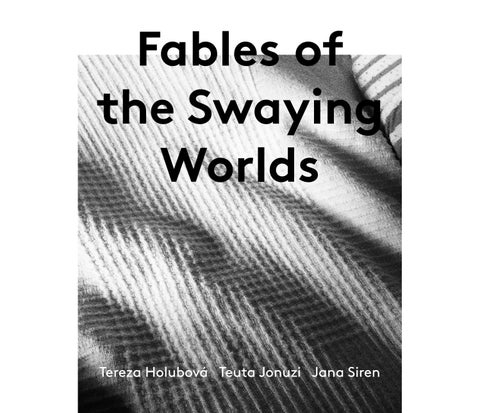
Fables of the Swaying Worlds
Tereza Holubovรก Teuta Jonuzi Jana Siren Tereza Holubovรก Teuta Jonuzi Jana Siren
Contents 005
Introduction
006 Worlding ’Fables of the Swaying Worlds’, written by Jana Siren and Teuta Jonuzi 010
Imaginary
014 Site of Shared/Unshared Intimacy Rituals ’Black Sand of Mountain Khan Bayanzurkh’, written by Jana Siren 026 Archeology of Time ’Reflections and Explorations on the Relationship Between Individuals, Matter, and Space’, original text written by Dušan Prekop 036 Speculative Limbo ’Who Lives Here? On Void Becoming Your Home’, written by Teuta Jonuzi 042
Acting up
046 Extraction of Resources ’Late thoughts on Artistic Practice and Artistic Research: On Artistic Research and Artistic Practice’, written by Teuta Jonuzi 050
Phenomenal Eatables
056
Fermentation
059
Imprint
004
’Suburbia (Heaven Or)’, Sean Leon, 2016
Is this Heaven or suburbia? Is this Heaven or suburbia?
Introduction Fables of the Swaying Worlds
The premise of such a speculation would be quite spatially limited in its physicality. You are confronted with your immediate surroundings. They consist of two things: the home itself and its inhabitants. So what precisely happens in such environments? If we take it task by task, day by day, our new domestic routines might seem almost repetitive but they do tend to provide structure. It’s akin to how when first learning a foreign language you had to describe and frame your day by listing what you were doing each hour. Through this process of continual recurrence we
are also, in a way, learning how to navigate in this new world through the language of newfound scenarios we find ourselves in. It’s been established that a world like this comes with its own routines, but the question is whether they come with more positive connotations or rather worrisome ones. Routines become habits, so yes, in an unsure world, they come off as useful. However, a routine is also the process of an action that keeps repeating itself again and again, until something you once loved and valued becomes a Sisyphean nightmare. This might mean we are filling a lazy afternoon with making up fables just like soap bubbles that pop in an instance. See, some of them are made of glass, still fragile but cold as ice. Through our collective
consciousness the many fables we weave might even become a “‘fabrication of giants’” (Deleuze & Guattari 171).1 It sounds so easy! In cooking fables and knotting their fabric together we prepare our pharmakon2; the remedy, poison, and scapegoat in one shifting form. The recipe goes as follows; making, coming into existence, un-making; worlding, and un-worlding. Like a desire which might be a virtue and a vice in one. It might act upon itself, and we should not forget the scapegoat that is us ourselves.
Deleuze, Gilles, and Félix Guattari. W hat is philosophy?. Columbia University Press, 1994. 2 Derrida, Jacques. “Plato’s pharmacy.” 1981. 1
005
The goal of this proposal is to bring about a Speculative Future which would be the solution to an ongoing process, or rather, create a context from which you would be able to compose the aforementioned Speculative Future.
Worlding Does doing mean more than being? By shifting the noun “world” into a gerund (“world” into “worlding”) the “fitness or necessity of the action to be performed” will be created. 1 This performative potential of worlding reflects in its distinct effect. This effect of “[w]orlding is a particular blending of the material and the semiotic that removes the boundaries between subject and environment, or perhaps between persona and topos.” 2
006
Similarly, Donna Haraway, in her book When Species Meet (2008), states that SF is “storytelling and fact telling; it is the patterning of possible worlds and possible times,materialsemiotic worlds, gone, here, and yet to come.” However, this could be applied to fabulation and other ways of worlding as well. How would we obtain these patterns in order to put
the worlding process in action? One of the many ways might be turning the passive appearances of objects into active actors fit to obtain their new performativity and perform their speculative and fabling flight. The process of worlding and fabulation can also contain pharmakon, a concept that Jacque Derrida observed and worked with (Dissemination, Plato’s Pharmacy). In Dissemination, Derrida states that the essence of the pharmakon “lies in the way in which, having no stable essence, no ‘proper’ characteristics, it is not, in any sense (metaphysical, physical, chemical, alchemical) of the word, a substance... It is rather the prior medium in which differentiation in general is produced”(Dissemination, 125-6). Providing imagined worlds with the potential of both growth and regression.
1 “Gerundive.” Merriam-Webster.com Dictionary, Merriam-Webster, https://www.merriam-webster. com/dictionary/gerundive. Accessed 30 May 2020. 2 Palmer, Helen, and Hunter, Vicky. Worlding. www.newmaterialism.eu, 16 March 2018, https:// newmaterialism.eu/almanac/w/worlding.html, Accessed 2. June 2020
‘Untitled’, Johan Siren,2020
008
Yarn Line of yarn Lines in the sand Stone sinking and diving in Throughout cultivating not-yet existing stories, which are retrieved from the nearest physical presence, we enact, pretend and prepare recipes, aspiring towards possible worlds. Engaging in observations of yet indeterminate presences.
009
‘Untitled’, Jana Siren, 2020
14 April 2020
Imaginary
010
Jana Siren, 2020
Screenshot, Teuta Jonuzi, 2020
Striving for the future means moving around in all directions and, yet, being trapped in comfort and the curse of repetition. In its Sisyphean qualities, it is both dreamlike and as real as my own hand. Despite the scattered character of our processes, we set out to play a simple game that all children like to play - walking on top of a thin line which appears on the cracked asphalt of a pavement. Balancing, focusing, and inevitably tripping and falling. We are following, notifying, enacting, and rendering anew the streams of intimate places and affectivity. We seek to see and taste emotions, colours, tools, deceptions, and roots of events which inevitably lead us towards futures.
011
012
‘Acts of Radical Intimacy’ (series), Still from a video, Teuta Jonuzi, 2020
‘Acts of Radical Intimacy’ (series), Still from a video, Teuta Jonuzi, 2020
Soon enough we will be bathing in the vagueness of the broken promises, that were never verbalized. Just yesterday you told me the same story as many times before and it made me realize that you might be an emotional whore. Yet we keep on fetishizing our own sadness.
013
‘5% of Happiness 95% of Melancholy’, Screenshot, Teuta Jonuzi, 2020
Site of Shared/ Unshared Intimacy Rituals
014
Since public rituals have been temporarily paused for the time being we have had to create our own bespoke rituals upon which we can depend on. It almost feels like we have reclaimed power over our days while also trying to recreate and perpetuate what external factors once claimed to be normal in the past. It can either feel very meditative or, in the worst case scenario, it can resemble a limbo-like state. If you take your time and treat each action with care, diligence and pleasure it might come off as a sort of learned mantra, meaning you might even be able to reach Nirvana
at the end of it. However, due to the lack of certainty, in our current course towards this Speculative Future, the path to our goal is hazy and the nature of our goal itself is equally undetermined. Teuta Jonuzi, 2020
015
Diary notes, Teuta Jonuzi, 2020
016
017
‘Krasavice’ (series), Tereza Holubová, 2020
Jeanne Dielman, 23 quai du Commerce, 1080 Bruxelles. Directed by Chantal Akerman, 1975.
Black Sand of Mountain Khan Bayanzurkh
018
Could the vision of tomorrow’s events be made into narrative speculation? What would the essence, drive, and details of tomorrow or the day after be like? On this day it will probably be raining or the sun will be shining. I will make breakfast and I do not need to give much thought to what will follow next. All of these patterns are located on the map of a daily cycle, which is ruled by repetition: repetition, in turn, fuels and drives my emotions and feelings. Such repetition is, in a sense, ritualistic. However, the ritual is not present to bind, foresee, or to elevate, but to guard the flow of time. This time is common to those who share the same intimate space; those who are looking after each other, after their bodies, and those who oversee
the shared time. The main character, Jeanne Dielman, in Chantal Akerman’s movie, Jeanne Dielman, 23 quai du Commerce, 1080 Bruxelles (1975), immerses herself in the same ritualistic flow of performing care to keep her teenage son and herself in the safety of their meticulously organised life. The course of Dielman’s day is a flawless sequence of timing and succession of domestic tasks and earning a living through secretly prostituting herself, receiving her customers at home when her son is at school. Akerman’s movie is assembled from long scenes following Dielman through her daily routines around the clock - cleaning, cooking and running errands. The movie follows a course of three days during which a crack in the flawless run of the daily
Jana Siren, 2020
019
The crack in a cycle of daily , as well as imaginings of tomorrow’s events, are both sources of causality and its great potential. They open a portal of the cause which has the power to change all, or nothing. The affinity of causality and contingency is also present in the relationship between wind and sand - a synergy which produces a place of continuous modification, the dune system. Inhabitants of dune systems must learn the code of a shifting landscape. While we contemplate the essence and
narratives of the coming days, we can also fabulate about the stories of tomorrow in desert-like landscapes. We can envision stories weaved by lichens growing on the Khan Bayanzurkh mountain in the Gobi desert. Or, we can picture what the giant worm olgoi-khorkhoi dreams about in his hiding place under the black mountain, Khan Bayanzurkh. Does this legendary creature dream about its own unlikely existence? Or maybe, it dreams about weighing the Spice flowing through Dune’s fictional desert of Arrakis during its next geological period?
Jeanne Dielman, 23 quai du Commerce, 1080 Bruxelles. Directed by Chantal Akerman, 1975.
cycle appears. This disruption brings a profound change in the cyclical flow of Dielman’s days and releases anxiety which was resting at bay, held back under the protection of the ritualistic repetition and perfection.
Everydayness is loaded with the possible. The thin line might expand into a vast plain and shrink back, leaving us trapped in the former space of a no longer existing place. There is no ground under our feet when playing. The game rules are always ready to be dropped and flipped.
020
‘Untitled’, Jana Siren, 2020
Jana Siren, 2020
021
022
‘Untitled’, Jana Siren, 2020
Sing with me: Off you go! Sweep and sweep then weep and weep. Little sparrow do your leap, leap. And home we keep, keep.
Grow grow you’re too slow. Get a bow and do the show. Grow grow join the row. Red, green, red, green follow him! 23. April 2020
023
‘Untitled’, Jana Siren, 2020
Repeat after me:
024
‘Untitled’, Jana Siren, 2020
10. April 2020 025
‘Untitled’, Jana Siren, 2020
Spíž - myš - kuchyň - nůž - muš nebo miž? Kolik toho sníš? Kolik toho vypiješ? Kolik si toho zasloužíš? Spíš? A nebo je to spíž? Podloží - tebe - tělo - podloží černozem - sem s ní - jsem! Voda - mouka - sůl - z žraloka je půl vážka - váha - dráha - křehká.
Archeology of Time Reflections and Explorations on the Relationship Between Individuals, Matter, and Space;
026
Haptic experience helps us to recognize differences in density and state through the sense of touch. It opens up another dimension in perceiving and, quite literally, grasping things. You experience this phenomenon
automatically, merely by moving around and existing in 3D space. We operate in environments following archetypes created in relation to space and the movement within it. We continuously adapt this space to our own needs for existence and navigation through it. The perception of matter and space through optical experience has a peculiarly observed element, and this is the fact that certain things can disappear at a given moment depending on the object’s distance from the observer. So I perceive the whole world as a composite of endless layers, which we experience daily,
‘Untitled’, Jana Siren, 2020
Matter, as the building block of all objects, is composed of one common element - atoms. The composition and physical structure of objects is where we can start to classify and separate bodies from each other. When I think about this through the lens of interpersonal connection, it is a subconscious separation. Only our own egos separate us from each other despite our matter being uniform.
027
028 ‘Untitled’, Jana Siren, 2020
even just by simply pouring water into a glass or unpacking purchases from shopping bags and gradually unpacking the products themselves, which are in different packaging.
contexts of the exhibition’s white space. The gallery’s space can separate the work from the whole human experience and emotional labour that went into creating it.
The subjective statement about one’s own experience and relationships with matter is presented by creating various procedural moments and references through various tactile archetypal elements, which are then inserted and placed in the context of a limited space where they then redefine and create new contexts within.
I would like to point out rather than criticize, without unnecessary conclusions, goals, or definitions; the purpose of every being is death. What are understanding and grasping? This is the question I ask myself when observing how art and creation evolve and what procedures and approaches people use, what tools and definitions they create in their thinking, and what tendencies they follow. Everything has the potential to be or not be bold, austere, risky, and spontaneous. Original Essay written by Dušan Prekop. Abbreviated and translated from Slovak to English by Joe Duruji 029
The gallery’s presentation becomes the vehicle through which observers perceive the work on display. Ideas are displaced from their original contexts and translated into the new environmental and conceptual
030
‘Untitled’, Jana Siren, 2020
031
032
‘Untitled’, Jana Siren, 2020
033
034
Screenshot, Teuta Jonuzi, 2020
Screenshot, Teuta Jonuzi, 2020
035
Screenshot, Teuta Jonuzi, 2020
Screenshot, Teuta Jonuzi, 2020
Speculative Limbo Sisyphean Nightmare Who Lives Here? On Void Becoming Your Home. What comes first in a timeline which doesn’t seem linear anymore? The arrow of time had been fractured mid-throw and scattered in a million different directions. Now, is it important to pick up the broken-off pieces or leave them be? I wonder if by collecting them together again, whether it would work like a puzzle in that they would simply become one by moving them closer to each other, or would I need a gluing medium?
036
This specific agenda represents in its physicality a home. It looks like an actual home, specifically, let’s say a room in a home. What are the characteristics of this site? It has four walls, and you are able to enter and leave it at will. So from the outside, this site comes across as solid, right?
The issue arises when, after entering, it remains just as solid. Living in such a space creates a never-ending set of exchanging energies, created by the exercised cyclicity, bound within this structure. After a million times, the meaning becomes both engraved on the walls and lost, thus the subject becomes an object and vice-versa. By embracing the imperfections created by the glue which helped us put the broken pieces back together, we are not shying away from their history. The glue in the cracks already consists of lived experiences and represents itself symbolically as the moment of repair. When playing around with the idea, you can begin to assume which
pieces fit together. Assumption plays a significant role in creating these personas or topos. So how do you present a specific hypothesis of ‘a clown’. There are of course specific aesthetical characteristics, which can be researched, copied and finally exercised. Teuta Jonuzi, 2020
037
‘Never Change’, Screenshot, Teuta Jonuzi, 2020
‘Acts of Radical Intimacy’ (series), Still from a video, Teuta Jonuzi, 2020
038
Emotional Whore - Fear of Intimacy - Falling in Love with Friends - Emotional Dependency - Oversharing - Ov
Emotional Whore - Fear of Intimacy - Falling in Love with Friends -
039
verreacting - Fetishizing Sadness - Social Distance - Your Ego
040
‘Alarm Clock’
041
‘Untitled’, Jana Siren, 2020
’Alarm Clock’, Teuta Jonuzi, 2020
Thought that I had received a closure, but then I woke up.
Acting Up ‘I’ll Make It up to You’ You seem to have forgotten all about me. Yet the only one on my mind is you. Trying to recognize this phenomena, but suddenly realized. What is that? A demon or perhaps a spirit of some sorts, lurking in the corner of my mind. The ghost that never visits.
042
‘I’ll Make It up to You’, Teuta Jonuzi, 2020
And what did you expect? Some sort of delusional closure, which obviously never arrived. Just as I assumed.
043
‘Long Time No See (...)’,Pictures taken with Photo Booth, Teuta Jonuzi, 2020
044
Diary notes, Teuta Jonuzi, 2020
045
Screenshot, Teuta Jonuzi, 2020
Screenshot, Teuta Jonuzi, 2020
Screenshot, Teuta Jonuzi, 2020
Extraction of Resources Late thoughts on Artistic Practice and Artistic Research: On Artistic Research and Artistic Practice I cannot but write, in a way, of my own emotional agenda being visible. In the last couple of months, everyone’s timeline has been disrupted drastically and thus created new positions towards certain questions that might have been definite before, but are now less clear. It might be ethical of me not to promise the reader any concrete answers nor solutions and merely my own personal experience as an artist. Making this thesis subjective, thus counterproductive in regards to, at least a scientific research;
046
“Artistic research thus revolves around articulating new questions without seeking answers.” 1
Thinking about artistic research and what it could or even couldn’t be, had me thinking from the very beginning about artistic practice. Is it possible to a) research through practice? Or is it vice-versa, b) practice is exercised through a theoretical thesis. Or would it possibly be c) the simultaneous process of theory and practice supporting and inspiring each other throughout the process of development?
in a Greek sense of ‘genius’, hiding in the corner of a room, finally decides to make itself apparent and I lastly arrive with a brilliant idea.
In my personal experience with producing pieces in a more intuitive way, approach a) definitely seems the most accurate. The production of art pieces is, in this case, a form of meditation and it creates this sort of matra that is repeated until,
Firstly I would argue that no idea is entirely original. We merely get inspired and then after some time mutate an old vision of the future and reappropriate it enough to fool even ourselves about the origin of it. Then again even language itself is
On the other hand, during this type of process, an idea that might have been significant for the work itself might be lost in translation. More precisely, this means possible misunderstanding might be created due to the lack of a universal language*.
047
Screenshot, Teuta Jonuzi, 2020
Screenshot, Teuta Jonuzi, 2020
not universal. The language thought to be the utmost comprehension for most of the world, and especially the art market, is English. One might argue that even English is too general with the lack of some of the nuances of more philosophical or even poetic languages, and thus becomes reductionist; “(...) And I remember the vivid discussions about the ambivalence of English as the new „lingua franca“. We discussed the importance not only of using our native language in a local but also in a scientific context. In fact every discipline has by nature its very own, special scientific language. And if we really want to be transdisciplinary in the original sense, we have to accept the diversity of languages as a primary source of transgression. I believe, to a certain extent, that we find ourselves in a particularly European discussion, which shows us how English as a „universal language“ might lead to a drastic reduction of discursive diversity.” 2
048
By arguing for a) research through practice, it may have already answered some questions we would ask ourselves in the next example, which is b) exercising practice
through a theoretical thesis. I might just add some late thoughts to it. This kind of approach might at first seem like more of a traditional way of thinking about artistic production. More precisely, a historical study of a certain discipline, trying to replicate the masters and create a piece that is a direct clone. Here, at least, no one is pretending to have an original idea;
which is surrounding all of us. This, in my opinion, should be taken as a legitimate concern of our present-day society. Instead of thinking that one day everything will be the same as before, we shall create new narratives.
“Artistic research, which consists of generating knowledge and insight by applying artistic methods to explicit research questions, is often seen as a prototypical transdisciplinary field of experimentation, an area where the sciences and art combine into one, and where sciences (i.e. natural sciences) seem to consider themselves as universal aesthetic geniuses, much like Leonardo da Vinci.” 3 Lastly, I would like to argue for a, c) the simultaneous process of theory and practice supporting and inspiring each other throughout the process of development. For this seemed to be the most beneficial way of working, in my opinion. Even if the research is directed in a more sociological or philosophical way. As I mentioned before there is a mist of emotional landscapes,
* I might also add that, in my opinion art can transcendent language. In a simple way of thinking about it, when we see a beautiful performance or listen to a song, it might provoke emotions, which can not be described in a lingvistic way of form. 1 “Reclaiming Artistic Research – First Thoughts...”, Lucy Cotter, PhD, 2017 2 “Transgressing Disciplines”, Braidt Andrea, 2019, p.p. 95-96 3 “Transgressing Disciplines”, Braidt Andrea, 2019, p. 78
‘Just Making Sure’ Turn my loneliness into excitement. Then please into sadness and finally leave me hanging. After all the lessons taught, through hardship, will be the most memorable.
049
‘Just Making Sure’, Teuta Jonuzi, 2020
Lets not enjoy ourselves too much this time, ok?
Phenomenal Eatables
050
A general condition, common to the range of eatables (raw or processed) is the feature of a container. Whether it is a natural container such as an eggshell, an integument such as in the case of fruits and nuts, or a “cultural” born container; a pot or an altered eggshell used as a water container.
These receptacles are either artificial ones, meant for storing and processing food or the natural retaining form of a critter (a chick) or a fruit kernel, which inevitably ripens in order to start another generation of offspring. The culturaly born and modified forms are found in the food categories such as pastry and its varieties of shapes and flavors. Or also in the natural containers turned into a symbolic representation such as a modified eggshell or its representation made in clay and painted. This idea, of a containing shape given to something as profound as the edibles, is here appropriated through a performative act of observing through painting and delving in the depth of a presence such as the one of an eggshell.
‘Krasavice’ (series), Tereza Holubová, 2020
The idea of phenomenal eatables proposes a different scope of involvement in the processes around food, understood not only as a source of nourishment but as raw substances or objects with symbolic, cultural, historical and imminent futuristic dimensions. These different perspectives are here found in the fringes of the worlding and fabulating processes. They involve plain cooking interwoven with ritualistic and imaginative aspects.
051
052
‘Untitled’, Johan Siren,2020
053
‘Untitled’, Jana Siren,2020
054
055
‘Krasavice’ (series), Tereza Holubová, 2020
Fermentation Processing food from the cultural, chemical as well as microbiological perspective is illustrated in a diagram Culinary Triangle designed by anthropologist Claude Lévi-Strauss (in Food and culture 2012)1. In which he suggested two branches of processing raw eatables: one branch as being on the side of culture and the other one on the side of nature. The Culinary Triangle renders an abstract formula that features boiling as “culture” shaped the process and roasting as “nature” shaped process. Smoking is stretched across both lines. If we ignore Lévi-Strauss’s bias of nature versus culture we can grasp the complexity of food processing driven by different stages of microbiological, chemical and cultural modification.
056
The third point possible to add to the three points of Levi Strauss’s Culinary triangle is the process of fermentation. As opposed to food processing by boiling, roasting and especially smoking, that is done by air, fermenting demands a fully anaerobic environment in order to support the growth of “microorganisms, e. g. lactic acid bacteria, yeasts”2. It keeps mold
and microorganisms away from the fruits submerged in salty brine and “facilitates enzymatic chemical reaction”3 unlike cooking which changes “thermodynamic” patterns of the food. Thus it preserves the food and protects it and makes it less prone to react to changing conditions such as temperature, etc. Fermentation is a practice that prevents food from rotting. If done in controlled conditions it can preserve food and significantly extend its shelf life in altered form but closer to the raw state than to the state of decomposition. Raw in Levi Strausse’s Culinary triangle is seen “as the original structure” 4. Even washing dirt away from a carrot is perceived as an “cultural act” (Vilgis 154) of cooking, taking away from its rawness by altering its molecular structure in the slightest way. Thus, fermentation as a primordial form of the cultural act of food processing is on the side of human culture but it is in sync and cooperation with the interlinked cultures of other microorganisms. Therefore fermenting means cultivating through facilitating and caring ratherthan
through eradication of microorganisms which cause rotting. It is a less intrusive mechanism of preserving through cultivation. Thethreestatusesoffoodanditsprocessing are the same since their evolution began: the raw, cooked (including smoked and roasted) and fermented which remained in the triangular basic form. “The molecular structure of foods stipulates these possibilities and allows for no others.“ (Vilgis 155). Thus in our imagination, we embrace this stable set of characteristics of eatables as a vehicle for inserting biological time based on thermodynamic laws into the time flows of histories and cultures. Jana Siren, 2020
1 Lévi-Strauss, Claude. “The culinary triangle.” Food and culture. Routledge, 2012. 54-61. 2 Vilgis, Thomas. Evolution – Culinary Culture – Cooking Technology: Aesthetic Practice of Cookery. 2017 3 Vilgis, Thomas A. “Evolution – Culinary Culture – Cooking Technology”. Evolution – Culinary Culture – Cooking Technology. Bielefeld: transcript, 2017. 4 Vilgis, Thomas A. “Evolution – Culinary Culture – Cooking Technology”. Evolution – Culinary Culture – Cooking Technology. Bielefeld: transcript, 2017.
‘Untitled’, Jana Siren,2020
Publication was created for the group exhibition ‘Futures in Process: Of Sites Rendering Speculation’ curated by El Baroni Bassam and Mi You. Photo on cover and back page by Johan Siren. Project funding and an exhibition of:
058
Aalto University School of Arts, Design and Architecture Department of Art Visual Cultures, Curating and Contemporary Art (ViCCA) www.aalto.fi
Imprint Project Curators & Artists
Tereza Holubová Teuta Jonuzi Jana Siren
Catalog Curator Catalog Graphic Design Proofreading and Translation Image Editing Image Rights
Teuta Jonuzi Daša Vašková Joe Duruji Daša Vašková Tereza Holubová Teuta Jonuzi Johan Siren Jana Siren Visual Cultures, Curating and Contemporary Art (ViCCA) English/Slovak/Czech 60 2020
059
Department Language Pages Year