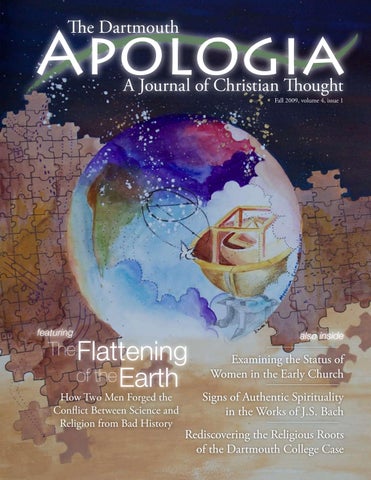

Apologia e Dartmouth A
featuring
The Flattening Earth
How Two Men Forged the Conflict Between Science and Religion from Bad History of the
Examining the Status of Women in the Early Church also inside
Signs of Authentic Spirituality in the Works of J.S. Bach
Rediscovering the Religious Roots of the Dartmouth College Case
A Letter from the Editor Christianity as Fact
Religion is often marketed for its usefulness. It is endorsed with appeals to our pursuit of happiness, meaning and personal development, just like a political campaign, wonder drug or self-help bestseller. At The Apologia, we find this approach unsatisfactory and even distasteful, because it suggests that our beliefs suit our ulterior motives instead of reflecting our convictions about the nature of reality. We are determined not to be peddlers of our religious beliefs but to present with integrity what we hold to be objective fact. We are primarily interested not in Christianity’s usefulness but in its veracity. That is to say, we are not Christians because we view Christianity as the best means to make ourselves happy or the world a better place, though we may hold those views as well. We are Christians because we think that Christianity is an accurate reckoning of the world and humanity’s place in it—regardless of religion’s advertised benefits. In saying this, I am paraphrasing C.S. Lewis, who once wrote, “Christianity is not a patent medicine. Christianity claims to give an account of facts—to tell you what the real universe is like.”
We call the claims that Christ made about himself the Gospel, or Good News. This Gospel has always been the core of Christianity, and in it Christ asserts—as fact—that He is a God against whom we have sinned. Furthermore, he maintains that he will forgive our sins if we put our faith in Him, that is, if we acknowledge that the claims he makes about Himself are true and live our lives accordingly. These claims are either true or false. If true, Christ’s claims about His Godhood, our sinfulness and His work of redemption are the supreme facts of our existence. If false, they are dangerous nonsense fit only for refutation and categorical dismissal. The alternative between true and false cannot in this case be ignored: the meaning of life depends on it. Therefore, one must either accept Christ wholeheartedly or reject him outright. Honest, intellectually gifted people have come down on both sides of the question, but there is no rational middle ground.
At The Apologia, we make the case that Christ’s claims are true, but you may notice that few directly apologetic articles are published in this journal. Just as we have no intention of hawking religious snake oil, we prefer not to bludgeon our readers with arcane proofs for the existence of God, the superiority of Christian morality or the necessity of an Intelligent Designer. Instead, you will find articles addressing the sciences, the humanities and the arts, all from the unique perspective of Christianity. We are presenting evidence that the coherence and explanatory power of the Christian perspective supports the truth of its principal propositions, namely the truth claims of Jesus.
Richard Swinburne, this issue’s interviewee, writes in Is There a God?, “We find that the view that there is a God explains everything.” We affirm this claim, and, in the spirit of Dartmouth’s liberal arts education, we seek to demonstrate that the truth of Christianity is relevant to every field of study. In so doing, we make every effort to ask and answer the hard questions, and we encourage you to do the same.

Charles Clark Editor-in-Chief
Submissions
We welcome the submission of any article, essay or artwork for publication in The Dartmouth Apologia Submissions should seek to promote respectful, thoughtful discussion in the community. We will consider submissions from any member of the community but reserve the right to publish only those that are in line with our mission statement and quality rubric. Blitz Apologia.

front cover image: Cosmographicum by Kaite Yang ‘09
Fall 2009, Volume 4, Issue 1
Editor-in-chief
Charles Clark ‘11
Editorial board
Bethany Mills ‘10
Sarah White ‘11
Peter Blair ‘12
Production
Alex Mercado ‘11
Edward Talmage ‘12
Alex Barsamian ‘04 Th ‘09
Photography
Kelsey Carter ‘12
Contributing alumni
Jenny Bouton ‘02
Robert Cousins ‘09
Charles Dunn ‘10
Tessa Winter ‘09
Contributor
Glenn Tinder
Faculty advisory board
Gregg Fairbrothers, Tuck
Richard Denton, Physics
Eric Hansen, Thayer
Eric Johnson, Tuck
James Murphy, Government
Leo Zacharski, DMS
Special thanks to Council on Student
Organizations
The Eleazar Wheelock Society
David Allman ‘76
Andrew Schuman ‘10
Beth Pearson
Robert Philp

Letters to the Editor
We value your opinions and encourage thoughtful submissions expressing support, dissent or other views. We will gladly consider any letter that is consistent with our mission statement’s focus on promoting intellectual discourse in the Dartmouth community.
dartmouthapologia.org
Have thoughts about what you’ve read? Join the conversation! Log on to www.dartmouthapologia. org to access this issue’s articles and for an interactive discussion forum. Subscription information is also available on the web site. The opinions expressed in The Dartmouth Apologia are those of the authors and do not necessarily reflect those of the journal, its editors or Dartmouth College. Copyright © 2009 The Dartmouth Apologia







TThe Religious RooTs of The DaRTmouTh College Case
Jenny Bouton ‘02
inTeRview
Richard Swinburne, Ph.D., Oxford
CompaRing The sTaTus of women in The eaRly ChRisTian ChuRCh with Their Contemporaries in Greco-Roman Culture at Large
Anna Lynn Doster ‘12 and Sarah White ‘11
engulfeD by noThingness
Glenn Tinder, Ph.D., University of Massachusetts Boston
The flaTTening of The eaRTh: How Two Men Forged the Conflict between Science and Religion from Bad History
Charles Clark ‘11




The “passions” of J.s. baCh: Comments on the Cross Emily DeBaun ‘12 Reason anD faiTh: The Thought of Thomas Aquinas
Peter Blair ‘12
genuine ResponsibiliTy:
Dietrich Bonhoeffer and the German Resistance
Sarah White ‘11
final ThoughTs: (Re)Defining Good Tessa Winter ‘09
he Dartmouth Apologia exists to articulate Christian perspectives in the academic community.
2 6 9 16 20 26 30 34 38
by Jenny Bouton
the religious roots Dartmouth College Case of the
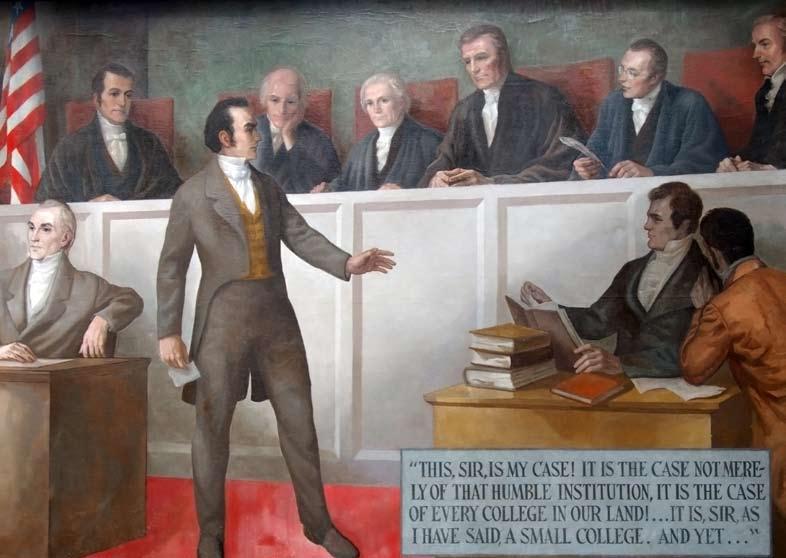
Daniel Webster arguing for Dartmouth College, mural in Thayer Hall, photograph by Bethany Mills ‘10.
‘02
To some, religious life on the Dartmouth campus is a mere footnote or afterthought, peripheral at best. To others, it appears a wasteful or even malignant distraction from the business of the College. However, from its charter as a religious missionary school to the founding of the Tucker Foundation in 1951 to “further the moral and spiritual work of the College,”1 religion has played a central and critical role in the life of Dartmouth College. While some aspects of Dartmouth’s history, such as the landmark precedent of the Dartmouth College case, are well known beyond its campus, few people on or off the Dartmouth campus know that this episode began as a religious controversy. When John Wheelock, the second president of Dartmouth and son of the College’s founder, appealed to the state government to intervene, he inadvertently politicized an internal dispute while obscuring its nature.
Religion has played a central and critical role in the life of Dartmouth College.
undergraduate religious societies began to form in New England as Christians responded to these changes. Additionally, many colleges and universities were swept up in a string of revivals, beginning with Yale in 1802. Some students and professors at Dartmouth, hoping that their school would experience this religious awakening as well, attacked the secular curricula, the political values of Enlightenment humanism and the “carnival atmosphere” (i.e. moral decline, drinking, rowdiness, irreverence to God), claiming that the milieu was not suited for the training of young men for responsible roles in church and society. “Nearly every New England college experienced a religious revival [at the beginning of the 19th Century] … The trouble with Dartmouth was that there had been no revival since 1782.”3
Many of us are familiar with at least the basic facts of the Dartmouth College case. In 1815, Dartmouth’s Board of Trustees deposed the second president, John Wheelock, for attacking them in a widely read publication, which alleged that the Board was using the College as a springboard for establishing a religious hierarchy in New England.2 In response, Wheelock appealed to the legislature of New Hampshire to change Dartmouth’s charter, effectively converting the school from a private to a public institution. The original trustees objected and sought to have the actions of the legislature declared unconstitutional. For this purpose, they retained Dartmouth alumnus Daniel Webster, who argued eloquently for the sanctity of the original charter. When the Court ruled in favor of the College and invalidated the acts of the New Hampshire legislature, Dartmouth was allowed to continue as a private institution.
In 1804, a majority of trustees of the College appointed Dartmouth alumnus Roswell Shurtleff, a tutor at Dartmouth and an orthodox Calvinist with traditional views on Scripture, to the long-vacant Professorship in Divinity. This position traditionally included the pastoring of Hanover’s Church of Christ at Dartmouth, where both students and townspeople
Due in no small part to his spiritual care for the students, another wave of religious revival spread over the campus in 1815.
However, the role played by religion, and in particular by a Christian professor, has remained obscure for some time, and very few treatments of the Dartmouth College case show any concern for the origin of the dispute. Despite the religious roots of the college, Dartmouth, like much of New England, had adopted humanist values. In the early 19th century,
worshipped. His nomination came over the violent protests of John Wheelock: Wheelock’s friend and Professor of Classics at Dartmouth, John Smith, had served as interim pastor of that church since 1797, giving Wheelock effective control over both church and college. Smith himself wanted to be relieved of his ecclesial duties, but Wheelock insisted Smith remain,
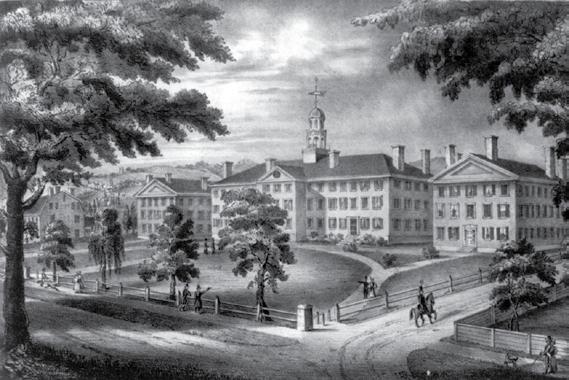
Lithograph of Dartmouth College circa 1834.
and forced Shurtleff’s congregation out of the college chapel.
This exiled congregation began to meet in the Hanover town meeting house, and it is due in part to Shurtleff’s preaching in Hanover that a religious awakening broke out in the winter of 1805, resulting in forty new members in Shurtleff’s church. In response to student petitions, the Board of Trustees, now fully in the hands of those sympathetic to Shurtleff, passed resolutions in 1809 to ban “treating,” the ritualized drinking parties accompanying major campus events. Outraged by the new restrictions, anti-awakening students rioted, burning outhouses, vandalizing the rooms of those in favor of religious awakening, firing guns on campus and slandering the religious organizations. Wheelock, likewise irate, refused to punish the rioters and blamed the awakening faction for disrupting campus life.
state takeover of the College. Although some have concluded that there were “no serious theological or political differences between Wheelock and the trustees,”4 the significance of these revivals was that they placed Shurtleff and Wheelock in opposition about such practical matters of theology as the place of emotions and revival in evangelical religion.
Shurtleff, however, was ordained as an “evangelist” in 1809 in the Congregational Church at Lyme in recognition for his efforts in spreading the gospel in the region, and the next year he was appointed as college librarian in addition to his other duties. As the College’s chaplain and a man of God, he was seen as the natural caretaker for boys from Christian homes. Concerned fathers would often write to Shurtleff re-
In the events that followed, Shurtleff and his colleague Professor Adams played a significant, yet not widely known role. When Wheelock called for state intervention, Shurtleff and Adams sided with the original board of trustees, known as the “Octagon.” They withheld the names of graduating students from the newly formed and state-controlled University board and held their own commencement. Practically, Dartmouth University had no existence, but the College was still functioning with a president, faculty, buildings, and student body,5 whose loyalty was likely due in no small part to Shurtleff. Whereas Wheelock was “generally unpopular”6 with the students, Shurtleff had become universally well-liked; his integrity, humility, gifts in teaching and personal interest in his students had earned him high regard among the students.
In the winter of 1816, the new board ordered the Octagon to appear before them to answer charges of acting as illegitimate officers of Dartmouth. The
Practically, Dartmouth University had no existence, but the College was still functioning with a president, faculty, buildings, and student body.
questing him to take a special interest in their sons to ensure their development in “Christian virtue” and “moral character” in the degrading secular college atmosphere. Shurtleff always responded with a personal interview with the student and thus developed close relationships with many students. Due in no small part to his spiritual care for the students, another wave of religious revival spread over the campus in 1815.
It was this spiritual ambiance at the College, supported by a traditionally religious board, in addition to Wheelock’s continued efforts to shut down Shurtleff’s congregation, that led to the final break between Wheelock and the trustees. This became the catalyst for Wheelock’s appeal to the legislature of New Hampshire, which precipitated what was essentially a
College’s president, Francis Brown, and Professors Adams and Shurtleff refused to appear before the new board, awaiting “the result of an appeal to the judicial tribunals.”7 In the Octagon’s absence, the University board removed Brown as President and Trustee, three of Trustees from their positions, and Adams and Shurtleff as faculty members. John Wheelock was briefly reinstated as president. By this time, however, he was too ill to perform his duties. The supporters of New Hampshire Governor Plumer forced entry into the college buildings; when Dartmouth University opened session, only one student showed up. The College with a loyal student body met in another building; that term both the College and the University functioned side by side.
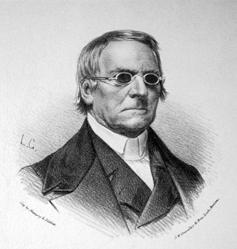
Portrait of Roswell Shurtleff, courtesy of the Dartmouth College Library.
In the meantime, the Octagon had filed suit against William Woodward, the state-approved secretary of the new board, who refused to hand over the records and seal. This, of course, became what is now called the Dartmouth College Case. “With Daniel Webster pleading and with other distinguished lawyers participating, [the Supreme Court] held for the college in Trustees of Dartmouth College v. Woodward in 1819. The state legislative act was void because the college was a charitable institution, not a public corporation; hence the charter was a contract and could not be impaired under the Constitution.”8 Not only did Shurtleff and those who favored the revival of Christian thought and values secure religious freedom for their own benefit, but they
His integrity, humility, gifts in teaching and personal interest in his students had earned him high regard among the students.
also protected the integrity of the College, and by extension, all other American educational institutions.
Closer to home, the religious origins of the case ensured support from pro-revival elements across the state. “While the case was being litigated, the Congregational clergy of New Hampshire set aside days of prayer that the college, now ‘a nursery of piety’, would not revert to being again ‘the reverse.’ To the participants in the college and the community, then, the significance of the Dartmouth College Case was not the political battle between Federalists and Republicans or the contest between the state legislature and the United States Supreme Court. It was, rather, the question who would control the religious future of Dartmouth and Hanover. The Supreme Court’s 1819 decision in favor of the trustees was thus a major victory for the cause of evangelical education.”9
As for Roswell Shurtleff, in 1827 he was appointed to a joint position as a Professor of Moral Philosophy and political [sic] Economy, and was granted a doctorate in divinity from the University of Vermont in 1834. He held this joint position until his resignation in 1838 due to poor health. In January of 1861 he fell seriously ill and died a month later. His grave, with that of his wife and three infant children, can be found on the west side of the cemetery on the Dartmouth campus. The inscription reads, in part, “He spent thirty eight years in the service of Dartmouth College, connecting his name inseparably with its history, and earning the grateful remembrance of many classes of pupils. A sound theologian, an acute philosopher, a thorough instructor, a thoughtful Christian, he faithfully served his generation and fell asleep in sure hope of immortal life through Jesus Christ our Lord.”
1 “About the William Jewett Tucker Foundation,” Dartmouth.edu, 2009, Dartmouth College, 30 March 2009,
2 John Wheelock, Sketches of the History of Dartmouth College and Moor’s Charity School, with a particular Account of Some Late Remarkable Proceedings of the Board of Trustees, From the Year 1779 to the Year 1815, 1815.
3 Steven J. Novak,“The College in the Dartmouth College Case: A Reinterpretation,” The New England Quarterly, Vol. 47, No. 4 (1974): 554.
4 Richard Hofstadter, Academic Freedom in the Age of the College (New York, 1955) 220.
5 Francis Stites, Private Interest and Public Gain (Amherst: University of Massachusetts Press, 1972) 36.
6 Novak 552.
7 Stites 42.
8 Eldon Johnson, “The Dartmouth College Case: The Neglected Educational Meaning,” Journal of the Early Republic, Vol. 3, No. 1 (Spring, 1983): 47.
9 Novak 563.

Jenny Bouton ‘02 is from Hartford, Vermont. She was a German and Linguistics double major.
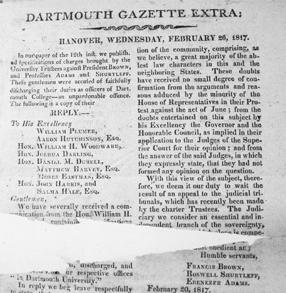
Newspaper response to accusations against Shurtleff and Co., courtesy of the Dartmouth College Library.
Richa R d Swinbu R ne
conducted by Charles Clark

Richard Swinburne, Ph.D., is Emeritus Nolloth Professor of the Philosophy of the Christian Religion, University of Oxford. His research centers on the philosophy of religion and the philosophy of science. His major contributions to his field began in 1977 with his publication of The Coherence of Theism, the first work in a trilogy completed by The Existence of God and Faith and Reason during the following four years. These works received enthusiastic critical reviews and established Swinburne’s reputation for clear and convincing philosophical argument. His most popular book, Is There a God?, was published in 1996 and offers Swinburne’s case for the existence of God in language accessible to the casual reader of philosophy. Professor Swinburne graciously granted this publication an interview.
In addition to your philosophical interests, you have a background in the hard sciences and their history, which shows in your acceptance of human evolution, the Big Bang and other scientific theories based upon the evidence, despite objections from some fundamentalist Christians. How does your scientific background affect your philosophical methods and opinions, and how does it relate to your personal faith in God?
I acquired my scientific background subsequently to my first degree, and I set myself to acquire that because, when I started to do graduate work in philosophy, it became clear to me that the modern world’s paradigm of knowledge was scientific knowledge. So I wanted to understand how science worked and in particular how science had worked over the centuries, the history of science, in order to understand the criteria which scientists use for judging theories to be true or false. I was enormously impressed by the great theoretical achievements of modern science and they seemed to me to reveal an orderliness in the world that needed explaining. So I suppose that science, as it were, was another push in the direction of religion.
What are the differences between scientific knowledge and religious knowledge?
Well, I think they are both true and justified by our general inductive standards. That is to say, we have some standards for judging claims about the world to be true or false, which are a bit wider than what we naturally call science, and we use those same criteria in history and in investigations done by detectives and so on. We do have common criteria for assessing scientific theories and for assessing theological claims. That is to say, the evidence that the claim is true is that if a claim is true you would expect to find the evidence, if it’s false you wouldn’t expect to find the evidence, and the claim is a simple one that fits in with other things you know. I think we use these criteria in all cases of inquiry.
an interview with
In both cases, in the case of science as in the case of theological claims, we are dependent to a considerable extent on what other people tell us. We can’t do all the experiments ourselves or anything like that, and so, if you’re in a community that tells you the earth is flat, you believe the earth is flat, and that is a very reasonable thing to do. Likewise, if you’re in a community that tells you that the Koran is true word for word, you believe the Koran is true word for word, because you have no other way of checking it out. These are the common criteria of what we can observe and what other people tell us. This forms our evidence, which is judged by the former criteria I have mentioned.
There is, however, in the case of religious knowledge, one further source of knowledge, which doesn’t really apply so much in the scientific case. Many people have significant religious experiences, in the sense of experiences that seem to them to be of God, and it is reasonable to believe such experiences to be of God unless you have counterevidence. It is reasonable in virtue of a very general epistemological principle, which I call the principle of credulity: you should believe that things are as they seem to be in the absence of counterevidence. It is on the basis of this principle that we believe that when we are seeing something, it is probably there, and when we remember something, it probably happened and so on, unless we have counterevidence.
So, in summary, I think there are the certain same general criteria for forming both scientific and religious beliefs, criteria for assembling evidence (what we observe, what other people tell us), criteria for moving beyond the evidence to theory, but also, in the religious case, our own personal experiences, internal experiences, must form part of the evidence, and that, I think, is a significant difference for many people. For many other people, religious experience doesn’t play very much a part in their religious beliefs. People come to them on the basis of testimony by apparent experts, which, as I say, is a reasonable thing to do, if you’ve got no counterevidence, or on the basis of seeing it’s the best theory of the world.
It is often said that religious faith requires a “leap.” Put another way, many believe that faith and reason are compatible only so far, and ultimately one must choose to follow one and not the other. What do you say about that idea? In your personal view, what is the relationship between faith and reason?
Well to begin, you must be very careful what you mean by faith, and I think what the Christian tradition
at any rate has meant by faith for much of its two thousand year history is trust. The person of faith is the person who trusts God and acts on the assumption that there is a God. He lives his life on that assumption. Just leaving the religious issue aside for moment, it is a reasonable thing to act on certain assumptions that you don’t believe are true in certain cases. Suppose that I want a million pounds, and there’s something marvelous I can do with a million pounds that I couldn’t otherwise do. It might be sensible to buy a lot of tickets to the lottery and hope that I get a million pounds. No, I don’t think that I will get a million pounds, but that would be a rational thing to do, because the great good that can be achieved by relying on the assumption in question cannot be achieved in any other way. Bearing that in mind, it would be very silly to trust God if you were pretty convinced there is no God, but if you are a bit uncertain, it would be a very sensible thing to trust God if you want a great good that can only be obtained by trusting, that is to say, by living the religious life, and Christianity has taught that the life of heaven is available to people who try to live that life on earth. So, for your own sake and because it seems a life more worth living on earth than other lives, it might be sensible to live the Christian life even if you’re a bit doubtful that there’s a God, simply because any other kind of life, firstly, won’t get you heaven, and secondly, it would be less worth living on earth. That is to say, living the Christian life on the assumption that there is a God would be the most worthwhile thing to do, and, therefore, it’s worth doing even if there’s some doubt about whether it’s true. So, there is a slightly complicated relationship between theoretical belief and faith, but, in general, within the qualifications I have mentioned, it would be only sensible to live the life of faith if at any rate you have some reason to believe that there is a God and that he is trustworthy.
You have said that your arguments for the existence of God are probabilistic. What do you mean by that? How does one evaluate the probability that something invisible like God exists?
They’re probabilistic in the sense that their conclusions are not certain given the evidence, but the evidence makes the conclusions probable. Of course that’s normally the case in ordinary life with more or less any conclusion. Certainly it’s true of scientific theories, historical theories, detectives’ theories about who did the crime and so on. In almost any case, you could be mistaken, but, in many cases, the evidence suggests you’re very probably right. In other cases, it suggests
you’re not. So, it’s not in any way to the demerit of religion that its theories are only probable. How can you assess the probability? Well, you can’t give an exact number. But then again, you can’t give an exact number to the probability that quantum theory is true or relativity theory is true or grand unified theory is true. You can only say it’s high or not so high, or more probable than this, and that’s all you can do in the case of the claim: There is a God. But, if my arguments are correct, then the evidence makes that claim quite probably true, not overwhelmingly probable, but fairly probable, significantly more probable than not.
In your book, Is There a God?, you discuss reasons why theism explains the world and its order better than either materialism or humanism. Considering the depth of understanding that science offers us of the material causes of physical phenomena and the psychological causes of human behavior, do we still need God to make sense of the universe?
I see as substantial evidence for theism the fact that the universe is a regularly ordered place. When you drop things they always fall to ground, the same law of gravity that holds on earth holds as far as we can tell in the most distant galaxies, and it’s a very remarkable fact that that is the case. Laws of nature are full of entities, what this means is that every particle of the universe behaves in the very same way, codified by the law of gravity, and that certainly does need explaining. It’s really too big an item for science to explain. That is, it is the top level of scientific explanation, this uniformity, but this top level itself needs to be explained, because so many particles behave in exactly the same way. And I’m certainly not invoking a “God of the Gaps” to explain things. My argument arises from the very fact that science has been immensely successful in explaining physical phenomena and even psychological phenomena to a limited extent.
Well, what does, as it were, materialist theory tell us about the universe? Well, it tells us that the scientific level is the top level of explanation. That’s to say it’s just a brute fact that every bit of the universe behaves in the same way as every other bit of the universe, in conforming to the law of gravity and the other scientific laws. And this is to postulate an enormous coincidence in the behavior of things. Now normally when
we see enormous coincidences and no other possible explanation occurs to us in the terms of the agency of some personal being, we adopt such an explanation. If somebody is dealing cards, and however well they’re shuffled, they always come out in the order such that that person wins the card game, perhaps that’s just a coincidence, but since this is just the sort of thing that a card player might have in mind to bring about, it would be a very natural explanation to suppose that he did bring it about and it was not simply a chance coincidence. That is to say, if you get enormous coincidences, which are such that a possible personal agent would have a reason for bringing them about, then that is quite a probable explanation of that occurrence, which is the one that theism offers but materialism or humanism doesn’t.
One subject that you have dealt with extensively in your writing is the Problem of Evil, which is an objection to theism on the grounds that the existence of evil is inconsistent with the existence of an all-powerful, all-good God. How do you reconcile that inconsistency? Why would God permit evil to occur?
Taking any person with moral sensitivity, it must occur to them that perhaps a perfectly good God would not allow people to suffer. But then, when you reflect on the matter a bit, you can see that suffering does serve a significant purpose. If God is really to give us freedom to make our own decisions and to have decisions that make a real difference to the world for good or evil, then he must let us have a free choice between good and evil. And if he wants us to be able to not merely make a difference in things, but to form our own characters so that some good actions come naturally to us, then he’s got to put us into a position where we have to make important choices for the kind of person we are to be. And so, for these reasons, he’s got to allow us to learn about evil, and he’s got to allow us to suffer in order that we may choose to cope with that suffering and by so doing form our character. You can’t form a character unless you find yourself in difficult or awkward and painful situations, because it’s in those that people show themselves at their best and develop such a character. So to give us real choices and to allow us to develop our character, there is a point in God allowing us to suffer in various ways, and although of course he might have chosen, and perhaps in other worlds has chosen, to make actually good people who don’t suffer, they don’t have the same choice of their own destiny that we do. And therefore I think that, given the limited period of earthly life, God is justified in allowing evil to occur, and we can be grateful for the opportunities that He gives us through suffering.
Swinburne published Is There a God? in 1996.
Jesus
with
Comparing the Status of Women in the Early Christian Church with Their Contemporaries in Greco-Roman Culture at Large
by Anna Lynn Doster and Sarah White
In the first century Greco-Roman world, women were considered naturally inferior to men. They were viewed as a commodity exchanged by marriage and held to a strict moral standard from which their husbands were excused. They were deprived of any form of independence and forbidden to exercise authority or influence of any kind. As the great Roman orator Cicero wrote, “Our ancestors, in their wisdom, considered that all women, because of their innate weakness, should be under the control of guardians.”1 Today, in a progressive society that values the rights and equality of women, Christianity is often characterized as the extension of this misogynistic worldview. Yet the history of the early Church tells a dramatically different story. The Christian teaching that in Christ “there is neither Greek nor Jew, there is neither slave nor free, there is neither male nor female,”2 shocked
talking
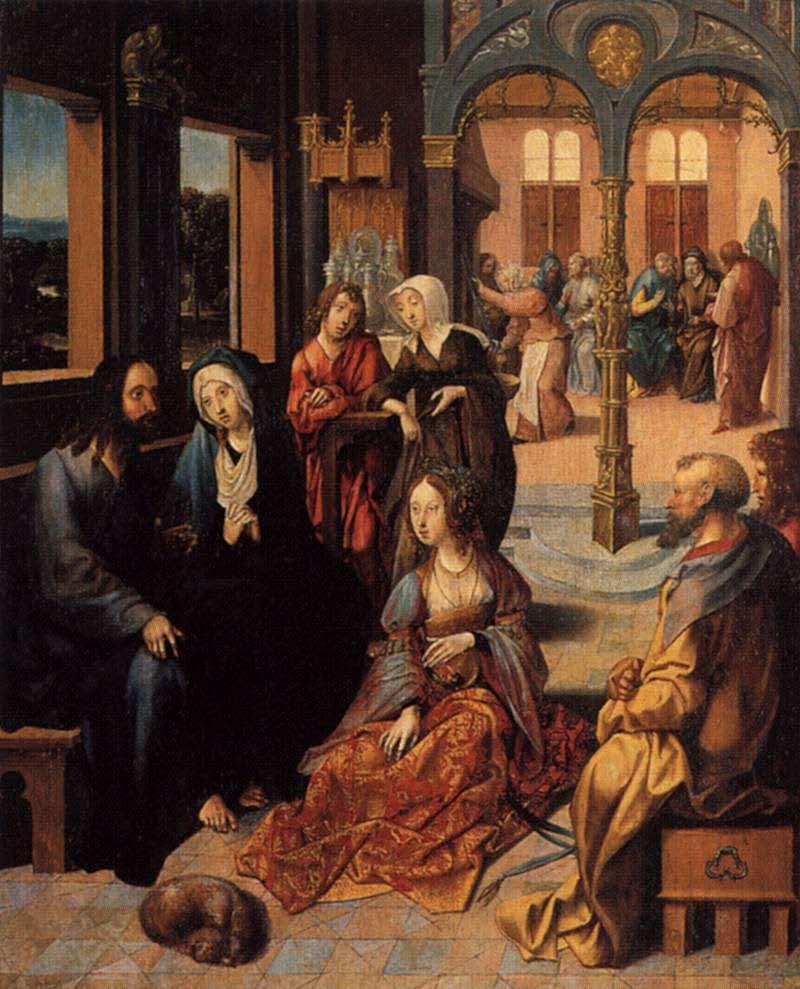
a group of mostly women in Christ in the House of Martha and Mary, painted c. 1515 by Cornelis Engebrechtsz.
and offended the ancient world. Women were valued equally with men. In marriage they were partners, not property, and both husband and wife were expected to adhere to the same set of moral standards. They were allowed to participate in the Church as individuals, and to hold positions of authority and influence in accordance with their spiritual gifting. Contrary to modern day perception, it was the Christian teaching embodied in the early church community that provided the catalyst and foundation for a revolution in the rights and dignity of women.
The Greek philosophers, who shaped the thought of ancient Greco-Roman society, tended to interpret the world in terms of oppositions. For this reason, the Greeks and Romans thought of women as the opposite of men, that is, as everything that men were not, and because both societies were rigidly patriarchal they tended to have high views of men and correspondingly low views of women. According to this mode of thinking, since men were rational, women were irrational. Similarly, if a man was supposed to be in control of his desires, then a woman must be incapable of controlling hers. In general, the Greco-Romans viewed women as intellectually and morally incompetent; as Gillian Clark wrote in her survey Women in
the Ancient World, “Women were seen as more emotional than men… more gullible, more likely to yield control of their reactions than men [were].”3 Many ancient authors expressed this view of women in their writings, and it was also reflected in medical works that explored the difference between male and female biology. Aristotle, for example, believed that women “were a defective kind of human” whose “reason is simply not in full control of their desires, any more than it is in children.”4 In addition to being compared to children, women were often compared to wild animals that had to be tamed by their male relatives in order to become proper members of society. As Pierre Brulé points out, “Metaphors and symbolic comparisons liken [a young bride] to a goat, especially a wild goat,” that is, to “an animal who has to be brought to heel.”5 For members of Greco-Roman society, there was no question that the genders were fundamentally unequal and that all of the
In Rome … a woman was required to remain perpetually under the guardianship of a male relative.
disadvantages fell on the side of women.
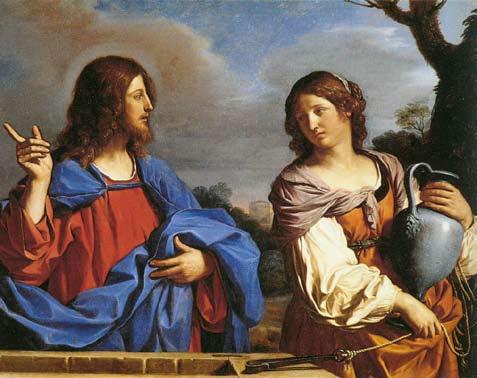
The Christian Church, beginning with Jesus, had a radical view of the status of women. In the Gospels, Jesus approaches women personally, teaching them about His mission and the Kingdom of God. In the Gospel of John, He initiates a conversation with a Samaritan woman about worshipping God. In doing so, Jesus defies contemporary social customs, since Samaritans and women were both considered so socially inferior that they ought to be ignored entirely. However, he clearly values this woman highly enough to risk incurring the criticism of his peers. John writes,
The woman said to him, “I know the Messiah is coming (he who is called Christ). When he
bridegroom leads his bride away to his house.
comes, he will tell us all things.” Jesus said to her, “I who speak to you am he.” Just then his disciples came back. They marveled that he was talking with a woman, but no one said, “What do you seek?” or, “Why are you talking with her?”6
On this and many other occasions recorded in the Gospels, Jesus demonstrates that he values women equally with men. John tells us that he loved Mary and Martha, two women who were His disciples, as well as their brother Lazarus,7 and the Gospels contain many examples of Jesus showing compassion toward women who were ill or disabled and healing them.8 The example Jesus set concerning the treatment of women was followed by the disciples and the early Church.
One of the clearest ways in which the early Christians broke from the Greco-Roman conception of women was in their perception of marriage. In the ancient world, marriage was a nonnegotiable transaction conducted between men, a father and potential husband. Women were traded as property for a bride price or dowry depending on the relative social position of the two families. Once married, women were expected to remain al-
This sudden transition could not fail to be traumatic for many young women, but marriage was still preferable to the perpetual childhood that would be the legal fate of an unmarried woman.
Either married or unmarried, a woman was required to remain perpetually under the guardianship of a male relative. In Rome, a woman could be passed from her father’s guardianship to become the legal daughter of her husband, or she could remain under her father’s power even after she was married. Roman law gave the head of the household the “power of life and death over his children, who could do nothing without his consent,”11 and the same applied to a woman’s hus-
Unmarried women and widows of the early Church were given important roles in ministry.
most exclusively inside their houses. In both Greece and Rome, “The assumption was that… [women] must lead a domestic life under male protection, for they are not suited to independence.”9 Sophocles, an Athenian playwright, depicted one woman as saying,
As young girls, I think, we lead the sweetest life of all mortals in our father’s house; for innocence always keeps children in happiness. But when we reach the age of marriage, we are thrust out and sold away from our ancestral gods and our parents, some to strangers, some to barbarians, some to a good house and some to a hostile one.10
Paul preaches to both
and women
band after her marriage. Essentially, women were trapped within the households of their father or husband for their entire lives, as subordinates whose welfare depended on the good will of the men who owned them.
With its typically progressive approach to the status of women, the early Church redefined the marriage relationship. In the book of Acts, Luke’s biblical history of the early Church, he highlights a woman named Pricilla.12 She and her husband Aquila were missionaries who accompanied Paul on one of his journeys. Together, they are credited with instructing Apollos, a major evangelist of the first century, and “[explaining] to him the way of God more accurately.”13 Luke clearly indicates Priscilla’s agency and her interdependent relationship with her husband. She is certainly not Aquila’s
men
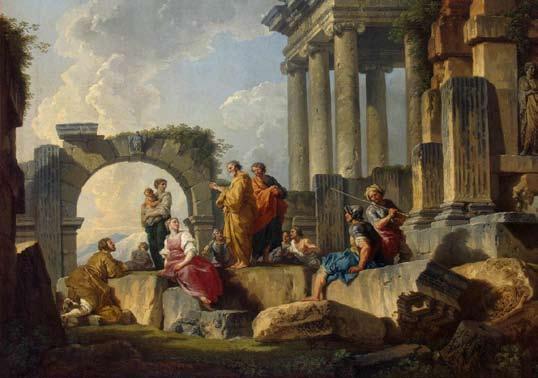
in Apostle Paul Preaching on the Ruins by Giovanni Paolo Pannini, 1744.
property, but rather his partner in ministry and marriage. Marriage was also not considered mandatory for women in the Christian community, and the unmarried women and widows of the early Church were given important roles in ministry. Paul, in his letter to the Corinthians, expresses his esteem for unmarried women, who are not “anxious about worldly things”
but “about the things of the Lord, how to be holy in body and spirit.”14 Widows, rather than being abandoned to poverty after the deaths of their husbands, which could force them to return to their fathers’ homes or to remarry, were taken in by the Church. In return, these widows took on spiritual and ministerial responsibilities. The third century Apostolic Church-Ordinances instructed that,
Greco-Roman view that women were intellectually and morally incompetent profoundly affected their treatment under the law and ultimately resulted in a moral double standard by which women were judged harshly for crimes that were not even considered offenses when committed by men. As previously discussed, Roman law required women to be constantly under the protection of a male guardian; indeed, “Roman woman existed legally only in relation to a man.”16 By requiring women to have a guardian, the law placed them in the same legal category as “children and the mentally disturbed.”17 Women’s perceived susceptibility to vice resulted in strict regulation of their behavior. Under the law code of Romulus, both drinking and adultery were crimes which were punishable by death for women.18 Cato, a Roman statesman of the third century BC, wrote that men had the legal right to execute their wives for adultery without trial. On the other hand, he says, “If you [a man] should commit adultery or indecency, she must not presume to lay a finger on you, nor does the law allow it.”19 Cato also spoke in defense of a law that denied a woman the right to spend her own money, saying, “The woman who can spend her own money will do so; the one who cannot will ask her husband.”20 This measure reflected the Roman belief that a woman’s natural instinct was always toward luxury, and thus toward moral deprav-
Christian men and women alike were called to live according to the same moral standard.
Three widows shall be appointed: two, who persevere in prayer, because of all those who are in temptations and for revelations and instruction concerning what is required; but one, who, abiding with those who are tried by sickness, is of good service, watchful, informing the priests of what is necessary.15
The revolutionary stance the early Church took on marriage afforded a range of opportunities to wives, maidens, and widows that greatly exceeded that available elsewhere in contemporary society.
Another way in which the early Church departed from Greco-Roman beliefs was in regard to its beliefs about the moral capacity of women. The pervasive
ity. This instinct could only be contained by subjecting women to the rule of men. Because Roman society saw men as having greater restraint, they were allowed to spend as they saw fit. These laws concerning adultery and extravagance, indulgences acceptable for men but not for women, are only two examples of the double standard applied to the moral behavior of men and women in Greco-Roman society.
In the Gospels, Jesus insists that men and women be held to the same moral standard. In the Gospel of John, a group of Jewish religious leaders bring a woman caught in adultery to Jesus, demanding that she be stoned according to the Law of Moses. Jesus replied to them, “Let him who is without sin among you be the
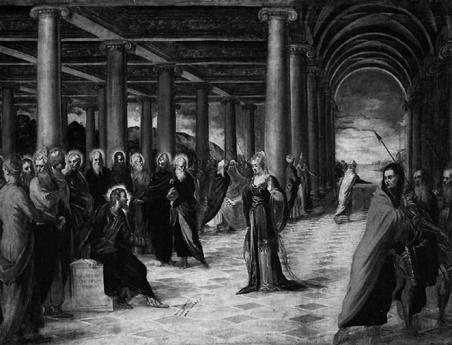
Christ and the Woman Taken in Adultery, by Tintoretto.
first to throw a stone at her.” Since her accusers were forced to admit their own unrighteousness, the woman was not condemned, and Jesus bid her depart and “sin no more.”21 It is notable that the woman’s accusers clearly practiced a double standard in their judgment. While they attempted to have the woman stoned, they made no attempt to bring the man with whom she committed adultery to justice. Jesus, with his lesson about forgiveness and repentance, prevented them from executing their double justice.
In his letters, Paul provides a uniform code of moral behavior by which all Christians, both men and women, are to abide. For example, in his first letter to the Thessalonians, he writes,
Finally, then, [brothers and sisters],22 we ask and urge you in the Lord Jesus, that as you received from us how you ought to live and to please God, just as you are doing, that you do so more and more. For you know what instructions we gave you in the Lord Jesus. For this is the will of God, your sanctification: that you abstain from sexual immorality; that each one of you know how to control his [or her] own body in holiness or honor.23
passage, Paul sends blessings to other women who are ministers of the Gospel including Prisca, Mary, Junia, Tryphaenea, Tryphosa, and Julia.25 He does not distinguish between the men and women he greets, but mentions all by name and praises all for their service to the Gospel. Paul writes in 1 Corinthians, “In the Lord, woman is not independent of man nor man of woman,”26 and the early Church developed into an authen-
Women also played a particularly important role in the logistical aspects of the growth and maintenance of the Church.
tic culture of interdependent relationships between the men and women. It becomes clear in passages such as this that the mission of the early Church to spread the good news of grace for the forgiveness of sins and the hope of eternal life available through faith in the risen Christ was so important as to obliterate any distinction between its servants. Men and women were united in this common cause.
In accordance with the example set by Jesus and the teaching of the apostle Paul, Christian men and women alike were called to live according to the same moral standard. This was an important step toward the equal treatment of women under the law.
While in Greco-Roman society women were denied access to roles of authority or influence through a variety of social, economic and legal restraints, Christian women took on important roles in the Church community. Many women are mentioned in the New Testament for their roles in serving God and the Church. Paul writes in the sixteenth chapter of Romans, “I commend to you our sister Phoebe, a servant of the Church at Cenchreae, that you may welcome her in the Lord in a way worthy of the saints, and help her in whatever she may need from you, for she has been a patron of many and of myself as well.”24 In the same
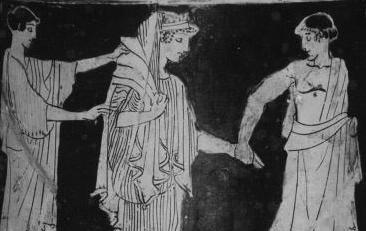
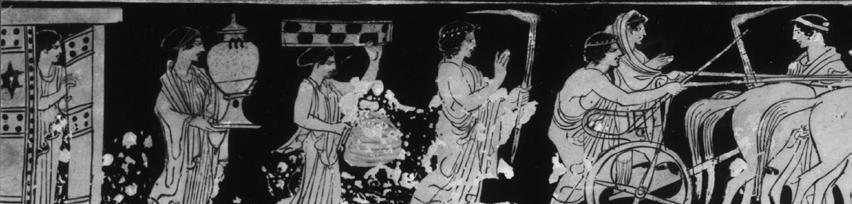
Ancient Greek depiction of a wedding procession.
Women also played a particularly important role in the logistical aspects of the growth and maintenance of the Church. John Wijngaards writes that women were frequently responsible for “instructing catechumens, welcoming strangers, placing orphaned children with foster parents, visiting the sick, mediating in quarrels, and advising bishops and priests on the needs of their parishioners.”27 All of these services to the community were considered critical to the mission of the early Church. In Acts 12:12, reference is made to a woman named Mary holding a religious gathering in her home: “When he realized this, he went to the house of Mary, the mother of John whose other name was Mark, where many were gathered together and were praying.” Because such important activities took place in a traditionally feminine sphere, women’s
opportunity for leadership greatly increased.28 In Acts 16: 12-15, a new convert named Lydia also provides a meeting place for Christians. Luke says of her, “And after she was baptized, and her household as well, she urged us, saying, ‘If you have judged me to be faithful to the Lord, come to my house and stay.’ And she prevailed upon us.”29 By hosting these gatherings of believers, women like Mary and Lydia “played an integral part in the establishment and continuance of a local church.”30 These small gatherings eventually evolved into local congregations. The participation of women in the embryonic stage of the early Church is a clear indication of the important role that they were to play in the spread of Christianity.
Several women are mentioned in the New Testament who served the Church in other ways. Tabitha, whose story is told in Acts 9: 36-43, is one of the women who seems to have played the role of a deaconess. Tabitha was noteworthy for “her generosity towards the disadvantaged” and “being raised to life again by God through Peter.”31 Ben Witherington writes in Women in the Earliest Churches, “Perhaps the main reason for the Tabitha story is that Luke wishes to reveal how a woman functioned as a deaconess, a very generous supporter of widows.”32 Women in the early Church could also be considered prophetesses.33 In Acts 21, Luke mentions a man named Philip the evangelist who “had four unmarried daughters, who prophesied.”34 With regard to these women, Witherington remarks that “prophecy is a gift of the Holy Spirit,” and that because this gift is most often identified with leaders of the Church, “Philip’s daughters are probably depicted as included among these leaders.”35 By showing hospitality, sharing the gospel, and giving generously to the needy, the women of the early Church contributed greatly both to the spread of Christianity and to the support of the Christian community of which they were a part.
“In Christ Jesus … there is neither Jew nor Greek, there is neither slave nor free, there is neither male not female, for you are all one in Christ Jesus”
(Galatians 3:26, 28).
concerned that allowing women so much freedom would make their society unstable. Pliny the Younger, a Roman magistrate, wrote a letter in 111 AD to Emperor Trajan regarding the punishment of two women slaves who he believed to be Christian ministers. According to Margaret MacDonald writing in Early Christian Women and Pagan Opinion, “The fact that these women had a prominent ministerial role in the Christian community – a ministry apparently not hampered by their status as slaves – was in all likelihood a significant factor in their visibility and subsequent arrest.”36 However, it was not merely their placement in positions of authority that troubled the Roman government. In his critique of Christianity written in the third century A.D., Octavius Minucius Felix expressed shock that both men and women congregated to feast on Christian holidays.37 Therefore, it was not simply the Christian ministry and teachings that non-Christian officials found threatening, but rather the undermining of the Greco-Roman social structure.38 The violence with which the liberation of Greco-Roman women by the teachings and practices of Christianity was met is a testament to its revolutionary nature. Both men and women were martyred during the first centuries of the Church for their beliefs and Christian service. 39 In Acts 8:1-3, Luke writes,
And there arose on that day a great persecution against the church in Jerusalem, and they were all scattered throughout the regions of Judea and Samaria, except the apostles. Devout men buried Stephen and made great lamentation over him. But Saul was ravaging the church, and entering house after house, he dragged off men and women and committed them to prison.
By allowing women to take on roles of responsibility and influence, the Christian community invited persecution from the Roman government, which was
In the year 64 AD, Emperor Nero enforced strict persecution of Christian men and women as punishment for their supposed involvement in the great fire of Rome, and later this persecution spread throughout the Roman Empire. Jean LaPorte writes in her book The Role of Women in Early Christianity,
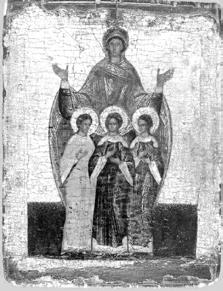
Sophia the Martyr with three daughters: Faith, Hope and Love. Russian icon.
Christian women suffer their share in the persecutions…Sometimes the women show courage and such a sense of the divine that they become examples and leaders among other confessors. Usually they endure the trials as well as men, thus proving that men and women are equal before God and receive the same gifts of the Holy Spirit.40
The martyrdom of women who kept the faith alongside men in spite of persecution is irrefutable evidence of their dedication to the Gospel message, that through faith in Christ “that they may have life and have it abundantly.”41
The Christian faith was founded on the principle that every member of the Church is equally valuable. As Paul says in his letter to the Galatians, “In Christ Jesus…there is neither Jew nor Greek, there is neither slave nor free, there is neither male not female, for you are all one in Christ Jesus.”42 This radical unity was totally at odds with contemporary Greco-Roman opinion, and it allowed women to experience unprecedented freedoms and to contribute to the early Church community in ways that have endured to the present day.
1 Cicero, qtd. in Antony Kamm, The Romans: An Introduction, (London: Routledge, 1995) 107.
2 Galatians 3:28. All Scripture quotations come from the English Standard Version
3 Gillian Clark, Women in the Ancient World (Oxford: Oxford University Press for the Classical Association, 1989) 4.
4 Ibid. 6.
5 Pierre Brulé, Women of Ancient Greece, Trans. Antonia Nevill (Edinburgh: Edinburgh University Press, 2003) 147.
6 John 4:25-27.
7 John 11:5.
8 Luke 4:38-39, 7:11-17, 8:2-3.
9 Clark 4.
10 Sophocles, qtd. in Sian Lewis, The Athenian Woman: An Iconographic Handbook (London: Routledge, 2002) 22.
11 James Donaldson, Woman; her position and influence in ancient Greece and Rome, and among the early Christians (London: Longmans, 1907) 87.
12 Acts 18:1-3, 24-26.
13 Acts 18:26.
14 1 Corinthians 7:33-34.
15 Jean LaPorte, The Role of Women in Early Christianity (New York: The Edwin Mellen Press, 1982) 126-27.
16 Holt N. Parker, “Why Were the Vestals Virgins? Or The Chastity of Women and the Safety of the Roman State,” (American Journal of Philology 125.4, 2004) 573.
17 Clark 9.
18 Mary R. Lefkowitz and Maureen B. Fant, Women in Greece and Rome (Toronto: Samuel-Stevens, 1977) 133.
19 Ibid. 148.
20 Ibid. 136.
21 John 8:1-11.
22 In the original Greek, Paul uses the word α , which means brothers or brothers and sisters, to address the members of the Church.
23 1 Thessalonians 4:1-5.
24 Romans 16:1-2.
25 Romans 16:1-16.
26 1 Corinthians 11:11.
27 John Wijngaards, Women Deacons in the Early Church: Historical Texts and Contemporary Debates (New York: The Crossroad Publishing Company, 2002) 16.
28 Margaret Y. MacDonald, Early Christian Women and Pagan Opinion (Cambridge: Cambridge University Press, 1996) 30.
29 Acts: 16:15.
30 Ben Witherington III, Women in the Earliest Churches (Cambridge: Cambridge University Press, 1988) 149.
31 The NIV Study Bible, ed. Kenneth L. Barker (Grand Rapids, MI: The Zondervan Corporation, 1995) 1665.
32 Witherington 150.
33 Barker 1690.
34 Acts 21:9.
35 Witherington 152.
36 MacDonald 52.
37 Ibid. 61.
38 Ibid.
39 Barker 1660.
40 LaPorte 7.
41 John 10:10.
42 Galatians 3:26-28.


Anna Lynn Doster ‘12 is from Cameron, South Carolina. She is an Asian and Middle Eastern Studies and Economics double major.
Sarah White ‘11 is from Chapada dos Guimaraes, Brazil. She is an English major and a Russian minor.
by Glenn Tinder
engulfed by Nothingness
The nineteenth and twentieth centuries have been called the age of the death of God. This event was announced by more than one philosopher, most dramatically, no doubt, by Nietzsche. Of course, Nietzsche was inclined toward extreme and debatable judgments, but the event was real. This can be seen in the atheism of the most influential minds of the time, such as Marx, Freud and Mill. And it was given impetus by Darwin’s apparent demonstration that man was not created by God but developed through a purely natural mechanism of evolution. And it unfolded, in a way highly convincing both to intellectuals and to the populace at large, in the ceaseless advance of scientific knowledge and in the flourishing of technology. It seemed clear that history was governed by man, or by a biological process, and not by God.
Upon the disappearance of God, however, there ensued another, and quite unexpected, event: the disappearance of reality—of the supposedly solid and unquestionable things that we could see all around us. The great weakness of God, felt by human beings since the time of the ancient Hebrews, was his invisibility. He couldn’t be seen. Could his reality, then, be confidently affirmed? The things around us, in contrast, could be seen and could be studied by science. Their reality could hardly be doubted.
It turned out, however, that their reality could be doubted. Perhaps I don’t doubt their reality the moment I see them, but the next time I see them they are not quite the same. Are they still the same realities? Have the earlier realities, by changing, vanished? Such questions intensify with the passage of time and the accumulation of changes. If I look for the same realities a few years later, they may well be gone. Physical things may have been destroyed, persons may have
died. Hence Thomas Wolfe’s discovery that “you can’t go home again.” How then do the supposedly solid things that you can see, and cannot question, differ from the benign clouds that form and evaporate on a summer afternoon? The clouds are scarcely real. Are the visible, and supposedly substantial, realities around us any more real?
The crucial issue, it seems, is the equation of visibility and reality. Common sense urges us to believe only what we can see. But what we can see passes away. Visible things are ephemeral, and ephemeral things are not wholly real. They may seem real today, but by tomorrow they have vanished. This points toward the core truth in this whole matter: only the invisible can be changeless and thus wholly real. Contrary to common sense, everything visible is temporal, and the temporal is the realm of the ephemeral, of the unreal. The invisibility of Israel’s God was a sign of his reality.
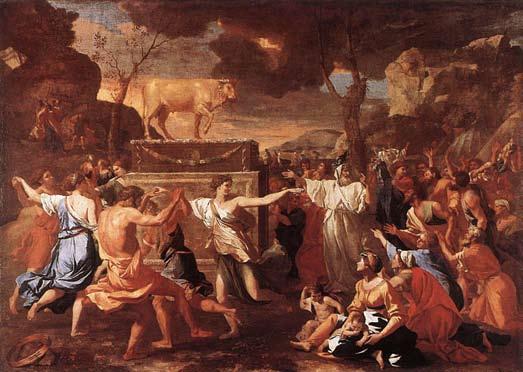
The evanescence and consequent compromised reality of the seen was acutely felt in the ancient world by the Jews and by the Greeks. To the eyes of the spirit, the invisibility of Israel’s God testified to his transcendence of nature and history, of the things that pass away. Eternal and authentically real, God infused his own reality into the persons he had created by giving them an eternal destiny. But to the eyes of the multitudes, God’s invisibility was deeply troubling. The Golden Calf charmed Moses’s followers precisely by its visibility. The idols that lured the Jewish people away from the God of the Bible were all made of stone and wood and could be seen by everyone. The true God could not be seen and could only be known by revelation and faith. Christians here followed the Jews. “No one has ever seen God,” John declares. And Paul asserts of himself and his followers that “we look not at the things that are seen but at the things that are
unseen, for the things that are seen are temporal, while the things that are unseen are eternal.”
In Greece we see something comparable. Plato was keenly aware of the dubious reality of visible things, and one of the essential characteristics of the forms in which he found full reality was that they were known by the intellect alone and could not be seen. This is dramatized in the famous line, illustrating the gradations of reality and knowledge, in The Republic. But in Greece, as in Israel, the multitudes saw things otherwise. Plato’s philosophy was developed in reaction to the demos which, beguiled by visible glories, brought the Athenian golden age to a tragic end in the catastrophe of the Sicilian war.
As reality disappears, the quest for truth—through philosophy, art, science, and religion—becomes pointless. Nothing remains to be revealed by the light of truth. This was perfectly apparent to Plato. He was a
philosophic dictatorship is unacceptable to practically everyone (and was perhaps unacceptable to Plato himself), but the logic of his argument is surprisingly hard to resist. And the state of the world in the twenty-first century makes it even harder. The advanced societies of the West, all liberal democracies, present pictures of life carried on in the deep twilight brought on by
As reality disappears, the quest for truth—through philosophy, art, science, and religion—becomes pointless.
the death of God, followed by the immersion of life in visible, but evanescent, realities. Like the captives depicted in Plato’s myth of the cave, we are fascinated by spectacles which we take to be exhibitions of reality but are in fact only a play of shadows.
philosopher of light, and in his political philosophy he sought ways to bring light into common life. For this to be possible, however, there had to be realities to be illuminated. These he believed to be the forms of ideas, in which all visible things participated and to which they owed such reality as they had. Intellect gave us access to these forms. The key to a good society therefore lay in vesting absolute power in those with the intellectual ability and training to apprehend the forms and, supreme over all the forms, the “idea of the good.” If the people were given liberty and power, however, they would become engrossed in visible things and draw society down into darkness. Plato’s doctrine of
The most sensitive minds in modern times have been far from unaware of our situation, and have sought a bedrock of enduring and reliable reality. Proust’s “remembrance of things past” was essentially an effort to rescue from oblivion things which seemed to have vanished into the past but in fact could be found, and brought back to life, through memory. Nietzsche’s doctrine of eternal recurrence (which Nietzsche believed to be literally true) was designed to give the overwhelming force of eternal cycles to realities which seemed, on the death of the God who had kept all that had ever happened in his own memory, continually to disappear into an omnivorous past. As with Proust, the tiniest details of present experience, which appeared to be vanishing like summer clouds, in fact would reappear again and again throughout eternity.
One of the major responses to the passing of reality with the death of God was unquestionably the doctrine of progress which, as our current fascination with the latest developments in technology and the commercial cult of youth shows, is far from dead. True and lasting reality, in the guise of the future, is entering and giving substance to our lives in time. Marxism illustrated the power, and illustrated as well, by the disasters it brought on the world, the basic inadequacy of this response. In a way, the gospel of progress was the direct opposite of Proust’s resort to memory. Proust sought enduring reality in the past, through memory. The protagonists of historical progress sought reality in the future, in some cases through revolution. The principal weakness in the doctrine of progress is not that the goals of the great protagonists of progress, like Marx, have inspired some of the most
The Adoration of the Golden Calf, by Nicolas Poussin.
terrible human atrocities in history, such as the massive killing that occurred in China and Cambodia. It is rather that any historical achievement—quite unlike the Christian eschaton—is still in history and thus is ephemeral. The doctrine of progress has not just betrayed its protagonists in practice; it is also deeply wrong in principle.
Quite a different and more sinister response to the disappearance of reality lay in reverence for the state. Indefeasible reality could be found in the sovereign and comprehensive form of our common life. The major philosopher of the state, no doubt, was Hegel, for whom the state was virtually divine—“the march of God on earth.” And the deified state was of course not just any state. In Hegel’s case, the God-state was Prussia in his own time. With the end of twentieth century, the world is acutely conscious of the terrible deeds states are inclined to commit. Yet virtual worship of a particular state, that is, nationalism, is widespread and is commonly fused in the popular mind with religion. God and country are twin objects of supreme regard.
Many sophisticated minds today believe that solid and enduring reality is to be found not through any interpretations of time, such as Nietzsche’s, and certainly not in any social or political entity, but in the disclosures of natural science. This is a formidable faith, and not to be despised. The advance of physical science is acknowledged on all sides as one of the greatest of human accomplishments. The equation of scientific and ultimate human knowledge may seem spiritually impoverished but in substance is a kind of Platonism. Reality is found not in things seen, even though seeing plays a key role scientific inquiry, but in realities known only to trained and disciplined minds—realities which are necessarily in the nature of ideas, or forms, intel-
key truth here seems to be that a great many people either exultantly assume that reality will be found in the pleasures and excitements of temporal life or else quietly despair of finding authentic reality and immerse themselves in things that are passing, hoping to find therein ways of forgetting what will inevitably happen to everything in time. A certain frivolity invades even the churches. Parishioners have little apparent interest in hearing what serious and well-informed Christians consider to be the eternal Word of God, which includes such highly uncomfortable doctrines as human sinfulness and divine anger. And they are not constrained to hear of these things, for their pastors are often, like themselves, theologically ill-informed and are practically always under pressure to enlarge membership of their churches. They are therefore strongly tempted, like politicians, to say the things people want to hear and the churches become, properly speaking, social rather than religious associations.
Personal being is affirmed in its heights and depths by Christianity more fully and unqualifiedly than by any other religion or system of thought.
lectually accessible even though invisible. Science, like religion, transcends the ephemerality of things that are seen.
In all this I have said nothing of the frivolous, although highly popular, responses to the disappearance of reality: drugs and drink, sex, spectator sports, entertainment and recreation. Adventure should probably be included among these, although it includes activities like mountain climbing in which men risk their lives, and one hesitates to say that men consciously putting their lives in peril are frivolous. In any case, the
Among all these responses to the disappearance of reality, I have suggested that the one possessing a certain validity is science. Might we, then, in order to rise above popular immersion in the ephemeral, resort to science or to some other version of Platonism? Christians are bound to find this an unacceptable option. Why? What does Christianity offer that cannot be found in science, or in Platonism in some form? The answer, I suggest, is simple and elemental: persons. Personal being is affirmed in its heights and depths by Christianity more fully and unqualifiedly than by any other religion or system of thought. This is to say that only Christianity responds adequately to the disappearance of reality. Only Christianity fully recognizes persons, both in the depths to which they have cast themselves by sin, and in the heights to which they have been raised by grace. The fate of persons in the thought of Plato is made clear in his political writings. Persons as such do not have lives which must be respected and guarded. Rather, they are in the nature
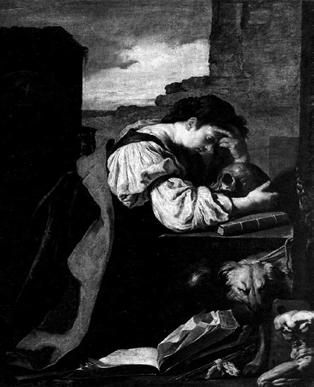
Melancholy, by
Domenico Feti.
of material which wise men laboring to create a perfect society are fully justified in using as they see fit, or in discarding when found unusable. Plato’s quietly ruthless politics is philosophically grounded. Just as his republic is severely impersonal, so is fundamental reality. The forms, or ideas, are in the nature of eternal abstractions, purified of all personal qualities. As a kind of Platonism, science in like fashion is inhospitable to persons. To put the matter with perhaps excessive simplicity, there can be no science of persons—not in their full particularity, and not in the freedom which raises them above nature. Persons are subjects and cannot be made into objects of scientific study without being lost. They are studied by means of poetry and other arts, above all, novels. They are sources of science but are not known through science. Nor are they known through a philosophy which finds reality exclusively in forms, or ideas.
life—as merciful. No other faith, to my knowledge, recognizes so clearly the fact of what Kant called radical evil, and Christians sin. Humankind is a fallen species. In their fallenness, humans are often selfish and inconsiderate, and sometimes despicable and horrifying. The consequence is that a God answering to the human plight must above all be a God who forgives and redeems. Otherwise, humans on earth would carry on doomed lives. The God envisioned in the Old
The idea of the resurrection of the dead is rationally incomprehensible, yet it may well be indispensible to understanding human destiny in a way that saves the reality of persons.
In what way does Christianity affirm personal being? In almost every aspect of its life and thought. Here I can give only examples. If the ephemeral is more or less unreal, and only the eternal is real, then persons are real only if they are heirs of eternal life. If they pass away in time, like benign clouds on a summer afternoon, they must be counted, among all the other ephemera of experience, less than real. To affirm eternal life is not to claim that our lives go on, after we have died, in roughly the same manner they did before. Christianity does not claim that they do. It claims rather that those who have died will be raised by God from death into lasting life. The idea of the resurrection of the dead is rationally incomprehensible, yet it may well be indispensible to understanding human destiny in a way that saves the reality of persons. It is a way of saying that, although the soul is not immortal naturally, and death is real, yet death is not definitive. It is not superior to a God who gave life once and can give it again—and will do so to those willing to accept it. Another way in which Christianity affirms personal being is in its vision of God—the God who raises the dead into eternal
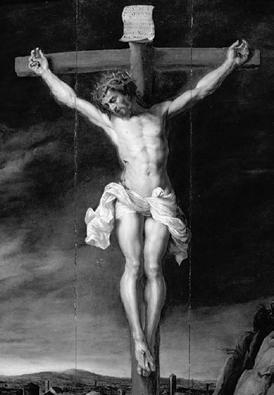
Testament—in the prophets or in the Psalms—is often wrathful, but in the end is always merciful. In the New Testament, divine mercy comes into the center of the picture. The Cross can be taken as a symbol of wrath the energy of which is put in the service of redemption.
While other examples of ways in which Christianity affirms the person could be given, such as its understanding of Paul’s agape, which “bears all things, believes all things, hopes all things, endures all things,” rather than Plato’s fundamentally impersonal eros, enough has been said to put before us the question: Is there any salvation from the nothingness engulfing us other than that offered by the crucified Christ? There does not appear to be. This is to say, not that all but Christians are lost, but that Christ on the Cross—what Jurgen Moltmann called “the crucified God”—is, for the entire human race, the heart of the matter. In the final analysis, all human hope rests on that God.
Dr. Glenn E. Tinder is a professor emeritus of political science at the University of Massachusetts, Boston. He is the author of several books, including Community: Reflections on a Tragic Ideal, Against Fate: An Essay on Personal Dignity, The Political Meaning of Christianity, and most recently, Liberty: Rethinking an Imperiled Ideal. His article, “Can We Be Good Without God?” in the Atlantic Monthly (December 1989) is one of the most requested reprints in the history of the journal. He received his BA from Pomona College, an MA from Claremont Graduate School, and a PhD from the University of California, Berkeley.
Christ on the Cross, by Jan van Boeckhorst.
F LATTE n I n G
The of the eaRth
How Two Men Forged the Conflict between Science and Religion from Bad History
by Charles Clark

Writing in 1609, Johannes Kepler exhorted the student of astronomy, “I urge my reader… Let him join with me in praising and celebrating the wisdom and greatness of the Creator, which I disclose to him from the deeper explanations of the form of the universe.”1 The connection Kepler draws between praising God and explaining the universe, that is, between religious practice and scientific inquiry, seems out of place in our contemporary discourse. Nonetheless, in his Astronomia Nova Kepler presented the first scientific proofs of the Copernican cosmological model, while at the same time urging the reader to “recognize the well-being of living things throughout nature, in the firmness and stability of the world so that he reveres God’s handiwork” and to “recognize the wisdom of the Creator in [the universe’s] motion which is as mysterious as it is worthy of all admiration.”2
Four centuries later, the synthesis of religion and science found in Kepler’s work is rare and marginalized. In the mainstream, scientific atheists like Richard Dawkins and Daniel Dennett write polemics against religion, decrying it as obsolete and anti-intellectual, while religionists, especially conservative Christians,
Medieval map of a round Earth.

push back with attacks on many of modern science’s leading theories. Extremists on both sides believe that religion and science are locked in a battle for the modern mind and that no acceptable compromise exists.
However, this conflict thesis is a relatively recent development. The writings of many whom we retrospectively call scientists, including Kepler, Copernicus, Bacon, Galileo, Descartes, Pascal, Newton, Faraday and many others, themselves believed that theology was relevant to their scientific investigations. Religion was not an external imposition but a key part of the mental landscape of early modern scientists. They would have reacted with puzzlement to the modern suggestion that they should have kept the science and religion separate.
Extremists on both sides believe that religion and science are locked in a battle for the modern mind.
Where, then, did the notion that religion and science are inherently opposed to one another originate?
In Reconciling Religion and Science, Peter J. Bowler writes, “The claim that the advance of science necessarily brings it into conflict with established religious
beliefs was advanced most energetically in the late nineteenth century by those who believed that science was the vehicle by which a new, secular view of the human situation would be established.”3 Thus, the idea that religion and science are fundamentally opposed is not a product of scientific discovery, but rather of the naturalist philosophy that began to influence scientific theory in the early 19th century. The conflation of science with naturalism, that is, the philosophical outlook that matter is all that exists, resulted in the idea that science was the only way to know truth. The trajectory of history, therefore, began to be caricatured as one in which the theological and philosophical were gradually supplanted by the scientific. Bowler affirms, “The exponents of scientific naturalism believed the conflict was inevitable because religion was wedded to traditional dogma while science offered a new route to the truth that inevitably exposed the inadequacies of past ideas. This was a war that science was bound to win because it was the only reliable source of information.”4
Having presented the general philosophical outlook that promoted the conflict thesis, Bowler identifies its
At the beginning of his History of the Conflict between Religion and Science, Draper sets the tone for the stories he will narrate. He writes,
John William Draper two primary representatives. He says, “The metaphor of a ‘war’ between the two areas was projected most explicitly by J.W. Draper’s History of the Conflict between Religion and Science (1874) and A. D. White’s History of the Warfare of Science with Theology (1896).”5 So, how and why did Draper and White create the perceived dichotomy of religion and science? An examination of their works indicates that they rewrote history, popularizing many myths that persist even today, and in the process, they instigated the struggle that they claimed had begun hundreds of years before.
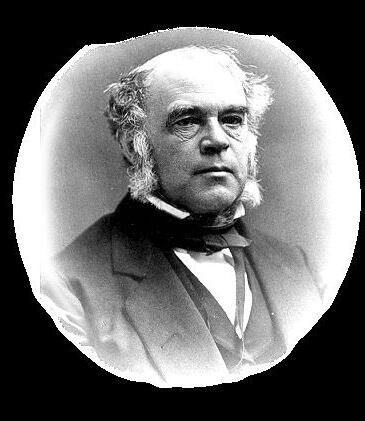
The history of Science is not a mere record of isolated discoveries; it is a narrative of the conflict of two contending powers, the expansive force of the human intellect on one side, and the compression arising from traditionary faith and human interests on the other.6
Any serious reader of history should immediately be put on guard by these statements. The tidiness with which Draper intends to narrate the complex development of Western science and its interaction with the enormous, intricate fabric of Christian theology and religious practice seems unrealistically simplistic. Such a reductionist perspective must naturally ignore the political, economic, and social aspects of the historical events in question; since it promises that the said events are concerned only with the religious and the scientific. Draper intends to reduce approximately a millennium of human history with all its complexity to a chess game between hastily drawn caricatures of Religion and Science.
Draper’s book… reshaped the history of science into a simple plot in which the evils and ignorance of religious dogma sidetracked the march of human knowledge and the natural progress of scientific truth…science had fought religious bigotry, like some David and Goliath, to come out shining in the cause of human knowledge and the final realization of glittering truth.8
Of all of the myths that Draper and White helped to popularize, one of the most persistent is that of medieval belief in the flat earth. According to the myth, after all of the scientific achievements of the classical Greeks and Romans were lost in the Dark Ages, the inhabitants of Europe reverted to the archaic belief that the world was flat. This erroneous belief was supposedly founded upon the church’s insistence on literal interpretations of the Bible. Then, according to Draper and White, Christopher Columbus sets out to prove that the world is round by finding a westward passage to the East Indies, but he must first contend with the powerful church authorities who hurl accusations of heresy before his expedition is eventually funded, and he goes on to discover the New World.
Draper and White ignore this evidence entirely and choose to present only those facts that support their claims.
Some version of this narrative continues to be taught to school children today. Many of us can recite this traditional poem, a staple of elementary primers:
Furthermore, Draper admits that his approach is a novel one, as he says, “No one has hitherto treated the subject from this point of view.”7 Why, if the battle lines between science and religion had been drawn as clearly as Draper intends to draw them, had historians failed to notice for almost a millennium? If a war between religion and science had been raging, it was an invisible war. Christine Garwood recognizes Draper’s reductionist viewpoint. She writes,
In fourteen hundred and ninety-two, Columbus sailed the ocean blue. He took three ships with him, too, And called aboard his faithful crew. Mighty, strong and brave was he As he sailed upon the open sea. Some people still thought the world was flat! Can you even imagine that?
Draper premises his argument concerning medieval flat-earthism on the claim that “An uncritical
observation of the aspect of Nature persuades us that the earth is an extended level surface.”9 He therefore concludes that the inhabitants of medieval Europe naturally believed that the earth was flat. Draper does not explain why he assumes that all observations of that period were uncritical or how the scien tific knowledge of the classical past was so thoroughly obliterated despite the preservation of scientific texts in monasteries throughout Europe. Instead, Draper goes on to credit the Church with the reinforcement of the popu lation’s natural ignorance. He writes, “As to the earth, [the Church Fathers] af firmed that it is a flat sur face, over which the sky is spread like a dome, or, as St. Augustine tells us, is stretched like a skin.”10
Unfortunately, this ac count of the Church’s will ful suppression of scientific inquiry and of the medieval be lief in the flat earth is almost en tirely fictional, a fact of which Draper and White should have been well aware. A comparison of their claims with the facts indicates that they were either particularly incompetent historians or willful deceivers of their readers. As Garwood makes clear,
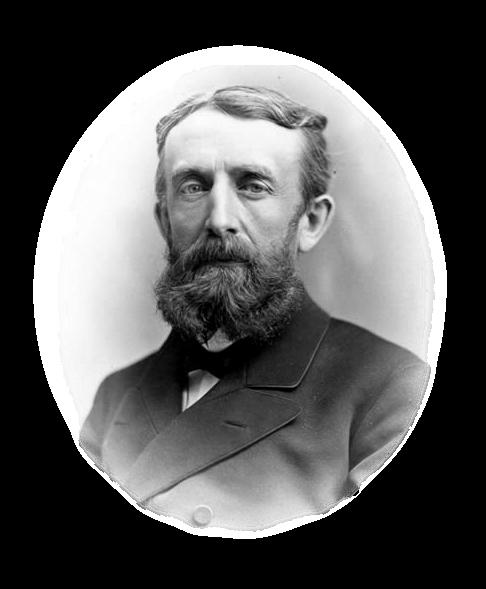
of pagan philosophy with their apparent contradictions in Scripture. As he often does, Augustine demonstrates that if read allegorically, the Bible does not necessarily contradict facts attested by secular disciplines. This position is virtually the opposite of that credited to him
White follows in Draper’s footsteps not only by adopting the conflict thesis but also by committing many of the same factual distortions as his predecessor. Concerning the flat earth myth, he retraces Draper’s argument and commits many of the same historical inaccuracies. However, he does acknowledge that some well educated medieval Christians were aware of the earth’s sphericity. Unfortunately,
The conflict model…led him seriously to overstate the extent of flat-earth belief, both in terms of the number of believers and the timescales involved. His set-piece concludes with the ill-judged statement: it is only ‘as we approach the modern period’ that ‘we find [the] truth [of the globular theory] acknowledged by the vast majority of thinking men’, an estimate incorrect by twenty centuries or so.12
All of the most widely renowned and distributed authors of the early medieval period were in firm agreement [that the world was spherical]...They included St. Augustine…who confirmed his belief in a spherical earth in a number of writings… His emphasis on an allegorical rather than literal reading of the scriptures naturally extended to the shape of the earth, and he argued that depictions of a flat earth with the sky spread over it like a tent were simply metaphors or figures of speech.11
This account of the Church’s willful suppression of scientific inquiry and of the medieval belief in the flat earth is almost entirely fictional.
Like Draper, White is guilty of a reductionist historical perspective that prevents him from providing an accurate or comprehensive discussion of his subject. Garwood observes that in White’s work “medieval flatearth thinking again played a notable role as a prime example of scriptural literalism derailing ‘natural’ progress towards scientific truth.”13
In this case, Draper brazenly abuses his historical source. By taking St. Augustine’s words regarding the shape of the earth out of context, Draper makes him appear to take a position of Biblical literalism which Augustine, an experienced rhetorician, opposed on the grounds that it distracted from Scripture’s intended meaning. The original context of St. Augustine’s words appears in the thirteenth chapter of his Confessions. His argument is concerned with reconciling the teachings
The real inspiration for the flat earth myth as perpetuated by Draper and White, particularly the heroic exploits of Christopher Columbus against the bigoted religionists, was none other than “beloved storyteller Washington Irving (1783-1859), who loved to write historical fiction under the guise of history.”14 Jeffrey Burton Russell writes that, “No one before the 1830s believed that medieval people thought that the earth was flat,”15 but with the publication of Irving’s Columbus: His Life and Voyages, the flat earth myth
Andrew Dickson White
entered the American consciousness, where it persists to the present day. Russell exposes Irving’s counterfeit historical narrative, saying,
It was he who invented the indelible picture of the young Columbus, a “simple mariner,” appearing before a dark crowd of benighted inquisitors and hooded theologians at a council of Salamanca… “Irving, scenting his opportunity for a picturesque and moving scene,” created a fictitious account of this” nonexistent university council” and “let his imagination go completely...the whole story is misleading and mischievous nonsense.”16
Nevertheless, Irving’s myth provided a valuable foundation on which Draper and White built their case for the conflict of religion and science. According to modern scholars, the case of medieval belief in the flat earth is closed. Garwood writes that in the medieval period, “Culture was suffused with images of terra rotunda to such an extent that serious promulgation of flat-earth belief would become little more than a waste of time.”17 Indeed, one may readily discover medieval representations of the globular earth preserved in both literary and visual sources. Two such examples are Dante’s Divine Comedy, which narrates a descent into hell and a reemergence on the other side of a spherical world, and the numerous representations of rulers holding globes, which symbolize their power over the earth. However, because it provides an irrefutable objection to their version of history, Draper and White ignore this evidence entirely and choose to present only those facts that support their claims.
Further examples of Draper and White’s distortion of history in order to substantiate the conflict thesis include the myth of Galileo as a martyr for science and the imprisonment of Roger Bacon. In the case of Galileo, his trial concerned his mocking and insulting portrayal of the Pope Urban VIII, his former patron, rather than his scientific discoveries.18 In the case of Roger Bacon, one of the first proponents of the experimental method, he was not, as White alleged, imprisoned on account of his scientific ideas, but rather on account of his criticisms of the opulence of the church. As modern historian of science David Lindberg writes, “[Bacon’s] imprisonment, if it occurred at all (which I doubt) probably resulted with his sympathies for the radical ‘poverty’ wing of the Franciscans (a wholly theological matter) rather than from any scientific novelties which he may have proposed.”19 In regards to his scientific endeavors, the church was generally supportive: it was Pope Clement who commissioned Bacon’s three major works.
Considering its lack of basis in historical fact, the enduring popularity of the conflict thesis is somewhat surprising. Garwood notes, “The military metaphor
According to modern scholars, the case of medieval belief in the flat earth is closed.
Columbus, by Sebastian del Piombo, 1519.
employed by Draper and White was propaganda par excellence, and it seized the popular imagination at a time when Western culture was awash with the rhetoric and imagery of war.”20 Moreover, the conflict thesis is appealing for its simplicity, since it makes the complex reality of the historical events it reduces more easily digestible. Finally, it served its purpose as ammunition against the religious worldview well, and secular-
ists have ensured that it remains fixed in the public consciousness.
Draper and White left to the world a legacy of bad history and a fallacious framework for understanding the relationship between science and religion. The internalization of the conflict thesis fomented animosity where cooperation between the two disciplines had once flourished. The long tradition of scientific achievement by thinkers equally interested in spiritual matters has been largely forgotten, leaving the modern student with only half the picture. While Newton’s Principia Mathematica remains the seminal work of classical mechanics, his biblical commentaries gather
dust. Abbot Gregor Mendel’s pea plants flourishing in his monastery’s garden are revered for their contribution to the modern miracle of genetics but stripped of their spiritual setting. Acknowledging the lack of historical evidence for the conflict of science and religion is the first step in recasting the dialogue between the two in a more progressive mode.
1 Johannes Kepler, New Astronomy, Trans. William H. Donahue (Cambridge: Cambridge University Press, 1992) 65.
2 Ibid.
3 Peter J. Bowler, Reconciling Religion and Science: The Debate in Early Twentieth-Century Britain (Chicago : University of Chicago Press, 2001) 10.
4 Ibid.
5 Ibid.
6 John William Draper, History of the Conflict between Religion and Science (New York: D. Appleton and Co., 1881) vi.
7 Ibid. vi-vii.
8 Christine Garwood, Flat Earth: The History of an Infamous Idea (New York: Thomas Dunn Books, 2008) 11.
9 Draper 152.
10 Ibid. 63.
11 Garwood 24.
12 Ibid. 13.
13 Ibid. 12.
14 Jeffrey Burton Russell, Summary of The Myth of the Flat Earth, <http://www.veritas-ucsb.org/library/ russell/FlatEarth.html>.
15 Ibid.
16 Ibid.
17 Garwood 26.
18 See Apologia issues I & II, for the Galileo Revisited Series.
19 D.C. Lindberg, “Medieval Science and Its Religious Context,” Osiris 10 (10): 60-79.
20 Garwood 13.

Charles Clark ‘11 is from Murfreesboro, Tennessee. He is a Classical Archaeology major and an English minor.
Cosmographicum by Kaite Yang ‘09. Commissioned 2009.
The “Passions”
of J.S. B ACH : Comments on the
Cross
by Emily DeBaun
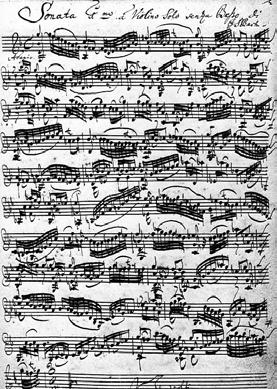
The regulation of church music over the past several centuries has perpetuated the idea that sacred music is written obligatorily rather than expressively. Superstitious composition rules, such as banning dissonant “Devil Chords” and preventing pieces from ending in minor keys, appear to stifle a composer’s creativity.1 Such regulation suggests that the Biblical lyrics of church pieces are not expressions of composers’ theology but exist merely to satisfy the demands of oppressive employers. This implies that sacred music can be performed today with little consideration of lyrical content, and a piece can be appreciated for its musical content alone. Examining the sacred music of Baroque composer Johann Sebastian Bach, however, reveals that these conclusions are not necessarily valid. Bach’s faith drove the composition of
works intended to holistically communicate the message of the Gospel.
Bach wrote an astounding 1,127 pieces during his life (1685–1750), a stunning testament to his creativity and industry.2 His prolific composing career was more than a matter of artistic genius; it was a product of his Christian faith. Bach was raised a Lutheran in
His prolific composing career was more than a matter of artistic genius; it was a product of his Christian faith.
post-Reformation Germany and was an avid student of the Bible and other religious writings. The many annotations in his well-worn Bible reflected his desire to
Manuscript in Bach’s hand.
serve God through music, and he declared at the age of twenty-three that his life’s mission was to write “Wellregulated church music to the glory of God.”3 This calling, along with his zeal for Scripture and immense musical talent, led Bach to write music drenched with theological meaning, much of which points directly to Jesus’ crucifixion. Specifically, Bach’s “St. John’s Passion” and “St. Matthew’s Passion” boldly explore the meaning of the cross.
rainbow. The lyrics of this particular piece are translated from German “Consider how his back so stained with bleeding in every portion doth heaven imitate . . . the world’s most lovely rainbow, arching, as God’s own
Bach typically uses flats to represent the mundane, human world and sharps to represent the divine, in this specific context Jesus during his crucifixion.
Cross-like structures appear throughout Bach’s music. He has been called “The supreme composer of the Christian Cross, itself a metaphor at once vertical and horizontal,”4 and his writing is simultaneously harmonically and rhythmically complex.5 In considering the details of his work, Bach’s music includes chiastic structures, note patterns appearing as visual crosses in sheet music.6 Also, Bach once explained of his piece “Symbolum” that the resolution of a particular dissonant chord is really “Christ [absolving] the cross bearers of their crosses.”7 Indeed, the cross concept permeates Bach’s pieces.
Bach’s “St. John’s Passion” and “St. Matthew’s Passion” not only reference Jesus’ crucifixion but also examine its implications. These massive choral works were written in 1724 and 1727, respectively, for Good Friday church services. These two pieces lyrically and musically describe the nature of the cross.
“St. John’s Passion” is said to reflect Bach’s personal exploration of the Gospel of John.8 It focuses on the cross’ connection with the forgiveness of sin, Jesus’ oneness with Yahweh and Christ’s glory through suffering.9
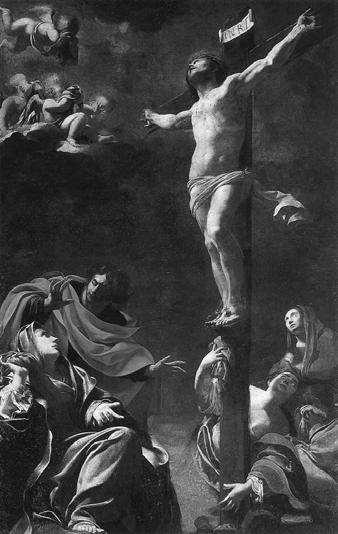
In “St. John’s Passion,” Bach emphasizes the forgiveness of sin through the artistic description of a
sign of blessing stands!”10 Like God’s rainbow promising peace to Noah in the Old Testament, the rainbow described in these lyrics promises that Jesus’ blood is “God’s own sign of blessing.”11 Simultaneously, Bach “Paints the rainbow vividly,” using a mellifluous twisting scale pattern.12 The cohesive music and lyrics of the rainbow symbol explain the cross’ ability to annul sins and reconcile mankind to God.
The rainbow is also one of the many ways “St. John’s Passion” connects Jesus’ cross with Yahweh, the God of the Old Testament. Bach confirms this link in the opening lyrics of the composition, translated “Lord, our Lord’s glory in all the land is wonderful!”13 These words imitate the opening phrase of Psalm 8 “O Lord, our Lord, how majestic is your name in all the earth!”14 The topic of the composition, Jesus’ crucifixion, is introduced by praising Yahweh. This connection is brought even further when a specific musical phrase is first concluded with a lyric reference to Yahweh, and later repeated identically, but with a lyric reference to Jesus “The Incarnate Word.” Musical and lyrical parallelism connect the cross with Yahweh; they show Bach’s belief in Jesus’ divinity.15
Crucifixion, by Simon Vouet, 1622.
In “St. John’s Passion,” Bach further connects Yahweh and Jesus to show that Jesus is most glorified, as the Son of God, in his crucifixion. This is particularly evident in Bach’s “Jesus of Nazareth” chorus, a brief melody that appears several times through the composition with varying lyrics. The initial melody has lyrics “Jesus of Nazareth.” Later, its lyrics question Jesus’ identity, appearing multiple times in the part of the composition describing Jesus’ trial before Pilate. Finally, the lyrics reflect the “Royal inscription” given to Jesus when crucified: “Jesus of Nazareth, King of Jews.” After his identity has been questioned throughout the piece, the “Jesus of Nazareth” choruses resolve in declaring Jesus to be divine royalty.16 Jesus is most glorious in his situation of most agony. This lyrical transformation takes place along with a transition in key signature. The “Jesus of Nazareth” choruses go from being in tonalities with many flat notes to tonalities with sharp notes.17 Bach typically uses flats to represent the mundane, human world and sharps to represent the divine, in this specific context Jesus during his crucifixion.18 Bach sets the cross as Jesus’ place of exaltation in spite of his physical suffering.
Whereas “St. John’s Passion” focuses on the aspects of the cross that have the greatest personal importance for Bach, “St. Matthew’s Passion” offers a more strictly Lutheran interpretation of Jesus’ crucifixion. Bach was well educated in Martin Luther’s teachings, and he seems to have used portions of Luther’s “How to Meditate on the Passion of Christ” as the basis for the presentation of the cross in “St. Matthew’s Passion.”19 The components of the cross that Bach emphasizes in this composition are Jesus’ suffering, love for mankind and offer of salvation.20
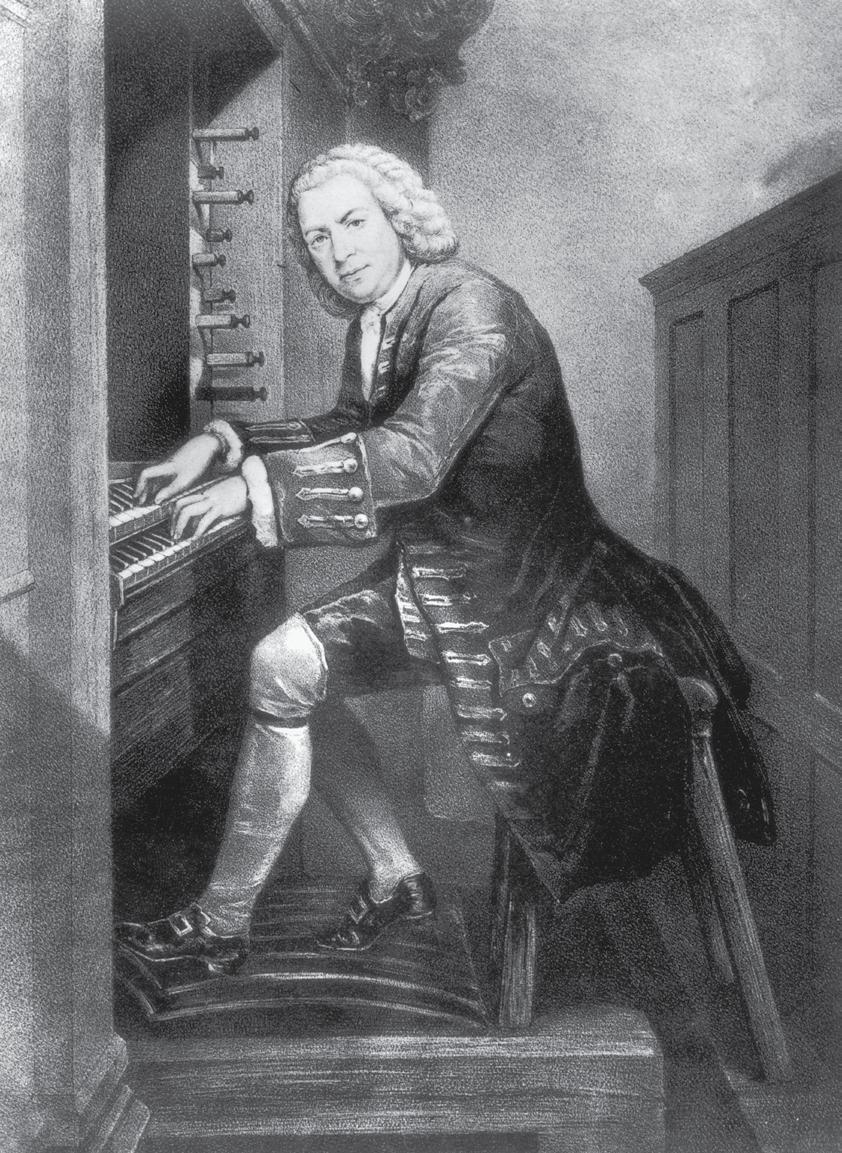
Martin Luther believed “When we meditate on the Passion of Christ in the right way, we see Christ and are terrified at the sight.”21 Bach invokes such a sense of fear in his musical depiction of the crucifixion in “St. Matthew’s Passion.” Throughout the piece, low instruments’ short, fast notes signify “Jesus’ spiritual torment.”22 The movement “O Golgotha” modulates
into flatter and flatter tonalities, symbolizing the rebellion of the sinful world at Jesus’ crucifixion. Like Luther, Bach incites fear of God by a focus on the cross’ torment.23
In “St. Matthew’s Passion,” Bach also expresses Luther’s entreatment to “Look how full of love God’s heart is for you. It was this love that moved Him to bear the heavy load of your conscience and sin.”24 Bach uses oboes to remind listeners of the connection
J.S. Bach at his organ.
between Christ’s love and the cross; oboes’ sweet timbre counters the tumult of fearsome movements like “O Golgotha.” Most notably, oboes are used in the movement “From Love” with other high-pitched instruments to create a supportive musical texture similar to a typical Baroque accompaniment, or “basso continuo.” A typical “basso continuo” consists of basses and other low instruments, but using high wind and string instruments for this function gives the movement an otherworldly air. Scholars interpret this as a musical depiction of Christ’s love and protection for mankind, and through this Bach emphasizes Christ’s love as an important aspect of the cross.25
Bach’s work is more than an outburst of musical creativity; it is a thoughtful expression of a deep faith.
In light of Jesus’ suffering for love, Luther encourages hearers to “Take your sins and throw them on Christ. Believe with a joyful spirit your sins are His wounds and sufferings. He carries them and makes satisfaction for them.”26 In “St. Matthew’s Passion,” Bach echoes these Lutheran sentiments in the movement “See Jesus,” which encourages believers to search for atonement in the cross. In this movement, lyrics describe Jesus’ outspread arms and nodding head and the arms figuratively embrace onlookers. The nodding head confirms believers’ forgiveness and salvation, which is Bach’s expression of Luther’s concluding concept.27
Bach’s theology permeates many layers of his “St. John’s Passion” and “St. Matthew’s Passion.” As Bach scholar Martin Geck puts it, “Bach did not use the words of the Bible just for a few oratorical works but … set to music its rhymed paraphrases with the utmost emphasis and unfailing energy.” He calls this “Not craft or aestheticism but credo.”28 Essentially, Bach’s work is more than an outburst of musical creativity; it is a thoughtful expression of a deep faith. This fact challenges today’s performers and listeners to consider the religious intent behind such classical music. In these two pieces, music and meaning are inseparable. To truly appreciate Bach’s artistry, it is necessary to consider his music’s spiritual purposes, through which historical sacred music comes to life. Church music can no longer be viewed as merely aurally pleasing; it is a powerful medium of theological instruction and spiritual expression.
1 Finlo Rohrer, “The Devil’s Music,” BBC News, <http://news.bbc.co.uk/2/hi/uk_news/ magazine/4952646.stm>.
2 Jan Hanford and Jan Koster, “J.S. Bach: Complete works by BVW Number,” The J.S. Bach Home Page, <http://www.jsbach.org/bwvlist.html>.
3 Patrick Kavanaugh, Spiritual Lives of the Great Composers (Grand Rapids: Zondervan Publishing House, 1996) 18–20.
4 Wilfrid Mellars, Bach and the Dance of God (New York: Oxford University Press, 1980) 9.
5 Ibid. 9.
6 Kavanaugh 21.
7 Martin Geck, Johann Sebastian Bach (Boston: Harcourt, 2006) 656.
8 Eric Chafe, Tonal Allegory in the Vocal Music of J.S. Bach (Berkeley: University of California Press, 1991) 276.
9 Ibid. 278, 283-4.
10 Geck 663.
11 Chafe 278.
12 Geck 664.
13 Chafe 283.
14 Psalm 8:1, The Holy Bible: English Standard Version (Wheaton: Good News Publishers, 2001).
15 Chafe 283.
16 Ibid. 286-97.
17 Ibid. 296.
18 Ibid. 19.
19 Ibid. 276-7.
20 Ibid. 348-9.
21 Martin Luther, “How to Meditate on the Passion of Christ,” trans. Paul T. McCain (2004) 2.
22 Chafe 351.
23 Ibid. 348.
24 Luther 6.
25 Chafe 350–1.
26 Luther 5.
27 Chafe 341.
28 Geck 654.

Emily DeBaun ‘12 is from Sandown, New Hampshire.
Reason
by Peter Blair
Faith &
The Thought of Thomas Aquinas
In the orthodox view, Christianity does not have a monopoly on truth. While Christianity provides the only entirely correct account of the universe, Christianity’s perfect truth does not entail the total falsity of all other accounts, and though they are necessarily false insofar as they contradict Christianity, truth can be found in other religions and philosophies. For this reason, reconciliation with other systems has characterized the Church from its beginnings. Christianity’s engagement with non-Christian thought proceeds from the Christian belief that reason and faith are complementary, not oppositional. Thomas Aquinas’ synthesis of Aristotle and Christianity is a vital chapter in this engagement. His interaction with the philosophy of Aristotle demonstrates both the harmony of reason and faith and the oneness of truth, which are both central to the Christian intellectual tradition.
Thomas Aquinas came from a powerful medieval family related to the Hohenstaufen Holy Roman emperors.1 Despite his powerful position, Aquinas chose to devote his life not to power or wealth but to God, becoming a priest in the religious order of St. Dominic. The Dominicans were a new order in the Catholic

Church, and they and the Franciscans had started a reform movement characterized by active outreach and voluntary poverty that rebuked the atmosphere of religious complacency and decadence which they perceived in the parts of the Church.2 During his priestly training, Aquinas was influenced by the philosophical interests of Albertus Magnus, and he began to write philosophical and theological works of his own.
Aquinas is still studied in philosophy classes for his brilliant synthesis of Christianity and the philosophy of Aristotle. The prevailing mode of Christian thought before Aquinas was Platonism, due to the influence of Augustine of Hippo, an early Christian theologian who had been a Platonist prior to his conversion. He, along with several other early thinkers, accomplished a synthesis of Plato and Christianity, adapting Platonic language and concepts for Christian thought.3 In the tradition of Augustine, Aquinas resolved to accomplish a new synthesis of Christianity and ancient philosophy, which he believed could convey the Christian religion to his contemporaries more effectively and precisely than the predominant Platonic model.
Until shortly before Aquinas’ time, Aristotle was largely unknown in the West, though his works were
Portrait of Thomas Aquinas.
preserved in the East, especially in Alexandria, by Jewish and Muslim scholars. It was through contact with these thinkers that Aristotle became known in the West.4 This fact made some Christians doubly dubious towards Aristotle, as he both challenged Plato and came mediated through Jewish and Muslim sources. However, Aquinas, encouraged by Albertus Magnus, embraced Aristotle. He became a prominent defender of Aristotle and incorporated Aristotle’s thought and language into his philosophy and theology.
Aquinas felt comfortable undertaking such incorporation because, as he said, “All truth is one.”5 He argued that what we learn from the natural world through science and philosophy, provided it is unquestionably true, can never contradict that which we learn from revelation, that is, directly from God.6 He compared Scripture and reason to two books, “the book of revelation” and “the book of nature,” which were both “written” by God and consequently compatible. Therefore, though Aquinas was well educated in the Bible and the writings of earlier theologians, he preferred to base his arguments in logic and philosophical reasoning that could appeal even to nonbelievers.7 He did so confident in his faith that reason and philosophy would confirm and not contradict the revelation of God.
the importance of the natural, physical world. By adopting a position nearer to Aristotle’s, Aquinas affirmed, for example, that the soul was in close union with the body. This view inevitably elevated the value placed upon the body and the natural world.9
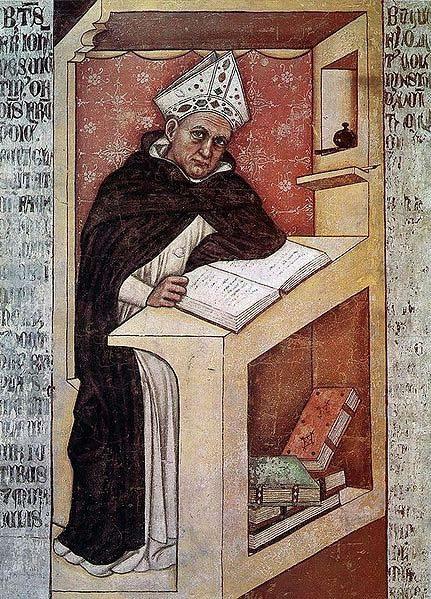
One of the most important shifts in Christian thought associated with Aristotle’s influence on Aquinas is an affirmation of the concrete, physical reality of the human condition.8 Like Plato himself, Christian Platonists tended to emphasize the subjective and the abstract, the realm of purely spiritual forms and ideas. This philosophical emphasis could translate into a felt contempt for matter and the physical aspects of humanity. This contempt in turn sometimes led to behavior that was excessively ascetic and theology that ignored the physical or even saw it as evil. Aristotle, however, had disagreed with Plato and had emphasized
This greater respect for the physical world had profound philosophical implications. The starting point of the philosophies of both Aristotle and Aquinas was what they perceived with their senses. Thus Aquinas wrote that, “All our intellectual knowledge takes its rise from the senses.”10 Both Aristotle and Aquinas believed that all philosophy should start with what we know about existing objects. They believed that there are universal and inescapable common starting points to human thought that are grounded in sense perception, and that these common points are likely to point toward the truth. The philosopher’s task, then, is to identify these common starting points underneath the seemly irreconcilable diversity of human thought and to build conclusions from there.11 This shift in thought led to a greater appreciation of the created world, a perspective which had both theological and cultural significance.12 It helped people to understand Christ’s claim to be divinely human, and it also supported Church sponsorship of scientific research that occurred throughout the Middle Ages and Renaissance.
Aquinas’ work is also steeped in the Aristotelian notion of teleology. Teleology is the idea that everything is directed to some proper goal or end. First Aristotle, then Aquinas, distinguished between the concepts of actuality and potentiality. Aristotle described actuality as the extent to which a being’s potential has been realized and potentiality as the measure of a being’s unrealized potential.13 Plants have the inherent potential to grow and humans to flourish, and growth and flourishing are the ends toward which their lives are directed. The goal of every life is reached as its potential
Thomas Aquinas in study.
is actualized. This distinction between potentiality and actuality and its relation to Aristotle’s teleology is prominent throughout Aquinas’ thought, and he used these concepts in many important ways.14 We take it for granted today that every academic discipline has its own legitimate ends, its own purpose or goal: science to discover truths about the natural world, history to learn about the past, and so on. However, this idea was a matter of debate in Aquinas’ time, as many philosophers thought that the purpose of all disciplines was directly theological. Following Aristotle’s teleology, Aquinas maintained that all academic disciplines, while ultimately relating to God, had their own separate and immediate ends.15 This conception of teleology made possible the university as we know it today. Additionally, Aquinas used these ideas to describe God. Aquinas maintained that God was pure actuality without potentiality. Since God is perfect, Aquinas argued that he cannot change or become more, and he is therefore fully actualized. Aquinas believed that God has no teleological end to reach but is instead the end towards which all else is directed.16
Another result of Aquinas’ interaction with Aristotle was his five proofs for the existence of God, known as the “Five Ways.” These arguments, and modern variations of them, are still discussed and debated today in many introductory philosophy courses. They remain some of the most persuasive proofs for the existence of God ever constructed, and Aquinas shaped his arguments from the philosophical reasoning of Aristotle. One of these five proofs, called the “argument of the unmoved mover,” borrowed the concept of the prime mover from Aristotle. In book twelve of his Metaphysics, Aristotle argued that the fact of the universe demanded the existence of “something which moves other things without itself being moved by anything.”17 Aristotle believed that the universe was composed of an underlying essence and that the prime mover was the being that moved and organized this essence. Aquinas, centuries later, adapted this argument to argue that all things that move must have been put into motion by something else. However, because motion cannot infinitely regress with no starting point, there must have been at some point something which caused motion in something else but did not itself need a mover. Aquinas called this unmoved mover God.18
These examples of Aquinas’ engagement with Aristotle reflect his belief in the harmony of faith and reason and the unity of truth. There are many other examples of Aristotelian concepts and vocabulary in Aquinas’ work, especially in his metaphysics, epistemology, and moral theory. Like the examples above, they are important in their own right. However, more significant still is the fact that Aquinas embraced
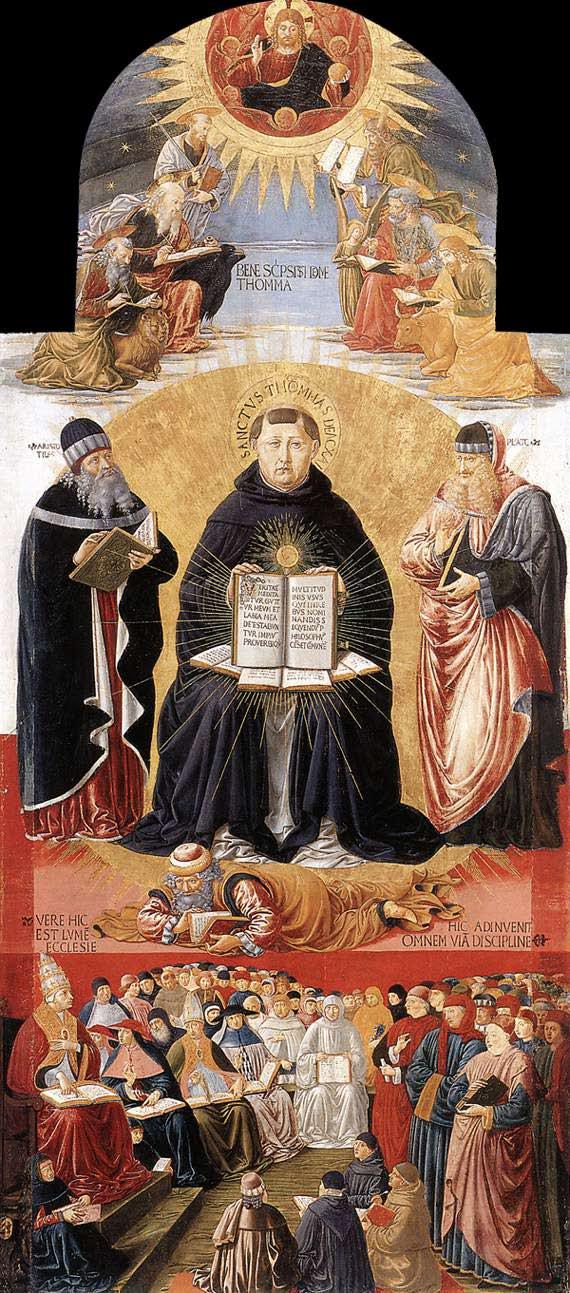
A montage celebrating Thomas Aquinas.
Aristotle’s work at all. Aquinas undertook the project in spite of objections because he firmly believed that rather than conflicting with each other, the scientific, philosophical, and theological areas of human thought form a whole, integrated, and coherent body of truth.
Aquinas’ theological system, a synthesis of the truths of the best philosophy and science of the time and the truths of Christian revelation, demonstrates that there
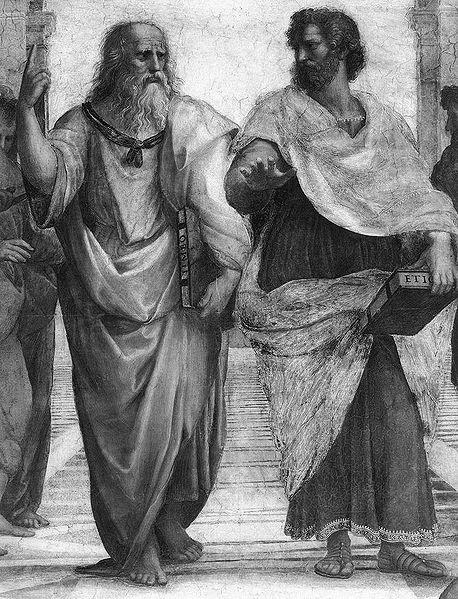
is only one truth and that all truth, whether of faith or of reason, is one.
Aquinas once said, “We must love them both, those whose opinions we share and those whose opinions we reject. For both have labored in the search for truth and both have helped us in the finding of it.”19 This statement exemplifies Aquinas’ practice of seeking truth by accepting truth and rejecting error regardless of its source, a practice which empowered him to integrate faith and reason. His synthesis of Christianity with the philosophy of Aristotle continues to influence the
trajectory of Christian thought. For example, in recent history theologians utilized Aquinas’ principals to synthesize Christianity and the philosophy of Immanuel Kant. Thomas Aquinas’ work, and the work he continues to inspire even today, demonstrates the intellectual flexibility of Christianity, the oneness of truth, and the convergence of faith and reason.
1 Ralph McInerny, St. Thomas Aquinas (Notre Dame: University of Notre Dame Press, 1982) 13.
2 G.K. Chesterton, St. Thomas Aquinas and St. Francis of Assisi (New York: Sheed and Ward Inc., 1923) 39.
3 Ralph McInerny, A Student’s Guide to Philosophy (Wilmington: ISI, 1999) 18.
4 Frederick Copleston, A History of Philosophy (New York: Imagine Books, 1962) 235.
5 Thomas Aquinas, Summa Theologica trans. Fathers of the English Dominican Province (New York: Christian Classics, 1981) 89.
6 Chesterton 70.
7 Ibid. 71.
8 Copleston A History of Philosophy (New York: Imagine Books, 1962), 307.
9 Ibid. 424.
10 Chesterton 148.
11 McInerny A Student’s Guide 33.
12 Chesterton 109.
13 Frederick Copleston, Medieval Philosophy (New York: Harper, 1961) 88.
14 Frederick Copleston, A History of Philosophy (New York: Imagine Books, 1962) 425.
15 Ibid. 317.
16 Thomas Aquinas, Summa of the Summa, ed. Peter Kreeft, trans. Fathers of the English Dominican Province (New York: Ignatius Press, 1990) 87.
17 Aristotle, Metaphysics, trans. John McMahon (New York: Prometheus Books, 1991) 89.
18 Thomas Aquinas, Summa Theologica, trans. Fathers of the English Dominican Province (New York: Christian Classics, 1981) 13.
19 Thomas Merton, Thomas Merton: The Essential Writings, ed. Lawrence Cunningham (New York: Paulist Press, 1992) 121.

Peter Blair ‘12 is from Newton Square, Pennsylvania. He is a Government and Classics double major.
Plato and Aristoltle in The School of Athens, Raphael, 1509–1510.
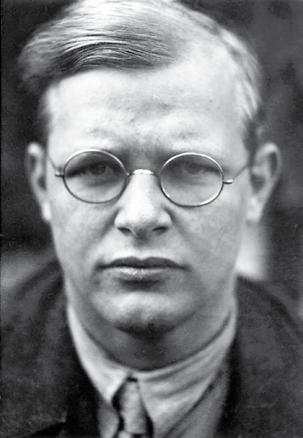
OGenuine Responsibility
Dietrich Bonhoeffer and the German Resistance
by Sarah White
n July 27, 1945, a memorial service radio broadcast from London to Berlin included the words, “We are gathered here in the presence of God to make thankful remembrance of the life and work of his servant Dietrich Bonhoeffer, who gave his life in faith and obedience to his holy word …”1 This announcement was the first that Bonhoeffer’s family and friends learned of his fate after weeks of anxious waiting. Dietrich Bonhoeffer was executed for the crime of resistance to the Nazi state less than a month before the fall of the Third Reich. Though he was safe in the United States on the eve of the Second World War, Bonhoeffer chose to return to Germany and share the fate of his fellow Christians in the difficult times he knew were coming. Because he believed that obedience to God is the foundation of ethics and the ultimate guide for Christian behavior, Bonhoeffer made the decision to take a moral and active stand against the Nazi regime.
Dietrich Bonhoeffer was born in 1906 to Karl Bonhoeffer, a well-known Berlin psychiatrist, and his wife Julie. At that time, more than 70% of Berliners considered themselves to be members of the Protestant Church, but it is estimated that only 5-7% attended church on a regular basis.2 Bonhoeffer’s family was in the latter group; they considered themselves Christians and taught their children basic theology but rarely attended church. Religion was not considered an important part of life in the Bonhoeffer household, but rather “A spirit of rational empiricism and liberalism most strongly characterized family life.”3 His older brothers followed their father into the sciences, but at a young age Bonhoeffer declared his determination to study theology. This decision baffled his family and led to several arguments with his brothers, who were unable to understand his decision to join an institution
that seemed to them weak and ephemeral. Bonhoeffer retorted, “If the Church is feeble, I shall reform it!”4
While studying at Berlin, Bonhoeffer became acquainted with the ideas of influential theologian Karl Barth, who “Demanded a revolution turning the attention of theology from human beings toward God in Christ.”5 At that time, the faculty of the university was dominated by a liberal theological movement that saw Christianity and the Bible as a cultural and traditional establishment, rather than as a living faith. Bonhoeffer, however, joined the theological movement that under the Nazi regime would come to be known as the Confessing Church, which held as its primary conviction that the Bible, and not man, is the highest authority for all Christians. As he studied, Bonhoeffer worked to form the theology that would later guide his decisions both before and during the war. He believed that the Church and the Christian community should not be relegated to the periphery of life, but become an essential part of the way people live. In Life Together he wrote,
Christianity means community through Jesus Christ and in Jesus Christ. No Christian community is more or less than this … What does this mean? It means, first, that a Christian needs others because of Jesus Christ. It means, second, that a Christian comes to others only through Jesus Christ. It means, third, that in Jesus Christ we have been … united for eternity.6
This belief in the importance of this community, which he called “The extraordinary, the ‘roses and lilies’ of the Christian life,”7 was a major part of what led to his break with the Nazi party.
Bonhoeffer’s great struggle for the integrity of the German Church began in 1933 when Hitler was
appointed Reich Chancellor and the Nazi party came into power. His first run-in with the new regime came only a few days after Hitler assumed power. Bonhoeffer gave a speech on the radio entitled “The Younger Generation’s Altered View of the Concept
“It is never in thinking of myself, but it is always in thinking of the call of Christ, that I shall be set free for genuine responsibility.”
—Dietrich Bonhoeffer
of the Fuhrer,” which distinguished between a leader and a misleader and was taken off the air before it was completed.8 This incident set the tone for Bonhoeffer’s future interactions with the new government.
Some of Bonhoeffer’s strongest objections to the Nazis stemmed from the anti-Semitism that was already evident in the early days of the regime. Stephen Plant writes, “Bonhoeffer was one of a very few within the Confessing Church who considered solidarity
organizations—including the Catholic and Protestant churches—under the central government.
Many German Christians viewed the consolidation of the Church under the Nazis positively, as a way to unite the “patchwork” of churches into “A single national Church.”12 Others, like Bonhoeffer, insisted that the church must remain separate from the state and be allowed to determine spiritual affairs without interference from secular authority.13 These two parties quickly separated as Hitler called for the election of a Reich Bishop. At first Hitler’s agenda was thwarted by the defeat of his candidate for the position. The results of this election, however, were soon overturned, and the state quickly took over the governance of the Church.14 One historian estimates that only 36% of pastors in the Berlin area were allied with the Confessing Church that stood in opposition to Hitler.15 Bonhoeffer was among them. He continued to preach against following Hitler unquestioningly, believing that such devotion ought to be reserved for God. He reminded his congregation,

German church rally with a banner reading, “The German Christian Reads the Gospel of the Reich.”
with the Jews, and not just Jews who had converted to Christianity, a matter on which the Church must stake its life.”9 For example, Bonhoeffer believed that the Church would be committing an act of heresy if it conformed to the Nazi regulation that banned Jews from holding civil office, which in Germany included the clergy.10 Bonhoeffer strongly opposed this ordinance, denying “That membership of a Church can ever be based on race.”11 This was not the only law that the Nazi state attempted to impose on the church. One of its first moves was an attempt to organize all German
God’s victory means … reducing the world and its clamor to silence; it means crossing through all of our ideas and plans, it means the Cross. The Cross above the World … The Cross of Jesus Christ, that means the bitter scorn of God for all human heights … [and] the rule of God over the whole world.16
He also lectured at the Berlin University, where he was now a professor, but his stance quickly made him unpopular with the Nazis and in the fall of 1936 he lost his license to lecture there.17 As conditions in Germany worsened, Bonhoeffer wrote, “Only one thing has force and permanence, and that is Christ Himself. Only he who shares in Him has the power to withstand and overcome. He is the centre and the strength of … the Church … but also of humanity, of reason, of justice and of culture.”18 He continued to work at a seminary known as the House of Brethren until being banished from Berlin less than two years later,19 and in 1941 he was denied the right to publish materials on the grounds that he was engaging in “Subversive activities.”20
During his time at the House of Brethren, Bonhoeffer wrote two books published in English as Life Together and The Cost of Discipleship. In The Cost of Discipleship, Bonhoeffer wrote,
Neither failure nor hostility can weaken the messenger’s conviction that he has been sent by Jesus … For this is no way they have chosen themselves, no undertaking of their own. It is, in the strict sense of the word, a mission.
With this the Lord promises them his abiding presence, even when they find themselves as sheep among wolves, defenseless, powerless, sore pressed and best with great danger. Nothing can happen to them without Jesus knowing of it.21
This foreshadowed the coming years in Germany. As the war was getting underway, Bonhoeffer had one last opportunity to escape the impending disaster. In June 1939, Bonhoeffer helped his sister and her Jewish husband to leave Germany and travelled with them to London before going on to New York. His friends urged him to stay where he would be safe, but Bonhoeffer refused. He wrote to one friend,
I have made a mistake in coming to America. I must live through this difficult period in our national history with the Christian people of Germany … Christians in Germany will face the terrible alternative of either willing the defeat of their nation in order that Christian civilization may survive, or willing the victory of their nation … I know which of these alternatives I must choose; but I cannot make that choice in security.22
Though this choice was clear to Bonhoeffer, he struggled with the decision of how he would be involved in the resistance movement. Ultimately, he concluded, “It is never in thinking of myself, but it is always in thinking of the call of Christ, that I shall be set free for genuine responsibility.”23
Bonhoeffer spent some of his time during the years of the war writing his book Ethics. André Dumas says, “The writings in the second period of Bonhoeffer’s life are markedly different in tone from those of the first. No longer is he writing university theses … Instead he is preaching to church people about confessional obedience in the Nazi era. Nazism could easily put up with harmless ‘being’ of faith so long as it was not expressed in the ‘act’ of obedience.”24 Bonhoeffer believed in the “immediacy” of obedience, that is, that Christians are called to obey Christ without hesitation. In The Cost of Discipleship, he wrote, “The call of Jesus made short work of all … barriers, and created obedience. That call was the Word of God himself, and all that it required was single-minded obedience.”25 He also emphasized the commonality of obedience and faith as inseparable because each proceeds from the other, and thus both are essential to the Christian life.26 This decision to remain always obedient is what drew Bonhoeffer to join the resistance even though his life was at stake.27 Despite the danger of his position, Bonhoeffer found peace in “Following Jesus,” which he described as “A discipleship which will liberate all mankind from all man-made dogmas, from every burden and oppression, from every anxiety and torture which afflicts the conscience.”28 Bonhoeffer chose his course and Ethics
was never completed, for he was still working on the manuscript on the day of his arrest.
Bonhoeffer was not a soldier, but in 1941 he became a civilian member of the German Military Intelligence.29 Operating within the Nazi organization, he was able to pass along information to the Allies as well as help Jews leave Germany for Switzerland.30 As the years went on, he became more and more involved in the resistance movement. He wrote in Ethics, “Conscience is unwilling to sacrifice its integrity to any other value, and it
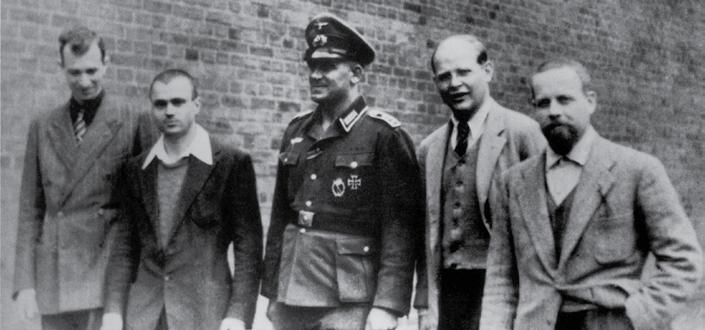
therefore refuses to incur guilt for the sake of another man … A responsibility which would oblige a man to act against his conscience would carry within it its own condemnation.”31 Bonhoeffer’s conscience impelled him to the decision to become involved not only in the initial open resistance to Hitler but also in a life of secret opposition. As the Second World War progressed and the Nazis continued to win, Bonhoeffer knew that the resistance had little chance of a swift victory.
On April 5, 1943, Bonhoeffer was arrested for evading conscription and helping Jews to escape from Germany. While in jail, Bonhoeffer continued to write prolifically, producing poetry and a play in addition to
On April 5, 1943, Bonhoeffer was arrested for evading conscription and helping Jews to escape from Germany.
writing many letters to his family and friends. By all accounts, Bonhoeffer’s spirit was never oppressed by his captivity, but rather he ministered to and cheered those around him at every opportunity. In his first letter to his parents after his arrest, Bonhoeffer wrote, “Strangely enough, the discomforts that one generally associates with prison life, the physical hardships, hardly bother me at all.”32 A few weeks later, on his first Easter in prison, he wrote, “Good Friday and Easter free us to think about other things far beyond our own personal fate, about the ultimate meaning of all life,
Bonhoeffer with a gaurd and fellow prisoners at Tegel.
suffering, and events; we lay hold of a great hope.”33 After a year of incarceration, Bonhoeffer was transferred to several different prisons, and at this point he was no longer allowed contact with the outside world. One of his fellow prisoners wrote, “Bonhoeffer always seemed to me to spread an atmosphere of happiness and joy over the least incident and profound gratitude for the very fact that he was alive … He was one of the very few persons I have ever met for whom God was real and always near.”34
Finally, Bonhoeffer’s case came to trial. He was tried in the middle of the night along with several other prisoners and sentenced to death. In The Cost of Discipleship many years before Bonhoeffer had written,
If we fall into the hands of men, and meet suffering and death from their violence, we are none the less certain that everything comes from God. The same God who sees no sparrow fall to the ground without his knowledge and will, allows nothing to happen, except it be good and profitable for his children and the cause for which they stand. We are in God’s hands. Therefore, ‘Fear not.’35
According to the testimony of those near him, Bonhoeffer lived out his words until the very moment of this death. When he was called away to his trial, he told a fellow prisoner, “This is the end, but for me it is the beginning of life.”36 The prison doctor reported that Bonhoeffer prayed that morning in his cell and then, stripped naked before the scaffold where he was to die, he knelt on the ground and prayed again. Then Dietrich Bonhoeffer was hanged.

Bonhoeffer gave his life to the resistance against the evil of the Nazi regime because he believed that, as a Christian, he was called to give his obedience to Christ regardless of the consequences. Though he had many opportunities to relent or to flee to safety, Bonhoeffer chose to remain in Germany, responsive to the call he felt from God telling him that his place was with his Church community and with the German people in their time of trouble. Even in prison, Bonhoeffer remained loyal to that call, rejoicing in the freedom that his obedience gave him. Bonhoeffer’s faith gave him the courage he needed to resist the evil that he saw in the world, even at the cost of his own life.
1 Mary Bosanquet, The Life and Death of Dietrich Bonhoeffer (New York: Harper & Row, 1968) 16.
2 Stephen Plant, Bonhoeffer (London: Continuum Books, 2004) 15.
3 Plant 15.
4 Bosanquet 45.
5 Plant 18.
6 Dietrich Bonhoeffer, Life Together, Trans. John W. Doberstein (New York: HarperCollins Publishers, 1954) 21.
7 Ibid
8 Plant 22-23.
9 Ibid. 29.
10 Ibid. 22-23.
11 Bosanquet 120.
12 Ibid.
13 Ibid. 120-21.
14 Ibid. 121.
15 Plant 26.
16 Bosanquet 121.
17 Plant 28.
18 Dietrich Bonhoeffer, Ethics, ed. Eberhard Bethge, Trans. Neville Horton Smith (New York: Macmillan, 1965) 56.
19 Plant 28.
20 Ibid. 31.
21 Dietrich Bonhoeffer, The Cost of Discipleship, Trans. R. H. Fuller(New York: Macmillian, 1961) 190.
22 Plant 30.
23 Ethics 259.
24 André Dumas, Dietrich Bonhoeffer: Theologian of Reality, Trans. Robert McAfee Brown (New York: Macmillan, 1971) 118.
25 The Cost of Discipleship 69.
26 Dumas 124-25.
27 Bosanquet 219-20, 233-34.
28 The Cost of Discipleship 31.
29 Plant 31.
30 Ibid. 33.
31 Ethics 242.
32 Dietrich Bonhoeffer, Letters and Papers from Prison: The Enlarged Edition, ed. Eberhard Bethge (New York: Macmillan, 1971) 21.
33 Letters 25.
34 John W. Doberstein, “Introduction” in Life Together (New York: HarperCollins Publishers, 1954) 13.
35 The Cost of Discipleship 195.
36 Life Together Introduction 13.

Bonhoeffer’s cell at Tegel.
Sarah White ‘11 is from Chapada dos Guimaraes, Brazil. She is an English major and a Russian minor.
(Re)Defining Good TEssA WInTER Final Thoughts from
Ewe Bwana, Mungu wangu u mwema.
Oh Lord, my God is good.
Iwas in Nairobi, Kenya during one of the most violent periods of its short history as an independent nation. Practically everyone I knew had told me not to go, but somehow I had felt compelled. In short, the situation was terrible. People were murdered daily in nearby sections of the Nairobi, the universities were all closed indefinitely and the government was in shambles.
It was my birthday, and my friends and I sat huddled in the basement of our church, talking softly and waiting anxiously for something, though I did not know what. At the sound of footsteps on the stairs, everyone in the room fell silent. But the sound escalated suddenly as a young man appeared in the doorway— Sammy! He’s alive! As an outsider, not knowing this man or his situation, I sat perplexed by the excitement that replaced the tense, nervous feeling in the room. Seeing my confusion, the young man—Sammy—sat down and began to explain:
The provincial city of Eldoret, Sammy’s hometown, stood at the center of Kenya’s social upheaval and ethnic violence. In 2007, the Kenyan presidential election had reawakened significant tensions between tribal groups throughout the country, most significantly between the Kikuyu and Kalenjin peoples in Eldoret. A number of Kalenjin in the area began to systematically
attack their Kikuyu neighbors, forcing them to flee their homes. Indeed, during the first days of January the New York Times ran the story of fifty Kikuyu women and children who were brutally murdered as they hid in a church, calling for international action in the town.
Sammy is Kikuyu. He and his family had hoped their Kalenjin friends would protect them, but as the violence crept closer they were forced to run. When Sammy and his family arrived at the city police station, his mother realized that she had forgotten the suitcase containing all of their important documents: birth certificates, tax information and photographs. Weighing the importance of the documents against the dangers outside the police compound, Sammy decided to make the ten-mile trek to his home on foot to collect the suitcase.
As he was leaving his home again with the precious documents, Sammy heard the familiar voice of his Kikuyu neighbor calling his name. As he looked up, he heard a more ominous sound coming from behind him. Turning to face the sound, Sammy froze at the sight of the approaching mob. An angry cry from the mob roused him, sending him running towards the back of his already fleeing neighbor. Sammy quickly caught up with his neighbor, who was beginning to tire. The man motioned that Sammy should keep going and leave him behind. Sammy obeyed, and seconds later the mob overtook the man and cut him down with machetes.


Tears streaming down his face, Sammy ran blindly until exhaustion forced him to slow. Hearing footsteps and fearing they might belong to the mob, he scrambled down the embankment and found shelter in a nearby culvert. For seven hours he waited, crouching in the muddy water and clutching the precious suitcase to his chest as he listened to passing footfalls on the road above. By the grace of God, night fell quickly and the darkness allowed Sammy to safely creep from his hiding place and make his way back towards the police compound. When he entered the station, his mother burst into tears—Uhai! You are back from the dead!
Later, Sammy learned that his home had been destroyed, his family’s business burned to the ground, his peaceful life erased by his own neighbors. His family’s future and his own were uncertain. They lived in a displacement camp under the constant threat of starvation, separation and renewed violence. And yet Sammy radiated joy, peace and hope.
While I was in Kenya, I heard many stories like Sammy’s that left me wondering if I could survive in such circumstances. And yet these people did so much more than merely survive. They lived and loved as if they had everything that they needed. Surrounded by violence, uncertainty and war, they endured because they sought after a God Who is able to redeem even the most horrible things of this life and somehow return good. In God alone they found their abundant life, their security and their peace. Through their lives, I have come to redefine “good” not as safety or comfort but as an intimate knowledge of the God Who is good.
Our God’s goodness is vast beyond all measure, just as His power is omnipotent and His knowledge, omniscient. But He is not only good in an impersonal, universal sense far beyond our finite understanding; He is and desires our individual, our personal good. Indeed, Jesus declared our good to be the reason for His incarnation, stating, “I have come that you might have life, and have it abundantly” (John 10:10). As His creatures, we all thirst deeply for what is good, and only in Him can our desire ever be fully satisfied.

Tessa Winter ‘09 is from Kennebunk, Maine. She graduated this past June from Dartmouth with a degree in Sociology. She is currently working as a research assistant for a pediatric psychiatrist in Maine while applying to medical schools. While at Dartmouth, Tessa was an active member of the Navigators and served as the production manager and special features editor of this publication. She was also an active member of the Tucker Foundation Multi-Faith Council, a member of the First Congregational Church of Woodstock, and an avid swing dancer. Tessa also spent several of her off-terms interning at I Choose Life—Africa, a public health education non-profit, based in Nairobi, Kenya.
Tessa with her father (holding a Maasi stick weapon called a rungu) at a Maasi village down in the Maasi Mara. The men with them are Maasi warriors teaching Tessa and her father a dance.
A sunset after a rainstorm on the Maasi Mara with an acacia tree in the foreground and another in the distance.
The Maasi Mara is the Kenyan part of the Serengeti.
A Prayer for Dartmouth
This prayer by professor of religion Lucius Waterman appears on a plaque hanging outside Parkhurst Hall.
O Lord God Almighty, well-spring of wisdom, master of power, guide of all growth, giver of all gain. We make our prayer to thee, this day, for Dartmouth College. Earnestly entreating thy favour for its people. For its work, and for all its life. Let thy hand be upon its officers of administration to make them strong and wise, and let thy word make known to them the hiding-place of power. Give to its teachers the gift of teaching, and make them to be men right-minded and high-hearted. Give to its students the spirit of vision, and fill them with a just ambition to be strong and well-furnished, and to have understanding of the times in which they live. Save the men of Dartmouth from the allurements of self-indulgence, from the assaults of evil foes, from pride of success, from false ambitions, from hardness, from shallowness, from laziness, from heedlessness, from carelessness of opportunity, and from ingratitude for sacrifices out of which their opportunity has grown. Make, we beseech thee, this society of scholars to be a fountain of true knowledge, a temple of sacred service, a fortress for the defense of things just and right, and fill the Dartmouth spirit with thy spirit, to make it a name and a praise that shall not fail, but stand before thee forever. We ask in the name in which alone is salvation, even through Jesus Christ our Lord, amen.
The Reverend Lucius Waterman, D.D.
The Nicene Creed
We, the members of The Dartmouth Apologia, affirm that the Bible is inspired by God, that faith in Jesus Christ is necessary for salvation, and that God has called us to live by the moral principles of the New Testament. We also affirm the Nicene Creed, with the understanding that views may differ on baptism and the meaning of the word “catholic.”
Former Staff


The Apologia would like to acknowledge the devoted service of outgoing members of its leadership including Andrew Schuman, Robert Cousins, Tessa Winter, Charles Dunn, Christopher Blakenship, and Kaite Yang. Our thoughts and prayers are with them as they pursue new avenues of service.
We [I] believe in one God, the Father, the Almighty, maker of heaven and earth, of all that is, seen and unseen.
We [I] believe in one Lord, Jesus Christ, the only Son of God, eternally begotten of the Father, God from God, Light from Light, true God from true God, begotten, not made, of one Being with the Father. Through him all things were made. For us and for our salvation he came down from heaven: by the power of the Holy Spirit he became incarnate from the Virgin Mary, and was made man. For our sake he was crucified under Pontius Pilate; he suffered death and was buried. On the third day he rose again in accordance with the Scriptures; he ascended into heaven and is seated at the right hand of the Father. He will come again in glory to judge the living and the dead, and his kingdom will have no end.
We [I] believe in the Holy Spirit, the Lord, the giver of life, who proceeds from the Father [and the Son]. With the Father and the Son he is worshiped and glorified. He has spoken through the Prophets. We believe in one holy catholic and apostolic Church. We acknowledge one baptism for the forgiveness of sins. We look for the resurrection of the dead, and the life of the world to come. Amen.
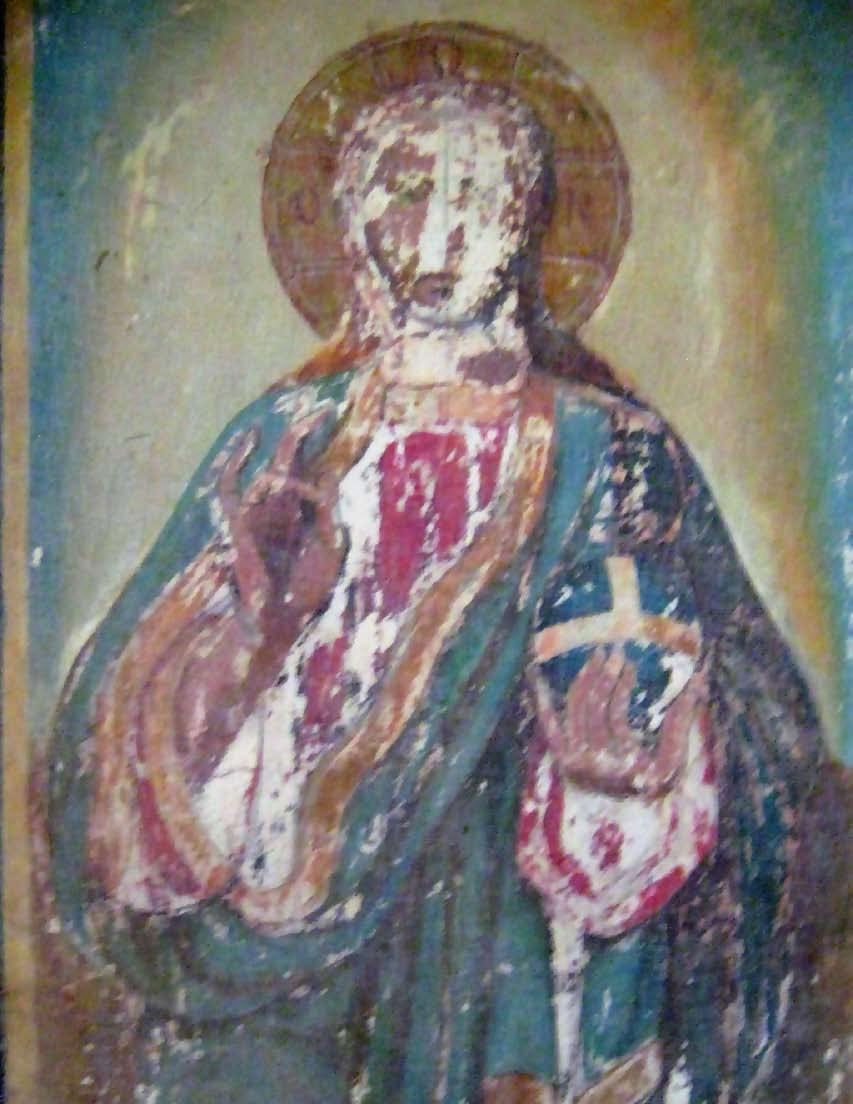
Detail of a 14th century fresco from a church in Mystras, Greece. Photo by Charles Clark ‘11.