

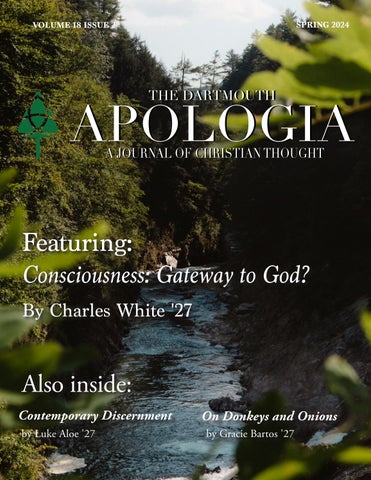
A JOURNAL OF CHRISTIAN THOUGHT A JOURNAL OF CHRISTIAN THOUGHT
Featuring: Consciousness: Gateway to God?

Charles White
D’27
By Sadie Jackson D’27
By Gracie Bartos D’27
By Luke Aloe D’27
Endormeur"
By Luca Gandrud D'27
By Tyler Long D'27

To subscribe to our journal, visit our website (see below). Subscriptions to the journal are free and subscribers get each new issue delivered right to their front door!
We welcome the submission of any article, essay, or artwork for publication in The Dartmouth Apologia that seeks to promote respectful, thoughtful discussion in the community. We will consider all submissions from any members of the community but reserve the right to publish only those that align with our mission statement and quality rubric.
We deeply value your opinions and encourage thoughtful words of support, dissent, or other views. We will gladly consider any letter that is consistent with our mission statement’s focus on promoting intellectual discourse in the Dartmouth community.
The Dartmouth Apologia exists to articulate Christian perspectives in the academic community. We do this through our biannual publications, lecture series, and weekly reader groups where we read and discuss the works of exemplary apologists such as G.K. Chesterton and C.S. Lewis.
We at The Dartmouth Apologia invite people from all intellectual, religious, and spiritual backgrounds to join us in our discussions as we search for truth and authenticity. If you would like to get involved, please feel free to email us or visit our website.
Visit our website: dartmouthapologia.org Send us an email: the.dartmouth.apologia@dartmouth.edu.
Catherine Horner D’26, Editor-in-Chief, Art Director
Matthew Kim D’26, Managing Editor, Editor
Aleksa Sotirov D’26, Publisher, Editor
Charles Ambrose D’25, Editor
Marissa Benz D’26, Editor
Tula Nicholson D’25, Editor
Amelie Bradley D'25, Editor
Najma Zahira D’24, Senior Editor
Isaiah Menning D’24, Senior Editor
Will Bryant D’24, Senior Editor
Jack Brustkern D'25, Senior Editor
Emil Liden D'25, Senior Editor
Sadie Jackson D’27, Art Director
Jack Donofrio D’25, Digital Manager
Nico Bezzerides D'27, Digital Manager
Gregg Fairbrothers D’76
Eric Hansen, Professor of Engineering, Thayer
James Murphy, Professor of Government
Lindsay Whaley, Professor of Classics & Linguistics
Council on Student Organizations
The Eleazar Wheelock Society
Dear Reader,
In your hands, you are holding The Dartmouth Apologia.
How might one describe The Apologia? To coopt C.S. Lewis from “Meditation In A Toolshed,” you might understand this journal as one understands a beam of light that filters through a crack in a toolshed.
On one hand, light is scientific. In the same way, The Apologia is a student journal at Dartmouth College. We arrange meetings, keep spreadsheets, revise for the Oxford comma, and double click in Adobe InDesign. Like any organization, we have our mechanics.
On the other hand, light is artful. In the same way, each Apologia issue marks a pit stop on a larger inquiry, which has traveled through prayer, discussion, and rhetoric. We wonder at the nature of God, and we seek to reveal his love first through the human ties we forge together. As both a community and publication, The Apologia frames our own journeys to understand truth.
As you might have seen in the Table of Contents, all our writers are freshmen. Their example reminds us that we remain freshmen, always on a new frontier in time, not adults of light, but children (John 12:36).
To these writers, thank you for opening your minds in written form. To our editors, thank you for your care towards each thesis. To our designers, thank you for your technical thoroughness. Farther along The Apologia continuum, thank you to our dedicated alumni, especially Charlie and Sarah Clark, and our graduated sages, Najma Zahira, Isaiah Menning, and Will Bryant, all of whom have provided valued mentorship. And to you, the reader, we thank you for opening this copy. We hope you enjoy the articles and learn from them. Take care in this day and the next.
Warmly,


Catherine Horner D’26, Editor-In-Chief

The Dartmouth Apologia exists to articulate Christian perspectives in the academic community.




By Charles White D'27
As soon as a first responder arrives on a scene, they test those involved for consciousness, rushing to discern whether the subject is awake. According to EMS indicators, a patient who is responsive to verbal and pain stimuli can still be unconscious.1 Therefore, consciousness extends deeper than interactions with the external world. Consciousness depends on the state of awakeness of the individual, measured by how they can make decisions and process information. At its heart, consciousness is subjective, individual experience; a person who is not awake cannot have their own individual experience. Moreover, a person making decisions and processing information is doing this only in the context of being conscious.
The origin of this subjective consciousness eludes us – this is the problem or mystery of consciousness. To date, there has been no definitive answer to the mystery of consciousness, so key thinkers on the topic are considering other explanations beyond the physical
workings of the brain. This is not to say that science will never get to the bottom of it, but the enduring complexity leads some to ponder a higher power. I will examine how physical and philosophical evidence might support some external force that could explain consciousness. The finite, subjective origin of consciousness leads us to a force behind our own consciousness, and the incompleteness of human consciousness leads us to understand the probability of a greater being with a more perfect consciousness who embodies this force. After examining the qualities (omnipotence and omniscience) of this being, we see more and more how they characteristically fit the Christian God.
To get to the root of consciousness, we have to understand the problem of consciousness. We do this through the scientific study of the brain-consciousness relationship. A coalition of experts in philosophy,
psychology, and neuroscience presented their findings on consciousness in the respected journal “Advances in Cognitive Psychology,” including a synopsis of the problem of consciousness and the scientific discussion of the subject. They conclude that, “In spite of considerable research efforts […] there is still no resounding and consensual approach in sight which could explain why, on the one hand, brain processes and conscious events appear maximally different on the descriptive level, and how, on the other hand, they are functionally and ontologically linked.”2 In other words, there is notable separation between medically measured, physical brain events and measurements of consciousness. Scientists recognize that there is a connection between brain events and conscious activity; they simply cannot figure out the nature of this connection. Oftentimes this discrepancy causes experts such as Wagemann et al. to take a step back and reframe the issue beyond a strict physicalist paradigm.2 Many scholars are now investigating the possibility of dualism, meaning that the physical workings of the brain are not the sole influence on consciousness. Again, this is not to say that the sheer lack of scientific answers at this time proves the existence of God, but instead what we know from scientific exploration compels us to entertain a theory of some other force. Since exhaustive examinations of the brain have summed to no conclusive explanation for the problem of consciousness, the investigation from then on ought to be more flexible and hospitable to ideas like dualism.
When searching for the cause for consciousness, it is worth determining whether or not consciousness is just an unexplainable, fundamental phenomenon, without cause. For this to be true, consciousness itself would have to satisfy certain qualities. On questions of fundamentality, we turn to Thomas Aquinas, one of the greatest Christian thinkers of all time. Aquinas focuses on the ne-
cessity of phenomena in that, “it is impossible to go on to infinity in necessary things which have their necessity caused by another [...] Therefore we cannot but postulate the existence of some being having of itself its own necessity, and not receiving it from another, but rather causing in others their necessity.”3 Something must exist which both is necessary by itself and causes necessity in all other things, or else nothing would exist. Consciousness cannot fulfill this role because it would have to be eternal and objective in order to cause necessity in all things for all time. As far as we know, consciousness is a subjective quality–unique to each person–and therefore finite; it begins with each person’s life. In fact, the subjectivity of consciousness is now widely accepted in the scientific community. Wagemann et al. admit, “consciousness may be considered to be unexplainable, since no objective explanation can exhaust its idiosyncratic subjectivity.” Consciousness is bound to the individual, which means that consciousness is not fundamental. However, by Aquinas’s logic, there must be another fundamental Cause since it is impossible to regress infinitely in causes which are not necessary to exist. Whatever this ultimate Cause is must directly or indirectly cause all phenomena, including consciousness.
Consciousness is not fundamental, so it must be created in some way by an ultimate Cause. It ought to follow that in the content of individual consciousness, we see the influence of this necessary Cause. Edith Stein, a Christian convert, philosopher, saint, and martyr used the experience of joy as an example of the content of consciousness pointing to its creator. Karl Schudt paraphrased her argument, that “the experience [of joy] depends upon something other than the I […] the I is contingent in its being. Here we see that it is contingent
The path to the most important power in our lives will not be one taken passively, but must be discerned with the utmost attention and reason.
with respect to experience, in that the I cannot force itself to experience joy… I may not be able to experience joy because of some obstacle that is not accessible to the I, some problem in the soul.”4 Schudt asserts that the same Force upon which the I (consciousness) is contingent is the same Force that lets us feel joy. Joy is a
perfect example of the lack of control we have over our own consciousness. Try as one might, it is impossible for one to induce joy in oneself by willpower. Even in joyful events, as Stein points out, it is possible to not feel an ounce of joy.4 Thus, consciousness must be at least partly influenced by a factor other than the self and the external world. Christians would argue that this factor is the soul.
But what is the soul? The soul is Christianity’s answer for the brain-consciousness divide: our connection to the external Force. Part of this connection is the recognition of the possibility of a more perfect consciousness, which Christians believe is God. Schudt argues, “The being of the I always has this character of being suspended over an abyss. It is a limited being, not in full possession of its being. But in order to know

something as limited, one must have an adequate concept of what has been limited […] pure being is not temporal but eternal.” The monumental limitation on human consciousness that Schudt speaks of is our subjective experience – we cannot experience the past or the future, but only one moment at a time, which is always changing. The soul is the part of the mind that can comprehend the unlimited from the limited: the pure experience from the human experience. Since one’s consciousness is limited by the changing moment, it is out of their control. Thus, we recognize that something must be in control, and we sense a perfect consciousness out there. It is this concept which moves us from the idea of a Cause to God. This God must be eternal, must have this perfect consciousness we recognize, and must be personal in order to connect with countless
souls. The recognition of a perfect consciousness is proof that there is a personal God who possesses it, and that he is urging us to get closer to him.
Further, the soul is anxious about its incompleteness, yearning for an understanding of a more perfect consciousness. Schudt articulates, “I realize that the idea of pure being is an idea of the fullness of being, and I also realize that I do not have it. Consciousness finds itself so disposed so as to long for God,”4 since “anxiety brings the self face to face with the nothingness of its own possibilities. It feels itself to be out of place, not to have a home.”4 Here, Schudt speaks poetically of a more profound anxiety inherent in each human, rather than the stress one feels conditionally due to external circumstances. Our perceived feebleness and the limitations of our consciousness bring an Angst or anxiety which

To date, there has been no definitive answer for the mystery of consciousness.
directs the soul to reach for anything associated with a more eternal and complete existence. The distractions of the world often cover up this Angst, yet in the quiet moments of deep introspection, one might feel this longing. It might surface as a realization of one’s own mortality or a serious contemplation of one’s place or value in this world. Stein describes this longing as a desire for eternal life, the satisfaction of consciousness, and the very thing that God offers through a relationship with him.
This God must meet some requirements to be able to cause consciousness in us and guide our souls to him.
In particular, God must be omnipotent, meaning that he can do anything, including the act of granting us consciousness. He must also be omniscient, so that he can know our deepest thoughts in order to pursue us and plant in us a deep desire for completeness. These are qualities that Christians agree pertain to God. Nonetheless, many find fault with these qualities, and their impugnments must be considered in order to determine whether God is capable of fulfilling his role in consciousness.
Yujin Nagasawa, a philosophy professor at the University of Oklahoma, acknowledges one of these arguments by the philosopher, Patrick Grim, that, “because no one else (no one other than me) can acquire knowledge de se of me, God’s omniscience, that is, divine omniscience, is not omniscience simpliciter,”5 so a God of the like would not exist. To clarify terminology, Grim’s knowledge de se simply means knowledge about oneself from one’s own perspective, which is the brick

and mortar of subjective consciousness. Further, omniscience simpliciter is Grim’s understanding of God’s omniscience, where God would know everything, including the knowledge de se of many individuals all at once. Grim’s argument at first seems logical. After all, only the individual knows their own experience from their own perspective, so for God to know that perspective would mean that God is the same as that individual, which is false according to Christianity. Grim thinks he sees a contradiction here – a flaw in the common conception of God.
Nonetheless, we find that in order to be that necessary Cause that Aquinas spoke of, God should not define his own omniscience and omnipotence by our expectations. Nagasawa explains this in his answer to Grim, saying that “the fact that God does not have a power to do what is necessarily impossible to do does not undermine His omnipotence […] Moreover, because, as I have argued, divine omniscience can be understood as God’s exercising the epistemic part of His omnipotence […] it does not undermine divine omniscience.”5 In other words, God has the power to put limits on his own omnipotence if he chooses. For example, his ability to know our thoughts does not mean he is always knowing our thoughts or exercising that epistemic part of his omnipotence. He might just have the power to know everything at once, which he does not always exercise because it contradicts the rules he set for his own omnipotence. No matter how he is analyzed, this ultimate God who works mysteriously through our soul is above human
Joy is a perfect example of the lack of control we have on our own consciousness.
logic in any situation. Our definitions of omnipotence and omniscience, and our ideas about how consciousness should practically come about are backed with such little knowledge, that this God cannot be counted out due to our own limited conceptions of what his powers are.
In the Bible, those with whom God has communed directly confirm how he does not fit our projected limitations on him. God told his prophet, Isaiah, “For my thoughts are not your thoughts, neither are your ways my ways… As the heavens are higher than the earth, so are my ways higher than your ways and my thoughts than your thoughts.”6 God is the fundamental Cause who gave us the ability to think and ponder. By nature, his ways should be incomprehensible to us if he contains that purer, eternal experience. Thus, without contradiction, he can have this necessary omniscience and omnipotence to let us know that our state of being is incomplete, and to create consciousness.
ChrisTiAn doCTrine And ClosinG remArks
It is pivotal to compare these findings with the Christian doctrine on this issue, and once taken into account, Christian doctrine emphasizes that the soul is reaching out to the omnipotent Christian God. In his great work, Mere Christianity, a simple yet profound explanation of Christianity, C.S. Lewis explains that,
In our natural state we are not sons of God, only (so to speak) statues. We have got no Zoe or spiritual life: only Bios or biological life which is presently going to run down and die. Now the whole offer which Christianity makes is this: that we can, if we let God have His way, come to share in the life of Christ. If we do, we shall then be sharing a life which was begotten, not made, which always has existed and always will exist. Christ is the Son of God. If we share in this kind of life we also
shall be sons of God. We shall love the Father as He does and the Holy Ghost will arise in us."7
Christianity shows that God is, in fact, pursuing us while we are still living a Bios life, seeking a personal relationship which would lead us to an eternal life. He does this (not exclusively) through the soul. Before we accept God’s gracious gift of a relationship with him, we are the staunchest rebels towards this God, yet we have this Angst in our hearts, searching on the deepest level for fulfillment of consciousness, perhaps not yet realizing that it is possible. Once we make the choice to accept God’s promise, we are not immediately transformed into the perfection we can sense in God. Those who have accepted God’s free gift of salvation, according to the Christian doctrine, are still bound by earthly bodies with earthly consciousness, but they are sustained by the unshakeable promise that upon death, they will be brought into a perfect type of consciousness, through an eternal life with God. In the meantime, Christians assert that they are guided by the Holy Spirit, the third of the Holy Trinity, the three Beings of the one
The soul is the part of the mind that can comprehend the unlimited from the limited: the pure experience from the human experience.
God. This is the presence of God in the believer, who guides their refreshed soul towards a life more representative of the life of Christ, slowly remaking them into the pure, eternal soul which will live forever with God. Therefore, this doctrine of the Trinity encapsulates the way that God has both urged us on towards himself through the soul, and how he grants us a more perfect consciousness, not right away, but prepares us for it through development. The subject of consciousness may elude us for a purpose. The path to the most important power in our lives will not be one taken passively but must be discerned with the utmost atten-
tion and reason. Consciousness is not without cause, so through a study of personal consciousness emerges the concept of a fundamental Cause behind consciousness. By looking at the desires of the soul, it becomes evident that this Cause is relational, guiding our souls with a purpose, to come into a relationship with the ultimate God who possesses perfect consciousness. Furthermore, the omnipotence and omniscience of this God, which allow him to do these things, are impossible to tie down to human-imposed limitations, since he is not bound by a separate essence which determines what is possible for him to do.4 He is so perfect of an answer that we can reach his existence without needing to know the technical aspects of the problem of consciousness like how a soul even exists in our body (through brain functions or something else?). The mystery then becomes a joy, and, with refreshed souls, we realize that whatever incompleteness we felt in the past is filled by the hope in God’s great promise.



Charles White D'27 is from Fairfield, CT and is pursuing a major in Engineering Physics and a Bachelors of Engineering.
1 Greg Friese. “Use AVPU Scale to Determine a Patient’s Level of Consciousness.” EMS 1, August 18, 2009. https://www.ems1.com/ems-training/articles/use-avpu-scale-to-determine-a-patients-level-of-consciousness-FVpjgzNGwSJAGoeQ/.
2 Wagemann, Johannes, Friedrich Edelhäuser, and Ulrich Weger. “Outer and Inner Dimensions of Brain and Consciousness—Refining and Integrating the Phenomenal Layers.” Advances in Cognitive Psychology 14, no. 4 (2018): 167–85. https://doi. org/10.5709/acp-0248-2.
3 Thomas, Aquinas, Saint. Summa Theologica, Part I (Prima Pars) From the Complete American Edition. Summa Theologica, Part I. Project Gutenberg, 2006.
4 Schudt, Karl. “Edith Stein’s Proof for the Existence of God from Consciousness.” American Catholic Philosophical Quarterly 82, no. 1 (2008): 105–25. https://doi. org/10.5840/acpq200882122.
5 Nagasawa, Yujin. God and Phenomenal Consciousness : A Novel Approach to Knowledge Arguments. Cambridge ; Cambridge University Press, 2008. https://www.biblegateway. com/passage/?search=Isaiah%2055%3A8-9&version=NIV.
6 Isaiah 55:8-9 (NIV)
7 Clive Staples Lewis. Mere Christianity. HarperCollins Publishers, 2001
8 Icons ("willow" and "head") sourced by Noun Project and illustrated by Catherine Horner.



Sadie Jackson D'27
Each fall, Dartmouth freshmen arrive on campus for orientation and find themselves surrounded by a thousand unfamiliar faces. These freshmen share a common goal while navigating their first term: to find a sense of belonging. As the term progresses, many students experience panic at the prospect that everyone else has found that belonging. As the desire to find a home is central to each chapter of life, we gravitate towards people with similar interests and personalities, and we bond over shared experiences. We even change our personalities on occasion, so our peers will take interest in us.
As one environment that provides a common place set upon common principles, religious fellowship challenges believers on the question of not just where to go, but also how to be. From this basis, someone may believe they cannot enter Christian fellowship because they lack a ‘moral entry requirement.’ But these principles are an ideal rather than a continual reality.
One does not have to fit the moral mold to belong to the Christian faith, the basis for Christian fellowship. Instead, all Biblical figures, except for Jesus, are broken sinners in need of a Savior. Despite our universal brokenness, the Bible shares many examples in which God uplifts figures outcasted by society. Timothy Keller once said, “Church is a hospital for sinners— not a museum for saints.”1 Our universal sin enables our universal belonging, which the Bible demonstrates in the interactions between Christ and three groups: legalistic biblical figures, exemplary biblical figures, and outcast biblical figures.
AbouT “leGAlisTiC” ChrisTiAns?
Some Christians today alienate non-believers from the faith due to their rigid criticism of sinfulness. In Jesus’s time, the Pharisees likewise boasted their abilities to follow religious law. While the Bible calls Christians to live according to faith, only Jesus Christ can accom-
plish this complete feat. Thus, a paradox emerges where some Christians pursue Christian precepts or commands to satisfy their own human pridefulness, rather than to honor the glory of God. Christians can escape this paradox through continual humility to recognize their need for salvation. In his parables, Jesus condemns the Pharisees for proclaiming their own piety:
Two men went up into the temple to pray, one a Pharisee and the other a tax collector. The Pharisee, standing by himself, prayed thus: ‘God, I thank you that I am not like other men, extortioners, unjust, adulterers, or even like this tax collector…’ But the tax collector, standing far off, would not even lift up his eyes to heaven, but beat his breast, saying, ‘God, be merciful to me, a sinner!’ I tell you, this man went down to his house justified, rather than the other. For everyone who exalts himself will be humbled, but the one who humbles himself will be exalted.2
During biblical times, tax collectors did not bear the most welcomed reputations, as it was common knowledge that tax collectors would demand more funds than their authorized allotment, and then pocket the excess. The Pharisees castigated the dishonest tax collectors according to their own closer adherence to religious law, often making judgements according to their own self-perceived religious piety. Jesus holds the Pharisees accountable for their pridefulness that impedes authentic adherence to divine commandment. Scripture says that we are “...created in Christ Jesus for good works…”3 The Pharisees, however, pursue these good works for their own glory rather than divine glory, without acknowledging their need for salvation. Jesus notes the hypocrisy in their faith: “Woe to you, scribes and Pharisees, hypocrites! For you shut the kingdom of heaven in people's
faces. For you neither enter yourselves nor allow those who would enter to go in.”4 When Christians utilize religious law to leverage greater morality over others, they fall victim to pride, or a false piousness. They misrepresent the Christian faith, a dangerous position for Christianity, as non-believers perceive the faith through false behaviors. God decrees that such individuals are “shutting the kingdom of heaven in people’s faces.” Instead, Jesus states to “...let your light shine before others, so that they may see your good works and give glory to your Father who is in heaven.”5 God does not call believers to flaunt moral superiority, which positions the believer, rather than Christ, as praiseworthy. Instead, God calls believers to walk in faith as a medium for his glory and love.
While the Pharisees would not associate with adulterers, extortioners, and tax collectors, Jesus welcomed them, not only dining with them– an intimate and accepting practice in Biblical times– but also urging them to follow him. Through Jesus’s proactive and universal acceptance, he grew the Christian community. For example, Matthew, one of the twelve disciples, left his life as a tax collector to follow Jesus. The Pharisees once asked Jesus why he ate with sinners and tax collectors. He replied, “Those who are well have no need of a physician, but those who are sick. I came not to call
The Pharisees pursue these good works for their own glory rather than divine glory, without acknowledging their need for salvation.
the righteous, but sinners.”6 The Pharisees could not see their own sinfulness and therefore were unaware of their need for a Savior. The tax collectors and others who were aware of their brokenness, however, realized that they could not become clean on their own. Jesus teaches how sinners are welcomed into the family of God through the Parable of the Lost Sheep. The Pharisees came to Jesus and scorned him, saying, “This man receives sinners and eats with them.”7 Jesus then responded:
What man of you, having a hundred sheep, if he has lost one of them, does not leave the ninety-nine in the open country, and go after the one that is lost, until he finds it? And when he has found it, he lays it on his shoulders, rejoicing… Just so, I tell you, there will be more joy in heaven over one sinner who repents than over ninety-nine righteous persons who need no repentance.8
Jesus’s response to the Pharisees through this parable explains why universal acceptance heals sin rather than fomenting sin, a risk with our neighbors that the Pharisees did not entertain. When we recognize our own transgressions, we realize our own need for a Savior, and we do not misrepresent the Christian faith with moral leverage in mind.
Esteemed biblical figures also need salvation to overcome their sinfulness, despite their legacies as human models for Christians to come. For example, Christians today regard Peter as a model for developing a relationship with Jesus and the faith. After the Pentecost, when Jesus ascended into heaven forty days after rising from the dead, Peter traveled to the Middle East and Asia Minor, spreading the gospel and performing miracles.
He forewent security for a devotion to the gospel, when he was persecuted for his beliefs by the Jews, who rejected his teachings. He even insisted that he be crucified upside down, feeling that he was unworthy of being killed in the same way as Jesus Christ. But even Peter confronted fears in his faith. In Matthew 14, the disciples were in a boat, and Jesus came walking on the water toward them. In awe of the power of God, Peter asked Jesus to command him to walk out on the water. Jesus said “come,” and Peter began to walk. “But when [Peter] saw the wind, he was afraid, and beginning to sink he cried out, ‘Lord, save me.’ Jesus immediately reached out his hand and took hold of him, saying to him, ‘O you of little faith, why did you doubt?’”9 Here, Peter’s fear dominated his faith. This happened once again after Jesus was arrested. In the hours preceding his arrest, before praying in the Garden of Gethsemane, Jesus said to the disciples, “You will all fall away, for it is written, ‘I will strike the shepherd, and the sheep will be scattered.’”10 Peter confidently responded that, while the other disciples might abandon him, he would never. “And Jesus said to him, ‘Truly, I tell you, this very night, before the rooster crows twice, you will deny me three times.’”11 Sure enough, before the rooster crowed twice, Peter denied Jesus to crowds that approached him three times. Peter embodies two facts at once: he died for his faith, and he doubted his faith. His martyrdom was not based on his spotless moral record, but on his ultimate devotion to God and his perseverance against his doubt. Meeting this effort, Jesus still lifted Peter when he sank. God still worked through Peter to spread the gospel. God does not discard his followers when they commit sin. Instead, he brings them back to him.
Scripture illustrates how not only figures viewed as
righteous can develop a relationship with God, but also those whose sin runs deep. Humans tend to develop criteria for outcasts, but God does not dismiss sinners with this same social stringency. In other words, God does not dismiss sinners as society does. There are countless accounts in the Bible where God uses social outcasts for his divine will. For example, Rahab was a prostitute in Jericho, the gateway city to the Promised Land. As the Israelites were approaching the city of Jericho, Joshua sent two spies to survey the city. When they came upon Rahab’s house, while fleeing from the king of Jericho, Rahab hid them on her roof. She expressed to them how she had heard of the wondrous miracles God had done, saying to them, “...for the Lord your God, he is God in the heavens above and on the earth beneath.”12
After saving the spies from the king, she asked that they spare her family when God would punish Jericho. “And the men said to her, ‘Our life for yours even to death! If you do not tell this business of ours, then when the Lord
gives us the land we will deal kindly and faithfully with you.’”13 Sure enough, when the Israelites then brought the city of Jericho crumbling down, the house of Rahab’s father, and all who were inside, survived. Rahab went on to marry an Israelite named Salmon, and she ended up as part of the lineage of Jesus Christ laid out in Matthew 1. Rahab was a foreigner not only among the Israelites, but also among her own people, the Canaanites of Jericho, who shunned her for prostitution and thus determined her low social status. Her story illustrates the transformative power of redemption and faith. Joshua states that the city of Jericho had heard of the miraculous deeds that the Israelites had performed through the power of God, yet it was a prostitute, living on the fringes of society, who proclaimed faith in the God of the Israelites. Furthermore, when the king of Jericho came to her house looking for the spies, she hid those spies at great personal risk. This act of defiance against her own king demonstrates the extent of her faith in the
God of the Israelites. And because of her faith, she and her family were spared, and she was welcomed into the family of God.
The Bible outlines how believers cannot let social status impact their behavior towards others. In John 4, Jesus models universal acceptance in his encounter with the Samaritan woman at the well. The Samaritans were half-Jew and half-Gentile, outcast from both groups. According to Scripture, Jews would “have no dealings with Samaritans.”14 Additionally, the woman had been married to five different men, her promiscuity another detriment to her social acceptance. Thus, she went to draw water from the well around the “sixth hour,” or noon, amid scorching heat, to avoid contact with the other women. Nonetheless, Jesus still approached her and asked her for water. She responded with confusion,
God does not discard his followers when they commit sin. Instead, he brings them back to him.
and Jesus replied by sharing the good news of salvation, saying, ‘Whoever drinks of the water that I will give him will never be thirsty again. The water that I will give him will become in him a spring of water welling up to eternal life.”15 After her exchange with Christ, she went and shared her testimony with her town, and many came to believe that Jesus Christ was Savior. The woman at the well came from a life of sin. The Scriptures do not specify whether or not she repented her sins, but they do reveal how Jesus acted towards her. First, Jesus approached the woman already knowing that she led a sinful life. He also knew that she was a Samaritan, but that did not stop him, a Jew, from not only asking her for water, but also offering her the “living water,” the news of salvation. Like how God brought Rahab into His family, Jesus brought the woman at the well into the Christian faith, no matter her sinful past.
WhAT AbouT The ChrisTiAn ChurCh iTself?
Scripture emphasizes the importance of welcoming sinners into the body of believers, but has the Church carried out this mission over the last two millennia?
There are Christian individuals and groups in each stage of history who have strived to live out the Word of God.
After the Pentecost, each of Jesus’s disciples, aside from John who died in exile, faced persecution for spreading the gospel across the world. Since then, countless Christians have welcomed social outcasts into the faith; however, this has not always been the case. When examining Christianity, it is important to make a distinction between Christians and Christ. While Christians ought to live out their faith, they are sinners and will always struggle to follow the model for acceptance that Jesus established. One glaring example: Martin Luther, who founded the Protestant Church, wrote and published The Jews and Their Lies. This antisemitic book referred to Jews as offspring of the Devil, stating that “we are not at fault in slaying them.”16 These writings were used by Christians in Nazi Germany as moral justification for the Holocaust. While not all Christians supported the Nazis, the church in Nazi Germany did not live in accordance with Scripture, following Martin Luther’s teachings regarding the Jewish people rather than the model of Christian acceptance. The church is called to emulate Christ’s example in walking in the Word, but the church does not represent Christ to perfection. Therefore, such institutions depend on salvation, just as much as the individuals in those institutions.
No one on this earth can uphold complete divine morality, “for all have sinned and fall short of the glory of God.”17 If we cannot expect the most righteous disciples always to remain strong in faith, why need we fear our sinful histories, as an impediment to join the family of God and Christian fellowship? The only one to have ever lived perfectly in accordance with Scripture was Jesus Christ, who was not only fully man, but fully God as well. Noah was a drunk, Moses doubted God and became angry, David committed murder and adultery, Solomon had many wives, and the disciples fled at the crucifixion. Still, God did not leave them.
Sin should make us ineligible for a relationship with God, but it does not. Instead, God seeks out us sinners and yearns that we build a relationship with Him. The redemptive and restorative power of God’s love is stronger than any sin, so Christian belonging in His kingdom is never a question. And in our own communities of human fellowship, we find a chance to model that same love, a gift from God to the world.

1Timothy Keller
2 Luke 18:10-11, 13-14 (ESV)
3 Ephesians 2:10 (ESV)
4 Matthew 23:13 (ESV)
5 Matthew 5:16 (ESV)
6 Mark 2:17 (ESV)
7 Luke 15:2 (ESV)
8 Luke 15:4-5, 7 (ESV)
9 Matthew 14:30-31 (ESV)
10 Mark 14:27 (ESV)
11 Mark 14:30 (ESV)
12 Joshua 2:11 (ESV)
13 Joshua 2:14 (ESV)
14 John 4:9 (ESV)
15 John 4:14 (ESV)
16 Luther, Martin. The Jews and Their Lies. (Liberty Bell Publications, 2004.)
17 Romans 3:23 (ESV)
18 Icons ("olive branch" and "hands") sourced by Noun Project and illustrated by Catherine Horner.





Gracie Bartos D'27
The Brothers Karamazov has earned a global reputation as a challenging read for both its length and its topos. Having attracted over 150 years of readership and scrutiny, Fyodor Dostoevsky’s tome of moral dilemma and intellectual anguish has established itself as one of the greatest feats of world literary genius. But distinct from many other novels held up as great classics, The Brothers Karamazov’s storyline hinges on a lessthan-perfect set of protagonists: three brothers whose personalities combine atheism, sensualism, piety, and intellectualism into one messy, labyrinthine, and beautiful whole. Perhaps just as strange is how the climactic plot action (the murder of the family’s patriarch) is concentrated early on in the novel, with two whole parts still to go. From morally gray protagonists to a narrative that favors dialogue over plot, The Brothers Karamazov’s mystery and majesty are in hewing meaning out of the mundane and readjusting the reader’s focus to what is small.
russiA The CAreeninG TroikA: An inTroduCTion To smAll deeds
The Brothers Karamazov was authored in the late 19th century, when the Russian tsar was facing significant pushback from destitute peasants, impoverished industrial workers, and repressed ethnic minorities. Amidst this socioeconomic turmoil, a revolutionary group called “The People’s Will” sought to overthrow the tsar with abrasive force, resorting to terrorist tactics to force concessions of power. As a counter to this extreme approach, a liberal-populist newspaper preached small cultural work as the solution to the crumbling empire. The essayist Lakov Abramov posited what he called “small deeds theory” as the solution to Russia’s harsh penal system, destitute peasantry, and economic exploitation.1
This theory offered that small deeds of service done for the brotherhood of man would prove more valuable than sweeping acts of revolt. Instead of assassinating the tsar or unleashing violent attacks on authority, what
if we cared for the sick, housed the homeless, published literature, and defended the dignity of humanity within our own daily rhythms? What if we staged a series of small, quotidian rebellions? What if revolution started at the bottom? To subscribe to small deeds theory was to step into interpersonal compassion daily with the knowledge that if your neighbor and your neighbor’s neighbor did the same then there would be hope for healing a fractured world.
Dostoevsky and other 19th century Russian authors were writing in step with this theory of small deeds. Chekhov, Tolstoy, and Dostoevsky published works that spotlighted ordinary (or, perhaps even a step below ordinary) individuals whose smallest works held tremendous weight. The Brothers Karamazov maintains that moving towards what is small (i.e. Alyosha’s choice to leave the monastery and spend life sojourning in the world as a righteous man in the presence of drunkards and prostitutes) is actually to pursue what is holy. Chekhov’s Uncle Vanya revolves around an ensemble cast without a definitive hero and operates with little to no plot action. Tolstoy is famously quoted for his “history isn’t made by great men”— it is the common man whose daily movements toward truth, goodness, and beauty affect the whole.
Whether consciously or not, these authors were drawing on the same small deeds theory championed in the gospels. What follows will explore how Jesus of Nazareth himself is a paragon of what it means to transfigure world trajectory through small deeds and how the whole arc of the Gospel narrative calls us to reinvest meaning in the ordinary and to regard what is small as revolutionary. It seems imperative to start with a very simple (almost silly) question: who was this Jesus guy, anyway? Scholars and theologians have debated the identity of the
historical and the religious Christ for centuries, so this essay will take as its foundation, with as little personal exegetical extrapolation as possible, the account of Jesus of Nazareth presented in the four gospels.
From the get-go, the story of Christ is one of modesty. Born to the most unlikely couple (to an unmarried woman, at that) and laid in a manger after being excluded from the warmth of an inn, Jesus had the humblest of humble beginnings.2 The Messiah spent his first moments on Earth in a trough used for feeding pigs, cows, and the like. The God whom the universe could not contain was rocked in a cradle, and the Christ figure (from the Greek Christos: literally, “the anointed one”) took on the form of a newborn, bound to the same bodily functions as the rest of mankind. It is in this way that Jesus was truly Emmanuel: “God with us.” An omniscient, omnipresent, and omnipotent God had his diapers changed, relied on food for sustenance, and required sleep to recharge his bodily functions. From the outset, God’s Incarnation was to lean into what is small—what is ordinary, corporeal, basic even. Still, this choice to embrace something “small” by taking on human flesh had a Herculean impact: it was the ultimate display of love, one that steps down from infinite abundance to show man he is not alone.
The Brothers Karamazov’s mystery and majesty is in hewing meaning out of the mundane and readjusting the reader’s focus to what is small.
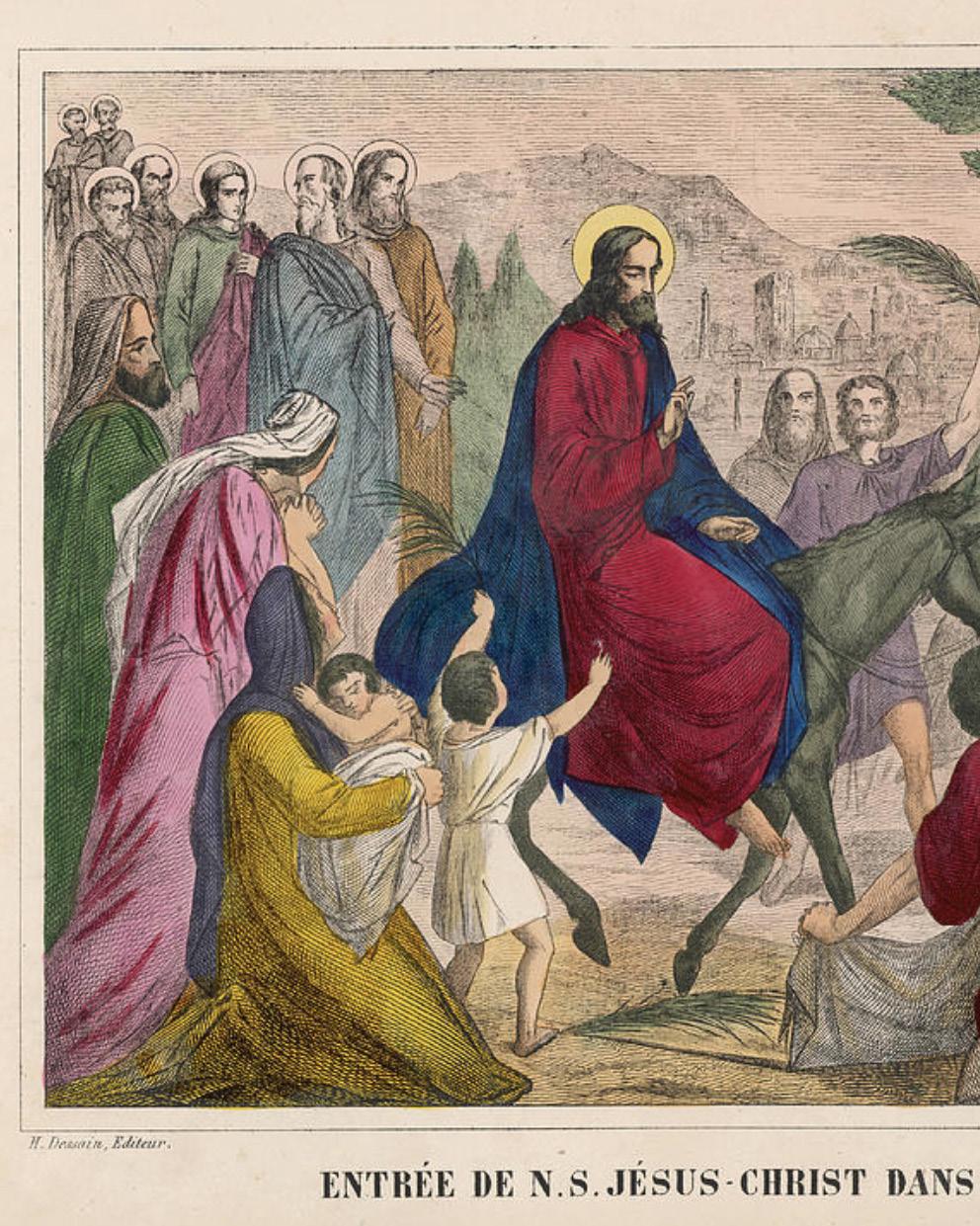
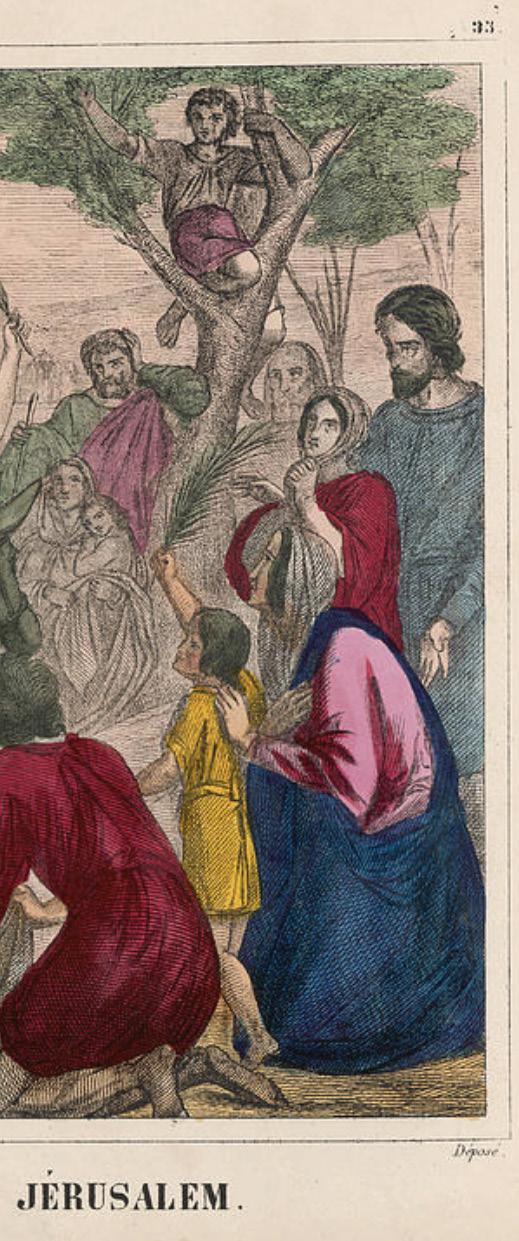
The gospel narratives hold up Jesus’ humanity, which includes all of the small choices he made, alongside his miracles. As Jesus approached Jerusalem in anticipation of his greatest miracle (i.e. the Resurrection), he asked two disciples to untie a donkey and her colt so that he may ride into the city saddled on the back of the foal.3 “Say to Daughter Zion, ‘See your king comes to you gentle and riding on a donkey, and on a colt, the foal of a donkey,’” the prophecy in Zechariah reads.4 The King of Zion does not ride to the cross hoisted up on the pedestal of a glorious chariot, escorted by a phalanx of armored men. He comes “gentle,” riding on a baby donkey. Christ forgoes the fanfare, the frivolity, and the pageantry of an exaggerated entrance in exchange for what is simple and ordinary. Political leaders and war heroes of the time would make a glamorous spectacle of their return home, participating in parades and flag-waving to sanctify their victories. But the Savior of the world chooses humility and inspires us to do the same, and it is this smallness that prefaces the crowning miracle of the Ascension at Bethany.
Fully God and fully man, Jesus of Nazareth is far from being exempt from human expression and sensitivities. Widely known as the shortest sentence of the New Testament, John 11:35 presents a more familiar instance of Jesus’ humanity: “Jesus wept.” In weeping at the death of his friend Lazarus, God becomes small, human, and ordinary. Integrated right next to the miracles of Jesus healing a blind man and raising Lazarus from the dead, Christ’s ordinariness and corporeality flanks his divinity. Perhaps a more striking moment of emotional intensity is the final moment before Jesus’ last breath. “Eli, Eli, lema sabachthani,” Jesus cries on the cross, reciting Psalm 22: “My God, my God, why have you forsaken me?”5 The Messiah’s death is not a heroic or gladiatorial spectacle but a lonely moment of prayerful lamentation. Sandwiched

between two crucified criminals, the world’s Redeemer breathes his last breath in tears and agony. In weeping, Jesus makes sacred all that is human. To have a heart that is soft enough to keep breaking for a fractured world is holy, and the Messiah transfigures human tears and lamentation into divine practices, giving us, too, the license to weep for a needy world.
Becoming small is a mantle we all must take up with Christ as our exemplar, the Gospels preach. Not only does Jesus become small as an act of compassion for mankind, but he also ascribes the small, ordinary, compassionate life to all who thirst after righteousness. “Unless you change and become like little children,” Jesus explains to his disciples, “you will never enter the kingdom of heaven. Therefore, whoever takes the lowly position of this child is the greatest in the kingdom of heaven. And whoever welcomes one such child in my name welcomes me.”6 Childhood’s beauty is in its simplicity and joy in smallness, and those who are able to lean into childlike tendencies are “greatest in the kingdom of heaven.”
Even adults are encouraged to maintain this simplicity. When a wealthy young man approaches Jesus and asks what “good thing” he must accomplish to enter into eternal life, Jesus first tells him to keep the commandments: “‘You shall not murder, you shall not commit adultery, you shall not steal, you shall not give false testimony, honor your father and mother,’ and ‘love your neighbor as yourself.’”7 Here, Jesus recited the Mosaic Ten Commandments with an interesting caveat. He omits the first four traditional commandments concerning how an individual interacts with God and substitutes the prescription against envy for the golden rule. The righteous life is not lived when we specialize in our individual relationship with the Divine (a vertical relationship fixed upward), Jesus seems to imply: the righteous life is also lived when we are fair to others in our day to day. It is lived when we step into compassion outwardly, into what is simple, human, neighborly, ordinary. The good life is marked by a kind of horizontalism. By no means does this diminish an individual’s relationship with God, but it does implicate that small deeds at the ground level help pave the road to everlasting life. Relationships with image-bearers steer us toward a relationship with the Creator. Just as there is sanctity in the “lowly position” of a child, so too is there divinity in living “out” and not “up”: living small instead of exaltedly.
While Jesus’ death and resurrection total up to the greatest and most exalted deed in Christian canon, the crucifixion can even be said to be one of those small yet abundantly transformative deeds. To face death and shoulder the same fate as a criminal is to lean into what is
ordinary, or even less than ordinary. The human experience is a unique combination of joys, sorrows, successes, and defeats tailored to each individual, yet one universal factor binds all of humanity together: the guarantee of death. Rich or poor, black or white, male or female, Jew or gentile, death knocks on everyone’s door. In this way, to die is perhaps to do the smallest deed, to do the most human deed, the most basic, ubiquitous, ordinary, worldly, standard, customary deed. So, in choosing death, God (the one being for whom death is not guaranteed) steps into the smallest of deeds to deliver mankind. In dying, God tells the world that he is not a distant cosmic soup with detached interests and unfeeling power, but a personal Companion, Father, and Friend: “God with us.” It is in this way that Jesus’ humble death becomes the linchpin of all human history and the cornerstone for eternal life. To “be saved” is to know that God chose to enter into a polluted world for our sake. To “be saved” is to imitate his grace in how we sojourn in that world. To “be saved” is to become small.
To understand futher how the smallest deeds can save an aching world, we can turn back to the wisdom and insight offered by 19th century Russian authors. Whether intentionally or not, these writers artfully retell the Gospel narrative: that small deeds enable revolutionary salvation. Their more modern chronicles incidentally popularize what is at the core of Christ's walk on land.
Dostoevsky’s The Brothers Karamazov is what Sigmund Freud called “the most magnificent novel ever written,” what James Joyce said to have “made a deep impression on [him],” and what Virginia Woolf said was “composed purely and wholly of the stuff of the soul. Against our wills we are drawn in, whirled round, blinded, suffocated, and at the same time filled with a giddy
Becoming small is a mantle we all must take up with Christ as our exemplar, the Gospels preach.
rapture.”8 Some scholarship, such as Mark Gregory’s research at the University of Mississippi, notes the dramatic influence Dostoevsky’s Christian spirituality had on the novel, even claiming the whole work to be a theological drama.9 So what is it about this eight-hundred page behemoth that has inspired rapture and has captured the attention of some of the 20th century’s most bright and influential minds? How has the novel come to be a witness to the Greatest Story ever told?
From its conceptualization, the novel was to rest exclusively on what is small and underwhelming. As Dostoevsky was initially slating The Brothers Karamazov, he wrote:
I have conceived and will soon begin a large novel in which, inter alia, a major role will be played by children—minors, aged from about seven to fifteen. There will be much portrayal of children. I am studying them, I have been studying them all my life, and love them very much.10
From the get-go, before pen is put to paper, Dostoevsky is already flipping the tables of literary protagonism: the novel will not center on a pantheon of splendid heroes in their prime, but on children (see Matthew 18:35). While the main characters of The Brothers Karamazov are ultimately written as young adults, the narrative maintains a lean towards what is small and underwhelming.
The named protagonist, Alyosha Karamazov, is the archetype of small deeds theory in action. Alyosha abandons a holy and pious monastic life in exchange for one that would allow him to engage with the world in ordinary ways and to be a messenger of healing in day-to-day life. The rest of the novel’s key figures are by no means unblemished, yet even from the rubble of all the ordinary, underwhelming, dirty, unholy, and profane, Dostoevsky hews out nuggets of beauty, grace, goodness, and redemption. The leading players, as the title implies, are Alyosha and his brothers: Ivan (an afflicted and coldly moral intellectual atheist) and Dmitri (a sensualist arrested for the murder of his father). Dostoevsky’s other key figures are Grushenka (a prostitute) and Smerdyakov (the product of Fyodor Pavlovich’s rape of a young girl). In an early chapter, Dostoevsky names all this sensualism and affliction “Sodom” after the Biblical city destroyed for its wickedness and its lack of compassion for the stranger. But he also takes care to note the presence of Madonna (the virgin Queen of Heaven representing all compassion and good counsel) in every Karamazov and related figure. In all the small, base, ordinary, and even ugly, Dostoevsky inspires us to chase down grace, wholeness, and beauty. Perhaps the most striking imagery of smallness giving way to greatness is Dostoevsky’s onion. Grushenka, the novel’s guilt-ridden coquette, tells a fable of a woman who offered an onion to a hungry beggar on the street. The woman eventually dies and is relegated to hell but is offered one potential “out.” God extends to the woman that same onion she offered to the beggar once upon a time. In grabbing hold of the onion, the woman “Cannibal Onion”
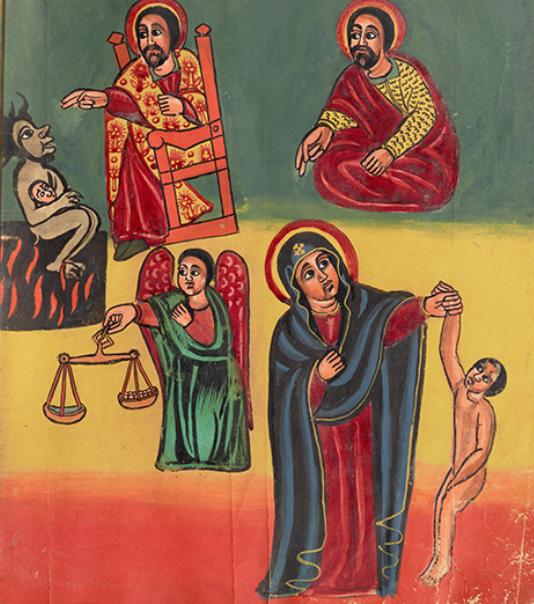
begins to be pulled up and out of hell’s flaming lake, as other forlorn souls catch hold of her in hopes of their own escape. “It’s my onion, not yours,” the woman snarls, and she kicks the other sinners back to the tumult of hellfire.
As soon as the words leave her mouth, the onion breaks, and back the woman falls into the lake, relinquishing all hope of salvation. One onion given to a hungry beggar had the potential to rescue hell’s lake full of transgressors. One onion. One small deed. All it took was one woman becoming humble and gracious enough to share the hope of salvation. Grushenka ends the story by claiming that in all her “wicked” life she, too, gave just one little onion. And that, she says, has made all the difference.
The onion fable is a story of small deeds drumming up an abundance of hope, grace, and peace. Grushenka is untidy and ordinary and human and fallible. Yet for all her self-proclaimed “wickedness,” she claims redemp-
tion in the smallest deed. If only we, unlike the woman in Grushenka’s story, humble ourselves enough to include the whole of mankind in our daily mission, then can we have hope of the full restoration of God’s intended shalom: of God’s intended peace. Attempting large-scale, immediate change in pursuit of a hurried utopia devolves into chaos, just as the abrasive tactics of Russian revolutionaries produced a state of violence and misery for decades to come. One leader or one group out of many seeking to lay waste to an entire system simply will not do. Only a posture of daily compassion that includes every small corner of God’s kingdom can build sustainable tranquility. The Apostle Paul’s commission to “pray without ceasing” is a literal charge to constantly find Madonna—to find beauty—in the everyday, in the mundane, and in the small. 11 Because a kind word is a prayer. And a stranger’s smile is a prayer. And making someone tea is a prayer. And an expression of gratitude is a prayer. And an apology is a prayer. And planting a tree is a prayer. And riding into Jerusalem on a baby donkey is a prayer. And an onion is a prayer. And prayers are in every last pocket of ordinary, simple, unremarkable beauty. And, as Dostoevsky himself would say, beauty will save the world.12
Perhaps we need not be as concerned with the systems that grow too large for one man or group of men to summit, just as large edifices and spires that grip our attention might collapse over our heads and bury us. Perhaps we should be more concerned with the small single brick that we carry each day, which is in our power to be either thrown at our neighbor’s window or laid as the cornerstone for an asylum. Of course, one brick alone is not enough to build fortresses of tranquility: all who thirst for justice come together under the common banner of restoration and compassion. It is not and never will be
And prayers are in every last pocket of ordinary, simple, unremarkable beauty.
good for man to be alone, especially when there are onions to give and sanctuaries to build.13 As we collectively wait for the restoration of Paradise, we work: so that brick by brick, onion by onion, we may finally build Your will of love, grace, and kindness in our own hearts and in the hearts of others. On earth as it is in Heaven.

1 The Great Soviet Encyclopedia, 3rd Edition. S.v. “Small Deeds Theory.” (19701979).
2 Luke 2:7 (NIV).
3 Matthew 21:1–11, Mark 11:1–11, Luke 19:28–44, and John 12:12–19 (NIV).
4 Matthew 21:5 (NIV), adapted from Zechariah 9:9.
5 Mark 15:34 (NIV).
6 Matthew 18:3-5 (NIV).
7 Matthew 19:16-22 (NIV).
8 Alexandra Guzeva, “5 Western Writers Influenced by Fyodor Dostoyevsky,” Russia Beyond, June 1, 2018, www.rbth.com/arts/328152-5-western-writers-influenced-bydostoyevsky.
9 Mark Gregory, “Christian society is not yet ready for this: Fyodor Dostoevsky’s Christianity” (2009). University of Mississippi. Honors Theses.
10 Gregory, page 84.
11 1 Thessalonians 5:17 (ESV).
12 Fyodor Dostoevsky, The Idiot (1869).
13 Genesis 2:18 (NIV).
14 Icons ("lily" and "onion") sourced by Noun Project and illustrated by Catherine Horner.









Luke Aloe D'27
We all experience revelation in some form: a seemingly external thought enters our consciousness, too applicable or specific to ignore. How do we interpret the origin of this revelation? Consider the religious hypothetical: if an individual prays to God for guidance in one specific area of his life, and one day an answer or idea springs into his consciousness, is that merely the end result of social influences or biochemical processes transmitted throughout the brain? Or does that revelation derive from something bigger, that being God? When approaching a profound decision, we face the challenge to ascertain whether our answers derive from divine guidance. We often juggle many competing voices and perspectives when coming to a decision, including our personal desires, the desires of loved ones, and the encouragements from contemporary culture. Past that human clamor, how can we pinpoint the voice of God? At Dartmouth, many of us believe that we have a calling in
life towards some “greater purpose,” but we can struggle, especially during young adulthood, to determine that vocation. Amid this struggle, the Christian tradition offers the concept of discernment as a tool to help identify what is and is not the voice of God. The process to comprehend the nuance in thought is deeply rooted in biblical examples and Christian religious and literary histories, all of which provide clarity to the abstract and intangible nature of attempting communication with God. Though it is not immediately or obviously clear where or how we are called, the biblical figures of both the Old and New Testaments and the writings of St. Ignatius of Loyola provide examples to guide our practice of discernment, our sixth sense for true revelation.
The fAll: our firsT exPosure To disCernmenT ThrouGh CounTerexAmPle Discernment originates in the Old Testament
as a distinct form of meditative prayer, encouraging a deep connection to God through wisdom and moral understanding. These biblical roots reveal how discernment is intertwined with God’s ongoing relationship with humankind. In Genesis, the biblical narrative begins when God creates humanity with an innate ability to make independent decisions. Adam and Eve, the first two humans, are unable to make a decision that aligns with divine command, as they consume the forbidden fruit. Their inability to discern good from evil in Genesis 3 provides a warning: discernment is vital to a righteous life. Early in the Bible, we first witness discernment gone wrong, through the counterexample in which Adam and Eve follow a false voice, to their detriment.
Created by God as stewards for his creation on Earth, Adam and Eve were given both a human conscience and a free will, allowing them to rule over God’s creation and to make decisions on their own accord. Humanity was given dominion over creation, although our human imperfections mean that the power attached to such dominion risks corruption. God tells Adam and Eve not to “eat of the fruit of the tree that is in the midst of the garden, neither shall you touch it, lest you die.”1 Despite this commandment, the “cunning” serpent manipulates
When needing to make a profound decision, it can be incredibly difficult to decipher the significance and genuine divinity of an intrusive idea that enters the mind.
Eve, and then Adam, into consuming the forbidden fruit. The serpent utilizes the language of God to underscore the perverse idea that Adam and Eve will become more “like God” should they disobey his explicit commandment to avoid eating the fruit of one tree. This cunningness misleads the first humans to believe that they could achieve a greater dominion, and therefore, greater selfdetermination. Through choosing to listen to the serpent, Adam and Eve experience a spiritual death that separates God and mankind. The biblical anecdote demonstrates the ease at which human choice can succumb to folly. The narrative of the Fall conveys the necessity of discernment when desiring to behave according to the will of God. Adam and Eve disregard contemplative prayer, revealing that a discerning mind is necessary for holy personal conduct.
In the Old Testament, Israelite rulers and prophets were tasked with guiding the Israelite people according to God’s will. Their successes and failures in wrestling with his voice provide guidance for those who hope to discern God’s voice in modernity. There are three specific examples that outline righteous discernment practices: King Solomon demonstrates how humility assists discernment, King David demonstrates how patience assists discernment, and the prophet Samuel demonstrates that discernment can be challenging to recognize.
The biblical king Solomon demonstrates that humility assists the discernment process, when he surrenders himself to the will of God. Solomon initially lacks a “wise and discerning mind.”2 As a youthful and inexperienced leader who often lived in the shadow of his father David, Solomon seeks a covenant with God. One day, Solomon burns offerings at an altar, after which God appears to Solomon in a dream. Solomon explains
to the Lord that he is “but a little child” and asks for an “understanding mind to govern [His] people [and] discern between good and evil.”3 God is immensely pleased when Solomon expresses humility and selflessness, requesting a gift that benefits the Israelite people, rather than one that benefits his own interests. God states that Solomon will be a sage ruler, unmatched throughout Israelite history.4 Solomon’s unenlightened mind is replaced with a deeply wise one. God’s plans and instructions are surprising and unforeseen, as he often points human life in unexpected and perhaps displeasing directions. Solomon uses the discerning mind that God gifted him with to act as a more mature leader, on behalf of all the Israelite people, who can now better serve God. The narrative provided in 1 Kings demonstrates Solomon’s continual discernment when two women are arguing over who is the mother of an infant. Solomon wisely uses language to trick the false mother into surrendering the baby to the biological mother. He uses his God-given gift to uphold normal Israelite legal procedures in an abnormal circumstance, with the unusual absence of “two or three witnesses.”5 Here, Solomon contrasts Adam and Eve, as he develops the ability to discern in consultation with God, rather than rejecting divine guidance and acting on impulse.
As the father of Solomon, King David also demonstrates that patience, based on a mere desire to know God, assists the discernment process. David asks for God’s guidance in Psalm 24: “Make me know your ways, O Lord; teach me your paths. Lead me in your
truth and teach me, for you are the God of my salvation; for you I wait all day long.”6 While David expresses a genuine and heartfelt desire to discern God’s will, he also expresses vulnerability as a leader who lacks the ability to understand God’s guidance fully, therefore unable to please God best and uphold His commandments. However, David explains that he will wait patiently for God to lead him in truth. David reveals that discernment demands a great deal of patience and waiting, as leading the Israelite people likewise demands patience. Again, the notion that communication with and leadership through God both demand patience contrasts the rash impulsivity with which Eve decided to eat the fruit.
Finally, Samuel, a young prophet, demonstrates how discerning the voice of God can be initially challenging, but how it also precipitates human accomplishment. Only after Samuel learns to discern the voice of God does he become a great figure in Israelite history. In the middle of the night, the Lord calls out to Samuel three times, but Samuel repeatedly mistakes the voice of God for the voice of his foster father, Eli, calling out to him. Finally, after the third time, Eli tells Samuel to listen for the voice of God. Eli can better discern God’s voice due to his advanced age and blindness, a condition that requires him to communicate in abstract methods. Samuel’s account provides insight into how it can be
It is important to have humility in the process, by surrendering yourself fully as someone listening to the voice of God.
challenging to discern the voice of God. Notably, Samuel only hears the voice of God after receiving guidance from another individual, Eli, essentially a high-priest figure that points Samuel towards God. Samuel also employs humility when he states, “Speak, for your servant is listening,” and he demonstrates patience when he keeps responding to God calling him, after his initial inability to recognize God’s voice.7 Just like Samuel, it can seem impossible to attempt to recognize the voice of God in our own lives, but his account tells us that it is normal to wrestle with this concern. God keeps calling out to Samuel, representing the fact that God always welcomes a relationship with us and attempts communication with
us. The stories of Solomon, David, and Samuel, and their respective unique struggles with discernment reveal the practice as intertwined with Old Testament theology, yet still relevant with modern and personal applications.
While the Old Testament displays early Israelite practice of discernment, the New Testament emphasizes how to apply that discernment to our lives. Paul, an early Christian convert, writes a letter to the Corinthian people.
In his letter, he explains that God’s gift of the Holy Spirit comes with a number of blessings:

To one there is given through the Spirit a message of wisdom, to another a message of knowledge by means of the same Spirit, to another faith by the same Spirit, to another gifts of healing by that one Spirit, to another miraculous powers, to another prophecy, to another distinguishing between spirits, to another speaking in different kinds of tongues, and to still another the interpretation of tongues. 8
Here, the crucial phrase “distinguishing between spirits” refers to the practice of discerning between good and evil. When the New Testament was written in ancient Greek, this spiritual blessing was given the name diakrisis, which translates to “discernment of spirits.”
Specifically, the gift to distinguish between spirits goes beyond a superficial judgment of right versus wrong; instead, believers gain spiritual insight to recognize the
origins of various influences, and whether such thoughts derive from a divine nature. As an example of this abstract concept, in Acts 8, the Apostle Peter exhibits diakrisis when he confronts Simon the Sorcerer’s misguided interpretation of the Holy Spirit. Simon was a sorcerer from Samaria who had a reputation for practicing magic. When Peter came to Samaria to preach the Word of Jesus Christ, he laid hands on new believers so that they could receive the Holy Spirit. Simon then asked if he could purchase the ability to receive the Holy Spirit with money. However, Peter discerned the impurity of Simon’s intentions, as he understood the discrepancy between Simon’s distorted perception of the Holy Spirit and its objective divinity. When the gift of discernment was recorded in Corinthians, believers could access a tool to navigate deceptive teachings and questionable spiritual experiences, proving essential in the turbulent years of the early church. The anecdote in Acts depicts how Peter sought to understand and discern Simon’s intention, which was a sinful desire to manipulate spiritual gifts for personal gain. More broadly, however, Peter’s ability to discern between spirits exemplifies the role of diakrisis in safeguarding authenticity in early Christianity. Early believers exercised careful judgment to discern the true nature of spiritual manifestations. With the same method, modern-day believers can apply the discernment of spirits to their lives. Like Peter, we can use faith and our best judgment to determine whether or not a thought derives from God.
Acts 15 provides explanations into how early Christians were guided by the Holy Spirit, and how they applied their ability to practice discernment. The early church faced big questions about whether Christianity was, indeed, a distinct faith, or merely a denomination of Judaism. Believers also grappled with how to approach understanding Christ’s divinity. At a number of meetings,
including the Council of Jerusalem (circa 48-50 A.D.), apostles and other religious leaders convened to determine whether Gentile Christians ought to adhere to ancient Jewish customs, just as the new Christian faith was beginning to spread outside the Roman province of Judea, across disparate geographic and cultural regions. At the council, attendees had open dialogue and shared personal testimonies, and then used discernment to weigh the provided testimonies. In their exercise of faith and discernment, they chose to exempt Gentile Christian from certain Jewish customs. The Council composed a letter for Gentile believers in Antioch, Syria, and Cilicia. Discerning not to impose all aspects of Levitical law on new Gentile adherents, the authors wrote, “It seemed good to the Holy Spirit and to us not to burden you with anything beyond the following requirements,” demonstrating their acknowledgement of the centrality of the Holy Spirit in the discernment process.9 This practice of community discernment, which frequently occurred as the early church was organizing and expanding, mirrored a novel way in which the Christian faith was practiced. Instead of the hierarchical, top-down nature of early Judaism, where the priestly class handed down religious law and customs to the populace, the gifts of the Holy Spirit universalized conversation with God within each believer,
Discernment is no easy task, but a challenging road of genuine introspection, patience, and willingness to rely fully on God.
enabling each to come to an understanding of objective truth on his own. Simply, the Holy Spirit allowed each believer to develop his own ability to discern God’s will in his individual life. However, discernment was frequently practiced in group settings, as early believers, guided by the Holy Spirit, clarified and established fundamental Christian doctrines, such as what was done at the Council of Jerusalem.
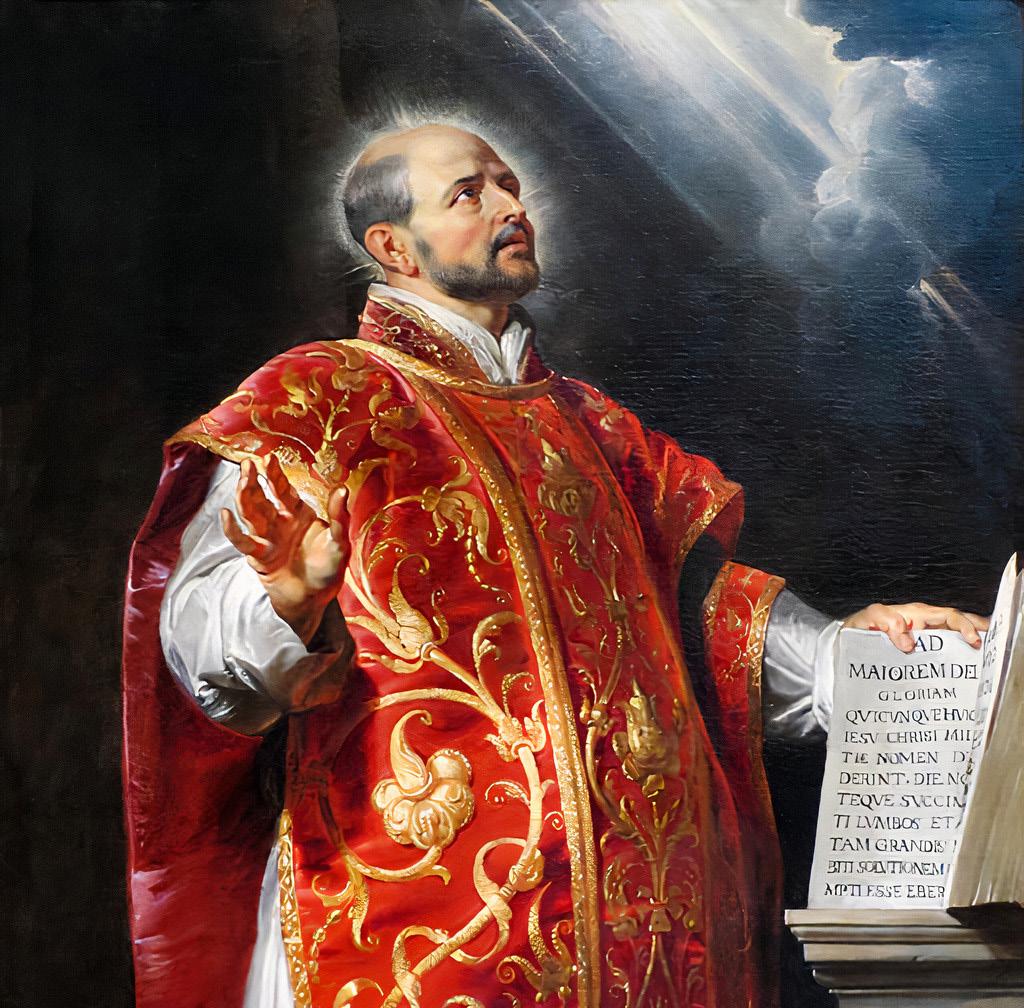
Building off this foundation of communal discernment in early Christendom, discernment significantly developed over a millennium later with the teachings of St. Ignatius of Loyola, and the emergence of Ignatius Spirituality. St. Ignatius, born in fifteenth century Castile (contemporary Spain), underwent a sudden and intense spiritual conversion following an injury in battle that left him bedridden for a year. During his lengthy recovery from injury, St. Ignatius grappled with his former drunkenness, womanizing, gambling, and pursuit of prestigious military titles, all of which left him feeling unfulfilled. His emptiness ignited a spiritual journey where he felt compelled to better understand Christ and the rich Catholic theological tradition of Middle Ages Spain. During his religious journey, he developed the Spiritual Exercises, a manual that instructs users on meditation and prayer, specifically designed to deepen one’s ability to discern God’s will. The exercises focus on the “discernment of spirits,” a reference to 1 Corinthians 12:10, where practitioners learn to recognize the ways of the Holy Spirit, as compared to the ways of enemy forces. Moreover, discernment of spirits pertains to the rivaling internal voices within one’s consciousness. St. Ignatius came to distinguish between two distinct experiences, consolation and desolation, which indicate two different spiritual movements within an individual. Consolation denotes a feeling of inner peace and spiritual closeness to God, and Ignatius views moments of consolation as an
At its core, discernment relies on the belief that God indeed works though his human agents.
indication of an individual spiritually aligning with God’s will. On the contrary, desolation denotes a feeling of doubt, confusion, and distance from God. In a sense, to feel desolate is to have an experience without any attempt at discerning divine will.
The Ignatian-style discerning process involves patiently paying attention to seasons of desolation and consolation in one’s life, thereby allowing individuals to gain insight into God’s will. Admittedly, guidance for Ignatian discernment can feel incredibly abstract and intangible. Instead of proposing a formula, St. Ignatius understood discernment to be a process that must be wrestled with. Considering what moments of life are times of consolation—internal movements that bring peace, joy, and closeness with God—or desolation—internal movements that lead to spiritual emptiness— is not something that can be clearly done. The contemplation requires deep reflection on the intricacies of one’s experiences and emotions. Moreover, this process must be retrospective, reflecting on one’s former feelings and experiences, not just an active, in-the-moment process. St. Ignatius impresses that individuals have instincts towards greater communion with the divine, as one can essentially come to understand what exactly God desires from them. Ultimately, St. Ignatius explains that individuals attempting discernment must have faith that their personal conclusions, reached through diligent
contemplation, align with the will of God. At its core, discernment relies on the belief that God indeed works though his human agents: “Few souls understand what God would accomplish in them if they were to abandon themselves unreservedly to him and if they were to allow his grace to mold them accordingly.”10
Discernment, as rooted in the Christian theological and literary tradition, offers the incredible ability to interpret guidance from the divine. The Old Testament narratives of Solomon, David, and Samuel show how prominent Israelite leaders struggled to hear or interpret the voice of God. In the New Testament, the Apostle Paul understands the “distinguishing between spirits” as a spiritual gift that helps the faithful discern between what is divine and deceptive. Early Christians practiced communal discernment to showcase the centrality of the Holy Spirit in the new faith. Finally, St. Ignatius’s Spiritual Exercises preach guidance for observing one’s innate spiritual conditions as a pathway for gaining insight into God’s will. But in the modern day, how does discernment remain relevant in our lives? The process can provide guidance for challenging questions that appear completely separate from the religious realm. What job should I take post-college? What major should I select? What friends should I surround myself with? Discernment is a challenging road of genuine introspection, patience, and willingness to rely fully on God. But the Christian tradition demonstrates how we can in fact align ourselves with his divine intentions.


1 Genesis 3:3 (ESV)
2 1 Kings 3:12 (ESV)
3 1 Kings 3:7-9 (ESV)
4 1 Kings 3:7 (ESV)
5 Deuteronomy 19:15 (ESV)
6 Psalm 24:4-5 (ESV)
7 1 Samuel 3:10 (ESV)
8 1 Corinthians 12:8-10 (ESV)
9 Acts 15:28 (ESV)
10 St. Ignatius of Loyola, The Spiritual Exercises of St. Ignatius of Loyola, translated by Elder Mullan.
11 Icons ("rose" and "ear") sourced by Noun Project and illustrated by Catherine Horner.

By Luca Gandrud D'27



"Let
my teaching fall like rain and my words descend like dew, like showers on new grass, like abundant rain on tender plants." Deuteronomy 32:2



Tyler
If you don’t know who Larry King is, think of him as last generation’s Jimmy Fallon. If you haven’t seen his look of bewilderment in 1997 when rock legend Tina Turner began to chant the Lotus Sutra on national television, then you can spend a worthwhile minute on YouTube. In 2020, Ms. Turner published Happiness Becomes You, both a memoir and guide to Nichiren Buddhist practice. Throughout the book, the ‘Queen of Rock 'n Roll’ relates how chanting significantly changed her life for the better: alimentation came for her personal struggles and her career rose to commercial acclaim after she started chanting. This practice represents a pertinent concern with religion: a contemporary conception that blends religion and capitalist culture.
With social mobility in the United States becoming more rigid, interest in alternative routes of success— beyond or complimentary to the American mantra of ‘by your bootstraps’—has increased.1 Prosperity, in its slipperiness, entreats the common American to find ways to
get ahead by any means. Christianity, which around 68% of Americans identify with, is by no means the least impacted.2 Modern American Christianity has shifted from the figure of Christ to the spectacle of the church. It misconstrues God as someone to bargain with instead of the loving figure that the Bible lays out.
Many modern Christians subsist on church once a week, dropping a twenty in the offering box, and going to Chili’s with the family afterwards. This is a transactional view of Christianity, contrasted with keeping to biblically motivated doctrine. The shallowness of this transactionality is seen in its creed: that the disciple need not be sanctified, need not pursue Jesus’s teachings, or know God at all. However glamorous Transactional Christianity may be, either in practice in megachurches or in its cultural fame (or infamy, depending on who you ask), the contrast of Christianity's firm foundation is clear: the basis of Jesus’s teachings is life-changing, life-giving bonds with Him and God. Through looking at the Prosperity
Gospel, the poster child of Transactional Christianity, and by relying on the core of love and joy at the heart of the Gospels, the notion of shallow belief can be rebuked in favor of true redemption.
The mosT ProsPeriT y for The leAsT sPiriTuAliT y
Although it was not mature until the 1970s, the Prosperity Gospel put down roots during the post-WWII religious boom in the 1950s. As many Americans looked for healing and affluence in sacred spaces, Brooklyn preacher Norman Vincent Peale developed a doctrine of “metaphysical mind-power—remembered for its psychological cast and emphasis on a cheerful and well-ordered mind”—in an era of increasing interest in therapeutics. Peale blended psychological concepts with religious texts, capturing attention in the economically loose postwar mood.3 His most noteworthy book, The Power of Positive Thinking, was a record-breaking self-help guide. In it, he suggests that “formulas, patterns of right thought, and the release of power through effective words” are enough to substantially change one's life.4 One need only “picturize, prayerize, and actualize” to call upon the power of God.5 Peale’s doctrine, however successful, mistakenly simplified prayer and the generosity of the Christian God to the 'see it, buy it, get it,' of an Amazon order. In this way, Peale applied the Christian tradition to the American thirst for success. The Prosperity Gospel grew out of this development.
While Peale and his contemporaries leveraged the silver screen for their ministries, the televangelists soon dwarfed their forefathers. By 1980, the Prosperity Gospel had begun to take full shape and space in American culture and the silver screen preachers had come to dominate national airtime.6 Within this golden age of church TV were Tammy and Jim Bakker. The couple started their
mainline show in 1973 and claimed fame and fortune by the early 1980s in the thriving televangelist market. The Bakkers and their contemporaries preached a doctrine that inherently called wealth into the lives of the faithful and righteous. As a consequence, the couple always had to show themselves worthy with spectacle after spectacle, even to the point of selling fraudulent timeshares to fund their self-swallowing ethos.7 As Kate Bowler of the Duke Divinity School explains, “the burden of [the] gospel was it always had to be proven in an endless cycle of bigger and better.”8 With the televangelicals came the maturation of the Prosperity Gospel: instead of focusing on God’s great love and biblical salvation, prosperity preachers began to look to God only for the enrichment of bank accounts and redemption from debt. This dogma would come to be incredibly popular and has been adopted by the American megachurch movement today.
Take World Changers Church International, headed by Creflo Dollar. In the church’s prime, it claimed the 15th-largest congregation in the nation. Dollar has built a public image of easy affluence, highlighted best
Modern American Christianity has shifted from the figure of Christ to the spectacle of the church and misconstrues God as someone to bargain with instead of the loving figure that the Bible lays out.
by a request in 2015 for a replacement private jet, and continues preaching how to live the life God intends for you.9 What he gets wrong is how one is to achieve such a life. Like Peale before them, contemporary superstars like Dollar, Joel Osteen, and Joyce Meyer teach that to be healthy and wealthy only requires positive thought, with or without Jesus. The Prosperity Gospel has come full circle and now idealizes self-help philosophies that have little biblical backing. Whatever the substance of these beliefs, they are presented in the facsimile of chapels and pulpits, with an aesthetic that mostly matches the American Christian tradition but does little to mimic its spiritual tenets.10 Therefore, even as the Prosperity Gospel has changed since the 1950s, its core principles remain a reduction of Christian maxims.
The Prosperity Gospel preaches a palatable doctrine: God gives to those who give, so give and be saved. This creed can narrow a church’s vision to finances only and diminish individual salvation, minimizing the sanctity of the pulpit and the soul, both key targets for Transactional Christianity. Prosperity churches often call upon God to inspire their congregation to give specific amounts—ranging from a day’s pay to fifty thousand dollars—despite Bible teachings.11 Christianity does call upon its followers to support the church but the absolute value does not matter; rather, the relative value of the sacrifice to the person.12 Secondly, it shifts focus off the individual’s soul and exclusively onto their actions. Giving money to a church is spiritually easier than the intense revolution Jesus calls for. Donating requires no change of heart, no permeating faith, and no nurturing of a relationship with Christ. Instead of accepting the responsibilities of Christianity along with its blessings, the transactional view exchanges donation for devotion. Within all of Jesus’s teachings, He preaches that what truly matters in Christianity is a person’s evolution, from head to toe,
not just from wallet to offering basket.
The Christian call to evolve runs deep. As God speaks through Ezekiel in the Old Testament,
I will give them one heart and put a new spirit within them; I will remove the heart of stone from their flesh and give them a heart of flesh, so that they may follow my statutes and keep my ordinances and obey them. Then they shall be my people, and I will be their God.13
This sets up a relationship of intention and action: if the intention-informing heart is lifted to heavenly standards, one’s actions must also be lifted. Christianity is often mistaken for transactional when practicing righteous action exclusive of a matching righteous intention. But for a disciple of Jesus, action must always be motivated by a changed heart seeking after God. As Jesus says:
As the Father has loved me, so I have loved you; abide in my love. If you keep my commandments, you will abide in my love, just as I have kept my Father’s command-
Peale’s doctrine, however successful, mistakenly simplified prayer and the generosity of the Christian God to the 'see it, buy it, get it,' of an Amazon order.
ments and abide in his love. I have said these things to you so that my joy may be in you and that your joy may be complete. This is my commandment, that you love one another as I have loved you.14
Action and intention go hand in hand within this passage, as Jesus commands His followers to abide in His love and thus keep his commandments. Whereas Transactional Christianity supposes that external action is the only measure of one’s religious success, Jesus preaches the opposite: the inward motivation that inspires one to do good works is as necessary as the action itself. This right motivation comes from accepting salvation and being changed through Jesus’s love. Rev. C. L. Franklin, one of the most popular radio preachers of his time, often taught about the transformational love that sits at the core of Christianity. Despite his medium, he wholly rejected the
Prosperity Gospel. Rev. Franklin rebuked the materialistic doctrine in one of his sermons, saying it would be a betrayal of the Bible, Jesus’s teachings, and the pastoral profession.15 While teaching on 1 Corinthians, Rev. Franklin addresses Christ’s love. In this letter, St. Paul writes, “if I have prophetic powers and understand all mysteries and all knowledge and if I have all faith to remove mountains but do not have love, I am nothing.”16 Here, Paul places love at the center of the Christian life and person. Rev. Franklin builds on this, preaching that to be a child of God, one must have love abundantly, allowing love to “control and permeate” their life.17 These men teach how Jesus lived a life of selfless, unending devotion. This is the love that Christians are called to. Here, love is more than just the human emotion. Christ’s love is a supreme devotion to the Father and us; how else could he have put his life to the side? This heavenly love is greatly expanded


on in much of the New Testament. In the Gospel of Matthew, Jesus prays, “My Father, if it is possible, let this cup pass from me, yet not what I want but what you want.”18 Jesus is supremely loyal to the Father and shows us what ultimate love looks like. He knows we cannot live up to this example, which only further glorifies His sacrifice as He knows it can never be reciprocated. Instead, Jesus offered everything so that we may have a direct relationship with Him and God the Father. This love, in the deepest sense of the word, does not exist in Transactional Christianity. Within the shallow paradigm, Jesus is swayed by tithes and actions, even if they are devoid of the love he commands us to abide in.
The condition of joy, which Jesus adds to his decree in John 15, must not be overlooked. Just like love, joy is not a superficial emotion in Christianity. It entails a deep-seated contentment with yourself, others, and God. Jesus gives his followers the difficult task of abiding in his love but adds that, in doing so, our joy will be complete.19 Like love, joy is more than human emotion; it is a divine condition. Heavenly joy suffuses all parts of the follower’s heart and mind, dispelling worry and allowing peace to enter into their life. This joy thickens the skin against external stress and allows for the grace of God to be felt in every moment, giving way to both rest and purpose in the Christian’s life. As King David famously writes,
The Lord is my shepherd; I shall not want. He makes me lie down in green pastures; He leads me beside still waters; He restores my soul….
You are with me; Your rod and your staff,
they comfort me20
David praises the Lord for the peace, rest, and comfort found in God's presence. In this way, he speaks of the important disposition that must come upon those who seek the Lord: as Jesus says, “My peace I leave with you; my peace I give to you” so that the Christian need not be burdened by worry or stress but can fix their eyes on God and his qualities.21 The basis of Christianity supposes that you are saved, no matter what mistakes you make or your failings, such that Jesus will always make up the deficit considering you earnestly search for him. Thus, fear and anxiety for the things of this world flee as you focus more and more on the things of Heaven. Transactional Christianity never considers what happens in the next world, or even one's disposition in this one beyond financial generosity. Rather, it focuses only on action and blessings but never gets to the root cause of the heart. The Bible utterly refutes this. Not only is this misconception avoidant of Jesus’s teachings but it also sidesteps the
However, both the Old and New Testaments report joy overflowing in lives where there should be despair, of peace everlasting where there should be distress, of love redemptive where there should be punishment.
meat of belief: to leave behind the necessary change in life is to leave out the fundamental root of Christianity. Paul defines the fruits of the Spirit, as “love, joy, peace, patience, kindness, generosity, faithfulness, gentleness, and self-control.”22 Often, these tenets are Sunday school trivia, but for the disciple of Christ there is no greater goal than the achievement of these gifts. For it is by these attributes that the faithful are recognized and it is through these attributes that one lives out a Christ-like life, following his commands and abiding in His love. This joy is accomplished also through the growing knowledge of God. As you spend time reading the Bible, meditating on Scripture, praying, and discussing with other believers, the face of God becomes clearer and clearer. The bountiful goodness, graciousness, love, humility, strength, and wisdom that describe the Christian God give way to a sharper image of the Lord: in this revelation, it becomes easier and easier to delight in and be constantly surprised by His goodness and find joy in His presence.
To view Christianity as transactional is to relegate His death and resurrection to the footnotes of history. Transactional Christianity portrays God as a farcical overlord who vacillates between mercy and revenge based on the good deed of the day. However, both the Old and New Testaments report of joy overflowing in lives where there should be despair, of peace everlasting where there should be distress, of love redemptive where there should be punishment. Transactional Christianity only leaves space for action and subsequent reward. While this notion of Christianity is an understandable misconception in our current society, dig a little deeper and you will discover the treasure trove of God's genuine love, joy, care, and power revealed by the simple good-heartedness of Jesus’s scriptural teachings. In one of his parables, Jesus
compared the Kingdom of Heaven to a fine pearl that a merchant saw and had to buy, selling everything he had to afford it.23 Christianity doesn’t call its followers to liquidate their assets and empty their wallets; it calls them to give all their heart, all their soul, and all their mind.


Tyler Long D'27 is from Vail, CO and is studing Religion, Anthropology, and Agriculture.
1 Ariel Gelrud Shiro, et al., Stuck on the Ladder: Intragenerational Wealth Mobility in the United States, (Washington D.C.: Brookings Institute, 2022) https://www. brookings.edu
2 “Religion,” Gallup, 2022, https://news.gallup.com/poll/1690/Religion.aspx.
3 Kate Bowler, Blessed: A History of the American Prosperity Gospel (Oxford University Press, 2013), 55-57
4 Norman Vincent Peale, The Power of Positive Thinking (Prentice-Hall, 1952), 55.
5 Peale, The Power of Positive Thinking, 55.
6 William H. Swatos Jr., Encyclopedia of Religion and Society (AltaMira, 1998).
7 Jim Bakker faced criminal charges and subsequent convictions for this in 1989. The Bakker cultural empire would crumble soon after.
8 Bowler, Blessed, 109.
9 CBS News, “Televangelist Creflo Dollar under scrutiny after asking followers to buy him $65 million private jet,” 2015.
10 In many ways, this aesthetic has blended with American star culture, playing hymn-inspired songs to rock beats and sweeping the chapel with fog machines.
11 Bowler, Blessed, 130.
12 See Genesis 28:20-22, Mark 12:41-44, and Matthew 22:15-12 for the Old Testament origin of tithing and two interactions Jesus has with the practice.
13 Ezekiel 11:19-20 (NRSVue).
14 John 15:9-12 (NRSVue).
15 Rev. C.L. Franklin, Fret Not Thyself (Atlanta International Records, 2009), https:// www.youtube.com/watch?v=MAijHngN0Sc.
16 1 Corinthians 13:2 (NRSVue).
17 Rev. C.L. Franklin, Paul’s Hymn of Love (Atlanta International Records, 2008).
18 Matthew 26:39 (NRSVue).
19 In Greek, the word is “meinate,” which is literally translated “remain” in the imperative mood, second person plural, and Aorist tense, meaning Jesus commands you all to remain as a fact. See https://www.abarim-publications.com/DictionaryG/m/m-e-nom.html for more information on the Greek.
20 Psalm 23 (NRSVue).
21 John 14:27 (NRSVue).
22 Galatians 5:22-23 (NRSVue).
23 Matthew 13:45-46 (NRSVue).
24 “Our Pastors | World Changers International Church.” n.d. World Changers Church International. https://www.worldchangers.org/our-pastors.
8 Icons ("almond blossom" and "palm") sourced by Noun Project and illustrated by Catherine Horner.

This prayer by professor of religion Lucius Waterman appears on a plaque hanging at the entrance of Parkhurst Hall.
O Lord God Almighty, well-spring of wisdom, master of power, guide of all growth, giver of all gain. We make our prayer to thee, this day, for Dartmouth College. Earnestly entreating thy favour for its people. For its work, and for all its life. Let thy hand be upon its officers of administration to make them strong and wise, and let thy word make known to them the hiding-place of power. Give to its teachers the gift of teaching, and make them to be men right-minded and high-hearted. Give to its students the spirit of vision, and fill them with a just ambition to be strong and well-furnished, and to have understanding of the times in which they live. Save the men of Dartmouth from the allurements of self-indulgence, from the assaults of evil foes, from pride of success, from false ambitions, from hardness, from shallowness, from laziness, from heedlessness, from carelessness of opportunity, and from ingratitude for sacrifices out of which their opportunity has grown. Make, we beseech thee, this society of scholars to be a fountain of true knowledge, a temple of sacred service, a fortress for the defense of things just and right, and fill the Dartmouth spirit with thy spirit, to make it a name and a praise that shall not fail, but stand before thee forever. We ask in the name in which alone is salvation, even through Jesus Christ our Lord, amen.
— The Reverend Lucius Waterman, D.D.

We, the editorial board of The Dartmouth Apologia, affirm that salvation is given through faith in Jesus, that the Bible is inspired by God, and that we are called to live by the teachings of Jesus and the apostles. We affirm the Nicene Creed, with the understanding that views may differ on baptism and the meaning of the word “catholic.”
We [I] believe in one God, the Father almighty, maker of heaven and earth, of all things visible and invisible.
We [I] believe in one Lord Jesus Christ, the Only Begotten Son of God, born of the Father before all ages. God from God, Light from Light, true God from true God, begotten, not made, consubstanstial with the Father; through him all things were made. For us men and for our salvation he came down from heaven, and by the Holy Spirit was incarnate of the Virgin Mary, and became man. For our sake he was crucified under Pontius Pilate, he suffered death and was buried, and rose again on the third day in accordance with the Scriptures. He ascended into heaven and is seated at the right hand of the Father. He will come again in glory to judge the living and the dead and his kingdom will have no end.
We [I] believe in the Holy Spirit, the Lord, the giver of life, who proceeds from the Father [and the Son], who with the Father and the Son is adored and glorified, who has spoken through the Prophets.
We [I] believe in one, holy, catholic, and apostolic Church. We [I] confess one Baptism for the forgiveness of sins and we [I] look forward to the resurrection of the dead and the life of the world to come. Amen.

[1 Peter 3:15]