










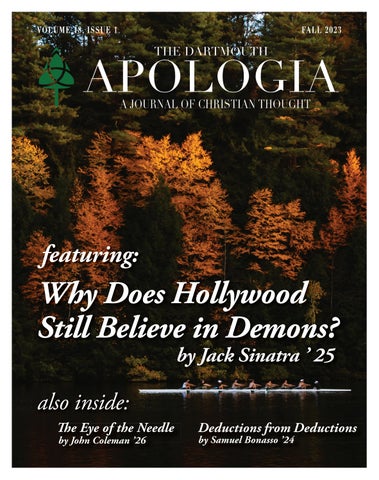



by Jack Sinatra ’ 25


also inside: by John Coleman ’ 26 by Samuel Bonasso ’ 24

Th e Eye of the Needle Deductions from Deductions


exists to articulate Christian perspectives in the academic community.
4
10
18
34 40 32 24

FALL 2023
VOLUME 18 ISSUE 1
CHRISTIANITY AND AMERICAN POLITICS, PAST AND FUTURE
An Interview with Peter Wehner
WILL BRYANT D ’ 24
WHY DOES HOLLYWOOD STILL BELIEVE IN DEMONS?
Exploring Spiritual Undercurrents in Horror Cinema
JACK SINATRA D ’ 25
THE EYE OF THE NEEDLE
Wealth in the Bible
JOHN COLEMAN D ’ 26
DEDUCTIONS FROM DEDUCTIONS
The Unstable Edifice of Skeptical New Testament Scholarship
SAMUEL BONASSO D ’ 24
YOUR HAND IN MINE
Poem
ELIZABETH HADLEY D ’ 23
ON REDEMPTION
Navigating the Paradox of Justice and Love
CRAWFORD HOVIS D ’ 25
THE RELIGIOUS AND SPIRITUAL LIVES OF DARTMOUTH STUDENTS
Preliminary Results
WILL BRYANT D ’ 24
Jack Brustkern D’25, Editor-in-Chief
Emil Liden D’25, Managing Editor, Art Director
Amelie Bradley D’25, Publisher, Editor
Charles Ambrose D’25, Editor
Marissa Benz D’26, Editor
Catherine Horner D’26, Editor
Matthew Kim D’26, Editor
Tula Nicholson D’25, Editor
Aleksa Sotirov D’26, Editor
Najma Zahira D’24, Senior Editor
Isaiah Menning D’24, Senior Editor
Will Bryant D’24, Senior Editor
Hailey Hao D’24, Poetry Editor
Anthony Fosu D’24, Art Director
Jack Donofrio D’25, Digital Manager
Gregg Fairbrothers D’76
Eric Hansen, Professor of Engineering, Thayer
James Murphy, Professor of Government
Lindsay Whaley, Professor of Classics & Linguistics
Council on Student Organizations
The Eleazar Wheelock Society
To subscribe to our journal, visit our website or use your phone’s camera to scan the QR code to the right. Subscriptions to the journal are free and subscribers get each new issue delivered right to their front door! For more information, visit our website or send us an email at the.dartmouth.apologia@dartmouth.edu.


We welcome the submission of any article, essay, or artwork for publication in The Dartmouth Apologia that seeks to promote respectful, thoughtful discussion in the community. We will consider all submissions from any members of the community but reserve the right to publish only those that align with our mission statement and quality rubric.
We deeply value your opinions and encourage thoughtful words of support, dissent, or other views. We will gladly consider any letter that is consistent with our mission statement’s focus on promoting intellectual discourse in the Dartmouth community.
email: the.dartmouth.apologia@dartmouth.edu
Dear Reader,
Though Robert Frost was only enrolled as a student in the fall of 1892, he was here for that season that best boasts the woods of the Upper Valley. This fall must have left an impression on him, for Frost returned many times during his career. “Two roads diverged in a yellow wood” – those famous words that begin his poem “The Road Not Taken” – may even be referring to a pair of roads in a wood not far from where we enjoy our own hikes and runs in the nearby hills. This fall, we too experienced the yellow wood of the Upper Valley with its seasonal peculiarities along with the fall studies and festivities.
Whether you were here in the Upper Valley to experience this particular fall or were further away, I am thankful that this journal has made its way into your hands. I hope that in perusing or perhaps even studying these articles you might be better able to ponder the more weighty questions of life and faith.
In every issue, the credit is due to the writers who bring his or her late night conversations and dorm room musings to bear. They are the ones who invite Christ into their wrestlings and then put pen to paper to share the fruits with their peers and friends in the Dartmouth community. Thank you to these writers, and thank you also to all our editors who accompany and guide them on each of thier journeys, and for our incredible design team members who bring the articles alive. I’d like to also thank the previous leadership team – Najma, Will and Isaiah – for all of their support and mentorship for years and still now.
As your read, I hope you will take to heart the glimpses of beauty that stand out most, that through this we might all be better able to ponder Christ and serve our neighbor.
In peace,



Jack Brustkern D’25 16th Editor-in-Chief of The Dartmouth Apologia




eter Wehner is an in-residence Senior Fellow at the Trinity Forum, a contributing opinion writer for The New York Times, and a contributing editor for The Atlantic. He has written for numerous other publications—including Time, Wall Street Journal, The Washington Post, Financial Times, The Weekly Standard, National Review, Commentary, National Affairs, and Christianity Today. He has also appeared frequently as a commentator on MSNBC, CNN, Fox News, CBS, PBS, and C-SPAN television.
Wehner served in the Reagan, George H.W. Bush, and George W. Bush administrations, including as Deputy Director of Speechwriting and later Director of the Office of Strategic Initiatives for President George W. Bush.

Wehner is author of City of Man: Religion and Politics in a New Era (co-authored with Michael J. Gerson) and Wealth and Justice: The Morality of Democratic Capitalism (co-authored with Arthur C. Brooks). His most recent book is The Death of Politics: How to Heal Our Frayed Republic After Trump.
The following interview has been edited for length and clarity.



The Dartmouth Apologia: Could you characterize the relationship between Christianity and politics in the 1990s and 2000s prior to 2016?
Peter Wehner: Sure. I’d say it started a little bit earlier than the ‘90s, because I think an inflection point happened in the late ‘70s and ‘80s with the advent of the Moral Majority and the involvement in politics of Jerry Falwell Sr. and Pat Robertson. Then there was an institutionalization of Christians involved in politics that manifested in the Moral Majority and other organizations.
Jerry Falwell Sr. is illustrative of that shift. He was a Southern Baptist and had traditionally been wary about Christian involvement in politics — he said he was more interested in saving souls. (Falwell, a segregationist, did find time to attack Dr. Martin Luther King, Jr.) He then got very involved in politics in the ‘80s in support of Ronald Reagan, and he and Robertson began to make pronouncements on the intersection of politics and faith in ways that were harmful.
I think there was a reasonably responsible evangelical and Christian presence in American politics in the ‘90s. Not perfect by any means, but trying to make a case for Christian values and Christian ethics. That continued in the 2000s through President Bush's Global AIDS Initiative, called PEPFAR. That program saved 25 million people on the African continent. Evangelicals were also involved in the pro-life movement. That complicated history began in 1973 with Roe v. Wade — some evangelical Christian organizations and certainly the Catholic church have been pro-life since then.
There was also a certain kind of disposition and temperament that Christians brought into politics, which we saw as far back as the 1980s, which foreshadowed what we're seeing now in the age of Trump and the MAGA movement. And I think that has been harmful to both American politics and to American Christianity. When Trump won the nomination in 2016, I think the worst tendencies were given jet fuel.
DA: How did the church change in response to its newfound role in American public life in the 80s and 90s?
PW: I think it changed in several respects. Christians put their focus on this world, rather than the world to come. Access to power was seductive for many Christians. They began to embrace the methods not of Jesus, not of the New Testament, but of political parties and even political operatives. The sensibilities of the Church changed over time in ways that I think overall are negative.
To clarify, I'm not an Anabaptist. I don't think that the Christian should, by definition, be uninvolved in politics, because I think politics is an important arena in which issues of justice are debated and determined. Justice always matters, and it should matter to Christians. So I don't think Christians should turn away from politics or be silent and indifferent to human catastrophes in the political arena, because there's a human cost. When politics goes really bad Christians should have something to say about it. At the same time, there are just enough warnings throughout history that when the church gets involved in politics, it ultimately corrupts the church and a lot of Christians.
Politics changes Christians more than Christians change politics. We've seen that play itself out in the United States and in recent decades. Politics is seductive, and human beings are fallible and vulnerable. People can change without even knowing that they have changed, and they can begin to adopt certain assumptions unconsciously. Net-on-net, the involvement of American Christians in American politics in recent decades has probably been more negative than positive. That doesn't mean that positive contributions haven’t been made, but overall its involvement in politics has hurt the witness of the American church.

DA: We’ve characterized the relationship between Christianity and American politics before the election of Donald Trump in 2016. Why did Trump gain such support in 2016, particularly from conservative Christians?
PW: For one, there was a seething resentment within rightwing Christianity, a feeling that Christians had been patronized and condescended to by the elite culture. And there's reason to believe that was true. These days it's overstated, the degree to which that happened, but I don't think that there's much question that Christians were looked down upon by an elite culture. Trump tapped into the grievances

and resentments that had been building up.
I think there was an attitude of existential threat in Christians’ view toward politics. As culture was changing, there was increasing fear among Christians that they were losing their culture and their country, and that their children would be massively harmed. To face this extraordinary threat, Christians needed to go to the ramparts and use even non-Christian methods to win. During conversations with people in 2016, I frequently heard the same kind of argument: though John McCain, Mitt Romney, George W. Bush, and Ronald Reagan were certainly better than Donald Trump as human beings, Trump was a fighter. That was a term that I heard a lot. While they weren't necessarily in favor of the methods that he would use, or his personal life, or his cruelty and his tactics, they felt like he understood the nature of the enemy, and that he hated the same people that they hated and that he would bring a gun to a cultural knife fight. In 2016, a lot of Christians were more uneasy with Trump's tactics and personality than they are today, because over time they’ve made accommodations to him and they refuse to speak out.
DA: Since Trump’s election, many have argued that American Christianity has lost its moral witness. What do you believe were the strengths of that moral witness before Trump, and what exactly has been lost since Trump?
PW: Historically, the church’s witness was at its best when it embodied principles of justice and moral order. When it engaged in politics in a way that didn't set aside the fruit of the Spirit: Love, joy, peace, patience, kindness, self-control, and all the rest. The church was an inviting place, and offered safe haven and sanctuary, and a home in the community to a broken world and to broken people. The church radiated the ethic of Jesus and the teachings of Jesus. There was something inviting about Christianity — whether or not someone agreed with the church theologically, it was a community they could admire. People saw Christianity as humane, loving, and compassionate.
There have been many revivals throughout history, including the First and Second Great Awakenings in America, where people gave voice to moral causes and moral concerns. But it was done in a way that resonated with peo-
ple rather than alienated them. The church has now lost its moral witness because it has adopted Trump’s methods: the cruelty, the crudity, the lies, the conspiracy theories. I mean, [church leaders have] overwhelmingly supported him. Many prominent figures — Robert Jeffress, Franklin Graham, Al Mohler, Wayne Grudem — have defended Trump to one degree or another, and pretty much refused to call him out. They're complicit in the rise of the movement. They're complicit in Trump's actions, and in his presidency.
I should say here that I understood the argument evangelicals made in 2016 to balance personal character and policy agenda, and that the policy agenda should take precedence. In the end, I didn't buy that argument, but I understood it. The unforgivable mistake that many Christians made was to refuse to condemn Trump’s individual actions. When the moral transgressions happened, they kept silent, they wouldn't speak out. In fact, often they were his sword and shield.
DA: For many young Christians, including students at Dartmouth, Trump has dominated their political upbringing. What is lacking from their civic experience as a result?
PW: It really pains me for younger Christians to have grown up in this era, because you're seeing politics at its worst, not at its best. What's missing are role models to show how Christians can stand for biblical ethics, moral order, and decency, in what the theologian Eugene Peterson would call the “Jesus way.” Peterson argued that you can't pursue the “Jesus truth” if you're not pursuing the “Jesus way.” I would say that what's missing for people of your generation are Christian political figures who embody the Jesus way — figures who engage in politics in a way that's principled, but decent and thoughtful.
When these role models are missing, it is easy for young people to become cynical about politics. It becomes a Nietzschean world, where the will to power prevails. Might is right, and the ends justify any means. People also start to wonder: how transformative is a Christian faith? The supposition would be that Christians involved in politics would nonetheless try to conform their life to the principles of faith and a biblical ethic. What a lot of people are

seeing is the opposite: [Christians] whose core identity is partisan and political.
DA: Are there particular people who stand out as examples of healthy religious engagement with politics?
PW: In terms of contemporary figures, Mitt Romney stands out as a member of the LDS church. That is not my faith tradition, but Romney and Utah Governor Spencer Cox make clear that their faith is central to their life, and they conduct themselves with dignity and integrity as a result. Many evangelical leaders have embraced the worst of Trumpism, or simply gone silent in the midst of the MAGA movement, and have lost a degree of integrity as a result.
Historically, William Wilberforce is an obvious example, a kind of sainted figure within evangelical Christianity and one of the driving forces of the abolitionist movement. I'm
also a huge fan of Abraham Lincoln. Though not an orthodox Christian, it's clear from his writings and his actions that he grappled seriously with faith. He stood up against evil when it existed in his midst. Both of his inaugural addresses invoke a Christian ethic of peace. He stood for principle and tried to heal the nation, and was not motivated by vengeance or anger.
George W. Bush's support of the Global AIDS Initiative, PEPFAR, was in part a manifestation of his faith. Though there was no real constituency for the program, he raised its funding to $15 billion in a single stroke. The program saved 25 million lives on the African continent, one of the great humane programs in American history.
DA: What role, if any, should history play in a rehabilitation of Christianity’s relationship with American politics?
PW: Yes, I think history is useful. In one respect it is useful because it shows us that there are a lot of ups and downs when it comes to Christian involvement in politics. Sometimes the Christian church and Christian institutions are shining examples — they are pistons in the engine of justice. The world is better because of their presence and they bear witness to Christ in imperfect but admirable ways.
Other times, Christians get involved in politics and they make things worse. We see it in historic anti-Semitism, in the Crusades and the Inquisition, and in the MAGA movement. We saw it in the American South, with chattel slavery. We saw it in the German national church’s support for Nazism. We saw it with the Dutch Reformed Church during South African apartheid. During the Rwandan genocide, the vast majority of the population were self-proclaimed Christians.
The Christian witness in the early church was extraordinary. An obscure Messianic movement in the second and
third centuries in Palestine became the dominant faith of Western civilization partly because of, according to sociologist Rodney Stark, the communal compassion in Christian social networks. They cared for the sick and the widow and the orphan, they welcomed strangers and cared for outsiders, they respected women who were considered — at best — third class citizens. They weren’t political, they didn't seek power, they just lived a faithful life in a faithful community. And the radiant effects were enormous. [The example of the early church] stays with us today. It’s a good reminder that politics and cultural power are not the chief levers of the Christian witness.
But again, politics matters. The Dutch theologian Abraham Kuyper argues that everything, including politics, falls under the domain of God. In this context, Christians should put forward, in a compelling and persuasive way, a Christian anthropology: a belief that all people are created in the image of God. In the political world, Christians should use the practical implications of this belief to guide

their involvement, both for the particular causes one rallies around, and the manner in which one rallies around those causes. Again, you need the “Jesus truth” and the “Jesus way.” If there’s a vast gap between the two, I don’t think it will end well for the causes that are being championed and for the witness of the Church.
DA: Are there specific issues where you find the Christian perspective on politics particularly relevant?
PW: I'd say my main concern right now is less issue-specific than it is a broader attack on liberal democracy, truth, law, decency, and on the public square itself. I think we're in an usually precarious and dangerous time. For most of my life, politics was an arena to debate issues — and it still is to some extent — but the Trump phenomenon has damaged the function of the public square in ways not seen since the Civil War. The assault on truth itself, and the resulting nihilism or quasi-nihilism you see on parts of the American right, is a huge cause for concern. Christians should pursue and embrace truth — as Jesus says, “the truth shall set you free” — and yet many Christians institutions are a battering ram against truth in the current political environment. I hope that enough Christians speak up and reclaim truth as a concept, to counter the worst manifestations of misinformation and disinformation.
DA: In closing, what book would you recommend to young people who want to learn how to engage healthily with religion in the public square?
PW: St. Augustine’s City of God is the definitive book in that respect. I do think that answering a prior question to Christian political engagement is important — that is, how do you create proper Christian sensibilities, dispositions, and attitudes? If that is missing, the seduction of power is very strong and often overwhelming. There are many different answers to this question — from Kuyper, Calvin, and Augustine, for example — I think they are all worth reading or at least acquainting oneself with the theology.
The last thing I’ll mention is not primarily a political book at all, but it bears on this question. The book is A Severe Mercy by Sheldon Vanauken. In the afterword, Vanauken reflects on his involvement in the anti-war movement during the
Vietnam War. He thought that, as a faithful Christian, he should take a stand against a war that he considered unjust. But as the movement developed, Vanauken saw that the movement’s political goals took priority over Christian attitudes. “The Movement, whatever its ideals, did a good deal of hating,” he wrote. This was really a cautionary tale. Once Christ became secondary, the driving force of the movement became hatred for its enemies. Despite his admirable motives to be a faithful Christian witness in politics — whatever you think about the Vietnam War — Vanauken saw that political movements can reshape Christian sensibilities, and that, again, politics changes Christians more than Christians change politics. I read that years ago, and it has stayed with me. I think it’s still very applicable.








JACK SINATRA
fter experiencing the chilling terror of The Conjuring for the first time, audiences worldwide were driven to desperate measures, reaching out to the Vatican in a frantic attempt to safeguard their souls from potential demonic possession. The fear and fascination ignited by the film exemplify why demons have such an enduring presence in our society. In the world of cinema, demons remain prominent, taking on roles as formidable antagonists. But is their continued prevalence solely because they embody inherent evil and make for compelling foes? Or does their power over modern audiences originate from a deeper, darker source, transcending mere entertainment?
As one delves into the realm of modern cinema to analyze the depiction of demons, it becomes evident that these portrayals point to profound religious truths, far beyond the realm of Hollywood stereotypes and misinterpretations. Demons remain a haunting presence, having found their place not only in movies but also in music and literature. Despite technological advancements

and societal upheaval, the fear they evoke has transcended generations. Whether consciously acknowledged or lurking in the subconscious, our fears of demons remain deeply ingrained, contributing to their timeless allure and impact on our collective psyche. Delving into the various aspects of what people fear and why they fear them helps us better understand the relationship between our physical world and the spiritual realm.
The interconnectedness between fear and belief, an examination of the implicit religious beliefs in contemporary society, and a consideration of the significance of religious accuracy in popular culture all point towards a universal belief in the reality of malevolent supernatural entities. This fascination and trepidation surrounding demons serve as a bridge to a deeper connection with the divine. As individuals grapple with the fear of demonic forces, a recognition of the existence of the supernatural enhances faith that a loving and protecting God does exist.


When Christian and non-Christian individuals express fear of demons, it inherently implies a belief that these entities hold the potential to impact their lives.
The inherent fear of supernatural evil might be the biggest indicator of an underlying belief in demons. It is necessary in this case to take a deeper dive into why people fear demons. In his article “Fear” from The Philosophical Review, Robert M. Gordon offers insightful research on the dynamics of fear and vulnerability, allowing us to gain insight into the profound impact of demonic entities on belief systems and the spiritual journey. Gordon’s research on fear establishes an intricate connection between what individuals fear and their underlying vulnerabilities. When Christian and non-Christian individuals express fear of demons, it inherently implies a belief that these entities hold the potential to impact their lives.
The enduring fear of demons is deeply rooted in the human psyche. Gordon argues that “fearing motivates avoidance of vulnerability, so that even if one’s fears prove true, one will have salvaged what is importantly at stake.”1 In the context of demons, an individual’s fear serves as a protective mechanism, compelling them to avoid potential harm or malevolent influence caused by demons. According to Gordon, fears truly become tangible when they represent something an individual has no power over. He uses the vocabulary “non-deliberative uncertainty” to postulate that fear of a demon, for example, is born of the fear that a demon may attack and cause harm.2 If a demon chooses to attack, it is a matter of non-deliberative uncertainty because the individual cannot change whether or not it will happen. The non-deliberately uncertain nature of a demonic attack motivates the individual to accept the presence of the Devil and begin a salvage mission. Uncertainty in this case stems from the inexplicable nature of malevolent entities and their potential impact on powerless individuals’ lives.
Gordon additionally makes a distinction between attitudinal fears and cognitive fears. Attitudinal fears stem
from an individual’s wishes or desires, such as wishing to avoid encountering demons or the supernatural evil.3 On the other hand, cognitive fears relate to non-deliberative uncertainty. For example, someone may be terrified that there are demons in the house because a candle flickered out (cognitive) or because demons are evil and are not wanted in the house (attitudinal).4 In this example, the cognitive fears stem from uncertainty that a demon is present in the house (non-deliberative uncertainty). With attitudinal fear of demons, the fear itself centers on an individual’s desire for there not to be a demon present. This desire originates from the belief that demons have malevolent intentions and could cause harm. In other words, people fear the presence of demons because they characterize them in this way.
Fear of demons encompasses both cognitive and attitudinal aspects, exerting a profound influence on how individuals respond to these malevolent entities. This fear goes beyond concerns about potential harm, as it is deeply entwined with personal beliefs and values. Essentially, our inherent belief in demons gives rise to powerful attitudinal fears that cannot be easily dismissed. It stems from a foundation of uncertainty, compelling individuals not to brush it aside but rather to confront and grapple with it, all in an effort to protect what they hold dear. This fear, however, isn’t solely rooted in uncertainty about the existence of demons. As literature and theater evolved from the Reformation onward, it becomes evident that many Christians in America firmly maintained their belief in the earthly influence of Satan. Exploring the historical portrayal of malevolent supernatural beings allows us to understand the profound impact the Devil has had on people’s fears.
The representation of demonic evil and the Devil as its figure-head has undergone significant changes over

tapestry of Christian beliefs, the Devil has left his mark as a symbol of fear.
the course of history, but one aspect has remained constant: the persistent fear they evoke in human minds. Prior to the fourteenth century, the image of the Devil was often intertwined with elements of temptation and evil, but the level of horror and dread associated with him was not as pronounced as it would later become. It was during the Reformation that the portrayal of the Devil took on a heightened sense of terror, driven by theological shifts and changing cultural dynamics. In his book The Birth of the American Horror Film, Gary D. Rhodes discusses the Middle age portrayal of demons and their representations as supernatural beings with malevolent intentions. According to Rhodes, the time of the Reformation established an image of the Devil that was nothing short of horrifying, as theologians emphasized his role as an interloper in human affairs: “the theology of Luther ‘encouraged belief in Satan.’”5 Luther’s theological teachings encouraged believers to take Satan’s existence seriously and recognize the constant threat he posed to their spiritual well-being. As the Reformation caused immense change in Europe and Christianity, the belief in demons not only remained, but strengthened. The period also witnessed a heightened focus on individual spirituality and personal relationships with God. As the fear of damnation became more prominent, the figure of Satan assumed a more significant role in religious discourse, representing the embodiment of evil and temptation. One depiction shows “Serpents extend from the demon’s ears while he literally consumes the flesh of Judas Iscariot.”6 Across the evolving tapestry of Christian beliefs, the Devil has left his mark as a symbol of fear. This lasting impact has contributed to the enduring fear of demonic entities deeply entrenched in the collective human psyche.
Colonial America additionally provides a
particularly compelling example of how individual perceptions of evil forces, such as Satan and demonic possession, influenced the collective fear of demons. It was during this time that witchcraft trials took center stage, and the fear of malevolent supernatural entities was very real to most Americans.7 In this era, Satan was thought to stalk men on cloven hooves and slither after women, preying on their sinfulness.8 The belief in evil supernatural powers was deeply ingrained in Colonial Americans, in turn shaping the portrayals and perceptions of the Devil in early American culture. The historically prevalent role of the Devil and the malevolent supernatural has left a lasting impact on contemporary beliefs and attitudes towards demons, highlighting the perpetual power of fear and its connection to religious belief and cultural context.
Even the Colonial period leading up to the witch trials portrayed the Devil as something that should be feared. Christopher Marlowe’s play, The Tragicall [sic] History of the Life and Death of Doctor Faustus (c. 1592), both utilized the fear of damnation to create a compelling story and highlighted the profound dread individuals associated with encounters with malevolent supernatural entities. The portrayal of Faustus’s tragic pact with the Devil highlights the consequences of succumbing to temptation and the inherent fear of losing one’s soul to supernatural evil.9 Later, in the nineteenth century, the portrayal of the Devil in literary works and theatrical productions often adopted humor, as seen in Washington Irving’s “The Devil and Tom Walker.”10 However, beneath the humor lies an underlying fear of demonic forces and the potential consequences of making deals with malevolent entities.
In contemporary society, the enduring fear of demons finds its roots in implicit religious beliefs that underlie our perceptions of supernatural entities. Fanhao Nie’s article “Demonic Influence: The Negative Mental Health Effects of Belief in Demons” from the Journal for the Scientific Study of Religion highlights that over half of contemporary Americans believe in demons, reflecting the prevalence of the malevolent supernatural throughout Christianity and other religious traditions.11 Douglas E Cowan takes a deeper dive into the implications of this in his book Sacred Terror: Religion and Horror on the Silver Screen. According to Cowan, the belief in zombies, mummies, and vampires is not widespread in the Western world. In contrast, the Devil and his malevolent followers
hold a significant place in Christianity, the dominant religious tradition in North America. This belief increases “the sociological effect of the ‘true story’” that ultimately makes horror movies frightening.12 The prevalence of these types of horror films implies that filmmakers know how to tap into this belief and harness it to make successful movies.
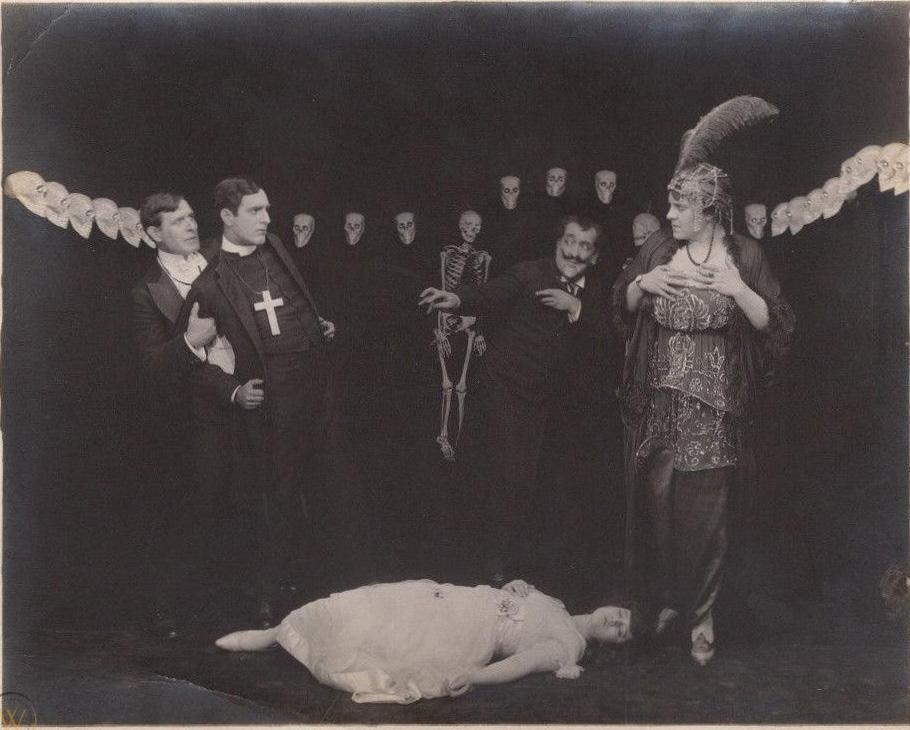
Over the years a multitude of films have been made with Satan as the main antagonist. As Rhodes’ article delves into films like The Devil’s Darling (1915), it becomes evident that the portrayal of demons as malevolent entities has captivated audiences for generations, tapping into the timeless fascination with the unknown and the innate fear of supernatural evil. The film’s description as a “strangely gruesome flight of the imagination” emphasizes the allure of entities that are unseen but have the power to evoke
fear.13 The ongoing fear of demons is amplified by their sometimes fantastical representation in film as malevolent entities, shrouded in darkness and mystery.
When exploring the fascination with demons and their portrayal in popular culture, it is crucial to bridge the gap between religious accuracy and Hollywood stereotypes. When religious concepts (like demons) are depicted authentically, drawing from the rich tapestry of religious lore, audiences are more likely to engage with the narrative on a deeper level. One of the most highly revered movies on the betrayal and crucifixion of Jesus, The Passion of Christ (2004), not only affected audiences worldwide but served

to powerfully influence the people who worked on the film. The actor who played Jesus, Jim Caviezel, commented on his experience during an interview with The Christian Broadcasting Network Inc, explaining that he often felt a great presence while shooting: “This prayer that came from me was, ‘I don’t want people to see me. I just want them to see Jesus. And through that conversions will happen.’ That’s what I wanted more than anything, that people would have a visceral effect to finally make a decision whether to follow Him or not.” Due to the literally painstaking attempt to make the passion of Christ as realistic as possible, Caviezel had experienced some sort of connection with God, and he hoped that others watching the film would glean the same effect. The movie’s co-producer, Steve McEveety, had been screening it for clergy throughout Rome, even receiving the ultimate endorsement from Pope John Paul II. McEveety recounted the pope’s comment on the film, quoting him as saying, “It is as it was.” Such accuracy evokes not only a sense of awe and wonder, but also serves to engage viewers to the point where they feel compelled to reevaluate their own spiritual beliefs.
The television program Supernatural stands out as an example of a show that specifically prioritizes religious accuracy in its portrayal of demons. Show creator Eric Kripke is keen on getting the facts straight when it
comes to myth, legend, and even religion, ensuring that the series is grounded in reality.14 The writers of the show make conscious efforts to draw from real urban legends and religious artifacts, giving a sense of authenticity to the supernatural elements depicted in the episodes. For instance, demon hunters in the show are frequently seen using the Devil’s Trap, a religious diagram used to bind demons, which is derived from ancient texts.15 Additionally, Supernatural Magazine provides educational material for fans, delving into the origins of the urban legends and monsters featured in episodes. By drawing from authentic sources and historical references, Supernatural exemplifies how accurate portrayals can enrich storytelling and deepen the audience’s appreciation of the mystical and supernatural elements within the framework of religious traditions. When a show like Supernatural incorporates genuine religious concepts and historical references, it creates a bridge between the fictional narrative and the realworld belief that has shaped human cultures for centuries. This connection adds depth and authenticity while also captivating the audience by tapping into this inherent belief of demons discussed previously.
In the context of accuracy, Cowan spends a great deal of time analyzing the “true story” impact of the widely popular demonic horror film, The Exorcist (1973) and the
public’s reaction to it. He asserts that the movie shocked people to their core, leaving individuals “horribly frightened or so confused that they have begun to lose their grip on reality.”16 Clearly audiences displayed a potent connection to the unseen world depicted in the movie, strongly hinting at a belief in its portrayal of the supernatural. In Cowan’s words: “The message, it seems, is clear: Satan is real, and he has a plan for your life.”17 Interestingly, in their frantic state, people instinctively were led to call on priests; in other words, once The Exorcist convinced audiences that Satan is real, it simultaneously convinced audiences that God is real as well. People were so frightened by the malevolent supernatural that they strove to understand and become more connected with the benevolent supernatural.
The belief in demons and the inclination towards faith in God are often intertwined, sharing a common foundation in supernatural belief.18 In Christianity, the Goodness of God is juxtaposed by the pride of Satan, literally “the adversary.” Satan works to cause harm and adversity in the world while God promises protection and salvation. The fear that demons evoke, given to humans by God, can strengthen individuals’ faith in the power and hope that flows from a loving God. As individuals grapple with the fear of demonic forces and the desire for safety, their faith in God becomes a guiding force in navigating the uncertainties of a world inhabited by unseen malevolent entities.19 This interconnectedness of belief in demons and faith in God underscores the power of supernatural beliefs in shaping our perceptions of the unseen forces that both intrigue and evoke fear within us.
The fear of damnation and supernatural evil is intertwined with the inclination towards faith in God, as belief in evil reinforces the need for protection and salvation. In this context, the fear of demons as a God-given
mechanism encourages us to turn towards a higher power, seeking refuge and guidance in the face of the unknown and malevolent forces. As highlighted by Gordon, with his assertion that in the face of fear individuals are compelled to protect what is important, we see that, as people are confronted with the idea of malevolent supernatural entities, they seek a sense of security and assurance that they can withstand such encounters.
Additionally it’s important to recognize that, just as demons are considered supernatural entities, the concept of an all-powerful God also exists within the realm of the supernatural. This perspective offers a coherent framework where both God and demons coexist. Moreover, the fear of damnation and the notion of an afterlife governed by moral consequences play a pivotal role in reinforcing the inclination towards faith in God. The idea of an eternal punishment for succumbing to temptation and aligning with malevolent entities accentuates the importance of adhering to moral principles and seeking divine benevolence. Therefore, the enduring fear of demons and supernatural evil is not merely a superficial fright of mythical beings; it delves into the core of human beliefs and the quest for protection, salvation, and moral guidance.
The fear of demons is a profound manifestation of deeply rooted beliefs that have persisted across cultures and time periods. This fear not only reflects a universal fascination with the unknown but also underscores the complex interplay between faith, vulnerability, and the human desire for protection. This interplay becomes particularly evident when considering that fear of demons becomes a powerful testament to the intricate relationship between belief in the existence of malevolent supernatural
When a show like Supernatural incorporates genuine religious concepts and historical references, it creates a bridge between the fictional narrative and the real-world beliefs that have shaped human cultures for centuries.
This fear is not a sign of weakness but a reflection of our innate awareness of the spiritual realm and the complex dynamics between light and darkness.
entities and faith in God.
The intertwining of belief in demons and faith in God showcases the duality of human spirituality—our capacity to embrace the divine while acknowledging the existence of forces that oppose it. The belief in demons serves to amplify the significance of God as a protective force against evil. As the fear of supernatural evil deepens, so does the yearning for divine guidance and intervention, illuminating God’s design within human nature to seek divine protection when confronted with malevolent forces.
Just as the fear of darkness heightens the appreciation of light, the fear of demons reinforces the need for a benevolent higher power to navigate the complexities of the spiritual
realm and reaffirms the intricate relationship between our God-given fears and our spiritual yearnings.
Furthermore, bridging the gap between religious accuracy and Hollywood stereotypes is vital in understanding the reality of these supernatural entities. When filmmakers draw from the wellspring of religious tradition and even religious lore, they not only create a more immersive experience for audiences but also unify people from diverse backgrounds. Despite varied beliefs, the universal fear of demons, as seen in the public’s reactions to popular films like The Exorcist, bring individuals together under shared yearning for protection and spiritual guidance. This collective response underscores the potent grip that the fear

of supernatural entities has on the human psyche, driving people to turn towards Christianity’s divine intervention. Thus, filmmakers not only offer an immersive portrayal of these entities but also manage to unite people from diverse backgrounds in their common search for solace and strength. By delving into the depths of religious accuracy, creators can transcend mere entertainment to engage in meaningful conversations about faith, spirituality, and the age-old battle between good and evil. In a world where the fear of demons persists, we can find solace in the fact that faith provides a powerful source of strength and protection. This fear is not a sign of weakness but a reflection of our innate awareness of the spiritual realm and the complex dynamics between light and darkness. Through understanding, education, and respectful portrayal, the fear of demons can be transformed into an opportunity for spiritual growth and exploration. As we confront these fears, we can draw closer to our beliefs, realizing that faith in God is a shield against the malevolent forces that may seek to undermine the divine order. Embracing our fears reaffirms the resilience of our faith in God, offering a guiding light through the mysterious depths of the spiritual realm and reminding us that in the face of darkness, our belief in God stands as an unyielding fortress.

1 . Robert M. Gordon, “Fear,” The Philosophical Review 89, no. 4 (1980): 560.
2 . Gordon, 574.
3 . Gordon, 564.
4 . Gordon, 564.
5 . Gary D. Rhodes, The Birth of the American Horror Film (Edinburgh University Press, 2018), 125.
6 . Rhodes, 125.
7. Rhodes, 125.
8 . Rhodes, 125.
9 . Rhodes, 125.
10 . Rhodes, 126.
11 . Fanhao Nie and Daniel V. A. Olson, “Demonic Influence: The Negative Mental Health Effects of Belief in Demons.” Journal for the Scientific Study of Religion 55, no. 3 (2016): 498.
12 . Douglas E Cowan, Sacred terror : religion and horror on the silver screen (Waco, Tex.: Baylor University Press, 2008), 174.
13 . Rhodes, 125.
14 . Erika Engstrom and Joseph M. Valenzano, “Demon Hunters and Hegemony: Portrayal of Religion on the CW’s Supernatural.” Journal of Media and Religion 9, no. 2 (2010): 73.
15 . Engstrom and Valenzano, 73.
16 . Cowan, 184.
17 . Cowan, 184.
18 . Nie, 513.
19 . Nie, 513.




JOHN COLEMAN
magine a sumptuous feast with all types of food and drink. For many, that may sound delicious, hinting at an exciting night of eating, drinking, and dancing. For others, it may be a stark reminder of worldly inequality, provoking a visceral reaction of disgust at the immorality of having so much while others have so little. Those differing views reflect a moral divide on wealth. Is wealth something to be lavishly enjoyed as a sign of God’s earthly favor? Or does it pave the path to hell? At first glance, it appears that the Bible presents contradictory messages that could be used to support a wide variety of interpretations. Yet the underlying teaching is surprisingly simple. Wealth is certainly not inherently immoral – it can be used for much good – but it is more frequently prone to misuse making it more often a temptation and an obstacle to the complete and total loyalty God asks of His people.
In this article I will argue the above by examining a collection of Bible verses. First, I will argue that the

Bible teaches that wealth can never be truly ours, that it is always the property of the God who first created all. I will then examine human temptation from wealth before focusing on the benefits of wealth as described in the Old and New Testaments.
THE CHOICE: GOD OR WEALTH?
Since God is the creator of all, the Bible condemns possessive and covetous attitudes toward wealth. Psalm 24 firmly establishes the fact of God’s ownership: “The earth is the Lord’s and all that is in it”. Because a covetous attitude toward wealth is borne of the desire to gain solely for oneself, that attitude inherently rejects God as Creator and Owner of all. To be clear, the sin comes not in wealth itself, for God does not create anything inherently evil, but in an improper attitude toward wealth.
So if only a covetous attitude toward wealth is sinful, why does the Bible warn so strongly against possessing wealth at all? Consider the story of the


To be clear, the sin comes not in wealth itself, for God does not create anything inherently evil, but in an improper attitude toward wealth.
rich young man and Jesus. Coming to Jesus, he asks what he must do to achieve eternal life. The man has enthusiastically followed the commandments, but he balks when Jesus then tells him to sell his possessions and give the proceeds to the poor. In every traditional way, the rich man has been serving God. But, his lingering attachment to his wealth prevents him from completely accepting the Great Commandment to “love the LORD your God with all your heart, and with all your soul, and with all your might” for he is still trying to love his wealth as well.
This is summed up in the Book of Proverbs, when Agur asks God to help him avoid things that could lead him astray: “Remove far from me falsehood and lying; give me neither poverty nor riches; feed me with the food that I need, or I shall be full, and deny you, and say, ‘Who is the LORD?’”. While the potential sin of lying is selfexplanatory, Agur, as a wise man, understands both the trap of poverty and the trap of wealth. Poverty can lead to envy and stealing, just as riches can beget pride and forgetting God as it did in the case of the Israelites in the desert. While most understand that, it would be laughable to claim that poverty itself is inherently immoral. He asks God to remove them from him precisely because he fears that his will may not be strong enough to avoid the temptation that so often accompanies wealth and want. Agur exemplifies the Bible’s concern about wealth: not about wealth itself but about its effects on humans. Deuteronomy warns against this potential arrogance even
more directly, “Do not say to yourself, ‘My power and the might of my own hand have gotten me this wealth.’ But remember the LORD your God, for it is he who gives you power to get wealth”. Much like Agur, Deuteronomy warns not of the inherent evil of wealth but of its corrupting and sinful potential. Here the condemnation is not of the wealthy man, but of the man who forgets his God.
That is why Christ encourages His followers to adopt the spiritual poverty necessary to fully surrender to God. Spiritual poverty is based on the humility that allows one to recognize both God as the source of all that is good and His glorification as the purpose of earthly life. A key part of that approach is adopting Christ’s strict teaching: “‘If any want to become my followers, let them deny themselves and take up their cross daily and follow me’”. By denying their earthly wants (primarily wealth), one can follow Christ much like the apostles who abandoned their nets and therefore their livelihoods to serve Christ. Put simply, the Bible teaches that life is a series of choices between God and distractions. God leads to salvation, worldly distractions to sin. This is no better simplified than in one of Christ’s most famous teachings: “‘No one can serve two masters; for a slave will either hate one and love the other…You cannot serve God and mammon”. Wealth alone is not sin, but it is a sin to serve wealth at the expense of God.
Spiritual poverty is based on the humility that allows one to recognize both God as the source of all that is good and His glorification as the purpose of earthly life.




While wealth certainly makes it harder to fully accept Christ, the Bible also teaches that wealth can cloud judgment in other ways, leading to additional sin. First and foremost that sin is forgetting, exploiting, and oppressing the poor. Jesus illustrates this concept in the story of the rich man and Lazarus. The earthly pains of Lazarus are great. He lays outside the house of a rich man longing for food and covered in sores licked by dogs. But his plight, like the plight of many of the poor people in the Bible, begets a spiritual poverty that turns him toward God so that when he dies, he joins Abraham in the eternal light of the Lord. The same cannot be said of the rich man, who ignored the plight of Lazarus, stepping over him every day, failing to follow the commandments to love one’s neighbor or care for the downtrodden. In his wealth and comfort, the rich man forgot the purpose of life, too focused on feasting “‘sumptuously every day’” to turn to God, thereby rejecting Christ’s command to love thy neighbor.
In the Old Testament, Ezekiel condemns his society by comparing it to Sodom, the epitome of evil in the Bible: “This was the guilt of your sister Sodom: she and her daughters had pride, excess of food, and prosperous ease, but did not aid the poor and the needy.” Ezekiel establishes the greatest of sins, all of which the Bible teaches can come from the wrong attitudes toward wealth. In their arrogance and pride, Sodom violated God’s laws by refusing to aid those in need, demonstrating their hoarding attitude toward wealth, unwilling to share even with those in desperation. In his condemnation of Israel, Amos declares that God will not forgive Israel “because they sell the righteous for silver, and the needy for a pair of sandals— they who trample the head of the poor into the dust of the earth, and push the afflicted out of the way.” In a brutal depiction of Israel, Amos does not attack the silver or sandals themselves. Rather, he condemns the people’s obsession with obtaining wealth to the point that they would sell their brethren into slavery. In the same way Christ condemns the rich man in the story of Lazarus, Amos condemns the rich for having forgotten the poor to the point that they grind their heads into dust, obliterating all memory of them except that which lives forever in the mind of God. These are great sins that the prophets and Jesus consider worthy of
punishment – earthly destruction in the Old Testament, eternal damnation in the New, but agonizing punishment nonetheless.
It is the belief that the wealthy often exploit the poor that leads Mary to proclaim “He has filled the hungry with good things, and the rich He has sent away empty” in the Magnificat, and allowed St. Paul to write, “The love of money is a root of all kinds of evil, and in their eagerness to be rich some have wandered away from the faith”. It is not money itself, but an improper attitude toward it that leads to the greatest of sins: Forgetting the Lord and the less fortunate.
And yet, for all the warnings against wealth, many of the great heroes of the Old Testament were fabulously wealthy. What sets them apart from the rich sinners is their different attitude toward wealth. Indeed, the proper and righteous use of wealth is depicted nowhere better than in the Old Testament story of Abigail and Nabal and the New Testament story of the rich fool. When King David’s servant asks Nabal, a “very rich” man, for food, he refuses to share the bounty God has given him. Hearing of her husband’s transgressions, Abigail disobeys him and delivers immense gifts to David and his entourage, holding her wealth lightly and understanding that hospitality and charity must always trump the preservation of one’s wealth. For the righteous use of her God-given wealth, she is rewarded greatly, eventually becoming David’s wife.
Consider as well the story of Jesus and the corrupt tax-collector Zacchaeus. Once held under
wealth’s power, Zaccheus, repenting, says, “‘Look, half of my possessions, Lord, I will give to the poor; and if I have defrauded anyone of anything, I will pay it back four times as much’”. Demonstrating a total detachment from his wealth, Zacchaeus agrees to give up what he has without Jesus’ asking. He innately understands that following God wholeheartedly will be much easier if he has fewer possessions to tempt his attachment. For this Jesus rewards him, proclaiming, “‘Today salvation has come to this house’”. Jesus is not condemning wealth in and of itself. Christ finds nothing wrong with Zacchaeus keeping half his possessions. The reason Zaccheus has been rewarded with eternal salvation is less because he gave up some of his wealth but because he changed his attitude toward it and therefore toward life.
In an example of how to use wealth well, the early Christian community shared its wealth. According to the Acts of the Apostles, “There was not a needy person among them, for as many as owned lands or houses sold them and brought the proceeds of what was sold. They laid it at the apostles’ feet, and it was distributed to each as any had need”. Epitomizing an attempt to adopt spiritual poverty, the early apostolic community shared its wealth, thereby severing any personal connection to money, and ensuring that nobody had any less nor any more than necessary for survival. The apostles themselves, as the most lauded members of the community, practiced selfdenial, submitting themselves entirely to the provision of others, focusing solely on spreading and following Christ’s message.
Hearing of her husband’s transgressions, Abigail disobeys him and delivers immense gifts to David and his entourage, holding her wealth lightly and understanding that hospitality and charity must always trump the preservation of one’s wealth.

In this way, the Bible presents a consistent and nuanced take on wealth: not immoral but a significant obstacle to obtaining the perfect, loyal and obedient relationship that God desires with his creation. In granting us the gift of free will, life becomes a series of choices, forks in the road per se, and the Bible encourages us to choose God rather than distractions. While not inherently wrong, wealth is one of the greatest temptors in life. It can lead to arrogance and sin, forgetting the power and province of the Lord. That is inherently wrong and the Bible condemns those who fall prey to the allure of wealth, and yet, at the same time, the Bible clearly recognizes that there can be beneficial and proper uses of wealth. Both the Old and New Testaments contain stories of heroes such as Abigail and Zacheus who use their in righteous ways and are rewarded handsomely for it.
Indeed, the food provided in the initial image is not inherently sinful. The morality depends on its use. As a banquet for the poor and the hungry, the feast would be something to be commended, indeed celebrated as the proper use of material wealth. But gluttony is a sin. In
that way, the food in the above image is much like the Bible’s portrayal of wealth. It is not inherently immoral, and in many cases it can be used for good and righteous things, but it can also be a distraction from God.

1. Psalms 24:1, NRSV.
2. Matthew 19:21, NRSV.
3. Matthew 19:21, NRSV.
4. Deuteronomy 6:5, NRSV.
5. Proverbs 30:8-9, NRSV.
6. Deuteronomy 8:17-18, NRSV.
7. Micah 6:8, NRSV.
8. Luke 9:23, NRSV.
9. Matthew 6:24, NRSV.
10. Luke 16:19-20, NRSV.
11. Luke 16:22, NRSV.
12. Luke 16:19, NRSV.
13. Ezekiel 16:49, NRSV.
14. Amos 2:6-7, NRSV.
15. 1 Timothy 6:10, NRSV.
16. 1 Samuel 25:2, NRSV.
17. Luke 19:8, NRSV.
18. Luke 19:9, NRSV.
19. Acts 4:34-35, NRSV.








SAMUEL BONASSO
hen I have conversations and dialogue with people who say, ‘I was a Christian; I was raised a Christian,’ and they have an intellectual journey out of the faith, they almost always quote Bart Ehrman,” Pastor Mike Winger says in a video analysis of one of Ehrman’s debates.
Ehrman—a New Testament scholar, UNC professor, and bestselling popular author—frequently engages in such debates, wherein he challenges the reliability of scripture, trustworthiness of Christian tradition, and plausibility of the Resurrection. Although many Christians have never heard of Ehrman, his influence is not lost on Pastor Winger: “Dr. Bart Ehrman may have turned more Christians into atheists than anybody else alive today.”

THE GOSPELS ACCORDING TO EHRMAN
Ehrman is far from the first, or only, academic to shirk Christian orthodoxy in the name of scholarship. In the wake of the Enlightenment, scholars began the


first quest for the “historical Jesus,” motivated by the belief they could look behind the religious biases of the New Testament to examine the real Jesus’s life. Christians today now must contend with two hundred years of scholarship that, if true, would render the doctrine of Biblical inerrancy impossible. Although Ehrman earned his PhD in Biblical textual criticism (the study of manuscripts and their variants), he champions the whole pantheon of New Testament skepticism. Ehrman’s foremost attacks target the four Gospels (Matthew, Mark, Luke, and John), arguably the most important New Testament writings, which he claims are all falsely attributed; utilize little to no direct eyewitness testimony; and rely on embellished, fictitious legends of Jesus’s ministry. In a 2009 debate about the Resurrection, Ehrman begins with the following assertion:
Are the Gospels the kind of sources that historians would want when trying to establish what probably happened in the past? I think the answer to that



Readers should come to their own conclusions, rooted in their own worldviews, rather than adopting the biases of those uncharitably interpreting the texts for them.
question is no. When were the Gospels written? Well, they are not contemporary to the events they narrate… Our earliest account of Jesus’ resurrection is 40 years after the event.
Indeed, most scholars, Christian or otherwise, date Mark between 65 and 70 AD, Matthew and Luke between 80 and 85, and John between 90 and 95. Note the lynchpin of Ehrman’s critique: the Gospels arrived at least several decades after Jesus’ ministry, and therefore historians should approach them skeptically. Christian apologists keenly object that scholars do not uniformly enforce such a standard for ancient texts. The earliest extant history of Alexander the Great arrived 300 years after his death, but no one today balks at the miraculous speed at which he conquered the ancient world. As long as the Gospel authors (the “Evangelists”) wrote about Jesus within the ostensible lifetimes of eyewitnesses to his ministry, scholars cannot justify rejecting the texts outright and in fact possess every reason to consider the books’ claims seriously.

Most skeptics today instead posit later datings to assert “legendary development,” a popular skeptical framework that claims first-century Christian communities orally altered the Jesus tradition to fit their needs for decades before the Evangelists codified these stories. Consider the Jesus Seminar, a group of 50 scholars and laymen who met around the turn of the century to study the historical Jesus. In perhaps their most infamous finding, they deemed a mere 18 percent of Jesus’s sayings historical, with the rest resulting from authorial creativity or legendary development.

not an impersonal science. It is less like experimental chemistry and more like evolutionary biology, in which researchers collect observations and induce models that best fit the data. There is always room for error, as well as ample—sometimes necessary—space for bias. When evaluating the Gospels, historians must decide if they will philosophically accept any miracle as the best explanation of events. Strict naturalists will always postulate alternatives to the supernatural; without such limitations, conservative scholars can perform more comprehensive historical Jesus studies, particularly regarding the Resurrection.
Consider John Robinson, a Cambridge University fellow liberal in theology but largely orthodox in his view of Christian history. In his 1976 book Redating the New Testament, Robinson’s summary of the state of Biblical scholarship rings true even today:
What seemed to be firm datings based on scientific evidence are revealed to rest on deductions from deductions… What one looks for in vain in much recent scholarship is any serious wrestling with the external or internal evidence for the dating of individual books, [rather] than an a priori pattern of theological development into which they are then made to fit… One realizes how thin is the foundation for some of the textbook answers and how circular the arguments for many of their relative dating. Disturb the position of one major piece and the pattern starts disconcertingly to dissolve.

What objective evidence do skeptics cite to support such an iconoclastic hypothesis? The answer is none at least, nothing objective. This inadequacy often results less from poor scholarship and more from the nature of historiography. History is rigorous but

Notwithstanding, if historians avoided inference entirely, they could study no history. If scholars unanimously dated the Gospel of John to the late second century (as they once did until the discovery of an early manuscript), they could naturally rule out the Apostle John as the author. However, this conclusion would operate on unprovable, inductive assumptions about



Readers do not get far into investigating the truth of a miracle-based faith when they presuppose the impossibility of miracles before they begin.
the human lifespan. Rather than criticize all inference, this article seeks to dispel any finality with which scholars might stamp their speculative work. Ehrman may be a man of letters, but he earned his degrees in textual criticism—not history—and his background should serve as an example. Anyone, even a college undergraduate, has access to the same information professional historians study. Readers should come to their own conclusions, rooted in their own worldviews, rather than adopting the biases of those uncharitably interpreting the texts for them.
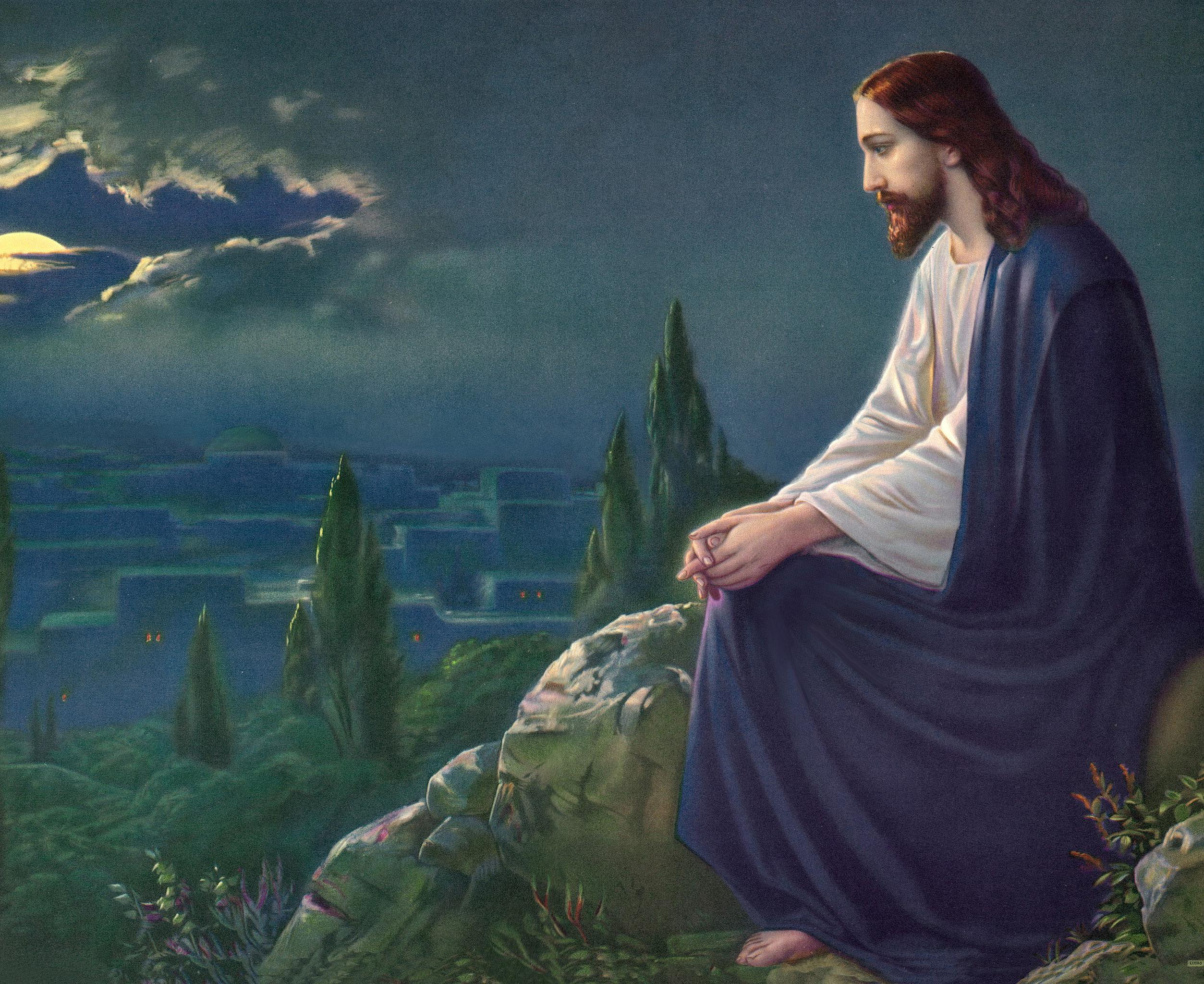
Robinson begins Redating the New Testament with an examination of the destruction of Jerusalem in 70 AD. According to Robinson, if the majority of the New Testament were written after 70, one would expect the text to overflow with explicit historical references to such a watershed moment. Yet there are none; rather, there are sparse allusions to Jerusalem’s downfall, primarily in the Synoptic Gospels (Matthew, Mark, and Luke), wherein Jesus foretells the destruction of the Second Temple by 40 years. One immediately senses the worldview implications that arise in studying these prophecies, for if Jesus indeed predicted Jerusalem’s downfall decades before the fact, Christianity would become nontrivially more plausible. To study this subject, scholars most often turn to Mark, which they postulate to be the earliest Gospel. In Mark 13, Jesus enters the “Olivet Discourse” as he prophesies on the Mount of Olives, and parallel passages appear in Matthew and Luke. Regarding the Temple, which Jesus and his disciples visited the previous chapter, Jesus declares:
“Do you see all these great buildings?... Not one stone here will be left on another; every one will be thrown down.”
For the rest of Mark 13, Jesus engages in further
prophecy, but the purview is unclear. He speaks of wars, persecutions, and false Messiahs, but he does not clarify if he is predicting an imminent conflict, the end times, both, or neither. Regardless, because of Jesus’s unambiguous prediction of the Temple’s destruction, scholars treat the Olivet Discourse as a case study in dating the Gospels. Although some secular scholars, motivated solely by naturalistic biases, place Mark after 70 AD without question, a recent survey found that 98 of 160 scholars, including skeptics, dated Mark before 70. Regardless, even among pre-70 dates, scholars can still date Mark after 65 to allow themselves a rational escape from prognostication. The Jewish-Roman War that led to Jerusalem’s downfall began in 66, so if Mark wrote around that time, his prediction of the Temple’s destruction would be no great feat. Readers do not get far into investigating the truth of a miracle-based faith when they presuppose the impossibility of miracles before they begin.
Furthermore, given the ambiguity of Mark 13’s prophecies, a late dating of Mark indeed makes less sense of the Olivet Discourse. The passage seems to link the destruction of Jerusalem with the Parousia (Jesus’ second coming), an association that could have led early Christians to believe Christ would return once the city fell. If Mark wrote his Gospel after 70, and the Parousia had not occurred, why would he organize the Olivet Discourse so nebulously and potentially paint his Messiah as a failed apocalyptic prophet, a designation now favored by modern skeptics? If Mark fabricated the passage, why would he offer Christians reasons to doubt their faith in the wake of the Neronian persecutions of 68 AD, which saw believers burned alive and fed to wild dogs? Lastly, Jesus’ admonitions do not easily conform to external historical sources, undermining the interpretation of Mark 13 as historical fiction. Jesus warns listeners to pray the siege “will not take place in winter,” but first-century Jewish historian Josephus reports that the Temple fell during the summer. Jesus warns those in
Judea to “flee to the mountains”, but church historian Eusebius indicates that Christians traveled below sea level to the Decapolis before the Jewish-Roman War even began.
Even Christian theology provides secular alternatives to later datings. Jesus’ prophecies are not entirely novel, but echo the destruction of the first Temple, which fell to the Neo-Babylonians 600 years earlier. More importantly, the Olivet Discourse carries arguably as much symbolic as prophetic significance. Before 70 AD, Jews relied on the Temple to make sacrifices to God as a means of atonement and worship. Central to Christianity, Jesus’s sacrifice on the cross abolished the need for the Temple by providing forgiveness of sins for all believers. In the Olivet Discourse, Jesus predicts the demonstration of his Messiahship as much as, or more than, an actual war.
No content in the Olivet Discourse necessarily proves an early dating, but neither does it force scholars to date Mark after or even near 70 AD. Mark 13 showcases historical criticism as a matter of models; scholars adopt one model as a lens through which to view the relevant information, comparing their results to those of another model. Historians cannot prove a model to be true, only more likely than another, and the same methodology applies when moving on to a positive case for early dating.
As previously mentioned, most scholars place Mark first among the Gospels. This hypothesis, known as Markan priority, addresses the “Synoptic problem” of resolving apparent dependencies between Matthew, Mark, and Luke. About three-quarters of the content in
Mark, the shortest Gospel, appears in Matthew and Luke, making Markan priority likely under the assumption that later authors would have added to the earliest Gospel. Markan priority runs contrary to some early church writings, but it ultimately bears no evidential weight against Christianity’s truth, and many Christian scholars accept it as a model. This article also assumes Markan priority but only alongside acknowledgement that any solution to the Synoptic problem is not immune to the fallible chains of inference described earlier by
Robinson.
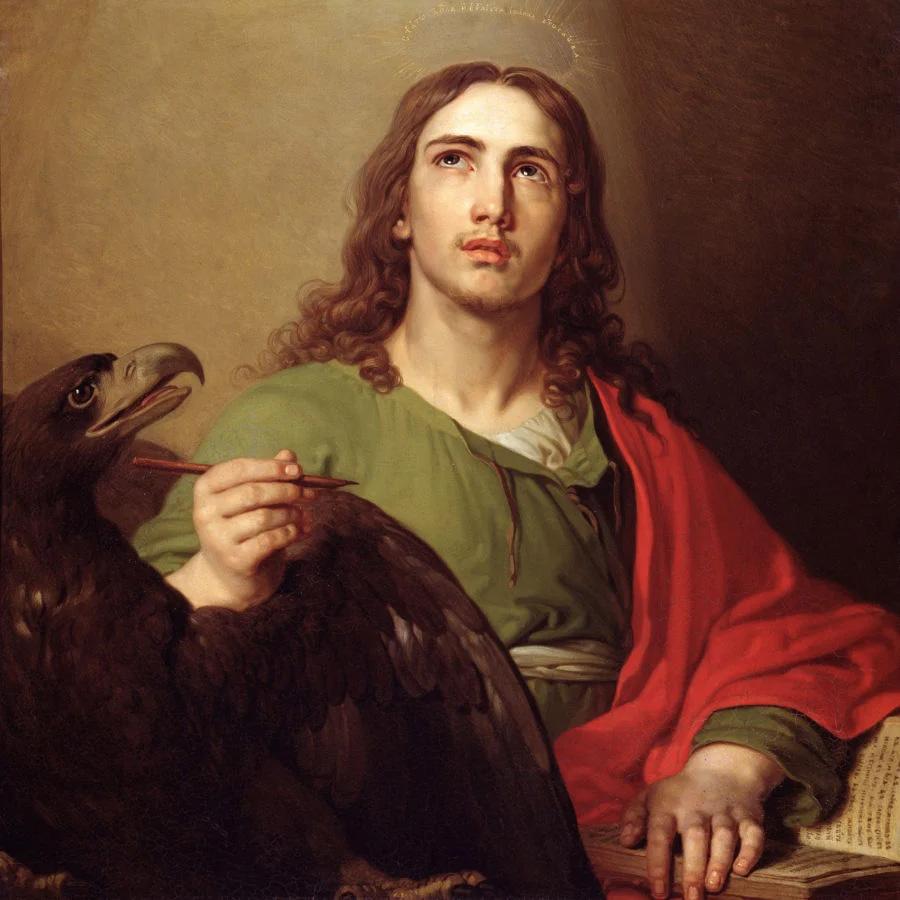
Synoptic interdependence in fact provides the strongest case for early dating. Although some scholars still argue for Matthean priority, almost all agree that the Book of Luke arrived last among the Synoptics, around 80 - 85 AD. Church tradition teaches that Luke, a physician and traveling companion of Paul, wrote both his Gospel and the Acts of the Apostles, collectively known as Luke-Acts. The shared style and continuity across the Gospel and Acts suggests that the same hand
penned both, but the author never internally identifies himself as Luke. Skeptics like Ehrman thus classify LukeActs as anonymous, further removing the texts from the supposed eyewitnesses, but that is another debate.
Like the other synoptists, Luke writes his Gospel in the style of a Greco-Roman biography, but he structures Acts as a history of the early church. The majority of Acts follows Saint Paul’s conversion, missionary journeys, and eventual imprisonment, but curiously, it provides no account of his martyrdom, which took place under Nero c. 65 AD. The last eight chapters of Acts closely narrate Paul’s trial before the Romans, even mirroring Jesus’ own trial before Pilate, but the book ends suddenly before Paul’s audience with Nero c. 62 AD. Under the assumption of a late dating of Acts, the book’s ending has confounded many, such as Imperial-era German theologian Adolf von Harnack. He writes in his 1911 book The Date of Acts:
“[Late datings of Acts] altogether transgress against inward probability and all the psychological laws of historical composition. The more clearly we see that the trial of St. Paul, and above all his appeal to Caesar, is the chief subject of the last quarter of Acts, the more hopeless does it appear that we can explain why the narrative breaks off as it does, otherwise than by assuming that the trial had actually not yet reached its close. It is no use to struggle against this conclusion.”
Harnack dated Acts to c. 62 AD, thus upending the dating schema for all the Synoptics. The Gospel of Luke now must arrive before 62, meaning scholars can reasonably place Matthew in the 50s and Mark in the 40s, assuming Markan priority. Taking account of the magnified evidential weight in favor of Christianity provided by Jesus’s prophecies in the Olivet Discourse, as well as the unlikeliness of legendary development entering Mark in less than two decades, one can see why those begging the question against Christianity’s truth would object to dates so early. Regardless, note that some skeptics feel comfortable dating Mark earlier still, such as scholar James G. Crossley, who places Mark as early as the late 30s.
The evidence from Acts constitutes an argument
from silence, defined by Christian epistemologist Tim McGrew as “a pattern of reasoning in which the failure of a known source to mention a particular fact or event is used as the ground of an inference.” Apologists are quick to criticize skeptics who make arguments from silence to assert contradictions in the New Testament. Dr. Ehrman himself asserts that Jesus’s explicit claims to divinity present in John but not earlier Gospels must be fabricated, and apologists rightly point out that this constitutes an argument from silence. How, then, can Christian apologists rely on Harnack’s potentially fallacious chain of inference to date Acts?
Arguments from silence are not inherently deceptive, but rather they vary in evidential weight. Erik Manning of apologetics ministries “Talk About Doubts” and “Reasonable Faith” frames the situation with the following analogy: if someone says they cannot see an elephant in a room, that is good evidence there is no elephant, but if someone says they cannot see a spider, that is not good evidence against the spider’s presence. Ehrman’s criticism of the historicity of John thus crumbles if one provides reasonable alternative explanations of why Jesus’ divinity claims do not appear in the Synoptics (discussed later).
Regarding Acts, Harnack’s argument is cumulative. Luke demonstrates methodical craftsmanship across his two books, noting throughout the Gospel and Acts fulfilled prophecies, other early Christian martyrs, and many peripheral historical events. Therefore, when Luke, the only New Testament author of a Christian history, fails to even hint at Peter’s execution (circa 68), the Neronian persecutions, and even the destruction of the Temple beyond the Olivet Discourse, one must wonder about the robustness of any dating beyond 70 AD. Manning notes that Harnack’s line of reasoning is as much an argument from silence as an argument from the purpose of Acts:
We are bringing in specific information about the book and the author, not mere generalizations about a book written by someone at that time… I am not saying this is necessarily a knock-down argument for early dating, either, [but] it makes it more probable than not that Acts was written early.
History thus provides at least one rigorous approach for dating the Synoptics early, but how do scholars study the Gospel of John, which lacks the strong interdependency of the Synoptics? According to Robinson, a scholarly consensus held for a time that the author of John “certainly used Mark, probably Luke, and potentially Matthew,” and so it became inevitable to place John in the last decade of the first century, a date that persists to today largely unchallenged. But by the mid-20th century, Biblical scholarship pivoted to the belief that “whatever the cross-fertilization between the traditions, John is not dependent upon the synoptists for his material and therefore does not for this reason have to be dated after them.” Robinson was himself perplexed by the obstinance with which scholars adhere to late dates despite all evidence to the contrary.
John admittedly has a high Christology, with Jesus claiming God’s name (“before Abraham was born, I am!”) and Godhood itself (“I and the Father are one”). Such strong claims do not appear directly in the Synoptics, but Jesus still receives worship and displays abilities reserved exclusively for the Hebrew God. One could explain the discrepancy by citing the Messianic Secret, a primarily Markan motif wherein Jesus intentionally hides his true nature at the beginning of his ministry, instead revealing himself to his disciples piecemeal. The argument from silence stemming from John’s theology is only of moderate strength, and it does little on its own to date John late considering that Paul equates Jesus to God in his writings c. 60 AD.
John differs among the Evangelists not only in his style, but also sources. Whereas Luke, who presumably did not meet Jesus, acknowledges he consulted with
eyewitnesses, the primary source of John is the author himself, “the disciple whom Jesus loved” (again, skeptics will classify John as anonymous, unconvinced of the evidence from the Church Fathers). In Jesus and the Eyewitnesses, Cambridge’s Richard Bauckham powerfully argues that “trusting in testimony is not an irrational act of faith that leaves critical rationality aside, [but] the rationally appropriate way of responding to authentic testimony.” Thus, the Gospel of John’s authenticity rests in both the author’s credibility and intentions as an eyewitness.
Like with the Synoptics, scholars can argue for John’s reliability historically. Robinson notes how the book “reflects intimate contact with a Palestinian world blotted off the map in AD 70;” Bauckham describes how the frequency of characters’ names in John, and all the Gospels, aligns almost exactly with archeological data from ancient Palestinian tombstones.
Yet the above are only additional data, and they cannot prove one model right or wrong. Here, I write as a Christian more than a student: no amount of historical evidence can render faith unnecessary. Historical studies are essential, but even if a scholar proved the Resurrection beyond a reasonable doubt, only the heart enables one to believe it. Considering the intimate nature of John’s Gospel, I suggest the best case for its reliability comes from reading the book itself. The motif of testimony runs throughout John: John the Baptist testifies to Jesus’ coming; a Samaritan woman testifies to Jesus’ discernment of hearts; and Jesus’ own works testify to his divinity. Without a modicum of faith in the beloved disciple—moreover, in Jesus himself—the Gospel of
For all the supposed rigor of New Testament scholarship, the scholars themselves routinely arrive at incompatible views despite analyzing identical data.
John’s testimony will never appear trustworthy enough. I turn again to Ehrman, whose own spiritual journey perhaps mirrors that of many of his readers. As an evangelical Protestant, he believed in the divine inspiration of scripture until attending Princeton Seminary, where his faith in the Bible waned as he analyzed apparent contradictions in the texts. Yet Ehrman remained a Christian for 15 more years, and his eventual deconversion did not result from his academic work: in the end, his own emotional reckoning with the problem of evil shattered his belief “that God was active in the world, that he answered prayer, [and] that he intervened on behalf of his faithful.” Perhaps, then, Biblical criticism is as much a discipline of the heart as of the mind. For all the supposed rigor of New Testament scholarship, the scholars themselves routinely arrive at incompatible views despite analyzing identical data.
In a 2006 debate with Ehrman, William Lane Craig, arguably the preeminent Christian apologist today, opens by remarking:
I was amazed to discover how much [Ehrman’s and my] life stories are alike. As slightly marginalized teenage boys with some passing acquaintance with Christianity, both of our lives were turned upside down when at the age of 15 to 16, we each experienced a spiritual rebirth through personal faith in Christ. Eager to serve him, we both attended the same college in Illinois, Wheaton College, where we both even studied Greek under the same professor. After graduation, we both went on to pursue doctoral studies… I received a fellowship from the German government to study the resurrection of Jesus, [and] as a result of my studies, I became even more convinced of the historical credibility of that event… Sadly, Dr. Ehrman came to radically different conclusions as a result of his.

1 Mike Winger, “How An Atheist Scholar Misleads Millions Of People: The Mark Series pt 65 (15:34),” BibleThinker, July 12, 2021, video, 1:10:51, https://www. youtube.com/watch?v=g2ne3ndnVQk&t=1324s.
2. Winger.
3 . Richard Bauckham, Jesus and the Eyewitnesses (Grand Rapids: Will B. Eerdmans Publishing, 2006), 1-2.
4. John Robinson, Redating the New Testament (Philadelphia: Westminster Press, 1976), 3. 5. “About Dr. Bart Ehrman,” The Bart Ehrman Blog, https://ehrmanblog.org/aboutbart/
6. Bart Ehrman, “Can Historians Prove Jesus Rose from the Dead?” (debate presentation, Southern Evangelical Seminary, Charlotte, NC, April 2, 2009).
7. ibid
8. Donald L. Wasson, "Diodorus Siculus," World History Encyclopedia, last modified December 14, 2020, https://www.worldhistory.org/Diodorus_Siculus/, .
9. “The Jesus Seminar,” Westar Institute, Accessed September 9, 2023, https://www. westarinstitute.org/about/the-jesus-seminar.
10. Robinson, 3, 9.
11. Mk 13:2, NIV.
12. Mike Licona and Josh Pelletier, “When was the Gospel of Mark written?,” September 21, 2021, video, https://www.youtube.com/watch?v=6z_xSmispcY&t=2358s.
13. Tacitus Cornelius, The Annals (Cambridge, Mass.: Harvard University Press), 285.
14. Mk 13:18, NIV.
15. Mk 13:14, NIV.
16. Robinson, 16.
17. "Temple of Jerusalem," World History Encyclopedia, last modified September 5, 2023, https://www.britannica.com/topic/Temple-of-Jerusalem.
18. Eusebius. Historia Ecclesiastica. C. 320.
19. Adolf von Harnack, The Date of the Acts and the Synoptic Gospels (New York: G.P. Putnam’s Sons, 1911).
20. James G. Crossley, The Date of Mark’s Gospel: Insight from the Law in Earliest Christianity (London: T & T Clark, 2004).
21. Timothy McGrew, “The Argument from Silence,” Acta analytica : philosophy and psychology 29, no. 2 (2014): 215–228.
22. Erik Manning, “When Were The Gospels Written?,” Testify, September 7, 2022, video, https://www.youtube.com/watch?v=ZSU6s-n1eXE&t=318s.
23. ibid
24. Jn 8:58, NIV.
25. Jn 10:30, NIV.
26. Richard Bauckham, Jesus and the Eyewitnesses (Grand Rapids: Will B. Eerdmans Publishing, 2006), 5.
27. Bauckham, 90.
28. Bart Ehrman, “Bart Ehrman on Problem of Suffering – UCB,” The Bart Ehrman Blog, February 28, 2016, https://ehrmanblog.org/bart-ehrman-on-problem-of-suffering-ucb/
29. William Lane Craig, “Is There Historical Evidence for the Resurrection of Jesus?” (debate presentation, College of the Holy Cross, Worcester, Massachusetts, March 28, 2006).

ELIZABETH HADLEY
I felt your hand grow cold, and now I’m plucking the hairs off your blanket, before I put it in a box in a drawer in a closet because no one will be able to use it again.
I felt your hand grow cold, and now I am walking to class like you’re still with us, and people I talk to don’t know that you’re not watching your soap opera in the chair, that chair, your chair, waiting for me or someone to bring you oatmeal. I pour cinnamon on my own, and I want it to be yours. But when I turn around, your chair, that chair, the chair is empty.
I felt your hand grow cold, and I forgot what warmth feels like.
I felt the veins in your hand stop pumping blood through, and I wonder what it means to be alive, if that’s all it takes.
















urderers can be saved, vandals can enter through the gates of Heaven, and thieves can inherit the Kingdom of God. But how is it fair that such people should be forgiven for their misdeeds? I recently had a conversation about this problem with a friend of mine and found myself having trouble explaining the Christian understanding of redemption. My friend objected to the concept of redemptive salvation and I was disappointed not to have an adequate response. Maybe it was because I had avoided putting thought towards that particular tenet of my faith as a result of my personal policy of avoiding self-sabotage. After all, if redemption is not just and logically sound, it is in our best interest not to alert our Creator, who is privy to our every thought. While I say this with my tongue in my cheek, the uneasiness I have at times felt about the concept of redemption is quite genuine. The difficulty I encountered trying to respond to my friend’s questions made it perfectly clear that I, to some extent, shared in his objection: that the forgiveness of sins does not seem perfectly just. However, this


objection comes from an implicit assumption that some people are more deserving of the Lord’s grace than others, a deceptively self-centered view of the world and a misunderstanding of the relationship between God’s justice and love. The interrelation of the Lord’s justice and love, which manifests in the sacrifice of Jesus of Nazareth, is fundamental to a proper understanding of the redemptive salvation God gives us.
I believe that justice is a fundamental desire that most people have. The rational among us want to see the hardworking succeed, the compassionate rewarded, and the evil punished. This desire for justice makes the Christian notion of forgiveness understandably foreign to many. After all, the claim of the gospel that “if you confess with your lips that Jesus is Lord and believe in your heart that God raised Him from the dead, you will be saved,”1 is not an obviously just decree. As an example, let us consider the life of Augustine of Hippo.

Augustine lived in modern-day Algeria in the fourth and fifth centuries AD and, in his young life, in-


The interrelation of the Lord’s justice and love, manifest in the sacrifice of Jesus of Nazareth, is fundamental to a proper understanding of the redemptive salvation God gives us.
dulged his carnal impulses and destructive temptations. He writes of his wayward youth in Confessions, recounting “innumerable lies,” theft, and enslavement to greed.2 Even as Augustine came into adulthood, he spent much of his life living loosely before converting in his thirties. In Confessions, Augustine further details the lustful escapades, devotion to false religions, and acts of vandalism he committed while involved with a gang that characterized his young adulthood.3 While he did eventually commit his life to Christ in his early thirties, Augustine’s conversion and salvation nonetheless followed decades of sin and rejection of the church.
While Augustine’s early life was mired in sin, the extension of salvation to whoever believes means that not only may a non-believer turn to Christ and find redemption, but that even the “worst” among us (however we might define that) can be saved. We even have examples of this apparent injustice in scripture, such as the conversion of Saul. Saul of Tarsus was a Pharisee living in Roman-occupied Jerusalem and a persecutor of early Christians in the first century AD. He describes his campaign against the early church in Acts 26, saying: “I not only locked up many of the saints in prison, but I also cast my vote against them when they were being condemned to death. By punishing them often in all the synagogues I tried to force them to blaspheme; and since I was so furiously enraged at them, I pursued them even to foreign cities.”4 His persecution of early Christians continued until he was on the road to Damascus where he was to arrest certain Christians and “[bring] them bound before the chief priests.”5 On his journey, Jesus appeared to him calling on the Pharisee to stop persecuting Christians and to instead follow him. Saul’s salvation, which followed an extended campaign of persecution against the followers of his eventual savior, seems distinctly unjust.
However, while the examples of Augustine and Saul demonstrate the redemption of men who had lived particularly sinful lives, they are also exceptional cases, as each
of these men went forth from their conversions to radically transform Christendom and further the gospel of Jesus Christ. Saul, renamed Paul, did more to spread the gospel than anyone in history, establishing churches throughout Greece and Asia Minor.6 Augustine became the Bishop of Hippo from 396 to 430 AD, writing both Confessions and City of God among other works. His writing and thinking helped shape modern Christian thought as well as the practice of biblical interpretation, and his contribution to theology shaped Latin Christianity more than any source, save for Scripture itself.7 While the redemption of these men following particularly sinful early lives may still seem unjust, perhaps the fruit they bore in their later years make objections to the justice of their salvation less valid.

Even harder to accept are claims of redemption such as “deathbed conversions,” or, more generally, suggestions that someone could be saved exceedingly late or at the end of their life. In the Gospel of Luke, for example, as Jesus is being crucified, one of the criminals being executed with him calls on the Lord saying, “Jesus, remember me when you come into your kingdom,” to which Jesus replies, “Truly I tell you, today you will be with me in Paradise.”8 That a man condemned to death could reach out to Jesus in his final moments and receive the gift of eternal life despite whatever sins led him to that situation seems distinctly unjust. Why should a criminal who is facing the end of his life be able to utter a few words and, by doing so, be promised an eternity in paradise upon their death that same day?
The examples of Augustine, Paul, and the thief on the cross represent men who made sinful choices in their lives and still were redeemed by God and given eternal life. Augustine, a ne’er-do-well until his thirties was saved after a sinful youth. Paul, a murder of Christians, was sought out by God despite this. The thief was being put to death for breaking one of the Ten Commandments and simply called on Jesus while being executed. These men did nothing to deserve this salvation and, in fact, did plenty to be deemed

deserving of the opposite. That they or anyone else, including the most deceitful, wicked, or violent among us, can be saved simply by faith in the Lord Jesus Christ, again, seems almost wrong.
However, such an objection to God’s extension of salvation to sinners is ignorant of one simple truth: that each of us is in desperate need of God’s grace. In his epistle to the Romans, Paul writes that “there is no one who is righteous, not even one,"9 that “all have sinned and fall short of the glory of God.”10 This is exceptionally important, for, though our transgressions may seem small, James writes that “whoever keeps the whole law but fails in one point has become accountable for all of it.”11 James’ assertion suggests that any sin, no matter how “minor,” separates us from God and places us in need of his grace for salvation.
James is not suggesting that all sins are equal in severity, but rather that all are deserving of punishment, “for the wages of sin is death.”12 Therefore, while it would be far more heinous to murder someone than to lie to them, both of these actions break God’s law and perpetrating them makes one equally subject to judgment. This idea ought not be foreign. For instance, consider a one-time Novack Cafe thief and a serial final exam cheater. While the latter crime is a more egregious violation of standards, both individuals are liable to stand in judgment and face disciplinary action from the College. Similarly, any violation of God’s commandments, regardless of how seemingly minor, places us in need of redemption. That a Pharisee who persecuted early Christians, a man who sought frivolous sexual encounters, and a criminal who simply called on Jesus while being executed for his trespasses should have salvation and eternal life extended to them is no more unfair or unjust than any one of us being offered salvation.
Objections to the salvation of those we perceive as more sinful or less deserving than ourselves ultimately comes from a self-centered view of the world and a failure to recognize our own need for redemption. Jesus himself addressed this apparent unfairness in the book of Matthew. In chapter 20, Jesus tells a parable about laborers in a vineyard which goes as follows: the owner of a vineyard finds himself in need of laborers, so he goes out and hires a few at the beginning of the day, agreeing to a typical day’s wage. At nine o’clock, the owner of the vineyard goes back out and sees laborers in the marketplace waiting for work. He

tells them to go work his vineyard and that he will pay them what is right. He did the same at noon and at three o’clock, and then, at five o’clock, the owner of the vineyard found more laborers and hired them to work for the last hour of the day. At the end of the day, the owner of the vineyard began to pay his workers, paying those he hired at five o’clock first, and giving them the typical day’s wage. He paid all of the laborers that same wage, angering those he hired at the beginning of the day who had worked a full day, unlike the others. The owner responded to them, saying, “‘Friend, I am doing you no wrong; did you not agree with me for the usual daily wage? Take what belongs to you and go; I choose to give to this last the same as I give

to you. Am I not allowed to do what I choose with what belongs to me? Or are you envious because I am generous?’”13 The parable makes clear it does not matter when we come to follow Christ or how our works and good deeds compare, that it is our “Father’s good pleasure to give [us] the kingdom”14 if only we serve him. None of us deserve this redemption, and it is God’s prerogative to give it freely
to those that he calls regardless of the circumstances of his calling. Indeed, the objection that the Lord’s redemption of the sinful is unjust holds true in only one regard–not that it is unfair to the righteous, nonexistent as they are, but that it is unfair to God.
Then, having established that no one is more deserving of redemption than another, we need only answer
None of us deserve this redemption, and it is God’s prerogative to give it freely to those that He calls regardless of the circumstances of His calling.
Our perfectly just God demanded atonement for sins, and in his infinite love, he provided it himself.
how God justly redeemed his children and why he would do such a thing. We would do well to understand his motive first, for though it is no more just that one should receive salvation than another, a God acting out of justice alone may have been more likely to redeem none of us, rather than all of us as he has done. However, if we consider that God works also through love, and not justice alone, his motivation becomes clearer–God has redeemed us because he loves us.
However, the Lord, being perfectly just, must also have been just in his means of saving us, regardless of his motivation. To justly forgive us our sins, then, the Lord demanded a suitable sacrifice. As the author of Hebrews writes, “Indeed, under the law almost everything is purified with blood, and without the shedding of blood there is no forgiveness of sins.”15 This demand for atonement is the byproduct of God’s perfect justice. We could not be forgiven without a sacrifice, but to atone for the sins of the entire world would require a sacrifice unprecedented. Jesus Christ was the perfect sacrifice. Having lived a perfectly righteous life and having known no sin, Jesus suffered on our behalf as atonement for our iniquities. As Paul describes in 2 Corinthians, “[God] made him to be sin who knew no sin, so that in him we might become the righteousness of God.”16 In other words, Jesus became our sin that we might become his righteousness; he was judged in our place so that we can be judged in his. I would not dare pretend to be able to fully appreciate or articulate the significance of this, but this I know: that our perfectly just God demanded atonement for sins, and in his infinite love, he provided it himself. Jesus, like a man who, owing nothing himself, paid the debts of every debtor in the world, has saved us from the sins for which we ought to be condemned to death. Rather than object to the forgiveness of those who owed more than us or who lived a greater part of their lives in debt, we must recognize that none of us is deserving of this redemption. Whether one strayed from righteousness in their youth, persecuted and killed those serving God’s Kingdom before coming to know Jesus, or lived a life of crime before genuinely and earnestly calling on him in their final moments, none is more worthy than another.
The unfairness in this transaction is not on the part of the one graciously paying our debts but rests with us. To violate part of the law of the Lord is to be liable for the whole law, and no one can stand up to that level of scrutiny. We are all equally in need of God’s redemptive grace, and he is no less just in offering it to any one compared to another. In his perfect justice, however, the Lord demands atonement to redeem us, and, out of his love for us, he has taken on flesh in the person of Jesus to offer himself as atonement. It is then our Father’s great pleasure to give us the gift of redemption out of an abundance of love. The promise of this gift of redemption in Jesus’s sacrifice and subsequent resurrection is expressed concisely in the Gospel of John: “For God so loved the world that he gave his only Son, so that everyone who believes in him may not perish but may have eternal life.”17

1. Romans 10:9, ESV.
Crawford Hovis D’25 is from Knoxville, TN and is pursuing majors in Government modified with Economics and History.
2. Confessions 1:19-30, ESV.
3. Gafford, Joe Aaron II (Spring 2015) "The Life and Conversion of Augustine of Hippo," Tenor of Our Times: Vol. 4, Article 4. Page 16. Available at: https://scholarworks. harding.edu/tenor/vol4/iss1/4
4. Acts 26:10-11, ESV.
5. Acts 9:3-22, ESV.
6. Sanders, E.P.. "St. Paul the Apostle." Encyclopedia Britannica, 3 Jul. 2023, https:// www.britannica.com/biography/Saint-Paul-the-Apostle. Accessed 17 September 2023.
7. O'Donnell, James. "St. Augustine". Encyclopedia Britannica, 24 Aug. 2023, https:// www.britannica.com/biography/Saint-Augustine. Accessed 4 September 2023.
8. Luke 23:42-43, ESV.
9. Romans 3:10, ESV.
10. Romans 3:23, ESV.
11. James 2:10, ESV.
12. Romans 6:23, ESV.
13. Matthew 20:13-15, ESV.
14. Luke 12:32, ESV.
15. Hebrews 9:22, ESV.
16. 2 Corinthians 5:21, ESV.
17. John 3:16, ESV.
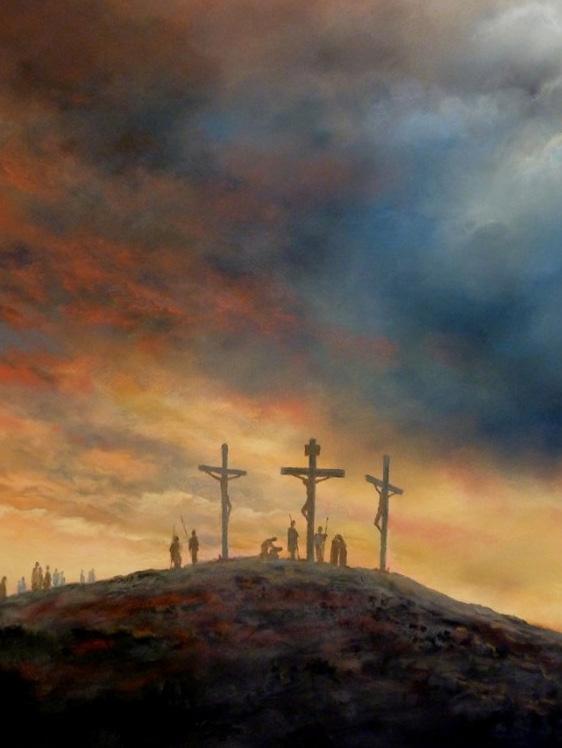











ike many institutions of higher learning, Dartmouth has a complicated relationship with religion. The College was founded by the Congregational minister Eleazar Wheelock and spent its early years as an explicitly religious institution. Soon, though, the rising tide of secularism swept through American higher education, and to this day Dartmouth remains institutionally distant from its religious roots. Among the student body, the story is no less varied. Despite the stereotype that the students of elite universities reject religious belief, Dartmouth students maintain a diversity of religious beliefs and




Abstract: I administer an online survey of 60 questions on religion and spirituality to a simple random sample of 500 Dartmouth undergraduates, offering a monetary incentive for completion. The survey obtains a partial response rate of 50.6% and a complete response rate of 32.2%. Initial findings fall into two categories. First, Dartmouth students express significant openness to spiritual realities, but generally hesitate to move beyond that openness to committed spiritual practice. Second, there is widespread consensus among Dartmouth students that private-facing concerns (e.g. personal happiness and morality, family and friends) are much more important than public-facing concerns (e.g. social justice, the flourishing of humanity). I conclude with an outline of further research to be done with this survey data.

practices. A minority of students, to be sure, have no religious affiliation, but most students possess some kind of relationship with religious belief, whether distant or very committed.
This handout summarizes initial findings from a survey administered to Dartmouth undergraduates on questions of religion and spirituality. I aim to characterize and quantify the kinds of relationships Dartmouth students maintain with religious and spiritual belief. I find that there is significant diversity among students on these measures; some students are completely areligious, some

Photo by Tobin Yates
students possess deep religious conviction, and most students lie somewhere in the middle. After a brief section on methodology, I will discuss this religious and spiritual diversity in greater detail. In particular, I find that students express (1) significant openness to spiritual realities and (2) greater concern for private issues than public issues.
I administered a survey of 60 multiple choice questions to a simple random sample of 500 undergraduate Dartmouth emails, offering a $10 incentive upon survey completion. The survey received approval from Dartmouth’s Committee for the Protection of Human Subjects with exempt status on December 5, 2022. Response collection began on February 6, 2023 and concluded on April 1, 2023. The survey received 253 total responses and 161 complete responses. Because the variables used in weighting were demographic and asked at the end of the survey, only the 161 complete responses are included in the weighted dataset. All results presented in this report are weighted (N = 161).
Sample selection poses a threat to the external validity of any study with opt-in survey design. Upon receipt of the email informing the respondent of their inclusion
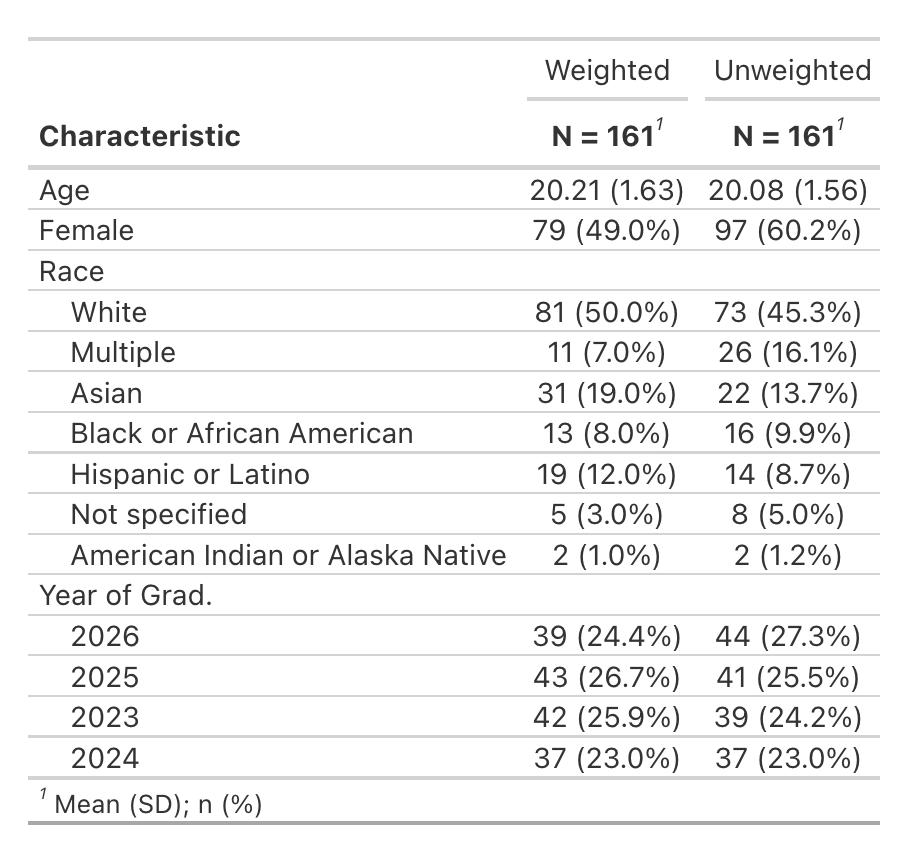
in the study, the respondent can choose whether or not to respond to the survey. Because the initial email contains information about the content of the survey, survey respondents are likely to be on average more interested in the subject of interest than the general population. When this occurs, sample statistics are no longer representative of that population. Instead, they represent a subset of the population that shares above-average interest in the topic of the survey—in this case, religion and spirituality.
In order to mitigate bias caused by sample selection, respondent data can be weighted in accordance with known population-level targets for key demographic variables. I use a weighting procedure known as raking to assign each respondent a multiplicative weight such that the sample dataset matches a set of known-population level targets. These weights are used when calculating summary statistics to emphasize respondents from undersampled groups and deemphasize respondents from oversampled groups.
In this case, population-level targets for race, gender, and class year were obtained from Dartmouth’s Office of Institutional Research, and the survey data were weighted in accordance with these targets. Race, gender, and class year characteristics were used because each plays an important role in the formation of religious and spiritual belief, so they likely contribute to sample selection. Race plays a role in determining the religious traditions that one is exposed to early in life, gender is a significant factor in religiosity, and class year serves as a proxy for the respondent’s distance to their family religious life. As a student progresses
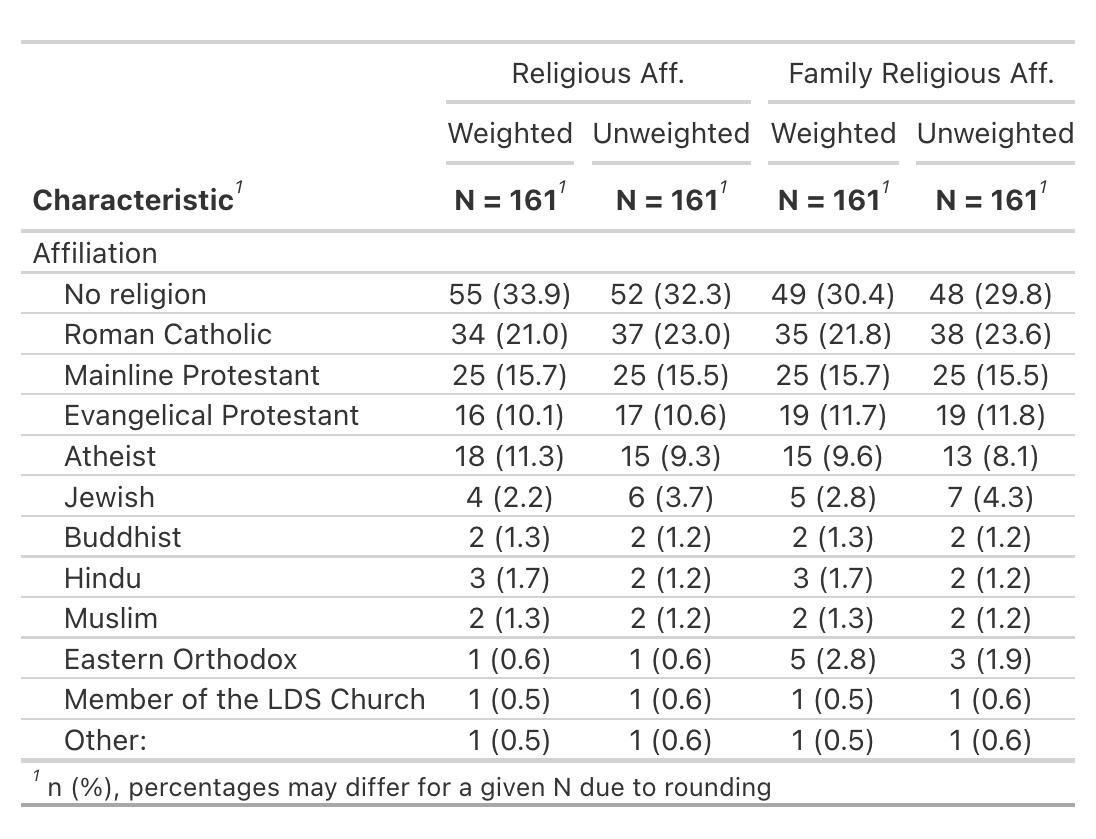
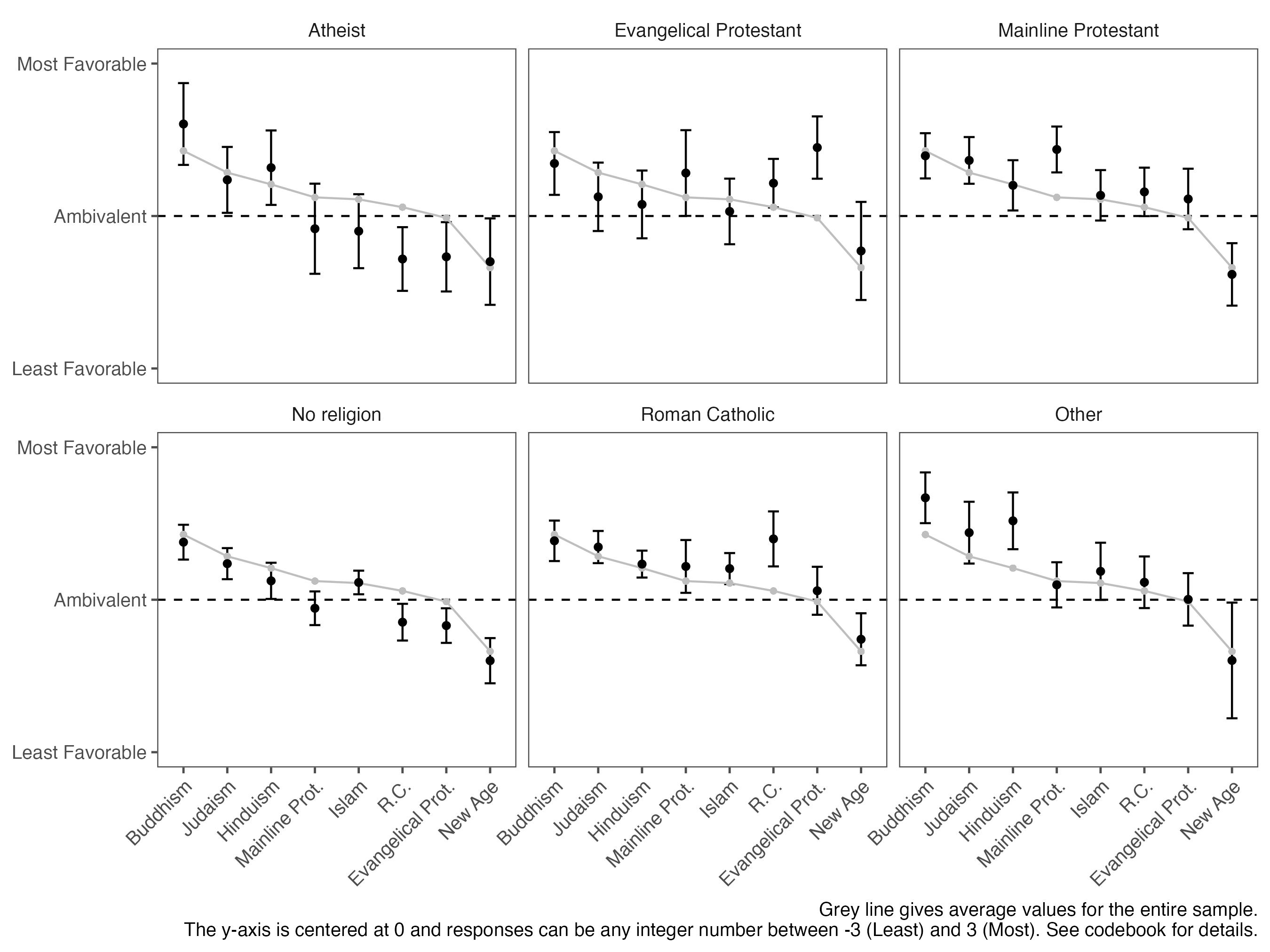
through college, they likely detach from their childhood patterns of religiosity in one way or another. Table 1 displays the results of weighting with race, gender, and class year.
The weighted dataset corrects for many potential sources of bias in the unweighted data, including the oversampling of women. Women are more likely to be spiritual or religious than men, so the unweighted data would overestimate levels of spirituality and religiosity. Table 2 confirms this potential source of bias, showing that the unweighted data moderately overestimate the number of non-religious and atheist students.
The results presented in the remainder of this paper have been weighted according to the above procedure. Standard deviations of weighted variables are calculated according to Cochran (1977).
The results presented in this handout fall into two categories. First, Dartmouth students are very “open” to spiritual realities, meaning that they express a belief in the possibility of spiritual reality, but most do not turn that openness into specific spiritual convictions or practices. Second, students’s ultimate concerns in life are dominated by private concerns; except for a minority who are religiously devout, students eschew public-facing issues.
I begin with Figure 1, which displays students’ answers to the question, “How interested are you at present in developing your religious faith or spirituality?” A majority of students would describe themselves as at least “fairly interested.” This distribution is highly significantly different from equal proportions across the groups of interest (X2 =
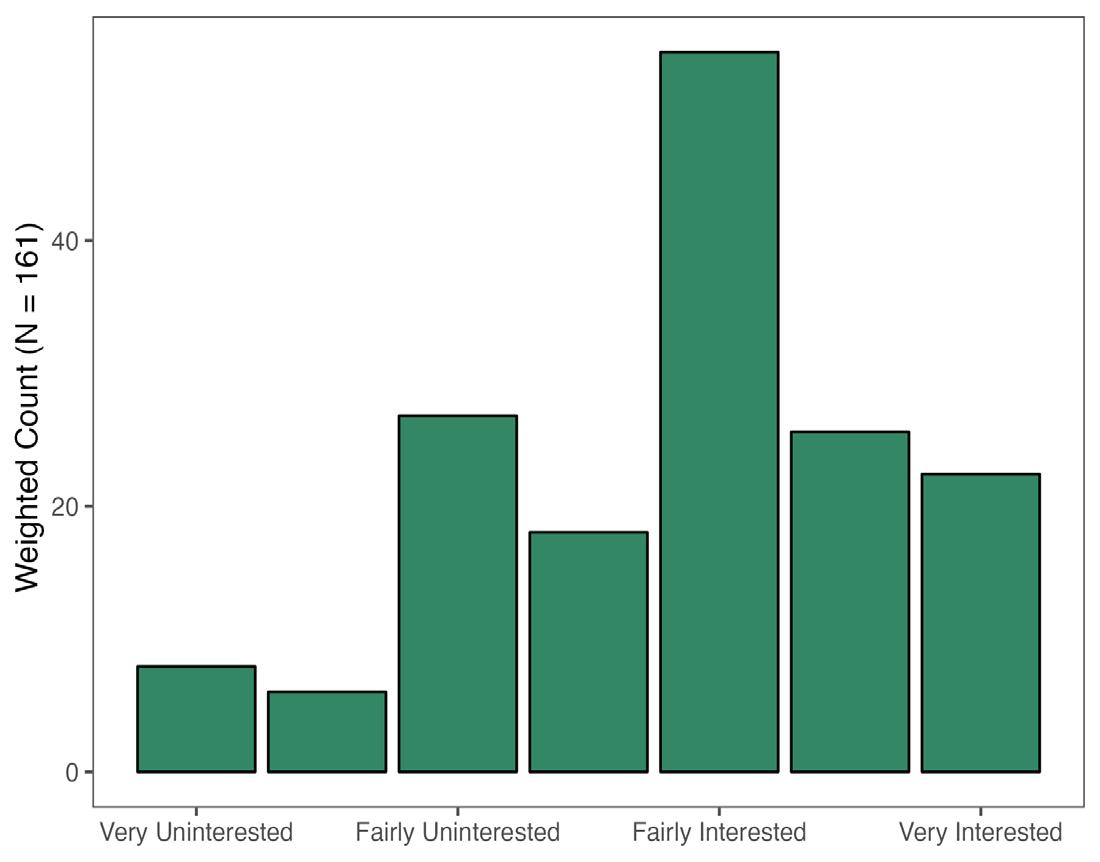
66.34783, p = .0005).
If students are open to spirituality, then what exactly are they open to? The results in Figure 2 provide the details. This figure represents answers to the questions: “What is your overall opinion of [e.g. Buddhism]’s reputation?” Averages for these questions were calculated within each of six groups of religious affiliation. Each facet displays how students of these six religious affiliations feel about the reputations of the eight traditions on the x-axis.
Across different religious affiliations, students are emphatically favorable to Buddhism, emphatically unfavorable to New Age spirituality, and somewhat favorable toward other religions. These results offer clues to what kinds of spirituality students are most favorable towards, if not actually intent on practicing themselves. Their emphat-
ic favorability to Buddhism over more conventional, familiar religious traditions suggests that students are most open to inward-facing spiritualities that are not tied to historical structures or centers of power. Most students have little exposure to Buddhism in its historic South Asian context, and only understand the tradition as it has been inherited in a Western spiritual landscape. Therefore, the favorability towards Buddhism suggests less an interest in Buddhism as a unique South Asian religion, and more so an interest in non-Western, inward-facing spirituality in general.
Students’ unfavorability towards New Age spirituality, however, complicates this conclusion. New Age, like Buddhism in its Western appropriation, is inward-facing, therapeutic, and often implicitly critical of Western hierarchy. Indeed, some forms of New Age adopt elements of Buddhist spirituality. Why, then, are students not favorable towards both Buddhism and New Age? Based on anecdotal evidence from a focus group of students that offered feedback on a draft of the survey instrument, the term “New Age spirituality” connotes spiritual practices that are inherently foolish or unserious. In its popular meaning, the term necessarily excludes genuine religiosity—unlike the term “Buddhism.” This semantic distinction offers a plausible explanation for the wide difference in students’ favorability towards Buddhism and New Age, despite their similar spiritual features.
Students, then, are meaningfully favorable to religious and spiritual traditions that do not possess a reputation associated with Western tradition and hierarchy. In particular, they seem to have a higher view of spiritualities that are inward-facing and therapeutic, while disliking the
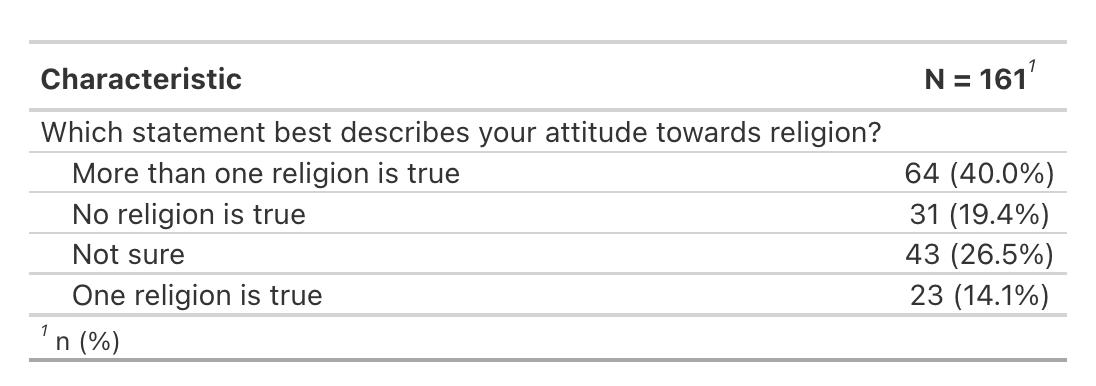
unserious applications of those features in New Age spirituality.
This picture comes into sharper focus with the results in Table 3, which displays students’ answers to the question, “Which statement best describes your attitude towards religion?” Most students either believe that more than one religion is true, or they are not sure. This result displays the “openness” of students’ spirituality, in every sense of the word. They are very open to the possibility of spiritual realities, even many coexisting ones. Students are so open, in fact, that they have yet to close their beliefs onto a particular statement about spiritual truth. There are a minority of committed religious devotees, and a minority of atheists, but most students are in an undecided and open middle ground.
In terms of religious practice, there is a similar degree of openness. Table 4 displays students’ levels of prayer and religious service attendance and their desire for those activities, respectively. These results suggest a degree of openness towards spiritual practice, especially the more internal practice of prayer, but they do not show that many students actually commit to performing such practice often. Given that students at college have freedom to decide how often they pray or attend religious services with little external pressure, it is surprising that so many students want to increase the frequency of these spiritual practices. This, in keeping with the above results, suggests that students are open to new spiritual practices, but they have yet to transform that desire into actual practice.
In sum, most Dartmouth students are open to spiritual realities, but reticent to move beyond that openness to
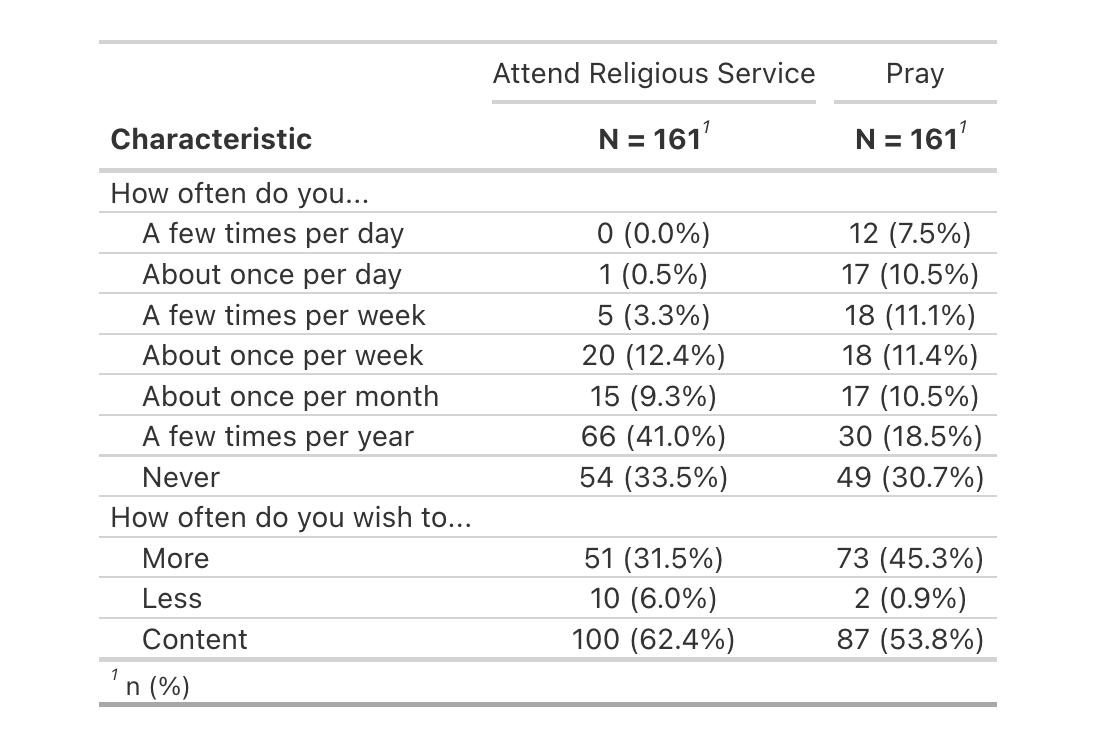
Table 4. Many students express a desire for greater spiritual practice, but do not act on that desire.
committed religious belief or practice.
In a two-part question, the survey asks students to select the concerns that are most important to them from a list of eleven. First, they select their top five concerns from the list, and second, they rank those five from most important to least.
Figure 3 displays the relationship between the popularity of the concern and the importance of the concern with a scatterplot. I have sorted the concerns into three broadly suggestive categories—private, public, and religious. These categories are somewhat arbitrary and only intended to improve the readability of the figure and highlight some important patterns.
These results suggest two important conclusions. First, students are overwhelmingly concerned with the private features of their life (personal happiness and morality, family, friends), over public features (e.g. social justice, the environment). Even among the careerist concerns, private-facing “financial stability” is slightly more important than public-facing “career success.” Students are clearly not “selfish” in the pejorative sense—they care very much about their friends, their family, and their own sense of morality—but these altruistic concerns are contained to the private sphere. There is no similar level of altruism about concerns facing the nation or the globe, whether it be social justice, global warming, or the flourishing of humanity at large.
Second, the shape of the scatterplot suggests that there is broad consensus among students about what’s most important, except among the religious. For every concern except religion, its rank increases with increasing popularity. That is, most students agree on their first, second, and third most important concerns. Among the less important concerns, there is much less consensus—fewer students select those concerns in their top five. Religion represents the only outlier to this trend. For a minority of committed religious students, religion is very important to them. In this way, committed religious devotion marks notable dissent from a widespread consensus about the importance of private concerns. Religion is the only somewhat public-facing concern that is very important for even a minority of Dartmouth students.
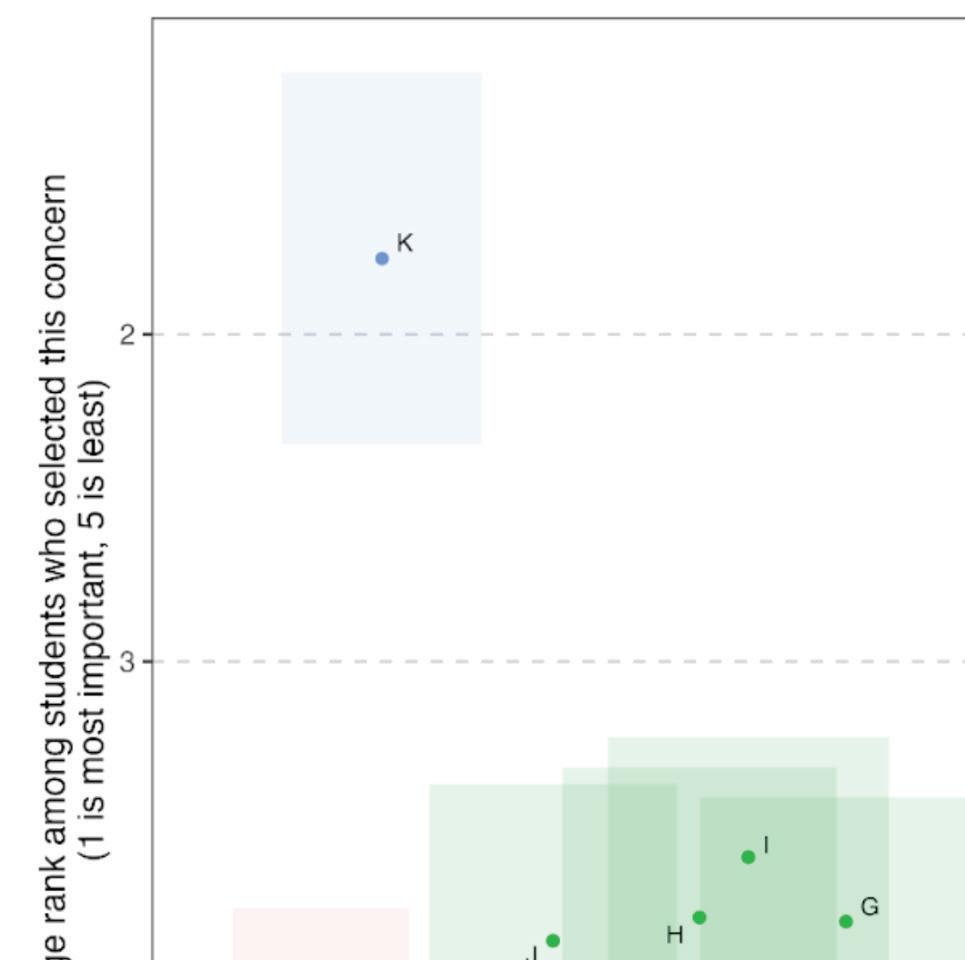

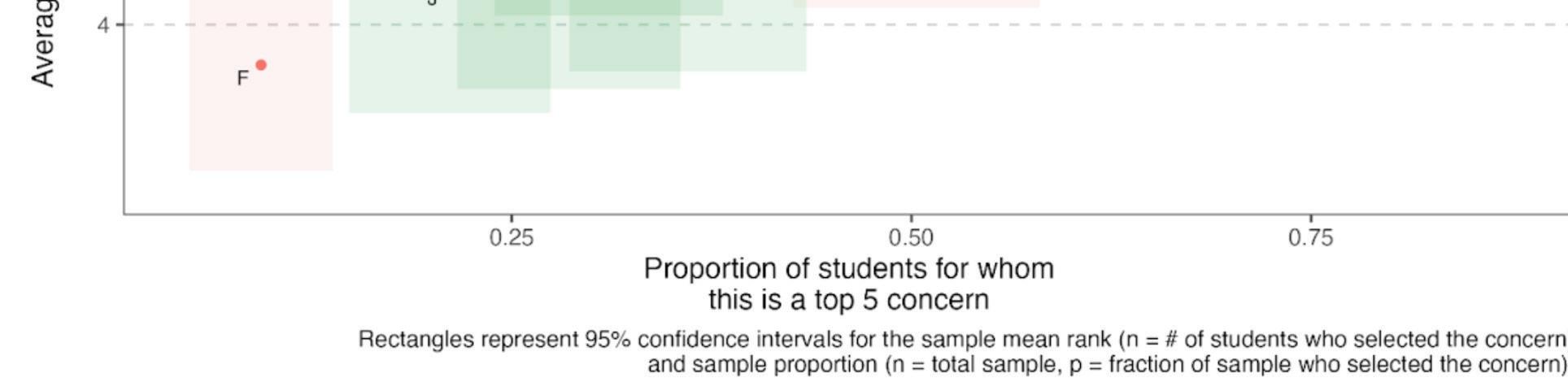
In a word, these survey results show that Dartmouth students are “retreating,” in two ways. First, they are retreating from emphatic religious convictions, either for or against. Most students are open to spiritual reality, but few possess exclusive belief. Second, students are retreating from public-facing concerns, in favor of their private life. Committed religious belief is the only potentially public-facing concern that is still viable for any group of Dartmouth students.
This report serves as an initial summary of trends to be presented for the Wheelock Society, but much work remains to be done. There are three areas that should be particularly fruitful. First, more statistical work remains to be done in terms of measuring the various factors that determine whether or not a student is religious, using regression analyses. This will allow for the comparison of many factors on students’ religious outcomes, and for the measurement of religious factors on other student outcomes. Second, the survey tests students’ literacy in various religious traditions and asks further questions about their beliefs on specific spiritual topics (e.g. the afterlife, hallucinogens and religious experience, astrology and the occult).
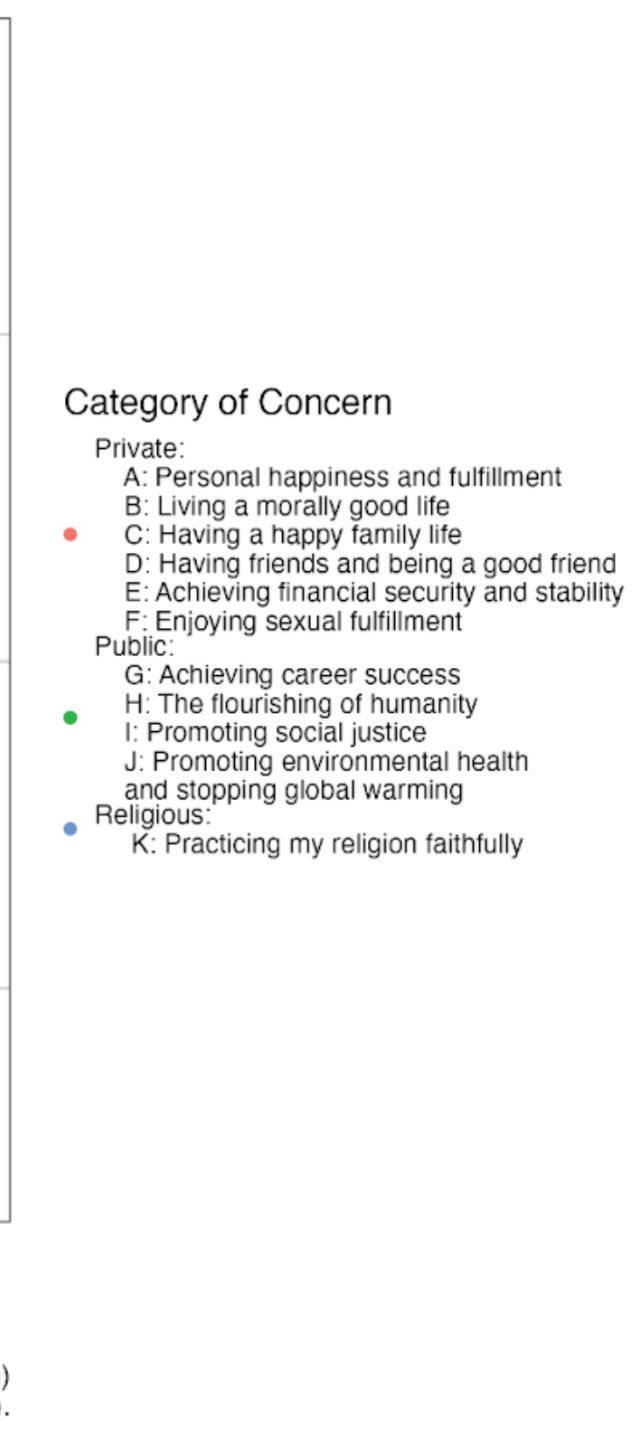
This data will build on the results presented in this report to develop a clearer and more complex picture of spirituality at Dartmouth. Lastly, the survey asks several questions about students’ involvement in various aspects of campus life at Dartmouth (e.g. extracurriculars, academic interests, Greek life). This data will allow us to study the sociology of religion in a Dartmouth-specific context, as religious and spiritual affiliations interact with the local institutions that dominate students’ lives.
This prayer by professor of religion Lucius Waterman appears on a plaque hanging at the entrance of Parkhurst Hall.
O Lord God Almighty, well-spring of wisdom, master of power, guide of all growth, giver of all gain. We make our prayer to thee, this day, for Dartmouth College. Earnestly entreating thy favour for its people. For its work, and for all its life. Let thy hand be upon its officers of administration to make them strong and wise, and let thy word make known to them the hiding-place of power. Give to its teachers the gift of teaching, and make them to be men right-minded and high-hearted. Give to its students the spirit of vision, and fill them with a just ambition to be strong and well-furnished, and to have understanding of the times in which they live. Save the men of Dartmouth from the allurements of self-indulgence, from the assaults of evil foes, from pride of success, from false ambitions, from hardness, from shallowness, from laziness, from heedlessness, from carelessness of opportunity, and from ingratitude for sacrifices out of which their opportunity has grown. Make, we beseech thee, this society of scholars to be a fountain of true knowledge, a temple of sacred service, a fortress for the defense of things just and right, and fill the Dartmouth spirit with thy spirit, to make it a name and a praise that shall not fail, but stand before thee forever. We ask in the name in which alone is salvation, even through Jesus Christ our Lord, amen.
— The Reverend Lucius Waterman, D.D.
We, the editorial board of The Dartmouth Apologia, affirm that salvation is given through faith in Jesus, that the Bible is inspired by God, and that we are called to live by the teachings of Jesus and the apostles. We affirm the Nicene Creed, with the understanding that views may differ on baptism and the meaning of the word “catholic.”
We [I] believe in one God, the Father almighty, maker of heaven and earth, of all things visible and invisible.
We [I] believe in one Lord Jesus Christ, the Only Begotten Son of God, born of the Father before all ages. God from God, Light from Light, true God from true God, begotten, not made, consubstanstial with the Father; through him all things were made. For us men and for our salvation he came down from heaven, and by the Holy Spirit was incarnate of the Virgin Mary, and became man. For our sake he was crucified under Pontius Pilate, he suffered death and was buried, and rose again on the third day in accordance with the Scriptures. He ascended into heaven and is seated at the right hand of the Father. He will come again in glory to judge the living and the dead and his kingdom will have no end.
We [I] believe in the Holy Spirit, the Lord, the giver of life, who proceeds from the Father [and the Son], who with the Father and the Son is adored and glorified, who has spoken through the Prophets.
We [I] believe in one, holy, catholic, and apostolic Church. We [I] confess one Baptism for the forgiveness of sins and we [I] look forward to the resurrection of the dead and the life of the world to come. Amen.
The Dartmouth Apologia exists to articulate Christian perspectives in the academic community. We do this through our biannual publications, lecture series, and weekly reader groups where we read and discuss the works of exemplary apologists such as G.K. Chesterton and C.S. Lewis.
We at The Dartmouth Apologia invite people from all intellectual, religious, and spiritual backgrounds to join us in our discussions as we search for truth and authenticity. If you would like to get involved, please feel free to email us at the. dartmouth.apologia@dartmouth.edu or check out our Instagram or Facebook @dartmouthapologia. To subscribe to the journal or to check out past issues of the journal, visit our website at www.dartmouthapologia.org.


[1 Peter 3:15]