e x i s t s t o a r t i c u l a t e C h r i s t i a n
p e r s p e c t i v e s i n t h e a c a d e m i c
c o m m u n i t y.
T H E D A R T M O U T H A P O L O G I A
Free Will & Divine Love in the Era of COVID-19
An Analysis of the Problem of Evil rough G.K. Chesterton’s eory of Paradoxes
A History of Christian Socialism
Revisiting the Mission in Hopi
Lessons from History, Indigenization, and Missio Dei
It’s Not About Your Wedding Night
Clarifying the Heart Behind Christian Sexual Ethics
Can We Agree to Disagree?
A Review of e Bible Made Impossible by Christian Smith
C O N T R I B U T O R S
Blake Whitmer D’23 (“Free Will & Divine Love in the Era of COVID-19,” p. 4) is a Philosophy & Logic major from Arkansas.
Daniel Lim D’21 (“Revisiting the Mission in Hopi,” p 18) is a Philosophy major and Native American Studies, & Chinese minor from Polacca, AZ.
Paul Jeon D’21 (“It’s Not About Your Wedding Night,” p 30) is an English and Economics double-major from Fair eld, CT.
Andrea Jenkins D’20 (“Can We Agree to Disagree?” p. 40) is a Computer Science major from Longview, TX.
Joseph Collum D’22 (“A History of Christian Socialism,” p. 10) is an English major with a concentration in ction Creative Writing from Waddy, KY
Blake Whitmer
Joseph Collum
Daniel Lim
Paul Jeon
Andrea Jenkins
E X E C U T I V E B O A R D
Christopher Candelora D’22, Editor-in-Chief
Alice Little D’22, Managing Editor
Joseph Gyorda D’22, Programming Director
Michael Carlowicz D’22, Publisher
Leslie An D’21, Art Director
E D I T O R I A L B O A R D
Levi Roseman D’21
Joseph Collum D’22
Jacob Wesley Dell D’22
Sara Catherine Cook D’23
Drew Whitley D’23
Blake Whitmer D’23
A D V I S O R Y B O A R D
Gregg Fairbrothers D’76
Eric Hansen, Professor of Engineering, ayer
James Murphy, Professor of Government
Lindsay Whaley, Professor of Classics & Linguistics
S P E C I A L T H A N K S
Council on Student Organizations e Eleazar Wheelock Society
S U B M I S S I O N S
We welcome the submission of any article, essay, or artwork for publication in the Dartmouth Apologia that seeks to promote respectful, thoughtful discussion in the community We will consider all submissions from any members of the community but reserve the right to publish only those that align with our mission statement and quality rubric.
email: the dartmouth apologia@dartmouth edu
L E T T E R S T O T H E E D I T O R
We deeply value your opinions and encourage thoughtful words of support, dissent, or other views. We will gladly consider any letter that is consistent with our mission statement ’ s focus on promoting intellectual discourse in the Dartmouth community.
email: the dartmouth apologia@dartmouth edu
L E T T E R F
Dear Reader,
Wherever you may be, I hope that this letter nds you healthy and well
Nobody could have predicted 2020 would have unfolded the way it did. Back in January we rather naïvely planned to title this issue “20/20 Vision ” Such light-hearted humor seems so distant after our year of global disease and political unrest ese months of hardship gave us all time to re ect, pick up a new book, and x things around the house, and this issue is a manifestation of such practices.
All our writers re ected on their personal experiences and beliefs in a successful attempt to contextualize them within Christian theology. Some writers picked up books on biblicism, the history of Christian socialism, and even the social ethics within Christianity. is is exactly what the Apologia exists for to re ect and think critically about the Christian Faith and as such the Editorial Board and Executive Team have spent the last six months returning to our roots and “ xing things around the house ”
is year, we saw the return of a formal Editorial Board which has not been in place for quite some time. e reason for this was to bring you, the reader, the highest quality articles possible. Week in and week out, we all gathered on Zoom to discuss articles, to scrutinize ideas within Christianity, to address misconceptions about faith, and to contemplate some existential questions In the New Jerusalem, G K Chesterton notes, “ eology is only thought applied to religion,” and this is what the Apologia seeks to convey. We endeavor to dispel the myth that faith and reason are mutually exclusive, and to show that Christianity is not a thoughtless practice but rather a tradition and truth deeply rooted in philosophy and academia.
Now, you nd yourself with this issue in your hands. Why? Perhaps you are a college student who considers yourself on a spiritual journey of sorts, looking to nd answers to some of the “big questions” of life Or perhaps you have a Christian background, but struggle to wrap your head around certain doctrines of the church No matter what background you come from, no matter where you are on your spiritual journey, I invite you to read this issue cover to cover and to use it as a tool for re ection. If this issue still leaves you with unanswered questions, I invite you to engage with the Apologia further by reaching out to us to continue the conversation.
I would like to close this letter by thanking our Editorial Board, our writers, and our layout team for their tireless work in putting this issue together. It has been a long and arduous year but this all-star team stepped up to the plate, and I am so incredibly thankful that they t the Apologia into the chaos that has been 2020 We have all spent hours on Zoom and Google Docs on top of all the screen time from our courses, and we thrived Be proud of this issue and all the work you have done
Yours truly,
Christopher Candelora D’22 Editor-in-Chief
of the Dartmouth Apologia
Photo taken by Christopher Candelora
Free Will & Divine Love in the Era of
C O V I D - 1 9
by Blake Whitmer
An Analysis of the Problem of Evil Through G.K. Chesterton’s Theory of Paradoxes
Christian doctrine has always been linked with the concept of paradoxes e Bible makes numerous claims that appear inherently paradoxical. Jesus once uttered that “the last will be rst, and the rst will be last” an idea that boggles the brain until given further consideration.1 At other points, the Bible presents ideas that seem to fundamentally contradict each other. In Paul’s letter to the Romans, he tells the church in Rome to obey governing authorities, while in Acts, Peter states that “We must obey God rather than human beings!”2
is phenomenon has not gone unnoticed either. e problem of evil and the Euthyphro dilemma both argue that Christianity contradicts itself. e former asserts that the existence of evil cannot be reconciled with the belief in an all-powerful God, while the latter argues that a belief in absolute morality cannot be reconciled with a belief in an all-powerful God. Some of Christianity’s most vehement supporters, on the other hand, argue that these paradoxes are proof that Christianity must be true. Søren Kierkegaard is a famous example of this stance, arguing in Fear and Trembling that the story of Abraham should be considered highly unethical under any sensible ethical system, but that, even so, Abraham was justi ed in his actions 3 Kierkegaard breaks these paradoxes down further in other parts of his works
Among the broad swath of theories and arguments and philosophies that all stem from these paradoxes, this article will focus on the theory of G.K. Chesterton, outlined in Chapter Six of his book Orthodoxy. Here, he argues a view similar to Kierkegaard’s, namely that the paradoxes of Christianity in some way make Christianity better than the sum of its parts. So, what does Chesterton say? What is Christianity’s relation to paradoxes? And, perhaps most importantly, does Chesterton’s theory say anything useful about the current global pandemic, a situation that feels tragic, nonsensical, and perhaps even paradoxical within the Christian faith? e goal of this paper is to take one of the arguments that uses a paradox to critique Christianity namely, the problem of evil and one of the arguments that uses paradoxes to defend Christianity namely, Chesterton’s theory of paradoxes and analyze the way
these two arguments interact is paper will then argue that Chesterton’s theory explains the nature of paradox and contradiction better than the problem of evil. us, we should adopt Chesterton’s position that paradoxes are a strength of Christianity rather than a weakness.
G.K. CHESTERTON’S THEORY OF PARADOXES
G K Chesterton begins his process of reasoning by analyzing common criticisms of Christianity he heard, studied, and embodied while he was agnostic According to these criticisms, Christianity was too pessimistic: “It prevented men, by morbid tears and terrors, from seeking joy and liberty in the bosom of nature.”4 It is easy to see how this criticism is applied in the modern age. On the one hand, Christians are viewed as prudes, killjoys, and moralists. In order to be Christian, it is commonly thought that one must give up sex, alcohol, and fun. But Chesterton points out that this is not the only common criticism of Christianity. On the other hand, Christianity is also too optimistic: “it comforted men with a ctitious providence, and put them in a pink-and-white nursery.”5 is argument is also commonly employed in the modern era. Christians are unwilling to confront the cold hard reality that God does not exist, and as such, they are considered weak But these two criticisms are at odds with each other Is Christianity both too optimistic and too pessimistic? is is a logical impossibility.
Chesterton illustrates another set of contradictory criticisms. Christianity is commonly considered “timid, monkish, and unmanly,” but it is also considered violent for “ ghting too much.” Christianity is condemned for making people soft, yet also condemned for inciting wars.6 Both of these criticisms are at odds with one another. Which one is it? Does Christianity make people meek and passive paci sts, or does it turn Christians into brutal crusaders?
Later, Chesterton realized that these contradictory criticisms were not, in fact, evidence that should be held against Christianity, but rather a unique reason to believe that Christianity is true Christianity, rather than being contradictory, is the only ideology that can allow for opposing virtues to both be maximized To illustrate this, Chesterton uses the example of a soldier surrounded by enemies How should a soldier in this situation escape? If he holds onto
his life, “ en he will be a coward, and will not escape. ” If he simply waits for death, “He will be a suicide, and will not escape. ” What is the solution? Rather than balancing a desire for life and a carelessness over death, the soldier must maximize both his desire for life and a carelessness over facing death. “He must seek his life in a spirit of furious indi erence to it; he must desire life like water and yet drink death like wine.” As such, the verse “‘He that will lose his life, the same shall save it’” is ful lled.7
is is not a phenomenon unique to the Christian idea of courage. Chesterton also points out the Christian idea of modesty that rises in response to the question “what is the value of a human being?” On one hand, humans appear to be intelligent, valuable beings worthy of respect How else would murder be a great crime if it did not destroy something equally great? But at the same time, humans are vicious, malevolent creatures capable of doing great evil. e history of humanity is a history of warfare, sadism, and exploitation. Because of this, one could conclude humans are not deserving of value and respect.
How is this paradox resolved? Does a human hold value or does a human hold no value? Should we take pride or nd humility in our humanity? According to Chesterton, the pagan world simply seeks to balance this desire for pride and humility, nding a middle ground that is not too modest but not too arrogant. Chesterton believes Christianity, however, nds a way to maximize both pride and humility Time and time again, mankind has trespassed against a perfect God, making man the “chief of sinners,” but God saw t to forgive humanity, restoring our value, thus also making us the “chief of creatures ”8 Yet again, rather than nding a balance between two virtues, Christianity nds a way to take two seemingly opposed virtues and maximize them both.
WHAT IS THE PROBLEM OF EVIL?
e year 2020 began with such optimism en, spring hit and with it, COVID-19-induced mass quarantine Many had to put their lives on hold, being forced into various forms of isolation For thousands of others, lifetime careers were lost. Paying for rent, food, and the necessities of life became a question of “if ” rather than “when.” e worst part of all was that loved ones died. At the time of this essay, the number of total cases in the United States has crossed the threshold of seven million, whilst the number of total deaths is over 200,000.9 As such, it is sensible to ask: why are so many people su ering? With COVID-19, the fundamentally surreal and paradoxical nature of the world
we live in was thrust into the open. A critic of Christianity might ask where God has been during this pandemic. e coronavirus crisis is a reminder of one of the world’s greatest paradoxes: the problem of evil.
e problem of evil is an argument formulated to disprove the existence of God. According to Michael Tooley, American Philosopher at UC Boulder, the argument can be formulated as such:
1 If God exists, then God is omnipotent, omniscient, and morally perfect
2 If God is omnipotent, then God has the power to eliminate all evil
3 If God is omniscient, then God knows when evil exists.
4. If God is morally perfect, then God has the desire to eliminate all evil.
5. Evil exists.
6. If evil exists and God exists, then either God doesn’t have the power to eliminate all evil, or doesn’t know when evil exists, or doesn’t have the desire to eliminate all evil.
7. erefore, God doesn’t exist.10
e central theme of this argument is that evil is incompatible with some of the characteristics commonly associated with God, those being omniscience, omnipotence, and moral perfection roughout the years, philosophers have provided various counterarguments to the problem of evil. One common defense is that the existence of evil allows a greater good to exist. Tooley illustrates this response with the example of a person trying to solve a di cult problem: “the frustration that one experiences in trying to solve a di cult problem is outweighed by the satisfaction of arriving at a solution, and therefore that the world is a better place because it contains such evils.”11 Another common rebuttal that Tooley lists is the ‘free will’ defense: “the world is a better place if it contains individuals who possess libertarian free will ”12 Both of these are interesting ar-
guments although unconvincing to many atheists in the world today, Tooley included but it is clear that objectors to the problem of evil usually nd a problem with premise four stated above. Many Christians have proposed conceivable ways that God would allow the existence of evil, usually centered around the idea that by letting evil exist, some greater good can exist in the process.
A NEW WAY TO APPLY CHESTERTON’S THEORY
Chesterton does not apply his theory to the problem of evil in Orthodoxy, nor does he discuss COVID-19. But the problem of evil certainly appears to be paradoxical, which means that Chesterton ’ s theory could be applicable. e problem of evil is similar to the paradoxes of Chesterton, as it points out two contradictory ideas both endorsed by Christianity: the idea of a morally-perfect God and the idea of evil. However, there is a di erence between the problem of evil and the paradoxes of Chesterton because the idea of God is a good thing while the idea of evil is a bad thing Chesterton’s paradoxes almost always involve a relation between two contradictory good things, such as love of life and willingness to sacri ce life or the innate value of humanity and the need to hold humanity accountable for its tendency towards evil.
However, what if we were to adopt the common Christian defense to the problem of evil outlined earlier, namely that evil is a byproduct of humans being given free will? If this were the case, then Christianity is indeed maximizing two good things: the idea of unconditional love and the idea of unrestricted freedom If we accept that evil exists as a result of humanity’s libertarian free will, then the Christian God cannot exist because he allows humans to do whatever they want, and furthermore, the Chris-
tian God cannot exist because he unconditionally loves humanity. e problem of evil would then argue that the two goods of human freedom and God’s love fundamentally contradict one another.
Let us imagine, however, what the world would look like with only one of these goods: love. In this world, the autonomy of humanity would be greatly compromised. ere would be no evil, but it would only be because humanity would simply be incapable of choosing evil. As such, the essence of what makes humanity human would be lost. ere could be no risks, as a mistake leading to evil would be an impossibility e value of love would be reduced, since humans would not be able to do anything other than loving their neighbor Certainly, there would be a lot of happiness, but in the absence of free will, the world might as well be lled with automatons
Let us now consider the alternative: a world of only freedom. is world would be extremely nihilistic in nature. Humans would have the ability to do whatever they
sion from Eden. Now, certainly, this justi cation does not provide particularly satisfying or comforting answers to the alarmingly tangible e ects of coronavirus in the human race, but in terms of a reasoned theological perspective, it gives some insight. e application of Chesterton’s theory of paradoxes provides some further reason and perhaps consolation.
It is important to note that the Chestertonian way of contextualizing the problem of evil does not explicitly provide a logical explanation as to why COVID-19 exists; however, Chesterton’s theory could instead guide us towards the way to react to the severity of the situation While God grants humanity absolute freedom, it is not his intention that this freedom should be used for evil It is God’s intention that absolute freedom should be used for absolute goodness 14 us, God did not intend for COVID-19 to exist. Disease and sin were never a part of God’s original plan for humanity, and the su ering of the pandemic should remind us of this fact. Every person has
desire, but in the absence of a loving God, none of their actions would have meaning.
Instead of choosing between creating a free world or a good world, God creates a world that is both good and free God gives humans freedom in order that they might become autonomous beings capable of learning, loving, and taking risks Of course, humans will make mistakes, leading to the existence of evil in the world, but that is where God brings in the next part of his plan. God promises the world that someday he will redeem the world and rescue it from evil. In this way, both freedom and goodness are maximized.
Now, how does this all tie back to COVID-19 and the su ering that COVID-19 wrought? One of the most popular responses to this question relates back to the fall of man. God created all the universe and saw “that it was good.” He created the species to live in harmony with humanity as ruler over them by the balanced goods of love and freedom. No outside evil existed in God’s plan for creation. Adam and Eve, in their freedom, chose to bring evil into the garden by eating of the tree Because of their fall, all evil--su ering, disease, famine, and, most of all, death-entered our lives 13 By extension to present circumstances, the novel coronavirus is derived in the fall and the expul-
to make a choice regarding how to react to this su ering: they could either interpret this su ering as clear, logical proof that God does not care about humanity, or they can embrace the paradoxical solution that absolute freedom has the possibility of evil as a byproduct
THE BIBLE’S RESPONSE TO PARADOXES
Christianity is no stranger to paradoxes. In Matthew 5:5, Jesus proclaims “Blessed are the meek, for they shall inherit the Earth.”15 In 1 John 4:8, God is described as love.16 en, separately, in Romans 2:5, God is described as wrathful 17 But instead of running from these seemingly contradictory characteristics, Christianity welcomes them all Contradictory characteristics are fused in order to create something greater than the sum of its parts Christianity does indeed embrace paradoxes, whether levied against it by its critics or levied for it by its supporters, making it an ideology uniquely positioned to explain a time as surreal as a pandemic.
1. Matthew 20:16 (NIV).
2 Romans 13:1-7 (NIV) Acts 5:29 (NIV)
3 Søren Kierkegaard, Fear and Trembling, Alastair Hannay, (London: Penguin Group, 1985), 83-108
4 G K Chesterton, Orthodoxy, (Digireads com Publishing, 2018), 63
5 Chesterton, 63
6 Chesterton, 64
7 Chesterton, 69 (quoting Matthew 16:25)
8 Chesterton, 69-70
9 “Covid Forecasts: Deaths,” Center for Disease Control and Prevention, accessed September 30, 2020, https://www cdc gov/coronavirus/2019-ncov/covid-data/forecasting-us.html#:~:text=Interpretation%20of%20Forecasts%20of%20New%20and%20 Total%20Deaths&text= e%20national%20ensemble%20predicts%20that,be%20 reported%20by%20this%20date
10 Michael Tooley, “ e Problem of Evil,” e Stanford Encyclopedia of Philosophy (Spring 2019 Edition), Edward N Zalta (ed ), https://plato stanford edu/archives/ spr2019/entries/evil/
11 Tooley
12 Tooley
13. Genesis 3: 1–24 (NIV).
14 omas Aquinas, Summa eologica, trans Fathers of the English Dominican Province (New York: Benziger Brothers, 1911), IIa-IIae, q 94, arts 2 Also see Romans 6: 5-14 (NIV)
15 Matthew 5:5 (ESV)
16 1 John 4:8 (ESV)
17 Romans 2:5 (ESV)
Illustration by Leslie An
A History Of Christian Socialism
Illustration
Christian socialism: an oxymoron Marx famously declared religion the “opium of the people,” another chain to which the corrupt, bourgeois Church held the key 1 Marx, having taken this hard line, founded socialism as a direct enemy of the Church. No Christian could associate with a philosophy that professed such things, and rightly so. But this gridlock lies on the surface and, unfortunately, most Christians and socialists remain there. Dig only as deep as the couple-millimeter cover of a paperback Bible and that gridlock starts to loosen.
Christ Himself said, “It is easier for a camel to go through the eye of a needle than for a rich man to enter the Kingdom of God ”2 Doesn’t this rich man belong to the bourgeoisie? e verse points out the spiritual corruption that comes with wealth and warns Christians that wealth does not buy salvation After the Ascension, the apostles formed a community in which “ no one claimed that any of their possessions was their own, but they shared everything they had.”3 e early apostles denied all private property, living in true, shared community. is community seems to be living by the socialist rule set by Marx: “from each according to their ability, to each according to their need.”4 Since the early Church believed itself to be existing in the end times, this community alone cannot act as an economic model. Income mattered signi cantly less when one was sure that Christ would return in the coming weeks, so it can be tempting to write o Acts 3–5 as merely a utopian ideal But later applications of these ideas show that this is not the case In 516 AD, when Christianity had become the religion of the entire Roman Empire, Saint Benedict quoted Acts 4:2 in his rule for his monks which renounced private property 5 Giving up private property became par for the course for many future monastic rules a precedent that continues into the present day in orders such as the Franciscan Friars. e only purpose these examples from Scripture and Church history serve is to point out that Christian socialism is not innately oxymoronic. ey do not sustain that Christ was a socialist, as much as secular, champagne socialists would love to claim. Beyond Scripture, there are plenty of scholars who have written compelling arguments for Christian socialism. But look no further than my title to see that this article is not another philosophical argument. is article analyzes actors and action: the writings and public works of by-God Christian socialists in the
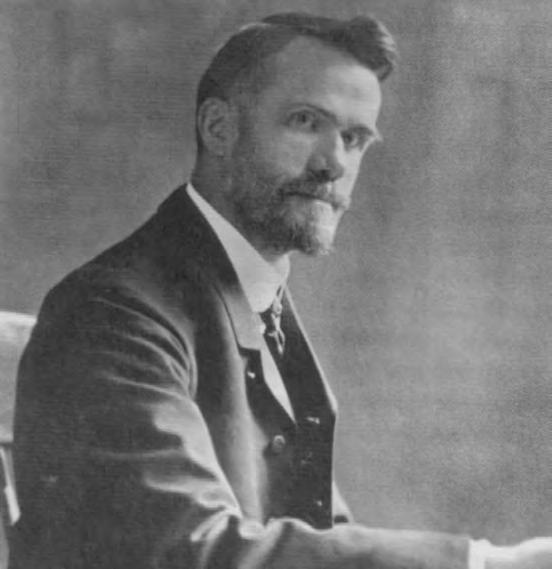
20th century. Christian socialism formed in the American church from the Social Gospel of Walter Rauschenbusch, passed on to the early American socialists Norman omas and Reinhold Niebuhr, and taken into the public sphere by activists such as Myles Horton and Martin Luther King Jr. during the Civil Rights movement. ese thinkers saw past the gridlock into the truths of both their faith and socialism. eir lives profess the historical case for Christian socialism. is article will primarily analyze the history of the 20th-century American Protestant church’s pursuit of God’s Kingdom on Earth through the conjunction of two seemingly opposite ideologies: Christianity and socialism 6
At the turn of the 20th century, a theology called the “Social Gospel” emerged It called for Christians to actively change society to assist the needy and oppressed e father of the Social Gospel in America, Walter Rauschenbusch, was a Baptist theologian and pastor who led a movement of evangelicals that did not entirely embrace the class warfare of Marxism but did embrace socialist ideals such as labor unions, public ownership, and labor protective legislation. When Rauschenbusch faced conservative opposition in the Church, he said, “God had to raise up socialism because the organized Church was too blind, or too slow, to realize God’s ends.”7 His work as a pastor in the slums of Manhattan brought him to this conclusion. He worked with parishioners on the margins struggling to make ends meet. He visited hospital beds. He fed the hungry. He held funerals for children And every Sunday he preached God’s love and called his parishioners to live like Christ, who gave up everything even His own life for His people here on earth 8
While ministering in New York, Rauschenbusch saw a Catholic priest named Father Edward McGlynn speak at a progressive political rally. McGlynn highlighted these words from the Lord’s prayer: “ y kingdom come, y will be done, on earth as it is in heaven.” From this moment on, Rauschenbusch emphasized the Kingdom of God in all his sermons, preaching it as something to work towards on earth.9 On sabbatical in Germany, he solidi ed his thoughts on social Christianity and set forth to form the Brotherhood of the Kingdom, a think tank that spread the Social Gospel across the evangelical Church. To spread his message outside his own theological circles, Rauschenbusch wrote the book Christianity and the Social Crises which proved successful and allowed him to speak his message of the Kingdom across the United States He spent the rest of his career writing on the Social Gospel and speaking out for peace and social change in the political sphere His great-
est legacy, however, was the in uence of his Social Gospel over socialist-leaning Christians, leading them to work for change in the political sphere for years to come. In many ways, he made the term “Christian socialism” possible.10
At Rauschenbusch’s death in 1918, America and the world stood at a pivotal point in economic history. World War I a war in which Rauschenbusch famously opposed US involvement had come to an end, an ending which marked the beginning of the globalization of capitalist democracy. Rauschenbusch saw the rise of socialism as a direct response to the moral depravity of World War I depravity in uenced by increased economic and military globalism He took these beliefs into the public sphere at an antiwar rally in 1917, at which he used his Social Gospel to argue against US intervention 11 is rally was uncharacteristic for Rauschenbush since he was typically less inclined to apply his Social Gospel to the political sphere. While he tended to isolate himself from the political sphere, his followers were quite the opposite; they went into the roaring twenties with the words, “ on earth as it is in heaven,” ringing in their ears as they sought to spread that good news into the secular world through political activism.
e Social Gospel spread across the Protestant church over the next decade, and as it spread it took a new shape: Christian political activism. In 1914, a group of British paci sts formed an organization called the Fellowship of Reconciliation (FOR), and a year later a branch of the organization sprung up in America is American FOR became almost entirely populated by Protestant social gospelers (as inspired by Rauschenbusch’s vocal opposition of WWI12) ese ministers became the founders of American Christian socialism 13
Among the founders of the American FOR, which continued its work for reconciliation and justice after the war, was Princeton-educated, Presbyterian minister Norman omas. He was ordained at Union eological Seminary in New York, a school which played an instrumental role in the founding of Christian socialism. omas holds an often-forgotten place in American history because he
ran as a candidate for the Presidency six times under the American Socialist Party. omas cites not Marx and Engles, but Walter Rauschenbusch as his in uence towards socialism.14 Like Rauschenbusch, omas got his start as a minister in New York City but quickly turned to activism and politics as his way to live out the Social Gospel. In addition to co-founding the American FOR, omas helped to found the American Civil Liberties Union (ACLU) which defends constitutional rights to this day. While certainly not the only Christian involved in Socialist Party activities during this time, omas stands as the most prominent and vocal 15
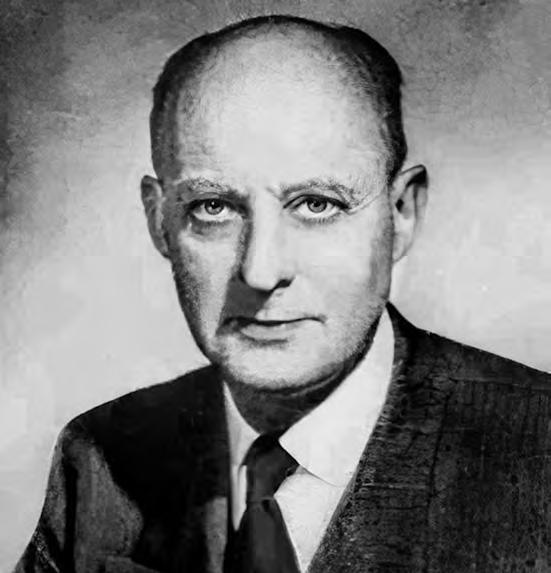
While the American FOR was the most well-known, it was not the only paci st, socialist-minded organization operating during the twenties In 1921, the Fellowship for a Christian Social Order (FCSO) was founded by another group of Social Gospel in uenced Protestant ministers. Most notable among these ministers was a man named Reinhold Niebuhr. Niebuhr had come to theology by way of the Social Gospel through Rauschenbusch and his contemporaries. As a minister to German immigrant autoworkers in Detroit, he had learned to apply Christ’s teachings to his own political beliefs of economic equality. In a radio address taken from the Library of Congress manuscript archives, Niebuhr preached against auto typhoon Henry Ford after having seen the working conditions in his early factories, saying, “Ford would not contribute to the community chest because he believed in ‘justice rather than charity ’ Meanwhile, well over half the caseload of the institutions of the chest was taken up by Ford workers ”16 However, Niebuhr was not just another liberal Protestant While he was in uenced by the Social Gospel early on in his studies, he became skeptical of the optimistic emphasis it placed on a kingdom on earth, calling it naive for neglecting innate human sinfulness. He worried that sin would necessarily lead to injustice and inequality, which pushed him to advocate for the need of government institutions to mandate justice and equality. ough his doubt eventually grew into a rejection of socialism, his study and work with groups such as the Detroit autoworkers in his earlier career had a massive in uence on Christian socialism. During that time, he said, “I became a socialist in theory long before I enrolled
in the Socialist Party and before I had read anything by Marx ”17 is early work bred the next generation of the Social Gospel and the peak of Protestant Christian socialism in America
In 1928, Niebuhr’s FCSO was incorporated into omas ’ FOR.18 One year later, Wall Street crashed, and the Great Depression began. Niebuhr enlisted in the Socialist Party, joining many of his Christian colleagues of the FOR. In 1931, he founded the Fellowship of Socialist Christians, an organization focused on “the primacy of its Christian rather than socialist, convictions.”19 During this time, Niebuhr accepted a position as a professor at Union eological Seminary, Norman omas ’ alma mater.
In the middle of the 20th century, Union eological Seminary at Columbia University was becoming somewhat of a hub of radical Christian intellectualism. Already noted in this paper are the connections between Norman omas, Reinhold Niebuhr, and the seminary Niebuhr’s in uence as an American theologian spread outwards from its starting point at Union He remains in uential to this day leading to a 2017 America Magazine article titled “Politicians Love to Quote Reinhold Niebuhr” which detailed the likes of President Barack Obama, New York Times Op-Ed columnist David Brooks, and former director of the FBI James Comey quoting Niebuhr.20 Under his professorship, Union became a hotbed for radical Christian social teaching. Dissatis ed with a purely academic life, however, he turned to civil rights activism -- most notably cofounding
Americans for Democratic Action21 and was awarded the Presidential Medal of Freedom in 1964 22
While his in uence was necessary to the civil rights movement, there are no pictures of Niebuhr leading marches across bridges in Alabama One nal piece of history must connect Niebuhr’s early writing to the radical activism of the fties and sixties. at “missing piece” is Myles Horton, founding member of the Southern Christian Leadership Conference, activist, educator, Union graduate, and Christian socialist. Horton grew up in a politically active Christian household in rural Tennessee. His parents were schoolteachers and local activists. His father was a member of the Worker Alliance union, a Socialist Party-sponsored union for unemployed workers. Horton’s faith grew in the soil of his mother’s words: “ e only thing that is important is to love your neighbor.”23 As a young child he heard “neighbor” and took it to mean the sharecroppers and laborers he grew up around, people in whom he saw great power and the virtue necessary for self-governance is background led him to Union Seminary in 1929 and to his decision to join the Socialist Party in the same year “Socialism seemed to me the only way to deal with the problems as I saw them,” Horton wrote in his autobiography e Long Haul. 24 At Union, he became a student of Niebuhr’s and encountered other students of the Social Gospel.25
In 1932, Horton founded the Highlander Folk School, a school for peer education and conversation among the working people of rural Tennessee and beyond. He
founded the school on the belief that “education is a profound political act, especially if education takes place among the poor.”26 Initially, Highlander primarily worked with local labor disputes to some success, even successfully organizing unions in nearby towns. However, the school’s greatest legacy, as well as the greatest legacy of American Christian socialism, lies in its work with the civil rights movement.27
In the early fties the American political climate was changing. World War II had ended half a decade ago and much of the country had experienced vast economic growth and relative prosperity, but parts of the country had been left behind. In the American South, Jim Crow was still the law of the land with little federal support for change at lack of support had begun to change in the beginning of the fties, and in preparation for the change, Horton and Highlander School turned their focus towards the brewing civil rights battle In 1954, the Supreme Court ruled school segregation unconstitutional e following year, Rosa Parks attended a workshop on civil disobedience at Highlander four months before taking a seat in the white section of a Montgomery bus.28
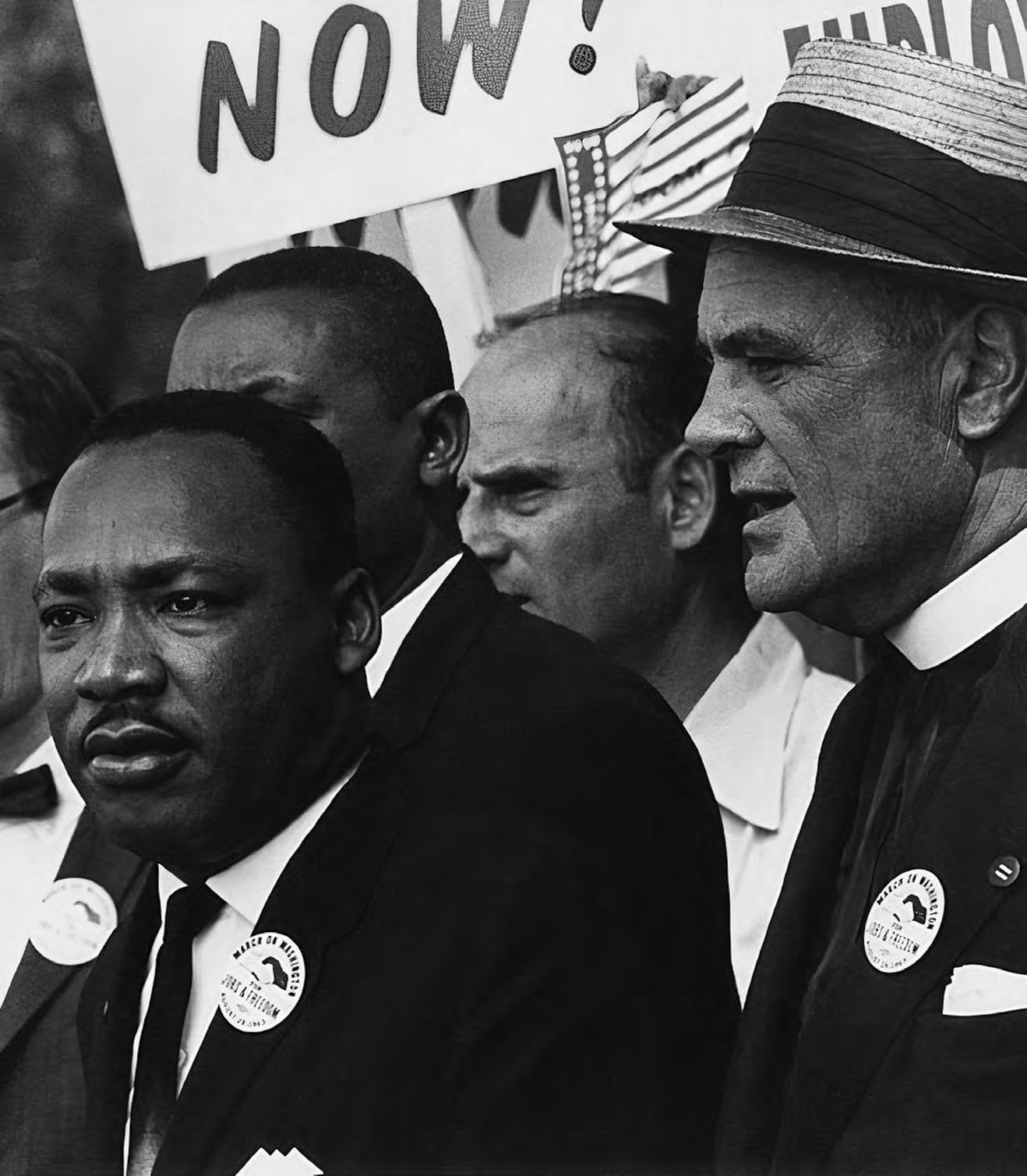
At rst glance, the Christian connections to the civil rights movement seem to be pretty weak evidence for a greater Christian socialist movement in the fties and sixties. e civil rights movement fought for basic human rights for all as dictated by constitutional and natural law. It was not exactly a socialist revolution. However, upon a closer look, the movement ’ s ties to socialism are clear. Highlander was founded by Christian socialists with the explicit intention of educating the working masses for nonviolent class warfare. In 1957, when Martin Luther King Jr. was a junior at Morehouse College, he attended an event at Highlander. A photo of his attendance was used on billboards all across the South with the caption “Luther King at Communist Training School: Remember, the freedom he wants is yours ” While these billboards were meant to disparage the civil rights movement as un-American, the folks at Highlander and King himself may not have taken it as much of an insult 29
While remembered as the greatest hero, leader and martyr of the civil rights movement, Martin Luther King Jr.’s social philosophy reached far beyond race. While King studied at Morehouse and worked in factories during the summers, he was mentored by a sociology professor, Walter Chivers, who swore “ money is not the root only of evil but of race. ”
Photo by Rowland Scherman and restored by Adam Cuerden from Wikimedia Commons
King went on to study at Crozer Seminary where he read Social Gospel philosophers in more depth, including both Rauschenbusch and Niebuhr. By the time he was organizing the Montgomery bus boycott and founding the Southern Christian Leadership Conference in 1955, he had fully formed a personal philosophy that issues of race, economic inequality, and class were inextricably linked in America.30
A publicly socialist leader of the civil rights movement would not have gone over well in the midst of the Cold War, and therefore much of the early evidence of King’s leanings come from those close to him at the time. In a 1955 letter to his bride-to-be, Coretta Scott, King wrote, “[Capitalism] started out with a noble and high motive but like most human systems it fell victim to the very thing it was revolting against So capitalism has out-lived its usefulness ”31 Coretta King cited King’s socialist tendencies the whole time she knew him.32 However, the nal year
intended. King had pushed for the march to take place as a peaceful but illegal occupation of the mall, leading to mass arrests and a much bigger story. By causing a scene with the Poor People’s March, King hoped to draw attention to the direct con ict between those with wealth and power and the poor. He wished to peacefully prove the point of eternal class warfare in America and thereby create a movement of the working class as e ective as the civil rights movement had been. With the Poor People’s March, King wanted to reverse the reality which he stated to Coretta King in 1952: capitalism “has brought about a system that takes necessities away from the masses to give luxuries to the classes ”
“I am much more socialistic in my economic theory than capitalistic,” King admitted in the same letter 34 While presenting a straight-edge and moderate face for the cameras to further his movement, Martin Luther King Jr was at heart a Christian socialist.
d v o c a t e f o r a s t a t u s q u o .
of King’s life gives the hardest evidence that he had much larger intentions for his movement than the abolition of Jim Crow
In his 1967 book Where Do We Go from Here?, MLK wrote, “ e solution to poverty is to abolish it directly by a now widely discussed matter: the guaranteed income.”33 e guaranteed income was exactly what it sounds like--a guarantee that no family or individual should fall below a certain income. Overt democratic socialist policies such as this one were the direction King had chosen in 1967, the year before his death. While innately tied to racial economic inequality, these economic initiatives were for all the working class and were meant to level the playing eld between the ruling, bourgeois class and the working poor.
In 1968, the SCLC began organizing for a Poor People’s March on Washington similar to the historic 1963 civil rights march On April 4, 1968, however, Dr King was assassinated at the Lorraine Motel in Memphis His initiative for the march was to push towards a broader class-focused mission e march did take place, but not as he had
From the Sermon on the Mount to speeches by ministers from the steps of the Lincoln Memorial and from the feeding of the ve thousand to legislation for racial equality, Christianity is a religion of action. Every person cited in this article studied the Scripture and then put the Word into action. ey believed that the Word becomes Flesh, and when it does, it does not advocate for a status quo. Christianity takes a stand in the eternal earthly struggle for justice. If the last shall be rst, they are most worth ghting for Socialism advocates for the same equality that humankind nds in the unity of the body of Christ, an equality which would allow for perfect justice on Earth as it is in Heaven Rauschenbusch saw this goal in the dream of God’s Kingdom on Earth. Niebuhr and omas furthered his philosophy and passed it on to the likes of Horton and King. ose men in turn a ected immense social change on behalf of the marginalized the ones neglected by the rich, comfortable men, who nd the gates of heaven as narrow as the eye of a needle. While eternal class warfare is not Christian, it expresses the sentiment of constant social struggle against sin, speci cally the sin of injustice. Niebuhr was right that the Kingdom of God is unattainable by human means on Earth. When the call to radical love, sacri ce, and justice is heeded and brought from within the Church out into the world, the Kingdom seems much nearer. It just so happens that when the Church has been most successful in that call, the socialist policies walked hand in hand Christian socialism is not an oxymoron It’s Kingdom philosophy: “ on earth as it is in heaven ”
1 Karl Marx, “A Contribution to the Critique of Hegel’s Philosophy of the Right,” (Paris: Deutsch-Französische Jahrbücher, 1844)
2 Mark 10:25 (NKJV)
3. Acts 4:32 (NIV).
4 Karl Marx, “Critique of Gotha Programme Part I,” (Moscow: Progress Publishers, 1970)
5 Saint Benedict, Abbot of Monte Cassino, e Holy Rule of St Benedict, trans Rev Boniface Verheyen (Grand Rapids: Christian Classics Ethereal Library, 1949), 40
6 For the sake of continuity and relative brevity, this article will focus on Christian socialism in the Protestant church e Catholic story of Christian socialism is equally important but developed separately
7. Peter Feurherd, “When Evangelicals Loved Socialism,” JSTOR Daily, ITHAKA, January 31, 2019, https://daily jstor org/when-christian-evangelicals-loved-socialism/
8 “Walter Rauschenbusch: Champion of the Social Gospel,” Christianity Today, accessed September 26, 2020, https://www christianitytoday com/history/people/activists/ walter-rauschenbusch html
9 Julian Gotobed, “Walter Rauschenbusch (1861–1918),” Boston Collaborative Encyclopedia of Western eology, Wesley Wildman, 1994, http://people bu edu/wwildman/bce/rauschenbusch htm
10. Jacob Dorn, “ e Social Gospel and Socialism: A Comparison of the ought of Francis Greenwood Peabody, Washington Gladden, and Walter Rauschenbusch,” Church History 62, no 1 (1993): 90–94
11 Dorn, 97
12 Dorn, 97
13 Christopher Evans, e Social Gospel in American Press, 2017), 137
14 Evans, 4
15. “Norman omas, ” Ohio History Central, acces ohiohistorycentral org/w/Norman omas
16 Reinhold Niebuhr, “Moral Man and Immoral Niebuhr,” American Public Media, 26 Septembe web/20090809133030/
17 John Cort, Christian Socialism, (Maryknoll: Orbis
18 Evans, 138
19 Cort, Christian Socialism, 270
20. Drew Christiansen, “Politicians Love to Quote Rei Him,” America: e Jesuit Review, November 20, 201 org/politics-society/2017/11/20/politicians-love-quo ey-actually-gets-him
21 “Reinhold Niebuhr,” Stanford King Institute, Sta tember 26, 2020, https://kinginstitute stanford edu/e
22 “Famous Inductee: Reinhold Niebuhr,” Missouri on September 26, 2020, https://house mo gov/Famou 23. Shadi Rahimi, “Peace Pro le: Myles Horton,” Pea doi: 10 1080/1367886022000016910
24 Rahimi, 343–48
25. Jon Hale, “Early Pedagogical In uences on the M Horton and Critical Education in the Deep South,” A nal 34, no 2, (2007): 318 ISSN-1535-0584
26 Hale, 322
27 Hale, 321–22
28. “Highlander Folk School,” Stanford King Institut on September 26, 2020, https://kinginstitute stanford er-folk-school
29. “Communism,” Stanford King Institute, Stanford 26, 2020, https://kinginstitute stanford edu/encyclop
30 Douglas Sturm, “Martin Luther King Jr , as Dem gious Ethics 18, no 2 (1990): 80–96
31 “Martin Luther King on Capitalism,” MLK G 2020, https://mlkglobal org/2017/11/23/martin-luth words/
32 “Communism,” Stanford King Institute, Stanford
33. “King on Capitalism,” MLK Global.
34 Matthew Goodrich, “ e Forgotten Socialist Hist ese Times, Institute for Public A airs, January 15 article/martin-luther-king-jr-day-socialism-capitalism
Revisiting the Mission in Hopi
Lessons from Histor y, Indigenization, and Missio Dei
by Daniel Lim
In 2008, I moved from South Korea to the Hopi Reservation the land of the Hopi Tribe in Northern Arizona when my parents were called as missionaries to serve in the First Mesa Baptist Church, a small congregation on the reservation. Living among the Hopi people as a part of a missionary family has been a wonderful experience that taught me many valuable lessons and shaped my worldviews and identity. However, since sharing my experiences on the Hopi Reservation with my college peers, I have become more conscious of the connotations inferred by others in the “missionary in Indian land” label I discovered that my positive view of Christian missions was not shared by those who had di erent experiences. Instead of love, fellowship, or compassion, the themes that most notably characterized Christian missions seemed to be abuse, violence, coercion, and conquest.1 is article acknowledges the validity of antipathic attitudes toward Christian missions on Indigenous lands by calling attention to the centuries-long, regretful history of Christian colonialism. But importantly, I want to put forward a perspective on mission by sharing my thoughts that I developed by living in the Hopi Reservation for the past decade
Ever since Jesus commanded in Matthew’s gospel, “ erefore go and make disciples of all nations, baptizing them in the name of the Father and of the Son and of the Holy Spirit, and teaching them to obey everything I have commanded you,”2 missionaries have diligently traversed the world to deliver the Gospel in places far from their homes. e idea of “mission” is an essential component to the Christian theology and praxis, as evidenced by the New Testament’s total of 266 references to the ancient Greek verb “apostellein,” which means “ to send away.”3 Accordingly, Christ’s apostles the “ ones that are sent away ” acted on that call to spread the Gospel.
e history of Christian mission
stretches from the Apostle Paul in the Roman Empire to all modern-day local and international denominations of Christianity. Currently, it is estimated that more than 400,000 Catholic and Protestant missionaries are situated in foreign nations.4 It is argued that Christian missionary e orts are often complex, multi-directional, and multicultural encounters that are not easily reducible to a one-sided view of colonialism.5 I agree with the notion that such encounters are complex And while there are anecdotes of ourishing missions that have greatly contributed to cultural development and philanthropies for di erent peoples around the world, it is wrong to label the Christian missions’ unspeakable mistreatment of the Indigenous peoples simply as “innocent cross-cultural encounters.”6 I hold that Christian missions, regardless of their denominations, failed overall as missionaries and disproportionately committed disservice to the Indigenous peoples.
e Hopi people’s encounters with Christians are primarily marked rst by the Spanish Conquests led by the Franciscans and later by the assimilatory colonialism of the United States From 1629, when three Franciscan missionaries arrived in Hopi, to the early 1900s, when the U S federal government established residential schools and took away Hopi children by force, there had been a three-centuries-long e ort to “Christianize” the Hopi people.7 By 1955, however, less than two percent of the Hopi population had become practicing Christians.8 Although these numbers by themselves cannot determine whether or not a particular mission was successful, the history of abuse and ideological patronization provides clear grounds to judge these missions as a series of blunders that might have been predestined to fail.
At the time the Spanish arrived at Hopi, they had fully indulged themselves in the Aristotelian dogma of natural slavery which theorizes that some people are born to be slaves while others are born to rule 9 is
notion was most representatively defended by Juan Gines de Sepulveda, a 16th-century Spanish theologian, who argued that the assumed “barbarous” nature of the American Natives fully justi ed the Spaniards in waging war on the Indians as a preliminary means to Christianizing them.10 An embodiment of this was the Requerimiento, a written document carried by the conquistadors and read to the Indian peoples upon rst contact, which proclaimed that whoever refused to accept Christianity and the Church as their ruler would be rightly punished, pillaged, enslaved, and killed.11 Such a justi cation for abuse easily devolved into mistreatment and violence in the Spanish missions in Hopi as well It is reliably reported that Spanish missionaries enslaved the Hopis to build the missions, sexually violated young Native women, and severely punished and even killed those who refused to attend Catholic Mass 12 is war waged by the Spanish against the Native American peoples was not only physically violent but also culturally destructive. In the eyes of the Westerners, any indigenous traditions, customs, religions, and cultures were viewed as degenerate, superstitious, and primitive requiring a conversion to Western civilization.13 When they built a mission in the Hopi village of Awatovi in present-day Ar-
izona, the Spanish purposefully chose to do so on top of a sacred kiva a chamber used for Hopi religious ceremonies to manifest the superimposition of Christianity on Hopi traditional religious beliefs.14 Moreover, the missionaries destroyed sacred Hopi alters and ceremonial artifacts and harshly punished those who practiced the traditional religion.15 is patronizing attitude toward Native peoples and their traditions continued long after the Spanish left the Hopi lands. e United States continued this legacy with slogans such as “kill the Indian, save the man, ” and the federal government continued the practice of annihilating native institutions with the imposition of American residential schools Native children, including the Hopis, were forcibly relocated to these schools in an e ort to “Christianize and civilize” Native peoples by uprooting their youth from their familial ties and traditional way of life.16 e results were tragic for Native cultures, traditions, and cohesiveness.
e sources of these abuses and failures are many. But in the context of Christian missions, I hold that two things in particular most decidedly led to failure: a passion on the part of missionaries guided by blind naïveté and a lack of any attempt to indigenize Christianity into traditional
Native culture.
I do not attempt to claim that the previous missionary e orts were devoid of hard work and sometimes I dare say misguided good will.17 ough unsettling to admit, many of the previously-mentioned acts of violence by missionaries occurred under the intention to evangelize and do what they thought was right. Native American scholar George Tinker suggests that an enigmatic aspect of Indian missions was that “while the missionaries clearly functioned to facilitate the exploitation of Indian people, they themselves usually did not bene t from those acts of exploitation ”18 Other than the fact that these missionaries were naïvely passionate to spread the Gospel, there are no other apparent practical reasons to explain their sincere dedication to the missions I view this naïve passion, however, as a classic blunder in the missions’ history that often yielded violence, coercion, and misunderstandings, similar to what history shows in the spread of Christianity in the Roman Empire, the Crusades, and, ultimately, the Americas following European contact.
“The only thing we have to give is Jesus, a gift to us, so a gift to you. If you can build up around Christ a better culture and civilization than we have been able to do, we will sit at your feet.”
Since such naïveté is grounded in dogmatic commitments to religious and cultural mutual exclusivity, many missionaries brand themselves as superior, legitimate, and right, and they see the recipients of their e orts as culturally inferior, illegitimate, and wrong. In the context of mission, such a divisive mindset not only attempts to justify destructive behavior, but it also fails to prioritize the recipients of mission. When purely guided by the naïve passion, mission downgrades into a mere one-sided projection of alien propaganda that fails to reach the hearts and minds of the recipients in a way that resonates with them or in a way that is indigenized
Good and successful missions do not make the two mistakes addressed above. Instead, good missionaries approach mission with, rst, an attitude of sharing and, second, a humbleness that brings reconciliation. A “sharing attitude” is an approach in which missionaries’ role is not to proclaim and teach but to share. Eli Stanley Jones, a 20th-century American missionary who served India, captured this spirit as follows:
Take from our civilization anything good and beautiful you may nd there if it appeals to you. But keep what is good in your own. We are not out to replace the cultures of the East with Western culture. e only thing we have to give is Jesus, a gift to us, so a gift to you If you can build up around Christ a better culture and civilization than we have been able to do, we will sit at your feet 19
Missionaries must realize that assertiveness in mission is o ensive and dysfunctional, and they need to retreat a step to respect the recipients’ intellectual and spiritual freedom Furthermore, if we confess that God is universal and meets everyone where they are, then we must acknowledge that he nds everyone through their culture’s unique locus theologicus the present human experience shaped by the social, philosophical, and epistemological context.20 Stephan B. Bevans, a 20th-century American missionary who served the Philippines, describes such a process as “contextual theology,” and he posits that it is a theological imperative to contextualize Christianity. According to Bevans, “ ere is no such thing as ‘theology’; there is only contextual theology: feminist theology, black theology, liberation theology, Filipino theology, Asian-American theology, African theology, and so forth ”21 Accordingly, successful missions to Native American peoples require a Native American theology and, speci cally for the Hopi, a Hopi theology 22
My father recounts that he professed the following in
God finds everyone through their culture’s unique locus theologicus.
his rst sermon at Hopi: “If Jesus came to Hopi, He would come in the image of a Hopi man. ” is is represented in the mural art on the water fountain outside of our church done by one of our church members, Wilma Nahsonhoya, that depicts Christ as a Hopi man in a traditional Hopi
out t. e stained-glass décors in our church building are designed by our church members who express their faith in terms of imageries that are natural to them. Many of the songs we sing at our church are sung in the Hopi language; the Holy Communion is done with liqui ed somiviki (blue corn dough); the crosses at our church resemble the Hopi lightning, rainbow, and mesa symbols; and even the unusually long duration of our church services re ect the Hopi people’s kairological sense of time. ese are only some examples of what indigenization of Christianity can look like. For individuals who are perfectly familiar with both Hopi culture and Christianity, I believe that indigenization can occur in more profound ways that psychologically and spiritually impact their faith
Now that I have addressed the rst quality of good mission an attitude of sharing I will move on to addressing the second quality of good mission a humbleness that brings reconciliation. By the term “humbleness” I mean a mindset in which missionaries confess that works of missions are not of their agency but of God’s. is perspective in missiology is most representatively embodied by a theology that scholars refer to as missio Dei, or “mission of God.” eologian Karl Barth claimed that the word missio in the early church did not denote sending ministers to other countries but instead was “ an expression of the doctrine of the Trinity namely an expression of the divine sending forth of the self, the sending of the Son and the Holy Spirit to the world ”23 In other words, mission is not a human activity; it is an action of God, the Divine Sender, and of Jesus, the truest apostle 24 us, according to missio Dei and contrary to the common perception of mission, the acts of converting and
argue that while mission is often thought of as an exclusive, specialized activity of clergies, it actually is something that is and should be practiced by all Christians.27 eir conclusion is primarily drawn from missio Dei’ s unique recognition of God’s reconciliatory nature that is, God’s mission is broader than just evangelization and is also based on the realization of God’s restorative, healing, loving, and reconciliatory nature.28 Missiologist Andrew Kirk expresses it thus: “ e mission of God ows directly from the nature of who God is... God’s intention for the world is that in every respect it should show forth the way he is love, community, equality, diversity, mercy, compassion and justice ”29 Witnessing and contributing to the realization of God’s reconciliatory nature happens in all aspects of our lives as mentioned above As Kirk a rms, “the life of work is for almost all Christians the primary missionary frontier,” whether it be at home, at school, at work, with family, with friends, with passersby, and with enemies, there is love and reconciliation that we need to actively promote.30 Ultimately, missio Dei sustains that individuals’ small actions contribute to God’s grander scheme of reconciliation of the world and his people with God himself. As stated in St. Paul’s Second Letter to the Corinthians, All this is from God, who reconciled us to himself through Christ and gave us the ministry of reconciliation: that God was reconciling the world to himself in Christ, not counting people’s sins against them. And he has committed to us the message of reconciliation We are therefore Christ’s ambassadors, as though God were making his appeal through us We implore you on Christ’s behalf: Be reconciled to God.31
As missio Dei compels all of us to witness and partic-
“God’s intention for the world is that in every respect it should show forth the way he is – love, community, equality, diversity, mercy, compassion and justice.”
evangelizing are not up to the missionaries but to God. is means that missionaries hold a much more nuanced role in the missio Dei theology as merely acting as facilitating instruments that witness God’s nature at work 25 In other words, mission is something that exists in all aspects of our lives 26 Mennonite missionaries Alan and Eleanor Kreider
ipate in the midst of our daily lives, it guides my family and myself as well in the same way. My parents ’ place in mission is as good neighbors that people can count on for prayers, help with family issues, church events, roof repairs, carpools, and birthday parties. And my siblings’ and my
place in mission is right in our lives as students and friends where we laugh, tease, eat, study, and play basketball with the peers around us. I believe that God works through the small things in our lives to make big things happen. Having conducted his mission this way, my father was honored with an invitation to a Hopi Tribal Council meeting to share a prayer with Hopi leaders, a rst in history for the Christian clergy. For our church’s 109th anniversary ceremony, Hopi religious leaders attended the event to share a message and celebrate together.32 Also, it was very memorable when, a few years ago, our church was invited to sing Christian hymns at a traditional Hopi ceremony where everyone in the plaza, Christians and non-Christians, was equally blessed with an electric burst of rain and hail the most highly regarded sign of blessing for the Hopis I believe that events like this manifest God’s reconciliatory mission that he invites us to witness and take part in.
In summary, I believe that growing up in a missionary family on the Hopi Reservation allowed me to see and understand some of the challenges that Christian missions have faced in interacting with Indigenous peoples. As sketched out by history, mission guided by blind naïvete and a false sense of agency have rendered many missions dysfunctional, o ensive, and imperialist. I believe, however, that a more optimistic outlook in mission is possible if we practice it with an attitude of sharing, not imposing, and thereby accommodating and facilitating the indigenization of Christianity for Native peoples Importantly, by acknowledging that it is God, not ourselves, who works the missionary miracles, missionaries should remember to humbly witness and partake in the reconciliatory work of God as illustrated by the missio Dei
1 Dana L Robert, Christian Mission: How Christianity Became a World Religion (Oxford: John Wiley & Sons, Ltd , 2009) PAGE NUMBER
2 Matthew 28:19-20 (NIV)
3. Robert, 11.
4 “Missions Statistics,” e Traveling Team, accessed on October 6, 2020, http://www thetravelingteam org/stats
5. Robert, 1.
6 George E Tinker, Missionary Conquest: e Gospel and Native American Cultural Genocide (Minneapolis: Fortpress, 193), 4
7 Harry C James, Pages from Hopi History (Tucson: University of Arizona Press, 1974), 44
8 Edward Holland Spicer, Cycles of Conquest: e Impact of Spain, Mexico, and the United States on Indians of the Southwest (Tucson: University of Arizona Press, 1962), 207
9 Aristotle, “ e Politics Book 1” in Aristotle: Selections, trans/ed Terence Irwin and Gail Fine, (Indianapolis: Hackett Publishing Company Inc, 1995).
10 Lewis Hanke, Aristotle and the American Indians: A Study in Race Prejudice in the Modern World (White sh: Literary Licensing LLC, 2011), 72-73
11 Lewis Hanke, e Spanish Struggle for Justice in the Conquest of America (Dallas: Southern Methodist University Press, 2002), 32-33
12 Edmund R Nequatewa, Truth of a Hopi: Stories Relating to the Origin, Myths, and Clan Histories of the Hopi (London: Forgotten Books, 2008), 40-42
13 George G Hunter III, e Celtic Way of Evangelization: How Christiantiy Can Reach the West, (Nashville: Abingdon Press, 2000), 4-5.
14 James, 47
15 Nequatewa, 40; James, 48
16 Becky Little, “How Boarding Schools Tried to ‘Kill the Indian’ rough Assimilation,” History Channel, last modi ed November 1, 2018, https://www history com/ news/how-boarding-schools-tried-to-kill-the-indian-through-assimilation
17. Tinker, 15.
18 Tinker, 17
19 E Stanley Jones, A Song of Ascents (Nashville: Abingdon Press, 1968), 96 Emphasis added
20 Stephen B Bevans, Models of Contextual eolog y (New York: Orbis Books, 2002), 4
21 Bevans, 3
22 Some purist theologians may be skeptical of the process of contextualization and indigenization in the worries of fabricating theologically ungrounded–what is often denoted as syncretic–practices of Christianity. How to properly navigate indigenization is an important topic for another discussion, but I still hold that it is better not to completely reject indigeneity and the attempt to contextualize As we see in history, missions lacking such e orts not only became o ensive and incompetent, but they also failed to recognize people’s sense of identity is created a “cultural vacuum, ” which is dangerous and has unfortunate consequences See omas E Bates, Native American Identity, Christianity, and Critical Contextualization, 36 e term “cultural vacuum ” was coined by Vine Deloria Jr who used the term in his book Missionaries and the Religious Vacuum
23. Alan Kreider, Worship and Mission After Christendom (Scottdale: Herald Press, 2011), 43
24 Kreider, 43
25 Kreider, 48
26 Kreider, 53
27 Kreider, 53
is is a point of contention revolving conversations in missiology, and receives objections such that Missio Dei is merely an attempt to justify and distinguish the modern mission from the colonial missions that downplays the signi cance of the action of the Church and ultimately fails to provide a concrete model for how mission should go about See Flett, John G e Witness of God: e Trinity, Missio Dei, Karl Barth, and the Nature of Christian 174 Ch 1 Introduction ) In response to such objections as that “if everything is mission, nothing is mission,” Kreider acknowledges that discernment is necessary to distinguish mere social movement and philanthropy from missionary work Kreider, 54 (the objection was raised by Scottish Anglican missionary Stephen Neill) More can be said about this topic in another discussion, but Kreider argues that at least three things–Jesus Christ, the metanarrative, and freedom from powers–constitute the necessary discernment Kreider, 54-56
28 Kreider, 54
29 Tormod Engelsviken, “Missio Dei: e understanding and misunderstanding of a theological concept in European churches and Missiology,” International Review of Mission 92, no 367 (2006): 485
30 Kreider, 54
31 2 Corinthians 5:20 (NIV)
32. Louella Nahsonhoya, “First Mesa Baptist Church, Celebration of Life Ceremony,” Hopi Tutuveni 21, no 9, (2013): 6 Retrieved from hopi-nsn gov
I thank Professor Palmer and Sunny for the fruitful discussions in NAS 8, NAS 22, and Logos Small Group that deeply in uenced my perspective and knowledge that were central to writing this piece I also thank Alice Little, Joan Kim, James Lim, Kyle “ Taqaomaw” Secakuku, Tia “Nazbaa” Folgheraiter, Mikal Poleahla, Romancita Adams, Louella Nahsonhoya, and my parents for providing helpful comments during the drafting process Moreover, I thank my family for inspiring me with actions that embody the values that I put forward in the article and the Hopi community members for generously welcoming my family to their motherland
It’s Not About Your Wedding Night
by Paul Jeon
Clarifying the Heart Behind Christian Sexual Ethics
According to the Roman physician Galen of Pergamon, 2nd-century Christians were notable amongst their society for at least two reasons. First, given their belief in a bodily resurrection, they exhibited a curious “free[dom] from the fear of death.”Second, Galen noted, Christians demonstrated remarkable bodily self-control and sexual restraint.1 is latter observation is corroborated by contemporary accounts of Christians from within and without their ranks; for example, the unknown Christian author of the 2nd or 3rd century Epistle to Diognetus describes Christians as otherwise “indistinguishable from other men either by nationality, language or customs ” but notably distinguished by their sexual conduct: “ ey share their meals but not their wives.”2
In 21st-century America, sexual norms remain a primary distinguishing marker of Christians from their society. A Cosmopolitan series documenting the experiences of women who grew up in the “purity culture” movement of the 1990s and 2000s, for example, casts evangelical sexual norms as anomalous and even harmful, citing how “Evangelical or bornagain Christians are more likely than other Americans to believe it is morally wrong for unmarried adults to have sex ”3 e results of a Pew Research Center study conducted in February 2020 further describe how many American adults view Christianity as incompatible with changing sexual norms. 53% of respondents cited “ more permissive attitudes about sexual behavior and sexuality in popular culture” as a major cause of declining Christian in uence in America, and another 32% cited it as a minor cause, but a cause nonetheless.4
ty culture movement swept through American evangelical culture in the 1990s and 2000s, primarily advancing a horizontal motivation to pursue a Christian sexual ethic. Proponents of evangelical purity culture encouraged Christian adolescents to choose abstinence until marriage to avoid heartache, guilt, and STDs, and to secure their and their future spouse ’ s satisfaction in marriage and married sex life.
In 21stcentury America, sexual norms remain a primary distinguishing marker of Christians from their society.
Why, then, is it that Christians subscribe to a sexual ethic that is consistently distinct from that of their society? What have been their motivations for doing so? In discussing ethics, Christians sometimes distinguish between the “horizontal” dimension––the sense in which ethics governs the relationship between people––and the “vertical” dimension––the sense in which ethics governs the relationship between people and God e aforementioned puri-
As the adolescents raised in purity culture have come of age, the harmful impacts of its messaging have been widely documented and the movement reevaluated. To see this, look no further than Joshua Harris, the author of I Kissed Dating Goodbye, which achieved textbook-like status in purity culture circles after its publication in 1997 In 2018, however, Harris retracted his book and released a documentary titled I Survived I Kissed Dating Goodbye to illustrate its negative impacts 5 At present, evangelical culture is no longer in the “I Kissed Dating Goodbye” era, but rather in an “I Survived I Kissed Dating Goodbye” era––no longer in purity culture but rather in a post-purity culture. Yet, as I will demonstrate, evangelical guidance on sexual ethics remains rmly in the realm of the horizontal, suggesting that the most important consequences of one ’ s sexual behavior are between people In this article, I will clarify what is a biblical motivation for subscribing to a Christian sexual ethic. Examining the Apostle Paul’s teachings on sexual ethics in 1 Corinthians 6 and 1 essalonians 4, I hope to show that the Bible teaches that the primary motivation to follow a Christian sexual ethic is not horizontal, but vertical, or grounded in the Christian’s relationship with God. Toward this end, I will rst establish a working de nition of biblical sexual ethics. en, I will examine and critique the horizontal arguments found in contemporary evangelical teachings on sex, nally comparing them to the vertical argument found in Paul’s letters
But rst, a clari cation, as I would be remiss not to acknowledge that sex is a charged subject with potentially fraught personal resonances e purpose of this article is
not to, in any way, inscribe despair or condemnation on any who feel they have failed (or are failing) in this area of Christian sexual ethics. Prior to Paul’s exhortation to the Corinthian church to “ ee from sexual immorality,” he writes:
Do not be deceived: Neither the sexually immoral nor idolaters nor adulterers [...] will inherit the kingdom of God And that is what some of you were. But you were washed, you were sancti ed, you were justi ed in the name of the Lord Jesus Christ and by the Spirit of our God.6
e good news of Christianity is that no human could ever perfectly keep God’s commands and ourish according to his design; but in his great love for humanity, God became human in Jesus Christ, perfectly keeping the commands and demonstrating how to live according to God’s design Christians believe that Jesus died in humanity’s place and rose again, that those who trust in him might be washed, sancti ed, and justi ed to have right standing with God––
Christians believe that Jesus died in humanity’s place and rose again, that those who trust in him might be washed, sanctified, and justified to have right standing with God––no ma er their sexual history or lack thereof.
no matter their sexual history or lack thereof. It is out of a trust and love for this God who rst loved that Christians are called and empowered to obey his commands, even when the precise reasons and bene ts of following them may be obscured.
W H A T I S A C H R I S T I A N S E X U A L E T H I C ?
In this article, I de ne the normative Christian sexual ethic as the enjoyment of sexual relations within the context of marriage. Sex is a gift from God, and Christians are to enjoy it with their spouse in a marital context. For those who do not marry, or are not yet married, the Bible prescribes celibacy, or abstinence from sexual relations. While no reader will nd in their modern English translations of the Bible the explicit command: “do not have sex before marriage,” or “sexual expression is to be reserved for marital context, ” there are at least two reasons to draw this conclusion, which I brie y summarize here.
First, within the broader biblical metanarrative, the creation account in Genesis 1-2 points to God’s normative design for sex, providing answers to questions of purpose and moral order, including those pertaining to human sexuality 7 As Dennis Hollinger explains: e creation story in Genesis points to clear givens with regard to sex In Genesis 1-2 God ordains sexuality, sexual intercourse, procreation, and marriage. And the givens are intimately linked to each other is givenness is the standard toward which we are to orient all sexual expression and the context in which all sexual behavior is to be experienced.8
e creation narrative in Genesis presents sex as an expression of a unitive bond designed to be singular and permanent––the marriage relationship e theology of sex posited by Genesis 1-2 has been foundational to subsequent Christian thought, from Old Testament laws to the teachings of New Testament gures such as Jesus and Paul, who repeatedly reference Genesis 1-2 as the preeminent authority for their teachings on marriage and sex. For instance, when teaching on divorce, Christ directly quotes Genesis 1:27 and 2:24 to reinforce the permanence of the normative9 marriage union: “But at the beginning of creation God ‘made them male and female.’ ‘For this reason a man will leave his father and mother and be united to his wife, and the two will become one esh.’ So they are no longer two, but one esh. erefore what God has joined together, let no one separate.”10 Paul additionally quotes Genesis 2:24 when teaching the Ephesian church on proper marriage conduct, establishing it as the authority behind his
guidance that “husbands ought to love their wives as their own bodies.”11
Second, the New Testament contains repeated commands against the Greek word porneia, often translated in modern English versions to “sexual immorality” and in the King James Version, “fornication.”12 One might wonder if this translation to “fornication” was invented in later interpretations to serve a puritanical agenda. Contextual rendering helps to solve this problem, however, as the meaning of porneia becomes illuminated by the following New Testament passages:
1 Corinthians 7:1-2: “Now for the matters you wrote about: “It is good for a man not to have sexual relations with a woman. ” But since sexual immorality [porneia] is occurring, each man should have sexual relations with his own wife, and each woman with her own husband ”13
Hebrews 13:4: “Marriage should be honored by all, and the marriage bed kept pure, for God will judge the adulterer and all the sexually immoral [pornos] ”14
e passage from 1 Corinthians sanctions sexual relations with one ’ s wife or husband as a response to widespread porneia, a rming marriage as the proper context for sex and de ning sex outside of marriage as sexual immorality [porneia]. Similarly, the passage from Hebrews establishes the sexually immoral [pornos] in contradistinction to those who honor marriage. erefore, a biblical sexual ethic upholds the goodness of sex but only within the context of marriage. To follow a Christian sexual ethic is to reserve sexual relations for a singular marriage relationship that is intended for permanence
It is important to note, further, that within the Christian paradigm, sex and marriage are good gifts of God, but not essential to human ourishing ose who enjoy sexual relations with their spouse adhere to a Christian sexual ethic, but so do those who remain single and practice lifelong celibacy. To see this, look no further than Jesus, who did not marry nor have sexual relations, yet whom the author of Hebrews describes as “the pioneer and perfecter” of the Christian faith, the human who perfectly demonstrated how to live according to God’s design.15 In the Gospel of Matthew, Jesus even elevates Christian singleness and lifelong celibacy that is for the glory of God, teaching that “there are those who choose to live like eunuchs [i.e. by practicing celibacy] for the sake of the kingdom of heaven.
e one who can accept this should accept it.”16 Unfortunately, the possibility and glory of lifelong singleness has
often gone unemphasized in evangelical discourse, as we shall soon see.
e creation narrative principle––that God designed humans to follow his normative sexual ethic––implies that the Christian sexual ethic is not the arbitrary command of a killjoy deity but rather a fundamentally good prescription that leads to human ourishing. Taking this logic, the
It is important to note that within the Christian paradigm, sex and marriage are good gifts of God, but not essential to human flourishing.
purity culture movement of the 1990s and 2000s speculated on the speci c bene ts of reserving sexual relations for marriage: lower risk of STDs and heartbreak, more ful llment in marriage and married sex life Unfortunately, in doing so, it attributed primacy to these factors to persuade and even intimidate adolescents to abstinence Take, for instance, the infamous opening scene of Joshua Harris’s I Kissed Dating Goodbye e book opens by describing Anna and David’s wedding day, pleasant, picturesque, and peaceful, when suddenly the “unthinkable happen[s]”:
A girl stood up in the middle of the congregation, walked quietly to the altar, and took David’s other hand Another girl approached and stood next to the rst, followed by another Soon, a chain of six girls stood by him as he repeated his vows to Anna.
Anna felt her lip begin to quiver as tears welled up in her eyes [ ]
“Who are these girls, David? What is going
on?” she gasped “ ey ’ re girls from my past, ” he answered sadly. “Anna, they don’t mean anything to me now but I’ve given part of my heart to each of them.”
“I thought your heart was mine,” she said “It is, it is,” he pleaded. “Everything that’s left is yours ”17 Harris’s rhetoric is powerful; a teenager reading this scene would certainly become wary of replicating David’s mistakes. ere is no mention of God, however, and the primary tactic driving the reader’s response is not positive conviction but the fear of hurting a future spouse with past baggage. Horizontal motivation pervades this scene and other hallmark texts of the purity culture movement. e original “purity pledge” from True Love Waits, for instance, requires signees to a rm the statement: “Believing that true love waits, I make a commitment to God, myself, my family, those I date, and my future mate to be sexually pure
With emerging revelations of the harmful impacts of this messaging, Harris and other influential figures in the movement have since expressed regret and retracted their texts.
until the day I enter marriage.”18 While the pledge includes “God” as one of the bene ciaries of the signer’s sexual purity, the preceding clause (“Believing that true love waits”) suggests that the foundational motivation to “ stay pure ” is for one ’ s true love––their “future mate. ” With emerging revelations of the harmful impacts of
this messaging, Harris and other in uential gures in the movement have since expressed regret and retracted their texts. Evangelicals are no longer in an era of purity culture but rather post-purity culture. However, as cultural theorist Raymond Williams describes, dominant cultures do not simply disappear but rather become “residual,” remaining in uential though perhaps less conspicuous.19 I am not so much responding to the pitfalls of the purity culture movement, as has been accomplished by both secular and Christian outlets.20 Rather, I am responding to insidious remnants of the purity culture movement ’ s horizontal rhetoric in contemporary evangelical guidance on sex
To demonstrate the pervasiveness of purity culture rhetoric, I conducted a Google search with search terms combining “Christianity” and “Christian teaching” with terms like “ sex, ” and “wait until marriage” to examine contemporary resources a new Christian might stumble upon if they were curious about Christian sexual ethics.21 While the search results yielded some thoughtful pieces that clearly explain a biblical view of sexual conduct (even some that explicitly acknowledge and respond to the problems of purity culture), it also yielded many recent pieces that unmistakably re ect the horizontal rhetoric of purity culture.22
Carrying the authoritative title “Everything a Christian needs to know about sex, ” a 2019 article on e Christian Post admonishes:
When one unites with many sexual partners, one leaves behind pieces of themselves Often today we treat sexual intercourse as a try out while dating is is not a wise or biblical practice for sexuality. While sex with multiple partners is harmful emotionally and spiritually, it can also be harmful physically. Many STDs are rampant throughout the human population, along with HIV Of course of utmost concern is the chance of becoming pregnant.23
e article casts the “biblical practice for sexuality” as primarily desirable, then, for its emotional and physical bene ts. It grounds the motivation to keep a Christian sexual ethic on the speculative claim that those who sleep around will face emotional and physical consequences, and the “ utmost concern ” behind its admonition is to avoid unwanted pregnancy
Perhaps the most striking piece I discovered in my inquiry was the third search result returned when I searched: “Christian teaching on waiting before marriage.” On her personal blog To Love, Honor, and Vacuum, author Sheila Wray Gregoire (also responsible for books like e Good Girl’s Guide to Great Sex) explains “Why God Wants us to
Wait Until Marriage for Sex.” Ironically, the reasons the article provides make no mention of God:
1. Sex Before Marriage Has A Di erent Meaning an Sex Once You’re Married
2. Sex Before Marriage Makes Sex Feel Dirty
3 Sex Before Marriage Can Make Sex Kinda Lousy
4 Sex Before Marriage Can Make Married Sex No Longer Exciting24
Implicit, then, in Gregoire’s argument is that God’s foremost desire is for us to have the best sex lives possible in marriage Demonstrating a self-awareness characteristic of post-purity culture, Gregoire makes sure to qualify her arguments, writing: “Now, I’m not trying to make any of you feel guilty.”25 Her logic and justi cations, however, remain rmly in the horizontal rhetoric of purity culture. It is revealing that these are potentially among the rst resources someone may consult when investigating the Christian sexual ethic. And while these articles’ overbearing rhetoric readily invites skepticism, I believe an overemphasis on the horizontal often manifests in evangelical discourse in ways that are much less conspicuous yet in uential.
What are the weaknesses of the horizontal argument for keeping a Christian sexual ethic? On one level, for the non-Christian, the claim that abstaining from sex before
marriage leads to better sex in marriage may appear dubious. Many of the pieces I have referenced above resort to idiosyncratic anecdotes, hypothetical thought-exercises, or generalized “studies” mentioned in passing to support this hypothesis Gregoire draws this conclusion from “ surveys ” and email testimonies of her readers, and “Everything
Dominant
cultures do not simply disappear.
a Christian needs to know about sex ” draws its authority from the subjective claim that “You’ll notice that those who practice sexual intercourse with many partners will often appear disgruntled and empty ”26 An article on the Christian website Beliefnet even proposes: “Get a room of 100 married couples together who were not virgins when they got married and ask them if they wish they had waited and
you might be surprised by how many will say ‘ yes, ’” but it does not go so far as to conduct this survey itself 27
Against this “evidence,” those desiring to discredit these alleged bene ts have their own arsenal of subjective anecdotes and arguments. e Cosmopolitan series on women who “ grew up evangelical but are no longer religious” details their chie y negative sexual experiences following their upbringing in purity culture.28 Another article on Buzzfeed titled “19 People Share What Happened When ey Waited Until After Marriage To
Cornell University study published in e Journal of Family and Marriage reported that “Women who entered into sexual relationships with their current partners the most rapidly reported signi cantly lower levels of relationship satisfaction than those who waited somewhat longer.”30 I believe an overemphasis on these horizontal arguments, however, is problematic––at the very least, they are dicult to prove and may not be generalizable.
For the Christian, moreover, an overemphasis on horcious conose in the nd experint those of tion. First, sumes celstatus and are called If single e a future hy should ring single horizontal sus ’ s aforeg that God leness “for kingdom Paul’s recto remain expression vided dee Lord ”31 t the goal stian’s sext is greater in marleges marunbiblical ree and akes self d spouse
the chief end of obedience rather than God
Second, while post-purity culture resources such as Gregoire’s pay lip service to those who may feel ashamed of their sexual histories, their emphasis on future sex as the primary reason to keep a biblical sexual ethic may still inscribe undue guilt and confusion on Christians with previous sexual partners. Have their hearts really been irrevocably scattered? Horizontal rhetoric is undeniably convenient for those who grew up in Christian households and fully intend to marry (and often marry young), perhaps explaining why the purity culture movement primarily targeted young Christian adolescents.32 For Christians who do not t one or both of these categories, however, a more expansive and robust theology of sex is necessary.
Many of the horizontally motivated Christian articles appeal to Paul’s teachings on sex in 1 Corinthians 6 and 1 essalonians 4 to support their arguments ese are often passing mentions of decontextualized verses, however, and in this section, I will more thoroughly investigate these passages in their context to distill Paul’s logic Specifically, on what grounds does Paul command Christians in Corinth and essalonica to subscribe to a biblical sexual ethic?
Arguing that the goal of the Christian’s sexual restraint is greater satisfaction in marriage privileges marriage to an unbiblical degree and makes self and spouse the chief end of obedience rather than God.
One striking feature of both passages is that they unequivocally claim that sexual morality matters. In this, they share a concern for sex with the aforementioned evangelical articles that I read as responding to the secularization of sex as a merely physical exchange. In his correspondence with the Corinthian church, Paul responds to a similar dichotomization of the physical and spiritual, as demonstrated by the popular saying: “Food is meant for the stomach and the stomach for food ”33 He immediately rebuts this statement, appealing to the fact that God does care about the physical; God has created our present bodies and will raise them in the future, as he did Jesus’s resurrection body.34 Paul goes so far as to claim that sexual sin is unique among other sins as one a person commits “against their own body,” therefore warranting his extended exposition on it.35 He makes a similar argument in 1 essalonians 4, embedding an argument for sexual morality within his broader exposition on Chris-
tian conduct: “It is God’s will that you should be sancti ed: that you should avoid sexual immorality.”36 According to his grammatical construction, Paul equates Christian sancti cation with sexual morality. His writings demonstrate the centrality of sexual morality to Christian life, and this coheres with 2nd-century accounts of how sexual conduct was viewed as inseparable from Christian identity. Where Paul departs from post-purity culture rhetoric, however, is in his conception of why sexual morality mat-
Christians pursue sexual integrity because God
cares about our bodies.
ters. In Paul’s writings, the motivation to follow a biblical sexual ethic is unequivocally vertical; it is all about God. “ e body is not meant for sexual immorality, but for the Lord, and the Lord for the body,” Paul writes to the Corinthians, notably omitting any mention of the Christian’s body being reserved for their future spouse. 37 Indeed, when Paul describes the consequences of sexual immorality, he cautions against it precluding the believer’s spiritual union with Christ: “Do you not know that he who is joined to a prostitute becomes one body with her? For, as it is written, “ e two will become one esh ” But he who is joined to the Lord becomes one spirit with him.”38 According to Paul, the Christian should be concerned about sex outside of its sanctioned context primarily because it threatens one ’ s vertical relationship with God, not one ’ s relationship with a future spouse.
Biblical scholar Alistair Scott May contends that Paul’s logic in this passage even casts ambiguity on the spiritual impact of sex within marriage, necessitating Paul’s explicit a rmation in the following chapter that “it is no sin” to marry.39 Viewing 1 Corinthians 5 through 7 as a continuous discourse, then, Paul is chie y concerned with how to please God, and he argues that Christians should be willing
to wholly sacri ce the pleasures of marriage (and thereby marital sex) toward this end. He argues in chapter 7: e unmarried man is anxious about the things of the Lord, how to please the Lord. But the married man is anxious about worldly things, how to please his wife, and his interests are divided And the unmarried or betrothed woman is anxious about the things of the Lord, how to be holy in body and spirit. But the married woman is anxious about worldly things, how to please her husband. I say this for your own bene t, not to lay any restraint upon you, but to promote good order and to secure your undivided devotion to the Lord.40
I do not wish to suggest that Paul is categorically prescribing singleness for everyone. Instead, I want to highlight how Paul’s theology of sex is not a sexual ethic for future sex but one for the Lord––and therefore he is willing to forego marriage and sex altogether for God. e Christian sexual ethic, Paul explains, is not about pleasing one ’ s spouse but about pleasing God. is same reasoning underlies 1 essalonians 4, which Paul prefaces as his instruction on “how to please the Lord ”41 Why should the essalonian church pursue the Christian sexual ethic? Because “it is God’s will,”
Paul explains.42 e motivation behind the biblical sexual ethic is not primarily horizontal but vertical: Christians pursue sexual integrity because God cares about our bodies, God dwells within our bodies, God wills for his people to live this way, God will punish sexual immorality, God is glori ed by obedience, and sexual sin uniquely threatens our relationship with God. To the Corinthians, Paul rests his impassioned pleas on the preeminence of God, not only in the arena of sex, but in all matters. God has created, redeemed, and will one day raise the Corinthian believers ’ bodies: “You are not your own, so glorify God in your body ”43
It would be deceptive to omit Paul’s acknowledgment of the horizontal consequences of Christian sexual conduct However, the externalities Paul describes are distinct from those we have seen in evangelical guidance on sex; he is chie y interested in how one ’ s sexual behavior impacts the Church––fellow Christians––rather than one ’ s future spouse. To the essalonians, Paul cautions against sexual immorality by arguing “in this matter no one should wrong or take advantage of a brother or sister [adelphos].”44 While it is unclear what exactly Paul intends by “wrongdoing,” Paul’s broader appeal is that one ’ s “private” sexual conduct impacts their Christian family, or adelphoi. 45 Further, when Paul rhetorically asks in 1 Corinthians 6:15: “Do you not know that your bodies are members of Christ? Shall I then take the members of Christ and make them members of a prostitute?”46 I read this as a reminder to the Corinthians of their duty to one
another as members of one body, a metaphor he develops more fully in 1 Corinthians 12:12-31.47 It is important to note that the horizontal, between-believer relationships
Non-Christians, too, are designed in the image of God, and therefore Christians should desire their flourishing.
that Paul is concerned with here are themselves mediated and made possible by the vertical relationship between the Christian and Christ; we might more accurately describe it as a “vertically horizontal” or “horizontally vertical” reason to pursue a Christian sexual ethic.
To close, I consider two implications that follow from our discussion First, how might Christians approach dialogue on sex with non-Christians? We have seen that the design principle entails that the Christian sexual ethic is good for all of humanity Non-Christians, too, are designed in the image of God, and therefore Christians should desire their ourishing by way of a Christian sexual ethic. Yet, we have also considered that the speculated bene ts of reserving sex for marriage can also be subjective and contested by non-Christians; “guilt” may not be as pressing an issue for the non-Christian who does not share the Christian’s framework for human sexuality. More signi cantly, the fact that Paul grounds his arguments in vertical logic implies that Christians cannot expect non-Christians to love or understand the Christian sexual ethic. In summary, Christians should strongly desire for their non-Christian family, friends, and society to live according to a Christian sexual ethic but also recognize the impossibility
of them following a Christian sexual ethic without following Christ.48 A Christian who understands the vertical motivation behind their obedience might actively desire for the non-Christians in their society to rst know and enjoy God rather than focus on selectively modifying their speci c behaviors. Our discussion demonstrates that for the Christian, sexual ethics are about God, and therefore their conversations about sex will also be inseparable from discussing Christ
Second, I believe our conversation goes beyond the Christian sexual ethic and speaks more generally to Christian obedience and the role of extrabiblical speculation in ensuring obedience A Christian who recognizes the primarily vertical motivation behind their sexual ethic will also recognize that the same desire to please God is their motivation in all realms of life. On one hand, God’s role as creator and designer implies that all his commands are not arbitrary but for our good. Additionally, God has given humans minds to interpret and investigate, and it would be dangerous to blindly follow his commands without re ecting on why they exist or why they are good. I want to caution, however, against overly relying on extrabiblical speculation as to why God’s commands exist. Indeed, one might read the rst sin recorded in Genesis 3 as prompted by extrabiblical speculation, after the serpent falsely speculates to Eve about the consequences of tasting the fruit of the knowledge of good and evil: “You will not certainly die ”49
I read Adam’s and Eve’s failure in Genesis 3 as twofold: a failure to precisely know God’s commands and a failure to trust the goodness of God’s commands.50 In this light, I hope to have demonstrated that a proper understanding of God’s commands and a foundational trust in his goodness are at the heart of Christian obedience. Resting on the Sabbath may lead to improved productivity, praying may supplement one ’ s mental health, and following a biblical sexual ethic may have a multitude of socio-emotional bene ts, but the Christian ultimately obeys because they trust in God’s goodness and desire to love him through their obedience
By centering the perspectives of liminal gures like the new Christian who consults Google to seek Christian guidance on sex, the Christian called to lifelong singleness, and the Christian with previous partners, we have distilled a vertical motivation which is valuable for all Christians. Christians obey a biblical sexual ethic not for their future spouse, but for God; not to ensure a happier marriage and wedding night, but to glorify God, because their ultimate, permanent, most satisfying union is with Christ. Indeed, Jesus explains to the Sadducees in Matthew 22 that marriage is not a permanent reality. Instead, one of the nal scenes of the biblical narrative presents a joyful wedding ceremony, not between two humans, but between Christ and his Bride––the Church 51 Inspired, motivated, and looking forward to this unimaginably glorious union with Christ, Christians obey God’s commands––he is the reason why
1 M Sprengling, “Galen on the Christians ” e American Journal of eolog y 21, no
1 (1917): 96
2 “Epistle to Diognetus,” Vatican Online, accessed June 23, 2020, http://www vatican va/spirit/documents/spirit 20010522 diogneto en html John Chapman, “Epistle to Diognetus,” e Catholic Encyclopedia, May 1, 1909, accessed June 23, 2020, http:// www.newadvent.org/cathen/05008b.htm.
3 Lori Gregory, “ e Only Conversations We Had Were Around Purity Pledges,” Cosmopolitan, June 19, 2017, https://www cosmopolitan com/sex-love/a9988794/evangelical-sex-purity-pledges/
4 “Views about religion in American society,” Pew Research Center, March 12, 2020, https://www pewforum org/2020/03/12/views-about-religion-in-american-society/
5 Sarah McCammon, “Evangelical Writer Kisses An Old Idea Goodbye,” National Public Radio, December 17, 2018, https://www npr org/2018/12/17/671888011/evangelical-writer-kisses-an-old-idea-goodbye.
6 1 Corinthians 6:18, 9-11 (NIV)
7 For more on this subject, see: Nick Nowalk, “Sex & Spirituality,” Christian Union, 2011
8 Dennis P Hollinger, e Meaning of Sex: Christian Ethics and the Moral Life, (Grand Rapids: Baker Academic, 2009): 77
9 As a clari cation, this article does not intend to argue for the normativity of heterosexual relationships within the biblical paradigm e purpose of these quotations is to establish how the creation narrative is foundational to the Christian theology of sex.
10 Mark 10:6-9 (NIV)
11 Ephesians 5:28-31 (NIV)
12 See: Marshall Beretta, “Has Christianity Made Up Its Own Meaning of Fornication to Mean Sex Before Marriage?”, Eternal Perspective Ministries, February 3, 2010, h t t p s : / / w w w e p m o r g /
ing-fornication/
13 1 Corinthians 7:1-2 (NIV) For help with the Greek, I consulted “1 Corinthians 7,” Blue Letter Bible, https://www.blueletterbible.org/niv/1co/7/1/t conc 1069002. For concerns about the normativity of heterosexual relationships within the biblical paradigm, see Endnote 9
14 Hebrews 13:4 (NIV) For help with the Greek, I consulted “Hebrews 13,” Blue Letter Bible, https://www blueletterbible org/niv/heb/13/1/s 1146001
15 Hebrews 12:2 (NIV)
16 Matthew 19:12 (NIV)
17 Joshua Harris, I Kissed Dating Goodbye, (Colorado Springs: Multnomah, 2003): 13,14.
18 Joe Carter, “ e FAQs: What You Should Know About Purity Culture,” e Gospel Coalition, July 24, 2019, https://www thegospelcoalition org/article/faqs-know-purity-culture/
19 Raymond Williams, “Dominant, Residual, Emergent,” Art eory, 1977, accessed June 23, 2020, http://theoria art-zoo com/dominant-residual-and-emergent-raymond-williams/
20 For examples, see some of the articles I reference, including by Carter, Phillips, Beaty, and Gregory. See also: Linda Kay Klein, Pure, (New York: Atria, 2018).
21 Given this hypothetical scenario, I present only resources found on the rst two pages of the search results Being conscious of Google’s personalized algorithms, I veri ed the search results via a private (cookie-free) browsing mode
22 For instances of thoughtful pieces, see: Louis Phillips, “How Should Christians Have Sex Biblically?”, Ravi Zacharias International Ministries, accessed June 23, 2020, https://www rzim org/read/rzim-global/how-should-christians-have-sex-biblically; Katelyn Beaty, “How Should Christians Have Sex?”, e New York Times, June 15, 2019, https://nyti.ms/2KlvzEi.
23 Justin Steckbauer, “Everything a Christian needs to know about sex, ” e Christian Post, February 28, 2019, https://www christianpost com/voices/everything-a-christianneeds-to-know-about-sex html
24 Sheila Wray Gregoire, “Why God Wants us to Wait Until Marriage for Sex,” To Love, Honor, and Vacuum, April 3, 2012, https://tolovehonorandvacuum com/2012/04/whygod-wants-us-to-wait-until-marriage-for-sex/
25 Gregoire, “Wait Until Marriage ”
26. Steckbauer, “Everything a Christian needs to know about sex. ”
27 Shellie R Warren, “6 Reasons Why It’s Still Smart to Wait Until Marriage,” BeliefNet, accessed June 23, 2020, https://www beliefnet com/love-family/relationships/ galleries/6-reasons-why-its-still-smart-to-wait-until-marriage aspx
28 Lori Gregory, “ e Only Conversations We Had Were Around Purity Pledges,” Cosmopolitan, June 19, 2017, https://www cosmopolitan com/sex-love/a9988794/ evangelical-sex-purity-pledges/; Lori Gregory, “No One Said Anything About Sex Growing Up I Was Afraid of Kissing Boys,” Cosmopolitan, June 19, 2017, https://www
cosmopolitan com/sex-love/a9988814/evangelical-church-teen-sex/ Lori Gregory, “Every Sermon About Women Being Jezebels and Tempting Men Made Me Feel Shame” Cosmopolitan, June 19, 2017, https://www cosmopolitan com/sex-love/a9988835/ evangelical-church-sexual-abuse-molestation/
29 Hayley Tillett, “19 People Share What Happened When ey Waited Until After Marriage To Have Sex,” Buzzfeed, March 15, 2020, https://www.buzzfeed.com/hayleyrochelletillett/sex-after-marriage- rst-time-stories
Note: this article includes graphic and crude language about sexual experiences
30 Sharon Sassler, Fenaba R Addo, and Daniel T Lichter, “ e Tempo of Sexual Activity and Later Relationship Quality,” Journal of Marriage and Family 74 (2012): 708-725; see Alexa McCourt, “Fools rush in? Sex early in a relationship linked to later dissatisfaction,” Cornell Chronicle, December 19, 2012, https://news cornell edu/stories/2012/12/ fools-rush-sex-early-relationship Multiple evangelical resources further cite the same study referenced in a 1986 Christianity Today article that connect “early sexual experience with dissatisfaction in their present marriages, unhappiness with the level of sexual intimacy and the prevalence of low self-esteem ”
31 Matthew 19:12 (NIV) 1 Corinthians 7:35 (NIV)
32 e causality of this statement (that Christians who marry younger were targeted by the purity culture movement) may be di cult to disentangle, as the purity culture movement has likely in uenced the trend in Christians marrying younger
33 1 Corinthians 6:13 (NIV)
34. 1 Corinthians 6:13, 14 (NIV).
35 1 Corinthians 6:18 (NIV)
36 1 essalonians 4:3 (NIV)
37 1 Corinthians 6:13 (NIV)
38 1 Corinthians 6:16-17 (NIV) In this passage, Paul often discusses sexual immorality with respect to a prostitute, as 1st-century Corinth was the site of pagan temples “where prostitutes were frequently on o er ” see Brian S Rosner, “Temple Prostitution in 1 Corinthians 6:12-20,” Novum Testamentum, 40 (1998): 336-51 Accessed July 29, 2020 www.jstor.org/stable/1561060. I do not wish to suggest that Paul is (or I am) unduly condemning the prostitute; to reiterate, the good news of Christianity is that Christ offers salvation to all who turn to him, no matter their past To the chagrin of the Pharisees, Jesus himself associated with the prostitutes and tax collectors in his society and invited them into God’s kingdom
39 1 Corinthians 7:36 (NIV) see Alistair Scott May, “ e Body for the Lord: Sex and Identity in 1st Corinthians 5-7” (PhD diss , University of Glasgow, 2001), 3, 128
40 1 Corinthians 7:32-35 (NIV)
41. 1 essalonians 4:1 (NIV).
42 1 essalonians 4:3 (NIV)
43 1 Corinthians 6:20 (NIV)
44 1 essalonians 4:5 (NIV)
45 For help with the Greek, I consulted “1 essalonians 4,” Blue Letter Bible, <https:// www blueletterbible org/esv/1th/4/1/t conc 1115006>
46 1 Corinthians 6:15 (NIV) See also Endnote 38
47 Some point out that the appeal that Paul uses in 1 Corinthians 6:19: “Do you not know that your bodies are temples of the Holy Spirit,” echoes 1 Corinthians 3:16: “Don’t you know that you yourselves are God’s temple and that God’s Spirit dwells in your midst?” in which Paul discusses Christian community However, one must also note that Paul conceives of the singular body as temple in 6:19 and the communal body as temple in 3:16 see Nijay K Gupta, “Which ‘Body’ Is a Temple (1 Corinthians 6:19)?
Paul beyond the Individual/Communal Divide,” e Catholic Biblical Quarterly 72, no 3 (2010): 518-36
48 I do not wish to assume the reader’s obedience to a Christian sexual ethic In case it is not clear from this guidance, the Christian should desire their own obedience to a Christian sexual ethic and recognize the impossibility of their own obedience without Christ
49 Genesis 3:4-5 (NIV)
50 Jesus rebukes the Sadducees in Matthew 22 for a similar failure after they speculate on marriage rights at the resurrection: “You are in error because you do not know the Scriptures or the power of God” (Matthew 22:29, NIV) One may read the Sadducees as in a similar position as the horizontal rhetoricians of purity culture: both overvalue marriage to an unbiblical degree
51. See Matthew 22:22-33 (NIV). Revelation 19:1-9 (NIV).
I would like to thank India Perdue for her role in shaping this article e title is hers, and our discussions inspired my thinking on the pitfalls of horizontal rhetoric and the power and value of centering liminal groups in Christian discourse I am additionally grateful to my editors Chris Candelora, Charlie Clark, Drew Whitley, and Levi Roseman, along with my friends including Eddie Pyun (among others), who engaged with this essay and provided helpful feedback to re ne my thinking
Can We Agree
A Review of e Bible Made Impossible: Why Biblicism Is Not a Truly Evangelical Reading of Scripture by Christian Smith
Many evangelicals claim to teach the one true meaning of the Bible, a meaning they claim should be obvious to any faithful reader. Yet within both evangelicalism and the broader Christian community there is widespread disagreement about biblical interpretation. In e Bible Made Impossible: Why Biblicism Is Not a Truly Evangelical Reading of Scripture, Christian Smith describes this disagreement as “pervasive interpretative pluralism”
stream evangelicalism in the form of book titles (such as “Bible Answers for Almost All Your Questions”) and slogans from popular merchandise (such as “BIBLE––Basic Instruction Before Leaving Earth”).2 Smith also quotes statements of faith that imply this handbook usage of the Bible from evangelical organizations such as the Southern Baptist Convention (“[ e Holy Bible] is a perfect treasure of divine instruction … and therefore is … the true center of Christian union”) and Campus Crusade (“ e sole basis of … [w]e believe that it was uniquely, pired by the Holy Spirit and that it rror (inerrant) [i]t is the supreme all matters on which it speaks”) 3
Having established this de nition of cism, Smith looks at the resulting ems in American evangelicalism, esy what he calls pervasive interpretive m.4 Pervasive interpretive pluralism dea that there are “divergent underamong ... committed readers” of the ut many topics.5 If the idea of bibli, meaning that the Bible is an easily handbook with one true interpredevoted readers should “be able to olid consensus about what it teaches do not and apparently cannot.”6 te how biblicism leads to pervasive luralism, Smith analyzes a story from ch Jesus talks with a Samaritan womht way to worship God ( John 4:1-42) n plausible interpretations of the pasretation, the central aspect of the stoas a feminist for engaging a woman
RISTIAN THOUGHT, S THE GLOBE AND OUGHOUT TIME , STLES WITH THE IT Y OF MULTIPLE PRETATIONS. NO R HAS E XACTLY THE ET OF CONVICTIONS NG ALL OF SCRIPTURE S ANOTHER.
in intellectual conversation in a culture where women were widely believed to be intellectually inferior to men. Another interpretation of the story is as an urgent call for Christians to preach the gospel outside their “comfort zones. ” is interpretation hinges on the ethnic and cultural di erence between Samaritans and Jews. A third interpretation focuses on how Jesus elevates a person of low social status and treats the story as an illustration of the “upside-down” hierarchy of God’s kingdom.7 While biblicism would say that there is only one correct way to interpret the passage, Smith shows how every passage has multiple interpretations that could be legitimate All Christian thought, across the globe and throughout time, wrestles with the reality of multiple interpretations No believer has exactly the same set of convictions regarding all of Scripture as another ere is, then, no better word than “pervasive” to describe this pluralism
In the second part of the book, Smith presents some ways of reading the Bible that o er an alternative to biblicism. While he admits these are incomplete solutions to the problems facing evangelicalism, he argues that they would begin to address pervasive interpretative pluralism and the other issues caused by overly simplistic approaches to the Bible. First, Smith argues that Christians should become more accepting of complexity and ambiguity both in the Bible and in their relationship to other interpretative communities. Christians should approach Scripture more humbly, bearing in mind the limits of human knowledge and understanding is would reduce the strain of so many groups insisting that their interpretation is the only correct one, which re ects badly on Christianity as a whole
Smith goes on to say that an insistence on a handbook-like reading of the Bible is entirely unnecessary to Christian faithfulness. He proposes instead that the Bible should be read “Christocentrically,” focusing on how different parts of the Bible relate to the central gure of Jesus.
SMITH PRESENTS SOME WAYS OF RE ADING THE BIBLE THAT OFFER AN ALTERNATIVE TO BIBLICISM.
is kind of reading allows for di erent interpretations to stay grounded in the core truth of the Gospel: the term Christians have traditionally used to summarize Jesus’s message of loving God and our neighbors, of his death for
IT IS POSSIBLE TO TAKE THE BIBLE SERIOUSLY WITHOUT TRE ATING IT LIKE A HANDBOOK .
the forgiveness of sins, and of his resurrection inaugurating God’s kingdom. Smith’s proposal for a Christocentric reading shows that theological liberalism, an interpretative approach which evangelicals often accuse of emptying the Bible of its content, is not the only alternative to biblicism. It is possible to take the Bible seriously without treating it like a handbook. Smith is advocating for proper use of the Bible, not the discontinuation or deemphasis of it.8
Overall, I found Smith’s book useful for providing a vocabulary for the way evangelicals approach the Bible and its shortcomings Christians and non-Christians alike might bene t from reading this book to gain a broader perspective on the possibilities of biblical interpretation and to consider an epistemically humble, Christological alternative to closeminded, apparently-irreconcilable disagreement.
1 Christian Smith, e Bible Made Impossible: Why Biblicism Is Not a Truly Evangelical Reading of Scripture, (Ada Township: Brazos Press, 2012), 4-5, 10
2 Smith, 6-10
3. Smith, 12-16.
4 Smith, 67
5 Smith, 17
6 Smith, 26
7 Smith, 48-50
8 Smith, 169
A P R A Y E R F O R D A R T
M O U T H
is prayer by professor of religion Lucius Waterman appears on a plaque hanging at the entrance of Parkhurst Hall.
O Lord God Almighty, well-spring of wisdom, master of power, guide of all growth, giver of all gain We make our prayer to thee, this day, for Dartmouth College. Earnestly entreating thy favour for its people. For its work, and for all its life. Let thy hand be upon its o cers of administration to make them strong and wise, and let thy word make known to them the hiding-place of power. Give to its teachers the gift of teaching, and make them to be men right-minded and high-hearted. Give to its students the spirit of vision, and ll them with a just ambition to be strong and well-furnished, and to have understanding of the times in which they live Save the men of Dartmouth from the allurements of self-indulgence, from the assaults of evil foes, from pride of success, from false ambitions, from hardness, from shallowness, from laziness, from heedlessness, from carelessness of opportunity, and from ingratitude for sacri ces out of which their opportunity has grown. Make, we beseech thee, this society of scholars to be a fountain of true knowledge, a temple of sacred service, a fortress for the defense of things just and right, and ll the Dartmouth spirit with thy spirit, to make it a name and a praise that shall not fail, but stand before thee forever. We ask in the name in which alone is salvation, even through Jesus Christ our Lord, amen.
e Reverend Lucius Waterman, D.D.
N I C E N E C R E E D
We, the members of the Dartmouth Apologia, a rm the Nicene Creed, with the understanding that views may di er on baptism and the meaning of the word “catholic.”
We [I] believe in one God, the Father almighty, maker of heaven and earth, of all things visible and invisible.
We [I] believe in one Lord Jesus Christ, the Only Begotten Son of God, born of the Father before all ages God from God, Light from Light, true God from true God, begotten, not made, consubstantial with the Father; through him all things were made For us men and for our salvation he came down from heaven, and by the Holy Spirit was incarnate of the Virgin Mary, and became man. For our sake he was cruci ed under Pontius Pilate, he su ered death and was buried, and rose again on the third day in accordance with the Scriptures. He ascended into heaven and is seated at the right hand of the Father. He will come again in glory to judge the living and the dead and his kingdom will have no end
We [I] believe in the Holy Spirit, the Lord, the giver of life, who proceeds from the Father and the Son, who with the Father and the Son is adored and glori ed, who has spoken through the prophets.
We [I] believe in one, holy, catholic and apostolic Church I confess one Baptism for the forgiveness of sins and I look forward to the resurrection of the dead and the life of the world to come Amen
G E T T I N G I N V O L V E D
e Dartmouth Apologia exists to articulate Christian perspectives in an academic setting, and we do this through our biannual publications, lecture series, and weekly reader groups, where we read and discuss the works of exemplary apologists such as G K Chesterton and C.S. Lewis.
We at the Dartmouth Apologia invite people from all intellectual, religious, and spiritual backgrounds to join us in our discussions as we search for truth and authenticity If you would like to get involved, please feel free to email us at the dartmouth apologia@ dartmouth edu or check out our Instagram or Facebook @dartmouthapologia To subscribe to the journal or to check out past issues of the journal, visit our website at www.dartmouthapologia.org.