also inside History as Critique of Newman’s Idea of a University Obsession and Redemption in Works by Shelley and Tolkien Te Neuroscience of Christian Spirituality
We have always held a deep respect for tradition at Te Apologia. We have let the guiding hand of tradition shape our articles, our conversations, and our interactions with the world. Tough it may seem counterintuitive, this adherence to tradition does not constrain us to an archaic or outmoded way of thinking, but it rather frees us from the hidden constraints of the present.
Te values and habits of this world invariably force our minds time and time again into the same pattern of thought; we approach the great questions of life with unacknowledged biases, rather than the objectivity we so earnestly desire. Tradition pays homage to the great minds of the past and in doing so brings to light our contemporary fallacies. Gilbert K. Chesterton wrote in Orthodoxy, “Tradition means giving votes to the most obscure of all classes, our ancestors. It is the democracy of the dead. Tradition refuses to submit to the small and arrogant oligarchy of those who merely happen to be walking about.” By reading and respecting the writings of prior thinkers, we recognize our own prejudices and humble ourselves to the teachings of tradition. By listening to the voices of the dead, we are freed to approach the theological and cultural issues of this present age from a new and liberating angle.
To that end, this issue continues the precedent set by prior issues of letting the voices of the past help to articulate a Christian perspective for the twenty-frst century. Within these pages, you will fnd an interview with one of the leading scholars of the early church, rediscover a debate between Tomas Aquinas and William of Ockham, examine Cardinal Newman’s 1852 Idea of a University, and study some of the writings of C. S. Lewis and J. R. R. Tolkien.
Of course, modern thinkers also have much to ofer in discussions about faith and reason, and you will also encounter articles wrestling with the Problem of Good and neuroscience’s current understanding of free will. Te diversity of topics refects our desire to present a culturally relevant articulation of Christian principles and the unity of the Christian faith: from past to present, from higher education to humble practicality, from the modern divide between faith and reason to the dangers of power and the true nature of love.
We hold that Christianity is true for all people in all places at all times, never changing and never outdated. Tis is what we at Te Apologia seek to convey through our writings—that Christianity is truth. As the inimitable Dorothy L. Sayers wrote, “Tis… is the Christian afrmation. It is not my invention, and its truth or falsehood cannot be afected by any words of mine.” We hope that as you read these words of ours, you consider their truth for yourself, and perhaps begin to understand why we believe so emphatically in the good news, the Gospel of Jesus Christ. A Letter from the Editors
Betsy Winkle Editor-in-Chief
Submissions
Nathaniel Schmucker Managing Editor
We welcome the submission of any article, essay, or artwork for publication in Te Dartmouth Apologia Submissions should seek to promote respectful, thoughtful discussion in the community. We will consider submissions from any member of the community but reserve the right to publish only those that align with our mission statement and quality rubric. Email: Te.Dartmouth.Apologia@Dartmouth.Edu
by Clarissa Li ‘15
Fall 2013, Volume 8, Issue 1
Editor-in-Chief
Betsy Winkle ‘15
Managing Editor
Nathaniel Schmucker ‘15
Editorial Board
Chris Hauser ‘14
Hayden Kvamme ‘14
Ellen Weburg ‘14
Hannah Jung ‘15
Abby Tornburg ‘15
Business Manager
Robert Smith ‘14
Production Manager
Janice Yip ‘15
Production Staff
Michael Choi ‘14
Minae Seog ‘14
Allison Wang ‘16
Photography
Clarissa Li ‘15
Contributors
Ryan Bouton ‘01
Rich Lopez GR
Aaron Colston ‘14
Sandy Fox ‘16
Faculty Advisory Board
Gregg Fairbrothers, Tuck Richard Denton, Physics Eric Hansen, Tayer
James Murphy, Government Leo Zacharski, DMS
Special thanks to Council on Student Organizations Te Eleazar Wheelock Society
Letters to the Editor
We value your opinions and encourage thoughtful submissions expressing support, dissent, or other views. We will gladly consider any letter that is consistent with our mission statement’s focus on promoting intellectual discourse in the Dartmouth community.
Apologia Online
Subscription information for the journal or bi-weekly blog is available on our website at dartmouthapologia.org. Past issues of the journal are available online for archival viewing.
TThe Church Fathers and the Rationality of Christianity
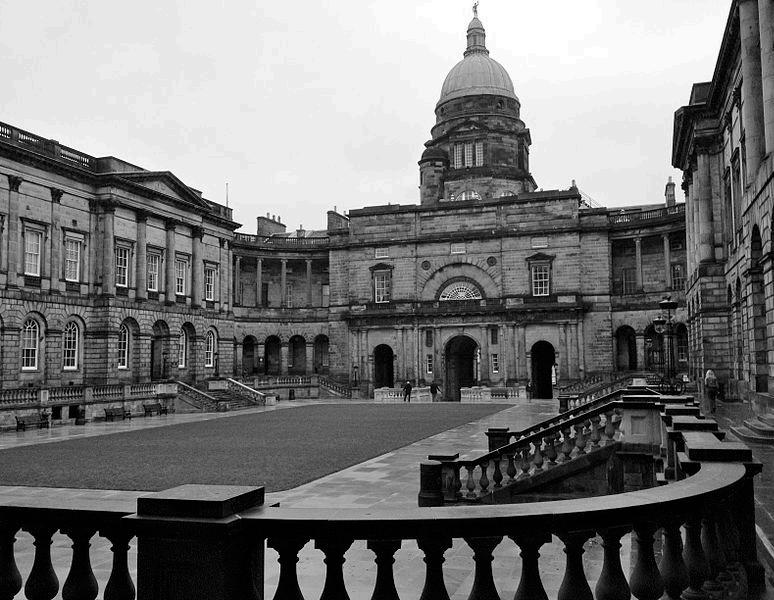
Doctor Sara Parvis University of Edinburgh
TUNNEL VISION: Obsession and Redemption in Works by Shelley and Tolkien
Sandy Fox ‘16
A UNIVERSITY IN THE VINEYARD:
History as Critique of John Henry Newman’s Idea of a University
Aaron Colston ‘14
THE PROBLEM OF GOOD: Is Christianity Necessary?
Nathaniel Schmucker ‘15
THE SCIENCE OF THEOLOGY: Aquinas, Ockham, and the Crisis of Late Scholasticism
Chris Hauser ‘14
BOOK REVIEW: The Neuroscience of Christian Spirituality
Richard Lopez GR
BOOK REVIEW: The Four Loves
Abby Tornburg ‘15
BOOK REVIEW: The Perplexing Problem of Power
Ryan Bouton ‘01
An interview with
DR. SARA PARVIS
Conducted
by
Chris Hauser
Dr. Sara Parvis is a Senior Lecturer in
Divinity School. Beyond the publication of her book, Marcellus of Ancyra and the Lost Years of the Arian Controversy 325-345 include studying the development of orthodoxy and heresy, examining the sources of authority in the early Church, and considering the role of scriptural exegesis in Patristic thought.
The
Church Fathers of Christianity the Rationality &
Who were the church fathers?
Te church fathers are the teachers and theologians (including one or two women) from the period after the New Testament was written to the period when the East and West went their separate ways. People have diferent ways of defning who the last church father is. For example, many of the Orthodox churches include the time of the Byzantine Empire as far as the ffteenth century and have Gregory Palamas as last. In the West, the common defnition is to fnish with Gregory the Great in the sixth century.
Many people today think of religious beliefs as something unintellectual and childish. As someone who studies the church fathers, what do you think of this view?
Te frst thing I would say is that the great faithreason divide did not exist in the ancient world. Te people who were interested in science were also the people who were interested in what we call religion. Tis goes back to Socrates, Plato, and Aristotle—long before the rise of Christianity. Tere essentially was no problem between faith and reason in the ancient world.
I generally do not worry about there being a
problem, for it is a question of how to understand reality. In the ancient world—and this is true of classical writers as well as Christian writers—what is real is actually what we cannot see. For Plato, what were real were the Forms, the imperishable, immaterial things of which the things in this world are perishable copies.
appreciate a Platonic vision of reality that says that what is real it what is not visible?
I think that we are experiencing a hangover in philosophy from the eighteenth and nineteenth centuries. Now, cosmologists and a large number of other scientists spend their time with things that are not real. String theory and many other modern scientifc theories are completely untestable. Likewise, some of the most exciting practices of mathematics use powerful computers and models to deal with things that are unreal. So, the idea that what we cannot see can be real is not as much of a problem now as it was one hundred years ago. I think that this idea will start working its way into more popular thought and philosophy in the years to come.
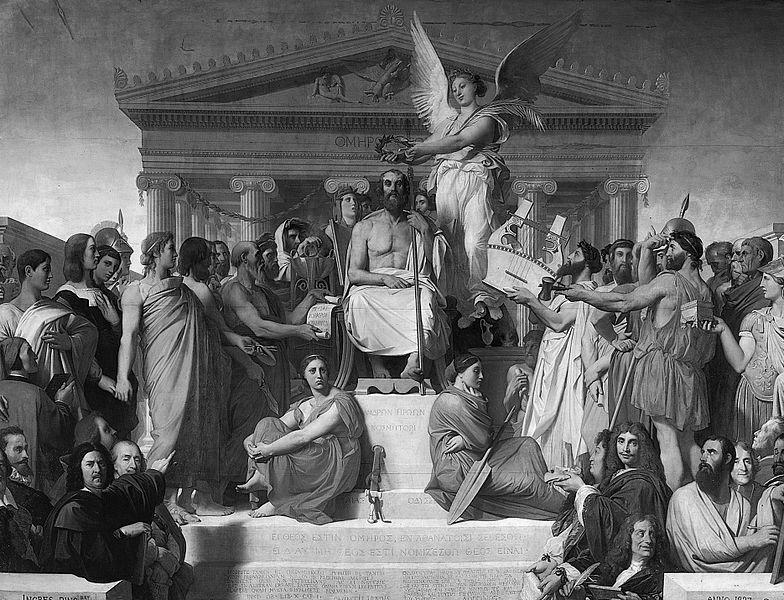
Apotheose Homers by Jean Auguste Dominique Ingres, c. 1827
Where there is a problem, though, is that Christians come across as anti-intellectual by appearing to be uninterested in establishing facts. To be fair to Christians, I think that it is often because they get excited about what they fnd and stop their studies too
Te Christians think that the scientists are being deliberately abstruse and are ignoring the evidence in front of their eyes that creation must be designed. To solve this problem, Christians need to be talking to colleagues on their own intellectual level.
The idea that what we cannot see can be real is not as much of a problem now as it was one hundred years ago.
soon. For example, they discover what cosmologists, astrophysicists, and other scientists largely agree upon—that life looks as if it has been designed with intention. Tey then clap their hands with excitement and stop their argument there, thinking they have proved the existence of God. Te scientists feel that the Christians have not taken full heed of their arguments and do not have a real sense of what they are arguing.
Te media loves to turn these debates into big boxing matches. It loves to pit the people with the strongest opinions against each other, rather than to foster discussion between people who really know what they are talking about. Te people in this second category— on both the Christian and the secular scientist sides— will always express a degree of nuance and a degree of recognition of the complexity of the questions. Te media, though, often does not want to hear the complexity. What it wants to hear is the disagreement, which is more fun and interesting to report.
How do you think we have moved from the position of the church fathers to a position where Christians feel a strong need to try to reconcile their beliefs with what is being done in science?
It would be worth saying that among early Christians there was some nervousness about philosophy. For every theologian like Clement of Alexandria or Origen, who actively wanted to debate the great questions of existence with pagan philosophers, there were many other Christians who were afraid of philosophy. We have anti-philosophical comments from the early Christians, such as Tertullian, who famously said, “What has Athens to do with Jerusalem?” Tis shows that at the very least, people spoke a rhetoric that Christians do not need to and should not engage with the classical philosophy of the day. On the other hand, though, Clement of Alexandria complained that his fellow Christians thought of philosophy as some kind of ogre and ran screaming when they heard it. You can imagine he probably gave some talks that were not well received.
I think one of the big and often ignored subtexts both then and now is the level of education. One of the things early Christianity struggled with but was very good at was bringing together people from diferent levels of education. Tis, in general, was very difcult to do in the greater Roman world. Having a certain level of education was a cultural currency in the ancient world and opened many doors, and people who did
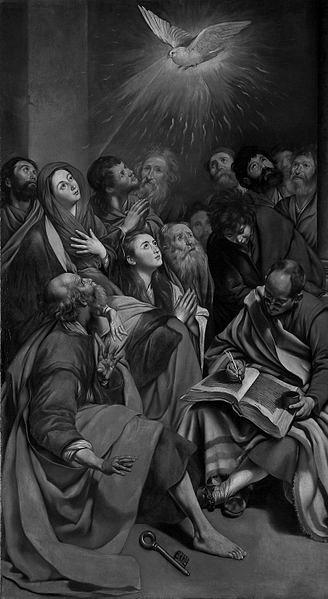
Pentecostes by Juan Bautista Maino, c. 1612-14
not have that education were despised. It seems that ordinary Christians were better educated on the whole than people from equivalent communities, partly because Christianity involved knowing the Scriptures. Tere were also a lot of people who were attracted to Christianity—like slaves or women—who were too intelligent for their situation in life and had capacity and time to study questions of Christian philosophy. In early Christianity some theories of the Holy Spirit said that the Spirit would overcome any education gap and would give you words to speak on the day you were called to defend Christianity. A lot of the attraction of contemporary Pentecostal Christianity comes from the same sense that God can communicate to you via the Holy Spirit directly through the reading of the Scriptures. Consequentially, you do not have to engage in complex forms of scientifc and philosophical discourse. Of course the other side is that some feel very resentful of those who suggest that the Holy Spirit is not enough. Tey fnd it liberating to think “you are just as good as anybody else if God calls on you, if the Holy Spirit talks to you.” When people start suggesting that “No, on this topic you don’t know as much as scientists because you don’t have a PhD,” some people fnd that it takes away what they considered very good news to them, and they fnd that very hurtful. Today, I think there is often an unspoken sense that some scientists are not taking seriously people who come from lower backgrounds than their own and who have not had the same educational opportunities that they have had.
Do you think that part of Christianity’s defensive position on science might come from the Enlightenment? And are we starting to realize that the polarizing opposition of reason and faith was misguided from the beginning?
I would certainly agree with that. I think the Enlightenment was in some ways the teenage-hood
Americans rightly are proud of the role the Enlightenment has played in setting up the United States, its Constitution, and its intellectual ideals, but many people—including scientists and Christians— are now starting to be worried about the autonomous acting subject making its own moral judgments. We see that this might lead to the destruction of the planet and to the destruction of the human race. We can see that there are serious moral reasons why the autonomous acting subject will not work in the future and that we have to return to a collective agreement on things. Religion is asking What would Jesus do? or What does God want? or What are we before eternity? I think
Many people—including scientists and Christians— are now starting to be worried about the autonomous acting subject making its own moral judgments.
of philosophy. Te Enlightenment was a very exciting moment in history for people across Europe—but I think things that might seem self-evidently true at a moment and have a large impact can eventually come to be seen as less than the full story and perhaps even as an obstacle to further knowledge. I think that is what happened to the Enlightenment, especially with regards to the Enlightenment’s elevation of the autonomous acting subject.
these are questions that will become more important and that scientists are going to be the frst ones asking them. Tey might not ask them in religious terms but in terms of What are our obligations to our children, our grandchildren, humanity, and life in general? or What are our obligations to the universe? Scientists and philosophers will ask how we are going to move beyond the autonomous acting subject making its own autonomous moral judgments to some kind of
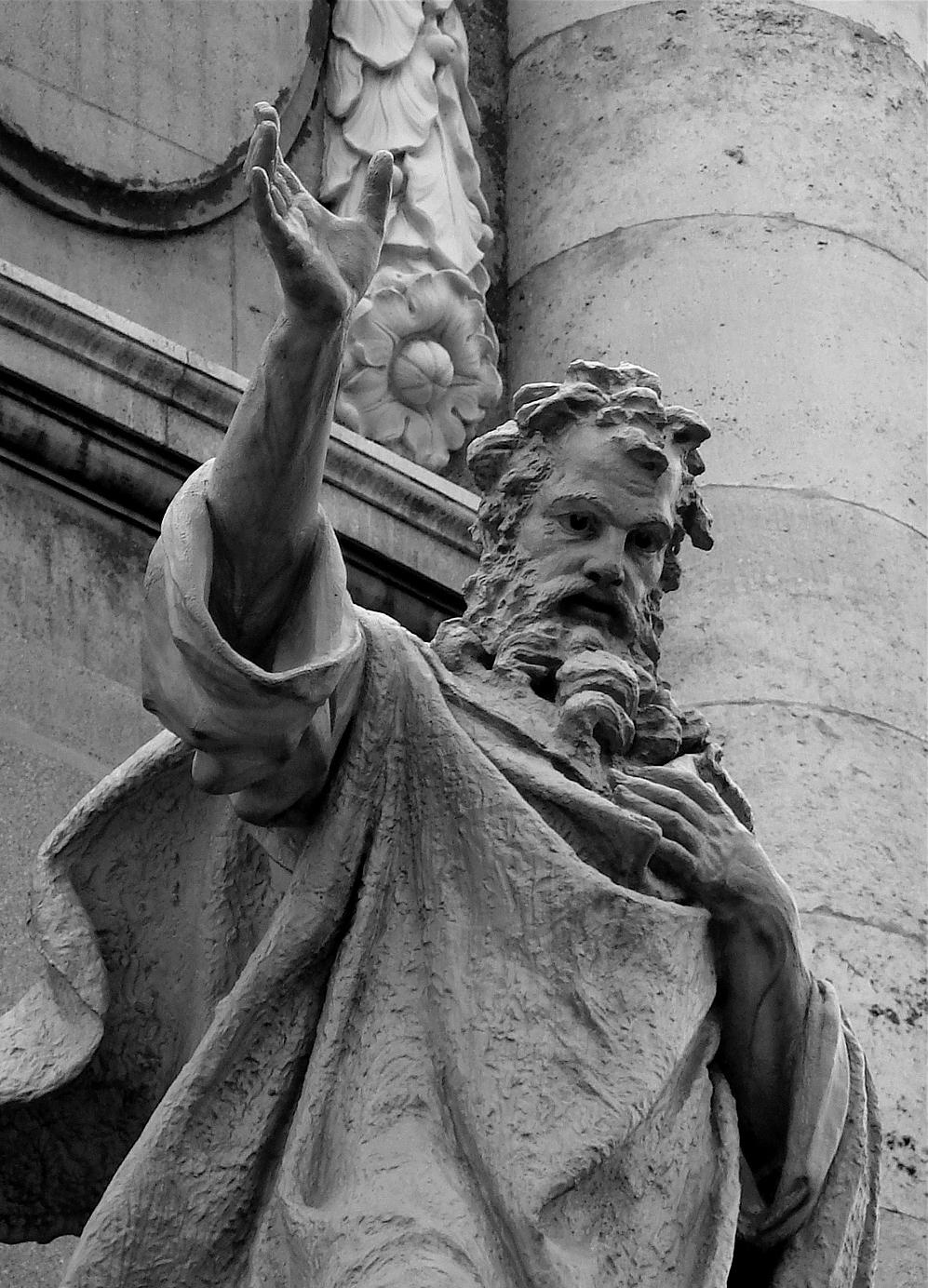
Irenæus af Lyon by Carl Rohl Smith, c. 1883-84
agreement whereby we avoid the dangers of individual moral systems.
How did St. Irenaeus of Leon approach the relationship between faith and reason, Christianity and science?
Irenaeus argued that the supreme God created the universe deliberately. Irenaeus’ diference with his contemporaries—both the Gnostics and some classicists—was whether a god or gods purposefully created the world for good or whether the created world was the byproduct of something happening in the eternal realm. Te Gnostics and many classical philosophers could not expect the supreme being of the universe to be involved in creating, because creating is an unsatisfactory thing to do—the world is too messy. Irenaeus argued that the same God who created the world also sustains it for good. Tat is a huge jump even now, and I think a lot of scientists would fnd it hard to argue. Tey would be reasonably happy to posit an uninvolved First Cause or an uninvolved Gracious Being in the universe, but they are always careful to
distinguish it from the Christian God. Te idea of a God who cares for creation, wants it to fourish, and designed it with the idea that it should fourish is a step beyond that, and I think it is a step that you can only take in faith. Irenaeus, though, thought that it was patent from the world—that you should be able to tell from the world and its beauty that someone who means good for all creation created it.
Te modern scientifc equivalent to Irenaeus’ argument is to say that the universe is well made. Tis
Even though scientists are afraid of being used to justify religion or used to justify a Christian God, they frequently come back to a level of astonishment at creation and the beauty in the world.
is certainly something we say now. Te more people in all branches of science study—especially with computers in the last twenty years—the clearer is has become how wonderfully made the universe is in all its diferent parts. Tis wonder that has come back into science in recent years is something Irenaeus expected us to see in the universe and expected to lead us back to God. I think science does lead us back to God, because even though scientists are very afraid of being used to justify religion or used to justify a Christian God, they frequently come back to a level of astonishment at creation and the beauty in the world.
How did another church father, Justin Martyr, see the relationship between nature and grace, faith and reason?
Justin Martyr is an absolutely fascinating character. In some ways he is the person who brought Christianity in the second century out of darkness into light. He became a leader of the persecuted community. He was prepared to write to the Emperor to say that what he was doing was wrong, for the Emperor was putting Christians to death because they were Christians, rather than for any actual crimes they had committed. It did not make legal sense—you would not treat burglars the same way, pardoning them if they said, “I was a burglar but I’m not anymore.” Neither did it make philosophical sense, for it is not just. Te emperor called himself just—disposed toward doing the right thing—and pious—acting with a sense of morality—yet what he was doing was not worthy of the philosophers. So, Justin Martyr tried to engage his peers on their own terms as philosophers.
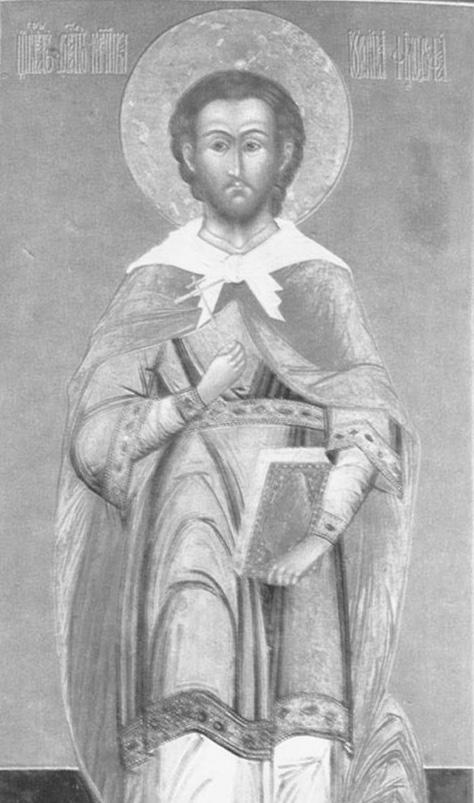
Icon of Justin Martyr, author unknown, c. 2012
Justin’s chief idea as it emerges from his apologies to the Emperor is that the Word of God, the Logos, the Christ, is the rational principle that gives order to the universe. Plato has something similar, but he calls that which gives structure and order to the universe the Light rather than the Logos. We also have this idea in pre-Christian Jewish philosophy with
provincial governors saying, “Do you believe in the most high god?” to which a Christian could say, “Yes.” Te governor could legally pardon the Christian, and the Christian did not have to compromise his beliefs. One core of these creedal confessions is confessing Jesus Christ and the historical details surrounding his life and death. Te early Christians said that “Jesus was
Creeds are intended to be simple and intended to be for everyone.
Philo of Alexandria, who saw the Word of God as a diferentiable entity from God. Te only other place we fnd this idea before Justin is in the prologue to John’s gospel, which takes Philo’s Word of God and says the Word of God has been made incarnate among us. Justin uses this terminology, but otherwise he expresses a very Platonic view that all knowledge comes from the One who makes the world intelligible. All knowledge comes from the organizing principle of the world, which is the Word of God, which is the Logos, who is Christ, the Son of God.
For Justin, that meant Socrates had access to real truth because the Word of God sows the seeds of knowledge in people everywhere, and all that prevents them from reaching the truth—from reaching God—is demons. Justin was quite the demonologist; he picked up a lot of Jewish Old Testament demonology. For him, there exists a fght between the demons, who try to confuse the truth, and the Logos, which reveals the truth. Some people like Socrates get close to the truth are persecuted for that by the demons, but Christians have access to the full truth through Jesus Christ.
Many people today think that creeds or statements of doctrines of the early church are too
cated. Can you help us understand why they are sophisticated?
One thing I want to say about creeds is that they are intended to be simple and intended to be for everyone. Te early Christians had to think about and crystalize their beliefs more than most people, since they were constantly defending themselves in the dock. Tey needed clear answers regarding what they believed about Christ. Tey had to have thought very carefully about what they were prepared to confess to and what they were not.
An amusing syndrome developed where governors tried to acquit Christians because they did not want to put them to death, they did not want to give Christians publicity as martyrs, or they felt that the system was unjust. So, governors began to try to fnd formulae to which Christians could confess but which did not require a guilty verdict. We have examples of
crucifed under Pontius Pilate,” which was a historical detail. Tey quickly started to add other historical details, including the birth form the Holy Spirit and Mary, the death, the resurrection, and so on. To that they added the great commandment, “Go and make disciples of all nations baptizing them in the name of the Father and of the Son and of the Holy Spirit.” Tis became the mark of being a Christian.
Te question then became what these statements meant. Tis is what we see Irenaeus discussing—What does it mean to have the Father? Irenaeus argues that having the Father means that you believe the Almighty God is everything that is and that God is the Father who loves and cares for us. Already, we have specifc statements describing God, the Father Almighty. Tey then moved to Jesus Christ—and this is what
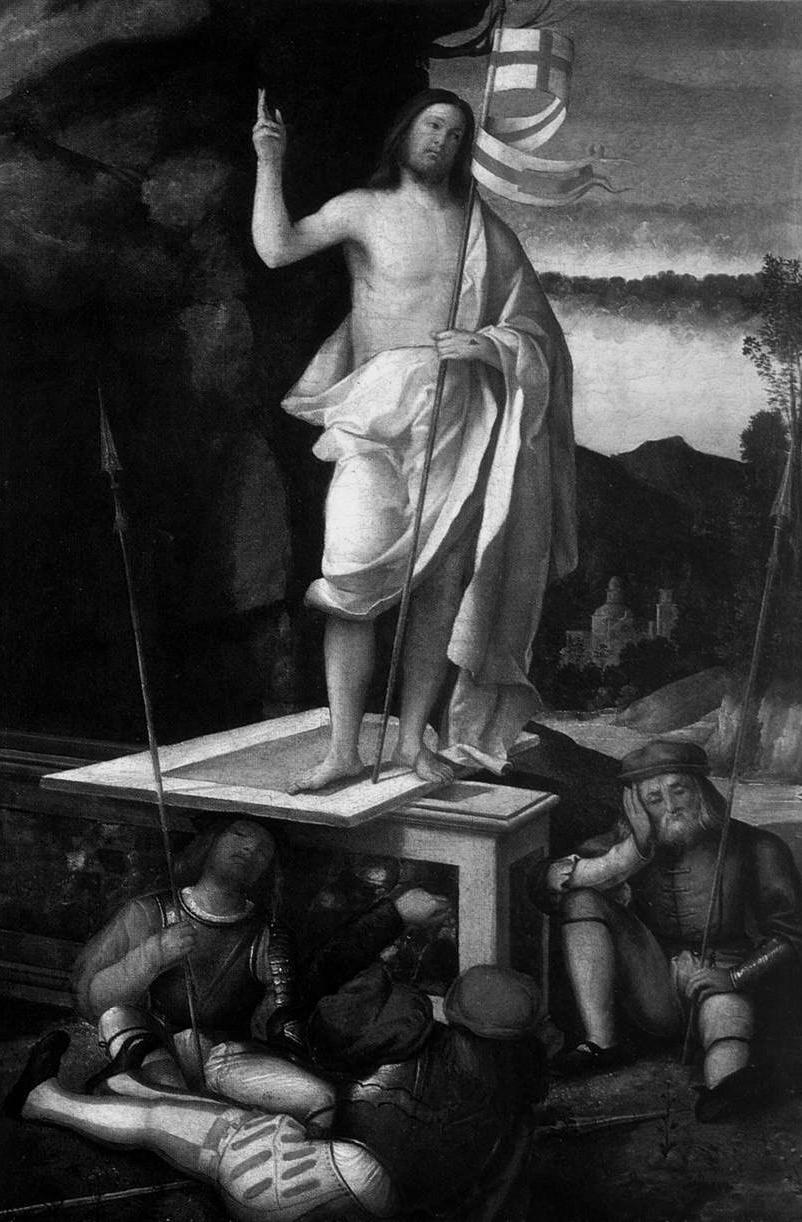
Resurrection of Christ by Marco Basaiti, c. 1520
the Nicene debates were about—wondering if they should say he is God as the Father is God or that he is a created thing like us. Te decision they came to was that he is God. Athanasius argued that it would not be possible for someone who was not God to save us. Tey then looked at the Holy Spirit, asking if it were possible for the Spirit to sanctify people if he were not truly God. Tus we see the origin of many debates. Te conclusions of these debates were crystallized in the creeds, in a form that was meant to accessible by all and readily intelligible.
We still see behind the creeds, though, the sophistication of the prior philosophical debates over
Tis sparked many debates about what it meant for Jesus to have the form of God and the form of a servant, whether this meant he had two natures, how those natures related to each other, and what it meant to say that Jesus humbled himself. Although people used philosophy to make sense of that, they did so because they were debating very central Christian tenants about the content of Christianity—what it means to be saved and how we are meant to relate to Jesus.
In closing, I want to include something about history and the importance of not throwing away everything from the past. Te creeds preserve for us the
Having a strong historical sense of where Christianity is coming from is our best defense against the ahistorical decision that we can throw everything out and start again.
how to interpret and understand Scripture. One of the most important debates of all, about the nature of Christ, comes from a famous passage in Philippians 2.
“Tough he [Jesus] was in the form of God, did not count equality with God a thing to be grasped, but emptied himself, by taking the form of a servant, being born in the likeness of men. And being found in human form, he humbled himself by becoming obedient to the point of death, even death on a cross. Terefore God has highly exalted him and bestowed on him the name that is above every name, so that at the name of Jesus every knee should bow, in heaven and on earth and under the earth, and every tongue confess that Jesus Christ is Lord, to the glory of God the Father.” i
great historical debates of Christianity. Teir content has been the faith of the church for 1500 years, and they are something we should think through in every age. Having a strong historical sense of where Christianity is coming from and the diferent forms it has taken throughout the ages is our best defense against the ahistorical decision that we can throw everything out and start again. Every age tries to throw out church history—it inevitably lives in its own ideology and has a hard time moving beyond it. I think historical creeds are Christianity’s best defense against a blackout sense of history.
i. Phillipians 2: 6-11 (ESV).
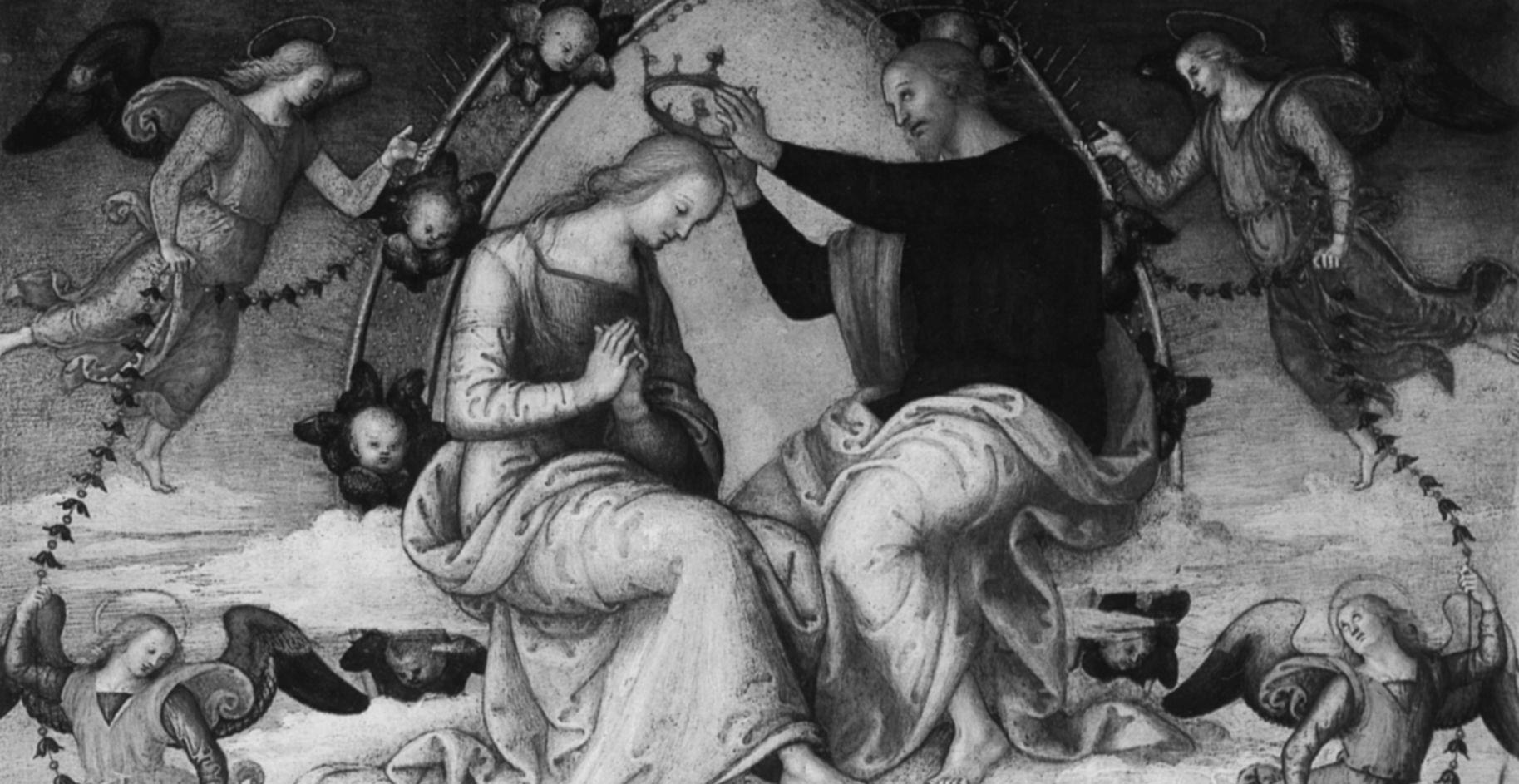
Pala di San Francesco al Monte (Incoronazione della Vergine) by Pietro Perugino, c. 1504
TUNNELVISION
Obsession and Redemption in Works by Shelley and Tolkien
by Sandy Fox
In her most famous novel, FRANKENSTEIN; OR, Te Modern Prometheus, Mary Shelley imagines the voice of the doctor whose ambition and surgical skill drive him beyond medical research and into the realm of creation:
I appeared rather like one doomed by slavery to toil in the mines . . . than an artist occupied by his favourite employment. . . . I became nervous to a most painful degree; the fall of a leaf startled me, and I shunned my fellowcreatures as if I had been guilty of a crime.i
Since 1818, readers have sympathized with the ambition of “artist” Dr. Victor Frankenstein while recognizing that “his favourite employment,” designing a creature of his own, spirals into an obsession and costs the lives of those closest to him.ii Well over a century later in 1945, J. R. R. Tolkien wrote of an artist with a diferent obsession in “Leaf by Niggle.” On the surface, “Leaf by Niggle” seems a trivial story: it concerns not murder and vengeance but rather “a very ordinary and rather silly little man” who gets hardly a peaceful
moment to devote to his life’s work, a mural of a giant tree.iii A paintbrush can hardly do the damage of a scalpel, but Niggle, too, risks elements of his humanity towards his “fellow-creatures.” Each character is ambitious, and each character’s ambition feeds his pride, misdirecting his talent, narrowing his vision to target a single selfsh goal, and numbing his concern for how his actions afect others. Each takes a journey leading towards the resolution of his obsession, but in the end, only Niggle is saved. To fnd where their paths split, one must start with the vice that motivates them. Anyone looking for the source of Frankenstein’s pride would do well to read his diary. He refects on his childhood, saying, “I believed myself destined for some great enterprise. I deemed it criminal to throw away . . . those talents that might be useful to my fellow-creatures.”iv It is hardly a crime to be self-aware; Frankenstein, after all, grew up as one of the brightest students in Geneva and soon won recognition for his contributions to science. Nevertheless, his great mind, weaned on ambition, yearns for more once the doctor realizes the true scope of the scientifc feld. Fran-
kenstein itches to exercise his superior intellect in the name of human advancement. Possessed by pride, he sets of on his own to conceive a brainchild that will in some unspecifed way help others and in a far more defnite way glorify the brain behind it.
Many would expect such a genius to be proud— Frankenstein is accomplishing wonders, after all—but what of an unknown painter? Niggle leads a simple life among simple people content with their chores and cottages and market runs, but he wants something more. “He was the sort of painter who can paint leaves better than trees,” writes Tolkien. “He used to spend a long time on a single leaf, trying to catch its shape, and its sheen, and the glistening of dewdrops on its
than on others. Tis town knows as well as any that stinginess with time is the hallmark of self-absorption.
Frankenstein, too, allows his project to consume attention that should belong to others. “My eyes were insensible to the charms of nature,” he writes later about the onset of his obsession. “Te same feelings which made me neglect the scenes around me caused me also to forget those friends who were so many miles absent.”vii In his youth, even in his busiest years of study, the doctor did not neglect his love for nature or forget his devoted family. As the project grows and demands more of his time, however, it reduces him to a shadow of his former self. Soon Frankenstein is at the mercy of his ambition, channeling his energies
Possessed by pride, Frankenstein sets off on his own to brain behind it.
edges. Yet he wanted to paint a whole tree, with all of its leaves in the same style, and all of them diferent.”v Like Frankenstein, Niggle does not broadcast his project, but unlike the doctor, Niggle is not waiting for a fnal reveal. His is an introspective pride, and he can do without external confrmation if he could just get this one painting right. Niggle “took a great deal of pains with leaves, just for their own sake. But he never thought that that made him important.”vi Perhaps he does not think himself important, but he certainly feels entitled to spend his time on the mural rather
into one creation while ignoring the other—made up of human beings and the earth they inhabit—that he used to love above all else.
Perhaps Niggle once loved people, too. We only know that he starts of the story alone and as a bit of a crab, with “the sort of kind heart . . . [that] made him uncomfortable more often than it made him do anything; and even when he did anything, it did not prevent him from grumbling.”viii For the most part, he works like the other industrious villagers without complaint, but soon he becomes a recluse, hoarding
Te Swiss Alps in Gossau by Monamona8, c. 2012
his time for the mural and becoming reluctant to help those in need. Neighbors who come to the door are met by a man who is “thinking all the time about his big canvas, in the tall shed that had been built for it out in his garden (on a plot where once he had grown potatoes).”ix In a village of contributing citizens, Niggle is known for being the one who stands on a ladder not in the garden but before the living room wall, and for being the one who uses canvas and paint for art instead of house repair. As he becomes more and more possessive of his painting, he looks upon guests as intruders robbing him of time he must devote to the only thing that matters.
More important than Niggle’s civic and neighborly duties is “the journey.” Everyone prepares for this journey, though they do not decide when to leave; rather, someone comes to pick up the traveler, and he or she should have packed their belongings by then. Niggle, of course, procrastinates: “Now and again, he remembered his journey, and began to pack a few things in an inefectual way: at such times he did not paint very much.”x Preparation for the journey counts as no more than another interruption of the ultimate task, the completion of the mural. He would much rather concentrate on how to shape his surroundings to conform to his individual vision. Te journey is abstract, distant, and compliant with a will outside of his own. Tat Niggle ignores the journey proves his obsession is, in some ways, as rooted as Frankenstein’s; yet the respective obsessions of Niggle and Frankenstein difer in a key way.
Frankenstein’s pride in his own brilliance spurs him to create something out of nothing. No longer satisfed with his place in the universe as a partaker of creation,
no one should try at all. His project failed not because of faulty methodology or empirical imprecision, but because of egocentric motives. No one should play creator out of self-absorption or discontent with the state of the world.
Niggle, on the other hand, does not create for the sake of self-glorifcation but paints for the sake of creation. Unfortunately, he goes about it the wrong way, obsessing about how he can capture the essence
The Tree embodies what Niggle tried so desperately to capture, and instead of rekindling pride in the painter’s imagination, it inspires admiration for the giver.
he seeks to become a creator himself and stand on the same plane as the Creator of the Universe—in the Christian worldview, God Himself. Frankenstein appears to succeed in his attempt at self-deifcation, animating a creature that begins life as benign and fercely intelligent. But the monster that teaches itself to read in three languages and quotes Paradise Lost soon turns vengeful from lack of love, taking the lives of several innocent people and leading his maker into the Arctic for a fnal standof. Te fact that Frankenstein dies before he can destroy the monster emphasizes the futility of his ambition: the lesson is not that he or another should try again and avoid the same mistakes, but that
of a leaf and placing great pride on his ability to do so. Still, he only wants to mirror the creation he sees. Tough he becomes wrongly possessive of his replica, Niggle’s fxation refects admiration for nature’s beauty. Consumed by a prideful desire for perfection, he does not manage to fnish his tribute before he is whisked away on his journey. Luggage-less and pining after his mural, he boards a train and travels through a tunnel to a place where he is sentenced to centuries of menial labor (much like Frankenstein’s years spent fguratively “doomed by slavery to toil in the mines”).xi At last Niggle faces judgment by a jury of disembodied voices. One merciful voice defends him, noting
Among the Bernese Alps by Albert Bierstadt, date unknown
how the artist grudgingly helped his neighbors when he wanted nothing more than to paint. Te jury rules to release him, and Niggle walks into a beautiful feld where he fnds “the Tree, his Tree, fnished. If you could say that of a Tree that was alive, its leaves opening, its branches growing and bending in the wind that Niggle had so often felt or guessed, and had so often failed to catch.”xii He is humbled by the Tree, a living creature he could never have created. Indeed, he fell short of imitating it in two dimensions. Te Tree embodies what he tried so desperately to capture, and instead of rekindling pride in the painter’s imagination, it inspires admiration for the giver. As he wonders at its beauty Niggle exclaims of the Tree, “It’s a gift!”xiii Tough he could neither acknowledge his own imperfections nor recognize a greater Creator without some sort of latent humility, Niggle has not earned this gift. He is saved because he knew at heart he was not creating for himself. Te Bible abounds with references to God’s forgiving spirit, such as this excerpt from Titus: “He saved us, not because of righteous things we had done, but because of his mercy.”xiv Niggle knows his life does not merit redemption, but he accepts the gift through grace, knowing it will bloom in ways he could not have foreseen.
When we fnd in “Leaf by Niggle” that acceptance is the key to salvation, we realize that there is some hope for Frankenstein. In his last days of life, ravaged by sickness but still seeking the destruction of the monster, he feels his mind returning to the scenes of nature he once adored. An explorer who takes Frankenstein aboard his vessel observes of the ailing man, “Even broken in spirit as he is, no one can feel more deeply than he does the beauties of nature. Te starry
Perhaps a man so far gone down the tunnel of obsession, so eager to meet death and fnd an end to his sufering and guilt, might not see the remedy to his former pride. But perhaps this fnal thought means he has found something of the creator in the starry night sky.
i. Mary Shelley, Frankenstein (London: Collins, 2010) 44.
ii. Shelley, 44
iii. J. R. R. Tolkien, “Leaf by Niggle,” Te Tolkien Reader (New York: Ballantine, 1966). 100-120) 102.
iv. Shelley, 189.
v. Tolkien, 100-101.
vi. Tolkien,110.
vii. Shelley, 43.
viii. Tolkien, 100.
ix. Tolkien, 101.
x. Tolkien, 100.
xi. Shelley, 44.
xii. Tolkien, 113.
xiii. Tolkien, 113.
xiv. Titus 3:5 (NIV).
xv. Shelley, 18.
Sandy Fox ’16 is from Washington, D.C. She is a Linguistics modifed with German major.
sky, the sea, and every sight aforded by these wonderful regions, seem still to have the power of elevating his soul from earth.”xv
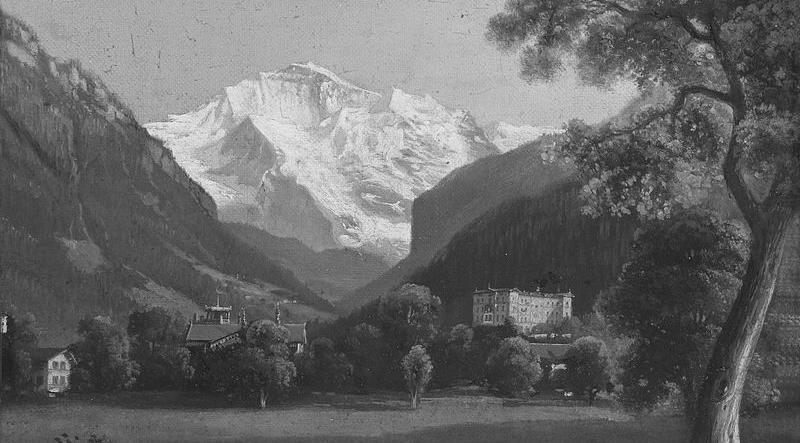
Jungfrau by Hubert Sattler, c. 1904
A UNIVERSITY IN THE VINEYARD
History as Critique of John Henry Newman’s Idea of a University
In the year 1851, John Henry Newman, an Englishman by birth, an Anglican by baptism, and an Oxford graduate by education, found himself a university president—in Dublin, Ireland, no less.
Before Newman’s appointment, the Irish Catholic fock did not have their own university, and the thinker himself did not yet have his great work, the Idea of a University. In Colin Barr’s observation, Newman’s Idea of a University: Defned and Illustrated in Nine Discourses Delivered to the Catholics of Dublin has been foundational to the rhetoric of higher education in the English-speaking world, but its success is in spite of Newman’s time as president, not because of it. Barr chooses not to involve Newman’s Idea in his analysis of the university’s failure perhaps because, as he argues convincingly, the overwhelming majority of the failure had hardly anything to do with Newman anyway: the renowned thinker, educator, Catholic convert, and master of nineteenth-century English prose was surrounded by unfavorable social conditions, which were problems out of his hands.i Even if Newman’s Idea did
by Aaron Colston
not cause the failure of the university, the university’s history certainly criticizes his Idea. Simply put, the university’s history responds to Newman by demonstrating that, although a university is an idea, it is an idea which functions to solve a problem in society— not a problem outside society—and is, therefore, constrained by this societal context. For a secular institution like Dartmouth, accomplishing educational goals in a social context is, of course, easier said than done. For a Christian institution like Newman’s Catholic University of Ireland, however, the stakes are heightened even more by the attempt to not only execute a university’s problem-solving design—contextual tension included—but also respond authentically to the Gospel.
Despite his personal faith and rectorship of a Christian university, Newman argued in a series of lectures (which eventually became the Idea of a University) that a broadened intellect, educated in the liberal arts, does not guarantee a more moral or religious person. Instead, he believed that higher education’s ability
to form the intellect, before it was “useful,” was good and beautiful in itself. In his mind, a university uses liberal arts to teach people how to build their intellects, not machines or careers. While the focus on “the intellect” may seem self-centered, Newman’s thought is not exactly confned to the individual, since he also proposed that by training the intellect, a liberal arts education prepares students for going into their respective posts in society. Terefore, attention to the intellect— and the intrinsic beauty of knowledge which invites
the English Crown as a way to provide higher education to students who were unlikely to register at Trinity College Dublin because of its ties to the Anglican faith. Te Crown thought that ofering a secular education at the Queen’s Colleges would accommodate Presbyterian and Catholic students. Te idea was controversial to say the least: all but two of the Irish Catholic bishops called the idea “godless.” Within the next year, the bishops endeavored to form a Catholic university in place of the ones ofered to their fock by the Crown. Soon after their endeavor began, Paul Cullen, a clerical agent for the Irish bishops in Rome, wrote to a colleague that with a university, “religion will be saved in Ireland.” Cullen was made the bishop of Dublin in 1849, and, hoping to bring “name and fame to the good work,” approached Newman in the summer of 1851 with the idea that Newman should be rector of the university.iii
As it turned out, Newman’s fame was one of many issues that arose as the university slowly lowered its sails: a nationalist strain in the episcopacy raised concerns over Newman’s Englishness—an issue which Newman did not help to defect because he insisted that his fellow converts from Oxford played a role in his administration. Meanwhile, Cullen managed to isolate the other bishops from making major decisions in the university’s administration (Cullen did not have much of a choice, seeing how the bishops could hardly agree on anything). Tis caused the other bishops to lose interest, which made it difcult, and then impossible, to raise funds. Not only that, but there were not enough secondary schools from which the university could
What is so compelling about Newman’s analysis is that it all sounds very simple: teach a segment of the population how to think, and they will go on to improve the way the world thinks.
it—is intimately tied to “cultivating the public mind,” as he called it.ii Aside from the elevation of knowledge as beautiful, what is so compelling about Newman’s analysis is that it all sounds very simple: teach a segment of the population how to think, and they will go on to improve the way the world thinks. Te problem with Newman’s analysis, however, is its assumption that a liberal arts college or university will be in perfect relationship with the outside world. Te history of Newman’s university shows that this is not always the case.
Te Catholic University of Ireland (CUI) was developed out of a particular moment in the long tensions between the peoples of Ireland and England. In the year 1844, this tension manifested over the “Queen’s Colleges.” Tese colleges were proposed by
draw its students, and what students were available had little incentive to support the project; because the CUI did not seek a charter from the Crown, it could only bestow to its undergraduates bachelor degrees issued by the Vatican. Tese degrees were less than desirable for an ambitious student who could have gotten virtually the same classical education from the Queen’s Colleges and earned a civil degree, which was more likely to lead to gainful employment. It turned out that, beginning from Newman’s appointment in 1851, the university register was on the decline, and classes were not to begin until 1854. Te overarching irony of the university’s struggle against “godless” secular education, as the bishops called it, was that the most successful part of the university was the medical school, which ofered civil professional degrees, but not enough to keep the
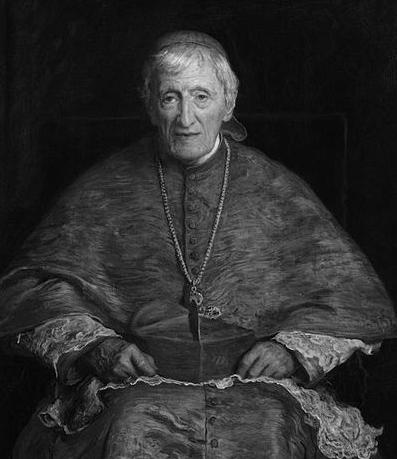
John Henry Newman by Sir John Everett Millais, before 1896
university functioning. So when Newman began his lectures in 1852, preaching the beauty of liberal education for its own sake, the institution that professed to provide that education barely kept afoat. Newman eventually left the rectorship in 1858, and although 1861 saw a short reemergence, beginning in 1883— fve years after Cullen died—the Jesuits oversaw the university until it eventually became incorporated into the National University of Ireland, and is now University College Dublin.iv
Tis confict between the purpose of the university as Newman imagined it and as it actually functioned begs stepping back a little. Not only did Newman assume the world and the school would be in harmony, which was not the case in his time, but Newman also seemed to think that the university and the world were independent entities. On the one hand, a strong distinction between educational institutions and society feels right: after all, universities and colleges act and even look diferent than the towns and cities that surround them. In a word, a college can form a “bubble,” a type of cultural shield from the rest of the world. And so the world and the college, it seems, must be diferent things. Even though Newman supported liberal arts education for its own sake, he also managed to undercut its educational purity, its ability to be “for its own sake.” By stating—even if indirectly—that college prepares students for places in society, Newman still hints that something is there in the midst of those years in school which leads the student back to society. It is this implied origin and destination of the student— not to mention a university’s complicated relationship with government and economy—which suggests that the line between a university and the outside world is more or less an illusion. What further critiques Newman’s “education for its own sake” is that, broadly speaking, educational institutions are rarely conducted without some tension, strife or problem to solve—for instance, from the very beginning the bishops of Ireland conceived the Catholic University of Ireland in order to rectify a perceived social problem (a lack of their own version of higher education) with religious consequences (perpetuating their faith). Te point here is not to reject, but to modify, Newman’s claims. He was right in saying that a liberal arts education is beautiful but not in saying “beautiful in itself:” so long as a liberal arts education “takes place” in a university, it becomes entangled in the particular legacy and missions of that institution. In other words, its beauty is the role it takes through the university, and therefore in the drama of society—not as an outsider.
But where does this leave a Christian university? Newman says that a university cultivates the public mind: to play with his phrase, a Christian univer-
sity cultivates the public mind and the “public soul.” Whether or not the CUI failed or succeeded in this requires an extensive investigation of Irish religious history in order to better arrive at what Ireland’s “public soul” was in the days of the university’s beginnings. Sufce it to say, however, that the lesson of the CUI is that—toeing the cliché—a Christian university is made to solve a problem in the world like any other university, yet, unlike any other university, it is not “of” the world. Tis “otherworldliness,” regardless of denomination, stems from the thought that belief in Christ (or lack thereof) is in fact a problem in the world, not merely a religious or even intellectual problem. Te knowledge such a university transmits in a liberal arts or professional curriculum, or the knowledge it creates in research, will inevitably be tangled in the afairs of a society still grappling to live out and understand the event of Christ’s coming into the world. A Christian university never transmits a “pure” curriculum or conducts “pure” research because the whole point of the institution is to be working in the vineyard. Insisting on this illusory purity would make as little sense as keeping the plow out of the soil.
i. Colin Barr, “Te Failure of the Catholic University of Ireland,” Te Failure of Newman’s Catholic University of Ireland (Archivium Hibernicum, 2001, 55) 126.
ii. John Henry Newman, Te Idea of a University defned and Illustrated In Nine Discourses Delivered to the Catholics of Dublin, Project Gutenberg, http://www.gutenberg.org/fles/24526/24526-pdf, 206
iii. Barr, 127-130.
iv. Barr, 128, 131-39.
Aaron Colston ’14 is from Inglewood, CA. He is a Senior Fellow.
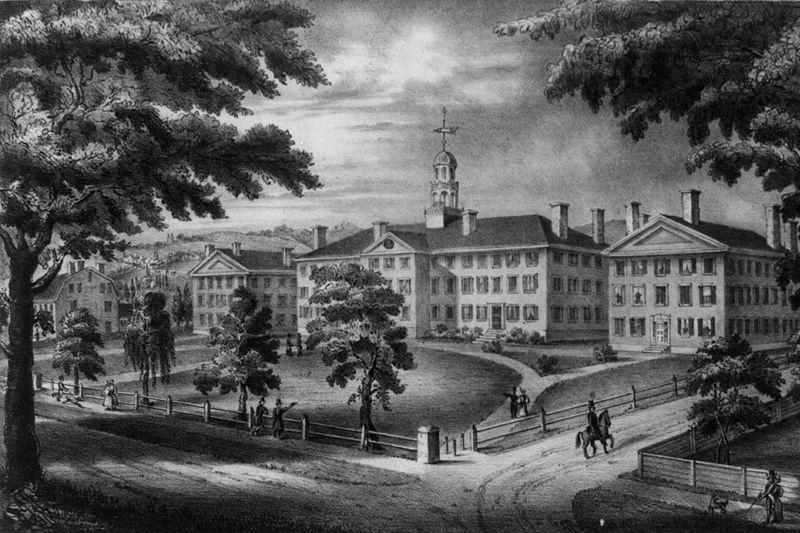
View of Dartmouth College, author unknown, c. 1834
Good
The Problem of Is Christianity Necessary?
by Nathaniel Schmucker
Many are familiar with the so-called Problem of Evil. For ages, mankind has observed evil things that happen in this world—hurricanes fooding coastal cities, tornadoes destroying innocent towns, gunmen massacring schoolchildren, bombers turning heroic marathons into national tragedies—and people have asked themselves whether God is really good or if he exists at all. Christian scholars have developed clear responses to the Problem of Evil and have shown that earthly evil is not inconsistent with the concept of a good God.i
Tis essay, however, does not repeat those arguments but instead considers a parallel question, the Problem of Good. Just as people have taken the presence of evil as a reason to question the validity of Christianity, so also people have seen the presence of good as inconsistent with Christianity’s message. Te skeptic asks: Why do non-Christians do good deeds? Why do they prosper, succeed, and at times act morally superior to their Christian neighbors? Is Christianity really necessary for good behavior? Similarly, many ask: Don’t all good people go to heaven? If I can be good and can go to heaven without the nuisance of attending church, praying, and paying tithes, why am I told that I must obey Christian dogma?
For the skeptic to ask these questions is reasonable, for it is undeniable that people can be good without the Christian God. We need look no further than the example given by Mahatma Gandhi, one of the most famous Hindus, who led a large, non-violent campaign for freedom and civil rights in India. Gandhi sufered persecution from the government and spent many months in prison, but he never abandoned his creed of non-violence and truthfulness. His actions brought lasting change to Indian politics and inspired many others to follow his example of peaceful protest.
Similarly, it is undeniable that professing Christians are not always as good as their neighbors and that atrocities have been committed in the name of Christianity. On the broadest scale, Christians have launched wars, crusades, and inquisitions to spread their message. On a smaller scale, churches have sparked disputes in their communities. Individual Christians at times lie, cheat, steal, act selfshly, and grow angry over petty issues.
Tus, one might come to the conclusion that people can be good without Christianity and that Christianity is a failed moral system. If the old adage, “Good people go to heaven; bad people go to hell” holds true, then the logical conclusion is that we can enter heaven
without having to take on the label “Christian.” Te doctrines, catechisms, dogmas, practices, and traditions of Christianity seem superfuous, and life would be much simpler if people abandoned Christianity altogether to seek an easier alternative to moral behavior and eternal life.
Christianity throughout the ages has rejected this line of thinking as a misunderstanding. Unfortunately, this misunderstood version of Christianity has become increasingly common in contemporary America with the rise of what sociologists Christian Smith and Me-
ish, faithless, heartless, ruthless.” iv Christians believe that God’s common grace prevents people from acting with such evil all of the time. Even if the skeptic does not believe the sinful state of human nature described by Paul, to think that people could easily be much worse than they presently are is no stretch of the imagination.
Te third aspect of common grace, which is closely paired with the second, is that all people can pursue the good. If the second aspect is ‘negative’ in that God restrains evil, this third is ‘positive’ in that God en-
Biblical Christianity…is a religion whose foundation is about identity rather than about thought, emotion, or action.
linda Lundquist Denton call Moralistic Terapeutic Deism. As we shall see, biblical Christianity, as opposed to its Moralistic Terapeutic Deist counterpart, is a religion whose foundation is about identity rather than thought, emotion, or action.
Christianity Afrms the Skeptic’s Initial Questions
Christianity readily afrms that non-Christians can do good works and that Christians sometimes sin egregiously. Te Christian explanation of why the secular world prospers is part of the doctrine of common grace. God’s common grace is an unmerited blessing that he bestows on all people, whether Christian, Muslim, Hindu, atheist, or agnostic. Tis grace has three functions: it gives blessings, it restrains evil in the world, and it enables all people to do good. ii
In its frst sense, common grace means that God gives life, joy, success, talents, and other blessings to all people. Christianity holds that God created and actively sustains the entire universe and that thus it is only natural that God bestows relationships, love, capacity for education, prosperity, and other gifts to the Christian and the non-Christian alike. As the book of Matthew says, God “makes his sun rise on the evil and on the good, and sends rain on the just and on the unjust.”iii It is God who causes the rain to fall on the felds of both the Christian and the non-Christian farmer. Although specifc gifts and blessings may difer in magnitude from person to person, by no means are they limited to only Christians.
Secondly, common grace restrains sin in people. In his letter to the Romans, the Apostle Paul says that all people have a “debased mind to do what ought not to be done. Tey were flled with all manner of unrighteousness, evil, covetousness, malice. Tey are full of envy, murder, strife, deceit, maliciousness. Tey are gossips, slanderers, haters of God, insolent, haughty, boastful, inventors of evil, disobedient to parents, fool-
ables all people to do good things. A non-Christian policeman is just as capable as a Christian policeman of giving his life to protect his city, and all children, regardless of religion, could share their lunches with a classmate who forgot hers. Goodness is not reserved for Christians alone. Common grace, then, provides the basis for the Christian understanding of why nonChristians do good deeds and prosper.
Consider next the question of why Christians sin. Te Christian explanation for why believers sometimes
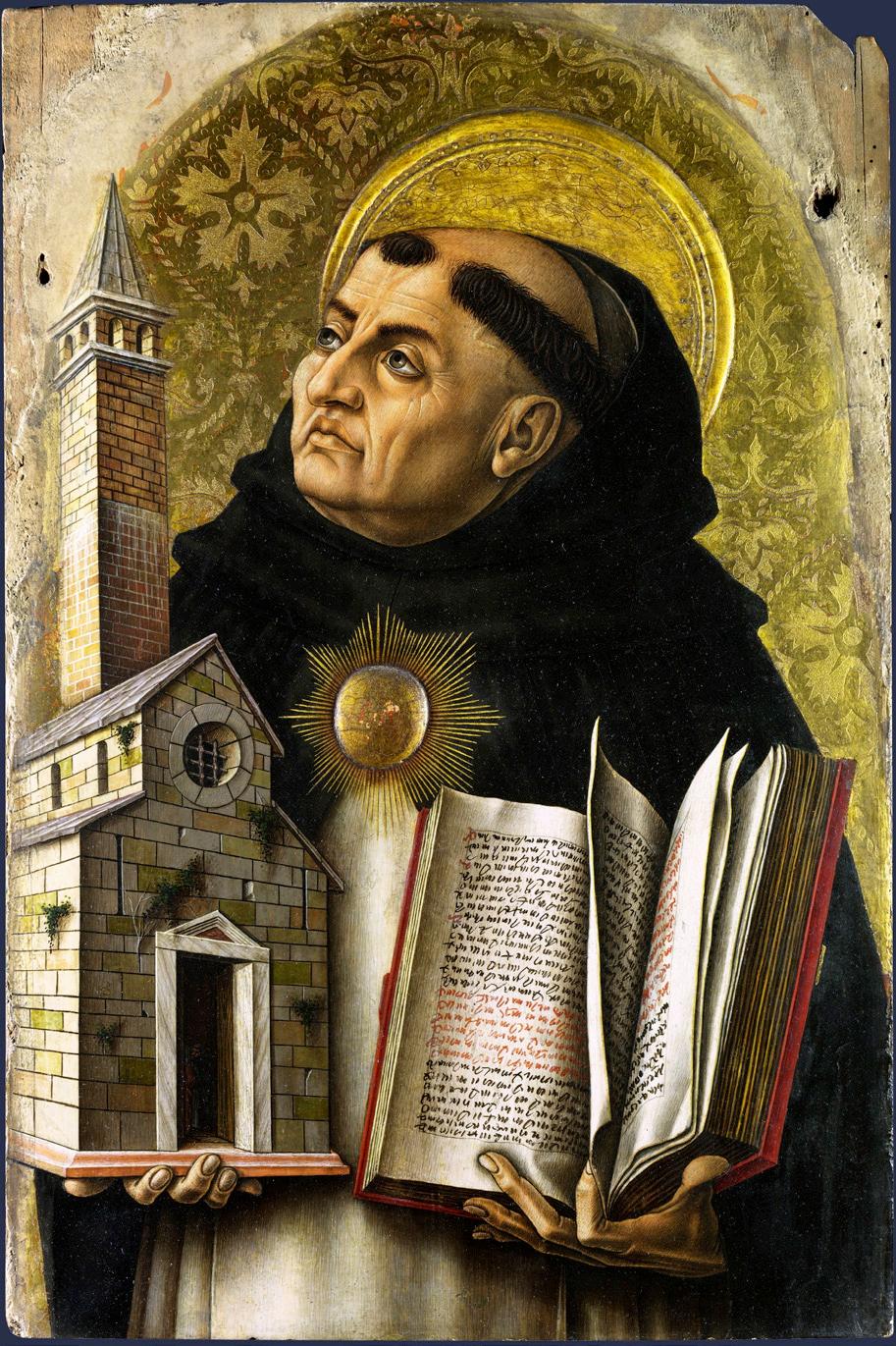
Saint Tomas Aquinas by Carlo Crivelli, c. 1450
Te
of man changes such that he is posse non peccare—able not to sin. Although Christians are no longer slaves of sin living under its inescapable spell and although they are freed to pursue righteousness, they are not above the infuence of sin.vii Te Christian does not always act morally, nor is he expected to always do so. Tis state of man does not excuse immoral behavior, but sufces to show that Christianity does not bestow moral perfection.
Doing good deeds without being a Christian is possible, and becoming a Christian does not cause people to cease sinning.
act in unholy ways lies in the doctrines of human nature and of sanctifcation. As we have already seen in the book of Romans, and as the church has afrmed throughout history, human nature is broken. As St. Augustine writes in the Enchiridion, mankind before salvation is either ignorant of the Scriptures and “lives according to the fesh [i.e. a sinful life] with no restraint of reason” or is aware of the written law of God, in which state “even if he wishes to live according to the law [of God], he is vanquished—man sins knowingly and is brought under the spell and made the slave of sin.”v Put another way, in man’s natural state, he is non posse non peccare—not able not to sin.
After salvation, man does not instantaneously become perfect and cease sinning. Te rest of his life is a long process of sanctifcation—of growing and maturing in faith. In St. Augustine’s words, “although there is still in man a power that fghts against him—his infrmity being not yet fully healed—yet the righteous man lives by faith and lives righteously in so far as he does not yield to evil desires.”vi At salvation, the state
Common grace and the sinful state of human nature thus validate the skeptic’s initial questions about the Problem of Good. Doing good deeds without being a Christian is possible, and becoming a Christian does not cause people to cease sinning. Te skeptic might here deduce that since good people go to heaven and since we can be good without God, Christianity is not necessary.
Te Skeptic’s Underlying Assumption
Te faw in the skeptic’s thinking is that he has misunderstood the purpose of Christianity. Frequent-
Washington National Cathedral
ly, the assumption behind the skeptic’s questions is that Christianity teaches a moral system that promotes good behavior and that this morality gains people entrance into heaven. In recent decades, this view of Christianity has pervaded American culture.
In 2005, Christian Smith and Melinda Lundquist Denton published a landmark sociological study on the religious state of American adolescents. Teir book, Soul Searching: Te Religious and Spiritual Lives of American Teenagers, draws upon data from 267 faceto-face interviews with teenagers in 45 states and from a fve-year study conducted by the University of North Carolina at Chapel Hill.viii Smith and Denton show that teenagers and their parents, although professing adherence to various Protestant denominations, the Catholic Church, Judaism, Islam, Mormonism, or
Morals play a large part in religion. Morals are good if they’re healthy for society. Like Christianity, which is all I know, the values you get from, like, the Ten Commandments. I think every religion is important in its own respect. You know, if you’re Muslim, then Islam is the way for you. If you’re Jewish, well, that’s great too. If you’re Christian, well good for you. It’s just whatever makes you feel good about you.xiii
Te participant’s last sentence leads us into the second aspect of MTD, its therapeutic benefts. Religion teaches morality in order to “[make] you feel good about you.”xiv According to Smith and Denton, religion is “about feeling good, happy, secure, at peace.”xv Church services are not about the corporate worship of an almighty God, but rather are about
Most Americans think that one of religion’s primary functions is helping people make good choices but that religion is not necessary for teaching that good behavior.
other religions, in practice all share the same religious belief called Moralistic Terapeutic Deism (MTD). Tis fnding revolutionized the understanding of the state of religion of America.ix
Te fve basic tenets of this “de facto dominant religion” are:
1. A God exists who created and orders the world and watches over human life on earth.
2. God wants people to be good, nice, and fair to each other, as taught in the Bible and by most world religions.
3. Te central life goal is to be happy and to feel good about oneself.
4. God does not need to be particularly involved in one’s life except when God is needed to resolve a problem.
5. Good people go to heaven when they die.x
MTD focuses on encouraging moral behavior. Most Americans do not have a clear understanding of morality beyond the simple statement, being moral is about doing good deeds. Morality is about fulflling potential, treating others according to the golden rule, and being generally kind, friendly, and non-disruptive to social norms.xi Most think that one of religion’s primary functions is helping people make good choices but that religion is not necessary for teaching that good behavior. Religion thus becomes non-essential for achieving its chief purpose.xii In the words of one female participant in Smith and Denton’s study:
socializing with people, singing feel-good songs, and fnding encouragement to continue the all-important pursuit of morality. On Sunday afternoons, churchgoers volunteer in a soup kitchen, play on the church softball team, and go home feeling satisfed that they have done their good deeds for the week.
Finally, MTD revolves around a belief in the Christian God or some other divine being. MTD is similar to eighteenth-century Deism, a movement that taught that God was a Divine Watchmaker who made the universe and set it in motion but who leaves it alone without interfering in individual afairs.xvi In contrast to Deism, however, MTD teaches that God does interfere in the afairs of mankind, but only to help people out when they are stuck. God is “something like a combination Divine Butler and Cosmic Terapist: he is always on call, takes care of any problems that arise, professionally helps his people to feel better about themselves, and does not become too personally involved in the process.”xvii God helps with the job interview, the hard exam, and the sick child, but he does little else.
Although Moralistic Terapeutic Deism has become the predominant subconscious religion of many Americans who profess to be Christians, its adherents sufer from the common misconception that Christianity is a religion primarily concerned with right thinking, feeling, or doing.xviii Many misunderstandings of Christianity are rooted epistemologically in thinking—we must wrestle with and master a set of philosophical assertions. Others are rooted existen-
Children
tially in feeling—we will fnd ultimate happiness by conquering our emotions. Still others are rooted pragmatically in doing—we must live and act a certain way. Most misconceptions of Christianity in America are not purely about thinking, feeling, or doing but are some combination of the three.xix
MTD reduces Christianity to a combination of feeling and doing; right thoughts are relatively unimportant. Smith and Denton fnd that most Americans are incredibly inarticulate about their religious beliefs.
feeling, being, getting, or being made happy, and 99 teenagers (37.1%) mentioned feeling good about oneself or life. Interviews included the phrase “feel happy” well more than 2000 times.xxii Te average use of the phrase “feel happy” was higher than the total number of times people mentioned salvation. In its therapeutic aspects, MTD is about creating proper feelings.
MTD is also about encouraging proper behavior. As we have already seen, MTD is inherently moralistic, teaching good behavior and adherence to cultural norms. Te Bible is nothing more than the Ten Commandments, the church is nothing more than a community service organization, and Christianity is nothing more than a moral system.
MTD is rarely as dramatic or radical as this essay may make it sound; in reality, MTD is a worldview that operates in the background of people’s lives. People do not profess to be Moralistic Terapeutic Deists, but they subconsciously adhere to and afrm its tenets. MTD does not always evidence itself as strongly as some of the examples above, for it tends to be subtle and subconscious, but it is always a system that focuses on right feeling and right doing.
Articulating the Biblical Perspective
In contrast to the principles that MTD proclaims as Christian, the principles that orthodox Christianity has passed down for generations proclaim that Christianity is a religion that concerns being, rather than thinking, feeling, or doing. Christianity has never been about right philosophies. Te Pharisees, who were the foremost religious scholars of the frst-century world and who studied the Scriptures with more diligence than anyone else, received the harshest rebukes from Jesus.xxiii Neither is Christianity about creating good feelings. In fact, the Bible promises that Christians will face emotional hardship: “all who desire to live a godly life in Christ Jesus will be persecuted.”xxiv Neither is Christianity about right actions. When the rich,
While the skeptic is right in thinking that morality is a part of Christianity, he mistakes it for being Christianity’s chief purpose.
When asked what they believed and why it mattered, most of the adolescents interviewed could not name any specifc beliefs or could at most string together a few fragments of doctrines. In the 267 interviews, 13 (4.9%) mentioned obeying God or the church, 12 (4.5%) mentioned repentance, and only 6 (2.2%) mentioned salvation.xxi
In contrast, experiencing positive emotions was an important aspect of religion, according to those interviewed. 112 teenagers (41.9%) mentioned personally
young ruler approached Christ to ask what he must do to enter the kingdom of heaven, boasting that he had obeyed the Ten Commandments since he was a child, Christ said that actions alone do not merit salvation.xxv Christianity’s root is not in thought, emotion, or action, but in identity. When the Bible speaks of salvation and of entrance into heaven, it does so in ontological terms.xxvi In the book of Romans, Paul writes that we have an identity either in Adam or in Christ.xxvii Trough Adam’s sin, all people have entered into the
Going to Church by André Henri Dargelas, c. 1828-1906
state described above by St. Augustine in which we are “brought under the spell and made the slave of sin.”xxviii In salvation, God restores our sinful natures, changing who we fundamentally are. Our identity transforms us from being in Adam to being in Christ, from having minds that are focused on earthly desires to minds that are focused on God. We are made into “a new creation,” for God says, “I will give you a new heart, and a new spirit I will put within you. And I will remove the heart of stone from your fesh and give you a heart of fesh.”xxix Neither our thoughts, nor our emotions, nor our actions alone can achieve this transformation of our natures, for it requires God’s supernatural work.
As the natural consequence of this new being, the Christian pursues right thinking, feeling, and doing. In the words of St. Augustine, the Christian is no longer enslaved to sinful desires but is gradually “conquering them by his love of righteousness.”xxx Te desires and afections of his heart are now pointed heavenwards. Te process of sanctifcation begins, and the Christian is freed to pursue the good and to grow in holiness.
Salvation’s ontological root shapes our understanding of the skeptic’s question: Since all good people go to heaven, and I can be good without Christianity, why should I bother with it? We should bother with Christianity because it is not simply about encouraging good behavior or making us feel good. While the skeptic is right in thinking that morality is a part of Christianity, he mistakes it for being Christianity’s chief purpose. Instead, our being in Christ through God’s renewal of our natures allows us to enter heaven, and although we might pursue morality and happiness outside of Christianity, we will not fnd the necessary change of being through any other worldview or religion.
Te adage that good people go to heaven and bad people go to hell still holds true, but the Bible’s defnition of good is not the same as the skeptic’s. In Jesus’ words, “No one is good except God alone.”xxxi If only God is good, then the goodness of MTD is not good enough. Instead, if our identity lies in Christ, his goodness and holiness cover us and present us blameless before God. When we are new beings in Christ, God looks on us and says, “Well done, good and faithful servant…Enter into the joy of your master.”xxxii
i. For one such apologetic, see Chris Hauser’s article, “Divine Attributes: Why an Imperfect God Just Won’t Do,” in the Spring 2013 issue of the Apologia.
ii. Scott Kaufmann, “Te Problem of Good,” Q, 10 June 2013, < http://www.qideas.org/essays/theproblem-of-good.aspx>.
iii. Matthew 5:45 (ESV)
iv. Romans 1:28-31 (ESV)
v. St. Augustine was a Christian theologian who
lived from 354-430 and whose writings remain very infuential in Christian scholarship. Augustine of Hippo, Enchiridion, trans. Albert C. Outler, 10 June 2013, < http://www.tertullian.org/fathers/ augustine_enchiridion_02_trans.htm>, 31.118. See also Romans 8:1-8.
vi. Augustine, Enchiridion, 31.118.
vii. I John 1:8.
viii. Christian Smith with Melinda Lundquist Denton, Soul Searching: Te Religious and Spiritual Lives of American Teenagers (New York: Oxford University Press, 2005), 6.
ix. Smith and Denton, Soul Searching, 162.
x. Smith and Denton, Soul Searching, 162.
xi. Smith and Denton, Soul Searching, 163.
xii. Smith and Denton, Soul Searching, 155.
xiii. Smith and Denton, Soul Searching, 163.
xiv. Smith and Denton, Soul Searching, 163.
xv. Smith and Denton, Soul Searching, 164.
xvi. Smith and Denton, Soul Searching, 165.
xvii. Smith and Denton, Soul Searching, 165.
xviii. Michael Ramsden, “Understanding the Root of the Gospel,” bethinking, 11 June 2013, <http:// www.bethinking.org/other-religions/intermediate/ understanding-the-root-of-the-gospel.htm>.
xix. Ramsden, “Root of the Gospel.”
xx. Smith and Denton, Soul Searching, 131-3.
xxi. Smith and Denton, Soul Searching, 168.
xxii. Smith and Denton, Soul Searching, 168.
xxiii. Matthew 23:1-36.
xxiv. II Timothy 3:12 (ESV). See also Matthew 5:10.
xxv. Mark 10:17-27.
xxvi. Ramsden, “Root of the Gospel.”
xxvii. Romans 5:12-21.
xxviii. Augustine, Enchiridion, 31.118.
xxix. II Corinthians 5:17; Ezekiel 36:26 (ESV).
xxx. Augustine, Enchiridion, 31.118.
xxxi. Mark 10:18 (ESV).
xxxii. Matthew 25:23 (ESV).
Nathaniel Schmucker ’15 is from Wayne, PA. He is a double major in History and Economics modifed with Math.
THE SCIENCE OF THEOLOGY:
AQUINAS, OCKHAM, AND THE CRISIS OF LATE SCHOLASTICISM
by Chris Hauser
Te scholar who has contributed most to the view of late [i.e., post-thirteenth century] medieval intellectual history as a decline from greatness is the late Etienne Gilson, the modern authority on medieval scholasticism…Gilson measured the whole of medieval thought by the work of Tomas Aquinas. Few thinkers in Western thought have received so enthusiastic and uncritical an endorsement from a historian as that accorded Aquinas by Gilson. Te historical achievement considered to be justifcation for such praise was Aquinas’s peculiar synthesis of reason and revelation, his union of philosophy and theology, Aristotle and Augustine— what the thirteenth century considered the highest human knowledge and divine truth.i
Thus writes Steven Ozment in 1980 concerning the medieval historian Etienne Gilson, a Catholic intellectual working in the early twentieth century, a period shortly after Pope Leo XII’s 1879 encyclical Aeterni Patris and the Catholic Church’s wholesale readoption of Saint Tomas
Aquinas (d.1274) as its exemplar philosopher. Ozment continues a few pages later,
For Gilson, the fourteenth century stands as a sad essay in “speculative lassitude”…but he did not have all the facts at hand, and he was enamored of Tomas Aquinas. His critics have accused him of confusing the history of Western thought with the narrow problem of the relationship between reason and revelation. Such criticism underestimates what Gilson perceived to be at stake in the dissolution of the Tomist synthesis. At issue for him was the modern division of Western society into its distinctive secular and religious elements…far more was at stake in the golden age of scholasticism than simply a few theological questions.ii
Such is Ozment’s half-hearted attempt to defend the earlier medievalist from other late twentiethcentury critics such as Gordon Lef and Damasus Trapp, who defend the fourteenth century as a time of great intellectual ferment and instead locate the “speculative lassitude” in the ffteenth century, or Heiko A. Oberman, who himself defends the achievements of
the ffteenth century.iii Although not exactly endorsing these critics either, Ozment is certainly wary of Gilson’s alleged “enthusiastic and uncritical endorsement” of Tomas Aquinas. More recently, John Marenbon warns in his 2007 book, Medieval Philosophy: an Historical and Philosophical Introduction, against historiographical biases in medieval studies, citing in particular the Catholic Church’s “quasi-ofcial” endorsement of Aquinas as one of the “post-medieval developments, which distort the history of medieval philosophy if it is allowed to be shaped by them.”iv
Now it is not my intention to wade into the middle of this debate and address all these competing viewpoints, and I am certainly aware of the dangers of a retrospective historiography that might unduly distort
as Christian philosophy that Gilson argues for an intellectual decline, particularly in the infuential thought of William of Ockham (d.1347), in the wake of the pinnacle that was Aquinas’ great synthesis. Here Van Nieuwenhove, recalling Gilson, writes, “Undoubtedly, in the fourteenth century we witness the gradual erosion of the medieval synthesis of faith and reason, theology and philosophy. William of Ockham is not the only thinker who represents this evolution, but he is perhaps the most celebrated (or reviled) exponent of it.”viii Although we can uncover “some of the key intuitions of the modern world” in Ockham’s thought even though contemporary analytic philosophers might fnd his philosophical semantics, his parsimonious nominalist ontology,
Here, in their respective treatments of the integration of faith and reason, theology and philosophy, grace and nature, the devolution from Aquinas to Ockham truly was the greatest of declines.
the relative signifcance of the persons it purports to study. Nonetheless, I would like to revisit Etienne Gilson’s interpretation of the unique signifcance of Tomas Aquinas and the crisis of faith and reason in later scholasticism, an interpretation that has been at least partially endorsed by the contemporary philosopher Alfred Freddoso and contemporary theologian Rik Van Nieuwenhove.v Alfred Freddoso points out that contemporary analytic philosophers, working in a school notable for its distinctive emphasis on logic and philosophical semantics, have taken an increased interest in the work of the fourteenth-century philosopher William of Ockham. Nevertheless, Freddoso cautions against an overzealous appropriation of Ockham which fails to appreciate the Christian context of his work.vi Similarly, while Gilson leaves philosophers to make their own evaluations about the value of studying and knowing medieval philosophy, he nevertheless insists that every Christian philosopher ought to study this period, for “this is his own personal history or, at least, that of his own personal philosophical tradition.”vii Tis brings us back to Gilson’s other claim, mentioned at the outset of this essay, the view of late medieval (post-thirteenth century) intellectual history as a decline from a golden age of scholasticism. It is clear that Gilson recognized and afrmed the intellectual ferment of the entire Middle Ages, from its earliest centuries right up to the Reformation. What does he mean then by equally insisting upon its decline?
Te key is to recognize that fourteenth-century medieval thought was indeed Christian, and it is
or even his voluntarism intellectually invigorating, we must recognize the context within which these new ideas arose and interpret these developments “in light of the growing division of faith and reason, and theology and philosophy, at the end of the thirteenth century.”ix Far from an “enthusiastic and uncritical endorsement,” Gilson’s praise for Aquinas and lament for the “speculative lassitude” in the wake of the 1277 Condemnation of Paris reveals his fundamental awareness of the Christian context of medieval thought.x Here, in their respective treatments of the integration of faith and reason, theology and philosophy, grace and nature, the devolution from Aquinas to Ockham truly was the greatest of declines. Whilst Aquinas defends a theological wisdom that does not replace natural wisdom but perfects and completes it on its own terms, a wisdom that is nevertheless a free gift and free choice of faith, Ockham instead merely concedes a theological order of wisdom that is above the wisdom of natural reason in such a way as to replace natural reason, except insofar as natural reason may contribute to the logical analysis of theological truths. In Aquinas, this integration reaches down to a metaphysical teleology built into the nature of the created world, for reason is ordered towards faith and nature is ordered towards grace. In Ockham, the integration only touches the surface, for it involves mere logical coherence: the propositions of faith cannot contradict the propositions of reason. And even this bare logical coherence is abandoned at times.
It is outside the scope of the present essay to explore the full horizon of this decline, and so here I
merely limit my discussion to Aquinas’ and Ockham’s divergent answers to the question of whether or not theology qualifes as an Aristotelian science. For much of the Middle Ages, Aristotle was considered the exemplar of non-religious wisdom, and his defnition of “science,” rooted in the Latin word for knowledge, scientia, was widely revered. Te deliberate knowledge acquired through “science” was distinguished from the mere “opinion” acquired through personal experience or dialectical discussion. Hence, the debate over
but to the weakness of human intelligence; yet the slenderest knowledge that may be obtained of the highest things is more desirable than the most certain knowledge obtained of lesser things, as is said in de Animalibus xi xi
Te Christian Faith lays claim to a divine revelation disclosing sacred mysteries concerning God and his salvifc plan for humanity; it lays claim to an inefable, transcendent reality beyond comprehension and knowability, which has nonetheless been made
to a debate over whether, according to the court of natural reason, theology merits the appellation “knowledge” or “wisdom” rather than mere “opinion” or, in contemporary parlance, “belief.”
whether theology qualifes as a science amounted to a debate over whether, according to the court of natural reason, theology merits the appellation “knowledge” or “wisdom” rather than mere “opinion” or, in contemporary parlance, “belief.”
Whilst Aquinas had argued that theology is not only a science but also the highest of sciences, Ockham denied that it is a science at all. In his reply to the objection that theology is a less certain science because it depends on less certain principles, Aquinas writes,
It may well happen that what is in itself the more certain may seem to us the less certain on account of the weakness of our intelligence, “which is dazzled by the clearest objects of nature; as the owl is dazzled by the light of the sun” (Metaph. ii. Lect. I). Hence the fact that some happen to doubt about articles of faith is not due to the uncertain nature of the truths,
known and revealed to God’s People. Now an inefable, transcendent reality can be thought of as beyond comprehension in two distinct ways.xii On the one hand, one can consider this divine reality as unknowable in itself, that is, as a kind of unfathomable abyss which in itself simply cannot be penetrated by any intellectual light, no matter how great; all is quenched in the infnite, eternal vastness of its incomprehensibility. On the other hand, one can consider this divine reality as perfectly knowable in itself, that is, as a kind of brilliant sun which, though in itself the source and summit of all intelligibility, nonetheless blinds all who look at it on account of its sheer brightness; all rays of reality might ultimately be traced back to this source, which, as the source of all light and the light by which all see, cannot itself be circumscribed in comprehension but only eternally gazed upon. Tis is to consider the question epistemologically, that is, from the standpoint of
Illustration of Dante’s Paradiso by Giovanni di Paolo, c. 1450
knowledge: it might also be considered metaphysically, that is, from the standpoint of existence. On the one hand, one may say that God has no essence (essentia), for God transcends all that is and cannot be bound by defnition. On the other hand, one may say that God is his essence, that God’s essence is to be (esse) and hence, as the fullness of reality, again cannot be bounded by defnition. While either answer might be a live option in generic theological speculation, such as the sort open to the Greek Philosophers, only one of these solutions can properly be said to be Christian: only the latter corresponds to God Who Is—when
defnition, hence denying that it satisfes and completes the highest standards for wisdom according to natural reason. In order to understand the importance of this divergence, we must go through the disagreement in detail.xiii In his question concerning whether theology is a science, Ockham reasons, “An [intellectual] habit with respect to the principles is better known and more evident than [the corresponding] habit with respect to the conclusions; therefore, it is impossible for the principles to be taken merely on faith and the conclusions to be known scientifcally.”xiv Of course, Aquinas has an answer to this objection: though it is
Hence, theology is no less a science for borrowing its principles (through revelation and faith) from a higher science (i.e., God’s knowledge) than is perspective for borrowing its principles from geometry or music for borrowing its principles from arithmetic.
Moses asks in Exodus 3:14 for the name of God, the reply is unforgettable: I Am Who Am. Tis is the eternal, transcendent Christian God who both created all that is out of nothing and yet also entered time and took on the nature of Man in order to reveal himself to Mankind, make known his salvifc plan for the redemption and sanctifcation of humanity, and fulfll this promise through a gruesome death and glorious resurrection.
Nonetheless, Ockham denies that theology can be classifed as a “science” according to Aristotle’s
true that the principles of theology are taken on faith, they are taken on faith in God and his chosen prophets, in whom there is greater certainty than anywhere else. Hence, Aquinas concedes that the principles of faith are not evidently known (unlike the frst principles of natural reason) but are borrowed from a higher science, the science of God himself (God’s knowledge, communicated through revelation), but he nonetheless argues that this does not obviate theology from being a science. For indeed,
Tere are some [sciences] which proceed from principles known by the light of a higher science: thus the science of perspective proceeds from the principles established by geometry, and music from principles established by arithmetic…Hence, just as the musician accepts on authority the principles taught him by the mathematician, so sacred science is established on principles revealed by God.xv
Hence, theology is no less a science for borrowing its principles (through revelation and faith) from a higher science (i.e., God’s knowledge) than is perspective for borrowing its principles from geometry or music for borrowing its principles from arithmetic. Nevertheless, Ockham has a rejoinder to this argument:
As for the claim that there are two kinds of science, one of which proceeds from principles that are known per se by the light of a higher science, I reply that even though this is true of a subordinate science, still, no given individual ever has evident knowledge of the relevant conclusions unless he knows them either through experience or through premises that he has evident cognition of. Hence, it is absurd to claim that I have scientifc knowledge with respect to this
William of Ockham by Moscarlop, c. 2007
or that conclusion by reason of the fact that you know principles which I accept on faith because you tell them to me. And, in the same way, it is silly to claim that I have scientifc knowledge of the conclusions of theology by reason of the fact that God knows principles which I accept on faith because he reveals them.xvi
Here Ockham introduces his empiricist epistemology, tearing down Aristotle’s edifce of nested subalternate and subalternating sciences—leaving aside theology, can anything be a science under Ockham’s system? Tere is only one science left, the science of empirical investigation—but further discussion of this issue is outside the scope of this essay.
What is important for us here is that Ockham is separating both the principles and the conclusions of theology from other sciences on the grounds that theology’s principles cannot be known with a sufcient degree of “evidentness,” for God cannot be an “object of intuition or empirical observation.”xvii Again, Aquinas has a rejoinder, for he distinguishes two kinds of certitude (i.e., evidentness):
Certitude can be thought of in two ways. First, in terms of the cause of certitude and, accordingly, that which has a more certain cause is said to be more certain. And in this sense faith is more certain…since faith is founded on divine truth… In a second way, certitude is thought of in terms of the subject and, accordingly, that which the human intellect perceives more fully is said to be more certain; and because the things that belong to faith… lie beyond human understanding, faith is less certain in this sense. Yet since each thing is judged absolutely according to its cause, … it follows that faith is more certain absolutely speaking.xviii
Ockham will have none of this, however. He obstinately denies theology a place among the intellectual disciplines, even while insisting upon the unique venerability of theology:
It does not detract from the dignity of our theology that its conclusions are not known with evidentness—just as it does not detract from the dignity of our cognition of the principles of theology that they are not known with evidentness. And so just as there is no derogation involved in the fact that the principles are not known evidently, so too with the conclusions. And when it is claimed that [our theology] exceeds other [sciences] both in the dignity of its subject matter and in certitude, I reply that this argument proves equally well that the principles [of our theology] are known with evidentness; for those principles exceed the others both in certitude (since they are not subject to human reason) and in the dignity of their subject matter just as well as the conclusions do.
Terefore, I claim that ‘certitude’ is being taken either for adherence or for evidentness. In the frst sense, they do exceed [the conclusions of the other sciences], but not in the second sense.xix
Ascent of the Blessed by Hieronymus Bosch, between c. 1490 and c. 1516
It is at this point in the debate, after having ofered a juxtaposition of these excerpts from Aquinas and Ockham, that the philosopher Alfred Freddoso poses an essential question: is the disagreement here substantive or merely a quibble over the term “science?”
After all, though he denies theology the status of scientia, Ockham makes it clear in the above passage that this fact, in his mind, “does not detract from the
two kinds of knowledge: all sciences, whether theology or something else, are properly considered more certain and hence more of a science according to the certitude of their cause. Hence, Aquinas’ distinction illustrates that theology is the highest science, for its cause, which is God himself (through revelation), is highest. Ockham’s distinction, however, results in two orders of knowledge: while other kinds of knowledge
While both separate two senses of certitude, Aquinas does so in such a way as to illustrate how theology involves the highest certitude, but Ockham does so in order to illustrate just the opposite.
dignity of our theology.” Moreover, both Aquinas and Ockham make a distinction about certainty: Aquinas distinguishes two senses of certainty, one considering the cause of the certainty of the knowledge and one considering the subject who knows; likewise, Ockham distinguishes two senses of “certitude,” one in terms of adherence and one in terms of evidentness. Is the disagreement then merely a superfcial matter of using the term “scientia” in diferent senses?
It is indeed true that Aquinas and Ockham are using the term “scientia” in diferent senses, but that does not obviate the critical divergence in their two conceptions of the relationship between faith and reason, theology and philosophy. While both separate two senses of certitude, Aquinas does so in such a way as to illustrate how theology involves the highest certitude, but Ockham does so in order to illustrate just the opposite. When Aquinas distinguishes certainty according to the cause of knowledge from certainty according to the subject who knows, he does not posit
are judged higher or lower according to their degrees of evidentness, theology is judged higher according to its degree of adherence. Scientia, the highest sort of natural wisdom, is highest due to its evidentness, but theology is higher than scientia because of its degree of adherence, i.e., because of its central signifcance to the Christian faithful. Tus, though Ockham’s distinction allows him to still praise theology as the highest wisdom and to insist that he has done nothing to detract from its dignity, theology is now praised not according to the standards of natural wisdom but according to its own separate standard. No longer does the way of natural wisdom lead to the way of supernatural wisdom; no longer will a beautiful synthesis be sought between the claims of Christianity and the claims of human science but rather a mere ceasefre, a stalemate in which neither system threatens the other.
Hence, Ockham has created two ways of judging and hence two orders of knowledge—a separatism, however hidden beneath his praises of theology.
School of Athens by Raphael, c. 1505
Indeed, Freddoso suggests that, in denying theology the status of Aristotelian scientia, Ockham has efectively abandoned “the prototypically Catholic intellectual project of unifying classical philosophy and the Christian faith in such a way as to exhibit the latter as the perfection of the former…”xx Similarly, Gilson notes that though his predecessors had “often disagreed as to the sense in which it could be said that theology was a science,” they nonetheless had all agreed that it was a science since the time William of Auxerre (d.1231), that is, since the incorporation of Aristotle and the notion of Aristotelian science into medieval thought: Ockham, however, “denies that theology is a science, because no science can rest upon faith.”xxi In other words, his predecessors all agreed, in principle, on a unifed standard of wisdom by which both natural and supernatural knowledge could be judged higher or lower. While not a “radical intellectual separatist,” Ockham, Freddoso claims, exhibits an “irenic separatism,” a budding separatism that will only continue to widen in time, for the corruption lies in the very foundations of Ockham’s synthesis.xxii A principle of non-contradiction remains: faith and reason cannot contradict one another.xxiii But the alliance is a weak one. It as if Ockham has brought two islands close together: for now they remain close, but, since he has not united them into one landmass (as Aquinas and others tried), even now they remain separate, if contiguous, orders of truth, and they will (and indeed have) only grow farther apart as time unfolds.
i. Steven Ozment, Te Age of Reform 1250-1550: An Intellectual and Religious History of Late Medieval and Reformation Europe (New Haven: Yale University Press, 1980) 9.
ii. Ozment, 17.
iii. Ozment, 16-20.
iv. John Marenbon, Medieval Philosophy: an Historical and Philosophical Introduction (New York: Routledge, 2007) 245.
v. See Freddoso’s 1999 article, “Faith and Reason in Ockham,” in Te Cambridge Companion to Ockham, ed. Paul Vincent Spade (Cambridge: Cambridge University Press, 1999) 326-349; and see the epilogue of Van Nieuwenhove’s An Introduction to Medieval Teology (New York: Cambridge University Press, 2012).
vi. “Still, to limit ourselves to this fragmentary approach prevents us from understanding these thinkers as they understood themselves and renders us vulnerable to the abiding temptation to refashion their work so as to make it suit our own cultural and philosophical biases” (Freddoso, “Ockham on Faith and Reason,” 326).
vii. Etienne Gilson, History of Christian Philosophy in the Middle Ages (New York: Random House, 1955), 544.
viii. Van Nieuwenhove, 284.
ix. Van Nieuwenhove, 284.
x. See Chris Hauser’s blog post, “Te 1277 Condemnation of Paris,” for more details on this subject. http://blog.dartmouthapologia.org/ show/1524.
xi. ST I, Q.1, A.5, ad. 1.
xii. See Josef Pieper, “Te Silence of Saint Tomas,” trans. John Murray, S.J., and Daniel O’Connor (New York: Pantheon Books, 1957) 59f Te following explanation is inspired by Pieper’s own treatment of the subject.
xiii. Here I mention approvingly Freddoso’ article, “Ockham on Faith and Reason,” which inspired this section of my essay. I follow his treatment closely, taking the following passages of Ockham from his own citations of them.
xiv. Ordinatio I, prologue, q.7 quoted in Freddoso’s “Ockham on Faith and Reason,” 333.
xv. ST I, Q.1, A.2.
xvi. Ordinatio I, prologue, q.7 quoted in Freddoso’s “Ockham on Faith and Reason,” 334.
xvii. Van Nieuwenhove, 260-261.
xviii. ST 2-2, Q.4, a.8, cited in Freddoso’s “Ockham on Faith and Reason,” 334-5; see also ST I, Q.1, A.5, ad. 1. Freddoso notes that “…Christian faith in its perfected state exceeds the natural intellectual virtues in the degree of frmness with which one who has it adheres to divine revealed truth – even to the point of voluntarily undergoing martyrdom in order to give witness to that truth,” 334.
xiv. Ordinatio I, prologue, q. 7, cited in Freddoso’s “Ockham on Faith and Reason,” 336.
xx. “Ockham on Faith and Reason,” 346.
xxi. History of Christian Philosophy in the Middle Ages, 498.
xxii. See Section VI: Conclusion: Ockham’s Irenic Separatism in Freddoso’s “Ockham on Faith and Reason.” Te expression is picked up by Van Nieuwenhoke, 261f
xxiii. Tis might not even be true, as at times Ockham seems willing to even drop this to preserve theological truths.
Chris Hauser ’14 is from Barrington, IL. He is a double major in Philosophy and History modifed with Medieval and Renaissance Studies.
RESPONSE TO
Dr. Curt Tompson’s A
Anatomy of the Soul
THE NEUROSCIENCE OF CHRISTIAN SPIRITUALITY
by Richard Lopez
Open any newspaper or scroll through a blog roll and you will encounter a story highlighting (and probably sensationalizing) the latest neuroscience study, accompanied by a headline that reads “Scientists fnd love in the brain!” or “Stock traders don’t feel fear—brain studies show.”
Notwithstanding these exaggerated claims, non-invasive neuroimaging methods have duly allowed brain scientists to observe the mind in action and to uncover the neural bases of various phenomena, such as how we perceive and form impressions of others, or how we experience and regulate our emotions.
To date, those within the neuroscience community have had relatively little engagement with scholars in disciplines that appear to be completely at odds with the basic tenets and assumptions of neuroscience. An example of this lack of cross talk has occurred between neuroscience and Christian theology. Indeed, there have been few serious eforts to see how our increasing knowledge about the structure and functions of the brain can speak to the Christian worldview or deepen our understanding of how the Christian faith is applied and lived.
Caudate nucleus by Woutergroen, c. 2008
In his book Anatomy of the Soul: Surprising Connections Between Neuroscience and Spiritual Practices Tat Can Transform Your Life and Relationships, psychiatrist Curt Tompson argues that neuroscience and Christian spirituality can and should be brought to bear on one another.i Troughout the book Tompson uses the interdisciplinary feld of interpersonal neurobiology (IPNB) as the scafolding upon which he builds his case, tipping his hat to Dr. Daniel Siegel, who launched the feld with his infuential book Te Developing Mind: How Relationships and the Brain Interact to Shape Who We Are.
One of the key principles of IPNB is that there are continuous, reciprocal relationships between our experiences and our brain development. Tis idea renders the perennial nature versus nurture debate inconsequential, since it is not a matter of genetic and environmental factors infuencing the brain unidirectionally. Rather, there is such fuidity with which brain activity infuences behavior, which then modulates brain function, which then afects future behavior, that it becomes nearly impossible to establish a neat chain of cause-and-efect.
In the book, Tompson is careful to make sure readers understand this nuanced dance between brain and behavior, for he maintains that once people do understand it, they can begin to change how they approach their relationships with God and other people. Tompson illustrates this in the context of close relationships with others where people share their life narratives: “When a person tells her story and is truly heard and understood, both she and the listener undergo actual changes in their brain circuitry. Tey feel a greater sense of emotional and relational connection, decreased anxiety, and greater awareness of and compassion for others’ sufering.”ii Tat is, the fact that our neural machinery is so sensitive and responsive to experience allows it to support empathy
and emotional processing, arguably in real time.
Troughout the book, and with IPNB as the guiding theoretical framework, Tompson keeps two traceable thematic arcs in view. Te frst is the idea of entrainment of brain networks in the course of human development. Specifcally, as a person goes through the chaotic mill of life, replete with emotionally charged events and joyous and painful memories, his or her neural networks respond to and are constantly conditioned by all these experiences. In the case of trauma or abuse, a person may show pronounced sensitivity to anything associated with the traumatic event and may even re-experience a food of anxiety or fear—all due to a preset pattern of neuronal activity. Tis phenomenon is also common in drug addiction and other compulsive behaviors in which altered brain circuitry associated with motivation and reward increases the likelihood to take drugs or engage in a harmful behavior, despite a person’s knowledge of the negative consequences. Te disturbing implication here is that one’s behavior can become automatized due to the ease with which neural networks change and re-organize.
Dr. Tompson points out that as neural networks become conditioned, cognitive processing breaks down (dis-integrates) and becomes biased in favor of the fring patterns of these networks. He claims that God is aware of this fact: “God knows that unless... our neural networks are integrated...we will remain in the narrow, constricting, well-hewn grooves of the networks we have formed over our lifetimes.”iii According to Tompson this also applies to our sense of self and self-knowledge. Something from without is needed to efect a change: “Te way we understand and make sense of our story is refected in the wiring of our brain. Tis networking (via Hebb’s axiom: neurons that fre together wire together) tends to reinforce our story’s hardwiring…and will continue
Neurosciences by Nicolas P. Rougier, c. 2003
to do so unless substantially acted upon by another outside relationship.”iv Te most important outside relationship, Tompson contends, is with God Himself. And if someone allows him or herself to be known and loved by God, then supernatural transformation of the mind and its attendant brain networks becomes possible—culminating in a rich and integrated mental
lovely and mysterious integration occurs between the two minds, an inter-mind integration. Indeed, recent brain research has revealed that in the so-called interpersonal space between minds, there is brain-tobrain coupling such that activity in one person’s brain is re-represented and instantiated in another person’s brain.vii
If someone allows him or herself to be known and loved by God, then supernatural transformation of the mind and its attendant brain networks becomes possible—culminating in a rich and integrated mental life pleasing to God.
life pleasing to God. Tis elicits a strikingly similar sentiment to that in St. Paul’s epistle to the Romans: “Do not conform to the pattern of this world, but be transformed by the renewing of your mind.”v Given what we now know about the inextricable links between brain function and our mental lives, this renewal must necessarily entail changes in patterns of brain activity and possibly even brain structure. In many ways, the second major arc of Anatomy of the Soul proceeds from the frst. Still maintaining that brain networks are plastic and amenable to change, Tompson asserts that long-held and respected Christian disciplines, such as prayer and confession, are the very means of transformation; these practices actually renew and re-fashion our brains, quite literally, by the re-wiring of neural networks. According to Tompson, confessional living is one of the most difcult but most powerful engines of transformation and sanctifcation, for ourselves and others:
God does not expect...[us]...to be perfect. He does, however, long for us to be perceptive. He does not expect that we will never make mistakes, but he cares that we are attuned to the mistakes we inevitably will make. God cares that we are honest about our blunders, but not so that we will beat ourselves up until he is satisfed that we have been sufciently shamed for our behavior. God is interested in integration, in connection. And telling the truth—both verbally and nonverbally—about our mistakes actually enhances the integration of the mind of the one we have hurt—and our own minds as well.vi
If we follow Tompson’s logic here, the implication is weighty. When one intentionally practices the discipline of confession with candor and vulnerability, it opens the door to the most dramatic kind of transformation of mind. Te mind of the listener is changed alongside the mind of the speaker. You might call this intra-mind integration. And then, a more
To conclude, Anatomy of the Soul ofers a novel and provocative case for incorporating fndings from modern brain science, namely IPNB, into Christian thought and practice. Troughout the book, Dr. Tompson seamlessly weaves his own counseling experiences with clients with accounts of empirical investigations of the mind and brain, while holding prominently some key ideas that will spark fruitful discussions both in the Christian and psychiatry communities. One such idea worth pondering is that God cares deeply about our embodied existence. Tat care entails recognition that the central nervous system is an incredibly important part of creation that, while oftentimes subject to the dis-integrating, automatizing efects of sin, can also demonstrate the power of God’s redeeming work to radically transform and integrate our minds—in the service of deeper, enriched relationships with God and others.
i. Curt Tompson, Anatomy of the Soul: Surprising Connections Between Neuroscience and Spiritual Practices Tat Can Transform Your Life and Relationships (Carrollton: Tyndale Momentum, 2010).
ii. Tompson, xiv.
iii. Tompson, 81.
iv. Tompson, 163.
v. Romans 12:2 (NIV).
vi. Tompson, 121.
vii. Uri Hasson et al., “Brain-to-brain coupling: a mechanism for creating and sharing a social world” (Triends in Cognitive Sciences, 2012, 16.2) 114-121.
Richard Lopez is from Rockaway, NJ. He is a graduate student in the Department of Psychological and Brain Sciences.
A RESPONSE TO Book Review
C. S. Lewis’
Te Four Loves
by Abby Thornburg
While the English language has a single word to describe the vast notion of love, Greek divides love into four distinct types: Afection, Friendship, Eros, and Charity. In his book, Te Four Loves, author and theologian C. S. Lewis elaborates on the essence of each of these varieties of love and uses love as an entry point for understanding the Christian message. What sets this book apart is that Lewis not only presents a compelling case for Christianity, but also ofers ways for Christians themselves to grow. Lewis challenges Christians and nonChristians alike to love more intentionally by defning diferent categories in which to practice love, encouraging Christians to model their love after the example of Christ, and teaching the importance of gracefully receiving love in addition to giving it.
By revisiting the Greek to establish categories into which love can be divided, Te Four Loves gives a framework for practicing love. Lewis illustrates examples of the beauty inherent in each love. Afection is care like a mother provides for her baby, Friendship is the camaraderie of those bound together by their mutual focus on a goal, Eros is the oneness desired by lovers, and Charity is providing for one in need without expecting any repayment. At the end of his exposition on each
type of love, Lewis reveals the danger of treating any one type of natural love as ultimate, and presents the overarching necessity of God’s divine form of Charity. Lewis sees God’s Charity not as an escape from the risk of loving things of the world, but as a reason to love people all the more. Lewis challenges Christians to emulate Christ’s example by loving in various ways. Lewis presents the message of St. Augustine, who, after the tragic loss of his best friend, urged his followers never to give their hearts to anyone or anything but God. After reading Lewis’s descriptions of the way that every type of mundane earthly love is prone to failure, it is easy to see how one might think it wise to agree with Augustine and to avoid the risk of loving people and things. In a sin-wrought world, God is the only trustworthy object of love. Yet, in response to Augustine and other Christians who use their trust in God as a way to hide from the rest of the world, Lewis poignantly points out that this behavior is far from Christian. Lewis says of Christ himself: “I am sure that His teaching was never meant to confrm my congenital preference for safe investments and limited liabilities…We follow One who wept over Jerusalem and at the grave of Lazarus.”i Christ, himself perfect and intimate with God the Father, came to a broken
world to love people, even as they rejected him. Tus, in becoming more like Christ, Christians ought not isolate themselves, but love boldly and unconditionally—without expecting anything in return.
While Lewis critiques Christians who use God as a way to hide from the risk of loving people, this concept can also be understood from a non-Religious perspective. Any type of singular investment can blind you from other opportunities to love. Take, for example, a man who is very devoted to his work. Certainly, loving
ofer. Whereas giving unconditional love teaches us to be like God, accepting unconditional love teaches us to be loved by God, which is an equally important aspect of the Christian message.
While Lewis is right to mention the importance of both giving and receiving Charity, his message could be improved by including a more explicit explanation of how the two actions are connected. In the Bible, there are various mentions of how our love for one another ought to be founded upon God’s love for us. In 1 John,
Whereas giving unconditional teaches us to be like God, accepting unconditional love teaches us to be loved by God, which is equally desirable in light of the Christian message.
one’s profession is not a problem in itself. In fact, this man’s work allows him to serve his family by supporting them fnancially and, perhaps, to serve others at work as well. It becomes a problem, however, when the man works so much that he has no time or energy left for his family. Much as Augustine wanted to hide from the pain of the world by focusing solely on God, so this man’s obsessive love for his work can him from engaging in the other types of love. Giving unconditional love well requires intentionality.
Lewis makes evident his belief in the value of giving unconditional love, but he furthers his argument by positing that receiving love unconditionally is also vital. Te idea of loving unconditionally is preached often, both in and out of the church, but the complimentary concept of receiving unconditional love is frequently omitted. While strictly pouring out love is reasonable for God, who is the source of all love, we as humans inevitably require the Charity of others at times. Unconditional love is something we need, but it is not always something we want, because it forces us to admit our helplessness. Lewis says, “We want to be loved for our cleverness, beauty, generosity, fairness, usefulness.”ii We also want to be able to reciprocate the kind deeds done for us. To illustrate this point, Lewis tells of a man who is struck down by a life-long disease and must depend on his wife for everything. Because of the situation, the wife must give and the man must take, with no expectation of the opposite ever being true. While the wife’s unconditional love is certainly admirable, “in such a case to receive is harder and perhaps more blessed than to give.”iii Certainly, learning to accept Charity gracefully is beautiful in any context, but what makes the reception of Charity so vital to the Christian is that all love from God is Charity. Tere is nothing you can give to God that He did not frst give you. Utter dependence is the best we have to
the author says, “We love because He frst loved us. If someone says, ‘I love God,’ and hates his brother, he is a liar; for the one who does not love his brother whom he has seen, cannot love God, whom he has not seen.”iv Tis verse echoes Lewis’ ideas in many ways; implicit in many of his examples are suggestions that loving people teaches us to love God, and being loved by God helps us to love people. Lewis shows that Christianity ofers direction for loving people intentionally, but he could make it clearer that it also provides the motivation and strength for doing so.
By giving his reader a framework for thinking about love, and reasons to practice both the outpouring and reception of unconditional love, Lewis efectively makes a case for Christianity while also urging everyone to consider their beliefs and love more deeply. Tis is what sets Te Four Loves apart. It gives the nonChristian reader a unique glimpse into the Christian mind and heart, presenting complex theological ideas in an easily accessible way. For anyone looking for an introduction to Christianity, for anyone looking to be challenged in his faith, or for anyone in between, Te Four Loves is well worth the read.
i. C. S. Lewis, Te Four Loves (Orlando: Harcourt, Inc., 1960) 121.
ii. Lewis, 132.
iii. Lewis, 132.
iv. 1 John 4:19-20 (NASB).
Abby Tornburg ’15 is from Menlo Park, CA. She is a Mathematics major.
A RESPONSE TO Book
James Hunter’s
To Change the World
THE PERPLEXING PROBLEM OF POWER
No! With that power I should have power too great and terrible. And over me the Ring would gain a power still greater and more deadly! Do not tempt me! For I do not wish to become like the Dark Lord himself. Yet the way of the Ring to my heart is by pity, pity for weakness and the desire of strength to do good. Do not tempt me! I dare not take it, not even to keep it safe, unused.i
In 1991 James Hunter, the distinguished sociologist at the University of Virginia who coined the term “culture war,” wrote Culture Wars to describe the increasingly politicized confict emerging between traditionalists and the progressives. In 2010, he wrote To Change the World to refect on the way that Christians apply themselves to culture change and cultural confict. Hunter points out that the attempt to use power to infuence or compel others, regardless of the skill employed or end sought, inevitably provokes resistance of some kind. Furthermore, the law of unintended consequences always reigns, rendering many such attempts counterproductive or deeply compromised. Add to this the efects that exercising power can have over the wielder, such as those Gandalf and Galadriel feared in Te Lord of the Rings, and the use of power, even towards a good end, is paradoxical. It is doubly paradoxical for Christians, who follow the pattern of Jesus; despite his omnipotence, he chose to submit to the powers of the world rather than engage in a struggle with them. With this in mind, should Christians try to change the world? If so, are they going about it efectively? James Davison Hunter answers both of these questions with a resounding, though
by Ryan Bouton
nuanced, “no.” It is the nuance that produces the three essays that make up To Change the World Hunter’s frst essay explores the theories of culture that direct much of the culture-change talk and activity in Christian circles, bringing respected leaders such as Chuck Colson, Os Guiness, and Andy Crouch under intense scrutiny. In particular, Hunter excoriates approaches that focus on changing the hearts and minds of individuals as a means to cultural transformation and renewal. Hunter asserts that both those who seek to increase the personal devotion of individuals and those who seek to improve the Christian mind or the worldview of individuals pursue noble ends, but they fail to grasp the nature of culture and cultural change and so fail dismally if world-changing is the goal. Hunter urges his readers to recognize that changes in what individuals think or value, even if attempted by large aggregate numbers or majorities, simply cannot compete with the power found in institutions, elite fgures, and the networks surrounding them. No local newspaper can rival the New York Times when it comes to cultural cache and infuence; even if the Valley News were to gain more subscriptions than the New York Times, and even if it were demonstrably more accurate, it would simply not have the elite status and privilege enjoyed by the paper of record. It would serve a noble goal as a local newspaper, but it could not compete in the arena of cultural infuence even among the locals who read it. As Hunter puts it, “overlapping networks of leaders and overlapping resources all operating near or in the center of institutions and in common purpose—are some of the practical dynamics within which
world-changing occurs.”ii He points to the short-term success of the temperance movements of the nineteenth and twentieth centuries as examples of how diffcult it is to achieve a desired cultural change; despite broad-based appeal and legislative achievements such as prohibition, the temperance movement did not address or transform the cultural realities that made the idea of restraint seem ridiculous to both elites and the average person. “Culture is endlessly complex and diffcult, and it is highly resistant to our passion to change it, however well intentioned and heroic our eforts may be.”iii
After his examination of the nature of culture and culture-change theories, Hunter turns to the question of power. His second essay critiques both the way most people conceive of power and the way that the Christian Right, the Christian Left, and the Anabaptist approaches to the exercise of power fail to operate with success or Christian character. In the broader cultural situation, Hunter points to the problematic ways in which public life has been confated with politics. As a consequence, most attempts to change a cultural situation become exercises in coercion, provoking aggrieved parties to adopt the attitude of ressentiment, an entrenched attitude of anger and revenge on account of an injury done through the political process. Tis creates an increasingly corrosive public environment, and Christians who play into this situation with a culture war attitude only infame already difcult situations. Te obsession in our time with political solutions can prevent men and women of good will from engaging with the more fundamental forms of power: the power to name, to defne, to defne what is considered real in such a way that some actions are natural while others are unthinkable.iv At the same time, Hunter rejects the Anabapist approach of separation from the world as a solution, for he recognizes that “all human relations are inherently power relations.”v Te question of how to use power properly, though paradoxical, is therefore also inescapable. His examination of the way Jesus used power in the gospel accounts leads him to conclude that Christians can and must exercise power, but that coercion can in no way be considered “the Christian way,” for it is the lesser of evils at best.
Hunters fnal essay shifts from the critiques that dominate the frst two essays in order to provides a positive vision for the interface between the church and the world. He adopts the term “faithful presence” to describe this vision for operating outside of the dynamics of political coercion and ressentiment while remaining engaged in public life. While Hunter asserts that Christians should not be trying to change the world, there is nuance, for he does not advocate or condone passivity. “If there are
benevolent consequences of our engagement with the world, in other words, it is precisely because it is not rooted in a desire to change the world for the better but rather because it is an expression of a desire to honor the creator of all goodness, beauty, and truth, a manifestation of our loving obedience to God, and a fulfllment of God’s command to love our neighbor.”vi
Although Hunter’s book continues to provoke debates about culture change, this last statement is well worth ruminating on, and it is the ambition of his last essay to explain how such a reality can be lived out. Tim Keller has spoken often of his vision of the church as “an alternative city within the city that serves the city,” and Hunter’s vision of the church as a countercultural community strikes many of the same notes, for it also promotes deliberate action contrary to prevailing cultural values without requiring a culture war mentality. Hunter also explores the burden of leadership laid on every person, a form of benevolent infuence that avoids elitism and domination, and he provides a series of vignettes illustrating real-world ways in which Christians are living out the calling to leadership and faithful presence.
At Dartmouth College students are pressed to exercise leadership in the world and to “make the world’s problems your own.” Tis is a noble call, but those who take it seriously must consider the ways in which the use of one’s infuence, power, and position carry hidden problems and paradoxes. Tis, however, is a methodological problem, and not only does Hunter press the question of methodology, but he also questions the motives that drive so many towards world-changing, as so often the simply setting “change the world” as a goal creates more problems than it solves.
i. J.R.R. Tolkien, Te Lord of the Rings (New York: Houghton Mifin Company, 1991) 60.
ii. James Davison Hunter, To Change the World: Te Irony, Tragedy, and Possibility of Christianity in the Late Modern World (New York: Oxford University Press, 2010) 44.
iii. Hunter, 47.
iv. Hunter, 178.
v. Hunter, 178.
vi. Hunter, 234.
Ryan Bouton D’01 majored in Classics and is now pursuing the M.A.R. through Reformed Teological Seminary. He and his wife, Jenny D’02, lead the Cru movement at Dartmouth.
A Prayer for Dartmouth
Tis prayer by professor of religion Lucius Waterman appears on a plaque hanging outside Parkhurst Hall.
O Lord God Almighty, well-spring of wisdom, master of power, guide of all growth, giver of all gain. We make our prayer to thee, this day, for Dartmouth College. Earnestly entreating thy favour for its people. For its work, and for all its life. Let thy hand be upon its ofcers of administration to make them strong and wise, and let thy word make known to them the hiding-place of power. Give to its teachers the gift of teaching, and make them to be men right-minded and high-hearted. Give to its students the spirit of vision, and fll them with a just ambition to be strong and well-furnished, and to have understanding of the times in which they live. Save the men of Dartmouth from the allurements of self-indulgence, from the assaults of evil foes, from pride of success, from false ambitions, from hardness, from shallowness, from laziness, from heedlessness, from carelessness of opportunity, and from ingratitude for sacrifces out of which their opportunity has grown. Make, we beseech thee, this society of scholars to be a fountain of true knowledge, a temple of sacred service, a fortress for the defense of things just and right, and fll the Dartmouth spirit with thy spirit, to make it a name and a praise that shall not fail, but stand before thee forever. We ask in the name in which alone is salvation, even through Jesus Christ our Lord, amen.
Te
Reverend Lucius Waterman, D.D.
The Nicene Creed
We, the members of Te Dartmouth Apologia, afrm that the Bible is inspired by God, that faith in Jesus Christ is necessary for salvation, and that God has called us to live by the moral principles of the New Testament. We also afrm the Nicene Creed, with the understanding that views may difer on baptism and the meaning of the word “catholic.”
We [I] believe in one God, the Father, the Almighty, maker of heaven and earth, of all that is, seen and unseen.
We [I] believe in one Lord, Jesus Christ, the only Son of God, eternally begotten of the Father, God from God, Light from Light, true God from true God, begotten, not made, of one Being with the Father. Trough him all things were made. For us and for our salvation he came down from heaven: by the power of the Holy Spirit he became incarnate from the Virgin Mary, and was made man. For our sake he was crucifed under Pontius Pilate; he sufered death and was buried. On the third day he rose again in accordance with the Scriptures; he ascended into heaven and is seated at the right hand of the Father. He will come again in glory to judge the living and the dead, and his kingdom will have no end.
We [I] believe in the Holy Spirit, the Lord, the giver of life, who proceeds from the Father [and the Son]. With the Father and the Son he is worshiped and glorifed. He has spoken through the Prophets. We believe in one holy catholic and apostolic Church. We acknowledge one baptism for the forgiveness of sins. We look for the resurrection of the dead, and the life of the world to come. Amen.