The pan-European magazine for the professional cleaning sector
SEPTEMBER 2026
B CORP
HYGIENE
BUSINESS
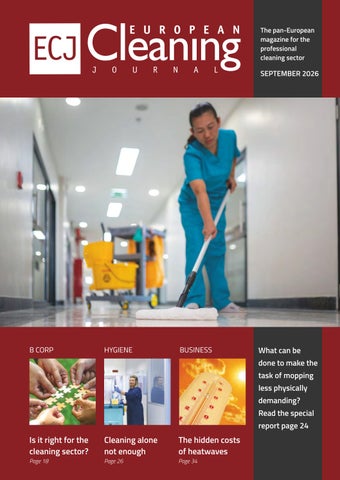
What can be done to make the task of mopping less physically demanding? Read the special report page 24
Is it right for the cleaning sector?
Cleaning alone not enough
The hidden costs of heatwaves
Page 18
Page 26
Page 34
CONTENTS
September 2026 | Vol.34, No.4
BUSINESS
SPECIAL REPORTS
34 The hidden costs of heatwaves
14 Carpets or hard floors? What are the advantages of choosing a carpet over a hard floor?
Hartley Milner looks back on Europe’s scorching summer and reflects on the implications.
18 B Corp - right for cleaning?
03 News
Is the increasingly popular certification practical for the cleaning sector?
10 European reports
22 Mopping made easy How mopping can be a less arduous task for the cleaning operative.
26 Cleaning alone not enough
40 New product review
There’s a difference between cleaning and contamination prevention.
29 Functional efficiency A look at the most important qualities of a washroom dispensing system.
37 Systems must be redesigned How cleaning practices can be adapted to prevent MSDs in ageing operatives.
2023
38 Wipers for all trades Why it’s important to use bespoke wiping products in all applications.
Criterion Publishing Ltd Castle House, 89 High Street Berkhamsted HP4 2DF, UK T +44 (0)1494 791222 F +44 (0)1494 792223 info@europeancleaningjournal.com www. europeancleaningjournal.com Subscriptions UK - £60 / Continental Europe - £70 / International - £80
Editor Michelle Marshall Features Writer Ann Laffeaty Advertisement director Chris Godman Advertisement sales executive Laura Bell
Circulation Marie Payne
Italy, Spain & Switzerland Fabio Potesta Mediapoint & Communications Corte Lambruschini, Corso Buenos Aires, 8 V0 Piano, Interno 7 16129 Genova, Italy T +39 010 570 4948 F +39 010 553 0088 info@mediapointsrl.it www. mediapointsrl.it
European Cleaning Journal is published six times a year by Criterion Publishing Ltd. Although every effort is made to ensure the accuracy and reliability of material published in European Cleaning, Criterion Publishing Ltd and its agents can accept no responsibility for the veracity of claims made by contributors, manufacturers or advertisers. Copyright for all material published in European Cleaning remains with Criterion Publishing Ltd and its agents.
ISSN 0968-901X ©Criterion Publishing 2026
CBP007012
Cleaning innovation for everyone. Interclean is the world’s leading platform for cleaning and hygiene professionals, and offers a comprehensive overview of products, services, and innovations from the world’s leading companies. Widely recognised for professional networking, knowledge exchange, insightful analysis, and industry trends.
Let’s get you involved, connected, and engaged! Contact us for personalised advice.
28 - 30 October 2026 Interclean Shanghai 2026 SNIEC Shanghai
4 – 7 April 2028 Interclean Amsterdam 2028 RAI Amsterdam
intercleanshow.com
News & events
Latest News & Events from ECJ
Join us at the European Cleaning & Hygiene Awards - the night of the year! On Thursday October 8, the European Cleaning & Hygiene Awards - founded and organised by European Cleaning Journal - will bring together cleaning and hygiene professionals from across Europe at Pueblo Español, Palma de Mallorca, for a night of celebration, connection and recognition. The 2026 winners will be revealed across 11 categories - celebrating the organisations, teams and individuals who have set the standard for our industry this year. Tickets for the event are still available so if you haven’t booked your place yet, now is the time. Here are the finalists: Digital transformation Alisea Climex Derrycourt Cleaning Specialists Wastify AI Investment in Training and People Development B And A The Best MCC Cleanliving CSU Strattos Academy The Mount Charles Group Excellence in ClientContractor Partnerships Asito & Fujifilm Chamberlaine Cleaning Services & Chelsea Barracks Derrycourt Cleaning Specialists & Connolly Hospital ISS UK & NHS JPC by Samsic & British Land Principle Cleaning Services & Landsec Serlimar & STEF Sustainability Best Practice: Service Provider CleanEvent Services CSU Julius Rutherfoord & Co Peartree Cleaning Services Principle Cleaning Services Sustainability Best Practice: Manufacturer Alani Higiene Profesional Entidad Maya, Eversea Hylab Dispensers Tork, an Essity brand
WEPA Professional Commitment to Diversity in the Workplace CSU Chamberlaine Cleaning Services NGB Clean Vebego Best Initiative Raising the Profile of the Cleaning Sector La Lucente Loo of the Year Awards Ryans Cleaning Tork, an Essity brand Technological Innovation of the Year Ennovamark Etrash Foremost Freematica España Novosan ToolSense Leader of the Year Oktay Bal, RV-Tech Jonathan Mallon, The Mount Charles Group Aisling Ryan, Ryans Cleaning John Spencer, NIC Services Group Jack Stuifbergen, Breedweer Facilitaire Diensten Rising Star Emily Downing, Cleenol Group Daniel Henstock, Pearroc Thayene Lorens, CCS Cullen Cleaning Services Samantha Mantovan, Principle Cleaning Services Archie Trueger, Principle Cleaning Services Best Company to Work For B and A The Best MCC Breedweer Facilitaire Diensten CleanEvent Services CSU Cleenol Group Tennant EMEA ECJ editor and founder of the awards Michelle Marshall said:”We are so excited to bring the industry together in Palma de Mallorca this October for what promises to be a very special celebration. The European Cleaning & Hygiene Awards are about more than recognising success; they are about championing the
progress, professionalism and innovation that continue to move our sector forward.”
Visit www.echawards.com/ attend to find out how to book your tickets for the big night..
EVENTS October 8
March 16-18 2027
European Cleaning & Hygiene Awards
The Cleaning Show
Palma de Mallorca, Spain www.echawards.com
London, UK cleaningshow.co.uk/london March 16-18 2027
October 13-15
Europropre
Cleantex Africa
Paris, France www.europropre.com
Johannesburg, South Africa cleantex.co.za
March 30-April 2 2027 October 28-30
China Clean Expo
Interclean Shanghai
Shanghai, China www.chinacleanexpo.com
Shanghai, China www.intercleanshow.com/china
May 11-13 2027 November 5-7
ISSA Pulire
Clean Eurasia
Milan, Italy www.issapulire.com
Istanbul, Turkey www.cleaneurasiaexpo.com
September 21-24 2027 November 16-19
CMS Berlin
ISSA North America
Berlin, Germany www.cms-berlin.de
Las Vegas, USA www.issa.com
April 4-7 2028 March 9-11 2027
Interclean Amsterdam
Clean-Tech Expo
Amsterdam, Netherlands www.intercleanshow.com
Warsaw, Poland cleantechexpo.pl
To have your event included in the Events section, contact ECJ via email at: michelle@europeancleaningjournal.com
September 2026 | ECJ | 3
News
OCS makes deal to buy Mitie
In the UK, the OCS Group has announced its acquisition of fellow facilities management business Mitie. The deal will create a group with combined annual revenues of £8.5 billion, along with enhanced sector and geographic reach. Currently employing over 135,000 people, OCS delivers integrated facilities management services to over 8,000 clients across Europe, Asia Pacific and the Middle East. Since 2022 it has been owned by the US private investment firm Clayton, Dubilier & Rice (CD&R). Mitie Group is a PLC, also operating internationally, that employs 84,000 people.
Stronger together In a statement OCS said the proposed combination would strengthen the group’s ability to support clients operating in increasingly complex, regulated and
mission critical environments across government, defence, healthcare, national infrastructure, life sciences, and commercial markets. Rob Legge, OCS Group chief group executive officer commented:”While there is a long process ahead, both businesses remain focused on supporting customers and delivering the high standards they expect every day. Together, we can build something remarkable for our colleagues, our customers and the country.”
Invest in people Mitie chief executive officer Phil Bentley added: “As part of a larger group with a wider geographical footprint, Mitie would have an even stronger platform to invest in our people, technology and services, and to do even more for the customers and communities we support.”
Scented products danger Particles from scented cleaning products can be inhaled deep into the lungs, according to scientists. And they can contribute to respiratory system issues or even enter the bloodstream. Researchers at Purdue University in Indiana began studying the impact of cleaning products and chemical
billions of ultra-fine particles in quantities well above the levels usually found outdoors. And they were surprised to discover that these particles were able to form and grow within a matter of minutes. “By the time you finish cleaning up an indoor space, you’ve already formed a lot of nanoparticles and inhaled them,” says Boor.
disinfectants on indoor environments during the Covid-19 pandemic. During their study they observed that many of the products were heavily scented, says study lead Brandon Boor. “The idea is to create a pleasant smellscape in the indoor space,” he said. “But clean air should not smell like highly concentrated citrus fruit - it should not really smell of anything.” Scientists found that activities such as mopping, spraying countertops and wiping surfaces with scented products formed
Ultrafine particles pose potential health risks because they are small enough to be deposited throughout the airways and penetrate deep into the lungs. Boor claims he wants the findings to inform consumers’ choices rather than alarm them. He advises people to choose low-fragrance or fragrance-free products where possible; to avoid applying several scented products in the same cleaning session and to run exhaust fans or open windows when cleaning to ventilate the space.
Robot vacuum cleaners face US ban over national security fears Non-American robot vacuum cleaners could soon be banned from the US over fears they pose a threat to national security. The nation’s Federal Communications Commission has unveiled strict new measures targeting foreignmade technology. These state that any new foreignmanufactured robot capable of ground movement, navigation or obstacle avoidance will be
4 | September 2026 | ECJ
banned unless manufacturers receive an exemption. The rules apply to any device where the combined weight of the machine and its docking station exceeds 4.4 lbs. Other popular household gadgets such as automated lawnmowers will be included in the ban along with any other gadget that uses local or remote software, AI, environmental sensors or wireless connectivity
such as Wi-Fi, Bluetooth or cellular capabilities.
Barriers to future launches Existing models that have already been approved for sale in the US will remain on the shelves. However, a number of major tech brands including Roborock, Ecovacs, Dreame and Roomba which rely heavily on foreign manufacturing hubs will face major hurdles
when launching future models without approval. It is part of a broad range of efforts by the US government to protect the country’s AI industry amid increasing challenges from Chinese rivals. Various AI breakthroughs from China have led to fears that the US’s domination of technologies such as chatbots could be challenged by cheaper and more capable versions.
Nexaro strengthens distribution Osprey bought by Goodway
Autonomous cleaning solutions specialist Nexaro in Germany has nine new distribution partners across Europe - in Spain, Portugal, the UK, Denmark, Switzerland, Germany, the Czech Republic, Hungary and Croatia. The new distributors are Robot Componentes in Spain, Iberoeste in Portugal, Pristine Trading Group in the UK, RV Unique and ABJ Industri in Denmark, Weita and Scheitlin-Papier in Switzerland, ATEXX and Kareima in Germany, X-Care Robotics
and Köder in the Czech Republic, Reform Robotics in Hungary and Tapess in Croatia. “Our new distribution partners bring us closer to customers in key European markets,” says Thomas Rump, head of sales at Nexaro. “What matters to us isn’t just the size of the network, but above all the quality of the partnerships. Our partners understand what professional users need on the ground, and they help us bring cobotic solutions into everyday practice.”
Goodway Technologies - which has its headquarters in the US - has acquired UK-based dry steam cleaning equipment manufacturer OspreyDeepclean, expanding its presence in Europe and broadening its cleaning and sanitation technology portfolio. The acquisition brings together two companies serving sectors including food and beverage processing, manufacturing, transportation and facilities management. Goodway Technologies said the move strengthens its range of industrial cleaning solutions while increasing its footprint in the UK and European markets. OspreyDeepclean designs and supplies professional and industrial dry steam cleaning equipment, which is used across commercial and industrial environments for cleaning and sanitation applications. Thomas Stücken, managing
director of OspreyDeepclean, said the partnership would enable the company to accelerate product development while continuing to support its existing customer base. “Our partnership with Goodway Technologies creates a new chapter for our company and our customers. We’re committed to delivering best-in-class dry steam solutions, and with their additional resources and support, we’ll be able to accelerate innovation while maintaining the quality and service our customers rely on.” Goodway Technologies said OspreyDeepclean will become part of its global portfolio while continuing to support customers and distribution partners throughout the UK and Europe. It added the acquisition represents a further step in the expansion of its international business.
September 2026 | ECJ | 5
News
Kärcher and Stihl battery alliance hails pioneering collaboration for our customers.” Professional users will now be able to use the same batteries and chargers for both their Kärcher cleaning equipment and their STIHL power tools. This means they can cover the entire spectrum of daily landscaping, forestry and cleaning tasks with just one battery system.
Partnership
• Michael Traub (left) of Stihl and Kärcher’s Hartmut Jenner at the launch
In Germany, Alfred Kärcher - one of the professional cleaning sector’s leading names - and Andreas Stihl, specialist in outdoor power equipment, have announced the launch of a joint battery alliance. The aim of this strategic partnership, say the companies, is to offer professional users a common, high-performance and future-proof battery standard. At the heart of the alliance is the ALLPRO battery system developed by STIHL and unveiled earlier this year, which will be used in the professional equipment from both brands in future. Kärcher says it will continue to support its existing Battery
6 | September 2026 | ECJ
Universe technology - including service, spare parts and battery availability - and machines introduced from the start of 2027 will instead feature Stihl’s ALLPRO battery system.
Larger scope “Professional users need more than just high-performance tools. They need systems that cover a wide range of tasks, reduce complexity and ensure their investment pays off in the long term,” said Michael Traub, chairman of the executive board of STIHL at the launch. “This is exactly where ALLPRO comes in. The partnership with Kärcher expands the scope of our battery system to include further
professional applications, thereby creating added value in our customers’ day-to-day work.”
Innovative strength Hartmut Jenner, CEO and chairman of the board of management of Alfred Kärcher added: “STIHL and Kärcher are two family-owned businesses whose success has always been based on innovative strength and an uncompromising commitment to quality. Through the synergy between our equipment, we are creating far more than just a technical solution: we are consistently driving forward the electrification of professional applications, thereby securing a decisive competitive advantage
The news has been hailed as more than a merely technical partnership - it’s an unusual collaboration between two family-owned companies that have been competing in overlapping product categories. It brings much-needed reduced complexity, lower investment costs and greater flexibility for municipal, facilities management and landscaping customers.
New to Samsic Facilities management services provider Samsic Facility has added three new companies to the group - EasyFresh of Portugal and Edilservice64 and APE Service in Italy. In Portugal, Samsic says, EasyFresh enhances its proximity and cleaning services coverage while APE Services expands its presence in Tuscany. With the acquisition of EDILservice64, Samsic Italy is expanding its service offering by adding maintenance expertise. The three businesses together bring 200 additional employees and around €10 million in additional revenue to the group.
DEEP CLEANING. EASY HANDLING. There’s Kärcher for that. Think maintaining large carpets has to be overwhelming? No way! Discover our new BRC 40/34 C deep carpet cleaner, paired with the CarpetPro Beyond Cleaner iCapsol RM 764N OA and the battery-powered CVS 65/1 carpet sweeper. The complete package for preparation, cleaning, and finishing of large carpeted areas. Learn more at karcher.com
News
People want to thank washroom cleaning staff - but rarely do is some familiarity or routine,” Logenius continued. “However, we’re asking everyone to start small and the next time they’re in the same space as a cleaner, to share a simple message thanking them for their important work. Small acts can make a big difference.”
Worldwide survey
Tork is encouraging businesses and washroom visitors to take a moment to thank professional cleaners in celebration of ‘Thank Your Cleaner Day’ on October 14. Cleaning is hard work - and cleaning teams deserve more recognition for their efforts. This was the view of 56 per cent of washroom users questioned in the latest Tork Insight Survey. “Tork data shows that 38 per cent of cleaners surveyed have left their jobs due to lack of recognition and burnout,” said Jenny Logenius, global brand manager, professional
hygiene at Essity. “These factors are unrelated to pay, but contribute to recruitment and retention challenges across the cleaning industry.
Celebrate professionals “However, many washroom users wish they could thank cleaners for the job they do. Tork is proud to join the growing list of global organisations celebrating these professionals who play a critical role in creating hygienic, comfortable and safe spaces.” Four out of every five people
surveyed said hygiene issues in the washroom created a negative impression of an entire business. And many said they would avoid a venue or business due to issues with hygiene or privacy. Poor washroom experiences may lead customers to take action, creating potential consequences for business reputation and revenue. “The survey shows that people are more likely to interact with cleaning teams in their workplace than in a public facility washroom, such as a train station, probably because there
The Tork Insight Survey 2026 was conducted in 11 countries worldwide including the UK, US, France and Germany. A total of 11,500 members of the public and 100 facility managers were questioned in the online study. To learn more about steps that businesses can take to support cleaning staff – and to strengthen inclusive hygiene by meeting the needs of as many as possible in the public washroom – visit www. torkglobal.com/gb/en/about/ inclusive-hygiene
Don’t miss this edition’s special report on washroom dispensing systems. Starts page 29
Sodexo recognised among UK’s top employers for gender equality Sodexo UK & Ireland has been named one of The Times Top 50 Employers for Gender Equality for the third consecutive year. Compiled by Business in the Community and promoted by The Times, the annual listing recognises organisations that are embedding gender equality across their businesses and taking action to create more inclusive workplaces. According to Sodexo, the recognition reflects its continued focus on using data and insight to improve outcomes for employees and
8 | September 2026 | ECJ
strengthen accountability across the business. The company says women now make up 45 per cent of its UK and Ireland senior leadership team and 36 per cent of operational leadership roles. Jean Renton, CEO of Sodexo UK & Ireland, said: “Creating opportunities for everyone to succeed is fundamental to who we are at Sodexo.” She added that while the company was proud of its progress, it remained committed to “removing barriers, widening opportunities and
ensuring every colleague has the chance to thrive.” Sodexo has introduced a range of initiatives aimed at improving inclusion and career progression. These include participation in the Social Mobility Employer Index, enhanced family-friendly policies such as parental and paid carers’ leave, support for employees affected by menopause and endometriosis, and structured development programmes designed to improve representation at all levels of the business. The company has also
strengthened governance by using gender pay gap data to inform action plans, while its SoTogether employee network provides support and resources focused on gender equity. In addition, Sodexo says it continues to expand its work to support colleagues affected by domestic abuse. Ndidi Okezie OBE, chief executive of Business in the Community, said: “Progress on gender equality is not only vital for fairness, but for business performance and long-term economic growth.”
THE EUROPEAN CLEANING & HYGIENE AWARDS 2026 October 8 2026 Pueblo Español Palma, Mallorca
YOU’RE INVITED TO JOIN US ON THE NIGHT OF THE YEAR! The perfect networking opportunity for you and your team Get inspired: Spend an enjoyable evening celebrating the success of our industry An evening full of entertainment and music in one of Europe's most beautiful cities
We would love to have you with us Visit www.echawards.com/attend to find out more
Brought to you by
Event Partner
Media Partners
Sponsors
An Essity brand
Latest: Netherlands
Latest: France
Subjective eyes, objective outcome
Advancing urban cleanliness
John Griep in the Netherlands tells us more about how a VSR-KMS cleaning inspection operates.
Christian Bouzols in France on a new label promoting local authorities commited to clean spaces.
Cleaning inspection starts with something less solid than it looks: an inspector judging a surface by eye. What registers as a fault depends on the light, on the colour and texture of the surface, even on the day. Two inspectors may not see exactly the same thing. That is why VSR-KMS does not rest on any single observation, but on a sample, an approval line and statistics.
Why the outcome does not rest on one pair of eyes A VSR-KMS outcome is not one impression of one room, and it is not a single score either. Inspectors count faults across a sample of units, and the number of faults allowed is fixed in advance by combining the sample size for a room category with its agreed fault margin. That threshold, the Acceptance Quality Limit, is the approval line: stay under it and the delivery passes, cross it and it fails. Room types carry different limits, because a sanitary area and an office are not held to the same standard. The approval or rejection therefore does not turn on any single count. It rests on the sample as a whole, measured against a line that was set before the inspection began. Applied correctly, VSR-KMS delivers a reliability of at least 95 per cent.
Measuring or thinking along That reliability holds only as long as the measurement stays factual, and here the inspector’s
own judgement is the risk. The experience of a good controller is worth a lot, but the moment an assumption is written down as a fact, the report no longer says what it claims to say. The difference shows up in a real report. Take an inspection of 12 office rooms. A vague summary notes that the waste bin was not emptied and there was loose dirt on the floor, with no counts and no link to the sample. A customer can do little with that. Now the version that stays with the facts: in six of the 12 rooms the waste bin had not been emptied, all six on the first floor; across the sample 26 faults were found against twenty allowed, 21 of them around the waste bins. Same inspection, but the reader now knows what happened and whether the norm was breached. That rule runs through every VSR report. Observations belong inside the measurement; interpretation, advice and illustration belong outside it, clearly marked as such. An inspector can think along, but not inside the count.
System plus discipline Objectivity in VSR-KMS is not a single feature. It comes from two things combined: an outcome built on a sample measured against a fixed approval line, and the discipline to keep assumptions out of that measurement. Both have to hold. Get them right, and a subjective pair of eyes still produces a result a customer can rely on.
The Eco-Clean City label distinguishes local authorities that are committed to a structured and progressive approach to sustainably improve the cleanliness of their public spaces. Created by the AVPU (Association of Cities for Urban Cleanliness), this label promotes cities that implement concrete actions to reduce dirt, improve the living environment and sustainably change behaviour in public spaces. Urban cleanliness is a complex issue, influenced by many factors: user behaviour, available facilities, organisation of services, attractiveness of public spaces and tourist pressure. Faced with this complexity, one-off or isolated responses quickly show their limits. This is why the Eco-Clean City label is based on a systemic approach to urban cleanliness. The aim is not only to clean more, but to understand the causes of dirt in order to act effectively and sustainably. This approach is based on the observation, analysis and coordinated activation of all the levers of action. The label thus supports local authorities in the implementation of a comprehensive strategy based in particular on the assessment of the level of cleanliness; the implementation of action plans; investments in equipment and organisation; communication, awarenessraising and mediation; citizen involvement; innovation and sustainable development approaches.
Sustainable results Feedback from the local authorities involved shows that a sustainable improvement in cleanliness is possible when the approach is structured, managed over time and based on objective data. The first analyses of cities that have obtained the fifth star show an average improvement of around 12 per cent in their level of cleanliness - confirming the benefits of a sustainable
10 | September 2026 | ECJ
commitment to the approach. Improving cleanliness is based on the combination of several levers of action, activated in a coherent and continuous way. It is this global approach that allows local authorities to move from a logic of reaction to a logic of management and continuous improvement. The label therefore does not only recognise a level of cleanliness at a given time: it values the ability of a local authority to sustainably improve the cleanliness of its territory.
Five-star progression The Eco-Clean City label is part of a logic of continuous improvement, through five levels of recognition: One Star: Rate. Measure your level of cleanliness using Objective Cleanliness Indicators (IOPs) and benefit from a comparative analysis. Two stars: Act. Implement a strategic action plan based on the results obtained. Three stars: Structuring sustainably. Integrate sustainable development issues into urban cleanliness policies. Four stars: Mobilise. Involve the inhabitants and everyone working in the area in the process of improvement. Five stars: Excelling and innovating. Deploy a global, innovative and efficient strategy, validated in detail by a field audit. The label allows local authorities to promote their actions and results, structure their urban cleanliness strategy, mobilise services and residents around common objectives, and be part of a national dynamic for the exchange of good practices. More than 150 local authorities already benefit from the label. But the list of municipalities achieving the five-star rating at a national level is quite limited. Only Antibes, Le Havre, Cannes, Metz, Nice, Niort and Saint-Brieuc have achieved it - joined this year by the most recent one promoted: Caen, in Normandy.
Latest: Italy
Latest: Germany
Market shows stability and growth
Minijob debate and wage demands
ECJ’s Anna Garbagna reports on the latest survey of manufacturers and distributors in Italy.
Germany’s contract cleaning sector is facing a challenge autumn, writes Katja Scholz for ECJ.
The Italian professional cleaning market is worth approximately €7 billion and remains a stable sector, although it is undergoing gradual transformation. This is according to 2026 research conducted by Cerved for AFIDAMP among manufacturers and distributors, carried out between April and June this year. On the manufacturing side, 2025 turnover is estimated at between €3.6 billion and €4.4 billion. Chemicals represent the largest segment, with revenues of between €1.4 billion and €1.6 billion, followed by machines, at between €1.1 billion and €1.3 billion, and paper, at between €820 million and €970 million. Almost twothirds of companies have turnover of more than €5 million, while nine out of 10 manufacture predominantly in Italy, confirming the strong national roots of the supply chain.
Better financials 2025 ended positively for around half of manufacturers, while expectations for 2026 remain geared towards growth. The strongest prospects are for chemical products, although positive indications are also emerging for machines, paper, equipment, and fibres and cloths. The market’s financial position is also improving, with more regular payments and a reduction in overdue debts. Among the end-use sectors, Ho.Re.Ca. continues to play a central role. Hospitality is the sector that has shown the most consistent growth since 2022, supported by positive trends in tourism, catering and services.
Distribution main channel For manufacturers, distribution continues to be the main sales channel, generating around three-quarters of turnover. Priorities for 2026 include strengthening distribution networks, digital marketing, developing sales forces and participating in trade exhibitions. Sustainability and product
innovation also remain high on the agenda: more than a quarter of companies have filed patents over the past five years. On the international front, Germany remains the leading target market, followed by Spain, France, the United States and the United Kingdom. The response to competition from emerging markets continues to focus on quality, innovation and protecting market positioning rather than reducing prices.
Transformation of models Distribution is worth approximately €3 billion and has a highly fragmented structure: 60 per cent of the market is generated by 22 per cent of companies, while half of the sample has turnover of no more than €1.5 million. Here too, almost one company in two recorded growth in 2025, with average growth of 11.4 per cent. The most significant transformation, however, concerns the service model. Sales of chemicals, equipment and machinery are increasingly being complemented by consultancy, training, maintenance and rental services. Training has been taken up by more than 70 per cent of distributors, while green products now account for 20 per cent of turnover. Interest is also growing in autonomous machines and high-performance premium solutions. Digitalisation is another area with scope for development. Almost half of manufacturers are already using artificial intelligence tools, particularly in marketing and communications, while among distributors adoption stands at around one in five companies. The picture that emerges is of a supply chain that is growing not only in terms of numbers, but above all in its ability to deliver value: greater technical expertise, more services, more innovation and greater attention to the quality of solutions offered to professional customers, thereby strengthening competitiveness and specialisation.
The building cleaning industry is facing a difficult financial situation: on the one hand, wage and social security costs are rising, while on the other, many businesses are struggling with weak demand. Two current debates - around Minijobs and wage increases - highlight the challenges facing the sector. The German government’s pension commission is recommending marginal employment contracts in future be included in the statutory pension insurance system as a general rule, and their special status under tax and social security law be abolished. An exception would apply to school pupils. This has once again put the future of the Minijob on the political agenda. The issue is particularly relevant to the building cleaning sector: almost 30 per cent of employees work on a Minijob basis, while personnel costs account for an average of around 85 per cent of total costs. The Federal Association of the German Building Cleaning Trade (BIV) is therefore warning of additional burdens on businesses. Its managing director Wolfgang Molitor criticised the government’s approach: “Now this way, now that way - sometimes the government wants to make Minijobs more expensive for companies, sometimes it wants to abolish them. Meanwhile, the details remain unclear. So what now? With this erratic approach, the government is creating uncertainty such among companies and employees.” Only recently, the government proposed introducing contributions to health and long-term care insurance for the first time for Minijobs. Now the possibility of abolishing their special status altogether is being considered. From the BIV’s perspective, two points are crucial. Minijobs are already the most expensive form of employment for companies, it argues. There should therefore be no further one-sided burden on employers. At the same time, any reform must ensure low-income
employees are not left worse off through higher deductions, as this could make undeclared work or withdrawing from the labour market more attractive.
Collective bargaining round The current collective bargaining round this autumn is also putting money centre stage. The IG BAU trade union is demanding a pay increase of more than 13 per cent over a 12-month period for pay grade one, which covers the largest number of employees. The BIV has firmly rejected the demand. There are nine wage groups in the building cleaning sector. Two of these are covered by generally binding industry-wide minimum wages. The current rate for the entry-level group of unskilled workers is €15 per hour, while skilled workers in pay grade six earn €18.40. Christian Kloevekorn, chairman of the BIV’s collective bargaining commission, points to the sector’s economic situation. Following years of stagnation and recession, he says, the German economy remains weak. At the same time, rising social security contributions and other levies are creating additional pressure on businesses. The latest BIV economic survey supports this assessment: only 16 per cent of companies have a positive outlook for the current financial year, while 34 per cent expect business to deteriorate. Industry, offices and administration in particular are cutting back on orders and services. At the same time, 29 per cent of companies have recently had to reduce their workforce for. For the pay negotiations, this means demands for higher pay are colliding with rising costs and diminishing room for manoeuvre among companies. Or, as Kloevekorn puts it: “The worse the situation, the louder the demands.” The central question over the coming months is therefore likely to be how higher incomes can be reconciled with the economic viability of businesses.
September 2026 | ECJ | 11
Latest: Denmark
Latest: UK
Expectations are like dust…
The summer that changed the game
Lotte Printz in Denmark speaks to Martin Schuster as he publishes his book on the cleaning industry.
Lynn Webster in the UK analyses the impact of the big acquisition news story of the summer.
There could be entire anthropological studies written about cleaning… You could study culture, motivation, leadership, migration, class, gender, language, trust, invisible labour, service expectations and the strange social politics of office kitchens. Office kitchen areas deserve a whole department of their own at a university somewhere in fact! According to Martin Schuster, sales manager at CleanManager in Denmark and now also an author. Not of an anthropological study - nor of a cleaning manual. But of a book: “It Was Clean When I Left”. The book takes the reader on a behind-the-scenes tour around the cleaning sector landscape based on Schuster’s own experiences from 10 years at operational level and what he has heard through the grapevine. “Cleaning is a kind of job that doesn’t really get noticed until things ‘go wrong’. But mind you, nobody goes to work to do a shitty job and it would be great if the book could be an eye-opener that there are people behind this job and industry,” Schuster says, speaking to ECJ. People who have to pick up their children too, who may work when public transport is limited and might even feel uncomfortable in empty buildings at night where office kitchen areas can also turn into low-budget thrillers if the light flickers at the wrong moment as he puts it. Real-life and vivid examples like these mingle with oneliners and flashes of wit. Not to throw anybody under the bus, but to paint a clearer picture of the ‘people behind the mop’ (as chapter 4 is called) and to deflate the perception that what they do is ‘just cleaning’. The 12-chapter book kicks off with what happens when the phone rings before 6am on a Monday, deals with the peculiar things cleaners find, and the customers who are always ‘right-ish’! Schuster argues cleaning companies should dare have
12 | September 2026 | ECJ
proper conversations with customers, and states that expectations are like dust. If you do not deal with them regularly, they gather in corners and make everything look worse. “There are many misunderstandings between customers and cleaning companies.” If expectations are managed and what the customer sees is aligned with what the contract says, there’ll be fewer misunderstandings, allowing more time for actual tasks. And if you dare ask: ‘does this price make sense for the result being promised?’, fewer contracts would be priced to the bone, Schuster argues. . The book project started with a newsletter on LinkedIn in Danish. When he switched to English, he saw no change in dedication from the Danish readers and seized the opportunity to widen his audience. “I can’t help but share and spread my stories far and wide. And then one day someone said: ‘Why don’t you write a book?’ A week later, I decided to go ahead with my passion project. I feel I have something to give,” Schuster explains. A digital copy in English is now available via LinkedIn - free of charge - but there’ll also be a small print run to be handed out in and around the sector. “I hope it will spread, of course, and give the reader food for thought. That people within this industry will think: ‘this is darn right’, but also perhaps make it sink in and consider if they can do things differently. There’s a lot of ‘that’s how we’ve always done things’ in this industry,” Schuster says. “And I hope those without much knowledge of cleaning, but with an attitude towards it, realise that cleaning doesn’t just happen or is not just about spotting a stain on the floor. It is carried out by human beings and to do their jobs they do in fact need skill and knowledge.” Work in this industry doesn’t need applause every time someone empties a bin. But it deserves respect – to quote from the book!
One of the big news stories over the summer has been the proposed acquisition of Mitie by OCS. If approved, the deal could create one of the UK’s largest facilities management groups, bringing together significant experience and expertise across a wide range of sectors. Where much of the focus has been on the scale of the proposed transaction and its wider facilities management implications, the cleaning sector alone provides another interesting perspective. A combined OCS and Mitie cleaning operation would have considerable scale, resources and the ability to deliver services across some of the UK’s largest public and private sector portfolios. So, what does this mean for the smaller, independent cleaning companies that are no less ambitious in their own growth strategies? For large organisations, scale can bring significant advantages. Greater investment capacity inevitably supports technology, data analytics, environmental, social and sustainability initiatives and new approaches to service delivery. For clients managing complex estates, the convenience of accessing multiple FM services through one major provider is an attraction. However, scale does not necessarily mean bigger is always better. As the market becomes increasingly consolidated, smaller cleaning businesses have an opportunity to make their differences count. The key question is therefore not simply how they can compete with a much larger organisation, but how they can demonstrate why their size, independence and personal approach provide genuine and added value. For many independent cleaning companies, this starts with relationships. Clients often value having direct access to the business owner, senior management or the person responsible for delivering their contract. Issues can be discussed and resolved quickly, without lengthy
approval processes or layers of corporate management. Flexibility is another significant distinction and potentially an advantage. While large providers may operate through established procedures, standardised packages and defined service models, smaller businesses in contrast are able to tailor their approach around an individual client’s personal requirements. Cleaning schedules can be adapted, additional requests accommodated and services changed as local, site circumstances evolve. There is also the question of accountability. For an independent cleaning company, every client relationship matters. This is not to decry the relationships made by the large corporations but the personal touch is less evident. Reputation is built through referrals, recommendations and long-term partnerships. This creates a powerful incentive to deliver consistently high standards and to understand the customer’s business rather than simply deliver the predetermined cleaning regime. Ultimately, the OCS and Mitie deal could make an already competitive cleaning market even more interesting. Perhaps it may encourage further consolidation among larger providers, but it is simultaneously creating space for agile independent businesses to emphasise what they do differently. Certainly, in speaking with those who are successful, often family owned and smaller business they are seeing the opportunities this brings their way. The future holds great opportunities; unique attributes that are therefore less about size and more about quality, responsiveness, innovation and relationships that give clients clear options of choice. Independent cleaning companies that can evidence excellent performance, invest in their people, embrace appropriate innovation and maintain genuine client relationships will make a compelling proposition.
N W E
The Vertical Urinal Screen Built for More Flexibility Adaptable Fold to Fit Any Urinal Bowl
Superior Splashback Reduction
Tear-Out for Drain Dome Covers
SPLASH HOG 60 Days of Stay-in-Place Protection
Citrus Mango
Linen Breeze
Tropical Punch
vectairsystems.com
Carpet care
Carpets or hard floors? What are the advantages of choosing a carpet over a hard floor? Ann Laffeaty looks at the pros and cons of carpets and finds out how best to clean them.
WHY CHOOSE A CARPET? And when is a hard floor more appropriate? The decision often comes down to one of personal taste because a carpeted surface creates a vastly different impression to that of a hard floor. And both have their pros and cons – as well as their own specific cleaning challenges. So what are the arguments for choosing a carpet over a hard floor? And do carpets have any drawbacks in terms of cleaning and maintenance? Cleanology’s managing director Juliet Widdicombe believes carpets offer several advantages over a hard floor. “A carpet provides a softer surface underfoot which makes the space feel warmer and more comfortable than one with a hard flooring,” she said. “It also acts as an insulating layer which means carpets are better at retaining the heat – and this can potentially reduce heating costs. And they offer improved acoustics because they absorb sound rather than reflecting it, reducing the noise from footsteps and general activity. This is particularly useful in environments such as offices, hotels, schools and multi-tenancy buildings.” Carpets also tend to hide the dirt better than hard floors, she adds. “In general the fibres will mask the dust, stains and items of small debris - particularly when the carpet has a pattern,” she said. “Hard floors, on the other hand, tend to show the dirt immediately.” Any visible debris can quickly be removed from a carpet with regular vacuuming whereas hard floors will require polishing as well, she adds. “Damage caused by heels and wheeled traffic is
14 | September 2026 | ECJ
generally less noticeable on a carpeted surface, too, since the fibres will absorb any impact and disguise the wear patterns,” she said. “And hard flooring is also more vulnerable to visible scuffing and scratching, particularly in high-traffic areas where wear becomes obvious more quickly and is often irreversible.” The most effective method of cleaning a carpet depends on the particular situation, she said. “Hot water extraction provides the deepest clean, removing embedded dirt and allergens while a low moisture dry cleaning method using a bonnet mop is ideal where quick drying and minimal disruption are required,” she said. Cleanology offers a range of carpet cleaning services including hot water extraction and low moisture dry cleaning depending on the level of soiling and the operational requirements. Hot water extraction is carried out using specialist machinery such as the Prochem Steempro and provides a deep clean that removes embedded dirt, bacteria and allergens. “Where minimal disruption is required, a dry cleaning method using a bonnet mop allows for rapid drying and a quicker return to use,” said Widdicombe. “And a specialist stain removal product may be applied depending on the nature of the stain – if it is coffee or wine, for example. This will ensure an effective treatment while also protecting the carpet fibres.”
Hiding dirt The decision between a carpet or a hard floor has been a subject for discussion since time immemorial, says equipment and solutions provider Prochem’s sales director Phil Jones. “Hard surfaces can provide a higher degree of durability but they can also be tiring to stand on all day,” he said. “Carpets, on the other hand, offer a warmer and more homely feel with a reduced level of noise because they absorb sound waves.” This makes carpets particularly suitable for certain environments, he said. “For example, it is common to have carpets in a call centre or at a 24-hour
help desk to reduce background noise.” Wheeled traffic can be a particular issue on hard floors, says Jones. “A rolling load concentrates all the weight on to a very small, inflexible contact point - applying far more pressure per square centimetre than human feet and causing scratches, scuffs or deep dents,” he said. “The type of wheel concerned can also have a major impact because nylon, plastic or metal wheels can act like cutting tools on certain types of hard floor. And the damage may be enhanced if any soil or grit particles are trapped in a wheel.” Studies have shown that carpets are more effective at removing and trapping the types of particles and allergens that can blow in on the breeze, he said. “This helps to improve the air quality in both residential and commercial environments,” said Jones. “On a hard floor, those particles and allergens can be re-circulated simply by opening a door and creating an airflow.”
Soil is dry or greasy He says dirt and soil come in two forms: dry and greasy. “The dry soil which contains dust, grit, sand and skin cells can be easily removed with a dry vacuum,” he said. “This should take place as regularly as possible - otherwise, grit and sand will become an abrasive material that will wear the carpet out from its base. “On a hard surface the dry soiling can be removed with a dry mop or vacuum, but even a slight airflow will move it around.” Greasy soil from people’s shoes will be transferred on to the floor through foot traffic and will start to build up on both hard and soft surfaces if not maintained regularly, he says. “While greasy soil may be removed easily from a hard surface with the regular use of a damp mop, extra moisture or a cleaning solution will be required on a carpet using a mechanical carpet extraction system such as a rotary bonnet or a rinse extraction machine.” Carpets need to be cleaned as regularly as possible to prevent the build-up of greasy soil, he says. “The dry particulate soil must first be vacuumed up, then the
greasy soil needs to be removed since this will stick to the carpet fibres and dull down the colour,” said Jones. Prochem produces a range of cleaning solutions and machinery for maintenance, preventative, deep and corrective cleaning plus products for heavy-duty restoration. The company has also developed training courses to help the operator understand carpet types, carpet construction and cleaning solutions. Carpeted floors offer distinct advantages over hard surfaces from an acoustic, thermal and safety perspective according to Kärcher’s senior cleaning solutions consultant Gundula Braun. “Carpets act as natural sound absorbers, significantly reducing both airborne sound and impact noise from footsteps, trolleys or moving furniture,” she said. “This makes them highly advantageous in environments where a calm, professional atmosphere is paramount such as open-plan offices, educational institutions, libraries, healthcare facilities and hotel corridors. “Carpets also provide excellent thermal insulation which can contribute to energy savings by retaining indoor heat. And in terms of safety, textile floor surfaces offer higher slip resistance thereby substantially reducing the risk of slip-and-fall accidents in high-traffic commercial environments.” Hard floors are generally more susceptible to immediate, permanent aesthetic damage from mechanical stress, she says. “High heels, heavy trolleys and dragged furniture cause visible scratches, scuffs or cracks on hard surfaces which often require complex and costly restoration,” said Braun. From a clean air perspective, airborne dust when someone walks across a room will settle more quickly on a carpet than on
a hard floor, she says. “This means the air in the room stays cleaner for longer. “And a well-maintained carpet provides a feeling of luxury and wellbeing while also reflecting light in a different way to that of a hard floor. This creates a cosy and more comfortable atmosphere.”
Drying times crucial A proper carpet care programme requires a combination of machines for interim and deep cleaning plus matching detergents to handle heavy soiling and deep-seated dirt while also protecting the fibres and extending the carpet’s lifespan, Braun adds. “With a little planning, carpet care is really simple and can be handled very well,” she said. “The main difference between deep hard floor cleaning and deep carpet cleaning relates to the drying time of the surface. Because of its texture, carpet requires a longer drying time than a hard floor which means an area might be out of use for longer. However, smart scheduling will minimise any issues connected to the drying time.” Kärcher provides a comprehensive system of machines, accessories and cleaning agents for carpet cleaning. These include vacuums and carpet sweepers plus deep cleaning models that use orbital action and spray extraction to remove any ingrained dirt. And the CarpetPro Line of detergents includes the spotting agent Universal Stain Remover RM 769 and encapsulation cleaner CarpetPro iCapsol RM 768 OA. This detaches and crystallises dirt particles for ready for dry vacuuming. It seems, then, that carpets offer many advantages over a hard floor including quietness, warmth and comfort. But do they have any disadvantages? The deep cleaning process will often be
more intensive with a carpet than a hard floor because a shampoo will usually be required, says Cleanology’s Juliet Widdicombe. “The carpet will also need time to dry after a deep clean whereas a hard floor can be used immediately,” she said. “And the pile of a carpet can trap dust, allergens and microbes which means regular vacuuming and deep cleaning will be required. Hard flooring allows for easier disinfection, making it particularly suitable for spillprone or clinical areas.” Carpets are quick to absorb spillages of substances such as coffee, tea and red wine and this can make their removal more problematic, says Prochem’s Phil Jones. “On a hard floor this is normally less of an issue because those spills and stains can merely be liquefied and cleaned up with the addition of a cleaning solution and a damp mop,” he said.
Cleaning may be neglected The fact that a carpet pile will hide dry, loose dirt within its fibres can be both a blessing and a curse, according to Kärcher’s Gundula Braun. “While a carpet may appear to remain clean for longer than hard floors which show dust, smudges and footprints immediately, people will often neglect the care and cleaning routine that it requires and deserves,” said Braun. “Over time the carpet will then begin to look worn or even give off smells, which means something beyond the daily carpet care routine might be necessary. “And while carpets absorb impact from heavy traffic more efficiently than hard floors, wheeled traffic can cause pilecrushing or tracking over time unless the carpet has been designed for heavy commercial use. This highlights the importance of regular mechanical brushing to lift the pile and maintain the carpet’s value.”
September 2026 | ECJ | 15
Products: carpet care
Fibre-deep Kärcher has introduced the battery-powered Puzzi 2/1 Bp, a compact spray extraction machine designed for spot cleaning of upholstery and carpets and the removal of everyday stains during routine cleaning operations.
The machine sprays water mixed with detergent onto the surface before vacuuming up moisture and loosened dirt. Surfaces can be treated once or several times depending on the level of soiling. Removing moisture during each pass can reduce drying times, allowing furniture and other surfaces to return to use relatively quickly. Weighing 4 kg, the Puzzi 2/1 Bp has a 1.7-litre fresh water tank that can be removed for filling. A float valve stops suction when the dirty water tank is full, after which the dirty water tank can be removed and emptied. A wide carrying handle assists transportation between work areas, while operation is controlled by separate buttons for pumping and vacuuming. An indicator light shows the selected mode. Kärcher says the machine is designed to be straightforward to operate, making it suitable for use by staff with different levels of experience. This can be relevant in cleaning operations where staff turnover or shortages of experienced personnel make consistent stain removal more difficult. The battery-powered machine is designed for mobile use and can be carried on a cleaning trolley. Its compact dimensions also allow it to be transported between locations and stored where space is limited. The Puzzi 2/1 Bp follows Kärcher’s launch of the larger battery-powered Puzzi 9/1 Bp in 2021, which was designed for deep cleaning larger upholstered
16 | September 2026 | ECJ
and carpeted areas. The newer model is focused on spot cleaning and the removal of stains such as drink spills and food residue. www.karcher.com
Protective coat A UK luxury car manufacturer has used a protective treatment on approximately 2,000 square metres of new 100 per cent wool carpet installed in its reception area, following advice from cleaning products specialist Prochem. It advised the suitability of protective treatments can vary according to the absorbency of the carpet fibres. Wool and nylon are absorbent materials, meaning liquid spills such as drinks and food can penetrate the fibres and potentially cause permanent staining.
The car producer provided Prochem with a sample of the new carpet for testing. Prochem applied its B130 Fluoroseal CF protective treatment before deliberately spilling coffee, tea, red wine and champagne onto the treated carpet. Tests were then carried out to assess whether the stains could be removed. Following the results, the client approved the treatment for use on the reception carpet. B130 Fluoroseal CF is a WoolSafe-approved carpet and upholstery protector based on cationic technology. According to Prochem, following application and curing, it forms a coating around the fibres designed to provide resistance to water- and oil-based spillages. The treatment was applied by the in-house cleaning team while the premises were closed. The carpet was first thoroughly vacuumed to remove dry soil. B109 Fibre & Fabric Rinse was
then lightly misted onto it to prepare the fibres for the protective treatment. B130 Fluoroseal CF was subsequently applied in its readyto-use format using a pump-up sprayer fitted with an 8004 spray tip. The product was then brushed into the carpet pile to distribute the treatment evenly before being left to dry. The formulation is designed to cause liquid to bead on the surface of the carpet rather than immediately penetrating the fibres, allowing spills to be blotted up. Prochem says it can also reduce the penetration of dirt and greasy soils, potentially making cleaning easier. prochem.co.uk
All surfaces O 143 SPRAY is Ghibli’s rotoorbital single disc designed for cleaning delicate surfaces such as carpets. The oscillating head adapts to all surfaces and enables the removal of dirt particles from fibres while guaranteeing short drying time. Both the spray system and on/ off button are on the handle of the machine to allow uninterrupted working. The spray system comprises a 12-litre tank that’s easy to install and remove; a pump for maximum power and performance; and two adjustable nozzles. As an optional accessory there’s a polycotton pad for cleaning fitted carpets with reduced drying times - it’s reversible and washable. Ghibli says the roto-orbital movement means cleaning solution can be kept under the pad holder with less water and detergent consumption. Other features include ergonomic
handle, compact frame, large wheels and manageable weight. www.ghibli.com
Focus on the pH When choosing a cleaning agent, pH is one of the factors to consider says The WoolSafe Organisation – the international body that evaluates, tests, and certifies maintenance and cleaning products safe for use on wool carpets and rugs. Alkaline cleaners, like traditional hand soaps, are very effective at removing grease, but can damage the surface they are used on. The cosmetics industry recognises this, and modern skin care products are formulated to be acidic, matching the natural pH of human skin. Wool behaves similarly to skin, and prolonged exposure to alkaline products damages its surface. The fibre’s scales erode, its protective waxy layer is stripped away, and its natural water and stain repellent properties are lost. This harmful effect can be demonstrated by applying water to three sections of the same wool carpet: untreated, maintained with a WoolSafe approved product, and maintained with a highly alkaline, buffered product. Water beads on the first two areas but immediately sinks into the third, where the fibres’ protection has been compromised. High alkalinity also affects colour stability. The acid dyes commonly used in wool dyeing, bond to the fibres under acidic conditions, giving dyed carpets a typical pH around 4.0. If this bond is destabilised, colour bleeding can occur. A simple pH measurement cannot pinpoint suitable cleaning agents, as the real risk comes from buffered products, which maintain their high pH despite the residual dyeing acids in the carpet, which can overcome the high pH of non-buffered cleaners. During WoolSafe approval it tested buffering strength by titration. Products needing more acid to neutralise than the specified limits, fail. WoolSafe approved products are never strongly buffered. www.woolsafe.org
Backpack vac SPRiNTUS has introduced the BoostiX iGO ZERO, a cordless backpack vacuum cleaner designed for professional cleaning in confined spaces and areas where unrestricted movement is required, including stairwells, public transport vehicles, cinemas, theatres and large buildings. The vacuum cleaner weighs 4.4 kg and features a carrying system with chest and hip straps to distribute the load. A shoulderheight hose connection and
multifunctional carrying strap are designed to support movement during cleaning tasks. The BoostiX iGO ZERO is powered by a brushless 300W EC motor, which is designed to require limited maintenance. Depending on the battery configuration, the machine has a stated operating time of up to 90 minutes. Its operating noise level is 69 dB(A), allowing it to be used in environments where sound levels need to be controlled. A triple HEPA 13 filtration system is fitted to capture fine dust particles from the airflow. SPRiNTUS says this makes the machine suitable for locations where indoor air quality is a consideration, including healthcare facilities, schools and nurseries. Around 75 per cent of the plastic components are made from recycled material. Its cordless design removes the need for mains power during operation, allowing cleaning to be carried out without trailing cables. www.sprintus.eu
Large areas Lindhaus has developed the Dynamic eco FORCE professional upright vacuum cleaner for carpet maintenance in hotels and other facilities with large carpeted areas. The machine combines vacuuming with an optional dry cleaning system designed for more intensive carpet care. Dynamic eco FORCE has two motors positioned in the base, creating a low centre of gravity. A patented weight distribution system reduces the weight on the handle to 860 grams, with the design intended to support manoeuvrability during extended cleaning. The machine can be equipped with the patented DCS – Dry Cleaning System, enabling operators to carry out dry carpet cleaning as well as routine vacuuming. Its dynamically balanced brush roller rotates at up to 5,000 rpm
to work the cleaning product into carpet fibres and assist with the removal of embedded dirt. The system is also designed for use on delicate textiles. Five-stage filtration, electronic brush overload control and onboard accessories are included. Three working widths of 300, 380 and 450 mm are available for different applications. lindhaus.com
Special report on mopping - starts page 24
September 2026 | ECJ | 17
B Corp certification
B Corp - right for cleaning? Paul Evans, founder and director of Rumpus - a B Corp-certified PR agency - asks whether the certification, which has gained considerable traction around the world, can function as a practical and credible framework in the professional cleaning sector.
ACROSS THE CLEANING and hygiene sector, ‘doing good business’ is no longer a secondary concern. It sits at the heart of how products are formulated, how people are employed, how services are delivered, and increasingly, how companies communicate their value. The shift is not being driven by sentiment alone. Regulatory scrutiny is increasing, procurement criteria are evolving, and expectations from employees are changing just as quickly. The direction of travel is clear, even if the pace varies from one organisation to another. The challenge is that this is a sector shaped by cost pressure, operational complexity and tight margins, especially in the current climate, alongside a historically weak reputation in these areas. As Louis Beaumont, managing director of Hive Cleaning, puts it: “The sector has often been a race to the bottom. Low cost, low wages, high chemical usage and very little transparency.” Against that legacy, the B Corp movement has gained huge traction around the world. More cleaning and hygiene businesses are exploring the framework to show they do things differently, and as a way of demonstrating broader social and environmental responsibility. B Lab UK recently told me there are now around 70 European B Corps connected to the hygiene sector. But the question now is not simply whether B Corp is wellintentioned. It is whether it can function as a credible and practical framework in a sector defined by those operational com-
18 | September 2026 | ECJ
plexities and commercial pressures. As a leader of a B Corp-certified PR agency, I believe strongly in the intent behind the framework. The key is making sure that it delivers meaningful change and positive action. B Corp is designed to assess the whole of a business rather than individual components of performance. Governance, workers, community, environment and customers are all considered together, reflecting the idea that responsible business cannot be reduced to one metric or isolated issue. Recent updates to the framework have reinforced that position. B Lab has introduced more explicit requirements across key impact areas, moving away from a system where strengths in one area could offset weaknesses in another. The expectation is now broader consistency, supported by clearer evidence. For cleaning and hygiene businesses, this raises the bar significantly. It is no longer sufficient to demonstrate progress in product formulation or environmental impact if labour practices or supply chain oversight fall short. And it takes time. As Sam Greaves, managing director of Cleenol, explains: “It took around six months to complete the assessment, followed by just under 12 months in the verification queue before certification.” The certification process requires discipline, documentation and internal alignment. It often exposes gaps that may previously have been overlooked or deprioritised. This level of scrutiny may be unfamiliar to many businesses. And for others, it may create operational friction that is difficult to ignore. But this is also where the framework derives so much of its value. It encourages businesses to move beyond informal commitments and towards structured, verifiable practice. B Corp works best when it’s treated as more than a certification exercise, and more as a mechanism for interrogating how a business actually operates.
The cleaning and hygiene industry is a particularly demanding environment in which to apply a framework like B Corp. I understand the challenges it can pose - it is highly operational, technically complex and often price-driven. Claims of responsibility must stand up to scrutiny across several fronts. Product formulation requires companies to balance efficacy, safety and environmental impact, often under strict regulation. Packaging faces growing scrutiny around waste, recyclability and circularity. Labour brings its own pressures, from pay and retention to training and workforce wellbeing. Then there’s supply chain management and monitoring, one of the biggest ongoing challenges for the sector. Overlay this with a cost-driven procurement landscape, and the scale of the challenge becomes clear. Improvements in one area can create pressure in another.
Broad framework This is where a broad framework like B Corp becomes useful. It encourages companies to look across all of these dimensions simultaneously, rather than focusing on a single area of improvement that may have a limited overall impact. At the same time, it brings trade-offs into sharper focus. It requires businesses to make decisions with a wider set of stakeholders in mind, even when those decisions are commercially difficult. Businesses that go through the process often find it pushes them further. Beaumont reflects that for Hive Cleaning, “it formalised what we were already doing and pushed us further, particularly in supply chain scrutiny, carbon measurement and reducing reliance on harsh chemicals”. Similarly, at Cleenol, the process has been used to strengthen internal systems: “The process helped us review, structure and, in some areas, enhance our practices, creating greater accountability and transparency across the business.” These are not headline-grabbing changes. But they are arguably more important. They point to a shift in how businesses are
run, rather than how they are presented. Responsible business is often presented as a straightforward win-win. But in cleaning and hygiene, it rarely is. We know the sector is price-sensitive. Introducing higher labour standards, more sustainable products or additional reporting requirements inevitably creates tension. It is where procurement must look beyond the black and white of a tender. Beaumont is direct about this: “There is definitely tension in a price-sensitive market: ethical labour, sustainable products and proper training all come at a cost.”
Progress and compromise Businesses that engage seriously with frameworks like B Corp recognise responsible business practices cannot be adopted without trade-offs. Progress involves prioritisation and, sometimes, compromise. What begins to shift is the basis of competition. Instead of focusing exclusively on price, companies can reposition themselves around reliability, accountability and broader value. As Beaumont puts it: “We don’t try to be the cheapest, we aim to be the most responsible and the most reliable. That’s a different conversation.” This also prompts a wider question. If B Corp is not adopted, what alternative framework provides a comparable level of structure and accountability? No framework eliminates complexity, and no business operates without constraint. As Beaumont points out: “B Corp is a great benchmark, but it’s not the only indicator of doing the right thing.” Organisations such as EcoVadis and Planet Mark offer credible approaches, particularly in areas such as supply chain assessment and carbon measurement. But the broader shift encouraged by B Corp – moving from competing purely on cost to competing on value and responsibility – may ultimately be one of its most significant advantages. It’s also important to note that for many businesses, the most practical route may not be immediate certification, but gradual adoption. Applying elements of the framework can provide direction without the immediate pressure of meeting every requirement. This is where the conversation around B Corp becomes more useful. Rather than treating certification as a binary choice, it can be approached as a framework for decision making. It can offer a structure for assessing how a business performs across multiple dimensions. Even businesses that aren’t ready for certification can benefit from understanding where they currently stand. This matters because it allows firms to start embedding the principles of the
framework without immediately committing to certification. Ultimately, that’s the real value here: measurable change. And with B Corp, that can take many forms, be it environmental, social or operational. At Hive Cleaning, one of the most visible shifts has been in workforce conditions. “We pay 100 per cent London Living Wage across all employees as a non-negotiable standard,” says Beaumont, “which has improved retention, engagement and service consistency.” This is a clear example of how a principle, the fair treatment of workers, translates into a practical business decision, with measurable outcomes. At Cleenol, the impact has been more focused on community engagement. “We’ve moved from one-off activity to long-term community partnerships,” Greaves explains, “including launching The Sun Fund to deliver 5,000 hours of work experience and 500 hours of mentoring for young people.” Again, it’s a move away from one-off activity towards something more structured and accountable. These are examples from certified businesses. But for those that might be earlier in their journey, implementing initiatives like these doesn’t have to be part of the formal certification process. Instead, it shows intent and a willingness to engage with the questions that the framework raises. Over time, changes like these will accumulate and can create a foundation that makes certification more achievable in the future. And they begin to shift how decisions are made on a day-to-day basis.
The communications challenge Communication is where many businesses still fall short. The mistake is treating the logo as the story. But in a sector as practical and performance-driven as cleaning and hygiene, a tick-box approach will never be enough for a discerning stakeholder. And the rigour of the new standards means that this will no longer be possible anyway. Customers, procurement teams and employees want to know the specifics of what has actually changed. They want to understand how labour conditions have improved, how products have evolved and how environmental impact is being reduced. They want evidence. Without evidence, certification becomes little more than a badge with no deeper meaning. There is also a regulatory dimension to consider. Across Europe, scrutiny of environmental and sustainability claims is increasing. Companies are expected to be more precise in how they describe their impact, and to avoid broad, unsubstantiated statements. Communication is no
longer just about branding. It’s about evidence, credibility and compliance. Responsible businesses shift the conversation from cost alone to cost versus value, risk and long-term reliability. Cleenol’s approach points in this direction. As Sam Greaves notes: “We track metrics such as volunteering hours, community engagement and participant progress, and are developing a formal Impact Report to strengthen transparency.” This kind of structured reporting is likely to become more important. Impact reporting remains optional for smaller businesses, but for me, it should be a fundamental requirement. It supports transparency while helping businesses identify where further improvement is needed. For many businesses, the hard part is gathering the evidence in the first place. But perhaps the biggest challenge is to accept that tradeoffs will remain: perfection is not possible. What matters is the direction of travel and the extent to which responsibility is embedded in decision-making.
From intent to credibility B Corp represents one of the most ambitious attempts to redefine what good business looks like and how performance is measured. For the cleaning and hygiene sector, it offers a framework that aligns well with many of the challenges the industry faces. Its credibility ultimately depends on the rigour of the standard and how honestly businesses apply and communicate what it means in practice. In a sector where performance, safety and cost remain critical, the presence of a logo will never be enough. What matters is the evidence behind it. It provides a point of reference, a way of structuring conversations, setting expectations and measuring progress over time. For some businesses, certification will be a natural next step. But for others, it will remain a catalyst - an internal guide, helping to shape practice and guide meaningful change. Once again, it’s about progress, not perfection. The companies that will stand out are not those that simply achieve certification, but those that embrace the principles of B Corp and translate them into tangible action, and explain that action in a way that is clear, specific and credible. In cleaning and hygiene, responsible businesses will not be judged by what companies claim. It will be judged by what they can prove. If you’re considering B Corp, the best place to start is with a simple question: where would your business struggle under scrutiny today? The answer to that question is often far more valuable than the certification itself.
September 2026 | ECJ | 19
Mopping equipment
Mopping made easy Mopping is an arduous task, so what can be done to lighten the cleaner’s load? ECJ looks at the latest mopping systems that are easier to push, lighter to transport and less of a strain to wring out.
MANUAL MOPPING CAN BE physically demanding. The weight of the equipment, the repetitive movements required to use it and the need for frequent bending and twisting can lead to fatigue, strain and reduced efficiency on the part of the cleaner. And this is particularly the case when cleaning large facilities or when carrying out the same task several times during a shift. Repetitive actions such as bending and stretching, manual wringing and handling heavy or awkward equipment can lead to pains in the back, wrists and shoulders according to Cleanology’s managing director Juliet Widdicombe. “It can also lead to muscular fatigue and longer-term musculoskeletal issues,” she said. “Other effects over time can include the risk of injury, absences due to sickness and a reduction in productivity.” The scope of mopping is becoming increasingly limited due to the strain it places on operatives, she says. “While manual mopping can be effective in confined spaces and for spot cleaning, many large or high traffic areas can now be cleaned more safely, consistently and efficiently using mechanised methods,” said Widdicombe. A cleaner’s life can be eased with the help of ergonomic equipment and modern systems that reduce physical strain, she says. “Lightweight tools, adjustable handles and flat mopping systems can all be helpful,” she said. “Mechanical alternatives and equipment that removes the need for bending, twisting and manual wringing can also reduce the strain.
22 | September 2026 | ECJ
“And clear processes, robust training and well designed products can all help to reduce fatigue, improve comfort and increase productivity.” There is no denying the fact that mopping can be highly stressful in terms of effort, according to Kärcher’s product manager for manual tools Jennifer Majcher. “The repetitive physical strain of floor cleaning can cause acute aches and pains in the arms, back and shoulders of the operator – particularly when poorly designed or outdated equipment is used,” she said. “These musculoskeletal disorders can affect the muscles, nerves, tendons, joints, cartilage and spinal discs.
Repetitive strain “Carpal tunnel syndrome is also a frequent problem for manual cleaning operators because it can be caused by repetitive wrist rotation and the forceful twisting motions used in traditional wringing. And all these conditions will inevitably lead to an increase in the number of sickness days taken by the cleaners.” However, she believes the industry is undergoing a significant transformation. “The misconception that manual cleaning is inherently outdated or unergonomic is being challenged by modern product design,” said Majcher. “Manual cleaning has evolved and today’s systems are engineered to eliminate these strains on the body through an intense focus on usability, efficiency and ergonomic handling.” Customers need to be given information on how to choose the right mop and the right textile, she says. “A professional mop system should be exceptionally lightweight, clean effectively, be highly durable and glide smoothly over floors to lower resistance,” she explained. “By combining height-adjustable telescopic handles with touch-free, foot-operated logistics, the physical burden on the operator’s back, joints and wrists can be significantly eased.” Kärcher’s Ergo system features a lightweight aluminium construction and an ‘S’-shaped frame joint to support a natural
figure-of-eight mopping motion. This is said to reduce repetitive wrist movements and body strain. The Flex mop holder has a hands-free attachment that allows mops with flaps to be locked into place with the foot. Any manual task has the potential to become physically demanding if the equipment has not been designed with the user in mind, says Robert Scott’s marketing manager James Brisbane. “Traditional mopping systems often required heavy buckets, manual wringing, repeated bending and awkward wrist movement,” he said. “And wet mops become significantly heavier during use, while transporting water between cleaning areas can place an additional strain on the body.” Modern mopping systems have been developed specifically to reduce these issues, he claims. “Lightweight materials, improved wringing mechanisms, ergonomic handles and more absorbent, efficient mop heads and microfibre mops all help to reduce the physical effort required while also improving cleaning performance,” he says. When a cleaning task becomes more comfortable it improves productivity as well as boosting the employee’s wellbeing, according to Brisbane. ”It also reduces fatigue during shifts and helps organisations to support staff retention,” he says.
Minimise bending Features such as ergonomic handles, lightweight materials, efficient wringers, colour-coded systems and high-performance microfibre mops all help to reduce effort and increase cleaning efficiency, he adds. “Flat mopping systems can also minimise bending and make it easier to clean under furniture and around obstacles,” said Brisbane. Training also plays an important role. “Using the correct technique, selecting the right mop for the application in hand and maintaining equipment properly can all Continued page 24
Mopping equipment Mopping made easy (continued from page 22) improve results and user comfort,” he said. ”Ultimately the aim should be to help operatives clean larger areas more effectively while reducing the level of unnecessary physical effort.” Robert Scott offers a range of traditional yarn, microfibre and flat mopping systems that incorporate lightweight aluminium handles, ergonomic grip options, efficient wringing systems and absorbent yarns said to require less effort to achieve good results. The company’s colour-coded products also help to support hygiene compliance and reduce the risk of cross-contamination. Export sales manager of TTS Alessandro Costantini agrees that manual mopping can be extremely arduous. “The main difficulties arise from the physical effort required by repetitive wringing operations, transporting heavy buckets filled with water or pre-soaked mops and the constant bending required by the operator to pick up dirty mops from the floor after removing them,” he said.
carrying heavy buckets while the company’s Wiz wringer significantly reduces operator effort, according to Costantini. The company also offers the Pockety and Uni touch-free mop disposal systems that remove the need for the operator to bend to pick up dirty mops. Filmop’s business development manager Paolo Scapinello describes traditional manual mopping as a highly strenuous task. “Difficulties mainly stem from the use of heavy and outdated equipment such as cotton Kentucky mops that become very heavy when soaked with water, combined with buckets that can exceed 25 litres in capacity,” he said. “Added to this are the repetitive actions required plus the need to forcefully and continuously wring out the mop and the constant bending that forces the operator into incorrect and unnatural postures.” The prolonged use of non-ergonomic equipment and the adoption of poor postures are the main risk factors for musculoskeletal disorders and diseases, he
The prolonged use of inadequate equipment and maintaining incorrect postures can lead to musculoskeletal disorders while the constant bending can cause back pain or injury, he says. And using a traditional wringer requires significant physical strength, increasing the risk of muscle pain and fatigue related to repetitive and stressful movements. Ergonomic equipment and ‘touch-free’ systems that reduce physical strain and eliminate the need for unnatural movements can simplify the cleaner’s life, said Costantini. “Operators should be equipped with tools that avoid the need for lifting and transporting heavy loads and that automate or facilitate critical phases such as mop-detachment and wringing,” he adds. “This will allow them to maintain a correct posture while they work.” The TTS Ray tank handle is said to remove the strain of filling, lifting and
says. “Over time, extreme wrist flexion and extension movements along with the overloading of the shoulders and lower back result in chronic fatigue, muscular syndromes and frequent injuries,” he said. “This is as a primary cause of absenteeism which has a heavy impact both on the worker’s health and on the company’s costs.” To ease the daily workload it is essential to replace traditional systems with lightweight solutions designed to strict ergonomic principles, says Scapinello. “This means abandoning heavy water buckets and old mops in favour of high-gliding microfibre flat systems,” he said. “Furthermore, it is crucial to eliminate strenuous manual wringing operations by introducing advanced methods that bypass the traditional bucket and press, such as presoaking systems or controlled on-demand dosing directly on site.”
24 | September 2026 | ECJ
Filmop’s ErgoSwing system consists of a telescopic handle with turning grips combined with an ergonomic joint designed to support a natural S-shaped motion. This is said to significantly reduce wrist flexion and extension movements compared with traditional systems while maintaining the correct posture of the back. The company’s Globo touch-free mopping system allows the operator to attach and release the mop from an upright position without the need for continuous bending. So does manual mopping - with all its stresses and strains - have a future? And if so, what other elements can be incorporated to make the task easier?
Hybrid future The future of professional cleaning will involve a hybrid strategy that combines the best of both worlds, says Kärcher’s Jennifer Majcher. “An ideal approach is a combined solution such as a cleaning trolley equipped with both a compact machine and a manual mopping system to ensure full readiness for every possible application,” she said. Machines are likely to take on a greater share of routine floor cleaning in the long term, says Cleanology’s Juliet Widdicombe. “Manual mopping will not disappear entirely, but it will remain as a complementary solution where machinery is not practical,” she said. Manual mopping is essential for prompt interventions in sensitive areas, restricted spaces, heavily furnished areas and hardto-reach corners, says Filmop’s Paolo Scapinello. “The challenge for the future is to transform equipment into genuine compact, ergonomic and eco-sustainable workstations,” he said. “Innovation will increasingly move towards reducing the physical effort required.” Manual mopping will maintain a vital role for cleaning walls, glass, ceilings, toilet fittings and kitchens, says TTS’s Alessandro Costantini. “Future refinements will increasingly focus on reducing weight, improving versatility and enhancing ergonomics,” he said. And Robert Scott’s James Brisbane agrees that mopping will continue to play an essential role in cleaning for the foreseeable future. “Machines and robotic cleaning equipment have transformed floorcare in many larger facilities but they are designed to complement - not replace - manual cleaning,” he said. “We expect to see continued development in creating mops from lighter, stronger materials and with more ergonomic designs and improved microfibre technology, The future of manual mopping is all about working smarter rather than harder.”
Products: mopping equipment
Wet and dry Vikan’s Microfibre Socket Mop is designed to combine microfibre cleaning with the format of a traditional socket mop. Made from 100 per cent microfibre, it is intended for wet and dry cleaning of hard floors in professional environments. When used wet, the mop is designed to remove soil while leaving floors with relatively little residual moisture, supporting quicker drying in areas that need to return to use. When used dry, it can collect loose debris as part of routine floor cleaning.
Its absorbency also allows it to be used for drying equipment and other surfaces extending its application beyond floor cleaning. Using the same mop for wet and dry tasks can reduce the need for different mop types within cleaning programmes and provide a consistent format for operators across different applications, says Vikan. Different colours are available to support colour-coded cleaning systems and help separate equipment according to cleaning area or task. www.vikan.com
No-touch patent VDM has developed its patented Touch Free System, which allows used mops to be released directly into a recovery bucket without the operator touching either the mop or its frame. The system is designed to reduce contact with contaminated materials and limit the release of dirt during mop replacement. It is intended for use with the preimpregnation method, which can help control water and detergent consumption during cleaning.
The Touch Free System can be used with VDM microfibre mops, including versions manufactured using recycled materials and certified with the EU Ecolabel. It is also designed to reduce bending during mop attachment and release, limiting some of the movements required during routine cleaning tasks. VDM says Touch Free can be incorporated into its trolley solutions, including models with components protected by Microban technology. The combination is intended to bring mop handling, textile selection and trolley design together within a single cleaning system. www.vdm.it
including SARS-CoV-2. The mop range is compatible with Velcro, pocket and flap mop holders. The system comprises a mop, holder and telescopic handle, with different mop designs available for various cleaning applications. Two of the main materials used in the mop range are Ergo and Wet. The MicroSweep Duotex Ergo Mop is a flat mop intended for dry, damp or wet daily cleaning. Fringes around its edge are designed to increase the area available for collecting dust and larger particles. The MicroWet Duotex Mop has loops across its surface and is intended for daily cleaning where larger quantities of dirt and grease need to be removed. It can also be used for surface disinfection in healthcare environments, where its construction is designed to distribute liquid across the surface. www.duotex.se
Intelligent
Intuitive Micro System Duotex produces microfibre cleaning products, including mops, cloths and other cleaning textiles. The company’s products carry the Nordic Swan Ecolabel and are classified as Class A for microplastic emissions. Its latest products also incorporate recycled materials, including mops, cloths and other cleaning textiles. Duotex says independent testing has assessed the ability of its mops to remove bacteria and viruses from surfaces using tap water. Tests have reported removal of up to 99.99 per cent of MRSA bacteria and bovine coronavirus (BCoV), which the company describes as comparable to human coronaviruses
Automation is now widely used in professional floor cleaning, with battery-powered scrubber dryers and autonomous robotic cleaners being deployed. As automated equipment develops, cleaning operations are increasingly combining machines with manual methods. Scrubber dryers and robotic cleaners can provide consistent floor cleaning, but their operation can also create challenges in some environments, says Rekola. Airflow and turbulence generated during machine operation can move lightweight debris such as dust and fluff rather than collecting it. Tight corners, narrow areas and spaces containing obstacles can also remain difficult for automated equipment to reach.
Rekola Reflex has developed a squeegee-based floor mopping system intended to address these areas. The system is designed to clean corners, edges and confined spaces that may be difficult for machines and conventional flat mops to access. The Rekola Reflex system can be used for pre-dusting and preimpregnated mopping on both small and larger floor areas. It is intended to complement machine and robotic cleaning. By combining manual cleaning for areas that are difficult to access with machine cleaning for larger floor areas, cleaning teams can use suitable methods in line with different environments’ needs. rekola.com
One socket Ramon Hygiene Products has introduced Trinity, a patented mop socket designed to be compatible with several commercial handle systems. The socket works with Exel and SYR Interchange handles, as well as standard wooden and most commercial threaded handles. This allows cleaning teams to use the same mop heads with different existing handle systems - potentially reducing the need to replace equipment when standardising products.
For distributors, the compatibility of the socket can reduce the number of separate product variants required to supply customers using different handle systems. It may also reduce duplication in stock. Trinity has been incorporated into Ramon’s traditional mop range. Five colour-coded variants are available to support colour-coding practices. The socket was also developed with material use in mind and uses less plastic than the designs it replaces. www.ramonhygiene.co.uk
September 2026 | ECJ | 25
Cross-contamination
Cleaning alone not enough In many facilities, cleaning is still treated as the primary defence against cross-contamination. If surfaces are visibly clean and cleaning schedules are completed, the assumption is hygiene risks are under control. That is not the case, explains Brodie Cook, account manager at Able.
IN PRACTICE, contamination failures are often caused less by missed cleaning and more by how people, equipment and materials move through the environment. A disinfected surface can be recontaminated within minutes. Clean linen can become a contamination risk during transport. Waste routes can undermine hygiene standards if they cross with food preparation or patient care areas. In regulated environments such as healthcare, care homes, hospitality and education, effective contamination control depends on far more than cleaning frequency. It depends on workflow, segregation, accountability and operational discipline. Cleaning removes contamination. Preventing cross-contamination requires controlling how contamination moves. Cleaning removes visible soil, contamination and biological material from surfaces. It is essential, but it does not prevent contaminants from being reintroduced. For example, a sanitised washroom may still fail hygiene standards if hightouch points are repeatedly contaminated between scheduled cleans. A clean trolley can become a contamination source if it is used across dirty and clean zones. In these cases, cleaning itself has been carried out correctly. The failure sits within the wider system. This is why contamination control should not begin with the question: “Has this been cleaned?” but with: “How does contamination move through this environment?” When contamination issues appear, the
26 | September 2026 | ECJ
first response is often to review chemicals, disinfectants or cleaning products. Product suitability matters, but workflow failures usually create greater risk. Laundry handling is a clear example. Infection risks are often caused not by poor washing performance, but by dirty and clean linen crossing paths during collection, sorting or storage. The same principle applies across cleaning operations: cleaning cloths used across multiple zones; housekeeping equipment stored in inappropriate areas; staff moving between contaminated and clean spaces without clear controls; waste routes crossing with food preparation areas; unclear separation between dirty and clean processes. In these situations, contamination spreads through movement rather than through poor cleaning. Increasing disinfection frequency does not solve a workflow problem. A common mistake is to respond to repeated contamination issues by purchasing stronger chemicals or increasing cleaning hours. This often improves appearances but does little to address the underlying cause.
Poorly-managed segregation Segregation remains one of the simplest and most effective controls for reducing cross-contamination, yet it is often poorly managed. Dirty and clean processes need clear physical separation throughout. This applies to: laundry handling, waste disposal, cleaning equipment storage, food preparation, patient care equipment, washroom maintenance and housekeeping workflows. Without clear segregation, contamination spreads through normal daily activity rather than through obvious failures. This is particularly common in buildings that have evolved over time rather than being designed around hygiene processes. Additional equipment, storage pressure and operational shortcuts gradually weaken safe separation. The issue is rarely a major failure. More often, it is small routine compromises repeated every day. For example, temporary storage
becomes permanent, clean equipment is placed ‘just for now’ in the wrong area, or staff create informal shortcuts to save time during busy periods. Individually these decisions appear minor, but over time they create routine contamination risks that are difficult to reverse. Another common problem is the assumption that staff simply know who is responsible for what. In reality, unclear ownership creates significant contamination risk. Questions such as: Who cleans shared equipment? Who signs off highrisk areas? Who owns laundry compliance? Who checks whether procedures are actually followed? often produce inconsistent answers. Where responsibility sits between departments - housekeeping, facilities, nursing teams, catering or management gaps appear. This is where contamination risks become difficult to identify. Cleaning schedules may exist, but without clear ownership, standards drift. Documentation becomes inconsistent, inspections become reactive, and failures are often only discovered after complaints, audits or outbreaks. Cross-contamination prevention depends as much on accountability as it does on cleaning practice. This is particularly challenging in outsourced cleaning models, where contractors may manage cleaning delivery but operational ownership still sits with the site itself. If expectations are not clearly defined, both sides assume the other is managing the risk. Even well-designed procedures fail if they are difficult to follow under real operational pressure. If staff must walk excessive distances to dispose of contaminated materials, shortcuts happen. If cleaning equipment is difficult to access, alternative methods are used. If procedures are too complex during busy periods, consistency disappears. This is why contamination control must be built around actual staff behaviour rather than idealised policy documents. Training is important, but training alone
is not enough. The operational question should be: does the environment make the correct action the easiest action? If the answer is no, contamination risks remain regardless of training quality. Many hygiene failures are not knowledge failures. They are design failures. Staffing pressure also plays a major role. During shortages, teams prioritise immediate operational demands over ideal process control. If systems only work under perfect staffing conditions, they are unlikely to remain reliable in practice. Good contamination control should still function during busy periods, staff absences and unexpected operational pressure. Traditional cleaning inspections often focus on visible standards such as dust, staining and presentation. These remain important, but they do not always reveal contamination risk. A visually clean environment can still have poor segregation, weak handling procedures or unclear contamination routes. This is why inspections should also consider: workflow design; equipment placement; staff movement patterns; chemical storage; linen handling routes; responsibility ownership; procedural compliance.
Inspection should assess the system, not just the surface. This moves hygiene management away from: “Did cleaning happen?” towards: “Does this environment support safe operations?” Passing a visual inspection should not be confused with controlling contamination risk. Many organisations achieve strong presentation standards while underlying workflow problems remain unchanged. This is why audit findings often surprise management teams. The environment appears clean, but the operational system is still creating avoidable risk. One of the most common misconceptions is contamination problems are solved by cleaning more often. Sometimes frequency helps, but often it masks a deeper operational problem. Repeatedly cleaning an area constantly being recontaminated is not prevention. It is symptom management. Likewise, stronger chemicals or more frequent disinfection may improve appearance without reducing actual risk if poor workflow remains unchanged. Better contamination control usually comes from: clearer process design; stronger segregation; defined ownership; practical staff workflows; measurable
compliance systems. The objective is not maximum cleaning. It is controlled contamination risk. This is also where budget decisions often go wrong. It is easier to approve additional consumables than to redesign a workflow, review building layout or change operational responsibilities. However, the latter usually delivers the more meaningful longterm improvement. Cross-contamination prevention is often treated as a housekeeping issue. In practice, it is an operational management issue. Organisations that manage contamination well usually have: clearly defined workflows; visible separation between dirty and clean processes; documented ownership of responsibilities; inspection systems that assess compliance, not just appearance; leadership that treats hygiene as an operational discipline rather than a cleaning task. This becomes most visible under pressure - during inspections, outbreaks, staffing shortages or periods of higher demand. When pressure increases, systems matter more than intentions. www.welcometoable.co.uk
September 2026 | ECJ | 27
More than 20 years in essential industries AI training, leadership programmes and strategy UK-based, working internationally Book a discovery call with Ceris Burns
Practical AI. Essential Industries. cbai.co.uk
ceris@cbai.co.uk
+44 (0) 7847 642543
Washroom dispensing
Functional efficiency How important is functional efficiency in a washroom dispenser? Are qualities such as ease of use and seamless refilling more important than, say, the cost or appearance of the unit? ECJ finds out more.
A GOOD WASHROOM DISPENSER needs to be able to function well for the end-user. Taking out the soap or paper should be achievable in a seamless action because if a unit jams or is difficult to operate, it will slow the whole process down. However, dispensers should also be quick to fill for the cleaner. And they should be easy to clean, intuitive to use and slow to run out – otherwise they will quickly become grubby and empty, forcing washroom visitors to queue for those dispensers that still have soap and paper. So how can all these goals be achieved? Functional reliability is fundamental to the operation of any dispenser, says Essity’s global communications manager Jenny Turner. “A dispenser that is not intuitive to use or requires multiple attempts to operate can slow down the flow of users, particularly in a high-traffic environment such as an office, transport hub or hospitality venue,” she said. “This can contribute to queues and create a frustrating experience. Well-designed dispensers should be immediately understandable, responsive and consistent in performance to support a smooth user throughput and maintain hygiene standards.” Washroom visitors are more likely to practice good hand hygiene if the soap and hand towel systems work well, she adds. “Ease of use and availability of product are key enablers of good hygiene behaviour,” says Turner. “When dispensers give out soap and paper reliably and efficiently, users are more likely to complete the full handwashing process. Conversely, systems that are jammed, hard to use or
frequently empty can discourage compliance. Functional systems remove the barriers to hand hygiene and help to reinforce positive habits.” Efficient servicing is also critical to overall washroom performance, she said. “Dispensers that are quick and easy to refill help to reduce cleaning time, improve staff productivity and lower the total labour cost,” said Turner. “They also reduce the risk of run-outs that can negatively impact user experience and hygiene outcomes.” When the refilling process is simple and intuitive the well-being and effectiveness of cleaning staff is improved, she adds. “Our own research reveals 90 per cent of cleaners experience physical challenges linked to their roles while 80 per cent report mental health pressures due to factors such as stress and a lack of support,” she said. “Products that are easy to handle with accessible and straightforward refills can help to reduce levels of physical strain and make daily tasks more manageable.”
Extend refill intervals Minimising run-outs in high-traffic environments can be achieved through a combination of high-capacity units, controlled consumption and the ability to easily topup as needed, she said. “Features such as single-sheet dispensing for paper towels or controlled-dose soap systems will help to reduce waste while maintaining a high hygiene performance,” said Turner. “These approaches extend refill intervals without compromising user satisfaction.” Digital solutions can also play a key role, she adds. “Facilities can use real-time data to monitor dispenser status and traffic levels, enabling teams to refill when needed rather than relying on manual checks or fixed schedules. This helps to prevent runouts, reduce unnecessary servicing and optimise staff time, particularly in busy or complex environments.” Dispenser design plays a significant role in cleaning efficiency, according to Turner. “Smooth surfaces, minimal seams and intuitive opening mechanisms help to reduce dirt accumulation and simplify
wipe-downs,” she said. “Enclosed systems can also help to protect consumables from contamination, while reliability is important because dispensers that are designed to last will avoid time wasted fixing faults and replacing units.” It is absolutely essential that a washroom dispenser should function well for the end-user, says Hagleitner’s junior product manager Luca Jacobs. “People can only wash their hands if they are able to access soap easily,” she said. “Soap and dispensers must be fully functional and sufficiently intuitive for everyone to be able to use them regardless of age or ability. Dispensers that are difficult to operate can create frustration, slow down the user journey and potentially contribute to queues during busy periods.” The more hygienic and well-maintained a facility appears, the more likely washroom visitors are to wash and dry their hands correctly, she says. “User-friendly systems help to remove barriers to compliance,” said Jacobs. “It is also important that washroom dispensers should be quick and easy to fill for the cleaner. Every minute of labour counts which means a simple, fast refilling procedure will save valuable staff time and reduce labour costs. “Intelligent, digitally-connected dispensers can further improve efficiency by eliminating unnecessary service rounds. These will ensure cleaning staff know exactly where an intervention is required and can work in a more targeted manner. In addition, systems designed to dispense the entire refill will minimise product waste while integrated reserve tanks will extend service intervals and help to reduce operating costs.” A refill should deliver the maximum number of dispensing cycles possible without compromising effective handwashing, she said. “Users must always receive enough soap to clean their hands properly. This balance can be achieved through precise portion control and disContinued page 30
September 2026 | ECJ | 29
Washroom dispensing Functional efficiency (continued from page 29) pensing formats such as foam soap, which maximise the number of dispensing cycles per refill without compromising hygiene.” The shape, construction and surface finish of a dispenser all play an important role in facilitating cleaning, she adds. “Smooth surfaces and well-designed forms will reduce the accumulation of dirt and allow for faster, more effective cleaning.” Dispensers that are difficult to operate, slow to dispense or unclear how to use can lead to user frustration, reduced hand hygiene compliance and washroom queues at peak times, says Cleanology’s managing director Juliet Widdicombe. “By contrast a well-designed, reliable dispenser will support efficient flow, good hygiene standards and a positive user experience,” she said. Washroom visitors are significantly more likely to practice good hand hygiene when the soap and hand towel systems work well and are easy to use, she says. “Reliable dispensers encourage full handwashing and proper drying whereas empty, slow or poorly functioning systems can lead to users skipping steps or avoiding handwashing altogether, reducing overall hygiene compliance.” Washroom dispensers should be quick
30 | September 2026 | ECJ
and easy for cleaners to refill as well, she adds. “A simple, efficient refilling process will reduce cleaning time and labour costs while also helping to ensure dispensers are consistently stocked and won’t run out during peak use,” she said. “This supports a smooth washroom operation while also preventing user delays and maintaining hygiene standards throughout the day.
Positive experience “A good washroom dispenser should also be designed to run out slowly in order to minimise the number of refills required, and this can be achieved by selecting dispensers with a high capacity, a controlled portion dispensing system and reliable mechanisms that avoid wastage or leaks. This reduces refill frequency which results in reduced labour costs and a more efficient washroom operation - particularly during peak usage periods.” According to Widdicombe, dispensers should have smooth, wipe-clean surfaces and minimal joints or crevices to reduce the build-up of dirt and bacteria and allow cleaning operatives to clean them quickly and effectively. So, how important is functional efficiency in a dispenser compared with other
attributes such as sustainability, affordability and an attractive design? Functional efficiency is the most important attribute of any washroom dispenser, says Widdicombe. “It directly affects hygiene compliance, user flow and day to day operational performance which means it is the foundation on which all other benefits depend,” she said. Hagleitner’s Luca Jacobs agrees. “Ultimately, customers expect maximum value for money and a positive experience for washroom users,” she said. “That means achieving the highest possible number of dispensing cycles from each refill without compromising performance. Technologies such as foam soap systems support this objective by combining efficiency, costeffectiveness and user satisfaction.” And functional efficiency underpins every other attribute, says Essity’s Jenny Turner. “A dispenser that does not perform reliably cannot deliver on sustainability or cost-efficiency goals because it may lead to waste, over-consumption or increased maintenance,” she said. “The most effective solutions therefore balance performance, sustainability and design to meet all operational and user needs.”
Products: washroom dispensing
Easy to use All Tork washroom dispensers are designed to be easy to use, quick to refill and simple to clean - says Essity. They have also been developed to control consumption to reduce the number of maintenance checks required and ease the cleaner’s burden. For example, the Tork PeakServe Continuous Hand Towel Dispenser caters for more than
1,000 people between refills to ensure a long-lasting supply and may be topped up at any time. It also has a particularly low pull force and delivers each towel in three seconds. Tork Foam Soap serves up to 1,650 users between refills and the dispenser has been developed to be easy to use even by people with low hand strength. A new soap cartridge can be snapped into place by the cleaner in seconds. And the Tork SmartOne
toilet tissue system gives out sheets of paper singly to reduce consumption and facilitate more predictable refill cycles. The paper is withdrawn from a nozzle at the front to prevent the user from having to access
the end of the roll inside. Tork Elevation washroom dispensers have curved surfaces with no crevices to make them easy to clean. And Essity has issued new guidance aimed at helping businesses to make their washrooms more usable to enhance user satisfaction. www.torkglobal.com
Rethinking Vectair has added V-Air Flow Max to its V-Air Flow range of washroom fragrance systems. The refill is designed for a 30-day servicing cycle and is intended for washrooms where space, airflow and ventilation can affect fragrance distribution. Used with the V-Air Flow dispenser, V-Air Flow Max contains a higher fragrance loading and works with the dispenser’s fan technology to distribute fragrance. The fan moves air across the refill, supporting fragrance delivery in areas where natural airflow may be limited.
The system is designed to provide controlled fragrance distribution while retaining a 30-day replacement interval. This approach is intended to reduce variation in fragrance delivery between washrooms with different layouts and environmental conditions. The development reflects a move towards fragrance systems that take account of individual washroom characteristics rather than applying the same solution across different spaces, says Vectair. Factors including room size, ventilation, airflow and levels of use can influence how fragrance is distributed and may therefore affect the choice of dispensing system. V-Air Flow Max combines the refill with the existing V-Air Flow dispenser platform, providing an additional option for areas needing greater fragrance delivery. www.vectairsystems.com
32 | September 2026 | ECJ
CLEAN HANDS CLEAR CONSCIENCE No plastic packaging. No waste. No compromise on the wash experience.
DISCOVER
MORE
>90%
Lower CO2 emissions
>95%
Less water transported
100%
Recyclable packaging
solenis.com © 2026 Solenis. 111807-03/09/26-MASTER
Our solid hand wash bar Lasts upto 30x longer than regular liquid soap
Business: heatwaves
The hidden costs of heatwaves
Europe’s weather maps showed deep red over much of the summer as the continent sweltered under record temperatures. With extreme heat events becoming ever more frequent, Hartley Milner explores their economic impacts and strategies to risk manage climate warming. I REACHED THE SUMMIT after a long, arduous trek, battling sheeting rain and buffeting winds with every step. As I slumped breathlessly onto a boulder, a fellow hiker emerged from behind the cairn, grinning broadly. “Good afternoon, lovely day for a stroll,” he said, his greeting betraying a very Gallic sense of irony. With a nod to the leaden skies, I responded in kind … “welcome to sunny Scotland!” “No, I don’t mind a few spots of rain,” he said, “In fact, I’m loving your miserable weather, it’s why I’m over here: to escape the brutal heat in France this summer. In Paris, where I live and work, temperatures regularly nudge 40 degrees celsius. Life there is becoming intolerable.” Having got formal introductions out of
34 | September 2026 | ECJ
the way, I was intrigued to discover this affable Frenchman was a commercial architect specialising in sustainability and regenerative design, and I wanted to know more about his work. As we picked our way down the rocky mountain path, I asked for his views on how Europe can build resilience against climate warming. “The biggest problem is that most indoor spaces provide little heat relief for people and may even exacerbate the problem,” Arnaud said. “In France, around 80 per cent of office buildings are more than 20 years old and over 50 per cent were built before the 1980s when the emphasis was on retaining warmth in winter. In summer, they are heat traps. “Retro-fitting heat resilience into older buildings can be costly and challenging. But we must grasp the nettle … the wildfires that destroyed hundreds of homes and business premises in the Bordeaux region and across much of Europe make that clear. Each country will need to implement a national programme of works. How the works are funded needs to be decided as a
matter of urgency. However, retro-fitting buildings can be around 40 per cent less costly than constructing new buildings of the same type.” Arnaud said his practice had undertaken commissions ranging from basic building conversions, such as installing heatresistant glazing, rain water capture and natural wind cooling, to large-scale solutions. These include drought-resistant sedum roof gardens and living walls that block the sun’s heat and cool the air through plant evaporation. Both also have a cooling effect on the surrounding environment and provide ‘squats’ for a variety of wildlife species.
Design heat resilience But he stressed that the future imperative must be to design heat resilience into new-builds. And he cited examples of innovative construction technologies, including the use of high-density aluminium foils that reflect up to 95 per cent of radiant heat away from buildings in summer and trap interior warmth in winter. Meanwhile,
cooling systems are in development that produce many times fewer carbon emissions and use less energy than traditional air-conditioning. Next generation buildings will likely be able to self-regulate temperatures, using organic ‘phase change’ materials that store and releases large amounts of thermal energy by changing their physical state. The process absorbs heat during the day, keeping interior spaces cool, and at night releases that stored warmth as outdoor temperatures fall. Phase change is a natural process which requires no electricity, significantly contributing to the European Union’s carbon neutral goal, as well as reducing energy costs for consumers.
Fastest-warming continent Another cool idea for temperature control Arnaud highlighted was a pipe system already in operation below Paris. It works by drawing water from the Seine to cool buildings and then pumps it back into the river, a little warmer but well within ecological harm thresholds. The Louvre, hospitals, schools and major commercial districts are already on the network and there are plans to triple coverage by 2042. “We have the technologies to protect our communities today and more will become mainstream in years to come,” he added. Europe is the fastest-warming continent on Earth, with temperatures rising at around twice the global average, according to the Copernicus Climate Change Service. The record-breaking heatwaves this summer plunged the EU’s internal market into chaos. Supply chain bottlenecks and disruption to logistics networks led to acute shortages in raw materials, while failed harvests meant more produce had to be imported from abroad, fuelling food price inflation. Refrigerated supermarket units and warehouses faced ambient temperatures exceeding 50°C, making it hard to maintain stable environments for perishables. A stress test by German insurer Allianz Trade calculates that extreme heat could cost EU economies around €180 billion this year, roughly one per cent of GDP and virtually wiping out the bloc’s growth expectations for 2026. The report, Too hot to grow: The economic costs of extreme heat, flags that a critical heat tolerance threshold is reached at 30°C, beyond which operational and financial damage increases sharply. Worryingly, the bulk of losses are not covered by insurance. Allianz says: “Most heat damage accumulates through excess mortality, lost working hours, healthcare system
pressure and infrastructure stress … channels that indemnity contracts are not designed to handle.” Allianz also emphasises the impacts on productivity and employee wellbeing. Once temperatures pass the 30°C threshold, physical and cognitive fatigue sets in and labour output per hour drops by about three per cent, or $1.30 (€1.13), for every additional degree. Workers find their focus impaired, leading to sluggish performance and mistakes, and where machinery is involved a heightened risk of accidents. Those employed in heat-exposed sectors such as agriculture, construction, manufacturing, logistics and tourism face some of the greatest health risks. The EU says it is treating summer heat as a “systemic economic and operational risk” through advisory frameworks, climate risk assessments and resilience strategies. These include guidance for employers on carrying out workplace heat risk assessments, adapting their spaces to better protect employees and helping member states predict operational disruptions. All this is non-binding, while major trade unions are pushing for legally-enforceable maximum workplace temperatures and mandatory heat breaks.
Strike action by workers Esther Lynch, general secretary of the European Trade Union Confederation, told ECJ: “Workers across Europe are being forced to take strike action during summer because it’s the only way to keep themselves safe during dangerously high temperatures. We are also seeing strike action by workers in precarious employment who are being told to choose between putting themselves in danger or not being able to pay their rent. This cannot continue. “We are warning politicians and employers that they must work with trade unions to organise work during high temperatures in a sensible and safe way, otherwise the numbers of strikes will continue to grow every summer. Building competitiveness does not mean ignoring this problem. It means dealing with it through negotiation with trade unions at European sector and company level.” MEP Maria Ohisalo, rapporteur for a parliamentary report on extreme temperatures at work, is supporting the unions’ demands. She said: “Right now there is no European-wide regulation on protection against workplace heat – or cold – exposure, just a patchwork of mere recommendations. But workers everywhere need the protection that only legally-binding and harmonised
rules can offer.” For now, the European Commission is continuing with its advisory programmes. However, before the end of 2026, the it is aiming to have a more ambitious, comprehensive integrated framework for climate resilience and risk management in place. This is expected to comprise a mix of legislative and non-binding measures. The policy was drawn up following a consultation with stakeholders, including business leaders and unions. Core elements are expected to include targets for building climate resilience across member states; data from Copernicus to guide national and regional decisions; mandatory guidelines for identifying, mapping and updating climate risks and the integration of risk prevention with major public policies and funding. Other key features comprise technical and financial support to help public and private sectors implement climate adaptations and mechanisms to tackle cross-sector risks affecting energy, supply chains and infrastructure. There are simple steps employers can take to protect their workers. Measures recommended by the European Agency for Safety and Health at Work include:
Work schedules • Move heavy physical tasks and outdoor work to the cooler early morning or late evening hours. • Offer more regular, short rest breaks in shaded or cool environments. • Reduce work intensity during peak heatwave alerts.
The workplace: • Provide constant access to cool drinking water close to workstations. • Set up artificial shade, industrial fans or portable cooling stations for outdoor and warehouse teams. • Block direct sunlight using window blinds, improve ventilation and install or properly maintain air-conditioning.
Staff health • Show managers and employees how to recognise heat exhaustion and heat stroke symptoms. • Relax uniform and dress codes in favour of light, breathable UVprotective garments. • Monitor older workers, pregnant employees or those with chronic conditions more closely. Employers can also access practical digital tools like OiRA, the Online Interactive Risk Assessment, to evaluate thermal hazards specific to their industry.
September 2026 | ECJ | 35
THE AUTOMATED FACTORY AND WAREHOUSING SHOW 22-24 October 2026 - Piacenza, Italy
AMONG THE CONFIRMED EXHIBITORS AT AGV EXPO 2026
AMONG THE CONFIRMED SUPPORTING ASSOCIATIONS
AMONG THE CONFIRMED INSTITUTIONAL PATRONAGES
MEDIAPOINT & EXHIBITIONS
For info and stand bookings Ph. +39 010 5704948 - info@agvexpo.it - www.agvexpo.it
Ageing workforce
A SYSTEMATIC REVIEW published in Frontiers in Public Health has examined musculoskeletal disorders (MSDs) among hospital cleaning staff aged 50 and over - drawing on 11 international studies to map the physical demands, risk factors, and organisational conditions that determine whether older workers can sustain productive, injury-free employment. The findings are directly relevant beyond the hospital context. The physical demands of cleaning - prolonged standing, repetitive bending, floor care, equipment handling - are consistent across facility types. And the organisational levers the review identifies as protective apply equally to office blocks, residential buildings and commercial environments. The message for building managers and cleaning contractors is clear: the risk is not primarily in the workers. It is in how the work is organised. The review found MSD prevalence rates ranging from 49.1 per cent to 68.96 per cent among cleaning workers aged 50 and over, depending on the measurement window (seven-day or 12-month recall periods). The body regions most frequently affected were the lower back, upper back, shoulders, and knees - consistent with the biomechanical demands of floor cleaning, equipment handling and sustained awkward postures. One important nuance: the review found that age alone does not in itself predict MSD risk. Some studies showed increased risk with age; others suggested a protective effect of accumulated professional experience. The authors attribute part of this inconsistency to the ‘healthy worker effect’: the tendency for the most physically compromised workers to exit the labour force earlier, leaving a relatively healthier cohort in active employment. This means MSD prevalence among workers who remain in the sector may actually understate the true burden.
Biomechanically demanding tasks The review categorises cleaning tasks into five broad groups: surface and equipment cleaning, patient area work, floor care, waste handling and object transport. The biomechanically demanding tasks are: • Floor washing and machine operation impose sustained forward bending and shoulder loading. • Trolley handling requires significant pushing and pulling forces. • Waste collection involves repeated trunk flexion under load. • Prolonged standing throughout shifts contributes to lower limb fatigue and cumulative spinal loading. These demands are not unique to
Systems must be redesigned New research on musculoskeletal disorders in older cleaning operatives points to organisational and ergonomic levers that building managers and cleaning contractors control directly. Consultancy firm ValkarTech in the US tells us how an ageing workforce is not a problem to be managed, but a system to be redesigned. hospitals. Any cleaning operation serving large, multi-floor facilities with significant floor area, heavy equipment, and continuous occupancy imposes comparable physical loads on its workforce. The review identifies several factors beyond physical demand that contribute to MSD risk in older cleaning workers: • Age-related physiological changes: reduced muscle strength and diminished recovery capacity mean the same task load imposes a proportionally greater physiological cost on older workers. • Insufficient rest: workers who cannot recover adequately between shifts accumulate musculoskeletal load over time. • Occupational stress: sustained work pace, irregular scheduling and limited social recognition of cleaning work are all identified as contributors to MSD risk.
Taking action The interaction between these factors is significant. A worker managing elevated physical demands, limited recovery time and a high-stress work environment is substantially more at risk than any single factor would predict in isolation. The most actionable section of the review concerns what the authors frame through the Person–Environment Fit model: the premise that MSDs arise when work demands exceed individual capacity in an organisational environment that fails to compensate or adapt. This framing shifts the analytical lens from the worker to the system. Organisational risk factors include: • Low work autonomy - limited ability for workers to pace themselves or sequence tasks • Effort-reward imbalance - high physical output without commensurate recognition or compensation • Insufficient communication between management and frontline staff • Absence of ergonomic training • Extended task repetition. Conversely, operations characterised by task rotation, communication, structured training and adequate recovery time are associated with meaningfully better
musculoskeletal health outcomes. The difference is not in the workforce - it is in how the work is organised. On the equipment side, the review identifies specific technological improvements as effective risk-reduction measures: • Adjustable handles on mops, brooms, and cleaning tools • Ergonomic waste containers that minimise lifting and twisting • Mechanical assists for heavy equipment transport Structured ergonomic training, ie, teaching correct body mechanics for specific cleaning tasks, and adequate supervisory support are identified as independent protective factors. The review’s conclusions translate directly into operational decisions that cleaning contractors and building managers can make: • Task rotation: distributing physically demanding tasks across team members rather than concentrating them on specific individuals or shifts. • Strategic scheduling of rest: building recovery windows into shift schedules rather than treating rest as incidental. • Ergonomic equipment investment: adjustable tools, mechanical assists and purpose-designed containers are not premium options. • Structured ergonomic training: technique training for specific cleaning tasks should be part of every onboarding programme and reinforced through continuing development. • Management-team communication: regular, substantive communication between supervisors and frontline staff about workload, physical constraints and task allocation is independently associated with better health outcomes. The cleaning sector is experiencing demographic ageing. The workforce that maintains commercial and institutional buildings is older on average than it was 20 years ago, and the pipeline of younger replacement workers is constrained by well-documented labour market pressures. This is the operating environment, not a temporary condition.
September 2026 | ECJ | 37
Wipes & cloths
Wipers for all trades Wipers and cloths are used in various sectors including the manufacturing, automotive, pharmaceuticals, healthcare and food preparation industries. But can the same wiper be used in all of these environments? Ann Laffeaty asks the question and finds out why bespoke products are often required for use in certain environments.
THE TERM ‘WIPING’ actually covers a whole range of disciplines. People use wipes and cloths for various purposes depending on which industry they are in. They may simply wish to remove dust or dirt from a piece of machinery, for example, or perhaps they will need to sanitise or disinfect a hygiene-critical surface with a wiper impregnated with a cleaning solution. Wipers are also widely used in mechanical engineering environments for removing grease and grime from the hands. And they are an essential tool for polishing paintwork, cleaning intricate components and mopping up spills in the automotive industry.
One wipe for any task? But is there such a thing as a single cloth or wiper that can be used for any task? Or do these products always need to be adapted to suit specific environments? There are definitely some wipers and cloths that can be used across more than one industry, says Essity’s communications director Jenny Turner. “But this is only when their functional qualities match the demands of the task,” she said. “The suitability of a wiper depends far more on its material properties than on the
38 | September 2026 | ECJ
industry itself. For example, a cloth that is highly absorbent, low-linting, durable and food-contact approved can often perform well in different settings that share similar cleaning challenges.” In the same way, a wiper designed for efficient grease removal or scratch-free cleaning in the industrial sector may also be appropriate for other environments, she says. “The same wiper may be suitable for food preparation or in a general hygiene scenario where the same needs exist,” she said. “However, while some cloths perform well across multiple segments, not all products are universal.” Low linting wipers are essential for environments where stray fibres could have a detrimental impact on processes or contaminate surfaces, according to Turner. “Lint could have an adverse effect on the operation of delicate machinery, for example, or cause problems in the food preparation sector,” she said.
Healthcare needs “Abrasive cloths designed for heavyduty cleaning such as removing grease or carbonised residues should never be used on scratch sensitive surfaces. And polishing tasks will require soft, non abrasive, lint free materials to avoid streaks and prevent surface damage.” High standards of hygiene are essential in healthcare environments where all wipers and cloths need to be low linting, highly absorbent and compatible with cleaning, sanitising and disinfecting protocols, she said. “These products should support infection prevention measures and be able to help teams execute cleaning tasks effectively and consistently,” said Turner. Colour coded cloths play an important role in both healthcare and food settings, she adds. “Colour coding is a simple method of limiting cross contamination and ensuring that all cloths used in high risk areas such as food contact environments are not accidentally reused elsewhere,” she said. “The same principle applies in healthcare where separating
cloths by area or by cleaning function helps to protect patients by preventing the transfer of microorganisms between rooms and surfaces.” Cloths and wipers in manufacturing and automotive settings typically need to be durable so they can be used for heavy duty wiping tasks such as removing oil and grease, she said. “They also need a high degree of absorbency to minimise solvent use and speed up wipe downs, and they must also be compatible with chemicals since solvents are frequently used in these environments,” she said. “A low-linting wiper will be required here because stray fibres could interfere with machinery or surface coatings. And a scratch free performance is important for sensitive automotive surfaces.” Tork offers a range of industrial cleaning cloths designed to absorb solvents quickly and prevent scratching when used on delicate equipment. The company also offers colour-coded cloths for use in hygienecritical environments. Kimberly-Clark’s end-user marketing lead Catherine Grinstead says wiping may appear on the surface to be a fairly universal task.
Right wiper for the job “However, using the right wiper for the job is critical for achieving an effective clean while also protecting people, products and processes,” she said. “In the food preparation sector, for example, the industry calls for food contact-approved wipes and there is an industry-wide acceptance that blue-coloured wipers are preferred in these environments for high visibility.” Controlled or sensitive environments typically require low lint or lint free wipers to avoid contamination, she adds. “Automotive and manufacturing settings on the other hand may need more durable, absorbent wipers capable of handling oils, grease and solvents.” Some applications require soft, non abrasive materials for polishing or for surface finishing, she adds. “Others may
benefit from a textured or abrasive wipe for heavier dirt removal,” said Grinstead. “No single wiper can deliver optimal performance across all these needs.” Wipers In healthcare environments are often used with disinfectants, she says. “This means they need to be strong when wet, low linting and compatible with chemicals without breaking down,” said Grinstead. “Infection control is paramount here which means consistency, cleanliness and reliability all matter greatly.”
Must be compliant Hygiene and food safety are the overriding concerns in the food industry, she says. “Wipers here must be compliant for use in food preparation areas as well as highly absorbent for mopping up spills and capable of reducing the risk of cross contamination,” she said. “Visual differentiation, such as colour coding, is also commonly used to help support hygiene protocols in food handling environments.” The pharmaceuticals sector is a particularly demanding environment, according to Grinstead. “In many cases,
clean room or clean controlled wipers are required to minimise particle shedding and support strict contamination control standards,” she said. “Consistency of performance, traceability and compliance with regulatory expectations are all critical in pharmaceutical manufacturing and laboratory settings.” Manufacturing and automotive environments typically require strong, durable wipers that can cope with oils, grease, solvents and heavy soils, she says. “High absorbency and strength are key here along with resistance to tearing during use. In automotive finishing or inspection areas, low lint wipes are essential to protect paintwork and surfaces.” Using the wrong wiper could cause a whole raft of problems, according to Grinstead. “Lint could contaminate sensitive equipment or products while abrasive wipes could damage delicate surfaces such as vehicle bodywork,” she said. “Insufficient absorbency could lead to ineffective spill control and increased safety risks. And In regulated environments, the wrong choice of wiper could compromise hygiene
standards or compliance requirements.” Kimberly Clark advocates a ‘right wipe for the right purpose’ approach to help businesses choose the most appropriate solution for each application rather than relying on a one-size-fits-all product.
Better performance So are there any cases where one cloth could be used for all tasks? Multipurpose wipers can be effective for general, non critical applications where the risks are low and where the requirements are less demanding, she said. “However in most professional environments, specialist wipers designed for specific tasks will deliver better performance, improved safety and greater efficiency,” she said. Multipurpose wipers can be effective in low risk environments and for general cleaning tasks such as everyday spills, says Essity’s Jenny Turner. “However, specialist cloths are always preferable when the task demands a specific property,” she said. “Selecting the right product for the job is therefore essential to achieving safe, efficient and high quality cleaning results.”
September 2026 | ECJ | 39
New product review
Cork-based New from Ennovamark is an air care system using FSC-certified cork as the main material for its fragrance refills. Ethicork is designed for washrooms, workplaces and other commercial environments. The patent-pending Zoned Dispersal Pathway technology uses the natural structure of cork as the fragrance delivery system rather than as a carrier. The refill is structured to release fragrance in stages over its service life and is designed to operate passively using natural air movement without batteries, fans or an external power source. The cork used in the refills is harvested from cork oak trees without felling them, allowing the material to regenerate. The manufacturer says cork is biodegradable, naturally resistant to mould and fungal growth and has odour management properties. Each Ethicork refill has a stated service life of up to 60 days and incorporates a passive colour-change indicator to show when servicing is required. The system is compatible with a range of passive dispensers. The fragrance formulations are described as VOC-exempt. The refills do not contain CFCs, HFCs, HCFCs, PFCs, harmful propellants or solvents, SF6 or harmful phthalates. The system is intended for environments including offices, hotels, gyms, spas and washrooms. ennovamark.com
Digital training Cleaning Workx, the digital training platform operated by FacilityApps for the professional cleaning sector, has added two training modules covering periodic interior and sanitary cleaning. The modules are available in 18 languages and are intended to support consistent training across multilingual workforces. The Periodic Interior Cleaning module covers tasks including cleaning doors and frames, cabinets, office chairs, window sills and radiators. It addresses the identification
40 | September 2026 | ECJ
of different types of soiling, work sequences, appropriate materials and techniques, and safe procedures when furniture needs to be moved. The Periodic Sanitary Cleaning module focuses on more intensive cleaning of sanitary areas. Topics include descaling, cleaning toilets, doors and walls, addressing areas that can be missed during routine cleaning, using protective equipment and selecting cleaning materials. A final quality check is also included. The modules were developed following demand from existing Cleaning Workx customers. The platform provides short training sessions using visual instruction, audio and text, with the content available in multiple languages. Cleaning Workx uses a virtual reality-based environment to present cleaning scenarios and can be used for onboarding, skills development and examination preparation. Training results and certification can be linked to the wider FacilityApps platform. www.facilityapps.com
Practical AI AI training and consultancy provider CBAi has expanded its training programme for professionals working in cleaning, facilities management, recycling and waste management. The company now offers five courses covering different aspects of generative AI, alongside consultancy and bespoke AI systems for individual organisations. The training is designed to address practical business applications, including tender preparation, compliance documentation, reporting, planning and administrative tasks. CBAi also provides guidance on AI governance and policy, with programmes aimed at leaders
and business teams. Its Practical AI for Senior Leaders course is a one-day programme focused on decisions around AI investment, tools and policies. GenAI for Business is a one-day workshop covering the fundamentals of generative AI and its application within organisations. Copilot Essentials for Work consists of six sessions covering Microsoft Copilot features including Chat, Create, Apps, Agents and Notebooks, with applications including reports, key performance indicators, toolbox talks and tenders. The AI Marketing Roadmap is a 10-module on-demand course covering AI fundamentals, tendering, content strategy and AI discovery. It also includes monthly live question-andanswer sessions. The AI Strategy Accelerator is a six-week programme tailored to individual businesses and is designed to support wider AI implementation and in-house training. Alongside its training programmes, CBAi provides consultancy covering areas such as AI policy, governance, workflow development and the creation of customised tools. The company says its programmes and projects use real sector examples rather than generic case studies. www.cbai.co.uk
For drains
Diversey, a Solenis company has expanded its cleaning and hygiene offering with ecoSTORM, a bio-based drain maintenance system designed to break down fats, oils, grease and organic build-up in drainage systems. The system is intended for commercial kitchens, food service, retail and healthcare
environments, where organic residues can contribute to drain blockages and odours. It uses a bacteria-based formulation that is automatically dosed directly into drains. The wall-mounted system incorporates an automated dosing controller designed to dispense the formulation in set quantities. The compact installation removes the need to store chemical containers on the floor and is intended to support regular drain maintenance. According to Diversey, the system works by breaking down organic material before it accumulates in drainage networks. The approach is designed to reduce residue build-up and help prevent associated plumbing and odour issues. ecoSTORM was developed by NCH Corporation - Solenis has acquired the business. www.solenis.com
Partnership Truvox International has entered an OEM partnership with Australian manufacturer Pacvac and expanded its dry vacuum range with the Valet Backpack PRO Battery, a cordless backpack vacuum for confined and hardto-reach areas. The machine weighs 5.7 kg including its batteries and features an adjustable Ecoharness with three height settings, padded sections and a breathable mesh backing. The harness is 50 per cent recycled plastic. The Valet Backpack PRO Battery has standard and boost operating modes and uses fourstage filtration incorporating a Hypercone filter. Its cordless design removes trailing cables during operation. The lithium-ion batteries provide up to 40 minutes of operating time, with a stated full charging time of one hour and 45 minutes. A battery-life display and quick-release battery system are included. This model is supplied with two batteries and a charger, together with a hose, telescopic wand, all-purpose floor tool, crevice tool, dusting brush and upholstery tool. www.truvox.com
Reader registration form September 2026 To receive ECJ free of charge (subject to qualification), complete the form below. Name .................................................................................... Job title ................................................................................ Company ............................................................................... Address ................................................................................ Postal code ............................................................................
Please tick just one box in each section. Your company’s main business activity: q Factory & industrial premises q Offices & commercial premises (including banks) q Contract cleaning/cleaning services q Distributors/wholesalers q Health authorities/hospitals/ nursing homes q Central and local government q Hotels/catering/recreation (including leisure centres) q Education establishments (including universities, schools & colleges) q Other (please specify) Number of company employees:
Country ................................................................................. Tel ........................................................................................ Fax ......................................................................................
Are you personally responsible for purchasing or specifying machinery, materials, products, equipment or support services used in the cleaning and maintenance of non-domestic establishments Yes/No q None of the above.
E-mail .................................................................................. Web site ................................................................................ Please sign here only if you wish to receive a regular copy of European Cleaning Journal (the publisher reserves the right to accept or refuse application).
Signature ......................................... Date...................
Scan and email your completed form to: marie@europeancleaningjournal.com. Or register online at www.europeancleaningjournal.com