EDITION · NOVEMBER 2026
PA R T T W O O F T W O
The
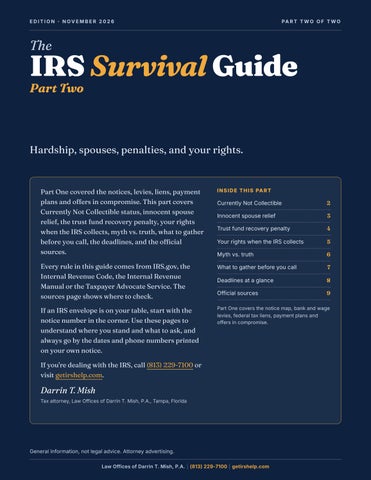
IRS Survival Guide Part Two
Hardship, spouses, penalties, and your rights.
Part One covered the notices, levies, liens, payment
INSIDE THIS PART
plans and offers in compromise. This part covers
Currently Not Collectible
2
Currently Not Collectible status, innocent spouse
Innocent spouse relief
3
Trust fund recovery penalty
4
before you call, the deadlines, and the official
Your rights when the IRS collects
5
sources.
Myth vs. truth
6
Every rule in this guide comes from IRS.gov, the
What to gather before you call
7
Internal Revenue Code, the Internal Revenue
Deadlines at a glance
8
Official sources
9
relief, the trust fund recovery penalty, your rights when the IRS collects, myth vs. truth, what to gather
Manual or the Taxpayer Advocate Service. The sources page shows where to check. If an IRS envelope is on your table, start with the notice number in the corner. Use these pages to
Part One covers the notice map, bank and wage levies, federal tax liens, payment plans and offers in compromise.
understand where you stand and what to ask, and always go by the dates and phone numbers printed on your own notice. If you're dealing with the IRS, call (813) 229-7100 or visit getirshelp.com.
Darrin T. Mish Tax attorney, Law Offices of Darrin T. Mish, P.A., Tampa, Florida
General information, not legal advice. Attorney advertising. Law Offices of Darrin T. Mish, P.A. | (813) 229-7100 | getirshelp.com
06
C U R R E N T LY N OT C O L L E C T I B L E
A pause, not a pardon If you can't pay because of financial hardship, the IRS may temporarily delay collection until your situation improves. It calls this Currently Not Collectible status, or CNC. WHAT CNC DOES
WHAT CNC DOESN'T DO
Temporarily suspends most collection activity. Gives you time while your finances are reviewed and improve.
It doesn't forgive or cancel the debt. You still owe the full amount. Penalties and interest keep accruing until you pay in full.
While your account is in CNC, the IRS may Review your finances again later. Resume collection if your ability to pay improves. File a Notice of Federal Tax Lien. Apply your federal tax refunds to the debt. How to ask for it Call 800-829-1040 or the number on your bill or notice. Expect the IRS to ask about your finances, possibly on Form 433-F, 433-A or 433-B, and for documents showing your income, monthly living expenses, bank accounts, property and other assets. CNC and your other options CNC is one of several ways the IRS handles a balance you can't pay right now, along with payment plans and offers in compromise (Part One). Which one fits depends on your finances, and the IRS makes the call.
0
dollars of the balance forgiven by CNC
The full balance stays on the books, and interest and penalties keep running.
"Collection pauses. The debt doesn't." Sources: IRS, Temporarily delay the collection process; IRM 5.16.1. Checked Nov. 14, 2026.
Three ways the IRS handles a balance you can't pay in full
2
PAYMENT PLAN
OFFER IN COMPROMISE
CURRENTLY NOT COLLECTIBLE
The balance
Paid over time
Settled for less, if the IRS accepts
Still owed in full
Collection
Levy generally barred while a request is pending, with exceptions
Lien generally released within 45 days after the final offer payment is received and verified
Most collection paused; may resume
Law Offices of Darrin T. Mish, P.A. | (813) 229-7100 | getirshelp.com
General information, not legal advice. Attorney advertising.
07
INNOCENT SPOUSE RELIEF
When a joint return wasn't your doing Sign a joint return and you're both responsible for the tax, interest and penalties, even after a divorce. Relief exists for spouses who didn't know about the errors.
Joint responsibility holds even if you later divorce, if a divorce decree says your spouse is responsible, or if your spouse earned all the income. Innocent spouse relief can relieve you from paying additional tax when your spouse understated the tax on your joint return and you didn't know about the errors, such as unreported income, incorrect deductions or credits, or incorrect values for assets. Innocent spouse relief For understated tax caused by your spouse's errors, such as unreported income or improper deductions, when you didn't know and had no reason to know about them.
Separation of liability If you're divorced, separated or no longer living with your spouse, you may be able to pay only your share of the understated tax.
One form covers all three File Form 8857. You don't have to pick a type. The IRS considers your information and applies whatever relief, if any, you qualify for. It will also contact your spouse or former spouse to ask if they want to take part. What it doesn't cover
The IRS says innocent spouse relief doesn't cover tax on your own income, household employment taxes, individual shared responsibility payments, business taxes or trust fund recovery penalties. Innocent spouse relief also isn't available if you knew about the errors, or a reasonable person in your position would have known. For separation of liability, only actual knowledge counts against you (IRC § 6015(c)(3)(C)). The IRS makes an exception for victims of domestic abuse who didn't challenge the return out of fear or signed it under pressure or threat.
Years that are off the table
Equitable relief If you don't qualify for the other two, relief may be possible if it would be unfair to hold you responsible based on all the facts.
THE CLOCKS
2
years, generally, after the IRS first tries to collect the tax from you, to request innocent spouse relief or separation of liability. Don't wait: the IRS says to ask as soon as you learn of the taxes due. Equitable relief has its own time limits, explained in the Form 8857 instructions.
30
days from the determination letter to appeal A Tax Court petition is due within 90 days after the IRS mails its final determination letter (IRC § 6015(e)). The IRS says its review may take 6 months or longer. Keep filing and paying your taxes while you wait.
Any year where you signed an offer in compromise or a closing agreement covering the same taxes, a court made a final decision denying relief, or you took part in a related court case and didn't ask for relief.
Sources: IRS, Innocent spouse relief; Instructions for Form 8857; IRC § 6015. Checked Nov. 14, 2026.
3
General information, not legal advice. Attorney advertising.
Law Offices of Darrin T. Mish, P.A. | (813) 229-7100 | getirshelp.com
08
T R U S T F U N D R E C OV E RY P E N A LT Y
When payroll taxes become personal Taxes withheld from employees' pay belong to the government from day one. If a business doesn't pay them over, the IRS can come after the people responsible. 1
2
3
4
5
Withheld Income tax and the employee share of Social Security and Medicare come out of pay.
Not paid The money isn't deposited, and the IRS can't immediately collect from the business.
Interview The IRS may interview you about your duties and authority.
Letter A proposed assessment. You have 60 days to appeal (75 if mailed outside the U.S.).
Personal Once assessed, a lien, levy or seizure can reach your personal assets.
Why "trust fund" Withheld income and employment taxes, and collected excise taxes, are called trust fund taxes because the business holds that money in trust until it makes the deposit. The penalty can be assessed even if the business is still operating. Who can owe it Any person who is responsible for collecting or paying these taxes and willfully fails to. Responsible means having the duty and the power to direct the collecting, accounting and paying of the taxes. That can include officers or employees of a corporation, partners, directors, shareholders, nonprofit board members, payroll service providers, and anyone else with authority over how funds are spent. Willful means you knew, or should have known, about the unpaid taxes and either intentionally disregarded the law or were plainly indifferent to it. The IRS treats paying other creditors instead of the payroll taxes as a sign of willfulness. How much The penalty equals the unpaid trust fund tax: the income tax withheld plus the employee's share of FICA. For collected excise taxes, it's the unpaid amount collected.
4
Law Offices of Darrin T. Mish, P.A. | (813) 229-7100 | getirshelp.com
"If you sign the checks and decide who gets paid, that can include you." NOT EVERYONE WHO PAYS THE BILLS
The IRS says an employee whose job was only to pay bills as a superior directed, rather than to decide which creditors got paid, isn't a responsible person.
READ NEXT
IRS Notice 784, Could You Be Personally Liable for Certain Unpaid Federal Taxes?, and Publication 5 on appeal rights. Sources: IRS, Employment taxes and the Trust Fund Recovery Penalty; IRC § 6672(a). Checked Nov. 14, 2026.
General information, not legal advice. Attorney advertising.
09
YO U R R I G H T S
Your rights when the IRS comes to collect Before most levies, the IRS generally has to send a final notice and offer you a hearing at least 30 days ahead (IRC § 6330). After a levy, the law spells out when it must be released. The IRS is required to release a levy if it determines that
1
You paid the amount you owe.
2
3
Releasing the levy will help you pay your taxes.
entered an installment agreement whose 4 You terms don't allow the levy to continue.
5
The levy is creating an economic hardship.
property is worth more than you owe, and 6 The releasing it won't hurt the IRS's ability to collect.
The period for collection ended before the levy was issued.
A release doesn't mean you no longer owe. If you don't make arrangements, the levy can be reissued. If the IRS denies a release, you can appeal (Publication 1660), and in certain situations you can ask to have levied property or proceeds returned.
Two kinds of appeal CDP
CAP
Collection Due Process hearing
Collection Appeals Program
Offered with the final levy notices (LT11, Letter 1058, CP90) and the lien filing notice (Letter 3172). Request it on Form 12153 by the deadline on the notice. A CDP hearing before the IRS Independent Office of Appeals is your chance to challenge the levy or lien and raise other issues, such as payment options. Miss the lien hearing deadline and you may still get an equivalent hearing within one year, generally without the right to go to Tax Court.
CP501, CP503 and CP504 say you may request a CAP appeal before collection action by following the notice's instructions. Form 9423 is the Collection Appeal Request. FREE HELP The Taxpayer Advocate Service is an independent organization within the IRS: 877-777-4778, taxpayeradvocate.irs.gov. You may also qualify for a Low Income Taxpayer Clinic. Publication 1 lists your rights as a taxpayer.
Sources: IRS, How do I get a levy released?; IRC §§ 6330, 6343; IRS CDP FAQs; IRS notice pages for CP90 and CP501–CP504; TAS, Letter 3172; IRS, Understanding a federal tax lien; Publication 1660. Checked Nov. 14, 2026.
5
Law Offices of Darrin T. Mish, P.A. | (813) 229-7100 | getirshelp.com
General information, not legal advice. Attorney advertising.
10
MYTH VS. TRUTH
Eight IRS myths, checked against the rules MYTH
MYTH
"An extension gives me more time to pay."
"The IRS can empty my bank account without warning."
TRUTH
It's more time to file, not to pay. Interest and the failureto-pay penalty start at the April deadline. Pay what you can with the extension.
TRUTH
IRS, Get an extension to file your tax return
IRC § 6330(a), exceptions in § 6330(f)
MYTH
MYTH
"Only the business owner is on the hook for unpaid payroll taxes."
"Unfiled years only matter if I owe for them."
TRUTH
The IRS generally won't approve a payment plan or an offer in compromise until all your required returns are filed. Filing comes first.
IRC § 6672(a); IRS TFRP page
IRS, Payment plans; Form 656-B
MYTH
MYTH
"Currently Not Collectible means the debt is gone."
"Once the levy is released, I'm in the clear."
TRUTH
A release doesn't mean you don't have to pay. Without arrangements, the IRS can levy again.
IRS, Temporarily delay the collection process
IRS, How do I get a levy released?
MYTH
MYTH
TRUTH
TRUTH
IRS, Innocent spouse relief
IRS, Understanding your CP2000 series notice
The trust fund recovery penalty can reach any responsible person who willfully didn't pay. If you sign the checks and decide who gets paid, that can include you.
CNC pauses most collection. You still owe the full amount, and penalties and interest keep accruing.
"My divorce decree says my ex owes it, so I don't."
On a joint return, you're both responsible even if a divorce decree says otherwise. Innocent spouse relief is the IRS route for getting out from under your spouse's errors.
6
Generally, the IRS has to send a final notice of intent to levy and offer you a hearing at least 30 days first. There are exceptions, so don't let that window pass.
TRUTH
TRUTH
"A CP2000 is a bill, so I just have to pay it."
A CP2000 proposes changes and isn't a bill. You can agree or disagree, with documents, by the date on the notice.
Law Offices of Darrin T. Mish, P.A. | (813) 229-7100 | getirshelp.com
General information, not legal advice. Attorney advertising.
11
CHECKLIST
What to gather before you call the IRS The IRS will ask about your finances, and some fixes depend on how fast you can answer. Pull these together first. A · THE PAPERWORK IN FRONT OF YOU
C · IF YOU'VE BEEN LEVIED
Every IRS notice you've received, especially the newest. Note the notice number, the date, the deadline and the phone number printed on it.
Your bank's or employer's fax number, so the IRS can send a release quickly. Your Statement of Dependents and Filing Status, returned to your employer within three days.
The levy forms, if any: Form 668-A for a bank, Form 668-W for wages, and Publication 1494.
A court order for child support, if it was in place before the wage levy.
Copies of your tax returns, and a list of any years you haven't filed. Payment plans and offers generally require all returns to be filed.
Proof the money belongs to someone else, if the levied account isn't really yours.
Form 2848, if you want someone else to speak to the IRS for you.
Proof of full payment, if the IRS levied after you'd paid. Form 8546 covers bank fees from an IRS error.
B · YOUR MONEY PICTURE
Proof of income: recent pay stubs and other income records. Monthly living expenses: housing, utilities, food, transportation, health care. Bank account statements. Property and other assets: vehicles, real estate, retirement and investment accounts.
7
FORMS THE IRS MAY ASK FOR
Form 433-F, 433-A or 433-B, its collection information statements. Simple Payment Plans don't require one. Sources: IRS pages on bank levies, wage levies, levy hardship, CNC, payment plans and CP2000; Form 656-B. Checked Nov. 14, 2026.
Law Offices of Darrin T. Mish, P.A. | (813) 229-7100 | getirshelp.com
General information, not legal advice. Attorney advertising.
12
DEADLINES
Deadlines at a glance The clocks that start when the IRS acts. Your own notice controls. If its date differs from this page, go by the notice.
21
3
30
The bank waits 21 days after the levy before sending frozen funds. IRC § 6332(c).
Return the Statement of Dependents and Filing Status to your employer.
If unpaid 30 days from the notice date, the IRS can levy your state tax refund.
days Bank levy hold
days Wage levy form
days After a CP504
30
30
1
The IRS generally must send a final notice with hearing rights at least 30 days ahead. IRC § 6330.
The IRS CDP FAQs give 30 days for LT11, Letter 1058 and Letter 3172. Use the deadline printed on yours.
Missed the Letter 3172 deadline? You may request an equivalent hearing within one year of the notice date.
days Before a first levy
days CDP hearing request
year Equivalent hearing (lien)
30
180
60
Contact the IRS no later than 30 days from the notice date about reinstatement. Pay before the termination date.
Pay in full within 180 days or less, with no setup fee.
Time to appeal a proposed trust fund recovery penalty (75 days if mailed outside the U.S.).
days CP523: plan in default
days Short-term payment plan
days TFRP proposal letter
2
30
April
Generally 2 years after the IRS first tries to collect from you (IRC § 6015(b), (c)). Equitable relief has different limits (Form 8857 instructions).
The IRS releases the lien within 30 days after you pay in full. For an accepted offer: generally 45 days after the final payment is received and verified.
An extension is more time to file, not to pay. Interest and the failure-to-pay penalty start at the April deadline.
years Innocent spouse request
days Lien release after payment
Extensions
Sources: IRS bank and wage levy pages; IRS CP504, CP523 and CP2000 pages; TAS CP504 and Letter 3172; IRS CDP FAQs; IRS payment plans; IRS TFRP page; IRS innocent spouse page and Form 8857 instructions; IRS, Understanding a federal tax lien; Form 656-B; IRS extension page; IRC §§ 6015, 6330, 6332. Checked Nov. 14, 2026.
8
Law Offices of Darrin T. Mish, P.A. | (813) 229-7100 | getirshelp.com
General information, not legal advice. Attorney advertising.
13
OFFICIAL SOURCES
Check it yourself Every rule in this guide comes from these official pages, checked November 14, 2026. Rules and fees change, so check the current version before you act. IRS.GOV: COLLECTION AND NOTICES Understanding your CP14, CP501, CP503, CP504, CP90, CP523 and CP2000 notices
Online payment agreement
Understanding your CP3219A notice
Instructions for Form 9465
Understanding your LT11 notice or Letter 1058
Offer in compromise
Sample Letter 3172
Form 656-B, Offer in Compromise booklet (Rev. 4-2026)
Collection Due Process FAQs
Topic 204, Offers in compromise
Information about bank levies
Innocent spouse relief
irs.gov/individuals/understanding-your-cp504-notice (same pattern for each) irs.gov/individuals/understanding-your-cp3219a-notice irs.gov/individuals/understanding-your-lt11-notice-or-letter-1058 irs.gov/pub/notices/ltr3172_english.pdf irs.gov/appeals/collection-due-process-cdp-faqs irs.gov/businesses/small-businesses-self-employed/information-about -bank-levies
Information about wage levies
irs.gov/businesses/small-businesses-self-employed/information-about -wage-levies
What if a levy is causing a hardship?
irs.gov/businesses/small-businesses-self-employed/what-if-a-levy-iscausing-a-hardship
How do I get a levy released?
irs.gov/payments/online-payment-agreement-application
Simple payment plans
irs.gov/payments/simple-payment-plans-for-individuals-and-business es irs.gov/instructions/i9465
irs.gov/payments/offer-in-compromise irs.gov/pub/irs-pdf/f656b.pdf irs.gov/taxtopics/tc204
irs.gov/individuals/innocent-spouse-relief
Instructions for Form 8857 irs.gov/instructions/i8857
Employment taxes and the Trust Fund Recovery Penalty
irs.gov/businesses/small-businesses-self-employed/employment-taxe s-and-the-trust-fund-recovery-penalty-tfrp
Get an extension to file your tax return
irs.gov/filing/get-an-extension-to-file-your-tax-return
irs.gov/businesses/small-businesses-self-employed/how-do-i-get-a-le vy-released
INTERNAL REVENUE MANUAL IRM 5.11.2, Notice of levy (hardship release)
irs.gov/businesses/small-businesses-self-employed/whats-the-differe nce-between-a-levy-and-a-lien
IRM 5.14.1, Installment agreements (user fees)
What's the difference between a levy and a lien? Understanding a federal tax lien
irs.gov/businesses/small-businesses-self-employed/understanding-a-f ederal-tax-lien
Temporarily delay the collection process (CNC)
irs.gov/businesses/small-businesses-self-employed/temporarily-delaythe-collection-process
Publication 594, The IRS Collection Process
irs.gov/irm/part5/irm_05-011-002
irs.gov/irm/part5/irm_05-014-001r
IRM 5.16.1, Currently not collectible irs.gov/irm/part5/irm_05-016-001r
INTERNAL REVENUE CODE (TITLE 26) § 6015 innocent spouse · § 6213 Tax Court window · § 6320 lien hearing · § 6330 levy hearing · § 6331 levy · § 6332 bank 21day hold · § 6343 levy release · § 6672 TFRP
irs.gov/pub/irs-pdf/p594.pdf
govinfo.gov/link/uscode/26/6330 (change the section number)
irs.gov/forms-pubs
TAXPAYER ADVOCATE SERVICE Notice CP504 and Letter 3172 explainers
Publication 1494 · Publication 1660 · Publication 1
IRS.GOV: PAYING AND RELIEF Payment plans (installment agreements)
irs.gov/payments/payment-plans-installment-agreements
9
taxpayeradvocate.irs.gov/notices
Get help: 877-777-4778 taxpayeradvocate.irs.gov
Law Offices of Darrin T. Mish, P.A. | (813) 229-7100 | getirshelp.com
General information, not legal advice. Attorney advertising.
T H E I R S S U R V I VA L G U I D E
PA R T T W O O F T W O
Law Offices of Darrin T. Mish, P.A. TA M PA , F L O R I D A · I R S TA X P R O B L E M S
ADDRESS
15421 N Florida Ave Suite A Tampa, FL 33613
PHONE
(813) 229-7100 WEBSITE
getirshelp.com
Levies, liens, payment plans, offers in compromise, innocent spouse relief and trust fund penalties.
General information, not legal advice. Attorney advertising.
Reading this guide does not create an attorney-client relationship. No particular result is promised. Fees and rules shown were checked on IRS.gov on November 14, 2026, and can change.