M E D I A , B R O A D C A S T & I N S TA L L AT I O N
TM
Broadcast
I N T E R N A T I O N A L
M E D I A , B R O A D C A S T & I N S TA L L AT I O N
TM
Formula 1 Broadcast
I N T E R N A T I O N A L
TM Broadcast International #158 October 2026
M E D I A , B R O A D C A S T & I N S TA L L AT I O N
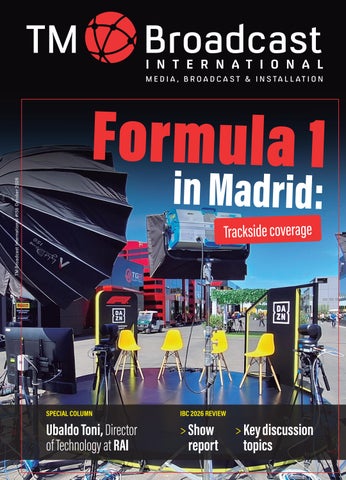
inMadrid: Tracksidecoverage
SPECIAL COLUMN
IBC2026 REVIEW
UbaldoToni, Director of Technologyat RAI
> Show report
> Keydiscussion topics
EDITORIAL IBC 2026: Some conclusions
and, above all, converge. Software, IP, cloud and
IBC 2026 closed its doors last September after bringing together 41,225 audiovisual industry professionals in Amsterdam. This represents a 6% decrease compared with the 43,858 attendees recorded in 2025 and confirms, for the second consecutive year, a slight downward trend in attendance.
artificial intelligence can no longer be understood as independent developments. The transition towards software-defined infrastructures requires increasingly interoperable, multivendor environments. At the same time, more distributed architectures demand greater attention to maintaining control over content and workflows.
But beyond the numbers, each edition of IBC also provides an opportunity to take the pulse of an industry in constant transformation. And after walking the show floor and speaking with different players across the sector, our impression is that many of the trends that shaped this year’s edition point in the same direction: connecting, simplifying and unifying.
There is another consequence of this evolution that was particularly visible in Amsterdam: the need for simplification. Audiovisual infrastructures are becoming increasingly sophisticated, but those interacting with them do not necessarily fit the traditional profile of a specialised broadcast engineer. More intuitive interfaces, task automation
The major technological drivers of recent years
and reduced operational complexity were therefore
remain firmly in place. The transition towards
recurring themes among the new solutions
software continues to accelerate; there now
presented at the show.
appears to be broad consensus across the industry around IP; software and cloud continue to enable more flexible and distributed production models; and artificial intelligence is becoming increasingly pervasive, integrated directly into production workflows.
The audiovisual industry has spent much of the past few years multiplying possibilities: more platforms, more formats, more destinations, more tools, more ways to produce and distribute content. IBC 2026 leaves the impression that a different phase is now beginning. After years of fragmentation, the challenge
But perhaps the most interesting development is
is to reconnect all these pieces and make them work
what happens as all these transformations mature
together as a whole.
Editor in chief Javier de Martín
editor@tmbroadcast.com
Director Daniel Esparza
press@tmbroadcast.com
Editorial Staff Bárbara Ausín Carlos Serrano Key account manager Patricia Pérez ppt@tmbroadcast.com
Graphic Design and Layout Sorex Media Ana Guijarro
TM Broadcast International #158 October 2026
Administration Laura de Diego
administration@tmbroadcast.com
Published in Spain ISSN: 2659-5966
TM Broadcast International is a magazine published by Daró Media Group SL Centro Empresarial Tartessos Calle Pollensa 2, oficina 14 28290 Las Rozas (Madrid), Spain Phone +34 91 640 46 43
SUMMARY 6
News
16
OPINION Ubaldo Toni, RAI
20
Richard Jonker, NETGEAR
IBC 2026
Report from the show: Connecting, simplifying and unifying Everyone experiences the show from a different perspective and probably leaves with different conclusions. Ours, with the aim of providing a broad view across the industry, is that many of the trends that shaped IBC 2026 point in the same direction: connecting, simplifying and unifying.
26
Key discussion topics: A familiar conversation, told differently 41,225 attendees, four days, and an industry redefining what it means to be part of it. TM BROADCAST brings together around 20 exhibitors to discuss this year’s key industry topics.
4
40
MAJOR EVENTS
Formula 1 Madrid GP: trackside coverage in a completely new environment The new Madring circuit marked a double debut: a new Grand Prix in Spain and a completely new track. As a result, broadcast services company TBS deployed a special operation as part of the technical service it provides to DAZN for its F1 coverage. The operation strengthened on-site production, with a mobile studio through the streets of Madrid and new spaces at the circuit itself.
52
Silvia Moreno, Head of Production at DAZN Spain: “For this Grand Prix, our deployment tripled and we produced 50% more live coverage”.
5
NEWS
BBC Sport expands its XR production capabilities with a new LED studio upgrade To try to create an immersive look and feel in the studio, the investment extends to the studio floor where ROE Visual Black Marble BM2 LED panels are integrated. “Moving into a smaller studio space meant we needed a more creative approach to how we use LED”, explains John Murphy, BBC Sport Design Director.
BBC Sport has announced a major infrastructure upgrade at its Media City hub service studio in Salford, investing in ROE Visual’s Ruby RB1.5 wall panels and Black Marble BM2 LED flooring. The acquisition marks an expansion of a collaborative pipeline that includes graphics specialist AE Live, Megapixel, and ROE Visual, as the company has claimed in a statement. The transition goes from traditional green-screen environments to LED-powered Extended Reality (XR) volumes. Following their technical execution during UEFA Euro 2024 and the full-LED XR environment deployed for the FIFA World Cup 2026 coverage, BBC Sport and Media City aim to offer iconic programming, including Match of the Day. Demands of the compact studio The decision to invest in the Ruby RB1.5 (1.5mm pixel pitch) and the Black Marble BM2 floor panels
6
directly answers the physical and creative shifts occurring in studio design. › Shrinking Footprints: Modern studio trends favor smaller physical footprints, but they still need to deliver that big, immersive ‘wow factor’. Surrounding a compact set with an intricate VR/XR environment looks forward to allowing production teams to deliver an incredibly vast, dynamic space out of a limited area. › Camera Proximity without Pixelation: In a smaller studio, cameras must inevitably operate close to the backdrop. To avoid visible pixelation or screen structure when captured at close range, there is a spot where the 1.5 mm pitch of the Ruby series eliminates this barrier, providing a smooth, “video-like” environment. Presenters can stand directly against the screen while maintaining flawless visual integrity on camera.
“For this permanent installation, the BM2 panels have been customized with a bespoke surface finish — a first for the glossy BM2 — developed in close collaboration with the ROE Visual team. By combining a premium XR technology backbone with set extension, high-end graphics and fast metadata exchange, we can create a much larger visual environment from a more compact footprint”. He continues: “ROE Visual stood out from the start. It’s not just about the panels — it’s about the partnership. They understood our creative ambition, they were agile in developing the custom BM2 finish we needed, and they worked alongside us to engineer a workflow that delivers. That level of collaboration is rare in this industry”. “The result is a studio that doesn’t feel compact — it feels expansive, immersive, and completely future-proof. ROE Visual’s agility and development expertise were key to making that concept work”.
NEWS
7
NEWS
RTL and Sky to cut 500 jobs following their integration in Germany place in 2026, while the process will be completed in 2027, RTL Deutschland has confirmed to several German media outlets. “The workforce reduction will be carried out in a socially responsible manner, in close coordination with the relevant As part of the integration process between RTL Deutschland and Sky Deutschland, both companies plan to eliminate around 500 jobs in Germany by the end of 2027. The majority of these job cuts are expected to take
works councils”, the company shares. The process will also involve “not renewing contracts that are coming to an end and not filling vacant positions”, with the aim of avoiding redundancies for operational reasons.
The German press puts the number of positions that will disappear through expiring contracts that will not be renewed and vacant positions that will not be filled at around 150. The reduction comes as part of the integration of Sky Deutschland into RTL Group, following the acquisition completed on 1 June. The company expects to generate around €250 million in annual synergies over the three years following the completion of the transaction.
Channel 4 to cut 28% of its workforce as part of transformation strategy Channel 4 Chief Executive Priya Dogra has launched the first stage of the broadcaster’s long-term transformation strategy. This initial phase focuses on creating a simpler, more efficient operating model that will allow the broadcaster to deliver these strategic goals, as the company has claimed in a statement. The renewal shares proposals for a new organisational design, looking forward to creating a simpler, more focused organisation that directs a greater proportion of its revenues towards distinctive British content.
8
Work on Channel 4’s future strategic direction is well advanced and will be shared in the coming months. At its heart, the theme of the transformation is ‘owning our future’: with the idea of reshaping how the broadcaster reaches audiences through distribution, partnerships and platforms; enabling greater investment in distinctive programmes that set Channel 4 apart; and ensuring resources are allocated to maximise long-term value, sustainability and public impact. Earlier this year, Channel 4 began a comprehensive review of the
shape, size and structure of the organisation. The review took place against the backdrop of a rapidly changing media landscape, including evolving audience habits, increasing global competition, a challenging consumer environment and a volatile advertising market. These trends continue to place pressure on commissioning budgets and reinforce the need for fundamental change in how the organisation operates.
NEWS
Lithuanian television group LNK Group migrates its broadcasting operations to a software-defined infrastructure LNK Group, one of Lithuania’s commercial television groups, has moved playout and media management for its five national television networks to Grass Valley’s AMPP Media Operating System. This completes its project to introduce software-defined operations alongside its transition to SMPTE ST 2110, as Grass Valley has claimed in a statement. The deployment covers LNK, BTV, TV1, InfoTV and 2TV, replacing LNK’s legacy playout environment
with Playout X and Framelight X running on AMPP Local at its Vilnius facility. Delivered by Hannu Pro, Grass Valley’s partner in the Baltic region and a certified AMPP Managed Service Partner, the project combines an on-premises primary system with cloud-based disaster recovery.
required the reliability and operational resilience of national television playout, with greater flexibility to develop services and workflows.
LNK selected the Grass Valley solution as part of a wider upgrade of its broadcast infrastructure. The broadcaster
9
NEWS
Grup Mediapro changes its name and will become Imagina from 2027 Grup Mediapro has announced that, as of January 1, 2027, the group will be renamed Imagina. The change brings back one of the names the group has used throughout its history and is intended to express its willingness to look to the future while keeping its past firmly in mind, as the company has claimed in a state,emt. Mediapro will also present Espai Imagina, its new immersive experiences centre in Barcelona, on September 21. Its inaugural exhibition, ‘Codi Gaudí, la experiencia inédita’, will allow visitors to discover buildings envisioned by Antoni Gaudí that were never built. The group will subsequently bring this experience to different cities around the world. Group restructuring Sergio Oslé, executive chairman of Mediapro, and Carlos Núñez, CEO, announced at an internal meeting with all company employees that, following several months of restructuring, the group has returned to a growth trajectory. The immediate priority is to drive new projects that create unique experiences for audiences worldwide and finance this growth with resources generated by the company itself, which will amount to more than €100 million over the next three years.
10
HBS appoints Ronald den Hollander as new CEO Infront has announced the appointment of Ronald den Hollander as CEO of its Host Broadcast Services (HBS) subsidiary, effective 1 October 2026. The appointment follows the previously announced decision of Dan Miodownik, CEO of HBS, and Luc-Antoine Charial, COO of HBS, to resign from their respective roles following the delivery of key 2026 projects, including the host broadcast of the FIFA World Cup 2026, the US Open and the inaugural World Athletics Ultimate Championship, as it has claimed in a statement. Den Hollander will step up from his current position as HBS Director of Broadcast Sites, Operations & Services and assume overall responsibility for the strategic direction, operational delivery, innovation and continued growth of HBS and its affiliated production businesses. Den Hollander has been with HBS for more than 20 years and has served on the HBS Executive Management Team for almost a decade. Since 2024, he has been HBS Director of Broadcast Sites, Operations & Services. He has played a leading role in the delivery of some of the world’s largest sporting events, including five editions of the FIFA World Cup, several editions of UEFA EURO and various Asian Games. Since joining HBS in 2005, he has held senior roles spanning construction, venue management and broadcast infrastructure, including the design, delivery and operation of complex international broadcast centres and facilities. Philippe Blatter, President & CEO of Infront, shares: “Following an extensive succession process, we are delighted to appoint Ronald den Hollander to lead HBS into its next phase of development. HBS stands as one of the most capable host broadcast organisations in the world, built on a remarkable legacy of excellence, innovation and operational execution. With more than two decades of experience at the intersection of sport, broadcasting and event operations.
NEWS
The EBU strengthens its sports portfolio by renewing exclusive biathlon rights until 2034 The European Broadcasting Union (EBU) and the International Biathlon Union (IBU) have extended their exclusive media rights and production partnership offer fans access to the world’s best biathletes across EBU Members’ and partner services until 2034. The new agreement takes a partnership that began in 1993 into its fifth decade, as the organisation has claimed in a statement. The renewal is part of the EBU’s strategy to maintain a broad
portfolio of sports rights for its members, including disciplines with less media coverage than major football competitions. In recent years, the organisation has extended its agreements with European Athletics until 2031 and with the UCI for its major World Championships, also until 2031, while its partnership with World Rowing includes rights through to 2032. These are complemented by agreements covering sports such as gymnastics and aquatics.
The extension covers the period from the 2030/31 season to the end of the 2033/34 season, building on the current agreement, which runs until 2030.
Image: Courtesy of IBU
11
NEWS
The end of the one-size-fits-all front page? The Washington Post develops a system that adapts the news experience to each reader Arc XP, the media technology platform developed within The Washington Post, has launched Arc XP Compass, a personalization engine for news homepages and section landing pages. The new solution is designed to distinguish between returning readers and first-time visitors, remember what each user has recently read, and reorganize the page accordingly, as it has claimed in a statement. Arc XP Compass is designed to tailor the experience for each reader while keeping editorial priorities in the hands of editors. Newsrooms can therefore determine which stories take the lead, while the platform adapts the rest of the page based on each user’s behavior and reading history. One of the solution’s features is ‘Catch Me Up’. For example, if a reader follows the initial evacuation orders during a wildfire and then stops checking the news for three days, Compass can identify where they stopped reading and, upon their return, show them a chronological summary of the key developments that took place during their absence. This content is generated from reporting produced by the newsroom itself rather than through automated
12
summarization. A first-time visitor to the site does not receive this personalized experience. Updates related to the same story are also brought together into a single narrative through what Arc XP calls ‘dynamic timelines’, rather than being spread across numerous separate links. Editors retain control over this experience through prioritization tools that allow them to pin, highlight, or deprioritize any story directly, ensuring that personalization remains aligned with the newsroom’s editorial judgment. News consumption The solution comes in response to changing news consumption habits. According to the Reuters Institute for the Study of Journalism’s Digital News Report 2026, social media and video platforms have now overtaken news organizations’ own websites and apps as the most common way of accessing news. These platforms are used by 54% of respondents across 48 markets, compared with 51% who use news organizations’ own websites and apps. The trend is particularly pronounced among younger audiences. Among 18- to 24-year-olds, 52% now identify social media, video platforms,
or AI chatbots as their main source of news, 32 percentage points ahead of the next source. News organizations’ own websites and apps are no longer the main source of news for any age group globally. The use of artificial intelligence is also changing how audiences access news. Globally, 10% of users turned to a standalone AI chatbot for news in the previous week, up from 7% a year earlier. Among those under 35, the figure rises to 16%. Referral traffic is also proving vulnerable: traffic from Google Discover to Reach, the UK’s largest commercial news publisher, fell by 46% in the second half of 2025, according to data the company shared with investors. Against this backdrop, Arc XP describes ‘adaptive discovery’ as an approach that enables media organizations to make use of their direct relationship with readers and the archive of content produced by their own newsrooms. The company notes that global trust in answers provided by AI chatbots stands at 20%, compared with 37% for news in general.
NEWS
AIMS certifies 14 IPMX products from eight manufacturers The Alliance for IP Media Solutions (AIMS) has announced the results of its second IPMX Product Certification Test Event, held August 24 through 28 at European Broadcasting Union (EBU) headquarters in Geneva, Switzerland. Eight manufacturers submitted fourteen products for testing, and all fourteen were officially certified to the Internet Protocol Media Experience (IPMX) standard, as the organization has claimed in a statement. The EBU serves as the independent certification authority for IPMX and
conducted the testing at its Geneva facility, while AIMS administers the certification program overall. This event, the second since the program’s inaugural session in January 2026 that certified 48 products from 10 manufacturers, was open to AIMS, VSF and AMWA member companies. Its objective is to continue the shift from informal plugfests to a formal, repeatable certification process, giving integrators and end users an independent basis for verifying IPMX interoperability.
Following testing, solutions from Bridge Technologies, Cobalt Digital, EvertzAV, ITDev, intoPIX, Matrox Video, Macnica, and PlexusAV successfully passed certification. Testing covered the baseline IPMX requirements along with uncompressed video and audio, the JPEG XS profile, the JPEG XS TDC profile mode, and the HKEP and PEP capabilities.
13
NEWS
CNN Creators unveils new Doha facility for multiplatform production CNN’s multiplatform programming initiative, CNN Creators, unveils its new facility within Media City Qatar, in Doha. The new space looks forward to opening up the full range of production capabilities for CNN Creators, which has been broadcast from a temporary facility since its launch in October 2025, as the media company has claimed in a statement. The new studio is designed to offer a host of possibilities for the show’s multiplatform team to explore, combining a studio, newsroom and production center into one space – all of which will be in front of the camera. Meara Erdozain, SVP of International Programming at CNN, explains: “CNN Creators is unlike any programming initiative CNN has ever produced and we wanted to create a fluid space that would allow the team complete flexibility to experiment and innovate. It’s a space where conversations and ideas can be captured in real time, delivering on the multiplatform concept of CNN Creators with a live show at its heart. It also reflects the dynamism of a newsroom environment, allowing us to capture real conversations and spontaneity, and give a sense of a genuine interaction with our audience”. The infrastructure uses multiple, remotely operated cameras suspended from a
14
ceiling track, with the intention of giving a 360 degree, constantly moving perspective of the Creator environment. The control room system allows the team to broadcast vertically and horizontally, which will enable both live streaming and linear broadcasts at any time. Andrew Potter, Executive Producer of CNN Creators, shares: “From the very beginning our vision for CNN Creators has been to explore presentation techniques and styles that show the evolution of a story from start to finish, and present those in new ways. This space supercharges that capability,
so we can really start having some fun breaking down those boundaries”. Erdozain adds: “The beauty of this space is that the way we use it will continue to evolve from week to week, month to month, allowing the characters to grow within their new ecosystem. The idea is that we can continue to experiment and surprise our audiences each week. A focal point of the studio is the kitchen area – the heart of every home – where open and real conversations happen around the world, connecting with everyone at the table and beyond”.
NEWS
Commercial production caught in the dispute between advertising giant WPP and independent companies Advertising giant WPP Production has sent new guidelines to its more than 10,000 employees across 43 cities, setting out the approach they are expected to follow from now on. WPP’s stated objective is to “avoid the traditional triple-bid process” and position WPP Production as the “default trusted partner.” The instructions are as follows: 1. C over all three bids themselves. If a client requests a three-way bid for comparison purposes, WPP Production should consider submitting all three proposals itself — changing only the approach, location or director — while ensuring that the work never leaves the company. 2. P ut pressure on procurement departments. When dealing with a client’s Procurement teams, employees are asked to actively persuade them to assign all production work directly to WPP, or at least establish a threshold below which a competitive tender would not be required (for example, any project worth
less than €500,000 would go directly to WPP). 3. If the client still asks to compare WPP with external production companies, there are two options: › Get ahead of the process by submitting WPP’s own proposal first (budget, approach and directors), in an attempt to close the deal before the comparison is launched. › If the client insists on proceeding with an external comparison, participate only with a guaranteed advantage: the client receives WPP’s proposal first, external companies receive the same brief afterwards, and they are informed that WPP has already submitted its proposal. The entire process is documented with dates. The alternative is to decline to participate in the external bid and instead negotiate with the client in parallel to convince them of the savings associated with centralising the work with WPP.
However, the move by the advertising giant has not come as a surprise. Last April, production trade associations from Europe (EPA!), the UK (APA) and the US (AICP) brought together a global group of 25 associations to warn advertisers about moves by WPP’s production entities and their potential impact on competition. In their joint letter, the organisations argued that the parent company was seeking to block the usual due-diligence routes used to identify the right creative partners and, in their view, favour the allocation of work within the group itself. The associations’ response Following the publication of the new guidelines, AICP, APA and EPA, which believe the move confirms their previous warnings, have decided to respond to what they describe as “WPP’s blatant attack on the three-bid system for commercial production.” “This poses a serious threat to the free market in commercial production, not only for the independent production companies, editing and post-production businesses that make up the sector, but also for the marketing investments of WPP’s clients, if they fail to recognise and understand this for what it really is: an anticompetitive and self-serving ‘bid’ by their own ‘agencies’ within WPP,” they said.
15
OPINION | RAI
UBALDO TONI
Public service media: A strategic investment for Europe
RAI’s Director of Technology, Ubaldo Toni, provides TM BROADCAST with an insight into the strategy of the Italian broadcaster, whose main projects and investments will be explored by the magazine over the coming months, while also calling for greater cooperation among European public service broadcasters I have been working in the television industry for 37 years, and of all the changes I have witnessed, those of the past few years have undoubtedly been the most significant. European public service broadcasters are the ones facing the greatest challenges. In my view, the most profound change is not simply the emergence of new ways of creating and distributing content. We are well equipped to deal with cross-media production workflows and multi-platform distribution. The real transformation lies in the globalization of content and the overwhelming impact of social media, particularly image-driven platforms such as TikTok and Instagram, alongside the ever-growing offering from global streaming players such as Netflix, Prime Video and Disney+.
16
The former are widely perceived as being completely free, while the latter create the impression that, with relatively inexpensive subscriptions, audiences can access an enormous wealth of entertainment and information. Against this backdrop, the cost of funding public service media is increasingly seen as unjustified. This perception is beginning to shift slightly, however, largely because premium sports rights have become extremely expensive and many major sporting events now require multiple subscriptions—DAZN, Eurosport and Sky in Italy, for example. It is no coincidence that many people in Italy ask why RAI does not broadcast every FIFA World Cup match free-to-air. In an increasingly complex global economic environment, European governments naturally tend to reduce funding for public service broadcasters as much as possible. What is often overlooked is that these organizations—particularly in Italy—are a driving force behind a vast audiovisual industry. They provide trusted national and regional news, while also delivering services that are commercially unprofitable but socially essential, such as programming for minority audiences and people with disabilities. The shortage of resources forces companies such as RAI to place greater emphasis on commercial revenues in order to compensate for declining public funding.
OPINION | RAI
The result is increased advertising, which gives viewers the misleading impression that public service broadcasting is little different from commercial television. Nothing could be further from the truth. Limited financial resources also make it increasingly difficult to maintain the highest technological standards, while continuing to invest in innovation and technical experimentation—areas in which public service broadcasters were leaders until the early 2000s. Fortunately, RAI continues to pursue the highest quality standards, fully aware of its role as one of Italy's leading industrial and cultural institutions. Despite financial constraints, the company continues to make major investments in technology. RAI has launched a long-term industrial plan aimed at modernizing its technology assets and streamlining operational processes. The program involves investments worth several hundred million euros over almost ten years, supported in part by the rationalization of the company's real estate portfolio. The most ambitious initiative already underway is undoubtedly the construction of the new Milan Production Centre. With eight studios across more than 65,000 square metres, it is set to become a new benchmark for technological excellence among European broadcast production facilities. At the same time, RAI is commissioning new studios in Rome, Naples and Turin, while deploying major infrastructure projects to support the complete transition to IP-based production and distribution.
Among these is the complete renewal of its sports production infrastructure based on the latest Avid and EVS technologies. The company also continues to invest in major live productions, above all the Sanremo Music Festival, which grows in scale and technical sophistication every year. As always, TM BROADCAST will provide detailed technical and production coverage of these landmark RAI projects.
RAI has launched a long-term industrial plan aimed at modernizing its technology assets and streamlining operational processes. The program involves investments worth several hundred million euros over almost ten years
Panasonic has secured an agreement covering hundreds of PTZ cameras, while additional contracts have been awarded to many of the industry's leading technology vendors, including Imagine Communications, Riedel, Avid, EVS, FOR-A, Genelec, Sony, Canon and many others
17
OPINION | RAI
Readers will also find updates on several major contracts recently awarded by RAI. Among the most significant is the renewal of its high-end broadcast camera fleet, with Grass Valley replacing Hitachi after 15 years. Panasonic has secured an agreement covering hundreds of PTZ cameras, while additional contracts have been awarded to many of the industry's leading technology vendors, including Imagine Communications, Riedel, Avid, EVS, FOR-A, Genelec, Sony, Canon and many others.
This is not only vital for supporting a strategic industrial sector of sufficient scale to preserve an appropriate degree of technological and operational autonomy in an increasingly uncertain geopolitical landscape. It is equally important to ensure the continued availability of news, information and content that are not driven solely by commercial or profit considerations, but that reflect and strengthen the values, culture and traditions of Europe.
For all these reasons, it remains essential that European governments continue to provide public service broadcasters with adequate and sustainable funding.
RAI is fully committed to this mission, but its success depends on close cooperation and a shared vision among all European public service broadcasters.
18
OPINION | NETGEAR
RICHARD JONKER
One network, three worlds: it's about the solution, not the product
By Richard Jonker, Business Development Manager Enterprise at NETGEAR Broadcast technology has spent decades differentiating itself from everything around it. Enterprise AV and IT have done much the same, but Broadcast overengineered it more thoroughly than most. Now that audio, video, control, and orchestration all move onto IP networks, those old boundaries are becoming commercially unhelpful. Customers across these sectors are not looking for another box. They want a dependable way to transport high-quality video, audio, and data across increasingly complex environments. The industry needs to stop pitching individual products and start solving the complete operational problem. That is where Broadcast leads, through open initiatives like DMF, MXL, NMOS, and BCP008. Organizations want open standards, interoperable systems, and infrastructure that will not lock them into one manufacturer or application. Technologies such as SMPTE ST-2110, IPMX, NDI, Dante, and AES67 emerged from different communities, but they reflect the same demand: move media reliably over IP while preserving choice and optimizing for performance and cost. That creates common ground between three previously separate "planets," Broadcast, Professional AV, and Enterprise IT, because their underlying requirements are converging. Each sector wants something technically different, but they are all asking the same question: can
this network carry critical media without becoming a specialist science project? That is the problem NETGEAR AV solves. NETGEAR’s role in the transport layer is not simply to provide switching hardware. It is to remove the network as a source of risk, translating complex standards into infrastructure that is easier to design, deploy, and support, whether the application is a live production facility, a corporate broadcast studio, a university campus, or a global collaboration environment. Presence across all three planets matters because they influence each other: Broadcast experience brings an understanding of absolute reliability, redundancy, timing, and zero-tolerance workflows. Pro AV contributes distributed architectures at scale, diverse endpoints, and serial deployment economics that Broadcast rarely deals with. Enterprise IT brings security discipline, remote management, and lifecycle planning that most AV integrators are only beginning to adopt. No single sector has the complete answer, which is precisely the near-term advantage of combining all three. This convergence also changes how solutions should be marketed. Technical specifications remain important, but they are not the outcome. The outcome is faster deployment, lower integration risk, reduced support and operational costs, and the freedom to adopt new workflows without rebuilding the network from scratch.
19
IBC 2026
20
REPORT FROM THE SHOW
IBC2026 Connecting, simplifying and unifying
Everyone experiences the show from a different perspective and probably leaves with different conclusions. Ours, with the aim of providing a broad view across the industry, is that many of the trends that shaped IBC 2026 point in the same direction: connecting, simplifying and unifying By Daniel Esparza | Amsterdam
There is no single IBC, but many. Every September, the RAI Amsterdam becomes a major meeting point for manufacturers, broadcasters, production companies, platforms, integrators, technology providers and professionals from virtually every part of the audiovisual chain. Everyone experiences the show from a different perspective and probably leaves with different conclusions. Ours, after walking the halls and speaking with different players across the industry, is that many of the trends that shaped IBC 2026 point in the same direction: connecting, simplifying and unifying.
21
IBC 2026
The major technology drivers of recent years are still very much present. The transition towards software continues to accelerate, while there now appears to be broad consensus across the industry around IP: the question is no longer so much whether to move towards this model, but when and how to do so, depending on factors that often extend beyond technology itself. Software and cloud, meanwhile, continue to enable more flexible and distributed production models, with a growing ability to operate resources remotely. And artificial intelligence, of course, once again appears across a wide range of solutions, but increasingly less as a standalone addition and more as an integral part of production workflows. Perhaps the most interesting aspect of this year’s edition, however, was seeing what happens as all these transformations mature and, above all, converge. Software, IP, cloud and artificial intelligence cannot be understood as independent
22
developments. After years of fragmentation across audiences, platforms, formats and workflows, the industry now seems to be looking for ways to reconnect all these pieces.
Fewer visitors, a different show? Attendance, which tends to generate some debate during the show and in the days that follow, was the subject of a recurring observation in our conversations in Amsterdam: there seemed to be fewer people. In this case, the figures support that impression. IBC 2026 closed with 41,225 attendees, 6% fewer than the 43,858 recorded in 2025. The decline is relatively modest, but it marks the second consecutive year of falling attendance and leaves the figure 8.6% below 2024. Looking further back, the gap compared with pre-pandemic figures is more significant: almost 27% below 2019 and around 28.5% below the record set in 2017.
Interpreting these figures, however, requires some caution. Some companies may have reduced the number of professionals they send to the show; travel and event budgets may be facing greater scrutiny; or the transformation taking place across the market itself may also be affecting its major meeting points. There is probably no single explanation.
After years of fragmentation across audiences, platforms, formats and workflows, the industry now seems to be looking for ways to reconnect all these pieces
There is another consideration worth keeping in mind. At a strictly professional trade show, the total number of visitors is not necessarily as relevant as the profile and decision-making capacity of those who attend. A decline in attendance
REPORT FROM THE SHOW
does not, in itself, imply an equivalent loss of commercial or technological relevance. Perhaps the more interesting question is not simply how many people attend IBC, but who still considers it essential to be there — and why.
Interoperability: from promise to necessity If we had to choose one of the most frequently recurring concepts at IBC 2026, interoperability would certainly rank highly. The shift towards software-defined infrastructures is forcing the industry to reconsider how technologies that traditionally operated as much more self-contained systems interact with one
another. It is no longer enough for each solution to perform its function effectively in isolation; it must also be able to integrate into architectures where tools from different manufacturers coexist.
Perhaps the more interesting question is not simply how many people attend IBC, but who still considers it essential to be there — and why
In this context, Dynamic Media Facility (DMF), an EBU-led initiative that proposes a reference architecture for moving
from hardware-based infrastructures towards flexible, interoperable, software-defined production environments, takes on particular importance. Beyond individual implementations, the underlying message is clear: the transition towards software requires a move towards multivendor environments, where solutions from different manufacturers can work together. And this search for interoperability is not limited to DMF. In the days leading up to IBC and throughout the show itself, a series of integrations between technologies from different manufacturers provided further examples of the same trend.
23
IBC 2026
The audiovisual industry expands its boundaries These partnerships also highlight another development: the traditional boundaries of broadcast are becoming increasingly blurred. Audiovisual companies are working with major technology players to incorporate cloud infrastructure, GPU processing, artificial intelligence and new management and distribution capabilities. The convergence of broadcast and IT has been part of the industry’s conversation for years, but
24
its growing maturity brings an additional challenge that we have addressed many times in these pages: how to build effective relationships between professionals, manufacturers and providers coming from different technology cultures.
The transition towards software requires a move towards multivendor environments, where solutions from different manufacturers can work together
Making increasingly complex technology easier to use This issue connects with another recurring theme we encountered across the halls: ease of use. It was striking to see how many of the new solutions presented at IBC highlighted more intuitive interfaces, task automation or reduced operational complexity among their key benefits. Audiovisual infrastructures are becoming increasingly sophisticated, but the people interacting with
REPORT FROM THE SHOW
them do not necessarily fit the traditional profile of a specialised broadcast engineer. This creates a new challenge for manufacturers: making systems easier to use even as the technology beneath their interfaces becomes increasingly complex. Ease of use could therefore become an increasingly important factor in the adoption of new technologies by organisations and professionals.
Sport as a laboratory If there was one area that was particularly visible at IBC 2026, it was sports production. The presence of organisations such as OBS, FIFA, UEFA and LaLiga in the conference programme once again reflected the role of sport as a testing ground for many of the transformations that later extend into other areas of the industry.
towards increasingly distributed architectures. Resources located at the event venue, remote production centres, cloud infrastructure and geographically distributed teams can all form part of the same workflow. The case of Olympic Broadcasting Services, which we have covered extensively in the pages of this magazine, is particularly illustrative.
Distributing without losing control And as architectures become more distributed, another concept that appeared in different forms throughout IBC becomes increasingly important: content sovereignty. The adoption of cloud and software provides flexibility and scalability, but at the same time raises questions around technology dependency, asset location,
costs, security and an organisation’s ability to retain control over its own content and workflows.
Ease of use could become an increasingly important factor in the adoption of new technologies by organisations and professionals The audiovisual industry has spent much of the past few years multiplying possibilities: more platforms, more formats, more destinations, more tools and more ways to produce and distribute content. IBC 2026 leaves the impression that a different phase is now beginning — one in which the challenge is to ensure that all these possibilities can be integrated and work together as a whole.
At the same time, major sporting events illustrate another of the trends we encountered in Amsterdam: the move
25
IBC 2026
IBC2026 Afamiliar conversation, told differently
26
KEY DISCUSSION TOPICS
41,225 attendees, four days, and an industry redefining what it means to be part of it. TM BROADCAST brings together around 20 exhibitors to discuss this year’s key industry topics By Bárbara Ausín
27
IBC 2026
And once more, IBC 2026 has served as a meeting point for the media, entertainment, and technology industries. Between September 11 and 14, international experts and leaders convened at RAI Amsterdam to showcase their latest solutions and discuss the key trends driving this changing ecosystem — perspectives that, taken together, revealed a striking degree of alignment. Over four days, the event brought together 41,225 attendees from 170 countries and more than 1,300 exhibitors, with a programme focused on business, innovation and collaboration, according to the organisers. Although it has registered a 6% decline compared to IBC 2025 — which concluded with 43,858 attendees from 170 countries and more than 1,300 exhibitors — first-time exhibitors have risen 36%, while many established global brands expanded their presence. Initiatives including Future Tech Ignite, Braindate and the expanded Talent & Skills
28
Development Programme also created more ways for ideas, expertise and commercial opportunities to develop across the global IBC community. Additionally, this edition featured more than 45,000 sqm of exhibition space across 14 halls. Yet the most revealing aspect of IBC 2026 was not necessarily what was on display at those halls, but what the show revealed about the industry itself. While looking for the main topics shaping the sector, it became increasingly clear that the bigger story was not a single technology or trend, but the way it is evolving — and expanding into adjacent markets. TM BROADCAST brings together around 20 exhibitors to discuss this year’s key industry topics. This evolution is particularly visible in the broader scope that broadcast is taking on. “One of the big changes is the character of broadcast as a whole: streaming, phone-based content consumption, and the confluence of ProAV and broadcast
— especially in the wake of IPMX — are reshaping the landscape”, explains Simen K. Frostad, Chairman at Bridge Technologies. “Many of those ‘ProAV-butnot-ProAV’ decision-makers roamed the halls of IBC this year. But increasingly, rather than them coming to us, we as an industry will need to start going to them at ISE. We have to ask: is broadcast even a unifying term that makes sense anymore?” he reflects. Alvaro Ortiz, Regional Marketing Manager, Panasonic Broadcast
KEY DISCUSSION TOPICS
& ProAV at Panasonic, coincides: “As time passes, more and more ‘non exclusive broadcast’ customers are attending, and the way they search for solutions is not only based on the video perspective, but in a wider point of view: integration with different technologies from different environments, like visuals, automation, mechanics”. A similar convergence was noticed by Colin McDonald, Product Manager at Teradek: “I do think the
profile of professionals attending the event is changing, but more in the sense that the needs of many of our previously separate customer segments are becoming increasingly aligned”.
international meeting place where we can better understand the different standards, priorities and market requirements across regions”, shares Ken Frommert, ENCO’s General Manager and President.
From scheduled meetings to spontaneous encounters across the show floor, the conversations increasingly revolve around “larger objectives, such as creating more content, reaching new audiences, improving accessibility and reducing operational complexity. IBC remains an invaluable
In this sense, IBC mirrors the shift taking place across the industry. To quote Dave MacKinnon, VP of Product Management at Clear-Com, the event “has increasingly become a reflection of how interconnected the broadcast and live production industries have turned into”.
29
IBC 2026
“What also feels different is the level at which some of the conversations are taking place. There is increasingly a strategic dimension to discussions that might previously have been focused primarily on individual technologies”, adds José Gozalbo, CPTO of AgileTV. This shift is also visible in the way visitors approach their meetings at the show. According to Scott Stiefel, Chief Executive Officer at Telos Alliance, most customers are now willing to schedule meetings weeks in advance, in the interest of efficiency.
30
“This provides a more coherent conversation, targeted at specific needs or projects, rather than just kicking the tires on a booth tour. We saw many customers in this group with solid projects, specific technical needs, and shovel-ready”, he states. “Our own schedule was busier than last year. The meetings were also more senior, and people arrived better prepared”, notes Pablo Rodríguez de Tembleque, Sales Director South Europe at Appear. Peter Barber, CEO at Atomos, noticed a similar
pattern: “The quality of the attendees really stood out. Most of the people who came to speak with us were experienced industry professionals who already understood what we do [...] At IBC, we were able to move quickly into meaningful conversations about real-world applications”. “The key questions today are no longer about features, but about integration, operational excellence, cost optimization, resilience, and ROI”, emphasizes Henry Alexander, Sales Director of BCE.
KEY DISCUSSION TOPICS
Same stories, different chapters These demands were clearly reflected on the exhibition floor, where the stands were very aware of the muse inspiring the latest novelties of each company. Some of them have it clear. “The most recurrent topic was clearly the ongoing transition towards IP and software-defined environments”, affirms Lionel Dutilleux, Marketing & Communication Manager of Deltatec. Alberto Cieri, Senior VP of Sales and Marketing at Matrox, saw the same theme develop across the show: “One of the most recurrent topics was the Dynamic Media Facility (DMF) [...] the conversation is moving from why organizations should embrace software-defined production to how they can implement it in practical terms”. Others have pointed out “interoperability” as the most frequent one. “It is such a major theme. Customers do not
want to replace everything that already works. They want the freedom to combine dedicated hardware, software-defined applications, existing infrastructure and multiple vendors within a common environment”, points out Jon Wilson, Grass Valley’s CEO. This view is commonly shared in the industry. “They increasingly expect to build production environments using technology from different manufacturers, so they want to know how easily a product fits into their existing workflow… not only whether it has the right specifications”, shares Suso Carrillo, Product Communications Lead at BirdDog. “Broadcasters want the freedom to combine best-of-breed solutions, integrate technologies from multiple vendors, and avoid being locked into proprietary ecosystems”, notes Andreas Hilmer, Chief Marketing Officer at Lawo. The same pattern of gradual, rather than disruptive, change was
echoed elsewhere on the show floor. “The evidence from IBC points to evolution rather than revolution. Broadcasters are not discarding SDI or abandoning ST 2110. Instead, they are adding NDI where it can reduce cabling, simplify source distribution, enable remote operation or make multiview monitoring more affordable. The products most likely to succeed are therefore those that make NDI easy to deploy while continuing to support familiar broadcast connections”, recalls Peter Barber (Atomos). “Interoperability came up constantly, but in a distinct way to previous years. It is now a buying requirement, not an engineering preference”, adds Pablo Rodríguez de Tembleque (Appear). “What has changed compared with previous years is that the conversation has shifted from vision to execution. Customers are less interested in whether software-based infrastructures work and
31
IBC 2026
more interested in how to deploy them efficiently, improve resource utilization, and reduce total cost of ownership”, explains Andreas Hilmer (Lawo). This same shift was also noted by Lionel Dutilleux (Deltatec): “We observed that customers are increasingly looking for partners able to support them with dedicated projects rather than simply provide off-theshelf products [...] a clear shift from a product-based approach toward a more project-driven model”. Not every conversation revolved around IP, though. “There was significant interest in the state of 5G Broadcast and the technologies that will be required”, notes Ray Miklius, Chief Technology Officer at GatesAir. Elsewhere on the show floor, that same practical mindset extended to production technology as a whole. “What stood out this year was the confidence around where production is heading. The conversations we had were less about whether new technologies
32
will be adopted and more about how they can be used practically”, says Craig Heffernan, Director of Blackmagic Design EMEA.
The other big conversation: AI This new direction was also perceived when discussing artificial intelligence, which, of course, has not gone unnoticed in this edition. “AI was another major theme at the show, but it felt noticeably different. It is no longer simply a buzzword or something primarily associated with concerns around creative loss; instead, AI is increasingly being positioned as a practical tool for making existing workflows faster, more automated, and more dynamic”, details Colin McDonald (Teradek). That same shift from concept to application came up again and again. “It is another important topic. Two years ago, most conversations about AI were conceptual, but today clients are looking for concrete results: automatic camera framing, faster news diffusion, or
AI-assisted streaming production”, comments Hind El Bezzaz Semlali, Regional Marketing Media Solutions at Sony. “The strongest trend was the movement of AI from experimentation into practical, everyday broadcast workflows”, remarks Ken Frommert (ENCO). That practical turn came with its own set of concerns, too. “We also heard growing concern about the effect of the AI boom on the availability, lead times, and cost of compute and infrastructure components. This is adding
KEY DISCUSSION TOPICS
a new consideration as organizations plan and scale their future media facilities”, remembers Alberto Cieri (Matrox).
debate around the ethical use of generative AI in the creative industries”, states Craig Heffernan (Blackmagic Design).
Whether as a topic of debate or as an opportunity to unveil a new update to a manufacturer’s solution, one thing was clear: the much-discussed topic of artificial intelligence was one of the event’s main focal points, albeit in a different way than in other editions. “AI has been a key conversation point with customers at IBC this year, as expected given the continued growth of integrated tools and services, alongside the
For others, though, the excitement around AI was only part of the picture. “There is certainly excitement around AI, cloud and other emerging technologies, but customers are ultimately focused on solving very tangible production challenges”, notes Dave MacKinnon (Clear-Com). “The impact of AI has been the constant drumbeat. The discussion has shifted from Generative AI and content production to workflow automation,
agentic AI and open APIs”, adds Scott Stiefel (Telos Alliance). “It was obviously everywhere, but the conversations felt much more pragmatic than in previous years”, recalls José Gozalbo (AgileTV). Not everyone experienced that pragmatism the same way, though. “Broadcasters’ concerns have shifted noticeably towards trust and authenticity. With AI-generated fake news now a genuine threat, news teams are far more focused on being able to verify that footage is exactly what it claims to be”, warns Ronen Artman, VP of Marketing at LiveU.
33
IBC 2026
Beyond technology In just four days, the halls of RAI Amsterdam revealed where the industry is heading. But that direction cannot be summed up in a single word, or a single technology: behind every stand was a different reading of what it means to innovate, from sustainability to trust in content, to something as simple as the people who make the industry possible. “For me, IBC is increasingly about more than seeing where the technology is
34
going. It is about bringing customers, technology companies and partners together to turn innovation into practical solutions”, reflects Jon Wilson (Grass Valley). That practical dimension came with its own caveats. “Innovation needs to be tangible. There is still excitement around it, but it is increasingly accompanied by questions about reliability, return on investment and whether the technology is ready to use today”, remarks Suso Carrillo (BirdDog).
For others, what stood out was less about the technology itself and more about the response it triggered. “It can be something that mechanically changes the state of the art, but especially when it solves a problem that they have been dealing with, their approach is warmer and much more open-minded”, notes Alvaro Ortiz (Panasonic). “The conversations were much more focused on what they needed next – whether that was
KEY DISCUSSION TOPICS
additional monitors, different screen sizes, higher brightness or the integration of reference displays into an existing HDR workflow”, remembers Bram Desmet, CEO of Flanders Scientific. For some, that same search for tangible value extended to something bigger than any single product. “Digital sovereignty has become a business imperative. A broadcaster’s content library and production workflows are strategic assets [...] sovereignty
extends beyond data protection to control over content, rights and business continuity”, says Henry Alexander (BCE). Sustainability was another lens through which companies read this year’s show. “Customers are struggling with higher energy costs, so they are particularly focused on transmitter efficiencies. Higher efficiencies mean a lower energy bill”, affirms Ray Miklius (GatesAir). Hind El Bezzaz Semlali (Sony) pointed to a similar
shift: “Sustainability has also moved from a talking point to something visible on the show floor itself”. There was also a broader sense that the industry itself is settling into a more mature phase. “Perhaps the clearest takeaway is one that echoes what we discussed earlier: the industry’s drive to find the right standards it can genuinely work with. Not every proposed standard will succeed, some will win adoption and others will fall away, but that consolidation is a healthy sign of an industry maturing rather than fragmenting further”, adds Ronen Artman, VP of Marketing at LiveU. And, in the end, some of the most memorable takeaways from IBC 2026 had little to do with technology at all. “Just the reinforcement that however it evolves, however the headlines change, the fundamental basis of the business is still about people: connections, trust, ideas”, concludes Simen K. Frostad (Bridge Technologies).
35
IBC 2026
But IBC 2026 delivered more headlines…: Lionel Dutilleux (Deltatec) “The profile of the visitors is also evolving, mix of technical, product, and business profiles, which reflects the fact that technology decisions are becoming increasingly interconnected”
Pablo Rodríguez de Tembleque (Appear) “Hybrid is not a phase that media organisations are passing through — it is simply how our customers work today. They want each workload where it makes the most sense, with the freedom to move it later without rebuilding everything around it”
Jon Wilson (Grass Valley) “The future is not hardware or software. It is not on- premises or cloud. It is about giving customers the freedom to use the right technology in the right place, with confidence that the architecture they choose today will give them more options tomorrow”interconnected”
36
Ken Frommert (ENCO) “The focus is now on practical, secure applications that enhance creativity, improve accessibility and help broadcasters deliver more value”
José Gozalbo (AgileTV) “Convergence will continue to be important, with TV increasingly becoming part of a broader connectivity, entertainment and customer experience strategy”
Alvaro Ortiz (Panasonic) “Attendees have a deeper knowledge and are difficult to get surprised with, but on the other hand a big part of the homework is done prior to the fair, so conversations used to be more accurate and clarifying”
KEY DISCUSSION TOPICS
further key takeaways from the show Suso Carrillo (BirdDog))
Colin McDonald (Teradek)
“There appeared to be less appetite for technology presented as a future promise and much more interest in solutions that are ready to deliver clear operational value today”
“In many cases, the challenge is simply getting data reliably from one place to another, and there is significant value in making that process easier”
Andreas Hilmer (Lawo) “The market is increasingly prioritizing openness, operational flexibility, and resource efficiency, and the conversations in Amsterdam confirmed that these will remain key drivers of infrastructure decisions in the years ahead”
Alberto Cieri (Matrox Video) “One of the clearest takeaways from IBC was the strength of the industry’s movement toward open standards and interoperability”
Henry Alexander (BCE) Peter Barber (Atomos) “We spoke with people from an incredible number of countries over the course of the show, which gave us valuable insight into how different regions are approaching many of the same challenges”
“AI has to earn its place in the workflow. [...] For BCE, that means assessing AI against customer needs, integration requirements and human oversight; not treating adoption as an end in itself”
Bram Desmet (Flanders Scientific) “At previous shows, we spent a lot of time talking about what HDR is, why you would use it and explaining the basic workflow. At IBC, many of the people we spoke with were already working in HDR”
37
IBC 2026
Ray Miklius (GatesAir) “The high interest in 5G Broadcast is expanding. The main question is when will receivers (cellphones, receiver semiconductors) be available”
Hind El Bezzaz Semlali (Sony) “Television and social media production are increasingly being generated from the same live feed, rather than being treated as separate workflows”
Craig Heffernan (Blackmagic Design) “Cloud workflows, AI in production, spatial video and IP 2110 are opening up different ways of working across production, post and delivery, and that sense of possibility was probably the biggest takeaway from the show”
Dave MacKinnon (Clear-Com) “The industry is moving toward more dynamic and distributed production, and communications need to be just as adaptable”
Ronen Artman (LiveU) “What’s become clear is that efficiency and interoperability are no longer separate goals”
Simen K. Frostad (Bridge Technologies) “At its heart, interoperability is something psychological and sociological - something fundamentally human: a recognition that we really are all better off when we work together”
Scott Stiefel (Telos Alliance) “New regulations and the push for a global AI slowdown may provide just enough breathing room for our industry to reassess the landscape”
38
KEY DISCUSSION TOPICS
39
MAJOR EVENTS
1 a l u m r Fo : P G d i r d a M tracksidecoverageina t n e m n o ir v n e w e n ly te le p com
The new Madring circuit marked a double debut: a new Grand Prix in Spain and a completely new track. As a result, broadcast services company TBS deployed a special operation as part of the technical service it provides to DAZN for its F1 coverage. The operation strengthened on-site production, with a mobile studio through the streets of Madrid and new spaces at the circuit itself. Roberto Jimeno, Technology and Operations Manager at TBS; Elena Borque, Head of Event and Outside Broadcast Production; and Jorge Cabrerizo, Head of Sound, break down the key aspects of the deployment in a three-way conversation with TM BROADCAST By Daniel Esparza
40
All images in this article are courtesy of TBS.
FORMULA 1 MADRID GP
41
MAJOR EVENTS
The arrival of Formula 1 at a completely new circuit represents an enormous challenge for the drivers, but also for the technical teams responsible for bringing the competition to viewers’ screens. Over the weekend of 11–13 September, with no previous on-site experience and faced with a semi-urban track featuring characteristics never before seen in the World Championship, Spanish broadcast services company TBS, part of Telefónica Group, undertook a special operation to support DAZN’s coverage of the first Madrid Grand Prix, held at Madring. TBS has been working as DAZN’s main technology provider for Formula 1 for three seasons, with a presence both at the circuits and at the production hub located at the platform’s General Perón headquarters in Madrid. This collaboration is also taking place against a backdrop of continuity for DAZN, which recently renewed its Formula 1 rights in Spain until 2030.
42
“DAZN is the rights holder and has full editorial control. In other words, any content seen on screen from an editorial point of view is DAZN’s responsibility, while the production resources, operations and technology are provided by TBS. That is the partnership,” explains Roberto Jimeno, Technology and Operations Manager at TBS. This division of responsibilities extends to every Grand Prix. Formula 1 Management produces the international, or multilateral, feed, which TBS receives at the General Perón control room, while DAZN generates its own content to personalise its coverage in Spain. DAZN’s usual personalised coverage resources include two RF cameras that move around the circuit and various unilateral feeds that TBS transports back to Madrid. “For example, the onboard cameras of the Spanish drivers. We don’t have to wait for the F1 World Feed director to cut them into PGM; instead, we take the feed that FOM
makes available in the cloud from its MCR (Master Control Room) in Biggin Hill, England, and bring it into General Perón, Madrid” says Roberto Jimeno. Within this group of signals and content additional to the international feed, TBS also transports various information feeds to General Perón that do not necessarily go to air —with information about the drivers, track conditions or weather— as well as a clean feed for replays and recordings and other
FORMULA 1 MADRID GP
content and interviews generated at the circuit during Grand Prix week.
Madrid breaks with the usual model TBS’s operation for DAZN usually grows for Grands Prix held in Spain, as is the case at Montmeló (Barcelona), where its status as a home race translates into a larger deployment of equipment and resources. In Madrid, however, this coincided with the debut of both the Grand Prix and
the circuit itself, taking the operation one step further. “Madrid is special because it is not only a Grand Prix in our country, but also the first edition of the Grand Prix at this circuit and, on top of that, the circuit itself is making its debut,” Jimeno points out. The expanded operation also required planning to begin earlier. TBS started working with DAZN on the specific Madrid deployment approximately two months before the Grand Prix. From June onwards, the two
companies defined the additional production requirements and studied the technical solutions needed for each of them.
TBS deployed around 30 professionals and added a permanent three-PTZ-camera set in the paddock, from where DAZN provided continuity coverage of the on-track activity from Friday to Sunday
43
MAJOR EVENTS
“From then on, we had various conversations with them, pinning down those requirements and looking at what technical solutions we could offer for each particular situation,” explains Elena Borque, Head of Event and Outside Broadcast Production at TBS.
The number of RF cameras, operating autonomously and able to move around the circuit, increased from two to three. The third also introduced a new aesthetic to DAZN’s coverage: a cinematic camera The deployment itself began a few days before the on-track activity. On Wednesday, DAZN produced special programming from various locations around Madrid, centred around a “mobile studio”: a vehicle in which three protagonists —Antonio Lobato, Pedro de la Rosa and Toni Cuquerella— travelled through the streets of
44
FORMULA 1 MADRID GP
Madrid from the city centre to the Madring venue, with TBS providing cameras, microphones, production and return feeds to enable a live production on the move. “We are used to seeing, for example, team celebrations where a camera is carried around, but having an entire programme presented from inside a vehicle and produced as a multicamera production is relatively new,” says Roberto Jimeno. The special coverage continued on Thursday with ‘Box, Box’, one of DAZN’s Formula 1 programmes, which also moved away from the usual Grand Prix locations. TBS produced an edition from the Monumental corner itself, one of Madring’s most distinctive points. The Monumental corner continued to play a prominent role throughout the rest of the weekend. From Friday to Sunday, DAZN had a live position there with a reporter, supported by an ENG camera equipped with a 4G device. The choice reflected expectations that this section of the track would
become one of the most recognisable locations of the new Grand Prix.
Three RF cameras and a new cinematic look The operation also grew over the weekend. TBS deployed around 30 professionals and added a permanent three-PTZcamera set in the paddock, from where DAZN provided continuity coverage of the on-track activity from Friday to Sunday, including not only Formula 1 but also the supporting F2 and F3 competitions. “Normally, that continuity is produced from General Perón, but in this case all the continuity coverage of the day’s on-track activity is produced from the circuit. That means more resources on site, more personnel and also more hours that would normally be handled
from Madrid,” explains Elena Borque. The number of radio frequency (RF) cameras, operating autonomously and able to move around the circuit, also increased from two to three. The third introduced a new aesthetic to DAZN’s coverage: a full-frame Sony cinema camera from the FX range, equipped with a cinema lens and stabiliser. “It is the first time we have used one in Formula 1 coverage for DAZN,” Roberto Jimeno points out. The addition follows a trend that is becoming increasingly common in sports production, with this type of camera being used to introduce a more cinematic look to certain shots. TBS already uses them regularly in its Spanish ACB basketball productions, while other competitions, such as LaLiga, have also incorporated this resource into their broadcasts.
“In terms of coverage, resources that are normally very clearly defined at other Grands Prix are doubled or even tripled here if we want to achieve full coverage,” Elena Borque
45
MAJOR EVENTS
A circuit with no previous references In the days leading up to the Grand Prix, beyond the increase in resources, one of the main difficulties lay in the very nature of Madring. There was no accumulated experience that could be used to anticipate all the production constraints on site. “It is a new circuit where it is not just that we haven’t been there before: no broadcaster has been able to work there, no team has been able to drive there and no media organisation has been able to be on site,” explains Elena Borque. That said, as TBS points out, the team was not starting entirely from scratch. Formula 1 provides
advance information on working distances, cabling, access points and antenna farm locations. However, something fundamental at other Grands Prix was missing: the experience accumulated from one edition to the next. “We are not going in blind, but we don’t have the certainty we have at other circuits, where there is already a certain degree of continuity in terms of both personnel and resources.” Distances added another difficulty. According to Elena Borque, they were considerably greater than usual, affecting both setup and live operations, particularly for reporters and RF camera operators who had to move between different points around the circuit.
“We are used to seeing, for example, team celebrations where a camera is carried around, but having an entire programme presented from inside a vehicle and produced as a multicamera production is relatively new,” Roberto Jimeno
46
A paddock unlike any other in the championship Another aspect that shaped the operation from a technical perspective was the infrastructure of the venue itself. As this is a semi-urban circuit, part of the paddock is located inside halls 3 and 4, in a covered area, while the hospitality and motorhome area is outside. “There is no other circuit like this,” says Roberto Jimeno. “The fact that we have two separate
FORMULA 1 MADRID GP
areas here, one indoor and the other outdoor, represents a significant technological challenge.” The challenge particularly affects wireless systems. “For all the wireless microphone coverage, wireless returns, communications and wireless cameras, we have the challenge of covering both indoor and outdoor areas while maintaining range.” “In terms of coverage, resources that are normally
very clearly defined at other Grands Prix are doubled or even tripled here if we want to achieve full coverage,” adds Elena Borque.
A remote production that moved closer to the circuit Despite the increase in on-site resources, the core of the production architecture did not change. The final programme received by DAZN viewers continued to be produced from the General Perón hub.
What did change was the weight of each end of that remote production. The virtual studio normally used in Madrid for DAZN’s continuity coverage gave way during this Grand Prix to a physical multicamera set located in the paddock, from where the weekend’s continuity coverage was produced. This had consequences for graphics. While graphics relating to the race are Formula 1’s responsibility, TBS handles those associated with DAZN’s programme. With a larger share of the production moved to the circuit, the need for certain virtual resources was reduced. “The more the operation at the circuit grows, the more the graphics side decreases,” explains Roberto Jimeno. The TBS executive uses the work normally required for the virtual studio as an example: “When that continuity coverage is produced from a virtual studio, we have to use some graphic ingenuity to virtually put ourselves inside a garage, bring
47
MAJOR EVENTS
out a car or incorporate augmented reality elements, such as drivers.” In Madrid, the physical presence at the circuit made it possible to reverse that approach: “In this case, it won’t be augmented reality, but actual reality: we will be there.”
Sound, one of the major challenges If there was one area where the growth of the operation translated directly into technical complexity, it was audio and, particularly, communications. The number of presenters, reporters and teams distributed across locations several kilometres apart meant that crosscommunications had to be multiplied. To address this situation, TBS added two high-density audio codecs to its usual equipment. “Normally, communications are, so to speak, fairly limited and straightforward: there are four IFBs, camera instructions and little else,” explains Jorge Cabrerizo, Head of Sound at TBS. “With this deployment,
48
we are talking about around 14 different IFBs: communication between production at the circuit and DAZN production, floor management with DAZN, internal technical communications, technical communications between the circuit and Madrid, TBS production with TBS production at General Perón...” In total, Cabrerizo puts the operation at around 30 calls, all over IP. The mobile studio added another layer. The mix was assisted from a support vehicle, while IP communications relied on bonding over 4G connections. TBS worked with Prodys on this part of the operation.
Producing from a corner without an OB van One of the most interesting decisions in the deployment was precisely what was not used: a conventional OB van for these additional productions. TBS’s usual Formula 1 infrastructure travels from Grand Prix to Grand Prix in flightcases, with a container holding approximately 600 kg of dedicated equipment. Additional equipment for the new productions was added to this system in Madrid. The clearest example was the aforementioned ‘Box, Box’ programme.
FORMULA 1 MADRID GP
DAZN’s General Perón hub DAZN’s production centre in Madrid, located at its offices at Avenida General Perón 40, is the hub from which the platform coordinates a significant part of its audiovisual production operations. TM BROADCAST had the opportunity to visit the facilities and take an in-depth look at their infrastructure in a report published in 2024.
DAZN wanted to produce the programme from the asphalt of the Monumental corner, a location where Formula 1 does not allow a trailer to be installed. “We would love to bring our OB van. We could put a trailer there and be much more comfortable,” Roberto Jimeno acknowledges. “But, obviously, Formula 1 tells us that we cannot put a trailer on the track.” The restriction required another solution to be designed: “If our client, DAZN, asks us to produce a programme from the asphalt of the Monumental corner, we have to find a way to produce a complete programme, with a multicamera set, without an OB van.” For Jimeno, this
The hub was created by converting a space originally intended for offices into a production centre integrated by TBS. Its facilities include two complete studios, each with its own control gallery and sound room, as well as an MCR responsible for managing signal acquisition and contribution and monitoring the quality of external connections. A hybrid audio and video router allows the various resources to be distributed between galleries, studios, booths and commentary positions. One of its most notable elements is the virtual studio, inaugurated in February 2024 and based on Vizrt technology. Its 360-degree virtual set makes it possible to adapt the space to different competitions and integrate graphics, data, augmented reality and video feeds in real time. Remote production is another key element of the infrastructure. In the case of Formula 1, the hub has pointto-point fibre-optic connections with the championship circuits and allows certain technical resources deployed at the venues to be controlled from Madrid. This architecture is precisely what underpins DAZN’s usual coverage and helps explain the hybrid model developed for the Madrid Grand Prix: a centralised production core at General Perón combined with a reinforced on-site operation.
49
MAJOR EVENTS
limitation is itself part of the project’s technical interest: “The fact that there are no OB vans is, once again, an engineering exercise and a technical challenge.”
When 100 kilos of batteries disappear The reliance on lightweight, mobile solutions also resulted in one of the most striking unforeseen incidents during preparations. Working without an OB van inside the track means relying heavily on batteries and portable charging systems, TBS explains. This is compounded by restrictions on transporting highcapacity lithium batteries by air, as they must travel under specific conditions as dangerous goods.
And precisely in the week before the event, Jimeno says, “the special container carrying the batteries and all the associated equipment disappeared without any logical explanation.” In the period between packing up at one circuit and arriving at the next, the equipment is usually stored in a designated area at the circuit until the logistics operator responsible for transporting Formula 1 equipment collects and transports it. “Well, even today, we still don’t know how, but that equipment never arrived in Madrid,” he explains. “We are talking about a 100 kg box handled by an international logistics operator under controlled conditions. These things can happen, and it is an unforeseen situation we have to deal with.”
“Communications are normally straightforward: four IFBs, camera instructions and little else. But with this deployment, we are talking about around 14 different IFBs. In total, around 30 calls, all over IP,” Jorge Cabrerizo
50
The timing could hardly have been worse: “It happened at the worst possible Grand Prix, because this is the one where we need the greatest battery autonomy.” Once the setback had been accepted, TBS subsequently replaced the equipment required for the deployment.
A spectrum where “there isn’t room for a pin” Added to all these constraints was an invisible but fundamental factor: radio spectrum management. Broadcasters cannot freely introduce RF devices at a Grand Prix. Every frequency must be coordinated with Formula 1 and subsequently obtain the corresponding authorisations from the national authorities. This is also why TBS could not, for example, consider introducing drones on its own initiative: during the race, the airspace is closed and any use of these systems is the responsibility of Formula 1.
FORMULA 1 MADRID GP
Roberto Jimeno, who has worked on football, Champions League, basketball and other sports productions, places Formula 1 at a particularly demanding level. “I think Formula 1 is an unparalleled example in terms of frequency coordination. It is absolutely strict. I would say it is the ultimate in coordination in this respect.” Planning also continues on site. Frequencies scheduled in advance may have to be reassigned depending on the specific circumstances at each circuit, using spectrum analysis to support these decisions. And Madrid took that complexity one step further. “The spectrum at a Formula 1 Grand Prix, and even more so in a European capital like Madrid... I can tell you that saying it is saturated is an understatement,” he concludes. “There isn’t room for a pin.”
51
MAJOR EVENTS
, o n e r o M Silvia
: in a p S N Z A D t a n io t Headof Produc
52
FORMULA 1 MADRID GP
“ForthisGrandPrix, ourdeployment tripledand weproduced50% morelivecoverage”
We complete our report on the Spanish GP with DAZN’s perspective on the strategic aspects of its coverage and the evolution of Formula 1 and other sports broadcasts Forty-five years later, Formula 1 returned to Madrid. And the coverage of the event also represented a milestone for DAZN. According to Silvia Moreno, Head of Production at DAZN Spain, the on-site deployment “tripled”: three RF cameras, three PTZ cameras and four ENG/LiveU cameras, as well as up to 14 on-air professionals, including commentators, presenters, pundits, analysts and reporters. The increase in resources was accompanied by more broadcast hours: “For this 2026 Spanish Grand Prix, we produced 50% more live television than we normally do on a standard F1 weekend,” Silvia Moreno tells TM BROADCAST. She puts the number of additional live programmes at ten compared with any other Grand Prix weekend.
Among the special productions was a “mobile studio” aboard a bus, from which DAZN’s Formula 1 presenters and analysts Antonio Lobato, Pedro de la Rosa and Toni Cuquerella travelled past some of Madrid’s iconic landmarks before arriving at Madring. “This was one of the most technically complex programmes of the week, as there could be no more than four people inside the vehicle while it was moving, and we asked TBS to devise a complete remote live production plan that would be stable, maintain coverage and work throughout the entire route.” For this, broadcast services company TBS deployed four PTZ cameras with stabilisers and vibration isolators, an ENG camera with a LiveU 800, headset microphones, a HyperDeck as a backup recording system and lighting, as well as support vehicles.
53
MAJOR EVENTS
The special programming also took ‘Box, Box’, the opening programme for the Grands Prix, to the new circuit’s Monumental corner, “with the added complexity of being outside the RF antenna coverage area”. The location also lacked television lighting and a power supply for the equipment. In this interview, Silvia Moreno breaks down the strategic aspects of the deployment, its main challenges and the evolution of Formula 1 and other sports broadcasts. The Madrid Grand Prix marked both the debut of a new event and that of a completely new circuit. From a production perspective, how did DAZN approach coverage of these characteristics, and what did you want to do differently compared with other races held in Spain, where the deployment is already usually larger? We wanted to convey the novelty of the circuit to viewers. Yes, it was
54
a Spanish GP, as we have experienced before in Barcelona, but it was different because it was the first time (in this current era) in Madrid, at a new circuit. Everything was new and there to be shown. That was where the difference lay: in what was unknown to the viewer, but also to us. Because we spent these months of construction visiting the circuit and following its development; but if you know F1, what a circuit looks like on a Monday bears little resemblance to what you will find on a Thursday in the paddock, garages, pit lane, etc. And we wanted to be the window through which viewers who were not attending and who did not have access to that more exclusive area could unwrap the gift alongside us and discover everything that was new. That was DAZN’s challenge: how do you prepare a production plan for a circuit you do not know, when you do not know what demands it will place on you or what realities you will encounter when the real
action begins? The guiding principle was therefore to have the largest possible deployment to cover every centimetre of the vast Madring circuit.
“We have spent these months of construction visiting the circuit and following its development. But in F1, what a circuit looks like on a Monday bears little resemblance to what you will find on a Thursday in the paddock, garages or pit lane.” As I understand it, in Madrid you reached around 30 hours of live coverage over the course of the Grand Prix. What does this figure represent compared with DAZN’s usual Formula 1 coverage? How many hours of live broadcasting do you normally produce during a Grand Prix? For this 2026 Spanish Grand Prix, we produced 50% more live television
FORMULA 1 MADRID GP
than we normally do on a standard F1 weekend. We produced ten more live programmes compared with any other Grand Prix weekend. That figure means not getting much sleep... [Laughs]. Joking aside, we wanted the action to start with us at the circuit and then link together all the sessions, qualifying sessions and support and F1 races within the same broadcast on our platform, so that viewers had that sense of continuity and of being constantly connected to what was happening on the Madrid track. In what format was DAZN’s Madrid Grand Prix coverage produced and distributed? Did you maintain the usual HD
model, or were there any particular differences in terms of resolution, HDR or image treatment? We maintained the HD signal distribution format. We did include a different camera setup from usual to give certain moments of our broadcast a more cinematic style.
“One of the most demanding challenges is audio: not only providing microphones for all the talent, but the most complicated part —the IFB feeds and instructions for all of them.”
Indeed, for the first time in your Formula 1 coverage, you incorporated a cinema camera. What did you want to add through this visual language, and to what extent are these types of cameras changing the aesthetics of sports broadcasts? We were looking for the versatility that this type of camera gives us, not only because of the way it can be used —and its stability for moving shots— but also because of its ability to record at high frame rates, allowing us to use those shots as transition material during the live broadcast. Sports broadcasts are changing because this type of camera allows you to
55
MAJOR EVENTS
offer shots that are different from those produced by standard broadcast cameras, which weigh close to 12 kg. Cameras such as the FX6/FX9 give you greater manoeuvrability, are lighter and provide the option of high-frame-rate recording. But they are not only used for live broadcasting; they are also a very good source of material for post-produced content.
“Having direct, reliable and instantaneous communication between the circuit and General Perón is therefore key in an operation like this”
56
One of the distinctive aspects of the coverage was moving a larger share of the production on site. What challenges did this approach involve, and what did it give you compared with the usual model? At a Grand Prix where we combine on-site coverage with the studio experience at our facilities in Madrid, we usually take two RF cameras —or occasionally add a third depending on the specific requirements of that GP. For this Spanish Grand Prix in Madrid, our deployment tripled. Our setup here consisted of three RF cameras, three PTZ cameras and four ENG/LiveU cameras. We had up to 14 talents on site:
commentators, presenters, pundits, analysts, reporters... And one of the challenges that is rarely talked about but is among the most demanding is audio: not only providing microphones for all these talents, but the most complicated part —the IFB feeds and instructions for all of them, as well as for those of us involved in the production around them who need to stay connected with each other and with the production control room, where the final decisions on content and the running order are made. How do you coordinate a production in which Formula 1’s international
FORMULA 1 MADRID GP
feed, DAZN’s unilateral content, the team deployed at the circuit and the General Perón production hub in Madrid all coexist? From your perspective, where does the greatest complexity lie? It is coordinated through a detailed knowledge of the exact timings of the international feed. The positive thing about F1 is that it always sticks to the timings set out in its Running Order; everything is scheduled down to the smallest detail and there are never delays. And you —at DAZN— simply have to work with the time you have around those slots to try to offer viewers a personalised experience.
From there, everything is based on generating content ideas, executing them and maintaining very good communication so that, in those moments of improvisation —which do happen, particularly when surprise guests appear— you have enough flexibility to incorporate them into your show without losing sight of the established timings, both those of the F1 Running Order and those of commercial breaks and the broadcast slots established on the platform.
“The positive thing about F1 is that it always sticks to the timings set out in its Running Order. Everything is scheduled down to the smallest detail and there are never delays. You simply have to work with the time you have around those slots to try to offer viewers a personalised experience.”
Hence the importance of what I mentioned earlier about audio working properly in an environment packed with frequencies, where telephone communications are often impossible. Having direct, reliable and instantaneous communication between the circuit and General Perón is therefore key in an operation like this. DAZN had more live positions and greater mobility both inside and outside the circuit, from the RF cameras and the presence at the Monumental corner to the mobile studio that travelled around Madrid in the days leading up to the event. How do you decide what is worth producing yourselves compared with everything already provided by Formula 1’s international feed? Everything is based on finding different ways of communicating that entertain our viewers. That was the idea behind taking the DAZN bus out onto the streets, travelling past iconic locations in Madrid,
57
MAJOR EVENTS
with Lobato, De la Rosa and Cuquerella acting as tour guides to the city hosting the Grand Prix, while always making references to the F1 championship and their professional careers. This was one of the most technically complex programmes of the week, as there could be no more than four people inside the vehicle while it was moving, and we asked TBS to devise a complete remote live production plan that would be stable, maintain coverage and work throughout the entire route. They installed four PTZ cameras with stabilisers and vibration isolators, an ENG camera + LiveU 800, headset microphones with a HyperDeck for backup recording, plus all the lighting, accompanied by support vehicles to make sure everything was working. That was for Wednesday, but on Thursday we also wanted to unveil the circuit in a big way: we produced our Grand Prix opening programme, ‘Box, Box’, from the Monumental corner itself, with the
58
added complexity of being outside the RF antenna coverage area, using the LiveU system, in an area with no television lighting or electrical power for the equipment. There was also the distinctive banking for which the corner is already known, which meant having to work with the presenters’ physical balance and the camera axes. Now that the Grand Prix has taken place, how do you assess the production model designed for Madrid? Was there any decision or format that worked particularly well and could be carried over to future Formula 1 coverage? We are a demanding team and you are always left with the feeling that perhaps we could have done more, but we are proud of the work carried out and the results achieved. Thirty hours of programming over four days involves a great deal of personal and technical effort, and I would say that, on a scale of ten, we could give ourselves an eight.
“The key is identifying the editorial moments when it is essential to be 100% on site because of the needs of the product, and combining them with the flexibility that remote production gives you on other occasions”
All the teams gave 100% to ensure that everything we had planned went perfectly, so the overall assessment is very positive. We should not forget that this was year one and that we lacked knowledge of the venue, as we mentioned earlier. Now that we know it, and although many things will probably change for year two as a result of the promoters’ and the competition’s own growth and learning process, we have already identified the areas where we can still raise the bar. Beyond Madrid, how is DAZN’s Formula 1 production evolving? Do you think we will see a greater on-site
FORMULA 1 MADRID GP
presence, or does the future lie in finding a balance between remote production and the resources deployed at the circuit? Since we started in 2024 with the exclusive F1 production rights, we have worked with a hybrid production system, but this is not limited to this competition; it also happens in other sports and at other companies within the sports broadcasting sector. At DAZN, we have always been known for being present where the action happens, and that is something we never stop doing, even though we work with a mixed remote and on-site model. The key is identifying the editorial moments when
it is essential to be 100% on site because of the needs of the product, and combining them with the flexibility that remote production gives you on other occasions. Beyond the competition itself, there seems to be growing interest in everything that happens before and after the on-track action. From your perspective, to what extent are these moments gaining prominence within Formula 1 coverage? How is this evolution influencing the way production is approached? It is proving to be a complicated year from a sporting perspective because of the regulation
changes, which are complex, have both supporters and detractors, and can be difficult for the casual fan to understand. That is why everything that happens around the race, before and after it, is becoming increasingly important, and our job is to try to explain what happens on the track in the least cumbersome way possible. That is why, at every Grand Prix, we work to explain and innovate, contributing and exploring different ways of communicating everything that happens in this sport: not only what happens when the lights go out, but also what comes before and after, both for the cars and for the protagonists themselves, the drivers.
59
TM
Broadcast
I N T E R N A T I O N A L M E D I A , B R O A D C A S T & I N S TA L L AT I O N
TM
Broadcast
I N T E R N A T I O N A L
M E D I A , B R O A D C A S T & I N S TA L L AT I O N
TM
Broadcast
I N T E R N A T I O N A L M E D I A , B R O A D C A S T & I N S TA L L AT I O N
TM Broadcast International: exclusive content with a global outlook
www.tmbroadcast.com