M E D I A , B R O A D C A S T & I N S TA L L AT I O N
TM
Broadcast
I N T E R N A T I O N A L
M E D I A , B R O A D C A S T & I N S TA L L AT I O N
TM
Broadcast
I N T E R N A T I O N A L
TM Broadcast International #156 August 2026
M E D I A , B R O A D C A S T & I N S TA L L AT I O N
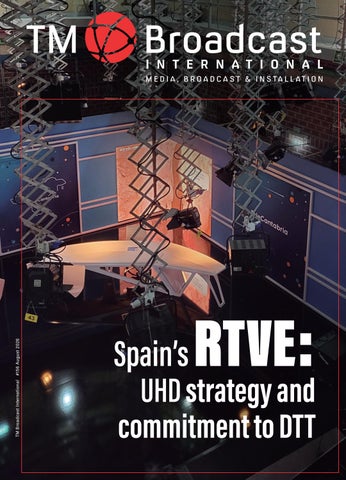
Spain’s
RTVE:
UHDstrategyand commitment toDTT
The audiovisual exhibition for the Spanish market See you on October 28 and 29, 2026
www.bitamshow.com
EDITORIAL The role of a public broadcaster in the platform era Over the past year, TM BROADCAST has focused on some of the world’s leading public broadcasters. Following our coverage throughout 2025 of the Nordic broadcasters and Italy’s RAI, in 2026 we have continued to broaden that perspective with new features on the BBC, CBC/Radio-Canada and, in this issue, Spain’s RTVE, which is celebrating its 70th anniversary. Each of these conversations has given us the opportunity to explore different technology strategies, distinct priorities and development models shaped by the realities of each market. Yet they all converge around the same question: what should the role of a public broadcaster be today in a landscape defined by the consolidation of major global platforms, changing viewing habits and rapid technological evolution? In issue #151, Morwen Williams, Director of Media Operations at the BBC, explained how the corporation is adapting its operations to a multiplatform environment through the integration of newsrooms, the adoption of new artificial intelligence-based tools and the incorporation of HTML graphics into its workflows. CBC/Radio-Canada, meanwhile, offered a complementary perspective by placing interoperability and open standards at the centre of its technology strategy. As Mathieu Rochon, Senior Technical Advisor at CBC/Radio-Canada,
Editor in chief Javier de Martín
editor@tmbroadcast.com
Director Daniel Esparza
press@tmbroadcast.com
Editorial Staff Bárbara Ausín Carlos Serrano Key account manager Patricia Pérez ppt@tmbroadcast.com
pointed out in issue #155, public broadcasters are uniquely positioned to foster open ecosystems that benefit the industry as a whole by encouraging collaboration and lowering barriers to entry for new players. Our cover interview with RTVE in this issue (#156) adds a third perspective to this discussion. As the broadcaster marks its 70th anniversary, Víctor Sánchez, Director of Media and Operations at TVE, and Jesús García Romero, Director of Engineering, outline for TM BROADCAST a technology roadmap based on migration to IP, the gradual rollout of UHD and the evolution of Digital Terrestrial Television (DTT). It is particularly interesting to see how, unlike other European broadcasters that have directed much of their strategy towards online-only distribution, RTVE continues to regard DTT as a strategic platform. This reflects the differences between distribution models in northern and southern Europe. Beyond the specific technologies discussed, all three conversations share the same conviction. Public broadcasters continue to believe that their mission extends far beyond producing content or competing for audiences. In an environment increasingly shaped by major international platforms, they reaffirm their role as drivers of innovation, as guarantors of an information and audiovisual offering guided by public service principles, and as vehicles for promoting the culture, traditions and values of their respective countries.
Graphic Design and Layout Sorex Media Ana Guijarro
TM Broadcast International #156 AUGUST 2026
Administration Laura de Diego
administration@tmbroadcast.com
Published in Spain ISSN: 2659-5966
TM Broadcast International is a magazine published by Daró Media Group SL Centro Empresarial Tartessos Calle Pollensa 2, oficina 14 28290 Las Rozas (Madrid), Spain Phone +34 91 640 46 43
SUMMARY 6
News
14
BROADCASTERS
Spanish broadcaster RTVE’s UHD strategy: strengthening the future of terrestrial television TM BROADCAST speaks exclusively with Víctor Sánchez, Director of Media and Operations at TVE, and Jesús García Romero, Director of Engineering, about RTVE’s technological roadmap, its transition to IP, the rollout of UHD, and the key projects that will shape the Corporation’s evolution over the coming years
4
30
PRODUCT ROUNDUP
Camera special: a market overview This special reviews a selection of current camera systems from leading manufacturers, offering an overview of the latest developments across the market.
52
INDUSTRY VOICES
Marco Lopez, CTO at Clear-Com: “Communications has become the connective tissue of modern production”
5
news | PAN SHOT
MFE unveils plans for a unified streaming platform across its European markets noted Berlusconi, the son of late Italian Prime Minister Silvio Berlusconi. Objectives The ProSiebenSat.1 acquisition gave MFE exposure to the Austrian and Swiss markets. MFE also broadened its reach in Portugal, where it acquired a stake in media company Impresa.
MFE-MediaForEurope has announced plans to launch a single streaming platform across its European markets. With the intention of compiting with global digital and advertising giants, it will combine technologies developed by its Italian and German businesses, as the company has claimed in a press conference. MFE, which runs television broadcasters in Italy and Spain, last year took control of German rival ProSiebenSat.1 as part of a push to try to gain European scale. “MFE had selected the best-performing elements from its existing streaming operations to build a single platform for the countries where it operates”, Chief Executive, Pier Silvio Berlusconi, explained as reported by Reuters from the press conference.
6
“The front end will be the Italian one, while the supporting technology will be the German one”, continued Berlusconi. The rollout will start in January. ProSiebenSat.1 runs ad-funded streaming platform Joyn, while MFE has developed the Infinity service in its Italian and Spanish markets. MFE will continue to produce content and programmes tailored to the needs of individual national audiences. “We are not an international fast-food chain”, added the executive. “We cook up live programmes designed for individual countries. We have to do that with products that are born on television and then move on to digital platforms”,
Berlusconi shares that MFE has already achieved €160 million in benefits this year from its integration with ProSiebenSat.1, compared with a four-year target of €261 million to €315 million it projected in 2025. However, he remarks: “On advertising revenue for the current year, saying advertising sales in Italy, its most resilient market so far, fell in the first six months, with a recovery in sight for the rest of the year”. The MFE CEO explains that ProSiebenSat.1 would continue to pare back its portfolio of digital investments, mainly in e-commerce, after selling six businesses, while retaining perfume retailer Flaconi, which is profitable and cash-generative. “The streamlining would weigh on revenue this year but help improve margins. He also ruled out further acquisitions in the coming quarters, saying the main focus would be on executing the strategy and integration”, he concluded.
news | PAN SHOT
7
news | PAN SHOT
UK investment firm Rcapital acquires ES Broadcast Hire following carve-out from ES Media Group Rcapital has announced the acquisition of ES Broadcast Hire Limited, led by Warren Taggart and Chris Eyles, from ES Media Group Limited. ES Broadcast Hire works with broadcasters, sports organisations, production companies, studios and event operators worldwide. The transaction follows the voluntary liquidation of ES Media Group. Following its carve-out from the parent group, the business now operates as an independent company backed by Rcapital to support its next phase of growth. The deal showcases another example of Rcapital being the buyer of choice for highly complex investments in businesses with global operations, providing certainty and deliverability for key stakeholders and advisors. Commenting on the transaction, Managing Director Warren Taggart, shares: “We are delighted with the investment from Rcapital; there are huge opportunities to scale the business, with focussed investment. We are excited to have found a partner who have demonstrated a deep understanding of our business and clear alignment on strategy”.
ARRI sells its global rental business to H2 Equity Partners
ARRI has entered into an agreement to sell its global rental activities in Europe, the United Kingdom, and North America to H2 Equity Partners. Illumination Dynamics will remain part of ARRI and is not included in the transaction, as the company has claimed in a statement. A key rationale for the transaction is to try to resolve a structural conflict of interest between ARRI’s manufacturing business and its own rental business: as a manufacturer of camera and lighting technology, ARRI supplies customers and partners worldwide, some of whom compete with its rental activities. Through this operation, ARRI aims to sharpen its focus on the development, production and commercialization of innovative camera, lighting and software-based technologies. “This transaction is a milestone in ARRI’s strategic transformation and future positioning”, affirms Thomas Riedel, owner of ARRI as well as founder and owner of Riedel Communications and the Riedel Group. “It enables us to direct our investments even more specifically toward the further development of our technologies and new growth areas. At the same time, it allows the rental business to continue to develop independently and to unlock additional market potential”. Positioning for both business models With the separation of the business areas, ARRI looks forward to creating a clearer market roles going forward. ARRI will focus on strengthening its position as an independent technology partner, while the standalone rental company will be able to work on expanding its market opportunities and operate independently.
8
news | PAN SHOT
IBC2026 Conference to focus on AI, live sports and new business models IBC2026 has announced this year’s Conference programme, bringing together global media and technology professionals, creators, sports organisations, broadcasters, platforms and brands. Running from 11–13 September at the RAI Amsterdam, the three-day IBC2026 Conference is built around IBC’s core themes of Shifting Business Models, Transformative Tech and People & Purpose, as the organization has claimed in a statement.
news, trust in content, audience behaviour and monetisation, this year’s programme brings together the people defining M&E’s future and inspires debate around the questions the industry needs to address now”. AI will be a defining thread, opening with ‘Disrupt, Innovate, Create: How to Embrace AI’, featuring Eline van der Velden, Founder and CEO of Particle 6 and the creator of AI actor Tilly Norwood, who will appear virtually alongside her.
The programme will also address how production is evolving for the streaming era, with Netflix VP Production Anna Mallett exploring the impact of international collaboration, virtual production, cloud-based postproduction and AI-assisted workflows. Live sport is another major focus of this year’s Conference, reflecting its role as one of the most demanding and innovative areas of media.
“The IBC2026 Conference reflects an industry that is no longer asking what advances are coming, but how to put them to work”, explains Sally Watts, Content Manager at IBC. “Across AI, sport, the creator economy, advertising,
Spark to expand at ISE 2027 with new formats and a new venue
Image: Integrated Systems Europe
Following its launch, Spark has confirmed that is scaling up for ISE 2027. The event will move to the Fira Montjuïc venue with the intention of meeting growing
demand and unlocking a broader, more ambitious programme. Additionally, it will support a broader content programme, larger-scale installations, increased participation and more immersive experience-led formats, as the organization has claimed in a statement. Spark 2026, powered by Samsung, was launched at Integrated Systems Europe (ISE) as a new event. This innovation
is designed with the intention of connecting the creative and production communities to shape the future of content and immersive experiences. Creators, brands, broadcasters, agencies, in-house teams and production innovators explored creative practices and how modern content is designed and produced across live, filmed and immersive experiences. Taking place in Hall 8.1 of Fira Gran Via, Spark featured four partner activations, thirty content sessions and sixty-three speakers, including keynotes from Jordan Schwarzenberger, Netflix and 0207 Def Jam.
9
news | PAN SHOT
NEP announces new multi-year agreement as Wimbledon broadcast services provider
NEP Europe has announced the successful delivery of broadcast services for The Championships, Wimbledon 2026. Additionally, the company has signed a new multiyear agreement with Wimbledon Broadcast Services (WBS) as a broadcast services provider, as it has claimed in a statement.
Under the agreement, NEP will continue as the broadcast technical services provider for future Championships, extending its longstanding relationship with WBS. Together, the organizations aim continue to evolve the host broadcast operation through expanded IP-based production, streamlined workflows and enhanced orchestration with NEP’s TFC broadcast control system.
improving how The
“What makes this relationship successful is a shared commitment to continually
operation forward every year”,
Championships is delivered. Working alongside WBS, we’ve evolved the host broadcast operation by finding smarter ways to work, embracing new technologies and giving both teams greater flexibility to innovate. This new agreement reflects the trust we’ve built together and, most importantly, the commitment of our people who continue to push the shares Ed Tischler, Managing Director, NEP UK.
Eurovision Sport introduces multilingual AI commentary for its European Athletics U18 Championships coverage Eurovision Sport has included multilingual AI-generated commentary at the European Athletics U18 Championships in Rieti, Italy (16–19 July). This initiative has been developed in partnership with European Athletics and technology partner CAMB.AI, as the EBU has claimed in a statemet. Through the EBU’s free streaming platform, Eurovision Sport will offer AI-generated translated commentary from its French-language remote commentary feed. All content will be labelled as AI-generated.
10
Commentary will be available in Dutch, German, Hindi, Japanese, Mandarin, Portuguese, Serbian and Spanish. Italian commentary will not be offered for the Rieti event, as domestic coverage will be provided by EBU Member and host broadcaster RAI. Alan Fagan, Managing Director, Eurovision Sport explains: “This initiative marks another milestone in Eurovision Sport’s commitment to making sport more accessible through innovation”. “As one of the world’s most followed Olympic sports, athletics has the power to unite
audiences across borders, making multilingual coverage an increasingly important part of the fan experience”, he continues. “Following encouraging results from earlier trials, we’re excited to continue expanding this innovation, together with our partners European Athletics and CAMB.AI”. Image: European Athletics
news | PAN SHOT
AIMS, VSF and EBU announce new IPMX testing and certification round
EBU calls for an AI governance framework that reinforces the role of public service media
The Alliance for IP Media Solutions (AIMS), together with the Video Services Forum (VSF) and the European Broadcasting Union (EBU), have announced the second IPMX Product Testing and Certification Event. Scheduled for Aug. 24–28 at the EBU headquarters in Geneva, Switzerland, it is open to AIMS and VSF member companies, as the organization has claimed in a statement. The week-long gathering looks forward to expanding the growing IPMX-certified product ecosystem while introducing formal certification of new capabilities developed as part of the IPMX roadmap. The Geneva certification event follows a “dirty hands” interoperability session scheduled for July 20–24 at the Matrox Video facility in Montreal, Canada. That members-only session will give AIMS participants hands-on testing of new IPMX developments ahead of the formal certification event, continuing the model of pre-certification interoperability work that has proven effective throughout the IPMX program. The August event will introduce certification for capabilities that have been in active development prior to the launch of the full realized standard in 2026. These include Host Key Exchange Protocol (HKEP) and HDCP handling for protected content, and the Privacy Encryption Protocol (PEP) security layer, which enables interoperable content encryption across multi-vendor deployments. HEVC and AVC compression profiles, which have seen strong industry interest in enabling efficient transport across existing infrastructure, are also progressing toward certification. AI generated image
The EBU has called for AI governance frameworks that recognize public service media as anchors of trust. It also demands concrete, and enforceable accountability from AI companies on the accuracy of AI-generated news, who sets the rules for trust online, and on the safety of children using AI systems, as the EBU has claimed in a statement. The message was delivered alongside Fondation Abeona, the Global Trust Challenge, and 5Rights Foundation at a side event of the UN Global Dialogue on AI Governance, in Geneva. “AI companies are inserting themselves between newsrooms and audiences, making journalism accountability methods such as bylines and editorial principles invisible to audiences, preventing trust from being maintained and increased”, explained Luis Jiménez, Head of Business Development and Partnerships for Eurovision News (EBU). The warning comes as public trust in news and reliance on unverified AI tools move in opposite directions. According to the Reuters Institute’s Digital News Report 2026, overall news trust has fallen to 37%, its lowest level since 2015, while AI chatbot use for news has reached 10% of respondents and continues to grow.
11
ADVERTORIAL
TheDynamicMediaFacility: W hythe
Futureof LiveProductionis Hybrid Ahead of IBC2026, Appear explains what the Dynamic Media Facility really means for broadcasters — and why the smart money is on infrastructure that spans hardware and software, not one at the expense of the other. By Ian Wagdin, Vice President Technology & Innovation at Appear Few topics have generated as much discussion across the industry's technical forums this year as the Dynamic Media Facility, or DMF — a concept many have heard of and few can yet define, but almost everyone senses it matters. As the industry heads to Amsterdam for IBC2026, it is worth cutting through the acronyms to set out what DMF is, what it is not, and why Appear believes the future is hybrid. A vision, not a single product The Dynamic Media Facility is best understood as a vision, one the EBU has articulated clearly in its reference architecture. It describes what a dynamic, software-defined ecosystem for live production can look like: an environment where resources are spun up and down on demand, reconfigured programmatically, and reused across productions rather than fixed to one. Within that vision sits the Media eXchange Layer, or MXL: an open-source project developed under the Linux Foundation. Where SDI moved signals between boxes in the hardware era, MXL moves media between software functions in the compute
12
era — letting applications share media directly in memory rather than repeatedly encoding, streaming and decoding it at every step. Stripping out that overhead cuts latency and can even allow some processes to run faster than real time. It is a small, but foundational piece of a bigger picture, and it dispels a persistent misconception: neither MXL nor DMF is here to replace SMPTE ST 2110 or other transport formats. The reality is coexistence, not replacement. The efficiency case The commercial logic behind DMF is compelling. In a typical live broadcast environment, only a fraction of capacity is in use at any one time — the rest of the time the infrastructure sits unused or is on the road between venues. Paying for infrastructure sized to those few peak transmission hours is inherently inefficient. A dynamic facility changes that calculus. Operators keep a right-sized baseline for their steady-state needs, then call on software that can be spun up and released to absorb the peaks — enabling higher-value productions without
ZERO DENSITY
a permanent build-out matched to the busiest hour of the week. There is also less requirement to move the infrastructure between venues, a trend we have seen in REMI workflows but which comes into its own in a dynamic deployment model. Reuse of resource is baked into the architecture with teams able to turn on and off, or scale, functionality as required. Why hybrid is the real story This is where Appear sees the heart of the matter. For the foreseeable future, almost every live production workflow will combine hardware-based infrastructure with software-based production on compute — in varying ratios, but rarely one alone. That blend is what we mean by hybrid. Few vendors genuinely have a foot in both camps. Appear does: the X Platform anchors high-performance, hardware-accelerated media transport and processing, while our VX software addresses the compute-based side of production. The point is not to bet on hardware or software winning outright, but to help broadcasters move fluidly between them as each workflow demands. An open, end-user-driven effort What gives the DMF vision credibility is who stands behind it. The work is being driven through the Joint Task Force on Dynamic Media Facilities (JT-DMF), a collaboration between the EBU and AMWA, with AMWA running the working groups. Four tracks are underway — end-to-end synchronisation, compute resource management, flow connection, and a business activity examining commercial models. Appear is involved across the effort: chairing one of the JTDMF groups, helping drive the open-source MXL project, and feeding the same principles into its own software. Other areas such as security and orchestration are also under discussion. Crucially, this is not vendors innovating in isolation. A strong community of public-service and commercial broadcasters across Europe
and North America is contributing real user stories and requirements — much as end-user backing through AIMS accelerated ST 2110 adoption a decade ago. A pivotal session in New York earlier this year brought major North American broadcasters firmly on board. Progress is deliberately iterative, too: rather than writing standards in the abstract for years, the task force publishes work in ‘increments’ and proves it through hands-on interoperability testing. New economics, new questions Dynamic facilities also reshape the economics. The earlier industry swing from CapEx to OpEx was largely vendor-driven; the emerging consensus is more nuanced — a hybrid of the two. Broadcasters increasingly expect to own a baseline for round-the-clock operations, then burst onto compute they do not own for major events before collapsing back afterwards. That raises new questions the business track is tackling directly: how does dynamic licensing work, and how do the economics stack up for vendors and broadcasters alike when production is paid for as it is used? The road to IBC2026 Expect DMF and MXL to be prominent themes when the industry gathers at the RAI this September. A further MXL interoperability demonstration is planned for the show, moving beyond the proof-of-concept stage seen at NAB toward the plug-and-play simplicity the vision ultimately requires. Alongside it is the growing association of DMF with TAMS — the BBCoriginated, now open-sourcing time-addressable media store — which unites the signal-centric world of live production with the storagecentric world of replay and highlights. For Appear, IBC2026 is a chance to show how that hybrid future works in practice. The facility of tomorrow will not be built entirely in hardware, nor entirely in software: it will be dynamic, efficient, open — and hybrid. You can see Appear at IBC2026 on booth 1.C61.
13
BROADCASTERS
Spanish broadcaster
RTVE's UHD strategy: strengtheningthefutureof terrestrial television
14
RTVE
This interview is part of an extensive feature published in TM BROADCAST Spain to mark the 70th anniversary of Spain's public broadcaster, one of Europe's leading broadcasters in technological innovation and a pioneer in UHD adoption. What follows is an adapted version for our international readership
15
BROADCASTERS
TM BROADCAST speaks exclusively with Víctor Sánchez, Director of Media and Operations at TVE, and Jesús García Romero, Director of Engineering, about RTVE's technological roadmap, its transition to IP, the rollout of UHD, and the key projects that will shape the Corporation's evolution over the coming years RTVE approaches its 70th anniversary with a clear technological roadmap and no intention of slowing down. Spain's public broadcaster is steadily advancing its migration towards IP infrastructures, accelerating the adoption of UHD as its new production and distribution standard, and exploring the role of artificial intelligence across its production workflows. At the same time, it continues to look beyond these immediate priorities towards a broader transformation that includes the future of digital terrestrial television (DTT), the renewal of its technical infrastructure and the evolution of professional skills in an increasingly complex media landscape. To gain a deeper understanding of this transformation and the strategic vision behind it,
16
TM BROADCAST travelled to RTVE's headquarters in Madrid to meet with Víctor Sánchez, Director of Media and Operations at TVE, and Jesús García Romero, Director of Engineering. The interview took place just one day before the European Broadcasting Union (EBU) Technology & Innovation Summit in Barcelona, where Sánchez was seeking re-election to the EBU Technical Committee, a position he successfully retained.
The meeting came at an especially busy moment for the Corporation, as both executives explained before the interview began. Alongside its ongoing FIFA World Cup coverage in UHD, RTVE had just completed the large-scale technical deployment supporting the Pope's visit to Spain—one of the broadcaster's most ambitious live production operations in recent years— coordinated in collaboration with several regional public broadcasters.
Víctor Sánchez and Jesús García Romero
RTVE
One of the interview's most revealing topics is RTVE's firm commitment to UHD, a strategy closely linked to its long-term vision for digital terrestrial television. While several European broadcasters no longer regard UHD as one of their main strategic priorities, RTVE argues that the transition to DVB-T2 will not only improve picture quality but also enable a more efficient use of radio spectrum. The Corporation also attributes this different approach to Europe's contrasting distribution models, where Southern European countries continue to rely far more heavily on terrestrial broadcasting than their Nordic counterparts.
RTVE is celebrating its 70th anniversary at a time marked by rapid technological acceleration, the consolidation of new formats beyond traditional television and profound changes in media consumption. Against this backdrop, what would you say are the Corporation's
main technical and strategic priorities for the years ahead? Víctor Sánchez.From a production perspective, our main technological priority is to continue moving towards an IP environment. Closely linked to that transition is the transformation of our entire production capability to UHD. From a broader technology standpoint, we are also introducing artificial intelligence workflows across our production chain. On the distribution side, there is currently a very important development related to the Royal Decree that is driving Spain's transition to DVB-T2. By the end of this year, Atresmedia and Mediaset [Spain's two largest commercial broadcasting groups] are also expected to launch UHD channels. This will mean that three broadcasters will already be transmitting in UHD, marking the beginning of a broader transition towards the format.
This represents a major step forward because it enables a more efficient use of radio spectrum. In short, it improves picture quality while optimising spectrum efficiency. Those are the main challenges currently on our agenda. Jesús García Romero.At the same time, we have recently undergone a major generational renewal within our engineering teams following our latest public recruitment process. Our next challenge is to ensure that all these new professionals are fully prepared for this new technological landscape. Behind all of this lies a highly complex infrastructure that has to operate as a single coordinated system. These are advanced technologies for which, in many cases, there is no dedicated prior training.
I'd like to explore some of the topics you've just mentioned in more detail. Let's start with UHD. RTVE became a pioneer with the launch of Europe's first UHD channel.
17
BROADCASTERS
What impact do you believe this initiative has had, both in Spain and across Europe? To what extent has it helped drive UHD adoption or served as a reference for other broadcasters? Víctor Sánchez.At the European level, it has been a major success because we were the first broadcaster to launch a UHD channel. Together with France, Spain is now one of at least two European countries with extensive UHD coverage, and I believe this trend will continue in markets where terrestrial broadcasting remains an important distribution platform. In Spain, the transition represents a significant improvement over the previous model. Moving to DVB-T2 increases the available spectrum capacity and allows us to deliver higher picture quality to viewers. From an industry perspective, I also believe it has helped stimulate the market.
18
Jesús García Romero.Complementing Víctor's point, it is true that the transition to UHD cannot progress as quickly as we might like because there is still a considerable amount of legacy infrastructure that simply cannot handle the data volumes generated by this format. A technological shift of this magnitude cannot happen overnight. What we are seeing, however, is that UHD is driving production centres towards IP infrastructures. Technological progress itself, together with the demand for a better user experience, is calling for a different way of working.
Where does that roadmap currently stand? Which projects or production centres are leading RTVE's transition towards UHD? Víctor Sánchez.We have been implementing our UHD strategy through a series of projects that initially may have appeared unrelated: outside broadcast units, our archive, continuity...
Now we are beginning to see how everything fits together. Once the required connectivity has been deployed, RTVE's UHD workflow is fully structured and ready to support an increasing number of programmes and productions. Jesús García Romero.In fact, our original plan only included a single UHD outside broadcast unit. However, while we were commissioning it, demand continued to grow, making it necessary to upgrade two additional units. In addition, the two studios we are about to commission at Sant Cugat—RTVE's production centre in Barcelona and the last facilities awaiting migration to IP—have both been designed with native UHD production capabilities. They will become RTVE's first studios capable of producing in UHD from end to end.
When TM BROADCAST has discussed this technological transition with other European broadcasters,
RTVE
particularly in the Nordic countries, several have told us that UHD is no longer among their main strategic priorities. In Spain, however —and especially at RTVE—there is a clear commitment to UHD. What do you think explains this different approach? Víctor Sánchez.The difference is largely explained by cultural factors and by the different distribution models across Europe. Generally speaking, Nordic countries rely far less on digital terrestrial television. Geography may play a role, as may viewing habits, but these countries are increasingly prioritising internet-based distribution. Southern European countries such as Italy, France, Spain and Portugal, on the other hand, continue to have a strong tradition of terrestrial broadcasting. Our position is that all distribution models should coexist: internet delivery, HbbTV, DTT... The more ways we have to reach audiences, the better.
19
BROADCASTERS
Let's move on to IP, the other major technological transformation you mentioned and one that, as you explained, is closely linked to the move towards UHD. Where does RTVE currently stand in this transition? What would you say have been the main achievements so far? Jesús García Romero.The transition to IP has been the greatest professional challenge of my career. When we began
20
this process there was still considerable uncertainty across the industry. We carried out a very detailed market analysis and reached the conclusion that IP was clearly the right direction. It simply made no sense to continue building new facilities based on traditional SDI technology when the future was obviously heading towards IP. There was also some uncertainty about how our engineering teams would respond to such a profound technological shift. In reality, the response was
extraordinarily positive. We started with a small IP island in the middle of an SDI ocean. Now the situation has almost completely reversed. Once the projects scheduled for September are completed, what will remain is a small SDI village within a predominantly IP environment.
What are the next steps on that roadmap? Jesús García Romero.Looking ahead, our next major challenge will be to begin migrating
RTVE
the Torrespaña and Prado del Rey production centres—RTVE's two main production facilities in Madrid—from SDI to IP. Naturally, this will be done while maintaining compatibility with the legacy systems that still need to remain operational for some time. Víctor Sánchez.Just as every new production environment will now be UHD, every new infrastructure we deploy will also be IP-based. Our long-term vision is for Torrespaña and Prado del Rey to operate as
a single IP-connected infrastructure. In other words, the physical location of a server or any other technical resource should no longer matter.
limiting factor is the amount of legacy technology that still needs to remain in service, together with the timelines associated with public procurement.
How many years away do you think that scenario is?
Víctor Sánchez.We have spent a long time analysing different solutions together with our engineering teams. I believe we are now entering the deployment phase, defining technical criteria and selecting technologies. Once those criteria have been finalised, the corresponding tenders will be published and the implementation phase will begin.
Víctor Sánchez.Five years. Jesús García Romero.I'm actually even more optimistic. The early stages of any transformation are always the slowest, but once the process gains momentum it tends to accelerate. The main
21
BROADCASTERS
Jesús García Romero “What we are seeing is that UHD is driving production centres towards IP infrastructures. Technological progress itself, together with the demand for a better user experience, is calling for a different way of working”
“We started with a small IP island in the middle of an SDI ocean. Now the situation has almost completely reversed. Once the projects scheduled for September are completed, what will remain is a small SDI village within a predominantly IP environment”
“We have an important role to play as a driving force for the industry and as a vehicle for promoting Spanish culture. It is a form of social return that cannot always be measured solely in economic terms”
For that reason, I believe that within four or five years we will have achieved a very significant part of our objective. You never reach one hundred percent, but we should be in a position where it makes no difference whether a server is physically located at Prado del Rey
22
or Torrespaña. Resources will be shared, signals will move seamlessly across the infrastructure, and everything will operate transparently. It is an extremely complex project and probably one of the greatest technological challenges currently facing RTVE.
As you have both mentioned, this technological evolution also requires a transformation of professional profiles. How is RTVE addressing this challenge? How do broadcast engineering and networking teams work together today? To what extent does a divide still exist between these two disciplines? Jesús García Romero.That is perfectly natural. There will always be some tension between different priorities. Some teams are responsible for guaranteeing system security, while others need resources to remain available so they can carry out their work. It is all part of the learning process. Víctor Sánchez.We are talking about highly complex technologies that require extensive training. We have professionals with enormous experience in traditional broadcast environments, and we are now supporting them as
RTVE
they transition towards IP, UHD and new network architectures. It is a demanding process. At the same time, I believe it is extremely valuable to have broadcast engineers who do not come from an IP background. They have an in-depth understanding of audiovisual signals, live production and what it means when a signal is lost during transmission. Networking specialists, on the other hand, contribute deep expertise in IP infrastructures and solve highly specific challenges within that field. Both profiles are essential. The best approach is to combine both skill sets: broadcast professionals who understand IP environments and networking specialists who bring advanced expertise in areas such as security, infrastructure management and systems administration.
Several European broadcasters have told us that one of the greatest challenges facing public service media today is
financial pressure: the need to do more with fewer resources. To what extent do you feel that pressure at RTVE? Víctor Sánchez.Naturally, we depend on budgets, regulatory frameworks and public policy decisions, all of which introduce a degree of uncertainty. Nevertheless, RTVE has maintained a sustained commitment to technological investment,
and that is clearly reflected in the company's transformation. From a technological standpoint, I believe RTVE currently occupies a leading position among European broadcasters. Jesús García Romero.Rather than talking about doing more with fewer resources, I would put it differently: doing more with the resources that are actually needed.
Víctor Sánchez “RTVE has maintained a sustained commitment to technological investment, and that is clearly reflected in the company's transformation”
“Our position is that all distribution models should coexist: internet delivery, HbbTV, DTT... The more ways we have to reach audiences, the better”
“The best approach is to combine both skill sets: broadcast professionals who understand IP environments and networking specialists who bring advanced expertise in areas such as security, infrastructure management and systems administration”
23
BROADCASTERS
The objective should not be to minimise every production, but to use the right resources to deliver high-quality content. There is no need to overspend, but neither should quality be sacrificed. The real challenge is to find the right balance and deliver productions that are technically robust while providing genuine social and cultural value. Personally, that is one of the things that makes me most proud of working at RTVE. From an engineering perspective, we always strive to deliver the highest possible quality with the resources available.
What do you believe the role of a public service broadcaster should continue to be today? Víctor Sánchez.I believe the role of a public broadcaster remains, above all, to inform, educate and entertain citizens. I continue to believe wholeheartedly in that founding mission of public service broadcasting, and I think it is just as relevant today as it has ever been.
24
Jesús García Romero.I would add that we also have an important role to play as a driving force for the industry and as a vehicle for promoting Spanish culture. International services, programming aimed at Spanish citizens living abroad and the dissemination of cultural content are all part of that public service mission. It is a form of social return that cannot always be measured solely in economic terms.
Finally, I'd like to end on a more personal note. Looking back on your careers, what would you say has been the most important lesson or insight you've gained? Jesús García Romero.There is one reflection that you have probably heard me make before: almost everything we have achieved has been accomplished collectively. In the end, we build teams, and every individual contributes their own skills, experience and expertise. That complementarity, combined with a genuine
commitment to doing things well, is what enables us to achieve our goals and deliver the best possible results. I also firmly believe that major achievements are never the work of a single organisation or just a handful of people. Whenever we have successfully delivered major technological projects, it has not been thanks solely to RTVE's professionals. We have worked side by
RTVE
side with engineers and technical specialists from manufacturers, suppliers and technology companies. For that reason, I believe many of our greatest achievements actually belong to the Spanish broadcast industry as a whole. That is probably my biggest lesson: the importance of collaboration, of bringing together complementary expertise and of working collectively towards shared goals.
Víctor Sánchez.If I had to choose one lesson, I would say that, in television, things always come together in the end. Projects are complex—very complex— but the people who work in this industry are consistently first-class professionals. Every television professional I have worked with has demonstrated an outstanding level of expertise. Very often I experience projects from two
different perspectives: the technological side, closely linked to engineering, and the operational side, focused on day-to-day production. There are productions and live events where these two worlds have to work in perfect alignment. Operational teams, engineering departments and technical support staff ultimately share exactly the same objective, and they all work together to make each project a success.
25
BROADCASTERS
26
OPINIONRTVE | SONY
Seventy years of RTVE, eighty of Sony: a history of shared technological evolution By Héctor Sierra, Head of Sales for Southern Europe & Benelux, Sony Media Solutions The fact that RTVE is celebrating its 70th anniversary alongside Sony's 80th is no coincidence: it reflects a partnership that has accompanied Spanish public broadcasting's technological transformation. From Betacam SP to today's migration to IP, the two companies have worked more as collaborators than as supplier and client, solving the same problems: recording faster, broadcasting with higher quality and, now, producing more flexibly and efficiently with less physical infrastructure.
Four decades of joint transformation Our relationship with RTVE began in the early 1980s, but the turning point came in 1989 with the Betacam SP format: the camcorder combined camera and recorder in a single unit, added the first CCD sensors and transformed news production times. RTVE and Sony were also pioneers in High Definition, with the first HD production ahead of the 1992 Barcelona Olympics. The leap to Ultra High Definition came with the first 4K documentary in Barcelona and the first 4K DTT broadcast trial, at the 2013 Mobile World Congress. The refurbishment of Prado del Rey (2017–2020) with Sony studio cameras, mixers and monitors consolidated HD production, while the 2021 upgrade of camcorders and wireless microphones introduced the first lightweight UHD-capable equipment. Another milestone was Los Conciertos de Radio 3, which
two years ago became the first television production to record a live broadcast with large-format 4K cinematic cameras, an achievement that remains a benchmark today.
IP convergence: a challenge shared with the sector Between 2024 and 2025, together with RTVE, we completed the transition to Ultra High Definition and IP at Torrespaña and in the outside broadcast units. This convergence towards a unified IP environment is supported by the Networked Live ecosystem from Sony and Nevion, which allows on-premises and cloud-based resources to be combined for live production. This approach is not exclusive to RTVE. Sony has made IP convergence the cornerstone of its global broadcast strategy, shown at NAB Show 2026 with the launch of MOXELA, a new software-based multimedia processing platform running on standard servers or in the cloud. This is the challenge RTVE, like Europe's other public broadcasters, will face: adopting UHD or IP is not enough; production centres must become software-defined infrastructures, sharing resources across sites and scaling up without duplicating equipment. Consolidating IP, advancing Software-Defined Broadcast, incorporating AI and ensuring content authenticity will be key priorities for the coming decade. Sony aims to remain, as for four decades, the partner supporting this transition.
27
ADVERTORIAL
MerAIdian:
TurningAIintoOperational Valuefor TVPlatforms Artificial Intelligence continues to dominate conversations across the media and broadcasting industry, but for many organizations, the challenge is no longer whether to adopt AI. It is how to turn it into measurable operational value. At AgileTV, that challenge led to the development of MerAIdian, our proprietary AI agent platform that is already supporting Quality Assurance, Engineering and delivery across multiple live customer projects. The platform reflects the way AgileTV approaches innovation. As a company that delivers and operates end-to-end television services for more than 50 million households across Europe and Latin America, we believe technology only creates value when it solves real operational challenges. AI should not be another layer of complexity. It should help simplify operations, improve efficiency and enable teams to bring new services to market faster. This philosophy has shaped the development of MerAIdian from the very beginning.
Standardization makes AI reliable One of the biggest misconceptions surrounding AI is that automation alone is enough to transform operations. The truth is that AI is only as effective as the processes and information behind it. Before introducing AI agents into our delivery workflows, AgileTV focused on standardizing the way projects are managed across the organization. Test plans were centralized, documentation formats were unified and
28
common methodologies were established across QA, Engineering and Delivery teams. We refer to this approach as Context Engineering, creating a structured operational environment where AI can consistently produce reliable results. This foundation delivers benefits well beyond automation. Engineering teams can reuse knowledge across projects, customer onboarding becomes significantly faster and delivery processes remain consistent regardless of the operator or deployment. Most importantly, AI agents always work with structured, high-quality information rather than fragmented data, making their recommendations both predictable and trustworthy.
Supporting the entire delivery lifecycle Built on this standardized framework, MerAIdian orchestrates a collection of specialized AI agents that assist engineering teams throughout the software delivery lifecycle.
ZERO DENSITY
The Test Case Generation Agent integrates directly with Jira, transforming user stories into standardized test cases, including Gherkin scenarios for automated testing. Through continuous validation by QA engineers, the system steadily improves its recommendations while maintaining consistency across projects. The Bug Triage Agent manages the complete incident classification process, from issue ingestion and customer-specific categorization to coverage analysis, prioritization and automated routing. As part of this workflow, it can identify testing gaps and generate additional test cases whenever missing validation is detected, helping teams improve overall test coverage as development progresses. MerAIdian also provides role-based dashboards for QA Engineers, Technical Leads and Delivery Managers, offering real-time visibility into project status, incident management and automated release documentation. These capabilities are complemented by AgileTV's SmartTV Lab in Bilbao, where applications are continuously validated across webOS, Tizen and Android TV devices using automated testing and real-time monitoring. Together, these components create a continuous QA pipeline where testing, validation and reporting become faster, more consistent and significantly less dependent on repetitive manual work.
Measuring success through operational impact For AI to become a meaningful part of television operations, it must deliver measurable improvements rather than simply automate isolated tasks.
During its first five weeks in production, MerAIdian supported five simultaneous customer projects, eliminating 76 hours of manual work while achieving 100 percent incident classification with no unassigned issues. Around 80 percent of the outputs generated by the platform were accepted without requiring manual rewriting, well above commonly reported industry benchmarks. Across activities such as test case creation, bug triage, requirements analysis and reporting, engineering teams recovered approximately 60 percent of the time previously dedicated to repetitive operational work. These results demonstrate that the greatest value of AI lies not in replacing engineering expertise but in allowing specialists to spend less time on routine processes and more time solving complex technical challenges that directly benefit customers. As television ecosystems continue to evolve, the same principles can be extended even further. AI-assisted software development, automated quality gates within CI/CD pipelines and intelligent operational workflows will continue reducing complexity across the entire platform lifecycle. For operators and broadcasters, this means faster deployments, greater operational efficiency and more resources available for innovation. At AgileTV, we see MerAIdian as a natural extension of our end-to-end operating model. Having spent years delivering and operating television services for leading operators around the world, we understand that meaningful innovation is measured by operational outcomes, not by technology alone. Visitors attending IBC 2026 will be able to experience MerAIdian through live demonstrations at AgileTV’s booth 5.D72, Hall 5, where our experts will showcase how AI is helping simplify TV operations, accelerate delivery and support engineering teams in real production environments.
29
CAMERA SPECIAL
30
CAMERA SPECIAL
Camera special: A market overview Cameras remain one of the defining technologies of the broadcast industry, and their evolution continues to shape live production. This special reviews a selection of current camera systems from leading manufacturers, offering an overview of the latest developments across the market. The products featured have either been selected by their respective manufacturers for inclusion in this special or chosen by the TM BROADCAST editorial team according to editorial criteria. Manufacturers are listed in alphabetical order.
31
CAMERA SPECIAL
» ARRI › ALEXA35 Live Xtreme Introduced in July 2026, the ARRI ALEXA 35 Live Xtreme has been selected for this special as the latest addition to ARRI’s live production camera range. It extends the ALEXA 35 Live platform with high-frame-rate output for traditional SDI-based workflows and comes with the ALEXA 35 High Speed License and the High Frame Rate SDI License permanently installed. When used with ARRI’s Live Production System LPS-1, comprising the Fiber Camera Adapter and Fiber Base Station, and a compatible slow-motion replay server, the camera outputs up to 8x HFR in
32
HD or 2x in UHD. Up to 4x HFR can be carried through a single SDI output, while higher speeds use both outputs. The system can provide a standard live feed and an HFR feed simultaneously. Frame rates of up to 330 fps retain the sensor’s stated 17-stop dynamic range, while Sensor Overdrive mode supports up to 480 fps with 11 stops. The launch follows the acquisition of ARRI by Thomas Riedel in April 2026. ARRI continues to operate independently from Munich under its existing management, alongside a strategic alignment with the Riedel Group.
CAMERA SPECIAL
» Blackmagic Design › URSACine 12K LF 100G The URSA Cine 12K LF 100G brings the large format image and production features of URSA Cine into live production. Designed for cinematic multicamera work, it combines a 36 x 24mm RGBW sensor, 16 stops of dynamic range, Blackmagic RAW recording and Generation 6 Color Science with high bandwidth SMPTE ST 2110 connectivity. The camera outputs real-time IP video from the 100G Ethernet at up to 2160p60, with live frame rates of up to 440 fps for slowmotion replay. The optional B4 lens mount supports electronically controlled broadcast lenses, while a centre crop allows Ultra HD capture at high frame rates. The optional Blackmagic Studio Viewfinder adds a 7-inch touchscreen display with camera menu control for live production.
› Resolution: Up to 12K (12288 × 8040) 3:2 open gate › Dynamic Range: 16 stops › Connectivity: 100G Ethernet with SMPTE ST 2110, 12G-SDI, USB-C, Wi-Fi, Lemo, Fischer, XLR › Recording: Blackmagic RAW with built-in H.264 proxies, Blackmagic Media Module support › Frame Rates: Up to 80 fps in 12K, 144 fps in 8K and 240 fps in 4K recording; SMPTE ST 2110 live output up to 440 fps for ultra-slow-motion workflows › Lens Mounts: PL, LPL, locking EF and optional B4 broadcast mount › Live Production Features: Centralized camera control and color matching, high frame rate replay, flexible lens support and shared high speed media access.
The camera includes a built-in colour corrector based on DaVinci Resolve's primary colour corrector, with remote shading possible via the ATEM Camera Control Panel. › Recommended for: Live productions combining large-format digital cinema acquisition with IP-based broadcast workflows, including sports, concerts, live entertainment and television production. › Sensor: Full-frame RGBW 36 x 24mm sensor
33
CAMERA SPECIAL
› Blackmagic URSACine Immersive 100G The Blackmagic URSA Cine Immersive 100G is an immersive cinema camera designed for live production with Apple Immersive Video. It features dual custom lenses, dual 8K x 8K RGBW sensors with 16 stops of dynamic range, and 100G Ethernet for live immersive video output. It relies on the same RGBW sensor design as the URSA Cine platform, with the dual sensor layout featuring larger photo-sites and equal numbers of red, green and blue pixels for colour super sampling. The camera captures 8K x 8K stereo video at up to 90 fps to a single Blackmagic RAW file or a single ProRes SMPTE ST 2110-22. The new Blackmagic URSA Live Encoder encodes live immersive video into Apple ProRes for SMPTE ST 2110-22 IP output over 100G Ethernet. With data rates below 50 Gb/s per camera, two URSA Cine Immersive 100G cameras can share a single 100G Ethernet connection. The camera also includes a Blackmagic Media Module 8TB, supports network connections over Wi-Fi, 100G Ethernet and mobile data, and includes DaVinci Resolve Studio. › Recommended for: Live immersive productions for Apple Vision Pro, including sports, concerts, live events, branded experiences and immersive broadcasting.
34
› Sensor: Dual 8K × 8K RGBW sensors with custom stereoscopic optical system › Resolution: 8K × 8K per eye › Dynamic Range: 16 stops › Recording: Dual 8K stereoscopic capture up to 90 fps to a single Blackmagic RAW file or a single ProRes SMPTE ST 2110-22 stream › Connectivity: 100G Ethernet, Wi-Fi, USB-C, mobile data tethering › Media: Internal 8TB Blackmagic Media Module › Live Production Features: 100G Ethernet with SMPTE ST 2110-22 live video output, Apple ProRes live encoding and DaVinci Resolve Studio support.
CAMERA SPECIAL
» Grass Valley › LDX 100 Series The Grass Valley LDX 100 Series combines image quality, operational flexibility, and a software-upgradable design for live production environments. Featuring imaging sensors with an always-active global shutter, the cameras deliver detailed images, color reproduction, and low-light performance. Support for simultaneous HDR, 4K, and HD production, along with integrated LUT-based HDR-to-SDR conversion, enables multiformat workflows. Connectivity supports integration into broadcast infrastructures, while controls, customizable settings,
and an integrated handgrip lens zoom are designed to support camera operation. A software-upgradable architecture offering permanent or daily feature licensing allows the LDX 100 Series to adapt to different production requirements. The entire LDX 100 Series supports Creative Grading, enabling operators to achieve a consistent visual style across the Grass Valley camera chain. The interface allows camera operators and shader teams to adjust key parameters and fine-tune the look of each shot.
35
CAMERA SPECIAL
› Grass Valley LDX 110 Series –Entry-Level Broadcast Cameras The Grass Valley LDX 110 Series brings broadcast imaging to an entry-level platform for live sports, entertainment, and studio productions. Comprising the LDX 110, LDX C110, and LDX 110 RF, the series incorporates a range of capabilities derived from the LDX 100 Series. At the heart of each camera is a 2/3-inch native UHD CMOS global shutter imager, based on the same generation of imaging technology introduced across the LDX 100 Series. This single-imager configuration provides image quality, detail, and motion handling while maintaining a cost-effective design for a range of live production
36
applications. The cameras support HD, UHD, SDR, HDR, and optional 3x high-speed operation. The LDX 110 Series incorporates integrated HDR/SDR LUT processing, Creative Grading, NFC and GPS support, and software licensing, including optional daily features and an additional ND filter. Connectivity through the XCU base station enables SDI and DirectIP workflows with support for SMPTE ST 2110 and AMWA NMOS standards. The compact LDX C110 offers the same functionality in a smaller form factor, while the LDX 110 RF extends these capabilities to wireless applications.
CAMERA SPECIAL
› Grass Valley LDX 150 & LDX 135 –Live Production CamerasBroadcast Cameras The Grass Valley LDX 150 and LDX 135 cameras are designed for live sports, entertainment, and broadcast production, supporting NativeIP™ and SDI connectivity without external conversion. The cameras support HD, UHD, HDR, and IP-based production environments. Powered by Grass Valley's 2/3-inch native UHD Xenios global shutter imagers, both models provide native UHD resolution, F11 sensitivity, signal-to-noise performance, and more than 15 stops of dynamic range. Their three-imager design, paired with a wide color gamut beam splitter, reproduces colors while capturing image detail with reduced motion artifacts.
software licensing. The LDX 135 offers UHD, HDR, and NativeIP functionality without high-speed operation. Both models are also available in compact versions, and the LDX 135 RF and LDX 150 RF extend these capabilities to wireless applications. Both cameras support software licensing options and are compatible with a range of production workflows.
The LDX 150 supports up to 3x UHD and 6x HD slow-motion capture through
› Grass Valley LDX 180 –Cinematic Storytelling for Live Production The Grass Valley LDX 180 is designed for live production requiring a cinematic look. As part of the LDX 100 Series, the LDX 180 shares accessories, transmission systems, and production workflows with other cameras in the range.
It incorporates Grass Valley's Super 35 Xenios CMOS sensor with a global shutter and oversampled UHD resolution. The camera features a PL lens mount compatible with a range of professional cinema lenses. The LDX 180 also supports Creative Grading, enabling operators to match the visual style across the Grass Valley camera chain. Its interface provides access to imaging parameters, allowing camera operators and shader teams to adjust image settings during production.
37
CAMERA SPECIAL
» Ikegami › HDK-X500 3-CMOS HDHDR portable camera Designed for use across a wide spectrum of applications, the HDK-X500 can be configured easily for pedestal-mounted studio operation, tripod-based sports coverage and shoulder-mounted location production. The HDK-X500 has three latest-generation 2/3-inch CMOS sensors with a global shutter architecture which enables the camera to capture natural images even in challenging situations. Still-frame replay of fast-moving objects, for example, is completely free from geometric distortion and there are no flash bands when the camera is capturing a strobe-illuminated stage or flash lighting from still cameras. Ikegami's AXII digital processor provides image processing, lower power consumption and functions including automatic optical
vignetting correction throughout the range of OVC-compatible B4 bayonet mount zoom lenses, and remote back focus adjustment. An integral 16-axis colour corrector allows precise scene matching or the creation of colour-related effects. Chroma and hue levels can be individually adjusted within the 16-axes both during normal programme production and to allow colour matching with other cameras. This high-level correction can be processed in real time. Like the other camera models in t he Ikegami UNICAM-XE family, the new HDK-X500 fully conforms to ITU-R BT.2020 specifications, covering a wider area than the conventional BT.709 colour space for HD.
› UHK-X700RF wireless 3-CMOS 4K-UHDHDR camera A recent addition to Ikegami's UNICAM-XE series, the UHK-X700RF wireless portable camera has the same feature set, operational ergonomics, compact size and light weight as its wired sister model UHK-X700. The UHK-X700RF is intended for applications such as news, OB sports and coverage of stage events. Even in fully rehearsed studio projects, it allows producers to introduce unusual-angle shots at short notice.
38
The transmitter operates in the 2 to 2.7 GHz band, accessible in 250 kHz tuning steps, with an output power of 100 mW. Two antennas mounted at the rear of the camera comprise one for the main video signal plus a smaller one for telemetry data. Multichannel antenna diversity is a standard feature for signal transmission in a wide range of environments. The video link incorporates a 10-bit HEVC codec which fully supports HDR and WCG delivery.
CAMERA SPECIAL
H.265-HEVC, H.264-AVC and MPEG-2 video coding are selectable via the control menu. End to end transmission latency is an extremely low 40ms. All control features can be accessed remotely via IP mesh radio. The UHK-X700RF is equipped with three 4K-UHD native sensors in a global shutter architecture. The wireless camera supports UHD (2160@50p/59.94p) and HD (1080@50p/i, 59.94p/i) frame rates as a standard feature. A dual filter wheel enables separate control of incoming light and
colour temperature. Space is included to mount any desired effect filter or an optical low-pass filter to further reduce aliasing and moiré artifacts. Automatic optical vignetting correction is supported when using OVC-compatible B4 bayonet mount zoom lenses. An optional Variable Neutral Density filter for the UHK-X700 and UHK-X700RF expands the creative possibilities of video production by allowing the lens aperture to remain fixed to control video exposure.
39
CAMERA SPECIAL
› UHL-X40 ultra-compact 3-CMOS 4K-UHDHDR cameracamera Based on Ikegami’s UHL-F4000 which was developed for aerial applications such as helicopter platforms, the UHL-X40 is designed for integration into a wide range of broadcast production environments. An Ethernet trunk line is available between the camera head and CCU as a standard feature. Using this line enables a distant CCU operator to send commands to a peripheral device such as a pan/tilt head or a teleprompter. The UHL-X40 combines 3-CMOS imaging, digital processing, compact dimensions, low weight and remote connectivity for applications such as studio stages, newsrooms, sports stadiums and point-of-view video capture. The camera head weighs just 1.1 kg and has very low power consumption. The control unit is also light in weight (2.6 kg).
40
The UHL-X40 shares most of the key features of the UNICAM-XE camera family, such as dual optical filter wheels with five positions each for separate control of neutral density and color correction filters, optical vignetting correction plus remote back focus. In addition to its 4K-UHD output, the CCU can deliver a simultaneous downconversion of the full 3840 x 2160 resolution UHD frame plus a 1920 x 1080 native cutout of the central area. Vertical image inversion function can be selected for applications such as theatre-stage outside broadcasting where upside-down overhead suspension is easier than traditional mounting. This feature saves having to assign a vision switcher channel to perform the image inversion.
CAMERA SPECIAL
» Panasonic › AW-UE160 PTZ Camera The AW-UE160 is Panasonic's flagship 4K PTZ camera, engineered for broadcast, live production, and studio applications. It features a large 1-inch MOS sensor, delivering 4K/60p video with HDR (HLG) and BT.2020 for accurate color reproduction. With low-light performance of F9/2000lx and a 20x optical zoom, it is designed for applications ranging from stadiums to studios. A key strength of the UE160 is its native ST 2110 support, enabling broadcast-grade IP workflows without external converters. It delivers uncompressed video over IP, synchronized audio/video, and PTP timecode for multi-camera productions. Now with support for both full-bandwidth NDI and
NDI|HX, the UE160 offers additional IP workflow flexibility, allowing integration into a wide range of networked production environments, from high-performance to bandwidth-constrained systems. The camera also supports SRT, RTMP, 12G-SDI, and HDMI, providing compatibility for hybrid workflows. Built-in auto framing with AI-based subject tracking enhances remote and dynamic productions in corporate, education, and studio environments. With additional features including FreeD for AR/VR, Genlock, tally, and return video, the UE160 is designed to integrate into demanding production environments, combining 4K imaging with IP production tools.
41
CAMERA SPECIAL
› AK-UBX100 Multipurpose Camera The AK-UBX100 is Panasonic's new 4K multi-purpose camera, designed for production environments. It combines a lightweight box-style design with imaging performance, connectivity, and interoperability with Panasonic's broadcast ecosystem. Built on the same 2/3-type bayonet lens mount sensor and processing platform as the UCX100 studio camera, the UBX100 ensures consistent operation, color matching, and integration with devices such as the AW-UE160 PTZ. Its 1.9 kg body makes it suitable for robotic mounting and flexible lens setups. It also incorporates the Auto Focus functionality introduced on the UCX100. The UBX100 is designed to operate alongside Panasonic's UCX100 studio camera and UE160 PTZ systems. Unified
42
menu structures and compatibility with common remote operation panels provide a common operating environment across multi-camera productions. The UBX100 supports IP protocols including SMPTE ST 2110, NDI® High Bandwidth, NDI® HX2, and SRT. Dual 12G-SDI and SFP+/28 ports provide wired connectivity for high-bandwidth video transmission. With an optional HD optical low-pass filter, the UBX100 reduces moiré and delivers sharper images in complex scenes. Auto-correction for F-drop and peripheral light falloff ensures uniformity across the frame. Remote back focus adjustment further streamlines setup, enabling precise fine-tuning from a distance without manual intervention.
CAMERA SPECIAL
› AG-CX370 Camcorder The Panasonic AG-CX370 is a compact, shoulder-mounted 4K camcorder built for news, events, and live streaming. Featuring a 1-inch MOS sensor, it captures UHD 4K/60p video with 10-bit HEVC recording. It records in HEVC, AVC-Intra, or MOV/MP4 formats to dual SDXC card slots, allowing relay or simultaneous recording. Features include 5G mobile streaming via USB-C, face detection autofocus, GPS metadata tagging, and wireless timecode synchronization for multicamera productions. The CX370 supports HDR recording (HLG/PQ) and advanced LUTs for color workflows. A 12G-SDI output enables uncompressed 4K delivery to broadcast switchers.
Its integrated IP capabilities include RTMP/RTSP, NDI|HX, FTP, and browser-based remote control. Built-in Wi-Fi, LAN, and USB-C tethering provide flexible connectivity. Optics include a 20x optical zoom, optical image stabilization, and dual XLR audio inputs with manual controls. Weighing 1.9 kg, the CX370 is designed for field production. Designed for journalists, corporate teams, and streaming applications, the AG-CX370 combines recording, streaming, and professional production capabilities in a single camcorder.
43
CAMERA SPECIAL
» RED › V-RAPTOR XE Introduced in September 2025, the RED V-RAPTOR XE has been selected for this special as the latest addition to RED’s Z Cinema lineup. Presented as a streamlined version of the V-RAPTOR [X], the camera is designed around what the company describes as the essential tools for cinematic storytelling while retaining RED’s 8K large-format imaging platform. The V-RAPTOR XE features RED’s 8K large-format (VV) global shutter sensor, supporting recording at up to 8K 60 fps, 6K Super 35 at up to 80 fps, 4K at up to
44
120 fps and 2K at up to 240 fps. According to RED, the camera also incorporates improved boot time and new sensor optimisation for more efficient power consumption through a firmware update. The system offers 17 stops of dynamic range, low-light performance, and is available with either an RF Mount or Nikon Z Mount. Weighing just over 4 lb, it remains compatible with existing V-RAPTOR accessories. RED also states that owners wishing to expand the camera to the V-RAPTOR [X] feature set will be able to upgrade their XE camera in the future.
CAMERA SPECIAL
» Sony Colour science. At the heart of cinematic live Sony’s colour science is designed to provide consistent colour reproduction across its camera portfolio. From VENICE and BURANO to Cinema Line and live system cameras, colour matching across multi-camera productions helps deliver consistent skin tones, accurate colour reproduction and SDR/HDR integration. This enables a unified cinematic look across productions while simplifying multi-camera workflows in live environments.
› Dual base ISO: the 8.6K sensor offers a base ISO of 3200 in addition to a base ISO of 800, whilst the 6K sensor features base ISOs of 500 and 2500. › Exposure latitude: the 8.6K sensor offers a high base ISO of 3200 for low-light HDR capture, with an exposure latitude of 6 stops above and 10 stops below 18% grey, totaling 16 stops.
› VENICE 2
› Mechanical ND filter: it incorporates a servo-controlled 8-stop mechanical ND filter mechanism integrated into the chassis, with a range from 0.3 (1/2 = 1 stop) to 2.4 (1/256 = 8 stops).
› Interchangeable sensor: this allows the image sensor to be removed and replaced, switching between the 8.6K sensor and the original 6K sensor as required.
› Mount: Native lever-lock E-mount, with a removable PL mount included as standard, compatible with Cooke /i Technology metadata. › Internal recording: supports X-OCN and ProRes 4444 / 422 HQ (up to 4K) without the need for an additional external recorder.
45
CAMERA SPECIAL
› BURANO › Sensor: full-frame 8.6K sensor (8632 x 4856), offering the same dual base ISO of 800 and 3200 as the VENICE 2, with a dynamic range of 16 stops. › Colour space: utilises the S-Gamut/S-Gamut.Cine colour space, which covers a gamut exceeding BT.2020 and DCI-P3, sharing the colour accuracy of the VENICE 2. › Stabilisation and AI: compatible with an integrated image stabilisation system
46
(IBIS), combined with fast hybrid autofocus and AI-powered subject recognition. › Mounts: Native PL (with Cooke /i contacts) and E-mount when the PL adapter is removed. › Recording: X-OCN LT, XAVC H and XAVC-I codecs, to CFexpress Type B cards. › Design: compact magnesium body, lighter than the VENICE 2.
CAMERA SPECIAL
› BRC-AM7
› HDC-F5500
› Sensor and zoom: delivers high-resolution 4K HDR imagery with a wide dynamic range and wide colour gamut, recording up to 4K 120p.
› Sensor: features a 4K Super 35 mm CMOS sensor
› Optics: features a 20x optical zoom, extendable via Clear Image Zoom to 30x in 4K (720 mm) and 40x in Full HD (940 mm). › ND filter: features a factory-fitted variable electronic ND filter, adjustable from 1/4 to 1/128 ND, with automatic exposure mode. › Colour: compatible with ITU709, S-Cinetone and S-Log3, as well as the S700PTP protocol for integrated remote control with Sony RCP panels and MSU units. › Connectivity: 12G-SDI, 3G-SDI and HDMI outputs; dual slots for CFexpress Type A and SDXC cards. › Format: According to Sony, it is the smallest and lightest camera in its class.
› Global shutter: prevents rolling shutter distortion and flash-banding, making it suitable for laser lighting and LED panels on stage. › IP workflow: supports IP networking, remote multi-camera operation and direct recording to the camera control unit (CCU) via the optional HKCU-REC55 module. › Mount: PL, compatible with cinema lenses. › HDR/SDR: compatible with Sony’s SR Live workflow for simultaneous HDR/SDR production. › Integration: works with the HDCU5000/5500 CCUs and the HDCE-TX50 IP extension adapter.
47
OPINION | TERADEK
Beyond backup: Why network resilience has become mission-critical for live production By Maruis van der Watt, VP, Engineering, Teradek For decades, broadcasters viewed redundancy as an insurance policy. A backup transmission path, secondary encoder, or spare piece of equipment existed primarily for peace of mind. If something failed, there was a contingency plan. Today, that mindset is evolving.In modern live production, resilience is no longer about recovering from failure. It’s about ensuring failure never becomes visible to the audience. The stakes have never been higher. Audiences consume live content across broadcast television, OTT platforms, social media, and mobile devices simultaneously. Whether they’re watching sports, breaking news, live entertainment, or corporate events, expectations are consistent: the stream works, the video is high quality, and interruptions are nonexistent. As a result, network resilience has become a business-critical priority. A major reason is the industry's growing reliance on IP-based workflows. Traditional broadcast infrastructure relied on controlled environments and dedicated circuits. Today’s productions depend on public internet connections, cellular networks, cloud platforms, remote contributors, and distributed teams. The advantages are substantial. IP connectivity has expanded flexibility, reduced costs, and enabled new production models. But it has also introduced new points of failure. Congestion, packet loss, latency spikes, bandwidth fluctuations, and cloud outages can all disrupt a live production.
48
Broadcasters are responding by redefining resilience. Historically, resilience relied on backup systems that remained idle until needed. Today, it depends on architectures that combine redundancy, visibility, and intelligent adaptation. The goal is not simply to survive failures, but to continue operating seamlessly when they occur. This is especially important in the field, where network conditions can change without warning. A crowded venue can overwhelm local networks, while breaking news often unfolds in areas with limited infrastructure. In these situations, relying on a single connection is increasingly viewed as an unnecessary risk. Solutions that aggregate multiple cellular and IP connections, such as Teradek’s Link — which can aggregate multiple cellular and IP networks into a single managed connection — are valuable tools for improving reliability. By leveraging multiple carriers and network types simultaneously, production teams can reduce dependence on any single provider and maintain connectivity even when individual networks experience congestion or degradation. Looking ahead, resilience will only become more important. The most successful workflows will not be those that avoid failure entirely. They will be the ones designed with enough redundancy, visibility, and adaptability that when failures do occur, they don't affect the audience experience. In live production, that distinction makes all the difference.
OPINION OPINION | MATROX | ATOMOS VIDEO
PETER BARBER
BRAM DESMET
The future of connected production ecosystems: From acquisition to final delivery
By Peter Barber, CEO, Atomos, and Bram Desmet, Managing Director, Flanders Scientific The Media and Entertainment industry is moving beyond the idea of standalone production tools. Cameras, monitors, recorders, cloud platforms, post-production systems, and delivery requirements can no longer be treated as isolated steps. Broadcasters, production companies, and content creators increasingly need connected workflows that support the image from the moment it is acquired through monitoring, validation, post-production, and final delivery. For Atomos, this has always been a natural direction. The company has helped creators capture, monitor, record, and move content through production workflows with greater speed and flexibility. But as workflows become more connected, creative and technical professionals are increasingly looking for solutions that support a broader part of the image pipeline. The acquisition of Flanders Scientific is an important step in expanding how we support professional image workflows.Atomos has a strong position in acquisition, monitoring, recording and connected production, while Flanders brings deep expertise in reference monitoring, color accuracy, and the critical image-evaluation stages of finishing and final delivery. Together, we can support creative and technical teams across more of the journey from capture through delivery. That strategic combination reflects a wider shift in the industry. Production and
post-production professionals are no longer just asking for individual devices. They are looking for workflow solutions that help them manage complexity across production, post-production, broadcast, and finishing environments. HDR, IP-based production, cloud collaboration, and emerging AI tools are all changing how content is created, moved, reviewed, and delivered. For professional monitoring, that evolution creates both opportunity and responsibility. As workflows become more distributed and technically demanding, monitoring has to evolve with them. HDR, remote collaboration, and new forms of automation all increase the need for accurate, consistent, and repeatable image evaluation. Whether you are working on set, in a broadcast facility, on a DIT cart, in post-production, or in final review, the monitor remains a critical decision-making tool. Atomos enables the connected production ecosystem, giving creators faster and more flexible ways to capture, monitor, record and move content through the pipeline. Flanders Scientific complements that workflow by providing the reference monitoring expertise required for grading, QC, mastering, and final image evaluation. The future of professional production will not be defined by isolated products, but by connected systems that help creative and technical teams work more efficiently and make confident decisions from acquisition through final delivery.
49
ADVERTORIAL
DoesDensity Matter?
By Erling Hedkvist, Sales & Business Development at manifold technologies
In broadcast technology, big numbers make for big headlines. 400GE. 4.8 Terabit of processing per RU. 512 sources on a single head. These are the specifications that dominate press releases, fuel trade show conversations, and find their way into capability briefs and tenders. But headline numbers can be deceptive. They create an impression of progress, but they don't always reflect what broadcasters actually need - or what they can realistically use. Take density. Yes, the ability to pack more processing into less space is a meaningful engineering achievement. It demonstrates mastery of hardware architecture, software optimisation, and thermal management. It speaks to years of R&D and deep understanding of both FPGA design and broadcast workflow requirements.
50
But density without usability is just a number. If a platform is difficult to configure, opaque to operate, or rigid in its resource allocation, then all that processing power becomes a burden rather than an asset. Engineers end up wrestling with complexity instead of focusing on production. This is the tension at the heart of any technology advancement: pushing boundaries is valuable, but only if that capability is deployed in a way that is genuinely usable.
ZERO DENSITY
For manifold, the move to introduce support for 400GE was not about ticking a box. It was about meeting a practical need that emerged from real-world deployments, but ensuring that it was delivered within the bounds of a singular, guiding philosophy: make it useful, make it meaningful, and make it usable.
can reach high densities, it is that they give broadcasters choice. The ability to select hardware that fits their needs today, from vendors they trust, knowing that capacity can be scaled incrementally as requirements grow. No rip-and-replace. No forced upgrades. Just linear, predictable expansion.
One recent tender illustrates the point clearly. manifold was able to propose a solution requiring just five 1RU servers, while the competitor's offering needed forty 2RU servers. That is not a marginal difference - it is a 95% reduction in space and a 90% reduction in energy consumption. With the rising cost of servers driven by skyrocketing AI demand, the capital expenditure savings alone were significant.
That is the quieter story. But it is arguably the more important one.
Those are not theoretical benefits. They translate directly into lower operational costs, less rack space to cool and power, and simpler system management. For a Tier One broadcaster running multiple simultaneous productions, that kind of efficiency is transformative. But here is the nuance. Not every broadcaster needs that density. A regional station, a corporate media team, or a house of worship has different requirements. For them, the headline number is interesting, but it is not the deciding factor. The real advantage of FPGA-driven, software-defined platforms is not that they
Big numbers will always attract attention. They are easy to market, easy to compare, easy to put on a slide. But the broadcasters who make the best long-term decisions are those who look beyond the headline. They ask: does this platform deliver deterministic performance? Is it flexible enough to adapt as our workflows evolve? Can we scale it without starting over? So, does density matter? Yes. For those who need it, it is transformative. But it is not determinative (though it is deterministic…). It’s an enabler, not a destination, and should never be the sole consideration. The best platforms are those that deliver the performance broadcasters require, in the form factor they choose, with the flexibility to grow when they are ready. And if that platform also happens to be capable of 400GE? That is useful to know. Whether you use it today, next year, or never, it is reassuring to have the headroom.
51
INDUSTRY VOICES
Marco Lopez, CTO at Clear-Com: “Communications has become the connective tissue of modern production” Beyond cameras, studios and major live broadcasts, there is another, less visible but equally critical technology layer that has taken on a fundamental role in recent years: the one that enables people, resources and signals to be coordinated in real time. “Communications has become the connective tissue of modern production,” explains
52
Marco Lopez, CTO at Clear-Com and this month’s guest in our Industry Voices section. “As teams spread across venues, cities and continents, intercom is no longer a local convenience—it’s the mission-critical backbone. Through cloud, IP and cellular, we make sure everyone stays instantly connected, wherever they are in the world.”
MARCO LOPEZ
53
FREESPEAK CELL.
INDUSTRY VOICES
In this conversation, Marco Lopez discusses some of the key trends and challenges facing communications, while also examining Clear-Com’s current position and roadmap. He does so through direct answers and compelling statements that encapsulate some of the major debates currently shaping the industry: “The biggest challenge is interoperability without friction” and “The gap is the ‘all-cloud, all-IP
54
tomorrow’ narrative versus today’s hybrid reality” are just two examples. Read the full interview below: Clear-Com has played a key role in professional communications for decades. Looking back at the company’s recent evolution, how would you assess its transformation over the last few years? What technology strategy has guided that journey?
Clear-Com’s journey over the past few years has been genuinely transformative. We’ve evolved from a hardware-centric heritage into a flexible, softwaredefined communications company—without ever compromising the reliability our customers trust. The strategy has been simple but powerful: unify wired, wireless, IP and virtual intercom into one seamless, future-ready ecosystem. Moving to the present, how would you define
MARCO LOPEZ
Clear-Com’s current strategic focus? Which technologies or areas of innovation are receiving the greatest attention from a product development perspective? Today our focus is flexibility and freedom. We’re investing heavily in cellular wireless with FreeSpeak Cell, advancing IP and softwaredefined intercom through our latest EHX v15 and new ARC architecture, expanding our cloud-based Gen-IC platform, and strengthening security. The goal is simple: let teams connect anywhere, on any infrastructure.
“The strategy has been simple but powerful: unify wired, wireless, IP and virtual intercom into one seamless, future-ready ecosystem” In this regard, what would you say differentiates Clear-Com in today’s market? What sets us apart is breadth with depth while being hyper focused on communications. No one else spans analog partyline, digital wireless, IP matrix and
cloud-native virtual intercom in one interoperable ecosystem. Add nearly six decades of experience, open-standards support and a world-class global support network, and that’s the Clear-Com difference. Broadcast and live production workflows have become increasingly distributed, with teams, facilities and resources often spread across multiple locations. How is this shift changing the role of communications systems within modern production environments?
FREESPEAK CELL.
55
INDUSTRY VOICES
Communications has become the connective tissue of modern production. As teams spread across venues, cities and continents, intercom is no longer a local convenience —it’s the mission-critical backbone. Through cloud, IP and cellular, we make sure everyone stays instantly connected, wherever they are in the world.
“The next five years belong to softwaredefined, cloud-connected and cellular-powered intercom. It’s the most exciting shift our industry has seen in decades” How is Clear-Com’s customer profile evolving? Are you still primarily serving traditional broadcasters, or are you seeing growing demand from new types of organisations and production environments? Our roots are in broadcast, and that remains core, but our customer base is expanding rapidly.
56
Live sports, houses of worship, corporate, theatre, touring events, government and critical infrastructure are all growing fast. Wherever real-time coordination matters, we’re seeing exciting new demand. As production environments become increasingly complex and heterogeneous, what are the main challenges when integrating communications systems into those ecosystems? The biggest challenge is interoperability without friction. Every ecosystem brings different standards, security needs and IT expectations. Our answer is open standards—Dante, AES67, SMPTE 2110— so Clear-Com becomes the dependable backbone that ties complex, heterogeneous systems together, simply and securely. Where do you currently see the biggest gap between industry narrative and operational reality? The gap is the “all-cloud, all-IP tomorrow” narrative versus today’s hybrid
reality. Customers have significant, valuable hardware investments still doing outstanding work. The real value isn’t ripping and replacing—it’s bridging legacy and new so teams can evolve at their own pace.
“Live sports, houses of worship, corporate, theatre, touring events, government and critical infrastructure are all growing fast. Wherever real-time coordination matters, we’re seeing exciting new demand” If you had to identify one trend that will define the industry’s agenda over the next five years, what would it be and why? Convergence—decoupling communication from fixed hardware. The next five years belong to softwaredefined, cloud-connected and cellular-powered intercom. Technologies like private and public 5G will break through RF congestion and scale, redefining how distributed
MARCO LOPEZ
productions stay connected. It’s the most exciting shift our industry has seen in decades. Finally, are there any upcoming projects, initiatives or areas of innovation that you believe will be especially significant for Clear-Com in the near future? Absolutely. FreeSpeak Cell is a genuine breakthrough— cellular intercom over public and private 5G, recently proven in live production. Alongside it, EHX v15 with our new ARC architecture and the continued growth of Gen-IC and Arcadia point to a more flexible, softwaredefined future. There’s a lot to be excited about.
IMAGES OF THE NÜRBURGRING RACE CIRCUIT.
Would you like to add anything else? Just that everything we do comes back to one purpose—keeping teams seamlessly connected when communication matters most. Whether onsite, remote or in the cloud, Clear-Com’s mission is to link people together in real time, and we’re more energized about that mission than ever.
57
TM
Broadcast
I N T E R N A T I O N A L M E D I A , B R O A D C A S T & I N S TA L L AT I O N
TM
Broadcast
I N T E R N A T I O N A L
M E D I A , B R O A D C A S T & I N S TA L L AT I O N
TM
Broadcast
I N T E R N A T I O N A L M E D I A , B R O A D C A S T & I N S TA L L AT I O N
TM Broadcast International: exclusive content with a global outlook
www.tmbroadcast.com