
Broadcast and IT:
An inevitable convergence
Broadcast has long ceased to be an isolated ecosystem. For decades, the media industry operated within relatively well-defined boundaries, with broadcasters, manufacturers, telecommunications operators and technology providers performing clearly differentiated roles. Today, however, those boundaries are becoming increasingly difficult to identify.
The transition towards software-based, IP and cloud environments has accelerated a convergence that extends far beyond technology. Companies originating from the IT sector are no longer simply infrastructure providers. They are also becoming involved, in one way or another, in areas that historically belonged to the media domain: content distribution, monetisation, artificial intelligence applied to media, and direct relationships with audiences.
This new landscape creates clear opportunities, but it also brings new challenges. When the same company can simultaneously act as a strategic technology supplier, a digital transformation partner and a stakeholder with its own interests within the content ecosystem, traditional market dynamics inevitably become more complex.
At the same time, media organisations are changing the way they engage with technology. Rather than relying on project-based approaches or one-off acquisitions, they are increasingly seeking partners capable of supporting long-term transformation processes.
FOX Corporation’s decision to designate AWS as its preferred AI and cloud provider is a good example of this trend, and in this issue we explore some of its implications. Beyond the agreement itself, it reflects a reality that is becoming increasingly visible: major media organisations no longer conceive their technological evolution without deep partnerships with companies originating from the IT world.
Editor in chief
Javier de Martín editor@tmbroadcast.com
Director
Daniel Esparza press@tmbroadcast.com
Editorial Staff
Bárbara Ausín
Carlos Serrano
Key account manager
Patricia Pérez ppt@tmbroadcast.com
Graphic Design and Layout
Sorex Media
Ana Guijarro
Administration
Laura de Diego administration@tmbroadcast.com Published in Spain ISSN: 2659-5966
TM Broadcast International #154 June 2026
TM Broadcast International is a magazine published by Daró Media Group SL Centro Empresarial Tartessos Calle Pollensa 2, oficina 14 28290 Las Rozas (Madrid), Spain Phone +34 91 640 46 43
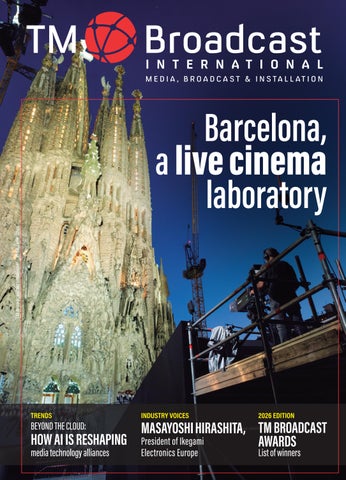
Barcelona, a live cinema laboratory: The Pope’s visit to the Sagrada Familia drives an unprecedented European broadcast
To mark the inauguration of the Tower of Jesus Christ and the Pope’s visit to Barcelona, Catalan regional broadcaster 3Cat deployed a UHD-HDR production based entirely on cinematic technology. TM BROADCAST provides an overview of this unique technical undertaking through the testimonies of some of its key protagonists.
By Norbert Paquet, Head of Live Production Solutions, Sony Europe

Beyond the cloud: how AI is reshaping media technology alliances
We speak with Steph Lone, Global Leader, Solutions Architecture, Media & Entertainment, Games and Sports at AWS, about the broader industry trends reflected in partnerships such as FOX Corporation’s decision to name AWS its preferred AI cloud provider



INDUSTRY VOICES | MASAYOSHI HIRASHITA
Masayoshi Hirashita, President of Ikegami Electronics (Europe) GmbH: “The challenge lies in addressing a broader spectrum of customers without diluting the brand’s core identity”
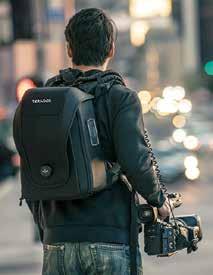

Live transmission backpacks: Evolution, challenges and current uses
The evolution of digital encoding and computing, together with advances in mobile communications (3G/4G LTE/5G) and increasingly constrained budgets, have driven the use of transmission backpacks.
TM BROADCAST AWARDS 2026
A snapshot of the evolution of the Spanish broadcast market
One of the key moments of the year has arrived for TM BROADCAST: the announcement of the winners of the sixth edition of the awards organised by the Spanish edition of this magazine.

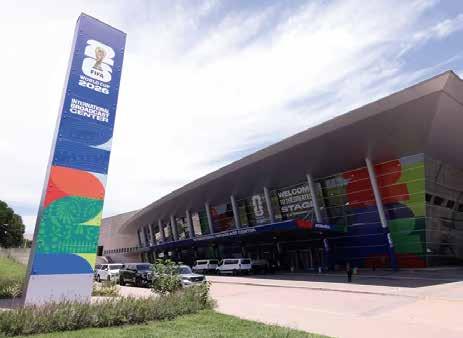
FIFA has confirmed the success of its media partnerships programme for the FIFA World Cup 2026. This year features the most expansive and innovative broadcast platform in the history of the competition, as it has claimed in a statement.
With agreements in over 220 territories worldwide, the FIFA World Cup 2026 looks forward to reaching more fans, driven by record-breaking media rights revenues and a diverse ecosystem of partners spanning traditional broadcasters, digital platforms and emerging content formats.
“The FIFA World Cup 2026 will set a new benchmark not only in terms of scale, but also in how the tournament is experienced around the world”, states FIFA Secretary General Mattias Grafström.
“Our media partnerships bring together the very best in global broadcasting with innovative digital platforms and new formats, ensuring that fans everywhere can connect with the game in more ways than ever before. This is central to FIFA’s mission of making football truly global and bringing the FIFA World Cup closer to every fan”, he adds.
In the host markets of Canada, Mexico and the United States, partnerships with Fox Sports (United States, English), Telemundo (United States, Spanish), CTV/TSN/RDS (Canada) and Televisa (Mexico) will focus on delivering enhanced coverage from every Host City.
This global platform is built on both long-standing relationships and new strategic partnerships (click here for the full overview).
FIFA has also introduced a series of innovative agreements designed to try to unlock additional value and connect with new audiences. Preferred Platform partnerships with YouTube and TikTok will drive a digital-first approach to content.
Additionally, FIFA’s first-ever global creator programme will offer select creators behind-the-scenes access.
In the United States, a collaboration between Fox Sports, FIFA and Cosm will deliver matches – including the final – in immersive, 12K shared-reality environments.
This broadcast ecosystem is supported by new production capabilities. The FIFA World Cup 2026 International Broadcast Centre in Dallas will act as the global hub for content distribution and media operations, with the intention of facilitating the delivery of advanced live match coverage alongside approximately 8,000 hours of additional non-live content.
Digital-first production workflows, including mobile filming solutions, will further support broadcasters in delivering content across social and digital platforms.
Project B has announced the appointment of Host Broadcast Services (HBS) as the Official Host Broadcaster for its inaugural global basketball circuit. This aims to mark a major milestone in the development of the platform’s international media and broadcast operations, as it has claimed in a statement.
Under a multi-year agreement, HBS will manage all centralized broadcast production and technical operations for Project
B’s worldwide competition, which will be streamed live on YouTube. The high-stakes basketball competition features the world’s best men’s and women’s players in iconic cities, combining dynamic storytelling across sport, entertainment, and culture.
Together, Project B and HBS will look forward to creating premium live and shoulder programming that captures the intensity of the circuit as it travels from city to city,
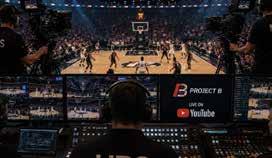
combining iconic destinations, global basketball superstars, and fast-paced on-court action. The centralized broadcast operations and production ecosystem is designed to enable localized commentary, studio programming, and market-specific coverage while maintaining a consistent worldclass production standard.
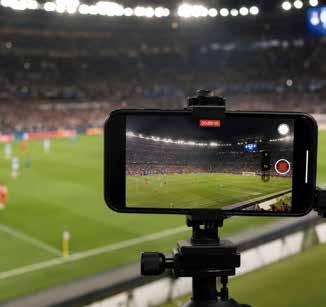
Developed in partnership with the league, the broadcast featured the LA Galaxy vs. Houston Dynamo FC match, streamed live on Apple TV from Dignity Health Sports Park in Carson, California. The event took place during the final weekend of MLS play before the regular season paused for the FIFA World Cup 2026 in North America.
iPhone 17 Pro was used to capture live footage throughout the match, including team warmups on the pitch, player introductions, in-net goal angles and the atmosphere inside the stadium. With cameras positioned throughout the venue, the broadcast delivered both the main coverage and new perspectives designed to bring viewers closer to the action.
Apple TV first incorporated iPhone into a live sports broadcast workflow during a September 2025 “Friday Night Baseball” matchup between the Boston Red Sox and the Detroit Tigers, using iPhone 17 Pro to capture select moments from the game and cinematic in-stadium footage.
The European Broadcasting Union (EBU) has published new guidelines for respectful media coverage of women’s athletics. These have been designed to tackle the sexualization of women athletes in sports broadcasting, as EBU has claimed in a statement.
‘Raising the Bar: Guidelines for respectful media coverage in women’s athletics’ are a direct response to ongoing concerns around the misrepresentation and objectification of women’s athletic performances on screen. It has been developed in collaboration with European Athletics and backed by Olympians including British pole vaulter Holly Bradshaw, Serbian long jumper Ivana Španović and Croatian high jumper Blanka Vlašić.
With a focus on raising editorial standards, the publication features clear, visual examples of camera work and broadcast direction that demonstrate how to prioritize technical skill while upholding the professionalism and dignity of women in sport.
The guidelines are now available for use by all broadcasters involved in the coverage of women’s athletics.
Glen Killane, Executive Director, EBU Sport shares: “Women’s sport deserves to be seen, covered, and valued on equal terms and we’re committed to making that a reality across our rights portfolio with our Members and partners”.

Fox Corporation and Roku have announced they have entered into a definitive agreement under which FOX will acquire Roku. The acquisition will be for $160.00 per share in a combination of cash and FOX Class A common stock, valuing Roku at approximately $22 billion in enterprise value, as FOX has claimed in a statement.
The transaction combines FOX’s sports, news and entertainment content and the Tubi service, with Roku’s leading connected
TV platform, The Roku Channel, first-party data and direct relationship with more than 100 million global streaming households. Their objective is to create a scaled next-generation media and technology company positioned at the intersection of two of the most important forces reshaping video consumption: the enduring primacy of live sports and news, and the continued rise of streaming.
FOX and Roku are committed to continuing to operate Roku as an

open, partner-friendly platform and to the continued ubiquitous distribution of FOX content. On a pro forma basis, the combined company will become the thirdlargest player in U.S. television by share of viewing, with an attractive mix of FOX’s sports, news, and entertainment content, alongside streaming services Tubi and The Roku Channel.
Grass Valley and Lawo have announced a technology collaboration focused on validating orchestration, control, and media exchange integration between Grass Valley AMPP and Lawo HOME. The collaboration aims to support the industry direction established by the EBU Dynamic Media Facility (DMF) initiative and the co-supported Media eXchange Layer (MXL) project, as the companies have claimed in a statement.
As media organizations move toward hybrid production environments spanning on-premises systems and public cloud, customers increasingly require best-of-breed platforms to work together predictably and without bespoke integration burden.
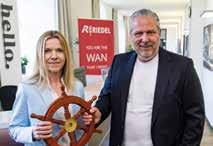
The Riedel Group has announced the appointment of Gudrun Scharler as CEO of Riedel Networks. She succeeds Michael Martens, who has led Riedel Networks since 2012 and will
Through this, both companies look forward to reinforcing their commitment to open and operationally flexible media infrastructures across software and hardware by connecting Grass Valley’s AMPP and Lawo’s HOME platforms.
The collaboration will initially focus on validating practical interoperability between AMPP
and HOME across control, orchestration, media transport and exchange, and operational monitoring with security-first deployment principles at the heart. This includes exploring use cases such as multi-platform routing, cross-environment resource visibility, and MXL-aligned exchange between software-based media functions.

support a structured handover through the end of August, as the company has claimed in a statement. “Michael has shaped Riedel Networks with exceptional commitment, entrepreneurial spirit, and a clear sense for what customers need”, shares Frank Eischet, Riedel Group COO. “We are deeply grateful for everything he has achieved over the past 14 years. At the same time, we are excited to welcome Gudrun as the new CEO of Riedel Networks. With her strong leadership background
in telecommunications, operations, and transformation, she is the right person to guide the company into its next phase of development”.
Scharler brings extensive executive experience from leading telecommunications and technology companies, where she has improved operational performance, led customer-focused transformation, and managed complex organizations.

WorldDAB has launched at WorldDAB Automotive 2026 a major new international study This has delivered compelling evidence that broadcast radio — with DAB+ as the established digital terrestrial broadcast radio platform — is essential, expected and embedded in the in-car experience, as the association has claimed in a statement.
Presented to senior automotive, broadcast and policy leaders at the annual event in Frankfurt, the findings look forward to underlining the continued importance of ensuring broadcast radio’s prominence and easy access in the dashboard as vehicles become increasingly connected.
Broadcast radio remains the first choice for drivers
The study shows that 83% of car buyers listen to radio in the car, making it the number one in-car audio source by a clear margin. Radio is also the most frequently used: half of all respondents said it is the audio they listen to most often, well ahead of streaming services (20%), personal music (12%), podcasts and audiobooks.
Daily listening patterns reinforce this dominance. 31% of car buyers listened to radio every day in the past week, compared with just 15% who listened daily to music on streaming platforms.
Even in a connected world, drivers still expect broadcast radio to be built into the dashboard. When asked which features are “must-haves” when buying a new car, 62% selected radio, placing it above built-in navigation, touchscreen displays and smartphone mirroring systems.
Broadcast radio is an essential part of the in-car experience, with 85% of in-car radio listeners saying they would “really miss having radio in my car”.
The study also highlights the performance of DAB/DAB+. 95% of DAB+ listeners say they like using it, and 91% find it easy to access while driving. Listeners praise its audio quality, reliability, station choice and on-screen information.
Ease of use remains one of broadcast radio’s strongest advantages. The study found:
› 96% agree radio is easy to use.
› 87% say radio is always just one click away.
› 72% agree radio is easier to listen to than other audio sources.
Broadcast radio also plays a critical role in safety and emergency communication. 83% say radio is very important in times of disaster, and 52% say it is the first place they would go for information while driving. Two-thirds of respondents believe radio is safer to use than other audio sources.
Beyond information and entertainment, broadcast radio provides connection and company. 85% say radio keeps them up to date with the world, while 69% say it keeps them connected to their local area. Many respondents describe how radio provides companionship when driving, with one saying: “Using radio in the car makes driving more enjoyable. It gives me music, entertainment and company while I’m on the road”.


Ateme, has announced a new partnership with Broadcasting Center Europe (BCE) and Scaleway to build a fully sovereign, cloud-based media supply chain-.The objective of this initiative is to cover the entire content lifecycle from ingest to monetized streaming, as the company has claimed in a statement.
Building on the recently announced collaboration between BCE and Scaleway, this expanded partnership integrates Ateme’s video processing, delivery and monetization capabilities.
Together, the three companies look forward to providing broadcasters, content owners and service providers with a production-ready, cloud-native media solution designed and operated entirely in Europe.
From ingest to monetization
Together, Ateme, BCE and Scaleway will offer an end-to-end suite of services, with the intention of covering every stage of the media lifecycle:
› Content acquisition and ingest.
› Processing, encoding and packaging.
› Content Management Chain.
› Broadcast Distribution and Streaming at scale across all platforms.
› Advanced monetization through dynamic ad insertion and targeted advertising.
Mark Roberts Motion Control (MRMC), the UK-based motion control robotics company, has announced that it has entered liquidation, with Lee Manning and James Thompson of S&W LLP appointed as joint liquidators, according to a statement published on MRMC’s website.
The joint liquidators confirm that they have reached an agreement for the sale of the entirety of the company’s business and assets, although the transaction remains subject to contract.
“The prospective buyer has indicated its intention to continue the company’s operations, restore a leading brand in the sector, and provide support to its existing customer base and suppliers. This includes plans to honour certain warranties and continue supporting customers” MRMC states.
The liquidation process was formally initiated on 22 May, almost two months after Nikon announced its divestment from the company. Subsequently, after a decade in its portfolio, the Japanese firm is understood to have opted to sell it to the UK investment firm Blandford Capital.
The company has said it will provide further information to customers in due course. In the meantime, it states that any orders and rental commitments confirmed by the liquidators will continue as planned. According to the company, team members have already contacted affected customers directly.

The Pope’s visit to the Sagrada Familia drives an unprecedented European broadcast
By Daniel Esparza
To mark the inauguration of the Tower of Jesus Christ and the Pope’s visit to Barcelona, Catalan regional broadcaster 3Cat deployed a UHD-HDR production based entirely on cinematic technology. TM BROADCAST provides an overview of this unique technical undertaking through the testimonies of some of its key protagonists
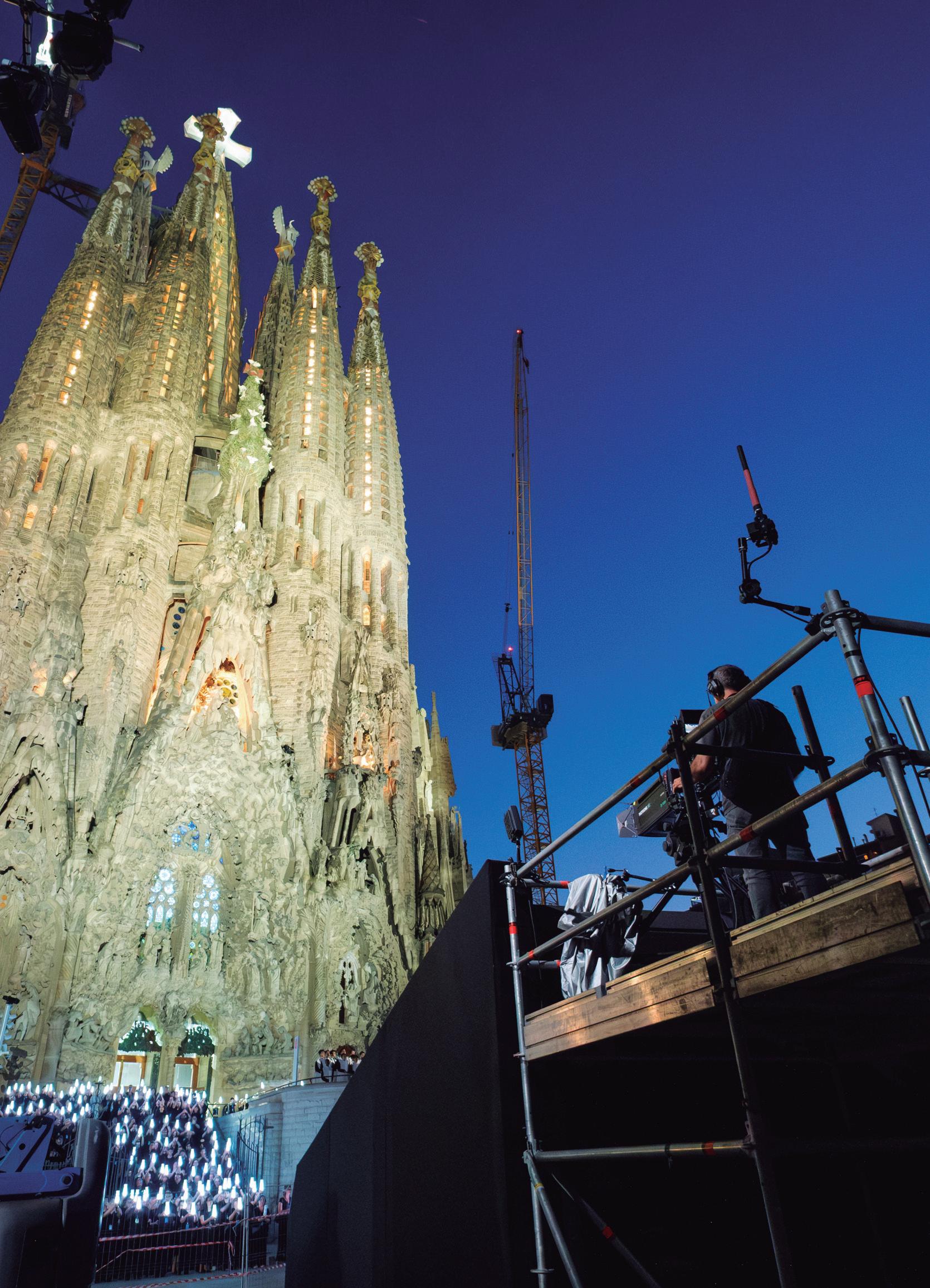
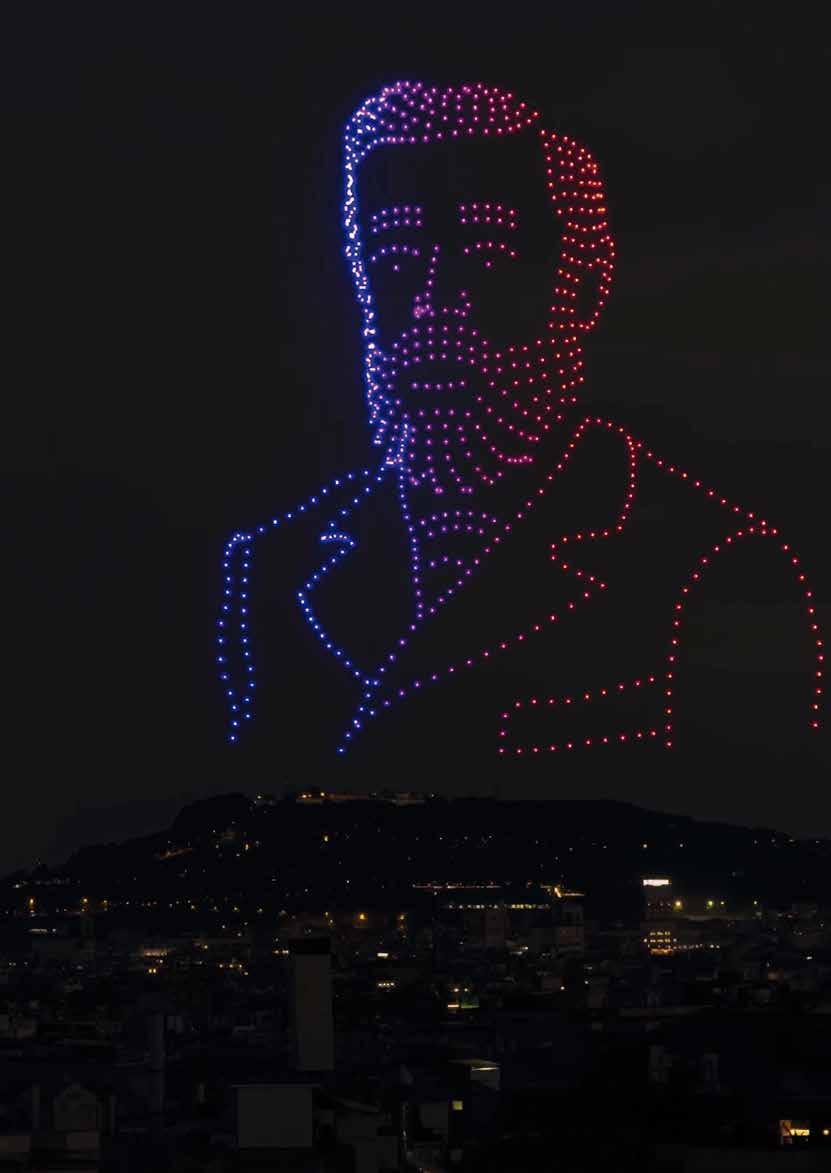
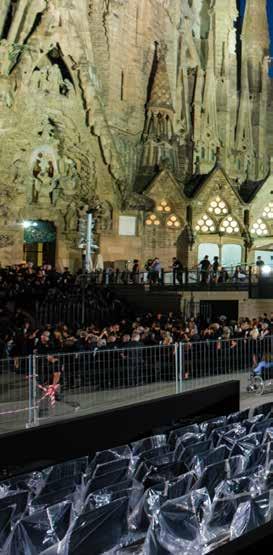
The official inauguration of the Tower of Jesus Christ at the Sagrada Família on 10 June, coinciding with the Pope’s apostolic visit to Spain, was not only a historic milestone for Barcelona’s iconic basilica. It also served as the setting for one of the most distinctive audiovisual productions seen in Europe to date: a broadcast operation built entirely on cinematic technology. The live transmission of the spectacle, directed by Paulí Subirà Claramunt and lasting approximately ten minutes, was conceived as a truly world-class international production, built around an unusual premise for television: making live cinema. The production was tasked with capturing a visually complex spectacle in which the illumination
of the basilica, fireworks and a choreographed drone display capable of recreating the figure of Antoni Gaudí played a central role.
The project’s technical direction was led by British consultant Hector SoleBradshaw Beltran, working alongside a team from the Image Department and the Technology Directorate (IDT) of Catalan regional broadcaster 3Cat. The initiative sought to position itself at the intersection of cinematic production and live television.
Before exploring other aspects of the production, it is worth taking a closer look at the event’s technical deployment. The coverage was produced in UHD-HDR HLG and featured a total of
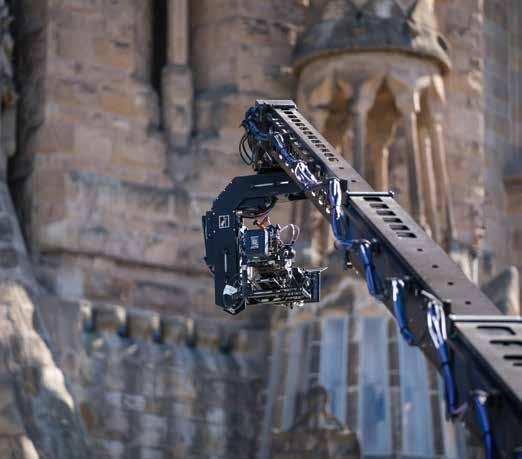
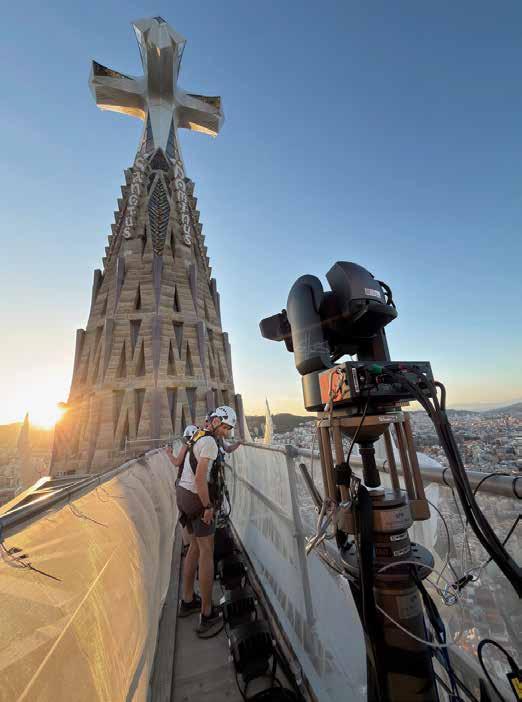
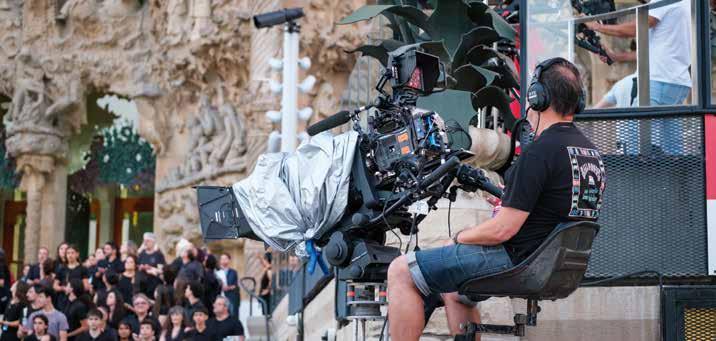
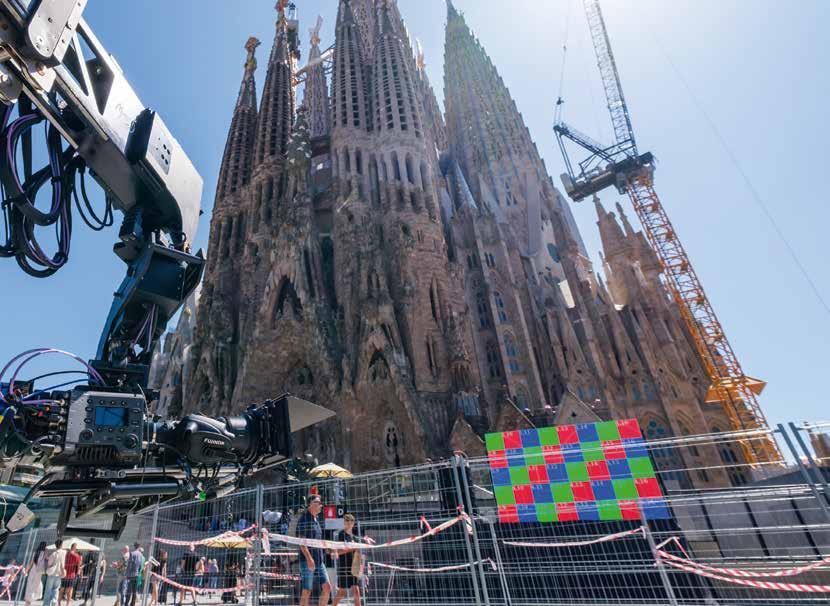
twenty cameras. According to information provided to TM BROADCAST by Héctor Sierra, South Europe & Benelux Sales Head at Sony, the setup consisted of ten Sony Venice 2 cameras for primary image acquisition, seven Sony FR7 units deployed in complex positions through robotic operation, and three Sony FX6 cameras reserved for specific tracking shots and other detailed coverage.
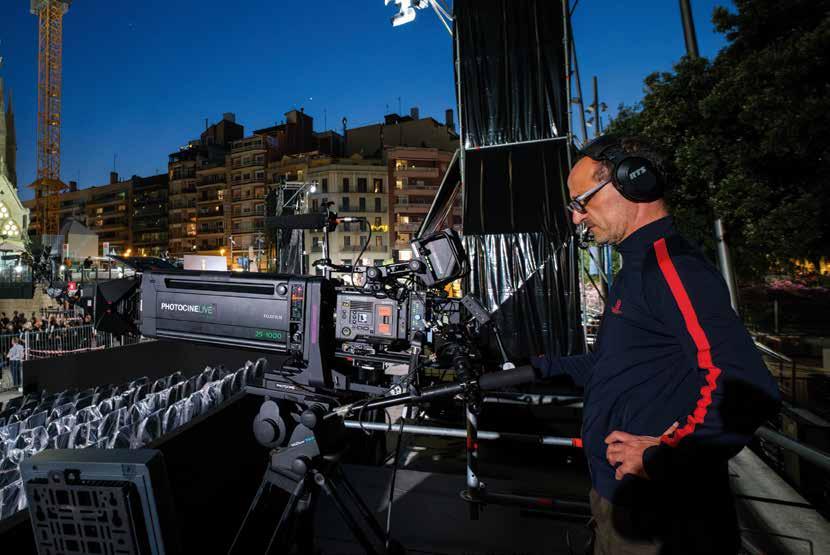
The system was complemented by Fujinon Duvo lenses as part of a configuration designed to maintain visual consistency throughout the production through the use of Full Frame sensor-based systems and equivalent acquisition technologies. The production also incorporated the technical integration of PhotoCine Live’s OB3 production truck.
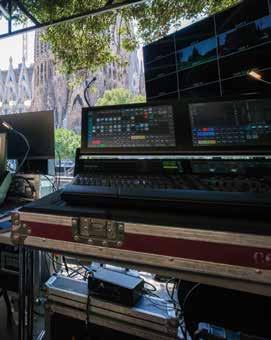
The French company, which has extensive experience in the rental of cinematic equipment, provided a mobile unit built entirely around Sony technology. It featured a Sony XVS-G1 production switcher, PVM-X2400 monitors and a 12G-SDI infrastructure designed to support all twenty cameras involved in the project.
Colour management was handled through AJA FS-HDR systems, with the option to integrate Pomfort LiveGrade into the workflow. Communications relied on a Riedel Artist 1024 matrix with Bolero wireless beltpacks, while audio production was supported by a Yamaha DM7 console.
In search of a “memorable” experience
The origins of the project date back to the moment when Paulí Subirà, Head of Image at TV3 (3Cat), was commissioned to participate in the inauguration of the Tower of Jesus Christ as part of the
events commemorating the centenary of the death of Barcelona’s iconic architect Antoni Gaudí, before the Pope’s visit became part of the equation. From the outset, the objective was to create a “memorable” experience.
Creative direction was entrusted to Igor Cortadellas, who conceived a spectacle built primarily around light as the central narrative element. The subsequent confirmation of the Pontiff’s presence at the basilica to attend the event, as part of his apostolic visit to Spain, added a new dimension to the project.
The artistic nature of the initiative ultimately gave rise to an unusual working model, based on the coexistence of
two production cultures that traditionally operate separately.
“That’s where the project becomes particularly interesting, where we can begin to explore new cinematic tools in the service of storytelling — tools capable of transporting viewers into a historic moment through a visually different language, without losing the sense of live television,” Subirà explains to TM BROADCAST.
A constant interaction therefore emerged between two worlds that do not normally work in this way. On the one hand stood the artistic and cinematic side; on the other, traditional broadcast engineering.
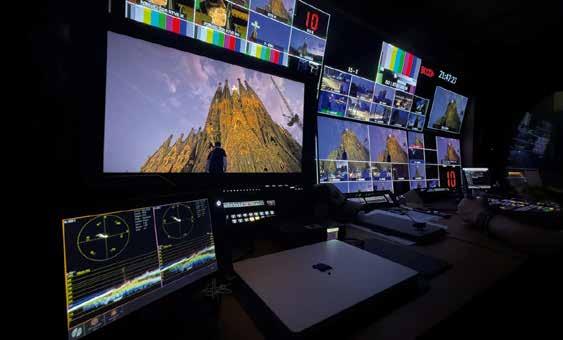
One of the most distinctive aspects of the deployment lies precisely in this combination of knowledge and experience. This is why the project evolved into a hybrid model of sorts.
TV3 (3Cat) contributed its extensive expertise in broadcast production, while the cinematic component represented a learning process for almost everyone involved, as it remains relatively new territory even for the industry itself.
Inspired by the Super Bowl, but “the European way”
To some extent, the reference model for the project was the Super Bowl. There, one finds a component clearly linked
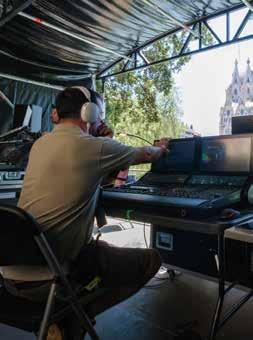
The setup consisted of ten Sony Venice 2 cameras for primary image acquisition, seven Sony FR7 units deployed in complex positions through robotic operation, and three Sony FX6 cameras reserved for specific tracking shots and other detailed coverage
to traditional live broadcasting, another associated with sport, and, between the two, a creative and artistic layer with its own visual narrative.
However, the goal was never to replicate the American model.
Instead, the intention was to explore a distinct approach to HDR, moving away from overly controlled workflows and seeking a differentiated visual identity capable of exploiting the
expressive possibilities of the format without compromising the demands of live production.
Rather than reproducing an existing formula, the ambition was to establish a unique identity for this type of production in Europe — a field in which there are still very few precedents. “We wanted to do something inspired by what is done at the Super Bowl, but do it the European way,” Hector Sole-Bradshaw tells TM BROADCAST.
Paradoxically, the project’s greatest challenge was not related to the cameras themselves, but rather to the way of working.
To explain this, Sole-Bradshaw takes a step back and focuses on the arrival of HDR in production environments. “In HDR, you start to see the seams.”
The broadcast industry has spent years optimising processes, reducing timescales and simplifying operational structures. However, the adoption of HDR already requires part of that logic to be reconsidered. While HD and SDR are relatively forgiving formats that tolerate certain operational shortcuts, HDR demands a much higher level of precision, specialisation and control.
The introduction of a cinematic aesthetic pushes this requirement even further, affecting every level of the production process: from cinematography and post-production workflows to the need for roles more commonly associated with film production, such as focus pullers and specialised camera assistants.
The cinematic look requires a complete rethink of how a programme is built. Cameras, for example, must be positioned where they perform best from a cinematic perspective, rather than where they would be most conveniently placed according to a traditional multi-camera broadcast logic. This shift also affects the professional profiles involved, which differ significantly from those found in a conventional broadcast production. The inclusion of a director of photography becomes crucial at every stage of the project.
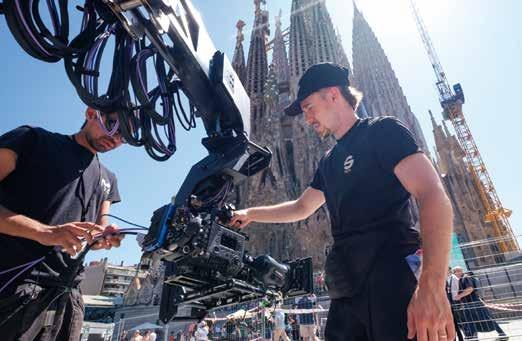
“The main challenge has been adapting workflows, timescales and budgets. If all departments — production, directing and technical operations — do not understand this change, the project cannot succeed”
Domenec Gibert (AEC), Director of Photography for the project and Coordinator of Cinematography and Lighting at 3Cat, explains it this way to TM BROADCAST: “I believe the role of the director of photography in an event such as the Sagrada Família, conceived as a Cinema Live production, is an extremely transversal one that brings together different departments. On the one hand, there is lighting, because in these cases there is usually a lighting designer responsible for creating the visual concept. The role also addresses the needs of the director. To achieve this, the director of photography works with production, post-production, technical and engineering departments in order to interpret both the technical and artistic requirements
of the final project. As a result, the role is shaped according to the specific project, generating different proportions of work in production or coordination.”
The involvement of postproduction professionals is equally essential in defining the look of the production, which is no longer shaped exclusively within camera control. A significant part of the visual identity is also designed in the colour grading suite.
Xavi Bonet, Head of Image Post-Production, summarises it as follows: “Post-production workflows must go hand in hand with live production workflows. The experience we have gained at 3Cat through the delivery of numerous cinematic broadcast productions in the documentary field, music
concerts and the ambitious theatrical production Mar i Cel has provided us with the knowledge required to tackle a challenge such as Cinema Live.”
The visual look conceived in the grading suite was the result of intensive work carried out alongside colourist Eva Parra and engineer Diego Fuentes — another clear example of cooperation between 3Cat’s Image Department and Technology Directorate (IDT).
During the installation phase, technical crews are accustomed to building conventional broadcast camera chains. Systems such as the Sony Venice, however, require professionals from the film industry who are fully familiar with how to configure, balance and prepare this type of equipment.
“For me, the main challenge has been adapting workflows, timescales and budgets. If all departments — production, directing and technical operations — do not understand this change, the project cannot succeed,” concludes Sole-Bradshaw.
The decision to work with PhotoCine Live was driven by a very specific reality: there are only a handful of operators in Europe capable of delivering a cinematic production of this nature. The French company has specialised in integrating cinematic technology into live production environments, particularly
for fashion shows, music events and productions for platforms such as Netflix, among other projects, although always within SDR workflows.
For PhotoCine Live, the Sagrada Família project represents a further step forward: it is the company’s first HDR production and also its first multilateral feed with international distribution for an event of this scale and significance. For that very reason, the project generated a particularly enriching collaboration for both parties. While PhotoCine Live provided the equipment and cinematic expertise, the 3Cat team contributed the knowledge and operational procedures associated with traditional broadcast production.
The search for visual differentiation also gave rise to one of the project’s greatest challenges. The team was convinced that the investment made in the production had to translate into a visual experience capable of delivering a perceptible difference for viewers. A constant interaction therefore emerged between two worlds that do not normally work in this way. On the one hand stood the artistic and cinematic side; on the other, traditional broadcast engineering
However, that creative freedom encounters certain limits when the main protagonist is a figure such as the Pope, who was accompanied throughout the event by a Sony FR7 positioned just a metre and
a half away and pointing upwards. “The Pope is a figure who has historically always been photographed in a very neutral way. And that creates a certain risk. You want to tell a story and the question immediately arises: how do we photograph him? What look do we give him? And to what extent can we apply that look without going too far?” explains Hector Sole-Bradshaw.
The issue extends far beyond the purely technical. According to the British consultant, the challenge lies in finding the right balance between the institutional dimension and the symbolic dimension of a figure who occupies a singular place within the event itself.
Achieving that balance required an ongoing dialogue between the director, the CCU operators and the director of photography. “If you don’t take risks, people will later say it doesn’t look that different. But if you go too far, they’ll also tell you it looks too different.”

By Norbert Paquet, Head of
On 10 June, during Pope Leo XIV’s visit to the Basilica of the Sagrada Familia and the inauguration of the Tower of Jesus Christ, around twenty cameras from Sony Cinema Line range captured one of the year’s most unique events live. The production, led by 3Cat, the national Catalan broadcaster, combined ten VENICE 2, seven FR7s and three FX6s to tell the story of an event of a monumental scale using cinematic language, whilst meeting the operational demands of live production.
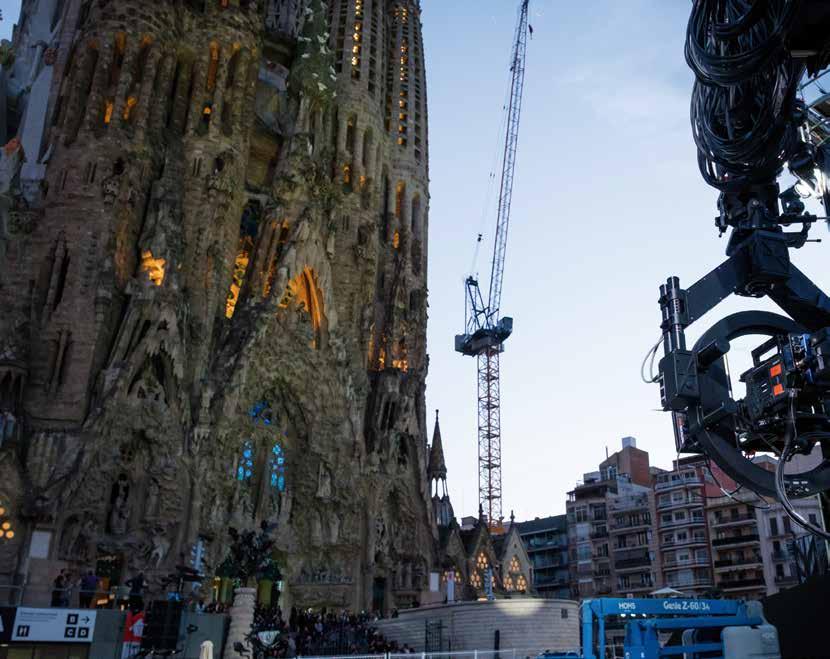
This project is the latest expression of a trend that we, at Sony, are driving under the concept of Cinematic Live: the convergence between the aesthetics of cinema and the immediacy of live broadcasting. For years, broadcast and cinema have been treated as separate disciplines with distinct tools and sensibilities. The Sagrada Familia demonstrates one more time that this boundary is dissolving, and it does so in one of the most demanding settings imaginable: variable natural lighting, hard to access spaces and a colossal architectural scale. Sony cameras do share the same colour science, which allowed shots from different sources to be intercut without any perceptible discontinuity. The VENICE 2 provided the image quality and low-light performance required for the night time
spectacle, the FR7 covered inaccessible angles via remote control, and the FX6 handled the shots requiring the greatest mobility.
Those were integrated onto PhotoCineLive’s OB3 mobile unit, using Sony XVS-G1 switcher, PVM-X and BVM-HX reference monitors, ensuring quality control of the master signal in UHD HDR HLG.
It is worth placing this Project within a broader context: Sony has been exploring this convergence for several years: from Sports down to Concerts, creators can integrate Cinematic look without compromising their operations. From Coppa Italia Frecciarossa Final to Black Sabath, including Squid Games, productions have access from the richness of Sony Cinema Live cameras, and put them in operations seamlessly into any Live Production environment.
At Sony, cinematic live production is about giving creators the freedom to deliver more immersive and emotionally connected storytelling without compromising the speed, reliability and precision required in live environments. While large-format sensors have helped shape this evolution, cinematic live production is equally defined by accurate colour reproduction, seamless
multi-camera matching and workflows that support creative flexibility at scale. For the industry, the lesson from the Sagrada Familia is clear: when cinematographic technology is seamlessly integrated into the live production workflow, it ceases to be a one-off exception and becomes yet another narrative tool, now available for everything from a religious event with global reach to a football final or a documentary. At Sony, we will continue to invest in this convergence between cinema and live broadcasting, convinced that much of the future of live broadcasting will be shaped by the language of cinema.
The lesson is clear: when cinematographic technology is seamlessly integrated into the live production workflow, it ceases to be a one-off exception and becomes yet another narrative tool

By Daniel Esparza

We speak with Steph Lone, Global Leader, Solutions Architecture, Media & Entertainment, Games and Sports at AWS, about the broader industry trends reflected in partnerships such as FOX Corporation’s decision to name AWS its preferred AI cloud provider
The recent announcement of FOX naming AWS as its preferred AI cloud provider may appear, at first glance, to be just another technology partnership. Yet, according to AWS, the agreement reflects a broader transformation taking place across the media industry.
“Our partnership with FOX Corporation spans Fox News Media, Fox Sports, the Fox broadcast network, and the FOX One direct-to-consumer platform, which serves 300 million monthly active users,” explains Steph Lone, Global Leader, Solutions Architecture, Media & Entertainment, Games and Sports at AWS, to TM BROADCAST. “It’s indicative of a larger shift we’re seeing amongst media companies today.”
That shift goes beyond infrastructure. Rather than engaging with technology vendors on a project-by-project basis, media organizations are increasingly seeking long-term partners capable of supporting transformation across the entire content lifecycle, from creation through distribution and monetization.
Rather than engaging with technology vendors on a project-byproject basis, media organizations are increasingly seeking long-term partners
“As FOX’s preferred AI cloud provider, AWS provides the speed, scale, and agility they need to modernize faster across their entire business portfolio,” says Steph Lone. “The relationship extends far beyond a typical transactional vendor to a more strategic, enterprisewide technology alliance.
It signals a shift in partnership culture that the industry will start to see more broadly across the board.”
If partnerships are evolving, so too is the role of artificial intelligence within media organizations. While generative AI often dominates headlines, AWS points to a growing number of use cases where AI is already delivering measurable operational benefits. These are typically workflows characterised by high-volume tasks, structured inputs and clearly defined outputs.
“Media companies are now seeing real operational impact with AI in areas that have high-volume tasks with clean inputs and clear outputs. These might include highlight and vertical video generation, video intelligence, content production, and system troubleshooting, among others.”
“Since video is processed once but optimized for multiple functions, it reduces costs by 34%” FOX Sports provides one example. Through AWS Elemental Inference, the broadcaster can automatically transform traditional 16:9 live sports feeds into vertical formats for social media consumption within 6-10 seconds, enabling near real-time distribution across digital platforms. “Since video is processed once but optimized for multiple functions, it reduces costs by 34%. That makes a huge difference, considering nearly 90% of Fox Sports digital content is consumed vertically.”
Other organizations are applying AI to entirely different challenges.
Bloomberg Media, for instance, has built an AI-powered video intelligence platform on AWS capable of extracting value from its 13-petabyte archive. According to Lone,
the system combines vision language models, multimodal embeddings, and knowledge graphs powered by Amazon Bedrock. “AI agents extract metadata, correlate assets via federated search, and assemble platform-optimized clips for distribution across 48 streaming platforms, reaching 60 million monthly viewers. This dramatically reduces time-to-market and unlocks new revenue from previously unstructured content.”
Sports organizations are also finding practical applications. “The PGA TOUR features timely coverage on every player using a multi-agent AI system based on AWS that produces over 1,200 articles per week at a 95% cost reduction,” highlights Lone.
Formula 1, meanwhile, has deployed a multi-agent root cause analysis system on Amazon Bedrock to support the more than 500 applications behind F1 TV Premium and race-day operations. “Supervisor and specialist AI agents analyze CloudWatch logs, correlate
incidents, and auto-generate tickets, allowing F1 to cut initial triage from 45 minutes to 4 minutes (a 95% reduction) while predicting and preventing issues before they reach fans.”
Taken together, these examples suggest that the industry is moving beyond experimentation and into a phase where AI adoption is increasingly tied to measurable business outcomes. “While some companies are experimenting with creative applications, human review remains essential,” adds Lone.
Another area undergoing rapid transformation is personalization.
“Media companies are now seeing real operational impact with AI in areas that have high-volume tasks with clean inputs and clear outputs”
Historically, personalization largely revolved around content recommendations after an event had ended. Today, according to AWS, the objective is becoming much more ambitious. “Personalization in live sports is moving from post-event recommendations to in-game, multi-format, multi-platform delivery,” says Lone.
The implications extend beyond recommendations. “The UI, the overlays, the ads, and the companion content all adapt dynamically based on the viewer, their device and location, and what is happening in the game.”
This evolution reflects changing audience consumption habits, particularly among younger viewers who increasingly engage with content through mobile devices and social platforms. “Since 88% of Gen Z consumes streaming content on smartphones, vertical video is also a key consideration.”
Examples of this shift are already emerging across the industry. According to AWS, media companies are
increasingly combining real-time content formatting with AI-powered content discovery to support more personalized experiences at scale.
The Bundesliga’s official application, for example, uses Amazon Personalize to deliver individualized content experiences based on user behaviour and preferences. “Using Amazon Personalize, the Bundesliga (DFL) Official App generates individualized content for millions of active users each season based on their favorite teams, players, and behavior. It’s helped increase article reads by 67% per user and improved the time users spend in the app by 17%.”
“Personalization in live sports is moving from post-event recommendations to in-game, multi-format, multiplatform delivery”
“Amazon Prime Video has replaced traditional genre-based browsing with personalized content recommendations using generative AI powered by Amazon Bedrock.”
“Since 88% of Gen Z consumes streaming content on smartphones, vertical video is also a key consideration”
Meanwhile, broadcasters are also exploring ways to personalize content while events are still taking place. “With AWS Elemental Inference, broadcasters like Fox Sports can publish social-optimized vertical clips while live events are still in progress.”
Delivering this type of real-time personalization, however, requires infrastructure capable of meeting the strict demands of live production. Scalability, latency and reliability remain critical considerations, particularly as AI becomes embedded in operational Amazon Prime Video is pursuing a similar objective through generative AI.
workflows. “Scalability, latency, and reliability are non-negotiables for any broadcaster, and they become even more critical when you introduce AI into live workflows.”
According to AWS, services such as AWS Elemental Inference are designed to run AI processing in parallel with video encoding, keeping latency within a 6-10 second window while applying multiple AI functions simultaneously, including vertical
reformatting, highlight detection and metadata enrichment.
“The more features you enable with AWS Elemental Inference, the more cost-efficient it becomes. Since it’s a fully managed, autonomous service that integrates with existing AWS Elemental MediaLive workflows, broadcasters do not need to provision, configure, or maintain infrastructure or modify their current video architecture to adopt AI capabilities.
In terms of reliability, AWS continues to have the strongest track record for availability, reliability, and security amongst cloud providers.”
More broadly, the company argues that AI should enhance live production workflows without adding complexity or operational risk. “As AI adoption accelerates, the challenge is no longer whether these capabilities are technically feasible, but how to deploy them at scale while maintaining
the reliability standards expected in broadcast environments.”
“As AI adoption accelerates, the challenge is no longer whether these capabilities are technically feasible, but how to deploy them at scale while maintaining the reliability standards expected in broadcast environments”



“The challenge lies in addressing a broader spectrum of customers without diluting the brand’s core identity”
In a context shaped by accelerating technological change, the constant emergence of new innovations, and a global landscape where uncertainty and volatility are also ever-present, it is particularly valuable to pause and listen to companies whose track record speaks to their ability to adapt. With that in mind, we turned to Ikegami, which is celebrating its 80th anniversary this year.
Over the course of these eight decades, the Japanese company has accompanied some of the most significant technological transformations experienced by the audiovisual industry and has managed to remain a leading manufacturer throughout all this time.
What are the keys to remaining in the market for so long? Masayoshi Hirashita, President of Ikegami Electronics (Europe) GmbH, shares some of them in this new edition of Industry Voices, TM BROADCAST’s space dedicated to gathering the views of some of the most influential voices in the sector
“Companies that last for generations usually have a strong sense of purpose, accumulated expertise and a commitment to continuous improvement,” Hirashita points out as one of the reasons behind the company’s longevity. At the same time, he recalls that “Despite all these changes, one thing has remained constant: the importance of providing high-quality, reliable storytelling and live content”.
The conversation also allows us to take the pulse of the European market and analyse the role Ikegami aspires to play in a context of growing competition and global uncertainty. Among the differentiating factors identified by Hirashita is the weight that public broadcasters continue to have in Europe. “Public broadcasters remain highly influential in many European countries, shaping technology adoption, production standards and investment priorities.”
We also discuss market transformation, the emergence of new players, pressure on margins, the evolution of customer requirements, and the way Ikegami is responding to these changes. “The challenge — and opportunity — lies in addressing a broader spectrum of customers without diluting the brand’s core identity,” he summarises.
The full interview follows.
Ikegami is celebrating its 80th anniversary this year. Over such a long
period, many companies have come and gone. From your perspective, what have been the key factors behind Ikegami’s longevity?
In my view, Ikegami’s longevity stems from a combination of technical excellence, consistency and the ability to evolve while maintaining its core identity.
Firstly, Ikegami has built a reputation for reliability and quality. In industries such as broadcasting and professional video, trust is paramount. Customers depend on equipment that performs flawlessly in high-pressure environments, and Ikegami has consistently delivered products that are renowned for their durability, precision and robust engineering.
Secondly, the company has remained closely connected to the real needs of broadcasters and production professionals. Rather than simply chasing trends, Ikegami has focused on practical innovation, developing technologies that genuinely improve workflow, image
quality and operational efficiency. This customerfocused mindset helps to create long-term relationships and loyalty.
Another important factor is adaptability. Over the past 80 years, the media and broadcast industry has undergone dramatic changes, evolving from analogue to digital and from SD to HD, and now transitioning to IP and UHD production. Ikegami has successfully navigated these transitions by embracing
new technologies while maintaining the craftsmanship and dependability that define the brand.
Finally, longevity often reflects corporate culture. Companies that last for generations usually have a strong sense of purpose, accumulated expertise and a commitment to continuous improvement. Ikegami appears to have balanced tradition with innovation, which is a rare achievement.
Reaching an 80th anniversary is not only a milestone of survival, but also evidence of sustained relevance and trust within the industry.
The broadcast and media industry has undergone major transformations over the past decades. Which changes have had the most profound impact from your perspective?
From my perspective, the broadcast and media industry has undergone
several fundamental transformations, but a few stand out as especially significant because they changed not only the technology, but also how audiences consume content and how broadcasters operate.
The first major shift was the transition from analogue to digital broadcasting. This change transformed image quality, audio performance, storage, editing and transmission workflows.
Digital technology dramatically improved efficiency and paved the way for HD, UHD and multi-platform production environments, which are now standard across the industry.
Another transformative change has been the rise of IP-based and networked production. Broadcasters are no longer limited by traditional hardware infrastructure. IP workflows enable greater flexibility, remote production capabilities, scalability and integration between facilities in different locations. This has become particularly important in live production and global event coverage.
Equally important has been the explosion of streaming and on-demand media consumption. Today’s audiences expect content
to be available anytime, anywhere, and on any device. This shift has transformed the economics of broadcasting, intensified competition and compelled traditional broadcasters to reconsider their distribution strategies and approaches to audience engagement.
Another significant development is the growing convergence of broadcast, IT, and software technologies. Modern production environments rely heavily on cloud services, automation, AI-assisted workflows and data-driven operations. Today, broadcasters are as much technology companies as media companies.
Finally, the pace of change itself has become a defining characteristic of the industry. In earlier decades, technological transitions
unfolded gradually over many years. Today, however, innovation cycles are much faster, requiring companies to be more agile, collaborative and forward-looking than ever before.
Despite all these changes, one thing has remained constant: the importance of providing high-quality, reliable storytelling and live content. Technologies evolve, but our core mission of connecting audiences through compelling content never changes.
How would you define Ikegami’s position in today’s European market, and what do you see as its key strengths in this region?
In today’s European market, I would describe Ikegami Europe as a highly respected specialist brand,
particularly renowned for its work in high-end broadcast production. Although the market has become more competitive and consolidated, Ikegami continues to occupy a unique position thanks to its engineering heritage, exceptional image quality and strong relationships with broadcasters and production professionals throughout the region.
One of Ikegami’s key strengths in Europe is its long-standing expertise in broadcast camera technology. The company is widely recognised for providing robust, high-performance systems for live production, sports coverage, studio operations and outside broadcasting. Its commitment to reliability and consistent image performance is particularly valued in environments where technical failure is not an option.
Another important advantage is the company’s strong regional presence and support structure. With its European headquarters in Germany
and an established network of channel partners and system integrators across Europe, the Middle East, and Africa, Ikegami maintains close proximity to customers and local markets.
Ikegami also benefits from a reputation for practical innovation. Rather than introducing technology for its own sake, the company focuses on solutions that address real operational requirements, including UHD, HDR, IP-based workflows, and future-proof system architectures. This balanced approach appeals to broadcasters looking for long-term value and dependable technology investments.
Finally, Ikegami’s strength in Europe stems from trust and continuity.
Many broadcasters and production companies have worked with the brand for decades, and this kind of long-term loyalty is extremely valuable in a market where reliability, service quality and technical expertise are critical differentiators.
“Rather than simply chasing trends, Ikegami has focused on practical innovation, developing technologies that genuinely improve workflow, image quality and operational efficiency”
“Today, broadcasters are as much technology companies as media companies”
“One of Europe’s defining characteristics is its diversity. Unlike more unified markets, Europe comprises many countries, languages, regulatory environments and audience cultures”
“I would describe the European broadcast market as technologically advanced, operationally demanding and uniquely diverse”
How would you describe the current state of the European broadcast market, and how does it differ from other regions from your perspective?
In my view, today’s European broadcast market is both highly sophisticated and highly complex. While it is a mature market with deep technical expertise, strong public and commercial broadcasting traditions, and a strong appetite for innovation, it is also operating under significant economic and competitive pressure.
One of Europe’s defining characteristics is its diversity. Unlike more unified markets, Europe comprises many countries, languages, regulatory environments and audience cultures. This creates complexity, but also drives demand for flexible, adaptable technologies and localised solutions. Vendors and broadcasters must navigate a much more fragmented landscape than in regions such as North America or parts of Asia.
Another key feature of the European market is its advanced transition towards IP-, softwaredriven and increasingly cloud-enabled workflows.
Broadcasters across Europe are investing in remote production, virtualisation, automation and more agile infrastructures, while balancing these developments with the operational realities of existing legacy systems.
Europe also differs in that public service broadcasting remains highly influential. Public broadcasters remain highly influential in many European countries, shaping technology adoption, production standards and investment priorities. This creates a market environment in which long-term reliability, interoperability, sustainability and regulatory compliance carry particular weight.
Compared with other regions, Europe can sometimes adopt a more cautious approach to large-scale technology transitions, partly due to regulatory considerations, procurement structures,
and the complexity of multi-country operations. At the same time, however, European broadcasters are often highly demanding and technically knowledgeable customers, making the region a strong driver of high-end innovation and engineering quality.
As the industry shifts towards software-based and virtualised workflows, how does a company with a strong hardware heritage like Ikegami adapt to this transition?
Another distinction that is becoming increasingly important is Europe’s focus on issues such as digital sovereignty, data governance and media independence. This is particularly relevant as cloud technology, artificial intelligence and platform ecosystems become more central to media operations. These considerations are becoming increasingly evident in strategic technology decisions across the region.
Overall, I would describe the European broadcast market as technologically
advanced, operationally demanding and uniquely diverse. Not only does it differ from other regions in terms of scale and structure, it also differs in the balance it seeks between innovation, regulation, cultural diversity, and long-term operational resilience.
How do you balance the demand for high-end performance with increasing cost pressures across the industry?
Balancing the demand for high-end performance with increasing cost pressures is one of the central challenges facing the
broadcast industry. In my view, the key lies in focusing on efficiency, flexibility and long-term value rather than merely reducing costs.
Broadcasters and production companies still require the highest levels of image quality, reliability and operational stability, particularly for live productions, sports events and premium content. At the same time, however, budgets are under pressure, and customers expect solutions that can adapt to changing production models and future technological developments.
Therefore, the balance comes from designing
systems that deliver strong performance while also improving workflow efficiency and protecting long-term investment. Technologies such as IP-based infrastructures, remote production, virtualisation and modular system architectures help customers to scale their operations more flexibly and reduce operational complexity over time.
Another important aspect is interoperability. Customers increasingly want solutions that integrate smoothly into mixed-vendor environments and evolving workflows.
Open standards and flexible system design can help broadcasters maximise the value of their existing infrastructure investments while transitioning gradually towards newer technologies.
It is also important to recognise that ‘high-end’ is no longer defined solely by technical specifications. Reliability, ease of operation, energy efficiency, remote maintainability and lifecycle support are now equally important factors in purchasing decisions. Often, customers are not simply looking for the lowest upfront cost, but the best overall operational value over many years.
In this environment, the companies that will ultimately succeed are those that can combine premium performance with practical, customer-focused innovation. The aim is to deliver technology that helps customers to operate more efficiently, sustainably and competitively in an ever-changing market without compromising on quality.
The production landscape has become more accessible and fragmented, with new players entering the market. How does
Ikegami approach this shift? Do you remain focused on top-tier customers, or is there a need to address a broader spectrum?
The production landscape has undoubtedly become far more accessible in recent years. Technological advances, lower entry barriers and the growth of digital and streaming platforms have created a much broader and more fragmented market than in the past. From my perspective, this shift presents both challenges and opportunities for established companies such as Ikegami.
“The
key lies in focusing on efficiency, flexibility and long-term value rather than merely reducing costs”
“Customers increasingly want solutions that integrate smoothly into mixed-vendor environments and evolving workflows
“Importantly, focusing on top-tier customers and broadening market relevance are not necessarily contradictory goals”
broadcasting and other mission-critical environments where performance standards are exceptionally high.
At the same time, however, the definition of ‘professional production’ has evolved significantly. Nowadays, a much wider range of content creators, production companies, streaming operators, and corporate media teams require high-quality production capabilities. Consequently, the market is no longer clearly divided between traditional broadcasters and everyone else.
may start with smaller or more agile production environments, but they still expect technology that can integrate into larger ecosystems and grow alongside their evolving needs. This creates opportunities for manufacturers who can combine premium engineering with practical usability and long-term system compatibility.
Ikegami’s core strength has traditionally been in the high-end professional broadcast sector, where reliability, image quality and operational stability are critical. This positioning remains extremely important, particularly in live production, sports
The challenge — and opportunity — lies in addressing a broader spectrum of customers without diluting the brand’s core identity. In practice, this means offering solutions that maintain professionalgrade quality and reliability, while also supporting flexible workflows, scalable infrastructures and different operational models.
I think the industry is increasingly valuing versatility. Customers
Importantly, focusing on top-tier customers and broadening market relevance are not necessarily contradictory goals. High-end innovation often drives technological development across the wider industry, and experience gained in challenging broadcast environments can provide significant advantages for emerging production sectors.
The key is to stay aligned with evolving customer needs while preserving the qualities that define the brand: trust, performance, reliability and long-term professional expertise.
In this evolving environment, where is Ikegami currently focusing its technological development efforts?
In today’s rapidly evolving broadcast environment, it seems that Ikegami is focusing its technological development on areas that combine high-end image quality with greater operational flexibility and efficiency.
A key area of focus is undoubtedly the ongoing development of IP-based production. As broadcasters increasingly transition towards SMPTE ST 2110 and hybrid SDI/IP infrastructures, Ikegami is investing in technologies that support this shift while preserving familiar operational workflows. Products such as the IPX-100 are specifically designed to connect traditional broadcast environments with modern IP-based production ecosystems.
Another important area of development is compact, highly versatile UHD/ HDR camera systems. The industry demands more
flexible production tools for remote production, robotics, studio automation, point-of-view capture and environments with space constraints. Ikegami’s recent focus on ultracompact camera platforms, such as the UHL-X40, reflects the growing importance of mobility and remote deployment without compromising broadcast-grade image quality, as well as the need for multi-purpose production workflows.
Overall, it seems that Ikegami is pursuing a balanced strategy of advancing towards IP-connected, flexible and highly efficient production environments, all the while maintaining the premium imaging quality and reliability that have traditionally defined the brand.
We seem to be entering a new global context, with shifts in supply chains, regionalisation and geopolitical dynamics. How is this affecting Ikegami as a Japanese manufacturer?
The global business environment is clearly becoming more complex, and the broadcast industry is not immune to these broader shifts. Supply chain resilience, regionalisation, geopolitical uncertainty and changing trade dynamics are now key strategic considerations for almost all technology manufacturers, including Japanese companies such as Ikegami.
“Manufacturers are placing much greater emphasis on securing component availability, strengthening supplier relationships, and improving operational flexibility”
“I believe that the industry is moving towards a model in which resilience, trust and adaptability are becoming as important as technical innovation itself”
In my view, one major consequence is the increased importance of supply chain stability and diversification. The industry has experienced firsthand the vulnerability of global production networks, whether due to semiconductor shortages, logistics disruptions or geopolitical tensions. Consequently, manufacturers are placing much greater emphasis on securing component availability, strengthening supplier relationships, and improving operational flexibility.
For a company like Ikegami, which has a long-standing reputation for reliability and engineering quality, maintaining consistent product delivery and support is especially important during periods of global uncertainty. Customers in broadcast environments depend on long product lifecycles and stable infrastructure planning, so resilience has become a competitive advantage in itself.
Regionalisation is also influencing how companies
engage with markets. Customers increasingly value strong local support, regional expertise, and closer collaboration. In Europe, for instance, broadcasters expect advanced technology, long-term partnerships, responsive service and integration support tailored to regional operational requirements. This makes regional subsidiaries and partner networks more strategically important than ever.
Meanwhile, geopolitical developments are accelerating discussions around technological sovereignty, infrastructure security and trusted supply ecosystems. Broadcasters and media organisations are paying closer attention to where technologies are developed, manufactured and supported, particularly as production systems become increasingly software-driven and network-connected.
Japanese manufacturers can also benefit from this environment. Japan is still strongly associated with
precision engineering, manufacturing quality, reliability and long-term business stability — all of which remain highly valued in professional broadcast markets.
Ultimately, I believe that the industry is moving towards a model in which resilience, trust and adaptability are becoming as important as technical innovation itself. Those that can combine global technological expertise with strong regional responsiveness and operational stability will be best placed for the future.
To conclude, if you had to point to one key challenge that will shape the evolution of the industry in the coming years, what would it be?
If I had to identify one defining challenge for the broadcasting and media industries in the coming years, it would be achieving a balance between technological transformation and sustainable business models.
The industry is evolving at an extraordinary pace. Broadcasters and media companies must navigate IP migration, cloud adoption, AI-driven workflows, remote production, changing audience behaviours and growing competition from global digital platforms simultaneously. Technological possibilities are expanding rapidly, but economic pressures are rising just as fast.
The real challenge lies not only in adopting new technologies, but also in doing so in a way that ensures long-term operational and financial sustainability. Media organisations must continue to deliver higher production quality, greater flexibility and multi-platform content experiences, all while operating within tighter budgets and increasingly fragmented revenue models.
This challenge also extends to people and organisational structures. As broadcast, IT, software, and cloud technologies continue to converge, the industry must adapt
its skills, workflows, and partnerships.
Success will increasingly depend on integrating engineering excellence with software expertise, data management, cybersecurity, and operational agility.
At the same time, audiences expect trustworthy, immediate and high-quality content experiences across every platform. This means that reliability and production quality remain as important as ever, even as infrastructures become more virtualised and distributed.
The future of the industry will depend on finding the right balance: embracing innovation without compromising operational stability or quality and adapting to new consumption models while preserving the core values of professional storytelling and live production.
Companies that combine technological innovation with resilience, flexibility and a clear understanding of their customers’ long-term needs are likely to succeed.
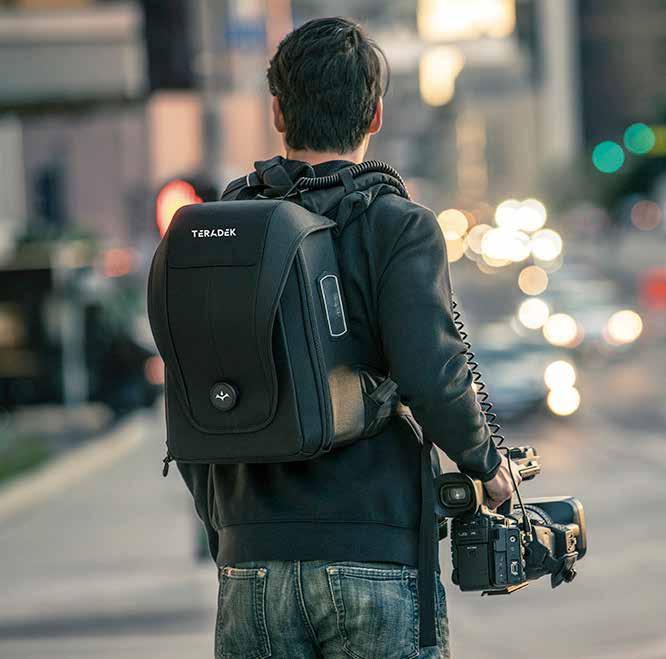

The evolution of digital encoding and computing, together with advances in mobile communications (3G/4G LTE/5G) and increasingly constrained budgets, have driven the use of transmission backpacks. In this article, we provide a comprehensive technical guide to understanding what makes this technology possible
By Carlos Medina, Audiovisual Technology Advisor
LiveU, Dejero, Teradek… They sound familiar, don’t they? These companies, together with others, are responsible for the strong adoption of live transmission backpacks. This type of equipment has enabled broadcast television, internet channels, social media
platforms and live events to put the technique of “live broadcasting” into practice.
The new challenges facing the audiovisual sector, technological developments in digital encoding and computing, advances in mobile communications
(3G/4G LTE/5G), together with tighter budgets, have driven the adoption of transmission or contribution backpacks (known simply as “backpacks” in audiovisual industry jargon). They are also referred to as video transmission backpacks. These systems have emerged, been implemented and succeeded thanks to immediacy, on-site presence and the personalisation offered to those wishing to tell the story of what is happening here and now, whether in news, sports, conferences, corporate events, presentations, web tutorials, outdoor live streaming, IRL (In Real Life) streaming, live podcasts, tabletop gaming (TTG), events, concerts and much more.
There are several techniques for live transmission, but they all pursue the same objective: transporting a video/audio signal from one location to another through cable-based transport and distribution systems
(optical fibre), satellite systems (C-band, Ka-band and Ku-band), terrestrial microwave links, or via the internet (FTP/Streaming), making it possible to share content in real time.
The transmitted audiovisual signal may be a master broadcast signal originating from a multicamera production in a television control room, or a single-camera production, meaning the signal comes directly from a standalone video camera (Video Input IN), which is sent to a production control room where that camera can be taken live on air.
In some cases, the configuration is complex and costly. For example, when a Production OB Van (UMP) is used together with a Transmission OB Van (UMT). However, in 2006, LiveU invented the backpack system itself (BackPack type).
LiveU has a long track record in the field of high-quality live video transmission from anywhere in the world. With more than 3,000 customers in over 130 countries, LiveU technology is the
The origin of these backpacks stems from the very essence of being on the front line of the events taking place around us. Being the first to have the news, and having it exclusively solution of choice for global broadcasters, news agencies, sports and entertainment organisations, delivering live video to television, mobile devices, online platforms and social media.
Transmission or contribution backpacks (BackPack type) are not simply padded carrying bags designed to protect equipment from impacts, but rather transmission solutions that make it possible to take advantage of the available capacity of mobile telephone networks. They represent a technological advancement that allows a video and audio signal to be transmitted from any location with mobile coverage, without the
need for satellite support, making it possible to carry out live broadcasts and FTP transfers in an almost immediate manner.
The origin of these backpacks stems from the very essence of being on the front line of the events taking place around us. Being the first to have the news, and having it exclusively. As early as the 1980s, the need emerged to be present with video
cameras “at the heart of the story”. Specifically, in 1985, Sony launched onto the market a type of camera known as a camcorder.
A transmission or contribution backpack offers a very simple workflow: arrive, switch on and broadcast live.
It should be noted that these systems have not replaced other transmission methods, such as the combination
of an ENG crew with a DSNG (Digital Satellite News Gathering) vehicle. Rather, the backpack has opened up the possibility of live transmission to a wider range of communication professionals. It has even become a complementary tool to more traditional fibre and satellite transmissions, reaching locations that require greater technical complexity, always in real time.
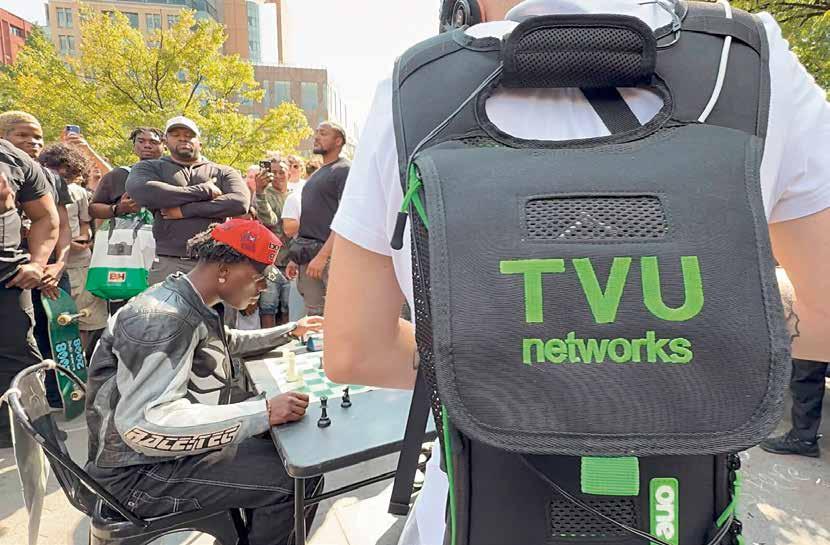
We have moved from DSNG and DENG to the concept of DMNG (Digital Mobile News Gathering) with the arrival of mobile networks, which enable live broadcasting in HD quality without the need for an outside broadcast vehicle, that is, directly from the camera to the broadcast studios.
Camera-to-studio transmission is possible through three different solutions. First, the video camera itself incorporates the technology required to generate a Wi-Fi network. Second, the camera features an interface or
slot for connecting a Wi-Fi USB dongle, a plug-andplay device that enables internet access (for example, Sony’s Content Browser Mobile (CBM)). Third, a wired physical connection is established between the camera and the transmission or contribution backpack.
These backpacks make it possible to contribute live content through the technical systems contained within them and under the operation of a single person. The term “backpack” is particularly appropriate because it is
exactly what the camera operator carries on their back, housing all the equipment required for those live transmissions.
The main elements that make up a backpack are: a video/audio encoder, modems with their corresponding antennas, and universal SIM compatibility slots so that SIM cards from any telecommunications provider or operator can be used. We are referring to 3G technology in its original form, 4G+ or LTE (Long Term Evolution), and today’s 5G. Each of
these figures and letters corresponds to the designation of a generation within the latest advances in mobile communications technology.
The International Telecommunication Union (ITU) established a committee to define the relevant specifications. This committee is known as IMT-Advanced and defines the requirements that a standard must meet in order to be considered part of the 4G, 4G+ or LTE, and 5G generations.
The main differences between 4G, 4G+ or LTE, and 5G relate to parameters such as data transfer speed (Mbps), latency (milliseconds) and territorial coverage. They also include increases in available bandwidth for data transmission and differences in energy consumption.
Understanding the evolution of mobile telephony generations is essential in order to assess the capabilities of a transmission or contribution backpack.
It should not be forgotten that inside the backpack there must also be a battery-powered system and the necessary cabling for correct operation.
The backpack can operate as an FTP (File Transfer Protocol) system, a network protocol used for transferring files between systems connected through a TCP (Transmission Control Protocol) network, based on a client-server architecture. In other words, a video file can be recorded on the camera and subsequently sent to a receiving server.
In addition, it offers a widely used feature known as Store-and-Forward, which is not a live transmission. It is the equivalent of a delayed live broadcast. It consists of recording footage on the camera while simultaneously transmitting the video continuously. Within approximately three or four minutes, the material is already available in the studio or production control room where the live programme is being produced.
All transmission/ contribution backpacks share a number of common characteristics:
› A/V encoding: refers to the codecs supported by the equipment, such as HEVC / AVC (H.265 / H.264); audio: AAC-HE/LC.
› Video/data interfaces: SD, HD, 3G-SDI (BNC), 12G-SDI (BNC), HDMI 2.0, HDMI 1.4, USB 2.0, RJ-45 Ethernet, Micro SD Card Slot, Audio Jack (in+out).
› Video resolutions: 1080p50/60/25/30/24, 1080i50/60, 720p50/60/25/30/24, PAL, NTSC, as well as the latest systems prepared for UHD and 4K content.
› Supported technologies: 3G, 4G LTE, 5G, HSPA+, HSUPA, HSDPA, UMTS, CDMA EVDO Rev 0/A/B, Mobile WiMAX, and external Wi-Fi 802.11 a, b, g & n support. IP Satellite (KA/BGAN).
› Dimensions and weight: compact size and a weight of approximately 1.5 kg, including the battery.
› Temperature: -5°C to +45°C.
One of the most interesting features offered by some 4G/5G backpacks is the ability to transmit HD video through network bonding or aggregation, including 3G/4G/LTE, WiFi, BGAN, Ethernet and fibre.
One of the most interesting features offered by some 4G/5G backpacks is the ability to transmit HD video through network bonding or aggregation, including 3G/4G/LTE, WiFi, BGAN, Ethernet and fibre
Bonding (abbreviation of Bandwidth ON Demand INteroperability Group) is the name given to the method of joining or aggregating multiple physical links to form a single logical link. Applied to image transmission, it provides the possibility of using several channels to transmit content between two points, with the aim of improving link reliability, quality, or both. The transmission of HD signals, and even more so UHD signals,
requires bandwidths capable of transferring large amounts of data. In outdoor environments, where mobile telephony is commonly used to send information, the possibility of adding/aggregating networks significantly improves transmission performance.
In order to establish a stable transmission, backpacks offer Adaptive Bitrate (ABR), Constant Bitrate (CBR), Variable Bitrate (VBR) and Forward Error Correction (FEC) options. LiveU has patented its own LiveU Reliable Transport (LRT™) algorithms — a reliable transport protocol.
Finally, any 4G/5G backpack that wishes to be well received by camera operators must excel in ergonomics to avoid fatigue, be resistant to shocks and water, and feature a silent and efficient cooling system such as Active Cooling.
The combination of these characteristics must deliver optimal results for live transmission, including the bitrates supported (for example, up to 30 Mbps), latency (the time it takes
for a packet to be transmitted across a network — the lower the latency, the better the transmission), and an effective boot-up system (less than 20 seconds).
The evolution and challenges of live transmission backpacks are clearly defined by the needs emerging within the audiovisual and events sectors, but the contributions made by manufacturers of this equipment are also essential in providing solutions:
› LiveU continues to be one of the leading references in the IP contribution backpack market. Its most representative solutions include the

LU800 series, aimed at multicamera productions and major event coverage; the LU300S family, designed for mobile journalists and lightweight productions; and LiveU Solo Pro, intended for content creators and live streaming applications. The company complements these solutions with LiveU Xtender, an external antenna designed to improve cellular reception in complex or congested environments.
› Canadian company Dejero maintains a prominent position in the market thanks to its Smart Blending technology, which combines multiple cellular,
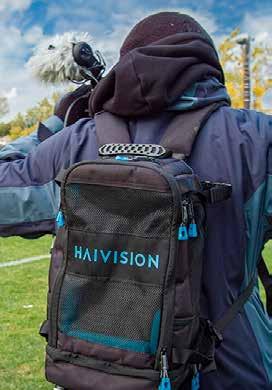
satellite and broadband connections to ensure reliable transmissions in demanding environments. Its EnGo range includes different configurations designed for ENG productions, news gathering and live event coverage, with support for 5G networks, HDR workflows and the transmission of multiple synchronised signals. The company complements its portable solutions with remote connectivity systems, centralised management tools and cloud services.
› US manufacturer Teradek develops video transmission solutions for broadcast, cinema, remote production and professional streaming applications. Its cellular bonding technology is primarily built around the Prism Mobile family, designed for IP contribution through protocols such as SRT and HEVC, and intended for productions requiring a high degree of operational mobility. In addition, Teradek offers complementary
connectivity, distribution and remote monitoring solutions integrated within its IP production ecosystem.
› TVU Networks is one of the most relevant players in the IP contribution and remote production market. Its TVU One and TVU One 4K backpacks use ISX (Inverse StatMux) technology to optimise the simultaneous use of multiple cellular, satellite and data links. The company has also expanded its offering towards cloud environments through remote production, collaboration and IP distribution platforms, creating one of the most comprehensive ecosystems in the industry.
› Aviwest technology, now integrated within the Haivision ecosystem, continues to be a benchmark for video contribution over unmanaged IP networks. Its solutions include the PRO and AIR families, capable of combining multiple 4G and 5G cellular connections, Wi-Fi, Ethernet
and satellite links. These platforms incorporate advanced aggregation and packet recovery algorithms, enabling live video contribution even under challenging network conditions.
› Mobile Viewpoint, integrated into Vislink since 2021, has evolved its mobile contribution solutions within the manufacturer’s global strategy. Its portable transmission systems combine cellular networks, Wi-Fi, Ethernet and satellite connectivity to deliver live HD and UHD video contribution. The company also maintains advanced capabilities for remote production, artificial intelligence-based automation and cloud signal management.
› Swedish manufacturer Intinor has established itself as one of the most recognised European companies in the field of IP contribution. Its Direkt Link solutions enable the transmission of live video and audio through the aggregation of multiple IP networks,
standing out for their flexibility, low latency and compatibility with different transport protocols. The company offers portable, vehicle-mounted and fixed-infrastructure configurations for broadcasters, production companies and service providers.
Each and every one of these solutions provides a number of noteworthy advantages:
› Any camera operator can become a live transmission point at any time and from any location.
› Ensure transmission reliability and quality through 4G LTE and 5G networks.
› Integrate with platforms such as Facebook Live, YouTube and Twitch.
› Reduce the costs associated with live production.
› Launch a live transmission in very short timeframes.
Today, these advantages coexist with a number of challenges, including:
› The real variability of network coverage (depending on the country, operator and urban environment).
› High-quality transmission versus increased latency.
› The economic control of data costs and the management of software licences, cloud services and qualified technical support fees.
› Battery life and autonomy.
› Compatibility and interoperability within existing infrastructures based on common standards and protocols.
› Interference caused by antenna and RF congestion.
› The need for highly qualified technical personnel with expertise in bonding, network prioritisation, codec settings and protocols, all of which have a crucial impact on the correct operation of live transmission backpacks. The evolution of live transmission backpacks continues to be closely linked to the growing demands of the audiovisual, broadcast and live events industries. As productions increasingly require mobility, immediacy and cost efficiency, these systems have become an essential tool within modern contribution workflows.
At the same time, advances in mobile communications, cloud infrastructures, encoding technologies and network aggregation techniques continue to expand the possibilities of this type of solution. The arrival of increasingly mature 5G networks, the integration of artificial intelligence into operational
workflows and the convergence between on-premises and cloud-based production environments are expected to shape the next stage in the development of live transmission backpacks.
What began as a niche solution for news gathering has evolved into a strategic technology for broadcasters, production companies, content creators and event organisers alike, capable of delivering high-quality live contribution from virtually anywhere in the world.
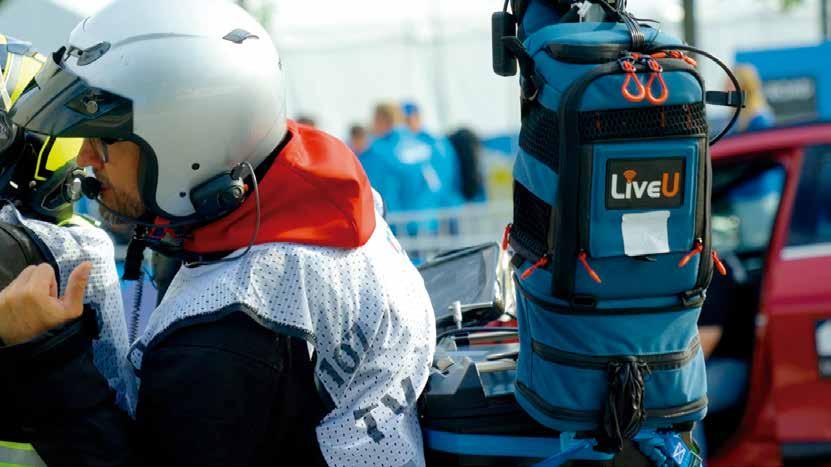
One of the key moments of the year has arrived for TM BROADCAST: the announcement of the winners of the sixth edition of the awards organised by the Spanish edition of this magazine. Now firmly established as one of the leading references within the Spanish broadcast and audiovisual industry — one of the most dynamic markets in Southern Europe — these awards aim to provide an annual snapshot of the state of the sector by recognising the most outstanding projects of the year
Beyond the individual recognition granted to each initiative, the TM BROADCAST Awards also offer a picture of the technological priorities, challenges and trends shaping the transformation of the Spanish broadcast market. Artificial intelligence, IP infrastructures, OTT and virtual production are among the key themes that have defined this year’s edition.
The 2026 edition was marked by the diversity of participating companies, greater representation across the industry, and an especially high level of difficulty when it came to reaching consensus. This resulted in a larger number of special mentions than in previous years — conceived by the jury as a second recognition of significant
value — as well as an unprecedented outcome in the history of the TM BROADCAST Awards: the decision to grant a joint award within a single category.
The jury for this edition was composed of some of the most respected figures in the Spanish broadcast industry. The panel met on 11 May at the magazine’s headquarters to deliberate on the list of winners.
Over the course of nearly two hours, its members analysed, debated and assessed the nominations across all categories in a session led by Javier de Martín, editor of TM BROADCAST, and Daniel Esparza, director of the magazine.
The committee included Vicente Alcalá, former Deputy Director of
Engineering at Telemadrid; Koldo Lizarralde, former Engineering Manager at EITB, the Basque public broadcaster; and José Enrique Zamorano, former Technical Director of Canal Sur, the public broadcaster of Andalusia, together with recognised industry experts and regular TM BROADCAST contributors Luis Sanz, Luis Pavía and Carlos Medina.
ceremony on 29 October
The awards ceremony will take place in Madrid on 29 October as part of BITAM Show — Spain’s leading professional event for the broadcast and audiovisual industry — and will be followed by an exclusive networking cocktail attended by some of the sector’s leading figures.
Winner: RTPA (Radiotelevisión del Principado de Asturias)
Project: Migration to a SMPTE ST 2110 IP Media Infrastructure
Summary
The audiovisual infrastructure renewal project undertaken by RTPA, the public broadcaster of the Principality of Asturias, involves the complete transformation of the broadcaster’s technical facilities through the migration from a legacy SD-SDI environment to an architecture fully based on SMPTE ST 2110.
Special Mention
DAZN | Madrid Production Hub Renovation
The renovation of DAZN’s facilities in Madrid transforms a space originally designed as corporate offices into an audiovisual production hub dedicated to international sports broadcasting for a global streaming platform. Developed together with Tech Brand Stories (TBS), the project integrates production studios, global connectivity, remote workflows and virtual production capabilities within a unified infrastructure.
Winner: 3Cat
Project: AI Assistant for News Image Description
Summary
Developed by 3Cat — Catalonia’s public audiovisual corporation — in collaboration with Eurecat, this project introduces a journalistic assistance system based on generative artificial intelligence for the automatic creation of accessible descriptions for news images. The initiative aims to facilitate access to visual content for people with visual impairments through automatically generated alternative text integrated directly into newsroom workflows.
Winner: Datos Media
Project: UHD Continuity System Based on IP Technology for RTVE
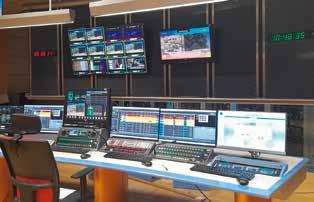
Summary
The project developed by Datos Media for RTVE, Spain’s national public broadcaster, involved the integration of a UHD continuity system based on ST 2110 IP technology and SDI. Designed to modernise the corporation’s transmission infrastructure, the system is prepared for UHD HDR workflows and advanced audio configurations, including Dolby Atmos. The project enabled the launch of RTVE’s first UHD channel and introduced the ability to operate using both IP video through ST 2110 with ST 2022-7 redundancy and conventional SDI infrastructure.
Winner: Ges-IT
Project: 5G Technical Production for the 2025 Zurich Rock ’n’ Roll Running Series Madrid
Summary
The project developed by Ges-IT for the 2025 Zurich Rock ’n’ Roll Running Series Madrid, one of Spain’s leading marathon events, proposed a sports production model based on the intensive use of 4G and 5G mobile networks as the primary contribution infrastructure for live video transmission. The initiative was designed to cover a large-scale urban event with significant operational complexity, multiple simultaneous points of interest and differentiated production requirements for both international feeds and customised broadcasts.
Winner: Canal Sur
Project: Generative AI Applied to News Storytelling at Canal Sur
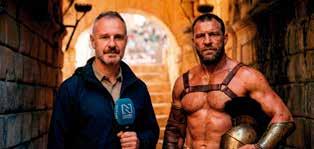
The project developed by Canal Sur, the public broadcaster of Andalusia, integrates generative artificial intelligence into news production workflows with the aim of developing new audiovisual narratives focused on historical and cultural storytelling. The initiative combines archive restoration, visual recreation, advanced animation and AI-generated historical environments to create immersive audiovisual experiences linked to the identity and heritage of Andalusia.
Cinfo | AI-Driven Automated Production
OTT Platform: tiivii.tv
The tiivii.tv platform, developed by Cinfo, introduces an automated audiovisual production model based on artificial intelligence applied to sports broadcasting. The project integrates computer vision algorithms, automated live production systems, data-driven graphics and cloud transcoding technologies with the aim of eliminating a significant portion of human intervention from live production processes.
Winner: Souvenir Studios
Project: AI-Assisted Post-Production for the Series ‘Day One’
The project ‘Day One’, developed by Souvenir Studios, introduces a hybrid post-production workflow based on the integration of generative artificial intelligence within a fiction series set against the technological backdrop of the Mobile World Congress in Barcelona. Conceived as a technology thriller, the production explores the impact of augmented reality contact lenses connected to the limbic system, while applying the same technological logic to the project’s own audiovisual production pipeline.
XPost Studios | Actor De-Aging in the Series ‘El Homenaje’

The project developed by XPost Studios for the series ‘El Homenaje’ involved the digital rejuvenation of actress Ángela Molina through advanced de-aging techniques applied to more than 85 shots. The primary objective was to recreate different stages of the character Norma Bianchi’s life while maintaining narrative continuity and ensuring that the visual intervention remained imperceptible to viewers.
Winner: RTVE
Project: RTVE Grafo Semantic Integration Platform for Audiovisual Archives

Summary
RTVE Grafo is a semantic platform based on knowledge graphs and artificial intelligence designed to transform RTVE’s audiovisual archive into an interoperable, accessible and reusable infrastructure. The project integrates more than five decades of audiovisual heritage through an architecture capable of connecting millions of assets, entities and relationships linked to news, cultural, sports, fiction and entertainment content.
Winner: Filmin
Project: Interactive Content Discovery Recommender
Summary
Filmin’s Interactive Recommender — developed by one of Spain’s leading streaming platforms specialising in films and TV series — is a content discovery tool designed to help users find titles within the platform’s OTT catalogue through a recommendation system based on user behaviour, viewing context and editorial curation. The project was conceived as a response to the so-called “choice paralysis” associated with content overload across on-demand platforms.
EITB | GUAU Audio OTT Platform

GUAU (Gure Audioa) is the audio OTT platform developed by EITB for the digital distribution of live and on-demand audio content. The project forms part of the Basque broadcaster’s broader
digital strategy and shares technological infrastructure with other OTT platforms operated by the corporation, including PRIMERAN and MAKUSI.
Canal Sur | CanalSur Más On-Demand OTT Platform

CanalSur Más is the OTT platform developed by Canal Sur to centralise the digital distribution of audiovisual and audio content within the digital ecosystem of the Andalusian public broadcaster. The platform has been conceived as a comprehensive OTT environment combining catch-up television, live streaming, exclusive content and advanced editorial management of the catalogue.
Winner: 3Cat
Project: Catalunya Ràdio Studio 5 for Multi-Window Production
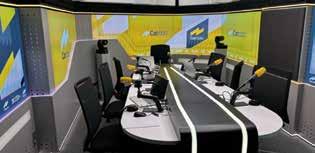
Summary
The new Studio 5 at Catalunya Ràdio, developed by 3Cat with technical
integration by Unitecnic, introduces a multi-window radio production environment based on a native IP infrastructure designed for hybrid audiovisual workflows and decentralised operations. The project forms part of 3Cat’s strategy to place digital and transmedia content at the centre of radio production.
Grup Mediapro | Migration to SMPTE ST 2110-30 Audio IP at Radio Euskadi
The project developed by Unitecnic for Radio Euskadi involved the structural migration of the station’s audio infrastructure to a native IP environment based on SMPTE ST 2110-30, PTPv2 synchronisation and NMOS-compatible governance standards. Implemented at EITB’s Production Centre, the project replaced a traditional architecture deployed in 2007 with an AoIP ecosystem designed for interoperable and scalable IP broadcast environments.
ASPA | New Radio Marca Headquarters
Studios in Madrid

The project developed by ASPA for the new headquarters of Radio Marca — one of Spain’s leading sports radio networks — involved a comprehensive renewal of the station’s technical infrastructure through the migration from an analogue and hybrid environment to a fully digital audio-over-IP architecture. The initiative included the design, engineering and installation of new studios and control systems aimed at strengthening operational capabilities and ensuring broadcast continuity.
Winner: RTVE
Project: Technical Production of La Vuelta a España
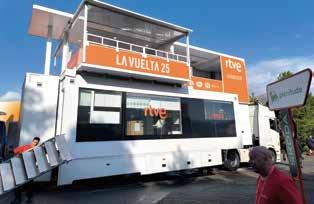
Summary
RTVE’s technical production of La Vuelta a España — one of cycling’s three Grand Tours — constitutes a multidisciplinary broadcast operation designed to cover all 21 stages of the competition through a combined deployment of terrestrial, aerial, satellite and digital resources. The project integrates television, radio and
OTT distribution within a continuous workflow for content acquisition, transport and production spanning more than 3,200 kilometres.
ACB / TBS / Mediaframe | Technical Production of the 2026 Copa del Rey acb Valencia
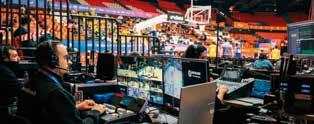
The joint entry submitted by acb — Spain’s leading professional basketball league — together with TBS and Mediaframe for the 2026 Copa del Rey acb Valencia involved a comprehensive sports production deployment designed to simultaneously cover the main tournament at Roig Arena, the Minicopa Endesa youth competition and the Fans’ Gathering associated with the event. The project integrates multiple broadcast workflows, international multi-feed distribution and hybrid production for linear television, OTT services and digital platforms.

The project developed by DAZN in collaboration with LALIGA — Spain’s top professional football competition — introduces an expanded sports production model aimed at transforming traditional football coverage into a more immersive and multiplatform narrative experience. Integrated within LALIGA’s Incentive Programme, the initiative seeks to extend audiovisual coverage beyond the match itself through new access points, acquisition systems and storytelling formats deployed throughout the entire matchday experience.
Winner: 3Cat
Project: News Studio Renovation
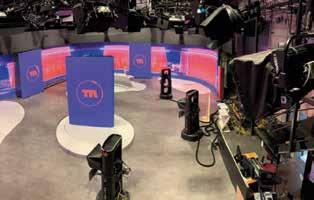
Summary
The “New 3Cat News” project involved the complete renewal of the technical and visual environment associated with the broadcaster’s news services through the creation of a new graphic, sonic and operational identity for 3Catinfo. Delivered between July 2024 and September 2025 with Telefónica Servicios
Audiovisuales (TSA) acting as systems integrator, the project combines studio renovation, robotic automation, LED integration and new visual storytelling systems designed for news production.
Project: Technical Production of ‘La Velada del Año V’
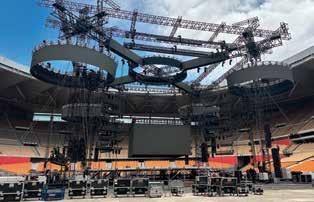
Summary
The technical production of ‘La Velada del Año V’ — a hybrid boxing and entertainment event created by content creator Ibai Llanos — was delivered by TBS under the technical direction of Xavier Soler (Sobatech). The project introduced a hybrid production model designed to integrate a sporting event and a large-scale music spectacle within a single technical ecosystem. Held at La Cartuja Stadium in Seville on 26 July 2025, the event attracted more than 80,000 attendees and achieved record-breaking concurrent audiences on Twitch, with published peaks ranging between 9.3 and 14 million connected devices.
Winner: Grup Mediapro
Project: Virtual Production Studio in Barcelona
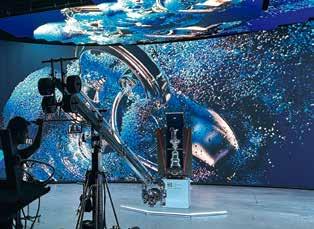
Summary
Grup Mediapro’s new virtual production studio in Barcelona is a permanent facility designed to operate under advanced virtual production standards. The installation integrates a hybrid environment capable of combining chroma-key production and LED volume workflows within the same operational space. Developed between July 2024 and December 2025, the project incorporates a design aimed at film production, broadcast applications and XR and ICVFX workflows.
Joint Winner: TBS / Cinelux
Project: Virtual Production Studio in Madrid
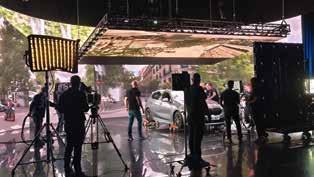
Summary
The virtual production studio jointly developed by TBS and Cinelux in Tres Cantos (Madrid) introduces a Stagecraft-based infrastructure designed to integrate film production, broadcast operations and live events within a single technical environment. The project combines LED volume technology, synchronised emissive lighting and broadcast workflows tailored to both fiction production and real-time television operations.
Winner: Telefónica Servicios Audiovisuales (TSA)
Project: LALIGA Audiovisual Contribution and Distribution Infrastructure

The project developed by Telefónica Servicios Audiovisuales (TSA) for LALIGA involved the deployment of a contribution and distribution infrastructure designed to manage the transport of video, audio and data signals between competition venues, production centres and domestic and international rights-holding broadcasters. The initiative forms part of LALIGA’s broader technological transformation process and has been conceived as a critical infrastructure platform designed to operate over the next five seasons.
TRECE | Portable Audiovisual Production System Based on Flight Cases
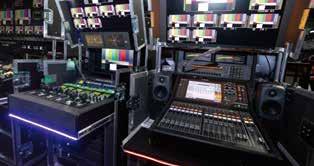
The project developed by Ábside Media Producciones for TRECE, a Spanish broadcaster, introduces a portable television production system based on a hybrid architecture comprising modular flight cases and a specially adapted production van for multi-camera broadcast operations. The initiative emerged as a response to the need to adapt production workflows to complex urban environments, tighter budgets and more flexible operational models compared with traditional large-scale OB trucks.