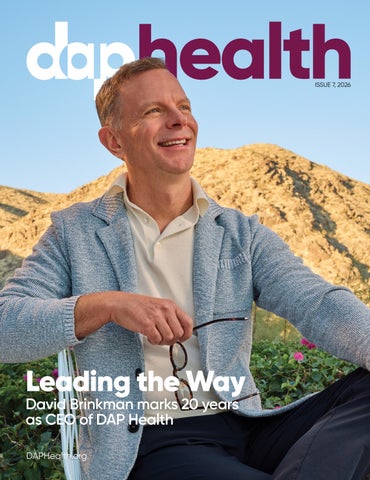
health ISSUE 7, 2026
Leading the Way David Brinkman marks 20 years as CEO of DAP Health DAPHealth.org
Welcome to Better Health With DAP Health Whether it’s time for your annual checkup, you’re managing an ongoing health condition, or you’re looking for health care for yourself or your family, we’re here for you. At DAP Health, you’ll find compassionate, whole-person care for every stage of life, all in one place. From preventive care and pediatrics to OB-GYN, dental care, mental health, pharmacy services, and specialty care, our team is here to help you live your healthiest life.
With locations throughout San Diego and Riverside counties, quality care is always close to home. Our Services Include
• Primary care • Pediatrics • OB-GYN • Dental care • Mental health • Sexual wellness
• HIV specialty care • Pharmacy • Laboratory services • Chronic disease
• Telehealth • Vaccinations and preventive care
management • Same-day care
Your health care team is ready when you are Schedule your first appointment today Call 760.466.0800 or visit DAPHealth.org
2
Need help keeping your health coverage? Our team can help you renew your Medi-Cal coverage and answer questions about health insurance at no cost to you.
Call 760.466.0800 to get started.
3
OB-GYN Care, Close to Home New clinicians now available
• Prenatal care • Perinatal education • Postpartum care
and support • Perinatal nutrition counseling • Annual well-woman exams 4
• Mammography • Birth control • Emergency
contraception • STI/HIV testing and treatment • General gynecology • Menopause therapy
Find care at DAPHealth.org
DAP Health is
advocacy dental care ending epidemics equitable access food assistance harm reduction health care health equity HIV care housing LGBTQ+ health mental health primary care recovery reproductive care sexual health social services women’s health
5
DAP HEALTH PRESIDENT AND CEO David Brinkman CHIEF MARKETING OFFICER Steven Henke VICE PRESIDENT OF MARKETING AND COMMUNICATIONS Dustin Gruber
Look for the helpers
When Mister Rogers spoke about difficult times, he often shared the advice his mother gave him: “Look for the helpers.” As you explore this issue of DAP Health magazine, I hope you’ll notice a powerful theme woven through many of these stories: people showing up for one another. You’ll read about the men who helped build the foundation of what would become Revivals, volunteers who answered a call during the darkest days of the HIV/AIDS epidemic and discovered that serving others was also a path to healing themselves. You’ll meet Melissa Lundgren, who has spent more than a decade bringing people together around a table each year for Dining Out For Life, transforming community into action. Their stories are separated by decades, but they share the same lesson: Meaningful change happens when people show up. That same spirit is reflected in our cover story celebrating David Brinkman’s 20 years of leadership at DAP Health. Throughout his career, David has consistently shown up for communities facing barriers to care, helping transform DAP Health from its roots as an AIDS service organization into one of California’s largest community health center networks. His vision, compassion, and commitment to health equity have expanded access to care for tens of thousands of people while preserving dignity and humanity at the heart of DAP Health’s mission. I’m struck by the fact that every achievement highlighted in these pages exists because someone chose to step forward. A volunteer. A donor. A clinician. A patient advocating for their own health. A leader willing to tackle a difficult challenge. Together, these individual acts of service create something far greater than any one person could accomplish alone. Thank you for being part of this community and for helping us continue this important work. Together, we are proving that when people show up for one another, extraordinary things happen. Empathy wins. With gratitude,
Steven Henke DAP Health Chief Marketing Officer
SENIOR COMMUNICATIONS MANAGER AND EDITOR Daniel Vaillancourt ART DIRECTOR Tes Schaff PHOTOGRAPHERS Oscar Fink, Lani Garfield, Brandon Harman, Ethan Kaminsky, David A. Lee, Demarcus O’Dell WRITERS Jacob Anderson-Minshall, Greg Archer, Staci Backauskas, Fabiola Berriozábal, Kent Black. Ellen Bluestein, Trey Burnette, June Allan Corrigan, Maggie Downs, María José Durán, Gary Goldstein, Steven Henke, Daniel Hirsch, Mateo Hoke, Barbara Kerr, Kay Kudukis, Donald Padgett, Victoria Pelletier, Kevin Perry, Amelia Rodriguez, Daniel Vaillancourt BOARD OF DIRECTORS EXECUTIVE COMMITTEE Kevin Bass, Interim Chair Fred Drewette, Treasurer Mark Adams, Secretary Susan Unger, Member-at-Large BOARD MEMBERS Carolyn Caldwell Bruce Finch Timothy Garnett Jordan Hall Patrick Jordan Scot Karp Karyl Ketchum, Ph,D. Veronica Williams, MBA, MSN, PHN, RNC-OB, RN ABOUT US VISION: DAP Health envisions a world where every person achieves their full potential. MISSION: DAP Health provides comprehensive health care and support services where all people are seen, heard, and affirmed. COVER & THIS PAGE
Photos by Brandon Harman 6
Table of Contents Feature Stories
The human side of DAP Health Becoming Thalia Hayden............................................................................................ 20 Homeless to Hopeful................................................................................................... 26 Put a Little Love in Your Heart..................................................................................... 32 The Men Who Showed Up.......................................................................................... 42 Leading the Way: David Brinkman’s 20 Years as CEO................................................ 62
Living Well
Patient-friendly health education and prevention A Checkup Is a Checkup............................................................................................... 8 Beyond Blood Sugar................................................................................................... 17 PrEP Is for Her, Too..................................................................................................... 95 How To Keep Your Medi-Cal Coverage..................................................................... 111
Family & Children’s Health For parents and guardians
We Know You Love Your Newborn. We Do, Too....................................................... 114 Why Well-Child Visits Matter..................................................................................... 118 Fluoride Varnish and Children’s Health..................................................................... 122
Community Impact We’re all in this together
Every Desert Breath You Take..................................................................................... 12 Meeting Patients Where They Are............................................................................... 72 A Taste of Togetherness.............................................................................................. 78 DAP Health’s Stonewall Complex............................................................................... 98
Voices & Ideas
Thought leadership and community perspectives Never Forget................................................................................................................ 36 The Art of Disagreeing Well......................................................................................... 85 Changing Lives Is More Than a Mantra ..................................................................... 89
Leadership & Innovation
How DAP Health is growing and evolving A Commitment to Service!.......................................................................................... 28 Pharmacy, Reimagined............................................................................................. 104 The Center of It All..................................................................................................... 106
Philanthropy & Support
Donors, supporters, and volunteers All In for DAP Health.................................................................................................... 49 In Memory of My Brothers........................................................................................... 53 The Future of Giving Looks Brighter With the DAP Health Foundation...................... 58 7
A Checkup Is a Checkup DAP Health’s unique campaign seeks to highlight the benefits of early detection and treatment, both of which lead to better health outcomes. Words by Fabiola Berriozábal
Would you drive your car for years without changing the oil or checking the tires? Didn’t think so. The vehicle might run fine for a while. No warning light may come on. Until one day, it does. Or worse! For Chief Medical Officer Dr. Joseph Aquilina — a family medicine expert who joined DAP Health two years ago after 23 years in the Navy — that is one of the easiest ways to explain preventive care. ”Just like you do regular maintenance on your car, you need regular maintenance on your body,” he says. That idea is at the heart of DAP Health’s “A Checkup Is a Checkup” campaign. The message is simple: A checkup does not mean something’s wrong. But it can be the visit that keeps something from getting worse. It can be the moment a patient asks questions, gets labs, or learns that everything looks fine.
8
You check your messages. Check your family’s health too.
Affordable Care for You and Your Family
Primary care, women’s health, pediatrics, dental care, pharmacies, and urgent care to help you stay on top of what matters most.
“Let’s just check to see where you are today,” Aquilina says. “Let’s see if we can take care of something now, before it becomes a bigger problem.” Aquilina thinks about this through a concept called “health span.” Lifespan is how long someone lives. Health span is how long someone lives well. ”Who wants to live a long life if they’re suffering all the time?” he asks. “We would all love to be as healthy as possible for as long as possible.” That is why he recommends patients visit their primary care team every year, even when they feel fine. ”Just come in to say hello,” he says. For many patients, that’s easier said than done. Some avoid care because they feel healthy. Others worry about cost, insurance, transportation, or language barriers. Many fear being judged — for their weight, their habits, their sexual history, or simply waiting too long to come in. Aquilina wants patients to know a checkup is not a lecture. “There’s no ‘should,’” he says. “‘Should’ is ‘could’ with shame.” The goal is not to shame anyone. It’s to help patients reach their own health goals. “This is a partnership. I work for you.”
Closing the gaps At DAP Health’s San Jacinto Health Center, medical assistant Selene Cuapio sees that partnership every day. Most of her patients are from a Mexican background. Many speak little or no English. She understands why that matters: Her own mother does not speak English. “I’ve been there,” she says. “So, it’s like, ‘OK, Mamá, let me help you.’” Every visit includes a review of what care each patient may be due for. The team calls missing checks “care gaps.” They can include blood tests, cancer screenings, mammograms, and immunizations, based on a patient’s age and health history. For Cuapio, closing those gaps means more than checking a box. “I grew up in a Mexican family. We don’t always know the importance of regular checkups. We don’t know that a yearly exam can catch things before we’re sick.” Waiting can have consequences. Cuapio remembers a patient who was due for a breast exam. A clinician found something concerning. The 9
“You can make sure all your preventive measures are in place. That first visit can make a big difference and set you up for successful health outcomes.”
10
DAP Health Chief Medical Officer Dr. Joseph Aquilina photographed by Brendan Harman.
patient was referred for a mammogram but delayed out of fear. Then COVID-19 disrupted care. By the time she was screened, the cancer had advanced. “She was afraid to find out it was something bad,” Cuapio says. The patient later said she wished she had gone sooner. Another patient did follow through. She completed her mammogram, got a biopsy, and learned she had cancer — but it was caught in time. The last time Cuapio saw her, she was doing well. Why it matters For Aquilina, that’s the whole point. Early detection gives patients more options. A colorectal cancer screening can start with a simple at-home test. If results are normal, some patients may not need another for several years. If something is abnormal, the care team follows up. “Ignoring it doesn’t make it better,” Aquilina warns. “It never makes it better.” The same is true for heart health. High blood pressure and high cholesterol often have no initial symptoms. A routine visit might catch them before a heart attack or stroke happens. Preventive care includes sexual wellness too. Aquilina recalls a young patient who came in for pain. Routine testing revealed an HIV-positive result. ”They felt fine,” he remembers. “They had no idea they were living with HIV.” Because it was found early, treatment started quickly. Today, people living with HIV can reach an undetectable viral load — which means that the virus cannot be sexually transmitted. ”Everybody deserves to know,” Aquilina says. For Cuapio, the first step is simple. “Just make an appointment with your primary care clinician,” she says. “That way, you can make sure all your preventive measures are in place. That first visit can make a big difference and set you up for successful health outcomes.” That message matters most in communities where people — we’re looking at you, women — often put themselves last. ”A lot of people depend on you,” Cuapio tells those grandmothers, mothers, daughters, girlfriends, and wives. “You need to take care of yourself.” Indeed, everyone does. Do it for you — and for the people who love you.
Your health matters.
Let’s schedule your checkup. Virtual and phone visits are available.
Ready to schedule? Call 760.323.9255. Medi-Cal, insurance, and sliding-scale options available. No insurance? We can help.
11
12
Every Desert Breath You Take A generous Desert Healthcare District & Foundation grant brings DAP Health together with a quartet of other local nonprofits to improve air quality for Coachella Valley residents. Words by Barbara Kerr
When people are asked what they love about living in the Coachella Valley, many simply raise their arms and point to beautiful palm trees, bright sunshine, and clear blue skies. But increasingly — due to rising temperatures, strong winds, and toxins from the shrinking shorelines of the Salton Sea — those skies are being darkened by blowing sand, dust, smog, and pollutants.
13
“In the Coachella Valley, air quality can have a real impact on people’s health, especially for those living with respiratory issues or who have chronic health conditions.”
14
Those issues are impacting the health of everyone in the region. From farmworkers who harvest crops to the influencers who attend Coachella. From children on playgrounds to adults at work and at home. A million-dollar commitment to environmental health In 2025, DAP Health and four other regional organizations — Asthma & Allergy Foundation, Desert Recreation Foundation, Visión y Compromiso, and Youth Leadership Institute — received nearly $1 million in grant funding from the Desert Healthcare District and Foundation for programs and services to improve local air quality awareness, community education, and access to respiratory care for more than 85,000 desert residents. “In the Coachella Valley, air quality can have a real impact on people’s health, especially for those living with respiratory issues or who have chronic health conditions,” says DAP Health Senior Manager of Community Health Manny Muro. “This work really matters, because it helps connect people with practical support, whether that’s education, referrals, or care.” DAP Health as a grant hub Of the five organizations, DAP Health is the only Federally Qualified Health Center (FQHC), therefore uniquely eligible to receive federal funding to provide comprehensive primary care and support services in underserved areas. So, it’s become an important hub for the work supporting the twoyear grant. For the nonprofit, said grant is funding four important initiatives: • Creation of an Air & Wellness Alliance • Training to support screening, diagnosis, and treatment • Coordination of clinical care for asthma, bronchitis, emphysema, and Chronic Obstructive Pulmonary Disease (COPD) across five clinics serving Palm Springs, Desert Hot Springs, Cathedral City, Coachella, Thermal, Mecca, and the surrounding communities • A bilingual (English/Spanish) outreach/media campaign on air quality impact and how to access DAP Health services Air quality begins at home DAP Health Director of Operations for Pediatrics & Adult Medicine Lucy Aceves knows how external factors can lead to worsening asthma, pulmonary disease, and breathing problems in children and adults. But she also sees the impact in homes, due to microplastic particles and toxins created by food and beverage containers, clothing, textiles, and more. “People don’t understand how much that impacts indoor air quality,” she says, adding that most people overlook that it’s not just pollution outside that’s problematic. “Poor interior air quality also causes sickness. Many have secondary asthma because of allergies.”
In an intense climate where windows are often closed, trapping toxic particles inside, Aceves encourages everyone to regularly open doors and windows to let fresh air in so dust and toxins can escape. She also urges patients to take advantage of care coordination at DAP Health, where clinicians can make environmental risk factor assessments and, where appropriate, support access to interventions like home air purifiers. DAP Health Patient Care Advocate Raquel Benavides is a licensed vocational nurse (LVN). She encourages everyone to “know your health and listen to your body,” and recommends creating a medical journal to allow you to “talk to your doctor to make better health decisions together. Work with your clinician to figure out how to stay healthy, how to stay out of the ER, how to stay out of the hospital.” A transformational moment DAP Health Senior Grant Writer Laura Nachison describes the grant funding as “transformational for DAP Health, in that it combines both marketing to raise community awareness of air quality conditions in the Coachella Valley, and how to seek care and treatment for poor-air-quality-related conditions.” She says the Desert Healthcare District “absolutely has their finger on the pulse of what’s happening to health here in the Coachella Valley. They care about it. They’re a great organization and have been friends to DAP Health for a long time.” Desert Healthcare District and Foundation Chief Program Officer Donna Craig is impressed that the five organizations have formed an alliance, meeting regularly and sharing information. “They have really solidified their relationships with each other,” she says, noting the results of the work now underway could lead to future grant funding to support additional lasting impact. Prevention, health, equity and access Muro is excited about the work taking place “because it sits at the intersection of all DAP Health does: prevention, health, equity, and access. It allows us to respond to a real regional need in a way that’s truly thoughtful and practical. “It challenges us to think bigger and to really collaborate with our community partners. Not just how we educate our community, but how we strengthen our systems, build our partnerships, and improve the health care experience of people affected by poor air quality. For me, that’s truly strong community health work. It’s about connecting people to the right information, the right support, and the right care, and doing it in a way that’s responsive to the diverse populations we serve.” For more information, or to become a DAP Health air quality patient, please scan the QR code or visit DAPHealth.org/breathe-easier-coachella-valley.
15
Coughing or wheezing, feeling short of breath? Poor air quality may affect lung health.
Find care at DAPHealth.org
16
What everyone should know about diabetes, from risk factors and prevention to diagnosis, treatment, and long-term health. Words by Amelia Rodriguez • Photo by Demarcus O’Dell
In 1993, during a routine annual physical, DAP Health Senior Communications Manager Daniel Vaillancourt had the sudden urge to ask his doctor to screen him for diabetes. The whim didn’t make sense on paper: Vaillancourt was a healthy, slim 30-year-old with no symptoms and few risk factors. But his dad had just been diagnosed with type 2 diabetes, and something in the younger man’s gut called for him to double-check. “I remember sitting in Dr. Jerome Nitzberg’s waiting room in Ashland, Oregon — where I worked at the Oregon Shakespeare Festival as an assistant publicist — while he processed the results of my glucose tolerance test,” Vaillancourt recalls. “After a while, Nitzberg approached me. But instead of saying, ‘You’re free to go,’ as he’d assured me he suspected he’d do, it was, ‘Follow me!’” Vaillancourt was diagnosed with type 2 diabetes and prescribed the oral agents glipizide and metformin. Now 63, he’s continued to manage the condition without requiring insulin injections, although his initial medications’ doses have been upped and a few other pills have been added to his regimen: the generic nateglinide and brand name drugs Januvia and Jardiance. Vaillancourt also eats healthily and exercises regularly. After more than three decades, he thankfully still maintains an impressively low 6.2% A1C, a check that measures average blood sugar levels over a few months. But if he’d ignored his hunch that day, Vaillancourt may have become one of the people living with undiagnosed diabetes. According to the CDC, 40.1 million Americans — or 12% of the country’s population — have the condition, and 27.6% of them don’t know. What’s your type? Adding to the confusion is the fact that there are multiple types of diabetes. Type 1, typically diagnosed in childhood, means that the patient’s pancreas makes little or no insulin, the hormone that allows the body’s cells to use sugars from food for energy.
17
“If there’s something wrong with you, you need to know, because early detection means early treatment, means better health outcomes in the long run.” 18
With type 2, the body can’t utilize insulin correctly (a problem called insulin resistance) or sees a decline in insulin production over time. This latter kind is linked to lifestyle — a lack of physical activity, a diet high in processed foods and added sugars, and poor sleep all can make one more susceptible, as does being overweight or having a history of gestational diabetes during pregnancy. Additionally, Black, Latino, and Indigenous American communities have higher rates of type 2 diabetes, and risk increases as one ages. Over time, diabetes can cause complications throughout the entire body, from damage to the blood vessels in the eyes to reduced blood flow in the feet. Not-so-fun fact: Diabetes is the leading cause of non-traumatic lower-limb amputation in the U.S. Patients also often experience problems with their gums, nerves, bladder, and sex organs, and heart and kidney disease are common comorbidities. Recognizing symptoms — if they appear “When patients come in, we ask them, ‘Have you noticed excessive urination? Has your weight or your vision changed? Are you experiencing any sexual performance issues?’” says DAP Health Director of Adult Medicine Dr. Damoun Rezai. These, along with other issues like fatigue or poor healing, can all be signs of blood sugar–related concerns, but diabetes often initially presents with no symptoms at all. So, it’s always a good idea to get tested, especially if you have any of the risk factors detailed above. Clinicians will generally run an A1C blood test. Results of 5.6% or below indicate healthy blood sugar levels. A staggering 115.2 million Americans are in the prediabetic range: 5.7% to 6.4%. While prediabetes is a serious warning sign for type 2, lifestyle changes can help you manage your blood sugar and keep your A1C out of the diabetic range of 6.5% or higher. Resources at DAP Health That’s where resources like DAP Health’s year-long diabetes prevention program come in. Open to adults considered high-risk for developing type 2 diabetes (based on considerations like A1C and body mass index), the free program involves weekly Zoom meetings where participants learn the daily tweaks that can help improve their blood sugar levels. “It can be something as minimal as walking after you eat or making small changes to portion sizes or putting honey in your coffee instead of refined sugar,” DAP Health Wellness Center Manager and program leader Cory Lujan says. “I give everyone a scale to track their weight. Once a month, we have a healthy lunch here at DAP Health’s headquarters in Palm Springs. We’re not asking anyone to start running marathons. These are just small, manageable changes that can have a big impact on a participant’s health.” Lujan and her team are hoping to expand the program soon to reach more patients throughout the community health center’s network.
Rezai offers similar support to patients who have been officially diagnosed with type 2 diabetes. “Hippocrates said, ‘Food is thy medicine,’” he adds. “As clinicians, we should really be educating, coaching, and helping to guide a patient’s diet.” Rezai asks his patients to adopt a Mediterranean diet, packed with produce and healthy fats and low in refined carbs. He also suggests implementing 150 minutes of moderate exercise each week. If medications are needed When it comes to pharmaceutical interventions, insulin therapy is rarely the first-line treatment for type 2. And while hugely popular GLP-1 medications like Ozempic can treat diabetes and address related health risk factors like obesity and heart disease, Rezai prefers to begin with less expensive and more accessible oral medications such as Vaillancourt’s initial treatment via glipizide and metformin. “These drugs have been around for a long time. They have good data,” Rezai maintains. “You can buy a 90-day supply for dollars.” Other pills such as dapagliflozin and canagliflozin are “scientifically built to use the body’s mechanism to help get rid of the sugar, through the kidneys,” Rezai adds. “They make you pee sugar, and they protect your heart.” And because diabetes can affect so many bodily systems, DAP Health’s one-stop-shop approach of multiple specialists under one roof can help patients prevent and monitor potential complications. “We can do foot exams right here. We can do eye exams,” Rezai explains. “If you need a cardiologist, pulmonologist, nephrologist, or neurologist, we refer you right away.” Other DAP Health–provided resources — from healthy food packages to housing and transportation assistance — support patients’ ability to take care of their bodies and see their clinicians regularly. The great news is that people with diabetes can live long, healthy, happy lives — but it’s critical that they know they have the disease so that they can begin to establish a treatment plan. “Whether you have diabetes or are at risk or not, don’t fear the doctor, don’t fear tests,” advises Vaillancourt, whose primary care clinician is at DAP Health, and who regularly consults with his beloved longtime endocrinologist, Dr. David Aftergood, in Beverly Hills. “If there’s something wrong with you, you need to know, because early detection means early treatment, means better health outcomes in the long run.”
Daniel Vaillancourt with Dr. Damoun Rezai 19
Becoming
Thalia Hayden Words by Kay Kudukis • Photos by Demarcus O’Dell From childhood chaos to “Talking with Thalia,” the NBC Palm Springs personality wrote an open book about her past. But it’s always the next chapter that sparks her light.
In Greek mythology, Thalia is the Muse of Comedy. That tracks. Prior to her New Jersey theatrical debut as Audrey in a fifth-grade production of “Little Shop of Horrors,” 10-year-old Hayden was already living up to her name. “I was that little girl saying, ‘Look at me! Look at me!’” she says today. “Whether it was performing, singing, gymnastics, or sports, I just really wanted to be seen.” Comedy’s counterpart is Tragedy, whose name is Melpomene. But in this tale, we’ll call her “Mom.” Hayden’s mother was a very busy muse indeed, so the youngster’s afterschool babysitters were Sally Jesse, Phil, and the queen of daytime talkers, Oprah. Hayden imagined she was asking all the questions. Early evenings, she’d switch off the TV to admire Mom — who nicknamed Hayden her “little shadow” — as she got dressed and did her makeup. When the doorbell rang, Mom and Dad would greet the neighbors and close the door. That’s when the alcohol, drugs, and partner-swapping started, lasting deep into the night. Ends up that safety in the Hayden home was only for pins. For high school graduation, Hayden got neither a car nor a gold watch. Mom gifted her a boob job. Start spreading the news A high school friend had suggested that TV news combined Hayden’s two loves — journalism and acting — so the senior gave it serious thought. Hadn’t Sally Jesse and Oprah started in the newsroom? “There’s a dichotomy I like,” Hayden admits. “A dark and a light that feels familiar. You can have fun and talk about entertainment and sports but then, on the other side, it’s all the heartbreaking catastrophes, chaos, and tragedy.” That Hayden was accepted at one of the nation’s leading Catholic colleges — Seton Hall University in South Orange, New Jersey — didn’t stop her from leaning into addiction. She ultimately graduated with a bachelor’s in communications, but her minors were booze, cocaine, and pain pills. Through the fog, she nonetheless saw a path.
20
21
“A lot of people think
drugs and alcohol are
the problem. They’re the symptom of the chaos underneath.”
22
“When I did a college internship at News 12 in New Jersey, my eyes lit up like a Christmas tree,” she recalls. “I saw the studio and I was sold. I knew that this is what I wanted to do.” Her first real job — though behind the scenes, not on camera — was at WNYW, the New York City flagship station of the Fox TV network. Her first day there was September 11, 2001. Trial by literal fire. By 2005, Hayden had pivoted, giving acting and modeling a go in Los Angeles. But when her increasingly out-of-control substance abuse made
Hayden on the NBC Palm Springs set shooting a segment of “DAP Health Explains” with Director of Pediatric Services Dr. Jasmin Brown. Photo by Daniel Vaillancourt.
her hit personal rock bottom, she sought therapy, which led to recovery, which led to her first oncamera job at WPTV in West Palm Beach. Florida wasn’t a fit, so from there she went to WHEC in Rochester, New York. Discovering the desert By 2012, Palm Springs had landed on Hayden’s radar, and her seasonal affective disorder would soon get a well-deserved break. “A weekend anchor slash reporter position opened up at what was then called KMIR — which would be three days reporting, two days anchoring,” Hayden remembers. “I applied right away. To my surprise, I got a call back pretty immediately.” Hayden got the job, finally finding home. But with over two decades in the newsroom, today she has a surprising admission. “I’m not into news. Never have been. I’m more into entertainment.”
23
Author, author And, as it turns out, into writing. In 2021, Hayden released her deeply honest, page-turning memoir “Local Celeb: Addict to Anchor,” in which she recounts her journey to sobriety. “Everyone has a story,” she says. “But making things public, and talking about it, holds me accountable to a certain degree. “A lot of people think drugs and alcohol are the problem. They’re the symptom of the chaos underneath. You need to find the root cause or the symptoms will keep popping up and appearing everywhere.” Hayden has grown to know and love herself, and prides herself on her genuineness. On social media, she bucks beauty standards by posting selfies sans makeup. She doesn’t do Botox or fillers, and not long ago, had her breast implants removed. That made her feel lighter on several different levels. Better late than never Having conquered her demons, and found a fulfilling job, Hayden was ready for what would come next. “I never wanted children, I never wanted a husband,” she reveals. “Three years into sobriety, I thought, ‘Now that I’m not doing drugs, and I have this career, what else is there for me?’ And then I thought, ‘Maybe I do want those things and I was denying myself because I didn’t think I could have them.’ Now, sitting here, married nine years, with a child, it’s like, ‘I did it!’” A few years shy of turning 50, Hayden feels being a mother is her greatest achievement. “That won’t ever be something I take for granted,” she says. “It’s like a whole life-changer.” But back to NBC Palm Springs. It will come as no surprise that “Talking with Thalia” is her favorite duty. It scratches that talk-show-host itch she’s had since childhood but also gives her something the news rarely delivers: room to ask why. “The hope in the segment is to get to that root discussion, not just the surface thing, whether it’s medical, emotional, or behavior driven,” she says. A unique collab with DAP Health Along with anchoring, Hayden has been NBC Palm Springs’ health reporter since 2014. Through the years, a special bond formed with DAP Health, which sponsors “Talking with Thalia.” And since January of this year, Hayden has also been the host of DAP Health’s hub at NBCPalmSprings.com/DAP-Health, where she interviews a clinician monthly on a topic of special interest: June being Men’s Health Month, or October being big for breast cancer awareness, for example. She sees it as a natural extension of her talent and interests. Like a medically inclined talk show segment. “I’m so excited for the future because of the growth that’s taken place so far,” she says of her recent achievements. As it turns out, she’s perfectly suited for her name. The root of Thalia is thallein/thallo, meaning to bloom, to flourish, to thrive. Or, as Hayden herself puts it, “I’m still becoming.”
24
DAP HEALTH EXPLAINS Health care conversations that simplify confusing topics for your family. Scan the code to visit our YouTube Channel
PALM SPRINGS 25
Homeless to Hopeful Brenda Bermudez went from living on the street to becoming a grateful DAP Health patient, volunteer, and resident of Vista Sunrise I. Words by Ellen Bluestein • Photos by Brandon Harman
Brenda Bermudez had never heard of the Coachella Valley until arriving in Palm Springs in August 2023 to seek treatment for substance use disorder. Originally from Los Angeles, she had lost everything during the COVID-19 pandemic. “I ended up really struggling with drugs and alcohol,” she says today. “I became homeless. I had been assaulted. I ended up getting stabbed in the neck in L.A. and being left for dead.” After that incident, Bermudez was determined to change. “I always knew there was something better for me,” she insists. “I just had to go out there and look for it, because I knew the help wasn’t going to come and find me.” When treatment options in Los Angeles County fell through, Bermudez entered a residential program in Cathedral City and eventually moved to Michael’s House in Palm Springs for additional care. There, she met Julio Diaz, a former DAP Health community health educator who now serves as an early intervention specialist at the nonprofit. He was then giving a presentation on the organization’s HIV prevention and care programs and services.
26
“I always knew there was something better for me. I just had to go out there and look for it, because I knew the help wasn’t going to come and find me.”
“At that point in my life, sitting there in that room listening, I wanted more. I wanted to see what DAP Health was all about,” says Bermudez. “I went up to Julio and said, ‘Everything you just spoke about, I’ve never heard about ’cause we don’t speak about that in my home.’” Diaz listened to Bermudez’s story and arranged for her to have a complete physical exam, free of charge, at DAP Health. It’s something she hadn’t had in years. The diagnosis When the results of her blood work came back, Bermudez learned she was HIV-positive. “It was heartbreaking,” she recalls. “I had one of those cries, like when you can’t cry anymore.” The stigma that often accompanies the disease also weighed heavily on Bermudez, who was raised in a traditional Latino family where anything related to sexuality was not discussed. “I have family members who have passed away shamefully from full-blown AIDS because they did not speak about it,” she says. “They were too ashamed to tell their brothers. They were too ashamed to tell anybody. They hoped it would just go away.” Still, she remained undeterred in her quest to regain her life. She went to her medical appointments to get her long-neglected health back on track. She had her teeth fixed at the DAP Health Sunrise dental clinic. She visited the Social Services Department to find a place to live and spent many hours at DAP Health’s Wellness Center, where she found the guidance, information, and resources needed to rebuild her life.
“Diamonds, pearls, and gold — they were not discovered by lazy people. You have to dig, climb, and dive to find them. And that’s exactly what I did. I knew the work was going to be hard, but I was given a shovel and I just started digging, pulling the dirt off my grave, and said, ‘I want to live. I want to be more.’ And I know that all the dirt that was dumped on me, I used it to get back up. I was far from being lazy because now I feel empowered. That was not going to be so easy for me had I stayed in L.A. There was no way there but death.” Today, Bermudez lives at Vista Sunrise I, an apartment complex for people living with HIV/AIDS at DAP Health Sunrise in Palm Springs, and volunteers at the organization’s Wellness Center. She has reconnected with her estranged daughter and is excited to meet her first grandchild, due this fall. Most important of all, thanks to local AA meetings and DAP Health’s SMART Recovery Program, she celebrated her three-year sobriety anniversary last August. Bermudez uses the metaphor of Jackie and Shadow — the famous pair of “24/7 livestream cam” wild bald eagles that lived near Big Bear Lake in California’s San Bernardino National Forest — to describe her relationship to DAP Health. “This is my safety nest. The organization gave me the courage, tenacity, and strength to get back on my feet and find my wings. Like an eagle, I may soar, but I never stray far from home. This place truly is my home. “I’m here today without any shame, without anything to be afraid of anymore. I could face whoever I am in front of and say, ‘Hey, my name is Brenda. Yes, I am HIV-positive. How can I help you? I can make difference in your life.’”
a
“I didn’t know how to live in a community again, coming from the streets, being battered, being beaten, being abused,” she says. “Because of what DAP Health stands for, what they do, I could focus on my health. I could focus on taking care of Brenda again.” The strongest of safety nets As Bermudez continued to put in the work, the team members at DAP Health remained a constant source of support. “They told me, ‘Don’t worry. We will take care of you’. And they did. They do. They have been truthful to that promise,” she says. “Every time I walked in those doors, I felt safe. I felt warmth, I felt cherished. If people knew how great and strong that safety net is, I know more people would be willing to get help.
27
28
A Commitment to Service! Jordan Hall may be the newest member of the board of directors, but he brings a wealth of professional health care experience to the table. Words by Kent Black • Photo by Demarcus O’Dell
Local luxury realtor and longtime DAP Health board member Kevin Bass knew there was something special about Jordan Hall the moment they met. They had crossed paths when Hall — then a Boise, Idaho, resident — was shopping for a winter residence in Palm Springs. Hall ended up purchasing a property represented by Bass, and though the realtor’s dealings with the buyer were necessarily limited during the process, Bass says he found Hall “ridiculously smart, savvy, and accomplished. I looked at his background and saw he was a former Marine with a Doctor of Nursing Practice (DNP) degree, had served as a nurse case manager at Walter Reed National Military Medical Center, and that geriatrics was one of his specialties. He started coming to DAP Health events, and I saw he had a deep passion about what we do.” Hall, 41, is modest about his accomplishments. He grew up in nearby Redlands, where one of his neighbors was Congressman Jerry Lewis, who represented California’s 41st Congressional District. Hall says Lewis was an early mentor, encouraging the young man’s goals. Following his studies at the University of Findlay, Hall entered the United States Marine Corps Delayed Entry Program (DEP). He subsequently attended Johns Hopkins University, where he earned his Bachelor of Science in Nursing. Hall says he was very fortunate to have had mentors in the Marines who recognized and encouraged his potential. “I can 100% say I would not be where I am today if it wasn’t for my military service. My deployment gave me the motivation as well as the confidence to go after what I wanted to do professionally.” Hall spent 2009 to 2012 working at Walter Reed in Washington, D.C., before the BRAC restructuring that relocated services to Bethesda, Maryland. He says one of the most gratifying roles in which he found himself was when he “worked with the most severely wounded, ill, and injured service members. Back then, we didn’t have a policy that spoke to what the service member does if he loses all limbs? How does one adapt? How do you rehab someone this way? Traditionally, they retire you. We started devising a program to keep these members on active duty so they could transition to another role. They may not be a war fighter on the ground, but they could remain a war fighter in some other capacity.
29
“My greatest joy is to help keep the missing moving along.” “We focused on developing different strategies to take care of patients. That really got my brain going. The problem with health care isn’t necessarily health care. The problem with health care is how it’s managed and run.” After leaving the military, Hall worked first for UCLA Health Faculty Practice Group, then for Apollo Medical Holdings before and after its transition as a publicly traded company (the company rebranded as Astrana Health, Inc.), before moving into a role supporting a wide range of organizations engaged in government value-based care initiatives. Hall says that at first he accepted Bass’ invitation to attend several DAP Health events because he thought it would provide good networking possibilities, “but from my very first event on, I’ve just been really captivated by the mission at DAP Health.” It was during Hall’s attendance at his first Steve Chase Humanitarian Awards in 2023 that he started to understand that he might want to be involved with the organization in a more significant way. “I remember sitting at the table thinking, ‘Oh, man, there are so many things I could do to help.’” He purchased an auction item to have dinner with the DAP Health board. That evening led Hall to have brunch with CEO David Brinkman, who pitched him on the idea that the growing organization could really use someone with his perspective and expertise. Hall came away from his first board meeting fired up. “This board is made up of a lot of bright folks and community leaders,” he says. “They come from various backgrounds that are very beneficial, and I was amazed how this talented group of people had taken this organization so far in such a short amount of time. But I also saw an immediate need I could help fill, such as contracting in the federal space.” It’s been a little over a year since Hall joined DAP Health’s board, and Bass sees his true value. “Jordan has been able to keep the vision on track,” he says. “He’s able to put it in practical terms and make it a reality because he understands the business side of health care.” The ever-modest Hall simply says it’s an honor to be able to help. “The bulk of what I do is work in federal programs, so it was easy for me to jump into this role and help with some of the programs and operations internally. My greatest joy is to help keep the mission moving along.”
30
Affordable Care for Healthier Smiles • Dental care for adults & children • Routine exams & cleanings • Fillings • Protective treatments • Restorations • Affordable pricing & Medi-Cal accepted
Find care at DAPHealth.org
31
Put a Little Love in Your Heart “Think of your fellow man, lend him a helping hand,” go the lyrics of Jackie DeShannon’s 1969 golden oldie. At Revivals, Hector Guerrero lives those words every single day. Words by Kay Kudukis • Photos by Brandon Harman
Tom Grissinger was working behind the scenes at Hot Rodeo last April when he had an unscheduled, accidental stunt involving a truck and galvanized steel livestock gates. “I thought I was OK, a few scratches,” Grissinger says now, “but later I found out I had done something to my foot. I couldn’t put any weight on it.” Every place he went to or called was out of crutches. Then he remembered Revivals, dialed, and asked for help. When Grissinger pulled into the thrift store’s Palm Springs parking lot moments later and let them know he’d arrived but was unable to walk in, customer service associate Hector Guerrero jumped into action and quickly brought two different sizes of supports out to the injured man. When Grissinger picked a pair and tried to pay, Guerrero waved him off. “It was medical, he needed them,” the 38-year-old tells me, “and my boss, manager Kris Fischer, empowers me all the time. He’s had my back since day one. He told me, ‘Do what you’d want someone to do for you.’” And so, Guerrero does. Like the time he was helping a senior gentleman lift something bulky into his trunk, and the shopper’s pants fell to his ankles. The younger man quickly pulled the trousers back up, then ran into the store and got the guy a much-needed belt. On the house, of course!
32
33
An award-winning team member Working at Revivals makes Guerrero extraordinarily happy because this is who he is — and who he gets to be on the daily. Especially after spending 13 years of, “I put another cog in the machine today,” he says. And it seems everyone throughout DAP Health and Revivals knows about this very good egg, because earlier this year, Guerrero received the Empathy Wins Award — based on one of DAP Health’s and Revivals’ quartet of core values, and voted on by his fellow team members, who number nearly 1,000.
When he was 18, doctors fashioned him a cosmetic right ear, and these days, Guerrero sports a shorter haircut. Completing the picture of a good life By 19, Guerrero was managing the men’s department at Target. It paid the bills and allowed him to focus on a very personal goal: true love.
In the end, it’s clear Guerrero and Revivals were made for each other. DAP Health’s own brand of thrift stores (with outposts in Palm Springs, Cathedral City, and Palm Desert) has a full fleet of good eggs on the sales floor and behind the scenes. In addition to stocking and selling merch, they provide vouchers to clients and free clothing to the unhoused, raise funds for DAP Health (to the tune of almost $2 million a year), and provide gift cards to the nonprofit’s Community Health, Philanthropy, and Harm Reduction departments to help inspire people to access the care they need and deserve.
His friends knew just the guy and pointed him toward “Amalio Jr. on MySpace.” So, at age 20 in 2008, Guerrero sent a message — to the wrong Amalio Jr.! When he finally reached the right person, Amalio Jr. ended up being Mr. Right indeed. They’ve been happily-everaftering since.
A boy’s life
Amalio, 49, is a veteran with a JD from Pacific Coast University School of Law who’s a paralegal with the Riverside County Public Defender’s office. “I was missing that calling,” Guerrero says of his 10-year management position at Vons. “I would just get up to go to work. It was not meaningful.” So, when COVID-19 hit and turned the world topsy-turvy, Guerrero quit.
Guerrero, a Long Beach native whose stay-at-home mom had six children — one girl followed by five boys — was a middle child. Dad was a pilot with a whole other second family in Mexico. Born with a condition called microtia, Guerrero is deaf on his right side. Where an ear would be, he once had
34
just a lobe. No opening. No canal. In school, he hid it by wearing his hair long and hid out as a teacher’s aide. “Maybe that’s why I liked assisting in special ed,” he muses. “They can’t help that they were born that way.”
That was 18 years ago, for anyone who’s counting. The pair became domestic partners first and then were legally married in 2015. They live in a home they purchased together in Cathedral City.
“I hope I make you feel human and cared for.”
Finding fulfillment at Revivals In 2024, Guerrero applied at Revivals. He’d read about DAP Health and thought his retail experience would be a great fit. Besides, the job might give him purpose. When he mentioned that during his job interview, Fischer, who’d been a manager at a big box store, empathized. He knew team members are usually just numbers in those environments, and that at Revivals, everyone who works there — whether they are employees or volunteers — takes care of one another, and of anyone and everyone who walks in, because they themselves are well taken care of by management and by the organization. Guerrero mentions a man who still sits heavy on his mind. He was Spanish-speaking, but nonverbal due to a stroke, carrying a bag of medications when he wandered in. They finally pieced his story together. He’d been flown alone from Guadalajara to Ontario Airport and ended up spending the night on the streets in Palm Springs. The Revivals team made the decision to send him to the hospital to get checked out while the family made emergency arrangements. “It was so sad,” Guerrero remembers. “I wouldn’t do that to a dog or a cat. Like, imagine, a human being?” What Guerrero seems to connect to are life’s fundamentals. “I’m happy just going home, walking my dog, feeding the stray cats, and starting all over tomorrow.” And where would he like to be in five years? “Hopefully, right where I am,” he says, adding that if anyone reading this should meet him through an interaction at Revivals, “I hope I make you feel human and cared for.” 35
36
NEVER FORGET The discovery of two Holocaust-era artifacts donated to DAP Health’s Revivals store in Palm Springs — and entrusted to Rancho Mirage’s Tolerance Education Center — serve as a living testimonial of past horrors that should never be repeated. Words by Gary Goldstein • Photos courtesy of City of Rancho Mirage
Given the countless films, TV shows, books, and firsthand accounts there have been about the Holocaust, it might feel as if every story about this horrific period has already been told. And then, remarkably, a new one, with its own new and amazing twist, comes to light. Such is the case with the discovery of two framed Holocaust-era artifacts anonymously donated to DAP Health’s Revivals resale store in Palm Springs. The first item is a hand-embroidered Star of David, the longtime symbol of Jewish identity. During World War II, the Nazis required Jews past the age of 6 across Nazi-occupied Europe to wear a yellow version of the six-pointed Star. The purpose: to more easily identify and target these innocent people for persecution. The second artifact is a set of currency notes from the Lodz Ghetto in German-occupied Poland, a sealed encampment in which an estimated 160,000 Jews were confined and abused by the Nazis. This money, which had no value outside the ghetto walls, was another tool used to isolate, control, and exploit Jewish people. It didn’t take long for Revivals volunteers to realize these rare items were of profound historical importance. Utmost care was taken to deliver them to DAP Health CEO David Brinkman. But once in his hands, the crucial question became: Where do these pieces belong? “I sent out a message to leaders of my board of directors, who are also leaders in the Jewish community,” says Brinkman, “so we could start a conversation to ensure these artifacts would be preserved.” This led to one of the most meaningful acts of remembrance and civic teamwork the Coachella Valley area has seen in years.
37
38
Keeping it local Typically, these kinds of significant objects might end up on display at one of the major Holocaust centers, such as the National Holocaust Museum in Washington, D.C., or the Museum of Tolerance in Los Angeles. But when Board Chair Eve Fromberg Edelstein, Esq. — who also happens to be a member of the Rancho Mirage City Council — laid eyes on the items, she felt they not only should be kept local but returned to the Jewish community. “I was astounded that something like this just showed up,” she says. “I thought, this is a miracle. These things don’t happen randomly.” Fromberg Edelstein then reached out to the Jewish Federation of the Desert, a service and advocacy group for the region’s Jewish population, for their assistance in placing the artifacts. The Federation suggested the Tolerance Education Center, a Holocaust education museum in Rancho Mirage, serve as the permanent home for the unearthed articles. The esteemed venue jumped at the chance. “We were absolutely thrilled to have them,” says Michele Gold, the center’s executive director. “They are precious. They are exactly what we are about.” As an institution dedicated to fighting antisemitism, racism, and bigotry, it proved an ideal match. “Artifacts are history, artifacts are education,” says Gold, who is the daughter of a Holocaust survivor. “They will be a prominent part of the teaching tools we share with our students and our communities throughout the Coachella Valley.” Brinkman formally donated the artifacts to Gold, on behalf of DAP Health and Revivals, during a Rancho Mirage City Council meeting on Thursday, June 18. Different missions, one purpose The discovery of these artifacts set into motion an exceptional collaboration among a trio of like-minded local organizations. Their individual missions may vary, but there is a significant thread that ties together DAP Health, the Jewish Federation, and the Tolerance Education Center. “We all continue to fight for the human rights of people who were persecuted by the Nazis — the Jewish community and the gay community — both of which still face discrimination in our country and around the globe,” says Brinkman. Fromberg Edelstein agrees. “The three organizations involved in this [effort] deal with marginalized populations and the protection and identity of these populations.” She continues, “My job is to bring the community together and create a safe community where people feel like they can live and thrive. All of these three organizations pride themselves on reflecting those missions and those values, and our city does as well. That, to me, is synergy.” “Sometimes these partnerships can be planned, and sometimes they happen serendipitously,” says Federation CEO Danny Labin. “This is a really incredible example of when different organizations that didn’t necessarily realize they shared something come together in service of something greater.” Never forget Following World War II, “Never Forget” became an enduring pledge to honor the six million Jews murdered during the Holocaust and to remember the appalling events with full clarity and honesty. And yet, there remains significant antisemitism and Holocaust denialism across the world, with disturbing increases in recent years. The continued existence, discovery, and display of Holocaust-related items can hopefully help combat the ignorance and hate that continue to surround one of history’s most unthinkable events.
39
Artifacts are history, artifacts are education. We become almost witnesses to the witnesses when you receive artifacts like these.
40
Fromberg Edelstein, Brinkman, Gold, and Labin at Rancho Mirage City Hall on June 18.
“These physical artifacts tell a story that, sadly, the human beings behind those artifacts cannot tell, because they were robbed of that possibility,” says Labin. “These artifacts are, in some ways, the closest thing we have to a living testimonial of the horrors of the Holocaust.” “We become almost witnesses to the witnesses when you receive artifacts like these,” adds Gold. “They are a huge educational tool to teach, especially our youth, what was going on and how the Holocaust didn’t begin in the gas chambers.” Leslie Pepper, a Jewish educator and Federation staff member, echoes Gold: “Education is the only way we can make a difference and change the ills going on in the world.” The artifacts are on display for public viewing at the Tolerance Education Center (35147 Landy Lane, Rancho Mirage, CA 92270) from 10:00 a.m. to 3:30 p.m. Monday through Thursday, from 10:00 a.m. to 2:00 p.m. on Friday, and Sunday by appointment only. Please call 760.625.6958 for more information. To view our video about these artifacts, please scan the QR code. 41
The Men Who Showed Up They stayed sober by serving others.
Words by Steven Henke • Photos by Demarcus O’Dell
At first glance, the manila envelope seemed ordinary. It was a cool May morning in Palm Springs, and I was sitting in Thom Muller’s kitchen, a man I had known for years after first meeting him at a 7:00 a.m. Alcoholics Anonymous meeting at Sunny Dunes, exchanging greetings and listening to his shares without ever fully knowing his story. That changed when he mentioned, almost in passing, his early days volunteering with Desert AIDS Project, a conversation that eventually led me here, to his table. As he carefully emptied the envelope onto the surface, out of it flowed evidence from another life: old photographs, HIV testing certifications from the 1990s, an award for having given 1,000 volunteer hours, and DAP name badges illustrating the many roles he held in the organization’s early days. Spread across the table, the objects hinted at the beginnings of something larger than a store — what people today know as Revivals: a place, a community, and a source of purpose. Muller speaks plainly, without claiming credit. More than three decades in Alcoholics Anonymous have taught him a simple discipline: service. It helped him get sober, and it helped him stay there.
Friends in Colorado had died. In Palm Springs, the crisis was still raging, and DAP needed volunteers. In fact, the nonprofit itself was still taking shape when Muller joined as an HIV testing volunteer. Two nights a week, he sat with people in two small offices at the back of The Desert Sun’s offices on North Palm Canyon Drive, part of what is now the Revivals Palm Springs store. Together, he and the men he served would wait for answers during one of the most frightening periods of the epidemic. “People were scared and uninformed,” Muller recalls. “They had no idea where this was headed.” There were no effective treatments. AZT had appeared, but it offered little hope. Entire circles of friends were disappearing. By today’s standards, the entire process was brutal. People had to wait two weeks for results. When they came back, Muller learned them at the same moment the men did. “We would open the envelope together,” he remembers. Sometimes, he held a hand. Sometimes, someone cried. Sometimes, fear manifested as anger. Each envelope had the potential to carry a life-changing answer. Curing isolation
That is where this story begins, not with a thrift store, but with a principle learned in recovery. “Be of service,” Muller says. “Not just in the rooms. Be of service outside the rooms.” That instruction would help spark one of the Coachella Valley’s most successful nonprofit retail enterprises.
For those who tested positive, DAP offered what medicine often could not yet provide: dignity, compassion, and the assurance that no one would face the disease alone. But even that compassion existed in a climate of fear and stigma. Who wanted to be associated with AIDS?
A step back in time
“People wouldn’t give money. They didn’t want to touch it,” says Craig Prater today. Back then, he was the development director at DAP. He remembers going before the Palm Springs City Council
When Muller got sober in the early 1990s, he was 40 years old, and the HIV/AIDS epidemic had already reshaped his life. 42
“Be of
service. Not just in the rooms.
Be of service
outside the rooms.”
repeatedly to ask for support, without any success. “It was hands-off.” Clients, too, carried fear into every interaction. For some, simply entering the DAP building felt dangerous. Prater recalls that Hispanic men who were married to women but needed the agency’s services — what today we would call men “on the down low” — were terrified of being discovered there. “It was very secretive,” he says. Case managers sometimes arranged private appointments when the building was closed, allowing clients to receive care without sacrificing privacy. Thankfully, there were also people who moved toward the crisis instead of away from it. Prater never forgot one group. “Nuns,” he says. “They went to the hospital when even parents wouldn’t go. They weren’t afraid to touch these men.” The birth of Revivals At the same time, another effort was taking shape in a storage room. Community members began donating clothing, furniture, books, canned goods, and household items. Some wanted to help people living with HIV/AIDS. Others were grieving
43
1: Thom Muller building out the first retail space on Perez Road when it was called Desert Friends Thrift Store. 2, 3, 4: Palm Springs Pride community outreach at Villa Capri Hotel. Thom Muller (3 & 4). 5: Eddie Dobbs (right), a Hollywood dresser to the stars, who volunteered in the clothing department at Desert Friends Thrift Store. Vintage photos courtesy of Thom Muller.
2
1 3
4
5
lost loved ones and wanted their belongings to serve some purpose. First, the donations were stored at DAP’s Vella Road location, where clients could take what they needed. When funding to expand medical services finally arrived, that storage room had to become clinical space. So, Muller and Jack Kunkel moved the donations to the front lawn and started selling them on the weekends. The money helped support counseling and testing. There was no business plan, just a need, and volunteers were willing to meet it. The yard sales caught on quickly. To regulars, the operation would become known as Desert Friends Thrift Shop when it opened its first storefront on Perez Road. Kunkel was the store’s first manager. What made it work was not merchandise, but the volunteers,
44
many of them from Palm Springs’ recovery community. At Sunny Dunes — a young Alcoholics Anonymous meeting that would grow into one of the city’s most influential recovery communities — Muller and others made regular announcements asking for help. The response was immediate. Newly sober men rebuilding their lives showed up to unload furniture, run registers, and drive their own cars across the valley to pick up donations. Many had seen the HIV/AIDS crisis up close. All understood what Muller learned in recovery: Helping someone else could also help save you. “Every one of them showed up,” says Muller. “Every one of them.” Among them were Gene Kittredge, Don King, Joe Troutman, and many others still fondly remembered in Palm
Springs’ recovery circles. Some were businesspeople, others retirees. Many were mourning people they’d lost. What united them was purpose. For Muller, the work offered yet another bonus: belonging. “After being selfish for all my drinking and drugging career, I was finally giving something back,” he says. The thrift shop became a gathering place where grief, recovery, generosity, and hope converged. Volunteers brought their own histories with them, and through the work, found community. Bargains for the cause As the thrift shop grew, DAP bought its first truck, then a larger one. Donations increased. Customers came for bargains, for the cause, or both.
45
The thrift shop became a gathering place where grief, recovery, generosity, and hope converged. 1
2
3
1 & 2: Thom Muller (R) with volunteer John Radiken, who built shelves and displays at the thrift store. 3: Thom Muller in the very first truck with a lift used for picking up donations. Prior to that, volunteers were using their own vehicles. 4: Jack Kunkell, the manager of Desert Friends Thrift Store. 46
4
The store also promised something more subtle: a way to help without being seen helping. “People could donate things and feel like they were supporting the cause,” Prater explains, “without having to say publicly they were giving to an HIV/AIDS organization. In a time when even association carried stigma, that mattered.” “When we started getting a thousand dollars a weekend, we knew we had a winner,” adds Muller. Passing the torch By the time Muller and Kunkel stepped away, others were carrying the work forward. The thrift shop expanded, evolved, and was eventually renamed Revivals. New leaders brought more sophisticated retail practices, but the foundation stayed the same, built by volunteers who simply showed up. It was shaped by people practicing service, by individuals who gave their time and effort with quiet consistency. At its core were those who understood a deeper truth: that helping others was often the surest path to healing themselves.
Today, DAP Health serves more than 80,000 patients at 23 clinic locations and six mobile units. Revivals generates nearly $2 million a year to help support its mission of making equity, dignity, and lifesaving care possible, an outcome the volunteers unloading furniture on Vella Road could scarcely have imagined. When Muller walks into a Revivals store today, he’s less interested in the scale of the operation than in the volunteers behind the counters and on the sales floor. “I see their concern. Their energy. Their desire to be there,” he says. The buildings are bigger now, the mission broader. The spirit, he insists, is the same. “I always say, ‘Thank you for volunteering.’” Before sliding the photographs and badges back into their envelope, Muller pauses to consider what those early years meant. His answer is simple: People are basically good. When a crisis comes, he says, they step up for one another. In his mind, he was only doing what he’d been taught to do — show up, help somebody, and stay sober. Everything else follows.
47
donate your furniture and home goods Schedule your FREE pickup today! RevivalsStores.com/Pickup
48
100% of proceeds transform local lives by funding health care at DAP Health.
All in for DAP Health A couple’s support reflects their belief in the organization’s mission and its future. Words by June Allan Corrigan • Photos by David A. Lee
Spend even a short amount of time with Walter Gendell and Jack Fitzsimmons, and it quickly becomes obvious they’re deeply committed to DAP Health. Their support dates to 2018, when the couple was still splitting their time between Palm Springs and the San Francisco Bay Area. Now that they’re both retired, full-time desert residents, they devote much of their energy to championing causes and organizations they believe in through their FitzDell Gifting Fund administered by the Inland Empire Community Foundation. Becoming involved with DAP Health was a natural step for Gendell. He’d been volunteering with AIDS service organizations since the eighties, a passion he pursued even as his career in human resources flourished. (For those who may not be aware, DAP Health was founded as Desert AIDS Project in 1984 but now serves a widely diverse swath of patients in multiple health care disciplines.) Meanwhile, Fitzsimmons’s career in the insurance industry meshed with his love of data-driven decision-making, a characteristic he recognizes and appreciates in DAP Health. “One of the things I really like about DAP Health is that they listen and go where the needs are, instead of assuming they know what people lack,” Fitzsimmons says. “That kind of analytical thinking really resonates with both of us when it comes to philanthropy.” Donors who check every box They became members of the Partners for Life major donor program early on, recognizing it as a way to make meaningful ongoing contributions, and mindful that it helps the organization better manage its budget. “Being PFL members, we meet so many other people who are as passionate as we are about DAP Health,” says Gendell. “It’s great to hear their stories and why they’re involved.” Recently, the duo participated in an Impact Hour Tour of DAP Health’s Sunrise campus. “It gave us greater personal insight into the people the nonprofit is helping,” says Gendell. They were particularly moved by a young woman’s story during the women’s health portion of the tour, and shocked by the lack of care many women endure. “My mother and grandmother both died from lung cancer, so I know how critical women’s health care is,” reveals Fitzsimmons. In recent years, the couple have focused their giving on programs that are affirming of both gender identity and sexual wellness. After learning more about
49
50
Gendell and Fitzsimmons photographed at home in Cathedral City.
“At the beginning of the AIDS crisis, it was the lesbian community and other women who stood beside us. Now women need our support.”
DAP Health’s women’s health initiatives, they’ve broadened their support to include the new women’s health clinic currently being constructed and coming soon to DAP Health Sunrise. They credit the organization with making a compelling case for why women’s health deserves broader community support. It’s a perspective that resonates deeply with them. “At the beginning of the AIDS crisis, it was the lesbian community and other women who stood beside us,” Gendell explains. “Now women need our support. Their access to health care and their autonomy over their own bodies is being challenged, and we want to be part of the solution.” That spirit of collective support is what regularly draws them to DAP Health’s signature fundraising events, such as The Chase gala and Dining Out For Life®. “It’s astonishing how much money they raise in a single night,” says Fitzsimmons. “It never fails to make my heart just burst with pride and gratitude for our LGBTQ+ community, and that DAP Health is truly making a difference through its support,” Gendell adds. The pair are also enthusiastic supporters of DAP Health’s Revivals Thrift Stores, frequenting the Cathedral City and Palm Springs locations as shoppers and donors. Gendell especially appreciates the convenience. “Revivals is terrific because they’ll pick up items,” he says. Fitzsimmons laughs and admits a little sheepishly that the stores have become a regular habit.
An eye toward the future As committed as they are to supporting DAP Health today, Gendell and Fitzsimmons have been thinking about the legacy they hope to leave behind. Through DAP Health’s Philanthropy Department, they’ve participated in complimentary estate-planning sessions with Thompson & Associates, a nationally recognized firm that helps individuals align their philanthropic goals with their long-term intentions. Although the couple already had a comprehensive estate plan in place, they’ve found the conversations invaluable. “We were pretty far along with our planning and thought we’d been thorough,” says Fitzsimmons. “But the representative raised things we hadn’t even considered. It gave us an opportunity to refine our plans.” The experience also helped them become more comfortable discussing future gifts with other organizations they may ultimately support. “There are certain programs we’re passionate about, and knowing we can be specific about where we want our contributions to go is important to us,” Fitzsimmons says. While the future is never certain, one thing is clear: DAP Health has become a cornerstone of the couple’s philanthropic endeavors. “Our support for DAP Health continues to grow because the organization continues to evolve to meet the needs of the diverse communities it serves,” says Gendell. “We want to support it now and well into the future.” 51
You check your messages. Check your health too. You check your phone all day — to stay connected, to stay informed, to stay in touch. Checking your health is no different. • Breast, cervical, and colon cancer • Depression and diabetes • Hepatitis, HIV, and STIs • Hypertension and other preventable conditions
Find care at DAPHealth.org
52
DINE OUT. END HIV.
In Memory of My Brothers For “Super Ambassador” Melissa Lundgren, Dining Out for Life is a family affair in more ways than one. Words by Kay Kudukis • Photos courtesy Melissa Lundgren
For the past 12 years, Melissa Lundgren has set a very intentional table. Should she ask you to join her at Eight4Nine Restaurant & Lounge next year for Dining Out For Life, congratulations! You’ve been handpicked for one of Palm Springs’ most joyful annual acts of giving.
Lundren flanked by friends and fellow diners Phillip Many, Bobby Zahn, Bill Mays, and Jeff Manus.
DOFL was created in 1991 at the crossroads of hope and desperation during the HIV/AIDS crisis. Less than a decade into the epidemic, the disease had already claimed the lives of 133,232 people nationwide. DOFL gave communities a way to support local AIDS service organizations. Today, the fundraiser supports 50 such nonprofits across the United States and Canada. Lundgren’s motivation? She’s always been down for a cause — and a beat. She’s a singer/songwriter who studied music and journalism at Pasadena City College. Her heyday was in the eighties, playing hotspots like Blah Blah Cafe in Studio City and Josephina’s, a neighborhood institution in Sherman Oaks. She also sang studio backup tracks with bandmate Marsha Coy. “Our voices were amazing together,” she reminisces. Born in Pasadena and raised in Arcadia, California, Lundgren was number three in the kiddie pool. There was older brother Karl, big sis Chris, Melissa, then baby Ted. “We put on plays and had dance parties. My brother Karl would dress us all up and make videos,” Lundgren says with a laugh. “We still have them.” 53
Karl graduated high school, announced he was fabulous, and moved to San Francisco. He found work as a caterer, and a life with a man Lundgren jokingly calls “his wife, Larry.” Meanwhile, Ted moved to San Diego and was a civilian accountant for the Navy. “Everybody loved Ted. He was just very creative, he was a real character,” Lundgren says affectionately. “One day he brought home this crazy guy named Patrick. He was pretty funny. Such a drama queen!” And that’s how Ted came out. “Ted was ambitious. He bought a home when he was 20. I think he grew pot and sold it on the side,” she says, clearly amused by the memory. Karl was the first of her two brothers to get sick. It was 1986. He was 36. “By the time they figured out they had AIDS, they didn’t have a lot of time,” recalls Lundgren of stricken gay men in those days. That’s how it was with Karl. Then with Larry. By the time 1989 rolled around, Lundgren was preparing to take the Nashville plunge when Ted called. He had HIV. Times had changed from the days of Karl and Larry, but not enough. It just took longer to die. Ted lived another seven years. He perished at 39. “All these people showed up at his service,” Lundgren recalls. “Traditionally conservative men, military tough guys. They shared stories about how cool Ted was.” Her voice softens. “They were so sad.” She made it to Music City in 1990, supporting her music career by working in film production — something she’d done when she lived in Los Angeles. Nashville’s scene was growing, and she became active in the local grassroots film and video community. Real estate caught her eye when a cute bungalow in the city’s East Nashville Historic District winked. She purchased and restored it, enjoying it so much that when production work began to slow, she pivoted to real estate full-time, focusing on homes with historical value. California beckoned her back in 2017, and today at Berkshire Hathaway, her support of Palm Springs preservation organizations connects to that part of her heart: conserving the past. Lundgren also began rebuilding what she started in Nashville, turning the annual DOFL community fundraiser into a community. “I don’t do anything small,” she vows. “I don’t know how to. So, it’s a client event, a friend event, and a neighbor event.”
54
“It is just great joy because it’s giving back, and it’s bringing people together. It’s my favorite passion project.”
Top Right: Lundren and brother Karl. Bottom Right: Ted Lundgren. Bottom Left: Karl Stewart.
55
Lundgren and her team welcome everyone, making sure all 50 to 80 guests get the highly revered, colorful “I Dined Out For Life” stickers. “Yeah,” she says of the patches worn as badges of honor — often multiple ones proudly emblazoning a lapel. “This is a thing.” Eight4Nine co-owner Willie Rhine donates 33% of the day’s and evening’s entire take — not just the profit — to DAP Health, with Lundgren providing DOFL-branded envelopes decorated with QR codes so diners may make additional donations. “It is just great joy,” she says, “because it’s giving back, and it’s bringing people together. It’s my favorite passion project.” Her ability to turn celebration into support has earned her the title of Super Ambassador. During 2026’s DOFL Greater Palm Springs last April 23, some 20,000 foodie philanthropists at 59 desert restaurants helped raise more than $220,000 for DAP Health in one single day and night, thanks in no small part to Lundgren and supporters like her who bring folks to the table. “Everyone has a Karl and Ted,” she concludes. “Everybody has that connection. I think collectively, we do it for all the Teds and Karls.”
Nick Irwin and Melissa Lundren 56
57
The Future of Giving Looks Brighter With the DAP Health Foundation The new entity continues to heighten the sophistication of the nonprofit’s Philanthropy Department. Words by Greg Archer • Photo by Brandon Harmon
Ever since its inception as Desert AIDS Project more than 40 years ago, DAP Health has continually evolved, embracing the emerging needs of the diverse communities it serves. Now, a new philanthropic endeavor — the launch of the DAP Health Foundation — will give donors greater clarity, confidence, and choice in how their generosity expands access to care. This marks a significant milestone in DAP Health’s overall growth, expanding its reach, services, and donor base with key efforts to honor donor intent. It also ensures DAP Health will continue providing comprehensive, affirming care for generations to come. “This is a strategic move for DAP Health,” says DAP Health Chief Philanthropy Officer Chris Kiser. “The creation of the foundation represents the continuing trajectory of the sophistication of the organization, particularly as it relates to philanthropy.” DAP Health itself is a 501(c)(3). According to Kiser, the foundation will also be classified as such, but with a supporting organization designation. “That means it exists to solely support another public charity — in this case, DAP Health,” he explains. “The foundation can’t operate independently. So, at the end of the day, this is an organization that exists to raise and manage funds, and then to make grants to DAP Health, which will also provide oversight of the foundation.” Which, in turn, benefits the community because the foundation will be donor-driven and a relationship-based philanthropy platform. To that end, benefactors can designate where their contributions are used, knowing their generosity reflects their personal values and philanthropic priorities. On a deeper level, it also creates the impact the donor intended, giving them a clearer, more personal way to support the causes they truly care about.
58
This is an organization that exists to raise and manage funds, and then to make grants to DAP Health.
IB IT
P E
O
IL
P
P O S S
LE
P
A
Impact
S
Stewardship
I E S
Connection
R T
N E R S H
I P
Advancing health equity and expanding philanthropic impact also comes into play. This, in turn, makes sure every patient receives the care they deserve, regardless of ability to pay. But one of the most unique aspects of the new endeavor is that it also gives DAP Health a stellar opportunity to refine its long-term giving, stewardship, and donor engagement. “The foundation also creates a kind of firewall,” Kiser maintains, “allowing donations to be designated specifically to different funds.” Some examples include HIV/AIDS specialty care, which has been one of the core missions of DAP Health since its inception. Other funds will be set aside for the new women’s health clinic at the Sunrise campus, for instance, which has become a key priority for DAP Health. “It’s important for people to realize that providing access to health care for women is a priority,” Kiser stresses. Endowment funds also fall under the menu of giving. “We’ve been around for more than four decades and we’re in a position to look at the future,” Kiser says of this turning point. “So, what happens over the next 40 years and the 40 years after that? One way to sustain our organization is to set up endowments. That is a huge pathway to ensuring that we’re here in the future, continuing to serve our core values and evolve alongside health care needs.”
59
To that end, once a donor’s contributions are placed into a particular area, such as an endowment or a specified fund, they’re 100% reserved in that area. Kiser says there are also several capital campaigns running, and donors can designate a fund to a capital campaign account. “Knowing their gift will be used for its intention gives donors an added layer of security,” he says, stressing that generosity should feel personal. “Donor intent is what philanthropy is founded on. It’s a professional obligation. It’s an IRS obligation. It’s a moral obligation. So, if I donate $10,000 to the women’s health clinic capital campaign, for example, that money must be spent on that project. It can’t be randomly or arbitrarily moved to another fund just because there’s a shortfall there.” On a broader scale, the foundation offers a unique opportunity to generate more conversations around designated gifts, planned gifts, and long-term impact. Mostly, donors can feel confident that their contributions land in the right area while DAP Health grows as well, stepping deeper into being a standout, ever-evolving, modern donorresponsive organization. Admittedly, Kiser is excited about the launch of the DAP Health Foundation, believing it adds yet another layer of commitment to the philanthropic lead role he stepped into more than a year ago. “I realize very clearly that DAP Health is a national leader,” he says, “and the fact that we remain true to our original mission, and also had the foresight to expand the trajectory of the organization into serving women and children throughout the Coachella Valley — not to mention North County, San Diego — is an incredibly noble cause because access to health care is everything. Health care is a basic human right, and we’re advancing that cause on a daily basis.” To learn more about the DAP Health Foundation, please visit DAPHealth.org/foundation.
60
Plan Your Legacy With Purpose Reflect on what matters most and create a personalized roadmap for your legacy. Confidential. No obligation. Offered at no cost. Interested in learning more? Scan to connect with our team.
DAPHealth.org/ PlannedLegacy
61
62
Leading the Way
63
David Brinkman reflects on what his 20 years as DAP Health’s CEO has taught him and why he continues to fight for health care access. Words by Maggie Downs • Additional reporting by Daniel Vaillancourt • Photos by Brandon Harman, Lani Garfield
Every weekend, David Brinkman drives from the desert to the coast and dives into the Pacific. A mile out is the minimum. Three miles, if he has the day to give. The ocean, he’ll tell you, is never boring. The waves shift. The water temperature drops without warning. Marine life appears and disappears. Out there, you must focus on what’s directly in front of you. “There’s no choice but to stay present,” says the 54-year-old. Brinkman has spent his entire career moving toward problems that would send most other people running in the opposite direction: AIDS, homelessness, poverty, public health crises. He has a knack for reading the currents beneath the surface, the unseen forces that shape people’s lives. That instinct developed early. A small-town start Brinkman grew up in Mason City, Iowa, a fifthgeneration resident in a state where differences were conspicuous. Early on, he understood he was gay, but the messages he absorbed about people like him were rarely subtle. “I knew my life was not safe,” he remembers. When you carry a secret, you become adept at spotting other people carrying theirs. His closest friends were often the kids who also occupied precarious positions in the social order: students of color, kids who were mocked, those who understood what it felt like to enter a room already at a disadvantage. “I identified with their struggle because 64
Clockwise: Brinkman attends his niece’s 2026 graduation with mother Maxine Brinkman and husband Will Grimm. Brinkman poses with PS Lola, winner of the 2018 Queen of the Desert pageant, a Desert AIDS Project fundraiser and community event celebrating drag performance, advocacy, and HIV awareness in Palm Springs. Lola went on to become a visible ambassador for the organization and an advocate for people living with HIV. Grimm and Brinkman. Brinkman with Shane Hoffman at Cascade AIDS Project in 1994.
65
I was having that same struggle,” he recalls. “Yet it was completely in silence.” At 14, Brinkman left Iowa for boarding school outside Minneapolis, then later attended Lewis & Clark College in Portland, Oregon. He chose the school partly because of its environmental law program. “I thought, if they care about the environment, they’re going to care about human rights issues, and I’ll be safe here,” he says. At Lewis & Clark, he majored in sociology and anthropology, minored in gender studies, and led the student LGBTQ organization. Then, on a visit home from school, he had his first panic attack. “My heart started racing at lunch,” he remembers. “I started sweating.”
“Health care only works when people can access it. My number one job is to make sure every decision we make helps more people get the care they need, when they need it, and in a way that respects their dignity.” A higher purpose is hereditary His parents — an endocrinologist father and registered nurse mother — recognized immediately that something deeper was happening in their son. Brinkman remembers finally articulating the fear that had been bubbling under. “I didn’t take time to process what was going on. I simply said, ‘There is a disease that is killing my community, and it will eventually kill me sooner than later.’” This was the early 1990s. Effective HIV treatments had not yet arrived. For many gay men, the future felt less like a plan than a grim statistical probability. But what happened next became one of the defining conversations of Brinkman’s life. “Parents are protective by nature,” he says. “Mine could have easily said, ‘Be celibate, become a priest.’ They could have said anything. But what they said stemmed from why they felt compelled to be of service with their lives.” Their advice was simple: Go to the front lines. “That was the permission I needed,” Brinkman recalls.
66
Entering the fray to fight the epidemic
The call of Southern California
The only open position at Portland’s Cascade AIDS Project was that of “condom fairy” (AKA community health outreach worker), whose sole duty would be the distribution of safer-sex supplies. Brinkman’s enthusiasm got him the gig.
Years later, Brinkman earned his MBA from Pepperdine University’s Graziadio Business School in Los Angeles and went on to lead My Friend’s Place, a nonprofit serving homeless youth on Hollywood Boulevard. “The need was so great, it was hard to feel that you could ever make a change,” he recalls. But somehow, over four years as executive director, he did.
Equipped with a fanny pack filled with condoms, lubricant, and educational materials, he spent afternoons in parks, evenings in bars, and late nights in bathhouses — sheathed in nothing but a white towel — talking to strangers about HIV prevention. From there, he was quickly promoted to case management. With two or three clients dying each week, the grief accumulated faster than it could be carried. When Brinkman finally acknowledged the toll, he approached the executive director, Susan Stoltenberg, expecting a difficult conversation. Instead, she redirected his future. Seeing skills he did not yet recognize, she encouraged him to move into fundraising. More importantly, he learned that philanthropy, when done well, is not really about money. It’s about transforming compassion into action. Stoltenberg proceeded to teach Brinkman the ropes, then accompanied him to benefits at wealthy gay men’s homes, from where together they watched the donations come pouring in.
As fulfilled as he was in L.A., when the executive director position opened at Desert AIDS Project in Palm Springs, Brinkman felt the alignment immediately. Something about this job was different. Susan Unger — who first met Brinkman during his interviews for the position in 2006 while she served on the organization’s board of directors, then stepped away for a few years, and has since returned — remembers an unusually strong reaction. Brinkman was younger than many candidates, but she came away convinced DAP needed to find a place for him. “We can’t let this guy get away,” she remembers thinking. What struck her was Brinkman’s direction. He arrived prepared, with a focused sense of how his life and work had led him there. “It was just clear he had a lot to offer.” It was at his fifth “audition” dinner with the board that a member questioned their responsibility to write personal checks to DAP. Brinkman categorically stated he believed members of the community would
Brinkman and philanthropist Annette Bloch dedicate the Barbara Keller LOVE Building on DAP Health’s Sunrise campus, celebrating a major milestone in the organization’s expansion of health care services for the Coachella Valley.
67
Brinkman applauds DAP Health team member Maria Elias for sharing her story at the 2025 Steve Chase Humanitarian Awards.
only make contributions to the nonprofit if they firmly understood the board was similarly invested — that each of its members had skin in the game. “If you don’t believe in that,” Brinkman told the board, “then I’m not the executive director for you.” “David started on August 1, 2006,” recalls longtime board member Kevin Bass. “Not only has he made good on the promise that was clearly on display during his hiring process, but he has also surpassed all our expectations. Under his leadership, the organization has secured hundreds of millions of dollars in public and private investment during the last two decades.” Building a new model To understand what Brinkman has helped build in the last 20 years — and how he would like to guide the nonprofit’s future — one must understand what DAP invented during its first decade of existence. When the organization was founded in 1984, it was the early years of the epidemic. Effective HIV medications were still years away. People were fired for having HIV. Stricken people were evicted from their apartments. The disease exposed weaknesses in nearly every institution that claimed to care for vulnerable people. Time and again, DAP board members would pose the same question: If this were your brother, your partner, your friend, what else would they need? The answers 68
kept expanding. Medical care, certainly. But also housing. Food. Mental health services. Dental care. Transportation. Basic human dignity. What emerged was not simply an AIDS service organization but a philosophy of care. Long before phrases like social drivers of health entered mainstream health care vocabulary, DAP was operating as if they were self-evident. “That is the silver lining of the HIV/ AIDS crisis,” Brinkman says. By the time the Affordable Care Act created a pathway for organizations like DAP to become federally qualified health centers, Brinkman understood where health care was headed. The future, as he saw it, required treating whole lives rather than isolated symptoms. Multiplying access to care In 2023, DAP Health pulled off the most ambitious expansion it has ever attempted when it successfully competed against several much larger entities to acquire the failing, fraud-riddled community health center network then known as Borrego Health. Overnight, Brinkman went from overseeing 250 team members caring for some 10,000 patients annually at a handful of clinics to leading almost 1,000 health care professionals and support and admin staff with almost 80,000 patients under their care at 23 locations and a half-dozen mobile units.
The absorption not only greatly increased the reach of DAP Health’s dental and mobile health efforts, but brought such new disciplines as pediatrics, OB-GYN, and pharmacy services to the fold. The same model developed during the HIV/AIDS epidemic could now be applied to broader populations: straight cisgender women, children, farmworkers, refugees, unhoused individuals, low-income families, and anyone else whose health was shaped by forces extending beyond an exam room. “We’ve gone from being a single-mission nonprofit to becoming one of California’s largest community health center networks,” says Bass, “and today we continue to protect and expand access to care for almost 80,000 patients throughout Riverside and San Diego counties. Like every other expansion we’ve accomplished, this one required successful fundraising, government partnerships, regulatory approvals, and operational oversight. I honestly don’t believe DAP Health would be the massive safety net it is today without David’s colossal vision and expert guidance.” The acquisition was not without risk — or detractors — with many worried that DAP Health was biting off more than it would be able to chew. After all, the agency was inheriting facilities that by and large were in major need of stabilization, both physical and philosophical. Distant communities unaware of the DAP Health brand’s track record were uncertain how or even if their care would be assured. And perhaps most importantly, there were two very different teams whose unique cultures needed to be seamlessly melded. Corina Velasquez was born in 1984, the year DAP was founded. By 2008, she’d begun serving as a medical assistant at Borrego Health. In 2021, she was named chief operating officer, a title she now holds at DAP Health. “When we were in the process
of seeking an acquisitor, there were three things that were fundamentally important to us,” she recalls. “We wanted a mission match. We wanted an organization that would safeguard our team members’ jobs. And we wanted to guarantee our patients would not be left without care. In DAP Health — thanks mainly to David’s direction — we hit the trifecta. “I have come to learn over the last three and a half years that David leads with heart, presence, and consistency. He does not just talk about mission, he walks it. Whether he’s asking about patient access, team member morale, or what is happening inside our clinics, his work is grounded in a genuine commitment to the people we serve and the people doing the work. I’m very proud to work alongside a CEO who understands that health care is deeply human. David’s ability to remain connected to the mission, visible to the teams, and accountable to the diverse communities we serve is part of what makes his leadership so impactful.” Meeting those communities where they are More than three years after the acquisition, DAP Health patients still face a variety of challenges. In Anza, transportation can be the primary health care obstacle. People live on unpaved roads where rideshare drivers won’t travel. In Thermal, farmworkers live with the cumulative consequences of decades of physical labor and exposure to groundwater contaminated with arsenic, and some patients speak Purépecha, an Indigenous language from Michoacán, making even Spanishlanguage services insufficient. Near San Diego, Chaldean Catholic refugees from Iran often arrive carrying profound trauma after being forced to leave their homes with little warning.
Left: Brinkman with Douglas Brooks, director of the White House Office of National AIDS Policy under President Obama, and Marsha Martin of UNAIDS. In October 2015, Brinkman traveled to Washington, D.C., as a featured presenter at the Fast-Track Cities Initiative & National HIV/AIDS Strategy Technical Consultation, hosted by the White House Office of National AIDS Policy and the International Association of Providers of AIDS Care. He spoke about DAP Health’s Get Tested Coachella Valley initiative. Right: Brinkman cuts the red ribbon at DAP Health’s ceremony inaugurating its new sexual wellness clinic in Indio on Saturday, July 16, 2022.
69
2006
2014
2008
David Brinkman named CEO of Desert AIDS Project August 1.
The first adult, HIV-specialty dental clinic in Riverside County opens on the DAP campus.
2007
Vista Sunrise I opens.
DAP launches Get Tested Coachella Valley as the nation’s first nonprofit-led, regionwide HIV testing, prevention, education, and linkage-to-care initiative.
2012
The Annette Bloch Cancer Care Center opens at DAP.
2015
Sexual wellness clinic The Dock opens at DAP.
Health that everybody gets to achieve their full potential in life, no matter who they are,” Brinkman says. The man loses no sleep over whether every tall hurdle will be overcome. He is confident that every element of “Future Forward,” the 2025 strategic plan he and his executive leadership team devised to map out how to reach their every goal — loosely divided into four areas that focus on advancing health equity, caring for employees, improving patient and client experience, and development resources and partnerships — will see DAP Health across the ambitious finish line. Looking back, looking forward Just some of DAP Health’s landmark achievements under Brinkman’s last two decades of leadership include the 80-unit affordable housing complex Vista Sunrise (for people living with HIV) on the nonprofit’s Sunrise campus in Palm Springs, the first adult HIV-specialty dental clinic in Riverside County, and free sexual wellness clinics in Palm Springs and Indio (to eradicate barriers to accessing free STI testing and treatment in the Eastern Coachella Valley).
In December 2019, Desert AIDS Project (now DAP Health) sent a delegation to Kigali, Rwanda, for the International Conference on AIDS and STIs in Africa (ICASA). During that trip, the delegation visited the Remera Health Center and met with local HIV care providers and young people living with HIV. Here, post-conference, Brinkman visits Volcanoes National Park in northwestern Rwanda, which is home to mountain gorillas.
The underlying question, however, remains the same one Desert AIDS Project asked more than 40 years ago: What else do people need? “It is the vision of DAP
70
There have also been official visits to the White House to celebrate the pioneering Get Tested Coachella Valley initiative, and to Africa to talk about DAP Health’s award-winning HIV/AIDS efforts. The Annette Bloch Cancer Care Center was established, and second on-campus affordable housing complex Vista Sunrise II (featuring 60 units for unhoused individuals and those suffering from chronic illness) was opened. Primed for his next act with not one ounce less of the passion with which he sought the post more than 20 years ago, Brinkman is currently shepherding major advocacy efforts in Washington, D.C., as well as the
2023
2016
DAP Health acquires Borrego Health.
The DAP Hepatitis Center of Excellence is established.
2020
DAP opens the first COVID-19 clinic in the desert.
2025
“Future Forward,” DAP Health’s strategic plan to be implemented over three years, is revealed.
2024
DAP Health marks 40 years of protecting and expanding health care access for all. Vista Sunrise II opens.
2026
Brinkman celebrates 20 years as CEO of DAP Health on August 1.
creation of the DAP Health Foundation to better serve donors of all stripes. On the footprint expansion front, coming soon are a sexual wellness clinic and pharmacy in Oceanside, which will bring much-needed services to San Diego’s North County, as well as improved infrastructure at DAP Health Sunrise. Currently being built there is a new OB-GYN and primary care space named the Magenta Clinic, plus a fifth DAP Health-owned pharmacy. Anyone who knows Brinkman understands his compassion and drive know no bounds. Just as he continues to fight for disenfranchised members of the many communities DAP Health serves, he will battle opposing forces on behalf of anyone who turns to DAP Health in their time of need, including immigrants, regardless of their legal status in this country. “The LGBTQ+ community has always been my community,” Brinkman says. “Today, knowing we are stronger together, my work is to expand access and lift all boats. Health care only works when people can access it. My number one job is to make sure every decision we make helps more people get the care they need, when they need it, and in a way that respects their dignity.” If that sounds like a Herculean task, it’s because it is. Thankfully, Brinkman is up for it. That’s why on weekends, when he needs to recharge, he goes to the sea. He swims beyond the point where most people would turn around. The water is cold. Conditions change in a heartbeat. The journey can sometimes
Brinkman at the 2020 Annual Steve Chase Humanitarian Awards.
feel insurmountable. He tackles all this with confident strokes. Then he returns to dry land, ready to resume the important work ahead.
71
Meeting Patients Where They Are Community Health team members go out in the field to provide care. Words by Donald Padgett • Photos by Demarcus O’Dell and Daniel Vaillancourt
The folks in DAP Health’s Community Health Department understand that extra efforts are required to ensure vital services are delivered to patients in underserved communities. “Outreach is the foundation of how we serve our communities — by meeting people where they are physically, socially, and emotionally,” says Director of Community Health and Wellness Patricio Battani. “It serves as a trusted bridge between vulnerable community members and the health care system.” Battani says the program addresses “gaps in care,” providing a “critical entry point into the health care system” for underserved individuals. Senior Manager of Community Health Manny Muro explains how those gaps are filled. “What makes community outreach unique is that these services are delivered outside the traditional walls of a clinic,” he says. “We are present at community events, schools, health fairs, senior centers, LGBTQ+ spaces, recovery-oriented settings, rural communities, and other locations where people may already feel more comfortable.” But tailoring support and services to many diverse populations in need is not as simple as it sounds. “There is no single typical person served by DAP Health community outreach,” says Muro. “The people we serve reflect the diversity and complexity of Southern California itself. We reach individuals and families across different ages, backgrounds, identities, income levels, languages, and life experiences.”
72
DAP Health Senior Director of Community Health Manny Muro
73
Removing barriers to care Muro and Battani both believe a shared experience of having encountered barriers connects these otherwise disparate communities. “Those barriers may include transportation, cost, stigma, fear, language access, unstable housing, limited access to clinicians, past negative experiences with health care, or simply not knowing where to begin,” says Muro. “Community outreach helps bridge those gaps by bringing services into trusted spaces.” “One of the most important contributions of community outreach is reducing barriers to health care access,” Battani adds. “Many individuals, particularly those experiencing poverty, homelessness, stigma, or lack of insurance, face challenges navigating traditional health care systems. Through field-based outreach and mobile services, we can take a proactive approach to assist folks in need and reduce the burden on emergency medical services, such as hospital emergency departments, which also reduces the cost burdens for insurance companies.” All in a day’s work, mobile units provide basic health screenings, immunizations, prevention services, and low-barrier access to care. Field-based efforts bring free, confidential HIV/HCV/STI testing, and education on prevention strategies like PrEP and safer sex practices to hard-to-reach communities — where services are limited — while identifying at-risk individuals and directing them to the care and treatment they need. “Each clinic is unique, as some offer women’s health, pediatrics, or sexual health and wellness,” Battani says of DAP Health’s 23 fixed locations in its Federally Qualified Health Center network. “Most importantly, each provides access to primary care.” Let’s not forget harm reduction Harm reduction is also a key component of the community outreach model. “Harm reduction means helping people who use substances stay alive, stay safer, and stay connected,” Muro says simply. “That can include Narcan distribution, overdose prevention education, safer-use supplies, free HIV and hepatitis C testing, linkage to treatment, and conversations about health that are grounded in trust.” Muro is quick to note that effective harm reduction begins by treating the patient with dignity and respect. “People deserve care, safety, and support regardless of where they are in their journey,” he says, adding that their efforts eschew “shame, judgment, or the idea that someone must be ‘ready’ for a certain kind of change before they are worthy of help.”
74
“DAP Health community outreach… should reach people where they are, in the language they understand, in spaces they trust, and with the dignity every person deserves.”
75
Community Health Specialists Rodney Vanderhorst and Norman Aleman Carrasco with Senior Manager of Community Health Manny Muro at a National HIV Testing Day event at Hunters Nightclub in Palm Springs last June. Photo by Daniel Vaillancourt.
Battani also notes the importance of general wellness. “Our outreach includes a strong focus on mental and emotional well-being, addressing issues such as isolation, substance use, and stress,” he says, noting how psychosocial support groups “foster community connections” and that “the integration of wellness services demonstrates a holistic, patient-centered approach that aligns with FQHC principles of whole-person care.” This holistic approach operates on the core principle that health care is for everyone, including those outside traditional delivery models. “DAP Health community outreach represents a belief that health care should not be limited to those who already know how to access it,” Muro explains. “It should reach people where they are, in the language they understand, in spaces they trust, and with the dignity every person deserves.” With folks like Muro and Battani, it’s no wonder DAP Health community outreach is having such a big impact everywhere team members show up to do the lifesaving work. 76
Your Child’s Health Matters • Annual, school, and
sports physicals • Emergency room and hospital admission follow-ups • General health issues • Immunizations • Injuries • Management of chronic diseases • Newborn visits • Pediatric psychology and psychiatry • Referrals to specialists
Find care at DAPHealth.org
77
78
Perry’s Fine Wines & Liquors’ Billy Marshall and Charlie Greener outside their Palm Springs shop.
79
“We wanted to create something that reflects both the sophistication of Palm Springs but also the ease and the approachability.”
80
DAP Health pairs well with Perry’s Fine Wines & Liquors in Provincetown and Palm Springs. Words by Kevin Perry • Photo by Oscar Fink • All product photos courtesy of Perry’s
Wine lowers inhibitions. It’s the ultimate truth juice! That’s why most toasts focus on topics that honestly matter. To life! To love! To happiness! And when you say “Cheers” with Perry’s new Two Hour Rule wines, you embrace all of the above. “A great bottle of wine does more than just fill a glass,” explains Charlie Greener, co-owner of Perry’s Fine Wines & Liquors. “It brings people together. It facilitates the best moments of their year.” Founded in Provincetown, Massachusetts, in 1934, Perry’s has been pouring joy ever since. “Often the best moments of my time in P-Town would be with a glass of something magical in my hand,” continues Greener. Greener and his husband, Billy Marshall, share a flair for the fantastic in both of their chosen hometowns. “When Billy and I originally came to P-Town 20 years ago, we completely fell in love with the place and the people. And when we came to Palm Springs two years ago, we really felt the same thing.”
81
When Greener and Marshall launched a second store in Palm Springs, the results were transcendent. Within a year, a USA Today readers’ poll crowned Perry’s the nation’s best wine shop. We’ll raise a glass to that! “Both P-Town and Palm Springs have always nurtured this spirit of escapism and pursuit of the good life,” says Greener, “as we’ve always said, with a little wink of mischief. They’re both places where life is simply a little bit more joyful. We’ve just found this extraordinary connection between the two.” To honor their commitment to community, Perry’s is dedicating their latest wine project, named Two Hour Rule, to DAP Health. “We wanted to create something that reflects both the sophistication of Palm Springs,” says Greener, “but also the ease and the approachability.” The Two Hour Rule label represents a duo of dazzling diversity. One is a bright yet earthy 2024 Russian River Valley Pinot Noir. The other, a refreshing 2025 Sonoma County Colombard/Viognier blend with a “frame of acidity.” Both astound. Let’s savor Greener’s words as we sip the deeper meaning of the new wine’s name. “The Two Hour Rule, for me, is a pivotal part of Palm Springs history,” he says. “In the mid-20th century, Hollywood film studios required their stars to remain within a two-hour radius of Los Angeles during production… It was this clause in people’s contracts that helped put Palm Springs on the map.” Guiding our conversation further back in time, Greener continues: “It was worlds apart from the studio pressure. Palm Springs became an escape for the glitterati of Hollywood during that Golden Age. They came for sunshine, privacy, freedom — all the things that happened behind those big, tall ficus hedges.” Intimate and epic — the ideal metaphor for Perry’s new Two Hour Rule wines. Each sip is personal, and each purchase helps the public good. “The launch of Two Hour Rule is our way of saying, ‘We’re here. We’re committed. And we’re going to pour everything we can into making this community even better,’” says Greener. “And if I look at organizations that make a community better, I can think of no greater example than DAP Health.” A dollar from each bottle of Two Hour Rule wines sold will be earmarked to benefit DAP Health. So, you can enjoy a glass while experiencing the buzz of belonging. “Our mission as a business has always been to make the communities in which we operate just better places to live,” beams Greener. DAP Health CEO David Brinkman agrees. “Partnerships like this are powerful because they meet people where they are,” he says. “Around the table, in community, and in moments of connection. Every bottle sold helps us continue delivering compassionate, inclusive care to those who need it most.” The feeling is more than mutual, says Greener. “The work they do is utterly, utterly fabulous. And so, it’s just such a huge pleasure for us to play a little part in helping them in their mission. We’re also hopefully driving a lot of awareness to them as an organization.” Indeed, the Two Hour Rule is a double dose of philanthropy done right. “The beauty of this project is the ability to support the places that we love,” concludes Greener. “Palm Springs is very, very similar to P-town. It became this place where one can relax, chill out, exhale, and really be oneself. That spirit is still there today.” And it’s a spirit that inspires us on every level. Drink responsibly. Love robustly. Give back joyously. Cheers!
82
83
Urgent Care for Your Whole Family Fast, friendly, walk-in care — no appointment needed. • Coughs, colds, flu, sinus infections • Stomach pain, nausea, or diarrhea • UTIs, STIs, and minor rashes • Sprains, strains, cuts, burns, or eye irritations • Blood pressure and blood sugar concerns
Find care. Cathedral City 760.321.6776 El Cajon 619.401.0404 Desert Hot Springs 760.676.5240
84
THE ART OF DISAGREEING WELL
Most workplaces see conflict as a problem to be solved. But thanks to consultants from Little Pineapple Collaborative, DAP Health is learning it can lead to deeper collaboration. Words by Victoria Pelletier
When DAP Health and Borrego Health merged in 2023, the spreadsheets balanced long before the people did. That’s the part of every merger nobody puts in the press release. The fusion happens on paper in a matter of months, but the actual work — the meetings, handoffs, quiet resentments, and unspoken expectations — takes years to sort out. DAP Health’s leadership knew that. So instead of issuing a values poster and hoping for the best, they asked their managers what they needed. The responses were candid. Two words kept appearing: conflict and accountability. Even the people paid to handle conflict were quietly raising their hands and asking for help. That’s how Kelsey Manne, founder of Little Pineapple Collaborative, ended up running bi-monthly training sessions for every manager at DAP Health. Her colleague Ashley Roberts co-leads the work. The engagement started in the fall of 2025 and runs through fall 2026. 85
“I actually think conflict is a form of collaboration.”
86
Their first move was unconventional. Rather than tell managers what conflict resolution should look like, they asked what everyone wanted to learn, and co-designed the curriculum from there. “For the first time in a long time, the managers were bought into the work,” Manne says. “I really credit CEO David Brinkman, Internal and Executive Communications Manager Elizabeth Peterson, and Director of Employee Learning and Development/Talent Acquisition Trish Sisneros for having that vision and allowing us to bring the managers along at the pace they were ready for.” Conflict can be productive That co-design instinct points to something larger. DAP Health’s team has grown to roughly 900 members now, each serving one of the most under-resourced patient populations in the country. Most community health organizations of this size are in survival mode. DAP Health is investing in something harder to measure than visit volume — the way its people talk to each other when something isn’t working. What’s striking about their approach is how much of it cuts against conventional wisdom. Most workplaces treat conflict as a problem to be solved or, more often, avoided completely. Manne sees it differently. “I actually think conflict is a form of collaboration,” she says. “If we can harness it as a way to be productive and create a safe space for communication to exist, I think that is the key to us moving forward together.” She’s careful with the word, though. In her framing, conflict lives on a spectrum: differences, then tensions, then disputes. Past that line is harm and abuse, which she’s explicit about not lumping in with the rest. “We’re not talking about harm and abuse,” she says. “That should be stopped and needs to be addressed differently.” The rest of the spectrum, she argues, is where the useful friction in any organization lives. The pushback that catches a flawed plan. The teammate who asks the question nobody else wanted to. The disagreement that produces a better answer than either side started with. Most of us don’t have language for any of it. We were raised on a kind of conflict avoidance that passes for politeness, and we end up confusing silence for harmony. A unique approach Roberts comes at this from a different angle. She started her career teaching kindergarten in Newark before moving into people and culture work, and she still talks about both jobs as if they’re the same job. “You have to teach a kid that letters make words, and then words make sentences, and then sentences have meaning,” she says. “There is this foundational piece there that surprisingly is the same for adults.”
The foundation she keeps coming back to is self-awareness. The first session she and Manne ran at DAP Health was on identity — how each person shows up differently depending on the room they walk into, and how those shifts shape every conflict that follows. “How do we start thinking about our identity, and how our identity impacts how we show up in a room?” Roberts asks. “If I am the only Black woman in a room, I might feel more likely to respond this way, or less likely to do this.” That session was the inflection point. It coincided with the immigration raids that not only hit many of the patients DAP Health serves, but team members and their families as well. The conversation turned to fears staff hadn’t said out loud anywhere else. “I’ve been so impressed since then with how folks have shown up with vulnerability and kindness for one another that we did not see before that session,” Manne says. The conversations most worth having From there, the work moved into the practical. Surveys went out before each session, and the responses shaped what came next. The data pointed consistently to the same root causes — unclear expectations, mixed messages between departments, conflicts that keep resurfacing because the underlying need was never clearly named. “How do we peel back the layers to truly understand why things are the way they are?” Roberts asks. It’s the kind of question that sounds simple in a training session and turns out to be hard in real life, where the surface argument is seldom the actual argument. Roberts has a line she keeps returning to: Culture is going to form whether you do anything about it or not. Your team, your family, your friendships — they all have a culture right now, and nobody put it to a vote. “So, you might as well do something,” she says, “because it’s going to happen regardless.” There’s a particular kind of optimism in DAP Health’s efforts. Most community health center networks of this size aren’t investing in this kind of training. They can’t. The economics are too brutal. “I’m consistently amazed at what DAP Health is doing,” Manne says. “I think their story needs to be shared loudly and as far as can be, because I do think they are a glimpse of hope in a sea of despair for their peers.” Roberts puts it more plainly. “The amount of resources and support that are provided is very rare to find.” Conflict isn’t what breaks an organization, or a family, or a friendship. Avoidance is. What DAP Health is betting on — quietly, and a little against all odds — is that the conversations people most want to avoid are the ones most worth having.
87
DAP Health is health care because you care Your impact starts here.
88
At DAP Health, Changing Lives Is More Than a Mantra Don’t take our word for it. Take the word of just 15 of our nearly 1,000 dedicated team members. Words by Jacob Anderson-Minshall • Screenshots from the video series by Ethan Kaminsky
Since 1984, DAP Health has been dedicated to ensuring whole-person care is available to every member of the diverse communities it serves, and making sure every patient is seen, heard, and affirmed. But its goals don’t stop there: DAP Health envisions a world where everyone can achieve their full potential. Many organizations have lofty ambitions, but they can be left in mission statements as management loses sight of those aspirations, their attention captured by the messy reality of day-to-day operations. That’s not happening at DAP Health.
You can tell a lot about a place by what team members say about it, their colleagues, and their patients. Talk with the people who work at DAP Health and you start to understand what a special group of people they are and how dedicated they are to serving those who have been marginalized by society. To the one, they truly believe in trying to leave every patient, their families, and their communities changed for the better. Here is just a sampling of what 15 team members from various levels of the organization have to say about their work, and what it means to change lives every single day. (Remarks have been edited for length and clarity.)
Dr. Silas Gyimah Family Medicine Physician
C.J. Tobe Chief Transformation Officer
“DAP Health exists to make sure everybody is living up to their fullest potential. It’s our mission. And it’s not just isolated to the clinical space or to the health space, but for people as individuals to grow, to mature, and to be the best version of themselves. If I were to use one word, it’s a place of support.”
“I believe access is justice. DAP Health’s vision is that every person achieves their full potential. DAP Health cannot do it alone — it’s going to take our community partners, donors, volunteers, team members, and beyond. We’ll achieve it together.”
Eve Fromberg Edelstein 2025 Board Chair “I think DAP Health is a major community player not only in the Palm Springs area, but the Coachella Valley at large. There are very few nonprofits that are changing lives and impacting people the way DAP Health is, and that is where I want to be of service when I’m called to my community.”
89
Manny Muro Senior Manager of Community Health “The people we’re meeting in community settings vary from site to site. We’re meeting migrant farmworkers in Mecca. We’re meeting people on the streets of Palm Springs who are in active substance use. We’re meeting a family at an immunization event in San Jacinto who need to get their vaccines. There are so many different places where people are, and their needs vary. But one thing that’s very common: We are the bridge connecting diverse community members to our DAP Health clinics.”
Anthony Velasco Director of Gender Health and Wellness Services Chris Kiser Chief Philanthropy Officer “DAP Health remains true to its original mission. We’ve incorporated what we learned in the past regarding treating HIV/ AIDS and have expanded that knowledge into treating women and children. We’ve also expanded our ability to provide HIV/AIDS care at all of our clinics. It’s fascinating how many people do not understand the scope of our services. We now treat almost 80,000 patients — and that is astounding to many of the people I talk to about DAP Health.”
90
“We live in a very hostile sociopolitical climate right now. One of the biggest challenges I’m experiencing as a clinician and as an advocate for transgender communities is the fear of whether we’re going to have the funding to continue the care we’re providing. The way I’m able to overcome this is by being surrounded by colleagues — and by being part of an organization — truly devoted to ensuring we are able to continue the care we’re providing for our patients.”
Corina Velasquez Chief Operating Officer “Part of my job is removing barriers for patients and team members so they can focus on what’s important — for our team members to be able to focus on delivering patient care in a meaningful way. To really know you had a hand in helping change the trajectory of someone’s life — whether it means getting them access to medication, getting their child in for a much-needed appointment, or connecting them to resources like food or housing — those are the things that matter.”
Dr. Joe Aquilina Family Medicine Physician & Chief Medical Officer “It’s just a beautiful organization, with really beautiful people pulling together. That’s what gets me out of bed in the morning. I’m most proud of DAP Health for the mindsets of all the folks that go into decisionmaking and all the folks who actually provide care for our patients. When you hear the conversations, we really, truly do have a genuine desire to help our patients feel seen, heard, and affirmed.”
Dr. Mercay Romero Director of Dental Services “The mission of DAP Health is exactly why I stay. I love serving the underserved communities that may otherwise not receive health care. Many of our patients don’t have transportation, and our mobile program eliminates that barrier. I love what we do — bringing the care to the patient. I think I’m proudest of my work because of the feedback I get from the children we serve. I’ll be at an elementary school and children will come up and hug me. People usually fear the dentist. These children don’t! I think I’ve achieved our mission — pain-free, fearless dentistry.”
91
Dee Calmett Sunrise Campus Navigator “We serve communities that are often forgotten by others, that a lot of people would view as throwaway. I know what it’s like to be part of a community like that. I know what it’s like to go in for health care and have people turn their nose up at you. We are so much more when we extend ourselves to a hurting world. That’s why I stay.”
Mita Beach Director of Operations for Specialty, Gender Health and Wellness “What called and inspired me to the work I’m doing today comes from my lived experience as a nonbinary person going into health care — not knowing how I was going to be treated, how the staff was going to treat, how the systems would or would not be set up for me. I really wanted to make a change for my community, for myself. That’s why I came here to do this work. What keeps me and most of my team coming in — we’re saving lives by the work we’re doing. It’s a celebration of life every day.”
92
Dr. Jason Halperin Medical Director of Specialty Programs “DAP Health is really a national model of how to provide the highest quality care to people living with HIV and for HIV prevention. I am proudest of the work I get to do at DAP Health because, especially right now, many of my patients are being targeted by the federal government. In this moment, where so many of our patients are targeted, this is what we must do. We must speak loudly and courageously on behalf of our patients.”
Jessica Ward DAP Health Sunrise Clinic Administrator “The thing that makes a community health center so special is the access to a wealth of resources, all in one location. Case management is key to the diverse communities we serve, because so many patients aren’t aware of the resources available to them, and we provide access to those resources. Without DAP Health, so many patients would not have access to medical, dental, social, or behavioral health services. Doing the work I do has made me more empathetic, more compassionate, and more understanding.”
Josh Nelson Chief Information Officer “One thing that surprised me when I joined DAP Health was the variety of community service programs we offer. I look at that as one of our most impactful services — we’re out working within various communities, trying to make an impact right at the street level. The thing I love the most about DAP Health is simply coming in every day knowing my work makes an impact.”
Steven Henke Chief Marketing Officer “Marketing and communications play a really important role at DAP Health because our patients are very diverse in terms of their backgrounds, their education levels, and the language they speak — and the marketing materials need to reflect that. Because if you don’t see yourself in health care materials, you’re not going to want to see yourself in one of our clinics.”
93
Free STI Testing & Treatment Free PrEP & PEP Services • STI testing and treatment • Emergency contraception • HIV testing • DoxyPEP for STI prevention • PrEP and PEP for HIV prevention
Find care at DAPHealth.org
Palm Springs 760.992.0492 Indio 760.656.8424 Cathedral City 760.969.5740 94
PrEP Is for Her, Too For years, HIV prevention has been marketed primarily to gay and bisexual men — and to a lesser extent, some transgender communities — leaving far too many cisgender women unaware that PrEP could benefit them too. It’s time to officially extend the invitation. Words by Daniel Hirsch • Photo by Brandon Harman
When Yucca Valley’s Alyssa Delgado first learned about PrEP — AKA pre-exposure prophylaxis, a daily pill or long-lasting injectable that’s been proven to be 99.9% effective for the prevention of HIV — getting on it made perfect sense to the 36-year-old. “It just gives you a little bit more peace of mind,” she says. “It’s what you do. You take care of yourself. You only have one life.” However, when Delgado asked her women’s health care specialist about getting injectable PrEP Yeztugo, she was met with a blank stare. They suggested she go to DAP Health’s Orange Clinic in Palm Springs, a bastion of comprehensive, no-shame-no-stigma sexual wellness services. Delgado’s story illustrates what’s true for many cisgender women who are straight, bisexual, lesbian, or queer and could benefit from PrEP. Even though the medication has been an essential tool for preventing new HIV infections for over a decade, many physicians are still uninformed about it or don’t bring it up with their female patients. Likewise, public health about PrEP often leaves cis women out. Delgado first learned about it on TV. None of her doctors had ever previously mentioned it. But the fact is that HIV doesn’t discriminate. Sexual orientation, gender identity, race, or relationship status are irrelevant. Risk is shaped solely by behaviors, biology, community prevalence, and access to prevention. Recent CDC data highlight the real impact of leaving women out of the conversation. According to the agency, women represented nearly 19% of new HIV diagnoses in 2022 but made up only 9% of PrEP users in 2024. Analysis of HIV risk by race shows Black women have much higher lifetime risks than white men, yet white men make up most PrEP users in the U.S. Experts all agree that, given PrEP’s overwhelming effectiveness, more women becoming aware of and obtaining prescriptions for it could greatly reduce HIV’s spread. Unique benefits for women DAP Health Medical Director of Specialty Programs Dr. Jason Halperin has two questions he asks every patient to determine if PrEP is right for them: “Are you sexually active?” and “How are you protecting yourself against HIV?” 95
“We should ask those two questions to every single patient that comes into DAP Heath, no matter their gender, gender identity, race, or body type,” Halperin says. “We have enough options that there’s no one I can think of to whom we cannot prescribe PrEP.” If a patient is sexually active and isn’t in a totally, 100% trusting monogamous relationship with a confirmed HIV-negative partner, the longtime HIV expert recommends they get on PrEP. For women and anyone who can become pregnant, PrEP options include daily oral pills or long-lasting injectables. Of important note: Historically, the oral pill Descovy was not recommended for preventing HIV via vaginal intercourse, but new panel guidance has updated recommendations so that it’s approved for patients who may be unable to take Truvada. “You can create a bubble around yourself and take total control of your sex life,” suggests DAP Health Nurse Practitioner of Sexual Wellness Anna Daymon of the Orange Clinic, who cares for Delgado. She adds that for women who rely on a partner to correctly and consistently use a condom, control over their sexual health has been in somebody else’s hands. “In taking PrEP, the power lies completely with the woman. Now, you’re taking care of yourself, keeping yourself healthy, and living your life.” Fighting the stigma and misconceptions Both Daymon and Halperin say many patients arrive with misconceptions and cultural baggage that create barriers to PrEP access. “I have women who come in and say, ‘Women can’t get HIV,’” Daymon reveals. “But once we get patients in here and we talk about it, they realize PrEP can be for everyone.”
“It just gives you a little bit more peace of mind. It’s what you do. You take care of yourself. You only have one life.”
96
Halperin often hears from patients who say they would know if a sexual partner was HIV-positive just by looking at them. He’s quick to remind them that the virus knows how to hide in the body, and that it’s typically 10 years post-infection before symptoms manifest. He also notes that a common misconception around HIV prevention and women’s health is that a routine pap smear will detect HIV infection. To be clear, vaginal swabs only test for chlamydia and gonorrhea. Syphilis and HIV require blood draws. “I’ve had multiple patients diagnosed with HIV who say, ‘This is impossible! I’ve been seeing my gynecologist every year,’” Halperin says. “It’s really important for women to know they have to request a full STI panel.” These misconceptions emerge from a culture and medical system that refuse to prioritize sexual health and often stigmatize those — especially women — who do. “Look how regulated birth control is,” Daymon offers. “If there are pockets of society that judge women as ‘promiscuous’ for being on birth control, the same label gets applied to PrEP users.”
Daymon explains to patients that getting on PrEP is a responsible, safe part of being a health-conscious adult, but shame and stigma can be hard to shake for many women. An often-affordable option Some patients assume PrEP is a costly addition to their health regimen. However, DAP Health PrEP Navigation Manager Andrew Glorioso is here to say there are many reasonable means of ensuring protection. “Truvada is readily available,” he says, noting the pills are almost always covered by insurance and that uninsured patients can make use of low-cost generic versions and may even qualify for PrEP assistance programs. Injectable forms of PrEP can be more expensive and aren’t always covered, but Glorioso says DAP Health’s navigation program exists “to look for solutions and options for individuals to access the type of PrEP they want to access.” Newer telehealth services can also deliver PrEP directly to patients, often for free. Since 2018, the platform MISTR has been offering free, online PrEP consultation and delivery to patients across the country. In 2025, it launched a companion platform called SISTR, which specifically tailors its sexual wellness and PrEP services to women. “HIV prevention has historically been marketed to gay men, but HIV affects many communities, and women — particularly women of color — continue to be disproportionately impacted,” says gay entrepreneur extraordinaire Tristan Schukraft, the owner of West Hollywood’s The Abbey and of boutique luxury hotel The Tryst in Puerto Vallarta, Mexico. He’s also MISTR’s founder. “We created SISTR to make sure women have a platform, community, and conversation built specifically for them.” For Delgado, who’s been on PrEP since earlier this year, that access hasn’t radically changed her life or behavior, but she will talk to anyone who’ll listen about her rightful decision to protect herself against HIV. “I’m a true believer that people should have information and education,” she says. “Ultimately, let them decide what works for them.”
DAP Health Nurse Practitioner of Sexual Wellness Anna Daymon, FNP-C, AAHIVS, of the Orange Clinic.
97
DAP Health’s Stonewall Complex in Cathedral City A place of refuge and comprehensive, compassionate care. Words by Trey Burnette • Photo by Brandon Harmon
The Stonewall Inn in Greenwich Village, Manhattan, is one of the birthplaces of the LGBTQ+ civil rights movement. After numerous raids on the popular queer bar, at roughly 1:20 a.m. on June 28, 1969, eight plain-clothed police officers made yet another. But this time, the queer patrons fought back against the targeted harassment of the community. The officers were barricaded in the bar. The resistance poured onto Christopher Street and gained support from the local community. The protests lasted through July 3. Poet Allen Ginsberg said, “The guys were so beautiful — they’ve lost that wounded look that fags all had 10 years ago.” The fight went on. Stonewall was a pivotal moment in history. It was a moment when queer people took agency over the safety and well-being of their own community. Today, DAP Health honors that legacy with its Stonewall complex in Cathedral City. It comprises Stonewall Medical Center, Stonewall Pharmacy, a separate on-site sexual wellness clinic, and separate suite dedicated to gender-affirming care. The two-story facility provides compassionate, high-quality health care to the LGBTQ+ and broader patient population. Stonewall represents each of DAP Health’s four core values: Empathy Wins. Our Words and Actions Align. Health Care Is Our Superpower. Positivity Promotes Possibility.
98
Dr. Kinji Hawthorne, Brandi Teegarden, Mita Beach, Dr. Jason Halperin, and Matt Reynolds.
99
“Patients feel safe at the clinic and supported by the locals who have pushed back against harmful policies.”
100
Sexual wellness and primary care The ground-floor sexual wellness clinic is similar to the Orange Clinic in Palm Springs and its counterpart in Indio. Offered are free STI testing and treatment, HIV testing, PrEP and PEP, pregnancy testing, and birth control consultations. Brandi Teegarden, a nurse practitioner of sexual wellness, explains her goal is to normalize conversations and erase the stigma surrounding sexual, mental, and physical health care. “I want people to get tested,” she says, “resolve their barriers to care, and turn their fear into understanding.” Teegarden says all are welcome to come in for a no-shame/nocost health screening. If they test positive for an STI, treatment is fast and free. If they test HIV-negative and are not yet on PrEP, they can get started on the HIV prevention medication. If they test positive for HIV, they are connected to antiretroviral HIV care at DAP Health as soon as possible, often within 72 hours. That second-floor space provides long-term primary care for those living with HIV and those who need gender-affirming care. The center also offers Ryan White services, case management, nutritional and food support, and community services like support groups and Ms. Dee’s Boutique (a no-cost, pre-loved clothing outlet). Gender-affirming care and pharmacy services DAP Health Director of Operations for Specialty Gender Health and Wellness Mita Beach says their role is to ensure the clinic works for all patients. “We serve queer, trans, and nonbinary people as well as folx [the gender-neutral form of “folks” some prefer to use] who have often not felt safe or welcomed in traditional health care spaces,” says Beach. “Many of our patients are uninsured, underinsured, or coming to us after being dismissed or harmed elsewhere. For a lot of people, Stonewall is the place they finally feel safe enough to come back to for health care.” Stonewall Pharmacy is another important part of the complex. It offers comprehensive pharmaceutical care by consolidating, syncing, and packaging medications to keep them correctly organized for patients. DAP Health Director of Pharmacy Operations Sheila Lo says medication compliance and cost are two of the main concerns for patients. Many older HIV patients don’t remember to take their meds. Younger HIV patients have trouble with their medication schedules. When price is a factor, pharmacists can help patients find programs that cover or help with costs. The pharmacy mostly serves people living with HIV, hepatitis C, and diabetes. It also offers gender-affirming medications. Pharmacists work directly with the clinic to ensure patients get premium care.
101
“We have close relationships with our patients,” says Lo. “The majority know us and trust us to discuss concerns, even if they hesitate to tell clinicians. We know their treatment regimen by heart. We ensure they’re on the right medication, get the right dose, and are safe from drug interactions. It’s not just a job at Stonewall Pharmacy. It is care we sincerely offer to every patient to help them achieve their treatment goals and live a healthy, productive life.” Access in the face of federal limitations The current political climate and federal policies have increased fear among many patients seeking treatment, and when they forgo health care, their medical needs can become more severe. New barriers and limitations for Medi-Cal patients aged 18-64 have forced many patients off insurance and made Covered California too expensive for others. Many undocumented — but tax-paying — patients have lost Medi-Cal coverage, and most are terrified of being detained by ICE if they travel to Stonewall. The primary care clinic takes health insurance and will help patients without insurance enroll in a plan. They also offer a sliding fee scale for the uninsured. DAP Health Medical Director of Specialty Programs Dr. Jason Halperin — a longtime HIV specialist who splits his time between Stonewall and Centro Medico Escondido on the San Diego coast — says, “Socioeconomics drive health outcomes, and financial insecurity compounds health challenges in unexpected ways, especially for an aging HIV and trans population.” The average age of a Stonewall HIV-positive patient is in their nineties. Halperin wants patients to know DAP Health has many options for marginalized patients. “The clinic serves as a place of solace and support,” he says, “and provides navigation services.” Stonewall helps enroll patients in ADAP (AIDS Drug Assistance Program), advocates with Inland Empire Health Plan for trans health care, and has assistance options when needed. Dr. Kinji Hawthorne — who serves as an HIV-credentialed infectious disease specialist at both Stonewall in Cathedral City and DAP Health Sunrise in Palm Springs — says since the current administration took office, “Medi-Cal has routinely denied HIV medications despite clear medical need, and some patients were retroactively removed from long-term disability if HIV was the only qualifying condition.” There’s clearly an increase in patient anxiety, and some foreignborn residents plan to or have left the United States. On the flip side, Hawthorne says, “Patients feel safe at the clinic and supported by the locals who have pushed back against harmful policies.” Ultimately, like in other times of distress, the LGBTQ+ community finds ways to survive and thrive, and once again, Stonewall has become a place of refuge and action.
102
Your Pharmacy Part of Your Care Team
DAP Health pharmacists do more than fill prescriptions. We work with your care team to help make managing your medications easier. • Pharmacist consultations • Insurance and prior authorization support • Financial assistance • Home delivery, when available • Daily dose packaging • Prescription synchronization Easier medication management. More connected care.
Find a DAP Health pharmacy at DAPHealth.org
103
Pharmacy, Reimagined
At DAP Health pharmacies, patients find coordinated care, trusted relationships, superior customer service, and fewer barriers to getting the meds they need. Words by Staci Backauskas • Photo by Brandon Harman
You’ve been waiting in line at the pharmacy and finally, it’s your turn. You’re told insurance doesn’t cover your prescription. This new medication interferes with another you already take, anyway. Most frustrating of all, they’re still waiting to hear back from your doctor’s office to see if there’s another option. These common issues don’t exist at DAP Health pharmacies. “We use an integrated approach,” says DAP Health Medical Director of Specialty Programs Dr. Jason Halperin, who works at Stonewall Medical Center in Cathedral City, and whose patients there reap the advantages of having Stonewall Pharmacy downstairs. There — and at other DAP Health-owned pharmacies — everyone works as part of your medical team. “We consider the whole patient when making medical choices.” What is integrated care? When care teams communicate, patients benefit. “We see all the chart notes and lab results,” says Borrego Springs Pharmacy pharmacist Lisa Marquez, explaining that at DAP Health, pharmacies and clinics are linked electronically. If there’s a question or concern, the pharmacist sends a note through the system. They don’t wait for the doctor’s office to return a call. “We look at every piece of a prescription to make sure it makes sense,” says Director of Pharmacy Operations Sheila Lo, adding that this helps identify risks and patterns, and ultimately provides better care. “We look at the patient as a whole, not just one prescription.” Integrated care also reduces insurance issues. Prescription denials are common. Complicated formularies make it hard for patients to get their meds. “When I need help with a medication, I have someone to assist me,” Halperin says. Pre-authorization specialists make the process even more efficient. “Once we get a prescription, we check if it’s on the formulary or needs prior authorization,” explains Crystal Erickson, a pharmacy tech and approval expert. “When I get a denial, I have the information I need to appeal.” When an outside pharmacy gets a denial, they often call the doctor’s office. Then they wait for them to come up with a solution. Halperin says having someone to fight those battles is like having a secret weapon. “I would never have that with another pharmacy,” he says. 104
Personal relationships are a priority. DAP Health pharmacists connect with their patients. “Personalization fosters trust,” asserts Marquez. Patients are more open about health concerns when they trust their pharmacists. They’re also more faithful about taking medication, which is critical. The CDC says that not following treatment plans is a big public health issue. It can cause worse health and more hospital visits. “We spend extra time on consultations,” continues Marquez. “We show patients why taking their medication is so important.” She adds that they not only call patients when medications are ready but also send text messages. Both help patients take their medication correctly. Marquez says the pharmacists know patients by name. “We ask them what they’re doing for the holidays and check in to see if they need anything. It’s a small-town community feel.” Even more benefits for patients It’s inconvenient to go to the pharmacy several times a month. “We sync all the prescriptions to be filled within a few days of each other,” says Marquez. “It’s easier to come in just once.”
“Our goal is to have zero out-of-pocket expenses for all prescriptions.”
Another plus is that short-term medications get taken off a patient’s profile when they’re finished. “That doesn’t happen at chain pharmacies,” maintains Halperin. “And it makes a huge difference when someone goes to an urgent care or emergency room. If those doctors think they’re on medications they no longer take, it can change care.” Then there are copays. High costs can prevent patients from getting their meds. DAP Health’s pharmacies all benefit from the federal 340B Drug Pricing Program, which means they buy drugs at a significant discount. “We pass the savings to patients who don’t have insurance,” says Lo. “That money also helps us make improvements to better serve patients, like the new pharmacy opening in 2027 in Oceanside.” It will join existing DAP Health-owned outlets in Cathedral City, Coachella, and Borrego Springs. Pharmacists and supporting team members are also always on the hunt for coupons and financial aid from manufacturers. “Our goal is to have zero out-of-pocket expenses for all prescriptions,” Erickson says. She loves the reactions from patients when they learn there’s no charge. “They’ll say, ‘I didn’t think it was going to happen,’” she smiles. “They’re so appreciative. They’re not used to the kind of care they get from us.” Finally, DAP Health pharmacies stock many medications that are more difficult to find. This ensures patients get what they need without the delay of having to place special orders. “We prescribe some costly medications,” acknowledges Halperin. “I feel confident our pharmacies are fluent in how to make sure patients can easily access them.” With DAP Health pharmacies, care is comprehensive and ongoing, not merely a series of individual transactions. Patients get what they need and deserve. It’s what sets them apart from other pharmacies in any of the diverse communities the nonprofit serves.
105
The Center of It All An upcoming new sexual wellness clinic in Oceanside brings the award-winning DAP Health model to San Diego’s North County. Words by Mateo Hoke • Illustrations by International Design Corporation
Things are about to get a whole lot brighter in San Diego’s North County. Two powerhouses of LGBTQ+ community service are joining forces, bringing decades of expertise under one roof. A new DAP Health sexual wellness clinic is slated to open inside the North County LGBTQ Resource Center in Oceanside, a move that will fundamentally transform sexual health in the region. “We’re rolling out the rainbow carpet for the community,” says DAP Health Medical Director of Specialty Programs Dr. Jason Halperin, who will also serve as medical director at the new Oceanside clinic once it opens. “This is going to be the most stigma-free, welcoming clinic that you could ever imagine.” Building on a long history of trust For nearly two decades, the Center has served as a kind of civic lighthouse for LGBTQ+ people in northern San Diego County. A beacon of safety, dignity, recognition, and crucial services. Founded in 2008, it has grown into a multifaceted hub offering everything from behavioral health and rental assistance to youth support groups, immigration services, and food distribution. It’s an institution. But until now, its services have not extended to health care. The DAP Health clinic is set to change that in a major way.
106
“The Center is powered by the most incredible group of people, who have radically committed to the empowerment of the LGBTQ+ community in northern San Diego County,” Halperin says. “At this moment, there is nothing more important than community and solidarity — so we have to lock arms, and that’s what we’re doing.” An oasis in a clinical desert When it opens, the new DAP Health clinic will offer a truly revolutionary level of care and access to the region, bringing comprehensive sexual wellness services (free HIV and STI testing, free STI treatment, free HIV prevention medications in the form of both PrEP and PEP, free pregnancy testing and birth control) — plus primary care and an on-site pharmacy — to an area in desperate need. For Max Disposti, the Center’s founder and executive director, this partnership represents the culmination of years spent trying to close dangerous gaps in regional care. “We are the only LGBTQ+ service provider in North County,” he says, adding that the region encompasses a population of more than one million people. “For clinical services like HIV testing and prevention, and sexual wellness in general, we’ve had to send people elsewhere.” That “elsewhere” could often mean a place where LBGTQ+ people don’t feel safe being honest about their health concerns. Such barriers carry real consequences. Oceanside, Disposti says, experiences disproportionately high HIV infection rates, and throughout North County, residents struggle to access critical sexual health services like STI testing and treatment, not to mention HIV prevention. But he says DAP Health’s presence will transform the Center into a true comprehensive care destination. “The partnership creates a wraparound service model,” he says. “It’s really benefiting our community as a whole.” The DAP Health brand Long regarded as one of California’s leading LGBTQ+ health organizations, DAP Health has spent decades building culturally competent HIV and sexual wellness programs in the Coachella Valley and beyond. The organization’s revolutionary free sexual wellness model — first launched in 2014 — dramatically expanded access to PrEP, STI testing, and other critical preventative care for populations that had historically been on the margins of sexual wellness. “We wanted to reach everyone,” says DAP Health Chief Transformation Officer C.J. Tobe of the nonprofit’s initial efforts more than a dozen years ago. “So, we made the program free, and the number of patients seeking preventative care quadrupled.” The model became especially impactful in underserved desert communities like Indio and Coachella. There, patients had previously needed to travel long distances for HIV testing, treatment, and prevention, and therefore, often did not seek care. DAP Health expanded the program across multiple sites, including Stonewall Medical Center in Cathedral City and College of the Desert in Palm Desert before looking to San Diego’s North County for their next home. “We looked at the data, but we also listened to the community,” Tobe says of expanding to Oceanside. “There were long wait times for HIV care and PrEP services in North County, so this is going to be transformative to the health and well-being of the community.”
107
“This is really a onestop shop. People can come in for sexual wellness services, behavioral health, and primary care all in the same place.”
108
One site fits all Plans for the Oceanside clinic include six exam rooms, the aforementioned on-site pharmacy, lab services, gender-affirming care, and the ability to start people newly diagnosed with HIV — or returning to care — on antiretroviral treatment within 72 hours. “This is really a one-stop shop,” Tobe says, especially when considering all the Center already offers members of the LGBTQ+ community. “People can come in for sexual wellness services, behavioral health, and primary care all in the same place.” The clinic’s opening comes at a time when federal funding for HIV prevention is being cut. Still, DAP Health is working to end the HIV epidemic through education and medication, Halperin insists. “HIV prevention tools like PrEP remain underutilized, often because of stigma or misinformation,” he says. “But PrEP is incredibly effective at preventing HIV, and it’s for everybody. Sexual wellness is not limited to one community or one type of relationship.” For Halperin, the impact of the clinic extends beyond medical care. The location itself carries significance. “This is an incredibly innovative model, the embedding of sexual wellness services inside an LGBTQ+ center,” he says. “There’s already tremendous trust in the Center, so people know this is a place where they’ll be respected.” Disposti believes such inclusivity is what makes this partnership so powerful. While rooted in LGBTQ+ health care, the clinic will serve the entire diverse region of North County, including families, students, members of the military, older retirees, and uninsured neighbors. “This isn’t just about LGBTQ+ people,” he maintains. “It’s about building a healthier community for everyone. It’s a big deal.” “This is the place you’ll come to be cared for, to feel empowered,” concludes Halperin. 109
Keep Your Medi-Cal Coverage Mantenga su Cobertura de Medi-Cal DAP Health is here to help. DAP Health está aquí para ayudarle. Do not throw these letters away.
No tire estas cartas.
Open them right away and follow the instructions.
Ábralas de inmediato y siga las instrucciones.
If you do not respond, you could lose your Medi-Cal coverage.
Si no responde, podría perder su cobertura de Medi-Cal. ¿Qué Debo Hacer?
What Should I Do?
Si tiene Medi-Cal:
If you have Medi-Cal:
√ Abra todas las cartas de Medi-Cal.
√ Open every letter from Medi-Cal. √ Complete and return any forms before the deadline. √ Make sure Medi-Cal has your current phone number
and address.
dirección actuales.
√ No espere hasta perder su cobertura.
√ Do not wait until your coverage ends.
¿Le Preocupa Compartir Información?
Worried About Sharing Information? You are not alone. Many people have questions about renewing their benefits. DAP Health can help explain the process and answer your questions. What If I Lose My Coverage?
No está solo(a). Muchas personas tienen preguntas sobre cómo renovar sus beneficios. DAP Health puede ayudarle a entender el proceso y responder sus preguntas. ¿Qué Pasa Si Pierdo Mi Cobertura? No se preocupe.
Don’t panic. Contact DAP Health right away. You may still qualify for another health plan, financial assistance, or DAP Health’s sliding-fee program.
Call DAP Health and ask to speak with an enrollment specialist.
√ Asegúrese de que Medi-Cal tenga su número de teléfono y √ Pida ayuda si no entiende los formularios.
√ Ask for help if you do not understand the forms.
Need Help?
√ Complete y envíe los formularios antes de la fecha límite.
Comuníquese con DAP Health de inmediato. Es posible que califique para otro plan de salud, ayuda financiera o el programa de tarifa reducida de DAP Health. ¿Necesita Ayuda? Llame a DAP Health y pida hablar con un especialista en inscripción.
760.466.0800 We’re here to help you keep the care you need. Estamos aquí para ayudarle a mantener la atención médica que necesita.
110
How To Keep Your Medi-Cal Coverage
At DAP Health, we’re here to help you with re-enrollment every step of the way. Words by María José Durán
Medi-Cal is California’s version of the federal Medicaid program, which helps low-income individuals pay for health care. New federal and state rules have changed or are changing parts of the program. Some began in 2026. Others start in 2027. As a result, DAP Health Operations Supervisor for Enhanced Care Management Claudia Barron and her team have been seeing more patients lose their Medi-Cal benefits than ever before. That’s because many are not renewing — out of fear or confusion. “Our team understands these changes can be stressful for patients,” says Barron. “We spend time educating them, helping them navigate the process, and encouraging them not to give up on their coverage. Often a small guidance can make a big difference.” What changes may affect Medi-Cal members? Beginning on January 1, 2026, new full-scope Medi-Cal enrollment was frozen for undocumented adults age 19 and over and various others. Those already enrolled can generally keep coverage if they renew on time. If their Medi-Cal ends, they may have a short grace period to fix the problem. After that, they may only qualify for limited Medi-Cal, such as emergency care. “For some patients, especially those affected by the new enrollment freeze, a lapse could make it much harder to regain full-scope MediCal,” reveals DAP Health Chief Transformation Officer C.J. Tobe. Starting on January 1, 2027, some adults ages 19 to 64 may have to show evidence of work, job training, volunteering/community service, or taking classes. The minimum requirement is 80 hours each month. As of January 1, adults 19 to 64 affected by the federal eligibility changes will also need to supply verification every six months. There are exceptions. Some may not have to meet the work rule because of pregnancy, disability, or other reasons. This year, Medi-Cal also brought back a limit to what older adults and people with disabilities can own. That means the state may look at a person’s assets, such as money in the bank, to make sure they qualify. That rule pertains to those aged 65 and over, people with disabilities, nursing-home residents, and certain non-MAGI groups — not all Medi-Cal members.
111
Do not ignore the yellow envelope Some patients are getting a yellow envelope asking for more information. The DAP Health team suggests people open the letter, fill it out, and send it back as soon as possible. The letters may ask for information such as pay stubs, an ID card, or a Social Security number, if the person has one. Mayra Garza is a care coordinator specialist manager at DAP Health. She says many immigrant patients are especially fearful about renewing MediCal. Some worry that sending information could put them or their families at risk, but Garza stresses that DAP Health is there for them. “We like to support them through the whole enrollment process,” she says. Garza adds that many families got health coverage two years ago. Then, California expanded Medi-Cal to more immigrants. Now, some patients are scared or no longer qualify for the same coverage. “Luckily, we offer a sliding scale fee program,” she says. This program can assist people who need immediate care at DAP Health clinics. DAP Health is looking out for its Medi-Cal patients Tobe says DAP Health is planning ahead so patients still have ways to get care. He shares a story about Centro Medico Oasis, in Thermal, at the east end of the Coachella Valley. December usually sees that clinic host Winterfest, a Christmastime fiesta where community members and their children come to enjoy free food and holiday gifts. But in 2025, after ICE raids raised anxiety, the event was canceled. Instead of getting people together, DAP Health team members and volunteers delivered gifts directly to people’s houses. “Fear is very, very real in different parts of the communities we serve,” Tobe says. “And it prevents them from getting the care and services and support they need.” In an article about Winterfest published on DAP Health’s website on December 11, 2025, a woman is quoted as telling DAP Health Regional Operations Director/East Heidi Galicia, through tears, “I would rather drink toxic water than risk leaving my home and being taken away.” Thankfully, DAP Health is planning ahead to keep helping as many patients as possible so that everyone—whether they are documented or not—feels seen, heard, and affirmed. What to do if you’re scared or think you may lose Medi-Cal • Do not throw away letters from Medi-Cal or your county. • Open the letter right away. • Ask for a DAP Health team member’s help before the deadline by calling 760.466.0800 and asking to speak with an enrollment specialist. You can also call your county office. Dial 951.358.5000 for Riverside County, and 866.262.9881 for San Diego County.
112
Open every Medi-Cal letter. Abra todas las cartas de Medi-Cal.
5 Ways to Protect Your Family’s Health 5 Maneras de Proteger la Salud de Su Familia
Complete forms before the deadline. Complete los formularios antes de la fecha límite. Call DAP Health if you need help. Llame a DAP Health si necesita ayuda. Update your contact information. Actualice su información de contacto. Know your options before coverage ends. Conozca sus opciones antes de que termine su cobertura Need Help? ¿Necesita Ayuda? 760.466.0800 Ask to speak with an enrollment specialist. Pida hablar con un especialista en inscripción. 113
We Know You Love Your Newborn. We Do, Too. That’s why you need to bring them in for their regular well-baby visits. Words by Maggie Downs
As new parents, the whirlwind of caring for an infant can be overwhelming. But one crucial aspect of your baby’s health that can’t be ignored is wellbaby visits, a series of routine check-ups that ensure your child is growing and developing as they should. As a child ages, well-baby visits become valuable opportunities not just for the pediatrician to monitor their health, but also to address the parents’ concerns, says DAP Health Director of Pediatric Services Dr. Jasmin Brown. These visits typically start within one to three days after your baby’s been discharged from the hospital, then continue at regular intervals. In the first year, visits are usually at 1, 2, 4, 6, 9, and 12 months, then 15, 18, 24, and 30 months. Above age 3, children are seen annually.
114
115
“These visits are critical to understanding your baby’s health at an early age and to setting them up for a bright future.”
116
What happens during a well-baby check-up? During these visits, your pediatrician will measure your baby’s weight, length, and head circumference to track their growth trajectory. These measurements are compared to standard growth charts to ensure your baby is meeting developmental milestones. The doctor will look for signs of jaundice in the baby’s eyes, check the size of the fontanels (the soft spots) atop the baby’s head, look for abnormalities in the mouth, check lymph nodes in the neck, feel for masses in the abdomen, look for spinal cord anomalies, check for abnormalities in the hips, examine the baby’s genitals, and more. “It can be a challenge to cover everything, especially in those early visits,” Brown says. “So, if you have a question about something that was or was not examined during the visit, I encourage you to bring it to your clinician’s attention. It’s OK to ask your child’s doctor, ‘Can you please look at this? Can you explain why you did this?’ Because everything from head to toe is important.” It’s about more than measuring growth Beyond physical measurements, your pediatrician will assess your baby’s motor skills, cognitive development, and social interactions. They may ask questions about feeding habits, sleep patterns, and general behavior to gain insight into their overall well-being. Well-baby visits also serve as an opportunity for preventive care. Brown says this is another reason why establishing a relationship with a pediatrician is important. A doctor who knows your family can tailor the visits to your needs. “If there are some things like deafness, or if the parents have heart disease, you can possibly look for things in the child that could be addressed early on,” she says.
status, or have declined vaccinations in the past, I urge you to speak to your doctor as soon as you can to discuss vaccinations. It could save your baby’s life.” Urgent care sick visits don’t really count While 10 regular visits before the age of 3 may seem excessive to new parents, this is the current standard of care that ensures your new baby develops properly and remains in maximum good health. A sick visit to urgent care is absolutely not the same as establishing a relationship with a pediatrician and bringing in your baby for the prescribed timetable of appointments. While transportation or scheduling challenges pose real barriers, it’s in your family’s best interest to successfully overcome them. The great news is that well-baby exams are covered by most insurance, including Medi-Cal. “These visits are critical to understanding your baby’s health at an early age,” concludes Brown, “and to setting them up for a bright future.” If your newborn or young baby is already a DAP Health pediatric patient and overdue for one of their recommended well-baby visits, please contact your DAP Health pediatrician to schedule their next appointment. To learn more about DAP Health’s pediatric services, or if you would like your child to become a DAP Health pediatric patient, please visit DAPHealth.org.
Furthermore, well-baby visits are a chance for parental education and guidance. Your pediatrician can offer advice on various topics, such as breastfeeding, formula-feeding, infant nutrition, sleep hygiene, and safety measures. They can also provide resources and support to help you navigate the challenges of parenthood. Vaccines are definitely not the enemy Your pediatrician will also discuss immunizations and administer any vaccines that are due according to the recommended schedule. Vaccinations are crucial for protecting your child from serious infectious diseases, and your pediatrician will address any concerns you may have regarding safety and efficacy. “Now more than ever, we’re seeing herd immunity decrease in our communities, leaving children and adults who are under-vaccinated or unvaccinated the most under-vaccinated to deadly and debilitating diseases,” says Brown. “If you’re unsure about your child’s immunization
117
118
Your Child Seems Healthy. Here’s Why a Well-Child Visit Still Matters. Words by Maggie Downs
When your child is eating well, sleeping through the night, and hitting their milestones, it’s easy to let their annual pediatric appointment slide. Life is busy, and doctor visits feel most urgent when something is wrong. But pediatric experts say waiting until illness strikes means missing critical preventive care. Well-child visits — routine checkups recommended annually for children from ages 3 through 18 — are designed to support healthy development before problems ever arise. “We want to see patients when they’re healthy,” says Dr. Alana Ghanim, a pediatrician at DAP Health’s Centro Medico in El Cajon. “We’re looking for any underlying issues that can go undiagnosed.” What happens during a well-child visit Well-child visits are designed to look at the full picture of a child’s health. Clinicians track growth and development, screen vision and hearing, and check in on milestones along with mental health. Just as important, these visits give parents space to talk through concerns, from shifts in mood to challenges at school, while clinicians review daily routines and keep vaccinations on schedule. Over time, these checkups also build something less visible but just as crucial — a relationship between the child, the family, and the care team. “Well-child visits create safe, routine opportunities for families and youth to ask questions and build trust with the care team,” says DAP Health Director of Operations for Pediatrics and Adult Medicine Lucille Aceves. “That becomes especially important as children get older and may be less likely to raise concerns on their own.” When a child comes in ill, however, the appointment is focused on the immediate issue. “A sick visit is more problem-focused,” Ghanim explains. “We’re not necessarily looking at the entire body.” Illness can also cloud the bigger picture. Temporary symptoms like inflammation or abnormal lab results may make it harder to understand what’s typical for that child. Well visits, by contrast, establish that baseline. Catching what parents can’t see Some of the most valuable insights from well-child visits come from issues families may not notice at home. Vision problems are a common example, says Ghanim. Children often don’t realize their eyesight is impaired, and parents may not recognize a problem until it affects school performance.
119
“It’s super important that we have them evaluated at least once a year. These visits aren’t just routine, they’re how we catch the things families can’t always see, including mental health concerns and other silent issues.”
120
“If we catch a mild vision problem early, we can get them seen by an optometrist right away,” continues Ghanim. “When a problem goes uncorrected and gets significantly worse, it takes much longer to treat.” The same principle applies to a wide range of concerns. Ghanim recalls finding dangerously elevated lead levels in a young patient during a routine screening — something that showed no obvious symptoms. Developmental delays are another area where early detection matters. A toddler who hasn’t started speaking by 12 to 15 months may not raise alarms at home, but it can signal the need for early intervention. This preventive philosophy extends to emotional health as well. “Even when children seem fine, these visits help us identify concerns early, and early identification can significantly improve a child’s emotional health, academic success, and overall well-being,” Aceves says. Meeting California’s requirements For families in California, state law mandates students to be up to date on immunizations before attending school, including vaccines for DTaP or Tdap, polio, hepatitis B, varicella, and measles, mumps, and rubella (MMR). A Tdap booster is necessary for entry into seventh grade and is typically given between ages 11 and 12. Staying on schedule is one of the simplest ways to avoid last-minute complications before the school year begins.
Students who plan to participate in sports usually need a physical as well. These exams review heart health, prior injuries, joint and muscle function, and any history of concussions. In many cases, clinicians can complete sports clearance during a well-child visit, although guidelines vary by school, so families should confirm what documentation is needed. When to schedule Pediatric offices tend to fill quickly in late summer as families rush to complete backto-school requirements. Ghanim recommends scheduling during summer vacation to avoid the August and September surge and to keep children from missing school days for appointments. For infants and toddlers up to age 3, visits are
more frequent and tied to age-based milestones rather than the school calendar. For ages 3 and above, once a year is the standard. “It’s super important that we have them evaluated at least once a year,” Ghanim says. “These visits aren’t just routine, they’re how we catch the things families can’t always see, including mental health concerns and other silent issues.” If your child is already a DAP Health pediatric patient and overdue for a checkup, please contact your DAP Health pediatrician to schedule their next appointment. To learn more about DAP Health’s pediatric services, or if you would like your child to become a DAP Health pediatric patient, please visit DAPHealth.org. 121
How Fluoride Varnish Can Prevent Cavities and Keep Your Kids Healthy Words Daniel Hirsch • Photo by Steven Henke
Finding out your child has a cavity is never welcome news during a visit to the dentist. But for many American families, childhood tooth decay is not just a remarkably common occurrence — it’s one with potentially serious implications. However, there’s a powerful prevention tool. During routine dental or medical visits, a clinician can apply fluoride varnish to a child’s teeth. This strengthens tooth enamel by releasing fluoride to promote remineralization, reversing early decay, and creating a barrier to keep harmful bacteria at bay. “It’s an added layer of protection against cavities,” says DAP Health Director of Dental Services Dr. Mercay Romero. “It’s a super important tool.” Armor against infection Fluoride varnish is a quick coating applied to all teeth in the mouth. The coating works as a barrier between the surface of teeth and the bacteria and plaque that can destroy them. Dentists recommend that children receive the application of fluoride varnish as soon as they begin dental visits, which is at the time of the eruption of the child’s first baby tooth. Children 6 through 14 are most prone to getting cavities, and fluoride varnish can greatly reduce the risk during these years. A simple process Application of fluoride varnish is a simple process. It requires the teeth to be wiped free of debris and saliva with a gauze pad. Next, the dental or medical clinician applies the fluoride varnish onto all surfaces of all teeth. The entire procedure takes only a few minutes and is painless. A common problem with serious risks Recent data from the National Institute of Dental and Craniofacial Research reports that 53% of children aged 6 to 8 experience tooth decay. If untreated, tooth decay and cavities can have serious repercussions for the overall health of a child. “A dental infection, which starts out as a cavity, can spread to the nerve of the tooth and cause an abscess,” Romero says. “An abscess can actually kill a person.” As an example, Romero often cites the tragic story of Deamonte Driver, 12, a child in Maryland who died in 2012 after bacteria from an abscessed tooth traveled to his brain. This death was entirely preventable. If Driver had had better access to dental care and better dental hygiene, he would have survived. “Fluoride varnish can help prevent future cavities and therefore future dental work,” Romero says. 122
One tool in good oral hygiene While fluoride varnish is tremendously useful in preventing tooth decay, Romero reminds all her patients that it’s only one facet of good oral hygiene. “You need to continue to brush your teeth and floss as your normally would,” she says. “And kids should also receive dental sealants, material applied once the permanent first molars erupt approximately at age 6. This further helps prevent cavities.” Additionally, even though a child will lose their baby teeth, maintaining good oral health even before permanent teeth arrive is essential to a child’s long-term health. “If children have rampant cavities in baby teeth, this very well may affect the permanent teeth,” Romero stresses. “If you start pulling baby teeth before it’s their time to go, you can end up with a lot of crowding and spacing issues down the road. Crowding of permanent teeth can make a person more prone to decay throughout their lives.” An accessible option “Both fluoride varnish and dental sealants are typically 100% covered by insurance,” Romero says, specifying that protective sealants are only covered once every three years. “Insurance companies realize this saves so much money down the line because they’re so effective in reducing future rates of root canals and crowns on permanent teeth.” Not only is fluoride varnish covered by most insurance — including Medi-Cal and Denti-Cal — it’s also a procedure that doesn’t require a special visit. It can be applied by either a medical or dental professional during a routine visit. Dental sealants, on the other hand, can only be applied by a dentist or dental hygienist in the dental setting. A little preventive care goes a long way Sometimes — especially if nothing is currently wrong with their child’s teeth — it can be hard to make the case for fluoride varnish and/or protective sealants to parents, but Romero reminds them: “Your child is going to have these teeth for the rest of their lives.” She encourages all parents to talk with their child’s health care clinician or dentist to prevent cavities before they start. “Even though your child doesn’t have cavities now,” she tells them, “we’ve got a long way to go.” To learn more about the dental care DAP Health provides, please visit DAPHealth.org.
123
Has it been a while since your last check-up? Whatever has kept you away, our care team is ready to welcome you.
At DAP Health, you’ll find real care that works for you: same-day appointments • a team that knows your name • costs based on what you can actually pay — insured or not.
Schedule your visit today. 760.466.0800 or DAPHealth.org
Bring the whole family. We treat all ages, all backgrounds, and all budgets. Sliding-scale fees available. We can help with Medi-Cal re-enrollment.