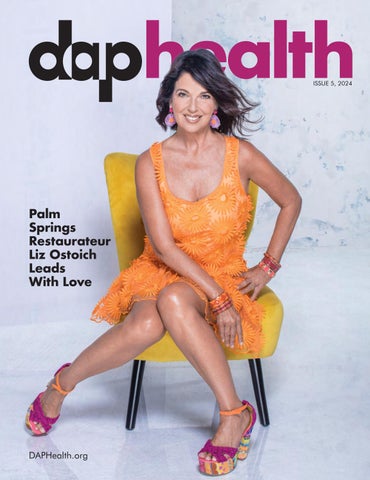
health ISSUE 5, 2024
Palm Springs Restaurateur Liz Ostoich Leads With Love
DAPHealth.org
because health equity matters Learn More About DAP Health
Photo by Matthew Mitchell
DAP HEALTH 1695 N. Sunrise Way Palm Springs, CA 92262 8:00 a.m. – 5:00 p.m. | Monday – Friday 760.323.2118 PRESIDENT AND CEO David Brinkman CHIEF OF BRAND MARKETING Steven Henke SENIOR COMMUNICATIONS MANAGER AND EDITOR Daniel Vaillancourt DIRECTOR OF BRAND MARKETING Dustin Gruber
hello.
So far, 2024 certainly has been a year of milestones. On August 1, all of us at DAP Health celebrated our first anniversary as an integrated organization. On August 2, I celebrated my 18th year as CEO. And on August 20, DAP Health turned 40. I’m filled with immense pride and gratitude for the incredible journey we’ve embarked upon together. This fifth edition of DAP Health magazine is a testament to the remarkable achievements of our dedicated staff, the steadfast support of our donors, the visionary leadership of our board, and the invaluable contributions of our volunteers. We’ve done all of it for the good of the patients within the diverse communities we serve. Each page of this book tells a tale of hope, perseverance, and the transformative power of health care. These stories reflect the heart and soul of DAP Health — a tapestry woven from wildly different experiences and backgrounds, but united by our vision: a world where every person achieves their full potential.
ART DIRECTOR Tes Schaff PHOTOGRAPHERS Donato Di Natale, Tavis Harvey, David A. Lee, AJ Meeker, Steven Michael, Matthew Mitchell, Demarcus O’Dell, Scott Rohlfs WRITERS Jacob Anderson-Minshall, Staci Backauskas, Kenneth Clark, Maggie Downs, María José Dúran, Daniel Hirsch, Kay Kudukis, Jim Macak, Meline Nadeau, Victoria Pelletier, Lorenzo Taylor, Daniel Vaillancourt BOARD OF DIRECTORS Patrick Jordan, Chair Kevin Bass, Co-Vice Chair Eve E. Fromberg-Edelstein, Esq., Co-Vice Chair Fred Drewette, Treasurer Mark Hamilton, Secretary
As you explore this magazine, I hope you’re filled with the same pride and joy that I am. It’s a celebration of our collective achievements, a reminder of the impact we make when we join forces.
BOARD MEMBERS Mark Adams, Carolyn Caldwell, Bruce W. Finch, Scot Karp, Karyl E. Ketchum, Ph.D., Athalie LaPamuk, Veronica Valenzuela Williams, MBA, MSN, PHN, RNC-OB, RN
In gratitude and partnership,
ABOUT US
David Brinkman, MBA CEO, DAP Health
VISION: DAP Health envisions a world where every person achieves their full potential.
To those who call DAP Health their health care home, your courage and trust inspire us every day. You drive our mission to provide comprehensive health care and support services where all people are seen, heard, and affirmed.
MISSION: DAP Health provides comprehensive health care and support services where all people are seen, heard, and affirmed. COVER
Liz Ostoich photo by Matthew Mitchell
4
Table of Contents Employee Q&A: The Future of DAP Health With Chief Strategy Officer Brande Orr............................................................6 Employee Profile: Chief Medical Officer Dr. Joseph Aquilina...................9 DAP Health’s Pharmacy Services..........................................................12 Vista Sunrise II Resident Profile: Sean Johnson....................................16 Revivals Stores Are So Much More Than Pre-Loved Retail...................18 Medi-Cal: No Immigration Status? No Problem!....................................22 Medi-Cal: ¿No Tienes Estatus Migratorio? ¡No Hay Problema!.............23 Patient Profile: Refugee Mwafaq Aljobory of Centro Medico El Cajon.....................................................................26 Patient Profile: Renaissance Woman Tracey Engelking of Palm Springs Family Health...............................................................30 Insomnia’s Causes and Cures................................................................34 Major Donor and Board Member Profile: Mark Adams..........................38 Employee Profile: Director of Specialty Programs Dr. Jason Halperin..................................................................................40 Employee Profile: Regional Operations Director — East Heidi Galicia...........................................................................................44 Seven Daily Health Rituals That Work....................................................46 Cover Story: Major Donor and Restaurateur Extraordinaire Liz Ostoich..............................................................................................48 Employee Profile: Director of Development — Events and Partnerships Debbie Chapman...........................................54 Make Kindness Your Superpower..........................................................58 All You Ever Wanted to Know About DoxyPEP......................................60 Employee Profile: Executive Assistant of Operations LaBianca McMillan.................................................................................62 Fostering Gender Diversity.....................................................................66 Women’s Health From A to Z.................................................................70 Patient Profile: Trans Parent Stephanie Battaglino of Stonewall Medical Center..................................................................74 Racism and Discrimination in Health Care.............................................78 Meditation For Children..........................................................................80
5
Cultivating the Future DAP Health Chief Strategy Officer Brande Orr is taking a multitude of voices into consideration as she helps map out the next 40 years. Words by Daniel Vaillancourt • Photo by Demarcus O’Dell
What exactly is a strategic plan? It identifies DAP Health’s priorities over the next three to five years. And then goals and measurable objectives on how to advance those priorities. It gives us guideposts for where we’re going to try to move the needle and improve, increase, or change. It answers questions like “Where do we want to focus attention and resources — not just internally, but externally — to increase health care access, improve health outcomes, and achieve health equity in the communities we serve?” and “Over the long term, what are the most promising pathways to mobilizing our mission to achieve our vision?” As chief strategy officer, what’s your role? I coordinate that process. My team is really everyone, and it’s important to me that everybody own the future. I see my main responsibility as cultivating a commitment to the future aligned with what we’re hearing about needs from the people we serve, and aligned with relevant trends we’re discovering in the external environment. Because if you don’t have a plan, then the future’s going to catch up with you. In honoring our patients, as well as those who founded DAP Health, we’re responsible for being prepared and not being left behind. For me, the best strategic plan is specific, measurable, and achievable. But the complex part of that is the plan must also be nimble. I don’t see us ever not being nimble.
6
7
What strategic successes are you most proud of so far? The fact that we have established an updated mission and vision statement for the new DAP Health is a strategic success. That we even launched a strategic planning process in our very first year post-acquisition is probably not something everybody would’ve chosen to do. But we leaned in and realized we can’t just be focused on yesterday. We have to look to the future. It’s responsible as an organization, unifying for our culture, and something we owe to patients. What challenges remain more than a year after the integration was made official? The most acute challenges that remain don’t have to do with the integration, they have to do with the fact that those we serve continue to face inequities and injustice. Those systemic barriers to health and well-being are growing for some, and just not allocated the resources they should — on a community level, a legislative level, or just in general. If you know our history, this is why DAP Health exists, and — as we always have — we will draw from the power of community and compassion to face disparities that many institutions are hesitant to address. What’s most unique about DAP Health’s strategic planning process? We are mission driven, not profit driven. We envision a world where everyone achieves their full potential, and our role in achieving that vision is to provide services in a very specific way. One where people feel seen, heard, and affirmed. The plan will reflect that. We understand that each community is as unique as each patient. We value stakeholder input — meaning patients and staff, as well as community members. We want to study data and learn from best practices. As we consider possible options to meeting needs over the longer term, we want to look at the likelihood of outcomes — how many people will see an improvement in health care access, for example. We also examine potential priorities through a sustainability lens — is there capacity, expertise, funding, and other inputs needed to ensure success. How is our past going to illuminate our path toward a bright future? All of us in this line of work were and are fearless. We don’t take no for an answer, we don’t dispose of people. DAP Health has always championed a patient-centered model and approach; we meet people where they are in their health care journey. That philosophy is something I think is essential, and at the core of how we make decisions. I keep coming back to the word “compassion.” To quote a speech by Nelson Mandela to honor those affected by HIV/AIDS, “Our human compassion binds us the one to the other — not in pity or patronizingly, but as human beings who have learnt how to turn our common suffering into hope for the future.” Due to the cruel realities of stigma, I was not informed about the AIDS crisis until my 20s, when I worked serving the unhoused and those in hospice. I therefore don’t completely understand the trauma of the epidemic’s early years. But what I do know is that out of it came such conviction that health care is a human right. If — through its 40-year history — DAP Health has learned how to possibly support someone facing a barrier to better health, then you can count on us to share that knowledge and try to improve things.
8
Semper Gumby In English, the Latin unofficial motto of the U.S. Navy translates as “Always Flexible.” It perfectly describes DAP Health Chief Medical Officer Dr. Joseph Aquilina. Words by Kay Kudukis • Photo by Matthew Mitchell
His parents were first-generation Sicilian-American, so of course, the entire family went to Grandma’s house for Sunday sauce. It was a nice break from the other six days when, evenings and after school, the three kids helped Mom and Dad in the family’s cleaning business. Cleaning neither garments nor houses, but car dealerships and fitness centers — any business in Buffalo that hired them. In addition, Dad worked two more jobs, hoping to give his kids a better version of the American dream than his. Joseph Aquilina, the only boy, a middle child, took up trombone and football. Maybe because he had an interest, or maybe because after school extracurriculars were more fun than cleaning. But he was drawn to the social aspects, the camaraderie. He even ended up combining both activities when the band performed at Rich Stadium for a Buffalo Bills game. Quite a score for the teenager. Young Joe played offensive guard and defensive end in high school football. Generally, those positions had a heavier body type than that of Aquilina, who’d grown tall but not thick. His build was more like a quarterback, or a tennis player. He picked up the racket when he was stationed in London, but more on that later. Because of his size, Joe worked harder to stay on the team, and can still recall the fantastic feeling at homecoming when they called his name: “Playing first string, defensive end, Joseph Aquilina.” College Bound Some plan their post-secondary life and know exactly where they’ll be after their senior summer. Others haven’t a clue. Aquilina fell into the latter category. He thought he might like to go to college — that’s what all the kids in his honors classes were doing — but he didn’t quite know how he was going to do that. His sister had been the first of any generation to attend college, but she stayed local. He did not want to do that.
9
10
DAP Health Chief Medical Officer Dr. Joseph Aquilina
His parents didn’t have the knowledge or funds to assist, so he relied on his friends for help and ideas. The University of Rochester came up, so he applied and received academic scholarships. Bonus: It was 90 miles away from Buffalo. Far enough away to live on campus, yet close enough to bring his laundry home on the weekends. “I thought I was busting out,” Aquilina says with a laugh.
For the two years he worked as a flight surgeon, he was deployed for six months on the USS Tarawa, attended to 500 Marine flyers, got a pilot’s license, and logged more than 300 flight hours in a CH46 helicopter.
He loved Rochester. “I had such a sense of independence. You can control your own schedule. I got my first non-family job at the Fine Arts Library. It was wonderful. I was a gallery guard. I could do my homework, watch the art exhibit, make sure no one touched anything, and get paid to study.”
He got married, they had twin daughters, and he continued to move up in positions and responsibilities within the Navy’s medical sector. That included three years in the U.K., and six months deployed in Kuwait, before returning to San Diego. There he earned his MBA, explored his tech fascination with a “side hustle” in dental charting software while concurrently wrapping up his 22 years of service as the director of outpatient health clinics.
Life in the Lab Was Too Boring
In Uniform No More
He chose microbiology as a major, but discovered the monotony of the lab didn’t really suit him. That was a problem. One day, a solution walked in: Urologist Dr. Bob, who came to take his wife (head of the lab) to lunch. “He was an affable, gregarious, fun guy,” Aquilina recalls. “And I just asked, ‘Hey, Dr. Bob. Can I join you one day, kind of see what your day is like?’”
Now both single and a civilian, Aquilina was ready to explore different opportunities. He worked in business development for a year, then shifted back to a team environment overseeing larger medical groups and implementing new initiatives.
Dr. Bob was as equally affable at work with patients, nurses, and staff. “Everybody knew and liked him. I thought, ‘I could do this,’” Aquilina grins, remembering. “It just seemed like a very social, fun job, and he really enjoyed it. So, I thought maybe I should consider medical school. I had no idea what that meant.” His counselor knew, and the news was good. Aquilina already had most of the credits needed. He just had to take the MCAT. His score did not disappoint. He was going to be a doctor! In the Navy His father wanted to mortgage the family home to pay for it, which terrified Aquilina. “What if I fail? Then he’s gonna lose the house. No way.” He had friends in ROTC at Rochester. “I thought, ‘Well, they seem like they’re happy.’” He cold-called the Navy. The recruiter couldn’t believe his luck. “Yes, we’ll absolutely pay for medical school. When can you start?” Aquilina graduated from Loyola’s Stritch School of Medicine in Chicago in May of 1994. In July of 1995, he reported for flight surgeon training at Naval Operational Medicine Institute in Pensacola.
For eight years, he served on the board of Glenner Memory Care Centers, specializing in adult day care centers and family resources, becoming well-versed in the workings of nonprofits. If you peep his social media, you’ll see his playful side: goofy pictures with his kids, visits to tennis matches, and adventures in sailing. In 2014, he met his now fiancée, a concierge physician in San Diego. Last summer, Dr. Joe was a tennis coach for the Special Olympics. At Long Last, DAP Health When he learned of DAP Health’s merger with Borrego Health, he saw a unique opportunity. “It’s a beautiful mission, and that was a huge attraction for me,” he says. “It seemed like an organization that really lived its values, which was really, really enticing.” Right now, he splits his time between San Diego and Palm Springs, and his personal needs are simple: tennis partners. He says he ranks himself a solid 4.0, but “I will play whenever, wherever, with whomever.” Semper Gumby.
11
12
Director of 340B Pharmacy Operations Sheila Lo at Stonewall Pharmacy in Cathedral City.
Prescriptions with a Side of Care Onsite pharmacies at DAP Health are changing the game for patients. Words by Victoria Pelletier • Photo by David A. Lee
At the intersection of great care and excellent value are DAP Health’s three affiliate pharmacies, two of which are located within DAP Health’s Stonewall Medical Center in Cathedral City and Coachella Valley Community Health Center in Coachella, and Borrego Pharmacy in Borrego Springs, a standalone. Alongside these, DAP Health Sunrise, the legacy practice in Palm Springs, partners with an on-campus Walgreens pharmacy to deliver exquisite service and affordability to its patients. I recently sat down with Guanzhong (Sheila) Lo of Cathedral City, Laura Dunn of Walgreens, Elisabeth Marquez of Borrego Springs, and Manuel Idio of Coachella to learn more about the ways their pharmacy practices offer robust support to the communities they serve. These talented pharmacists bring 70 years of combined experience to their constituents, wisdom that is always coupled with deep understanding of patients’ stories and specific pharmaceutical needs. Guanzhong (Sheila) Lo DAP Health Director of 340B Pharmacy Operations Guanzhong (Sheila) Lo, PharmD, MBA, AAHIVP began her pharmacy career more than 20 years ago. Having had tenures at Walgreens and at a hospital system in Florida, she has practiced for nearly eight years at DAP Health Stonewall in Cathedral City, having opened that location and the Coachella unit. While Lo lauds the pharmacies’ strong revenue performance and terrific financial value for customers, she believes one of greatest advantages of co-locating the clinics and pharmacies is how it affects the patient/clinician relationship and improves clinical outcomes. Unlike standalone pharmacies, DAP Health pharmacists can access the clinic’s patient files, ensuring that potential issues like missed appointments and drug interactions can be mitigated with early interventions. As a federally qualified health center (FQHC) with access to the federal 340B program, DAP Health is able to purchase medications at a reduced price for its pharmacies. The organization then passes those discounts on to its qualified patients, which helps it create more programs to benefit the community, such as the free STI testing and treatment it provides at its three sexual wellness clinics, in Palm Springs, Cathedral City, and Indio. At the end of the day, the DAP Health difference is responsive patient care. Lo relishes the opportunity to work for an organization that enhances the quality of life for so many.
13
Laura Dunn Hailing from a family of nurses from Illinois, Laura Dunn brings 18 years of pharmacy experience to her leadership role at the Walgreens unit affiliated with DAP Health Sunrise. Dunn sees tremendous patient benefit in using a pharmacy that’s directly on campus. For starters, Dunn celebrates the strong relationship between the pharmacy staff and the clinicians at the nonprofit’s many adjoining clinics. For example, DAP Health nurse practitioners can quickly access PrEP injectables available at Walgreens, meaning patients can receive real-time treatment from clinicians. Dunn also recognizes that the pharmacy’s accessibility allows her staff to get to know their Sunrise patients, pointing to the fact that they connect with them semiannually to review current medications and compliance with physician orders accompanying them. In addition, Dunn and one of her managers regularly participate in the morning huddles clinicians hold on behalf of their patients. Good relationships and workflow between the pharmacy and the clinic mean great health outcomes.
A certified HIV pharmacist who happens to be gay, Idio appreciates working for a DAP Health-owned pharmacy that understands the specific needs of LGBTQIA+ patients. Like his colleague Lo, Idio sees DAP Health’s 340B designation as a tangible financial benefit to patients, giving the pharmacy the bandwidth to make medicines affordable to patients on fixed incomes.
“Patients will receive timely, Of course, DAP Health is much more than a “good value” at a convenient compassionate, location. Idio notes that the nonprofit’s and cost-sensitive pharmacies bring “love and kindness” into patients’ lives by prioritizing their pharmaceutical care stories and outcomes over sales. his branch in Coachella, “love and from clinicians who At kindness” is often expressed in the shown to Spanish-speaking love what they do.” patience customers. While efforting to bring
Lisa Marquez With 10 years of progressive pharmacy experience in her toolbox, Lisa Marquez arrived at Borrego Pharmacy in September 2023, eager to collaborate with the retirees and immigrants that frequent it. With prior tenure in a large retail pharmacy, Marquez notes that one of the advantages of working with DAP Health is that pharmacists and pharmacy technicians really get to know patients and their medical histories.
Marquez also lauds the accessibility of DAP Health professionals. Calls are answered at the clinic by clinicians who partner with their colleagues at the pharmacy. Patient care is integrated between the pharmacy and the clinic, resulting in excellent communication and better patient outcomes. Marquez sees DAP Health pharmacies as embodying a “hometown” pharmacy feel. Benefiting from the nonprofit’s status as a federally qualified health center, its pharmacies are especially adept at working with patients from underserved or at-risk populations. Of course, employees thrive in the DAP Health culture too, and Marquez relishes the opportunity to work for an organization that cares for its own. She notes that DAP Health promotes healthy work/life balance, and offers employees the tools and time to care for their body, mind, and family.
14
Manuel Idio Manuel Idio started his pharmacological career in the Philippines prior to immigrating to the United States in 2001 as a naturalized citizen. After receiving a bachelor’s credential in pharmacy in 1991, Idio spent several years working as an inspector with Philippines Food and Drug Administration.
a permanent Spanish-speaking pharmacist to his location, Idio and his colleagues take ample time with Spanishspeaking patients to ensure they understand the ins and outs of the medicines that have been prescribed for them. In the meantime, Idio is learning as much Spanish as his time permits. The DAP Health Difference My takeaways from conversations with four outstanding pharmacists? DAP Health’s affiliate pharmacies bring convenience and value to patients. With 340B and FQHC designations, DAP Health affiliates know their patients and communities, and are adept at “meeting them where they are.” Further, strong connections between the pharmacy and clinical staff translate to exquisite patient care. Care is integrated, not siloed. It’s also clear that DAP Health cares about its employees and their families. Happy employees pass on the joy to patients.
Whether walking into the pharmacies at DAP Health in Coachella, Borrego Springs, Cathedral City, or Palm Springs, patients will receive timely, compassionate, and costsensitive pharmaceutical care from clinicians who love what they do. Now that’s what I call a win, win, win.
Home at Last One of the first residents to move into DAP Health and the Coachella Valley Housing Coalition’s new affordable housing complex Vista Sunrise II, Sean Johnson is nothing but grateful. Words and Photo by Daniel Vaillancourt
California native Sean Johnson, 59 — raised in Lake Tahoe and Carson City, Nevada — had been many things in his prior life: Pro baseball player and golfer. Married man. Divorcé. Straight, single dad. As we sit down to chat in his brand new Vista Sunrise II studio (furnished courtesy of Revivals), Johnson tells me of the unexpected turns taken since relocating from San Jose to Palm Springs in late 2017: Discovering and exploring his bisexuality. Becoming HIV positive. Going on disability for a repetitive-motion shoulder injury. Continuing to recover from prostate cancer surgery. And the big one: being unhoused. He says he “bounced around,” but always had either a car or a place to live. He’d rent rooms, stay with friends. “There were a couple of days, maybe even a month or two, where I was not on a couch, and had to go out to the streets,” he admits. “I found that having lack of control over my environment was not healthy for me. I never thought I’d be in that position. I do have people in my life, but I was embarrassed.” On the Fourth of July of 2023, Johnson decided to trade odd jobs and manual labor for shelter at an acquaintance’s five-acre homestead in Anza, but the situation was unstable, and he soon found himself needing a better, more permanent solution. As a DAP Health client and patient, Johnson found out about the SURE Housing Initiative (a Ryan White HIV/AIDS 16
program) and applied. He was then referred to Vista Sunrise II, found eligible, and received ongoing case management. “He then contacted me, and I asked if he was nearby so that we could meet to discuss what he might need for his new unit,” says DAP Health Housing Outreach Case Manager Marisa Rodriguez. “Revivals provided him with a new bed and essential household items.” Every time I walk in, I think, ‘Wow!’” says Johnson. “First of all, how grateful I am.” Johnson — who was one of the first new residents of Vista Sunrise II — is especially thankful his home is not only affordable but sustainable. The percentage of rent for which he is responsible is based on his fixed income, so he’ll never experience an increase. Plus, all of his utilities are included, a big bonus during the increasingly hot summer months. “I certainly have enough left over to eat,” he says. “The only other bills I have are my [mobile] phone and my car insurance.” Medical care at DAP Health is free, and just steps away. His daughter Nicole — a 26-year-old graphic designer in San Jose engaged to marry her fiancé next year — hasn’t yet visited Johnson’s new home. “She’s extremely happy for me,” he says, beaming. “We’re very, very close. She’s the greatest gift my ex-wife ever gave me. I’m looking forward to showing it to her.”
because your legacy matters
Imagine a future where health care is a right, not a privilege. Through planned giving, you can help secure a future where health equity becomes reality, leaving a legacy of hope. To learn more or schedule a conversation, contact us today and start building your lasting impact.
Visit PlannedGiving.DAPHealth.org to learn more.
DAP Heath is a 501(c)3 non-profit organization. Our federal tax ID number is 33-0068583.
Re-Loved Strength and Dignity Revivals is so much more than pre-loved retail. Words by Kenneth Clark • Photos by Donato Di Natale
Dane Koch, chief of retail for all four locations — Palm Springs, Cathedral City, Palm Desert, and Indio — of DAP Health’s Revivals brand of resale shops, recalls a phone call he received last March. It was from DAP Health CEO David Brinkman, who wanted to talk about Sunrise Vista II, the $40-million affordable housing development on the nonprofit’s ever-growing Sunrise campus at the corner of Vista Chino and North Sunrise Way in Palm Springs, which was nearing completion last spring. Brinkman asked Koch (pronounced like Diet Coke) if he and Revivals could help furnish the apartments, adding that the budget was very small. Koch sat down to give it some thought. Unlike Vista Sunrise I, built in 2003 by DAP Health to house its clients living with HIV, the new 60-unit development was done in partnership with the Coachella Valley Housing Coalition to provide longterm solutions for the valley’s unhoused, regardless of HIV status. “We like to say CVHC provided the house, and we at DAP Health provided the home,” says Koch. “We wanted to 18
give new residents something they could truly call their own that would foster a sense of belonging and dignity.” To that end, Koch knew creating a home environment for the chronically ill and unhoused was not a simple matter of a mattress, sofa, and coffee table. “I thought to myself, ‘Ok, if you’re an unhoused person, then you’re walking into this building with nothing more than the clothes on your back.’ I thought, ‘We’re going to do two things: We’re going to put furniture in the homes. Everyone is going to have a bed and everyone is going to have a seating area. “Secondly, we’re going to put in every basic essential we can think of to get their life started. So, when someone walks into their home, they’ll have dishes, pots, pans, cutlery, dishwashing soap, sponges, mops, and brooms. The bathrooms will be stocked with toothbrush, toothpaste, shampoo, hair comb, fingernail cutters, soap, and deodorant. If they don’t have a change of clothes, they’ll get vouchers to take to Revivals, so they can put clothes in their drawers.’”
Koch had 30 units to furnish, soup to nuts, but it wasn’t as if he could just get 30 of everything on his list. There are studios and one bedrooms, and most of the units have different floor plans. He had to get into each unit and walk it to figure out what would work best. And then he needed to work through his network of vendors to find out who could supply him with the best for the least. It was a tough nut to crack. But if anyone has the gumption to split it wide open, it’s Koch. The son of a U.S. Marine, Koch was born in Twentynine Palms, though the family moved to San Diego when he was 2. When he was 19, he landed his first job in retail, working for Montgomery Ward for 11 years before getting the opportunity to work for the crafts store Michaels. After 18 years with Michaels, he and a friend opened a design showroom at International Market Square in Minneapolis.
The key to this success is the team of volunteers who staff the stores. Though there are some paid positions — with Revivals raising the minimum wage for paid employees to $21 per hour, ensuring that those entrusted to give compassionate service to their customers also have the means to support themselves and their families — there are more than 250 volunteers who do everything from ring up at the cash registers, pick up donated items, clean dishes, sort clothes, repair electronics, appraise art and books, or carry out various administrative duties at DAP Health. “Some 80% of our workforce is volunteers,” says Koch, who oversees Volunteer Services in addition to his other roles. “And everybody is there because they want to be. They support DAP Health’s mission. They are also very in tune with who our clients are and who our customers are. And they are extremely respectful, regardless of whether you’re able to buy what you’re getting or it’s being given to you.”
By then, he and his husband were living in Palm Springs, and he had to commute back and forth. They opened the business in 2008 — just in time to see the economy tank. “It wasn’t working for me,” Koch says. “So, I left it in the first part of 2012 and came home. I wasn’t doing anything. My husband said, ‘I hear DAP Health is looking for an assistant store manager in one of their Revivals stores’. ‘Oh my God,’ I thought. Assistant store manager? I haven’t done that in about 30 years.’” Koch hadn’t been at Revivals very long when he was asked to take charge of buying for all the stores. They were just getting their new line of Mode furniture onto the floors, and with Koch’s background, the new merchandise soon accounted for nearly 30% of sales. A year later, CEO Brinkman elevated Koch to director of the retail operations. Though this most recent bout of inflation has put a dent in the sale of new merchandise, Revivals still has an edge when it comes to items like mattresses, which sell for hundreds of dollars less than at a mattress store. Koch has been instrumental in elevating the brand in a dozen different ways. All four stores are located along the Palm Canyon/Highway 111 corridor, and each has a distinctly vibrant feel to them. While there is wall-to-wall merchandise, all showrooms are laid out so there is a flow and ease of shopping. On any given morning, there might be a line of a couple dozen people outside Revivals Palm Springs or Palm Desert waiting to get in and hunt for treasures. The popularity of the stores among both residents and visitors — not to mention interior designers — translates into a substantial infusion of cash for DAP Health: nearly $2 million per year.
Chief of Retail Dane Koch at home with Cooper.
19
“Some 80% of the Revivals workforce are volunteers. Everybody’s there because they want to be. They support DAP Health’s mission.”
Koch doesn’t just view Revivals stores as a cash cow for DAP Health. He also sees the stores as a conduit for anyone in the community who’s in need. He says access to essential items, whether furniture or clean clothing, is fundamental to human dignity. He says Revivals’ partnership with organizations like DAP Health or Martha’s Village offers a solution for people experiencing homelessness or living in poverty. Giving people access to necessities helps them maintain a sense of self-worth. “I developed a voucher program,” he explains. “It was initially for our Social Services department. That’s where a client can come to their case manager and say, ‘Well, I really need pants, I need socks, I have no pots and pans in my kitchen, I have no lamp in my living room.’ And the case managers can create a voucher of needs for a particular client. We then fill it in one of our stores. Either the client picks it up or we deliver it. But what’s really important about the program is we allow
the client to come into the store and pick what they want. We don’t just go fill up a box with stuff and say, ‘Here.’ They get to play a role. It provides more dignity and it makes them feel a part of the process.” Furthermore, Koch says the Revivals mission also promotes health and well-being by supporting initiatives such as harm reduction. The stores are supplied with gift cards given to people who participate in DAP Health’s needle-exchange harm reduction program. As the move-in dates approached, Koch grew increasingly excited at the prospect of so many lives changing for the better. “We’re getting 30 people into homes that will improve their quality of life,” he says. “I told David Brinkman, ‘I just want to be there when somebody walks in and sees what they’re getting. They’re either going to be completely overwhelmed or beside themselves with joy.’ For me, this is a labor of love.”
21
Medi-Cal Now Available to All Low-Income Families Regardless of Immigration Status Words by María José Dúran
A new California law that went into effect in January 2024 allows all low-income residents — regardless of immigration status — to qualify for free or low-cost health insurance through Medi-Cal. “It’s a great step to include all who contribute to California,” says DAP Health Community Education and Enrollment Manager Joanna Ibarra. This new rule making undocumented adults ages 26-49 eligible for Medi-Cal is the last in a series that started in 2016 with coverage for immigrant children, then older adults, youths, and lastly, all age groups. To qualify for Medi-Cal, individuals’ or families’ income must be under the 138% line of the Federal Poverty Level, which varies depending on household size. With Medi-Cal Full-Scope, families and individuals can get all their health needs covered. “It covers everything, not just emergency services at the hospital,” explains Ibarra, “from sick visits, primary care, preventive care, basic dental care, medications, X-rays, imaging, prenatal care continues to be a benefit, labor and delivery, behavioral health, hospitalization, physical therapy, occupational therapy, to transportation.” However, fears of the public charge rule — a noncitizen who is likely to become primarily dependent on the government — stop many who qualify for Medi-Cal from applying for this benefit, as it can hinder immigration court cases or applications. “There’s a lot of misinformation,” says Ibarra. “We have encountered a lot of fear around public charge. A lot of patients refuse to apply for anything because of it.” In 2022, the government made an amendment to the public charge rule, excluding noncash benefits such as health care. “It clearly tells us that noncash benefits shouldn’t affect you, which includes health care,” Ibarra says. The application for Medi-Cal can be submitted online through info.benefitscal.com. An identification document (not necessarily a state ID), proof of address, and proof of income are necessary for the process.
22
“Another way [to apply for Medi-Cal] is to come to one of our clinics and we have enrollment counselors who can assist from step one to last,” Ibarra explains. “We guide people, enter their information for them.” For those who still don’t qualify for Medi-Cal due to income limits, DAP Health offers financial assistance on a sliding scale, also regardless of immigration status. Low-income families earning up to 200% of the Federal Income Poverty guidelines can benefit from discounted medical visits. “Health care is expensive for everyone,” Ibarra says, “so the sliding-fee scale is something that really has been beneficial to our community.” Many uninsured patients in Southern California’s Latino communities suffer from conditions that require constant preventative care and access to medication, such as diabetes or high blood pressure. Ibarra says these patients can benefit from access to Medi-Cal. “Preventative medicine is what people did not have access to.” Ibarra points out the importance of accessing health insurance. “We need to maintain being healthy, active, and involved in our lives, not worried about ‘Am I going to get sick?’ or ‘Will I have to go to work sick?’”
Medi-Cal Admite a Personas de Bajos Ingresos Sin Estatus Migratorio de Cualquier Edad Por María José Dúran
Ahora todas las personas que califican sin importar su estatus migratorio pueden acceder a seguro de salud gratuito o a bajo costo a través de Medi-cal. Una nueva ley que entró en vigor en enero de 2024 permite que todos los residentes de California de bajos ingresos puedan solicitar seguro de salud gratuito a través del programa Medi-Cal. “Es un gran paso para incluir a todos los residentes de California”, dice la jefa de Educación de Salud para la Comunidad y Registro de DAP Health Joanna Ibarra. Con Medi-Cal Full-Scope (cobertura completa), las familias o individuos que califiquen pueden conseguir cobertura para todas sus necesidades de salud. “Lo cubre todo, no solo servicios de emergencia en el hospital”, explica Ibarra, “desde visitas de enfermedad, atención primaria, cuidados preventivos, cuidado dental básico, radiografías y otras pruebas de imagen, cuidado prenatal, parto y nacimiento, salud mental, hospitalizaciones, fisioterapia, terapia ocupacional, hasta transporte.” Para poder acceder a Medi-Cal, las familias o individuos de California deben tener unos ingresos anuales que estén por debajo del 138% del Nivel de Pobreza Federal, algo que varía dependiendo del número de personas en el hogar. Puede consultar si su familia califica en este enlace. Sin embargo, el miedo a convertirse en carga pública impide que muchos soliciten este beneficio. La carga pública es una norma por la que una persona que no es ciudadana de los Estados Unidos y esté en riesgo de convertirse en mayoritariamente dependiente del gobierno es penalizada en los casos de inmigración o de corte migratoria.
“Hay muchísima desinformación”, dice Ibarra, “nos hemos encontrado mucho miedo alrededor de la carga pública. Muchos pacientes no quieren solicitar ningún beneficio por esto”. Pero la norma de carga pública excluye los beneficios que no son en dinero efectivo. “Claramente nos dice que si el beneficio no es en efectivo no te afecta, lo que incluye los seguros de salud”, dice Ibarra. Los interesados pueden solicitar Medi-Cal a través de la página web info.benefitscal.com. Para el proceso son necesarias una identificación (no necesariamente un documento oficial estatal), prueba de residencia y prueba de ingresos. “Otra manera [de solicitar Medi-Cal] es venir a una de nuestras clínicas donde tenemos consejeros de registro que pueden asistir desde el primer al último paso”, explica Ibarra. “Nosotros guiamos a las personas, les ayudamos a llenar los formularios con su información”. Para los que tengan ingresos anuales superiores y no puedan solicitar Medi-Cal, DAP Health ofrece asistencia financiera en escala gradual sin importar el estatus migratorio. Familias con ingresos que no sobrepasen el 200% del Límite de Pobreza Federal pueden solicitar servicios médicos con descuento. “Los seguros de salud son caros para todo el mundo”, dice Ibarra,”por eso la escala gradual que ofrecemos en DAP Health ha sido de gran ayuda para nuestra comunidad”. En el sur de California, muchos pacientes latinos sin seguro médico padecen enfermedades crónicas que requieren atención preventiva constante y acceso a medicamentos, como la diabetes o la presión arterial alta. Ibarra afirma que estos pacientes se podrían beneficiar del acceso a MediCal. “La medicina preventiva es a lo que la gente no tenía acceso.” Ibarra resalta lo importante que es tener accesso a un seguro ide salud como Medi-Cal. “Necesitamos mantener nuestra salud, actividad y desarrollo de nuestras vidas, y no estar preocupados de ‘Si me voy a enfermar’ o ‘Voy a tener que ir a trabajar enfermo.’”
23
because your family’s health matters porque la salud de tu familia importa
Photo by Scott Rohlfs
26
Flight Path The unlikely, globetrotting story of Centro Medico El Cajon’s most charming patient, Mwafaq Aljobory, who finds himself soaring in Southern California. Words by Daniel Hirsch
When Mwafaq Aljobory first stepped into Centro Medico El Cajon Urgent Care in 2019, his charm dazzled the staff and clinicians there almost instantly. “He just has this charisma about him,” says Nurse Practitioner Tamara TuckerHam, who would become, and remains, Aljobory’s primary care clinician.
join the Iraqi Royal Air Force after completing primary school. He excelled as a pilot — so much so that he would go on to become a pilot instructor, studying in that discipline in the United Kingdom, which put him in classrooms with other instructors-in-training from such far-flung places as Australia, Malaysia, and other nations from across the British Empire.
A debonair 79-year-old with wavy silver hair and a penchant for attending appointments in tailored suits, Aljobory left a memorable impression on every visit to the clinic. TuckerHam would eventually learn that behind this gentlemanly patient’s distinctive magnetism was a distinctive history — one that extends from Iraq to Czechoslovakia to the United Kingdom to Southern California. It’s a story that also includes flying supersonic fighter jets, becoming a refugee after the threat of assassination, and being a prolific, selftaught artist. Tucker-Ham would also discover surprising commonalities between patient and clinician that would lead to meaningful friendship.
On his return to Baghdad in the 1970s, Aljobory got married and had two sons. The family enjoyed a comfortable existence, much like the one he had in his own childhood. However, dedicating his life to flying jets meant being on the frontlines during some of Iraq’s most unstable years. Throughout the Iran-Iraq War, from 1980 to 1988, Aljobory was frequently at the site of deadly conflicts. “I do not like war. I like to fly,” he says. “When I pray, I say: Please God, don’t make me kill any human being.”
Born in 1945 in Baghdad, Iraq, Aljobory was the secondoldest of the six children of a successful businessman. The family enjoyed a comfortable existence in one of Baghdad’s more well-off neighborhoods during the remaining days of Iraq’s monarchy. From an early age, Aljobory’s ambitions could not be bound by gravity. He was fascinated with flight. “Since I was a child, I liked birds… I even made some [paper] planes,” says Aljobory, who speaks Arabic, Russia, Slovakian as well as some English. When he spoke with me for this story, he mostly spoke English, and had assistance from Centro Medico El Cajon’s Arabic translator, Afaf AlHayani. Despite his parents’ objections, who due to Aljobory’s good grades wanted him to be a teacher, the young man set out to
The U.S. invasion of Iraq brought a new kind of uncertainty and danger to Aljobory’s life. Following the fall of Saddam Hussein in 2003, sectarian violence exploded in Iraq, resulting in the deaths of tens of thousands of Iraqis, and the displacement of millions. At the time, Aljobory believed pilots who fought in the Iran-Iraq war were being targeted. When a militant shot and killed a retired pilot (and friend of his) while he was sitting in his front yard, Aljobory knew he and his family had to flee. It wasn’t until 2017 that Aljobory and his wife managed to leave Iraq, first finding refuge in Amman, Jordan. Separated from their family and sons — who had emigrated to the U.S. ahead of them — their time in Jordan was marked by painful video calls and not being present for the birth of their first grandchild. In 2020, with sponsorship from Aljobory’s brother, who lived in El Cajon, the couple joined their family in America. 27
“I appreciate how she spoke openly with me, was compassionate, and helped guide me to making the best decision for myself. I continue to be so grateful.”
They were pleasantly surprised to find a large Iraqi immigrant community in El Cajon. “When I came here, I saw the restaurant [signs], they’re all in Arabic!” Aljobory exclaims. With the amiable weather, and their sons and two grandchildren living nearby, Aljobory and his wife have enjoyed their retirement in El Cajon. He takes much comfort in his relationship with TuckerHam, whom he’s come to call “My angel.” First coming to the clinic looking for a primary care clinician, he later had to navigate difficult news related to his prostate, then seek urgent treatment when unexpected chest pain required heart surgery. Today, Aljobory still deeply depends on Tucker-Ham. “I appreciate how she spoke openly with me, was compassionate, and helped guide me to making the best decision for myself,” he says. “I continue to be so grateful.”
Aljobory with Tucker-Ham.
Photo by Scott Rohlfs
For her part, Tucker-Ham was instantly taken with Aljobory. He was exceedingly gracious to everyone he encountered, and full of gratitude for the care she provided. When he brought her an exquisitely rendered oil painting as a thank you gift, Tucker-Ham learned she and her patient share a mutual passion for art — one of many commonalities. When not working at Centro Medico El Cajon, Tucker-Ham is a committed ballet dancer who recently was a soloist in a San Diego production of “Don Quixote.” Starting at a young age, when he taught himself to paint, Aljobory has been creating vividly detailed oil paintings. He has always loved horses, and Arabian horses are frequent subjects for his paintings. Turns out Tucker-Ham has been riding dressage for years. Tucker-Ham also connected to many parts of Aljobory’s journey as an immigrant and refugee of violence. Her grandmother was originally from Czechoslovakia (where, for years, Aljobory taught flying), and fled Europe following the rise of the Nazis. “I just can’t imagine being in a situation where I got all these wonderful opportunities in my life, and then all of a sudden my whole life gets flipped upside down and I have to move to another country,” says Tucker-Ham. “And he has been nothing but gracious. He’s one of the patients who shows so much appreciation for everything.” When he speaks, gratitude and charm indeed flow from Aljobory. He’s quick with a compliment and the words “thanks to God.” When asked what’s the most difficult part his new life in the U.S., he shrugs it off: “I didn’t find any problem at all. All my neighbors like me. I’m happy. Everything is perfect here.”
An Aljobory original. 29
30
Writing Her Own Story Tracey Engelking is living her best life as both an involved Palm Springs resident and a thankful DAP Health patient. She wants you to live yours, too. Words by Daniel Vaillancourt • Photos by Steven Michael
Tracey Engelking, 51, may not be a celebrity, but if she tried her hand at fame, she’d surely be an overnight sensation. Often told she resembles Sarah Jessica Parker, she definitely exudes a star’s confidence, charisma, and sex appeal. She was born a water-lover, raised Roman Catholic, and lived with her mom, dad, and adored older sister Kelley in the tiny town of Auburn on Owasco Lake in the Finger Lakes region of Western New York state. “I was a competitive swimmer — always in the lake, always in the pool,” she says. “But it was so cold there! As beautiful as the summers were, even as a child, I knew there was no way I could live there.” So, after dropping out midway through her junior year as a fine art major at SUNY Buffalo, she packed her meager belongings — and $600 cash — into her Oldsmobile Cutlas Sierra and hightailed it to La Jolla, California, to live by the beach. The Greatest Wedding Story Ever Told While working as a showgirl at a club called Nightlife in San Diego’s Hillcrest neighborhood, Engelking met a hot new bartender named Chad. On his third day there, she offered him a tour of the area. They made a date for the very next day. “It was July 31, 1998,” she reveals. “We went to dinner, walked around downtown, went to the harbor, watched the fireworks over SeaWorld. Out of nowhere, I said, ‘You’re exactly the kind of guy I would get marry.’” When Chad replied the feeling was mutual, she blurted out, “Let’s get married!” They wed 48 hours after meeting, and they’re still together more than a quarter-century later. “He’s the easiest human I could ever, ever imagine being with,” she says. “I can’t imagine being with anybody else.” Alongside her diamond ring, Engelking wears the little pawn shop band they found for $20 in El Cajon.
Pregnant within months, they relocated to Chad’s native Houston, where he soon began working in aerospace. After their son Blue was born, Chad was transferred to Newport Beach (where he still works, for the same company) and the little family settled into a condo in San Clemente. “We had the quintessential small-town beach life,” she says. “We lived a block from the beach. I was a full-time mom for a lot of years, just raising our son, surfing every day.” When Blue was 10, Engelking began doing marketing, events, and social media for Hobie, the legendary maker of water-sport recreational products. But when the demands of working full-time grew too great, she quit. “I was fortunate enough to be able to retire in 2019,” she reveals. “And this is where my life really changes.” From Sea to Sand When COVID-19 happened, Engelking and the fam found refuge in Palm Springs, swapping the little weekend studio they’d enjoyed for more than a decade for the house that is now their primary residence. “We still have our place at the beach,” she clarifies. It’s home base for Blue, who’s 25. “We own it outright, so we’ll never get rid of it.” Engelking set about planting roots in the desert. She got her yoga teaching certification and started teaching at Urban Yoga at DAP Health’s Sunrise campus. She also regularly attended group classes taught by Ted Guice of G-Force Workout at Ruth Hardy Park. From there, her circle of friends just kept growing wider and deeper. Today, Engelking belongs to nonprofit groups the Palm Springs Women’s Club and Palm Springs Pathfinders, performs with the Desert Flaggers at the Sunday tea dance at Oscar’s, teaches yoga twice weekly at Steel Gym, has marched and danced in three Greater Palm Springs Pride parades, warmed up onstage alongside Guice and others at the 2023 DAP Health Equity Walk, and plays Mahjong weekly
31
“I felt heard and I felt seen. Dr. Schwenk is one of the most loving, compassionate doctors. It makes me feel excited to have my other doctors through DAP Health.”
with a large group whose members range from 25 to 94 years of age. “I feel like I found a world where I can be 100% myself,” she says, flashing that engaging smile. “And my husband encourages it. He’s happy for me to finally be my whole self and to not have people constantly saying, ‘Well, if she’d only tone it down.’”
swimwear, underwear, and sportswear line) sampled her prose, he made space for her on his website. Writing under the nom-de-porn Eris Chase, she’s so far posted 30 or so fictional pieces and advice articles. “I have no shame, and I’m very sex-positive,” she declares. “I always had a super high sex drive, right from the jump.” It’s Engelking’s high sex drive — and deep desire to maintain a vigorous monogamous relationship with Chad — that brought her stress. “Entering my perimenopausal years, I was really concerned about weight gain,” she says. “I’ve been the same size since I was 18, and I don’t want to invest in all new clothes. I’m concerned about the exhaustion. I’m really concerned about orgasms, and vaginal atrophy and dryness.” But when she shared her qualms with her coastal OB-GYN, a woman, they were brushed off as a fact of life. “I thought, ‘I need a different gynecologist,’” she says. “I’m in this desert with people who are vital and alive. I’m not willing to hang it all up, just age, and turn into a dried-up piece of fruit.” Enter a Health Care Savior Engelking found that new gynecologist through a man named Casey in her Mahjong group, whose partner happens to be Dr. Evan Schwenk, an OB-GYN at DAP Health’s Palm Springs Family Health. “I had my first appointment with him, told him my concerns, and he immediately started with all these great options,” says Engelking. “They just kept flowing! I felt heard and I felt seen. Dr. Schwenk is one of the most loving, compassionate doctors. It makes me feel excited to have my other doctors through DAP Health. “I don’t know if it’s because the culture at DAP Health is so sex-positive — it’s such a forward-thinking company. But we should all be living our best lives, whatever that means to us. I should be able to have sex in my 70s and 80s, just like men can. I don’t think it’s an unreasonable request to say, ‘Let’s use everything available.’” Engelking takes a breath, then continues.
Gay Male Erotica Palm Springs is also where Engelking finally decided to try her hand at erotic writing. But rather than craft hetero bodicerippers, her talent lies in spinning sexy man-on-man yarns. “When I was 13, 14 years old, I went to my grandmother’s neighbors’ house,” she explains. “They were a couple of older gay men. I went into their bathroom, and like a nosy child does, I started opening cabinets. They had a gay porn magazine. I stayed in that bathroom for 30 minutes! The men were so beautiful. I loved looking at them. So, when it came time to write, I thought, ‘I’m gonna write about two guys.’” So talented is Engelking that when friend and fashion designer Andrew Christian (known for his eponymous
“It’s hard being anyone, but being a woman sometimes, there’s so much shame involved. Same with gay men. I think maybe that’s why I do feel more comfortable here in the gay community. I don’t ever have to feel shame anymore. I like having sex. A lot of it. I don’t feel like I ever have to keep that from anyone out here.” Engelking says that every day, online, she reads stories about women whose concerns fall on deaf ears, whether it’s those of their husbands or partners, or of their doctors. “They’re just devastated. They’re depressed. They can’t get anyone to listen to them,” she says. “What I want more than anything is for some Latino mom out there — whose vagina is dry, who hasn’t had an orgasm in two years — to be able to say, ‘Oh, wait! Maybe if I go to someone who will listen to me, someone will hear me.” To read Engelking’s musings on menopause on DAPHealth.org, scan the QR code.
33
What’s Keeping You Up at Night? Shedding light on insomnia’s causes and cures. Words by Meline Nadeau
It’s three a.m. You’ve been tossing and turning for a long time. If you fall asleep now, you just might be able to eke out a few more hours of slumber. Still, you know you’ll wake up feeling groggy and cranky, only to struggle all over again at bedtime tomorrow night. Sound familiar? You’re not alone. Over a third of people struggle with insomnia — the all-too-common disorder that makes it difficult to fall or stay asleep — at some point in their life. And whether it’s a short-term problem or a chronic affliction, sufferers will tell you: It’s completely debilitating. Most adults need between seven to nine hours a night to function properly. But over 40% of Americans sleep much less than that. In fact, on average, we’re sleeping almost two fewer hours now than we did in the 1960s. Our lives are more hectic. We’re connected — and some of us therefore wired — 24/7. To make matters worse, many of us grew up thinking sleep is overrated. From the colleagues who brag about how they can get by on as little as five hours of sleep to those who parrot the mantra “I’ll sleep when I’m dead,” there’s a huge amount of pressure to prioritize work and play over rest — to always be “on.” But research overwhelmingly proves lack of sleep doesn’t just wear you out, but has a major impact on both your physical and mental health, your very quality of life. It affects mood, interpersonal relationships, and work performance, and makes it much harder to cope with stressors that contribute to depression and anxiety. “We need sleep for regeneration of our neural capacity,” says award-winning psychiatrist Dr. Sean Barlow, the chair of DAP Health’s Psychiatry department. “We need it for our brain to function the best. Without sleep, our brain isn’t working the way it’s supposed to.” DAP Health clinicians take a three-pronged approach to treating a patient’s insomnia. “One, we encourage good sleep hygiene,” continues Barlow, adding that the second is to suggest cognitive behavioral therapy for insomnia, a drugfree technique. “For eight to 10 sessions, to help them focus on their thoughts.” Third, since many underlying causes of insomnia can be mitigated or eliminated by improving unfavorable socioeconomic situations, case management is provided. Who Sleeps Least? To put it bluntly, it’s the disenfranchised — young and old. Of the five million Californians living below the poverty level, 13% are children (650,000). And while many factors can influence the quality of a child’s sleep, kids living in poverty must also deal with housing instability, food insecurity, and money scarcity. Not exactly the stuff that dreams are made of. We know sleep is crucial during childhood. It impacts alertness and attention span, memory, mood, vocabulary acquisition, and learning, and has a direct influence on a child’s happiness. Without the proper amount of sleep, children have difficulty developing the social, mental, and physical skills they need to function and thrive.
34
That’s why DAP Health offers preventative health and wellness services, pediatric psychology and psychiatry, and food and housing assistance to low-income families, regardless of whether they have health insurance. At the other end of the spectrum, seniors tend to sleep less than their younger peers. This is not because they need less sleep, but rather because they’re the most vulnerable physically, socially, and mentally. In fact, up to 70% of people over the age of 60 experience sleeplessness some or much of the time. Their sleep disorders are caused, in great part, by medication interactions, chronic diseases, pain, and the anxiety and loneliness caused by the decline of their social networks. In addition, 40% of seniors also have food, lodging, and health care scarcity brought on by having to live off a pension that doesn’t meet their basic needs. DAP Health physicians perform “a good medical assessment to make sure they are on the least amount of medicine and … and check [their medications] for things that impact sleep,” says Barlow. “It’s a complex biosocial approach to try to get them to sleep and … try to get them involved in activities that give them meaning.”
Finally, individuals who identify as LGBTQ+ also often experience more sleep deprivation than the general population. This is often due to lack of family, friend, and community support, and how the absence of those systems has a huge impact on mental health. Family abandonment and widespread discrimination can be traumatizing, leading to experiences of nightmares, sleep disturbances, and restlessness. DAP Health prides itself on offering judgment-free health care, wellness support, and social programs to its clients. It also provides specialized health services that uplift and build community. “We offer the LGBTQ community case management, psychotherapy,” says Barlow. “Patients get referred to psychiatry if it looks like it’s needed, whether it’s with DAP Health or other resources in the community. Their primary care doctor would be involved in helping with mental health as well.” Barlow is well-aware of society’s tendency to treat every ill with a pill. “There’s a go-to of taking meds, but it’s not necessarily the best option,” he concludes, adding that when it comes to treating insomnia and its underlying causes, “I would make psycho-social interventions the number one treatment for sleep over pharmacology.” 35
Photo by Steven Michael
Because where you shop matters
revivalsstores.com
Volunteer, Major Donor and Now, Board Member Mark Adams has given of himself to DAP Health for more than three decades. And he’s far from done. Words by Jim Macak • Photo by David A. Lee
As both a volunteer and major donor for the last 30 years, Mark Adams remembers when DAP Health was known as Desert AIDS Project. “The organization’s always been a trailblazer,” he says. “It’s always had a desire to grow while continuing to provide on behalf of the underserved, the needy, the poor. I have a lot of respect for the board and the directions it’s taken over the years.” This great respect for the board is partly what prompted Adams to take a seat on it last June. “I’ve really enjoyed being involved in DAP Health from the outside for all of these years,” he maintains. “But in talking to members of the board — and to CEO David Brinkman — a very compelling case was made for me to become a member. And so, I did! It’s high time I put in the hours of service and answered the call of duty.”
38
“Speaking on behalf of my fellow directors, I can say we couldn’t be more excited to welcome Mark onto our very hardworking board,” says longtime Board Chair Patrick Jordan. “Thanks to the very successful businesses he runs, he brings a breadth of experience in many sectors. All that in addition to the fact that, through his philanthropic family, he was brought up with the mindset of always giving back to one’s community.” Adams says he’d like to spend his first six to 12 months observing. “I want to take it all in,” he says, adding that that’s how he’ll figure out how best to make a major, lasting difference. “My background is in finance. Financial security has always been important to DAP Health, but now, with our recent expansion, that’s even more crucial going forward. I currently sit on the finance committee, and I think that’s where I can make the greatest impact.”
Major donor and board member Mark Adams, with husband Tyler Wibstad, at the 30th Annual Steve Chase Humanitarian Awards last March.
Last March 30, DAP Health rewarded Adams for his longtime commitment. At the Steve Chase Humanitarian Awards, he was the joint recipient — alongside eight fellow honorees — of the 2024 Community Legacy Award. It was the second time he’s been recognized. He received the Partners For Life Award at the 2008 gala. Adams says he was surprised to learn he’d be receiving a sophomore tribute, but that he’s thrilled to be in such good company. Many of his fellow honorees “are very close friends of mine. They’re very, very deserving.” A Media Dynasty Like DAP Health, in recent decades, Adams — who, as one newspaper put it, is part of a third-generation media family — has also undergone a significant evolution.
Tyler Wibstad — together 10 years, married since February 2023; “He was the holdout,” reveals Adams with a chuckle — consider their homes to be New York City and Palm Springs. Their grandparents used to bring Adams and his three brothers to the desert during spring breaks. His closest friendships were developed and nurtured there. “You’ve got so many things going on,” he says, “museums, hiking, arts and entertainment.”
“When you’re supporting DAP Health, you’re saving lives. I’m really happy to be involved.”
Once upon a time, Grandfather Cedric was a newspaper columnist with a popular radio show and a lucrative sideline voicing radio and TV ads. But neither Cedric’s son nor grandsons started out following in his footsteps.
Finding DAP Health Palm Springs was certainly hit hard by the AIDS crisis, but that didn’t put a damper on Adams’ decision to move there part-time in 1993. “I lost many, many friends to AIDS in the ’80s and ’90,” he says. “I really wanted to do something to honor their memory. Becoming involved at DAP was the perfect way to do so.”
Mark’s father, Stephen, made his fortune running outdoor advertising companies, community banks, and a network of RV dealers that sold camping equipment. For 20 years, Adams worked for a private equity firm specializing in media.
In the late ’90s and early aughts, Adams was part of a group of supporters who helped restructure The Chase. “There were probably 15 of us who just jumped in because the event was failing,” he recalls, adding that the effort included launching a silent auction and recruiting star headliners to perform. “It was an enormous undertaking, but that first year we doubled the attendance.”
Then, about a decade ago, he and his father decided to found Adams Publishing Group, which currently owns some 35 daily newspapers, more than 100 non-dailies (weeklies, bi-weeklies, etc.), and other media-related products and websites in 19 states.
Through it all, Adams kept putting his money where his heart is, making regular donations, including a particularly generous one that significantly contributed to the 1998 purchase of the structure now known as the Barbara Keller LOVE Building, the cornerstone of DAP Health’s Sunrise campus in Palm Springs.
“Newspapers were really struggling at that time,” remarks Adams, who serves as APG’s co-founder, president, and CEO. “We decided this was an area that needed some help. We thought we could make a difference. And it was just him and me until a couple of years ago, when his health began to decline. Eventually, my brothers and I bought him out.”
A Philanthropic Pas de Deux
Despite The New York Times recently reporting that traditional media’s collapse “seems to be accelerating,” Adams claims this hasn’t affected APG, what with the company’s focus on small-city publications. “It’s still a very challenged industry,” he admits, “but I would say smaller-community newspapers are in much better health than big-city newspapers, where there’s so much competition with broadcast television, bloggers, and websites.” In 2018, the Poynter Report — a newsletter issued by the Poynter Institute for Media Studies in St. Petersburg, Florida — reported that “in contrast with other big consolidators, they [APG] often leave existing management in place, do not impose cookie-cutter content templates, and do not start by stripping down newsrooms of editors and reporters.” Adams reveals this is still APG’s approach. APG’s corporate headquarters are located in a suburb of Minneapolis, Minnesota, where Adams was born and raised. The overarching family business (of which APG is a part) is anchored in Connecticut. And yet, Adams and his husband
As for his handsome husband and partner in philanthropy, Adams says he met Wibstad at a Minneapolis restaurant not long after he and his father launched APG. At that time, Wibstad was pursuing a degree in business administration at the University of Northwestern while serving as an assistant editor for the campus newspaper. He also worked in marketing and advertising for the local Annandale Advocate. Adams and Wibstad acknowledge their mutual interest in the newspaper industry contributed to their eventual match. Wibstad now works as a freelance marketing consultant and digital marketing manager. He notes that DAP Health is his primary care provider, adding he’s very pleased with the service he receives. While he volunteers and contributes to a number of New York City organizations, he does what he can to also support Adams’ activities on behalf of DAP Health and other Palm Springs institutions such as the Palm Springs Art Museum, the Palm Springs International Film Society, the Palm Springs Friends of the Philharmonic, and Palm Desert’s McCallum Theatre. Adams, though, still gives DAP Health a significant edge in terms of admiration and backing. “When you’re supporting DAP Health, you’re saving lives,” he concludes. “I’m really happy to be involved.” 39
How DAP Health’s Director of Specialty Programs Dr. Jason Halperin plans to make both gender affirmation, and HIV treatment and prevention, more accessible. Words by Jacob Anderson-Minshall • Photo by Scott Rohlfs
“I remember very distinctly,” says Dr. Jason Halperin, recalling the moment he was inspired to become a physician. He was 10, his family was spending time with an old friend, and suddenly, the man’s nose began to bleed. “He was unbelievably scared and concerned we might go anywhere near him.” Soon after that, that family friend passed away, and when young Halperin learned he’d died from complications related to HIV, his reaction was swift and heartfelt. He wanted to work in that field. By high school, having been repeatedly told he was terrible at science, he began to feel his dream was out of reach. So, in college, he got involved in HIV activism, joining ACT UP, the direct-action protest group that had chapters in most major cities in the 1980s and ’90s, and that by the 2000s was demanding access to better and more affordable HIV treatments around the globe. From there, Halperin went to Doctors Without Borders, where he worked on their international “access to essential medicines” campaign, in which the group was “demanding access to generic medications, both in the United States, but internationally, as well.” That work took him to South Africa, where he witnessed the complications of HIV, especially for women and children. He describes that wrenching experience as “eye-opening.”
40
41
“I thought I was going to be doing hospice-level work. And now all I do is get to explain to people that they’re going to live their longest, most incredible lives. I will go on and on about how far we’ve come. But we haven’t gone far enough until we have a cure.”
After getting a master’s degree in public health, Halperin planned to continue on to law school, but couldn’t shake the doctor dream from his childhood. “There was this gut feeling that it’s really the physician’s kind of one-on-one experience that I was really looking for. If I could have that, I could then use that to really advocate from the experience of an HIV physician.” Halperin applied to medical school — and got accepted, graduating from the University of Vermont’s College of Medicine in 2010. He later became an HIV specialist in New Orleans at CrescentCare, which grew out of the activistcreated HIV stalwart the NO/AIDS Task Force. “I went into medicine specifically because I felt like people have been unethically marginalized,” he explains. “I feel really comfortable with folks who have found it hard to enter the health system — and I think it’s our responsibility to bring even more love and gratitude for those who have had really traumatic experiences throughout the health system.” At CrescentCare’s new employee orientation, Halperin met Bruce Hinton (who went on to become a longtime physician assistant at DAP Health), and the two worked closely together until Hinton relocated to California in 2020. Hinton, who recently took a well-deserved retirement, recalls Halperin as “a dynamo,” and compares him to the resident genius on “The Big Bang Theory.” He says Halperin, like the fictional Sheldon, seems to have an extensive reference library in his head. “He just starts quoting — anything you ask him about.” At CrescentCare, Halperin became an advocate for Rapid StART programs aimed at getting people with HIV on antiretroviral therapy as quickly as possible. It was an idea that emerged from those with, and at risk of acquiring, HIV. “It was HIV advocates; it was their voice,” he acknowledges. “It was because they understood that a huge barrier was actually just getting into the clinic. That step is a large step, especially in a population that has never felt welcomed within the health system. My commitment was really, ‘How do we make the health system more welcoming?’ And Rapid StART was the entryway.” It was also around this time that studies emerged demonstrating that those whose HIV was properly
controlled by antiretroviral treatments were no longer at risk of transmitting the virus to their sexual partners, a fact often shorthanded as U=U, or undetectable equals untransmittable. “It takes about two to three weeks after starting ART to become undetectable,” Halperin shares. “That’s it!” With Rapid StART, “you’re lowering the barrier and you’re welcoming them into the clinic,” Halperin continues. “As an intervention, it’s centered on equity. It’s centered on dignity and equity. And as we think through interventions that have the most impact, I think, for me, those are the two things we should always be asking ourselves: Does this uphold equity? Does it uphold dignity? Those are my touch points.” Family is another touch point for Halperin, and it ended up drawing him from New Orleans to Encinitas, near San Diego, for great schools for his kids. At the time, he would have loved to work for DAP Health, but was told that to work there, he’d have to relocate to Palm Springs. He settled for a job closer to the coast. He says now that that period was difficult because he wasn’t able to pursue his passion. “The only reason I practice medicine is to work with people living with HIV.” When DAP Health announced its absorption of Borrego Health, Hinton reached out to Halperin, who eventually secured his position as DAP Health’s director of specialty programs, overseeing both HIV and gender affirmation. The one caveat? He’d have to work two days a week in the desert. So now, every Monday, Halperin’s on the road by 5:00 a.m., returning to Encinitas on Tuesday night. “It’s worth it,” he insists. “It sounds more intense than it is. I wouldn’t change a thing. This is such a gift to be able to return to be doing the work I love most.” He then finishes out the week in Escondido providing specialty services for North County, San Diego. Looking back on his career so far — and the advancements in HIV treatments — Halperin muses, “I thought I was going to be doing hospice-level work. And now all I do is get to explain to people that they’re going to live their longest, most incredible lives. I will go on and on about how far we’ve come. But we haven’t gone far enough until we have a cure.”
43
44
One Miraculous Journey
Once a mobile clinic client, Heidi Galicia has worked hard to become a DAP Health regional operations director. Words by Lorenzo Taylor • Photo by Steven Michael
Heidi Galicia is living the American dream. As a child, she bounced between Guatemala and the U.S., shifting uneasily between English and Spanish. She witnessed unspeakable violence, not only in her home country, but in her own home. Her family got childhood immunizations and primary care from the free mobile health clinic in the Desert Hot Springs K-Mart parking lot. Once shy and resigned to the subservient role assigned to her by her Latino culture, today, at age 40, Galicia is one of four regional operations directors for DAP Health, responsible for oversight of East Valley clinics that provide free health care to those in need. Her story of resilience and determination is powerful, and she acknowledges she couldn’t have done it without a few angels along the way. Her parents immigrated from Guatemala when she was 5 years old. Her father worked as an agricultural laborer, and her mother was a babysitter. Through hard work and long hours, they provided a comfortable life for Galicia and her siblings, buying a modest home which they shared with three other immigrant families. As a young girl, she returned to Guatemala City with her mother to help her ailing greatgrandmother. Unfortunately, violence cast a dark shadow over her life when gang members burst into their home in a terrifying kidnapping attempt. When no ransom was paid, they removed everything from the home, and she walked the streets in terror. A seven-year separation put an irreparable strain on her parents’ marriage, and her father’s alcoholism led to verbal and physical abuse. After their divorce, Galicia often had to translate her mother’s broken English, and appreciates the sacrifices her mother made to keep them safe and to rebuild their lives. A Quest for Education at Her Own Pace The pursuit of knowledge has always been challenging for Galicia. She vividly remembers coming home from kindergarten in tears due to teasing about her accent and poor English skills. She faced similar embarrassment when she returned to Guatemala for high school and struggled with Spanish. Upon returning to the States to complete her secondary education, she had to relearn English. But she persevered, allowing her innate intelligence to shine through and graduating a year early. Her father instilled in her the belief that her greatest ambition should be to become a wife and mother. Her husband encouraged her to pursue a professional certificate at a technical college, reminding her of how smart she is, and supporting her every step of the way. The flexibility of the program allowed Galicia to work during the day and take classes in the evenings and weekends,
while her husband took on childcare responsibilities and helped with expenses. It took 10 years to earn her undergraduate business degree while working and raising a family, and she doesn’t mind if it takes another 10 years to complete her master’s degree in public health. She embraces this slower path because it allows her to integrate her studies with real-life health care experiences, raise two children, teach Sunday school, and do missionary work in Mexico. Invaluable Help From an Unexpected Place Galicia confesses she’s had many angels in her life. While working a minimum-wage job at a lawn mowing company, her boss doggedly encouraged her to pursue her education, and provided flexibility for her to study and attend classes. When her car broke down one day, he loaned her his personal automobile to make it to class. When she was suddenly offered a full-time internship at Centro Medico Cathedral City, that same boss allowed her to leave with just one day’s notice, gave her a final paycheck, and a bouquet of flowers to wish her luck. Reflecting on his support, Galicia’s voice breaks a little. “I owe my career in health care to that man.” DAP Health Associate Chief Operating Officer Nedy Terrazas has been a steadfast supporter throughout Galicia’s 15-year rise. She remarks: “Since day one, when I was a front desk receptionist and she was a program enrollment specialist, Heidi has been committed to serving our community. She embodies a true go-getter attitude, whether she is working side by side with our frontline team or building relationships with patients or community partners.” It’s All About Giving Back Galicia loves her DAP Health region, which includes the very places where her father harvested vegetables from sunup to sundown. In her youth, she wanted to be a nurse, but witnessing one “code blue” convinced her direct patient care wasn’t for her. From her early days at Centro Medico Cathedral City, she was drawn to the management side of clinical services — ensuring the patient experience is as smooth as possible. She has a special place in her heart for mobile clinics, remembering her own childhood experience in that K-Mart parking lot. She takes pride in helping to expand mobile clinics to places where the nearest medical services are hours away. Recalling her own struggles with language, she hired staff members who spoke rare Indigenous languages of clients being served there. “I love helping people,” she says. “Even though my job is behind a desk instead of examining patients, providing resources to our managers and frontline staff so they can do their jobs is still delivering quality care to our patients.” 45
Seven Quick, Easy, and Inexpensive Daily Rituals for Better Health Improving your overall health doesn’t necessarily mean transforming every aspect of your life. Sometimes, it’s baby steps. Consistent baby steps. Words by Kenneth Clark
2
1
3
#1 Drink Water
#3 Stretch
During the night, we tend to get dehydrated, which accounts for the brain fog many people experience when waking up. Rehydrating can clear the fog, jumpstart your metabolism, and curb your appetite. While the caffeine in a cup of coffee certainly makes one feel alert, this beverage is also a diuretic, which will increase dehydration. Drink a large glass of water when you wake in the morning, then fill a one-liter bottle with water, keep it handy, and sip throughout the day. Your energy will stay even and your food cravings will lessen.
While it may seem that eight hours in bed should relax our muscles, the fact is that during the night, our muscles shorten and tighten. When we’re unable to extend, our muscles are weakened, which is why even walking out for the morning paper can feel arduous. Identify the areas of your body that need help, and give yourself 10 minutes to gently stretch them. It will make a tremendous difference in the rest of your day.
#2 Meditate
46
Morning meditation can reduce stress while increasing concentration and a sense of well-being. As a friend once advised me, “Meditation has been around for thousands of years … you shouldn’t have to pay through the nose to learn it.” There are many websites, such as mindful.org, that will guide you through the basics and have you meditating in no time. Plus, you don’t have to devote your morning to it. A 10-minute meditation, practiced every day, is hugely beneficial. (Go to page 80 to read the article on meditation for kids.)
It’s a well-known adage that most self-wellness plans fail because of ambition. We psyche ourselves up, count the minutes until D-day, then throw ourselves into it with zeal. The goal is briefly achieved, but backsliding soon sets in and we find ourselves back to where we started. It’s human nature. We like to sprint. It’s the long-distance run that turns into a slog. I can count on myself to create a completely unrealistic wellness chart at least twice a year. It usually includes spending hours every day devoted to swimming, running, yoga, and preparing complicated vegan meals. I’ve stuck with it for weeks, even a couple of months, but then work, relationships, or bacon derail me. Is there a solution? Yes. It’s called simplicity. Forget instant transformation. Make your commitment doable. There are some very easy adjustments you can make that will create a big difference in your long-term health. And they don’t require hours per day, or an expensive gym membership. Call it “Baby Steps to Better Health.”
5
4
7
6
#5 Diet
#7 Sleep
Once again, the key here is to not let your ambition run rampant. Don’t suddenly cut out meat, dairy, wine, and dessert because it makes you feel virtuous. It won’t last. Look at it this way: the average person eats three to four pounds of food per day. Now, if 75% of that food is processed, your health will suffer. But switch the equation. Plan meals so that they consist of 75% vegetables, fruits, grains, and legumes. That still leaves 25% with which to be naughty and indulgent. You don’t have to necessarily eat less, just eat smarter.
Yes, everyone tells us to get eight hours of sleep, but between resistance to sleep and waking up once or twice during the night to use the bathroom, we’re sometimes lucky to get five and a half. So first, avoid drinking anything an 90 minutes before bed so that you go to sleep with an empty bladder. Second, relax and clear your mind once in bed. I begin with my toes, and visualize relaxing each part of my body until I reach the top of my head. More often than not, I’m asleep before I get to my chin. (Go to page 34 to read the story on insomnia.)
#4 Exercise
#6 Connect
You’re rolling your eyes because everyone tells you to exercise. For most people, that means dragging themselves unwillingly to the gym. Again, make it simple. Exercise is just moving your body. Take a walk. An hour would be great, but a half hour is good, too. My mother-inlaw is 78 and takes a 45-minute walk with her neighbor every day at lunch. She can shop eight hours straight without breathing hard. The key is that she walks every day. Even in winter. And she lives in Cheyenne, Wyoming, so props.
There is a tendency as we age to socialize less and isolate more. We don’t have the camaraderie of the workplace, or the kids have moved away. Unconsciously, we retreat from the world. For the sake of your health, do the opposite. A Penn State University study showed that social interactions had an immediate positive cognitive impact. Other studies have suggested that spending time with friends can lower the risk of chronic illnesses, and that friendships will increase longevity. In other words, loneliness kills. 47
48
food F O R
T H O U G H T
Restaurateur and DAP Health major donor Liz Ostoich has a four-letter-word philosophy for living life: LOVE. Words by Daniel Vaillancourt • Photo by Matthew Mitchell
When Liz Ostoich was 11, she’d regularly walk up to Liberace’s Palm Springs home — the one with the big L on the gate — and ring the doorbell. Every time, the legendary entertainer’s housekeeper would come out, and Ostoich would inquire, “Is Liberace home?” Every time, the reply would be, “Just one minute. Let me check.” The housekeeper would disappear, emerging moments later with an autographed photo. Over a few years, Ostoich collected more than 20 of these, each of them a different black and white shot, but all personally inscribed “To Liz, Liberace xo.” “I fancied myself an actress, singer, dancer, and all that,” says Ostoich today. “I’m sure it was the entertainment part of the whole thing that drew me to him.” But collecting those 8 x 10 glossies also represented rare moments of joy for the woman born and raised in Riverside in 1967 as Elizabeth Ann Ashley, an “oops” baby whose two older siblings were preteens. Her father had taken the family back to his native Indiana when Ostoich was 4, and returned her and her mother to California by the time she was 11, thanks to “the seven worst winters he’d ever seen.” By then, a permanent frost had also settled on her parents’ marriage. “My dad moved us back, then left home,” recalls Ostoich. “My brother and sister left to get married. So now, we were down to just me and my mom, and I was pretty vulnerable.”
49
“There’s no shame in anyone’s journey. Where we stand today is a beautiful amalgamation of everything we’ve gone through, everything we’ve survived. And there is profound grace in that.”
A male teacher chose to take advantage of that vulnerability and molested Ostoich. The act — not to mention the entire legal proceeding that ensued — further traumatized her, leaving deep wounds. Feeling and fearing she could be deserted and/or hurt by anyone at any time, Ostoich developed major abandonment and trust issues. Longing to be loved and protected, she followed her high school sweetheart to the University of Utah. When that relationship did nothing to fill the void inside of her, Ostoich terminated it and applied to law school. “I felt I needed to take care of myself because I didn’t trust anybody,” she says. “I needed to make sure I would be OK, and that was the safest route I could take. I was a creative person — I really wanted to be an actress — but instead of following my dream, I had all these fears of failing. I thought, ‘I’m smart. I can take care of myself that way.’” By the time she was accepted to Pepperdine University in Malibu, Ostoich had moved on to fellow U of U undergrad Chad Bianco, an athlete who harbored his own dreams of pro baseball, but who chose to abandon them to follow his fiancée to California. In hindsight, Ostoich freely admits that — still needing to fill that hole in her heart — she too hastily settled on Bianco. “He wasn’t the right man for me, and I wasn’t the right woman for him,” she says. “But within six weeks of starting to date, we were engaged. Within nine months, we were married. I was barely 22. He was 21. We were so young. And I was so needy. I just wanted to be with someone who wouldn’t betray me.” They had two sons, now aged 30 and 34, but after six years, Ostoich filed for divorce on irreconcilable differences grounds. “My ex-husband is a person of controversy,” she says of the man who today is the divisive Riverside County Sheriff, adding she feels no ill will toward him despite being criticized for their history. “Our failure was not his fault. It was mine. We were — and still are — just completely different people. But I can’t completely reject him, because he’s the father of my children. I won’t hurt my kids like that.” That’s why Ostoich once hosted a 2018 fundraiser for Bianco at the home she shares with her current husband of 26 years, fellow lawyer Mark Ostoich. It’s another sore point with many of her detractors. “We’ve never been Trump supporters — we’ve never given even a dollar to Trump!” insists the political moderate in an effort to dispel persistent rumors. “I divorced Chad 27 years ago. At what point does that not matter anymore? What did you do 35 years ago, that you ended 27 years ago because that isn’t who you are today?”
In Mark, Ostoich found someone not only compatible but kind and solid. He’s the one who told her to quit her law career once it became clear it had never fulfilled her. He’s also the one who, in 2016, convinced her to take over the restaurant FARM in Palm Springs’ historic La Plaza — where she was a regular — when the previous owner had a vision that Ostoich should become its new proprietress. “Mark said, ‘You can trust me,’” recalls Ostoich, which is what she’d been yearning to hear all her life. “It was very emotional for me because I realized that, until that moment, I’d never trusted anyone. It’s the wind beneath your wings moment. He gave me the freedom to realize I didn’t have to be afraid. We had each other’s back.” And so, Ostoich embraced reinventing herself as a restaurateur with gusto, making FARM a smashing success that spawned similar triumphs in 2019’s Michelin Guiderecommended Tac/Quila, and 2022’s The Front Porch and Clandestino. “It’s the one thing I try to teach young people today,” she says. “To push through and be brave. Usually, the bad things we conjure up in our minds are just that — of our own making — and 99% of the time, they don’t happen.” At each eatery, Ostoich is not only intimately involved with what lands on the menu, but with the establishment’s aesthetic — selecting everything from artwork and flooring to the texture and color of linens, glassware, and flatware. It’s in these hundreds of little details that Ostoich lets the artistic side of her run free. It also gives each restaurant its distinctive flair. All this, of course, with the unbridled support of Mark, in whom Ostoich also found someone who shares her deep faith. “We both believe man has ruined the image of God,” she says, adding that this joint distaste for organized religion led them, in 2017, to create a weekly meeting for believers in their home. “Every Sunday, I make breakfast, Mark leads Bible study, and friends play music and sing,” she continues, adding that attendees run the gamut: gay, straight, young, old, conservative and liberal, moneyed and not. Many people are from the recovery community. One person is a former gang member/drug dealer. “I’ve known Liz and Mark for many years and consider them both valued friends,” says DAP Health Chief of Brand Marketing Steven Henke. “What I admire most is how they lead by example, putting their faith into action by helping the most vulnerable. I’ll never forget the evening I was invited to FARM when it was closed to the public. Liz and Mark — along with their invited friends and family — served
51
Photo by David A. Lee
Mark and Liz Ostoich on the patio of their restaurant Clandestino in Palm Springs.
more than 30 unhoused people. They give to our community quietly and with humility — not because it’s good for their business, but because it’s the right thing to do.” “The thing people don’t realize about us is that 90% of our donations have been to charities,” Ostoich reveals, rattling off the Human Rights Campaign, the Palm Springs Gay Softball League, the Palm Springs Plaza Theatre Foundation, and DAP Health as some of their favorites. “We’re not political people. We’re people people.” Because they feel strongly that health care is a basic human right everyone should have access to, all four restaurants in their empire have always enthusiastically participated in Dining Out For Life, the annual international foodie fundraising event that has garnered millions since 1991 for local HIV/AIDS service organizations. The amount earned on that one day and night each year is in part what makes it possible for DAP Health to continue its 40-year legacy of protecting and expanding health care access for all people.
In 2023 and 2024, Ostoich — whose eateries donate 50% of their gross daily and nightly tally — has been the top fundraiser for DAP Health. She can therefore lay claim to helping the organization and Dining Out For Life Greater Palm Springs perennially place in the top three markets, besting such higher-populated cities such as Los Angeles, San Francisco, and New York. Not that Ostoich is seeking credit. “We love our community,” she says simply. “We just want everybody to feel the love we feel.” As for herself, Ostoich has done much soul-searching of late. “What I feel is that I’m not who I was at 11 when I was abandoned,” she concludes. “I’m not who I was at 15 when I was molested, or at 22 when I married the wrong man. I’m not even who I was yesterday. I’m 57, and I’m here. And there’s no shame in my journey. There’s no shame in anyone’s journey. Where we stand today is a beautiful amalgamation of everything we’ve gone through, everything we’ve survived. And there is profound grace in that. Love everyone. Live in JOY!” (Additional reporting by Maggie Downs.)
52
DINE OUT. GIVE BACK. T H U R S DAY, A P R I L 24
DA P H E A LT H . O R G / D O F L
COULD IT BE
Beneath Debbie Chapman’s name on her brand-new DAP Health business card is her title, Director of Development: Events and Partnerships. Underneath that, in invisible ink, is a subtitle: Maker of Magical Memories. Words by Kay Kudukis
For 20 years, Debbie Chapman has been the creative genius behind some of the most extraordinarily unique — and uniquely extraordinary — special events in Southern California. Her productions of DAP Health’s 2019 and 2020 Steve Chase Humanitarian Awards were so dazzling, they prompted Board of Directors Co-Vice Chair Kevin Bass to call her “an eventplanning rock star.” What’s her secret sauce? Her core blueprint: Engage all five senses to create a ‘wow’ factor that leaves a lasting impression and keeps people talking long after. When she was asked to return in 2024 to produce the hottest date on the desert’s social calendar, she did just that, ensuring The Chase’s 30th anniversary edition was a smashing success, generating $2.3 million and leaving a strong buzz that has lasted for months. Let’s Make This Official Within a month of beginning the planning of this phenomenal gala, DAP Health Chief Development Officer Chris Boone invited Chapman to step into her current role as director of development: events and partnerships. While always passionate about event production, DAP Health’s Health Equity Walk and Dining Out For Life have Chapman excited to nurture mutually beneficial collaborations and explore new opportunities. “I love this community,” she says. “I’m always interested in finding ways we can support one another’s growth.”
54
Photo by Steven Michael
55
Photos by AJ Meeker
What many might not realize is that Chapman navigates her world with significant hearing loss. With no hearing in her right ear and only 60% in her left (with the help of a cochlear implant), she relies heavily on lip reading. Her challenge is often invisible to others because she’s worked tirelessly to ensure it never holds her back.
More hearing loss came 10 years after the first, when she was a regional property manager in Texas. Then again five years later, once she’d married, moved to California, and had two children. The final blow came in 1998, while juggling motherhood and running her own property management company. One morning, she woke to complete silence.
Her ability to read lips has made her a profoundly attentive listener. “Others can get distracted or multitask,” she explains, “but I have to focus entirely — look directly at you — because that’s the only way I can truly hear you.” And if she doesn’t acknowledge you? It’s not rudeness. She simply didn’t hear you. Try making eye contact instead.
Determined to overcome this new challenge, Chapman enrolled in a two-year American sign language course and, after extensive research, received a cochlear implant. For the first time, she heard her children’s voices.
Family, Challenges, and a Champion From age 12, Chapman was raised by her Italian grandparents, who instilled in her their love of cooking, a strong sense of family, and propensity for hugging. Mom was more of a free spirit, not quite suited for traditional parenting. As for Dad, he had a new family. By 17, Chapman had her high school diploma in hand. After a graduation ski trip, she was going to work for the airlines, travel, and make a difference. Only, one day on the slopes, she got hit with a high fever — and ignored it. Once home, doctors put her on antibiotics. Some 10 days later, they couldn’t say if it was due to the illness or the meds, but the news was bleak: She had a 50% hearing loss. The best she could do was work in a factory and collect a disability check. Crushed, the ambitious teen took a job proofreading at a check-printing company. After the worst six months of her life, she quit. There had to be more for her. She sent out resumes, and within two weeks, Eastern Airlines hired her in airfreight, where her supervisor, Robbie Robinson, changed her life. “At that time, to be a Black supervisor was rare, especially in Florida,” she recalls. “Robbie stood out. He dressed impeccably, bringing his best to work every day. When I doubted my ability to advance due to my hearing loss, he said, ‘Create a life where you hire your own assistant!’ He made me believe I could achieve anything. Even now, it brings tears to my eyes.” When One Door Closes… Chapman’s world expanded exponentially when she moved to Venezuela, doing contract work and volunteering as an event planner at the Valencia Newcomers Club. After two years, she returned to Florida as an accounts and leads manager at the International Gold Bullion Exchange.
Fate soon intervened when her friend and event producer Steve Norton asked for her help with an event. Her passion for event planning shone through, and when Norton suffered a stroke, he encouraged her to start her own venture. Evoque Events was born, and Chapman has since collaborated with some of the industry’s most innovative minds, many of whom remain her creative partners today. A Unique Gift Some who’ve experienced hearing loss have reported sharper eyesight. Science calls that “cross-modal plasticity — an adaptive change in the drive of neurons from one (deprived) sensory input toward another (non-deprived) sensory input.” But Chapman’s eyesight didn’t improve. Rather, she developed hyper intuition. “That gut feeling kicked in for me,” she says, “and it was almost like it was talking to me.” While she listens intently to every idea presented to her, her sixth sense has proven so reliable that she trusts its accuracy over everything else. It just knows. Highly competitive, Chapman not only sets the bar high for herself, but for others. After all, the key ingredient in her secret sauce is team collaboration. “My process is to surround myself with imaginative, forward-thinking individuals, and trust that our collective creativity will produce something exceptional.” It’s perfection she’s striving for, and she expects the same from every member of her team. “I truly believe people are capable of more than they realize,” she asserts. “Sometimes those expectations push them out of their comfort zones, but when you have faith in them and sincerely say, ‘Yes, I know you can do this,’ they often rise to the challenge and surpass their own expectations.” In every event she crafts and every challenge she overcomes, Chapman proves magic is not just an illusion, but a testament to the power of vision and resilience.
57
MAKE YOUR
Never underestimate the power of kind words and actions. Words by Kay Kudukis
The superpower game, classically, gives you two options: flying or invisibility.
unnecessary. I just thought, ‘How could you go out in public and act like that?’”
Bor-ing.
We are a society that is super stressed, and chronic stress — trauma in particular — “literally rewires the rage circuits,” writes neuroscientist R. Douglas Fields in his book “Why We Snap.” That rage produces epinephrine (street name: adrenaline). That’s your fight or flight hormone. The person on the other end of the tirade will also release epinephrine, and now Houston is being notified. Everybody’s heart rate is increasing, the force of its contractions matches the intensity of the anger/fear, in turn putting stress on the heart. Hearts don’t like that.
Flying is just popping off to wherever, whenever. Alone. In spandex, but without toiletries. Pass. And invisibility? That’s voyeurism, not a superpower. Kindness. Now there’s a superpower. DAP Health’s Chief of Retail Dane Koch oversees the nonprofit’s four Revivals Thrift Stores (in Palm Springs, Cathedral City, Palm Desert, and Indio). Staff and volunteers, he says, have recently been seeing an increasingly disturbing level of inhumanity from customers. “I had thought the pandemic, as scary as it was, and as isolating as it was, would actually make people become nicer,” he says. “And it really did just the opposite. People developed unreasonable expectations. One day, I had a situation where an employee was just in tears over the way somebody had treated them. And it was so
58
Koch had a chat with DAP Health Chief of Brand Marketing Steve Henke. “He’s such a great idea guy,” Koch commends. “He came up with a T-shirt that says, ‘Kindness Is Our Superpower.’” They hope it will act as a reminder to others to activate theirs. Turns out, there’s a big upside to it. “Kindness not only produces endorphins,” says DAP Health Director of Behavioral Health
Sharareh Gandy, Ph.D. “An act of kindness creates emotional warmth; you feel good inside.” That rosy feeling, says Gandy, is your body releasing oxytocin (AKA the love hormone; and yes, it’s really called that.) Kindness also releases the neurotransmitters dopamine and serotonin. This natural buzz is called a helper’s high. And the person you helped, in turn, experiences gratitude, delivering a hit of dopamine and serotonin to their system. Now everyone is feeling relaxed and groovy. And because life has a wicked sense of humor, that bit about there being a thin line between love and hate? Sadly, it’s scientifically true. Both emotions produce oxytocin. Which means the love hormone is also the hate hormone. It’s why you get a buzz when you’re telling someone off. The difference literally lies in forgiveness. The love version seems to have an abundance. The hate version has none. Sonny Von Cleveland, author of “Hey White Boy: Conversations of Redemption,” had been in and out of the prison system from a very young age. He’d become an angry gangbanger with a tragic backstory doing five years in the hole. The lifer in the cell across the hall called out, “Hey. White boy.” This lifer, named Mallory, was a Moabite, a member of an Islamic gang in the prison. An Islamic gang that does not like White people. Talking to Von Cleveland could even cost Mallory his life. So, what happened next was not just unusual. It was damn near a miracle. “He became my mentor,” Von Cleveland says. “I became a student. He taught me the beauty of self-forgiveness and forgiving others, and processing emotion — how to see life through the lens of kindness.” Today, Von Cleveland co-operates Frisky Business Cat Café with his wife, Claire. He’s also an indemand motivational speaker who volunteers at the prison in Indio, helping young men break free from destructive behaviors. He asks them to do what Mallory had him do over and over until he got it right. Write their own obituary.
“Imagine that you live to 110 years old,” instructs Von Cleveland. “Five people are going to speak at your funeral. What are those five people going to say about your life? Look at it from the perspective of your friends, your co-workers, your children, your spouse, your best friend. If you seriously imagine what you want these five people to say at your funeral, you will have a blueprint to the life you want to live. Reverse engineer it and follow the steps.” Leslie Ray ‘Popeye’ Charping didn’t get that memo. This is his legacy: Born in Galveston, Texas, on November 20, 1942, and passed away January 30, 2017, 29 years longer than expected and much longer than he deserved. He leaves behind two relieved children … six grandchildren, and countless other victims, including an ex-wife, relatives, friends, neighbors, doctors, nurses, and random An act of kindness strangers. He is creates emotional proof that evil can die.” warmth; you feel You get back what you put in, and Popeye clearly never banked one single moment of kindness. He got what he gave, and no tears were shed at his passing.
good inside. That rosy feeling is your body releasing oxytocin.
Good or bad, humans are ruled by their emotions. Negative or positive, they may pop up at unexpected and inconvenient times and places. They can feel overwhelming, so be kind to yourself and to others when that happens. Kindness is our super gift, and regifting is expected. That’s why your brain rewards you with that super buzz — so you’ll do it again. More good news: There are zero dangers of overdose. It’s organic, it’s made in-house, and it’s the same rush you get after you have really good sex!
59
Everything You Ever Wanted to Know About DoxyPEP Two 100-milligram pills of doxycycline taken 24 to 72 hours after sex can ward off STIs. Words by Daniel Hirsch
A hefty dose of antibiotics. A big syringe in the derrière. Getting treated for an STI is not fun — to say nothing of the symptoms and risks involved with contracting one like syphilis, gonorrhea, or chlamydia. With the CDC reporting rising numbers — gonorrhea is up 11% over the last five years, syphilis is up 79% — risk of infection is on the rise. However, clinicians around the country, spurred by recently released guidance from the CDC, are recommending the antibiotic doxycycline as a means of post-exposure prophylaxis (DoxyPEP for short) to prevent the spread of STIs. I spoke with DAP Health Chief Transformation Officer C.J. Tobe about this prevention strategy. Let’s start with the basics. What is DoxyPEP? DoxyPEP is two 100-milligram doxycycline pills that can be taken within 24 to 72 hours after sex. It reduces a person’s chance of contracting either chlamydia, gonorrhea, or syphilis by up to 70%. Doxycycline has been around for quite some time and is used to treat STIs and acne. How sexually active do you need to be to justify a prescription? It’s going to look different depending on a person’s lifestyle
60
and the conversation with their clinician. For example, if you have sex Friday, Saturday, and Sunday, you can take DoxyPEP that Monday morning and you’re good. Are there side effects? Isn’t doxy tough on the GI tract? A lot of the side effects that get reported are GI issues. So we recommend people take the medication with food or a carbonated drink. One of my worst nightmares, and it’s one shared by the World Health Organization, is an STI becomes resistant to antibiotics. Is that a concern with people regularly taking doxy? Part of the medical community is hesitant to embrace this strategy because they don’t know what could happen in terms of drug resistance. The other half are saying, “We need to get people on it right now because it’s an important preventative tool.” There’s always going to be a risk of drug resistance when people don’t follow the dosing recommendation of a doctor. As a public health person seeing the rise in STIs, I think a patient who is having sex should have that conversation with their doctor and see if DoxyPEP is right for them. Personally, I’ve been on doxy since 2020 and it’s been a lifesaver.
FREE STI TESTING & TREATMENT SCHEDULE AN APPOINTMENT
Mission: Possible
For Executive Assistant of Operations LaBianca McMillan, it’s personal experience that drives her passion. Words by Staci Backauskas • Photos by Demarcus O’Dell
When DAP Health Chief Transformation Officer C.J. Tobe first met LaBianca McMillan, he didn’t know she would soon become Radar O’Reilly to his Colonel Potter. (For readers too young to remember the good old ’70s, that’s a “M*A*S*H*” TV reference, where the former was the indispensable righthand person to the latter.) “I heard amazing things about this new person,” recalls Tobe. “So, I asked her to lunch to see how her first couple of months had been.” During their brief time together, Tobe was impressed with McMillan’s optimism and deep concern for patients. “I immediately fell in love with her and what she could bring to the organization,” he continues. “I knew she’d always put the people and the mission first.” Not long after McMillan was promoted from patient representative to PrEP navigator, the Community Health executive assistant position opened up, and she applied. It was the perfect fit for this Inland Empire resident with decades of experience in a variety of fields, including administration. Although her extensive experience and an MBA contribute to McMillan’s success, the motivation to advocate for free and equal health care for everyone comes from a different place. “As a Black woman, things of a serious nature were ignored by health care professionals I dealt with, and I had to be tenacious when it came to my kids being taken care of,” she says. “We could talk about degrees, but I think it’s more my personal experience that drives my passion.” Determination has long been a part of McMillan’s constitution. When her husband left her with 47 cents in the bank and three children, she utilized government programs to take care of her family, including WEX, a training program that helps people transition from welfare to a good-paying job. “I think I was making $7.50 an hour plus the welfare check, but it afforded me the opportunity to test for a probation officer position.” Step by step, she moved beyond survival mode, despite the judgment some levied about her being on welfare. She knew the purpose was to utilize the resources to get on her feet. “I didn’t want to make the same mistakes my parents made. My children did not ask to be here.” Thanks to her commitment, her son is now a U.S. Air Force staff sergeant who recently returned home safely from deployment, and her oldest daughter is an educator for early childhood development. Her second daughter is attending college to become a nurse, and works as a certified nursing assistant. While both work and family are important to her, McMillan knows once time has passed, it’s gone, so she strives to be present wherever she is. “I give my energy to what’s in front
of me,” she says. “When I’m at work, I’m full throttle, and when I’m with friends or family, I do my best to be the same way. Sometimes it’s hard. I’m learning every day and I’ve improved. I’m 90% there. Not quite a hundred yet.” Her current responsibilities include supporting Tobe and Chief Operating Officer Corina Velasquez, whose joint mission is to increase access to medical care in all clinics and social support for everyone in the community. This includes keeping track of reports, grant allocations, processing orders and requests, coordinating events and conferences, and tracking supplies to make sure everyone from Early Intervention Services and the mobile clinics to the Gender Health and Wellness and Social Services departments have what they need. When asked how she juggles it all, McMillan laughs. “I like organized chaos. I love it because I’m doing it as an advocate. I’m very vocal about people being taken care of. We’re human beings, and everyone should be taken care of.” McMillan’s role is so important to her that she commutes from the Inland Empire, which can be up to 90 minutes each way. “I know it sounds corny, but I absolutely love what I do. When you have a passion about what you do, that commute is nothing compared to what I do once I’m in this office.” Although she enjoys the fast pace, she loves spending time with friends and family, and journals regularly. She was born in California, but her family is from Texas, and it shows up in her love of a good steak and a great whiskey. “Café One Eleven at the Agua Caliente Casino [Cathedral City] is one of my favorite restaurants,” she says. “And I love the lavender whiskey by St. Luke.” She also goes to Disneyland as often as possible. “It’s my weakness,” she admits. McMillan’s skills and ability allow Tobe to focus on strategy and vision planning rather than the day-to-day. “We work together as a team,” he says. “There are times where she’s a step ahead of me, already anticipating my next move. It’s amazing how much we can accomplish, and the rate at which we can accomplish it, which just means a bigger impact for the community.” McMillan’s dedication is nurtured by a work environment where she feels appreciated. “I’ve never had a supervisor ask, ‘How can I support you?’ before. C.J. cares about who I am, my mental health, and what’s going on with me here at work.” While it’s clear that she is a shining example of the value of servant leadership — that style of governance that places the advancement, happiness, and empowerment of employees first — McMillan remains humble. “I’m just happy to be able to grow somewhere.”
McMillan (center) with her daughters Jayea McMillan (left), Jadelyn McMillan (right), and son Jaye McMillan, Jr. (in the framed photo). 64
66
DAP Health Director of Operations for Specialty and Gender Health & Wellness Mita Beach, who uses the pronouns They/Them/Theirs.
Fostering Gender Diversity Here are eight simple steps to making the world a saner, safer place for everyone. Words by Maggie Downs • Photo by Steven Michael
In a world where individual identity is as diverse as the colors of the rainbow, the exploration of gender expression and identity has become a focal point for understanding the complexity of the human experience. “I really believe that gender expression is a continuum,” says DAP Health Director of Specialty Programs Dr. Jason Halperin, who splits his time between Cathedral City’s Stonewall Medical Center and Centro Medico Escondido on the San Diego coast. “And there are many people who might be on those two poles, but there are probably even more people within the middle.” That continuum also includes those whose gender identity and/ or gender expression does not conform to what is typically associated with the sex to which they were assigned at birth. “We also have lovely brothers and sisters who were born not identifying with their gender at birth and are transitioning,” Halperin continues. “We as a medical system are absolutely committed to supporting everyone in both their journey and their acceptance of who they are.” This is so important, because gender expression plays an essential role in overall well-being. “Feeling confident and comfortable with one’s gender expression is closely linked to overall health,” says DAP Health Director of Operations for Specialty and Gender Health & Wellness Mita Beach. “It’s about making our whole community feel like a safe space for everybody.” That goes for what happens beyond the clinic walls too. Here are some practical tips from DAP Health experts for fostering inclusivity at work, at home, and in everyday life: #1 Build a Foundation of Knowledge It is not the burden of others to educate you on the wide array of gender identities and expressions. Begin to broaden your own knowledge by reading about gender, following online resources, and engaging with those who are comfortable sharing their experiences. Understanding terms like nonbinary, genderqueer, and gender-fluid can also help dispel misconceptions and promote respectful conversations. Keep in mind there’s also a difference between gender identity (who a person knows themselves to be) and gender expression (how a person presents their gender to others).
67
“When interacting with those who may not be familiar with or accepting of nonbinary or gender-diverse identities, I approach the conversation with empathy and education,” Beach says. “My stance is about opening dialogues with kindness, and sharing personal stories and experiences that illuminate the human aspect behind these identities.” #2 Use Inclusive Language Language plays a powerful role in shaping attitudes, and respecting and using individuals’ chosen pronouns is a fundamental aspect of affirming their gender identity. “Creating spaces that celebrate diversity, including genderneutral bathrooms — and the option to include pronouns in email signatures and name tags — can make a significant difference in making everyone feel seen and respected,” Beach says. Avoid making assumptions about someone’s gender identity based on appearance, and be open to learning about and using the language that resonates with individuals. If you’re unsure, politely ask and use the pronouns provided. If you make a mistake, correct it. #3 Create Safe Spaces Allies can play a crucial role in creating safe spaces by actively intervening in situations that may be harmful to individuals expressing their gender. Help foster environments where everyone feels safe and respected. Dr. Halperin has one patient, a transgender woman, who shared a powerful story about allyship while attending professional events outside the workplace. “Every time she goes to the bathroom, her colleague says, ‘Oh, I’m going to join you.’ And that simple gesture has been so powerful and supportive,” Halperin says. “It wasn’t this sense of her colleague going in there and fighting someone. It was just like, ‘I’m going to stand with you.’” #4 Challenge Stereotypes Actively challenge and question societal gender stereotypes. Be aware of preconceived notions about how someone should look, behave, or express themselves based on their gender. “Learning doesn’t stop when we leave school, right?” Beach says. “It’s about bringing those lessons on the wide world of gender identities into every space we’re in, making sure everyone gets the memo.” #5 Advocate for Inclusive Policies Advocate for inclusive policies in your workplace, schools, and communities. Encourage the implementation of genderneutral facilities and support systems that recognize and accommodate the needs of all individuals, regardless of their gender expression.
68
“Workplaces and educational institutions should create an environment that encourages curiosity about diverse identities and offers educational opportunities beyond the binary to highlight nonbinary and gender-diverse identities,” Beach says. “Policies need to be not just inclusive on paper but actively enforced, with clear channels for addressing grievances related to discrimination.” #6 Listen and Validate Actively listen to others’ experiences without judgment, and validate their feelings. Creating an open and nonjudgmental space allows individuals to share their stories and perspectives, fostering a sense of belonging and understanding. “I really center my daily life on asking how can I do more?” Halperin says. “And I do that because I am so safe, and I’m grateful for that safety, and we should be fighting for everyone to feel that way every day.” #7 Be an Ally “The word ‘ally’ is a verb,” Beach says. “Active allyship involves listening to and amplifying the voices of those experiencing discrimination, educating oneself and others about gender diversity, challenging transphobic and homophobic remarks and behaviors, and supporting policies and practices that promote inclusivity. “You can also show your support by getting behind the work of nonbinary and gender-diverse folks who are artists, activists, or teachers, helping their voices get heard wider and louder. Allies can also provide practical support, like accompanying friends to events for safety, or advocating for inclusive policies in their own workplaces and communities.” Finally, Beach shared this important reminder: “Being a good ally is about listening to what these folks need and making sure you’re helping in the ways they find most useful.” #8 Practice Continuous Self-Reflection Be open to evolving your understanding of gender. Recognize that learning is a lifelong process. Most of all, embrace the opportunity to grow as an ally. “So, yeah, making a welcoming world is kinda like a group project,” Beach concludes. “It’s about being kind, learning tons, and actually doing stuff to make life better for everyone. It’s about creating a vibe where everyone can just be themselves. And honestly, that’s the kind of future I’m here for — a place where everyone’s unique spark is not just OK but celebrated.”
because LGBTQ+ health matters
Women’s Health From A to Z DAP Health offers care for women at every stage of life. Words by Maggie Downs
Amid the sunshine of Southern California, DAP Health shines even brighter as a leading provider of women’s health services, offering a diverse range of programs and resources dedicated to the well-being of women at every age. According to DAP Health Director of OB-GYN Services Dr. Rhett Papa, it’s comprehensive care, with an emphasis on care. “One of my favorite sayings is that you are my boss,” he says. “I am here to do what you need me to do. So, I’m never going to recommend something, change a plan, make an order without talking to you first. “I’m your GPS. If you know a better route, and if I feel like that’s safe and won’t cause you any harm, let’s try that other route.” Pediatric Services The care begins right from the start. DAP Health provides comprehensive pediatric services to all children and teenagers from birth to age 18. “Your child’s pediatrician is your child’s personal health advocate,” says Director of Pediatric Services Dr. Jasmin Brown. “Establishing a long-term relationship with your child’s pediatrician gives you the opportunity to become familiar with your child’s medical history, which can be invaluable, especially during a health crisis.” Pediatricians specialize in diagnosing and managing your child’s health care, including preventive health and wellness, general health issues, immunizations, physicals for school and sports, newborn visits, and referrals to specialists. Primary Care When it comes to full-scope women’s health and sexual health, it begins early, says Papa, and continues all the way through menstruation to menopause and beyond. “As soon as a teenager is comfortable seeing a gynecologist, we are very welcoming when their pediatrician refers them to women’s health services,” he says. For those who might be nervous visiting a women’s health doctor for the first time, Papa says he tells patients a first visit doesn’t even have to involve an exam. “The only thing you are promising to let me do is talk to you,” he says. “We’re just going to talk about what’s going on. After we’ve discussed, if I don’t feel like I can help with your issue without an examination, we’ll talk about doing an examination. If you’re wanting a female provider, we’ll find a female provider. But I like to reassure people that there’s nothing they can tell us that we haven’t heard before, and we’re going to be able to listen to them with nonjudgmental ears.” The biggest priority is making care accessible and equitable. “All of the providers are very focused on encouraging our patients to come back as often as they feel they need to come, particularly during pregnancy but also for sexual health issues,” Papa says. Women can turn to any of DAP Health’s 25 clinics for pregnancy, contraception, menstrual health, or any other women’s health issues. And because some concerns might arise before the patient can make an appointment, those clinics are positioned for maximum access, while their schedules often allow for walk-ins. “We really try to encourage patients 70
71
that if they call and can’t get through, just come on by,” says Papa. “There’s usually someone — either a nurse or a provider — who can answer questions. We really want to discourage long ER visits for simple things when our patients could get more efficient care by coming to our clinics.” Sexual Wellness For matters of sexual wellness, patients will find a dedicated team at one of DAP Health’s clinics devoted to just that, at DAP Health Sunrise in Palm Springs, its Stonewall Medical Center in Cathedral City, or DAP Health Indio in Indio.
DAP Health Director of Pediatric Services Dr. Jasmin Brown of Desert Hot Springs Community Health Center Main Campus.
“Our recent expansion is important because years ago, our main demographic was gay males in Palm Springs, even though we’ve always been willing and able to see other orientations and genders,” says Anna Daymon, nurse practitioner of sexual wellness at the Orange Clinic at DAP Health Sunrise. “It just wasn’t always talked about because this is sexual wellness, and people still freak out about sexual wellness.” The clinics serve as a crucial hub for individuals seeking not only free testing and treatment for sexually transmitted infections (STIs), but HIV specialty care, with a focus on ensuring accessible and inclusive services. “We’re a free clinic, so we don’t care if they have insurance or not,” Daymon continues. “We don’t even ask about that. The most important thing is giving people access to care.” Led by experienced health care professionals, each sexual wellness clinic offers a range of specialized treatments as well, including PEP (post-exposure prophylaxis, a treatment that can be taken after potential exposure) for HIV and STI prevention, PrEP (pre-exposure prophylaxis) for HIV prevention, and Rapid StART (HIV treatment within 72 hours of a new diagnosis, or for patients returning to HIV care).
“Our [recent expansion] has opened up so much for us here, because I can say to a patient that they need to go to [one of our centers for] urgent care because what they need is outside the scope of sexual wellness,” says Daymon. “Or if they need some other type of provider, we have so many options to offer.” Beyond Sexual Wellness Through comprehensive case management and support services, sexual wellness clinic patients also receive assistance with accessing medication, managing cooccurring health conditions, securing housing and financial assistance, and connecting with community resources. This integrated approach not only enhances the overall well-being of patients but also fosters a sense of empowerment and resilience in the face of health challenges. Collaborative Care Offering a sense of collaborative care, the clinics at DAP Health work hand in hand to support patient wellness. For instance, recently there was a woman who went to urgent care, thinking she had an inflamed hair follicle or a pimple in her groin. The clinician in urgent care, however, realized the issue was a Bartholin’s gland cyst. One phone call later, the woman was evaluated, and received the proper treatment by a member of Papa’s team. “We have a good relationship with our urgent care clinics, so they can contact us to see a patient quickly,” says DAP Health Director of Maternal and Child Health Brenda McDermott. “And we encourage them to reach out to us so the patient doesn’t have to wait for another, separate visit,” Papa adds. “We want to help patients get on a path to wellness as efficiently as possible.”
DAP Health Director of OB-GYN Services Dr. Rhett Papa of Centro Medico El Cajon. 72
Photo by Scott Rohlfs
Beyond addressing the medical aspects of HIV/AIDS, the sexual wellness clinics take a holistic approach to patient care, recognizing the importance of addressing social, emotional, and practical concerns. It’s also the place to turn for pregnancy tests, emergency contraception, birth control consults, and referrals for other types of care, such as abortion services or an obstetrician.
Moreover, the clinics provide a supportive environment where patients can access resources and guidance to navigate their health care journey with confidence, support, and dignity — and with neither stigma nor shame.
because where you work matters
74
Family tree: Andrew and Stephanie Battaglino in her Palm Desert front yard.
A Leap of Faith Before transitioning two decades ago, corporate head Stephanie Battaglino needed the buy-in not of the boardroom, but of her then-10 year old son, Andrew. Words by Kay Kudukis • Photos by Donato Di Natale
In high school in mid-1970s New Jersey, Michael Battaglino was a good Catholic boy and likable jock who played football and wrestled. He received a football scholarship to the University of Delaware, and married his college sweetheart. What no one knew is that his entire façade was an act. Had there been an Academy Award for best job at hiding yourself, the girl inside Michael — who would eventually claim her name, Stephanie — would have won. Stephanie spent decades struggling to live up to the Y chromosome she’d mistakenly received in vitro, marrying a total of three times in the process. The third union was the longest, and produced a son, Andrew — the apple of his father’s eye. By the time Andrew was nine, Michael had earned an MBA, and his star was on the rise at work. Crossdressing, something he’d done from a young age, was getting harder to hide, especially at home. Sharing everything with your spouse but your core identity is not the recipe for a good marriage. Stephanie found likeminded people on the internet, and they would meet secretly. Andrew’s mother caught on, and the promises Michael made were not promises Stephanie could keep. One tortured night, his wife said it out loud at the kitchen table: This is not going away. “The hardest thing I ever had to tell my son wasn’t anything related to my gender. It was telling him we were splitting up as a family,” Stephanie laments today. The divorce was swift, but far from painless. Both parents were cognizant of how incredibly confusing this could be for a boy who hadn’t even reached puberty. But Stephanie knew without a doubt, “I was going to do whatever I needed to do to ensure I was in his life, and he was in mine.” Was it easy? Hell, no! Therapists were involved, and strong emotions came to the surface, resulting in the occasional screaming match. In the end, it all clicked into place for Andrew one Sunday when Stephanie took him to the Church of the Redeemer. Episcopalian by denomination, the Church practices radical hospitality, and that day it was filled to capacity with LGBTQ believers called to worship. That kind of immersion, in a world of acceptance and unconditional love, made a huge impact on the teen. “It was one of the best things Steph could have done for me,” Andrew, 29, now says. Today, he’s the lead construction manager for Sciame Homes, a high-end residential construction management firm with offices in New York City and Florida. But he still recalls that day in church, when he finally, wholly got it. “No matter what, my dad’s always gonna be my parent. My dad’s always gonna love and support me, whether man or a woman. Steph and Dad are singular.” With Andrew now on board, it was time for Stephanie to deal with her workplace. Since she was a corporate vice president at New York Life Insurance Company, a position of power, word of her transition would be loud. She feared the classically conservative Fortune 100 company might just let her go. Instead, they let her open doors. There was shock for some. Others had already noticed her bolder choices in attire. But the only thing her colleagues and direct reports wanted to know was, “What do
75
we call you?” She introduced herself, and that was that. By then in her mid-40s, she was finally living as her authentic self, becoming the first person to transition on the job at New York Life. Authenticity came with unexpected challenges, which she writes about in her book, “Reflections From Both Sides of the Glass Ceiling: Finding My True Self in Corporate America.” The good news, as she tells it, is that she was accepted as a woman at work. The bad? Gender now played into her male colleagues’ perception of her capabilities. That was a startling, unwelcome welcome to womanhood. It’s also when she realized her calling: helping others through the door New York Life let her open. Alongside kindred-spirit co-workers, Stephanie launched the company’s first LGBTQ employee resource group, and spearheaded more than $200,000 in grants to New York City’s Lesbian, Gay, Bisexual & Transgender Community Center, “established in 1983 at the height of the AIDS crisis to provide a safe and affirming place for LGBTQ+ New Yorkers to respond to the urgent threats facing the community,” per the org’s website. Stephanie also received a certificate from the UCLA Anderson School of Management’s LGBT Leadership 76
Institute, enhancing her “side hustle” as an internationally recognized speaker, workshop presenter, trainer, and LGBTQ+ workplace inclusion consultant. That’s how she met her wife, Mari. Together since 2008, and married for eight years, they relocated to the Coachella Valley when Stephanie retired from corporate life. In need of continuing gender-affirming health care, she soon became a patient of Physician Assistant Bruce Hinton at DAP Health’s Stonewall Medical Center in Cathedral City. Hinton recalls an early conversation they had about how California now provides financial assistance for trans people. It’s a state benefit Stephanie was never able to access for herself. She surprised him by expressing genuine happiness that such help is available today. “It would be easy to say ‘Well, damnit, I had to pay for it.’ But that wasn’t where she came from,” Hinton says. “She showed a really generous heart.” Although Andrew lives in Hoboken, New Jersey, he and Stephanie remain close, visiting at the holidays, and again last February, when they participated in the Tour de Palm Springs together. He’s happy she got to make that very personal decision 20 years ago. “As long as her personal decision to love me never changes,” he says, “I’m OK.”
because how you feel matters
Anything But Colorblind How race, racism, and discrimination lead to poorer health outcomes in people of color. Words by Lorenzo Taylor
“Of all the forms of inequality, injustice in health is the most shocking and inhuman.” The Reverend Martin Luther King Jr. made the above call to action against racial disparities in health care nearly six decades ago. While progress has been made since the days of underfunded segregated hospitals and forced medical experimentation, this is one of his dreams that remains elusive. Life expectancy for a Black baby born today, regardless of income, is only 67.4 years, while a White baby has a life expectancy of 77.5 years. This racial gap is even greater than it was during the 1970s, when Black life expectancy trailed by six years. Race should not determine one’s ability to live a long and healthy life, regardless of whether one’s ancestors came to this country on the Mayflower, a slave ship, wading across a river, or aboard a 747 aircraft. Experts attribute persistent health care inequities to systemic racism, poverty, distrust of the health care system, lack of insurance, language barriers, overreliance on emergency room care, subconscious bias, and other social drivers of health. These factors contribute to higher rates of diabetes, cardiovascular disease, HIV disease, substance abuse, and mental health disorders. Black and Latina women suffer from 78
inadequate maternal health care, and face elevated rates of unwanted pregnancies and pregnancy-related complications such as pre-eclampsia, gestational diabetes, preterm births, and maternal mortality. DAP Health Associate Chief Medical Officer Dr. Silas Gyimah notes that a significant percentage of the nonprofit’s clients, primarily Latinos, live below the poverty line and have limited experience with primary care. When he arrived from Ghana at age 14, Gyimah was struck by a system of health care where race and language determine health care outcomes. “When I saw what was happening, I realized that it was not coincidental; it was structural and based on the history of this country,” he says. “We can slowly chip away at it one step at a time, but we need to be aware that inequities exist.” Studies show that Black and Latino patients have better health outcomes when treated by a physician of their own race. Unfortunately, only 5.4% of all U.S. physicians identify as Black or African American, and less than 6% identify as Latino or Hispanic. One of the rare Black female physicians in the area is Dr. Ebony King of DAP Health’s Centro Medico Oasis in Thermal. She points to the medical education reforms in the 1910 Flexner Report as a major turning point in Black
underrepresentation in medicine. It resulted in the closing of many Black medical schools, which had been a pipeline for physicians serving in then-segregated hospitals and clinics.
In Riverside County, Blacks and Latinos are overrepresented in HIV cases relative to their population size, mainly due to stigma and homophobia. According to the CDC, Black and Latino gay and bisexual men are less likely to receive an HIV diagnosis, use PrEP (pre-exposure prophylaxis) as prevention, or be virally suppressed compared to White counterparts.
Dr. Silas Gyimah
Photo by Tavis Harvey
Nurse Practitioner Emma Bermudez of DAP Health’s Centro Medico Cathedral City links Latino health disparities to a lack of recognition of differing attitudes toward Western medicine, common among her patients and stemming from her own Mexican-American upbringing. She notes a “culture of acceptance” where patients may agree to treatment plans without understanding or intending to follow them, particularly in preventive care for conditions like diabetes. When interpreters are absent, patients’ children are often tasked with explaining complex medical terms that are beyond their comprehension.
alienate non-gay, sexually active young Urban males.”
Photo by Mathew Mitchell
King and Gyimah are keenly aware that Black patients’ ailments are often minimized by White primary care physicians, leading to distrust of the motives of health professionals and underreporting of symptoms. The perception of higher tolerance of pain has historical roots in Dr. J. Marion Sims’ brutal gynecological experimentation on enslaved Black women (18451853) and the Tuskegee syphilis experiments on Black men (19301972). Researchers have long tried to prove theories that people of African descent had larger kidneys, smaller lungs, and bigger heads to justify scientifically unsound racebased adjustments that have led to misdiagnosis and undertreatment of diseases in Black patients.
“We may have all come on different ships, but we’re in the same boat now.”
Despite these challenges, progress is being made. Many DAP Health sites have frontline staff who speak the language or share the culture of the community being served. Some clinics have Black and Latino artwork that signals patients are in welcoming places. Brothers of the Desert recently initiated a peer-led “Barbershop” discussion group for Black men, and Amigos Coachella Valley convenes weekly to address HIV and various health-related topics among Latino men. Racism, both overt and implicit, perpetuates health disparities. Seriously bridging the gaps in health disparities requires more robust policy and programmatic changes, such as expansion of insurance coverage, supporting diversity initiatives, meaningfully engaging people of color in the design of services and spaces, referring patients to nonclinical community health promotion programs, and promoting patient self-advocacy. To address the minority provider shortage, King recommends dramatically increasing STEM (science, technology, engineering, and mathematics) education for people of color, aggressive recruitment and mentoring, and integrating historic racism in health care into medical school curricula. Bermudez advises investing in more language interpreters, and adjusting clinic hours to be convenient for working adults. She also recommends culturally appropriate, intergenerational group classes on diet, injection practice, and physical exercise to educate patients on health maintenance in familyfriendly settings.
Gyimah stresses the importance of in-service unconscious bias trainings and patient feedback when they feel their issues are not being addressed. “Even if they know the system, they don’t trust the system Dr. Ebony King will lead to better outcomes,” he says. “This culture must change in order to rebuild trust and increase quality of care for all.” Tony Bradford, a Black, HIV-positive DAP Health Community Health specialist, notes, “Palm Springs has been successful Another quote from MLK expresses the urgency of devoting in almost eliminating HIV fatality in White gay males by resources to improving health outcomes for people of color: creating a welcoming environment in STD clinics that “We may have all come on different ships, but we’re in the celebrates gay male culture. However, those spaces may same boat now.”
79
Calm Minds, Happy Hearts Children who practice meditation benefit from its healing powers. Words by Meline Nadeau
“It’s so loud inside my head,” my 12-year-old says, her big, beautiful blue eyes ringed with fatigue. “I can’t sleep.” Outside, the loud roar of a low-flying aircraft brings back the not-so-distant memory of the global pandemic, with its riots, fires, sirens, and constant sound waves of helicopters. Now that the darkest days and nights of COVID-19 have passed, it’s easy to breathe a sigh of relief and tell ourselves, “Kids are resilient. They got through it. They’re going to be fine.” Sadly, it’s not that simple. Even before the world shut down, anxiety and depression were becoming more common among children and teenagers. As of 2023, more than 16% of youth aged 12 to 17 reported suffering from at least one major depressive episode in the past year. And, according to the National Institute of Mental Health, one in every three teenagers 13 to 18 will experience an anxiety disorder. There are many reasons for these alarming numbers. For one, high expectations and rising pressures to succeed have increased young people’s angst levels. The global pandemic amplified the impact of all these pressures. Those who already tended to be anxious experienced increased anxiety and heightened stress. Many others who hadn’t had any prior issues felt hopeless, unhappy, irritable, and restless most of the time.
Our kids are suffering — from anxiety, fear of dying, germaphobia, and ADHD (attention-deficit/hyperactivity disorder). They’re anxious, impatient, stressed out, and they expect instant gratification. But, short of having them all diagnosed and giving them daily doses of Ritalin, individualized education plans, and/or one-on-one counseling, what can we do? There is one solution that many have been turning to. It’s safe, natural, and doesn’t break the bank: mindful meditation, a practice that’s been around for thousands of years. Originally practiced by Buddhist monks to reach enlightenment, today, modern meditation is most often used to alleviate stress, the byproduct being improved focus and overall health.
Meditation centered around the breath is one of the most popular and easiest forms of meditation to practice. It’s not about stopping thoughts, but rather seeing thoughts clearly, with a relaxed focus.
So, to assuage their fears, many young people turned to their devices. Classes were online, and children and youth relied on their screens for everything from learning to entertaining themselves. Not to mention that their constant and relentless connection to social media made it impossible for them not to compare their lives to those they see posted online. Unsurprisingly, all that time spent wired to the internet had a major impact on their mental health.
Since the pandemic, despite the return to in-person classes, youth spend more time on their screens than ever. According to the CDC, kids aged 8 to 10 spend six to eight hours a day on screens, 11- to 14-year-olds spend nine hours, and those 15 to 18 spend seven and a half hours a day staring at electronics. And while we’re on the topic of in-person learning, let’s not forget about the increase in school shootings, resulting in drills and lockdowns. The world is undeniably scary and threatening. But back to screen time. The hours children and teens spend on devices are “having a major impact on their social skills,” says DAP Health’s Director of Operations for Pediatrics 80
and Adult Medicine Lucy Aceves. “Children with that kind of screen time are not in touch with reality. They don’t know how to speak to people, they don’t know how to be comfortable in a crowd. Their coping skills are lacking.”
Meditation centered around the breath is one of the most popular and easiest forms of meditation to practice. It’s not about stopping thoughts, but rather seeing thoughts clearly, with a relaxed focus. It’s a powerful tool that can help unwind years of negative mental patterns and bring more joy to the present moment.
One of the reasons meditation has become so popular in recent years is that it doesn’t require expensive equipment, nor does it have a steep learning curve to begin. In fact, websites such as mindful.org or mindoasis.org (to name but two) are great places to begin learning the practice. Moreover, mindful meditation can be done at home, in a quiet place in public, or during a break at work or school. One simply needs to sit quietly, resting or closing their eyes, and bring their attention to their breath. Ah… The practice is especially good for children whose minds are constantly pulled in different directions. ADHD, anxiety, depression, school performance, sleep issues, behavior problems, and even eating disorders can all be improved with meditation. It’s so effective, the American Academy of Pediatrics (AAP) encourages parents and teachers to educate their children. “We speak to parents on mindfulness meditation and limiting screen time … to help their children decompress, move on, and build their confidence,” says Aceves, who chose to limit her own son’s screen time when he was a child, even though letting him spend hours on his devices would have been so much easier.
Meditating just a few minutes a day can make a huge difference. Children as young as 4 or 5 can learn. Pediatricians recommend starting with as little as two to three minutes a day for preschoolers, three to 10 minutes a day for grade school children, and five to 30 minutes a day for teenagers. If your child is having a hard time coping, “make sure that before they go through their difficult situation, they do take
that pause, a moment to kind of just relax, to do some breathing, close their eyes,” Aceves suggests, adding taking this intermission helps them “put themselves into a safe headspace before they move on to whatever the challenge is.” “Close your eyes,” I whisper to my daughter. “Focus on my voice… Breathe.” 81
because your child ’s health matters
Vision: DAP Health envisions a world where every person achieves their full potential. Mission: DAP Health provides comprehensive health care and support services where all people are seen, heard, and affirmed.
Visión: DAP Health visualiza un mundo donde cada persona alcance su máximo potencial. Misión: DAP Health brinda atención médica integral y servicios de apoyo donde todas las personas son vistas, escuchadas y valoradas.
RE-LOVE THE ™ PRE-LOVED THE VALLEY’S BEST THRIFT STORE