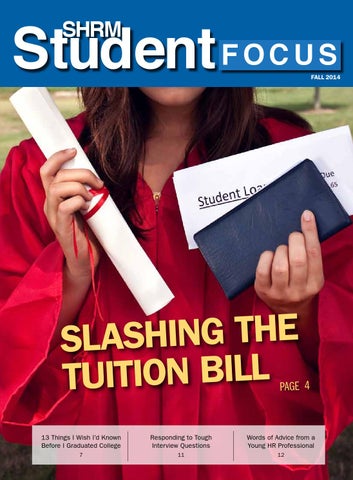
Student F O C U S SHRM
FALL 2014
E H T G N I H SLAS L L I B N O I T I U T
PAGE 4
13 Things I Wish I’d Known Before I Graduated College
Responding to Tough Interview Questions
Words of Advice from a Young HR Professional
7
11
12
Student F O C U S SHRM
FALL 2014
Future Focus 4
Slashing the Tuition Bill: There May Be More to Your Employee Benefits than You Think
7
13 Things I Wish I’d Known Before I Graduated College
10 Resumes, Interviews, and Cover Letters
11 Responding to Tough Interview Questions
12 Words of Advice from a Young HR Professional
14 MBA vs. HRM: Should You Pursue a Master’s in HR Management or an MBA?
18 How to Study Like an Honor Student
Chapter Focus 20 Crash-a-Class: Improving Chapter Enrollment
22 Student Chapter Awards
2 SHRMStudent Focus / Fall 2014
WE LCOM E
WELCOME BACK!
W
ith summer vacations and beach trips at an end, it is time to head back to school and get back to business. As you trade in your bathing suits for business suits and attend career fairs instead of state fairs, I encourage you to think not only about this next year of college but also about preparing yourself for what comes next. Whether that is getting your first internship or job, paying for graduate school, or becoming a better student, this issue of SHRMStudent Focus has you covered. There’s no better time than now to think about the future, even if it seems a long way off. Read on to learn how to stand out as a candidate, tips for paying for graduate school, advice on studying smarter and important life lessons to learn now. Although it may be tempting to block out all thoughts of finding a job after school or paying for graduate school until the day you get your diploma, make your transition to the “real world” a little easier by thinking about your post-graduate options now. As you move forward in your HR career, I hope you continue to see SHRM as a valuable resource and to take advantage of our discounted professional membership. Best of luck in the new school year!
Elissa C. O’Brien Vice President, Membership SHRM
ANNOUNCEMENTS 2015 SHRM Regional Student Conferences Stay tuned for new conference details, including a new and improved Case Competition format! Highlights include: • Longer preparation time for Case Competition. • More teams participating in Case Competition. • More educational sessions. Follow us @SHRMStudent!
Internship and Job Resources Did you know SHRM has a partnership with internships.com? As part of your SHRM Student Membership, you get free premium access to the site, a $20 value. Visit SHRM’s page for access to exclusive HR internships. Post your resume and look for open positions on the No. 1 HR job board. Visit HR Jobs to start your job search. Update your membership profile Ensure you are getting the most relevant information from SHRM by updating your contact information and graduation date. All adjustments need to be made by the individual member or by a member of the SHRM Member Care team. The Student Programs department can’t make changes to your member profile. To speak with a representative, please call 800283-7476, option 3, 703-548-3440 (International), option 3, or e-mail Member Care. To update your profile online, visit our Membership Center and select “Update Profile.” Please note, making adjustments in your e-mail address in the SHRM profile will result in all of your SHRM communications being directed to the new e-mail address, not just volunteer-related communications. Recently Graduated? Take advantage of SHRM’s special Student-toProfessional Membership program offer. Save $210 the first two years of membership! SHRM Foundation Student Scholarships The SHRM Foundation awards over $25,000 worth of scholarships to SHRM student members. The application deadline is November 1, 2014. To learn more about the scholarships or to apply, please visit our scholarship page.
Fall 2014 / SHRMStudent Focus 3
B E N E FITS
4 SHRMStudent Focus / Fall 2014
COVER STORY
THERE MAY BE MORE TO YOUR EMPLOYEE BENEFITS THAN YOU THINK By Meredith Berman
N
ow that I am a rising senior, graduate school is looming closer than ever. My parents’ friends constantly ask, “What are your plans for after college?” As of this week, my plan is to volunteer abroad during the summer and then go to grad school while juggling a job. How I am actually going to pay for more school is a whole different matter. A few weeks ago, I received a flyer in the mail to apply for the University of Michigan’s Ross School of Business’ Master of Management program. The program’s 10-month span immediately sparked my interest, and I excitedly headed online to do more research. Of course, the flyer conveniently left out the hefty price tag of $46,000, and my dreams of spending another year at the University of Michigan were quickly crushed. Feeling dejected at the prospect of another enor-
mous tuition bill, I trashed the flyer and promptly went back to the drawing board. With rising program costs, graduate-level education is becoming more unattainable. The National Center for Education Statistics found the median cost of nonprofit graduate tuition for the 20122013 year was $21,352, a steep increase from the $14,140 price tag a decade earlier. Depending on the program type and school, costs can be much higher. While student loans and scholarships are a common way to offset the cost of graduate school, they are not the only way. A 2013 Society for Human Resource Management (SHRM) survey on employee benefits found that 61% of employers offer undergraduate tuition assistance and 59% of employers offer graduate school tuition reimbursement. Those numbers shocked me. I could not believe that
over half of all companies are willing to pay for employees to go to college. While policies and amount of tuition reimbursement vary by company, many will cover the $5,250 per year allowed by the IRS to be filed as taxable income. With the help of SHRM’s lobbying efforts, this tax provision was made permanent in 2013, allowing employers to develop more stable educational assistance policies and providing employees with more opportunities to
continue their education. Deb Keary, vice president of human resources at SHRM, says in order for employees to be eligible for SHRM’s tuition reimbursement program, “courses should increase the employee’s effectiveness in his/her current position; be appropriate to prepare the employee for advancement opportunities at SHRM; be needed to fulfill requirements for a SHRM career-related degree; or be needed to prepare for professional certification.”
Fall 2014 / SHRMStudent Focus 5
B E N E FITS
Affordable Colleges Online notes that other common policies include maintaining at least a “C” average, working at the company for a set number of years, and completing the degree within a certain time frame. Snagging a job offering tuition reimbursement may be easier than you think. Many Fortune 500 companies offer tuition assistance programs, including companies like Apple, Verizon, Wal-Mart, and Wells Fargo. For instance, according to their website, Chevron will pay up to 75% of total costs for approved courses, which covers tuition, textbooks, lab fees, administration fees and registration fees. McKesson spent $3 million in tuition assistance for more than 800 employees in fiscal year 2013. Starbucks recently announced their College Achievement Plan, where Starbucks is collaborating with Arizona State University 6 SHRMStudent Focus / Fall 2014
COVER STORY
to provide employees with an opportunity for full-tuition reimbursement with a degree from ASU. And Keary notes that SHRM will pay $5,250 per calendar year for full-time employees and $2,625 for part-time employees. These companies understand the value of continued education, both for the employee and the company, and want to make it more attainable for their employees. Despite these beneficial programs, a study by SHRM found that 64% of companies say only 1-5% of employees take advantage of tuition assistance. Even if your company does not currently offer tuition reimbursement, it is worth it to sit down with your boss and talk about possible tuition help. Remind your boss of the tax break and the value your furthered education could bring to the company. Employers will be more likely to foot part of the education
bill if they know their contribution directly benefits their company, and not another company. If your employer seems open to the idea, broach the idea of committing to a certain number of years at the company in exchange for education assistance. Industries with high turnover rates could benefit from these types of agreements. Furthermore, outline how you will benefit the company. Will you learn new technological skills? Could interacting with professors and fellow students open your eyes to new viewpoints, more creative thinking and potential new clients? Tom Cherry, a senior planner with Independence University in Salt Lake City, notes in his article, “Rejuvenating Tuition Reimbursement Programs,” that an added benefit of tuition assistance for employers is that students can share key principles and ideas they learn with other employees.
Offering to teach other employees what you’ve learned in school helps your company get more bang for their buck, and becomes an investment in the future of the company, not just one employee. These tuition reimbursement programs are the perfect compromise of gaining real-world experience while enhancing education, not to mention reducing future student loans. For me, not having to choose between starting my career first or continuing my education makes my post-undergraduate plans a lot simpler. For those of you worried about juggling a career and school, consider taking online courses for more flexibility. SHRM found that 95% of companies say there is no difference in terms of tuition assistance between accredited online universities and traditional universities. Whether you are just finishing your undergraduate years or are a seasoned professional wanting to go back to school, taking advantage of a tuition reimbursement program makes achieving your dreams a little easier, at least financially. SF
Meredith Berman is a rising senior at the University of Michigan, where she studies communications and psychology. She is the member programs intern at SHRM.
F UT U R E F O C U S
13
THINGS I WISH I’D KNOWN BEFORE I GRADUATED COLLEGE
By Simon T. Bailey
A
lmost three decades have passed since I graduated from high school and then from college. I was as lost as a goose in a blizzard. I had no concrete plans, very little guidance, and didn’t do any significant travel outside of my hometown, Buffalo, N.Y. I was so happy to escape to Atlanta, Georgia, but little did I know that in my cluelessness it would cost me time, money, and energy. Eventually, I discovered, in the words of Sir Ken Robinson, “success is not a linear path, but a series of detours, full of twists and turns.” I wish someone would have pulled me by the ear and told me the raw truth. Maybe they did or didn’t. Nevertheless, it didn’t sink in. I don’t want this generation to repeat my mistakes, so here are 13 things I want them to know as they receive their diplomas.
1
Embrace seasoning.
When I worked at Disney, there were some promotions that bypassed me, and I often wondered why. It took me a few years to realize there were a few missing ingredients in my flavor profile.
Seasoning is embracing the character-building moments when you don’t know what you don’t know, but you are going to figure it out. Seasoning is acquiring the mental agility and emotional bandwidth to attain and retain whatever life brings you. It would take the seasoning of a relationship, a mentor, and a failure to help me attain the right flavor. Roger Hammer said it best: “I send a lot of horses out to the fairs for seasoning, to educate them. Some of them come around, and some don’t.”
2
Do the unthinkable.
I was recently talking with a guy name Robert at a conference. He shared with me that he had significant retail experience and heard that Microsoft was opening a retail store similar to Apple. He heard through the grapevine
that they were mainly hiring people who had worked at the Apple Store. Well, he didn’t have the inside track on landing the job or any hopes of getting in through traditional means of getting the job at Microsoft so he did something unreasonable. He sent an email directly to Steve Ballmer, CEO of Microsoft. He scoured the internet to find his email address. Two weeks later he received an email response from Steve’s assistant who passed his name onto the appropriate person within Microsoft. No risks. No rewards. Robert succeeded because he did something the average person would never do. Contact the CEO directly. This bold move put him a cut above the rest. While everyone was sitting by the phone waiting for the recruiter to call them or listening to crickets, he took
the bull by the horns and made it happen. What are you going to do?
3
Forgive and move on. Stop crying over
spilled milk. It happened. Let it go and move on. You are wasting precious energy worrying or trying to fix or change someone or something. It is what it is. The future moves toward you when you let go of whatever has been holding onto you. Dr. Christen Mirescu from Princeton says, “When the brain is worried it slows down and doesn’t produce neurogenesis, which is the process of growing neurons that help the brain grow.”
4
Habits are more important than goals. You hear all of the motivation and personal
Fall 2014 / SHRMStudent Focus 7
F UT U R E F O C U S
development experts advising you “set a goal.” I have discovered that there are some goals I set and didn’t reach. Why? Was it because I was dumb, slow, or excluded from the lucky sperm bank? No. When you do something over and over again and don’t need to think about it, then it becomes ingrained in your subconscious as a permanent behavior. Do you really have to think about driving or riding home? No, you just do it. When you have a desire or a goal that is deeply important to you but never change your habits, the goal will never become a reality. A habit forms a belief and belief creates behavior and behavior produces an outcome. Change your habits. Change your life.
5
Every day is an interview. People are sizing
you up in three seconds. Look your best at all times. 8 SHRMStudent Focus / Fall 2014
Smile. Be nice. Say hello to the person who can do nothing for you. Greet the receptionist of the business with a warm hello and handshake if appropriate. Introduce yourself. Listen more, and talk less. Speak clearly and thoughtfully. Have a point of view, and don’t wait for someone to read your mind.
6
Relationships are the currency of the future. When my parents dropped me off in Atlanta they made sure I was surrounded with an extended support group that would look out for me. Well, I didn’t know how to engage them by calling to check in, ask if there was anything I could do for them, or be available to volunteer or help any way I could. Because the well was empty and in the words of Harvey Mackay, I didn’t dig it
before I was thirsty, there was nothing for me to draw from in the time of need. I wish someone would’ve told me to cultivate relationships. They will become critical to your future.
7
Don’t get a job. Instead, go to work.
We are living in a world where the companies and businesses that will thrive in 21st century are cultivating four skill clusters: digital-age literacy, such as grasping economic concepts; inventive thinking, such as self-direction and the ability to work independently; effective communication, such as interpersonal skills; and high productivity, which is prioritizing, planning, and managing for results. I wish someone had told me to find a place of employment that would help me develop these four skills clusters — instead of chas-
ing after a paycheck. I made decent money but lacked the critical-thinking skills I needed back then.
8
Find your lane and work it. You may not
9
Beware of micro memes. A micro
have the ability, talent, or gift of Shakespeare, Einstein, Usain Bolt, or Lady GaGa. Don’t sweat it. Your gift is one that needs to be uncovered and mastered. What do you do well? What do people compliment you on? When you are operating at the optimal level what are you doing? That’s your lane. Learn all you can. In high school, I thought I wanted to be an accountant, but a teacher reminded me that I have a communication gift. WOW … thank you Mrs. Rita Lankes.
meme is a piece of cultural information, like a custom or
an idea, that’s passed on from person to person. It behaves like a flu and sometimes travels faster than speech. It comes from the Greek word “mimema,” meaning something imitated. It travels from mind to mind. Every day you are bombarded with memes and micro-messages but you have to choose what you think and believe. Embedded in movies, commercials, books — in every form of media there is a message behind the message. Beware of what you hear and see, and ask yourself whether you really believe what is being shared.
10
Say “yes.”
By the time you are 17 years of age, you’ve heard “no” over 150,000 times and “yes” only 5,000 times. Neuroplasticity is the ability of the brain and nervous system to change structurally and functionally as a result of input from the environment. When you say “yes” to your future, you are releasing neurotransmitters as neurons to infuse the synaptic nerve with hope and belief in yourself. You exist in the 21st century because the world needs you NOW.
11
session for 40 executives of a major Fortune 500 company that was already No. 1 in its region. However, the president made it very clear that while celebrating its past successes, each person needed to have the hair on the back of their neck standing up and their hair on fire as they contemplated how they would drive results for the new fiscal year.
12
Create a paradigm shift.
In the scientific field, a pattern, example, or sample is considered to be a paradigm. A paradigm shift occurs when a new thought, idea, product, or service is introduced that challenges the previous way of experiencing or doing something. For instance, in 1978 Masaru Ibuka introduced the Sony Walkman, which at the time was all the rage and was flying off the shelves of retail stores. On Oct. 23, 2001 — 30-
plus days after 9/11 — we were introduced to the grandchild of the Sony Walkman: Apple’s iPod. This invention disrupted the entire music-industry paradigm and forever shifted the way music is consumed. Assess where you are, and decide to be a paradigm buster.
13
Be desperate and change.
In his latest book “David and Goliath,” Malcolm Gladwell shares an amazing story about University of Louisville basketball coach Rick Pitino: “In 1978, when he was 25 years old, Pitino used the full-court press to take the school to its first NCAA tournament appearance in 24 years. Pitino says he has many coaches come to Louisville every year to learn the press. They turn around and email him and tell him that they can’t do it. He tells them, ‘We practice every day for two hours. The players are
moving almost 98% of the practice. We spend very little time talking.’” The coaches who came to learn from Rick Pitino were not desperate enough to change. Gladwell makes the point that to beat the Goliath in your life, you have to be desperate enough to do the unconventional. SF
Republished with permission from Business Insider. Simon T. Bailey is the author of Shift Your Brilliance and a weekly columnist for American City Business Journal.
Focus on producing
results. Gone are the days when people could skate by on producing dismal results, lackluster performance, and anemic strategies with no accountability. Everything in business is under microscopic investigation. Produce or be invited to find your happiness elsewhere. Recently, I was leading a Fall 2014 / SHRMStudent Focus 9
F UT U R E F O C U S
WHAT DO EMPLOYERS LOOK FOR IN RESUMES, COVER LETTERS, & INTERVIEWS? In 2013, SHRM asked HR professionals in recruiting positions about things that can make or break a candidate’s position. Here are some of the key findings from SHRM’s ‘Resumes, Cover Letters, and Interviews’ survey. To see a full copy of the findings, please visit http://www.shrm.org/Research/SurveyFindings/Articles/Pages/ResumeCover-Letter.aspx
TOP RESUME MISTAKES
99%
PREFERRED RESUME FORMAT Chronological (Education and experience) (63%) Combination of functional
87% of employers think it’s very important to tailor a resume.
and chronological (32%)
Grammatical/spelling errors
84%
Missing detailed job history
82%
Missing employment dates
Functional (Lists skills and
62%
experience by types) (4%) Other (1%)
Not in reverse chronological order
PREFERRED THANK-YOU NOTE METHOD 50
of employers think it’s important or very important to send a thank-you note after an interview.
37
9
Email & Postal
10 SHRMStudent Focus / Fall 2014
60%
Postal
COVER LETTERS The most important aspects of a cover letter are matching
work experience and skills to
job requirements
RESPONDING TO
TOUGH INTERVIEW QUESTIONS
I
t’s the most dreaded part of the interview—and for good reason: Dealing with questions you don’t expect from potential managers and their HR colleagues. Even if you don’t know what those questions will be, there are steps you can take to anticipate and deal with tough questions, says Vicki Oliver, a job interview consultant based in Manhattan and the author of 301 Smart Answers to Tough Interview Questions (Sourcebooks, 2005). She points to some common interviewing themes with suggestions on how to best anticipate and prepare. The resume gap. Whether a gap was voluntary or not, job seekers must be prepared to deal with any gaps in their employment history because the issue is guaranteed to be raised, Oliver says. A good approach to take here, she says, is to be prepared to talk about what you’ve been doing to fill your time—learning new skills, volunteering, etc. The unfortunate parting. It’s preferable to be asked to respond to a situation where you have been part of a layoff than one where you have been personally terminated, Oliver
admits. There is strength in numbers. But even discussing a personal termination can be handled effectively by: Not bad-mouthing, criticizing or demeaning the company or supervisor. Identifying key lessons learned from the experience. “Don’t sugar coat too much,” warns Oliver, who points out that personal networks can be quite effective at helping to determine the reasons behind a termination. “You just want to put the best face on things. Don’t go into a long, detailed explanation. Focus on what you learned from the experience and the skills you can carry forward with you.” That sends a positive message, she says. Provocative questions. “If you were a vegetable, what vegetable would you be and why?” “How high is the Empire State Building?” While Google recently stated that its use of “tricky interview questions” was “a complete waste of time,” other companies may still be using these questions and job seekers need to be prepared. It’s not so much that interviewers are looking for the “right” answer when they ask these types of questions,
Oliver says. It’s that they’re interested in evaluating how the interviewee considers and responds. In her book, she says, she talks about questions such as “What’s the best-managed company in America?” The issue isn’t whether you can respond to that question, but how you respond. So, for instance, an appropriate response might be: “Well, I don’t know that I could identify the best-managed company, but I personally recently bought stock in XYZ company because…” or “I’ve personally always admired XYZ company because...” Bring the question around to a topic you can talk about with authority, she advises. The closer. “Do you have any questions for us?” You
can guarantee that you will be asked this question. Despite that certainty, though, too many applicants fail to prepare. Two key points: Be prepared to ask some questions. They should not be questions you could have found the answers to on your own. Oliver suggests doing some background research related to the person who will be interviewing you and using that information to generate potential questions. For instance, you might find that the interviewer recently wrote an article on a particular topic. You could say: “I saw your article on XYZ. It made me wonder what you think about...” That approach, Oliver says, “is flattering and deep at the same time.” SF Fall 2014 / SHRMStudent Focus 11
F UT U R E F O C U S
WORDS OF ADVICE from a Young HR Professional
By Callie Zipple
S
o you’re graduating this year? Congratulations! Now what? I remember asking that question myself a little over four years ago when I was preparing to graduate from St. Norbert College. Looking back, I wish I had been given the opportunity to sit down with a recent graduate and have an honest, 12 SHRMStudent Focus / Fall 2014
down-to-earth conversation about what their transition to the “real world” had been like. I realize that everyone’s experience will be different, but at least I would have had some idea of what to expect. Lucky for you, I’m here to have that conversation with you as a recent graduate and young HR professional! I have put together 10 pieces of advice that helped me in my transition from a campus to a career. I’m hoping you will be able to identify with or even utilize these in your own transition. 1. Your internship isn’t in HR? So what! Make it your job. Take any and every opportunity to learn new things, but focus especially on areas that can help you build your resume. Approach the HR manager and ask if you
can be involved in a project. Ask if there are any committees to join that may allow you to network and meet new people. Ask your manager if you can sit in during his or her meetings to better understand a process or procedure. If you are comfortable with taking control of your position, you will find it to be much more valuable. 2. Make sure your resume and cover letter have zero errors. As a recruiter, I want to remember a resume because of the content, not because the candidate used the word “summery” instead of “summary.” And I promise that an error like that will not be forgotten. Also, make sure the contact information listed on your resume is current. I’m not a detective; if I can’t use the listed telephone and/or e-mail, I will likely reject your application.
3. When heading into an interview, have at least three personal situations ready to spin into an answer to a behavioral-based question. Whether it’s a school project, your first difficult discussion with a co-worker or an idea you presented that didn’t go as planned, run through the situation in your mind and ask yourself what you learned from it. There’s nothing more uncomfortable than being asked a question in an interview and not being able to come up with a well-rounded answer. 4. Be yourself during your interview—let your personality shine. While I was interviewing for my first job out of college, I tried to be what I thought an employer wanted. I tried to come across as someone who was
professional, experienced and knowledgeable when in fact I had never worked in a professional environment and had a background that included only my internship and schooling. I was very scripted and straightforward and did not allow for much dialogue during the interview. Each time I was asked a question, I provided an answer and moved on. By not allowing for the dialogue, I didn’t let the interviewer see my true personality. 5. On the flipside of #4, don’t be your interviewer’s best friend. As an interviewer, I don’t want too much information from you. If you had to leave a previous job due to medical issues, please leave it at that. It is not necessary to elaborate or to provide any information that isn’t pertinent to your ability to complete the job. 6. When you have found a position that you are interested in applying for, read the entire posting. Usually, the company provides instructions as to how to apply for the opening. For example, at my company— Adelman Travel—we direct people to our website on every external posting we list. Because of this, when I receive an e-mail that includes a resume/cover letter, I know the candidate hasn’t read the posting they are applying for. One of the most important qualities employers look for is attention to detail, so make sure to follow directions.
7. Don’t speak negatively about a past employer in an interview. The experience of having been let go from a previous position—whether it’s due to a layoff, a company closing or a termination—is never particularly positive, but that doesn’t mean that a potential future employer wants to hear you trash-talk your past employer. What if your past employer does business with the company with which you are interviewing? What if they are one of the company’s biggest suppliers? The way you talk about your past employer is the way that your potential future employer envisions you talking about them. Even though you may still be upset due to your recent separation from your previous job, find some way to spin the experience positively. Talk about what you learned while employed or what you have been doing to get back into the workforce. 8. Do your research on the company prior to applying for the job. It’s important that you agree with the company’s mission, vision and values. It is even more important that you can speak to what the company does and how it is profitable. The recruiter wants to know how you can make a positive impact on the organization’s bottom line. I would recommend utilizing the company’s website as well as any articles written by or about the company. You’ll want to consider the source of the information you are reading or reviewing, but it’s important to see the company from all angles.
9. Get familiar with all types of social media. Today, companies are sharing job opportunities through different outlets than they have used in the past. They are using specialized job boards, specific strategies and different kinds of technology to recruit a new generation of workers. I have shared jobs on Twitter and Facebook and even found one of my recent jobs on LinkedIn. Additionally, I would recommend that you find a way to have a personal outlet that is separate from your professional outlet. For example, my Twitter and LinkedIn profiles link to each other, while my Facebook profile remains disconnected. That allows me to stay connected with friends on Facebook while networking professionally on Twitter and LinkedIn. 10. Although technology is certainly the way of the future, don’t completely disregard the importance of in-person connections. Do some research on local, state and/or national groups in which you can get involved. I had gotten involved in SHRM at St. Norbert College and after graduation went on to convert my student membership to a professional membership with my local professional chapter. Through my involvement at the college and local professional level, I was given the opportunity to get involved at the state level. I served for two years as the College Relations Director for WISHRM, which gave me the opportunity to interact with HR students in Wisconsin and surrounding states. While I
no longer serve in this role, I am still contacted regularly by students and professionals that I have met as a result of my involvement. Even if you don’t have the time to volunteer in a position within the organization, attend the events and get as involved as you are able. I have found this to be invaluable in my career. These are not the only lessons I’ve learned during my short career in HR, but they are some of the most important. As young HR professionals, I urge you to find your passion in life and work that into your career. Make your career work for you. If you do something you aren’t passionate about or something you don’t enjoy, your professional years will be much less than you dreamed them to be. My passion is working for people in the field of human resources. What’s yours? SF
Callie Zipple is the HR generalist for Adelman Travel in Milwaukee. Her past professional positions include Staffing Consultant at Landmark Staffing in Appleton, Wis., and HR Generalist at Krueger International in Bonduel, Wis. Callie has also volunteered with WISHRM as the College Relations Director and with SHRM headquarters on the Young Professionals Advisory Council.
Fall 2014 / SHRMStudent Focus 13
F UT U R E F O C U S
MBA VS. HRM SHOULD YOU PURSUE A MASTER’S IN HR MANAGEMENT OR AN MBA? What is the difference between the two? Where will the different degrees lead you? Read on for valuable advice and insights on this issue from grad students, professors, and HR practitioners across the country. The following comments were taken from a discussion on the SHRM Student Union, an online bulletin board open to SHRM members. For more information on specific universities and programs, visit SHRM’s Directories of HR Programs page.
GRADUATE STUDENT PERSPECTIVES Dennis Berger: “The difference is very fundamental. An MBA gives one a thorough grounding in all aspects of the business profession. An individual may concentrate in a particular area, but will still be required to take a certain number of core courses in finance, economics, accounting, marketing, MIS, and management. Electives will be used for your concentration. In the MS in HRM degree you will spend all your time on the principles of HR, from org design, to training, to everything else the HR profession covers. Are you a business major? If not, you will be required to take leveling courses to get you up to speed. If your undergraduate degree is in management or
14 SHRMStudent Focus / Fall 2014
HR, the MBA would do you a world of good. Also, more and more of the trade journals are showing that HR professionals need to get an MBA to have any clout in the firm (that way they know about the financial and business aspects of the firm). If you are getting a degree in something else it may be best for you to pursue the HRM degree and after working for a while go back for the MBA. My MA is in HRD, but after being in an MBA program for a while I can definitely say that my eyes have been opened.”
Timothy Kresge: “I’m going to stick my neck out, here it goes. An MBA concentrates on the bottom line. People
are secondary. The concern for people and the concentration in HR will probably not consider issues of right and wrong, good versus bad practices. HR Management also cares about the bottom line but takes a much more people centric view. The individuals who make up an organization are our charges. We must balance the good of the organization with the good of the workforce. In HR we are advocates for employees and representatives of the company. Having never gone for my MBA I can only make conjecture as to the actual differences between an MBA with HR concentration and a MS in HR. But I am pretty sure an MBA will get you more money.
But I still chose to go for a MS in HR. Talk to professionals working in the field ask them what they perceive to be the difference.”
Doug Peterson (Ph.D. candidate, Nebraska): “Essentially, it depends on your program of studies. There is no real agreement as to content of the degree between schools as long as the content meets a minimum set by the accrediting body. The best in the US is the AACSB (the American Association of Collegiate Schools of Business), so I recommend you start by choosing an accredited program. Most major schools of business are accredited these days, but
the minor schools, some of the church affiliated schools, and most regional schools are not; they usually don’t have the resources to muster 95% faculty with Ph.D.’s, the library holdings, and the research support. Examples of accredited schools by league affiliation: all “Big 10,” all “Big 12,” and “PAC 10.” Most Ivy League schools, most Atlantic Coast and Southwest and Southeast conference schools too. In accredited schools, the MS in HRM is designed to provide a more explicit coverage of HR topics and specialties with the intention of preparing the student for a more quantitative and research-oriented focus, probably opening the way to enrollment in a Ph.D. program. Most MS programs have a thesis requirement. The MBA, on the other hand, is more generalistic in its orientation designed to prepare business practitioners (or people who want to be...) for career ladder succession. With that out of the way, the only thing else to say is that content then belongs to the school. Better HRM schools (Purdue, Cornell, Iowa, Wisconsin, Kansas, UCLA) probably with also have a very rigorous content in the MBA curriculum related to HRM. You may notice very little difference in the MS content of some schools and the better MBA schools then. Ask for the required courses you have to take, apply to the programs that meet your objectives best, accept offers from the best programs you can get into.”
Annette Betka: “I have just completed my first course on my way to an MSHR. I chose Loyola University’s Institute of Human Resources and Industrial Relations (Chicago), and the degrees they offered were MSHR (Human Resources) or MSIR (Industrial Relations). Every course required for the degree is either HR- or IR-related. There are no “Project Management” or general management classes, as you would find in an MBA program. Economics is not just a general economics, it’s a “Labor Economics”. Law class is either “Labor Law” or “HR Law.” In an MSHR(M) degree program, the entire focus is on HR, and you can concentrate in Comp & Benefits, Global HR, Organizational Development, Labor Relations, etc. vs. an MBA with a concentration in HR, where only a few of the classes were truly HR-focused.
Take a look at the course descriptions, required classes, and electives to find out what curriculum will best serve your career objectives. I believe that the complete focus on HR vs. general business management/administration is the major difference between the two types of degrees. It’s my opinion that if you have a choice, and your career goals definitely lie only in the HR arena, then choose the MSHR, IR, HRM (or whatever they happen to call it at the school). However, whether the company you work for, or hope to work for, identifies the difference in your choice is another matter. Managers may simply see a Master’s degree as a sign of your intelligence, initiative, and desire to advance professionally, regardless of the curriculum required to obtain it.”
Sheila Russ “I am currently working on my MS in HRM at Virginia Commonwealth University in Richmond. I started in the MBA with a concentration in HR, then switched to the MS in HRM. My reasoning for switching programs is simply because the MS offered more opportunity for me to take the classes I wanted. The MBA program will offer you a better overall knowledge of business. For instance, our MBA program is 12 classes - only four of which are electives. If you have a concentration, those four classes are chosen for you. With the MS we have to take 10 classes - only 4 of which are chosen for us, those being the HR classes. 3 of the other electives must be in certain areas (i.e. economics, a quantitative class, and an operations class). The other 3 electives can be chosen in a variety of areas. In making my decision to switch programs I spoke with several HR professionals I know through our local professional SHRM chapter. They, my advisor, and our dean of business graduate studies, all gave me the same advice. In a nutshell, what they told me was that if HR is really what you want to do, then the MS is your best option. If you do not have a background in business, then the MBA w/ HR might be better for you. I have a BS in Business Mgmt, I went with the MS. Also, (and this is no reflection on any MBA program, and I only quote someone else) a lot of schools have MBA programs, an MS is something that can set you apart in the industry.”
Fall 2014 / SHRMStudent Focus 15
F UT U R E F O C U S
ACADEMICIANS’ ADVICE Debra J. Cohen (SHRM, Chief Knowledge Officer, formerly George Washington University): “An MBA will give you a very broad business background. You will be required (at most schools) to take courses in all areas of business, such as accounting, marketing, finance, management, statistics, etc. You will be able to take at most, 4 maybe 5 courses in HR. The degree will probably be anywhere from 48 to 60 credit hours, depending upon the school. An MS in HR is much more focused to HR. It is usually shorter, 36 to 48 credits. Most of your courses will be in HR or in a related discipline. You might have to take a statistics course, but you will generally not be required to take a lot of other courses in outside disciplines such as accounting, finance, etc. So, which you go for depends on what you want to be able to do. If you are positive you want HR and you want to be a generalist, the MS degree may be the way to go. If you want to explore HR as well as other areas of management, the MBA may be the way to go. Each degree has its pluses and minuses. In addition, your background (i.e., whether or not your undergrad degree is in business) will also make a difference as to what you do.”
16 SHRMStudent Focus / Fall 2014
La Verne Hairston Higgins (Le Moyne College): “An MBA program with a concentration in HRM provides a broad spectrum of coursework on general business practices with some coursework (generally about 4 courses) on basic HRM issues/practices. In contrast, an MS/MAHRM (or MS/MA-IR) program provides a broad spectrum of coursework on general HRM issues with some coursework (generally about 4 courses) on basic business issues/ practices.”
Steve Thomas (Southwest Missouri State University): “The answer to the differences between the MBA with HR emphasis and the MS in HRM depends at least somewhat on the particular program in which you are interested. In general, however, the HRM emphasis in an MBA program requires far fewer specialized courses in HRM, normally three to four courses is sufficient for an emphasis. In an MS program, you will take 30-35 hours of classes that are all in HRM. In addition, you generally must have an undergraduate degree in business from an accredited university in order to be admitted to the MS in HRM program. The MBA admission is open to any major. There is some disagreement regarding which program
is more marketable. In my opinion, if you are certain that you want a career in HRM, a MS in HRM from a top school such as Cornell is the best way to go. This top tier school has excellent placement rates and good salaries for graduates. On the other hand, it’s difficult to get in. Many other MS programs also have successful graduates and good placements, but then so do the best MBA programs. Many feel that the MS is not as flexible as the MBA and that may be true. However, all MS graduates do have a broad exposure to business since they receive the business core at the undergraduate level. In sum, it’s a tough decision, and one that depends on your selection of program and career goals. Successful HR managers have come from both tracks. Whatever you choose, good luck!”
Mark J. Keppler (California State University-Fresno): “I wanted to pass along some advice (I get this question on a regular basis from my students). An MBA/HR concentration means that you will take between 11-14 classes, only 2-4 of which are HRM classes. The rest are general business classes (like accounting, yech!). An M.S. in HR or Industrial Relations will allow you to take 10-12
out of 14 classes in HRM. As you can see, there is quite a difference. In addition, I think you will find it easier to get an HR job with an M.S. -- particularly if you get a degree from one of the top five programs (Cornell, Univ. of Wisconsin, Univ. of Illinois, Univ. of Minn. and Michigan State Univ.)...”
Mitchell Adrian (Longwood College): “Well, as best I understand it, An MBA is a Masters in Business Administration - meaning a general business degree. The concentration in HR is nice, but that only indicates that most of your “free” or “elective” choices were in HR fields. The MS in HR is a Masters of Science geared specifically toward HR. In this case, your “electives” will be in other business fields and your primary concentration will be in HR. How does that affect you later? Well that depends. I have an MBA with an emphasis on HR. From there I went on the get my DBA. You’ll have to examine your specific needs and aspirations to determine what would be best for you.”
Dr. Alan Fish (International MBA Program, Charles Stuart University, NSW Australia): “I am replying to you from Australia, hence my response is in the context
of the design of courses here. I can only assume a similar situation would occur in the States. An MBA with a specialization in HR would include material that is broad based management in context. That is you would likely cover Marketing, Finance, Strategic Management, Economics, TQM, etc., in addition to your specialization in HR. Hence with the MBA
you are receiving a generalist business education with a particular specialization. Some would suggest that this is preferable for HR specialists as they have traditionally (here in Australia anyway) lacked a business focus to their operations. An MSc specifically in HR would include nothing but HR subjects. At the end of the day, you need to deter-
mine which is best in terms of your career. If you had an undergraduate degree in HR, I would be inclined to go for the MBA. If your undergraduate degree was in a specialist field other than HR, say Economics, Accounting or other business field I would go for the specialist degree i.e., the MSc. If your undergraduate degree was in say Psychology, Sociology, etc., I
would be inclined to the MBA. I suppose what I am saying to you is, to what extent do you lack knowledge in particular areas? Make your decision on that basis. But make sure you have some business education at the end of the day. If I can offer any further advice please let me know.”
HR PRACTITIONERS’ PERSPECTIVES Karen Aleck (Staff Recruiter for a leading healthcare company): “I received my MBA from the University of Chicago in 1993, with concentrations in HR and Marketing, and have been very happy with my choice. My HR and case-study oriented marketing classes taught me about the regulations you need to know to be effective in HR, and helped develop the ‘soft’ skill of decision-making when a situation is not black and white. These are the skills that I’m sure a good MA HR program teaches. The MBA program teaches the hard skills of accounting, finance, and statistics. The things a good HR professional will need to know to a) understand the business
in order to b) impact the business and c) communicate HR’s impact on the business. In a world where HR still struggles for ‘respectability’, these are the skills that will help you gain credibility and allow you to effectively communicate with peers in other functions. Only then (IMHO), can you put your other HR skills to good use. I’m not convinced that the MA program teaches these skills. I’ve seen too many MA people who think their role as HR professional is to make sure managers abide by FLSA. Puhleese. What the MBA probably does not offer is the more technical HR skills (i.e. how to do a salary survey, behavioral based interviewing technique, expatriate administration, etc.). I have had no
problem picking these skills up on the job, though. If at all possible, find a company, benefactor, long-lost-relative, ANYONE to pick up the tab for your degree...student loans are great when the money is coming in, but hell when you are paying them off!”
Gary Garber: “As a graduate of Cornell’s Masters in Industrial and Labor Relations (MILR), I have some insight that might be helpful. The main difference between MBA with a HR concentration and a Masters of Science in HR Mgmt. or a Masters in Labor Relations (which in today’s world can be almost totally HR-based and not traditional mgmt.-union focused) is this: an MBA has a ton of general
business courses and only a few HR ones. The MILR has a ton of HR courses and a few general business ones. Employers go to both schools, but I think the national recruited MILR schools are limited (Cornell, Minnesota, Michigan State, Illinois are the ones I ran across). Also, if you have a geographic preference, there may be a local school (MNA or Masters) that is recruited heavily by companies in that area.” SF
Fall 2014 / SHRMStudent Focus 17
F UT U R E F O C U S
HOW TO STUDY LIKE AN
Honor Student By Daniel D. Young
M
y story of how to study like an honor student is unique and all my own. Ever since the fifth grade, I have been passionate about being an honor student. As an adult, I realized it was my destiny to become one, because it’s attached to my values, which are hard work and determination. From there, I made a personal choice to have a living legacy that encompasses being an honor student. This was also brought on by my vision for my life, which is to be successful. I came to these realizations after I was laid off from the company I was working for due to a reorganization. I had to decide what I was going 18 SHRMStudent Focus / Fall 2014
to do with my life. I decided to pursue higher education and inspire my peers through this achievement. If I were to mentor a class of incoming freshmen, the advice I would give them would include a discussion of the guidelines, strategies, techniques, philosophy and habits that I personally formulated and currently follow. Guidelines are my road map. I always start by being as attentive as possible and identifying any weaknesses that could hinder my progress toward the completion of any task. For instance, if the telephone rings, I avoid the call. I try to minimize multitasking and focus all of my attention on the task at hand. I apply
Guidelines are my road map. I always start by being as attentive as possible and identifying any weaknesses that could hinder my progress toward the completion of any task. resolutions to my work based on constructive feedback from professors or tutors. In addition, I assess how much time there is to complete tasks so that I don’t miss any deadlines. Through these actions, I have developed the ability to focus, which keeps my eye on the primary goal of studying. Strategies give you a good plan of action to follow. Managing a weekly schedule will
facilitate optimal study time. Furthermore, I make sure all of my work is of high quality. Due to a full-time job and heavy course load, I’ve committed myself to ensuring that I use study time wisely. Also, I learn from prior experiences to make wise decisions. For instance, I do not recommend spending four hours at a party and allowing 30 minutes of study time for a huge final exam.
Subsequently, I have created my own set of mentor techniques to follow. The first is readiness. For example, when a professor asks the class to write something down, I immediately begin jotting down the lecture. Second, I’m always prepared to take on knowledge. I make sure that I have a pen and pad available at all times, even when I’m going to lunch. Being passionate about the subjects I’m studying makes me more dedicated to course work. Another technique I follow is escaping procrastination. I use this technique in order to avoid putting minuscule tasks in front of urgent ones. Lastly, motivation fuels me to continue following honor student techniques. With motivation, I have achieved proven results, such as making the dean’s list and earning good grades.
Next, I have a philosophy of being a model student: I lead by example. If I need to see change, I become the change that I want to see. I take on leadership roles to gain quality experience. My integrity keeps me grounded, so I can always adhere to a high degree of honesty. I believe honesty is the best policy, which brings me to my character—it speaks a lot about the positive choices I make. Most important, my superior habits keep me aligned with my goal of being an honor student. Being ethical brings out a sense of responsibility in me. I always take ownership of what I say I will do. As a result, I solve problems, always coming up with quick and effective solutions. Adequate sleep plays a huge part in my daily routine; I wake up fresh and
ready to learn new material. My best routine is to try and finish school work early; doing so means I avoid feeling rushed and I have ample time to fix any mistakes. Have you ever written a paper and the teacher has deducted points for misspelling words, quoting instead of paraphrasing, or putting in a wrong date? Revising your work will help minimize such errors. If anyone is thinking about being an honor student for the first time in their life, especially freshmen, these steps will aid in that decision: • Form your own ideas of your life’s story. • Set and follow guidelines. • Make strategies that work for you. • Create long-lasting mentor techniques. • Stick to your philosophy. • Develop quality habits. The results speak for
themselves. I achieved an “A” in my statistics class, which allowed me to meet my goal of inspiring fellow classmates to study like an honor student. As you can see from my story, this is what makes me stand out and makes others see the most in me! SF
Daniel D. Young is a senior attending Keller Graduate School of Management in Orlando, Fla., pursuing a master’s in human resource management and a student member of the Greater Orlando Society for Human Resource Management. Fall 2014 / SHRMStudent Focus 19
STU DE NT CHAPTE R
FO C U S
IMPROVING CHAPTER ENROLLMENT By Patricia Gillespie
If
you are at all like most student clubs and organizations, recruitment can prove to be very difficult, time-consuming, frustrating and disappointing. The California State University, San Bernardino student affiliate chapter of the Society for Human Resource Management (SHRM) was struggling to get new members. With much of the board graduating in June, we were worried about not having strong, new board members to leave the club to. We had tried recruitment strategies such as tabling and passing out informational flyers in various classrooms. While these strategies did generate a small amount of interest, we were not getting the active, involved membership that we hoped for. Tabling is very time-consuming and out of the dozens of e-mail addresses we received we were lucky if we got one new member. The problem we found is that most students do not realize how valuable it is to be involved in a club or organization specific to their concentration. They don’t have knowledge of the many
20 SHRMStudent Focus / Fall 2014
benefits that being a member of SHRM can provide. Trying to convey our personal experiences with SHRM onto a short flyer or a spam e-mail was not working. We needed a way to reach out to other management students that enabled us to tell them about the various ways SHRM has helped us as students. We needed face-toface interaction, but we had no idea how to get them to come to a meeting. We were in our last meeting of the winter quarter discussing this problem and trying to come up with new recruitment approaches when the simple suggestion of going into a human resources management class to talk about SHRM with the students turned into our most well-received and successful recruitment idea to date. From that discussion, “Crash-aClass” was born. The way “Crash-a-Class” works is we first talked to the professor of the class we wanted to “crash,” and we selected a date and time that worked with the professor’s lecture schedule. We asked that he or she not inform the students that we were coming. Then we
created a short PowerPoint presentation with the following talking points: • What is SHRM? • The benefits of being a SHRM member: • Networking. • Internship opportunities. • Access to research, articles, new laws and policies, and how they affect the industry. • Events, workshops and guest speakers our chapter of SHRM has had and how those have helped our members. We have had LinkedIn workshops, various speakers from all areas of HR, mock interviews, and negotiation and resume workshops. • SHRM Conferences and
Case Competitions. Our PowerPoint presentation included pictures of our different activities and events. We did not include a lot of words on the slides as we wanted to be able to speak to the class based on our own knowledge and experience— we wanted it to be personal. On the day of the “Crasha-Class,” we bought pizza and bottled water. When we walked into the class the students were pleasantly surprised, mainly because we had food. Three of us began passing out the pizza and water while the fourth person set up the PowerPoint. Once everyone had been served, we began the presentation. We started by introducing
SHRMStudent FOCUS
Student F O C U S Student F O C U S SHRM SHRM
Founded in 1948, the Society for Human Resource Management (SHRM) is the world’s largest HR SHRM membership organization devoted FOCUS to human resource management. Representing more than 275,000 members in over 160 countries, the Society is the leading provider of resources to serve the needs of HR professionals and advance the professional practice of human resource management. SHRM has more than 575 affiliated professional chapters and 200 student chapters within the United States and subsidiary offices in China, India and United Arab Emirates. Visit us at shrm.org.
Student
ourselves and our positions on the board. After that, we all took turns covering a specific area of the presentation. We each shared our personal stories about how being a member of SHRM has benefited us as students and as future professionals. We told the class about the internships we have gotten as a direct result of being active SHRM members. We also told them about the different workshops we have had and how those helped us improve our resumes, perform better in interviews, and even how to navigate and effectively use LinkedIn. In addition, we had cards printed with step-by-step instructions on how to join SHRM, which were passed out to each student. At the end of the presentation we asked the students various questions about what we had told them. This was a way for us to test
editors Laurie L. McIntosh SPHR, CAE Robert Lagow Rachel Rosen
how well we did in explaining the information and how interested the students actually were. Each student who answered correctly was given a prize. There was not one student who gave a wrong answer, in fact they began asking more questions and several students used their laptops to join right away. The professor was extremely pleased with the way the event went and allowed us to “crash” one of his other HR classes, which was also a success. “Crash-a-Class” is a successful recruitment technique because students already have to be in class, they are relieved by the interruption of the everyday lecture which seems to make them more interested and engaged in the presenta-
tion, and they get pizza—what student doesn’t love pizza? Since having our first “Crash-a-Class,” we have had several new faces at our general meetings; in fact, all of our new board members for the upcoming year came from those “Crash-a-Class” events. Last quarter we were lucky if the entire board showed up. Since we began this new recruitment technique, participation in the meetings has more than doubled. Like us on Facebook for updates on this and other events: https://www.facebook. com/pages/SHRM-atCSUSB/161768610548846. SF
Meredith Berman
designer Jezrehiah Towner
internet www.shrm.org/students
e-mail Laurie.Mcintosh@shrm.org
© 2014 Society for Human Resource Management 1800 Duke Street Alexandria, VA 22314 USA 800-283-7476 (U.S. only) +1-703-548-3440 (Int’l) +1-703-548-6999 TTY/TDD +1-703-535-6490 Fax
Patricia Gillespie is a human resources student in the College of Business and Public Administration at California State University, San Bernardino. Fall 2014 / SHRMStudent Focus 21
STU DE NT CHAPTE R
FO C U S
201 STU 3-14 DEN ME T R IT AW AR DS
The annual Student Chapter Merit Award program recognizes chapters for outstanding activities and projects in the following areas: Student Chapter Requirements, Chapter Operations, Chapter Programming and Professional Development of Members, Support of the Human Resource Profession, and SHRM Engagement. Congratulations to all the recipients for their hard work! Learn more at: http://www.shrm.org/ communities/studentprograms/pages/merit. aspx#sthash.z670UwE1.dpuf
OUSTANDING CHAPTERS Chapter Name
22 SHRMStudent Focus / Fall 2014
Chapter #
Area of Influence
Temple University - Main Campus
5118
Innovation/Technology
Southeastern Lousiana University
5479
Innovation/Technology
New York University
5570
Programming/Education
Middle Tennessee State University
5009
Programming/Education
Eastern Michigan University
5041
Campus/Community Service
University of South Carolina
5117
Recruitment
West Virginia University
5127
Innovation/Technology
Illinois State University
5162
Recruitment
Meredith College
5177
Programming/Education
University of Northern Iowa
5244
Programming/Education
University of Toledo
5245
Recruitment
University of Tennessee - Knoxville
5254
Programming/Education
North Carolina AT&T State University
5260
Programming/Education
University of Texas - Arlington
5293
Campus/Community Service
Villanova University
5323
Programming/Education
University of Puerto Rico - Mayaguez
5333
Campus/Community Service
University of Guam
5356
Promotion of Assurance and Learning
McNeese State University
5393
Programming/Education
New York Institute of Technology
5460
Programming/Education
Wayland Baptist University - Anchorage
5583
Campus/Community Service
Chapter Name
Chapter #
Area of Influence
Bryant and Stratton College - Virginia Beach
5633
Programming/Education
Blackhawk Technical College
5669
Campus/Community Service
San Diego State University
5676
Programming/Education
Athens State University
5695
Programming/Education
Rutgers, The State University of New Jersey Graduate Chapter
5154
Campus/Community Service
St. Cloud State University
5388
Campus/Community Service
SUPERIOR MERIT Chapter Name
Chapter #
Chapter Name
Chapter #
Alvernia University
5169
Portland State University
5243
Boise State University
5123
San Jose State University
5062
Briar Cliff University
5478
Seton Hill University
5434
California State Polytechnic University Pomona
5498
Sioux Empire Student Chapter
5496
St. Norbert College
5516
California State University - Fresno
5251
SUNY - Geneseo
5242
Central Michigan University
5086
Texas A&M University
5054
Central Washington University
5201
University of Akron
5035
Cumberland County College
5536
University of Alabama - Huntsville
5038
Indiana Institute of Technology
5192
University of Buffalo
5091
Indiana University - South Bend
5311
University of Hawaii at Manoa
5061
Lake Washington Institute of Technology
5207
University of New Haven
5360
Louisiana State University
5300
University of Puerto Rico - Aguadilla
5437
Michigan State University
5094
University of Puerto Rico - Rio Piedras
5129
Mount Mercy University
5688
University of Wisconsin - OshKosh
5130
Murray State University
5446
University of Wisconsin - Whitewater
5249
Nicholls State University
5431
Weber State University
5391
North Carolina State University
5100
Winthrop University
5074
MERIT AWARD Chapter Name
Chapter #
Chapter Name
Chapter #
Arkansas State University
5155
Franklin Pierce University
5657
Ashland University
5462
Georgia Southern University
5187
Bemidji State University
5689 5577
Indiana University of Pennsylvania Graduate Chapter
5182
Bridgewater College California State University - Long Beach
5234
5404
California State University - Stanislaus
5324
Indiana University/Purdue University Indianapolis
Fall 2014 / SHRMStudent Focus 23
STU DE NT CHAPTE R
FO C U S
MERIT AWARD Chapter Name
Chapter #
Chapter Name
Chapter #
Kansas State University
5148
University of Northern Florida
5098
Minnesota State Community & Technical College
5571
University of Puerto Rico Bayamon
5152
University of Scranton
5037
Northern Illinois University
5124
University of South Dakota
5283
NOVA Southeastern University - Jacksonville
5618
University of West Florida
5180
Polytechnic Institute of NYU
5358
University of Wisconsin - Green Bay
5380
Shippensburg University
5454
Utah State University
5172
SUNY - Oswego
5210
Webster University - North Florida
5256
Texas A&M University - San Antonio
5681
Western Michigan University
5364
University of Central Florida
5170
University of North Carolina - Chapel Hill Undergraduate
5274
HONORABLE MENTION Chapter Name
Chapter #
Chapter Name
Chapter #
Argosy University
5656
Rider University
5198
Baker College of Allen Park
5617
Rowan University
5076
Ball State University
5081
Texas State University - Sans Marcos
5355
Baylor University
5189
Towson University
5051
California State University Bakersfield
5012
Troy University - Montgomery
5227
California State University, San Bernardino
5651
University of Colorado - Boulder
5043
Chippewa Valley Technical College
5672
University of Colorado Denver
5211
Cleveland State University
5113
University of Nebraska at Omaha
5141
Colorado State University
5194
University of Nevada, Reno
5506
East Carolina University
5710
University of North Carolina at Charlotte
5042
Goldey-Beacom College
5521
University of North Texas
5017
HR Tampa Student Chapter
5568
University of Puerto Rico - Humacao
5399
Indiana State University
5499
University of Wisconsin - Madison
5164
Liberty University
5342
University of Puerto Rico - Ponce
5229
Loyola University Chicago
5246
Utah Valley University
5484
Marian University - Indianapolis
5606
Valley City State University
5684
Marquette University
5236
Vanderbilt University
5343
Marshall University
5615
Virginia Commonwealth University
5027
New Mexico State University
5319
Washington State University - Vancouver
5503
North Carolina Central University
5682
Willamette University - Atkinson
5414
Oklahoma State University
5114
Wright State University
5204
Old Dominion University
5224
Youngstown State University
5153
Regis University
5574
24 SHRMStudent Focus / Fall 2014