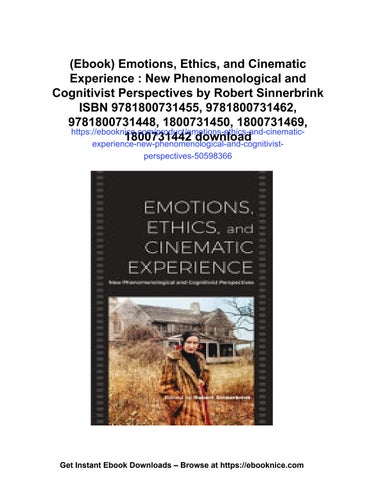
Emotions, Ethics, and Cinematic Experience
New Phenomenological and Cognitivist Perspectives
Edited by Robert Sinnerbrink
Published in 2021 by Berghahn Books
www.berghahnbooks.com
© 2021 Berghahn Books
Originally published as a special issue of Projections, Volume 13, issue 2 (2019).
All rights reserved. Except for the quotation of short passages for the purposes of criticism and review, no part of this book may be reproduced in any form or by any means, electronic or mechanical, including photocopying, recording, or any information storage and retrieval system now known or to be invented, without written permission of the publisher.
Library of Congress Cataloging-in-Publication Data Control Number: 2021937635
British Library Cataloguing in Publication Data
A catalogue record for this book is available from the British Library
ISBN 978-1-80073-144-8 hardback
ISBN 978-1-80073-145-5 paperback
ISBN 978-1-80073-146-2 ebook
List of illustrations
Preface
Introduction 1
Phenomenology Encounters Cognitivism
Robert Sinnerbrink
Chapter 1
Fascist Affect in 300
Carl Plantinga
Chapter 2
Other Sides
Loving and Grieving with Heart of a Dog and Merleau-Ponty’s Depth
Saige Walton
Chapter 3
Elemental Imagination and Film Experience:
Climate Change and the Cinematic Ethics of Immersive Filmworlds
Ludo de Roo
Chapter 4
Toward a Model of Distributed Affectivity for Cinematic Ethics
Ethical Experience, Trauma, and History
Brigid Martin
Chapter 5
Grey Gardens and the Problem of Objectivity
Notes on the Ethics of Observational Documentary
Mathew Abbott
Synthetic Beings and Synthespian Ethics
Embodiment Technologies in Science/Fiction
Jane Stadler
Index 143
Illustrations
1.1 King Leonidas and his buff Spartans stand proudly before a hill of dead Persians ( 300, Warner Bros., 2007) 21
1.2 Spartan newborn boys are either kept or killed after a close inspection. ( 300, Warner Bros., 2007) 26
1.3 A hideous Persian giant roars like a beast before attacking the Spartans ( 300, Warner Bros., 2007) 30
1.4 Ephialtes the hunchback, who was born a Spartan, had years ago escaped the Spartan eugenics practice, but betrays the Spartans and thus justifies the practice ( 300, Warner Bros., 2007) 31
1.5 The effeminate Xerxes (notice his eyeliner and painted fingernails) puts his hands on King Leonidas, eliciting homophobic disgust ( 300, Warner Bros., 2007) 32
1.6 Leonidas as Christ, having gloriously sacrificed himself for the Spartan nation ( 300, Warner Bros., 2007) 35
2.1 Laurie Anderson’s self-portrait (Heart of a Dog, Arte TV/HBO, 2015) 41
2.2 Blind Lolabelle (Heart of a Dog, Arte TV/HBO, 2015). 45
2.3 Expressive layers of time (Heart of a Dog, Arte TV/HBO, 2015). 48
2.4 From Goya’s dog to Lolabelle (Heart of a Dog, Arte TV/HBO, 2015). 50
2.5 Lolabelle in the bardo (Heart of a Dog, Arte TV/HBO, 2015). 51
2.6 Lolabelle and Lou Reed (Heart of a Dog, Arte TV/HBO, 2015). 54
4.1 Cheol-ho melancholically embraces his daughter in the Song family home with his suffering mother in the foreground (Aimless Bullet, Korean Film Archive / Blue Kino, 1961/2016). 85
4.2 Yeong-ho and Seol-hui’s meeting is interrupted by a stalker (off-camera) at Seol-hui’s apartment (Aimless Bullet, Korean Film Archive / Blue Kino, 1961/2016). 86
4.3 Cheol-ho has one of his wisdom teeth extracted, which begins a visceral trail of self-abuse (Aimless Bullet, Korean Film Archive / Blue Kino, 1961/2016). 87
4.4 Myeong-suk visits Cheol-ho’s newborn child in hospital alone (Aimless Bullet, Korean Film Archive / Blue Kino, 1961/2016). 95
4.5 Cheol-ho, still bleeding after his tooth extractions, is driven around Seoul in a taxi but is never able to decide where to go (Aimless Bullet, Korean Film Archive / Blue Kino, 1961/2016). 96
4.6 Yeong-ho passes by a hanging mother and her wailing infant child as he is pursued through the waterways beneath Seoul (Aimless Bullet, Korean Film Archive / Blue Kino, 1961/2016). 101
wPreface
Robert Sinnerbrink
In recent years, a debate has emerged over the question of film theory and the humanities, and the relationship between philosophy of film and empirical research/ scientific modes of theorization. Murray Smith (2018), for example, has called for a naturalised aesthetics of film, arguing for a pluralistic naturalism that would supplement and support, rather than renounce or replace, humanistic modes of inquiry concerning cinema. D.N. Rodowick (2007, 2015), by contrast, has criticised analytic-cognitivist approaches for being reductivist and ethically deficient, and pleaded for a humanistic film-philosophy that foregrounds our ethical commitments while remaining independent of reductive ‘scientism’. At bottom, this debate turns on whether we take naturalistic and humanistic approaches to be compatible and complementary, or else opposed and incommensurable. Linked to this is the question of how best to acknowledge the ethical and ideological dimensions of film (and our ways of theorizing it): does a commitment to naturalism, for example, entail an indifference towards, or inability to acknowledge, these ethical and ideological dimensions? Alternatively, does a commitment to ‘humanistic’ modes of inquiry—whether understood in hermeneutic, descriptive, critical, constructivist, or speculative terms—demand a dismissal or empirical research or intellectual indifference towards causal-explanatory accounts of phenomena?
The wager of this book—and of the Special Journal Issue of Projections from which it derives—is twofold. First, that we need not accept such false dilemmas pitting naturalism against humanism, hermeneutic against explanatory accounts, cognitivist film theory as opposed to film-philosophy, and so on. Second, that a pluralist or compatibilist approach will enhance, rather than enervate, philosophical, aesthetic, and ethical inquiry into film. Indeed, this book treats the debates outlined above in an exploratory and experimental spirit. Instead of adopting a fixed a priori position ‘for or against’ either side, participants were invited to explore the crossovers, compatibilities, and productive possibilities of interdisciplinary inquiry, with the aim of bringing phenomenological and cognitivist perspectives on contemporary cinema into productive dialogue and inventive exchange. The focus, in particular, was on the multifaceted relationship between emotion, ethics, and cinematic experience, broadly construed, exploring the ways in which both cognitivist and phenomenological approaches might work together to enhance our understanding of important philosophical and ethical issues in contemporary film theory/philosophy of film. Instead of arcane metaphilosophical discussions about the ethical/epistemic virtues and vices of particular approaches, or general arguments concerning the ‘theoretical correctness’ of one’s preferred paradigm, the contributors to this volume take a pragmatic and exploratory approach, testing their theoretical perspectives in a variety of contexts and in response to a wide range of problems, debates, and audiovisual works.
The result is a stimulating, productive, and innovative series of chapters spanning a rich and exciting array of topics. These include cognitivist aesthetic analyses of the ‘fascist affect’ in Zack Snyder’s 300; a phenomenological aesthetics exploring perception, touch, and our relationship with animality in Laurie Anderson’s Heart of a Dog; and a phenomenological account of ‘elemental imagination’ and its important ecocritical and ethical significance. There is a hybrid model of ‘distributed affectivity’ offered that is applied to films dealing with experiences of trauma and historical dislocation; philosophical and ethical reflections on objectivity in observational documentary; and a descriptive-conceptual mapping of ‘synthetic beings’ in new digital media, including the need to develop a ‘synthespian ethics’ in response to the challenges raised by virtual digital entities. The authors, who encompass a range of theoretical and philosophical backgrounds, thereby demonstrate how a pluralistic approach, spanning the ‘naturalistic/phenomenological’ divide, can yield rich results, enhancing our understanding of the complex nexus between ethics, emotion, and cinematic experience. Indeed, this focus on the relationship between emotional engagement, aesthetic experience, and ethical reflection requires a pluralistic approach, one capable of describing and explaining, analysing and evaluating, criticizing and exploring the many dimensions of cinematic experience understood in a holistic man-
ner and as an object of interdisciplinary inquiry. Despite the lively debate concerning the future of philosophical film theory in the academy, and its complex relations with both humanistic and naturalistic traditions, reports of the death of (film) theory have been greatly exaggerated—as I hope the contents of this book will make clear.
Finally, I would like to thank our authors for their excellent contributions, for their co-operation and diligence, and for showing by example how a pluralistic approach to philosophical film theory might work. I would also like to thank my editors at Berghahn for inviting us to publish the Projections Special Issue in book form, and for all their patient, helpful, and timely assistance along the way, especially during these difficult pandemic times.
References
Rodowick, D. N. 2007. ‘An Elegy for Theory’. October 122 (Fall): 91–109.
Rodowick, D. N. 2015. Philosophy’s Artful Conversation. Cambridge, MA. and London: Harvard University Press.
Smith, Murray. 2018. Film, Art, and the Third Culture: A Naturalized Aesthetics of Film. Oxford: Oxford University Press.
Phenomenology Encounters Cognitivism
Robert Sinnerbrink
Contemporary philosophical and theoretical inquiry into cinema has become increasingly interdisciplinary. With the rise of influential phenomenological and cognitivist approaches focusing on cinematic experience and aesthetic inquiry, the possibility of a productive synthesis of these hitherto opposed approaches has now emerged as a growing trend in contemporary research (see D’Aloia 2012, 2015; D’Aloia and Eugeni 2014; Ingram 2014; Rhym 2018; G. Smith 2014; M. Smith 2018; Stadler 2008, 2011, 2016, 2018; and Yacavone 2015). Despite the welcome work of individual theorists, and the increasing pluralism evident in leading film journals, the two approaches still remain frequently estranged from each other. Or where there is no theoretical conflict, they can remain confined within well-defined disciplinary and institutional boundaries, thus rendering the possibility of a synthetic or pluralistic approach more of a promissory note than a live possibility.
This special volume is therefore dedicated to exploring the ways in which phenomenological and cognitivist approaches offer complementary and overlapping ways of theorizing our experience of film.
The central focus is on the relationship between emotion, ethics, and cinematic experience, drawing on phenomenological and cognitivist perspectives, and showing how theoretical reflection on cinematic experience works hand-in-hand with close analysis of particular films. This volume features authors noted for their work on cognitivist as well as phenomenological approaches, and aims to show the rich theoretical possibilities opened up once we regard these as having open borders rather than fixed boundaries. The chapters featured here tend to emphasize one or another of these approaches but also show how they might be brought together in innovative ways. They focus on a range of related topics and diverse film examples in order to illuminate different aspects of cinematic spectatorship. These include topics such as the workings of affect, emotion, and mood; exploring new ways of theorizing subjectivity and objectivity in film; the ethical implications of new digital technologies; and the practical significance of imaginative aesthetic engagement with both narrative and nonfictional works. They also suggest ways in which we might enrich our investigation of contemporary cinema by drawing on what both theoretical methodologies have to offer while remaining committed to analyzing key aesthetic and contextual features of complex cinematic works.
In what follows, I outline the shared theoretical problématique defining the encounter between phenomenology and cognitivism, and argue for a more pluralistic and synthetic approach to film inquiry. What I call a “dialectical synthetic” approach offers the possibility of combining “thick” phenomenological description of cinematic works and aesthetic experience with empirically grounded, cognitivist explanatory accounts of the causal processes behind such phenomena. There is a productive and exciting space of interdisciplinary inquiry opening up where the attention to subjective experience, aesthetic engagement, and the close analysis of form intersects with theoretical models of explanation grounded in empirical research. In this way, we can do justice to both the experiential and aesthetic richness and complexity of cinema and offer explanatory models that promise to make a modest but important contribution to explaining how these works achieve their powerful aesthetic and ethical effects.
Cinematic Ethics: Phenomenology and Cognitivism
One of the areas of contemporary theoretical inquiry in which a synthetic approach is not only desirable but necessary is what I have elsewhere called “cinematic ethics” (Sinnerbrink 2016): the idea of cinema as a medium of ethical experience, where the power of film to elicit affective, emotional, and cognitive responses to moral situations contributes to the generation of complex forms of ethical experience prompting critical reflection. Although there has been much work on spectatorship,
on the one hand, and ethical aspects of film production and reception, on the other, the manner in which particular kinds of cinematic experience can be ethically significant, whether in evoking different kinds of subjective or social experience, challenging our habitual beliefs or settled convictions, or prompting empathic/sympathetic engagement with sociocultural perspectives differing from one’s own, is now finally receiving the theoretical attention that it deserves (see Grønstad 2016; Plantinga 2009, 2018; Sinnerbrink 2016; and Stadler 2008). Drawing out the ethical significance or socially transformative effects of film experience requires a combination of both phenomenological theory and cognitive theory along with contributions from other empirically as well as socially and historically grounded approaches. From this point of view, cinematic ethics is one important way in which phenomenological and cognitivist approaches might be brought together in order to better theorize emotional engagement and moral understanding evoked via cinematic means.
Indeed, there are already impressive attempts to explore, from phenomenological, cognitive, and philosophical perspectives, the ethical significance of our aesthetic experience of cinema (see Grønstad 2016; Hanich 2010; Plantinga 2018; and Stadler 2008). Such approaches place an emphasis on the “subjective” phenomena of affect, emotion, and mood, but also on more “objective” cognitive processes of critical reflection, questioning, and moral evaluation. Together, we can arrive at a more descriptively rich but also more explanatorily powerful ways of thinking about various aspects of cinematic experience, questions of ontology and aesthetics, and aesthetic features of the medium. To do this, however, phenomenology and cognitivist theory should work together: we need both phenomenologically “thick” descriptive as well as cognitive explanatory accounts complementing and mutually informing each other in order to do justice to the complexity of cinematic experience. We might call this a “dialectical” intellectual encounter or transformative philosophical exchange, one that synthesizes relevant elements of both approaches in order to better articulate the whole.
Why has there hitherto been much misunderstanding or mutual suspicion between these approaches? At one level, this is no doubt due to the background dispute between traditions of film or screen theory influenced by European “Continental” philosophical traditions and those more recent developments rejecting this paradigm, which draw instead on analytic aesthetics and empirically grounded forms of cognitivist theory (see Nannicelli and Taberham 2014; and Sinnerbrink 2011). Although the polemical character of this dispute has largely dissipated, the lack of familiarity across the so-called “divide” still breeds suspicion, if not contempt, in some quarters. Deleuzians, film phenomenologists, and “affect” theorists sometimes accuse cognitivists of a dogmatic scientific
“imperialism” that ignores culture, history, and politics, whereas cognitivists and analytic philosophers of film criticize the former in turn for impressionistic and associative approaches to theorization, a dogmatic deference to “master thinkers,” and overestimation of film interpretation as equivalent to film theory (see Sinnerbrink 2011). Yet there is much common ground between both approaches, despite differences in background traditions, theoretical commitments, and epistemic attitudes toward the relationship between the sciences and the humanities. As Murray Smith argues (2018), a pluralistic rapprochement between these traditions is needed; C.P. Snow’s “Two Cultures” problem still persists in film theory / philosophy of film, which means that efforts to address and overcome this opposition are as important as ever. Indeed, Smith’s own conception of the need for a “triangulation” of aesthetic experience—recognizing the interplay of phenomenological, psychological, and neurophysiological dimensions of our experience of art—is a good example of the synthetic approach that I have in mind.
One area that presents obvious overlap and affinities (and that reveals underlying theoretical differences) is theoretical inquiry into affect and emotion in cinema. Both phenomenologists and cognitivists agree on the importance of embodied experience, contextualized or “embedded” in sociocultural niches, mediated via technological prosthetic devices (extended), and with an emphasis on activity, interactivity, and modes of communicative and pragmatic exchange (enactive). Cinema itself can be understood in relation to the idea of the extended mind, with scholars now exploring the ways in which 4E (embodied, embedded, extended, and enacted) theories of cognition open up new paths of inquiry into diverse aspects of cinematic experience (see Coëgnarts and Kravanja 2015). On the other hand, the tendency of phenomenology to privilege the “primacy of perception” (as per Merleau-Ponty), often reverting to first-person experiential perspectives as evidence for theoretical claims, can come into tension with cognitivists’ emphasis on empirically grounded explanatory models that attempt to articulate the underlying causal processes and neurological, perceptual, and cognitive operations that make such phenomenological experience possible. In many ways, however, this represents something of a false or misleading dichotomy, since it is precisely in the interaction between phenomenological and cognitive perspectives that we are able to develop theoretical models that can do justice to both subjective and objective dimensions of cinematic experience. Were Merleau-Ponty alive today, he would doubtless be drawing on 4E cognitive theory as much as embodied phenomenological approaches (many of which are inspired by his work).
Another common source of theoretical confusion and misunderstanding concerns the different methodologies that film phenomenologists and cinematic cognitivists draw upon. We could roughly describe these as descriptive/experiential versus empirical/explana-
tory approaches. The role of heuristic strategies or reasoning protocols, which can include the use of cognitive shortcuts, illuminating ideas, synthetic concepts, or suggestive metaphors, differ widely in these two approaches. By theoretical heuristics, I mean exploratory ideas or theoretical framing perspectives that can enable us to “see” or articulate a phenomenon more clearly, make theoretical or conceptual connections, draw productive parallels, test theoretical or empirical claims, compare competing perspectives, or develop theories creatively and critically. The idea of the mind/brain as an information-processing device (computer) or of cinema as a “film-body” are two influential theoretical heuristics in philosophical film theory that have enabled productive inquiry but that have also generated certain theoretical confusions. For every productive connection or insight gained thanks to a suggestive parallel or analogy, there are also misleading inferences and important disanalogies that are not to be gainsaid.
This means that we need to be methodologically reflective or self-critical in our use of theoretical heuristics, being mindful of the temptation to take them to designate empirical realities or provide theoretical evidence (neither of which they necessarily do). The mind/brain differs in many ways from a computer (computers are neither embodied nor socially, culturally, and historically embedded, for example, a point that both phenomenologists and 4E cognitive theorists take very seriously), whereas the “film-body,” like our own bodies, is also embedded within a relational world articulated through practical engagements and shaped by shared horizons of meaning—an aspect curiously omitted in most haptic or “embodied” modes of phenomenological film theory, which assume something of a worldless “body in a vat” approach to their descriptions of cinematic engagement.
Both phenomenological and cognitivist approaches use heuristics that are productive and useful for practices of film theorization, but they would also benefit from further critical self-reflection on the methodological and epistemic benefits and drawbacks of using such devices as ways of bootstrapping the construction of theories. We should remain mindful of the methodological need to combine “thick” description of phenomena with empirical explanatory accounts of the causal processes underlying these phenomena. In short, it is important to acknowledge the productive role of theoretical heuristics and heuristic perspectives, but also not to confuse heuristic approaches or devices with descriptive or explanatory approaches as such.
Phenomenological Approaches to Film
As Christian Ferencz-Flatz and Julian Hanich remark, providing a coherent overview of film phenomenology is no easy task; it requires surveying a large and sprawling field, “the contours of which seem to be as vague as the foggy landscapes in an Antonioni or Angelopoulos film” (2016, 11).
One of the key challenges is simply defining what we mean by “phenomenology”: if the definition is overly broad (referring to any approach that focuses on subjective experience), then the term becomes so inclusive that even structuralist approaches can count as having a “phenomenological” dimension; if the definition is too narrow or strict (as in Husserl’s foundational descriptive science dedicated to articulating universal, invariant structures of consciousness via the phenomenological epoché and detached contemplation of “essences” (Wesensanchauung)), then almost no film theory would count as properly phenomenological in any robust sense (Ferencz-Flatz and Hanich 2016). Here, I strike a middle course. I acknowledge, on the one hand, that film phenomenology refers to a pluralistic set of theoretical approaches foregrounding subjective embodied experience, and that it is an essentially descriptive approach focusing on detailed or “thick” description, interpretation, and analysis of relevant aspects of cinematic experience. And on the other, I recognize that if phenomenology is to mean more than merely cataloguing one’s personal or idiosyncratic impressions of a film, it ought to aim at shared structures or common features of our embodied engagement with cinema, providing a descriptively rich interpretation and analysis of subjective phenomena that in turn can provide the basis for further (explanatory or contextualizing) theorization.
The relationship between phenomenology and film theory has, historically speaking, been rather halting and interrupted. With the exception of Merleau-Ponty’s occasional essays and remarks dealing with film, “classical” and existential phenomenologists have generally ignored or dismissed it (e.g., Husserl and Heidegger). French phenomenology (drawing on Husserl and Heidegger but largely shaped by Merleau-Ponty and Sartre) was brought to bear on film by theorists such as Amédée Ayfre, Henri Agel, and Jean-Pierre Meunier, as well as by individuals working within the interdisciplinary model of the filmologie movement (FerenczFlatz and Hanich 2016; Hanich and Fairfax 2019). In the Anglophone world, however, it was not until the 1990s that phenomenology was properly introduced, thanks to the groundbreaking work of Vivian Sobchack (1992, 2004) (with a contribution from Allan Casebier). Sobchack’s approach, adopted by many of her followers, has always been eclectic, drawing on elements of Husserl but largely drawing on concepts from Merleau-Ponty. It also combined concepts and approaches from both Merleau-Ponty’s earlier (primacy of perception) and later (chiasmus and “the flesh”) phases of philosophical inquiry. This eclecticism has become a hallmark of contemporary film phenomenology, including the addition of Deleuzian as well as cognitivist elements with the rise of “affect theory” and embodied approaches to cinematic experience (Barker 2009; Marks 2000, 2002; Massumi 2015; Pisters 2012).
Within this eclecticism, it is worth noting two difficulties. The first is the risk of conflating everyday and technical senses of “phe-
nomenology”—that is, a broad conception of subjective experiential processes versus hermeneutic interpretation and formal analysis of particular aspects of consciousness or our “being-in-the-world” ( Heidegger). The eclectic approach also runs the risk of offering first-person experiential “evidence” as though this would suffice for phenomenological demonstration. It is worth recalling, however, that “classical” phenomenology always aimed at invariant, universal features of consciousness; in film phenomenology, by contrast, there is typically a particularist focus on “the body,” affect, emotion, spectatorship, interpretation, and evaluation coupled with “symptomatic” readings of film as reflecting these “particularist” theoretical emphases. Whatever its theoretical provenance, phenomenology has always emphasized the importance of a descriptive account of situated experience of embodied spectators always already embedded within a meaningful social and historical world. It also focuses on corporeal, affective, aesthetic, and ethical aspects of film experience from a “bottom-up” rather than a “top-down” point of view.
The second difficulty is the tendency to cite theoretical descriptions or accounts of experience as though this were to do phenomenology: quoting Merleau-Ponty on perception or “the flesh,” however, is not the same as thick phenomenological description or interpretative analysis of cinematic experience. Contemporary film phenomenology is defined by diverse (and sometimes incoherent) strands: Merleau-Ponty, Husserl, and Heidegger; affect theory (Deleuzian); theories of corporeality; embodied spectatorship; aesthetics of “touch” (hapticity); gender and queer theories; and intersectional approaches. Whatever one’s particular theoretical or practical commitments, however, it is worth noting that “applying” theory is not the same as practicing phenomenology in the proper sense. If nothing else, phenomenology maintains a commitment to some kind of theoretical “bracketing” or suspension of presupposed theoretical concepts or frameworks in order to deal descriptively with phenomena or “the things themselves” while remaining mindful of the partial and contextual (i.e., hermeneutic) conditions of possibility defining any kind of phenomenological investigation.
Phenomenology: Two Problems of Subjectivism
The “classic” difficulty facing phenomenological approaches, whether in pure or applied terms, is that of subjectivism: the privileging of firstperson perspectives raises the question of the warrant or justification for the theoretical claims made on the basis of a descriptive account of such perspectives. Phenomenological approaches are essentially descriptive but include both interpretation and analysis of descriptive accounts of subjective phenomena, aiming to reveal their shared structures and communicable meanings. This suggests that phenomenology is particularly suited to illuminating our aesthetic experience of film but that
it is not necessarily methodologically suited to providing explanatory accounts of the causal processes underlying such experience. There are two related issues that are typically raised as criticisms of phenomenological approaches to cinematic experience. The first is the charge of aesthetic subjectivism, the argument that to provide a personal, first-person subjective (aesthetic) response is to provide evidence supporting interpretative and even theoretical claims. We do of course experience cinema from a first-person perspective, but one’s own idiosyncratic responses do not, of themselves, provide adequate evidence to support stronger theoretical claims. The second is epistemic subjectivism, the use of anecdotal (“just so” / ad hoc) evidence to support theoretical claims without offering adequate conceptual argumentation or theoretical justification. In some cases, this can be compounded by a dogmatic reliance on presupposed theoretical or conceptual frameworks, which clearly violates one of the cardinal precepts of phenomenological inquiry (Husserl’s motto, “to the things themselves!”). Because phenomenology is focused on a descriptive account of subjectivity, it inevitably courts the risk of subjectivism, whether aesthetic or epistemic. Phenomenological descriptive theory provides the basis for all sorts of theorization, but it does not constitute an explanatory account in its own right. Indeed, as a corollary to these twin charges of subjectivism, there is the related risk of reverting to speculative theory, which arises when one makes “theoretical” claims based on phenomenological evidence. As I remarked above, the use of heuristics and conceptual-metaphorical models (“cinema as brain,” “skin of the film”) can guide theoretical practice in an illuminating way, but such practices do not themselves constitute theoretical claims supported by empirical evidence. Rather, the heuristic use of guiding metaphors/concepts for the purpose of generating, developing, and transforming theoretical problems and debates soon become speculative and ungrounded if taken as part of a theoretical model with explanatory aims.
Two Responses to Subjectivism: Projection and Distribution
Film theorists influenced by phenomenology implicitly recognize the problem of subjectivism, but generally reject the classical phenomenological response of focusing on the disclosure of shared “structures of consciousness.” Instead, alternative strategies have emerged in order to deal with this problem, what we could call the projection and distribution responses. We can “desubjectify” affects—lived bodily responses to the affordances of our world—by “projecting” them onto nonhuman objects, events, or environmental states of affairs. Deleuzian affect theory, for example, drawing on a distinctive conception of affect deriving from Spinoza, Bergson, and Nietzsche (where affect is defined in relation to bodily capacities to be affected and to express such affection through transformations of the body via action and thought), projects affect be-
yond the “subjective” sphere such that objects, landscapes, and nature itself can be described as expressing “affect” in this corporeal-relational sense (Deleuze’s “pure qualities”) (Del Rio 2008; Shaviro 2010).
In a similar manner, we can also distribute these affective states across a plurality of related objects, creating a “distributed” or pluralized affective state encompassing a relationally defined composite body. Accordingly, shared affects are no longer primarily “subjective” but dispersed or distributed across a range of different bodies forming a relational composite whole. On this account, affects are no longer defined primarily in relation to the experiencing human subject but as “desubjectified,” free-floating intensities attributable to the “assemblages” formed by human and nonhuman bodies, artifacts, things, objects, and natural environments (Brinkema 2014; Massumi 2015; Shaviro 2010). This projective-distributive approach attributes affective states encompassing a plurality of related objects and bodies, creating “shared” affects that are distributed across different bodies and escaping subjectivism via collective affective expression.
Recent versions of this approach echo the idea of distributed cognition, positing an embodied response to moving images that is also projected/distributed so as to incorporate the film itself (the idea of a cinematic body or film-body, the “skin of the film,” or disembodied affects constituted by and expressed as cinematic form) (Brinkema 2014; Del Rio 2008; Marks 2000, 2002). The difficulty is that, however suggestive and illuminating these theoretical approaches may be, they are heuristic forms of theorization that draw on phenomenology and conceptual models in order to propose productive theoretical frameworks and to help us rethink how we conceptualize cinematic experience. They do not constitute, however, either a “phenomenological” descriptive account of subjective experience (since they are applying presupposed theoretical ideas) or a theoretical explanatory account of the processes underlying such experience (since they purport to reconceptualize such experience), however much theorists may imply that they do.
Cognitivism and Cinema
The broad field of “cognitivist” approaches to cinema, which spans many theoretical perspectives, can be defined by its theoretical and methodological commitment to naturalistic theorization and “piecemeal” modes of inquiry (see Carroll 2008; Nannicelli and Taberham 2014; and Plantinga 2018). It emerged as an alternative to the prevailing paradigms of film or screen theory—so-called “Grand Theory”—that synthesized, often in an eclectic manner, semiotic, psychoanalytic, and structuralist/poststructuralist theory and philosophy while remaining committed to a critical (ethico-political) perspective on ideological structures rather than empirical or explanatory approaches to theorizing cinematic experience (Sinnerbrink 2011). Earlier generations of cognitivist theory were influenced
by computational theories of mind as well as by work on AI systems and empirical-experimental models (drawing on cognitive psychology and the neurosciences). This research program has now broadened out to include evolutionary perspectives; bioculturalist models; multimodal, network, and distributed models, as well as 4E theories of cognition (see Coëgnarts and Kravanja 2015; and Nannicelli and Taberham 2014). As a naturalistic approach to theory—namely, that all relevant processes pertaining to cinematic experience can be explained in terms of natural causal processes as analyzed within empirically grounded theories—cognitivism remains committed to providing explanatory (rather than descriptive or hermeneutic) forms of theory. In keeping with this commitment, cognitivists thus endeavor to produce causally explanatory theories of perception, cognition, and emotional engagement with film, venturing also into questions concerning the aesthetics and ethics of cinema.
Contemporary cognitivists, however, reject the traditional dualism between reason and emotion, embodied versus mentalistic responses, exploring instead the interaction and dependency of these processes in our complex affective, emotional, and cognitive engagement with moving images (Nannicelli and Taberham 2014). They not only focus on the role of “top down” or higher-order cognitive processes (reflection, inference-making, hypothesizing, practical reasoning) but on the important “bottom-up” or lower-order embodied and affective processes involved in cognition that occur at sub-personal, automatic, or minimally conscious levels of awareness (physiological, corporeal, affective, and emotional-cognitive “priming” effects). Together these theories seek to provide explanatory accounts—drawing on empirical theory and research—to explain the causal processes, mechanisms, and experiential components making up our complex experience of cinematic engagement. More recent work ventures into film aesthetics and ethics of film in order to bring the insights of cognitive theory to account for the aesthetic effects of cinematic form and style as well as the moral significance of such forms in our cognitive engagement with audio-visual media (D’Aloia and Eugeni 2014; Nannicelli and Taberham 2014; Plantinga 2018; Shimamura 2013; M. Smith 2018).
Two critical objections to cognitivist approaches have appeared in recent years, which both focus on topics that were a focus for the psychoanalytic- semiotic-poststructuralist paradigm of film theory (Sinnerbrink 2010). First, can cognitivist approaches provide robust forms of critical interpretation / aesthetic evaluation of nonmainstream forms of cinema? (the aesthetic or “what about art film?” objection). And second, can cognitivist approaches account for the ideological-political effects of (popular) cinema? (the symptomatic or “what about ideology?” objection). To take the first, cognitivist theories, from David Bordwell and Noël Carroll to Murray Smith and Torben Grodal, have offered powerful explanatory theories that deal well with canonical forms of popular narrative cinema. But how well do they deal with art cinema that eschews,
for example, “erotetic” (question and answer), cognitive puzzle-solving, or PECMA (perception-emotion-cognition-motor action) flow models of narrative engagement defining popular cinema? Cognitivist models of narrative theory may work convincingly for genre films like Love Actually (Richard Curtis, 2003) or Transformers: The Last Knight (Michael Bay, 2017), critics may claim, but they work less well for “art films” like Le Quattro Volte (Michelangelo Frammartino, 2010) and The Turin Horse (Béla Tarr and Ágnes Hranitzky, 2012).
The second (the symptomatic) objection focuses on the question of cinema and ideology, asking whether cognitivist approaches, due to their commitments to scientific naturalism and empirical research, are adequately equipped to grapple with the ideological dimensions of film. Much of the work in so-called “Grand Theory”—particularly feminist film theory and Marxist critical theory approaches—has focused on the ideological structures shaping our engagement with (popular) cinema and the manner in which it can serve as a powerful vehicle of ideological influence, especially with regard to key aspects of personal identity (e.g., gender, race, and class). Can cognitivist theories engage with these ideological dimensions of cinematic experience without risking some version of the “naturalistic fallacy”? It is important to explain the causal processes shaping general features of our affective, emotional, and cognitive engagement with film, but we also need to address the question of how cinema contributes to the ideological context of contemporary cultural and sociopolitical institutions.
To these two objections, the aesthetic and the ideological, we can respond by saying that they remain inconclusive and are increasingly countered by new work focusing precisely on film aesthetics and ethicopolitical questions (ideology). To be sure, there are important issues pertaining to how “art films” work and how their particular aesthetic strategies thwart “standard” models of cognitive engagement. And there are important questions concerning the ideological dimensions of cinema that film theorists, whether cognitivist or phenomenological, would do well to consider more explicitly. Here, however, we can point to various attempts by cognitivist theorists to address both “art film” and ideology using the resources of cognitive theory. A number of theorists deal explicitly with nonstandard forms of narrative cinema, including experimental cinema, from cognitivist, neuroaesthetic, and even evolutionary biocultural perspectives (Grodal 2012; Shimamura 2013; M. Smith 2018). Their work shows how such approaches can provide us with the conceptual tools we need to undertake sophisticated and illuminating critical interpretations and aesthetic evaluations of challenging cinematic works. There are also attempts to tackle the ethicopolitical question of ideology in contemporary cinema drawing on the work of cognitive theory and phenomenology (Plantinga 2018; Stadler 2008). Such work seeks to account for how popular narrative film effectively captures
audience attention and solicits moral-ideological allegiance via affectiveemotional as well as cognitive-evaluative means. Carl Plantinga’s essay on Zack Snyder’s 300 in this volume is a compelling case in point. In short, both phenomenological and cognitivist approaches can be brought to bear on complex narratives and aesthetically challenging works, and they can examine the mechanisms and effects that make possible the uptake of ideological meanings in our sociocultural engagement with contemporary media.
The “Reductionism” Objection
Both of these objections reduce, so to speak, to versions of the “standard” objection to cognitivist approaches, which is what we could call the reductionism objection—that cognitivist approaches, again due to their naturalistic commitments, risk offering “reductive” accounts of relevant aesthetic elements pertinent to cinematic experience (the role of affect and mood, aesthetic experience, and noncognitive forms of engagement). This rather broad and vague claim—it is not difficult to charge any theory with “reductionism” given that most (piecemeal) theories target discrete phenomena or processes—can be broken down into two more specific claims. First, there is the claim that cognitivism ignores “noncognitive” affective processes that are central to cinematic experience, and so is reductive in being “too mentalistic” in its explanatory focus on “higher-order” aspects of engaging with film. And second, there is the claim that there are phenomena relevant to cinematic experience that just resist cognitivist (naturalistic-explanatory) theorization (the psychoanalytic conception of the unconscious, for example, or the abovementioned projective/distributive forms of affect), and so cognitivism is simply “too rationalistic.” Such phenomena are often taken to be central to accounting for our experience of “art cinema.”
In response, we can say that the first objection, once again, is readily countered by the rise of “antimentalist” accounts of affect, emotion, and cognition. Although earlier forms of cognitivist theory tended to focus on higher-order “top-down” forms of cognition, more recent approaches emphasize “bottom-up” processes in order to provide a richer, more adequate account of affective-cognitive engagement (see Coplan 2006; Plantinga 2018; and Stadler 2008). The recent emphasis on embodied cognition and on situated accounts of cognitive experience—acknowledging the essential role of social interaction, sociocultural learning, intersubjective communication, sociocultural “scripts,” and enactive engagement with others in the world—brings cognitivist theory more into line with phenomenological perspectives (see Coëgnarts and Kravanja 2015). The second objection depends on the validity of the claims made concerning such phenomena as the Freudian/Lacanian unconscious, psychoanalytic accounts of repression, fantasy, and the “perverse” character of cinematic spectatorship. Once again, the danger here is that of con-
flating heuristic concepts with empirical phenomena, treating “the unconscious” not as a heuristically useful notion but as designating some putative entity in the human psyche, and arguing that theories that fail to take this into account fail to adequately describe, hence theorize, their object.
In short, both versions of the “reductionism” objection (the too mentalistic / too rationalistic objections) are better understood as claims concerning the need to provide rich and complex phenomenological descriptive accounts of our objects of theoretical reflection. I would contend further that the charge of “reductionism” is actually a claim about the need for an adequate phenomenology of the objects of cognitive theorization: before we proceed with higher-order cognitive (naturalistic and explanatory) theory, we should ensure that we have adequately prepared the ground for such theorization by ensuring that we have an adequate phenomenological description of our object in order to better track our object. This claim calls for some further elaboration because it means that phenomenology and cognitivism can, and indeed should, be brought together in a complementary, even synthetic manner. In this way, we can do justice to the complexity of the phenomena in question when theorizing cinematic experience.
A Dialectical Tracking Model
Here, I would like to sketch a brief outline of how this kind of complementary or synthetic approach might work, which I will call (with a nod to both Hegel and Carroll) “a dialectical tracking model.” As I remarked above, phenomenology provides rich descriptive accounts of relevant phenomena pertinent to understanding cinematic experience, but such descriptive accounts stand to benefit from supplementation or elaboration by cognitivist theories in order to account for these phenomena in a causal manner. And, as I also remarked above, cognitivism provides rich explanatory theories of relevant aspects of cinematic experience, but these stand to benefit from supplementation by phenomenological descriptive accounts in order to track more accurately the phenomena that they are attempting to explain. Early cognitivist film theory lacked an adequate phenomenology, for example, of the overlapping relations between affect, emotion, and mood, and hence tended to focus on cognitively discrete emotions at the expense of affect and mood, offering theories that risked being overly mentalistic or rationalistic (a deficiency that has recently been corrected) (see Plantinga 2012; and Sinnerbrink 2012). Phenomenologically oriented “affect” theories, on the other hand, attempted to avoid the charge of subjectivism via strategies of projecting and distributing affect across bodies and milieux, but such approaches risk becoming overly speculative by conflating heuristic, descriptive, hermeneutic, and explanatory modes of film theorization concerning related aesthetic and ethical aspects of cinematic experience.
What all of this suggests is the need to develop adequate descriptive and explanatory accounts of cinematic experience if we are to do justice to its complex character. A dialectical approach—identifying limitations or inadequacies in existing theoretical models and supplementing or correcting these by way of synthetic theory construction—offers one way to combine phenomenological and cognitivist approaches in order to better describe and track, interpret and analyze, conceptualize and explain diverse but related dimensions of cinematic experience. This would enable us to develop descriptively rich and empirically grounded explanatory models of the relevant aesthetic and ethical aspects of cinematic engagement, and it would also allow us to track more accurately their phenomenological complexities. To do this, however, would require theoretical reflection on the methodological characteristics and theoretical specificities of heuristic, descriptive, and explanatory roles or modes of theory. It also demands theoretical vigilance to avoid conflating levels or types of theoretical inquiry, to avoid theoretical reductionism, and to avoid the temptations of speculative “pseudo-theory.” This kind of methodological self-reflection would also provide a more robust basis for exploring the essential contextual dimensions of cinematic experience (i.e., the role of social institutions, cultural practices, historical horizons of meaning, and ideological and political forces), without which the phenomena of subjective experiential encounters with film, not to mention our aesthetic and ethical experience of it, would make little sense.
The chapters in this volume all contribute, in diverse ways, to furthering the interaction between phenomenological and cognitivist approaches to theorizing emotion, ethics, and cinematic experience. The authors draw on both theoretical perspectives and offer a range of methodological approaches combining theoretical conceptualization, descriptive analysis, critical reflection, and film interpretation. Carl Plantinga brings a cognitivist approach to the question of the “fascist affect” in Zack Snyder’s 300 (2007). He argues that a close analysis reveals the cinematic strategies designed to elicit affective-emotional engagement; such an analysis can be used to explain the film’s unsettling proximity to “fascist aesthetics” and controversial ideological messaging. Drawing on cognitivist accounts of affect, emotion, and mood, Plantinga examines what makes a film like 300 attractive and appealing to many audience members, examining “the moods and emotions 300 attempts to elicit through the viewing of the film, and in support of the fascist ideology it exhibits.”
Saige Walton, by contrast, focuses on a nonmainstream art film, Laurie Anderson’s experimental essay film, Heart of a Dog (2015), a lyrical eulogy to her beloved companion animal, Lolabelle. Drawing on
Merleau-Ponty’s phenomenology of embodied experience, in particular the aesthetic experience of depth in relation to visual art, Walton examines Anderson’s film as an exploration of interspecies communication, affective bonding, and the experience of loss. Merleau-Ponty’s phenomenological insights into the relationships between depth and movement, body–world relationships, and the imaginative aesthetic encounter with elements and surfaces allows the film to explore loss in a manner that avoids the heaviness of grief in favor of a lyrical affirmation of shared experiential encounters. The film’s experimental aesthetic style is itself a mode of ethical engagement with forms of experience that are both familiar and unfamiliar, probing the boundary between human and nonhuman animality.
Ludo de Roo continues the phenomenological and ethical exploration of novel forms of cinematic aesthetics in his examination of elemental imagination and film experience in the urgent context of climate change. De Roo’s film-philosophical inquiry takes a phenomenological approach to what he calls the “elemental imagination” (elemental in that it is oriented toward the elements of our natural environment but also elemental in the sense of primary or fundamental for our experience of the world). It combines this with an ecocritical perspective on the ethical potential of immersive cinematic experience to resensitize us to the importance of the natural world and the ordinarily backgrounded natural elements that provide the “ground” of our existence. By close analysis of the aims and limitations of ecologically oriented documentary works and fictional films, we can raise ecological awareness via the experience of cinematic immersion. The latter has the potential to give us access to the ordinarily concealed dimension of the natural elements, de Roo argues, upon which human and nonhuman life on our threatened planet depends.
Brigid Martin brings an intercultural comparative aesthetics perspective to bear on both cognitivist and phenomenological approaches to cinematic experience, focusing on the remarkable rendering of (personal as well as sociocultural) trauma in the Korean film Aimless Bullet (Yu Hyun-mok, 1961). As Martin argues, contemporary theories of affect, combining phenomenological and cognitivist approaches, tend to focus on sympathy and moral allegiance, which means that “complex affects that problematize empathy and moral judgments” tend to be ignored. The role of complex affective experience in revealing facets of a broader social and historical milieu requires an account of “how affectiveaesthetic affordances establish distributed spaces for dynamic affective engagement.” Martin develops this approach by drawing on theories of scaffolded mind, classical Indian rasa aesthetics, and phenomenological aesthetics, a pluralistic mode of theorizing that enables us to understand more clearly “the ethical significance of complex affective situations” in cinematic works.
Documentary film is often overlooked in contemporary debates over the relationship between cinema and ethics; philosophical engagement with the ethical and aesthetic issues raised by the documentary form is even less well addressed. Mathew Abbott responds to this neglect by focusing on the controversial yet fascinating case of the Maysles brothers’ Grey Gardens (1976) and the ethics of observational documentary. Following recent attempts to defend the film for its candidly “subjective” (rather than “objective”) depiction of the reclusive Bouvier Beale sisters, Abbott revisits arguments over the claim of vérité and observational documentarians being able to capture truth and objectivity in their work, and explores the now orthodox skeptical rejection of such claims so memorably formulated by Emile de Antonio (“As soon as you point a camera, objectivity is romantic hype”). Against both critics citing problematic claims to objectivity and recent defenders of the “subjectivity” of Grey Gardens, Abbott analyzes the questionable philosophical assumption underpinning both positions—namely, an uncritical commitment to scientistic conceptions of objectivity akin to Thomas Nagel’s critique of the “view from nowhere” account of knowledge—arguing “that the film’s objective treatment of its subjects is part of its aesthetic and ethical achievement.” Far from claiming an untenable “view from nowhere” or celebrating the irreducibility of subjectivity that such views often entail, Abbott argues that “objectivity” in observational documentary is as much an ethical as an aesthetic attitude. As he concludes, it does not mean taking a purely dispassionate stance toward one’s subjects but rather “treating them without prejudice or moralism and letting them reveal themselves.”
Finally, Jane Stadler turns to some of the perplexing aesthetic and ethical issues raised by the advent of virtual/synthetic performers (“synthespians”) thanks to digital, CGI, postproduction, and virtual reality technology. Stadler examines the manner in which contemporary cinema and audiovisual media both explore and reflect upon the technological and ethical challenges posed by biological as well as by media technology. Cinema is not only a space of imaginative reflection enabling us to track technological developments, but it also allows us to extrapolate and project their possible social, cultural, moral, and political consequences. Indeed, cinema is the way that contemporary “technological and ethical concerns surrounding synthespians, representations of replicants, and manifestations of synthetic biology” are made vividly manifest. Films like Blade Runner 2049 (Denis Villeneuve, 2017) not only examine the ethics of “digital embodiment technologies and cybernetics” but open up ethical questions that require collaboration between the sciences and the humanities. This will enable us to understand more precisely the challenges to embodiment raised by contemporary technologies and ethically challenging developments in audiovisual media “such as the creation of virtual humans and ‘deepfake’ digital doubles in screen media.”
All of these contributions to the aesthetic and ethical aspects of cinematic experience demonstrate the benefits of an interdisciplinary approach to theorizing film. They also show the manner in which phenomenological and cognitivist perspectives can work together to enhance our theoretical understanding of emotion, ethics, and cinematic experience. Our hope is that these chapters will serve as an invitation to further interdisciplinary and pluralistic investigation of the complex nexus between emotional engagement, ethical evaluation, and cinematic experience.
Acknowledgments
Some of the contributions in this volume were originally presented at the “Cinematic Ethics 2: Emotion, Ethics, and Cinematic Experience” symposium held at Macquarie University, Sydney, 15–16 December 2016. I would like to thank all the participants involved in that event for their generous cooperation and commitment to developing their work for publication. This symposium was part of my Australian Research Council (ARC) Future Fellowship project, “Cinematic Ethics: Exploring Ethical Experience through Film” [FT FT130100334], and I would like to acknowledge the funding support provided by the ARC to hold this event. I would also like to thank Ted Nannicelli for his editorial acumen and for his enthusiastic support of both that symposium and this volume.
Robert Sinnerbrink is Associate Professor in Philosophy at Macquarie University, Sydney. He is the author of Terrence Malick: Filmmaker and Philosopher (Bloomsbury, 2019), Cinematic Ethics: Exploring Ethical Experience through Film (Routledge, 2016), New Philosophies of Film: Thinking Images (Bloomsbury, 2011), and Understanding Hegelianism (Acumen, 2007/Routledge 2014). He is a member of the editorial boards of FilmPhilosophy, Film and Philosophy, and Projections. He has published numerous articles on film and philosophy in journals such as Australasian Philosophical Review, Angelaki, Conversations: The Journal of Cavellian Studies, Film-Philosophy , NECSUS: European Journal of Media Studies , Projections, Post-Script, Screen, Screening the Past, and SubStance Email: robert.sinnerbrink@mq.edu.au
References
Barker, Jennifer M. 2009. The Tactile Eye: Touch and the Cinematic Experience. Berkeley: University of California Press. Brinkema, Eugenie. 2014. The Forms of the Affects. Durham, NC: Duke University Press. Carroll, Noël. 2008. The Philosophy of Motion Pictures. Malden, MA.: Blackwell Publishing. Coëgnarts, Maarten, and Peter Kravanja. 2015. “Film as an Exemplar of Bodily MeaningMaking.” In Embodied Cognition and Cinema, ed. Maarten Coëgnarts and Peter Kravanja, 17–42. Leuven: Leuven University Press.
Coplan, Amy. 2006. “Catching Characters’ Emotions: Emotional Contagion Responses to Narrative Film.” Film Studies: An International Review 8 (1): 26–38. doi:10.7227/FS.8.5
D’Aloia, Adriano. 2015. “The Character’s Body and the Viewer: Cinematic Empathy and Embodied Simulation in the Film Experience.” In Embodied Cognition and Cinema, ed. Maarten Coëgnarts and Peter Kravanja, 187–201. Leuven: Leuven University Press.
D’Aloia, Adriano. 2012. “The Intangible Ground—A Neurophenomenology of the Film Experience.” NECSUS: European Journal of Media Studies 1 (2): 219–239. doi:10.5117/ NECSUS2012.2.DALO.
D’Aloia, Adriano, and Ruggero Eugeni. 2014. “Neurophenomenology: An Introduction.” Cinéma & Cie 14 (22–23): 9–26. https://www.researchgate.net/publication/297045397 _Neurofilmology_An_Introduction.
Del Rio, Elena. 2008. Deleuze and the Cinemas of Performance: The Powers of Affection Edinburgh: Edinburgh University Press.
Ferencz-Flatz, Christian, and Julian Hanich. 2016. “Editors’ Introduction: What Is Film Phenomenology?” Studia Phaenomenologica 16: 11–61. doi:10.5840/studphaen2016161.
Grodal, Torben. 2012. “Frozen Style and Strong Emotions of Panic and Separation: Trier’s Prologues to Antichrist and Melancholia.” Journal of Scandinavian Cinema 2 (1): 47–53. doi:10.1386/jsca.2.1.47_1
Grønstad, Asbjørn. 2016. Film and the Ethical Imagination. London: Palgrave Macmillan. Hanich, Julian. 2010. Cinematic Emotions in Horror Films and Thrillers: The Aesthetic Paradox of Pleasurable Fear. London: Routledge.
Hanich, Julian, and Daniel Fairfax, eds. 2019. The Structures of Film Experience: Historical Assessments and Phenomenological Expansions. Amsterdam: University of Amsterdam Press.
Ingram, David. 2014. “Emotion and Affect in Eco-Films: Cognitivist and Phenomenological Approaches.” In Moving Environments: Affects, Emotion, Ecology, and Film, ed. Alexa Weik von Mossner, 23–39. Waterloo: Wilfried Laurier University Press.
Marks, Laura U. 2000. The Skin of the Film: Intercultural Cinema, Embodiment, and the Sense. Durham, NC: Duke University Press.
Marks, Laura U. 2002. Touch: Sensuous Theory and Multisensory Media. Minneapolis: University of Minnesota Press.
Massumi, Brian. 2015. Politics of Affect. London: Polity Press.
Nannicelli, Ted, and Paul Taberham, eds. 2014. “Introduction: Contemporary Cognitive Media Theory.” In Cognitive Media Theory, ed. Ted Nannicelli and Paul Taberham, 1–23. New York: Routledge.
Pisters, Patricia. 2012. The Neuro-Image: A Deleuzian Film-Philosophy of Digital Screen Culture. Stanford, CA: Stanford University Press.
Plantinga, Carl. 2009. Moving Viewers: American Film and the Spectator’s Experience Berkeley: University of California Press.
Plantinga, Carl. 2012. “Art Moods and Human Moods in Narrative Cinema.” New Literary History 43 (3): 455–475. doi:10.1353/nlh.2012.0025
Plantinga, Carl. 2018. Screen Stories: Emotion and the Ethics of Engagement. Oxford: Oxford University Press.
Rhym, John. 2018. “Historicizing Perception: Film Theory, Neuroscience, and the Philosophy of Mind.” Discourse 40 (1): 83–109. https://www.jstor.org/stable/10.13110.
Shaviro, Steven. 2010. Post-Cinematic Affect. London: Zero Books.
Shimamura, Arthur. 2013. Psychocinematics: Exploring Cognition at the Movies. Oxford: Oxford University Press.