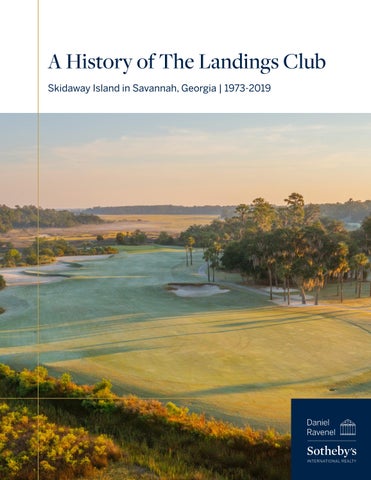
A History of The Landings Club Skidaway Island in Savannah, Georgia | 1973-20 19
A History of The LandingsClub
Skidaway Island, Georgia Presented by Daniel Ravenel Sotheby's International Realty Adapted from the historical account by Dr. Norman Sanders
SourcesandAcknowledgements Dr. Norman Sanders?s original account draws on several sources, including A Short History of Skidaway Island by V. E. ?Tex? Kelly, published in editions dated 1980, 1994, and 20 03. Kelly documented the roles of the Roebling family, Union Camp Corporation, the Chatham County/ City of Savannah Metropolitan Planning Commission, and the Branigar Organization. A longtime Union Camp employee, Kelly moved to The Landings with his wife, Margaret , in 1974. He also served as a county commissioner, president of the Savannah Golf Club, and president of The Landings Association in 1976 and 1977. Another source, The Golf Courses at The Landings on Skidaway Island, was produced by Landings volunteers in 1993. Its introduction, written by George Miller, describes Branigar?s involvement in the community beginning in 1969. The account also incorporates milestone records maintained by Doris Gibson, the Club?s longtime director of membership, marketing, and communication, and firsthand recollections from Richard Burke, president of the Branigar Organization during the development of The Landings. Burke and his wife made the community their home and raised their family there.
Introduction The history of The Landings Club is closely tied to the development of Skidaway Island. What began with plans for an island community grew into a member-owned club with six golf courses, extensive recreation facilities, and a tradition of reinvestment . This account traces the people, decisions, and milestones that shaped the community and its club through 20 19. Historical fees, membership policies, facility counts, and leadership references reflect the periods described.
Skidaway Island: TheFoundations Skidaway Island?s history extends thousands of years before The Landings. Tex Kelly?s research, informed by the Georgia Historical Society, Branigar, and Union Camp, traces the island?s early inhabitants and its Colonial, Revolutionary War, and Civil War periods. The modern development story centers on land ownership, transportation, and plans for an oceanographic research center.
1934: THE ROEBLINGS ARRIVE Robert C. Roebling and his wife brought their two young children to Skidaway Island in 1934. A member of the family associated with the Brooklyn Bridge, Roebling had traveled with his family aboard the schooner Black Douglas before purchasing Modena Plantation on the island?s northern end. The family lived aboard the schooner while land was cleared and homes were built . They later raised Aberdeen cattle and Hampshire hogs. The original account identifies Modena?s water tower and circular barn as reminders of this period.
1941-1943: UNION BAG AND PAPER ACQUIRES LAND In 1941, Union Bag and Paper Corporation purchased 5,0 0 6 wooded acres on Skidaway Island from Citizens & Southern Bank for timber production. In 1943, the company sold 672 acres, including Adams Point , to General Robert Travis. It later reacquired that property.
1964-1968: A BRIDGE AND A RESEARCH CENTER In 1964, the company, later known as Union Camp Corporation following its merger with Camp Manufacturing Company, offered Georgia 50 0 acres if the state would build a bridge to Skidaway Island. The Roeblings also offered land for a marine research center. The state declined Union Camp?s proposal. The following year, the Chatham County/ City of Savannah Metropolitan Planning Commission sought support from Governor Carl Sanders for a bridge. Its proposal described a possible island town of 40,0 0 0 to 50,0 0 0 residents, but no action followed. In February 1967, the commission supported bridges and causeways contingent on establishing a substantial oceanographic research center. A $3.6 million bond referendum passed on September 12 by nearly ten to one. Dorothy Roebling subsequently donated 284 acres at Modena Plantation to the state for the center. In 1968, Union Camp donated 30 0 acres to the Ocean Science Center of the Atlantic and 20 0 acres for a state park. Georgia later purchased another 10 9 adjoining acres for the park.
PlanningTheLandings Construction of two bridges and 8.1 miles of roadway began in 1969, creating the mainland connection needed for development . Union Camp acquired a 49% interest in the Chicago-based Branigar Organization, later purchasing the remaining 51% . It transferred an initial 50 0 acres to Branigar, followed by additional land, and authorized development of its approximately 6,0 0 0 -acre Skidaway Island property. Branigar named Harold Beck project director. Beck selected Sasaki, Dawson and DeMay of Watertown, Massachusetts, to prepare the first-phase master plan. The firm was known for resort and retirement community design. Beck and Hideo Sasaki spent three days exploring Skidaway Island on land, by boat , and by helicopter. Sasaki envisioned streets branching like tree limbs, homes blending with the forest , and a green approach from the bridge. Preserving open space was central to the plan. The roadway and bridges were dedicated in 1972. The drawbridge was named the Roebling Bridge in recognition of the family?s role in establishing the oceanographic center, a key factor in the bridge referendum?s approval. Lot sales began in May 1972. Branigar?s development continued through the opening of Deer Creek, the fourth phase, in 1991.
TheBirthof TheLandingsClub 1973 Branigar selected Arnold Palmer to design the Club?s first golf course, Marshwood.
1974 The first memberships in Marshwood-at-The-Landings were offered for $50 0. They were non-equity memberships with nonrefundable joining fees. The Marshwood course, clubhouse, and pool were completed in spring, followed by a June grand opening. The clubhouse included a golf shop, locker rooms, and club storage. On September 4, Palmer dedicated the 6,90 4-yard, par-72 course, discussing its design as he played all 18 holes. The Landings Women?s Golf Association formed that day with 40 founding members. Frank Thompson became the Club?s first golf professional and remained head professional until 1988.
1975 Four Har-Tru tennis courts opened at Marshwood. Branigar also established The Landings Association for property owners.
1976 The first nine holes of Magnolia, also designed by Palmer, were completed. Marshwood was divided into two nine-hole courses, Marshwood and Monastery, allowing golfers to combine any two of the three available nines. The Marshwood clubhouse served all three. Earl Haynes oversaw cart rentals, locker rooms, and club storage.
1978 The Club held its first Men?s Invitational golf tournament in spring.
1979 Union Camp transferred Skidaway Island Plantation to Branigar. Property owners voted overwhelmingly to incorporate it into The Landings as Phase II, known as Plantation. Midpoint was designed to appeal to younger professional families from Savannah. Magnolia?s final nine holes were completed. Palmer played the opening round at the December 4 dedication of the 6,891-yard, par-72 course. The Ladies?Nine-Hole Golf Group formed in fall. Joining fees increased to $1,0 0 0 and remained nonrefundable and non-equity.
1980 Branigar celebrated Plantation?s opening with an oyster roast . The second phase was planned to include 2,10 0 lots. Club joining fees increased to $1,50 0.
1982 Plantation opened in March with Tommy Hilliard as head professional. The redesigned 6,759-yard course featured a links-style routing that returned to the clubhouse only at the 18th hole. Joining fees increased to $3,0 0 0.
1983 The Franklin Creek Pool and Tennis Complex opened in summer with ten Har-Tru courts.
1985 Arthur Hills?s Palmetto course became the Club?s fourth golf course. The 6,90 1-yard layout was recognized by Golfweek among the country?s top 50 development courses. The Plantation clubhouse was dedicated in October with a Savannah Symphony Orchestra concert . It served both Plantation and Palmetto. Joining fees were $5,0 0 0 for Complete memberships and $3,0 0 0 for Social/ Tennis memberships.
1986 Marshwood?s 12-year-old greens were resurfaced, and its golf shop and men?s locker room were renovated. Joining fees increased to $7,50 0 for Complete memberships, $4,0 0 0 for Tennis, and $3,0 0 0 for Social.
1987 Franklin Creek expanded to 20 Har-Tru courts, a 50 0 -seat stadium, and a full-service tennis shop. Oakridge opened as the community?s third development phase. Branigar built the Westcross bridge over Green Island Road and developed The Village on Skidaway Island, with shops, banks, a gas station, grocery store, and restaurant . The Club hosted its first Georgia State Golf Association tournament , the GSGA Senior Championship.
1988 The Arthur Hills-designed Oakridge course opened as the Club?s fifth course. The 6,675-yard, par-72 layout featured split-level fairways and a hole incorporating a roughly 20 0 -year-old gravesite discovered during construction, with a nearby waterside gazebo. The Landings Association assumed security operations from Branigar, and property owners approved an assessment for an administration building. The Club hosted the USTA 40 s Tennis Championships for the first time, beginning an annual tradition that continued through the period covered by this account . The Landings Line debuted in June.
Becominga Member-OwnedClub 1989 On May 19, Branigar presented property owners with an equity buyout proposal. The Club became a private, member-owned equity club that month, introducing partially refundable joining fees of $22,50 0 for Golf, $9,0 0 0 for Tennis, and $5,40 0 for Social memberships. Existing members who purchased equity memberships received credits toward their joining fees. Those who declined could resign and receive their original joining fee or retain privileges through 1990. Members without property were required to purchase property or resign. Four property owners challenged the buyout terms through a class-action lawsuit , which was settled two years later. The Club established its articles of incorporation and a nine-member Board of Governors, initially composed of Branigar employees. In September, the board expanded to 13 members: seven Branigar employees and six equity members. The golf membership cap was set at 2,182 on August 1. The initial offering sold 1,482 memberships, with Branigar reserving 70 0 : 150 for resale properties and 550 for company lots. The Club hosted the GSGA Senior Championship for a second time. In August , joining fees increased to $25,0 0 0 for Golf, $10,0 0 0 for Tennis, and $6,0 0 0 for Social.
1990 General Manager: Pat McKenna In May, the Board of Governors retained Club Operations and Property Management to manage the Club. Volunteers founded the Village Library that year. Branigar selected Tom Fazio to design Deer Creek, the sixth golf course, and built the McWhorter bridge for pedestrians, bicycles, and golf carts. The Club hosted the GSGA Top 60 Women?s Classic. Joining fees increased to $30,0 0 0 for Golf, $12,0 0 0 for Tennis, and $7,0 0 0 for Social.
1991 General Manager: Pat McKenna Deer Creek opened as the community?s fourth phase. Its golf course, clubhouse, and golf shop celebrated a June grand opening attended by Gary McCord. The 7,0 94-yard course featured large tees, extensive mounding, elevated greens, grass bunkers, and two-tiered fairways. Its 14-acre practice facility included eight target greens, practice bunkers, chipping greens, and a 36-hole putting green. The buyout settlement resulted in 21 members joining under the agreement . Branigar ratified the equity plan on July 1. Franklin Creek added the Players?Lounge in August . The Oakridge Fitness Center opened in October with exercise equipment , indoor and outdoor pools, and four additional Har-Tru courts. The Club introduced computerized golf scheduling through the Intelligent Tee Time Manager.
1991 General Manager: Pat McKenna Deer Creek opened as the community?s fourth phase. Its golf course, clubhouse, and golf shop celebrated a June grand opening attended by Gary McCord. The 7,0 94-yard course featured large tees, extensive mounding, elevated greens, grass bunkers, and two-tiered fairways. Its 14-acre practice facility included eight target greens, practice bunkers, chipping greens, and a 36-hole putting green. The buyout settlement resulted in 21 members joining under the agreement . Branigar ratified the equity plan on July 1. Franklin Creek added the Players?Lounge in August . The Oakridge Fitness Center opened in October with exercise equipment , indoor and outdoor pools, and four additional Har-Tru courts. The Club introduced computerized golf scheduling through the Intelligent Tee Time Manager.
1992 President: Paul Hylbert | General Manager: Pat McKenna The Club ended its outside management agreement and adopted the Club Managers Association of America?s General Manager Concept , emphasizing on-site leadership across its operations. The board?s composition shifted to seven equity members and six Branigar employees. Branigar agreed to extend its financial responsibility through January 1, 1996, in exchange for annual dues increases of 10 % . It also agreed to increase repair and replacement reserve funding to $70 0,0 0 0 in 1995. The 1992 Club budget totaled $11,115,0 0 0, including $55,0 0 0 in depreciation. The Landings Club Employee Scholarship Foundation was established. By the time of the original account , the volunteer-led program was awarding approximately $40,0 0 0 annually to 30 to 35 employees or their children.
1993 President: Paul Hylbert | General Manager: Pat McKenna The Marshwood driving range was enlarged and rebuilt , and Magnolia?s irrigation system was replaced. The first Ladies?Member-Guest tournament , the Moon River Classic, took place in fall. Deer Creek hosted the Georgia Women?s Golf Association?s Amateur Ladies?Championship.
1994 President: Nick Holloway | General Manager: Pat McKenna Oakridge added a putting green surfaced with TifEagle. The original account identifies this as the grass?s first installation outside university test facilities.
1995 President: Nick Holloway | General Manager: Pat McKenna Joining fees increased to $35,0 0 0 for Golf, $12,0 0 0 for Tennis, and $7,0 0 0 for Social. The Oakridge clubhouse opened in April, completing the recreation facilities envisioned in Branigar?s plan. Plantation?s irrigation system was rehabilitated with an On Site Management & Control, or OSMAC, system. Developer funding of operating deficits ended on December 31. The board was reduced to nine members, including equity members elected by the membership.
1996 President: Lindsey Crump | General Manager: Pat McKenna The transition from Branigar to equity owners took effect on January 1. A majority of the nine board members were elected equity members. The board introduced a monthly House Charge instead of a dining minimum. It was designed to support consistent staff compensation, discourage individual tipping, and encourage use of the four clubhouses. The charge covered gratuities associated with approximately $112 in monthly dining; remaining funds later contributed to general Club revenue. The Club approved its first Strategic Plan and developed a shared community vision with The Landings Association, while each organization retained its own planning process. The Club, Association, and Yacht Club formed a Community Coordination Council. OSMAC irrigation controls were added at Palmetto and Oakridge. The Village Library dedicated a new building funded through volunteer donations.
1997 President: Herb McKenzie | Interim General Manager: Kathy Hiebert For the first time, all nine governors were equity members elected by the membership. An April survey showed strong support for clubhouse updates and Marshwood improvements. The board approved a five-year capital plan covering Marshwood clubhouse renovations, Deer Creek kitchen and bar improvements, Plantation clubhouse refurbishment and ballroom expansion, and an Oakridge Fitness Center expansion. Members authorized $4.6 million in long-term debt to fund the work. The board set a goal of hosting one major amateur golf tournament annually to strengthen the Club?s position, support the game, and introduce prospective members to The Landings. Deep-well permits for the Floridan Aquifer were renewed through December 20 0 5. Curtis Lewis purchased the Village property from Branigar.
1998 President: Ed Duffie | General Manager: Mike Byrne The Deer Creek kitchen and bar renovation was completed in October. Oakridge?s driving range was renovated with a new back tee, and Plantation?s 16-year-old greens were resurfaced with TifEagle. The Landings Association formed The Landings Company to fund community advertising and marketing. The Yacht Club purchased Landings Harbor and Delegal marinas from Branigar for $2 million, with a voter-approved loan guarantee from the Association. The Landings Line became Club Line on April 1. The Club hosted the Southern Golf Association?s Junior Championship, won by Sean O?Hair.
1999 President: Peter Crosby | General Manager: Mike Byrne The Marshwood clubhouse renovation was completed in November. Magnolia?s 20 -year-old greens were resurfaced with TifEagle, and Deer Creek?s nine-year-old bunkers were renovated. The Club introduced the Chelsea Reservations System for golf tee times and tennis court bookings.
Reinvestment andLong-TermPlanning 20 0 0 President: Ken Winnert | General Manager: Kathy Hiebert The Club borrowed $2.2 million of the $4.6 million authorized under its five-year capital plan, at an interest rate of 7.86% . A capital assessment added to joining fees on April 1 brought totals to $40,0 0 0 for Golf, $14,0 0 0 for Tennis, and $9,0 0 0 for Social. Planning began for alternative water sources and more efficient water use amid concerns about future reliance on the Floridan Aquifer. The Plantation clubhouse renovation and ballroom expansion were completed in October. The Club hired its first head teaching professional and hosted the GSGA Junior Championship. Palmetto?s 15-year-old greens were resurfaced with TifEagle, and bunkers at Palmetto and Oakridge were renovated.
20 0 1 President: Gary Bocard | General Manager: Kathy Hiebert The Oakridge Fitness Center expansion was completed in January. Magnolia underwent a comprehensive renovation, including irrigation and drainage upgrades, resurfaced fairways, concrete cart paths and curbing, and enlarged tees. The Club and Association acquired spray fields from Skidaway Island Utilities and responsibility for water certificates governing access for undeveloped properties. The Club took ownership of the north field, the Association the south field, and the Club all shallow wells. With voter approval, the Association assumed the Yacht Club?s $2 million debt and absorbed the organization. The Club hosted the Georgia Women?s Golf Association Championship.
20 0 2 President: Sid Beauchamp | General Manager: Kathy Hiebert In May, the Club received tax-exempt status under Section 50 1(c)(7) of the Internal Revenue Code. In September, the board allowed equity members in good standing for at least five years to retain memberships at any level if they sold their property and relocated to The Marshes. The Landings Leadership Council formed with representatives from the Association, Club, and real estate company. A three-year capital plan presented in October included Marshwood, Plantation, Palmetto, and Franklin Creek projects. All six golf courses achieved certification through the Audubon Cooperative Sanctuary Program. The Club hosted the GSGA Junior Championship. Members approved the first all-member capital assessment , effective December 1: $1,650 for Golf, $30 0 for Tennis, and $20 0 for Social. Joining fees became $41,650, $14,30 0, and $9,20 0, respectively. In December, the board extended equity membership eligibility to Marshview Landing property owners as the Association approved annexation of its planned 60 lots.
20 0 3 President: John Sellick | General Manager: Kathy Hiebert In January, the Club purchased Branigar?s remaining memberships, gaining full control over membership categories and structure. In April, equity membership eligibility was extended to Moon River Landing purchasers at negotiated fees as the Association approved annexation of 111 lots. Marshwood?s renovation was completed in October. Work included green complexes, irrigation and drainage, fairways, bunkers, concrete cart paths and curbing, and enlarged tees. A November membership survey drew a 62% response rate. Members generally expressed satisfaction with existing amenities and services, limited interest in additional facilities or major quality upgrades, and significant interest in smoke-free facilities. The Club hosted the Georgia State Seniors Championship for a third time. Nature Trails shallow wells were added to its water system, with the Association owning the land and the Club owning the wells.
20 0 4 President: Lee Cassady | General Manager: Kathy Hiebert Franklin Creek?s renovated tennis building reopened in August with improved locker rooms, an expanded shop, a central entrance, staff offices, an updated Players?Lounge, and a larger observation patio. The Oakridge clubhouse was redecorated and reopened as a smoke-free facility. Plantation?s renovation included irrigation and drainage, cart paths and curbing, enlarged tees, rebuilt bunkers, and a pump station completing the shallow-well water transportation system. In October, joining fees increased to $50,0 0 0 for Golf, $12,30 0 for Tennis, and $9,20 0 for Social.
20 0 5 President: Mike Moy | General Managers: Kathy Hiebert and Alan Gamble Palmetto?s renovation included green complexes, irrigation and drainage, fairways, bunkers, concrete cart paths and curbing, and enlarged tees. The Oakridge golf shop was also renovated. The first Landings Fourth of July fireworks event was held at Deer Creek. A Fitness Center Expansion Committee reviewed studies by WTS and The McMahon Group, both recommending expansion to remain competitive with comparable communities. Alan Gamble became general manager on August 1. The Club hosted the WSGA Championship, and deep-well permits were renewed through December 20 0 6.
20 0 6 President: John Courter | General Manager: Alan Gamble Franklin Creek?s tennis shop and café were renovated, and two hard courts were added. Deep-well permits were renewed through December 20 07. The Club hosted the GSGA Junior Championship, introduced an international labor program, and held its second Deer Creek Fourth of July fireworks event . The board announced joining-fee increases effective April 20 07. The Club paid off its long-term debt and became debt-free.
20 07 President: Phil Boyer | General Manager: Alan Gamble Members approved a seven-year capital plan covering the Fitness Center expansion, Deer Creek and Oakridge course renovations, and new golf maintenance facilities. The original schedule called for Fitness Center work in 20 0 8?20 0 9, Deer Creek in 20 0 9, Oakridge in 20 11, and maintenance facilities in 20 13. Magnolia?s tee surrounds were converted from sand to grass. Joining fees increased on April 1. Property owners joining within 60 days of closing paid $55,0 0 0 for Golf, $15,0 0 0 for Tennis, or $10,0 0 0 for Social. Those joining later paid $65,0 0 0, $18,0 0 0, or $12,0 0 0, respectively. The Club held its third Fourth of July fireworks event at Deer Creek and appointed a member committee to review its bylaws.
20 0 8 President: Dick Myers | General Manager: Alan Gamble The Oakridge Fitness Center expansion began in September, followed by Deer Creek renovations in November. Members approved amended bylaws following the review committee?s recommendations. The Club held its fourth Deer Creek Fourth of July fireworks event and hosted the GSGA Senior Championship for a fourth time. After two years of declining membership, particularly in golf, the Club developed a five-year forecasting model. Its projections indicated that golf membership declines could continue.
20 0 9 President: Bruce Fischer | General Managers: Alan Gamble and Bruce Fischer, interim The economic downturn and weakening real estate market increased membership resignations and downgrades. No new golf memberships were added in the first few months of the year. A limited-time incentive beginning June 1 replaced partially refundable Golf joining fees of $55,0 0 0 ?$65,0 0 0 with a $30,0 0 0 nonrefundable fee. Tennis and Social fees were reduced to $10,50 0 and $7,0 0 0. To protect capital reserves while addressing earlier refund obligations, the Club authorized one refund from the Resigned Golf Waiting List for every three new Golf memberships sold under the program. Refunds averaged nearly $30,0 0 0, making that balance important to capital planning. The Club conducted its third membership survey. The expanded Oakridge Fitness Center celebrated its May opening with a nature photography contest for a permanent display, and Oakridge?s greens were resurfaced in June. The USTA Savannah Challenger debuted at The Landings. In June, the Finance Committee established a $3 million minimum capital cash balance for unexpected needs without borrowing. The Club and Association jointly hosted the Fourth of July fireworks at Oakridge for the first time. Deer Creek reopened in October following Tom Fazio?s redesign, introducing Celebration Bermuda grass and G-angle bunker sand. A Continuous Quality Improvement program began across departments with volunteer facilitators. Alan Gamble resigned, and a search committee began seeking new leadership.
20 10 President: Beth Tarjan | Interim General Manager: Bruce Fischer, through May | Executive Director: Steven Freund, beginning in May The board adopted a long-term goal of remaining debt-free through pay-as-you-go financing and a minimum $3 million capital balance. Members approved up to 10 0 Golf memberships for people who did not own property in The Landings. Steven Freund became executive director and chief operating officer in May. After the incentive program ended April 30, joining fees were set at $33,0 0 0 for Golf, $12,0 0 0 for Tennis, and $8,0 0 0 for Social. All new equity joining fees would be nonrefundable, limiting future refund obligations. The Club and The Landings Real Estate Company began a cooperative national marketing initiative focused on golf-oriented prospects. The Club again hosted the Savannah Challenger and hosted the Georgia Amateur Golf Championship at Deer Creek. The Club and Association held their second joint Fourth of July fireworks event at Oakridge. The seven-year capital plan was adjusted to reduce the scope and change the timing of Oakridge restoration and maintenance facility construction.
20 11 President: Norm Sanders | Executive Director: Steven Freund A Landings Lifestyle video launched in February for national marketing, and the Club strengthened its partnership with The Landings Company. Working with Creative Golf Marketing, the Club introduced the Ambassador Preview Membership Initiative. Members invited friends to experience the Club for a year while paying monthly dues and fees. Participants who joined within 60 days received reduced joining rates. From mid-February through May 31, the program generated 290 new or upgraded memberships. The renovated Oakridge clubhouse reopened in April with Oakridge Steak & Pub, combining a sports bar and steakhouse. In June, joining fees returned to $33,0 0 0 for Golf and $12,0 0 0 for Tennis; Social fees were reduced to $5,0 0 0. The three-new-memberships-to-one-refund policy was extended to Tennis and Social waiting lists. Monthly surveys began, reaching one-twelfth of the membership each month. The board approved lower joining fees and dues for younger members. The Club hosted its third Savannah Challenger, the Executive Women?s Golf Association?s semifinal championship in July, and the USGA Women?s State Team Championship at Palmetto in October. The Club and Association held their third joint fireworks event at Oakridge. Members approved participation in the Private Club Network in August . Club leadership also adopted a strategy of restoring one golf course annually during lower-demand months.
20 12 President: Vicki McElreath | Executive Director: Steven Freund The Club introduced the brand message ?The Island of Much More.? Golf operations were reorganized under Director of Golf Tad Sanders, with Tyson Heisel directing north-course maintenance and Chris Steigelman directing south-course maintenance.
Members and staff developed the first Facilities and Land Use Plan, assessing buildings, land, and infrastructure, their useful life, repair or replacement costs, and a ten-year capital outlook. The Club hosted its fourth $50,0 0 0 Savannah Challenger. Two-thirds of that year?s competitors later played in Grand Slam events. The USTA National 55s tournament was held at the Club for the first time. Magnolia became the second course with Celebration Bermuda fairways. Restoration included selective tree removal, G-angle bunker sand, drainage and bridge repairs, and landscape improvements. It reopened in October. The Plantation ballroom entrance was renovated, and a new heating system enabled year-round use of the Marshwood pool. Bocce and pickleball were introduced. Two bocce courts were built , and a tennis court was temporarily converted for pickleball.
20 13 President: Tim Lindgren | Executive Director: Steven Freund Oakridge?s restoration completed the remaining major golf component of the seven-year capital plan. Work included Celebration Bermuda fairways, irrigation, concrete cart paths, bunkers, bridges, medal tees, and landscape improvements. The course reopened in October. The Marshwood driving range was expanded with stone pavers and a retaining wall. The Oakridge golf shop was renovated, and Marshwood?s fairways were converted to Celebration Bermuda. The Landings Men?s Golf Association was reestablished and exceeded 20 0 members by year-end. Head teaching professional Nicole Weller received both PGA and LPGA national Junior Golf Leader awards. Member Doug Hanzel won the USGA Senior Amateur, Society of Seniors, and Dixie Senior championships. Franklin Creek?s entrance and other areas received pavers, landscaping, flags, awnings, and furniture. The fifth Savannah Challenger received the Georgia Power 20 13 Sporting Event of the Year award. The Club hosted the USTA National 55s tournament for a second year. Oakridge?s indoor pools received new decking. Fitness upgrades included Schwinn bikes, Cybex Eagle upper-body equipment , Precor ellipticals, Cybex Arc Trainers, lounge furniture, and landscaping. The WELL, or What Excellence Looks Like, training program introduced staff certification and documentation. The Plantation ballroom foyer was renovated. Deer Creek?s dining renovation was completed on time and on budget . Rebranded as Deer Creek ? a Coastal Grill, it added outdoor dining with fire pits, awnings, lighting, fans, and heaters.
20 14 President: Beau Anders | Executive Director: Steven Freund The Plantation ballroom received new ceilings, lighting, carpeting, and artwork. Other interiors were updated, and the rear terrace gained stonework, plantings, and outdoor furniture. Palmetto became the fifth course with Celebration Bermuda fairways. Work also included TifEagle greens restored to their original dimensions, G-angle bunker sand, changes to two greens, tree work, and landscaping. Renovations were completed at three golf maintenance facilities. The Women?s Golf Association celebrated its 40 th anniversary. The Club hosted the GSGA Junior Sectional Challenge Match in July, its sixth Savannah Challenger, and its third USTA National 55s tournament .
The Club replaced its technology platform with Northstar operating software and updated its Facilities and Land Use Plan and Strategic Plan. Athletic and House memberships replaced Tennis and Social categories. Golf members who joined before August 1, 20 14, retained their previous options, including access to Social membership if they later downgraded. Franklin Creek added a pool slide and new lighting for tennis courts six, seven, and center court . Three additional pickleball courts brought the total to four. By year-end, pickleball and bocce participation reached approximately 380 and 350 players, respectively. The Club, Company, and Association formed Vision 2020 to study differences between available housing and prospective members?preferences. Plantation added a sushi chef and expanded its menu. Oakridge replaced lower-body exercise equipment and addressed crowding in functional training areas. The board presented a preliminary Facilities Master Plan for member feedback before a planned 20 15 vote.
20 15 President: Gary Hughes | Executive Director: Steven Freund The board held a second town hall on its proposed ten-year Facilities Master Plan and accompanying assessment . By a narrow margin, members returned the proposal for further consideration. Plantation became the sixth and final course with Celebration Bermuda fairways. Restoration included permanent Skidaway tees, G-angle bunker sand, and tree work. Combination tee options were added across all six courses. The Club hosted its seventh Savannah Challenger and fourth USTA National 55s tournament . Franklin Creek added bocce and pickleball courts. The Plantation golf shop and ladies?card room were refreshed in September. Chris Kader joined as director of court sports, and Jacob McLendon became director of fitness and wellness. A national golf-focused marketing campaign launched. A six-month membership option was introduced for Canadian and other international members. Electronic voting and electronic statements became available. Building on Vision 2020, the Association, Club, and Company formed The Landings Development Committee to study development and housing opportunities, informed in part by Urban Land Institute recommendations. The Club was named among America?s Healthiest Clubs by Prevo Health Solutions and among BoardRoom magazine?s Distinguished Emerald Clubs of the World.
20 16 President: John Kinnaman | Executive Director: Steven Freund Real Estate Scorecard recognized The Landings and its Club with the BLISS Award for Best Georgia Community. Court sports participation grew, with the new Landings Women?s Tennis Association, more than 40 0 active pickleball players, and more than 60 0 active bocce players. Members donated more than $10 0,0 0 0 to the TLC Employee Needs Fund.
Deer Creek?s restoration included replacing bunker sand with 2,70 0 tons of G-angle sand, reshaping bunkers, adding modern bunker drainage, removing unwanted grasses from fairways, tees, and approaches, and creating new Skidaway tee complexes.
20 17 President: Peter Calder | Executive Director: Steven Freund Members approved a $24.85 million investment plan developed by the Capital Project Committee and board. It included an expanded wellness center, Franklin Creek courts and pool improvements, a new dining venue, and a complete Marshwood clubhouse rebuild. Member feedback helped shape the fast-casual dining concept at Franklin Creek. The Club managed cleanup and maintenance following Hurricane Matthew in 20 16 and Hurricane Irma in 20 17 while remaining near budget and financially stable. Members continued to support the Scholarship Fund and Employee Needs Fund. The Club secured a five-year agreement for a professional golf tour event , with the first Club Car Championship scheduled at Deer Creek the following spring.
20 18 President: Cliff Frohn | Executive Director: Steven Freund The inaugural Club Car Championship drew record volunteer participation. Members hosted more than 10 0 players and caddies, and Deer Creek received favorable reviews from competitors. The tournament concluded before a large crowd at the 18th green. The Club launched its TLC mobile app, added pickleball and bocce courts, and celebrated the tenth anniversary of the St . Joseph?s/ Candler Savannah Challenger. Members also earned medals at regional pickleball events and state championships. The Deck at Franklin Creek opened November 1, the first major completion in the three-part capital program. Temporary fitness facilities supported members during construction, and the new portion of Oakridge Wellness Center began a soft opening during Thanksgiving week. The Club offered more than 50 social events, including ten new additions. Highlights included a Marshwood Polar Bear Plunge, Fourth of July celebrations, and the year-end Myriad Ball.
20 19 President: Cliff Frohn | Executive Director: Steven Freund The Club celebrated the Marshwood clubhouse groundbreaking on January 8 and the expanded Oakridge Wellness Center?s official opening on January 10. Golf maintenance included converting Plantation collars and approaches to Celebration grass, repairing more than 5,20 0 linear feet of cart paths, and addressing shade at 13 green sites. The Club held its second Club Car Championship and 45 member golf tournaments. Tournament participation increased 20 % , and members played an estimated 180,0 0 0 rounds. The golf team provided 2,845 private lessons and 1,537 club fittings. Oakridge Wellness Center visits increased 32% over the previous year, and the new Franklin Creek pool completed its first full season.
Pickleball Club Championship participation increased 35% , while Tennis Club Championship participation rose 39% . More than 740 members joined the fall bocce league. The St . Joseph?s/ Candler Savannah Challenger marked its eleventh year. Nearly all dining venues improved their food and service satisfaction scores. Social participation increased, and new offerings included a July Food and Beverage Festival, the seasonal Sunset Cove venue, and a gourmet trunk show at Oakridge Steak & Pub featuring the culinary team.
TheLandingsClubin2019 By the close of this account , The Landings Club had grown into a private, residential, member-owned club with approximately 3,0 0 0 memberships across full club/ golf, athletic/ tennis, and house/ social categories. Its facilities included six Audubon Sanctuary-certified championship golf courses, 31 tennis courts, 11 pickleball courts, eight bocce courts, a croquet lawn, three outdoor pools, two indoor pools, four clubhouses, six dining facilities, and a fitness and wellness center with professional staff and personal trainers. The Club worked with The Landings Company to expand national and international awareness, particularly among golf-oriented prospective members. Monthly surveys and direct feedback informed programming for members of all ages, while industry trends helped guide long-term planning. The history reflects a sustained commitment to member ownership, community partnerships, and reinvestment in the places and programs that define life at The Landings.
Your Local Real Estate Resource Local expertise with global reach. Understanding a community begins with understanding its history. Daniel Ravenel Sotheby?s International Realty brings local knowledge, personalized guidance, and the worldwide reach of the Sotheby?s International Realty network to your next move. Explore homes on Skidaway Island and connect with our team at danielravenelsir.com
Daniel Ravenel Sotheby's International Realty 300 BULL STREET, SUITE 101, SAVANNAH, GA 31401 o. 912.234.3323 Each office is independently owned and operated.