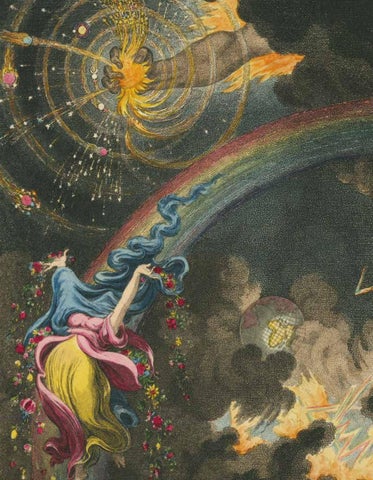
The Andrew Edmunds Collection of Caricature 100 Highlights ——
Preface (by Martin Rowson) / 5
Introduction / 9
William Hogarth (by Sheila O’Connell) / 17
James Gillray (by Tim Clayton) / 21
Thomas Rowlandson (by Nick Knowles) / 25
Catalogue / 28
Some notes on Provenance / 307 Select Bibliography / 316
Daniel Crouch Rare Books Ltd 4 Bury Street, St James’s London SW1Y 6AB +44 (0)20 7042 0240 info@crouchrarebooks.com crouchrarebooks.com
ISBN 978-1-0685979-4-7 Catalogue edited by Arnie Anonuevo, Jess Bolevin, Yasmin Bourke, Tim Clayton, Daniel Crouch, Camila Grillo, Rose Grossel, Kate Hunter, Nicholas Knowles, Sophia Milner, Sheila O’Connell, Molly Osbourne, Dan Press, Mia Rocquemore, Martin Rowson, Nick Trimming, Evelyn Unwin Tew, and Katherine Wood. Design by Ivone Chao Photography by Louie Fasciolo and Marco Maschiao Cover: item 73 Terms and conditions: The condition of all books has been described. Each item may be assumed to be in good condition, unless otherwise stated. Dimensions are given height by width. All prices are net and do not include postage and packing. Invoices will be rendered in £ sterling. The title of goods does not pass to the purchaser until the invoice is paid in full.
Printed in London by Park | Graphius on FSC® certified paper. Park is an EMAS certified company and its Environmental Management System is certified to ISO14001. 100% of the inks used are vegetable oil based, 95% of press chemicals are recycled for further use and, on average 99% of any waste associated with this production will be recycled. This document is printed on Galerie Matt made of material from wellmanaged, FSC®-certified forests and other controlled sources. The pulp used in this product is bleached without the use of chlorine (ECF).
The Andrew Edmunds Collection of Caricature 100 Highlights
Preface
By Martin Rowson, cartoonist, illustrator, performer, muralist, graphic novelist & poet They say that we all stand on the shoulders of giants. Actually, most of us spend our lives standing on piles of dead prone lilliputians, but occasionally people come along who redefine the way things are done. For example, Ralph Steadman and Gerald Scarfe, who in the 1960s typified a new - or more correctly re-established - savagery in British cartooning, are unimaginable without Ronald Searle having preceded them, although whereas the blots splattered throughout the oeuvres of Steadman and Scarfe (or Bell and Rowson for that matter) invariably denote blood or shit, Searle’s blots are champagne bubbles. But Searle in his turn, like every other British cartoonist, is unimaginable without Hogarth and Gillray, described by the great David Low as “the grandfather and father of the political cartoon”. (Low, for his part, was a giant who stood on his own shoulders.) Low’s encomium isn’t, in fact, true. Satirical prints are as old as printing; satire itself, like laughter more widely, is probably an evolutionary survival tool to stop us all going mad with existentialist terror at the sight of the ceaseless parade of clowns, crooks, psychopaths, narcissists, murderers and weapons-grade knobs who’ve placed themselves in positions of power over the rest of us. As Orwell memorably observed, every joke is a tiny revolution. Both Hogarth and Gillray originally trained as engravers, and in a different age, in another country, both might easily have spent their lives either making prints of other artists’ work (which Gillray in fact did) or churning out book plates. Happily for us, they were beneficiaries of a beautiful if largely forgotten moment in History, when the Royal Licensing Act - the engine of state censorship which could get you hung, drawn and quartered for mocking the king - was due to be renewed in Parliament in 1695 and, deliberately or otherwise, someone failed to schedule the vote in the Commons timetable and it lapsed. After 20 years of trying to reimpose it, our masters finally gave up and introduced the Stamp Act instead, to tax free expression. But by then it was too late. There’d already been an explosion of satire which then ran through the 18th Century like an open sewer, from Pope, Gay and Swift via Hogarth to Gillray, Cruikshank and beyond. In his masterly recent biography of Gillray, Tim Clayton describes the actual process of printing these images, including the best way of cleaning the copper plates between impressions. It was with a rag soaked in piss, which is nicely emblematic. Hogarth and Gillray, in their separate and different ways, entrenched the principle of taking the piss in the heart of British culture and politics. No other country has had an uninterrupted history of freely available and accessible political cartoons for 331 years,
THE ANDREW EDMUNDS COLLECTION OF CARICATURE - 100 HIGHLIGHTS
DANIEL CROUCH RARE BOOKS
5
dedicated to the principle of taking the piss out of the afore-mentioned weapons-grade knobs in power. And it’s not just piss. That open sewer of Satire was - and still is - literal, and the shit in these prints is an enduring legacy of Swift’s Faecal Muse. That’s because at its heart Satire is much more than “puncturing pomposity” (as the pompous say): its purpose is to remind our kings and leaders who want to be treated like gods that, actually, like the rest of us, they shit and will die. It’s entirely apt therefore, that the late, great Andrew Edmunds, who when he wasn’t collecting this amazing archive, used his remarkable pallette to select great wines for his restaurant, ensuring that British piss of the highest quality is still there to take.
THE ANDREW EDMUNDS COLLECTION OF CARICATURE - 100 HIGHLIGHTS
DANIEL CROUCH RARE BOOKS
7
Introduction
The Collection Daniel Crouch Rare Books is delighted to present The Andrew Edmunds Collection of Caricatures. Formed over half a century by the late Soho restaurateur, art dealer, and collector Andrew Edmunds (1943–2022). This astonishing assemblage comprises more than 10,000 prints dating from 1600 to 1900. It is the largest and finest collection of satirical prints in private hands. Superb in scope and quality, the Edmunds Collection rivals even the British Museum’s holdings - the largest and most important collection of British caricature in the world – in condition and richness of impression and includes hundreds of prints absent from the Museum’s catalogue. It contains the largest known concentrations of separately published works by the giants of British caricature: James Gillray: over 1,200 prints, including masterpieces such as The Plumb-pudding in Danger (see item 79), Fashionable Contrasts (see item 53), The Gout (see item 69), and the only known example of an erotic print by the artist (see item 59); William Hogarth: 300 works, including his engraved self-portrait Gulielmus Hogarth (see item 20), first states of the Four Stages of Cruelty woodcuts (see item 16), and a complete lifetime folio of engravings (see item 20); and Thomas Rowlandson: more than 500 prints, among them Rachel Pringle of Bardaboes (see item 52) and La Place Victoire á Paris (see item 55). Other highlights in the collection include Thomas Patch’s poignant portrait of a dying Laurence Sterne And When Death Himself Knocked at My Door (see item 21); George Bickham’s 1746 warming-pan satire (see item 15); Joseph Goupy’s delightful caricature of Handel, The Charming Brute (see item 18); and the only known copy of a 1779 satire on Mrs Phillips’s sex shop, The Insurance Office (see item 29). Together, these works trace the evolution of caricature from Restoration wit to Regency excess, illuminating three centuries of social, political, and artistic life. Beyond individual brilliance, the Edmunds Collection is remarkable for its breadth of themes: Women - from pioneering publishers Mary Darly (see items 22 & 27) and Hannah Humphreys (see items 83 & 93) to depictions of fashion and female agency; Race and Empire - including Newton’s Cruelty and Oppression Abroad (see item 54) and images probing Britain’s colonial conscience; National Rivalry - English caricatures of the French, and vice versa, in the age of Napoleon; Everyday Culture - food, drink, sex, politics, and the bustling print-shop trade itself. As a glass held up to the raillery and passion of Georgian Britain, these prints remain strikingly modern. Their savage wit, graphic exuberance, and visual shorthand echo today in political cartoons, animation, and even internet memes. In an era of polarized politics and populist media, eighteenthcentury caricature feels like a mirror held up to our own noisy public life.
THE ANDREW EDMUNDS COLLECTION OF CARICATURE - 100 HIGHLIGHTS
DANIEL CROUCH RARE BOOKS
9
The Collector Andrew Edmunds was born in Epping into a Quaker family and went to the Friends’ School, Saffron Walden. He went up to Queens’ College, Cambridge, in 1962 to read Natural Sciences, taking the Zoology Part II Tripos, and bought and sold both prints and wine while still an undergraduate (although the earliest confirmed acquisition in the collection dates from 1968). He came to believe that Georgian caricatures were seriously underappreciated and soon became the leading authority on the prints of Hogarth, Gillray and Rowlandson. In 1974 he opened his Lexington Street print shop (never gallery!), and, in 1985, he took over the wine bar next door and turned it into his eponymous restaurant. Andrew showed at the London Original Print Fair for more than 35 years and at Frieze Masters from 2015 to 2019. Prints from Andrew’s collection have been included in numerous exhibitions, including: James Gillray: The Art of Caricature, Tate Britain, 6 June – 2 September 2001; Hogarth, Louvre, 18 October 2006 – 7 January 2007, and Tate Britain, 7 February – 29 April 2007; Rude Britannia: British Comic Art, Tate Britain, 9 June – 5 September 2010; Cradled in Caricature, Fitzwilliam Museum, 13 October 2015 – 31 January 2016; James Gillray’s Hogarthian Progresses, Lewis Walpole Library, Yale, 6 April - 16 September 2016. Hogarth: Place and Progress, Sir John Soane’s Museum, 9 October 2019 – 5 January 2020; Hogarth and Europe, Tate Britain, 3 November 2021 – 20 March 2022. After an unfortunate burglary in the 1990s, Andrew kept the bulk of his collection in secure storage in a secret location just outside London, and so, until now, few people were aware of its size and quality, and fewer still have ever seen it in its entirety. Following the burglary, many of the prints were recovered as the hapless thief attempted to sell the prints at auction, in some cases adding spurious collectors’ marks to create a false provenance (which, incidentally, we note in the catalogue entries - the fictitious ‘Col Crawford’ stamp on The Parody, or Mother Cole and Loader (AEC:8099), for example). As one of a rare breed of dealer connoisseurs, Andrew was able to hand pick from the best prints coming through the auction rooms and his print shop. Over nearly 50 years, he collected with a lifetime’s knowledge, and in the words of his friend and fellow collector, Nick Knowles: “Andrew had the best eye for a print I have ever encountered; to look at a collection of prints with him, as I was lucky enough to do on visits we made together to both the Royal Collection in 2013 and to a seminar the Lewis Walpole Library in 2016, where he talked about early colour was a pleasure and education in itself ”. His collection makes a fitting memorial to his great knowledge and taste.
THE ANDREW EDMUNDS COLLECTION OF CARICATURE - 100 HIGHLIGHTS
DANIEL CROUCH RARE BOOKS
11
Acknowledgements
We are indebted to the enormous generosity and labours of Tim Clayton and Nick Knowles, without whom we would have made fools of ourselves with some glaringly stupid errors and would never have finished. Tim and Nick are both currently working on full catalogues raisonnés of the prints of James Gillray and Thomas Rowlandson respectively, and several of the entries here, and many in the wider list, include previously unpublished research discoveries that they have selflessly given us permission to use. We are also eternally grateful for Nick’s computing skills which have saved the day on more than one occasion. We also thank the eyes and wisdom of Sheila O’Connell and James Faber, and the good humour and penmanship of Martin Rowson. We would also like to take this opportunity to thank Bryony Edmunds and her and Andrew’s three children, Xanthe, Seraphina, and Milo for entrusting us with the collection and for letting us have so much fun cataloguing it.
THE ANDREW EDMUNDS COLLECTION OF CARICATURE - 100 HIGHLIGHTS
DANIEL CROUCH RARE BOOKS
13
Notes
A few notes on cataloguing In cataloguing the collection, we have used Dorothy George’s unsurpassable descriptions and comments in her Catalogue of Political and Personal Satires Preserved in the Department of Prints and Drawings in the British Museum where available, sometimes shortened, and occasionally modernized for language and twenty-first century sensibilities. For those items not described by the great lady, we have followed her methods and tried to provide similar descriptions (including transcriptions of captions and labels) and a commentary where relevant. Bibliographic references have been kept to a minimum: the BMSat: number; any entry in Ronald Paulson’s Hogarth’s Graphic Works, for Hogarth; Joseph Grego’s Rowlandson the Caricaturist, for Rowlandson; David Alexander's Richard Newton and English Caricature in the 1790s for Richard Newton; Noack and Noack’s Daumier Register for Daumier; and, if the print is not in the BM satires, a reference to an impression in a public collection. A select bibliography of these and other works may be found at the back of the catalogue. All colour, unless stated otherwise, is either original or early (Andrew was an absolute stickler on this). In a few instances we have been able to identify the colourist and have said so. Andrew was not a great record keeper. Notes on provenance have mostly come our way via cryptic scribbled pencil inscriptions on the backs of prints, a large pile of (mostly manuscript) notes in lever arch files kindly loaned to us by the Edmunds family, and snippets of conversations with Andrew recalled by Daniel, Nick, and Tim. We have transferred this information to the catalogue descriptions as best we can, and, for the more important collections, you will find some background notes on page 307. The complete catalogue The 100 descriptions contained within these pages are but an amusebouche to awaken the palate to the main course – a listing of the whole collection of c10,000 prints in a series of 84 PDF catalogues is available on request.
THE ANDREW EDMUNDS COLLECTION OF CARICATURE - 100 HIGHLIGHTS
DANIEL CROUCH RARE BOOKS
15
William Hogarth
By Sheila O’Connell, former Assistant Keeper, Department of Prints and Drawings, British Museum William Hogarth (1697–1764) is widely regarded as the founder of the English tradition of graphic satire. He was born in the City of London, where his father ran a Latin-speaking coffee house; its failure led to his father’s imprisonment for debt, probably encouraging Hogarth’s lifelong concern for financial independence. Apprenticed as a silver engraver, he was producing prints under his own name by the age of 22. He studied life drawing at informal ‘academies’ organized by fellow artists and would have learned about painting in the studio of James Thornhill, the leading British painter of the day; his marriage to Thornhill’s daughter, Jane, probably helped to launch his career. Hogarth’s early paintings were on a small scale, and he hit upon the idea of reproducing them as prints; better still, he would create series that increased sales. A Harlot’s Progress (1732, see item 10) enlivened the traditional story of an innocent girl seduced into prostitution with satirical references to contemporary life. The series sold hundreds of impressions and established Hogarth’s place in the art world, but its success encouraged unauthorized copies that undercut his profits. It is a sign of the reputation he had already achieved that he was able to push through Parliament an Act giving copyright to designers of prints; he delayed publication of his next series, A Rake’s Progress (see item 11), until the Act was passed in 1735. Selling by subscription, he went on to publish Marriage A-la-Mode (1745), Industry and Idleness (1747), Beer Street, Gin Lane (see item 17) and The Four Stages of Cruelty (all 1751, see item 16) and the Election series (1755–58). His friends included the writer Henry Fielding, with whom he campaigned against the unlicensed production of gin, and the actor David Garrick, who inspired Hogarth’s understanding of the ‘dumb show’, telling stories without words. Hogarth also developed as a fine painter: Elizabeth Einberg’s catalogue raisonné (2016) reproduces over 200 paintings, including life-size portraits and two wall paintings at St Bartholomew’s Hospital. There were, as yet, no public art galleries, but from the 1740s he and fellow artists showed their work to potential patrons at Vauxhall Gardens and the Foundling Hospital, and from 1760 they held annual exhibitions. Hogarth also made enemies, especially among younger artists who hoped that Britain could have a royal academy of art along French lines. Joshua Reynolds and others criticized his theoretical book, The Analysis of Beauty (1753), although it was well received by German and Italian reviewers, and disputes dogged his final years, especially after his appointment as Serjeant Painter to the King in 1757 brought him into the always fraught world of politics. After his death in 1764 his widow continued to market
THE ANDREW EDMUNDS COLLECTION OF CARICATURE - 100 HIGHLIGHTS
DANIEL CROUCH RARE BOOKS
17
his work successfully for another 25 years, and ‘Hogarthian’ became a term that evokes the rumbustious life of eighteenth-century London – a tradition that Gillray and Rowlandson would carry into a new age of caricature. When Andrew Edmunds opened his print shop in Lexington Street, Soho, in 1974, Hogarth – the most quintessentially London of eighteenth-century artists – stood at the centre of the business, and the logo of his neighbouring restaurant was a plate taken from one of his Hogarth prints. His private collection of Hogarth was regarded as legendary in its scope and quality, and when Tate Britain mounted its exhibitions Hogarth (2007) and Hogarth and Europe (2021–22), it chose to borrow from Edmunds rather than from the British Museum. Because Hogarth’s plates continued to be printed long after his death – by his widow until 1789, then by John Boydell from 1790 and in James Heath’s edition of 1822 – the value of a Hogarth collection lies above all in the quality and earliness of its impressions, the distinction on which Edmunds’s long experience as a dealer was built.
THE ANDREW EDMUNDS COLLECTION OF CARICATURE - 100 HIGHLIGHTS
DANIEL CROUCH RARE BOOKS
19
James Gillray
By Tim Clayton, historian, author of James Gillray: A Revolution in Satire (2022) James Gillray (1756–1815) is generally acknowledged as the greatest political caricaturist and one of Britain’s most important satirists – a brilliant writer of titles, captions and dialogue as well as an extremely talented artist. He grew up in Chelsea, where his Scottish father, who had lost an arm on military service in Flanders, was a Chelsea pensioner. Gillray trained as a writing engraver under Harry Ashby in Russell Court, behind Drury Lane Theatre. In 1779 he joined the Royal Academy Schools, studying drawing there for three years while maintaining himself by engraving the lettering on prints and etching satires. His principal employers were William Humphrey (1745–1810), William’s younger sister, Hannah (1750–1818), and another woman who specialized in political prints, Elizabeth d’Achery. Gillray had ambitions as a designer and engraver of literary and historical prints, and in the early 1780s he turned more of his attention to these, producing charming decorative ‘furniture’ prints and some ambitious large prints for Robert Wilkinson, who ran a major business in Cornhill in the City. He was drawn back into satire through new alliances with ambitious printsellers, first William Holland and then Samuel William Fores, who between them raised the profile of caricature, producing larger and more expensive prints for display, launching exhibitions and promoting their artists. It was Fores who first named Gillray as the engraver of a satire, all Gillray’s earlier satires having been anonymous. But Gillray was still surrendering his plates to his printsellers, being paid only a few guineas for each. This changed around July 1791, when Hannah Humphrey proposed what effectively became a partnership: he moved in with her, and they shared the profit from successive reissues of his prints as he quite quickly became famous and people began to collect his work. From then on he worked almost exclusively with her. The interest of Gillray’s work is enhanced by the turbulent times in which he worked, spanning the American Revolution, the French Revolution, the difficulties and scandals of the royal family and the introduction of paper money. Prints such as A Voluptuary under the Horrors of Digestion (1792), his portrait of the bloated Prince of Wales, and The Plumb-pudding in Danger (1805, see item 79), in which Pitt and Napoleon carve up the globe, remain among the defining images of the age. Increasingly savage censorship made opposition difficult, and in 1797 Pitt’s ministry offered Gillray a secret pension, persuading him that he could make a valuable contribution to the war effort; many of his most famous prints concern the long struggle against Napoleon, whom he christened ‘Little Boney’. Failing eyesight and madness ended his engraving career in 1811, the year in which he attempted suicide by throwing himself from an upper
THE ANDREW EDMUNDS COLLECTION OF CARICATURE - 100 HIGHLIGHTS
DANIEL CROUCH RARE BOOKS
21
window of Humphrey’s shop in St James’s Street. He spent his last years insane, cared for by Hannah Humphrey, and died on 1 June 1815, a little over a fortnight before the Battle of Waterloo. Gillray was the artist Andrew Edmunds held most dear. Edmunds began to compile a catalogue of Gillray’s work around 1970 and collected with it in mind. Wherever possible, each print is represented by an outstanding impression printed and coloured at the time of publication, often bearing Gillray’s handwriting, while later impressions are included to illustrate changes to and deterioration of the plate, and how the colouring of the prints changed over time. The collection contains some extremely rare prints, some of them unique – rare usually because they were suppressed for one reason or another – and very rare early states of prints that later became common, sometimes showing Gillray’s thinking as he altered the design in watercolour or ink. Almost the only gaps are a few extremely rare prints stolen from Edmunds in 1991. It is probably the finest collection of Gillray in existence.
THE ANDREW EDMUNDS COLLECTION OF CARICATURE - 100 HIGHLIGHTS
DANIEL CROUCH RARE BOOKS
23
Thomas Rowlandson
By Nicholas Knowles, collector Thomas Rowlandson (1757–1827) was one of the most gifted and prolific draughtsmen of Georgian Britain. He was born in the Old Jewry, in the heart of the City of London. After his father, a textile merchant, was declared bankrupt in 1759, the family retreated to Yorkshire, and the young Thomas was brought up in London by his childless uncle James, a Spitalfields silk manufacturer, and his French Huguenot wife, Jane. Schooled at Dr Barwis’s academy in Soho Square, he showed a precocious talent and entered the Royal Academy Schools at fifteen. His aunt’s French connections enabled a period of study at the Académie Royale de Peinture et de Sculpture in Paris in the mid-1770s – highly unusual for a British artist of the period. There his natural dashing line gained a Rococo fluency, able to make beauty out of the grotesque and the grotesque fascinating; while his exposure to the French academic study of facial expression and body language, as expounded by Charles Le Brun, informed his significant contribution to the development of caricature as an art form. Rowlandson worked with more than a hundred print publishers and ranged well beyond caricature, producing reproductive prints, topographical views, book illustrations, drawing books and even military drill guides. He gained wider renown with a string of satires on the candidates in the 1784 Westminster election, published by William Humphrey and others. Leading publishers such as S.W. Fores, John Raphael Smith and William Holland took him up, and he remained in demand for the rest of his life, his name alone sufficient to advertise a new series of prints. A substantial legacy from his aunt, who died in 1789, funded travels in Europe with his friend and patron, the banker Matthew Michell, and his output fell in the early 1790s as he spent his fortune in London. In 1800 settled in a new studio at 1 James Street, Adelphi, and became Rudolph Ackermann’s most important caricaturist, producing hundreds of caricatures and book illustrations, while also working extensively for Thomas Tegg’s Caricature Magazine (1807–13) and publishing prints himself, probably sold by his sister Elizabeth in her print shop. His print output ceased around 1823, and he died in 1827 after several years of ill health. Rowlandson was also an important and prolific maker of watercolours and drawings – for Sir Osbert Sitwell, ‘the greatest master of pure line that England has had the good fortune to produce’ – and a significant number of his studies for prints survive. Although he made many important political prints during the Regency Crisis, the French Revolution, the Napoleonic Wars and the Clarke scandal, all represented in the collection, he was not a political animal in the way that Gillray was. His great forte was social satire and an amused observation of the human condition, and his scenes of everyday Georgian life, such as A Bawd on her Last Legs (see item 56) and Distillers Looking into their Own Business, remain arresting.
THE ANDREW EDMUNDS COLLECTION OF CARICATURE - 100 HIGHLIGHTS
DANIEL CROUCH RARE BOOKS
25
The Rowlandson collection formed by Andrew Edmunds is remarkable both for its quality and for its rarity. It comprises some 520 prints by or after Rowlandson, including his earliest dated print, View on the Parade (1777). More than 65 are very rare, with fewer than five impressions recorded in the more than 120 public collections worldwide that have been checked; for 22 only two impressions are known, and the impression of A Prize Fight (see item 48) is the only one recorded. Many are fine impressions with authentic eighteenth-century colouring on early paper, to a degree unmatched by any other collection formed in recent times and now almost impossible to acquire. This makes the collection of particular value for studying the prints as they originally appeared, including their colouring, watermarks and paper.
THE ANDREW EDMUNDS COLLECTION OF CARICATURE - 100 HIGHLIGHTS
DANIEL CROUCH RARE BOOKS
27
Gunpowder, treason, and plot
1
[ULRICH, Heinrich, the elder, after] Eygentliche abbildung wie ettlich Englische edelleut einen raht. [True depiction of how certain English noblemen conspire to destroy the King, together with the whole Parliament, with powder]. Publication [Cologne, Abraham Hogenberg], Feb 1606. Description Engraving with etching, restoration to lower margin. Dimensions Sheet: 260 by 314mm (10.25 by 12.25 inches). References AEC:0002; BMSat:71.
28
DANIEL CROUCH RARE BOOKS
The first visual narrative to depict the conspirators of the Gunpowder Plot (November 1605) and their fate. A central vignette names and shames the conspirators of the Plot: “Bates”, as the servant, without his hat; “Robert Winter”, with a ring on his right forefinger, showing a paper to Bates; “Christopher Wright”; “Iohn Wright”; “Thomas Percy”; “Guido Fawkes”; “Robert Catesby”; and “Thomas Winter”. The image is flanked by two columns of German poetical description. It is after the, very marginally earlier, famous image by Heinrich Ulrich, the elder, Concilium septem nobilium Anglorum conjurantium in necem Jacobi I, Magnae Britanniae regis totiusque Anglici convocati parlamenti (1605), when it was the first to name Guy Fawkes (see BMSat:72). Almost immediately that image was copied by Crispijn de Passe the Elder (see NPG:334a). Three further very grisly vignettes appear below, detailing the fate of the traitors in January 1606. Firstly, three are drawn upon hurdles from the Tower to the place of execution at the west end of St. Paul’s, or Palace Yard; then they are hanged, drawn, and quartered, upon a scaffold, and their entrails burnt before them; and finally their heads appear on stakes. Beneath the images are eight lines in Latin and French, with the date, “Anno 1606. Mens. Feb.” Shortly after this series of vignettes, Claes Jansz Visscher, published his dramatic scene, The Execution of the Conspirators in the Gunpowder Plot (1606).
THE ANDREW EDMUNDS COLLECTION OF CARICATURE - 100 HIGHLIGHTS
The origin of the Whigs and the Tories
2
[L’ESTRANGE, Sir Roger] The Committee, or Popery in Masquerade. Publication [London, Mary Clark, for Henry Brome, 1680]. Description Engraving with etching. Dimensions Sheet: 297 by 412mm (11.75 by 16.25 inches). References AEC:0023; BMSat:1080.
30
DANIEL CROUCH RARE BOOKS
A strongly partisan Tory satire published at the height of the Exclusion Crisis (1679-1681). The print, after Sir Roger L’Estrange, purports to expose the danger of Catholicism, a fear of which the Whigs are exploiting in order to destroy the monarchy, the Church of England, and the existing constitution. The long legal battles fought over the right of a Catholic to reign gave rise to these two distinct parties, and stemmed from an increasing suspicion of the Roman Catholic Church’s authority. In fact, both Luttrell and the BM date the satire to April 15, 1680, the same day as a near-fatal attack on a Catholic magistrate in London. It depicts a committee of nine Protestant sectarians, namely Presbyterians, Independents, Anabaptists, Quakers, Ranters, Muggletonians, Fifth Monarchists, James Nayler, and Adamites, presented as a revival of the religious radicalism and political disorder of the Civil War (1642-1651). Between them lie papers concerning “Church and Crown Lands”, “Sequestrations”, “Remonstrainces”, “Petitions”, “Court of Iustice”, and “Humiliation”, representing the roles and rights that such groups might claim. From a window in the wall above, the Pope encourages their deliberations, while the banner “Behold Wee are a Covenanting People” invokes the National Covenant of 1638 and Solemn League and Covenant of 1643. On one side of the picture is an angry mob carrying a crown, mitre, and banners, inscribed, “A Thorough Reformation”, “Liberty”, “Property”, and “Religion”. The sceptre, orb, and a bust of Charles I lie on the floor at their feet. On the other side, a woman holds the head of a parson with a label (“Sequestered Livings”) on his chest, who is vomiting “Cannons”, “Com. Prayer”, “Surplice”, “Apocryha”, “in Bapt”. The print was originally accompanied by an Explanation composed of four columns of verse, which clearly evoke the Long Parliament of 1641 that challenged royal and episcopal authority, with a warning that “41 is come again”.
THE ANDREW EDMUNDS COLLECTION OF CARICATURE - 100 HIGHLIGHTS
L’Estranger Things
3
[COLLEGE, Stephen] Strange’s Case, Strangly Altered. Publication [13 Nov 1680]. Description Engraving with etching, with letterpress text, dated “13 November 1680” in iron gall ink. Dimensions Sheet: 340 by 397mm (13.5 by 15.75 inches). References AEC:0025; BMSat:1083.
Probably the first print by Protestant Stephen College (BM), and one of the earliest examples of a political faction attacking an opponent through a graphic satire. Dated in a contemporary hand “13 Nov. 1680”, it lampoons Sir Roger L’Estrange (1616-1704), Royalist pamphleteer, journalist, and press censor, and one of the most influential Tory propagandists of the Restoration, just as his position was losing ground. L’Estrange is represented as the dog “Touzer” for the first time, a name that would stick (sometimes as Towzer), and would represent him in other prints and pamphlets throughout the remainder of the Exclusion Crisis. He flees from the gallows, pursued by the Devil, with a rope around his neck, a cross, rosary (the accoutrements of a Catholic), and quill issuing from his head. L’Estrange’s stance, that while Catholicism was dangerous, the Whigs were exploiting fear and suspicion to destroy the monarchy, the Church of England and the existing constitution, led to accusations of Popery that College has reinforced in his satire. L’Estrange exclaims, “I Apeale to his Holyness (good Devill)”. According to the explanation beneath: “The Curr by chance the Noose did slip, By help of Devil and His Whip Ill Luck as could have come. Thus having ‘scapt the Fatal Tree In devilish haste, away flies he For Scotland, France or Rome; No matter which (for all he strives) And needs must go, when Devil drives Together with his Brome”. Provenance Manuscript date in the hand of Narcissus Luttrell (1657–1732); British Museum duplicate.
32
DANIEL CROUCH RARE BOOKS
THE ANDREW EDMUNDS COLLECTION OF CARICATURE - 100 HIGHLIGHTS
The Bubblers Medley
4
[ANONYMOUS] The Bubblers Medley, or a Sketch of the Times. Publication London, Tho: Bowles Print & Map Seller next ye Chapter House in St. Paul’s Church Yard, 1720. Description Hand-coloured engraving and etching. Dimensions Sheet: 370 by 265mm (14.5 by 10.5 inches); plate: 342 by 250mm (13.5 by 9.75 inches). References AEC:0050, BMSat:1610.
A “Medley” of various prints and papers lying in confusion upon one another, referring directly or indirectly to the notorious bubble schemes of the early eighteenth century. At the top right of the medley is the “Mint Coffe House” with the inscription “Si Populus vult Decepi Decepeatur” (“If the people want to be deceived, let them be deceived”). Parties of rogues and their victims are seated at tables. They discuss various investments and projects, from “English Copper” to the infamous “S[outh] Sea” Company. The Mint Coffee House was in Southwark, and seems to have been something of a hub for trading and speculating during the various bubbles of the 1720s. To the left a print describes the troubles of “The Dutch Bubblers”: “They coppy England, England, France, In vile destructive Bubbles, And e’ery idle fraud advance, That can augment their troubles”. The image shows men buying and selling stocks on the street. Beneath this is “QUINQUEMPOIX STREET”, the scene of the great bubble operations of John Law at Paris. This print is a copy from one published in Het Groote Tafereel der Dwaasheid, a collection of satires on the schemes of Law and others in 1720.”Bubble Poem” is the next subject, showing speculators in front of the Stock Exchange, London, with verses beneath describing their transactions: “While some build Castles in the Air, Directors build ‘em in the Seas; Subscribers plainly see ‘em there, For Fools will see as Wise Men please.” This lies atop a page from “The London Gazette to Aug. 16, 1720”, containing a proclamation from the Lords Justices and directing the Attorney General to bring writs of “Scire facias” against the York Buildings, Lustring, English Copper, and Welsh Copper, and Lead Companies. To the right on top of the pile is a card from the rare deck of “Stock Jobbing Cards”, published in 1720 by Thomas Bowles, satirizing the catastrophic South Sea Bubble. Another playing card is the Jack of Hearts, i.e. the knave, referring to the fraudsters who were convincing so many to part with their cash. The many prints almost conceal the image at the bottom of the “pile”, which shows a maritime subject. In the lower righthand corner, another illustration depicts a boy blowing bubbles, symbols of the financial speculation (and accompanying cons) that grew to a frenzy in Europe in the 1720s. This is one of two medley prints with the same title published by Thomas Bowles. Both were subsequently reprinted by Carington Bowles. See BMSat:1611 for the companion plate. Provenance Rt Hon Christopher Lennox-Boyd (1941-2012).
34
DANIEL CROUCH RARE BOOKS
THE ANDREW EDMUNDS COLLECTION OF CARICATURE - 100 HIGHLIGHTS
Bubble trouble
5
[COLE, James] The Bubblers bubbl’d or the Devil tale the Hindmost. Publication London & Westminster, Sold by the Printsellers of, [1720]. Description Engraved and etched broadside, restoration to bottom-left. Dimensions Sheet: 345 by 267mm (13.5 by 10.5 inches). References AEC: 0054; BMSat:1625.
A reversed English copy of a Dutch print (De Wind Koopers met Wind Betaald, 1720) ridiculing the disastrous economic consequences of the various “Bubbles” that plagued Europe at the time. A crowd has gathered around the Stock-Exchange, eager to buy and sell shares. One man shouts, “Bubbles of all sorts sold here.”; another declares, “I have got £4000 out of nothing”; his neighbour laments, “I have lost £1000 this day.” “A List of the Bubbles” appears at the top of the large placard including schemes such as “Robins Fishery for Gudgeons"; “Johns Coffee House;” “an Office for maintaining Bastard Children"; “Ram Insurance”; “Lute String”; and “For Makeing Women’s Silk Stockings & Mens Britches, cum multis aliis.” Of all the episodes of financial speculation, the South Sea Bubble is the most notorious. It was a fevered attack of mass madness, which affected all levels of society, as a significant proportion of the British population became convinced that their fortunes would be transformed by investing in the South Sea Company. The Company was formed as early as 1711, and was promised a monopoly on all trade to the Spanish colonies in South America, in return for taking on and consolidating the national debt. Unfortunately, the Treaty of Utrecht, which ended the War of Spanish Succession, severely restricted the trading rights of the Company, since it confirmed Spain’s sovereignty of its colonies in the New World. However, that did not stop the Company from obtaining permission to convert their “assets” (i.e. the National Debt) into shares, which they mis-sold on the basis of wildly exaggerated profits from their South Sea trading. Between January and May of 1720, shares in the South Sea Company soared from £128 to £550 each. Encouraged by this apparent success, hundreds of smaller “Bubbles”, or joint-stock ventures, were created, and gained similar momentum. In an attempt to ward off competition, the South Sea Company put its weight behind The Bubble Act, passed in June of 1720, which required all joint-stock companies to have a Royal charter. Once the Company had received its own Royal seal of approval this way, its shares almost doubled in price to an astronomical and unsustainable £1050. Consumer confidence waned, then collapsed, and by September the share price had returned to £175, and the bubble was well and truly burst. Fortunes won, were now largely lost. By 1721, investigations revealed a tangled web of corruption and fraud, involving company and government officials.
36
DANIEL CROUCH RARE BOOKS
THE ANDREW EDMUNDS COLLECTION OF CARICATURE - 100 HIGHLIGHTS
The Devil’s forever blowing bubbles
6
PICART, B. Monument Consacré A La Posterité En Memoire De La Folie Incroyable De La XX. Année Du XVIII. Siecle. Publication [Amsterdam, 1720]. Description Engraving with etching, repaired tear on right. Dimensions Sheet: 291 by 383mm (11.5 by 15 inches); plate: 279 by 371mm (11 by 14.5 inches). References AEC:0058; BM:1917,1208.1528.
A crowd has gathered before the English Coffee house, the “Quiquempoix”, in Amsterdam, mockingly named for the Paris stock exchange on Rue Quiquempoix. Within and before it, a huge crowd of men and women are buying and selling shares. Professional fraudsters are in evidence, with a leering man kneeling before a weeping lady and convincing her to take on a new investment. A rough cart - “Compagnie de Commerce” - is driven by Folly through the crowd. It is pulled by figures representing various places and schemes in which huge fortunes were being placed (and lost!), led by halfnaked natives of Mississippi and the South Sea. Above, Fortune floats, scattering bills and certificates over the crowd, while from a thundercloud next to her, the Devil blows bubbles. Below the image text in French and Dutch explains and ridicules the situation, asking: “Who will believe it? Who would ever have thought it? That in such a wise century a senseless system made Commerce a game of Fortune?” One of the main objects of ridicule is the infamous Mississippi Scheme, launched by John Law (1671-1729), a Scottish economist who served as Controller-General of Finances under the Duke of Orléans. Law created and ran the Mississippi Company, financed by the Royal Bank. Its chaotic collapse has been compared to the tulip mania of seventeenth-century Holland. The Mississippi bubble coincided with the South Sea bubble in England. Provenance With an unknown collector’s stamp, purple “W” within circle (L3852) to verso, together with the art historian Dr R. Graf ’s “RG” (L1207) stamped in purple.
38
DANIEL CROUCH RARE BOOKS
THE ANDREW EDMUNDS COLLECTION OF CARICATURE - 100 HIGHLIGHTS
Prize or blank
7
HOGARTH, Will[ia]m The Lottery. Publication [London, 1724]. Description Etching and engraving, printer’s device beneath title. Dimensions Sheet: 258 by 327mm (10.25 by 12.75 inches). References AEC:6571; BMSat:1730; MET:32.35(185).
The lottery grew increasingly popular during the 1720s, prompting Walpole to criticize it as no different to speculating in stocks, a risky business following the South Sea Bubble, and Fielding to pen his farce, The Lottery. Hogarth too contributed to the satirical depiction of the game, with a scene that mimics High Renaissance history painting. The drawing of state lotteries took place at Guildhall, where a large wheel was set up holding numbered tickets, and another with tickets marked either prize or blank. Hogarth depicts these mechanisms operated and observed by allegorical figures including Fear, Hope, Suspense, Sloth, and Despair. Good Luck is seized by Pleasure and Folly, while Minerva, representing wisdom, guides Misfortune instead towards Industry. This example is the second state. Provenance Sir Edward Astley, Bart., his stamp (L2774) on recto. Marquis of Bute by c1830. See p307 for notes on provenance.
40
DANIEL CROUCH RARE BOOKS
THE ANDREW EDMUNDS COLLECTION OF CARICATURE - 100 HIGHLIGHTS
Some of the Principal Inhabitants of ye Moon
8
[HOGARTH, William] [Royalty, Episcopy, and Law] Some of the Principal Inhabitants of ye Moon. Publication [?1724]. Description Etching and engraving, trimmed within platemark and tipped in to album page. Dimensions Sheet: 247 by 185mm (9.75 by 7.25 inches). References AEC:6579; BMSat:1734; Paulson:56.
42
DANIEL CROUCH RARE BOOKS
The caption continues: “as they Were Perfectly Discover’d by a Telescope brought to ye Greatest Perfection since ye last Eclipse; Exactly Engraved from the Objects, whereby ye Curious may Guess at their Religion, Manners, &c.”. The eclipse referred to in the caption occurred on Sunday May 11, 1724, and was preceded by a spate of pamphlets, poems, and publicity. The three “Principal Inhabitants”, seated on thrones, are Royalty, Episcopacy, and Law. To the left, Royalty wears a crown and his face is a coin bearing a monarch’s profile. Episcopacy wears a mitre and his face is formed from a “Jew’s harp”. The end of the harp is connected by a rope to a pump, from which his coins pour into a chest stamped with his armorial bearings. On the right, Law is represented by a wig-topped gavel. Before them stand attendants and courtiers, also comprised of objects including a teapot and fans. The repeated motif of bubbles, as the king’s chain, and reflected in the cloud, points towards the authorities’ involvement in or acquiescence to the disastrous South Sea Bubble. Only state. The extreme rarity of this print suggests that it may have been suppressed. Rare: only three institutional examples known: at the BM, Fitzwilliam, and the Lewis Walpole Library at Yale.
THE ANDREW EDMUNDS COLLECTION OF CARICATURE - 100 HIGHLIGHTS
Drunken antics in Temple Bar
9
HOGARTH, W[illia]m A Midnight Modern Conversation. Publication [1732-1733]. Description Etching and engraving, printed in sanguine. Dimensions Sheet: 432 by 525mm (17 by 20.75 inches); plate: 344 by 469mm (13.5 by 18.5 inches). References Paulson:128ii.
Based on an oil painting made by Hogarth two or three years previously, A Midnight Modern Conversation shows a raucous scene at 4am in St. John’s Coffee-house, Temple Bar. All manner of drunkenness is on display, with revellers toasting, smoking, laughing, talking, and falling over. Hogarth’s contemporaries hurried to identify the figures shown: the parson ladling punch was taken as either the eccentric preacher John Henley, or Cornelius Ford, the reprobate cousin of Dr. Johnson. The man behind the parson is thought to be John Harrison, a tobacconist with a shop in Bell Yard, who was famous in local taverns for his singing. The tipsy lawyer beside the parson is a barrister named Kettleby; the man already wearing his nightcap, a deaf bookbinder named Chandler who worked for Hogarth and later ran a pub. The man pouring port over the fallen man is supposed to be a friend of Hogarth’s, a doctor, and his victim James Figg, a prizefighter. Such was the popularity of the print that in 1742 a play titled A Modern Midnight Conversation, taken from Hogarth’s celebrated Print, was performed at Covent Garden. It had also been pirated less than two weeks after its first publication. Here in the second of three states.
44
DANIEL CROUCH RARE BOOKS
THE ANDREW EDMUNDS COLLECTION OF CARICATURE - 100 HIGHLIGHTS
Hogarth’s first publication: The Harlot’s Progress
10
HOGARTH, William [The Harlot’s Progress]. Publication [April 1732]. Description Six etchings with engraving. Dimensions Plate 1: 535 by 585mm (21 by 23 inches); Plate 2: 526 by 585mm (20.75 by 23 inches); Plate 3: 526 by 585mm (20.75 by 23 inches); Plate 4: 525 by 585mm (20.75 by 23 inches); Plate 5: 526 by 585mm (20.75 by 23 inches); Plate 6: 525 by 585mm (20.75 by 23 inches). References AEC:6643; Paulson:121i; P122i; P123i; P124i; P125i; P126i.
According to George Vertue’s notebooks, Hogarth “began a small picture of a common harlot, supposed to dwell in drewry lane. just riseing about noon out of bed. and at breakfast. a bunter waiting on her”. Apparently the painting proved popular among those to whom he showed it, and he made five others, which together tell the tragic tale of Moll Hackabout. Although Hogarth initially sought an engraver to execute the printed version of the series, he eventually found himself “obliged to engrave them all himself ”, which delayed their delivery until April 10. The prints are all examples of the first state, before the addition of the Latin cross cancelling the subscription, and are as follows: A Harlot’s Progress Plate 1: Moll Hackabout arrives in Cheapside, at the Bell Inn, where coaches from the north of England stopped. She is carrying the tools of her trade: scissors and a pincushion, but is at once approached by some infamous figures. The notorious brothel-keeper, Elizabeth Needham, examines her, while the rake Colonel Francis Charteris and pimp John Gourlay look on from a doorway. Plate 2. Hackabout has now become the mistress of a wealthy London Jew, and sits in the parlour of his house at the tea-table, attended by a young black page. As the Jew joins her, a servant helps to smuggle her young lover out of the door; Moll’s revealing dress may be an attempt to distract the one lover while the other escapes. Plate 3. Presumably dismissed by her prior lover for her lack of faithfulness, Hackabout is now a common prostitute in the Drury Lane district. While her pox-ridden servant prepares their tea, a magistrate enters with three bailiffs to arrest them. Plate 4. In Bridewell Prison, Hackabout and the other inmates stand beating hemp. A guard and his dog watch over them, both with rather fierce expressions, and behind them stands a man in the pillory, which is inscribed: “Better to Work than Stand thus”. Plate 5. Hackabout, now free, continues to suffer, as she sits unconscious in a dilapidated room, while two quacks fight over the best cure for her. One of them is Dr. Richard Rock, who sold “The famous, Anti-Venereal, Grand, Specifick Pill”, the other Dr. Jean Misaubin, inventor of a popular drop for prophylaxis and venereal disease. Her servant tries to break up the argument, while an infant, presumably Hackabout’s own, plays dangerously close to the fire.
48
DANIEL CROUCH RARE BOOKS
THE ANDREW EDMUNDS COLLECTION OF CARICATURE - 100 HIGHLIGHTS
Plate 6. Hackabout’s funeral, at which the coffin is inscribed “M. Hackabout Died Sep 2[?] 1731 Aged 23”. The mourners are all somewhat distracted: her son by a toy, one lady by her own reflection, another by an infected finger, and the parson by his brandy and the pretty woman sitting beside him. Only Hackabout’s servant looks truly aggrieved at the loss. Provenance Colonel Steele, with Agnews 1973.
52
DANIEL CROUCH RARE BOOKS
THE ANDREW EDMUNDS COLLECTION OF CARICATURE - 100 HIGHLIGHTS
The Rake’s Progress
11
HOGARTH, W[illia]m [The Rake’s Progress]. Publication June ye 25 1735. Description Eight etchings and engravings. Dimensions Plate 1: 527 by 589mm (20.75 by 23.25 inches); Plate 2: 526 by 589mm (20.75 by 23.25 inches); Plate 3: 526 by 589mm (20.75 by 23.25 inches); Plate 4: 525 by 588mm (20.75 by 23.25 inches); Plate 5: 526 by 588mm (20.75 by 23.25 inches); Plate 6: 526 by 588mm (20.75 by 23.25 inches); Plate 7: 526 by 588mm (20.75 by 23.25 inches); Plate 8: 526 by 588mm (20.75 by 23.25 inches). References AEC:6662; Paulson:132iii; P133iii; P134i; P135i; P136i; P137ii; P138ii; P139ii.
Following the success of The Harlot’s Progress, Hogarth announced in late 1733 a new series, The Rake’s Progress, which would be something of a male counterpart to the story of Miss Hackabout. After a significant delay, partly to allow time for Hogarth’s Act to come into force (see AEC:6931), the eight-print series was published in June 1735. Despite his best efforts, numerous pirated copies were still produced, and in another effort to combat these, Hogarth decided to have a smaller, cheaper set prepared for those who could not afford the higher quality edition. The series follows the story of Tom Rakewell, whose profligate lifestyle leads to his ruin. Each print is accompanied by explanatory and moralizing verses, supplied by Hogarth’s friend Dr John Hoadly (see AEC:6822). Hogarth was also assisted in the engraving of the plates by L.G. Scotin, although Scotin’s signature does not appear, except on the first engraved state of the second print. The plates are as follows: Plate 1. A chaotic scene in the house of Tom’s recently-deceased father, a miser whose money-hoarding is soon to be contrasted with his son’s prodigality. The heir is being accosted by the mother of his girlfriend, Sarah Young, who stands weeping and evidently pregnant. Her irate mother carries letters from Tom to the girl, of which disparate phrases such as “in Oxford”, “Dearest Life”, and “Marry You” are legible. With Rakewell distracted, his lawyer or steward takes advantage of the situation to steal money from the desk behind him. Scattered on the floor are various bills and demands for payment. Here in the third state, before Sarah Young’s face has been aged, and still with a bolt of cloth and a bill on the chair to the right. Plate 2. Newly enriched by his father’s estate, Rakewell has entered the beau monde and is shown here at his morning levee, with nightcap still on his head. He is surrounded by a crowd of rapacious hangers-on. The pedigree and dress of the attendants attest to his social ambition and willingness to pay for status: the man holding a “Garden plan” is Charles Bridgeman, gardener to both George I and George II; a musician, who may be intended for Handel himself, plays a harpsichord marked “I. Mahoan Fecit”, referring to the king’s harpsichord-maker. Kneeling before him, a jockey holds a trophy won by Rakewell’s horse, suitably named “Silly Tom”. Here in the third state, with “Harlot” misspelled as “Horlot” in the first line of the inscribed verse.
54
DANIEL CROUCH RARE BOOKS
THE ANDREW EDMUNDS COLLECTION OF CARICATURE - 100 HIGHLIGHTS
Plate 3. The drunken Rakewell enjoys a wild orgy at the Rose Tavern, an infamous brothel in Covent Garden. While one prostitute distracts him with her charms, another steals his watch. Almost everything in the room, from the furniture to the glasses, is broken or overturned. Around the walls are portraits of Roman emperors after Titian, all of whom have had their faces cut out except the notoriously-depraved Nero, and Julius Caesar. The scene was hinted at in the previous print by a painting of the Judgment of Paris: like the Trojan prince, Tom chose the gifts of Venus, with disaster soon to follow. Here in the first state, with the publication line: “Invented, Painted, Engrav’d, & Publish’d by Wm Hogarth ‘June ye 25’. 1735. According to Act of Parliament”. Plate 4. While on his way to a party in St. James’s, Rakewell is accosted by bailiffs, who present him with demands for his unpaid debts. Sarah Young comes to his rescue, paying the bill from her own, presumably meagre, pay as a seamstress. Above Rakewell, a man filling the street lamp spills the oil onto his head, a travesty of the Biblical practice of anointing with oil which here reflects the undeserved blessing he has received. Here in the first state, before lightning has been added to the sky, and the group in the right foreground. Plate 5. In the dilapidated Marylebone Old Church, Rakewell seeks a cure for his financial distress in marriage to an old and ugly, but presumably wealthy, woman. While a wizened old priest reads the rites, Tom is already eyeing up his new wife’s pretty young maid. In the background, Sarah Young and her mother attempt to disrupt the ceremony, the former holding her baby. Plate 6. Rakewell kneels in the middle of a room in a gambling house, his new wife’s fortune lost and his wig discarded in despair. He and many of the other gamblers are too engrossed in their games and the exchanging of money to notice that the place is on fire. Although the dog’s collar reads “Covent Gar”[den], it seems more likely that the scene takes place at White’s, where a disastrous fire occurred in 1733, and which is shown in a later state of the previous plate being struck by lightning. Here in the second state.
58
DANIEL CROUCH RARE BOOKS
THE ANDREW EDMUNDS COLLECTION OF CARICATURE - 100 HIGHLIGHTS
Plate 7. Following his losses at White’s, Rakewell is now confined to the Fleet debtors’ prison, alongside both his furious wife and Sarah Young, with their child. Around the room lies evidence of Rakewell’s deluded plans to redeem himself: a rejection letter concerning his play; a telescope symbolizing his ambitions to win the longitude reward being offered by the government; a make-shift alchemical laboratory; a pair of wearable wings, in reference to Daedalus’ and Icarus’ legendary but ill-fated escape from jail; “a scheme for paying ye Debts of ye Nation”. Hogarth’s own father had been confined to the same prison for debt, and had attempted to extricate himself by proposing just such a scheme in a letter sent to the Chancellor of the Exchequer in 1710. Here in the second state, on which the misspellings on the first have been corrected. [Plate 8]. What started with delusional scheming in debtors’ gaol has descended into outright madness, as Rakewell sits half-naked on the floor of a cell in Bethlem Hospital. Only Sarah Young remains at his side, but he continues to ignore her. All around are signs of insanity, from a man who believes himself king, to a leering musician who wears the score on his head. Two sniggering well-dressed ladies have come to observe the madmen in Bedlam. Here in the second state, the first completed with lettering. Provenance Colonel Steele, with Agnews 1973.
60
DANIEL CROUCH RARE BOOKS
THE ANDREW EDMUNDS COLLECTION OF CARICATURE - 100 HIGHLIGHTS
The Prime Minister’s prominent posterior blocks the path to public office
12
[ANONYMOUS] Idol-Worship or The Way to Preferment. Publication 1740. Description Engraving with etching. Dimensions Sheet: 400 by 285mm (15.75 by 11.25 inches). References AEC:0121; BMSat:2447.
The colossal Sir Robert Walpole, bending over with his backside exposed, stands before an entranceway. Between his legs is seen a long arcade leading to “Sain [ James’s] Place”, “The Treasury”, “The Exchequer”, and “The Admiralty.” A courtier aims to enter, driving a hoop inscribed “Wealth Pride Vanity Folly Luxury Want Dependance Servility Venality Corruption Prostitution”. In his hand he carries a “Petition for”, i.e. for anything. Another courtier has climbed up to kiss Sir Robert’s bottom! A sarcastic attack upon the servility of many members of both the Commons and the Lords to Sir Robert Walpole, whose pacifist policy was largely unpopular with the people. Merchants in particular were aggrieved at insults and injuries from France and Spain. Indeed, merchants in the Caribbean Sea claimed that Spanish troops conducting a search of a British vessel, as permitted under Walpole’s Treaty of Seville, had cut off the ear of its captain, giving rise to the so-called War of Jenkins’ Ear (1739-1748). The print is advertised in The Daily Post ( July 29, 1740, p2, col. 3). The price was stated to be one shilling. The advertisement was from “J. King, at the Globe in the Poultry”. Likewise, from The Country Journal; or, The Craftsman (May 10, 1740, p2, col. 3): “This Day is publish’d, Price 1s. IDOL WORSHIP; or, The Way to Preferment. Being the Picture of a Great Man, in a proper Attitude, as he is described in the next Chronicle of the Kings of England”.
62
DANIEL CROUCH RARE BOOKS
THE ANDREW EDMUNDS COLLECTION OF CARICATURE - 100 HIGHLIGHTS
Admiral admiration
13
PARR; [after] GRAVELOT The English Lion Let Loose or Vernon Triumphant. Publication [London], Geo. Foster at the White Horse in St Pauls Church Yard, March 30th 1742. Description Engraving with etching, date inscribed in ink to lower margin. Dimensions Sheet: 420 by 332mm (16.5 by 13 inches). References AEC:0167; BMSat:2424.
A celebration of British victories under Admiral Edward Vernon. The print consists of nine compartments, the first containing a portrait of “EDWARD VERNON VICE ADMIRAL OF THE BLUE”, the office to which he was promoted at the outset of the War of Jenkins’ Ear. Vernon had spoken prominently for the war with Spain, which was triggered when Spanish troops searching a British vessel were alleged to have cut off the captain’s ear. In the second compartment, Vernon “RECEIVES HIS COMMISSION” from the king; and in the third he “TAKE’S LEAVE OF HIS FAMILY” to sail to the Caribbean. The fourth vignette depicts the attack on “PORTO BELLO” of November 21, 1739; Vernon captured the Spanish port with just six ships, his victory prompting the composition of Rule Britannia!. In the fifth, he “LANDS AT JAMAICA” and is received by the Governor. The sixth gives a view of the attack on “FORT CHAGRE” on March 23, 1740; the seventh illustrates the attack on “BOCA CHICA” on March 25, 1741; and the eighth represents the attack on “CARTAGENA”. Although this combined naval and land campaign was initially successful, the British suffered great losses and were eventually forced to retreat. The defeat goes unacknowledged in this print. Between the two final vignettes is the armorial shield of Admiral Vernon, with the motto “VERNON Semper Viret.” Behind it is the British Lion, roaring: “Behold I’m loose, Spain hears me roar As far as the West Indian Shore; Deep in their Hearts I’ll stick my claws, And bathe in Spanish blood my jaws”.
64
DANIEL CROUCH RARE BOOKS
THE ANDREW EDMUNDS COLLECTION OF CARICATURE - 100 HIGHLIGHTS
That’s all Folkes
14
BARON, Bernard after HOGARTH, William Martin Folkes Esqr: Publication [London], Wm Hogarth, [1744]. Description Original engraved copper printing plate. Dimensions Plate: 335 by 240mm (13.18 by 9.45 inches). References AEC:6687; cf. P154; BM:1853,0112.1424.
HOGARTH, W[illia]m [Letter from Hogarth to Martin Folkes]. Publication Feb 13 1744. Description Autograph letter, signed, in ink on folded paper, with residue from red wax seal. Dimensions Sheet: 202 by 327mm (8 by 12.75 inches). References AEC:6688.
[HOGARTH, William] Martin Folkes Esqr. Publication [1742]. Description Engraving.
The original copper plate for the print of Hogarth’s portrait of his friend and colleague Martin Folkes, together with a letter from Hogarth to Folkes discussing the portrait and the engraving of the plate, and an impression taken from the, earlier, third state of the plate. Mathematician and numismatist Martin Folkes was named vicepresident of the Royal Society by Isaac Newton in 1723, and became president in 1741, on which occasion Hogarth executed an oil painting of him, still owned by the Society. Folkes was also vice-president of the Foundling Hospital, of which Hogarth was founding governor and generous benefactor. Hogarth’s portrait shows Folkes gesturing didactically with his right hand and gazing benignly out of the portrait. In the background a broken plinth attests to his antiquarian expertise. The first impressions were taken from this plate in 1742, and Hogarth’s signature was added for the fourth state of the print in 1744: “Wm Hogarth Pinxt et Sculpt” [in reverse]. A letter from Hogarth to Martin Folkes, whose portrait he painted upon Folkes’s election as president of the Royal Society. This letter concerns the engraving of the plate, executed by Bernard Baron. Hogarth’s oil painting of Folkes hung in the Royal Society, where it is still held today, but apparently Hogarth required it back in order that Baron could complete the copper plate for the print. The letter reads as follows: “Sr, Mr. Baron has advanc’d the plate as far as he well can without your Picture my man will bring it safe, if you will [?]please to give orders for the delivery of the Picture, at ye Royal Society. we were resolved not trouble you before Mr. Baron was quite ready to finish it without Interuption; some other work he has been finishing has retarded this thus long. I am your much obliged Humble Ser.t Wm. Hogarth”.
This third state of Hogarth’s portrait of Martin Folkes (see AEC:6687), before the addition of the artist’s signature. Provenance Steele.
Dimensions Sheet: 470 by 302mm (18.5 by 11.75 inches); plate: 333 by 237mm (13 by 9.33 inches). References AEC:6689; Paulson:154iii.
66
DANIEL CROUCH RARE BOOKS
THE ANDREW EDMUNDS COLLECTION OF CARICATURE - 100 HIGHLIGHTS
Out of the Warming-Pan, into the Fire
15 [BICKHAM, George the Younger; portrait after Alexis Simon BELLE] Thalpolectrum Parturiens: or the Wonderfull Product of the Court Warming-pan. Publication [London, George Bickham, c1746]. Description Engraving with etching, tipped to album page. Dimensions Sheet: 385 by 250mm (15.15 by 9.75 inches). References AEC:0236; BMSat:1156.
A subtle challenge, rather than a direct attack, on the legitimacy of the Stuart dynasty. The Young Pretender (Charles Edward Stuart) lies half-reclining on a couch in rather feminine dress. Following his defeat at the Battle of Culloden, Bonnie Prince Charlie fled disguised as a woman with the assistance of a Scottish woman named Flora MacDonald. He is flanked by two winged putti. One is drawing aside a curtain, while another lifts the lid of a warming-pan to reveal a portrait of his father, the Old Pretender ( James Francis Edward Stuart), copied from F. Chereau’s print after Alexis Simon Belle’s painting. This refers to the well-known allegations respecting the birth and royal lineage of James Francis Edward Stuart: that as an infant he was brought to the bed of Mary of Modena in a warming-pan, to serve as an impostor after her true son died. The Roxburghe Ballads contains a song on the subject (vol. iii. p724). Rare. The example in the BM is trimmed and, therefore, missing all lettering. Provenance Gardener Collection; Maggs.
68
DANIEL CROUCH RARE BOOKS
THE ANDREW EDMUNDS COLLECTION OF CARICATURE - 100 HIGHLIGHTS
Rare woodcuts of The Four Stages of Cruelty
16
BELL, J[ohn; after] William HOGARTH [Pair of woodcuts of plates three and four of The Four Stages of Cruelty]. Publication [London], Wm: Hogarth, Jany 1st. 1750. Description Two woodcut prints, trimmed to image along left, right, and top edges, printed on very thin paper. Dimensions [Cruelty in Perfection] Sheet: 467 by 377mm (18.5 by 14.75 inches); [The Reward of Cruelty] Sheet: 471 by 387mm (18.5 by 15.25 inches). References AEC:6723; Paulson:189; P190.
70
DANIEL CROUCH RARE BOOKS
Hogarth explains in his Autobiographical Notes that ‘the four stages of cruelty, were done in hopes of preventing in some degree that cruel treatment of poor Animals which makes the streets of London more disagreable to the human mind, than any thing what ever’. So that the prints were as accessible as possible to the masses, whom Hogarth saw as more inclined to violent crimes, two qualities of paper were used; those on thinner paper were priced at “1s.”, and those on finer at “1s.6d”. Published in early 1751, the four-print series shows how a morality that allows cruelty towards animals will eventually devolve into permitting and practising atrocities against humans, following the story of the villainous Thomas Nero from childhood to death. First Stage of Cruelty. Boys on the street torment animals for their amusement. One experiments with model wings by throwing a cat out the window, others encourage animals to fight. Several use cocks for target practice, and one pair blinds a bird. Most disturbing of all is Nero, who seems intent on impaling a snarling dog with an arrow. One kind-hearted young man offers the offender his tart in exchange for letting the dog go free. His pity is praised in the verse beneath, while the barbaric cruelty of the other boys is condemned. Second Stage of Cruelty. Conscious and unconscious cruelty are displayed, by men beating lame animals in the foreground, with Nero flogging a collapsed horse, and by the negligence of a driver who has fallen asleep and allowed his wagon to run over a little boy. In the background men cheer on a bull, in a bull-baiting display, while other signs reference different forms of violent entertainment, such as cockfighting and boxing. The verse beneath the image criticises any man who would partake in such vices as an “inhuman Wretch!” Cruelty in Perfection. A nighttime scene in a churchyard, with villagers apprehending Nero for the murder of his lover, a maid who has stolen from her mistress on his orders. He has been caught with the murder weapon, a dagger, as well as a pistol, and he wears a highwayman’s cloak with stolen watches in the pockets. The Reward of Cruelty. Nero’s corpse lies on a table inside a theatre, where it is being dissected by a group of surgeons including Dr. John Freke, who would take advantage of the following year’s Murder Act to acquire the bodies of convicted murderers for his anatomical studies. The kind-hearted boy from the first print reappears here, pointing in horror at the skeleton of “Gent[lema]n Harry” displayed on the wall. Henry Simms, or ‘Young Gentleman Harry’ was a robber hanged in June 1747; his skeleton is hung opposite that of “Macleane”, a highwayman executed in October 1750.
THE ANDREW EDMUNDS COLLECTION OF CARICATURE - 100 HIGHLIGHTS
Hogarth originally had two of the four designs produced as woodcuts, executed by John Bell one month before the engravings. These proved too expensive, however, and the first two images were not made. The woodcuts of the third and fourth scenes show the same composition as the engravings, but lack lettering. Paulson describes both as “copies” (p189-190). They are larger and earlier than the engraved set. Both blocks survived to be printed by the Boydells in the 1790s, but early impressions, as here, are extremely rare. Cruelty in Perfection is in the first state, before the text of the “Dear Tommy” letter from Ann Gill was printed from an inserted (possibly posthumously) woodblock, and before cracks and border losses. The Reward of Cruelty is in the first state, before cracks and border losses. Provenance Lichtenstein, with Colnaghi in the 1960s
72
DANIEL CROUCH RARE BOOKS
THE ANDREW EDMUNDS COLLECTION OF CARICATURE - 100 HIGHLIGHTS
Beer Street and Gin Lane
17
HOGARTH, W[illiam] Beer Street [and] Gin Lane. Publication Feb. 1. 1751. Description Two etchings and engravings, thin paper. Dimensions [Beer] Sheet: 463 by 392mm (18.25 by 15.5 inches); plate: 385 by 325mm (15.25 by 12.75 inches). [Gin] Sheet: 474 by 393mm (18.75 by 15.5 inches); plate: 380 by 320mm (15 by 12.5 inches). References AEC:6718; Paulson:185ii; P186ii.
74
DANIEL CROUCH RARE BOOKS
On February 13, 1751, the General Advertiser announced a new pair of prints by Hogarth, intended “to reform some reigning Vices peculiar to the lower Class of People”. Beer Street and Gin Lane depict the effects of different alcoholic beverages, encouraging all good Londoners to choose beer over gin. Gin drinking was seen as a particularly dangerous vice, and much of the capital’s increasing crime was attributed to its effects. In 1736, a bill had been passed putting additional taxes on gin sales; mock funerals were held for “Madame Geneva”, and the drink was sold under various pseudonyms, such as “Cuckold’s Comfort” or “The Ladies’ Delight”. By 1743 the law had been repealed. Gin sales continued to increase over the following decade, and in the summer of 1751 the Gin Act was passed in another attempt to curtail consumption. It does not appear to have completely solved the problem, however, as Hogarth’s prints were republished in 1759. Gin Lane shows a slum in St. Giles, with emaciated drunkards lying on the street, selling off their goods, fighting, and rioting. Its only successful inhabitants are a pawnbroker (“Gripe”), distiller (“Kilman”), and undertaker. The ill-effects of gin are shown to affect men and women alike, with one ragged woman dropping her baby due to her inebriation, and another pouring the spirit into an infant’s mouth. These figures are almost certainly based on the real life case of Judith Dufour, whose two-year-old child had been taken from her and sent to a workhouse. Dufour reclaimed her child and strangled it and left it in a ditch, and sold the clothes that had been provided by the workhouse in order to buy gin. Dufour was hanged for the murder. The pawnbroker’s sign is like a mocking version of a cross, and in the distance the statue of King George II is visible atop the steeple of St. George’s Bloomsbury; these symbols reflect the acquiescence of the royal and ecclesiastical authorities to the plight that Hogarth saw afflicting the poor. Verse below the image warns that “Gin cursed Fiend, with Fury fraught, Makes human race a Prey; It enters by a deadly Draught, And steals our Life away...”.
THE ANDREW EDMUNDS COLLECTION OF CARICATURE - 100 HIGHLIGHTS
By contrast, Beer Street shows the bustling and prosperous centre of St. Martin’s, with tradespeople going about their work, or taking a break to enjoy an invigorating tankard of beer. The pawnbroker’s shop has no visitors, and everyone is well-dressed and well-fed; the only exception is the ragged and scrawny painter, who is in fact painting a bottle and glass of gin on a signpost. The church, perhaps St. Martin’s-in-the-Fields, is flying a flag to show that it is the birthday of George II, a reference to national celebration, good-cheer, and success. Whereas in Gin Lane, a coffin is suspended from a building, here it is a barrel of beer. Both of these examples are in the second state, and the first of each to be published. Provenance Edwardes/Furstemberg.
76
DANIEL CROUCH RARE BOOKS
THE ANDREW EDMUNDS COLLECTION OF CARICATURE - 100 HIGHLIGHTS
The porcine pianist
18
[GOUPY, Joseph, after] The true Representation and Caracter. Publication [c1754]. Description Engraving with etching. Dimensions Sheet: 514 by 348mm (20.25 by 13.75 inches); plate: 470 by 312mm (18.5 by 12.25 inches). References AEC:0373; BMSat:3272.
George Frideric Handel, with the face of a pig, is seated on a beer barrel, playing on an organ. On his head stands an owl, while a monkey holds up to him a mirror. A scroll inscribed “Pension. Benefit. Nobility. Friendship” alludes to the patronage Handel enjoyed among the upper echelons of British society. The composer was fond of good living. It was said that he would occasionally retire from a party on the plea that a musical idea had just occurred to him, but in reality so that he might indulge in a glass or two of his favourite wine. In 1742, artist Joseph Goupy painted a portrait of Handel for the Prince of Wales. The two had worked alongside each other for decades, but seem to have fallen out shortly after the portrait was executed, as a few years later Goupy drew The Charming Brute, showing the pig-faced Handel surrounded by symbols of gluttony. This print appears to be a much simplified, and reversed, copy of that drawing. The drawing is now in the Fitzwilliam Museum (Fitz 961).
78
DANIEL CROUCH RARE BOOKS
THE ANDREW EDMUNDS COLLECTION OF CARICATURE - 100 HIGHLIGHTS
Stamping out the Stamp Act
19
[ANONYMOUS] The State of the Nation An: Dom: 1765. Publication [1765]. Description Engraving with etching. Dimensions Sheet: 403 by 407mm (15.75 by 16 inches); plate: 355 by 302mm (14 by 12 inches). References AEC:0531; BMSat:4130.
80
DANIEL CROUCH RARE BOOKS
Early in March 1764, George Grenville (1712–1770), First Lord of the Treasury, Chancellor of the Exchequer, and Leader of the House of Commons, presented his very controversial Budget, outlining a financial programme intended to address the colossal national debt brought about by the French and Indian War (1754–1763), and the ongoing cost of supporting British troops in America. Among the measures he proposed was a stamp duty on the American colonies, although the Stamp Act itself was not introduced until the following year. The proposed tax would legislate that colonists pay a duty on a wide range of printed goods and legal documents. Amongst those who opposed the implementation of such a tax was David Hartley the younger (c1731–1813), a friend of Benjamin Franklin. His pamphlet, The Budget (1764), was a staunch attack on Grenville’s financial policy. A swift riposte came in the form of Thomas Whately’s Remarks on the Budget (1765), attacking Hartley’s arguments. Hartley responded in kind with The State of the Nation, with a Preliminary Defence of the Budget (1765). Although the present satire is entirely anonymous, its title is a pointed attack on all those in the Grenville camp. Stranded on the shores of America, Britannia leans her weary head on the shoulder of a Native American, alarmed by Grenville, who has drawn his sword in an attempt to enforce his policies. He is physically restrained by William Pitt, holding the spear and cap of Liberty, who answers, “You have no right”. On the opposite side, Lord Mansfield, with a serpent at his breast and dagger in hand, approaches under the direction of Lord Bute, but is checked by Charles Pratt, recently created Baron Camden, who cries “No General Warrants”. The second confrontation broadens the satire beyond the impending Stamp Act itself: Mansfield and Pratt had been on opposing sides in the constitutional controversy over general warrants, while many contemporaries attributed the whole notion of the Stamp Act, which received Royal Assent on March 22, 1765, to an alliance between Grenville and Bute. Rare: only two institutional examples known, both in the BM; no examples found in available commercial records.
THE ANDREW EDMUNDS COLLECTION OF CARICATURE - 100 HIGHLIGHTS
[WILSON, Benjamin] The Repeal. Publication [London, Sold by Mr Smith, at the Woolpack, Number 45, in Long Acre near Drury Lane, 18th March 1766]. Description Engraving with etching, proof. Dimensions Sheet: 300 by 483mm (11.75 by 19 inches); plate: 294 by 465mm (11.5 by 18.25 inches). References AEC:0541; BMSat:4140, proof state (J,1.85).
82
DANIEL CROUCH RARE BOOKS
Commemorating a resounding victory for the American Colonies over the British Parliament, Wilson published this satire within “ten minutes after” the official repeal of the infamous Stamp Act, which had received Royal Assent on March 22, 1765. Intended to help balance the enormous costs of the French and Indian War (1754–1763), and the ongoing and crippling expense of keeping British troops in America, the Stamp Act was the first direct internal tax imposed by Parliament on the American colonies. To some, including the otherwise sage Benjamin Franklin, it seemed a brilliant idea to legislate that colonists purchase “stamps” for a wide range of printed goods manufactured in Britain, such as legal materials, newspapers, and playing cards. However, it immediately provoked a fierce backlash from a population already suffering from post-war economic difficulties and a shortage of currency. There was a strong constitutional objection, as Parliament was proposing taxing colonists who had no elected representatives in Westminster: in effect – taxation without representation! A special Stamp Act Congress met in New York in October 1765 and petitioned for repeal, while merchants organized boycotts of British goods, and popular resistance increasingly made the Act impossible to enforce. Parliament accordingly resolved to repeal it in February 1766. However, the victory was Pyrrhic, as on the same day that the Repeal received Royal Assent, a Declaratory Act asserted Parliament’s right to legislate for the colonies “in all cases whatsoever”, giving emphatic reaffirmation to Parliamentary sovereignty over the colonies. In this scene, a mock funeral for the most iniquitous measures of the Stamp Act and colonial policy is held on the banks of the Thames, lined with warehouses, such as “The Sheffield and Birmingham Warehouse Goods NOW Ship’d for America”. A lighter receives a huge case marked “A Statue of Mr Pitt”, probably referring to Joseph Wilton’s colossal statue erected at Charleston, South Carolina, in recognition of Pitt’s support for repeal of the Stamp Act. Nearby, bales marked “Stamps from America” contain the unwanted stamps returned after the Act’s repeal, while another warehouse displays “Black Cloth from America”, supposedly for the funeral. At left, an open tomb awaits its occupants, inscribed “Within this Family Vault lie (it is to be hop’d never to rise again) the Remains of — Hearth mon[ey] Ship mon[ey] Excise B[ill] Jew B[ill] Gen[eral] Warrants &c.” Above it, the skulls of the “1715” and “1745” Jacobite rebellions are impaled on poles. A procession approaches, led by Dr W. Scott, author of Anti-Sejanus, followed by Lord Bute as chief mourner, then the Duke of Bedford, with a “Weave[r]” visible in his pocket, and finally Lord Halifax and the Earl of Sandwich. Proof state, without sub-title or separate Explanation leaf, of an exceptionally rare broadside. Wilson documented the publication of his iconic satire in his autobiography: “Mr Burke, Mr Cowper and others
THE ANDREW EDMUNDS COLLECTION OF CARICATURE - 100 HIGHLIGHTS
encouraged me to make another print. An opportunity soon offered, for disputes ran very high respecting the Stamp Act in America, which was about to be repealed. The title of my 2nd print I therefore called ‘the Repeal, or the Funeral of Miss Amy Stamp’ for I was told from authority that it would certainly be repealed... This print I published within ten minutes after the Act was repealed. I had but four days to sell it in; because on the fifth there appeared two pirated editions which sold for half the price. Nevertheless in those four days, I sold about 2,000 at a shilling apiece; I was informed by persons of credit that there were sold of the pirated copies above sixteen thousand...” (Walpole Society, LXXIV, 2012, p200). The print was first advertised in the Public Advertiser on March 13, 1766; the next advertisement, on March 18, announced that the ‘print called the repeal will certainly be published this day, at two of the clock, notwithstanding the many endeavours to prevent its appearance. Price 1s. Sold by Mr Smith, at the Woolpack, Number 45, in Long Acre near Drury Lane’. Rare: only two institutional examples of this proof state are known, at the British Library and the Wellcome Institute; only one other example of the first issue found in available commercial records, Sotheby’s 2025.
84
DANIEL CROUCH RARE BOOKS
THE ANDREW EDMUNDS COLLECTION OF CARICATURE - 100 HIGHLIGHTS
One of the last of his lifetime
20
HOGARTH, William [Hogarth’s Works]. Publication [London, various, c1764]. Description Folio (580 by 470mm). 82 variously engraved, etched, and mezzotint, plates on 65 sheets, mostly interleaved, partially mounted on album leaves; contemporary calf backed marbled paper boards, worn; preserved in modern brown morocco backed clamshell case. References AEC:6881.
86
DANIEL CROUCH RARE BOOKS
A magnificent album composed of Hogarth’s most celebrated prints almost certainly compiled shortly before his death in October 1764, with plates dating from 1733 and including the final issues of the frontispiece, his self-portrait W,,m Hogarth Serjeant Painter to His Majesty (1764); and tailpiece: The Bathos (1764). The contents of the present album correspond very closely to the sequence of the album held at the Soane Museum, with 74 plates. In that volume, an ink note attached to the front free endpaper records that it was “Presented by Mr Hogarth to Doc__ Shomberg”, referring to Dr Isaac Schomberg (1714–1780), the physician who attended David Garrick during his final illness. It was acquired by Sir John Soane at the Revett sale at Christie’s on 26 June 1804, lot 133, for £29 8s, when it was described as “Hogarth’s Works, first impression of the Plates, a Presentation Copy”, although the actual lot description more cautiously referred simply to “fine impressions of the plates.” The Soane Museum notes that the physical construction of the volume appears consistent with bound sets issued by Hogarth, which he was producing from as early as 1736. The Edmunds and Soane albums follow the same unusual, nonchronological arrangement from Hogarth Painting the Comic Muse through Harlot’s Progress, The Rake’s Progress, Marriage-la-Mode, The Four Times of Day, Industry and Idleness, The Invasion, The Cockpit, Credulity, Superstition, and Fanaticism, and The Bathos. Similarly, the larger prints were sewn together into the binding, with protective sheets between them to prevent offsetting, while the smaller prints were mounted on album leaves. There are, however, some differences: the present album contains a few additional or inserted prints tipped-in on album paper: the group of four “Heads” and The Sleeping Congregation, and Columbus Breaking the Egg. It also reverses the order of Beer Street and Gin Lane. The “sets” in Edmunds’ album are made up of mixed states, whereas the Soane album uses first or final states. Rare: St. John’s College, Cambridge with 77 plates; The Soane Museum, London with 74 plates, London; The Morgan Library, NY, holds three large albums of Hogarth prints which are believed to have been compiled from material issued by Jane Hogarth: “Large plates bound as issued, others mounted onto bound album leaves”. The Lewis Walpole Library, at Yale, has two: the Frederick Edward Sotheby Collection, 97 engravings; and the Queen Charlotte Collection, 84 prints. Yale describes both as examples of sets put together and offered by Mrs. Hogarth after her husband’s death. One example has sold at auction since 1982, in 2013 at Bloomsbury Book Auctions, with 82 plates as here, and a printed index annotated by Hogarth.
THE ANDREW EDMUNDS COLLECTION OF CARICATURE - 100 HIGHLIGHTS
The plates are: W,,m Hogarth Serjeant Painter to His Majesty. Publish’d as the Act directs, march 29, 1758 (but 1764), P204vi (of 7); [A Harlot’s Progress. London, William Hogarth, 1744]: A Harlots Progress Plate 1. P121iv (of 4), Plate 2. (P122iv (of 4)), Plate 3. P123iii (of 3), Plate 4. P124iii (of 3), Plate 5. P125iv (of 4), Plate 6. P126iii (of 3). A complete set, all later states of the plates, with the characteristic dagger/ cross in the centre of the lower edge of the plate, and other changes. [A Rake’s Progress. London, William Hogarth, 1735 - 1763]:Plate 1. P132ii (of 4), Plate 2d. P133ii (of 5), Plate 3. P134iv (of 4), Plate 4 P135iii (of 3), Plate 5. P136iii (of 3), Plate 6. P137iii (of 3), Plate 7. P138iv (of 4), Plate 8. P139iii (of 3) “Retouch’d by the Author 1763”. A complete set, the first two plates early issues, that remaining late issues. [Marriage A-la-Mode. London, William Hogarth, 1745]:Marriage A-la-Mode (Plate 1). P158vii (of 8), Marriage A-la-Mode, (Plate II). P159iii (of 5), Marriage A-la-Mode (Plate III). P160iii (of 3). Marriage A-la-Mode (Plate IV). P161iv (of 4), Marriage A-la-Mode (Plate V). P162iv (of 5), Marriage A-la-Mode (Plate VI). P163iii (of 3). A complete set, mixed issues. [The Four Times of Day. London, William Hogarth, 1738]: Morning. P146ii (of 2), Noon. P147ii (of 2), Evening. P148iii (of 4), Night. P149ii (of 2). A complete set, late issues. A Midnight Modern Conversation. [London, William Hogarth, 1733]. P128iii (of 3); The Distrest Poet. London, William Hogarth, 1740. P145iii (of 3); The Enraged Musician. London, William Hogarth, 1741. P152iii (of 3); [Southwark Fair]. London, William Hogarth, 1733. P131i (of 1); Mr: Garrick in the Character of Richard the 3d:. London, William Hogarth, 1746. P165ii (of 2); O The Roast Beef Of Old England’. London, William Hogarth, 1749. P180ii (of 2); [Paul before Felix]. London, William Hogarth, 1752. P192i (of 1);
88
DANIEL CROUCH RARE BOOKS
THE ANDREW EDMUNDS COLLECTION OF CARICATURE - 100 HIGHLIGHTS
[Sullivan’s Paul before Felix]. London, William Hogarth, 1752. P192/1ii (of 3); [Mose’s brought to Pharaoh’s Daughter]. London, William Hogarth, 1752. P193ii (of 3); A Representation of the March of the Guards towards Scotland in the Year 1745. London, William Hogarth, 1761. P184viii (of 8); [Strolling Actresses dressing in a Barn]. London, William Hogarth, 1738. P150iv (of 4); [An Election. London, William Hogarth, 1755-1758]: An Election Entertainment Plate I. P198viii (of 8), Canvassing for Votes. Plate II, P199v (of 6), The Polling. Plate III. P200ii (of 3), Chairing The Member. Plate 4. P201iii (of 3). A complete set, late issues. [Bernard Baron, after Hogarth]. The Right Reverend father in God, Dr. Benjamin Hoadly. [London], 1743. P226i (of 1); [Industry and Idleness. London, William Hogarth, 1747]. Industry and Idleness. The Fellow ‘Prentices at their Looms. P168ii (of 2), The Industrious ‘Prentice performing the Duty of a Christian. P169ii (of 2), The idle ‘Prentice at play in the Church Yard during Divine Service. P170ii (of 2), The Industrious ‘Prentice a Favourite, and entrusted by his Master. P171ii (of 2), The Idle ‘Prentice turn’d away, and sent to Sea. P172iii (of 3), The Industrious ‘Prentice out of his Time, & Married to his Master’s Daughter. P173iv (of 5), The Idle ‘Prentice return’d from Sea, & in a Garret with a common Prostitute. P174ii (of 2), The Industrious ‘Prentice grown rich, & Sheriff of London. P175ii (of 2), The Idle ‘Prentice betray’d by his Whore, & taken in a Night cellar with his Accomplice. P176iii (of 4), The Industrious ‘Prentice Alderman of London, the idle one brought before him & Impeach’d by his Accomplice. P177ii (of 2), The Idle ‘Prentice Executed at Tyburn. P178iii (of 3), The Industrious ‘Prentice Lord-Mayor of London. P179iii (of 3). A complete set, late issues. John Wilkes Esqr’. London, William Hogarth, 1763. P214i (of 1); Simon lord Lovat. London, William Hogarth, 1746. P166ii (of 3); [The Stage-Coach, or the Country Inn Yard]. London, William Hogarth, 1747. P167iii (of 4); Paul Before Felix [Burlesqued]. London, William Hogarth, 1751. P191iv (of 5);
90
DANIEL CROUCH RARE BOOKS
THE ANDREW EDMUNDS COLLECTION OF CARICATURE - 100 HIGHLIGHTS
[Four Group Heads. London, William Hogarth, 1737]:[A Chorus of Singers]. P127iii (of 3), The Company of Undertakers. P144ii (of 2), [Scholars at a Lecture]. P143ii (of 2), [The Laughing Audience]. P130iv (of 4). A complete set, re-issuing the engraved headers from some subscription tickets from 1732 - 1733. [The Sleeping Congregation]. London, William Hogarth, 1762. P140iv (of 4); The five orders of Perriwigs... London, William Hogarth, 1761. P209iii (of 3); [Columbus breaking the egg]. London, William Hogarth, 1753. P194ii (of 2); 3. Caricatures - 4. Caricaturas. London, William Hogarth, 1743. P156iii (of 3). Originally a subscription ticket for Marriage-A-la-Mode. The Bench. London, William Hogarth, 1758. P205iii (of 6); [Time Smoking a Picture]. London, William Hogarth, 1761. P208iii (of 3); The Times Plate 1. London, William Hogarth, 1762. P211ii (of 3); The Bruiser. London, William Hogarth, 1763. P215vii (of 8); Beer Street. London, William Hogarth, 1751 [1759]. P185iii (of 3); Gin Lane. London, William Hogarth, 1751. P186iii (of 4); [The Four Stages of Cruelty. London, William Hogarth, 1751]:First Stage Of Cruelty. P187i (of 2), Second Stage of Cruelty. P188i (of 2), Cruelty In Perfection. 189i (of 1), The Reward Of Cruelty. P190iii (of 4). A complete set, mixed issues. [The Invasion. London, William Hogarth, 1756]:France Plate 1st. P202iii (of 3), England Plate 2d. P203iii (of 3). A pair. [The Cockpit]. London, William Hogarth, 1759. P206i (of 1); Credulity, Superstition and Fanaticism. London, William Hogarth, 1762. P210iii (of 3); Tail Piece -The Bathos. London, William Hogarth, 1764. P216i (of 1); The Bench. London, William Hogarth, 1758. 2 plates on one sheet, with caption plate printed below. P205iv (of 6). 92
DANIEL CROUCH RARE BOOKS
THE ANDREW EDMUNDS COLLECTION OF CARICATURE - 100 HIGHLIGHTS
One man and his dog
[HOGARTH, William] Gulielmus Hogarth. Publication 1749. Description Etching and engraving. Dimensions Sheet: 435 by 347mm (17.25 by 13.75 inches); plate: 379 by 285mm (15 by 11.25 inches). References AEC:6709; Paulson:181iv.
In 1745, Hogarth completed a self-portrait that he had been working on for a decade. It is set in an oval frame, which rests on a stack of books identified as the works of Shakespeare, Swift, and Milton. A palette bearing “The Line of Beauty” lies against the books, and beside them all stands the artist’s beloved pug, Trump. Hogarth himself wears a Montero cap, looking directly out at the viewer, with a scar on the right side of his forehead. In 1749, he engraved a reversed copy of the painting, to be used as the frontispiece to the folios he had then started to sell. It was replaced in 1759 by a more recent self-portrait. This is the fourth state of the print, with the title, signature, and date engraved. Provenance Alfred Morrison, his stamp “AM” L.151; Julian Marshall, his stamp “JM” L.1494.
94
DANIEL CROUCH RARE BOOKS
THE ANDREW EDMUNDS COLLECTION OF CARICATURE - 100 HIGHLIGHTS
Giving Death a Sterne talking to
21
FLOREN; [after Thomas] PATCH And when Death himself Knocked at my door... Publication [1768]. Description Engraving with etching, foxing to sheet. Dimensions Sheet: 463 by 348mm (18.25 by 13.75 inches); plate: 416 by 302mm (16.5 by 12 inches). References AEC:0558; BM:1868,0808.4420.
Issued at about the time of his death (March 18, 1768), Patch’s caricature shows the quintessential eighteenth-century satirical author, Laurence Sterne (1713-1768), though clearly infirm, literally standing up to and dismissing Death. Sterne had been chronically unwell for much of his adult life and had suffered from repeated respiratory illnesses, causing him to travel often to France and Italy for restorative bouts of fresh air. The caption beneath the image opens volume VII of Tristram Shandy: “Now as for my spirits, little have I to lay to their charge... in dangers ye gilded my horizon with hope, and when Death himself knocked at my door—ye bad him come again...”, which was published in January of 1765. By October of the same year, Sterne was back on the continent, where he met up not only with some enlightened gentlemen of his day (Baron d’Holbach, Diderot, John Wilkes, Samuel Foote, and Horace Walpole), but also two artists: Thomas Patch (1725–1782), who subsequently drew two cartoons of him, one of which is the preliminary watercolour drawing for this satire, now held in the collection at Shandy Hall; and Joseph Nollekens (1737–1823), who sculpted a fine marble bust of Sterne. Those works would be transformed into memento mori after Sterne’s death: Patch’s as the current satire, and Nollekens as a death mask. Patch’s scene is full of references to Sterne’s unique literary genius (Uncle Toby’s fortifications on the wall, Corporal Trim’s misappropriation of the “heirloom” boots), but also his alleged literary misdemeanours, including plagiarism of the works of his classical forebears, and nearer contemporaries. Beneath his desk, amongst the pile of books are “Aris[totle]” and “Ovid”, and against the far wall, a nasty machine with a serrated circular saw for cutting up books.
96
DANIEL CROUCH RARE BOOKS
THE ANDREW EDMUNDS COLLECTION OF CARICATURE - 100 HIGHLIGHTS
“Why ’tis the dear enchanting Creature Woman (MDarly)”
22
DARLY, M[ary, or Matthew]; and J[ames] ROBERTS An Essay on Woman. Publication [London], M Darly 39 Strand, 3d of Oct 1769. Description Engraving. Dimensions Sheet: 449 by 294mm (17.75 by 11.5 inches); plate: 350 by 250mm (13.75 by 9.75 inches). References Not in BM; O'Connoll, Mary Darly, Fun Merchant and Caricaturist, in Female Printmakers, Printsellers, and Print Publishers in the Eighteenth Century. The Imprint of Women c1700-1830, 2024; Giraud, review of Prints and Prejudice: Women Printmakers 1700-1930, V&A, 2022-2023.
98
DANIEL CROUCH RARE BOOKS
An exceptional, and early piece of feminist satire. At first glance this print looks like a conventional vanitas satire: a misogynistic catalogue of female perfidy. And unsurprisingly that is how much of modern cataloguing has described it. An extravagantly-dressed woman, anatomically dissected in the manner of Vesalius’s "muscle men" to reveal her skeleton, is surrounded by a barrage of quotations about women's vanity, sexual danger and destructive power: “This Woman that seduced all Mankind”; “He that tames Woman ruin meets”; “Who was the cause of a long ten Years War, and laid poor Troy in Ashes”; “Who tries to lose the Liberty of Britons — Woman”; “Who trusts his Heart with Woman is surely lost”; “Who to a Woman trusts his peace of mind / Is sure of Ruin”... The theory of what is Woman is explicitly presented as a pseudoscholarly "study", constructed out of quotations, books, anatomy, moralizing and stereotype, all written by men: John Gay, Thomas Otway, and Lord Lansdowne. Yet, one quotation stands out from the rest, attributed to “MDarly” (i.e. Mary or Matthew Darly), revealing a more affectionate and personal opinion on the nature of woman: “What is it makes our happiness on Earth... / Why ’tis the dear enchanting Creature Woman (MDarly)". Therefore, an alternative interpretation is offered: that this print is a magnificently surreptitious piece of feminist satire on the whole male intellectual tradition of defining and judging women. The date of publication for this print is important, for a number of reasons, but particularly because the Royal Academy of Arts had been founded in October of 1768, to “establish a society for promoting the Arts of Design” (RA). It may have rankled that neither of the Darlys had been nominated, however, the greater sin was that of the original 34 founding members, only two were women, Mary Moser and Angelica Kauffmann. “Despite their membership of the institution, the women were still subjected to professional restrictions, which can be demonstrated by Johan Zoffany's painting The Academicians of the Royal Academy (1772)... In this work, all the Academicians are engaged in a life-drawing class, with the exception of Kauffmann and Moser, who appear as portraits on the wall; as women it was not considered appropriate for them to attend life classes” (Royal Collection Trust). If pointed evidence were needed of the extent of Mary Darly’s contribution to the caricature publishing firm founded by her husband, Matthew, then surely this is it. The difficulties that female artists faced in studying human anatomy, while the female nude remained one of the staple subjects of the life class, is surely one of the Darly's pointed messages. Mary had long been a proponent of the right for women to study the arts. In 1762, she had herself produced the "first ‘how-to’ book in English" (O'Connell), which was advertised in the Public Advertiser on 2 October 1762: "This Day is Published, Price 4s. neatly stitched, Volume I,
THE ANDREW EDMUNDS COLLECTION OF CARICATURE - 100 HIGHLIGHTS
The Principles of Caricatura Drawing, on sixty Copper Plates, laid down in so pleasing and easy a Manner, that a young Genius may with Pleasure draw any Carick or droll Phiz in a short Time . . . To be had of Mary Darly, in Ryder’s Court, Cranbourne Alley, Leicester Fields; and at all the Print & Booksellers. Gentlemen & Ladies willing to have any Carick introduced, may send their Sketches as above, for the second Volume, and have them either Engrav’d, Etch’d or Dry-Needled, by their humble Servant". The title of the Darly's satire almost certainly also evokes the infamous and obscene Essay on Woman (1763), the pornographic parody of Pope’s An Essay on Man (1733-1734) associated with John Wilkes and Thomas Potter, whose prosecution became a major political scandal. Wilkes fled to France in 1764, after being prosecuted for seditious and obscene libel, and remained on the Continent for about four years. He was convicted in his absence and declared an outlaw. Not long before this print was published, he returned from exile and was elected member of parliament for Middlesex. His supporters turned his arrest, imprisonment, and repeated exclusion from Parliament into a popular campaign under the slogan “Wilkes and Liberty.” On May 10, 1768, troops fired on Wilke’s supporters gathered outside the King’s Bench Prison. Known as the St George's Fields massacre, the resulting deaths and injuries provoked further demonstrations and rioting. It is very likely that the inscription “He that tastes Woman ruin meets” refers to the political ruin temporarily suffered by Wilkes as a result of the affair. It is perhaps, therefore, no coincidence that in the early 1770s, "after the Wilkesite disturbances the Darlys relinquished political satire and instead published satires of fashion, manners, and well-known individuals. Inviting sketches and ideas, they warned that 'illiberal and indelicate Hints, such as one marked A. Z. [were] not admissible' and that 'low or political Subjects will not be noticed' (Public Advertiser, 15 and 22 Oct 1772)" (Clayton). Rare: seemingly not held by any major British Institutions although the online catalogue of the Wellcome Trust identifies prints with both titles by Bowles and Carver; a completely different engraving in the same style and attributed to Valentine Green, though not signed. Worldcat lists Yale as possessing "Woman", and Pierpoint Morgan library as holding a copy of "Man".
100
DANIEL CROUCH RARE BOOKS
THE ANDREW EDMUNDS COLLECTION OF CARICATURE - 100 HIGHLIGHTS
[DARLY, Mary, or Matthew, after] An Essay on Woman. Publication London, Jno. Smith No. 35 Cheapside, March 1; 1785.
A close copy of AEC:3853, with a few subtle differences. The quote by “M Darly” in the original has been changed for one by Shakespeare, and there is now a fully-constructed monument to the left, rather than just a pedestal.
Description Hand-coloured etching and engraving, trimmed into publication area and laid on card. Dimensions Sheet: 238 by 179mm (9.25 by 7 inches). References AEC:1231, Not in BM.
102
DANIEL CROUCH RARE BOOKS
THE ANDREW EDMUNDS COLLECTION OF CARICATURE - 100 HIGHLIGHTS
Political Electricity
23
“Bute & Wilkes inven.t”; “Veridicus & Junius fec.t” (partially erased in the plate) Political Electricity; or, An Historical & Prophetical Print in the Year 1770. Publication [1770]. Description Etched and engraved broadside, exceptionally wide-margined example. Dimensions Sheet: 770 by 567mm (30.25 by 22.25 inches); plate: 702 by 416mm (27.75 by 16.5 inches). References AEC:0599; BMSat:4422.
104
DANIEL CROUCH RARE BOOKS
The electrifying title of this complex satire, composed of a series of 26 vignettes, refers both to Benjamin Franklin’s celebrated experiments and to the ingenious “Electrical Chain” which dynamically runs through it, making live the link between ministers, politicians, and political events to their consequences. Ministerial corruption and attacks on constitutional liberties at home are producing the destruction of Britain’s commercial and imperial power abroad. One of the largest vignettes visualizes the consequences of this sequence of actions and reactions: “26. The great Lion Feast, representing y_ Emblem of England y_ Lion is roasted whole & y_ Chief People in Ad——n who have contributed to y_ Downfall of Poor Old England are set round an Oval Table very eager to devour him”. The whole can be seen as a concerted attack on the Duke of Grafton’s government shortly before his resignation on January 30, 1770; and an attempt to show that the political and imperial crisis of 1770 is intricately interconnected, and on a one way course to disaster for Britain. This message is reinforced by the accompanying key. Benjamin Franklin is the conductor, not only for the electrical conceit, but also the bright spark that could ignite American economic, and ultimately political independence, with a little help from France. The King, who has laid his crown aside, appears flying his kite very near the French coast, while Bute is transformed into “Doctor Franklin his Body ye Electrical Machine” being operated by French noblemen. Rare: known in only a handful of examples, a later issue exists with the original (as here) presumably libellous pseudonymous attribution changed to “Mercurius & Apelles”.
THE ANDREW EDMUNDS COLLECTION OF CARICATURE - 100 HIGHLIGHTS
Bagnigge Wells
24
SMITH, J[ohn] R[aphael; after] J[ohn] SANDERS Bagnigge Wells. Publication London, J.R. Smith & sold by H. Parker in Cornhill & W. Shropshire in new Bond Street, 15th June 1772. Description Etching and engraving with mezzotint, letters scraped on work. Dimensions Sheet: 370 by 510mm (14.5 by 20 inches); plate: 350 by 500mm (13.75 by 19.75 inches). References AEC:0650; BMSat:5090.
The interior of the long room at Bagnigge Wells, filled with a crowd of tea-drinkers, fashionably dressed in the macaroni manner. The central group consists of a courtesan who stands arm-in-arm with a macaroni, while with her left hand she beckons to another macaroni (right) who bows, hat in hand. On the right, are groups seated and standing at tea-tables; a serving-boy walks (left to right) holding a tea-tray in one hand, a large kettle in the other. In the foreground (right) a couple in deep shadow sit at a table. Two chandeliers with lighted candles hang from the ceiling. The gardens at Bagnigge Wells became popular after the discovery, in 1760, of two mineral springs that were reputedly able to purge every known ailment. Before long, however, they became better known as a place of courtship, and an afternoon spent taking the waters at Bagnigge Wells became synonymous with prostitution. See AEC:0751 for another print on this subject. This mezzotint is an example of the first state of the print before the plate was cut down and given the punning title: The Bread and Butter Manufactory or the Humors of Bagnigge Wells. The original chalk and watercolour drawing by Sanders for the print is now in the Whitworth Art Gallery, Manchester.
106
DANIEL CROUCH RARE BOOKS
THE ANDREW EDMUNDS COLLECTION OF CARICATURE - 100 HIGHLIGHTS
Carington Bowles’s print-shop window
25
[SMITH, John Raphael] Spectators at a print-shop. Publication London, Carington Bowles, at his Map & Print Warehouse, No. 69 in St. Pauls Church Yard, 25 June 1774. Description Hand-coloured mezzotint. Dimensions Sheet: 355 by 259mm (14 by 10.25 inches). References AEC:0693; BMSat:3758.
A superb and vivid record of the culture of Georgian commercial print consumption. Caricatures, social satires, fashionable subjects, portraits of popular preachers, curiosity, the art of gazing, browsing, and shopping itself, are all presented as part of the shop front of Carington Bowles’s own print shop at No. 69 St Paul’s Church Yard. Here were published numerous similarly-executed satires, etchings, uncoloured mezzotints, portraits, and other popular prints at the height of the vogue for such things. The 28 panes of the shop window are filled with recognizable examples of Bowles’s own stock. A young lady calls the attention of her lover, who smirks, to one of the prints; an old gentleman, absorbed in examining the window, is simultaneously captured by a sheriff ’s officer, who taps him on the shoulder and holds out a warrant for his “Arrest”. A small dog, meanwhile, seems considerably more interested in the young woman than in Bowles’s merchandise. Bowles, one of the most prolific London print publishers of the later eighteenth century, had begun his publishing career in Cornhill, where he operated from 1754 to 1764, before taking over his uncle Thomas Bowles’s established premises in St Paul’s Churchyard. He remained there until his death in 1793, when the business passed to his only son, Henry Carington Bowles, who continued the business as Bowles & Carver. The prints displayed in the window are as follows: Top row: The Revd Francis Kelly Maxwell; The Reverend Mr Rowland Hill, AM; The Reverend Mr. Samuel Brewer, B.D.; The Revd Mr Richd de Courcy, Chaplain to the Right Hon.ble Lord Kinsale; [Unidentified cleric]; The Reverend Mr Andrew Kinsman; The Revd Mr William Romaine, AM. Second row: Miss Rattle dressing for the Pantheon; The Light Guinea, or the Blade in the Dumps; Lady Nightcap at Breakfast; [An artist painting the portrait of a seated man]; Docking the Macaroni; The Revd Mr John Wesley, MA; The Reverend Mr George Whitefield, MA. Third row: Beau Mordecai Inspir’d; [Two men standing over a low table]; [A man smoking a pipe, woman in a mob cap sitting beside him]; The Paintress of Maccaroni’s; Welladay! is this my son Tom!; The Blooming Peach and Shrivell’d Apple; A Decoy for the Old as well as the Young. Bottom row: Miss Thoughtful; How d’ye like me; P’sha you flatter me.
108
DANIEL CROUCH RARE BOOKS
THE ANDREW EDMUNDS COLLECTION OF CARICATURE - 100 HIGHLIGHTS
The Continental Congress receives a Conciliatory Resolution
26
[ANONYMOUS] A tete a tete between the Premier & J Hancock Esq. Publication [London], W Humphreys Gerrard Street Soho, 18th Nov 1775. Description Engraving with etching, with ink stains to upper margin. Dimensions Sheet: 243 by 320mm (9.5 by 12.5 inches); plate: 230 by 305mm (9 by 12 inches). References AEC:0712; BMSat:5476.
The Prime Minister, Lord North, in full regalia of the Order of the Garter, meets with the ever large John Hancock, President of the Continental Congress and first signer of the American Declaration of Independence, in a fabulous landscape that reflects the home country of each. North stands in a typical English country park, with his faithful spaniel at his heels. Hancock is surrounded by palm trees, mountains, with a wild jaguar not quite at heel. With one great hand, Hancock holds out a small bunch of tempting carrots, while his other hand rests on the hilt of his partly drawn sword. North points questionably at his own sword... as if asking whether he should put it down. The reference is to Lord North’s Conciliatory Resolution of February 1775, which proposed that the American colonies would be exempt from further taxation if they contributed to the common defence and supported civil government. North had hoped the colonists would behave “like Spaniels” who will “own [his] plan”, while Hancock declares himself “a different man”, wild, formidable and resistant to British control. The proposal was rejected by the Continental Congress in July, with Hancock, then its President, signing the formal response. Rare: only two institutional examples known, at the BM, and Lewis Walpole Library at Yale.
110
DANIEL CROUCH RARE BOOKS
THE ANDREW EDMUNDS COLLECTION OF CARICATURE - 100 HIGHLIGHTS
“the most entertaining Work ever published in Europe”
27
DARLY, M[ary]; I.A.; Young Amity; Eliz. B.; [Henry William] BUNBURY; I.H.; St. James; R[ichard] St. G[eorge] M[ANSERGH]; by an Officer of the Guards, Bath; T. PORTER; I.R.; P[aul] SANDBY; STERNE; E[dward] TOPHAM; G.T.; F. TORRORSO; T. TREMONGER; J.W.; Wh Darly’s Comic-Prints of Characters, Caricatures, Macarones, etc. Price 4L. 4S. 0. Dedicated to D. Garrick Esq. Publication [London], Mary Darly according to Act of Parlt. (39 Strand), Jany. 1. 1776. Description Folio (470 by 305mm). Etched and engraved title-page, and 254 plates on 121 sheets (two double-page and folding, 32 full-page, 32 with two images per sheet, and 54 with three images per sheet) all with magnificent original publisher’s handcolour in full; contemporary half red morocco, marbled paper boards, gilt, a bit worn at the extremities. References AEC:3932; Clayton, ODNB; Thom, ‘18th century Queer Cultures #1: the Macaroni and his ancestors’, V&A, 2015; Not in BM.
112
DANIEL CROUCH RARE BOOKS
One of only two known fully-coloured examples, and the only one in private hands. Astonishingly beautiful, it is coloured throughout in a superb contemporary hand, employing the extravagant and vibrant colours of the life and times the images represent. An exceptionally rare work, only two British institutional examples are recorded, at the V&A (uncoloured), and Oxford (uncoloured). Described by Mary Darly as “the most entertaining Work ever published in Europe”, this collected volume of a selection of her and her husband’s output of nearly 500 caricatures and satirical prints was uncharacteristically published under her name alone, possibly because Matthew was too ill to argue about it. An impressive portrait of him, engraved in January 1771, closes the album, a clear antidote to a rather scathing depiction entitled The Political Designer of Pots Pans and Pipkins, possibly drawn as an act of revenge by William Austen in 1775. Describing herself as “fun merchant”, there is no doubt, however, that from 1766 Mary had been the dynamo behind this aspect of their business. In 1762, she had joined, and then rapidly took over from, her husband Matthew in his caricature publishing business, while he concentrated on more respectable works of ornamental interior design. The album includes almost exactly half of the comedic work published by the Darlys in the ten years since opening their shop at 39 Strand, so wonderfully depicted in The Macaroni Print Shop (1772), in 1766. According to Unkel, at the height of the Darly’s fame, “carriages lined the streets so their occupants could titter at the images on display in Darly’s Comic Exhibitions, held every spring from 1773 to 1778. By the end of the decade, they had become so popular that their publications were available throughout Great Britain and Ireland, Europe and even America. The name Darly became synonymous with the humorous images they produced”. The images are drawn by some of the best satirical artists of the day (Henry William Bunbury, Richard St. George Mansergh, Paul Sandby, Edward Topham), and many anonymous amateur artists. Some engravers and etchers too, are well-known, although more often they hide behind amusing pseudonyms, such as “Vinegar”, and “Old Envy”. Mary Darly actively sought and encouraged the participation of amateurs in her enterprise. Advertising at the front of her serial albums of Caricatures, or “Drol Prints, consisting of Heads, Figures, Conversations and Satires upon the follies if the Age Design’d by several Ladies, Gentlemen and the most Humourous Artists. Where Gentlemen and Ladies, may have Copper plates prepared and Varnished for etching. Ladies to whom the fumes of the Aqua Fortis are Noxious may have their Plates carefully Bit; and proved, and may be attended at their own Houses, and have ev’ry necessary instruction in any part of Engraving, etching, Dry needle, Mezotinto &c. All sorts of Tools for the Above Arts, and for immediate
THE ANDREW EDMUNDS COLLECTION OF CARICATURE - 100 HIGHLIGHTS
use neatly prepared. Viz. Gravers, Points, Oylstones, Bags, Grounding Tools, Scrapers, &c. Ladies and Gentlemen sending their Designs may have them neatly etch’d, & printed, for their own private Amusement at the most reasonable rates, or if for publication, shall have every grateful return and acknowledgement for any Comic design. Descriptive hints in Writing (not political) shall have due Honor shewn ’em & be Immediately Drawn and executed”. The sentiment was also iterated in the lower margins of her prints: “any sketch that is fair game will have due honour shown”, and “the greatest Variety of Comic Prints, by several Ladies, Gentlemen, and the most Humourous Artists”. After a brush with the censors in the early 1760s, and “the Wilkesite disturbances, the Darlys relinquished political satire and instead published satires of fashion, manners, and well-known individuals. Inviting sketches and ideas, they warned that ‘illiberal and indelicate Hints, such as one marked A. Z. [were] not admissible’ and that ‘low or political Subjects will not be noticed’ (Public Advertiser, 15 and 22 Oct 1772)” (Clayton). Instead, the Darly humour now centred around social stereotypes, most famously the young male Macaroni, an exemplar of “an extreme form of male fashion in the 1770s; their name derived from the Macaroni Club, a group of elite young men who had travelled extensively and were mad for all things foreign (themselves named after the pasta dish). This passion for foreign culture extended to an outlandish mode of dress: high, powdered wigs topped with miniscule hats, face powder and rouge, long swords, elaborate lace ruffles and tight, colourful silk suits – projecting an unexpectedly phallic virility” (Thom). Women’s fashions were also held up for mockery, including the use of cork padding to accentuate the posterior, satirized in a number of prints included in this album. However, the most spectacular lampooning is reserved for the absolutely fabulous towering hairdos, which appear in all sorts of absurd situations, incorporating fruit stalls, gardens, and topiary. The earliest prints, in the current album, date to 1766 (two), and the majority date from 1771 to 1776, including two scarce double-page and folding caricatures by Mansergh: The City Rout (1772), and Strollers Performing Hamlet before the Squire (1772). Rare: Not in the British Library, only two copies in Britain, at the V&A (uncoloured), and the Weston Library, Oxford (uncoloured), the Chester Beatty Library in Dublin holds a partial album, fully coloured, but without title-page; and a handful in American institutions, including Brown (uncoloured), California State Library (uncoloured); Harvard (coloured), the Huntington (uncoloured); NYPL (uncoloured), Yale (uncoloured).
118
DANIEL CROUCH RARE BOOKS
THE ANDREW EDMUNDS COLLECTION OF CARICATURE - 100 HIGHLIGHTS
Contents: One engraved title-page 31 leaves with one image per sheet: Chloe’s Cushion or the Cork Rump; Miss Shuttle-Cock; Phaetona or Modern Female Taste; The Vis-à-vis Bisected; The Village Assembly; A Scotch Reel; Oh-Heigh-Oh; A View of the Place des Victories at Paris; Bully Blubber or the Flying Buck; Modern Enigmas; Modern Enigmas; The Preposterous Head Dress; Wigs;Hats; View on the Pont Neuf at Paris’; The Kitchen of a French Post-House; Courier Francois; The Hopes of the Family. An Admission at the University; Timothy Fallow, and his Wife, going to Graves Hall, on a Sunday; Ridiculous Taste or the Ladies Absurdity; Boarding School Education, or the Frenchified Young Lady; The Macaroni Cauldron; The Connoiseurs; The Masquerade Dance; Macaroni Dressing Room; The Pluralist and Old Soldier; The Modern Corncutter; The Cambridge Jockey – Eques-Cantar; The London Jockies, going to Newmarket; The Well Fed English Constable; The Macaroni Duelists.
120
DANIEL CROUCH RARE BOOKS
THE ANDREW EDMUNDS COLLECTION OF CARICATURE - 100 HIGHLIGHTS
Two leaves double-page and folding: The City Rout (lower margin torn with loss to caption); Stollers performing Hamlet before the ‘Squire (long tear crossing the image). 31 leaves - two images to a sheet, and one tipped-in: The Dignifyd Clerical Macaroni – The Macaroni Shoe Maker, taking his Mundy’s Ride; The Cotillon Dancer – Signor Gruntinelli; The Divine Macaroni – Seapoys; George’s Delight or Neck or Nothing – England, Roast Beef &Plumb Pudding/France, Toad Stools & Garlick; Baron Forchetta, after a Bell of Fifty – A Knight of the Spit; The Macaroni Captains – A Hunt over a Bottle or the Cork Screw Chace [sic]; S.r Bibo Bulky – Macaronies Drawn after the Life; Mattew Mann, a Country Apothecary – The Learned Antiquarians Puzzl’d (by an English Epitaph); Artillery Duty – Why a Gardener is the most extraordinary Man in the World; Ganymede & Jack-Catch – My-Self; To be sold to the best Bidder – A Macaroni French Cook; A Welch Knight – The Last Drop; N. Wood. Gamekeeper to the R.t Hon.ble L.d Mulgrave, at his Lordship’s seat in Yorkshire – The Shower; Divine Flogging – An Apothecary’s Lady; The Fluttering Macaroni – The Covent Garden Macaronies; The Reforming Constable – A Macaroni General; The Siege of Bergem op Noom – The Park Politicians; The Military Contrast – Mr. Sharp and Mr. Blunt; The Bengall Minuet – The Consultation To Wig-or not to Wig That is the Question; The Coterie & Newmarket Macaroni – Refin’d Taste; The Eclipse Macaroni – The Spitalfields Phaeton; The city Train’d Bands Recruiting Serjeant – Capt.n Bounce & Col.l Fearful; The Curate on a Visit – Le Cabriolet; Macaroni Courtship – An English Macaroni at Paris changing English Guineas for Silver, and [untitled image tipped in “Rochester on Love”]; The Drowsy Contrast or Turtle and Bone Soup Macaronies – The Macaroni Print Shop; The Optical Contrast – Courier Francois; The Macaronies Downfall or, the Pious Dove’s Lamentation to the tune of Babies in the Wood – Shylock turnd Macbeth; The Macaroni Sportsman – An Old Macaroni Critic at a New Play; What’s! This my girl Nan – What’s This my boy Tom; The Light Guinea or Cap.t Flash Detected – A Meek-Aroni Hornpipe; The Abyssinian Traveller – The Aldermen Turtle and Gruel. 39 leaves - three images to a sheet: 122
DANIEL CROUCH RARE BOOKS
THE ANDREW EDMUNDS COLLECTION OF CARICATURE - 100 HIGHLIGHTS
The Dog Barber – Mon.r Le Medicin – A Macaroni; [Mastigeus] – Happy Peasant – Ganymede; The Paris Shoe Cleaner – Aminadab – The Turf Macaroni; The Emaciated Bath Macaroni – The Stable Y-d Macaroni – The Macaroni Bricklayer; A Law Macaroni – The Clerical Macaroni – The Parade Macaroni; The Tower Macaroni – The Clerical Butcher Macaroni – The Camblet Macaroni; The Fumigating Macaroni – A Courtezan & Frizeur – The St. James’s Macaroni; The Builder Macaroni – The Botanic Macaroni – The Coursing Macaroni; The Macaroni Mercer – The Knightsbridge Macaroni – The Whalebone Macaroni; Doctor Forceps – The Country Singing Clerk on a Sunday – Counsellor Hubble Bubble; The Woolwich Macaroni – The Merionethshire Macaroni – A Macaroni retunr’d from Riding; A Dancing Master Macaroni – The Sleepy Macaroni – The Catgut Macaroni; Cap.n Cut-Lass – The Tiger Macaroni – Billy-Button; Light Infantry – A Macaroni Waiter – The Bun Macaroni; The Chelsea Macaroni – A Pattern Adjutant – The Oriental Macaroni; The Timorous Sporting Macaroni – Captain Bun Quixote attacking the Oven – Pinchee, or the Bauble Macaroni; A Connoiseur – A Half Pay Officer – Mons.r Le Virtue; Nosciteur ex Naso – The Macaroni Vicar of Bray conversing with Plato – Corporal Perpendicular; Nosee – A Foulis – A Harrogate Meek-Arony; The Shuffling Macaroni – The Porter Macaroni – A Macaroni in a Morning Dress in the Park; The Antique Architect – An Oddity in Change Alley – A Polite Artist; The Windsor Macaroni – The Macaroni Waiter of Drury L-e – Chevalier Vatkens Louis; The Aurelian Macaroni – Chevalier de l’Etat Polaire – An Exchequer Clerk; The Noviciate of Macaroni – A Temple Macaroni – Miss Lovejoy; The Military Macaroni – A Hibernian Antique, Turn’d Modern Macaroni – The Upper Clapton Macaroni; The Cambridge Macaroni – A Macaroni Liveryman – The Macaroni Auctioneer; The Female Conoiseur [sic] – The Grub Street Macaroni – The Unfortunate Macaroni; The Bank Macaroni – Whos Afraid – The Equestrian Macaroni The City Tonsor – Mon.r Le Frizuer – Peasant of the Alps; A Character – The Original Macaroni – The Isis Macaroni; The Elected Cobbler – The Westminster Macaroni – The Butcher Macaroni; The Margate Macaroni – The Macaroni Schoolmaster – The Hunting Macaroni The Firework Macaroni – The Accoucheur Macaroni – The Macaroni Apothecary; Peasant of the Alps – French Peasant – French Lemonade Merchant; 126
DANIEL CROUCH RARE BOOKS
THE ANDREW EDMUNDS COLLECTION OF CARICATURE - 100 HIGHLIGHTS
Venison & Claret – A Pillar of the Church – Roast Beef & Port; A [four dice - rebus] Macaroni Gambler – The Fly Catching Macaroni – The Simpling Macaroni; The Tipling Squire – Sooty Dun the Devil’s Mealman – Contentment in Poverty; A French Corncutter – Tommy Trifle the Male Milliner – The Academic Mac; A Pantheon No Rep – The Surry Macaroni – The Fortunate Macaroni. One leaf - two images to a sheet: A Custom House Non Pareil – The Sleepy Politician. 15 leaves - three images to a sheet: The Bald Fac’d Doe – Moderate Interest – The Bath Macaroni; The Loosing Scavoir Vivre – The Black Legg’d Jockey – The Westminster Jockey; Lady Drudger – The Macaroni Haberdasher – The Ridicule; My Lord Tiptoe – The Lilly Macaroni – The Martial Macaroni; The Farmer Macaroni – The Little Deans Yard Macaroni – The Southwark Macaroni; The James’s Square Macaroni – The Oxford Adonis Macaroni – The Protecting Macaroni; A Rev’d Macaroni – Jehu – the True English Coachman – Seignor Catgutaneo; The Scavoir Vivre – The Illiterate Macaroni – The Madras Tyrant; The French Marrow Bone Singer – Doctor Gruel – The English Jesuit; A Nun of the II.d Class – A Nun of the Last Class – A Nun of the Sixth Class; A Nun of the 2d Class – A Nun of the 4th Class – A Nun of the 6th Class; A Mother Abbess of the Last Class – A Lady Abbess of the 1st Class – A Nun of the 3d Class; A Nun of the 2d Class - A Nun for the 1st Class – A Nun of the first Class; Mr. Convex – [untitled] – Mr. Triangle; Mr. Concave – Mrs. Ogee – Mr. Angle. One leaf - one image: Mr. Darly P.O.A.G.B. [Painter of Ornaments to the Academy of Great Britain].
128
DANIEL CROUCH RARE BOOKS
THE ANDREW EDMUNDS COLLECTION OF CARICATURE - 100 HIGHLIGHTS
Provenance By reputation from the library of Frederick Howard, 5th Earl of Carlisle (1748–1825), rake, futile British politician, failed American diplomat, and worse poet. Educated at Eton, where he formed a lifelong friendship with Charles James Fox, Carlisle spent much of his youth on the Continent, acquiring a reputation for gambling, extravagance, and fashionable dissipation. Although he entered the House of Lords in 1769, he initially showed little aptitude for parliamentary life and instead devoted himself to literary pursuits, publishing a volume of poetry in 1773. By the late 1770s he had turned seriously to public affairs, becoming Treasurer of the Household and a Privy Councillor before being appointed head of the Carlisle Commission, Britain’s final attempt to negotiate a settlement with the American colonies during the War of Independence. Carlisle is perhaps best known for his role as guardian to his young kinsman, Lord Byron. Appointed guardian in 1799 following the intervention of the family solicitor John Hanson, Carlisle assumed responsibility for the 11-year-old poet despite an often difficult relationship with Byron’s mother, Catherine Gordon. Unsurprisingly, Carlisle was not an especially affectionate guardian, but he provided financial support, oversaw Byron’s education (the mind boggles), and gave him the run of Castle Howard. Byron was initially grateful, and dedicated poems to the “honourable Frederick Earl of Carlisle” and acknowledged his kindness in print. However, the relationship deteriorated, as Byron increasingly came to believe that Carlisle had not done enough to advance his interests, particularly in securing his admission to the House of Lords. By 1809 the two had effectively broken with one another, a breach that would later find expression in Byron’s satirical verses directed against Carlisle.
130
DANIEL CROUCH RARE BOOKS
THE ANDREW EDMUNDS COLLECTION OF CARICATURE - 100 HIGHLIGHTS
The Tea-Tax-Tempest
28
[GUTTENBERG, Carl] The Tea-Tax-Tempest, or the Anglo-American Revolution. Publication [1778]. Description Engraving with etching, proof with scratch letters. Dimensions Sheet: 425 by 501mm (16.75 by 19.75 inches); plate: 410 by 489mm (16.25 by 19.25 inches). References AEC:0746; BMSat:5490.
A very dramatic allegory of the American Revolution and a deliberately subversive reversal of John Dixon’s The Oracle (1774). Dixon’s original had presented an optimistic vision of Concord and prosperity, with Britannia, Hibernia, Scotia, and America watching a magic-lantern show of a harmonious British Empire. Guttenberg retains the ingenious device, but reverses the political message: the projected vision is now one of revolution, British defeat, and American independence. Here Father Time operates the magic-lantern, showing to the four continents — Europe, Asia, Africa, and America — the consequences of Britain’s treatment of its American colonies. At the centre, the Stamp Act and the taxation of tea are transformed into a literal “Tea Tax Tempest”. Duty “Stamped” papers provide the fuel for a teapot on the boil, while the French cock vigorously pumps the bellows and fans the flames. The exploding pot propels the American serpent and the cap and staff of Liberty into the air, while the British lion collapses helpless beneath it all, next to its fallen standard of the three lions. To the right, American and allied forces advance under the allegorical figure of America, reaching to catch the cap of Liberty; British troops retreat in chaos and despair, some burdened beneath a great yoke. The struggle against tyranny is given an historical perspective by the presence of the two medallions beneath the image: “Holland 1560” evokes the Dutch struggle against Spanish rule and religious persecution; “Switzerland 1296” represents the legendary Swiss resistance to Habsburg tyranny. The Dutch lion supports the first medallion, while Hercules supports the second. Together they place the American Revolution within a procession of European struggles for liberty and independence.
134
DANIEL CROUCH RARE BOOKS
THE ANDREW EDMUNDS COLLECTION OF CARICATURE - 100 HIGHLIGHTS
Mrs Phillips’s Sex Shop
29
[ANONYMOUS] The Insurance Office. Publication [London], 4 Tott Ct Rd, [February 2, 1779]. Description Engraving with mezzotint, with letterpress sheet, both tipped on to separate album pages. Dimensions Sheet: 260 by 360mm (10.25 by 14.25 inches); plate: 240 by 345mm (9.5 by 13.5 inches). References AEC:0772; Not in BM.
Mrs Phillips was one of London’s most successful condom manufacturers and sellers during the mid-eighteenth century. Her devices were handmade from animal skins and bladders, secured with a pink ribbon, and designed to be washed and reused; they were not only popular throughout Britain but even shipped abroad. Naturally, they featured in numerous caricatures and satires. Here two gentlemen stand in her shop, jokingly called ‘The Insurance Office’, and examine the various wares. In the foreground, one man lowers his breeches, apparently to try on a condom that Mrs Phillips has taken from a box inscribed “Small Wares”, while in the background an attendant inflates a condom to show another customer how it works. The boxes that line the wall are inscribed with all sorts of mysterious names, such as “Magic Rings”, “Arch Bishops”, “Amusement for Old Maids”, and “Save Alls for Minors”. Above the counter, a sign promises “None in our Wares ere found a Flaw_ Self Preservation’s Natures Law”. Accompanying the print is an advertisement for Mrs Phillips’s premises at “No. 5, Orange-Court, near Leicester Fields”, at the “Sign of the Golden Fan and Rising Sun”, where she continued “the Business of making and selling Machines, commonly called Implements of Safety, which secures the Health of her Customers”. The notice ends with two couplets which are “very applicable to her Goods: To guard yourself from Shame and Fear, Votaries to Venus hasten here; None in my Wares ere found a Flaw, Self Preservation’s Nature’s Law.” Provenance Monckton Milnes; Duchess of Roxburghe. See p307 for notes on provenance.
136
DANIEL CROUCH RARE BOOKS
THE ANDREW EDMUNDS COLLECTION OF CARICATURE - 100 HIGHLIGHTS
The British lion captured
30
D.G.; [?after Louis Philippe BOITARD] The English Lion Dismember’d. Publication [London], E. Hodges N92 Under the Royal Exchange Cornhill, March 12th. 1780. Description Hand-coloured engraving with etching. Dimensions Sheet: 277 by 378mm (11 by 15 inches); plate: 230 by 343mm (9 by 13.5 inches). References AEC:0852; BMSat:5649.
140
DANIEL CROUCH RARE BOOKS
A satire on the cost of the American Revolutionary Wars to Britain. Lord North, carrying a significant “Budget” on his back, drags by a chain the British lion whose fore-paw (“America”) has been cut off. Beside it walk America, France, and Spain. America, a native with a head-dress and feather skirt, holds a tomahawk in one hand and a staff supporting the cap of liberty in the other; he says, “This Limb belongs to me in Spite of Fate”. France holds out a sword in his left hand, his right on the lion’s head. Spain, standing by France, says “I am afraid I shall lose all my Dollers & get Nothing”. Behind the lion advance three men carrying a flag which bears the word “Associations”, two of them with drawn swords. Pointing to North, one says, “Let our Associations Stop that lump of Iniquity from Ruining our Country”. North is walking over documents inscribed “York”, “Middlesex”, “Petitions”, and “Protestant Petition”, the latter referring to the monster petition for the repeal of the Catholic Relief Act, for which Lord George Gordon was then collecting signatures. The print echoes the composition of AEC:0394.
THE ANDREW EDMUNDS COLLECTION OF CARICATURE - 100 HIGHLIGHTS
An early culinary-political satire
31
[ANONYMOUS] The Bull Roasted: or the Political Cooks Serving their Customers. Publication London, I. Harris Sweetings Alley Cornhill, Feby 12 1780. Description Engraving with etching. Dimensions Sheet: 268 by 391mm (10.5 by 15.5 inches); plate: 248 by 352mm (9.75 by 13.75 inches). References AEC:0846; BMSat:5636.
February 1780 was a particularly bad month for Britain: the American Revolutionary War had become a global conflict. France had entered in 1778, Spain in 1779, and Britain was now confronting not simply the American rebellion but a coalition of European powers. And here, they all feast on the carcass of John Bull. The Dutchman is in a slightly different position, as he is not yet openly at war with Britain, although the relationship was rapidly deteriorating. His “Memorial Broth” refers to Sir Joseph Yorke’s repeated memorials to the States General protesting Dutch breaches of treaty obligations. Significantly, this is one of the earliest satirical prints of the period, if not the first, to depict rival national objectives through the cooking, feasting, and carving of assets. The tradition of culinary political allegory would eventually reach its most celebrated expression in Gillray’s The Plumb-pudding in Danger in 1805 (AEC:5759), in which Pitt and Napoleon carve up the world between them, as though it were a delicious pudding. On the very day that this print was published (February 12, 1780) American forces were receiving news of the British landing near Charleston: some 8,000 British troops under the command of Sir Henry Clinton had landed and a major fleet was off the coast. Ironically, it would be a major British victory, and one of the worst American disasters of the entire war. A companion print to, and possibly by the same artist as AEC:0859 and AEC:0936. Rare: known in only a handful of institutional examples, the BM, the LoC, the Met, the Morgan, and the Lewis Walpole Library at Yale. Provenance British Museum duplicate.
142
DANIEL CROUCH RARE BOOKS
THE ANDREW EDMUNDS COLLECTION OF CARICATURE - 100 HIGHLIGHTS
“Th’ Americans too will with Britons Unite, And each to the other be Mutual Delight.”
32
R.S. The Ballance [sic] of Power. Publication [London, R. Wilkinson], Jany. 17. 1781. Description Engraving with etching. Publication line rubbed off. Dimensions Sheet: 290 by 481mm (11.5 by 19 inches); plate: 248 by 350mm (9.75 by 13.75 inches). References AEC:0894; BMSat:5827.
144
DANIEL CROUCH RARE BOOKS
On a set of scales, England, holding the Sword of Justice and proclaiming, “No one injures me with impunity” outweighs the figures of America, France, Spain, and the Netherlands on the opposite side. Represented as a Native American with head in hand, America laments, “My ingratitude is justly punished”. Five engraved couplets beneath the cartoon provide additional (overly-optimistic) commentary on its message: “America, dup’d by a treacherous train, Now finds she’s a Tool both to France and to Spain; Yet all three united can’t weigh down the Scale: So the Dutchman jumps in with the hope to prevail. Yet Britain will boldly their efforts withstand, And bravely defy them by Sea and by Land: The Frenchman She’ll Drub, and the Spaniard She’ll Beat, While the Dutchman She’ll Ruin by Seizing his Fleet: Th’ Americans too will with Britons Unite, And each to the other be Mutual Delight.”
THE ANDREW EDMUNDS COLLECTION OF CARICATURE - 100 HIGHLIGHTS
Roman holiday
33
SANDBY, P[aul; after] D[avid] ALLAN [The Roman Carnival]. Publication [London], P. Sandby St. Georges Row, 1st Jany. 1781. Description Four etchings with aquatint, printed in bistre. Dimensions Each approximately: 375 by 550mm (14.75 by 21.75 inches). References AEC:0888; BM:1904,0819.759–763; Royal Collection Trust, RCIN:913351-913360.
A rare suite of four aquatints selected from an original group of ten watercolour drawings (now in the Royal Collection) made by David Allan in 1775, during his ten-year sojourn in Italy, and sold to Paul Sandby on his return. Only these four were ever printed, six years later in 1781, although in Allan’s original drawings the very recognizable architecture was illustrated in reverse, signalling his intention that they be published from the outset. “I did at Rome a set of Drawings in Bister representing the amusements of the Carnival at Rome in 8 drawings which Sandby bought from me in London & he has executed them Charmingly in Aquatinta prints at 4 guineas the set. They take well and he will make money of them...” (November 1780, to Sir William Hamilton). At the time, many of the people shown enjoying the party would have been recognizable, at least to themselves and close acquaintances: “several of the figures introduced in them, are portraits of persons well known to the English who visited Rome between the years 1770 and 1780” (Edward Edwards, writing in 1808). This suite was issued with an elegant and extremely detailed introduction, printed on a single leaf (lacking here). Allan and Sandby went to great lengths to dispel any belief that the Roman Carnival might be licentious in any way: “THE CARNIVAL is the most cheerful and brilliant Festival of the Romish Church. It begins on Twelfth Day, and from the variety and continuance of Entertainments seems intended, by surfeiting all classes of people with dissipation, to prepare them for the rigours of Lent, which immediately succeeds it. — In no city in Europe is the Carnival observed with more show and splendor than at Rome... The Characters or Figures represented in the Prints are partly dresses of the country, and partly fancy dresses, the Carnival is composed of both: they have been grouped and arranged; but the several Views are faithful portraits of different parts of Rome, and all the Characters, whether real or fancy, were drawn from nature”. The prints are: The Opening of the Carnival at Rome -The Obelisk near the Porta del Popolo. “At the sound of the great bell of the Capitol, the Maskers come out and assemble in the Corso and about the Obelisk of the Popolo, where scaffolds and seats are erected for those who choose to look on, the View represents the Piazza del Popolo, and the long street called the Corso, and the preparation of the horses for the race” (Introduction). The Horse race at Rome during the Carnival - Piazza del Popolo. “The horses are so placed and trained that they run off without riders, and the place of running is through the long street called the Corso, which is lined on both sides by coaches and the multitude who just leave an opening for
146
DANIEL CROUCH RARE BOOKS
THE ANDREW EDMUNDS COLLECTION OF CARICATURE - 100 HIGHLIGHTS
them to run across the street at the Popolo, a strong rope is stretched about three feet high, at which the horses are held by men who are ready to let them all go at the signal for letting the rope fall suddenly down, and there are small spurs fixed to their backs, each horse has two men, the one to put off the bridle, the other to give a cut with the whip; on the rope falling to the ground they all spring off at once, and run almost as fast as at Newmarket: the mortars are immediately fired to give notice to the people to keep out of their way; one sees here the natural spirit of the horses, who bite and kick to get soonest to the end of the street which is half an English mile long, at the end of which they are stopped by a canvas or blanket stretched across the street, which they run against, and are taken by men stationed there for that purpose” (Introduction). The Romans polite to strangers - Palazzo Ruspoli al Corso Rome. “The Family Ruspoli is not the least distinguished among the Roman nobility for its hospitality: the palace Ruspoli is situated in the Corso, and has a very good view of the horse-race and masquerade from its balconies, and the best places are generally filled with strangers. The Baragello, or city marshal, is the officer appointed to give orders for the horse-race; he is represented in this Print on horseback, having been sent by the governor of Rome to receive his orders from the strangers in the balcony; it is a polite attention which the Romans shew to illustrious strangers” (Introduction). The Victor conducted in triumph- Piazza S. Marco. “This Print represents the end of the Corso, where the horses are stopped by running against the canvas, the Judge of the race sits at the balcony in the corner. The horse that has won is here represented as conducted in triumph by one of the servants of the senator on horseback, preceded with trumpets, and the prize fixed to a pole, being a rich piece of brocade... Formerly the Romans obliged the Jews to run in sacks annually to divert them; the Jews finding it dangerous and tiresome, offered them every year prizes of embroidery, and horses to run in their stead” (Introduction). Rare: complete sets known at the Albertina in Vienna, the BM, the Museo di Roma in Trastevere, and at Yale.
148
DANIEL CROUCH RARE BOOKS
THE ANDREW EDMUNDS COLLECTION OF CARICATURE - 100 HIGHLIGHTS
Don’t tread on me
34
[GILLRAY, James] The American Rattle Snake. Publication [London], W.Humphrey, No 227 Strand, April 12th 1782. Description Hand-coloured etching, colour c1800. Dimensions Sheet: 257 by 360mm (10 by 14.25 inches); plate: 255 by 355mm (10 by 14 inches). References AEC:4862; BMSat, 5973.
150
DANIEL CROUCH RARE BOOKS
The American rattlesnake has encircled and forced to surrender two British armies: those of John Burgoyne (1722–1792) at Saratoga in 1777, and Charles, Earl Cornwallis (1738–1805) at Yorktown in 1781. A third circle is available for unwary military gentlemen. Benjamin Franklin adopted the rattlesnake symbol for the American Colonies in his Join or Die print of 1754 and it was used as a banner in the War of Independence with the motto “Don’t Tread on Me”. Provenance Washington State Album.
THE ANDREW EDMUNDS COLLECTION OF CARICATURE - 100 HIGHLIGHTS
The end of the American Revolutionary War
35
[?TOWNSHEND, Viscount, after] The Blessings Of Peace. Publication [London], M. Smith in Fleet Street, April 16th 1783. Description Etching and engraving. Dimensions Sheet: 290 by 348mm (11.5 by 13.75 inches). References AEC:1017; BMSat:6212.
Published on April 16, 1783, the day after the Continental Congress formally ratified the preliminary articles of peace with Great Britain in Paris. This monumental piece of news could not be hotter off the press. The moment when the American Revolutionary War had effectively ended is captured by this savage satire. Although the definitive peace treaty was still to be negotiated, the preliminary articles had been signed at Paris on November 30, 1782, and a cessation of hostilities had been proclaimed on both sides of the Atlantic earlier in April; the final Treaty of Paris would not be signed until September. The title, The Blessings of Peace, is deeply ironic. Across the Atlantic, America, represented as a young woman in Native American dress, is crowned by Benjamin Franklin and welcomed by the kings of France and Spain, while England’s sun sinks behind the hills. In Britain, meanwhile, George III, who has lost one of his boots (i.e. Bute) stands surrounded by former and current ministers, helplessly asking, “My Lords and Gentlemen, what should I do?”, while each offers an array of conflicting advice. Lord Thurlow says, “Follow the Voice of the People” (not the general interpretation of Thurlow’s advice to the king), while Lord Mansfield, urges him to, “Fallo your own Inclanation Ye can do no wrong”. Various other politicians and statesmen offer their own interpretations, with Charles Fox angrily demanding “Peace on any Terms”. In the distance groups of sailors are fighting with bludgeons; a soldier fires at an unarmed man who is running away. This probably represents the mutiny among the sailors at Portsmouth in March 1783 which was put down by Lord Howe.
152
DANIEL CROUCH RARE BOOKS
THE ANDREW EDMUNDS COLLECTION OF CARICATURE - 100 HIGHLIGHTS
An original copperplate etched by Gillray
36
[GILLRAY, James] [A couple on horseback]. Publication London, B Whittow & Son No.43 Shoe Lane Holborn, [c1785-1797]. Description Original etched copper printing plate; preserved in modern cloth folding case. Dimensions Plate: 255 by 193mm (10 by 7.5 inches). References AEC:4992; cf. BM:1868,0808.7606.
154
DANIEL CROUCH RARE BOOKS
Probably after an amateur design, with the platemaker stamp on the verso; 'B.Whittow & Son No 43 Shoe Lane, Holborn, London'. Benjamin Whittow was one of the leading platemakers, trading out of Shoe Lane (the nexus for London copper workers and boiler makers) between 1783 and the 1810's. His stamp changes over time as he changed partnerships, moved address and his son joined the business; the 43 Shoe Lane address here allows us to date the plate to around 1809. No contemporary publication of this engraving is known, so it may have been made privately for the amateur. A modern impression appears in the collection (See AEC:4993). Surviving Gillray plates are rare - only six others are known. A related scene, The sound of the horn! - or - the danger of riding an old-hunter, in which a similar couple are thrown from a horse, was published in 1807 by Hannah Humphrey.
THE ANDREW EDMUNDS COLLECTION OF CARICATURE - 100 HIGHLIGHTS
Familiar faces at the Vauxhall Gardens
37
POLLARD, R[obert]; aquatinta [by] Fr[ancis] JUKES; [after] T[homas] ROWLANDSON Vaux-Hall. Publication London, J.R. Smith No 83 - Oxford Street, June 28th 1785. Description Hand-coloured etching with aquatint. Dimensions Sheet: 548 by 785mm (21.5 by 31 inches); plate: 540 by 770mm (21.25 by 30.25 inches). References AEC:8141 and cf AEC:8140; See AEC:8140.
156
DANIEL CROUCH RARE BOOKS
An evening scene in Vauxhall Gardens. On the left is the orchestra with the organ behind and performers on the kettledrums, string, and wind instruments. The vocalist, Mrs. Weichsel, sings from the adjacent balcony, just above the heads of the crowd. A violinist and another musician are seated behind her. In the supper box beneath the orchestra is Dr. Johnson, seated between Boswell and Goldsmith, both caricatured; of two stout women one is reputed to be Mrs. Thrale. Many groups fill the foreground and middle distance. The two central figures are the Duchess of Devonshire and Lady Duncannon arm-in-arm. A naval officer with a wooden leg and a patch over one eye is reputed to be Admiral Pasley. Major Topham, an excellent portrait, stands staring through an eye glass. Between Topham and the supper-box are two men, one of whom is identified as Lord Camelford. An elderly parson, reputed to be Bate Dudley but not resembling him, gazes at the Duchess from behind a tree. Next him a man dressed as an officer in a Highland regiment with kilt and broadsword is supposed to be James Perry, editor of the Morning Chronicle. On the right the Prince of Wales, conspicuous by his star, whispers to Mrs. Robinson (Perdita), though their liaison was ended. Her arm is linked with an ugly and elderly little man, probably Robinson. On the left an elderly couple advance arm-in-arm. Behind the Prince is a group standing on a small platform (or tables), while in the foreground is a supper-table under trees where two cits entertain two courtesans. Lamp-lit trees and the covered way form a background. One of Rowlandson’s most famous etchings. A water-colour of the lower left-hand corner of the design, showing Johnson’s supper-box, the two figures on the left, and the group to the right of the box including Camelford and Topham, was exhibited 1936 by Frank T. Sabin, New Bond Street. It is almost exactly as in the etching except that a corner of the background on the right is omitted; the scale is approximately the same. (Reproduced, Catalogue, pl. CXI).
THE ANDREW EDMUNDS COLLECTION OF CARICATURE - 100 HIGHLIGHTS
Mrs. Hobart overhead
38
[ROWLANDSON, Thomas] The Parachute or a Sage Lady’s Second Experiment. Publication [London, Jackson], Septr. 1785. Description Hand-coloured etching, on thick laid paper. Dimensions Sheet: 345 by 255mm (13.5 by 10 inches). References AEC:8142; Not in BM; Not in Grego; Royal Collection Trust, RCIN:810142.
158
DANIEL CROUCH RARE BOOKS
An enormous lady [similar to Lady Buckinghamshire as ‘Madam Blubber’ (BMSat:6561) descends from the cloud streaked sky, her fully uplifted skirts ballooning up as a parachute to reveal her bare undercarriage, a sight watched by a large crowd from below. She clutches her large round hat on her head with both hands, her hat ribbons trail above. At the top of the picture a man with the bushy eyebrows of Fox, peeps down from the cloth draped basket of a balloon. The parachutiste is positioned to fall directly onto the phallically erect obelisk of St George’s Circus that stands upright beneath her, a lantern on each corner. A large and excited crowd watch her descent, milling round the obelisk (erected at St George’s Circus in 1771) in front of a skyline of domes pillars, spires and rooftops. On the left, two men cling waving hats to a lamp post, in front of which another man holds up a ladder into the air as if to meet her, a man clings on half way up and looking directly up her skirts. The inscription is an allusion to the play ‘Peeping Tom of Coventry’ by the Irish Playwright John O’Keeffe, which premiered in 1784. A brilliantly inventive satire on Fox’s electioneering, using the first English balloon ascent by a woman as a metaphor - cf. Rowlandson’s prescient use of a woman balloonist in his 1784 ‘Madam Blubber’ (BMSat:6561). In 1784-85 England was in the middle of a Ballooning craze, following the first English balloon ascent by Vincent Lunardi (1759-1806) in London on 15 September 1784. The ‘sage lady’ is a reference to Lunardi’s second flight on June 29th 1785 from St George’s Fields on the south side of the Thames. Originally planned with four passengers; Lunardi, Colonel Hastings, George Biggin, and the actress Letitia Ann Sage, the complement had to be reduced to just two because of weight. The balloon took off with Biggin and the petite Mrs Sage, making her the first English woman in flight. The modern parachute had also recently been invented in France in 1783 by Sébastien Lenormand and this must be one of the first appearances in print of the term. In 1785 Jean-Pierre Blanchard daringly demonstrated it as a means of safely disembarking from a hot air balloon. There are two states of the print: some merely have an incomplete imprint in the image ‘Pubd Sep 1st 1785 by.” e.g. Metropolitan Museum, MET:59.533.97, others also have an E.Jackson imprint Pubd March 24th 1786 below the title: e.g. NJSK Collection & the State Hermitage Museum, St Petersburg. The plate was also included as No 6 in the set of twelve Rowlandson prints issued by E.Jackson in 1786. Rare, but at least seven impressions are known, including one in the Royal Collection. One of Rowlandson’s funniest early prints.
THE ANDREW EDMUNDS COLLECTION OF CARICATURE - 100 HIGHLIGHTS
Another string to his bow
39
BYRON, F[rederick] G[eorge, after] The Prince’s Bow. Publication London, William Holland, Printseller, at Garrick’s Richard No: 50 Oxford Street near Berner’s Street, March 17th 1788. Description Hand-coloured etching, three sheets joined, loss to bottom margin at join of second and third sheet. Dimensions Sheet: 347 by 1956mm (13.75 by 77 inches); plate: 270 by 1930mm (10.75 by 76 inches). References AEC:2753; BMSat:7439.
160
DANIEL CROUCH RARE BOOKS
The Prince of Wales’s deep and formal bow, made to the throne, at the spectacular opening of Warren Hastings’s impeachment trial in Westminster Hall on February 13, 1788, soon became a sensation. Byron was quick to turn what was initially an admired gesture of ceremonial homage into a kind of contagious social disease: everyone in his processional satire is trying to reproduce it, with increasingly ridiculous results. Presented as a long series of comic vignettes, it starts with “ordinary” men attempting to reproduce the Prince’s gesture, one asking, “What do you think of mine, Sir?” and receiving the devastating response, “It won’t do upon my honour”. This is followed by physically impossible versions: a middle-aged man stoops, his left hand on his back, his right leg raised, his face contorted with pain, saying, “Oh, damn the Lumbago!”. A Frenchman, chapeau-bras and wearing a bag-wig, capers like a dancing-master, saying, “Ha! Ha! by gar poor John Bull’s back will ache at this amusement”; a stout and ugly bishop, bowing obsequiously, his hands on his breast, faces a thin stiff man who looks at him through an eye-glass, saying, “It may do for a poor Curate presenting a Petition!”
THE ANDREW EDMUNDS COLLECTION OF CARICATURE - 100 HIGHLIGHTS
Towards the end, Burke and Fox, both chapeau-bras, bow facing each other: Burke says, “Garrick’s bow at the Shrine of Shakespeare was nothing to it”; Fox answers, “This is to a certainty something like it”. Thurlow, in Chancellor’s wig and gown, bows, saying, “He take precedence of me! d—n his bow!”. The final figure, George Hanger, takes the joke in a different direction: his bow will supposedly “kick up the heels of chastity in Maid, Wife, or Widow”. As in a game of Chinese whispers, or Consequences, the Prince’s bow has now travelled all the way from courtly etiquette to sexual innuendo and slapstick comedy. Rare: Only two institutional examples known, at the BM, and the LoC; only one other example found in commerce, sold privately in 2017, possibly this example.
THE ANDREW EDMUNDS COLLECTION OF CARICATURE - 100 HIGHLIGHTS
DANIEL CROUCH RARE BOOKS
161
Slaves to their appetites
40
[BYRON, Frederick George, attributed to] English Slavery; or, a Picture of the Times. Publication London, William Holland, Printseller, at Garrick’s Richard No: 50 Oxford Street near Berner’s Street, April 1788. Description Hand-coloured etching, four sheets joined, vertical folds. Dimensions Sheet: 310 by 2401mm (12.25 by 94.5 inches); plate: 270 by 2341mm (10.75 by 92.25 inches). References AEC:2754; BMSat:7301.
With the Abolitionist campaign of 1788 as a background, this is a broad survey of people in British society who are enslaved to money, political influence, fashion, gambling, sexual relationships, appetite, and theatrical, or otherwise fashionable, life. Parliamentary records show that in May 1787, Granville Sharp, Thomas Clarkson, and others had established the Society for Effecting the Abolition of the Slave Trade. Thomas Clarkson was one of the original members of its London Committee, which became central to the campaign. By February 1788, Pitt had commissioned a formal government investigation into the slave trade by the Privy Council Committee for Trade and Foreign Plantations. This was a major development: abolition was no longer simply a matter of private moral agitation but had become a subject of official governmental inquiry. By April, when this satire appeared, the abolitionists were becoming increasingly anxious that an enormous number of petitions was simply sitting before Parliament without being acted upon. The London Committee’s minutes for April 8, 1788 record concern that “some notice should be taken in the lower house of the numerous petitions” already presented. Pitt eventually announced to the Commons on May 5 that he would move that Parliament should consider the slave trade early in the following session; a few days later he made the motion, which was agreed. On the 21st, Sir William Dolben introduced a bill to regulate the number of enslaved Africans carried on British slave ships; it became the first successful parliamentary legislation arising from the campaign, and received Royal Assent on July 11. Issued in two instalments, each consisting of two sheets, on April 3 and 13, 1788: [1] Thurlow and the King sit facing each other, a small box inscribed “B[ulse]” and a money-bag of “100,000” between them. The King says, “I would not for the world touch either”. Thurlow answers, “Nor I, by G-d!”. The “Bulse” was a pouch containing the famous diamond presented to George III in 1786 by the Nizam of the Deccan through Warren Hastings. The gift had generated allegations that Hastings was attempting to influence or bribe the King. [2] Queen Charlotte, her hair and shoulders covered with jewels, plays a square piano (inaccurately drawn). She looks up with a pleased smile, saying, “Pounds, shillings, pence and farthings, I Have at my fingers end”. The words “Pounds”, “Shillings”, “Pence” are repeated on her open musicbook. This is the old satirical charge of Queen Charlotte’s parsimony, but in 1788 it intersects with the Hastings controversy. Garrett’s recent study is particularly useful here: Charlotte had become implicated in the scandal in popular caricatures, despite the fact that the contemporary newspaper reports did not involve her.
162
DANIEL CROUCH RARE BOOKS
THE ANDREW EDMUNDS COLLECTION OF CARICATURE - 100 HIGHLIGHTS
[3] Mrs. Fitzherbert leads the Prince of Wales by a chain attached to his wrists; he is saying, “Delightful Slavery! A day, an hour; of such sweet bondage is worth an eternity of celestial happiness”. The “glass of fashion, and the mould of form, the observ’d of all observers” is from Hamlet, and the Prince’s bondage is, of course, his sexual enslavement to Mrs. Fitzherbert. The irony is intensified by the fact that he is represented as willingly embracing this! [4] Hastings, in oriental dress, is seated in a chair with Pitt beside him, bleeding him and saying, “Courage, my dear friend, you will find wonderful benefit from this bleeding”. Hastings says, “I trust entirely to your skill for my recovery”. It is suggested that Pitt’s assent to the impeachment was given to protect Hastings. [5] The Duke of York sits with Fox and Admiral Pigot at a card-table. He expresses anger at his bad luck; Fox and Pigot extend their hands with a propitiatory gesture. The Duke is literally being “plucked” financially. [6] Lady Archer sits at a dressing-table, her legs are crossed in a manner then considered indecorous. A monkey sits on the back of her chair imitating her actions. One of her daughters kneels behind her, her hands tied behind her back. Lady Archer tried (in vain) to prevent the marriage of her beautiful daughters, who were co-heiresses of their father’s estate. On February 29, 1788 Storer reported that Lady Archer’s three daughters had seceded from their mother’s house and established themselves independently. [7] Miss Farren holds an open book, looking at Lord Derby who stands legs astride and says, “I think this attitude will eclipse the Prince’s Bow!” She agrees: “Admirable, my Lord! quite new too! never saw such grace and dignity in my life!” This refers to the famous Prince’s Bow, a fashionable
164
DANIEL CROUCH RARE BOOKS
THE ANDREW EDMUNDS COLLECTION OF CARICATURE - 100 HIGHLIGHTS
pose associated with the Prince of Wales. Lord Derby is rehearsing his own version, with his mistress, Miss Farren, encouraging him. Derby is not only a slave to fashion, but also to love. [8] A fat and ugly parson sits at a circular table eating greedily. Behind his back stands the Devil dressed as a cook with cap and apron. One of many satires on the tithe pig, and on the gormandizing parson, but adopting language that references African slavery. [9] Burke, an emaciated parson, stands in a pulpit, his hands on an open book, saying, “And behold he lived upon the fat of the land and was fed with good things!”. Burke is shown as the opposite of the previous clergyman: he is gaunt and deprived rather than grossly overfed. His “slavery” is to the financial consequences of his political commitments. [10] A very slim and foppish young man is seated at a dressing-table whose draped oval mirror reflects his face. He applies a cosmetic to his cheek. He is probably Charles Greville (1762-1832), fifth son of Fulke Greville of Wilbury, father of the diarist, and enslaved to appearances. [11] A lady wearing a large, feathered hat stands clasping her hands to her breast and saying (or singing) “My heart, my good heart, says my Henry is true”. She turns her head towards a box in which Prince William claps ecstatically. She is Mrs. Billington who at this time was singing at Covent Garden as well as at concerts, and to whom the Prince is clearly enslaved. Rare: only three complete institutional examples known, at the BM, the Morgan, and the NPG, London; only one other example found in commerce, sold at Christie’s in 2012.
THE ANDREW EDMUNDS COLLECTION OF CARICATURE - 100 HIGHLIGHTS
DANIEL CROUCH RARE BOOKS
165
Old friends, new faces
41
BYRON, F[rederick] G[eorge, after] Meeting an Old Friend with a New Face. Publication London, William Holland, Printseller, at Garrick’s Richard No: 50 Oxford Street near Berner’s Street, May 12, 1788. Description Hand-coloured etching, on three sheets, second and third sheets joined, large tear to first sheet from top to bottom margin, skilfully repaired. Dimensions First sheet: 270 by 632mm (10.75 by 25 inches); second and third sheet (joined): 270 by 1289mm (10.75 by 50.75 inches). References AEC:2755; BM:1871,0812.1665.
A satire on social mobility and immobility. Ten pairs of people meet again after some time, and make comments on the changes in one another’s circumstances. So that the title, Meeting an Old Friend with a New Face, becomes a recurring joke: while former acquaintances do recognize one another, despite dramatic changes in dress, fortune and social position, those who have risen in the world, are particularly keen to disown their former lives. A maid speaks to an extravagantly dressed lady, remarking that she “was once in as high keeping” as her former friend, and is scorned. “Sir Barnaby Bowling” encounters an old acquaintance who foolishly reminds him of his humble origins in Wapping. A tailor asks an officer for payment, only to be treated as a stranger. A fat parson pretends not to recognize one of his parishioners, who begs him for charity because she is starving since her husband has been imprisoned. Rare: only three institutional examples known, at the BM, Royal Museums Greenwich, and the Lewis Walpole Library at Yale; only found in historical commercial records. The collection also has the original drawing by Byron for two of the figures (AEC:9456).
168
DANIEL CROUCH RARE BOOKS
THE ANDREW EDMUNDS COLLECTION OF CARICATURE - 100 HIGHLIGHTS
THE ANDREW EDMUNDS COLLECTION OF CARICATURE - 100 HIGHLIGHTS
DANIEL CROUCH RARE BOOKS
169
A feline funeral
42
PETTIT, John; [after] F[rederick] G[eorge] BYRON Old maids at a cat’s funeral. Publication London, William Holland at Garrick’s Richard No. 50 Oxford Street, April 10 1789.
A funeral procession of old maids shuffles along in the graveyard of a large church. All except one are carrying a cat, and they have gathered to mourn the passing of one bereft lady’s pet. The two women at the front of the procession carry a small black coffin. Engraved on either side of the title, below the image, is an eight-line requiem for the parted feline. RIP.
Description Hand-coloured etching. Dimensions Sheet: 290 by 587mm (11.5 by 23 inches). References AEC:2762; Not in BM.
170
DANIEL CROUCH RARE BOOKS
THE ANDREW EDMUNDS COLLECTION OF CARICATURE - 100 HIGHLIGHTS
THE ANDREW EDMUNDS COLLECTION OF CARICATURE - 100 HIGHLIGHTS
DANIEL CROUCH RARE BOOKS
171
Gillray’s attack on Boydell’s Shakespearean project
43
GILLRAY, James Shakespeare-Sacrificed. Publication [London], H.Humphrey No. 18 Old Bond Street, June 20th 1789. Description Hand-coloured etching with aquatint, printed in bistre. Dimensions Sheet: 527 by 409mm (20.75 by 16 inches); plate: 505 by 386mm (20 by 15.25 inches). References AEC:5128; BMSat:7584.
172
DANIEL CROUCH RARE BOOKS
Printseller John Boydell (1719–1804) sacrifices Shakespeare and his plays for money. Much of the final decade of Boydell’s life was dedicated to his most ambitious venture: an illustrated edition of Shakespeare, to be accompanied by a public gallery of paintings depicting scenes from his work, and a folio of prints based on those paintings. First conceived in November 1786 at a dinner party of various artists and publishers, the idea came to life in May 1789, when the Shakespeare Gallery was opened at 52 Pall Mall. Upon opening, 34 pieces by various notable painters were exhibited. The reception was generally positive, with The Times reporting on May 7 that “This establishment may be considered with great truth, as the first stone of an English School of Painting; and it is peculiarly honourable to a great commercial country, that it is indebted for such a distinguished circumstance to a commercial character—such an institution—will place, in the Calendar of Arts, the name of Boydell in the same rank with the Medici of Italy”. Others, however, were not so effusive, with critic Charles Lamb lamenting the promotion of “Opie’s Shakespeare, Northcote’s Shakespeare, light headed Fuseli’s Shakespeare, wooden-headed West’s Shakespeare, deaf-headed Reynolds’ Shakespeare, instead of my and everybody’s Shakespeare”. The most savage attack came from James Gillray, the present print, which was later followed by others such as Boydell sacrificing the Works of Shakespeare to the Devil of Money-Bags. Boydell stands before a blazing pile of the bard’s plays, raising his hands as if performing some occult rite. Atop the plumes of smoke rising from the conflagration sit various familiar characters, as they appeared in the paintings exhibited at the Gallery including Bottom (as depicted by Fuseli), Cardinal Beaufort (from Reynolds’s painting of Henry VI II. iii), the Duke of Gloucester, parodied (after Northcote), and the baby Perdita (taken from Opie’s painting of the Winter’s Tale II. iii). Behind the blaze a huge tome, “List of Subscribers to the Sacrifice”, stands atop a crushed pile of “Modern Masters”. On it sits an aged gnomelike creature with a large head, symbolizing Avarice; clutching a moneybag under each skinny arm. On his shoulders stands an infant blowing a bubble of “Immortality” from a pipe, and wearing a head-dress of peacock’s feathers, symbolizing Vanity. The other target of Gillray’s satire is the Royal Academy, which allowed a select group of painters to exhibit their works in its Great Exhibition Hall, but refused the same privilege to engravers. Around the hall was the Greek inscription that appears here in the magic circle around Boydell’s feet: “Let no stranger to the muses enter here”. A little boy with a painter’s palette pushes away another with an engraver’s burin. Despite such criticism, the Gallery persisted as the most popular aspect of Boydell’s Shakespeare project for several years. By 1796, however,
THE ANDREW EDMUNDS COLLECTION OF CARICATURE - 100 HIGHLIGHTS
subscriptions to the printed edition of the art had dropped by two-thirds, allegedly due to the quality of the engravings (Gillray would surely agree!), and in 1804, Boydell held a lottery to dispose of everything in his business, including the gallery and its paintings. This is the fourth state of Shakespeare-Sacrificed, with an altered publication line, price, and burnishing to the clouds.
174
DANIEL CROUCH RARE BOOKS
THE ANDREW EDMUNDS COLLECTION OF CARICATURE - 100 HIGHLIGHTS
Transformation cards
44
WALLIS, John [publisher] [Eight transformation cards]. Publication London, J. Wallis, No 16 Ludgate Street, 1789-1790. Description A set of eight etched transformation caricature cards, one with manuscript inscription in ink, trimmed to platemark, printed on card. Dimensions Each 148 by 90mm (5.75 by 3.5 inches). References AEC:1496.
176
DANIEL CROUCH RARE BOOKS
John Wallis was a well-known producer of children’s games and puzzles in the late-eighteenth and early-nineteenth century, even claiming - falsely - to be the inventor of the “dissected”, now “jigsaw”, puzzle. Among his earliest decks of cards, was a set of transformation cards, each of which shows a caricatured portrait that can be viewed from either side, each one depicting a different character. A young “miss” is transformed into a “grandmamma” when the card is turned around; “the rich widow” becomes “the fortune hunter”; the happy faces of a couple in the “courtship” stage of their relationship turn sour once they have taken the vows of “matrimony”. 1. Miss / Grandmamma - Published November 26, 1789 2. The Fortune Hunter / The Rich Widow - Published November 26, 1789 3. Moses / The Vicar - Published November 26, 1789 4. Courtship / Matrimony - Published November 26, 1789 5. In Place / Out of Place - Published December 12, 1789 6. Lord George Gordon [”Gordon” added in manuscript] - Published Decr. 28, 1789 7. Prize / Blank - Published Jany. 6, 1790 8. Old Maid / Old Bachelor - Published Jany. 11, 1790
THE ANDREW EDMUNDS COLLECTION OF CARICATURE - 100 HIGHLIGHTS
Mendoza vs. Humphreys
45
[CRUIKSHANK, Isaac] A Scientific Account of the concluding Battle between those Champions of the Fist, Daniel Mendoza and Richard Humphreys, fought at Doncaster, on Wednesday, the 29th of September, 1790. Publication London, SW Fores No 3 Piccadilly, Octr 9th 1790. Description Hand-coloured etched broadside, with letterpress text. Dimensions Sheet: 301 by 403mm (11.75 by 15.75 inches); plate: 273 by 375mm (10.75 by 14.75 inches); Letterpress sheet: 165 by 411mm (6.5 by 16.25 inches). References AEC:3251; BM:1851,0901.495; O’Quinn, Strange Shakespeare: The anti-Shylock in the boxing ring, Folger Library online 2020.
One of the very earliest examples of sports journalism. A blow-by-blow account of the final, and deciding, bout between iconic prize-fighting rivals Daniel Mendoza and Richard Humphreys, which took place at Doncaster on September 29, 1790. The print was published shortly after, in London on October 9. It was the culmination of a series of famous meetings which began with an informal encounter at Epping in 1787. This was followed by two prize-fights: at Odiham on January 9, 1788, when Humphreys defeated Mendoza; and at Stilton on May 6, 1789, when Mendoza defeated Humphreys. Mendoza, the ultimate victor, was a London-born Jewish boxer and one of the most celebrated pugilists of his generation. Humphreys was the fashionable “gentleman boxer”. Their seconds included John Jackson, Tom Johnson, Jack Butcher, and Joe Ward. The umpires were entirely aristocratic, and included the Duke of Hamilton, H. Axton, and Sir Thomas Apreece. These fights were often illustrated, very famously by Gillray: The famous battle between Richard Humphreys and Daniel Mendoza, at Odiham in Hampshire (1788, AEC:5053); Foul play, or Humphreys and Johnson a match for Mendoza (1788, AEC:5054); and The battle between Mendoza and Humphrey (1789, AEC:2263). Mendoza’s Jewish identity was highly visible in these images, and his rivalry with Humphreys was at times presented as a contest between communities. “Courageously struggling against ubiquitous ethnic hatred in the ring, in the press, and in his everyday life, Mendoza had emerged as a different kind of Jew, one whose manliness and honor paradoxically shored up a fantasy of English toleration. But in Doncaster Mendoza did something that tells us just how thoroughly ‘The Merchant of Venice’ ... defined British anti-Semitism. Mendoza brought Humphreys to the brink of defeat and then gently let him regain his ground. Again and again Mendoza held the nearly insensate Humphreys with his fist raised to land the final blow, only to theatrically set him down. The message was lost on no one: by repeatedly staging this act of mercy he became the anti-Shylock... This widely reported intervention in the ethnic imaginary of Britain was remembered for generations” (O’Quinn). Cruikshank’s depiction of the Doncaster fight is significant for another reason: with its accompanying sheet of text, giving a detailed account of each of the 72 rounds, it is often cited as one of the first pieces of sporting journalism. Rare: only one institutional example known, with the accompanying letterpress: that at the BM. Provenance Starhemberg. See p307 for notes on provenance.
178
DANIEL CROUCH RARE BOOKS
THE ANDREW EDMUNDS COLLECTION OF CARICATURE - 100 HIGHLIGHTS
Inside the mind of an extraordinary eccentric
46
GILLRAY, James Lieut. Goverr. Gall-stone. Publication [London], H. Humphrey, N.18 Old Bond Street, Feby. 15th. 1790. Description Hand-coloured etching with aquatint, printed in bistre, ‘CF’ stamp to verso. Dimensions Sheet: 543 by 420mm (21.5 by 16.5 inches); plate: 538 by 410mm (21.25 by 16.25 inches). References AEC:5141; BMSat:7721.
Philip Thicknesse (1719-1792) was one of the most extraordinary eccentrics of the eighteenth century, a gifted self-publicist, and something of a comic celebrity. In 1753, using the dowry from his second marriage, he bought the lieutenant-governorship of Landguard Fort near Felixstowe. In 1766, he moved with his third wife Ann Ford to Bath where his cottage, St Catherine’s Hermitage, became one of the sights on the tourist trail due to its landscaped gardens complete with “hermit’s cell” for Thicknesse himself ! In 1789-1790 Thicknesse was very close to the printseller Samuel William Fores, with whom Gillray was at war after their collaboration on a portrait of Pitt ended in mutual recrimination. It is possible that Gillray blamed him for turning Fores against his portrait. Indeed, Thicknesse had collected many enemies over the years, with whom he fought through abusive artistic and literary dedications. One of these was Captain John Crookshanks, who probably commissioned Gillray’s print. Thicknesse (who was paranoid but possibly correct) believed that other enemies had also contributed to the piece, and that the excellence of Gillray’s portrait of him – which he admitted – was partly owing to the widow and nephew of Thomas Gainsborough having lent Gillray his portrait of him. The print is an amazing compilation of episodes and details from Thicknesse’s life and career of literary venom. He began to suffer from gallstones about 1750 and to assuage the pain with laudanum which he recommended as a way of evading death. The figure breaking death’s spear is Jacko, Thicknesse’s pet monkey, who rode postillion on a journey through France and Spain. He locked his daughters in a nunnery, here supposedly “to keep their Fortunes” himself. The monument to Chatterton was in his garden in Bath. The present example is the third, published state, with the prior states being proofs before aquatinting and before letters. Provenance Ernest Crofts.
180
DANIEL CROUCH RARE BOOKS
THE ANDREW EDMUNDS COLLECTION OF CARICATURE - 100 HIGHLIGHTS
A hard day’s night
47
[ROWLANDSON, Thomas] [Five Sleeping Women]. Publication [London, ?Rowlandson, c1790]. Description Hand-coloured etching with aquatint, on thin-laid, with upside down small bell over round shield watermark. Dimensions Sheet: 255 by 332mm (10 by 13 inches). References AEC:8239; Not in BM; Not in Grego; Royal Collection Trust, RCIN:810994.
182
DANIEL CROUCH RARE BOOKS
Five women droop in slumber on armchairs and sofas in front of a folding screen. In the middle sits a large old woman, wearing a mob cap, with four attractive young women slumped asleep either side, possibly prostitutes with their madam. Rowlandson made a number of prints of sleeping people, for example A Nap in the Country and A Nap in Town (BMSat:6869) and A Comfortable Nap in a Postchaise (BNK:11791551). These might just possibly be family members of different generations having a morning nap, but this is more likely a “morning after” brothel scene. Very rare: the only other recorded impression is in the Royal Collection.
THE ANDREW EDMUNDS COLLECTION OF CARICATURE - 100 HIGHLIGHTS
Knock out!
48
[ROWLANDSON, Thomas] [A Prize Fight]. Publication [London, ?Rowlandson, c1790]. Description Hand-coloured etching with aquatint, on laid paper. Dimensions Sheet: 180 by 265mm (7 by 10.5 inches). References AEC:8238; Not in BM; Not in Grego; Private Collection Only.
184
DANIEL CROUCH RARE BOOKS
The end of a boxing match, with one bloodstained contestant lying on the ground propped up by a man behind him, and the victor lording it over him, sparring in the air. Both men are bare-chested. They are surrounded by an eager crowd, some stamping and waving their hats in excitement. One of a small group of rare prints using a similar, unusual, sketchy, flowing line style with little hatching. They were probably experiments with limited print runs. See also AEC:8188 (first published by Jackson in 1786); AEC:8191 (Humphrey, 1787); and AEC:8070. The prints are mostly undated but are likely from the late 1780s or early 1790s. Grego lists as an 1806 print A Prize-fight. Rowlandson made a number of boxing prints, mostly of famous bouts, such as The famous battle between Richard Humphreys and Daniel Mendoza (1788; see AEC:4167 for Gillray of the same subject). Rare: this is the only recorded impression.
THE ANDREW EDMUNDS COLLECTION OF CARICATURE - 100 HIGHLIGHTS
Sound effects
49
CRUIKSHANK, I[saac; possibly with James GILLRAY] The New South Sea Fishery or A Cheap Way to Catch Whales. Publication [London], H Humphries N 18 old Bond St, Jany 4 1791. Description Engraving, with aquatint, Gillray’s manuscript price “2” and annotations in ink to margin, “Mr. Dundas”, “Mr. Pitt”, watermarked fleur over GR and countermarked ‘I TAYLOR’. Dimensions Sheet: 396 by 548mm (15.5 by 21.5 inches). References AEC:5157; Not in BM; Royal Collection Trust, RL 21612.
186
DANIEL CROUCH RARE BOOKS
“The Hostile Nations view with glad Surprise The frugal Plans of Ministers so Wise But they the Censure of the World despise Sure from their faithful Commons of suplies Convinced that Man must fame immortal gain Who first dare fish with Millions in the Spanish Main.” A superb satire on the Nootka crisis of 1790 when Britain and Spain came to the brink of war over competing claims to the northwest Pacific coast of North America. It includes a relatively detailed map of the west coast of America from New Mexico to Nootka Sound. Nootka Sound was an important centre of the maritime fur trade. The seizure of British trading vessels and property by the Spanish in 1789 provoked a demand for restitution, and brought a wider challenge to Spain’s longstanding claims to exclusive sovereignty and commerce in the Pacific. British fur trader John Meares greatly exaggerated the case for confrontation by claiming that the Spanish had seized British vessels and dispossessed his settlement at Nootka. His evidence was subsequently challenged, most notably by George Dixon. The crisis escalated rapidly in 1790. Pitt’s government prepared the Royal Navy for war, while Spain sought the support of France under the Bourbon Family Compact. However, a not insignificant event was embroiling France at the time, and the French Revolution made French intervention virtually impossible. Spain was consequently driven towards negotiation. The Nootka Convention, signed on October 28, 1790, restored British property seized at Nootka and established British rights of navigation, trade, and fishing on the northwest coast, but restricted fishing within ten leagues of Spanish-occupied coasts. For this reason, William Pitt and Henry Dundas are depicted in a tiny boat, almost in the middle of the Pacific, attempting to catch whales with bags of money, “3 Million” and “1 Million”, as bait. Cruikshank’s satire attacks the settlement from the perspective of the parliamentary Opposition. Pitt anxiously asks, “I fear Harry this fishing will never answer”; Dundas reassures him that “the Gudgeons we caught in England will pay for it all”. The pun is central to the satire: a gudgeon was a small fish used as bait, but also a dupe or credulous person. The “gudgeons” are therefore the British public and parliamentary supporters who, in the Opposition’s view, had been induced to support the enormous expenditure incurred in preparing for a war that ended in a diplomatic settlement. All was not lost though, as the settlement opened the way for the British and Spanish exploration and surveying of the west coast of America prompting George Vancouver’s voyage of 1791–1795.
THE ANDREW EDMUNDS COLLECTION OF CARICATURE - 100 HIGHLIGHTS
The handwriting on the plate shows only that Hannah Humphrey sold impressions of the print and not that she published it or that Gillray engraved it, although either might have been the case. The print is as unusual for Cruikshank, who rarely, if ever, worked with Humphrey or used aquatint, as it is for Gillray, and there is a distinct possibility that Gillray had a hand in it. Provenance Melchet. See p307 for some notes on provenance.
188
DANIEL CROUCH RARE BOOKS
THE ANDREW EDMUNDS COLLECTION OF CARICATURE - 100 HIGHLIGHTS
A royal Paine
50
[GILLRAY, James] “The Rights of Man”: or Tommy Paine, the little American Taylor, taking the Measure of the Crown, for a new Pair of Revolution Breeches. Publication [London], H. Humphrey No.18, Old Bond Street, May 23th. 1791. Description Hand-coloured etching, trimmed just outside platemark, with watermark.
Tom Paine, lean and grotesquely caricatured, crouches to apply his tapemeasure to a gigantic crown. He is dressed as a ragged tailor, and wears a cocked hat of French fashion with a cockade inscribed “Vive la Liberty”, his hair in a long scraggy queue. Prior to his career as an author and revolutionary, Thomas Paine was, successively, employed as a stay-maker, an exciseman, and a pamphleteer. A satire on the first part of Paine’s Rights of Man, an answer to Burke’s Reflections, published on March 13, 1791 and dedicated to Washington. He went to Paris immediately after publication. His Common Sense, published on January 10, 1776, had been a leading cause of the American Declaration of Independence.
Dimensions Sheet: 355 by 250mm (14 by 9.75 inches); plate: 352 by 247mm (13.75 by 9.75 inches). References AEC:5173; BMSat, 7867.
190
DANIEL CROUCH RARE BOOKS
THE ANDREW EDMUNDS COLLECTION OF CARICATURE - 100 HIGHLIGHTS
Getting a chop at the crop shop
51
N[EWTON], R[ichard] A Crop Shop. Publication London, W.Holland, No 50 Oxford St., Octr. 8. 1791.
The inside of a hairdresser's, nicknamed a “Crop Shop” due to the very short haircuts in fashion at the time, which men are queueing for here. In particular, the “Titus cut” or “coiffure à la victime” became popular for both men and women in 1791, supposedly popularized by French actor François-Joseph Talma.
Description Hand-coloured etching. Dimensions Sheet: 262 by 374mm (10.25 by 14.75 inches); plate: 249 by 354mm (9.75 by 14 inches). References AEC:7681; Not in BM.
192
DANIEL CROUCH RARE BOOKS
THE ANDREW EDMUNDS COLLECTION OF CARICATURE - 100 HIGHLIGHTS
The magnificent Rachel Lauder
52
ROWLANDSON, [Thomas; after] E.D. Rachel Pringle of Barbadoes [ms]. Publication London, James Lewis No.11 Oxford Street, [faint, but overwritten with] W. Holland, Oxford St, [ms] 20 Dec 1791 [with, incorrectly] 1796 [ms]. Description Hand-coloured etching, with manuscript title and publication line. Dimensions Sheet: 595 by 480mm (23.5 by 19 inches); plate: 585 by 475mm (23 by 18.75 inches). References AEC:8266; Not in BM; Not in Grego; Royal Collection Trust, RCIN:810473.
One of the most remarkable portraits of an eighteenth-century woman, let alone a former Caribbean slave, and unique amongst Rowlandson’s oeuvre both for its subject, size, and powerful, enigmatic composition. Rachel Lauder was born into slavery in Barbados in the middle of the eighteenth century. According to the only available accounts of her life, which are unlikely to be wholly accurate, she was rescued from her abusive father by Captain Thomas Pringle, who purchased and then freed her, after which she took on the name Pringle. After Pringle left Barbados, she turned the Bridgetown house he had bought for her into the Royal Naval Hotel, which also catered to certain other needs of the itinerant British sailors. The Hotel’s patrons included Prince William Henry, later William IV, who is said to have wrecked the place in a drunken spree and consequently received a large bill for damages. At some point, Pringle also took the surname Polgreen, although there are no records of a marriage. By the time of her death in 1791, she had accrued a considerable fortune of almost £3,000, with assets including 38 slaves of her own. The print shows Polgreen sitting in front of the Hotel, with a sign on the wall advertising "Pawpaw Sweetmeats & Pickles of all Sorts by Rachel PP". She looks directly out at the viewer, and wears a turban and a rich array of gold jewellery, including a locket with a portrait of a white man, possibly significant to her. On the left a man in a plantation hat with swollen calves looks at a slim young coloured woman also in a turban (with added jaunty straw hat), who stands in the doorway of a building; perhaps she is one of Pringle's girls. Another man in military uniform stands at the window. The interpretation of the print is unclear; one conjecture is that the background figures represent the young Polgreen, her abusive father, and Captain Pringle coming to her rescue. Or does it commemorate the Prince's visit? The print was first published the year of her death, but the present example is a re-issue published by William Holland five years later. There are three known states of this rare print: i. A proof on laid paper without lettering (NJSK Collection). In the proof state, the officers coat is blue (i.e. naval) rather than army red; ii. This unique impression, with a Holland pen inscription in ink over a printed "James Lewis No 11 Oxford Street 20 Dec 1791"; iii. A reissue "London 1796 Published by W.Holland No 50 Oxford Street" (all other known impressions).
194
DANIEL CROUCH RARE BOOKS
THE ANDREW EDMUNDS COLLECTION OF CARICATURE - 100 HIGHLIGHTS
Although the print has been much discussed, an important point that has been overlooked until noted here by Nicholas Knowles, is that the overwritten Lewis imprint on this impression reveals that the print actually dates from 1791, not 1796 as previously supposed in the literature. This is significant for interpreting the print as Pringle died in 1791, so Rowlandson was very likely commissioned to memorialize her immediately after her death from a drawing sent to London from Barbados (note the “E.D. Delin”). Holland likely acquired the plate at a later date. The print is listed in a Holland advertisement on November 1, 1807 “of Mr Holland may be had the following West India Prints, Johnny Newcombe in the Island of Jamaica — A Grand Jamaica Ball Martial Law in Jamaica — The Blessings of Jamaica — and a Segar Smoking Society in Jamaica 5s each — A large Portrait of Rachel Pringle of Barbadoes 7s 6 — Likewise Gillray’s Sale of English Beauties in the East Indies 7 6d”.
196
DANIEL CROUCH RARE BOOKS
THE ANDREW EDMUNDS COLLECTION OF CARICATURE - 100 HIGHLIGHTS
‘The Duchess’s little Shoe yielding to the Magnitude of the Duke’s Foot’
53
[GILLRAY, James] Fashionable contrasts. Publication London, H.Humphrey N.18 Old Bond Street, Jany. 24th. 1792. Description Hand-coloured etching, printed in bistre, countermarked ‘[E &] P’. Dimensions Sheet: 296 by 475mm (11.75 by 18.75 inches); plate: 251 by 351mm (10 by 13.75 inches). References AEC:5214; BMSat:8058.
198
DANIEL CROUCH RARE BOOKS
The marriage of Princess Frederica Charlotte of Prussia to Prince Frederick, the Duke of York, in 1791 gave rise to a media frenzy, in which the British public became fixated on one of the princess’s finest features: her dainty feet! Although reported in The Evening Mail as being “below middling stature” and “rather inclined to the en bon point”, Frederica boasted petite feet, wearing shoes of just five and a half inches in length. The press seized on this feature, as shown in Cruikshank’s Getting the Length of the Duchess’s Foot (AEC:3287), and here, in Gillray’s famous celebration of the royal marriage, contemporary impressions of which are extremely rare. The suggestive snapshot promises that the Duke of York is in a good position to address the public’s concern about the future of the monarchy!
THE ANDREW EDMUNDS COLLECTION OF CARICATURE - 100 HIGHLIGHTS
Abolition amusements
54
[NEWTON, Richard] Justice and Humanity at Home. Publication London, Willm. Holland, No 50 Oxford St., May 10, 1792. Description Hand-coloured etching, trimmed within platemark. Dimensions Sheet: 396 by 513mm (15.5 by 20.25 inches). References AEC:7694; BMSat:9685.
[NEWTON, Richard] Cruelty & Oppression Abroad. Publication London, Willm Holland 50 Oxford Street, May 11 1792. Description Hand-coloured etching. Dimensions Sheet: 382 by 511mm (15 by 20 inches). References AEC:7695; BMSat: undescribed; BM:2007,7058.2.
200
DANIEL CROUCH RARE BOOKS
Outside a prison, a soldier lashed to three spears is being mercilessly flogged. He weeps, saying, “I had rather be a Slave on board of Captn Kimber’s ship”. A young officer says to the fierce-looking soldier who wields a cat-o’ -nine-tails: “Shew him no mercy, or you ruin all discipline”. Through a barred window looks a man, saying: “Starving in Prison for a debt of £10”. Against the wall lies a blind, aged, and ragged beggar, with a dog on a string; he says: “Bestow your Charity and save me from perrishing with Hunger & Cold”. On the left stands a dapper little man, evidently Wilberforce, surveying the whole scene. He says: “I and my tribe must look abroad for acts of cruelty and oppression—This is so near home it is beneath our notice. My Duty to my Maker teaches me thus to act”. On April 2, William Wilberforce made one of his many speeches to parliament on the topic of abolition. One of the two examples of atrocities he cited was the case of Captain John Kimber, who had allegedly tortured a teenage female slave aboard his ship, the Recovery. Kimber protested his innocence, but was arrested the following week and tried at the Old Bailey in June. Although he was acquitted, the trial at least established that those who killed slaves could be tried for murder.
A satire on the ongoing campaign to end the British slave trade. A Caribbean scene shows enslaved Africans dancing happily, watched by two white men and a white woman. In the foreground an abolitionist admits to a man in military uniform that accounts of cruelty are merely the products of his own “vile imagination”. Provenance Graham Montrose Adee. Captain Graham Montrose Adee (1880–1961), an officer in the U.S. Navy Supply Corps. Born in Washington, D.C., he was the son of author David Graham Adee and nephew of Alvey A. Adee, Second Assistant Secretary of State.
THE ANDREW EDMUNDS COLLECTION OF CARICATURE - 100 HIGHLIGHTS
The final days of the Ancien Régime
55
[ALKEN, Samuel; after Thomas ROWLANDSON] La Place Victoire á Paris [ms]. Publication London, S.W.Fores No.3. Piccadilly [ms], Octr. 13 1792 [ms]. Description Hand-coloured etching with aquatint. Dimensions Sheet: 462 by 633mm (18.25 by 25 inches); plate: 437 by 616mm (17.25 by 24.25 inches). References AEC:8276; BMSat:9679; Grego i.262-6.
An arc of the symmetrical houses of the Place des Victoires (built by Mansard in 1686) forms a background to an animated scene, the principal group being round the statue (burlesqued) of Louis le Grand. A charming lady walks with her hand on the arm of a grim abbé, whose hands are in a muff. A two-wheeled chair is pulled by one man and pushed by two others; its occupant, a lean Frenchman, looks up ecstatically at the statue. A stout English tourist wearing jack-boots and a lady in a riding-habit watch the scene, amused. Their mastiff looks threateningly at a slim greyhound. Beside them stands a bare-footed monk. In the middle distance three monks, the leader holding a crucifix, file past a coach at the back of which four footmen stand, one behind the other; the occupants, a lady and gentleman, face each other in animated conversation. In the foreground, beside the overturned stool of a decrotteur, a grotesque dwarf fiddles to a dancing dog. The towers and roof of Notre Dame are seen above the houses in the background, a topographical impossibility. The statue was pulled down by the mob on August 11, 1792. The two-wheeled chair or brouette of Paris was an object of ridicule to the English tourist; Cole called it “one of the most whimsical conveyances I ever saw, very little superior to a wheelbarrow” (Journal of my Journey to Paris in 1765, 1931, p49). Executed by Samuel Alken after a drawing by Thomas Rowlandson, itself inspired by an earlier print by W.H.Bunbury.
202
DANIEL CROUCH RARE BOOKS
THE ANDREW EDMUNDS COLLECTION OF CARICATURE - 100 HIGHLIGHTS
A sight for sore eyes
56
ROWLANDSON, T[homas] A Bawd on Her Last Legs. Publication [London], S.W.Fores No. 3. Piccadilly, Oct. 1. 1792. Description Hand-coloured etching with aquatint, on thick-wove paper. Dimensions Sheet: 307 by 410mm (12 by 16.25 inches); plate: 272 by 370mm (10.75 by 14.5 inches). References AEC:8275; BMSat:8197; Grego i.311.
204
DANIEL CROUCH RARE BOOKS
A fat old bawd leans back in an armchair, her left leg thrust forward. She pulls up her petticoat to display the bare leg, on which is a running sore, to an aged doctor, who bends over it, holding his spectacles to his eyes. Her desperate plight is apparent in the fixed stare with which she looks up. By her side is a bottle and glass. A pretty young courtesan, resting her arm on the back of the chair, leans forward to hold a candle above the leg. First published 1785 by E. Jackson, and reissued by S.W. Fores, who bought many of Jackson’s plates. A masterpiece of the grotesque, and a favourite Rowlandson contrast of decadent old age with young beauty.
THE ANDREW EDMUNDS COLLECTION OF CARICATURE - 100 HIGHLIGHTS
An early response to the execution of Louis XVI
57
G[ILLRA]Y, J[ame]s The Blood of the Murdered crying for Vengeance. Publication [London], H. Humphrey No 18. Old Bond Street, Feby. 16th 1793. Description Hand-coloured etching, printed in bistre. Dimensions Sheet: 360 by 252mm (14.25 by 10 inches); plate: 355 by 250mm (14 by 9.75 inches).
This print is Gillray’s second response to the execution of Louis XVI; The Zenith of French Glory (AEC:5260), published four days earlier, had been his first. Here the words, written in blood, are at the centre of the design, set a moment after the guillotine has fallen. They are a plea to the British to revenge the murder of Louis XVI, as was being demanded by French royalist emigrés and the most determined of their British supporters, men such as Burke and Windham. Gillray’s other work does not support the idea that he was committed to such a view, so if this print was not commissioned by royalists, then it should be seen as one in a range of responses to events in France represented by the other prints that Gillray signed “pro bono publico”.
References AEC:5262; BMSat:8304.
206
DANIEL CROUCH RARE BOOKS
THE ANDREW EDMUNDS COLLECTION OF CARICATURE - 100 HIGHLIGHTS
Liberty hell
58
[ROWLANDSON, Thomas; after John NIXON] French Liberty. Publication [London, John Reeves, early July 1793]. Description Hand-coloured etching, small hole to centre of image, on laid paper. Dimensions Sheet: 473 by 590mm (18.5 by 23.25 inches). References AEC:8293; BMSat:8334; Not in Grego.
208
DANIEL CROUCH RARE BOOKS
An allegorical representation of the state of France. The date would appear to be before the assassination of Marat ( July 13, 1793), though the churchtheatre may indicate the celebrations in Notre Dame of November 10, and its transformation into the “Temple of Reason”. In the foreground on the extreme right is the doorway of the temple of “Libertas” supported by two Corinthian columns. Liberty, a young woman with her arms bound behind her, is being pushed through the door by a band of ruffians with pikes; one raises his dagger to stab her. Viragoes with clubs and a soldier with a bayonet wait outside the temple to strike her down. Two decapitated heads are on the ground. Two naked demons are seated on the architrave of the door, blowing bubbles among which floats Tom Paine dressed as Harlequin, and holding a pair of stays inscribed “Rights of Man and Liberty”. In the centre foreground is a fire before which kneels a woman burning a spinning-wheel, her hand resting on a large book, “Trade and Commerce”; a boy brings her another inscribed “Fine Arts”. A broken palette, compass, and other tools lie on the ground. A man runs to the fire carrying on his head two books, “Agriculture” and “Law”, and a bee-hive, while an old military officer breaks the staff of Liberty across his knee. On the left a postboy (using boot and fist) and two men with bludgeons drive off a band of unoffending persons who walk in a dejected manner to the left. They are artisans carrying tools, a man with spade, rake, and pitchfork, a painter with palette, canvas, and brushes, a man carrying a picture of “Peace”, a woman with two infants, and a man with a cello on his back. In the middle distance is a grotesque statue of a fat woman on a cylindrical pedestal, inscribed “Murder”, “Treachery”, “Rebellion”, “Cowardice”, “Sedition”, and “Levellers”, with two skulls flanking a medallion: “This statue was erected in the first year of our glorious Confusion A.D. 1792.” Men and women (of the ancien-régime in character) dance round it holding hands. In the background is a large gothic church into the west door of which people are crowding. Over the door is a projecting balcony inscribed “The Massacre at Paris”, on which stand a zany with a trumpet, and other characters, as on booths at fairs. They display a large banner, on which Punch roasts a monk, inscribed “Religion, Law, & Equity, A Farce”. Behind and to the left are old houses with crow-stepped gables falling into ruins; on these are emblems of industry: a shuttle and shears, an anchor, horse-shoes, a sheep suspended as in the order of the Golden Fleece. In front of the houses small figures are breaking a loom and two women kneel beside a naked corpse. On the extreme left boats are putting out to sea. The BM has a proof impression with most of the inscription in pen in the hand of John Nixon. A historically-important print, but very large, so scarce, and most surviving copies are in very poor condition.
THE ANDREW EDMUNDS COLLECTION OF CARICATURE - 100 HIGHLIGHTS
The unique surviving pornographic print by James Gillray
59
G[ILLRA]Y, J[ame]s The Soldier in Quarters. Publication 1794. Description Hand-coloured etching. Dimensions Sheet: 306 by 378mm (12 by 15 inches); plate: 298 by 357mm (11.8 by 14 inches). References AEC:5281; Not in BM.
210
DANIEL CROUCH RARE BOOKS
The unique example of Gillray’s only surviving pornographic print. Prominently signed and dated 1794, the print shows a grenadier of the Foot Guards in full uniform but with his trousers down, mounted by a woman with her back to the viewer. In late summer 1793 Gillray had been with the army in Flanders and so it seems likely that Flanders may have been the setting. ‘In Quarters’ implies that the grenadier had been housed with local hosts, so that the woman inserting the grenadier’s impressive tackle might be his landlady or might be a local prostitute. Clayton goes on to argue that the extreme rarity of pornographic prints by Gillray does not mean that others were not produced: “Such a pornographic print by Gillray comes as a complete revelation, but its extreme rarity would be explained by the Proclamation Society’s boast that whether or not they prosecuted offending artists and print-sellers they made sure that they destroyed offensive plates and prints. Does this suggest that there might have been more pornographic work by Gillray that has not survived? Possibly”. Indeed, the “1841 article in Fraser’s Magazine implied that Gillray had designed erotic prints for Holland: ‘In the service of this Holland lived a most extraordinary genius, designated the Prince of Caricatura, - we mean James Gillray, who made drawings of a very disreputable class of design whilst a youth, and drew the naked figure with singular character and spirit” (Clayton). Since Clayton aired the idea that Gillray might earlier have been responsible for etching pornographic illustrations to William Holland’s pamphlets about flagellation, supporting evidence has come to light in Andrew Edmunds’ files. An illustration to Edouard Fuchs’s Geschichte der Erotischen Kunst and also to his L’element érotique dans la caricature showing a bare-breasted woman birching the bare bottom of a gentleman who is draped over the back of a maid is unmistakably by Gillray. It might very well be the missing illustration to Madam Birchini’s Dance where such a scene is described on pages 20 and 22. Fuchs’s collection fell into the hands of the Nazis in 1933 and it is unlikely that his print survived. However, it suggests that Gillray had already had brushes with the Proclamation Society who had made it their business to seek out and destroy obscene prints and boasted that whether or not they prosecuted offending artists and printsellers, they made sure that they destroyed the offensive plates and prints. Given this threat, the fact that Gillray signed and dated The Soldier in Quarters is an amazing act of defiance. If it was not a private commission, it may have been sold by James Aitken, the printseller used by Gillray for his riskier ventures, who was charged on 9 May 1795 with ‘exhibiting to public sale and view a number of scandalous and obscene prints, two of which were purchased by one of the Officers to establish the fact’.
THE ANDREW EDMUNDS COLLECTION OF CARICATURE - 100 HIGHLIGHTS
Here comes the sun
60
GILLRAY, James Light expelling Darkness. Publication [London], H.Humphrey No. 37. New Bond Street, April 30th 1795. Description Hand-coloured etching with aquatint, printed in bistre. Dimensions Sheet: 391 by 492mm (15.5 by 19.25 inches); plate: 347 by 450mm (13.75 by 17.75 inches).
In this magnificent mock-heroic design Pitt is an uncaricatured Apollo with the physique of the young god. His speeding chariot, drawn by the British lion and Hanoverian horse, incorporates a brilliant sun disc labelled “Commons King Lords” and the Hebrew word for wisdom. It scatters the Jacobin forces of darkness (Sheridan, Fox, Stanhope, Derby, Grafton, Lauderdale, Norfolk, Lansdowne, Taylor, and Erskine) with their “patriotic propositions” of “peace, peace on any terms”. Blind Justice flies above Pitt, bearing the motto “Honorable Peace or Everlasting War”. It would be a wholehearted celebration of Pitt’s policy were not the whole design more than faintly ludicrous.
References AEC:5324; BMSat:8644.
212
DANIEL CROUCH RARE BOOKS
THE ANDREW EDMUNDS COLLECTION OF CARICATURE - 100 HIGHLIGHTS
The French invade London
61
G[ILLRA]Y, J[ame]s Promis’d Horrors of the French Invasion. Publication [London], H. Humphrey, New Bond Street, Octr 20th. 1796. Description Hand-coloured aquatint, printed in bistre, trimmed just outside the platemark. Dimensions Sheet: 326 by 435mm (12.75 by 17.25 inches). References AEC:5409; BMSat:8826.
Chaos reigns as the French army, having executed a successful invasion, runs rampage through the streets of London. The light infantry marches along St. James’s Street, having set fire to the Palace, their leader stepping over the severed head of the Duke of Richmond. A detachment attacks White’s Club, pushing a wounded Duke of York over the balcony where they have cornered the Duke of Clarence, while the Prince of Wales is falling headfirst. George Canning (1770–1827) and Robert Jenkinson (1770–1828) hang back-to-back from a lamppost. Fox is flogging Pitt. Michael Angelo Taylor is a chicken perched on a bloody axe. Grenville’s equally weighty head and buttocks hang from a pole carried by Stanhope. Dundas’s head and bagpipes are in a basket to be delivered to Horne Tooke. The “Great Bedfordshire Ox” (the Duke of Bedford) is tossing Burke, goaded on by Thelwall. Sheridan makes off into Brooks’s with sacks of money. On the balcony Lansdowne is working a guillotine while Erskine burns the “Magna Carta”. The heads of Sydney, Windham, and Pepper Arden lie on a plate and Lansdowne brandishes Loughborough’s faceless wig. Grafton, Norfolk, and Derby look on. Gillray’s print was a direct response to the publication of Edmund Burke’s Two Letters . . . on the Proposals for Peace with the Regicide Directory of France. Burke argued against any peace with France that did not reverse the Revolution and restore the Bourbon monarchy, a view shared only by George III and the most hard-line of conservatives in Britain. On 18 October Parliament had debated the threat of invasion and here Gillray imagines with comic relish the possible dire consequence of Burke’s uncompromising refusal to make peace. The present example is the second, finished, state of the print. Provenance Starhemberg. See p307 for some notes on provenance.
214
DANIEL CROUCH RARE BOOKS
THE ANDREW EDMUNDS COLLECTION OF CARICATURE - 100 HIGHLIGHTS
Flying Scotsmen
62
NEWTON, R[ichar]d London - A Flight of Scotchmen. Publication London, Wm Holland Oxford St, Sepr 3 1796. Description Hand-coloured etching. Dimensions Sheet: 335 by 472mm (13.25 by 18.5 inches). References AEC:7812; BMSat: undescribed; Alexander:44; BM:2001,0520.22.
216
DANIEL CROUCH RARE BOOKS
Associated with the Highland Clearances of the latter-half of the eighteenth century, this print more immediately reflects wartime economic pressures and ongoing agrarian change in Scotland, which contributed to increased migration to London during the French Revolutionary Wars. London is beset by a torrent of Scotsmen, who also rain onto Ireland, the West Indies, America, and Germany, all wearing tartan kilts and bonnets, some with bagpipes. A signpost on the right points towards London and is inscribed “The best road for a Scot”. Provenance Starhemberg. See p307 for some notes on provenance.
THE ANDREW EDMUNDS COLLECTION OF CARICATURE - 100 HIGHLIGHTS
Pitt pushes paper
63
G[ILLRA]Y, J[ame]s Midas, Transmuting all, into Gold Paper. Publication [London], H. Humphrey New Bond Street, March 9th. 1797. Description Hand-coloured etching, printed in bistre. Dimensions Sheet: 394 by 285mm (15.5 by 11.25 inches); plate: 354 by 248mm (14 by 9.75 inches). References AEC:5434; BMSat:8895.
218
DANIEL CROUCH RARE BOOKS
Gillray imagines Pitt’s body bursting with gold coins, but as he vomits and defecates, they turn into paper notes. Around his feet a number of tiny men hold up their hands in dismay at the shower of paper; among them is a farmer wearing a smock, probably representing John Bull. Gillray reverses the myth of King Midas who was granted a wish that everything he touched would turn to gold: Pitt turns gold into paper. On the right, Pitt’s allies, Grenville, Windham, and Dundas, as naked putti, fly towards him with a scroll summarizing his speech of the day following the suspension: “Prosperous state of British finances and the new Plan for diminishing the National Debt – with hints on the increase of Commerce.” Below the title Gillray reminds his audience of another of Midas’s mistakes when he judged the music of Marsyas superior to that of Apollo: “The great Midas having dedicated himself to Bacchus [a reference to Pitt’s heavy drinking]... Apollo fixed Asses-Ears upon his head, for his Ignorance – & although he tried to hide his disgrace with a Regal Cap, yet the very Sedges which grew from the Mud... whisper’d out his Infamy, whenever they were agitated by the Wind from the opposite Shore”. On the left are large reeds in which Fox and his followers can be seen. Agitated by the wind blowing the French fleet across the Channel, the Foxites whisper “Midas has Ears”. In this caricature they are right: ass’s ears extend from the paper crown on Pitt’s head.
THE ANDREW EDMUNDS COLLECTION OF CARICATURE - 100 HIGHLIGHTS
Gillray mocks the Royal Academy
64
G[ILLRA]Y, J[ame]s Titianus Redivivus. Publication London, H. Humphrey St James’s Street, Novr 2d 1797. Description Hand-coloured etching, with aquatint, printed in bistre, trimmed just outside the platemark. Dimensions Sheet: 553 by 430mm (21.8 by 17 inches); plate: 548 by 421mm (21.5 by 16.5 inches). References AEC:5458; BMSat:9085.
Ann Jemima Provis and her father, Thomas Provis, had approached Benjamin West claiming to have found a copy of an old manuscript that explained how Titian and his Venetian contemporaries achieved their colouring. Taken in by what turned out to be a fraud, West used their process for his main exhibit of 1797 and seven other academicians bought in at ten guineas each, being sworn to secrecy until 53 more had joined them. Gillray’s print exposes the eight principals and mentions others, while a figure representing the subscribers is shown urinating on canvases by artists that Gillray admired, including Fuseli, de Loutherbourg, Sandby, Bartolozzi, and the young J.M.W. Turner. The print takes a swipe at the Royal Academy, and Boydell and Macklin as well as at the principal artists who had bought in to the hoax: Benjamin West, Joseph Farington, John Opie, Richard Westall, John Hoppner, Thomas Stothard, Robert Smirke, and John Francis Rigaud. Meanwhile, in the background, Devis, Lawrence, Northcote, Tresham, Downman, Edridge, Daniel, and Hamilton feature amongst hundreds of simian artists crawling beneath Miss Provis’s skirts. Farington is the most prominent figure in the print and his “Method of eating ones way into the Royal Academy” is particularly apposite. Fame proclaims, in words adapted from Alexander Pope, “Ye little Stars! hide your diminish’d heads” and the little stars of Rubens, Michelangelo, and Raphael fall from the sky over a crumbling Academy building. The unspoken line that follows in Pope’s poem is “Blush, Grandeur, blush! proud Courts, withdraw your blaze!”, thus presenting a subtle attack on the Academy and its Royal backer. At the time this quotation was so well known as to be a cliché, easily accessible to Gillray’s well-read audience who had become used to following up and decoding his cryptic references. Provenance Starhemberg. See p307 for some notes on provenance.
220
DANIEL CROUCH RARE BOOKS
THE ANDREW EDMUNDS COLLECTION OF CARICATURE - 100 HIGHLIGHTS
New moon
65
NEWTON, R[ichar]d The Full Moon In Eclipse. Publication London, W Holland Oxford St, May 8 1797. Description Hand-coloured etching. Dimensions Sheet: 253 by 241mm (10 by 9.5 inches); plate: 246 by 235mm (9.75 by 9.25 inches).
An old man sits outside on an ornate armchair, his dog by his side, looking through a telescope angled upwards. On a ridge before him, however, stands a black woman who is baring her behind at him. Provenance Starhemberg. See p307 for some notes on provenance.
References AEC:783; in BM; Alexander:56.
222
DANIEL CROUCH RARE BOOKS
THE ANDREW EDMUNDS COLLECTION OF CARICATURE - 100 HIGHLIGHTS
“the Hero of the new Republic rises to everlasting Honors!”
66
GILLRAY, J[ame]s The Apotheosis of Hoche. Publication London, H.Humphrey, 27, St James’s Street, 11th 1798. Description Hand-coloured etching with aquatint, printed in bistre, with letterpress text leaf. Dimensions Sheet: 530 by 400mm (20.75 by 15.75 inches); plate: 510 by 394mm (20 by 15.5 inches). References AEC:5468; BMSat:9156.
Lazare Hoche, the talented French general who had defeated the royalists at Quiberon, pacified the Vendée, led the 1797 Irish expedition and defeated the Austrians on the Rhine, had died in September of tuberculosis. Gillray’s brilliant plate is not so much a parody of anything by Reynolds or West as a bold, mock-heroic interpretation of Michelangelo, for even though Gillray’s concept is a ludicrous parody, it works on the heroic scale as well. It is a magnificent feat of design: over a landscape of civil war in the Vendée, possibly inspired by Jacques Callot’s Grandes Misères et Malheurs de la Guerre, Hoche rises towards a celestial noose in a Jacobin heaven while severed heads sing the Marseillaise and Ça Ira. A throng of Republican martyrs waits to greet him beneath tablets inscribed with the inverted decalogue that had been an idea of John Sneyd’s.The subject seems to have been suggested by George Canning’s friend John Hookham Frere. Here in the second, complete, state with a letterpress account of The Apotheosis of the French General Hoche, supposedly translated from the Redacteur: “The Soul of the Hero arose from the Dust, and reclining upon the Tri-coloured Bow of Heaven, tuned his soft Lyre, while Myriads of Celestials advanced to meet him, and joining the Melody of their Voices, chanted in Chorus, “He rises! the Hero of the new Republic rises to everlasting Honors!”...” Provenance Starhemberg. See p307 for some notes on provenance.
224
DANIEL CROUCH RARE BOOKS
THE ANDREW EDMUNDS COLLECTION OF CARICATURE - 100 HIGHLIGHTS
A monstrous representation of the First Republic
67
COOKE, J[ohn] Represantant d’une Grande Nation. Publication Obadiah Prim [but, Frederick Albert Winsor], Feby, 23rd. 1799. Description Hand-coloured etching and aquatint, heightened in gold. Dimensions Sheet: 677 by 598mm (26.75 by 23.5 inches). References AEC:1744; BMSat:9349; Lahikainen, Representant d’une grande nation: The Politics of an Anglo-French Aquatint, in Print Quarterly, vol. 29, no. 1, March 2012, pp22–32. Lahikainen also points out a number of satires, issued between 1807 and 1815, in which Winsor (the gas man) himself appears, including works by George Cruikshank, Samuel De Wilde, Thomas Rowlandson, and James Sayers. See, for example, The Good Effects of Carbonic Gas (AEC:3628).
226
DANIEL CROUCH RARE BOOKS
A grotesque monster, nude and hairy, represents the French Constitution of Year III. It stands against the trunk of “L’Arbre de Liberte” with upraised hands. His glaring eyeballs are inscribed “200” (probably an error for 250) and “500”, the numbers of the two Councils of the French legislature. His hairy body is tattooed with inscriptions, the most prominent being “Jacob[in] isme” and “Terreurrisme”, and others including “Anarchistes”, “Conspirateurs”, and “Girondistes”. The tree, “Embleme de l’Arbre de Connoissance”, has withered branches in which fantastic serpents are entwined. One has the head of Talleyrand, while others have those of the five Directors. A seven-headed serpent encircling the body of the Directory has the heads of the British Whig opposition: Fox, Norfolk, Bedford, Horne Tooke, Sheridan, Erskine, and Derby. The print was originally issued with an accompanying pamphlet, Monstrous but True Representative of a Great Nation (LoC 2011645321), describing these as “all good likenesses”, although they appear to have been derived from existing British caricature portraits rather than drawn from life. On the left a grinning Devil emerges from water and flames, surrounded by nine decapitated heads, among them that of Robespierre. The attack on the foreign policy of the French Republic stands out from the dense and repetitive invective inscribed across the monster. The print was etched by J. Cooke and published in London on February 23, 1799 by Frederick Albert Winsor, under the pseudonym “Obadiah Prim”. Although entirely French in language, it belongs to the unusual Anglo-French political world of Winsor’s publications, which deliberately addressed a European audience. Its elaborate imagery and inscriptions condemn not only the Revolution’s Jacobinism, Terrorism, and conspiracies, but also French military expansion and its wider threat to the political order of Europe. According to Lahikainen, it is “possible that the Winsor who published ‘Represantant’ is the same German engineer who was born in Brunswick in 1763 and died in Paris in 1830 after unsuccessfully starting the London gas-lighting enterprise that became the Gas Light and Coke Company”. The London Museum agrees, additionally describing him as the “Originator of Public Gas-Lighting”. If this is true, then there is a delicious irony here: the man who had made a career in the 1790s from warning Europe about the dangers of revolutionary ideology became, in the next decade, the showmanpromoter of an entirely new technology. His gas-lighting schemes were accompanied by ambitious prospectuses, demonstrations, lectures, and claims about the economic and national benefits of the technology. His 1806 prospectus for the National Light and Heat Company promised enormous national advantages from the elimination of smoke.
THE ANDREW EDMUNDS COLLECTION OF CARICATURE - 100 HIGHLIGHTS
The Siege of Pompey’s Pillar
68
G[ILLRA]Y, J[ame]s Siege de la Colonne de Pompee. Publication London, H.Humphrey, 27 St James’s Street, March 6th 1799. Description Hand-coloured etching. Dimensions Sheet: 567 by 435mm (22.25 by 17.25 inches); plate: 550 by 420mm (21.75 by 16.5 inches). References AEC:5540; BMSat:9352.
This is another example of these work for George Canning’s propaganda machine and belongs with the set of Egyptian Sketches, supposedly the work of a French artist captured en route to France by English cruisers along with the dubiously authentic Copies of Original Letters from the Army of General Bonaparte that Canning published to illustrate the plight of French troops in Egypt. Bonaparte had been accompanied to Egypt by a number of French scholars who aimed to study Egyptian culture and history. This print envisages a group of Napoleon’s “savants” besieged by Bedouin on Pompey’s Pillar, a triumphal column outside Alexandria. The design follows a set of instructions written anonymously in a copperplate hand but undoubtedly issued by someone intimately familiar with Bonaparte’s expedition. The sketch that accompanied these written instructions no longer survives, but the instructions are extremely detailed, and are followed faithfully in the print This print envisages a group of these “savants” besieged by Bedouinon Pompey’s Pillar, a triumphal column outside Alexandria. The design follows a set of instructions written anonymously in a copperplate hand but undoubtedly issued by someone intimately familiar with Bonaparte’s expedition. The sketch that accompanied these written instructions no longer survives, but the instructions are extremely detailed, and are followed faithfully in the print. Provenance Starhemberg. See p307 for some notes on provenance.
228
DANIEL CROUCH RARE BOOKS
THE ANDREW EDMUNDS COLLECTION OF CARICATURE - 100 HIGHLIGHTS
The disease of kings
69
[GILLRAY, James; possibly after John SNEYD] The Gout. Publication [London], H.Humphrey 27 St. James’s Street, May 14th 1799. Description Hand-coloured etching, watermarked ‘1794 / J Whatman’. Dimensions Sheet: 300 by 440mm (11.75 by 17.25 inches); plate: 260 by 360mm (10.25 by 14.25 inches).
A bare foot, inflamed and hideously swollen, rests on a cushion. The demon of gout, snorting fire, digs his barbed fangs and sharp teeth into the flesh. His barbed and serrated tail waves above him. A vivid amateur design, perhaps by John Sneyd. Provenance Duke of Northumberland. See p307 for some notes on provenance.
References AEC:5561; BMSat:9448.
230
DANIEL CROUCH RARE BOOKS
THE ANDREW EDMUNDS COLLECTION OF CARICATURE - 100 HIGHLIGHTS
A pot of Pitt
70
GILLRAY, J[ame]s Effusions of a Pot of Porter. Publication London, H.Humphrey. 27 St. James’s Street, Novr. 29th 1799. Description Hand-coloured etching with aquatint, printed in bistre, countermarked ‘RUSSELL & CO / 1798’. Dimensions Sheet: 486 by 348mm (19.25 by 13.75 inches); plate: 360 by 262mm (14.25 by 10.25 inches). References AEC:5591; BMSat:9430.
232
DANIEL CROUCH RARE BOOKS
This print is decidedly ambiguous. On the face of it, Gillray uses overstatement in favour of Pitt and mocks the Foxite writer Samuel Parr for blaming ills that were caused by bad weather on the ministry and their war; nevertheless, the reiterated portrait of Pitt as “Death on a Pale Horse”, even if it is supposed to be the product of Parr’s sour imagination, inevitably associates Pitt with callous arrogance, desolation, and eternal war. Likewise, the tax on porter was not exactly popular and resonated jarringly with those familiar with Hogarth’s Beer Street. The inscription on the pot which London und Paris translated as “for the good minister” could equally-well be translated as “for the good of the minister”.
THE ANDREW EDMUNDS COLLECTION OF CARICATURE - 100 HIGHLIGHTS
Cash accepted here
71
[ROWLANDSON, Thomas] A Brace of Abraham Newlands. Publication [London], Hixon, 355 Strand, Sept. 25. 1799. Description Hand-coloured etching, on thick-wove paper. Dimensions Sheet: 225 by 285mm (8.75 by 11.25 inches). References AEC:8344; BMSat:9469; Not in Grego.
A pretty young courtesan lies on her back on a low couch, legs apart and skirt ruched up to reveal a glimpse of her knee; another, with one breast bare, sits beside her. Heavy fringed drapery completes the design. The signature of Newland, chief clerk of the Bank of England, on bank-notes caused them to be known as Abraham Newlands. The implication of the title is that the young women's charms are deluxe and expensive, in contrast to mere '7 Shilling Pieces' (see BMSat:11437), or, at the very bottom end of the market 'Thruppenny knee tremblers', who would offer their standing services in a doorway in a dark alleyway, or against a tree at in a one of London's parks, notorious for their nighttime activities. Very rare: one other impression in the State Hermitage, St Petersburg. Provenance Starhemberg. See p307 for some notes on provenance.
234
DANIEL CROUCH RARE BOOKS
THE ANDREW EDMUNDS COLLECTION OF CARICATURE - 100 HIGHLIGHTS
A monument to the British victories over France
72
GILLRAY, J[ame]s Design for the Naval Pillar. Publication [London], H.Humphrey, 27, St. James’s Street, Feby. 1st 1800. Description Hand-coloured etching with aquatint, printed in bistre, trimmed within platemark. Dimensions Sheet: 568 by 307mm (22.25 by 12 inches). References AEC:5603; BMSat:9513.
A committee was formed in 1799, headed by the Duke of Clarence, for raising a “naval pillar or monument”, with artists invited to send in plans. The contest immediately attracted a great deal of attention, with Farington noting in his diary for August 12, 1799: “Smirke called in the morning with Mr. Davison the Agent, who shewed him a proposal for an advertisement calling on all Artists to offer designs for the Obelisk or pillar proposed to be raised to commemorate our naval victories”. A musical entertainment by the younger Dibdin, The Naval Pillar, or Britannia Triumphant, was performed at Covent Garden on October 7 (Lond. Chron., October 8, 1799). Controversy raged between Flaxman, who proposed a colossal statue of Britannia on Richmond Hill, and Dufour, an architect who pleaded for “a Monument of Architecture”. Gillray’s design suggests satire on the grandiose and self-interested schemes of rival artists, and though its general character is patriotic, there is irony in the attributes of Justice. Erected on a rock in the sea, it consists of a square base supported by the figures of Fortitude, with a lion, and Justice, with an ostrich, her scales not balanced. Between them is inscribed: “To Perpetuate the Destruction of the Regicide Navy of France, and the Triumph of the British Flag”. It rests on two slabs of stones inscribed with the names of admirals: (below) “Howe”, “Parker”, “Nelson”, “St Vincent”, “Bridport”; (above) “Duncan”, “Gardiner”, “Keith”, “Hood”. The column consists of the broken weapons, tools, and clothes of the French Revolutionaries, including a flag of “Egalité” with its shaft snapped, a torn cap of “Libertas”, and a blood-spattered pair of culottes. On its summit, Britannia stands triumphant holding a trident to represent her naval supremacy. Along with other features, this appears to be a reference to The Pursuits of Literature by Thomas James Mathias, a Tory loyalist attack on opposition writers which celebrates naval victories with the lines quoted beneath the title. The present example of the print is the second state, as published. Provenance Starhemberg. See p307 for some notes on provenance.
236
DANIEL CROUCH RARE BOOKS
THE ANDREW EDMUNDS COLLECTION OF CARICATURE - 100 HIGHLIGHTS
Creation
73
[GILLRAY, James] [Illustration to the Poetry of the Anti-Jacobin: The Progress of Man.] Publication [Unpublished, 1800] Description Hand-coloured engraving with aquatint, finished proof, colour probably applied by Gillray. Dimensions Sheet: 285 by 217mm (11.25 by 8.5 inches). References AEC:5597; Not in BM.
A stunning depiction of Creation, and the only known impression of this print from 1800. It illustrates lines in The Progress of Man (Anti-Jacobin, XV, February 19, 1798): “Whether some great, supreme o’er ruling Power Stretch’d forth its arm at Nature’s natal hour, Composed this mighty whole with plastic skill, Wielding the jarring elements at will? Or whether, sprung from Chaos’ mingled storm, The mass of matter started into form? Or Chance o’er earth’s green lap spontaneous fling The fruits of autumn and the flowers of spring?” In the late-eighteenth century, debates about materialism and mechanism, hitherto within the realm of philosophy and science, came to the fore in literary and political culture too, thanks to two revolutions, the Industrial and the French. Gillray clearly illustrates Canning’s lines which are intended to mock the uncertain speculation into scientific explanation for the creation in place of the biblical version in which ‘Jacobin’ poets and thinkers such as Payne Knight, Erasmus Darwin, William Godwin and Joseph Priestley were supposed to indulge. The mechanization and automation of so many systems and jobs undermined the human agency and organic processes on which they had previously depended. Man began to seem more machine than divine imagebearer. A resurgence of interest in the concept of spontaneous generation, proposed by Erasmus Darwin in his works of the 1790s and 1800s, further called into question the role of the Creator. Here the powerful hand of God is contrasted with the flourishing female form of Nature, who seems to give birth to the wonders of the world herself. Politically, materialism was strongly associated with the French, being born of the same Enlightenment philosophy from which the Revolution had arisen. Rejection of religion in the First Republic resulted in an official secular policy during the late-1790s, and was a frequent target of criticism, both satirical and serious. The Anti-Jacobin, opposed to this rejection of traditional authority, nonetheless acknowledged that the role and reality of the “supreme o’er ruling Power” was being questioned. In this case the plate was not destroyed in 1800, and it was repurposed and published by John Fairburn in 1831 as The Powerful Arm of Providence and dedicated, ironically, to the cause of reform.
238
DANIEL CROUCH RARE BOOKS
THE ANDREW EDMUNDS COLLECTION OF CARICATURE - 100 HIGHLIGHTS
Flying on Revolutionary wings
74
[GILLRAY, James] [Illustration to the Poetry of the Anti-Jacobin: ‘To the Author of the Epistle to the Editors of the Anti-Jacobin’ and ‘A Bit of an Ode to Mr Fox’.] Publication [Unpublished, 1800]. Description Hand-coloured etching with aquatint, unsigned finished proof, colour probably applied by Gillray, manuscript annotations in ink to margin, “1. Sr Fra. Burdett. 2. Burke. 3.” Dimensions Sheet: 266 by 195mm (10.5 by 7.75 inches). References AEC:5596; Not in BM.
This is another unique surviving print for the aborted illustrated edition of The Poetry of the Anti-Jacobin. There is a drawing for it in New York Public Library. The illustration is based on two poems published in the AntiJacobin, a weekly newspaper that ran from November 20, 1797 to July 9, 1798 for the purpose of condemning revolutionary doctrines. Much of the contribution came from George Canning, whose poems ridiculed Jacobin verse. The editors had received a critical epistle, which Canning suspected to have been written by Whig politician Robert Adair (although it was actually the young William Lamb, Lord Melbourne, future Prime Minister). In response, he wrote To the Author of the epistle to the Editors of the Anti-Jacobin, which includes the lines: “Studied Burke’s manner – aped his forms of speech; – Though when he strives his metaphors to reach, One luckless slip his meaning overstains, And loads the blunderbuss with B – df – rd’s brains”. This print is an illustration of the poem, with the anonymous letter-writer soaring on tricolour wings into the clouds, where a monkey in a cap of Liberty drives an ass-drawn cart. He is supported from below by cockaded sans-culottes, and by his foot is “the blunderbuss with B[e] df[o]rd’s brains” described in the poem. Another poem in the Anti-Jacobin written by George Ellis or John Hookham Frere, A Bit of an Odeto Mr. Fox, has Robert Adair sprouting feathers and soaring, leaving no doubt about whom the central figure here is (mistakenly) intended for. Provenance Renier. See p307 for some notes on provenance.
240
DANIEL CROUCH RARE BOOKS
THE ANDREW EDMUNDS COLLECTION OF CARICATURE - 100 HIGHLIGHTS
Taking the water
75
ROWLANDSON, [Thomas] Salt Water. Publication [London], R Ackermann’s Repository of the Arts 101 Strand, March 25 1800. Description Hand-coloured etching, on wove paper. Dimensions Sheet: 237 by 260mm (9.25 by 10.25 inches); plate: 235 by 258mm (9.25 by 10.25 inches). References AEC:8357; Not in BM; Grego ii.41; BNK:1791824.
Naked women venture into the sea from bathing machines. A fat woman with pendulous breasts is being lowered down the wooden steps into the water by two assistants: a smiling young woman, also naked and with her hair tied in a bandana, and a grotesque-faced old crone clad in robe and headscarf. They are watched from the cabin in the back of the machine, right, by two comely naked girls. A huge ribbed tarpaulin cowl hangs above the rear. Further behind, left, is another machine with a similar cowl over the back platform and “Margate Machine” on the side. In the water to the left, a flailing naked girl is being held up backwards in the water by another old crone in a hood. In the distance left are cliffs with a tower on top. A pair with Fresh Water (AEC:8356); this is the top half of the double plate. Sea bathing at resorts such as Margate became very fashionable in the late eighteenth century. Bathing machines had been first popularized in Margate by Benjamin Beale in the 1750s, who added the enormous hooped roof which could be lowered to allow bathers to make a modest entry into the water, satisfying Georgian notions of female propriety. ”Four-wheeled carriages, covered with canvas, and having at one end of them an umbrella of the same materials which is let down to the surface of the water, so that the bather descending from the machine by a few steps is concealed from the public view, whereby the most refined female is enabled to enjoy the advantages of the sea with the strictest delicacy” (Oulton, The Traveller’s Guide; or, English Itinerary, 1805, p245).
ROWLANDSON, [Thomas] Fresh Water. Publication [London], R Ackermann’s Repository of the Arts 101 Strand, March 25 1800. Description Hand-coloured etching, on wove. Dimensions Sheet: 225 by 260mm (8.75 by 10.25 inches); plate: 220 by 255mm (8.75 by 10 inches). References AEC:8356; Not in BM; Grego ii.41; YFC:print00570.
242
DANIEL CROUCH RARE BOOKS
Two women wash a naked fat man in a bath house. Their customer, a bald and ugly man lies on his back in a large wooden tub, legs flung up and arms out with a look of alarm on his face as a muscular middle aged female attendant scrubs his chest vigorously, while a pert young assistant leans over to empty a kettle. A sign hangs on the wall left above a grate with a fire and a large kettle: “Haddocks Bagnio. Warm Baths, Cupping. Bleeding”. Haddock’s Bagnio, started by Richard Haddock in the 1740s was a notorious Covent Garden bagnio that continued under various management until 1798 when ‘Mother’ Thornton died. Originally the bottom half of a double plate with Salt Water. Listed as a single item with its pair (AEC:8357) as Salt Water and Fresh water in the 1802 Ackermann catalogue (p36; 1805 p46; 1815 p49). Rare.
THE ANDREW EDMUNDS COLLECTION OF CARICATURE - 100 HIGHLIGHTS
Mutton dressed as lamb
76
ROWLANDSON, [Thomas; after Jeremias FALK; after Bernado STROZZI; after] P[eter] P[aul] RUBENS The Old Maid. Publication [London, T.Rowlandson, c1800]. Description Hand-coloured etching, on wove paper, “RUSSELL & BRIDGES” 1799 watermark. Dimensions Sheet: 425 by 352mm (16.75 by 13.75 inches); plate: 422 by 348mm (16.5 by 13.75 inches). References AEC:8351; not in BM; Not in Grego; HAM:HUAM260817.
An ageing woman sits in front of her looking glass holding up flowers. Furniture, dress and hairstyle are Dutch sixteenth century. She turns to look at her reflection in the mirror left, which looks back at her mouth pursed to hide her teeth. She holds up a rose in one hand taken from a posy she holds in her left hand, which is also reflected drooping in the glass. A pretty young maid dresses her hair with elaborate adornments; the head another young maid peeps over the side of the rectangular mirror. Inscription below: ”Each time she looks she fonder grows Thinks every charm grows stronger But alas vain maid, all eyes but your own Can see you are not younger”. One of many Rowlandson imitations after Old Master prints, in this case relatively late (1800-1815) in Rowlandson’s career. The image is the reverse of a plate made by Jeremias Falck (1619-1677), after Johann Liss, after Bernado Strozzi An Old Woman at the Toilet Table (see BM, 1913,0524.32). The original Strozzi painting Vanitas is in the Pushkin museum in Moscow (PSK:Ж-221). While the painting is now attributed to Strozzi, Rowlandson here attributes it to Rubens. The verse is from Gay’s Beggar’s Opera, Act II Scene II. Very rare: only two other impressions are recorded, one in the Harvard Art Museum, and one at Stanford University. A drawing by Rowlandson for the print is in NJSK collection, London. One of Rowlandson’s most important prints after an Old Master print, and also one of many examples of his interest in mirrors as an artistic device. The Watermark is 1799, so the first issue.
244
DANIEL CROUCH RARE BOOKS
THE ANDREW EDMUNDS COLLECTION OF CARICATURE - 100 HIGHLIGHTS
Emma and the Old Antique
77
GILLRAY, J[ame]s Dido, in Despair! Publication London, H. Humphrey No 27. St. James’s Street, Feby. 6th. 1801. Description Hand-coloured etching, printed in bistre, watermarked ‘Russell & Co 1798’. Dimensions Sheet: 347 by 484mm (13.75 by 19 inches); plate: 255 by 357mm (10 by 14 inches). References AEC:5636; Not in BM.
Emma Hamilton (1765–1815) mourns Nelson’s departure with over-thetop theatricality. Gillray habitually portrayed beautiful women as immensely fat, so Emma’s pregnancy may not have affected his interpretation very much. She is cast as Dido, Queen of Carthage, abandoned by a lover for whom duty is more important than love. Emma was an experienced artist’s model and a copy of the book recording her famous “attitudes” by Friedrich Rehberg, lies on the chaise longue with a naked figure in an inviting posture. Her garter is dedicated to the hero, and the antiquities on the floor include a bowdlerized Priapus, a head of Messalina (the allegedly insatiable adulteress who was wife to the Roman Emperor Claudius), and a Venus de’ Medici with her arms broken, with the result that she is displaying all her charms. A volume of “Antiquities of Herculaneum” is open at a satyr chasing a nymph. Her tipple is (like that of the Prince of Wales) the then-trendy maraschino liqueur which was also considered to have aphrodisiac properties. In every impression of this print the “s” of “Antiques” in the verse is faintly etched and printed, so that it is more easily read that she is complaining that she has been left with the old Antique, i.e. her husband, Sir William Hamilton (1730–1803)!
246
DANIEL CROUCH RARE BOOKS
THE ANDREW EDMUNDS COLLECTION OF CARICATURE - 100 HIGHLIGHTS
A busy day at Roberts’s print-shop
78
[ROBERTS, Piercy] Caricature Shop. Publication London, Roberts Middle Row Holborn, Sepr. 1801. Description Hand-coloured etching. Dimensions Sheet: 268 by 360mm (10.5 by 14.25 inches). References AEC:7997; Not in BM; MET:53.502.5.
248
DANIEL CROUCH RARE BOOKS
Piercy Roberts, the artist and printseller, depicts himself standing in the doorway of his extremely popular print shop at 28 Middle Row, Holborn, with a crowd of onlookers from all walks of life examining the weird and wonderful prints in the window. The prints shown in the window can be related to actual prints, mostly by Roberts himself. This is one of Roberts’s earliest prints, as Post Office directories and the local Parish rate books clearly indicate he started up in 1801, when he acquired bankrupt stock from James Aitken.
THE ANDREW EDMUNDS COLLECTION OF CARICATURE - 100 HIGHLIGHTS
Pitt and Napoleon carve up the world
79
GILLRAY, J[ame]s The Plumb-pudding in danger. Publication [London], H.Humphrey 27 St James’s Street, Feby 26th 1805. Description Hand-coloured etching, printed in bistre. Dimensions Sheet: 307 by 482mm (12 by 19 inches); plate: 260 by 363mm (10.25 by 14.25 inches). References AEC:5759; BMSat:10371.
250
DANIEL CROUCH RARE BOOKS
Pitt and Napoleon carve up the world, Napoleon seizing Europe while Pitt surreptitiously takes half the pudding. Pitt, with a carving knife, and three-pronged fork (like a trident) planted in the [Atlantic] “Ocean”, cuts a deep gash to the west of Britain, extending from the Pole to the Equator; he obtains the West Indies. Napoleon, using his sword and a two-pronged fork which straddles “Hanover”, is cutting from Europe a large fragment including “France”, “Holland”, “Spain”, “Swiss”, “Italy”, and the “Mediterranean”, but missing “Sweden” and “Russia”. Before each is an empty gold plate, on Pitt’s the Royal Arms, on Napoleon’s an imperial crown. On the back of Pitt’s chair is a crowned British Lion on its hind-legs, holding up a Union flag; a fierce imperial eagle clutching a bonnet rouge decorates that of Napoleon. Pitt looks warily at Napoleon who stares fiercely at the pudding. The quotation from Shakespeare’s Tempest, so familiar at the time as to be a cliché, introduces the underlying message that whatever great empires these greedy men carve out will eventually fade away like an illusion, leaving the self-important politicians as insignificant players in the great scheme of things. An outstanding impression of this highly prized print.
THE ANDREW EDMUNDS COLLECTION OF CARICATURE - 100 HIGHLIGHTS
Shaking things up
80
GILLRAY, J[ame]s
References AEC:5760; BMSat:10375.
Pitt stands in the House of Commons, facing the Opposition benches; he causes a tremendous explosion by uncorking a bottle containing the bloated and scowling face of Sheridan, whose hair swirls up into the neck of the bottle. He stands like a waiter with a napkin, marked with a crown and “GR”, under his left arm; the bottle is between his bent knees. Similar bottles, corked and labelled, stand on the Opposition benches. Tierney (“Glass of All-Sorts”), Fox (“True French Wine”), Windham (“Brandy and Water”), and Grey (“Goosberry Wine”) all look up at Pitt with anxious melancholy. On March 6, Sheridan had made his motion for the repeal of Pitt’s Additional Forces Bill in a rambling speech, full of quips and facetious analogies, one of which (on “Johnny McCrea”) became famous. He violently attacked the Ministry and the Volunteer system, though paying tribute to the volunteers themselves. Pitt neatly disposed of many of his allegations and inconsistencies, as symbolized here, and the important debate lasted until 3.30am. The lines underneath Gillray’s design parody Pitt’s reply to Sheridan, introducing into it Gillray’s conceit of uncorking a bottle – a favourite pleasure shared by Sheridan and Pitt – in a way that proves once again Gillray’s gift for expressive writing as well as expressive drawing, as he successfully imitated the rolling pace of Pitt’s oratory.
254
THE ANDREW EDMUNDS COLLECTION OF CARICATURE - 100 HIGHLIGHTS
Uncorking old-sherry. Publication London, H.Humphrey St James’s Street, March 10th 1805. Description Hand-coloured etching, printed in bistre. Dimensions Sheet: 492 by 304mm (19.25 by 12 inches); plate: 360 by 256mm (14.25 by 10 inches).
DANIEL CROUCH RARE BOOKS
A couple of cups
81
[ROWLANDSON, Thomas] [A superb ivory tankard late in the cabinets of the Regent Duke of Orleans & since of his Royal Highness the Duke of Sussex]. Publication [London, c1806-1812]. Description Etching, on wove. Dimensions Sheet: 480 by 300mm (19 by 11.75 inches); plate: 375 by 270mm (14.75 by 10.75 inches). References AEC:8422; BMSat: undescribed: Not In Grego; BM:1897,1117.21.
A tall ivory tankard, its body elaborately decorated with sculptured nymphs, tritons and putti, their limbs intricately entwined in a writhing sinuous frieze, suggestive of ivory or gilt metalwork of high Renaissance craftsmanship. The front side of the body of the tankard shows a muscular Neptune embracing a naked nymph, Amphitrite, her bare thighs press around a sea monster. The sea god has a long beard and a headdress of seaweed. The cup is capped by an ornate lid with alternating shields and heads of Tritons, a central finial supports the standing figure of a naked curly haired boy embracing an eagle (perhaps a Jupiter and Ganymede). One of Rowlandson’s greatest prints, a masterpiece of erotic art, privately printed. A pair with AEC:8422, both recording actual works for a private collector, Mr. Barnes of Redland Hall. Barnes was the Son of the Mayor of Bristol 1776-7, and died on February 21, 1821. His notable collection of ivories was sold by Mr Evans of Pall Mall in June 1822. There are two states (i) Without lettering. Impressions variously have watermarks 1806 (e.g. BM) and 1808 (NJSK) and as here. (ii) With printed title A superb ivory tankard late in the cabinets of the Regent Duke of Orleans & since of his Royal Highness the Duke of Sussex. Now in the cabinet of Mr. Barnes, Redland Hall, Gloucestershire. (e.g. Princeton, GA 2014.0051) and NJSK (with Watermark Trevano Mill 1811). Princeton also has an attached clipping, probably from an auction catalogue: ‘A Magnificent ivory tankard the subject the triumph of Neptune and Amphitrite, carved by the Celebrated John de Bologna, formerly in the cabinet of the Regent Duke of Orleans, lately in that of His Royal Highness the Duke of Sussex, mounted with silver Gilt, and enriched with beautiful Medallions, enamelled of Platina. This very exquisite piece of sculpture has been engraved on copper by the celebrated Rowlandson’. Rare in both states. Provenance Kenneth Monkman.
256
DANIEL CROUCH RARE BOOKS
THE ANDREW EDMUNDS COLLECTION OF CARICATURE - 100 HIGHLIGHTS
[ROWLANDSON, Thomas] [The Sledmere Loving cup | An antique shell cup with turtle shell lid and erotically entwined body's of nymphs and mermen]. Publication [London, c1806-1812]. Description Etching, on wove. Dimensions Sheet: 480 by 300mm; plate: 375 by 270mm. References AEC:8423; Not in BM; Not in Grego; MET:59.533.1254.
A large etching of a Renaissance cup, a large shell in a tangle of naked, erotically entwined figures. The main body of the cup is a triangular shell mostly covered by a turtle lid. The shell is supported by a frieze of naked male and female bodies their heads alternating below the rim, an orgy of naked arms and buttocks intertwining below, with little anatomical logic. A reclining female torso makes up the hinge of the cup. See AEC:8422 for its companion tankard; both owned in Rowlandson's time by Mr. Barnes of Redland Hall, Bristol. Listed as The Loving Cup (#21) in Thomas Rowlandson: prints and drawings Catalogue of an exhibition held R E Lewis, San Francisco, California, 10 June-5 July 1969, and illustrated on the back cover. The 'Sledmere' used in the title comes from the letter that accompanies the present example: '10 Nov [19]83 "Today I looked again at the copy of the print with rectangular base (still at cc (?)) in the Hailstone Court (?), YM. WG. & checked the m/s notes. On the recto in bottom margin, is: [in ink] "Drawing of a cup in Ivory in the possession of the late Sir M. Sykes Bart" [added in pencil] 'Sledmere' Only 100 Copies struck off ' 'See Over' [On verso in ink] 'Engraving of a ivory cup belonging to Sir M. M. Sykes Barr' Sir Mark Masterman Sykes, 3rd Baronet Sledmere (1771-1823). Print and book collector, member of the Roxburghe Club. His spectacular print collection was sold in a 19 day sale on 29 March 1824 and the following days for £7,597. The family seat is at Sledmere Hall, Yorkshire. Neither piece is still located at Sledmere; they may well have been dispersed in the 1900s by Lady Jessica Sykes to raise funds. Even rarer than AEC:8422, only two other impressions are known, one at the Metropolitan Museum, New York.
THE ANDREW EDMUNDS COLLECTION OF CARICATURE - 100 HIGHLIGHTS
DANIEL CROUCH RARE BOOKS
257
The voyage of the Broad-Bottomed Packet
82
GILLRAY, J[ame]s Charon’s-Boat. Publication London, H.Humphrey 27 St James’s Street, 16 July 1807. Description Hand-coloured engraving, with aquatint, printed in bistre, watermark of ‘J. WHATMAN’. Dimensions Sheet: 310 by 395mm (12.25 by 15.5 inches); plate: 248 by 349mm (9.75 by 13.75 inches). References AEC:5833; BMSat:10748.
The “Broad-Bottomed Packet” with its torn sail of “Catholic Emancipation” sails across the Styx to Hades where Fox waits for them with Cromwell, Robespierre, Despard, and Quigley. Moira stands by the mast which is topped with the Prince of Wales’s feathers fastened with a tricolour ribbon labelled “Fitz”. In fact, the Prince had distanced himself from both Emancipation and Fitzherbert. St Vincent steers the boat; Grenville encourages the grovelling Buckingham and Temple; Sheridan vomits; Erskine, Howick, Petty, Whitbread, Windham, Tomline Bishop of Lincoln, and Lauderdale are the other passengers. Hawkesbury, Castlereagh, and Canning are the Fates. Sidmouth and Ellenborough are in the water. Ellenborough played an equivocal part in the crisis: though opposed to Emancipation, he agreed to the Government’s Bill, but on the rupture with the King he sided with him, and declared there was nothing unconstitutional in the pledges required of the Ministry. He and Sidmouth became estranged from the Whigs and acted together. The present example is the first state, before extensive hatching around the Fates, and the addition of “Imps of Hell” on the back cover of “Wesley’s Hymns”. Provenance Duke of Northumberland. See p307 for some notes on provenance.
260
DANIEL CROUCH RARE BOOKS
THE ANDREW EDMUNDS COLLECTION OF CARICATURE - 100 HIGHLIGHTS
Hannah Humphrey’s print-shop window
83
GILLRAY, J[ame]s; [after John SNEYD] Very Slippy-Weather. Publication London, H. Humphrey No. 27 St. James’s Street, February 10th. 1808. Description Hand-coloured etching, printed in bistre. Dimensions Sheet: 379 by 276mm (15 by 10.75 inches); plate: 259 by 198mm (10.25 by 7.75 inches). References AEC:5842; BMSat:11100.
An elderly man slips violently on the pavement outside Hannah Humphrey’s shop; his legs fly up, but he carefully holds a thermometer in a vertical position. His hat and wig fly off, coins pour from his breeches pocket, a snuff-box bowls away, and a dog barks at him. He is unobserved, however, by four men who gaze at the shop-window, and by a grotesquely ugly and ragged boy with skates, who walks past, likewise intent on the prints in the window. These are: Top row: Taking Physick (AEC:5606); A Gentle Emetic (AEC:5731); A Brisk Cathartic (AEC:5730); Breathing a Vein (AEC:5732); Charming Well again (AEC:5734). Middle row: Coming in at the Death (AEC:5615); Tiddy-Doll, the great French-GingerbreadBaker, drawing out a new Batch of Kings (AEC:5778); King of Brobdings & Gulliver (AEC:5714); Kick at ye Broad Bottoms (AEC:5822); Oh that this too Solid Flesh (AEC:5161). Lowest visible row: A Decent Story (AEC:5355); Ladies Dress, as it soon will be (AEC:5375), Two-Penny Whist (AEC:5372), Palemon & Lavinia (AEC:5755). This is one of a set of seven plates by Gillray, all with the same signature and imprint, from drawings by Sneyd sent to the engraver in November 1807, when he was beginning to fail in health.
262
DANIEL CROUCH RARE BOOKS
THE ANDREW EDMUNDS COLLECTION OF CARICATURE - 100 HIGHLIGHTS
Canning flies high over Europe
84
GILLRAY, J[ame]s Phaeton alarm’d. Publication London, H. Humphrey 27 St James’s Street, March 22d 1808. Description Hand-coloured etching, with aquatint, watermarked ‘RUSE & TURNERS 1805’. Dimensions Sheet: 402 by 510mm (15.75 by 20 inches); plate: 340 by 377mm (13.5 by 14.75 inches). References AEC:5844; BMSat:10972.
Phaeton alarm’d! reflected the widespread shock at the illegality of Canning’s ruthless attack on neutral Copenhagen to seize the Danish fleet. Canning, as Phaëton, drives the chariot of his father Apollo (Pitt) recklessly across a sky that is full of enemies. He has lost control of the horses, and his chariot wheel has just crushed Libra – the scales of justice, one of which is inscribed ‘Copenhagen’. We know from Greek myth that the journey will end in disaster. Gillray collectors, at least, would spot the back reference to Light expelling Darkness in which Pitt had figured as a triumphant Apollo and would appreciate the pessimistic contrast. The model for the print was a brilliant squared-up drawing now in the Bodleian Library, Oxford. It is another of Gillray’s magnificent baroque mock history pieces, accurately illustrating a long passage from Addison’s 1717 translation of Book II of Ovid’s Metamorphoses. As one of his bigger showpiece prints it sold at a higher price than average. A broadsheet with twenty-seven lines from the poem could be bought to accompany the print. The most eyecatching feature, perhaps, was the depiction of Lord Grenville as a broadbottomed scorpio: There is a place above, where Scorpio bent In tail and arms surrounds a vast extent; In a wide circuit of the Heav’ns he shines, And fills the space of two coelestial signs. Soon as the youth beheld him vex’d with heat Brandish his sting, and in his poison sweat, Half dead with sudden fear he dropt the reins; The horses felt ’em loose upon their mains, And, flying out through all the plains above, Ran uncontroul’d where-e’re their fury drove; This fine and very early impression is in the second state, the first being a proof before letters and the third having additional cross-hatching.
264
DANIEL CROUCH RARE BOOKS
THE ANDREW EDMUNDS COLLECTION OF CARICATURE - 100 HIGHLIGHTS
Napoleon aflame
85
GILLRAY, J[ame]s Apotheosis of the CorsicanPhoenix. Publication [London], H. Humphrey 27 St James’s Street, August 2d. 1808. Description Hand-coloured etching, with aquatint, printed in bistre. Dimensions Sheet: 485 by 340mm (19 by 13.5 inches).; plate: 355 by 260mm (14 by 10.25 inches). References AEC:5856; BMSat:11007.
The summer of 1808 saw uprisings in Spain against the recently-established French control, resulting in stunning victories at the Battle of Bailén and Siege of Zaragoza. 9000 Spanish troops stationed in Denmark deserted their posts (with help from the British navy...) and returned to their country to fight off Napoleon’s forces. This resulted in the evacuation of Madrid by French troops, as well as many other minor victories. Britain naturally took advantage of the inconvenience to Napoleon, and launched an attack on the Iberian Peninsula led by Sir Arthur Wellesley. The print envisages that Napoleon will be destroyed by the rising in Spain, which will precipitate similar rebellion elsewhere throughout his empire. The phoenix will not rise from the ashes, but instead the dove will preside over “Peace on Earth”. Provenance Starhemberg. See p307 for some notes on provenance.
266
DANIEL CROUCH RARE BOOKS
THE ANDREW EDMUNDS COLLECTION OF CARICATURE - 100 HIGHLIGHTS
“...he is more within my power than may be imagined...”
86
GILLRAY, J[ame]s Pandora opening her Box. Publication [London], H. Humphrey 27 St. James’s Street, Feby 22d 1809. Description Hand-coloured etching, printed in bistre. Dimensions Sheet: 374 by 284mm (14.75 by 11.25 inches).; plate: 360 by 258mm (14.25 by 10.25 inches). References AEC:5871; BMSat, 11219.
In 1808, Mary Anne Clarke, mistress of Prince Frederick, Duke of York, sent a letter to his representative W. Adam, threatening to publish the Duke’s letters unless he paid her promised annuity of £400: “If h. r. h. refuses I have no other mode for my immediate wants, than to publish... every thing which has come under my knowledge during our intimacy, with all his letters; he is more within my power than may be imagined”. The Duke refused, and the exposure followed. One of the most incriminating notes was denied by the Duke, and Mrs. Clarke admitted that she used to practise copying his handwriting. Mrs. Clarke’s memoir caused a significant scandal, the subject eagerly taken up by the city’s caricaturists. A subscription, it is said, was opened to buy an annuity of £1,000 a year for Mrs. Clarke. Here she stands behind the bar of the House of Commons holding up a pot-shaped vessel (the pan of a commode) inscribed “Opposition Stink Box”. Members of the Government hold their noses in disgust while the Opposition listen with avid delight, and the back-benchers wave their hats ecstatically. Clarke testified in the House that she had sold army commissions with the Duke’s knowledge, which led to his resignation as Commander-in-Chief. The present example of the print is the second state, with Mrs. Clarke’s face altered.
268
DANIEL CROUCH RARE BOOKS
THE ANDREW EDMUNDS COLLECTION OF CARICATURE - 100 HIGHLIGHTS
Stairs and graces
87
[ROWLANDSON, Thomas] Exhibition Stare Case. Publication [London, 1811]. Description Hand-coloured etching, on wove paper. Dimensions Sheet: 495 by 325mm (19.5 by 12.75 inches). References AEC:8509; BMSat:11820; Grego ii.217 f. (reproduction).
270
DANIEL CROUCH RARE BOOKS
One of Rowlandson’s most famous images, a tour de force of chaos. Visitors to the Royal Academy struggle up and down the steeply curving staircase of Somerset House. On the lower steps stout ladies fall headlong: the uppermost, who is seemingly the cause of the catastrophe, treads on a dog; one falls head-first over the balustrade, one falls on top of a man, who has been hurled down; one lies at the bottom, being picked up by a man. The wild display of bare legs, causing delight to the spectators at the base of the stairs and on the staircase, is a motif of the design. The spectators standing on the right include a delighted man in a turban. The figures recede in perspective as they approach the top of the extravagantly steep staircase, where they are fighting to push their way up or down. On the stairs lies a “Catalix...Discriptive”. There is an architectural background showing part of the dome, below which is a frieze in bas-relief – a Venus drawn by nymphs and satyrs – and on the wall in a niche a statue of a nymph disrobing. The original drawing in pen and wash, styled A Soirée at the Royal Academy, is reproduced by the Vasari Society (2nd s. Pt. iii, No. 19). This has been altered and vulgarized in the etching, which has lost some of the freedom, expressiveness, and gusto of the drawing, where a man takes the place of the woman falling over a dog; most of the architectural detail is absent. The watercolour corresponding to the engraving was exhibited at Burlington Fine Arts Club, 1936-1937, from the collection of Mr. Minto Wilson, which also includes another state of the print. The catalogue identifies figures as Lady Buckinghamshire, Nollekens (with a crutch), Sir Joseph Banks, and Rowlandson himself. The drawing is now in the Yale Center for British Art (YCBA:B1981.25.2893).
THE ANDREW EDMUNDS COLLECTION OF CARICATURE - 100 HIGHLIGHTS
Theatrical scenes at the Congress of Vienna
88
CRUIKSHANK, G[eorge; after] G[eorge] H[UMPHREY] Twelfth Night or, What you Will! Publication [London], H Humphrey St James’s Street, Jany. 1815. Description Hand-coloured engraving. Dimensions Sheet: 263 by 365mm (10.25 by 14.25 inches); plate: 258 by 358mm (10.25 by 14 inches). References AEC:2957; BMSat:12453.
272
DANIEL CROUCH RARE BOOKS
Continuing the tradition made famous by Gillray’s The Plumb-pudding in Danger (1805), which portrays Britain and France cutting up the world between them, Cruikshank’s satire on the 1815 Congress of Vienna, presents all the world as a stage... on which stands a large “Twelfth Cake”, its surface forming a map over which the Tsar, the King of Prussia, and the Emperor of Austria are disputing. Castlereagh sits between Frederick William and Francis, facing Alexander, holding up a large knife and a trident-like fork. He says: “I have been assisting to devide the Cake but I dont much like my Office the the [sic] Gentlemen seem so dissatisfied”. Across Alexander’s knee lies a paper: “Proclamation to the Poles—Ann ye Blood—Def—d”. Frederick William, holding a small knife, sits beside the small portion marked “Prussia”, but points to a larger adjacent piece marked “Saxony”. Francis, who faces him, extends his arms over Germany, saying: “I shall get my peice cut as large as I can, I dont think it is large enough”. On a background of clouds is seated a meretricious-looking Justice, a bandage over one eye only, holding her flaming sword against her shoulder. She holds up her scales above the cake, but these are lop-sided, being violently deflected by two blasts of “Avarice” and “Ambition”. In the upper box Louis XVIII sits staring down at the conference. Behind him stands Bernadotte, much caricatured, and taking snuff with a cunning leer; he says: “Now I have got Norway I can get a wind to blow which way I please”. Beside the French king is a fat Dutchman, representing the Prince of Orange; he holds out an orange to Princess Charlotte, who looks away from him with unmannerly contempt. In the box below stands John Bull, turning from the stage to take the hand of a native American. He says: “I hope you wont disturb the peace [altered to piece]”. On the opposite side Ferdinand VII stands in the front of the upper box, reading with eager delight a “List of Prisoners to be Hung for supporting a Free Constitution”. During November and December 1814, the Congress of Vienna was at a deadlock over the interdependent questions of Poland and Saxony in which Castlereagh acted as mediator. (The uniform depicted possibly denotes Wellington, who replaced Castlereagh, arriving in Vienna on February 3). Alexander was determined to secure almost the whole of Poland, occupied by Russian troops as a result of the campaigns of 1813-1814. He had designated his brother as Viceroy. Prussia’s demand for the whole of Saxony as compensation for the loss of Prussian Poland was opposed by Austria. Eventually Frederick William, who aims at an imperial crown, obtained the northern part, and the King of Saxony recovered the remainder.
THE ANDREW EDMUNDS COLLECTION OF CARICATURE - 100 HIGHLIGHTS
All the states of Europe which had taken part in the war were represented at Vienna by plenipotentiaries, but the minor states are rightly represented as petitioners or spectators. It had been agreed that the conduct of the business should rest with the “leading Powers”, i.e. the four Allies, who were to retain the “initiative” (i.e. the decision!), and France and Spain. Bernadotte had extorted the consent of the Allies to the annexation of Norway by Sweden in return for military aid. After a short campaign in Norway he opened negotiations and union with Sweden was declared on November 4, 1814. Peace between England and America was signed at Ghent on December 24, the news reaching Vienna on January 1. On the return of Ferdinand to Spain he swept away the Constitution, re-established the Inquisition and instituted a reign of terror, with mass executions. The satire expresses the disappointment in England that the true pacification of Europe should be subordinated to selfish ambitions against the principles of justice and nationality. It derives from attacks by the Opposition on “the monstrous proceedings of the robbers at Vienna” (Memoirs of Horner, ii. 220). Provenance Louis Philippe I. See p307 for some notes on provenance.
274
DANIEL CROUCH RARE BOOKS
THE ANDREW EDMUNDS COLLECTION OF CARICATURE - 100 HIGHLIGHTS
Ross’s return from Baffin Bay
89
CRUIKSHANK, G[eorge] Landing the treasures, or results of the Polar Expedition!!! Publication London, G Humphrey 27 St. James’s Street, Jany. 18 1819. Description Hand-coloured etching. Dimensions Sheet: 270 by 600mm (10.75 by 23.5 inches); plate: 230 by 550mm (9 by 21.75 inches). References AEC:3060; BMSat:13194.
276
DANIEL CROUCH RARE BOOKS
Holding up John Ross’s recent expedition to Baffin’s Bay in search of the ever-elusive Northwest Passage as an example, this is a magnificent satire mocking the whole culture of heroic Arctic exploration, scientific appropriation, and patriotic claims to discovery, of the age. The losses and discomforts of Ross’s expedition, and exploring party, are worn as a grotesque badge of their brave achievements. The expedition’s scientific and ethnographic specimens are reduced to an absurd procession of miscellaneous curiosities destined for the British Museum and public display. The triumphal parade, headed by the explorer John Ross himself, extends all the way from the coast to the gate of the British Museum. Ross’s ship, the Isabella, sits at anchor, with a broom at the mast-head to show that she is for sale. The crowd cheers with mad delight and waves hats frantically. Sailors, all of whom have lost their noses from frost bite (replaced by a triangular black patch), and some fingers and toes too, bear scientific specimens, the trophies of the expedition. Ross, very stout, and wearing an even larger false nose, goose-steps forward pompously. After him marches his nephew, a dwarfish boy, in naval uniform, supporting the fore-paws of an enormous (dead) Polar Bear. On the bear are stars in the form of the constellation of the Great Bear. Behind the bear walks a lean military officer, Capt. Sabine, who holds up his musket with a gull spiked on his bayonet labelled: “Sabini”. Other sailors bring various interesting items and discoveries, with the last of them holding the leashes of four fat and frightened Esquimaux dogs; a small British dog expresses its contempt for these foreign impostors. Just stepping ashore is an Inuit “Jack Frost”, with spiky hair and beard, wearing below the waist a muff-like garment of fur. In the foreground is a stout, disgruntled “cit”, who says: “I think as how we have Bears [speculators], Gulls, Savages, Chump wood, Stones & Puppies enough without going to the North Pole for them”. In the background are tiny spectators watching from the high wall of the British Museum: Sir Joseph Banks, grasping the top of a ladder, stands on the wall, waving his hat: “Huzza! they have got Bursa Major as I live! Huzza!!” Leach (1790-1836), the naturalist, leaps high, exclaiming: “I see it! I see it! the North Pole by Jupiter!!...” Commander John Ross (1777-1856) returned from a voyage to explore the North-West Passage in November 1818, and in 1819 published a Voyage of Discovery. He found hills of red snow, bringing some home, dissolved and bottled. James Clark Ross (1800-1862) accompanied his uncle in the Isabella. Captain Sabine (1788-1883) was astronomer to the expedition, and reported on the biological results: of twenty-four species of birds from Greenland, one was entirely new, the Larus Sabini.
THE ANDREW EDMUNDS COLLECTION OF CARICATURE - 100 HIGHLIGHTS
How America won the southeast
90
C[RUIKSHAN]K, G[eorge] American Justice!! or The Ferocious Yankee Genl. Jack’s Reward for Butchering Two British Subjects!!! Publication London, J Sidebotham 287 Strand, April 1819. Description Hand-coloured etching. Dimensions Sheet: 252 by 357mm (10 by 14 inches). References AEC:3067; BMSat:13218.
280
DANIEL CROUCH RARE BOOKS
President James Monroe’s government had seriously considered disavowing General Andrew Jackson’s bloody actions in Florida against the Seminoles in 1818, but John Quincy Adams defended his campaign and used it to strengthen the American negotiating position with Spain. As a result, the Adams-OnÍs Treaty, by which Spain ceded Florida to the United States, was signed on February 22, 1819, only weeks before Cruikshank’s print appeared. Although the treaty still required ratification, the prospect of American possession of Florida was already a reality in diplomatic terms. Representing an important moment in the expansion of the United States, Cruikshank has in effect turned a complicated diplomatic and constitutional controversy into a grotesquely simple transaction: Monroe is seen here rewarding Jackson for bloodshed by handing him Florida. President Monroe, seated in state, receives General Jackson, offering him a paper: “The Government of the Floridas”; he says: “There’s your Reward! Where e’er you catch the English String ‘em up like Herrings!— Go, Rob the Indians! Seize their Country! Sell ‘em for Slaves! Liberty & Equality are only intended for the inhabitants of the United States! We’ll take care Nobody else shall enjoy any!” The scene is open country, Jackson’s men, ragged and ferocious ruffians like the Jacobin soldiery of English caricature, stand at attention behind him. Some have muskets, some spears, others daggers, pistols, and plunder, represented by poultry hanging from the bundles on their backs. Monroe’s seat, raised on two steps and flanked by curtains, is decorated by crossed daggers dripping blood, and supporting a cap of Liberty with tricolour cockade; one dagger is inscribed “English Blood”, the other “Indian Blood”; this emblem is above a motto: “American Liberty”. In the background, across the sea, Britannia sits on her island with the angry lion beside her. She extends an arm to the ghosts of Ambrister and Arbuthnot, who appeal to her from among clouds, for “Revenge! Revenge!” After the title: “Britons! strike home”, “Revenge your Country’s wrongs”. Andrew Jackson (President of America, 1829-1837), who had acquired fame by the repulse of the British at New Orleans in 1815, was sent in 1818 to attack Seminole Indians from Florida who were making trouble on the frontier. He followed them into Spanish territory, and, setting aside the sentence of a court-martial, executed two British subjects, Robert Christian Ambrister and Alexander Arbuthnot, who had been exercising hostile influence with the Indians. The matter was raised in the Lords by Lansdowne on May 11. Jackson’s actions were challenged in the Senate and Monroe did not overtly defend him. Later, he appointed him the first Governor of Florida, but not until the ratification in 1821 of the treaty with Spain; the print is thus remarkably prophetic. Rare: four institutional examples are known, at the BM, Princeton, the LoC, and the Tennessee State Museum; one other example found in commerce, at Forum in 2020.
THE ANDREW EDMUNDS COLLECTION OF CARICATURE - 100 HIGHLIGHTS
Female Reformers
91
CRUIKSHANK, G[eorge] The Belle alliance, or the Female Reformers of Blackburn!!! Publication [London], G Humphrey 27 St James’s St, August 12 1819. Description Hand-coloured engraving. Dimensions Sheet: 273 by 378mm (10.75 by 15 inches); plate: 252 by 352mm (10 by 13.75 inches). References AEC:3082; BMSat:13257.
A file of burlesqued female Reformers proceeds along a platform towards the chairman of a Reform Meeting, a bow-legged proletarian wearing fashionable Hessian boots. Beside him kneels a ragamuffin holding the pole of a banner inscribed “Reform”, a stout and noseless virago with petticoat rolled up to show breeches and tattered stockings. She places a large cap of Liberty with cockade and favour upon the pole, holding up in her hand a rolled document: “Adress of the Female Reform[ers]—of Blackburn July 5th 1819”. Three men, salaciously amused, stand behind the chairman; two wave their hats. Behind the women is a background of densely packed male spectators shouting: “God bless the Women!”; “Bless the whole of them”; and “Huzza! Petticoat government for ever”. Across the lower part of the design are spectators, much caricatured and generally disreputable, and on the left, a number of dwarfish Jacobin children with daggers or knives. The words after the title are quoted from the Black Dwarf ( July 14, 1819) in a full account of the meeting at Blackburn on July 5, when the Female Reformers presented a cap of Liberty with a short emphatic speech by Mrs. Alice Kitchen. Their Address was read by the chairman, Mr. J. Knight, and strongly worded resolutions were passed. It contained a passage declaring “the avowed determination, of instilling into the minds of their offspring a deep-rooted abhorrence of Tyranny, come in what shape it may; whether under the mask of civil or religious government...”. This was one of many mass meetings which, with the Unions and Associations formed in industrial districts, made Ministers fear revolution. Provenance Louis Philippe I. See p307 for some notes on provenance.
282
DANIEL CROUCH RARE BOOKS
THE ANDREW EDMUNDS COLLECTION OF CARICATURE - 100 HIGHLIGHTS
Unfriendly fire
92
[CRUIKSHANK, George; or Isaac Robert CRUIKSHANK] Massacre at St Peter’s, or “Britons Strike Home”!!! Publication [London], T Tegg 111 Cheapside, August 1819. Description Hand-coloured etching. Dimensions Sheet: 257 by 362mm (10 by 14.25 inches); plate: 246 by 347mm (9.75 by 13.75 inches). References AEC:3083; BMSat:13258.
An immediate response to the tragic Peterloo Massacre, when mounted Manchester Yeomanry charged a large Reform meeting at St Peter’s Field in Manchester. “Britons, strike home!”, a patriotic cry often used in foreign combat by British troops, is here ironically turned on their own people. Mounted men, all fat, wearing yeomanry uniform with the oversleeves and steels of butchers, ride savagely over men, women, and children, slashing at them with blood-stained axes. Smoke, as from a battle, and bayoneted muskets, form a background, with spectators watching from houses. They have a Union flag with “G R” and crown, and a fringed banner inscribed “Loyal Man[chester] Yeomanry”. The Yeomanry were acting on the instructions of the local magistrates to arrest Hunt, the leader of the meeting; it was thought the meeting would then quickly disperse. The troop consisted of local tradesmen whose horses were not under control, and, when pressed by the crowd, they drew their sabres. The 15th Hussars and Cheshire Yeomanry came to their help, as well as the infantry who had been posted in the adjacent streets. As a result of the ensuing chaos, 18 people lost their lives. A storm of indignation followed, helped by the scathing sobriquet “Peterloo”, which appeared as early as August 21 in the Manchester Observer. Rare: only a handful of institutional examples known; no examples in commerce found in available records.
284
DANIEL CROUCH RARE BOOKS
THE ANDREW EDMUNDS COLLECTION OF CARICATURE - 100 HIGHLIGHTS
Pains and Penalties in print
93
[LANE, Theodore] Honi. Soit. Qui. Maly. Pense. Publication London, G.Humphrey 27 St James’s St, August 12. 1821. Description Hand-coloured engraving. Dimensions Sheet: 339 by 491mm (13.25 by 19.25 inches); plate: 300 by 427mm (11.75 by 16.75 inches). References AEC:7575; BMSat:14206.
286
DANIEL CROUCH RARE BOOKS
A visual summary of the eagerness and commitment with which the country’s caricaturists depicted the Pains and Penalties Bill. Upon George’s ascension to the throne in 1820, his estranged wife, Caroline of Brunswick returned from her life abroad to assert her rights as Queen of Great Britain and Ireland. Desperate for a divorce, the King needed to prove that she was guilty of adultery, as indeed she was, having lived with Bartolomeo Pergami on the continent for years. Caroline, however, would not admit to this infraction of their marriage vows, and so George had the Pains and Penalties Bill brought before parliament which, if passed, would declare Caroline to have committed adultery and grant the longed-for divorce. The reading of the bill and the surrounding debate, filled with salacious detail, essentially served as a public trial of the Queen, with the members of the Lords acting as judge and jury. Witnesses were brought in from Caroline’s household to testify about her relationship with Pergami. The incident thus came to be known as the Trial of Queen Caroline, and gave rise to hundreds of caricatures and satires concerning the various accusations made against her, and the trial itself. Although the Bill was passed (essentially a verdict that she was indeed guilty of adultery), the slim majority and the surrounding public furore led the government to withdraw it. The Queen considered this a victory, and made a formal procession through London to St. Paul’s Cathedral as an act of thanks for the public support she had received during the trial. Support for the Queen’s cause had been great during the trial, but subsequently waned, and her brash attempt to attend George’s coronation was met with distaste in all corners. The very night of this embarrassing event, Caroline fell ill, and died on August 7, 1821. George Humphrey had published numerous satires during this period, some attacking the Queen, others hostile to the King. From January 1821, however, the campaign against Caroline began in earnest, and in August 1821 he published The Attorney General’s Charges against the late Queen... on Saturday August 19, 1820, illustrated with fifty coloured plates. Here in Humphrey’s shop-window, the panes are filled with careful copies of the prints from this series, reflecting anecdotes, evidence, and scandal from the trial. Architecturally, the shop is the same as Gillray’s well-known print (AEC:5842), but seen at close-quarters.
THE ANDREW EDMUNDS COLLECTION OF CARICATURE - 100 HIGHLIGHTS
Top row: The Caroline Column (AEC:7540); Delicious Dreams (AEC:7547); The Time Piece (AEC:3750); A new Coat of Arms (AEC:7552); Caroline Fair (AEC:7543); The effusions of a troubled Brain (AEC:7569); The Radical Ladder (AEC:7576). Middle row (top layer): Little Darling (AEC:7534); A Pas de Deux (AEC:7554); The Choice of Hercules (AEC:7556); An Arm full of Love (AEC:7545); Automaton Scaramouch (AEC:7539); The Como-cal Hobby (AEC:7544); A gentle Jog (AEC:7564); [Travelling] Tete a Tete (AEC:7568); Dignity (AEC:7562); Tent-ation (AEC:7567); Knight of the Bath (AEC:7559); Modern Genius (AEC:7555); National Love (AEC:7560); Modesty (AEC:7563). (second layer): The long & the Short (AEC:7529); Bat Cat & Mat (AEC:7558); Parting Hug (AEC:7557); A Wooden Substitute (AEC:7531); Moments of Pleasure (AEC:7517); Cat & Monkey (AEC:7541); Band Box (AEC:7533); Bonassus (AEC:7566); Address to the Sun (AEC:7565); Dido in Despair (AEC:7542); Whole Truth (AEC:7537); Auctioneer (AEC:3114); Returning Justice (AEC:7561); Broom and Wood. Lowest row: Bamboozl'em (AEC:7536); Stewards Court (AEC:7526); Arrival at Mother Woods (AEC:3752); The Royal Extinguisher (AEC:3113); Kings Head v Mother Red Cap (AEC:7573); Carrying Coals to Newcastle!! ["Brass Founders" on print] (AEC:7538); Lucifera's Procession (AEC:7553).
288
DANIEL CROUCH RARE BOOKS
THE ANDREW EDMUNDS COLLECTION OF CARICATURE - 100 HIGHLIGHTS
The original Wellington Boot
94
PAUL PRY [pseud. William HEATH] A Wellington Boot. Publication London, Thos McLean 26 Haymarket, [1827]. Description Hand-coloured engraving, trimmed within plate mark and tipped to album page. Dimensions Sheet: 350 by 243mm (13.75 by 9.5 inches). References AEC:6161; BM:1868,0808.8822.
290
DANIEL CROUCH RARE BOOKS
One of the most iconic images of the Duke of Wellington, his head emerging from his eponymous boot. In 1827, the Duke of Wellington, was appointed Commander-in-Chief of the British Army, holding the position from January 22, 1827, to January 22, 1828, when he became Prime Minister. No wonder he has a satisfied smile, his eyes turned towards the spectator. The story goes, that Arthur Wellesley, then Viscount Wellington, commissioned his London shoemaker George Hoby of St James’s Street to modify the standard military Hessian boot to suit his own style. The tell-tale tassel was removed, and the cut shortened so that the boots could be worn more comfortably with his uniform trousers. By 1813, the new boots were already being called “Wellingtons”. Their popularity increased dramatically after Wellington’s victory at Waterloo≠ in 1815, and they became very fashionable attire for gentlemen. On each point of this boot’s large star-shaped spur is a letter, to indicate some of his many orders: “K.G. C.H. G G. C.B.”. Behind is Horse Guards Parade; a sentry stands in front of a cannon; men are drilling in the background. He is the British Army, and the British Army is him.
THE ANDREW EDMUNDS COLLECTION OF CARICATURE - 100 HIGHLIGHTS
Will A[dvances] in I[ntellect] replace humanity?
95
PAUL PRY [pseud. William HEATH] March Of Intellect. Publication London, T. McLean 26 Haymarket, [c1829]. Description Hand-coloured etching, trimmed within platemark and laid to album page. Dimensions Sheet: 292 by 407mm (11.5 by 16 inches). References AEC:6263; BM:1948,0217.34.
292
DANIEL CROUCH RARE BOOKS
A pair of imaginative explorations of the future applications of new technologies. In the first, anticipating the steampunk aesthetic, Heath’s satire explores the future applications of new technologies, almost all of which have come to pass in one form or another. Who would have thought that one day those bound for “New South Wales” would be transported there by monster airships in the shape of whales with wings; military troops by aerial platoons held aloft by hot-air balloons; women would travel solo round the world by microlight; or commuters would be propelled through tubes by underground pneumatic railways? In the foreground a steam-horse careers forwards, the jockey-driver holding a steering-bar set in the creature’s head. Smoke pours from its nostrils; a huge smoking chimney, placarded “The Steam Horse VELOCITY No Stopage on the Road”, ascends from the tail. On the opposite side a woman hawks her “Delicate Viends [sic] for your Quadrupeds” from a little steam trolley. Next to her a footman in livery, smoking a giant pipe, hands a letter to a flying postman, supported on webbed wings. A man drives a lady in a light three-wheeled chair, worked by bellows and a propeller. A street-seller of “Mutton Broth” walks before his huge steaming pan which rests on a wheeled platform with a funnel. A massive old-fashioned country wagon has a steam funnel and a steersman: “London & Bath in Six Hours”. On the extreme right are adjacent open sheds; one contains a complicated mechanism where a top-boot is being brushed by steam; the owner sits on his portmanteau, waiting for them, while he puffs a cigar and reads the “Gazette de France”. This is placarded “Royal Patent Boot Cleaning Engine”; above: “Puras Deus, Non Plenas, Adspicit Manus” [“God regards only pure hands, not full ones”]. The other is smaller and contains an engine to which is attached a huge razor, operating on the Duchess of St. Albans and placarded “The St Al—ns New Steam Razor Patronized by her Grace” [cf. BM Satires No. 15654, &c.]. In the middle distance the Marble Arch and the scaffolded Palace are contrasted with a “Model for a new Church approved by the Mommitte [sic] of Taste”, a fantastic neo-Gothic hybrid with a dome, and a flat roof covered with tombs. A coffin is being hauled up by a crane, apparently worked by steam. Behind the church is “Greenwich Hill”, on which a figure is operating the “Grand Vacuum Tube-Company Direct to Bengal”. A turbaned conductor shouts to the waiting passengers, “Now whos for Bengal”. On the right is the “Companys Suspension Bridge—To Cape Town”, while in the distance a demoniac figure fires tiny figures from a mortar, the blast inscribed “Quick Conveyance for Irish Emigrants”.
THE ANDREW EDMUNDS COLLECTION OF CARICATURE - 100 HIGHLIGHTS
PAUL PRY [pseud. William HEATH] March Of Intellect, No.2. Publication [London], T. McLean 26 Haymarket, [c1829]. Description Hand-coloured etching. Dimensions Sheet: 323 by 465mm (12.75 by 18.25 inches); plate: 309 by 425mm (12.25 by 16.75 inches). References AEC:6264; Not in BM.
A chaotic scene filled with complex devices and machinery, laced with the underlying threat that such new technological developments have the potential to put humans out of their jobs. Inventors flog their patents and advertise new products, such as the “patent fire”. In the centre is a tower inscribed “Acme of Human Invention. Grand servant superseding apparatus for doing every kind of houshold work &c &c &c &c &c”. In each of its ten compartments is a fictional machine that could replace the work done by servants, such as cleaning, washing clothes, and cooking. There are also tunnels, running to the North Pole and South America, and the “royal consolidation rainbow bridge”, connecting London to St. Helena. These parody contemporary developments and events, such as the construction of the Thames Tunnel and Napoleon’s exile. Provenance Louis Philippe I. See p307 for some notes on provenance.
294
DANIEL CROUCH RARE BOOKS
THE ANDREW EDMUNDS COLLECTION OF CARICATURE - 100 HIGHLIGHTS
Not a pheasant plucker...
96
[SEYMOUR, Robert, attributed to] Cousin Thomas, or the Swan River Job. Publication London, T McLean 26 Haymarket, June 17 1829. Description Hand-coloured engraving, trimmed within platemark and tipped to album page. Dimensions Sheet: 348 by 251mm (13.75 by 10 inches). References AEC:8934; BMSat:15808.
A pointed satire on the highly contentious scheme for the colonization of Western Australia, and the controversial allocation of land in the newly established Swan River Settlement. It is aimed particularly at Thomas Peel (for whom Peel Inlet is named), cousin of the Home Secretary, Sir Robert Peel, and the suspicion of nepotism in how he obtained his land grant. Thomas Peel is shown literally “Plucking or Peeling” a white swan (really, it should be black!!), which he holds between his knees while stripping it of its feathers. A sign points towards the settlement, declaring that “The best parts of the Swan-River Settlement” can only be obtained through “Mr Tho P-l!!!”; at his feet lies a heap of feathers, while another swan struggles from a cage and two partly plucked birds fly away. Peel’s speech: “Cousin Bob’s letter did the job I shall feather my nest however” makes the charge of nepotism stick. In 1828, Peel joined a consortium proposing to establish a settlement at the Swan River, initially seeking a grant of four million acres. When the government sanctioned only one million acres, the other investors withdrew, but Peel persisted, eventually entering into partnership with Solomon Levey. His position was particularly vulnerable to accusations of favouritism because of his relationship to the Home Secretary. Rare: Only one northern hemispherical institutional example known, at the BM, and a handful in the southern, at the National Gallery of Australia, the National Library of Australia, the National Museum of Australia, the Alexander Turnbull Library, and the National Library of New Zealand; only one example known in commerce in available records.
296
DANIEL CROUCH RARE BOOKS
THE ANDREW EDMUNDS COLLECTION OF CARICATURE - 100 HIGHLIGHTS
A Royal appetite
97
DAUMIER, H[onoré] Gargantua. Publication [Paris], Chez Aubert galerie ve_ro dodat, [December 16 1831]. Description Lithograph. Dimensions Sheet: 255 by 340mm (10 by 13.5 inches). References AEC:3970; Not in BM; DR, 34.
A mammoth Louis Philippe is seated on his throne, swallowing bags of coins which have been extracted from the poor by his ministers. These are carried by lilliputian people up a plank that stretches from the ground to his mouth. At the foot of the plank is a crowd of miserable men and women handing over their money. About the throne are fat little favourites gathering up the peerages, decorations, and commissions into which the enforced offerings have been converted. Louis Philippe allowed himself a “salary” of more than 18 million francs, 37 times more than Napoleon Bonaparte, and almost 150 times the amount the American President received. This amount was paid on top of the regular upkeep of the various castles in his possession. At the same time, the majority of the working population was living in deepest poverty. Honoré Daumier (1808–1879) was the most prolific and penetrating caricaturist of nineteenth-century France. Trained under the lithographer Charles Ramelet, he joined Charles Philipon’s La Caricature in 1830 and, from 1832, Le Charivari, producing some 4,000 lithographs over four decades alongside paintings, drawings and sculpture. Gargantua was sufficiently scandalous (and popular!) that authorities quickly seized the prints and destroyed the original lithographic stone. Daumier was charged with “offense against the person of the King” and “incitement to hatred,” resulting in a six-month prison sentence and a 500-franc fine.
298
DANIEL CROUCH RARE BOOKS
THE ANDREW EDMUNDS COLLECTION OF CARICATURE - 100 HIGHLIGHTS
Crazy Horses
98
[ANONYMOUS] Effects Of The Rail Road On The Brute Creation. Publication Manchester, Ino. Townsend No. 2 King St., July 12th 1831. Description Lithograph. Dimensions Sheet: 337 by 414mm (13.25 by 16.25 inches).
As a result of the Liverpool & Manchester Railway, the horses that previously pulled stagecoaches are out of work, and have to turn to busking to earn a living. One plays the violin and says to a passing man, “Please to remember old Billy the Wheeler on the Liverpool road, Who never kick’d nobody in his life”. The man hands over a penny and responds, “Well this beats all yet rail road or eawt else!! Here’s a penny for thee and Paddy!! I’ll give that Meastur Monkey a penny to morrow”.
References AEC:2362; BM: 1994,0515.16.
300
DANIEL CROUCH RARE BOOKS
THE ANDREW EDMUNDS COLLECTION OF CARICATURE - 100 HIGHLIGHTS
Alphabetti vignetti
99
DAUMIER, H[onoré]; JUNCA [lithographer] [Alphabet on two sheets] Pet. Macéd d’Aubert No. 247 [and] Pet. Macéd. d’Aubert No. 251. Publication [Paris], Chez Aubert, pass: Véro-Dodat, [16 December 1835]. Description Lithograph, on two sheets of wove paper. Dimensions Each sheet approximately: 300 by 470mm (11.75 by 18.5 inches). References AEC:4084; Not in BM; DR, 323.
302
DANIEL CROUCH RARE BOOKS
Published in Paris by Charles Philipon and Gabriel Aubert as part of the Petites Macédoines d’Aubert - literally a “medley,” the title Aubert gave to a miscellany of some 200 unrelated single-sheet lithographs by the leading artists of his stable, spanning every genre and format then current in Le Charivari. Within this catch-all series Daumier contributed two comic alphabets, the present one issued in 1835 and a second in 1836, each spread across two plates of twelve letters designed to be trimmed and joined edge to edge into a continuous frieze or folding leporello for the nursery, pairing his caustic wit with the humble genre of the child’s primer. Children were then to be encouraged to colour the pictures, learning the alphabet as they did so. Given this intended purpose, it is not a surprise that the work suffered from a high mortality rate and is now extremely rare. We have only been able to trace three complete, hand-coloured Macédoines (the Morgan Library, New York; Harvard; and The Cotsen Library, Princeton), and two black and white examples; the present pair and one in the Noack collection, Switzerland.
THE ANDREW EDMUNDS COLLECTION OF CARICATURE - 100 HIGHLIGHTS
Nadar’s nadir
100
D[AUMIER], H[onoré]; BERTAUTS [lithographers] Nadar. Elevant la Photographie a la hauteur de l’Art. Publication Paris, [May 25 1862]. Description Lithograph. Dimensions Sheet: 405 by 307mm (16 by 12 inches). References AEC:4126; DR:3248.
‘Nadar elevating Photography to Art.’ In the 1850s, the caricaturist and writer Gaspard-Félix Tournachon (1820-1910), better known as Nadar, began to take an interest in the burgeoning field of photography. Over the following decade he became a pioneer, being the first person to take photographs underground, in the Paris catacombs, the publisher of the first magazine on air travel, L’Aéronaute, and the creator of the earliest aerial photographs. He achieved this final feat by means of his own, custom-made hot air balloons, which he flew over the city. To enable him to prepare and develop the plates while still in the air, Nadar invented a gas-proof cotton cover that could be draped over the basket mid-flight, so that he could conduct the wet plate collodion process. In 1862, he took a bird’s-eye photograph of Paris, from a height of 520 metres above the Petit Clamart. This exploit is depicted in Daumier’s lithograph, published in Le Boulevard, the short-lived illustrated newspaper run by his friend, Etienne Carjat. Le Boulevard included illustrations and texts of some of the most prominent artists of Second Empire Paris, including Charles Baudelaire, Victor Hugo, and Gustave Doré. All three of these men were also subjects of photographic portraits by Nadar. The print reflects the growing popularity of the medium, with the word “Photographie” on the façade of nearly every building; indeed, by the end of the decade there would be around 400 photography studios operating in the city. The basket of the balloon bears the name “Photographie Nadar” in the same script that fronted his premises at 35 Boulevard des Capucines. Also referenced is the contemporary question of how to class the new practice of photography: as an art, or as industry. As a technical medium involving chemical and mechanical processes that could be learnt and standardized, there were those who saw it as purely procedural. Baudelaire had famously referred to the craze of the 1850s as “industrial madness”. Nadar, however, declared in 1856 that “Photography today is more than a science: It has raised itself to the heights of art”. With his original use of lighting and pose, not to mention his aerial exploits, Nadar championed this elevation of photography.
304
DANIEL CROUCH RARE BOOKS
THE ANDREW EDMUNDS COLLECTION OF CARICATURE - 100 HIGHLIGHTS
Some notes on provenance
Bonhams Album Around 2015, an album was broken up by Bonhams auction house, containing prints dating from the early 1780s, printed in black on laid paper and coloured around 1810–1820. A comparable ‘Washington State’ album has blue sugar-paper mounts. Bute From generation to generation, the Crichton-Stuart family – the Earls and Marquesses of Bute – proved great patrons of the arts, amassing a large and impressive collection of paintings, books, and prints, many of which remain today at Mount Stuart, their seat on the Isle of Bute. At the head of the collecting dynasty was John Stuart, 3rd Earl of Bute (1713–1792), the first Scottish-born Prime Minister, who features in many of the caricatures within these pages! Following the death of John Crichton-Stuart, 6th Marquess of Bute in 1993, the family library, and some of the art collection, was dispersed. The Christie’s catalogue for one sale (March 15, 1995) records 411 lots of valuable English and Continental books. Earlier dispersals included the library at Dumfries House in 1961 and the Bute collection of fortytwo illuminated manuscripts and miniatures in 1983. Cholmeley of Brandsby The Cholmeley family of Brandsby, Yorkshire, came to be intimately connected with contemporary art, and particularly with etchings, through their close relationship with the painter and etcher John Sell Cotman. Francis Cholmeley II (1750-1808) employed Cotman as the family drawing master, and the artist spent three successive summers at Brandsby. The family archive therefore contains a substantial amount of Cotman material. Cowdray Park In 2014, two folio albums of political caricatures, many by James Gillray, were sold at Christie’s in the sale of the contents of Cowdray Park. These nineteenth-century trade albums may have been collected by Weetman Dickinson Pearson, 1st Viscount Cowdray (1856-1927), or acquired as part of his purchase of the West Sussex estate from the Perceval family in 1909. The National Gallery also records Cowdray Park as the provenance of a Gillray, confirming that the estate’s print collection extended beyond the two albums.
THE ANDREW EDMUNDS COLLECTION OF CARICATURE - 100 HIGHLIGHTS
DANIEL CROUCH RARE BOOKS
307
Michael Finney Michael Finney is a London-based antiquarian bookseller and print dealer, specializing in original seventeenth- to nineteenth-century prints, including works by Hogarth, Gillray and other caricaturists, as well as portraits, mezzotints, topographical and sporting prints. Desmond FitzGerald Desmond FitzGerald, Knight of Glin (1937–2011), was an Irish aristocrat, architectural historian, and furniture expert at the Victoria & Albert Museum. The contents of his seat, Glin Castle in County Limerick, were dispersed at a Christie’s sale on May 7, 2009, including Thomas Rowlandson’s four-print hunting series. Upon FitzGerald’s death, the knighthood held by the family since the early-fourteenth century, which bestowed the impressive title of ‘Black Knight’ on the holder, became dormant. Folio Society Album In 1970, the Folio Society made a catalogue of the prints in a large folio from the 1790s, assembling numerous works by James Gillray and Thomas Rowlandson. Although formed from prints that had already been in circulation, and had often suffered some damage before mounting, it contained numerous early and very rare impressions, including the only known intact copy of Gillray’s Battle of Quessan/Braveries of Philippe. Andrew Edmunds acquired the binding carcass, as well as the additional unidentified prints, many of which were in fact unrecognized Gillrays and Rowlandsons (for £1 a print!). The impressions have manuscript numbers in the title areas and fawn paper to the verso corners. William Augustus Fraser Sir William Augustus Fraser, 4th Baronet (1826–1898), was an MP, author and prolific collector whose bequests entered several British institutions. These included the donation of Nelson’s sword to the United Service Club, and Byron's sofa to the Garrick Club, as well as a large selection of pertinent caricatures to the Houses of Parliament. Fraser’s Gillray collection was bequeathed to the House of Lords Library in 1899 and consists of eleven folio volumes, predominantly Gillray, with some Rowlandson, and other material. It also preserves two letters and a drawing by Gillray. In the years following his death, Fraser’s estate, which appears to have been the subject of some dispute, was sold in several auctions at Christie’s and Sotheby’s, with a sale of prints at the former on December 4, 1900.
308
DANIEL CROUCH RARE BOOKS
THE ANDREW EDMUNDS COLLECTION OF CARICATURE - 100 HIGHLIGHTS
Frank A Gibson Frank A. Gibson was a principal customer of Walter Thomas Spencer (1863–1936), the influential London antiquarian bookseller and publisher. Gibson was the author of Charles Conder, His Life and Work (1914), which includes a catalogue of Conder’s etchings and lithographs. Earl Granville Granville Leveson-Gower, 1st Earl Granville (1773–1846), was a Whig statesman who served as Ambassador to Russia and to France during his career. In his personal life, however, he was not so diplomatic, engaging in several scandalous affairs, including with Lady Harriet Cavendish (1785-1862) and Lady Hester Stanhope (1776-1839). He was considered quite the charmer, with Pitt even comparing him to Antinous, the favourite and lover of Emperor Hadrian... Granville appears to have enjoyed the contemporary political satires that mocked him and his ilk, owning a wide selection of prints featuring Pitt, George III, and other prominent figures. Draper Hill Draper Hill (1935–2009) was an American cartoonist, collector and author whose scholarship centred on James Gillray. Editor of the Harvard Lampoon during his time at university, Hill then studied art in London before returning to the States to start his career as a writer and artist. His specialist collection was sold as The Draper Hill Collection of James Gillray Prints and Drawings at Phillips, London, on June 26, 2001. Kinross House Album An album of political satires from Kinross House in Scotland contained prints by James Gillray, including many impressions bought on the day of publication, and by Thomas Rowlandson, in reissues by S.W. Fores from the late-1790s. The prints were probably purchased by Sir James Montgomery, 2nd Baronet Stanhope (1766–1839), a lawyer and politician, who married the daughter of Thomas Graham of Kinross House. The album was sold by Lyon & Turnbull in January 2011 and acquired by Andrew Edmunds with Graham Saville; the prints are mounted with blue sugar paper at their corners. Francis Klingender Sale German-born Marxist art historian, Francis D. Klingender (1907–1955), settled in Britain as a young man, and later wrote a number of studies including Hogarth and English Caricature (1944) and Art and the Industrial Revolution (1947). From 1948, he lectured in Sociology at Hull, marrying a student at the university.
THE ANDREW EDMUNDS COLLECTION OF CARICATURE - 100 HIGHLIGHTS
DANIEL CROUCH RARE BOOKS
309
Klingender assembled a collection of prints, maps, and books, and sold 680 British satires to the British Museum in 1948 for £60. The remainder of his collection sold at Bonhams, Oxford, in 2010, following the death of his widow. Jean-Émile Laboureur Jean-Émile Laboureur (1877–1943) was a French printmaker, draughtsman and voracious collector. He spent time in London with German painter and printmaker Walter Sickert, acquiring English caricatures from junk shops, which explains some outliers in his collection. The enormous personal print collection was dispersed in the celebrated “Vente Laboureur” sales in the early-2000s, whose catalogues became important reference works. The collection included works by artists such as Henri de Toulouse-Lautrec, Pierre-Auguste Renoir, Pierre Bonnard and Jacques Villon, as well as Laboureur’s own engravings. Baron Horace de Landau Baron Horace de Landau (1824–1903) was a Ukrainian banker, bibliophile and collector who settled in Florence after a career with the Rothschild bank. His library eventually comprised around 22,000 manuscripts and 66,000 printed works, including numerous incunabula. A substantial part of his 10,000-strong print collection was dispersed in sales at Sotheby’s, London in 1948–49, with further material sold in Geneva and Zurich. Louis Philippe I The ‘Citizen King’, Louis-Philippe I (1773–1850), ruled France from 1830 until his abdication in the Revolution of 1848. Despite the scathing nature of the satires published about him during this period - including Daumier’s infamous poire and Gargantua - the King was an enthusiastic collector of caricatures. A 1852 sale of the contents of Louis-Philippe’s library included three albums: one of French caricatures, and two of English caricatures, including prints after James Gillray, William Heath and George Cruikshank. The political figures who feature were identified in the margins in the King’s own hand! Andrew Edmunds acquired these three albums at Christie’s in 2003. Galerie Martinez D. Didier Martinez and Anne Dumas-Simart Martinez are antique print dealers and the proprietors of Galerie Martinez D in Paris.
310
DANIEL CROUCH RARE BOOKS
THE ANDREW EDMUNDS COLLECTION OF CARICATURE - 100 HIGHLIGHTS
Melchet The Melchet album, comprising late-eighteenth century satires, was broken up at Christie’s, with many of the prints purchased by Andrew Edmunds and Nick Robinson. All the prints have prices and identifications in Gillray’s hand so this must either have been a ‘shop album’ made for use by customers in the Humphrey shop, or must have been specially prepared for the purchaser by Gillray. It was probably acquired by Alexander Baring by Alexander Baring, 1st Baron Ashburton (1774–1848), who purchased Melchet Court in Hampshire in 1821. Baring was a partner in the Dutch bank, Hope & Co., and later the family bank, Baring Brothers. Several members of the Baring family are depicted in the prints within this collection. Monckton Milnes Album In addition to being a politician, poet, and patron of the arts, Richard Monckton Milnes, 1st Baron Houghton (1809–1885), was also the owner of perhaps the largest private collection of printed erotica ever assembled. Among the few who were granted access to the secret collection were Sir Richard Burton, publisher of the Kama Sutra in English, and the young Algernon Charles Swinburne. Milnes also authored The Roadiad, a pornographic parody on the subject of flagellation. Much of Milnes’s library of erotic delights was bequeathed to the British Library, but an album sold in the Duchess of Roxburghe sale at Sotheby’s in 2015, which included Carington Bowles’s drolls of prostitutes, and the mezzotint of Mrs. Phillips's sex-shop, was likely part of his collection. Kenneth Monkman Kenneth MacKay Monkman (1911–1998) was a British producer and scriptwriter, and a noted collector of materials associated with Laurence Sterne and his residence, Shandy Hall, and prints by Richard Newton. At the dispersal of his estate, the British Museum acquired the Newton material it lacked, while Andrew Edmunds acquired the remainder, including a selection of mid-eighteenth century satires. Duke of Northumberland On 6 December 1990, two albums of political caricatures were sold at Sotheby’s from “the collection of Hugh Percy, 3rd Duke of Northumberland, sold by the Trustees of the 10th Duke” (lots 214–15). The prints within are on uncut sheets, indicating that they may have been purchased the week of publication, and then glued thinly to buff paper and numbered in pencil. They belonged to the Duke of Northumberland, most probably George Percy, the 5th Duke (1778-1867), and previously Lord Lovaine and Earl of Beverley. Member for the rotten borough of Bere Alston,
THE ANDREW EDMUNDS COLLECTION OF CARICATURE - 100 HIGHLIGHTS
DANIEL CROUCH RARE BOOKS
311
Lord of the Treasury from 1804 to 1806, and Deputy Chief Whip in the House of Lords under Sir Robert Peel, Percy must have found much to amuse him in contemporary satires! Indeed, he was a subscriber to the edition of the Poetry of the Anti-Jacobin illustrated with Gillray’s prints, and a friend and follower of George Canning. As the bindings are of later date than the prints, the albums may have been compiled by a librarian at Alnwick. Northwick Park An album of satires including prints by James Gillray with identities and prices in his own hand, or that of Hannah Humphrey. Andrew Edmunds believed that the Northwick Park album was a ‘shop album’ originally made for customers in the Humphrey shop to peruse and make their choice of prints that they wished to buy. At some point the Humphrey House Album was acquired by John Rushout, 2nd Baron Northwick (1770-1859), whose ancestral seat was Northwick Park near Blockley in Gloucestershire. In 1838, Lord Northwick purchased an unfinished Neo-Classical Greek Revival mansion in Cheltenham called Thirlestaine House to exhibit his impressive collection of art to the public. Many of Rushout’s paintings, coins, and antiques were sold off after his death, but some of the collection, including the album, remained at Thirlestaine, which was bought in 1863 by another great collector, Sir Thomas Phillipps, 1st Baronet (1792-1872). Phillipps amassed such a collection of books that the keeper of manuscripts at the British Museum wrote of his former house: “Every room is filled with heaps of papers, MSS, books, charters, packages & other things, lying in heaps under your feet, piled upon tables, beds, chairs, ladders &c.&c. and in every room, piles of huge boxes, up to the ceiling, containing the more valuable volumes! It is quite sickening...” Indeed, it took a small team eight months to relocate all his books to Thirlestaine! Following Phillipps's death, his heirs dispersed the collection at various auctions. At a sale at Christie’s in 1965, material including the Humphrey House album was bought by Louis Meyer, Cecil Court, and Marie Gray, formerly of W. T. Spencer’s staff. The album was subsequently broken up, and the Gillrays continued to appear on the market throughout the 1970s. Oettingen-Wallerstein Kraft Ernst, Count of Oettingen-Wallerstein (1748–1802), assumed power over his Swabian territories at the age of 25, and devoted himself to implementing industrial, agricultural and social reforms, introducing a standardized school system, and promoting midwifery training and vaccination. He also formed a large collection of contemporary prints, with subjects including the French Revolution, royal scandals, and social satire.
312
DANIEL CROUCH RARE BOOKS
THE ANDREW EDMUNDS COLLECTION OF CARICATURE - 100 HIGHLIGHTS
Much of the Oettingen-Wallerstein family collection was dispersed in a sale in the 1920s, and then in further auctions in London and on the Continent in the late-1990s. Dyson Perrins Charles William Dyson Perrins (1864–1958) was a prolific collector of illuminated manuscripts, printed books, with a particular interest in woodcuts, and porcelain, purchasing the Worcester Porcelain Factory in 1934. The family fortune derived from his grandfather, William Henry Perrins (1793-1867), who created Lea & Perrins Worcestershire sauce. A selection of Perrins’s early books was dispersed in Sotheby’s sales of 1946 and 1947, to finance the rebuilding of the factory after the Second World War. His manuscripts, prints, and remaining books followed in three major auctions after his death. He also donated to institutions including the British Museum, the National Gallery, the Victoria & Albert Museum, and the Ashmolean. Renier Fernand Gabriel Renier (1905–1988) and his wife Anne formed a great collection of children’s literature and printed ephemera, which they donated to the Victoria & Albert Museum in 1970. Fernand, born in Holland, moved to England in the 1920s, and the couple began collecting children’s books and related material in the 1950s as source material for social historians. Renier also acquired a smaller collection of political and social satires from the late eighteenth and early nineteenth centuries. Nicholas Robinson Nicholas Robinson (b.1946) is an Irish author, solicitor, and cartoonist, married to Mary Robinson, the 7th President of Ireland. Robinson acquired the satires of the Starhemberg collection, among many others, from Andrew Edmunds, as well as a collection of Thomas Rowlandson's prints from a Scandinavian royal family. Although he sold much of his collection, he retained all the prints relating to Ireland, and these were later bought by Trinity College Dublin. Scandinavian Royal Collection Nicholas Robinson bought a collection of prints by Thomas Rowlandson said to have come from a Scandinavian royal family, through R. E. Lewis of California via Erica Bruce in London. Schumacher Dr Schumacher was a German collector whose ownership stamp occurs on a number of Thomas Rowlandson prints from a volume of The History of the Westminster Election (1786).
THE ANDREW EDMUNDS COLLECTION OF CARICATURE - 100 HIGHLIGHTS
DANIEL CROUCH RARE BOOKS
313
John Raphael Smith The son of a landscape painter, John Raphael Smith (1751–1812) completed an apprenticeship as a linen draper, but went on to become a mezzotinter, engraver, publisher, and pastel portraitist. His reproductions of the works of Sir Joshua Reynolds are ranked among the masterpieces of mezzotint. In 1802 he announced his retirement from printmaking in favour of portraiture and sold a stock of 400 copper plates at Christie’s. Starhemberg Ludwig, Graf von Starhemberg (1762–1833), later Prince von Starhemberg, was an Austrian diplomat who served as envoy and ambassador in London from 1793 to 1807 and again during the renewed war with France. While in London he formed a collection of several thousand caricatures, buying the satires of James Gillray as they appeared and completing his collection with the best available examples of earlier prints. He owned at least three copies of Gillray’s German Nonchalance, in which he is caricatured, thumbing his nose at Napoleon. Indeed, he authored an anti-Bonaparte pamphlet ironically titled Le Grand Homme (1801). The Starhemberg collection was preserved in the Library of the Princes Starhemberg at Schloss Eferding, and the prints are therefore generally stamped with an “E”. The collection was sold by Venator & Hanstein in 1956. Robert Douwma of the London antiquarian dealership, Weinreb & Douwma, bought around 3,500 Starhemberg prints, including some duplicates, from Hanno Schreyer, a bookseller based in Bonn. Andrew Edmunds then sold Douwma’s collection, excepting some of the duplicates that Douwma retained, to Nicholas Robinson. After Robinson had added to his collection with additional purchases, Edmunds facilitated its sale to an American collector, William S. Taubman (1958-2006), except the prints associated with Ireland, which Robinson kept. Finally, Edmunds bought the collection outright from Taubman in 1987, and it forms the backbone of the present collection. Tyrell Album Ernest Jesse Tyrrell (1901-1970) was a businessman with two passions: the mandolin and collecting. An honorary member of The American Guild of Banjoists, Mandolinists and Guitarists, he played and promoted the instrument on both sides of the Atlantic. Tyrrell also spent many decades collecting printed ephemera, from trade cards to posters, as well as stamps, coins, instruments, and books. Following his death, his collections were dispersed at various sales, including one at Phillips Auction House in 1971, which included a late-eighteenth-century album of William Humphrey prints.
314
DANIEL CROUCH RARE BOOKS
THE ANDREW EDMUNDS COLLECTION OF CARICATURE - 100 HIGHLIGHTS
Duke of Westminster Album Hugh Lupus Grosvenor, 1st Duke of Westminster (1825–1899), was an MP from the age of 22, a significant landowner, and a keen sportsman, serving as Master of the Horse in his later life. As if that all wasn’t enough to keep him busy, he also fathered 15 children! Westminster also added to the prestigious Grosvenor family art collection, and in 2015, an album containing 54 hand-coloured political caricatures by James Gillray and other printmakers, together with four unrelated pen-and-ink drawings, was sold at Christie’s. Humphrey Minto Wilson Humphrey Minto Wilson (1883–1961) was a print collector and a principal customer of the antiquarian bookdealer and printseller, Walter Thomas Spencer. He had particular interests in caricatures and sporting subjects, and his collection of Carington Bowles mezzotints was exhibited at the Musée des Arts Décoratifs in Paris in 1938. Wilson’s prints were dispersed through a number of sales, including those of 1926, 1928 and 1948, with further material sold by his widow at Sotheby’s in 1974. Peter Winkworth Peter Stephen Winkworth (1929–2005) was an Anglo-Canadian stockbroker and one of the most important collectors of Canadiana. His passion began with the purchase of a set of Canadian prints, after which he subscribed to English and French art catalogues and attended auctions across the world. It was said by one Christie’s employee, “If Peter comes to your auction, then it’s made”. Much of his vast collection was acquired by the National Archives of Canada before his death, while the remainder was dispersed at Christie’s in 2014.
THE ANDREW EDMUNDS COLLECTION OF CARICATURE - 100 HIGHLIGHTS
DANIEL CROUCH RARE BOOKS
315
Select Bibliography
Alexander, D. Richard Newton and English Caricature in the 1790s. Manchester: Whitworth Art Gallery, 1998.
Lahikainen, A. “Représentant d’une grande nation: The Politics of an Anglo-French Aquatint.” Print Quarterly 29, no. 1 (March 2012).
Angelo, H. The Reminiscences of Henry Angelo. London: Kegan Paul, Trench, Trübner & Co., 1904.
Noack, L. and Noack, D. Daumier Register: The Complete Catalogue Raisonné and Thematic Guide of Daumier’s Graphic Work. New York: Noack, 2005.
Binyon, L. Catalogue of Drawings by British Artists and Artists of Foreign Origin Working in Great Britain, Preserved in the Department of Prints and Drawings in the British Museum. London: the British Museum, 1898–1907. Clayton, T. James Gillray: A Revolution in Satire. London: Paul Mellon Centre for Studies in British Art, 2022. Cohn, A. M. George Cruikshank: A Catalogue Raisonné of the Work Executed during the Years 1807– 1877. London: The Bookman’s Journal, 1924.
O’Quinn, D. “Strange Shakespeare: The Anti-Shylock in the Boxing Ring.” Shakespeare & Beyond, Folger Shakespeare Library, 10 November 2020. Paulson, R. Hogarth’s Graphic Works - Third Revised Edition. London: Print Room, 1989. Thom, D. “18th Century Queer Cultures #1: The Macaroni & His Ancestors.” V&A Blog, 4 March 2015.
George, M. D. and Stephens, F. G. Catalogue of Political and Personal Satires Preserved in the Department of Prints and Drawings in the British Museum. London: British Museum, 1870–1954. Giraud, M. “Prints and Prejudice: Women Printmakers 1700–1930.” Criticks Reviews, 5 February 2023. Grego, J. Rowlandson the Caricaturist: A Selection from His Works, with Anecdotal Descriptions of His Famous Caricatures and a Sketch of His Life, Times, and Contemporaries. London: Chatto and Windus, 1880. Ingamells, J. A Dictionary of British and Irish Travellers in Italy, 1701– 1800. New Haven and London: Yale University Press, 1997.
316
DANIEL CROUCH RARE BOOKS
THE ANDREW EDMUNDS COLLECTION OF CARICATURE - 100 HIGHLIGHTS