Daniel Crouch Rare Books Ltd 4 Bury Street, St James’s London SW1Y 6AB +44 (0)20 7042 0240 info@crouchrarebooks.com crouchrarebooks.com
Catalogue edited by Daniel Crouch, Rose Grossel, Kate Hunter, Nick Trimming, Evelyn Unwin Tew, and Katherine Wood Design by Ivone Chao and Divya Venkatesh Photography by Louie Fasciolo and Marco Maschiao Cover: item 8 Terms and conditions: The condition of all books has been described. Each item may be assumed to be in good condition, unless otherwise stated. Dimensions are given height by width. All prices are net and do not include postage and packing. Invoices will be rendered in £ sterling. The title of goods does not pass to the purchaser until the invoice is paid in full.
Printed in London by Park | Graphius on FSC® certified paper. Park is an EMAS certified company and its Environmental Management System is certified to ISO14001. 100% of the inks used are vegetable oil based, 95% of press chemicals are recycled for further use and, on average 99% of any waste associated with this production will be recycled. This document is printed on Galerie Matt made of material from wellmanaged, FSC®-certified forests and other controlled sources. The pulp used in this product is bleached without the use of chlorine (ECF).
“The Finest Harbour in the World”- The Knoblauch Collection of Printed Views of Sydney 1788–1938
Introduction
“The Finest Harbour in the World”- The Knoblauch Collection of Printed Views of Sydney 1788–1938” Almost exactly 200 years after Captain Cook embarked on this third voyage of discovery, Beat Knoblauch arrived in Australia, and bought his first antique print of Sydney. Now, nearly 50 years, and hundreds and hundreds of images of Sydney later, Daniel Crouch Rare Books presents “The Finest Harbour in the World”: The Knoblauch Collection of Printed Views of Sydney 1788–1938 in which the Sydney-scape unfolds and urbanises via original drawings and watercolours; a significant proportion of the earliest engravings of the late eighteenth century, made by first fleet voyagers – John Hunter and William Bradley; official visiting artists – Robert Cleveley; and many images from the first years of the new settlement, and the new century, made by colonists and convicts – Thomas Watling, John Eyre, Walter Presston, and Absalom West. The iconic “Blake’s View”, and “Jukes View”, and Moffat’s view are all present; as are the earliest views of Sydney to be entirely drawn, engraved, printed and published in Sydney. The very successful and prolific artists of the middle-decades of nineteenth century are well represented – the celebrated Martens (including the view he painted for his mother-in-law, here present signed and handcoloured by him), Lycett, Carmichael (including his trade card), Prout, Fowles, Terry, Gill – are all counterbalanced by the presence one of a very few of Captain Charles Staniforth Hext’s drawings to be printed, of a superb sketch of a cricket match in the parade ground at Sydney barracks. Early land-based photographs from the 1850s, that capture the industrialization of Sydney, are superseded by panoramic bird’s-eye-views that extend from harbour to hills, culminating in Curtis’s thoroughly modern and cheerful pictorial map of the 1930s. The Beat Knoblauch collection of views of Sydney is world renowned, and has been exhibited in Sydney, to great acclaim, in 1996, 1999, 2007-2008, and recently at Museum of Sydney in 2025. It is the subject of a superb book: ‘Sydney Views 1788 - 1888 from the Beat Knoblauch collection’ (2007), by Susan Hunt and Graeme Davison.
“THE FINEST HARBOUR IN THE WORLD” - THE KNOBLAUCH COLLECTION
DANIEL CROUCH RARE BOOKS
5
The collector A native of Switzerland, Beat has lived and worked in Mexico City, Hong Kong, South Korea, Indonesia, and Tehran. In Hong Kong, he met his wife, and she brought him to Australia, where his first job was project manager for a specialist agency managing clients’ land for development throughout Australia, New Zealand, and islands in between. Soon after his arrival in Australia, in 1976, a lithographed print of Sydney caught Beat’s eye. His interest in the early colonial views of the vibrant cityscape that was Sydney of the 1970s, grew into a fasciation, which soon became a passion, some would even say, an obsession. In addition to his collecting interests, of which views of Sydney is only one, Beat provides managerial, financial and legal services to overseas corporations and individual investors seeking to establish themselves in Australia, Beat is involved in several philanthropic activities in the local community. He is the Former President of the Swiss University Graduates in Australia, former Chairman of Swiss Australian Chamber of Commerce, Attaché to the Swiss Paralympic Team for the Sydney Paralympics 2000, delegate for Australia to the Council of the Swiss Abroad, Vice President of Swiss Community Care Society, and more.
“THE FINEST HARBOUR IN THE WORLD” - THE KNOBLAUCH COLLECTION
DANIEL CROUCH RARE BOOKS
7
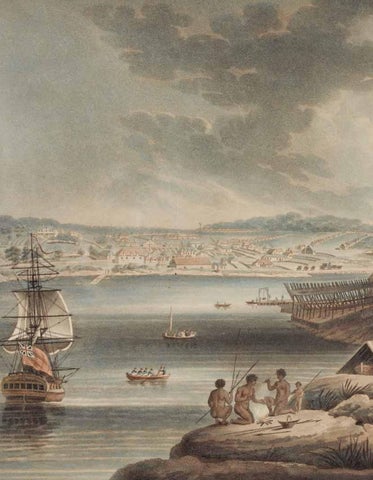
The first published view of what would become Sydney
1
PHILLIP, Arthur; Robert CLEVELEY; and engraved by Thomas MEDLAND A View of Botany Bay. Publication London, Published as the Act directs by J. Stockdale, June 17, 1789. Description Hand-coloured engraving, trimmed to within the platemark, upper right-hand corner damaged, some minor marginal toning. Dimensions 210 by 283mm (8.25 by 11.25 inches). References Ferguson, Australian Bibliography, 47; Hunt and Davison, Sydney Views 1788-1888, 1.
A magnificent view of Botany Bay, at the moment of the arrival of the first ships of the “First Fleet” in late January 1788. Published in Phillip’s official account, The Voyage of Governor Phillip to Botany Bay... (1789). As Captain of the First Fleet, Arthur Phillip(1738–1814) sailed to Australia with the intention of founding a permanent settlement there. He had joined the Royal Navy as barely a teenager in 1751, and had already retired twice after an illustrious career, before being commissioned by Lord Sydney to be the first Governor of New South Wales in 1786. He arrived at Botany Bay in the Supply on the 18th of January, 1788, and by the 20th, was soon joined by the full fleet of 11 ships, and about 750 convicts. First impressions were not good: the Bay was too shallow, there was no fresh water, and scant fertile ground. Three days later, Phillip founded the first convict settlement at Sydney Cove, in Port Jackson. This iconic first published view of what would one day become Sydney, shows the Supply, Alexander, Friendship, and Scarborough moored inside the Heads, with the rest of the fleet just about to cross the bar from the open sea to join them. The accomplished naval artist, Robert Cleveley (1747-1809), did spend much of his professional life aboard ship, however, his illustrations that accompany Phillip’s account, were made from sketches sent home to England by an anonymous artist with the First Fleet. His best known, and most accomplished paintings are related to the American War of Independence and the French Revolutionary Wars. [WITH]: THE LADIES MAGAZINE; after PHILLIP, Arthur; Robert CLEVELEY. View of Botany Bay. London, Published by G. Robinson & Co., January, 1790. Hand-coloured engraving. Published in The Ladies Magazine. (S: 120 by 209mm (4.75 by 8.25 inches); P: 115 by 178mm (4.5 by 7 inches)), toned. On verso pencil ms. 1790. PORTLOCK, Captain Nathaniel; after PHILLIP, Arthur; and Robert CLEVELEY. View of Botany Bay, in New South Wales. Engraved from a drawing made on the spot. London, Alex Hogg, 1794. Hand-coloured engraving. Published in Portlock’s A New, Complete, and Universal Collection of Authentic and Entertaining Voyages and Travels to All the Various Parts of the World (1794). (S: 196 by 214mm; (7.75 by 8.5 inches)). Number of items: 3
8
DANIEL CROUCH RARE BOOKS
“THE FINEST HARBOUR IN THE WORLD” - THE KNOBLAUCH COLLECTION
“The finest harbour in the world, in which a thousand sail of the line may ride in the most perfect security” (Phillip) 2
PHILLIP, Arthur; Robert CLEVELEY; and engraved by T. PRATTENT View in Port Jackson. Publication London, Published as the Act directs by J. Stockdale, 1789. Description Hand-coloured engraving, separation at platemark, strengthened on verso. Dimensions S: 219 by 298mm (8.5 by 11.75 inches); P: 204 by 248mm (8 by 9.75 inches). References Ferguson, Australian Bibliography, 47; Hill, Pacific Voyages, 1346; Hunt and Davison, Sydney Views 1788-1888, 2 and 3; not in McCormick.
A pre-settlement view of Port Jackson, Phillip’s preferred harbour, and the site of the first convict settlement in Australia. Published in Phillip’s The Voyage of Governor Phillip to Botany Bay... (1789). There are not yet any Europeans in sight in this harmonious view depicting First Nations people fishing in the calm waters of Port Jackson. It is one of the earliest views to show Aboriginal people front and centre of the image, not marginalised, not combat ready, and not Europeanised, as would become all too prevalent in following scenes. Phillip is generally regarded as “an enlightened leader for his time,... who sought to establish harmonious relations with the Eora people, the traditional owners of the land in the Sydney area. Local man Bennelong not only acted as an intermediary between Phillip and the Eora, but also seems to have enjoyed a genuine friendship with Phillip... The fledgling colony faced starvation as the lack of skilled farmers, spoilt seed, poor soils and unfamiliar climate saw the failure of the first crops. Phillip’s humane insistence that convict and free should share alike the reduction of their meagre rations was not universally popular; nor were his gifts of land to deserving convicts. But both actions ensured the colony’s survival and initiated an egalitarian spirit still prized in Australia today” (National Museum of Australia online). [WITH]: PHILLIP, Arthur; Robert CLEVELEY; and engraved by Thomas MEDLAND. A View in New South Wales (1789). Hand-coloured engraving (S: 226 by 298mm (9 by 11.75 inches); P: 204 by 261mm (8 by 10.25 inches)), toned. ADAMS, Michael; and John EASTGATE; after PHILLIP, Arthur; Robert CLEVELEY; and engraved by T. PRATTENT. A View in Port Jackson, New South Wales. London, Alex. Hogg, 1794. Engraving (S: 189 by 237mm (7.5 by 9.25 inches)), short repaired marginal tear just affecting the imprint, lightly toned. Published in Adams’s The New Royal System of Universal Geography: Containing a Complete, Full, Particular, and Accurate History and Description of All the Several Parts of the Whole World (1793). An early reprint of the original first published by Stockdale in 1789. Number of items: 3
10
DANIEL CROUCH RARE BOOKS
“THE FINEST HARBOUR IN THE WORLD” - THE KNOBLAUCH COLLECTION
“An icon of the First Settlement” Hunt and Davison
3
HUNTER, John; William BRADLEY; and Edward DAYES View of the settlement on Sydney Cove, Port Jackson 20th August, 1788. Drawn by E. Dayes from a Sketch of J. Hunter. Publication London, Printed for John Stockdale, Piccadilly, January 1, 1793. Description Engraving, toned, laid down on heavier stock. Dimensions S: 218 by 292mm (8.5 by 11.5 inches); P: 200 by 253mm (7.75 by 10 inches). References Ferguson, Australian Bibliography, 152; Hill, Pacific Voyages, 857; Hunt and Davison, Sydney Views 1788-1888, 32; McCormick, First Views of Australia 1788-1825, 7.
12
DANIEL CROUCH RARE BOOKS
The first published view of the first settlement of present-day Sydney. Showing the early days of the first encampment there, and “the quintessential image” (Hunt and Davison) that depicts the foundation of Australia. Windbreaks, tents, small huts, and ships safely at harbour, all nestle neatly beneath the standard Cross of St. George. The original sketch may have been by John Hunter, himself, or may have merely belonged to him, or been by William Bradley (1758-1833), who accompanied Hunter as lieutenant on board the Sirius, the flagship of the First Fleet, and with him conducted the first surveys of Sydney Harbour. After many adventures at sea, including being shipwrecked off the coast of Norway with his father as a young man, John Hunter (1737-1821) voyaged to Sydney as part of the “First Fleet”, and second captain of the Sirius, the convoy’s flagship. An accomplished officer, “Hunter stayed for four years during which he surveyed Port Jackson, Norfolk Island and the bays and rivers around Sydney. He spent three years back in England before being appointed Arthur Phillip’s successor as governor. By the time Hunter returned in 1795, many of the principles established by his predecessor had unravelled under the administration of the New South Wales Corps. Hunter struggled to curb the trade in rum and the “shameful excesses” it created. But he is also remembered for the significant explorations he instigated or conducted himself during his four-year term as governor. A typical man of the scientific Enlightenment, Hunter was skilled in navigation, astronomy, art, botany and writing. His precise observations of Sydney’s topography and people remain among the most important documents of the early years of the British in Australia” (NPG Australia, online). This view was published in Hunter’s official account, An Historical Journal of the Transactions at Port Jackson and Norfolk Island, with the Discoveries which have been made in New South Wales and in the Southern Ocean, since the publication of Phillip’s Voyage, compiled from the Official Papers (1793).
“THE FINEST HARBOUR IN THE WORLD” - THE KNOBLAUCH COLLECTION
[WITH]: HUNTER, John; Edward DAYES; after Thomas WATLING. View at Rose Hill. London, Printed for John Stockdale, Piccadilly, 1792. Handcoloured engraving (S: 215 by 278mm (8.5 by 11 inches); P: 202 by 253mm (8 by 10 inches)). The first published view of Rose Hill, Parramatta, and the farmhouse there. Later this would be the site of old Government House. Published in Hunter’s official account, An Historical Journal of the Transactions at Port Jackson and Norfolk Island, with the Discoveries which have been made in New South Wales and in the Southern Ocean, since the publication of Phillip’s Voyage, compiled from the Official Papers (1793). [AND]: CARMICHAEL, John. Sydney N. S. Wales. 1788. Sydney, c1848. Handcoloured etching (S: 138 by 224mm (5.5 by 8.75 inches)), toned. Number of items: 3
14
DANIEL CROUCH RARE BOOKS
“THE FINEST HARBOUR IN THE WORLD” - THE KNOBLAUCH COLLECTION
Early ethnography
4
WHITE, John Implements of New South Wales. Publication London, Published as the Act directs Dec: 29, 1789 by J. Debrett. Description Hand-coloured engraving. Dimensions S: 283 by 223mm (11.25 by 8.75 inches); P: 221 by 175mm (8.75 by 7 inches). References Ferguson, Australian Bibliography, 97.
A very early and detailed image including a number of First Nations instruments of war (spears, spear throwers, axe, boomerang) and a bark basket. Published in White’s Journal of a voyage to New South with sixty-five plates of non descript animals, birds, lizards, serpents, curious cones of trees and other natural productions (1790). John White (c1756-1832) was chief surgeon of the First Fleet, and began keeping a journal during the voyage. Once in Sydney, he kept notes of local flora and fauna, but paid particular attention to the birds. This was no doubt a distraction from the dire conditions in the fledgling colony, which was facing famine. The arrival of the Second Fleet, in 1790, compounded problems, as many of the new convicts were already dying or seriously ill. In his care of the sick White was somewhat of a hero. Despite a great “lack of medicines and hospital accommodation White and his assistants nursed more than half of them back to health. A similar crisis arose with the arrival of the Third Fleet between July and September 1791. At one time about 600 newly-arrived convicts were under medical treatment and incapable of work and in 1792 the appalling total of 436 died. The strain on White was severe and in December 1792 he applied for leave in England. Nevertheless he pursued his natural history studies and sent many specimens and drawings to England. When Thomas Watling, convict and artist, reached the colony in October 1792 he was assigned to White and in the next two years made many drawings for him. It is possible that White himself had some skill as an artist...” (Rienits for ADB online). Eventually, and as a great relief, White’s application for leave was granted. He arrived in London in July 1795, but was soon delivered an ultimatum to either return or resign. He resigned. [WITH]: ADAMS, Michael; and John GOLDAR; after John HUNTER; and William Stadden BLAKE. A Man, Woman & Children of New South Wales. London, Alex. Hogg, 1793. Hand-coloured engraving (S: 202 by 260mm (8 by 10.25 inches); P: 184 by 255mm (7.25 by 10 inches)), repaired tears and losses affecting the image. Published in Adams’s, The New Royal System of Universal Geography: Containing a Complete, Full, Particular, and Accurate History and Description of All the Several Parts of the Whole World, after the original engraving in Hunter’s An Historical Journal of the Transactions at Port Jackson and Norfolk Island (1793). Number of items: 2
16
DANIEL CROUCH RARE BOOKS
“THE FINEST HARBOUR IN THE WORLD” - THE KNOBLAUCH COLLECTION
The first and last of the First Fleet Journals
5
COLLINS, David; Edward DAYES, after Thomas WATLING; and engraved by James HEATH, and others A direct south view of the town of Sydney taken from the brow of the hill leading to the flag-staff. Publication London, Cadell & Davies, 1798. Description Hand-coloured engraving, trimmed, remargined at top. Dimensions 219 by 273mm (8.5 by 10.75 inches). References Hill, Pacific Voyages, 335; Hunt and Davison, Sydney Views 1788-1888, 4, 5, 6, 7, and 8; McCormick, First Views of Australia 1788-1825, 37, 38, 41, 43, 45, 47, 48, 49.
A superb view of the early settlement at Sydney Cove, Port Jackson, based on original drawings, now lost, by convict artist Thomas Watling. The scene shows Arthur Phillip’s original Government House to the far left, across the Cove, and takes in what would become Circular Quay, from Dawes Point, looking south along present-day George Street. Thomas Watling (born 1762), arguably the best-known of Australia’s early convict artists, was first a coach-painter from Dumfries in Scotland. He was charged with forging bank notes in 1788. Rather than risk conviction, and probable execution, he requested transportation instead, and was sentenced to 14 years in the new penal colony of New South Wales. He was duly shipped off in July of 1791, with 409 other convicts, in the Pitt. After a few adventures along the way, which included escape and recapture in Cape Town, Watling arrived in Sydney in October of 1792. He was immediately assigned to the surgeon-general, John White (c1756-1832), author of Journal of a Voyage to New South Wales (1790), and a keen naturalist, who employed Watling as artist until 1794. Upon White’s return to England in December of 1794, Watling worked for Collins, who used his sketches, in his own An Account of the English Colony in New South Wales (1798 and 1802), after their being re-worked by established English artist, Edward Dayes. David Collins (1756-1810) sailed in the Sirius with the First Fleet, arriving at Botany Bay on the 20th of January 1788. As a result of disappointment in the lack of fresh water, and other amenities, at Botany Bay, required for successful settlement, Collins accompanied the party that explored Port Jackson, and was instrumental in concluding the fleet’s transfer to Sydney Cove. The colony’s first government was inaugurated on the 7th of February, with Collins reading the relevant Act, commissions and letters patent. In June of 1788 Governor Phillip appointed him as secretary to the governor, and colony. Upon his return to England in 1797, Collins published his An Account,..., which being “more complete in detail than earlier works on the colony, and claimed as its object the dissuasion of his countrymen from regarding New South Wales with “odium and disgust”... received deserved praise and sold reasonably well, and a German edition followed in 1799. After the second volume, which was largely based on Hunter’s reports, was published in 1802, [his wife] helped to abridge and edit his work in a single volume in 1804” (ADB online). [WITH]: A selection of other views from the same work. - A view of the Governor’s house at Rose-hill in the township of Parramatta. London, Cadell & Davies, 1798. Hand-coloured engraving (S: 215 by 275mm (8.5 by 10.75 inches)), close-trimmed, repaired marginal tear affecting the imprint, toned.
18
DANIEL CROUCH RARE BOOKS
“THE FINEST HARBOUR IN THE WORLD” - THE KNOBLAUCH COLLECTION
- By water to Parramatta; with a distant view of the western mountains, taken from the Wind mill[-hill at Sydney]. London, Cadell & Davies, 1798. Handcoloured engraving (S: 195 by 255mm (7.75 by 10 inches)), trimmed to the platemark and laid down on heavier stock. - An Eastern View of Sydney, taken from a small prominence, nigh the New barracks. London, Cadell & Davies, 1798. Hand-coloured engraving (S: 210 by 276mm (8.25 by 10.75 inches)), trimmed to within platemark, top edge remargined affecting the image, laid down on heavier stock. - A South East View in Sydney, extending from the old to the new Barracks including the church, Pitt and Spring Rows. London, Cadell & Davies, 1798. Hand-coloured engraving (S: 216 by 276mm (8.5 by 10.75 inches)), close-trimmed, repaired marginal tear extending into the image, toned. - A Western View of Sydney Cove. London, Cadell & Davies, 1798. Handcoloured engraving (S: 213 by 275mm (8.5 by 10.75 inches)), trimmed to within the platemark, bottom margin renewed, not affecting the image. - The North View of Sydney-Cove, taken from the end of Pitt’s Row. London, Cadell & Davies, 1798. Hand-coloured engraving (S: 210 by 263mm (8.25 by 10.25 inches)), trimmed to within the platemark, laid down on heavier stock.
22
DANIEL CROUCH RARE BOOKS
“THE FINEST HARBOUR IN THE WORLD” - THE KNOBLAUCH COLLECTION
- The Brick-field-hill, or High road to Parramatta, August 11.1796. London, Cadell & Davies, 1798. Hand-coloured engraving (S: 210 by 260mm (8.25 by 10.25 inches)), close-trimmed, toned. - A western view of Toongabbe. London, Cadell & Davies, 1798. Handcoloured engraving (S: 116 by 146mm (4.5 by 5.75 inches), trimmed to within the platemark and laid down on gauze. - Baker’s Farm, high land on the banks of the river. London, Cadell & Davies, 1798. Hand-coloured engraving (S: 115 by 152mm (4.5 by 6 inches)), trimmed to within the platemark and laid down on gauze. - Saunderson’s Farm, Looking down the River. London, Cadell & Davies, 1798. Hand-coloured engraving (S: 114 by 151mm (4.5 by 6 inches)), trimmed to within the platemark and laid down on gauze. - A night scene in the Neighbourhood of Sydney. London, Cadell & Davies, 1798. Hand-coloured engraving (S: 196 by 255mm (7.75 × 10 inches)), some short marginal tears, laid down on heavier stock. - An Aboriginal family camped near Sydney by moonlight. London, Cadell & Davies, 1802. Engraved vignette (S: 264 by 211mm (10.5 × 8.25 inches)). Number of items: 13
26
DANIEL CROUCH RARE BOOKS
“THE FINEST HARBOUR IN THE WORLD” - THE KNOBLAUCH COLLECTION
By “the prince of pickpockets”, in urban Sydney?
6
[ANONYMOUS], as “George BARRINGTON”; Edward DAYES, after Thomas WATLING, and others; and engraved by Vincent WOODTHORPE, after James HEATH, and others Sydney. Publication London, M. Jones, Dec. 24. 1802. Description Hand-coloured engraving. Dimensions S: 122 by 207mm (4.75 by 8.15 inches); P: 118 by 192mm (4.75 by 7.5 inches) . References Abbey, Travel, 565; Ferguson, Australian Bibliography, 206, 328, and 345; Hill, Pacific Voyages, 59 and 60; Hunt and Davison, Sydney Views 1788-1888, 9, 10, 11, 13, and 14; McCormick, First Views of Australia 1788-1825, figures 4, 5, 6, 7, 9, and 10.
The real George Barrington, sometimes George Waldron, led an extraordinary life equal to the best picaresque narratives of the late eighteenth, early nineteenth centuries. He was “a legendary prince of rogues. Living in great style and posing as a gentleman, he stole the hearts of influential friends as readily as their purses” (ADB online). Eventually, his persuasive patrons, and charming eloquence, failed him, and Barrington was transported to Sydney in 1791. However, this proved to be a wonderful reversal of fortunes for Barrington, who literally ate, and drank, up all the opportunities his new circumstances presented him. He was soon elevated to the police watch that protected the government stores, received a conditional pardon, appointed chief constable at Parramatta, and became a gentleman of property. Eventually, his dissolute life caught up with him in 1804, and he became “infirm”. Some say, from excessive drinking, others from general “malversation” of government property, but actually from lunacy, and was soon dead. Barrington had gained a certain notoriety about and without the colony - many works, including salacious chapbooks, and An Account of A Voyage To New South Wales by George Barrington (1802), and The History of New South Wales, including Botany Bay, Port Jackson, Parramatta, Sydney, and all its Dependencies (1810), were credited to him for profit’s sake. These latter two, which included this illustration, and the ones below, are largely reworked, and illustrated after, that by David Collins (see item 5). [WITH]: From: An Account of A Voyage To New South Wales by George Barrington (1802): - South view of Sydney. London, M. Jones, 1803. Hand-coloured engraving (S: 123 by 208mm (4.75 by 8.25 inches); P: 118 by 192mm (4.75 by 7.5 inches)), toned. - East View of Sydney. London, M. Jones, 1803. Hand-coloured engraving (S: 123 by 208mm (4.75 by 8.25 inches)), unevenly toned. - View of the new church at Parramatta. London, M. Jones, 1803. Wood engraving (S: 129 by 205mm, (5 by 8 inches)), letterpress text on verso, trimmed to within platemark. - Garden Island. London, M. Jones, 1803. Hand-coloured engraving (S: 124 by 207mm (5 by 8.25 inches); P: 116 by 195mm (4.5 by 7.75 inches)). - Town & Cove of Sydney. London, M. Jones, 1803. Hand-coloured engraving (S: 120 by 207mm (4.75 by 8.25 inches); P: 103 by 177mm (4 by 7 inches)), unevenly toned.
28
DANIEL CROUCH RARE BOOKS
“THE FINEST HARBOUR IN THE WORLD” - THE KNOBLAUCH COLLECTION
- Entrance of Parramatta River. London, M. Jones, 1803. Hand-coloured engraving (S: 124 by 208mm (5 by 8.25 inches); P: 113 by 180mm (4.5 by 7 inches)). From: The History of New South Wales, including Botany Bay, Port Jackson, Parramatta, Sydney, and all its Dependencies (1810): - Burning the Dead. London, M. Jones, 1810. Hand-coloured engraving (S: 125 by 208mm (5 by 8.25 inches); P: 116 by 193mm (4.5 by 7.5 inches)), toned. - Emu. London, M. Jones, 1810. Hand-coloured engraving (S: 205 by 122mm (8 by 4.75 inches); P: 191 by 115mm (7.5 by 4.5 inches)), toned. Number of items: 9
30
DANIEL CROUCH RARE BOOKS
“THE FINEST HARBOUR IN THE WORLD” - THE KNOBLAUCH COLLECTION
The first separately published view of Sydney
7
WATLING, Thomas; engraved by William Stadden BLAKE A View of the Town of Sydney in the Colony of New South Wales Taken from the rising ground near the Court House on the West side of the Cove. Publication London, Published as the Act directs, June 1st, 1802. Description Hand-coloured engraving with aquatint. Dimensions S: 452 by 568mm (17.75 by 22.25 inches); P: 352 by 487mm (13.75 by 19.25 inches).
Often referred to as “Blake’s View”, this “flattering and celebratory view of industry, peace and progress in the new colony” (Hunt and Davison) is based on an oil painting, dated to 1799, sometimes attributed to Thomas Watling, but probably after an original sketch by him, which returned to England with Governor John Hunter in 1800. The promise of the young town of Sydney burgeons beneath a rising sun, illuminating the clearly identifiable streets and buildings: divided geographically, and socially by the Tank Stream. To the east is easy establishment, including Government House; and to the west, industry, including the barracks, gaol, and stores. The lower margin of the scene is dominated by an elaborate dedication to Hunter from William Stadden Blake (c1748-1822), master engraver, not to be confused with William Blake (1757-1827), poet, painter and printmaker.
References Hunt and Davison, Sydney Views 17881888, 33; McCormick, First Views of Australia 1788-1825, 51.
Number of items: 1
32
“THE FINEST HARBOUR IN THE WORLD” - THE KNOBLAUCH COLLECTION
DANIEL CROUCH RARE BOOKS
The separately issued “Dayes”, or “Jukes” view
8
DAYES, Edward; after Thomas WATLING; engraved by Francis JUKES A view of Sydney Cove, New South Wales. From an Original Picture in the possession of Isaac Clementson Esq.r. [and]: Explanatory description of the publick buildings &c of the town of Sydney, Port Jackson, as express’d in the view engraved under the inspection of Mr Thomson, late Acting Chief Surgeon to the settlement. Drawn by E. Dayes, from a Picture painted at the Colony; Engraved by F. Jukes. Publication London, F. Jukes, No. 10 Howland Street, April 10, 1804. Description Third state. Hand-coloured engraving with aquatint, trimmed to within the platemark; accompanied by an engraved plan (S: 254 by 355mm (10 by 14 inches); P: 211 by 315mm (8.25 by 12.5 inches), toned. Dimensions 447 by 609mm (17.5 by 24 inches). References Hunt and Davison, Sydney Views 17881888, 34; McCormick, First Views of Australia 1788-1825, 54 and 55.
An extremely detailed and early view of Sydney, accompanied by the very rare, invaluable, first published key to the town’s buildings. This is the third of three exceptionally rare states of this separately published view, all dating from about 1804. Often referred to as the “Dayes” or “Jukes” view, the original drawing for this superb scene, now lost, was probably drawn by the wellknown convict artist, Thomas Watling, in about 1799. It differs from the previous states by the length of the ship’s pennant, which was much longer, its swallowtail streamers stretching all the way to the dock at Simeon Lord’s Warehouses, and by evidence of the erasure of the streamers in the plate. The first and third states were both published by Jukes at his Howland Street address. Francis Jukes (1745-1812) was a prolific engraver and publisher, chiefly known for his topographical and shipping prints, the majority in aquatint. Edward Dayes (1763-1804) began his career as a miniaturist, but later found steady, if not inspiring, work creating elegant watercolour drawings from the sketches of amateurs. His commissions included realising illustrations from Lord Stanley’s trip to Iceland (1789), James Moore’s Twenty Five Views in the Southern Part of Scotland (1794), and other patrons, including the supporters of Australian convict artist Thomas Watling. [WITH]: MEYER, Joseph; after Edward DAYES; and Thomas WATLING. Sydney in New South Wales. Hildburghausen and New York, Bibliographischen Institut, 1835. Uncoloured engraved view (S: 185 by 253mm (7.25 by 10 inches); P: 135 by 188mm (5.25 by 7.5 inches); I: 106 by 152mm (4.25 by 6 inches)). Published in Meyer’s Universum, oder, Die schönsten Ansichten der Erde (1835). Number of items: 3
34
DANIEL CROUCH RARE BOOKS
“THE FINEST HARBOUR IN THE WORLD” - THE KNOBLAUCH COLLECTION
The Baudin expedition
9
BAUDIN, Nicolas Thomas; Francois PERON; CharlesAlexandre LESUEUR; Victor PILLEMENT; and Marie-Alexandre DUPARC Nouvelle-Hollande, Nouvelle Galles du Sud, vue de la partie méridionale de la ville de Sydney. Capitale des Colonies Anglaises aux Terres Australes, et de l’Embouchure de la rivière de Parramatta (1803). Publication Paris, de l’Imprimerie Impériale, 18071816. Description Engraved panorama, old folds, laid down on archival paper. Dimensions S: 300 by 523mm (11.75 by 20.5 inches); P: 242 by 495mm (9.5 by 19.5 inches). References Hill, Pacific Voyages, 1329 and 1330; Hunt and Davison, Sydney Views 1788-1888, 36, 37, and 38; McCormick, First Views of Australia 1788-1825, 65 and 69.
In 1800, Napoleon Bonaparte commissioned Captain Nicolas Thomas Baudin (1754–1803) to complete the discovery of “Terra Australis”. He duly set forth with two ships, Le Géographe and Le Naturaliste in order to find a strait which supposedly divided the Australian island in two halves. The French zoologist François Auguste Péron (1775–1810), who had studied under the anatomist Georges Cuvier in Paris, was the naturalist of the expedition, and Louis Claude de Saulces de Freycinet (1779–1842) served as cartographer. Meanwhile, Matthew Flinders was also attempting a circumnavigation of the Australian Continent, and the explorers met each other in the consequently named “Encounter Bay”. Although Flinders completed the task before Baudin’s expedition, he had the misfortune to be captured and imprisoned for six years at Mauritius on his voyage home, and his charts and manuscripts also held hostage. This allowed the French explorers to print their account of the new discoveries before Flinders, and to produce the first complete chart of the Australian continent in 1807. When Baudin died during the voyage in 1803, Freycinet took over command, much to the relief of all, and brought the expedition back to France. On the return of the expedition, Péron was charged with producing the narrative for publication. However, he died in 1810 before the second volume had been finished, with the result that the work had to be completed by Freycinet. This sweeping panorama of Sydney appears as plate XXXVIII in the first atlas volume of Péron’s account: Voyage de découvertes aux Terres Australes, exécuté par ordre de S. M. l’Empereur et Roi. Partie historique rédigée par M. F. Péron. Atlas par Mm. Lesueur et Petit (1811). [WITH]: A selection of other views and plates from the same work: - Nouvelle Hollande, N[ouv]elle Galles du Sud, navigation. Engraved view (S: 261 by 339mm (10.25 by 13.25 inches); P: 241 by 314mm (9.5 by 12.25 inches)), toned. - Mollusques et zoophytes. Stipple-engraving (S: 335 by 248mm (13.25 by 9.75 inches)), printed in colour, toned. - Mollusques et zoophytes. Stipple-engraving (S: 367 by 265mm (14.5 by 10.5 inches); P: 313 by 241mm (12.25 by 9.5 inches)), printed in colour, toned. - Mollusques et zoophytes. Stipple-engraving (S: 335 by 249mm (13.25 by 9.75 inches); P: 315 by 240mm (12.5 by 9.5 inches)), printed in colour, toned. - Nouvelle Hollande, N[ouv]elle Galles du Sud, ornithorinque. Stipple-engraving (S: 257 by 357mm (10 by 14 inches)), printed in colour, top margin trimmed to within platemark. Platypus.
36
DANIEL CROUCH RARE BOOKS
“THE FINEST HARBOUR IN THE WORLD” - THE KNOBLAUCH COLLECTION
- Nouvelle Hollande, N[ouv]elle Galles du Sud, vue d’une partie de la ville de Sydney capitale des Colonies Anglaises aux Terres Australes, et de l’entree du Port Jackson dans lequel ville est située. Hand-coloured engraving (S: 252 by 340mm (10 by 13.5 inches); P: 235 by 310mm (9.25 by 12.25 inches)), one or two spots. Plate 18. From: PERON, Francois. Voyage de decouvertes aux terres australes (1824): - Nouvelle-Hollande, Y-erran-gou-la-ga. Stipple-engraving (S: 335 by 259mm (13.25 by 10.25 inches); P: 320 by 244mm (12.5 by 9.5 inches)), printed in colour, and heightened with hand-colour. - Nouvelle-Hollande, N[ouv]elle Galles du Sud, Nourou-gal-derri s’avancant pour combattre. Stipple-engraving (S: 339 by 253mm (13.25 by 10 inches); P: 312 by 242mm (12.25 by 9.5 inches)). - Nouvelle-Hollande, Nouvelle Galles du Sud, grottes, chasse et peche des sauvages du Port Jackson. Hand-coloured engraving (S: 180 by 257mm (7 by 10 inches)), toned. From: FREYCINET, Louis Claude de Saulces de, Voyage de L’Uranie et la Physicienne - atlas historique (1825): - Nouvelle-Hollande, Port Jackson, ceremonie de l’enterrement des Sauvages. Paris, Pillet, aîné, 1825. Engraving (S: 304 by 412mm (12 by 16.25 inches); P: 237 by 319mm (9.25 by 12.5 inches)). Separation at platemark, short marginal tears, toned. - Port Jackson, vue de la maison du gouverneur a Parramatta. dess. par Marchais d’apres un dessin communique; grave par Schroeder. Hand-coloured engraving (S: 160 by 241mm (6.25 by 9.5 inches)), spotted. - Nouvelle Hollande, Port Jackson, Vue de L’eglise de Parramatta en 1819. dess. par Marchais d’apres un dessin communique; grave par Schroeder. Handcoloured engraving (S: 157 by 240mm (6.25 by 9.5 inches)), close-trimmed, some spotting. - Port-Jackson. Plan et Elevation de la Caserne des Convicts, A Sydney. dess. par Marchais d’apres un dessin communique; grave par Schroeder. Handcoloured engraving (S: 321 by 249mm (12.75 by 9.75 inches)), close-trimmed.
40
DANIEL CROUCH RARE BOOKS
“THE FINEST HARBOUR IN THE WORLD” - THE KNOBLAUCH COLLECTION
From: other European editions: - Sidney in Neu Holland. [Probably Leipzig, after 1807]. Wood-engraved view (S: 162 by 190mm (6.5 by 7.5 inches)), light toning. - Ansicht von Sydney von der Südseite, und der Mündung des Parramatta-Flußes. Weimar, Verlage des Landes=Industrie Comptoire, 1808. First German edition. Engraved panoramic view (S: 212 by 343mm (8.25 by 13.5 inches); P: 175 by 328mm (7 by 13 inches)). Published in Péron, Entdeckungsreise nach Australien, I (1808), toned. - Ansicht von Sydney von der Südseite, und der Mündung des ParramattaFlußes. Weimar, Verlage des Landes=Industrie Comptoire, 1808. First German edition. Hand-coloured wood engraved folding panoramic view (S: 196 by 342mm (7.75 by 13.5 inches)). Published in Péron, Entdeckungsreise nach Australien, I (1808). - [Untitled - Cabanes - Terre de Diemen, Habitations]. Milan, Giulio Ferrario, 1818. Hand-coloured engraving (S: 248 by 355mm (9.75 by 14 inches); P: 185 by 226mm (7.25 by 9 inches)). Published in Ferrario, Il costume antico e moderno, volume IV, plate 60. - [Untitled Ethnographical scene]. Milan, Giulio Ferrario, 1818. Handcoloured engraving (S: 249 by 359mm (9.75 by 14.25 inches); P: 160 by 220mm (6.25 by 8.75 inches)). Published in Ferrario, Il costume antico e moderno, volume IV, plate 64. - Beerdigungs Gebrauch der Wilden. [Meissen, F. W. Goedsche, c1835]. Lithograph (S: 134 by 163mm (5.25 by 6.5 inches)), top margin renewed, laid down on heavier stock. Published in Vollständige Völkergallerie in getreuen Abbildungen aller Nationen der Welt mit ausführlicher Beschreibung derselben. - Australien / Sÿdneÿ. [Meissen, F. W. Goedsche, c1835]. Hand-coloured lithograph (S: 139 by 164mm (5.5 by 6.5 inches)), laid down on heavier stock. Published in Vollständige Völkergallerie in getreuen Abbildungen aller Nationen der Welt mit ausführlicher Beschreibung derselben. - Australien / Port Jackson. [Meissen, F. W. Goedsche, c1835]. Handcoloured lithograph (S: 129 by 163mm (5 by 6.5 inches)), laid down on heavier stock, some minor marginal toning.
“THE FINEST HARBOUR IN THE WORLD” - THE KNOBLAUCH COLLECTION
DANIEL CROUCH RARE BOOKS
41
- Australien / Die Kirche von Paramata. [Meissen, F. W. Goedsche, c1835]. Hand-coloured lithograph (S: 140 by 166mm (5.5 by 6.5 inches)), laid down on heavier stock. Published in Vollständige Völkergallerie in getreuen Abbildungen aller Nationen der Welt mit ausführlicher Beschreibung derselben. - Sidney in Neu Sud Wallis. Darmstadt, Verlag der Kunstanstalt von Conrad Susemihl & Sohn, [c1845]. Later German edition. Hand-coloured etching (S: 171 by 247mm (6.75 by 9.75 inches); P: 138 by 177mm (5.5 by 7 inches)), old centrefold, pencilled annotations on verso. - Sydney. Selvaggi del Monti bleu [Aborigines of the Blue Mountains]. Zürich, Honeggeresche Lithographische Anstalt, 1845. Lithograph (S: 284 by 199mm (11.25 by 7.75 inches)). Number of items: 25
42
DANIEL CROUCH RARE BOOKS
“THE FINEST HARBOUR IN THE WORLD” - THE KNOBLAUCH COLLECTION
Sheltering from the oncoming storm
10
FLINDERS, Captain Matthew, R.N.; William WESTALL; and John PYE View of Port Jackson taken from the South Head. Publication London, G. & W. Nicol, 1814. Description Engraving, some light spotting. Dimensions S: 255 by 360mm; (10 by 14.25 inches). References Hill, Pacific Voyages, 614.
44
DANIEL CROUCH RARE BOOKS
A very evocative view of a First Nations family sheltered from the wind and the rain coming off the harbour by a large outcropping of rocks, a beautiful banksia, a tall grass tree, and a willowy eucalypt. Published in Flinders’s A Voyage to Terra Australis, the official account of the first circumnavigation of Australia: “the most outstanding book on the coastal exploration of Australia” (Wantrup). Flinders sailed from England on 18 July 1801, and during the next two years he surveyed the entire coast of Australia from Cape Leeuwin to Bass Strait. He returned to Port Jackson in 1803 having completed the first circumnavigation of Australia, thus establishing that it was a continent. The text offers a day-by-day record of the expedition. To this work Flinders prefixed an elaborate introduction relating the prior discoveries of the Dutch on the North West and South Coasts of Australia, short accounts of Tasman, Cook, Marion, and his own boat expedition with Bass in which Tasmania was circumnavigated for the first time. Flinders sailed on Bligh’s second expedition in 1792, and he includes a brief account from his own journal of the discoveries then made in Torres Straits, as well as an appendix by the expedition botanist, Robert Brown: General Remarks, Geographical and Systematical, on the Botany of Terra Australis (Appendix III, pp. 533–613 in vol. 2). Flinders received little formal training in surveying, but his achievements on this voyage, working under very difficult circumstances, established him as one of the greatest of all coastal surveyors. His natural ability, allied with the great pains he took to insure the accuracy of the printed results, have ensured that the present work is of monumental cartographical significance and that it should be “the centerpiece of any collection of books dealing with Australian coastal discovery” (Wantrup). On his return voyage to England, Flinders was forced by the state of his ship to seek assistance at the French island of Mauritius. There, despite his passport that instructed all French officers to render him assistance, the French Governor, General De Caen, arrested Flinders, accusing him of spying, and impounded his papers. Ignoring numerous official protests and disregarding even a direct order from Napoleon, De Caen held Flinders prisoner on Mauritius for the next six and a half years, finally releasing him on 14 June 1810. Although mortally ill, Flinders spent the last years of his too-short life preparing this detailed record of the Investigator voyage.
“THE FINEST HARBOUR IN THE WORLD” - THE KNOBLAUCH COLLECTION
William Westall (1781-1850), British painter and engraver, was in his first year at the Royal Academy when he was put forward to serve as official artist on the voyage of Matthew Flinders, the first recorded person to circumnavigate Australia and name it as a continent. He made drawings of the Australian landscape and people, and won a race to the highest mountain in Port Bowen and therefore the right to name it, which is why it is now called Mount Westall. After his return he worked mainly in illustration and landscape views. John Pye (1782-1874), a leading British landscape engraver, was trained by his father, Charles Pye. He moved to London in 1801, where he worked for the celebrated engraver James Heath and developed a reputation for his delicate handling of landscape, light and atmosphere. He later became closely associated with J. M. W. Turner. In 1814 Pye engraved several of William Westall’s Australian drawings, made during Matthew Flinders’s voyage. [WITH]: WESTALL, William; and J. BAILY. Port Jackson, New South Wales. London, J. Gold, 1809. Engraving with aquatint (S: 148 by 229mm (5.75 by 9 inches)), binding marks to bottom margin. Published in the Naval Chronicle, volume 22, plate 297. Number of items: 2
46
DANIEL CROUCH RARE BOOKS
“THE FINEST HARBOUR IN THE WORLD” - THE KNOBLAUCH COLLECTION
Eyre’s excruciatingly rare panorama of Sydney
11
MANN, David Dickenson; John EYRE; and John Heaviside CLARK View of Sydney from the West Side of Cove No. 1 [and] View of Sydney from the West Side of Cove No. 2. Publication London, John Booth, Duke Street, Portland Place, June 4th, 1810. Description Pair of hand-coloured engraved aquatints, previously bound en plano. Dimensions S: 480 by 645mm (19 by 25.5 inches); P: 410 by 550 mm (16.25 by 21.75 inches). References Bryan’s Dictionary of Painters and Engravers, 1886; Ferguson, Australian Bibliography, 518; Hunt and Davison, Sydney Views 1788-1888, 39 and 40; McCormick, First Views of Australia 17881825, 94, 95, 96, and 97.
The first two sheets of an intended monumental panorama of Sydney in four sheets. They were first issued separately and then published, as here, with David Mann’s Present Picture of New South Wales (1811). Both Mann, and the artist, John Eyre, were early convicts in the penal colony at Sydney. Together they have provided “the best contemporary account of the development and state of progress in the town” to date. Amongst Eyre’s earliest views of Sydney, this panorama showcases a cleanlined prosperous town, attractive to any émigré. Some well-documented dilapidations have been omitted, such as the first government windmill in Fort Phillip, which appears proudly on the horizon. John Eyre (born 1771), originally a weaver from Coventry, England, was sentenced to transportation for seven years for housebreaking, in 1799. He arrived in Sydney aboard the Canada late in 1801. Within a month of receiving a conditional pardon in June of 1804, he advertised for a box of water-colours, and was soon painting his local environs, and... house numbers. He is best known for these images of Sydney, painted for his friend David Mann, and those that he created for another friend, Absalom West (see items 14 and 15). Eyre left Sydney in 1812, and is barely heard of again. David Dickenson Mann (born c1775), had served in the households of the Duke of Northumberland, and Lord Charles Somerset, younger son of the fifth Duke of Beaufort. But in 1798, he was tried at the Old Bailey for forging a receipt for money, which he had actually embezzled to pay gambling debts. He was sentenced to transportation, and arrived in Sydney aboard the Hillsborough in 1799. He redeemed himself somewhat, under Philip King’s governorship, and served as a schoolmaster, as well as clerk to the Naval Officer, the Committee for the Erection of Jails, and to the Orphan Committee. After his pardon in 1802, he worked in the Colonial Secretary’s office. However, like many, he soon got on the wrong side of Governor William Bligh, and joined the rebel cause when Bligh was deposed. He returned to England with Colonel George Johnston in 1809, and published The Present Picture of New South Wales (1811), after which, as with Eyre, nothing is heard from him again. John “Waterloo” Heaviside Clark (1771-1863), was an accomplished illustrator who frequently used aquatint. He is referred to as “Waterloo Clark” because of a series of “sketches he made on the field directly after the battle. He was the author of A practical essay on the art of Colouring and Painting Landscapes with illustrations, published in 1807, and A practical Illustration of Gilpin’s Day (1824)” (Bryan). Number of items: 2
48
DANIEL CROUCH RARE BOOKS
“THE FINEST HARBOUR IN THE WORLD” - THE KNOBLAUCH COLLECTION
Eburne’s Eyres
12
EBURNE, Emma; after John EYRE; and printed by Charles Joseph HULLMANDEL View of part of the town of Sydney and harbour of Port Jackson, New South Wales, in Sepr 1806, as seen from the west [and] View of the town and cove of Sydney, New South Wales, in Sepr 1806, as seen from the east. Drawn by M.r Eyre. Lithographed by Miss Emma Eburne. Publication London, Mess.rs Colnaghi & Puckle, 23 Cockspur Street, 4th June, 1840. Description A pair of hand-coloured lithographs, torn with loss just affecting the image, unevenly toned. Dimensions S: 346 by 549mm (13.5 by 21.5 inches). References McCormick, First Views of Australia 17881825, 98 and 99.
A very rare pair of panoramas by Emma Eburne, after drawings by John Eyre. Although the views claim in their title to date from 1806, McCormick dates them to 1809. They are quite a departure for Eburne, later Oliver, and even later still Emma Sedgwick (1819–1885). She was an esteemed English watercolourist, who was a member of the New Society of Painters in Water Colours, now Royal Society of Painters in Water Colours, who exhibited landscapes at the Royal Academy, the British Institution, the Royal Society of British Artists, and numerous provincial galleries, including the Suffolk Fine Arts Association at Ipswich. Eburne travelled much in Europe with her first husband, the artist William Oliver, but does not seem to have ventured as far as Australia. [WITH]: MANN, David D.; John EYRE; and John Heaviside CLARK. New South Wales 1810. Sydney, William Dymock, 1884. Facsimile edition. 4 colour prints (S: 475 by 650 mm (18.75 by 25.5 inches); P: 410 by 550mm (16.25 by 21.75 inches)). No 1 View of Sydney from the east side of the cove; No 2 View of Sydney from the west side of the cove; No 3 View of Sydney from the east side of the cove; No 4 View of Sydney from the west side of the cove. Number of items: 6
50
DANIEL CROUCH RARE BOOKS
“THE FINEST HARBOUR IN THE WORLD” - THE KNOBLAUCH COLLECTION
One of only three known examples
13
MOFFAT, James; after John William LEWIN View of the Town and Cove of Sydney, New South Wales. Publication London, [c1812]. Description Hand-coloured engraving with aquatint, laid down on archival tissue. Dimensions S: 320 by 442mm (12.5 by 17.5 inches); P: 260 by 380mm (10.25 by 15 inches). References Hunt and Davison, Sydney Views 17881888, 45; Mander-Jones, ADB online; McCormick, First Views of Australia 17881825 (questioning the plate’s authenticity).
This exceptionally rare view, clearly based on an untitled watercolour attributed to John William Lewin (see McCormick 113), is by a littleknown, but very talented and distinctive engraver, James Moffat. Both the watercolour, and this print, can be dated to about 1812, as Palmer’s Mill is clearly shown, and the large commissariat store appears on the west side of the harbour. “This beautiful and delicate aquatint clearly acknowledges the presence of Indigenous people in the harbour. The slender vessel (foreground centre) with two seated figures and a plume of smoke from a cooking fire amidships, represents two Eora people in their stringy-bark canoe or ‘nowey’. For many thousands of years, the harbour had been their highway and a principal source of food, the men fishing in the shallows or from rocks with pronged fishing spears or ‘mooting’, the women from canoes, with handlines and shell lures” (SLNSW, Sydney Harbour: Seldom Seen, 2007). As a young lad of only 14, James Moffat (1775-1815) arrived in India in 1789. By 1797, he was advertising his prints in the Calcutta Gazette. John William Lewin (1770-1819), naturalist and artist, was a son of William Lewin, well-known naturalist, author of The Birds of Great Britain (1789-1794) to which both of his sons contributed. After a few hiccups, John William arrived in Sydney aboard the Minerva, in January of 1800. He managed to pursue his career as naturalist and artist, publishing Prodromus Entomology, Natural History of lepidopterous Insects of New South Wales (1805), Birds of New Holland (1808), and Birds of New South Wales (1813), in spite of never quite settling or prospering in the colony. Lewin had “hoped that the proceeds from the sale of his two books would enable him to return to England. Although this hope was not realized they greatly enhanced his fame and Drury secured his election as an associate of the Linnean Society in 1801... There is a collection of Lewin’s paintings in the Mitchell Library, Sydney, and a number of natural history watercolour drawings in the Rex Nan Kivell Collection in the National Library of Australia. His contemporaries esteemed him for his paintings of natural history subjects and of [First Nations People]” (Mander-Jones). Rare: two institutional examples are known, as part of the Rex Nan Kivell collection at the National Library of Australia; and at the State Library of New South Wales, part of the Sir William Dixson bequest. Number of items: 1
54
DANIEL CROUCH RARE BOOKS
“THE FINEST HARBOUR IN THE WORLD” - THE KNOBLAUCH COLLECTION
One of the colony’s first permanent residences
14
EYRE, John; and Walter PRESSTON [PRESTON] View of the seat of Woolloomoola [sic] near Sydney, in New South Wales. Dedicated to His Excellency Lachlan Macquarie, Governor of New South Wales. Sydney. Engraved by Presston [sic], drawn by J. Eyre. Publication Sydney, Absalom West, Feb. 1st, 1813 [but 1814]. Description Hand-coloured engraving, toned, marginal tears and repairs, laid down on archival paper. Dimensions 268 by 392mm (10.5 by 15.5 inches).
Plate 13, the first, in the second series of Absalom West’s publication of John Eyre’s views of Sydney and environs: “an extra collection of Twelve beautiful views of New South Wales...” (publisher’s broadside). It is a view of “Woolloomooloo House”, built by John Palmer (1760-1833) in about 1793, when he decided to settle in New South Wales. In February 1793 Lieutenant-Governor Francis Grose “had granted Palmer 100 acres at the head of Garden Island Cove, then known as Palmer’s Cove. Here, set in an extensive orchard, Palmer built Woolloomooloo Farm, one of the colony’s first permanent residences, where the Palmers lived and elegantly entertained the first rank of colonial society” (Steven). Rare: Only four complete sets of West’s views are known, and individual plates appear infrequently. Number of items: 1
References McCormick, First Views of Australia 17881825, 128; Steven, for ADB online.
56
DANIEL CROUCH RARE BOOKS
“THE FINEST HARBOUR IN THE WORLD” - THE KNOBLAUCH COLLECTION
Among the earliest engraved views of Sydney to be entirely produced in Sydney
15
EYRES [sic], John; and Walter PRESSTON [PRESTON] View of part of Sydney, the capital of New South Wales, taken from Dawes’s Point. Dedicated to His Excellency Lachlan Macquarie, Governor of New South Wales. Sydney, November 30th, 1812. Drawn by J. Eyres [sic], engraved by W. Presston [sic]. Publication Sydney, A. West, Nov.r 30th: 1813. Description Engraving, skilfully repaired tears occasionally affecting the image. Dimensions 261 by 380mm (10.25 by 15 inches). References Hunt and Davison, Sydney Views 17881888, 70; McCormick, First Views of Australia 1788-1825, 120.
Plate number 9 from the first series of Absalom West’s publication of John Eyre’s views of Sydney, the earliest of Sydney to be entirely drawn, engraved, printed and published in Sydney: “his select Collection of beautiful Views in New South Wales...” (publisher’s broadside). Based on a “lost drawing by Eyre, this view shows Billy Blue’s house on the far shore, the three private windmills of Boston, Palmer and Kable, and the exposed chimney breast forming part of Macquarie’s extension to the rest of Government House. A good study of the mansard roof of Bayly’s house and the Soulles commissariat store in the right mid-ground” (McCormick). Once freed from his conviction, Absalom West (fl.1795-1814) soon became a prosperous brewer, and publican, out at Dawes Point, where this view, by convict artist, John Eyre, is taken from. John Eyre’s first collaborator, David Mann, had left Australia in 1809, arranging for Eyre’s iconic panorama of Sydney to be engraved and published from London, in 1810 and 1811. West, however, had a much more revolutionary idea, and took the opportunity to engrave and publish Eyre’s drawings locally. The first plates were engraved by fellow former convict, Philip Slaeger (sometimes Slager, or Sligo), printed in March of 1812, and published by West himself. In the middle of August, Eyre announced his departure from Sydney, and West arranged for Slaeger and Walter Presston (sometimes Preston) to engrave a series of twelve views, of which this is plate 9, in the last months of 1812. The plates were published in January 1813 as Views of New South Wales, First Series; the images in the series, which include Sydney, Port Jackson, Botany Bay, Parramatta and Newcastle, are exceptionally rare. A second series of twelve views was issued in 1814, of which four were credited to Eyre, with at least two others probably from his drawings. Engraved by Walter Presston / Preston (1771-1819), who arrived in Sydney aboard the Guildford at the beginning of January 1812, having been transported for highway robbery. He engraved some of the first views of Sydney, in Sydney, including images by Eyre, Browne, Lewin and Wallis. His career in the colony was not a very smooth one, and seems to have fallen foul of the law a few times before being pardoned in 1819. Rare: Only four complete sets of West’s views are known, and individual plates appear infrequently. Number of items: 1
58
DANIEL CROUCH RARE BOOKS
“THE FINEST HARBOUR IN THE WORLD” - THE KNOBLAUCH COLLECTION
“Perspective views coloured for the shew glass or diagonal mirror” (Laurie)
16
EYRE, John; and Stephen TAYLOR South West View of Sydney in New South Wales. 139. Publication London, James Whittle & Richd. Holmes Laurie, 1st. Jan.y, 1814. Description Hand-coloured engravings. Dimensions S: 344 by 483mm (13.5 by 19 inches); P: 295 by 449mm (11.5 by 17.75 inches). References Hunt and Davison, Sydney Views 17881888, 41; McCormick, First Views of Australia 1788-1825, 119, 127, 139.
In 1814, Richard Laurie published a Catalogue of perspective views coloured for the shew glass or diagonal mirror, including amongst other views from around the world, these three of Sydney. Each is a close copy of Eyre’s views as published by Absalom West in the first series of his Views of New South Wales (1813): “139”, taken from plate 3 View of Part of Sydney, the Capital of New South Wales Taken from Long’s Point, showing “Macquarie’s high-roofed extension at the rear of Government House appears at the left of the building. The appearance of the Aborigines in the foreground is a common convention of the time” (McCormick). “140”, after plate 2, Port Jackson Harbour, in New South Wales, with a distant View of the Blue Mountains. Taken from South Head. “141”, after plates 11 and 12, consecutive View[s] of Part of the Town of Parramatta, in New South Wales. Taken from the North Side of the River. The three original watercolours upon which these Laurie and Whittle views are based, are recorded as being sold by Puttick & Simpson in London in March 1918. It appears that the consignor, William Kettle, may have been acting as agent for the firm of Laurie & Whittle, that was currently doing a spot of house-keeping. One of the watercolours is signed “S. Taylor” (i.e. Stephen Taylor fl. 1807-1849). Quite exactly how the various relationships between Eyre, West, Taylor, and Laurie and Whittle, worked to produce these “perspective views” is a bit unclear. It is possible that Eyre, for example, who returned to London from Sydney in 1812, took with him a set of his own drawings, or West’s proofs of his engravings, and that somehow they came into the hands of Laurie and Whittle, who then commissioned Taylor to copy them, or... who knows! [WITH]: EYRE, John; and Stephen TAYLOR. South West View of Parramatta in New South Wales. London, James Whittle & Richd. Holmes Laurie, 1st March, 1814. Hand-coloured engraving (S: 303 by 451mm (12 by 17.75 inches); P: 295 by 446mm (11.5 by 17.5 inches)), top margin skilfully repaired, just affecting the image; matted. EYRE, John; and Stephen TAYLOR. View of Sidney in New South Wales. (Taken from Bell Mount). London, James Whittle & Richd. Holmes Laurie, 12th April, 1814. Hand-coloured engraving (S: 315 by 469mm (12.5 by 18.5 inches); P: 287 by 435mm (11.25 by 17.25 inches)). Number of items: 3
60
DANIEL CROUCH RARE BOOKS
“THE FINEST HARBOUR IN THE WORLD” - THE KNOBLAUCH COLLECTION
Devoted to the First Nations People of Australia
17
CLARK, John Heaviside; and Matthew DUBOURG A complete set of plates from the ‘Field sports, &c. &c. of the native inhabitants of New South Wales’. Publication London, J. F. Dove; Edward Orme, 1813. Description 10 hand-coloured engravings with aquatint. Dimensions 135 by 185mm (5.25 by 7.25 inches). References Bryan’s Dictionary of Painters and Engravers, 1886.
Also published as the Supplement to Foreign field sports, fisheries, sporting anecdotes (1814), these plates are considered the first series to be entirely devoted to the First Nations People of Australia. Clark dedicated the work to Rear Admiral Bligh, without a trace of irony, in the hope that it would “keep alive the recollection of a distant spot, where your exertions for your country, and for the benefit of mankind, have been so eminently displayed”. Matthew Dubourg (fl.1786-1838), an accomplished aquatint engraver from London, often collaborated with John Heaviside Clark, on sporting, military and topographical views. Including: - Fishing. No. 1. London, Edwd Orme Bond St London, 1813. Handcoloured engraving with aquatint (S: 223 by 323mm (8.75 by 12.75 inches); P: 182 by 233mm (7.25 by 9.25 inches)). - The Dance. London, Edwd Orme Bond St London, 1813. Hand-coloured engraving with aquatint (S: 288 by 217mm (11.25 by 8.5 inches); P: 235 by 187mm (9.25 by 7.25 inches)). - Warriors of New S. Wales. London, Edwd Orme Bond St London, 1813. Hand-coloured engraving with aquatint (S: 217 by 286mm (8.5 by 11.25 inches); P: 184 by 235mm (7.25 by 9.25 inches)). - Climbing Trees. London, Edwd Orme Bond St London, 1813. Handcoloured engraving with aquatint (S: 287 by 216mm (11.25 by 8.5 inches); P: 235 by 184mm (9.25 by 7.25 inches)). - Trial. London, Edwd Orme Bond St London, 1813. Hand-coloured engraving with aquatint (S: 210 by 319mm (8.25 by 12.5 inches); P: 183 by 235mm (7.25 by 9.25 inches)). - Hunting The Kangaroo. London, Edwd Orme Bond St London, 1813. Hand-coloured engraving with aquatint (S: 212 by 277mm (8.25 by 11 inches); P: 182 by 231mm (7.25 by 9 inches)). - Repose. London, Edwd Orme Bond St London, 1813. Hand-coloured engraving with aquatint (S: 217 by 280mm (8.5 by 11 inches); P: 183 by 231mm (7.25 by 9 inches)).
64
DANIEL CROUCH RARE BOOKS
“THE FINEST HARBOUR IN THE WORLD” - THE KNOBLAUCH COLLECTION
- Smoking Out The Opossum. London, Edwd Orme Bond St London, 1813. Hand-coloured engraving with aquatint (S: 260 by 210mm (10.25 by 8.25 inches); P: 232 by 185mm (9.25 by 7.25 inches)). - Fishing no. 2. London, Edwd Orme Bond St London, 1813. Handcoloured engraving with aquatint (S: 209 by 320mm (8.25 by 12.5 inches); P: 184 by 235mm (7.25 by 9.25 inches)). - Throwing the Spear. London, Edwd Orme Bond St London, 1813. Handcoloured engraving with aquatint (S: 230 by 325mm (9 by 12.75 inches); P: 183 by 235mm (7.25 by 9.25 inches)). Number of items: 10
66
DANIEL CROUCH RARE BOOKS
“THE FINEST HARBOUR IN THE WORLD” - THE KNOBLAUCH COLLECTION
Shadow boxing
18
WENTWORTH, William Charles; probably after John LEWIN; and engraved by S. HALL A view of Sydney New South Wales. Publication London, G. and W. B. Whittaker, 1820. Description Second edition. Engraving. Dimensions 130 by 210mm (5 by 8.25 inches). References Mander-Jones, ADB online; McCormick, First Views of Australia 1788-1825, 143.
The frontispiece to the second edition of Wentworth’s A statistical historical and political description of the colony of New South Wales, and its dependent settlements in Van Diemen’s Land (1820). “A bizarre feature of this view is the engraver’s inventive portrayal of shadows, thereby positioning the sun in the south” (McCormick). [WITH]: BARRIERE, Pierre, as “Barriere Pere”; after John LEWIN. Vue de Sydney, Capitale de la Nouvelle Galles Méridionale. Paris, Librairie Nationale, [c1820]. Hand-coloured engraving (S: 133 by 168mm (5.25 by 6.5 inches)), trimmed to within the platemark. A later French edition. Pierre Barrière (c1764–1827) was a Parisian engraver, principally known for his work on maps and geographical subjects. He was the elder member of a family of engravers: his sons, Pierre Barrière the younger and Daniel Alexandre François Barrière, also pursued the profession. AUBERT, Pierre Eugène. Sydney (Australie). Paris, Imp. Gilquin Dupain, r. de la Calandre 19, [c1820]. Hand-coloured lithograph (S: 160 by 252mm (6.25 by 10 inches)). Number of items: 3
72
DANIEL CROUCH RARE BOOKS
“THE FINEST HARBOUR IN THE WORLD” - THE KNOBLAUCH COLLECTION
Australia’s third printmaking venture
19
WALLIS, James; [and possibly John LEWIN, and / or Joseph LYCETT]; engraved by Walter PRESTON [PRESSTON] A view of the Cove of and part of Sydney, New South Wales, taken from Dawes Battery. Publication London, at R. Ackermann’s 101 Strand, Sept.r 1. 1820. Description Third edition. Double-page engraving. Dimensions 327 by 557mm (12.75 by 22 inches). References Ferguson, Australian Bibliography, 843; Hunt and Davison, Sydney Views 17881888, 23, 41, 69, and 77; McCormick, First Views of Australia 1788-1825, 145, 148, 149, 150, 151; Wantrup, 236.
74
DANIEL CROUCH RARE BOOKS
A superb view of the western shore of Sydney Cove, showing the new general hospital, otherwise known as “Rum Hospital”. There are now four private windmills on the Sydney horizon. Billy Blue’s house is visible, as are the guns of Dawes Battery. “Robert Campbell’s warehouse with a side view of his large stone bungalow, Wharf House. A trader from India, Robert Campbell was one of a large group of merchants who made large profits out of the bustling trading port of Sydney. After being away for five years in London, Robert and his wife Sophia Campbell returned to Sydney in 1815 to find that their thriving business was ruined. After renting the wharf and warehouse, they lived frugally in Wharf House rebuilding their business and their reputations. Behind first Government House across the water are four windmills: the first two were built by John Boston and John Palmer, the third was Clarkson’s mill at Darlinghurst, just showing over the ridge. Henry Kable’s post mill, on the right, survived for many years near the current site of the State Library of New South Wales” (Hunt and Davison). James Wallis (c1785-1858), a career soldier, arrived in Sydney with his regiment in February of 1814, aboard the transport General Hewitt. Soon he was appointed commandant of the settlement in Newcastle. His tenure had a profound effect: he orchestrated the overhaul of the town’s infrastructure, building new brick and stone buildings, roadways, and made other significant improvements. In this he was assisted with designs by convict artist, Joseph Lycett, who was a fellow passenger of Wallis aboard the General Hewitt, and present in Newcastle at the same time. When Governor Macquarie visited Newcastle in 1818 he was so impressed that he named Wallis Plains, and a local lake, for Wallis. Another local artist, and convict, Walter Preston was also in Newcastle at the time. Wallis commissioned him to engrave his drawings of Sydney and environs on “common sheet copper, employed in coppering the bottoms of ships”. On the 6th of January, 1819, the Sydney Gazette advertised “a series of Original Views in New South Wales, consisting of two Sets, six in each set,...”. Only one complete set of this Sydney printing of Wallis and Preston’s views is known. “This set, including several proofs, is held in the Mitchell Library. One plate is inscribed by Wallis with a presentation note to Mrs. Macquarie. The Library also has an incomplete set of ten plates” (McCormick). The copperplates were taken to London by Wallis, when he left Australia in 1819. They were published by Ackermann, as here, with his imprint on each plate, dated “1 September 1820”, first separately without text under the very long title: Australian Views by Captain Wallis. Singularly curious, having been engraved on the common sheet copper, employed in coppering the bottoms of ships, by Preston, a convict, after Drawings by Captain Wallis, and are the first specimens produced in this infant community. They afford most correct views of the localities of Hawkesbury and the Blue Mountains - of Sydney Cove from Bennilong Point - of Newcastle, - Black Swans and
“THE FINEST HARBOUR IN THE WORLD” - THE KNOBLAUCH COLLECTION
Scenery - kangaroos and Scenery - Hunter’s River and Christ’s church, “first ever erected in view of Pacific Ocean”. Port Jackson; North and South Heads; Lieut. Governor O’Connell’s romantic villa Vaucluse, and singular Rock, Bottle and Glass; Dawe’s Battery, looking up the river; and very extraordinary representation of Dance of Natives, Dresses and Scenery, taken from Nature. The plates were subsequently published in book form, also by Ackermann, as here, in An Historical Account of The Colony of New South Wales and its Dependent Settlements; in Illustration of Twelve Views, Engraved By W. Preston, a Convict, from Drawings Taken on the Spot (1821). Engraved by Walter Preston / Presston (1771-1819), who arrived in Sydney aboard the Guildford at the beginning of January 1812, having been transported for highway robbery. He engraved some of the first views of Sydney, in Sydney, including images by Eyre, Browne, Lewin and Wallis. His career in the colony was not a very smooth one, and seems to have fallen foul of the law a few times before being pardoned in 1819, probably as a result of preparing these plates for Wallis. [WITH]: A selection of other plates from the same work. Without 3 plates in the original series, including two not attributed to Wallis in their captions, of Black Swans, and kangaroos. - Sydney from the north shore, New South Wales. London, Rudolf Ackermann, 1820. Hand-coloured engraving with aquatint (S: 444 by 587mm (17.5 by 23 inches); P: 405 by 525mm (16 by 20.75 inches)), old fold strengthened on the verso. Sydney viewed from the North Shore, showing the new two-storied military hospital, the tall smock-mill, the Rum hospital, and Palmer’s Mill. - A View of Dawes Battery at the entrance of Sydney Cove, New South Wales. London, at R. Ackermann’s 101 Strand, Sept.r 1. 1820. Hand-coloured engraving with aquatint (S: 260 by 370mm (10.25 by 14.5 inches); P: 234 by 340mm (9.25 by 13.5 inches)), margins folded over, not affecting the image within the platemark. A view taken from Garden Island. - A view of Hawkesbury and the Blue Mountains. London, R. Ackermann’s, Sept.r 1820. Hand-coloured engraving with aquatint (M: 504 by 689mm (19.75 by 27.25 inches)), laid down on archival paper. - Newcastle, Hunter’s River, New South Wales. London, Rudolf Ackermann, 1820. Hand-coloured engraving with aquatint (M: 510 by 630mm (20 by 24.75 inches)).
76
DANIEL CROUCH RARE BOOKS
“THE FINEST HARBOUR IN THE WORLD” - THE KNOBLAUCH COLLECTION
- [Possibly LEWIN, John, or Joseph LYCETT]; and Walter PRESTON. Corrobboree [sic] or dance of the natives of New South Wales, New Holland. [London, Rudolf Ackermann, 1820]. Engraved view (S: 435 by 595mm (17.25 by 23.5 inches)), with aquatint, and fine hand-colour in full, trimmed to within the platemark, repaired tear to lower margin affecting the imprint, toned; matted. - Sydney from Bennelong Point New South Wales. London, R. Ackermann’s, Sept.r 1, 1820. Hand-coloured engraving (S: 470 by 640 mm (18.5 by 25.25 inches); P: 395 by 529mm (15.5 by 20.75 inches)), old fold. Centred on the large Commissariat building, with Billy Blue’s house to the left of the image, and showing the new barracks. - Vaucluse Bay, Port Jackson, New South Wales. London, Rudolf Ackermann, 1820. Hand-coloured engraving with aquatint (S: 291 by 413mm (11.5 by 16.25 inches); P: 235 by 351mm (9.25 by 13.75 inches)), long tears crossing the image from the top margin. A view of convict Sir Henry Brown Hayes’s retreat, later expanded by William Charles Wentworth. The rocks to the right, called Bottle and Glass Point, were later destroyed during a naval gunnery exercise. - North and South Head’s in Port Jackson, New South Wales [sic]. London, R. Ackermann’s, Sept.r 1 1820. Hand-coloured engraving with aquatint (S: 347 by 473mm (13.75 by 18.5 inches); P: 237 by 345mm (9.25 by 13.5 inches)), unevenly toned. Number of items: 9
82
DANIEL CROUCH RARE BOOKS
“THE FINEST HARBOUR IN THE WORLD” - THE KNOBLAUCH COLLECTION
“One of the best known and most powerful topographic views of Sydney” (Hunt and Davison)
20
TAYLOR, James [Panorama du Port Jackson et de la ville de Sidney, pris d’une colline pres de la riviere de Parramatta; Tailor del]. Publication [Paris, Passage des Panoramas no. 26 et chez Nepveu et chez Rittner et Goupil, Mds d’Estampes Boulevard Montmartre no. 9], [after 1823].
A breathtaking view of Sydney taken from Observatory Hill, above the Rocks, from Sydney Cove to Darling Harbour, combining on a single sheet, possibly for the first time, Taylor’s three consecutive views, first published separately in London in 1823. Number of items: 1
Description First French edition. Hand-coloured panorama with aquatint, printed on a single sheet of wove paper. Dimensions 144 by 960mm (5.75 by 37.75 inches). References Hunt and Davison, Sydney Views 17881888, 46; McCormick, First Views of Australia 1788-1825, 172.
84
DANIEL CROUCH RARE BOOKS
“THE FINEST HARBOUR IN THE WORLD” - THE KNOBLAUCH COLLECTION
“THE FINEST HARBOUR IN THE WORLD” - THE KNOBLAUCH COLLECTION
DANIEL CROUCH RARE BOOKS
85
By a free settler
21
READ, Richard Jnr. Sydney, New South Wales, S. View. Publication London, The Gentleman’s Magazine, May, 1824. Description Hand-coloured engraving. Dimensions S: 125 by 210mm (5 by 8.25 inches); P: 119 by 192mm (4.75 by 7.5 inches). References Hunt and Davison, Sydney Views 17881888, 78; McCormick, First Views of Australia 1788-1825, 186.
Richard Read, sometimes “Jnr.”, (c1796-1862), is one of the few early published artists in the Knoblauch collection who arrived in Sydney (aboard the David Shaw, in 1819) as a free settler, rather than as a convict, or in a military, naval, or administrative capacity. Early in 1821, he advertised his professional services in the Sydney Gazette, as a portrait and historical painter, miniature painter, offering for sale “a most elegant collection of drawings consisting of Natives of New Zealand and New South Wales, View, Flowers, etc”, ready and willing to teach drawing “on a most easy and entirely new plan”, and to clean and restore works of art. The current view, of Sydney Cove, is after an original watercolour, dated 1820, now at the Dixson Galleries, NSW, and shows part of Campbell’s warehouse and wharf, and part of Nicholas Bayly’s house. Number of items: 1
86
DANIEL CROUCH RARE BOOKS
“THE FINEST HARBOUR IN THE WORLD” - THE KNOBLAUCH COLLECTION
Barron Field’s view of Sydney
22
ATKINSON, James; Richard READ, Snr.; and Joseph CROSS An account of the state of agriculture & grazing in New South Wales. Publication London, Printed and published by J. Cross, 1826. Description Octavo (225 by 140mm (8.75 by 5.5 inches)). Hand-coloured folding frontispiece panorama with aquatint, 3 full-page handcoloured engravings, and one full-page plan, lacking the folding map; modern half black calf, marbled paper boards, gilt. Dimensions 215 by 140mm (8.5 by 5.5 inches); foldout: 208 by 535mm (8.25 by 21 inches). References Hunt and Davison, Sydney Views 17881888, 49; McCormick, First Views of Australia 1788-1825, 184.
88
DANIEL CROUCH RARE BOOKS
With folding frontispiece View of Port Jackson and part of the town of Sydney, from a drawing in the possession of Barron Field Esqr., based on an original watercolour prepared for the Chief Justice of the Supreme Court of New South Wales, whose house appears on the far right. The view shows Robert Campbell’s warehouse and residence, Wharf House, possibly the first house to be built with a verandah. Preceded by a separately published edition with a slightly different title, the previous year, in which the views are credited to early Australian natural historian and artist, John William Lewin (1770-1819). Richard Read, Snr., (born c1765) was a convict artist, sentenced to transportation for forgery in 1812. He arrived in Sydney in 1813 aboard the Earl Spencer. He began advertising his drawing school late in 1814, and became a well-known portrait painter, and father of Richard Read Jnr. Joseph Cross, bookseller, publisher, copperplate printer and engraver had a shop at 18 Holborn “opposite Furnival’s Inn” from about 1823 when he engraved A new map of the county of Monmouth. Number of items: 1
“THE FINEST HARBOUR IN THE WORLD” - THE KNOBLAUCH COLLECTION
“THE FINEST HARBOUR IN THE WORLD” - THE KNOBLAUCH COLLECTION
DANIEL CROUCH RARE BOOKS
89
“The magnificent harbour of Port Jackson” (Taylor)
23
TAYLOR, Major James; and Robert HAVELL Part of the Harbour of Port Jackson, and the country between Sydney and the Blue Mountains, New South Wales. Dedicated to R. I. Wilmot Horton, Esqr. M. P. under Secretary of State for the Colonies. By Major Taylor of H. M. 48 Regr.t. Drawn by Major Taylor 48th Reg.t; Engraved by R. Havell & Son Chapel St.t Fitzroy Sqr. Publication London, Published Mess.rs Colnaghi & Co., Aug.t 1823. Description Double-page hand-coloured engraving with aquatint. Dimensions S: 503 by 678mm (19.75 by 26.75 inches); P: 475 by 655mm (18.75 by 25.75 inches). References Hunt and Davison, Sydney Views 17881888, 47; McCormick, First Views of Australia 1788-1825, 169.
Plate III, of three aquatints that were subsequently combined to form a panorama of LachlanMacquarie’s Sydney. Looking to the west, the view features Millers Point with its two post-mills. James Taylor (1785-1829), of the 48th Regiment, made the original drawings for his aquatints in about 1820, claiming he hoped the prints would be “of service to the Colony” (Taylor to Alexander Berry, 28 Feb 1820). From the vantage point of Observatory Hill, the plates offered “the magnificent Harbour of Port Jackson - its rocky and picturesque Shores - its numerous Islands and inlets - the Town of Sydney - the beautiful and Romantic Scenery of the Vicinity...”. By 1820, Sydney had grown dramatically, especially “during the administration of Lachlan Macquarie who was appointed governor of New South Wales in 1810. Unlike previous governors, Macquarie was not content merely to oversee a penal colony. His vigorous building programme changed forever the appearance of Sydney, while his policy of accepting emancipated convicts as respected citizens demonstrated a social attitude strangely out of step with the times. Both these policies earned him criticism. In 1819, alarmed by Macquarie’s extravagant public works, the British Government commissioned a lawyer and civil servant,J. T. Bigge, to investigate. The attacks by his critics were met head on by Macquarie’s supporters in New South Wales. Books, pamphlets and paintings lauded the governor’s undoubted achievements. Almost certainly Major Taylor’s drawings were used in, if not commissioned for, this cause” (State Library of NSW online). Number of items: 1
90
DANIEL CROUCH RARE BOOKS
“THE FINEST HARBOUR IN THE WORLD” - THE KNOBLAUCH COLLECTION
“More like English parkland than antipodean bush scenes” (Rienits)
24
LYCETT, Joseph North View of Sidney, New South Wales. Publication London, J. Souter, 73. St Pauls Church Yard, 1824-1825. Description Hand-coloured engraving with aquatint, trimmed to within platemark, title dissected, and laid down on heavier stock. Dimensions S: 176 by 275mm (7 by 10.75 inches); P: 118 by 278mm (4.75 by 11 inches). References Hunt and Davison, Sydney Views 17881888, 16, 76, 86, and 87; McCormick, First Views of Australia 1788-1825, see 195 and 196, 204, 206, 208, 218, 221, 223, 224,
92
DANIEL CROUCH RARE BOOKS
The frontispiece from Joseph Lycett’s Views in Australia or New South Wales & Van Diemen’s Land Delineated in Fifty Views, with descriptive Letter Press (1825). The series of 50 images was available by subscription in 13 parts between 1824 and 1825, before being published in one volume in 1825. The view is based upon a drawing made by Lycett prior to his departure from the colony in September 1822. It includes features not present when he left, such as St James Church, whose completion he anticipated. Taken from Kirribilli, the view includes many other recognisable features including Fort Macquarie, Palmer’s windmill, Government House, Government Wharf, St Philip’s Church and the Dawes Point Battery. “Lycett’s signature exotic bushland, featuring indigenous foliage and scrubs, in particular the prominent grass tree, fills the foreground, with the well-ordered Sydney settlement at a distance across the harbour. As with many of Lycett’s views the details closely reflect his patron’s interests. This view in particular has come to symbolise the growth under Governor Macquarie’s ambitious public works program. After the overthrow of Governor William Bligh, the officers of the New South Wales Corps had done very little to improve the appearance of Sydney and Macquarie found “all was in a most ruinous state of decay”. Befitting his commission from the Governor, prominent public buildings dominate Lycett’s scene: the Gothic turrets of Fort Macquarie and the Governor’s stables on the left, to Government House, St. James’s church and government windmills, around to Dawes Battery on the western point” (Hunt and Davison). Joseph Lycett (1774–1828) was an artist convicted of forgery in 1811 and sentenced to transportation for fourteen years. Although he found work as a clerk in the police office, he was soon discovered to be forging hundreds of not quite convincing enough 5 shilling bills. Once again, he was convicted of forgery, and this time sent up the coast to Newcastle. The commandant there was Captain James Wallis, fellow artist and passenger on the same ship that had transported Lycett to Sydney. Wallis clearly championed Lycett’s work, arranged some religious commissions for Lycett, and in February 1820 Governor Lachlan Macquarie sent some drawings to Lord Bathurst including this iconic view of Sydney. Lycett’s pardon may be a direct result. Lycett, whose “habits of intoxication” were “fixed and incurable” (Commissioner John Thomas Bigge), promptly left the Colony in 1822, and published his views of the Australian landscape, that at best “managed to capture something of the character of the Australian landscape, but..., although elegant and charming,... were obviously engraved to conform to what Lycett regarded as contemporary taste, and they look more like English parkland than antipodean bush scenes” (Rienits for ADB online). It is believed that Lycett spent his last years living near Bath, and after he was discovered to have forged some bank notes, cut his throat and was rushed to hospital, where he tore open the wound and died.
“THE FINEST HARBOUR IN THE WORLD” - THE KNOBLAUCH COLLECTION
[WITH]: A selection of other views from the same work. - View of the Heads at the entrance to Port Jackson New South Wales. London, J. Souter, 73. St Pauls Church Yard, 1824-1825. Hand-coloured engraving with aquatint (S: 270 by 367mm (10.75 by 14.5 inches); P: 228 by 320mm (9 by 12.5 inches)). A particularly spectacular view, taken from the heights above Vaucluse. “The signal station at South head is obvious on the right, and Lycett’s characteristic depictions of indigenous people and native vegetation, such as wattle, casuarinas and the distinctive grass tree occupy the foreground” (Hunt and Davison). - The residence of John McArthur Esq near Parramatta, New South Wales. London, J. Souter, 73. St Pauls Church Yard, 1824-1825. Hand-coloured engraving with aquatint (S: 270 by 360mm (10.75 by 14.25 inches); P: 232 by 322 mm (9.25 by 12.75 inches)). Several of Lycett’s views depict the residences and estates of prominent landowners: Captain Piper’s ‘Henrietta Villa’, Alexander Riley’s ‘Burwood Villa’, and John McArthur’s ‘Elizabeth Farm’, as here. - View of the Female Orphan School, near Parramatta, New South Wales. London, J. Souter, 73. St Pauls Church Yard, 1824-1825. Hand-coloured engraving with aquatint (S: 261 by 346mm (10.25 by 13.5 inches); P: 229 by 316mm (9 by 12.5 inches)). Governor Macquarie was so disgusted by the “decay” of urban Sydney, that he insisted on removing the female orphan school to Parramatta. The building was based on Mrs Macquarie’s childhood home at Airds in Scotland. The accompanying text states that “female children are now constantly protected and sheltered from that state of want and woe which the “misfortunes of the crimes” of their wretched parents had entailed upon these innocent and helpless orphans”. However, the reality was rather different, and it is reported that Lycett’s own daughter suffered abuse while at the school. - View on the Wingeecarrabee. London, J. Souter, 73. St Pauls Church Yard, 1824-1825. Hand-coloured engraving with aquatint (S: 267 by 358mm (10.5 by 14 inches); P: 234 by 332mm (9.25 by 13 inches)). - View upon the Nepean, at the Cow Pastures, New South Wales. London, J. Souter, 73. St Pauls Church Yard, 1824-1825. Hand-coloured engraving with aquatint (S: 262 by 355mm (10.25 by 14 inches); P: 232 by 322mm (9.25 by 12.75 inches)).
96
DANIEL CROUCH RARE BOOKS
“THE FINEST HARBOUR IN THE WORLD” - THE KNOBLAUCH COLLECTION
- Distant view of Sydney from the light house at South Head, New South Wales. London, J. Souter, 73. St Pauls Church Yard, 1824-1825. Handcoloured engraving (S: 269 by 365mm (10.5 by 14.25 inches); P: 228 by 315mm (9 by 12.5 inches)). - Bathurst Cataract, on the River Apsley, New South Wales. London, J. Souter, 73. St Pauls Church Yard, 1824-1825. Hand-coloured engraving with aquatint (S: 273 by 347mm (10.75 by 13.75 inches); P: 230 by 330mm (9 by 13 inches)). - The residence of Edward Riley Esq, Woolloomooloo. London, J. Souter, 73. St Pauls Church Yard, 1824-1825. Hand-coloured engraving with aquatint (S: 268 by 364mm (10.5 by 14.25 inches); P: 228 by 317mm (9 by 12.5 inches)). - Burwood Villa, New South Wales, the property of Alexander Riley Esqr. London, J. Souter, 73. St Pauls Church Yard, 1824-1825. Hand-coloured engraving with aquatint (S: 275 by 355mm (10.75 by 14 inches); P: 235 by 330mm (9.25 by 13 inches)). - View of Wilberforce, on the banks of the River Hawkesbury, New South Wales. London, J. Souter, 73. St Pauls Church Yard, 1824-1825. Handcoloured engraving with aquatint (S: 284 by 388mm (11.25 by 15.25 inches); P: 230 by 320mm (9 by 12.5 inches)). - Botany Bay, New South Wales. London, J. Souter, 73. St Pauls Church Yard, 1824-1825. Hand-coloured engraving with aquatint (S: 258 by 364 mm (10.25 by 14.25 inches); P: 230 by 321mm (9 by 12.75 inches)). With accompanying leaf of letterpress description. Number of items: 12
100
DANIEL CROUCH RARE BOOKS
“THE FINEST HARBOUR IN THE WORLD” - THE KNOBLAUCH COLLECTION
A retrospective view
25
[ANONYMOUS] [Sydney Cove in 1824 from site now occupied by the Mariners’ Church]. Publication [Sydney, after 1857]. Description Original pen and ink and watercolour drawing, laid down on heavier stock, marginal annotations in pen and ink.
An early view of Sydney Cove from the western shore, looking towards the eastern side of the harbour, with Fort Macquarie visible on the distant promontory. The scene is inscribed with the date 1824 and with its descriptive title referring retrospectively to the site on which the Mariners’ Church was subsequently erected in 1856–59. The church occupied the former site of the Government Boatyard and Master Boat Builder’s house at West Circular Quay. Number of items: 1
Dimensions S: 300 by 455mm (11.75 by 18 inches).
102
DANIEL CROUCH RARE BOOKS
“THE FINEST HARBOUR IN THE WORLD” - THE KNOBLAUCH COLLECTION
Bougainvillea
26
BOUGAINVILLE, Hyacinthe Yves Philippe Potentien, Baron de; Edmond Bigot de la TOUANNE; and Ambroise TARDIEU Vue de la ville de Sidney au Port Jackson (Nouvelle Galles Méridionale) prise en Aout 1825. Publication Paris, Arthus Bertrand, 1837. Description Hand-coloured lithograph. Dimensions 590 by 700mm (23.25 by 27.5 inches). References Duyker, review of Riviere (translator and editor), The Governor’s Noble Guest: Hyacinthe de Bougainville’s Account of Port Jackson, 1825, 1999; Hill, Pacific Voyages, 162; Hunt and Davison, Sydney Views 1788-1888, 82 and 86.
Published in the Atlas volume to Hyacinthe Yves Philippe Potentien, Baron de Bougainville’s Journal de la Navigation autour du globe de la fregate Thetis et de la corvette l’Esperance (1837). Son of the more famous French navigator Louis Bougainville, Hyacinthe de Bougainville (1781-1846) spent three months in Sydney in 1825. It was not his first visit, as he had been midshipman aboard the Geographe, as part of the Baudin expedition. However, his earlier voyage ended in ignominy, after clashes with Baudin, he volunteered for repatriation from Port Jackson on the Naturaliste in 1803. His next Pacific voyage, in 1824, was more successful, he was given command of “an expedition which visited Bourbon (La Reunion), Pondicherry, Manila, Macau, Surabaya, Port Jackson (Sydney) and Valparaiso in two vessels: the Thetis and the Esperance. Although Bougainville was expected to conduct hydrographic research during the voyage, his mission was not one of exploration, rather it was one of political, strategic and mercantile reportage. decade after Waterloo, more confident, commercially expansionist, France wished to show the flag, seek out trading opportunities and gather intelligence in case of any future war” (Duyker). [WITH]: A selection of other prints from the same work: - Fort Macquarie sur la pointe est de L’anse Sidney (Port Jackson, Nouvelle galles méridionale). Paris, Arthus Bertrand, 1837. Hand-coloured lithograph (S: 358 by 420mm (14 by 16.5 inches)), side margins folded back, toned. Plate 11. - Vue prise dans les jardins du gouvernement à Sidney. Nouvelle galles méridionale. Paris, Arthus Bertrand, 1837. Hand-coloured lithograph (S: 304 by 405mm (12 by 16 inches)), marginal tears, laid down on archival tissue. Plate 12. - Vue d’une partie de la côte nord-ouest de l’ile Luçon (Philippines.) pris le 20 Décembre 1824 … Vue de la ville de Sidney au Port Jackson (Nouvelle Galles Méridionale) prise en Août 1825. Paris, Arthus Bertrand, 1837. Handcoloured lithograph (S: 526 by 675mm (20.75 by 26.5 inches)). Plate 54. Framed. Number of items: 4
104
DANIEL CROUCH RARE BOOKS
“THE FINEST HARBOUR IN THE WORLD” - THE KNOBLAUCH COLLECTION
“I was given the corvette La Coquille which was renamed Astrolabe in memory of Mr. De La Pérouse” (Dumont D’Urville) 27
DUMONT D’URVILLE, Jules Sébastien César; Louis Auguste de SAINSON; Felix Achille SAINTAULAIRE Vue des caps du Port Jackson (Nouvelle Galles du Sud). Publication Paris, J. Tastu, Lith. de Lemercier, [1833]. Description Hand-coloured lithograph. Dimensions 323 by 478mm (12.75 by 18.75 inches). References Duyker, An Explorer’s Books, the Library of Dumont d’Urville, online; Hill, Pacific Voyages, 504 and 505; Hunt and Davison, Sydney Views 1788-1888, 43, 48, 51, 62.
Published in the atlas volume to Voyage de la corvette l’Astrolabe: execute par ordre du roi, pendant les annees 1826-1827-1828-1829,... Premier Division, Plate 31. Dumont d’Urville’s voyage aboard the Astrolabe was his first command, although he had accompanied Louis Isidore Duperrey to the Pacific on the same vessel when it was named the Coquille (1822-1825). His commission was to continue what Duperrey had started and explore the principal island groups of the Pacific, but also to keep an eye out for clues as to what had become of La Pérouse, who had vanished decades earlier. Like so many French voyagers before him, Jules-Sébastien-César Dumont d’Urville (1790–1842) found temporary safe-haven in Sydney. During his time at sea, he in fact made several visits to Australia. He “first visited New South Wales in early 1824, as second-in-command of Duperrey’s Coquille. During his two-month sojourn, he visited Botany Bay, Parramatta, Springwood, Penrith, Emu Plains and crossed the Blue Mountains to visit Bathurst. In October 1826, in command of the Astrolabe (the rechristened Coquille), and with secret orders to search for the site for a potential French penal colony, d’Urville returned to Australia. He visited King George Sound in Western Australia, then Western Port in Victoria and Jervis Bay on the New South Wales coast, before making his second visit to Port Jackson in December 1826. In 1827 he visited Van Diemen’s Land and would return twice more, in 1839 and 1840, to use Hobart as a base for his historic voyage to the Antarctic coast. Aside from his valuable accounts of early colonial Australia, d’Urville personally collected the type specimens of numerous Australian plant and insect species. As an ethnographer, he also gathered important information about Australian Aboriginal and Pacific cultures and languages. It was he who coined the terms Melanesia and Micronesia. Tragically, Dumont d’Urville, his wife Adèle (née Pépin) and their sixteen-year old son Jules Eugène Hector would all die in one of the first railway catastrophes in history: derailed at Meudon on 8 May 1842, they were trapped in their locked carriage and burnt to death as fire swept through the wreckage” (Duyker). [WITH]: A selection of views from the same work. - Vue du phare du Port Jackson (Nouvelle Galles du Sud). Paris, J. Tastu, Lith. de Lemercier, 1833. Hand-coloured lithograph (S: 290 by 415mm (11.5 by 16.25 inches)), laid down on heavier stock. Plate 26. - Vue de l’entrée de Sydney-Cove (Nouvelle Galles du Sud). Paris, J. Tastu, Lith. de Langlumé, 1833. Hand-coloured lithograph (S: 313 by 470mm (12.25 by 18.5 inches)), collector’s stamp “Voyage De E’Astrolabe - J. Dumont Durville - Commandant - J.T.”. Plate 28.
106
DANIEL CROUCH RARE BOOKS
“THE FINEST HARBOUR IN THE WORLD” - THE KNOBLAUCH COLLECTION
- Maison du gouverneur à Sydney. (Nouvelles Galles du Sud). Paris, J. Tastu, Lith. de Langlumé, 1833. Hand-coloured lithograph (S: 352 by 525mm (13.75 by 20.75 inches)), unevenly toned. Plate 29. Showing Government House, “with the additions made by successive governors”. During the twelve years the Macquaries were in residence, the building became one of the first attempts at “Italianate” style in the colony. “The spire of St. James’s church is behind the house, and the central tower of the Governor’s stables designed by Francis Greenway shows above the trees on the left” (Hunt and Davison). Dumont d’Urville met with Governor Darling, whom he described as “a coldly polite elderly man, who however promised me his good offices for anything that was within his power”, on December 2nd, 1826. - Vue des écuries du gouverneur à Sydney (Nouvelle Galles du Sud). Paris, J. Tastu, Lith. de Langlumé, 1833. Hand-coloured lithograph (S: 330 by 520mm (13 by 20.5 inches)), a little toned. Plate 30. - Vue de George’s Street à Sydney (Nouvelle Galles du Sud). Paris, J. Tastu, Lith. de Langlumé, 1833. Hand-coloured lithograph (S: 327 by 520mm (12.75 by 20.5 inches)), lightly toned. Plate 32. Based on an original painting by Sainson, this view, taken from Charlotte Place, now Grosvenor Street, looking east to George Street, Sydney, includes a portrait of Bungaree, the First Nations leader, who frequently greeted new arrivals at Circular Quay. “According to popular legend his uniform formerly belonged to [Governor Macquarie] himself ”. A chief of the Broken Bay tribe, Bungaree accompanied Matthew Flinders on the first circumnavigation of Australia. From: DUMONT D’URVILLE, Jules Sébastien César; Louis Auguste de SAINSON, Voyage pittoresque,... (1835). A two-volume compilation of the above. - 1. Vue de Sydney [and] 2. George Street a Sydney. Paris, J. Tastu, Lith. A. Bès, [1835, or later]. Later issue. Hand-coloured engravings on one sheet (S: 280 by 189mm (11 by 7.5 inches)), margins toned. - 3. Phare de Port Jackson and 4. Riviere de Parramatta. Paris, J. Tastu, Lith. A. Bès, [1835, or later]. Later issue. Hand-coloured engravings on one sheet (S: 269 by 177mm (10.5 by 7 inches)), margins toned. From: DUMONT D’URVILLE, Jules Sébastien César, Viaje pintoresco al rededor del mundo (1841).
108
DANIEL CROUCH RARE BOOKS
“THE FINEST HARBOUR IN THE WORLD” - THE KNOBLAUCH COLLECTION
- 1. Sydney a son Origine – 1. Sidney en su principio [and] 2. Caserne a Sydney – 2. Cuartel en Sidney. Paris and Barcelona, Imprenta y libreria de Juan Oliveres, [1841]. First Spanish edition. Hand-coloured engravings on one sheet (S: 264 by 158 mm (10.5 by 6.25 inches)), margins toned and surface abrasion at the top. - 1. Pirogue en ecorce cousue [and] 2. Ménure-lyre et Casuar. Paris and Barcelona, Imprenta y libreria de Juan Oliveres, [1841, or later]. First Spanish edition. Hand-coloured engravings on one sheet (S: 272 by 185mm (10.75 by 7.25 inches)), toned. - 3. Village a la Baie Jervis – 3. Aldea en la Bahia de Jervis [and] 4. Entrée du Port Jackson – 4. Entrada del Puerto Jackson. Paris and Barcelona, Imprenta y libreria de Juan Oliveres, [1841]. First Spanish edition. Hand-coloured engravings on one sheet (S: 270 by 171mm (10.75 by 6.75 inches)), margins toned. [AND]: WIMMER, Gottlieb Auguste. Neuestes Gemälde von Australien [from]: Schutz’s Allgemeine Erdkunde oder Beschreibung aller Länder der fünf Weltteile. Vienna, Anton Doll, 1832. Octavo (187 by 120mm (7.25 by 4.75 inches)). 6 engraved plates; contemporary cloth-backed, marbled paper boards. Ferguson 1616a. DOMENY DE RIENZI, M.G.L.; after Victor Marie Felix DANVIN. Nouvelle-Galles-du-Sud vue de Sidney. Paris, Firmin Didot, 1836. Etching (S: 127 by 209mm (5 by 8.25 inches)). Published in M.G.L. Domeny de Rienzi’s Océanie, ou Cinquième Partie du Monde (1836). From later publications: DANVIN, [Victor Marie Félix, after Louis-Auguste de SAINSON]. Phare de Port Jackson. [Paris, Firmin Didot Frères, 1837]. Engraving (S: 121 by 207mm (4.75 by 8.25 inches)). Published in L’Univers pittoresque: Océanie. (1837). Number of items: 14
110
DANIEL CROUCH RARE BOOKS
“THE FINEST HARBOUR IN THE WORLD” - THE KNOBLAUCH COLLECTION
Sydney in the 1820s
28
CUNNINGHAM, Peter Miller; and illustrated by [probably Ralph] “DODD”, after Louis Auguste de SAINSON. The Mirror of Literature, Amusement and Instruction. No. 601, Volume XXI. Publication London, J. Limbird, 143, Strand, (near Somerset House), Saturday, April 27, 1833. Description Octavo (209 by 130mm (8.25 by 5 inches)). Illustrated with wood-engravings throughout; original printed paper selfwrappers, removed from a sammelband. Dimensions 209 by 130mm (8.25 by 5 inches). References Fitzhardinge, for ADB online.
This issue of the Mirror of Literature,... paraphrases, and includes extracts from Peter Miller Cunningham’s Two Years in New South Wales (1827), which is a very comprehensive account of Sydney in the 1820s. Working as a surgeon-superintendent in convict transports, Cunningham (17891864) “made five trips to New South Wales between 1819 and 1828, in the Recovery (August-December 1819 and April-July 1823), Grenada (May-September 1821 and October 1824–January 1825) and Morley (November 1827–March 1828), in which he lost only three of the 747 convicts under his care. On his last voyage, however, his failure to report an outbreak of whooping cough among the soldiers’ children on board led to a severe epidemic in Sydney” (Fitzhardinge). Including two wood-engravings of Sydney, one of George Street, and the other of Old Government House, both after original lithographs included in Dumont d’Urville’s Voyage de la corvette l’Astrolabe... (1833). [WITH]: one other issue, and a fragment: Saturday December 10, 1831. (S: 215 by 135mm (8.5 by 5.25 inches)) (2 images, including cover). Saturday, October 30, 1824. Partial front cover only, illustrated with a woodcut (S: 180 by 135mm (7 by 5.25 inches)). [AND]: [PINNOCK, William]. Sydney, New South Wales. Sydney, Guide to Knowledge, Saturday December 27, 1834. Wood engraving (S: 193 by 270mm (7.5 by 10.75 inches)). The front cover of issue “No. CL.” of Guide to Knowledge, a journal in weekly parts. [MARTINI, J.G.] Sydney in New - South - Wales. Hildburghausen, Aus d. Kunstanst. d. Bibliogr. Inst., [c1834]. Hand-coloured engraving (S: 148 by 225mm (5.75 by 8.75 inches)). Published in Meyer’s Universum, 1834. [ANONYMOUS]. Bilder aus Neusüdwales. Ansicht von Port Jackson und der Stadt Sydney. [Leipzig, Das Pfennig-Magazin für Verbreitung gemeinnütziger Kenntnisse, 1837]. Wood engraving (S: 115 by 183mm (4.5 by 7.25 inches)), laid down on heavier stock, under glassine. [BELL, James]. [Sidney, New South Wales]. [Glasgow, A. Fullarton & Co., 1838]. Engraving (S: 135 by 225mm (5.25 by 8.75 inches)). Number of items: 7
112
DANIEL CROUCH RARE BOOKS
“THE FINEST HARBOUR IN THE WORLD” - THE KNOBLAUCH COLLECTION
“A transcendent talent” (Obituary)
29
CARMICHAEL, John Black Sydney. Cove. Between Fort Philip & Dawes Battery [sic]. Drawn and Engraved by J. Carmichael, Sydney. Publication [Sydney, A. Hill, 1829]. Description Hand-coloured engraving, trimmed to the neatline and laid down on archival tissue. Dimensions 163 by 221mm (6.5 by 8.75 inches). References Ferguson, Australian Bibliography, 1250; Hunt and Davison, Sydney Views 17881888, 48, and 67.
The opening view from John Carmichael’s very rare Select views of Sydney, New South Wales (1829), which contained six engravings. John Black Carmichael (1811-1857), originally from Edinburgh, arrived in Australia as a free settler in 1825. Shortly thereafter, he published Select views of Sydney, New South Wales (1829). A review in the Sydney Gazette for the 28th of March, 1829, was glowing: “Mr. John Carmichael is fast completing his series of engravings of Sydney and its surrounding scenery. Two of the views we have seen – they have taken Mr. Carmichael two months’ assiduous labor, and certainly do him infinite credit. In one view the observer is supposed to be stationed on Hyde Park, looking north-easterly. It takes in the unfinished Roman Catholic Chapel, with the range of streets lying north-westerly; the other from near the Commissariat Stores, looking up George-street. It is proposed to complete the whole in six views, to be published with a prospectus, at 15s. sterling. This is far too low to numerate the skill and time of the engraver, whom it will take months ere he can complete a work, which, in this country, was never yet equaled, and in few places promises to be excelled. Ingenuity and skill, such as are displayed in this undertaking are certainly well worthy of cultivation, and we would confidently solicit the warm support of the public in behalf of the engraver, who has a further claim upon the patronage of the liberal minded, in his being dumb, and we believe, deaf. Should Mr. Carmichael complete his stupendous work, it will be a credit to the Colony. The two views we have seen deservedly rank him with the best second-rate landscape engraver of the day”. His obituary stated that his “transcendent talent was long acknowledged in the colony, in which he was an old and respected resident, being one of the few free immigrants that came out from home 30 years ago. His works will long outlive him. He engraved, in addition to his numerous other productions, the maps of New South Wales and Tasmania”. From about 1835 he was assistant to engraver and artist Raphael Clint (1797-1849). [WITH]: A selection of other views from the same work: - [Sydney from Woolloomooloo Hill. Drawn and Engraved by J. Carmichael Sydney]. Sydney, A. Hill, 1829. Engraving (S: 138 by 221mm (5.5 by 8.75 inches)), trimmed to the neatline and laid down on heavier stock. - [George Street, from the wharf ]. Drawn and Engraved by J. Carmichael Sydney. Sydney, A. Hill, 1829. Engraving (S: 140 by 219mm (5.5 by 8.5 inches)), trimmed to the neatline, laid down on heavier stock. Number of items: 3
114
DANIEL CROUCH RARE BOOKS
“THE FINEST HARBOUR IN THE WORLD” - THE KNOBLAUCH COLLECTION
Sydney in the round
30
BURFORD, Robert; after Augustus EARLE Explanation of a view of the town of Sydney, exhibiting in the Panorama, Leicester Square. Publication London, J. & C. Adlard, 1829. Description Hand-coloured folding lithograph panorama, toned. Dimensions 324 by 439mm (12.75 by 17.25 inches). References Hackforth-Jones, Augustus Earle, Travel Artist: Paintings and Drawings in the Rex Nan Kivell Collection, National Library of Australia, page 4; Hunt and Davison, Sydney Views 1788-1888, 50; Murray-Oliver, for DNZB online.
116
DANIEL CROUCH RARE BOOKS
A small-scale reproduction of the first panoramic collaboration between Robert Burford and Augustus Earle, published in Description of a view of the town of Sydney, New South Wales, the harbour of Port Jackson, and surrounding country. Now exhibiting in the Panorama, Leicester-Square (1829). The panorama referred to, which had been on display at Leicester Square, was painted by Robert Burford (1791-1861), from original watercolours by Augustus Earle (1793-1838). Burford and his father John both worked for Robert Barker (1739–1806), the inventor of the “panorama”, and then, after his death, for his son Henry Aston Barker (1774–1856), at the “Panorama, Leicester Square”. A panorama in the eighteenth century was a circular painting showing a landscape in the round, housed in a specially built viewing structure. In 1793 Barker commissioned an Edinburgh architect, Robert Mitchell, to design a special building for exhibiting panoramas. Mitchell’s rotunda was erected in Cranbourne Street, on the north side of Leicester Square. Earle had exhibited at the Royal Academy from the age of thirteen but is best-remembered today as the first professionally-trained artist to visit five continents. In 1824, en route to India, he was accidentally abandoned on Tristan da Cunha for eight months, until a passing ship took him to Australia, where he soon established himself as the leading artist. Living in Sydney, as well as painting and producing lithographs he operated a gallery, taught painting, and sold art materials. Between 1828 and 1840, Burford designed a number of popular, mechanically moving panoramas of various parts of the world based on Earle’s drawings and paintings. “Those of Sydney were the first; the last was a panorama of the Bay of Islands. Earle’s other published works were Views in New South Wales and Van Diemen’s Land (1830), and A narrative of a nine months’ residence in New Zealand in 1827 (1832), one of the best descriptions of New Zealand before colonisation. His last work, Sketches illustrative of the native inhabitants and islands of New Zealand, a series of 10 hand-coloured lithographs, was published in 1838 under the auspices of the New Zealand Association. In 1837 Earle showed two paintings of naval subjects at the Royal Academy; A bivouac of travellers in Australia, in a Cabbage-tree Forest, Day Break in 1838 was his final appearance at the academy. Augustus Earle was probably the first English freelance painter to travel the world. He was the first European artist to establish himself for a time in New Zealand and make a prolonged study of a part of the country and a number of its people. Over 70 of Earle’s works are now held in the Rex Nan Kivell Collection in the National Library, Canberra, Australia” (Murray-Oliver).
“THE FINEST HARBOUR IN THE WORLD” - THE KNOBLAUCH COLLECTION
After returning to London, Earle accepted a position as artist aboard the Beagle with Charles Darwin, before ill-health forced him to be replaced by Conrad Martens. [WITH]: - Description of a view of the town of Sydney, New South Wales, the harbour of Port Jackson, and surrounding country. Now exhibiting in the Panorama, Leicester-Square. London, Printed by J. and C. Adlard, 1829. Octavo (219 by 139mm (8.5 by 5.5 inches)). Modern half brown morocco, marbled paper boards, gilt. Number of items: 2
“THE FINEST HARBOUR IN THE WORLD” - THE KNOBLAUCH COLLECTION
DANIEL CROUCH RARE BOOKS
117
Sydney’s spectacular gateway
31
EARLE, Augustus; and Charles Joseph HULLMANDEL The North Head of Port Jackson, New South Wales.
Published in Augustus Earle’s exceptionally rare first fascicle of four Views in New South Wales and Van Diemen’s Land (1830). Number of items: 1
Publication London, Joseph Cross, 1830. Description Lithograph, close-trimmed. Dimensions 240 by 318mm (9.5 by 12.5 inches). References Hackforth-Jones, Augustus Earle, Travel Artist: Paintings and Drawings in the Rex Nan Kivell Collection, National Library of Australia, page 4; Hunt and Davison, Sydney Views 1788-1888, 15; Murray-Oliver, for DNZB online.
118
DANIEL CROUCH RARE BOOKS
“THE FINEST HARBOUR IN THE WORLD” - THE KNOBLAUCH COLLECTION
“A picturesque advertisement for the virtues of European civilisation” (Hunt and Davison)
32
EARLE, Augustus; and Charles Joseph HULLMANDEL
Description Hand-coloured lithograph, close-trimmed affecting the caption; matted.
Published in Augustus Earle’s exceptionally rare first fascicle of four Views in New South Wales and Van Diemen’s Land (1830). Earle has “transformed Government House and gardens into a picturesque advertisement for the virtues of European civilisation in an antipodean setting. A well dressed couple, most probably Governor Darling and his wife Eliza, promenade in Mrs. Macquarie’s carefully laid out garden, complete with stone pines, eucalypts, feeding wallabies and a handsome gravel carriage loop rolled by a convict labourer” (Hunt and Davison).
Dimensions 231 by 315mm
Number of items: 1
Government House[, and part of the town of Sydney.] [sic] Publication London, Joseph Cross, 1830.
References Hackforth-Jones, Augustus Earle, Travel Artist: Paintings and Drawings in the Rex Nan Kivell Collection, National Library of Australia, page 4; Hunt and Davison, Sydney Views 1788-1888, 52.
“THE FINEST HARBOUR IN THE WORLD” - THE KNOBLAUCH COLLECTION
DANIEL CROUCH RARE BOOKS
119
Flying the flag for France
33
LAPLACE, Cyrille Pierre Théodore; Barthélemy LAUVERGNE, after Louis Auguste de SAINSON; and engraved by Sigismond HIMELY Sydney. Etablissement principal de la Nouvelle Galles du Sud. Publication Paris, Finot, for A. Bertrand, 1835. Description Aquatint, printed on papier de chine, and laid down on heavier stock. Dimensions 266 by 360mm (10.5 by 14.25 inches). References Hill, Pacific Voyages, 980; Hunt and Davison, Sydney Views 1788-1888, 52, and 87.
Cyrille Pierre Théodore Laplace’s (1793-1875) voyage to the Pacific, in command of La Favorite, between 1830 and 1832, was intended as a French flag-flying expedition, and to extend the discoveries of Bougainville, who had arrived in Sydney in 1825. Laplace was commissioned to voyage to India, the East Indies, South East Asia, and cross the South Pacific. The expedition was a scientific success but also marked a subtle shift in emphasis from discovery for its own sake to politically motivated expeditions. La Favorite arrived in Sydney in 1831. Published as plate 63 in Laplace’s, Voyage autour du monde par les mers de l’Inde et de la Chine de la corvette de sa Majesté La Favorite exécuté pendant les années 1830, 1831, 1832 sous le commandement de M. Laplace ... : album historique / gravé et publié par les soins et sous la direction de M. de Sainson (1835). [WITH]: - Vooloo-moloo [sic] au Port Jackson. Paris, Finot, for A. Bertrand, 1835. Aquatint (S: 270 by 364mm (10.75 by 14.25 inches)), printed on papier de chine, and laid down on heavier stock. Number of items: 2
120
DANIEL CROUCH RARE BOOKS
“THE FINEST HARBOUR IN THE WORLD” - THE KNOBLAUCH COLLECTION
Transported
34
HUGGINS, William John; and Edward DUNCAN [To John Parse, This Plate of the East India ship Mellish entering the Harbour of Sydney is most respectfully Dedicated by Arthur Vincent, Esq.r, Commander as a mark of his Sincere regard. Painted by W.J. Huggins; engraved by E. Duncan]. Publication London, Published by W. J. Huggins, Marine Painter, No. 105 Leadenhall Street, [after 1835]. Description Hand-coloured engraving with aquatint, trimmed to within the neatline, toned. Dimensions 280 by 450mm (11 by 17.75 inches). References State Library of NSW: DG V*/Ships/37
The original oil painting for this fine aquatint of the Mellish rounding the Heads is recorded as having been painted “c1835”, on a label fixed to the verso (State Library NSW). The Mellish visited Sydney between 1829 and 1840, twice transporting convicts to the colony. She was wrecked in 1844. William John Huggins (1781-1845) was an English painter of whose early life little is known but who is first recorded as an “ordinary seaman” serving as a steward and assistant to the purser on the East Indiaman Perseverance, on a voyage to Bombay and China in 1812-14. From this, and any other voyages he might have made, he probably returned with sketches which lasted him many years, though he may have also used other peoples’. For example, he knew Clarkson Stanfield in the early 1820s, after the latter had also returned as a seaman from the China voyage (in 1816) and was starting his career as a theatre scene painter, and marine and landscape artist. By the time he exhibited at the Royal Academy in 1817, Huggins had set up as a marine painter and ship portraitist in Leadenhall Street, close to East India House, where he remained for the rest of his life, last exhibiting at the Academy in 1844. He appears to have some early help from Thomas Duncan (c1779-1841), a ship decorator, art teacher and print colourist whose son Edward (1803-82) in turn worked with Huggins, lithographed about 150 of his pictures, and in 1834 married his eldest daughter, Berthia. Huggins’s work, both original and in print by Duncan and others, found a ready market among merchants and seamen. There are 18 ship portraits by him, and eight other oil subjects, in the National Maritime Museum, as well as drawings and prints. His range also included battle scenes and in September 1830 he was appointed Marine Painter to the “sailor king” William IV who commissioned three views of the Battle of Trafalgar, from him: all are still in the Royal Collection. Number of items: 1
122
DANIEL CROUCH RARE BOOKS
“THE FINEST HARBOUR IN THE WORLD” - THE KNOBLAUCH COLLECTION
One of Australia’s pioneering lithographers
35
AUSTIN, John Gardner; and Robert RUSSELL Old windmill, Government Domain. Publication [Sydney], Printed, Published and Sold, by J.G. Austin, 13 Hunter St., [1836]. Description Hand-coloured lithograph, repaired marginal tears affecting the image, toned. Dimensions 226 by 289mm (9 by 11.5 inches). References Ferguson, Australian Bibliography, 2079; Moyal, for ADB online.
First issue, published as part of the exceptionally rare A Series of Lithographic Drawings of Sydney and its Environs (1836). In all, 16 plates were issued in four parts. The following year Austin issued a collected edition from his new address “12 Bridge St”. This plate was then issued with a new imprint. Robert Russell (1808-1900), originally a surveyor, arrived in Sydney as a free settler aboard the Sir John Rae Reid late in 1833. He soon found work as assistant to the town surveyor, and then from 1838, an architect. In spite of all this activity, Russell found time to indulge in his passion for painting, and in 1835 became one of local artist, Conrad Martens’s earliest pupils. The “range of Russell’s interests was considerable. His letters provide a valuable and vivid description of early Victorian settlement and his own surroundings. He was well read in literary, technical and philosophical works and wrote articles, highly romantic poetry and verse dramas, an unpublished novel, The Shipwreck, and translations from the French. An inveterate experimenter and inventor, with interests in the graphic arts, he was the pioneer lithographer and etcher in Victoria, his etchings showing the influence of Salvator Rosa and Claude Lorraine. He also interested himself in the cliché-verre or glass-print, heliogravure and the daguerreotype, about which he had been informed by Strzelecki, and believed that such processes would supersede copper engraving for reproductive purposes; glass-prints by him reproducing etchings by Rembrandt exist. Russell achieved some local fame as a connoisseur of old-master paintings and as a print collector. By 1889 his collection contained a comprehensive selection of the great names of etching and engraving. His topographical delineations include landscapes of Sydney, Melbourne and environs, and the coastal and inland areas of Victoria. The famous first views of the Melbourne settlement from 1837 onwards were also lithographed by Russell, and he produced painted replicas of them until the last decade of his life” (Moyal). Number of items: 1
124
DANIEL CROUCH RARE BOOKS
“THE FINEST HARBOUR IN THE WORLD” - THE KNOBLAUCH COLLECTION
Contemporary life
36
GOVETT, William Romaine Sketches of New South Wales. [in]: The Saturday Magazine. Publication London, John William Parker, 1836-1837. Description 15 (of 18) original parts. Illustrated throughout; original publisher’s selfwrappers. Dimensions (various) References Ferguson, Australian Bibliography, 2175.
126
DANIEL CROUCH RARE BOOKS
A run of articles by Govett which are an early contemporary account of life in the new colony. William Romaine Govett (1807-1848) arrived in Sydney as assistant surveyor in the Surveyor-General’s Department of New South Wales in December of 1827. Part of his work included “surveying on the old Bathurst road, during which he discovered Govett’s Leap in the Blue Mountains, which was named by Mitchell in his honour. Mitchell was pleased with Govett and described him in a report on the department in 1832 as a wild young man who needed control, who had come to the colony ignorant of surveying but with much natural talent had become perhaps the ablest delineator of ground in the department, and who was remarkably clever at dealing with unexplored country. In February 1829 Govett was sent to the Hawkesbury River, where many farms required measurement, but in 1833 his career ended abruptly when the department was reduced. Govett returned to England in the Ann in March 1834 with a letter of recommendation from Mitchell to the British government. After his return to England Govett lived at Tiverton, where he wrote several articles on New South Wales which were published in the Saturday Magazine between 7 May 1836 and 2 September 1837 under the title Sketches of New South Wales. They dealt with such topics as the nature of the country he had helped to survey, the habits of the Aboriginals, and life in Sydney; they were illustrated with twelve paintings by Govett, which were later advertised for sale by G. Michelmore & Co” (Parson for ADB online).
“THE FINEST HARBOUR IN THE WORLD” - THE KNOBLAUCH COLLECTION
The individual parts include vignette illustrations: 1. 7 May 1836: View of the Gullies of the Grose River, from the Cataract named “Govatt’s Leap.” [sic] 2. 28 May 1836: Male and Female natives of New South Wales 3. 4 Jun 1836: Trial of a Native who has recently stolen his Wife from a trive to which he does not belong. [sic] 4. 25 Jun 1836: The Corroboree; a peculiar dance of the Natives of New South Wales (S: 278 by 183mm (11 by 7.25 inches)) 5. 16 Jul 1836: Forest Trees of New South Wales (S: 278 by 185mm (11 by 7.25 inches)) 6. 13 Aug 1836: Night Scene - the Gunyas, or Huts, of the Natives (S: 278 by 183mm (11 by 7.25 inches)) 7. 10 Sep 1836: Natives ascending lofty trees (S: 277 by 184mm (11 by 7.25 inches)) 8. 22 Oct 1836: Weapons of the Natives of New South Wales (S: 278 by 184mm (11 by 7.25 inches)) 9. 29 Oct 1836: [no illustration] 10. 5 Nov 1836: Native Women Weeping over a Grave 11. 12 Nov 1836: Mount Vittoria, New South Wales 12. 3 Dec 1836: North Headland of Port Jackson, New South Wales 13. 17 Dec 1836: South Headland of Broken Bay, New South Wales, called by the Natives “Barranjull.” 14. 31 Dec 1836: [Koala up a gum tree] to accompany Of the Animals called “Monkeys” in New South Wales 16. 1 Apr 1837: ‘Some account of Sydney and Port Jackson, and the Country towards Botany Bay’. Front cover with ‘Port Jackson, Fort Macquarie, and Part of Sydney Cove’. Wood engraving (S: 275 by 184mm (10.75 by 7.25 inches)). Number of items: 15
128
DANIEL CROUCH RARE BOOKS
“THE FINEST HARBOUR IN THE WORLD” - THE KNOBLAUCH COLLECTION
“With a feeling for atmosphere” (Walsh)
37
GARLING, Frederick; and lithographed by C. COUZENS [A view of Sydney Cove, New South Wales, from a drawing taken on the spot]. Publication London, M. & N. Hanhart, [c1837-1840]. Description Hand-coloured lithograph. Dimensions 382 by 536mm (15 by 21 inches). References Hunt and Davison, Sydney Views 17881888, 61; Walsh for ADB online.
Proof before letters, of an impressive view of Fort Macquarie on Bennelong Point. Built by Macquarie between 1817 and 1821, it cast a threatening shadow over ships attempting to arrive, or leave, Sydney Cove without permission, establishing Sydney as a British outpost in the Pacific to be reckoned with. “French visitors had a particular interest in assessing the military strength of the British colony and Fort Macquarie is featured in reports from several French voyages, including Hyacinthe de Bougainville, Jules Dumont d’Urville and Abel du Petit-Thouars. The fort continued to be an important landmark until it was demolished in 1901 to be replaced by the tram depot that occupied the site until construction of the Sydney Opera House” (Hunt and Davison). Frederick Garling (1806-1873) arrived in Australia with his parents in a convict transport ship, the Francis and Eliza, in 1815. His father is considered one of the first solicitors admitted in Australia. As a young man, he accompanied Captain Stirling on his exploration of the Swan River, Western Australia, as artist, in 1827. When he returned to Sydney, he began working in the Customs Office, where he would stay for his entire official career. However, he was able to forge a significant reputation, in his spare time, as a marine artist. “His output was prodigious: it is said that he painted a large proportion of the ships which entered Port Jackson during his lifetime. Most of his work, which was generally unsigned, was in water-colour and characterized by a feeling for atmosphere absent from the work of earlier Australian topographical artists. Examples of his art are to be seen in the Dixson and Mitchell Galleries, Sydney, and in the home of the Royal Sydney Yacht Squadron. He also wrote some verse of an undistinguished quality” (Walsh). Rare: Known in only one other example as here, and a variant, both in the State Library of New South Wales. The original watercolour was offered at auction in 2012. Number of items: 1
130
DANIEL CROUCH RARE BOOKS
“THE FINEST HARBOUR IN THE WORLD” - THE KNOBLAUCH COLLECTION
Trade Card
38
CARMICHAEL, John Black Spital Fields House, George Street, Sydney. Haberdasher Hosier Draper &c. Publication [Sydney, c1838].
John Black Carmichael (1811-1857), originally from Edinburgh, arrived in Australia as a free settler in 1825. Shortly thereafter, he published Select views of Sydney, New South Wales (1829). Number of items: 1
Description Etched trade card. Dimensions S: 121 by 198mm (4.75 by 7.75 inches); P: 50 by 150mm (2 by 6 inches).
132
DANIEL CROUCH RARE BOOKS
“THE FINEST HARBOUR IN THE WORLD” - THE KNOBLAUCH COLLECTION
A comprehensive picture of Sydney
39
MACLEHOSE, James; and William MOFFITT
Comprising:
A complete set of plates from ‘Maclehose’s picture of Sydney; and Strangers’ guide to Sydney for 1838’.
MACLEHOSE, James; and William MOFFITT. Billy Blue’s Cottage & the Harbour. Sydney, James Maclehose, 1838. Uncoloured wood engraved view (S: 123 by 184mm (4.75 by 7.25 inches)), torn with loss to the top margin, affecting the image. The distinctive hexagonal stone house that is “Billy Blue’s Cottage”, is a prominent feature in many views in the Knoblauch collection. William “Billy” Blue (c1767–1834) may have been born in Jamaica, Queens, New York; may have served in the American Revolutionary War; and may have made all of that up; but he was living in Deptford, London, by 1796. He was working as a confectioner, amongst other labours, when he was convicted of stealing raw sugar, spent four years aboard convict hulks, before transportation to Sydney. He arrived there in 1801, got married, had lots of children, and found work as a waterman, and oysterman, and “found favour with both government officials and the public, to whom he endeared himself with his whimsical style and banter. In 1808, his name was included in a list of citizens who supported the arrest of Governor Bligh. Blue was appointed harbour watchman and constable by Governor Macquarie in 1811. These titles enabled him to acquire a new home overlooking Sydney Harbour, which became a local landmark known as ‘Billy Blue’s Cottage’” (Park). William Moffitt (1802–1874) originally intended to be a bookbinder, but was caught stealing tea in 1823. Sentenced to transportation, he arrived in Sydney aboard the Guildford in December of 1827. Once free, in 1829, Moffitt quickly became an extremely successful, and wealthy, stationer, bookseller and engraver. In 1845, his shop was said to be “the handsomest in Sydney” (Fitzhardinge).
Publication Sydney, James Maclehose, 1838. Description Engraving. Dimensions 90 by 155mm (3.5 by 6 inches). References Gregory, Before Felton, for the National Gallery of Victoria; Park, for ADB online.
- Barrack from George Street. Sydney, James Maclehose, 1838. Hand-coloured engraved panorama (S: 107 by 187mm (4.25 by 7.25 inches); P: 96 by 179mm (3.75 by 7 inches)). Printed on green paper, this is a view of the large parade ground and barracks facing George Street, which itself, according to Maclehose, commanded “an extensive picturesque view of the town of Sydney and environs”. - Sydney Cove from Fort Philip. Sydney, James Maclehose, 1838. Engraved panorama (S: 105 by 183mm (4.25 by 7.25 inches); P: 95 by 180mm (3.75 by 7 inches)), stained. - Wooloomooloo from Domain Road. Sydney, James Maclehose, [c1839]. Engraving (S: 110 by 182mm (4.25 by 7.25 inches)), binding marks to the top edge. Early view of Woolloomooloo looking east with three windmills and fine colonial villas. 134
DANIEL CROUCH RARE BOOKS
“THE FINEST HARBOUR IN THE WORLD” - THE KNOBLAUCH COLLECTION
- Sydney Cove from the Stream. Sydney, James Maclehose, [c1839]. Handcoloured engraving (S: 110 by 182mm (4.25 by 7.25 inches)), binding marks to top edge. - Regentville, the Seat of Sir John Jamison. Sydney, James Maclehose, 1838. Engraving (S: 111 by 183mm (4.25 by 7.25 inches)), binding marks to top edge, toned. Regentville is a suburb of Sydney, close to Penrith. The property “Regentville” was built by Jamison around 1825 and is described as “a famous country house of the early period”, named in honour of George IV, the former Prince Regent. “Regentville” was a model property with vineyards, an irrigation scheme, and a woollen mill built about 1842; it was here that Henry Parkes obtained his first employment in Australia. - View of the Old Military Barracks, from George Street, Sydney. Sydney, J. Ferguson, George Street, [c1880]. Lithograph (S: 113 by 208mm (4.5 by 8.25 inches)). Later separate issue. Note Aboriginal group with one Bungaree-style figure doffing his hat. With ink library stamp of J.K.S. Houison (Parramatta), on the verso. - Four Banks (Commercial, New South Wales, Australia, and Australasia). Sydney, James Maclehose, [N.d.]. Engraving (S: 109 by 180mm (4.25 by 7 inches)), close-trimmed. Number of items: 8
136
DANIEL CROUCH RARE BOOKS
“THE FINEST HARBOUR IN THE WORLD” - THE KNOBLAUCH COLLECTION
Going on a whale hunt?
40
DU PETIT-THOUARS, Abel Aubert; and Theodore Romuald Georges MESNARD Voyage de la frégate Vénus - vue de Sydney et de l’entrée de la rivière de Paramatta [and] Vue de Sydney et de l’entrée de la riviere de Paramatta. Publication Paris, de Thierry frères [and] Gide, 1841. Description A pair of tinted lithograph panoramic views, each on two joined sheets, pressed and toned. Dimensions 162 by 421mm (6.5 by 16.5 inches); and 165 by 433mm (6.5 by 17 inches). References Hill, Pacific Voyages, 518.
Published in the official account of Petit-Thouars’s Voyage Autour du Monde sur la Fregate la Venus pendant les annees 1836-1839 (1840-1843). The voyage, “ostensibly to report on the whale fisheries in the Pacific, was actually primarily political in nature. The presence of the frigate Venus in ports around the world would be of value to French commerce and diplomacy,... Du Petit-Thouars’s account of his stay in California in 1837 is one of the most important and complete records of the Mexican period in California... After visits to Sydney and Mauritius, the ship sailed home, arriving after a voyage of thirty months” (Hill). Abel Aubert du Petit-Thouars (1793-1864) was nephew of the French botanist Louis du Petit-Thouars (1758-1831). He is credited with bringing the Marquesas and Society Islands under French protection. He rose to the rank of Vice-Admiral in 1846. Comprising: Vue de Sydney et de l’entree de la Riviere de Paramatta (2eme Feuille). Lithographed view (S: 309 by 519mm (12.25 by 20.5 inches)), toned. Vue de Sydney et de l’entree de la Riviere de Paramatta (1eme Feuille). Lithographed view (S: 309 by 518mm (12.25 by 20.5 inches)), toned. [WITH]: [ANONYMOUS]; after Theodore Romuald Georges MESNARD. View of the town of Sydney, New South Wales. [Boston, Gleason’s Pictorial Drawing-Room Companion, probably, after 1841]. Hand-coloured wood engraving (S: 132 by 277mm (5.25 by 11 inches)). Number of items: 3
138
DANIEL CROUCH RARE BOOKS
“THE FINEST HARBOUR IN THE WORLD” - THE KNOBLAUCH COLLECTION
Re-working Sydney Cove
41
RODIUS, Charles; and Sidney Gwynne HUGHES Sydney Cove, Port Jackson, the steam boat Australian accompanying with numerous friends on farewell of the missionary brig Camden, October 25th, 1838. Publication Sydney, N. P. Ringman, 1838. Description Hand-coloured etching with aquatint. Dimensions S: 298 by 460mm (11.75 by 18 inches). References Hill, Pacific Voyages, 518; Hunt and Davison, Sydney Views 1788-1888, 59 and 60.
Two issues of one of Charles Rodius’s most popular, and re-worked views: Sydney Cove. The view is taken from the mansion originally built for Robert Campbell, then home to David Scott Mitchell (of Library fame): Cumberland Place at The Rocks. Rodius sent his original watercolour to London in 1832, for engraving by Rudolf Ackermann, intending that it should become one of a series. That print seems to have been available from 1834; and was re-issued by local Sydney publisher John Gardner Austin. Thereafter, N.P. Ringman reworked the print, embellishing it with more ships, lusher vegetation, people, and a longer caption. Originally born Joseph Meyer (1802-1860), in Hamburg, Rodius trained as an artist in Paris and London, before being transported to Sydney for stealing a handbag. He arrived in 1829, and “was immediately assigned to the office of the Colonial Architect on account of his skills and experience as a draughtsman. Indeed, his application for a ticket-ofleave was originally denied on the grounds that “the services of the prisoner … were necessary ... to obtain as far as may be possible a Plan of every Building throughout the Colony”. However, early patrons in the colonial establishment supported his bid for independence, and he was released from government service in 1832. Trained in the artistic tradition of Picturesque landscape and the discipline of architectural perspective, Rodius produced numerous images of colonial topography, buildings (including the Government Houses of Sydney and Parramatta), roads and bridges. They provide a clear and accurate picture of Sydney and its environs during the 1830s” (Hansen). [WITH]: A selection of other views by and after Rodius: DU PETIT-THOUARS, Abel Aubert; and Theodore Romuald Georges MESNARD, after Charles RODIUS. Vue de la rade de Sydney et du Fort Macquarie, N[ouve]lle Hollande pendant le sejour de la Venus en 1838. Paris, de Thierry frères [and] Gide, 1841. Hand-coloured lithograph (S: 283 by 425mm (11.25 by 16.75 inches)). Published in the official account of Petit-Thouars’s Voyage Autour du Monde sur la Fregate la Venus pendant les annees 1836-1839 (1840-1843), plate 65.
140
DANIEL CROUCH RARE BOOKS
“THE FINEST HARBOUR IN THE WORLD” - THE KNOBLAUCH COLLECTION
[AND]: RODIUS, Charles, after; and Charles PYE. Bungaree. This singular countenance is an authentic Likeness from an original Drawing of the Chief of the Broka [sic] Bay Tribe, New South Wales, well known at Sidney. London, J.B. Ashby, [c1835]. Lithograph (S: 204 by 129mm (8 by 5 inches)), trimmed to the neatline, laid down on heavier stock. First published in 1830. Bungaree (c1775–1830) was a significant Sydney-area Indigenous leader. He arrived in Sydney from Broken Bay in the 1790s, and in 1802 he sailed with Matthew Flinders as a member of the HMS Investigator becoming the first known First Nations person to circumnavigate Australia. Bungaree “became well known for his wit and his practice of welcoming to his country ships entering Sydney Harbour. This, combined with the recognition of his standing in both communities, made him a favoured subject for portraitists and several early colonial artists created images of him. Augustus Earle’s circa 1826 painting of Bungaree is among Australia’s earliest portraits in oil on canvas, and Earle’s lithograph of the painting is regarded as the first printed portrait produced in New South Wales. Bungaree died in Sydney in November 1830 after a long illness” (National Portrait Gallery, Canberra). [AND]: A selection of contemporary views of Fort Macquarie: [ANONYMOUS]. Fort Macquarie. Sydney, Baker’s Lith., King St., [c1840]. Hand-coloured lithograph (S: 116 by 141mm (4.5 by 5.5 inches)), trimmed laid down on heavier stock. LEMAITRE, C.; after Edmond Bigot de la TOUANNE; and Antoine Joseph CHOLLET. Australie: vue du Fort Macquarie. [Paris], 1836. Hand-coloured engraving (S: 123 by 206mm (4.75 by 8 inches)), toned. LEMAITRE, C.; after Edmond Bigot de la TOUANNE; and J.W. COOK. Sydney. London, Whittaker and Co., 1836. Hand-coloured engraving (S: 105 by 144mm (4.25 by 5.75 inches)). Number of items: 6
142
DANIEL CROUCH RARE BOOKS
“THE FINEST HARBOUR IN THE WORLD” - THE KNOBLAUCH COLLECTION
Sydney in 1845
42
WILKES, Charles; and Alfred Thomas AGATE; engraved by RAWDON, WRIGHT & HATCH Sydney. Publication London and Philadelphia, Wiley and Putnam; [and] C. Sherman, [1845]. Description Hand-coloured engraving, trimmed to within the platemark, spotted, and unevenly toned. Dimensions 170 by 276mm (6.75 by 10.75 inches). References Hill, Pacific Voyages,1866.
Published in Narrative of the United States Exploring Expedition. During the years 1838, 1839, 1840, 1841, 1842. Alfred Thomas Agate (1812– 1846) was official artist of the United States Exploring Expedition, “U.S. Ex. Ex.” (1838-1842), led by Charles Wilkes (1798–1877). The celebrated circumnavigation explored extensively the coast of South America, the South Seas, Antarctica, California and the Northwest. Departing in August 1838, Wilkes rounded Cape Horn; crossed the Pacific surveying, charting, and exploring the Tuamotus, Tahiti, and Samoa; and reached Sydney, Australia, in November 1839. His ships probed Antarctic waters, cruising 1,500 miles along an unbroken ice shelf; then sailed via New Zealand and Tonga, reaching Fiji in May 1840. [WITH]: AUBERT [Pierre-Eugène]. Sydney (Australie). Paris, Publiée parDufour Mulat et Boulanger, [c1859]. Engraved view (S: 157 by 229mm (6.25 by 9 inches)). Number of items: 2
144
DANIEL CROUCH RARE BOOKS
“THE FINEST HARBOUR IN THE WORLD” - THE KNOBLAUCH COLLECTION
A felonious view
43
ELLIS, J.; and Thomas LILEY Fort Macquarie From The Harbour [“Looking West” ms], Nr. 2 Publication Sydney, T. Liley, [c1840]. Description Lithograph, laid down on heavier stock, toned. Dimensions 236 by 319mm (9.25 by 12.5 inches).
Thomas Liley (fl1840–1847), published at least two engraved views of Sydney by Ellis, this one, and a view of the Wesleyan Centenary Chapel, York Street, Sydney. Other images associated with Liley are of New Zealand interest. Originally from London, Liley was tried for bigamy and larceny and sentenced to seven years’ transportation in 1830. He arrived in Hobart aboard the Lord Lyndoch in 1831. Liley’s time in Australia wasn’t easy, and he seems to have fallen foul of the law a few times before eventually achieving his ticket-of-leave in 1837. At some point he began working as a printer, but in 1843 he was sued for libelling local artist John Skinner Prout (1805-1876), and spent three months in prison. In 1843 Liley was seriously in debt, and his property seized by the authorities, all except his printing press, which he seems to have kept hidden. In spite of accusations to that effect by a local baker, he was discharged from bankruptcy in 1845. In 1848, he and his wife sailed for New Zealand. Number of items: 1 Provenance: Inscribed “P.D.V. xv Regt” below the title, i.e. Philip de Vigier, other annotations to lower left margin.
146
DANIEL CROUCH RARE BOOKS
“THE FINEST HARBOUR IN THE WORLD” - THE KNOBLAUCH COLLECTION
Martens’s first printed view of Sydney
44
MARTENS, Conrad; Thomas Shotter BOYS; and lithographed by C. GRAF Sydney from the North Shore. Publication London, Paul & Dominic Colnaghi, Sept. 11th, 1843. Description Hand-coloured lithograph. Dimensions 430 by 675mm (17 by 26.5 inches). References Dundas, for ADB online; Hunt and Davison, Sydney Views 1788-1888, 80; Organ, Conrad Martens’ Prints: Lithographs, Engravings & Etchings 1830-1878, pages 8-9.
One of the most iconic views from the long career of celebrated Sydney artist, Conrad Martens (1801-1878), and his first to be printed. Also issued, possibly first, with the alternative title, View of Sydney from St. Leonards, Martens’s beloved home in Sydney. Martens was an artist from a young man, in London, but after his father’s death, in about 1832, he went adventuring: first joining Captain Francis Blackwood aboard the Hyacinth in a voyage to India; then, more famously, with Captain FitzRoy and Charles Darwin on the Beagle, replacing Augustus Earle as expedition artist. Martens left the Beagle in October of 1834, sailed to Tahiti, and in March of 1835, for New Zealand. Although, once the ship arrived in Sydney in May, and he had alighted, he never got back on board, staying in Sydney for the rest of his life. Martens, one of the “few artists to earn a living as a professional landscape painter in colonial Sydney” (Hunt and Davison), “had a liking for the North Shore of Sydney with its panoramic vistas of the harbour and foreshores, and in 1844 built a house at St Leonard’s. But the 1840s were lean years, and at one time he appears to have sought some financial help from his brother Henry in London. To augment his income he produced a lithographic View of Sydney from the North Shore [as here], hand-coloured prints of which sold for a guinea. Later, in 1850 he issued Sketches in the Environs of Sydney, a series of twenty lithographs in five parts. For his watercolours Martens found his purchasers among the élite of Sydney’s residents, and among the well-to-do landowners whose houses and holdings he painted. His landscapes show that he worked in New South Wales on the South Coast, and at Bong Bong, Lithgow, Scone and Walcha and in New England. He visited Brisbane several times, and in 1851 made an extensive sketching tour through the Darling Downs” (Dundas). Martens intended the lithograph to be sold “either hand coloured by himself, or uncoloured as printed, and by 1851, he had sold 48 coloured and 10 plain examples” (Organ). Thomas Shotter Boys (1803–1874) was apprenticed between 1817 and 1823 to the London engraver George Cooke. Made free, he moved to Paris, where he stayed until 1837. Having originally worked in watercolour, by the 1830s Boys became increasingly enamoured of lithography, including his famous Original Views of London as It Is (1842), which “introduced a vivacity previously unknown in the architectural delineation of this metropolis”, was to be his most celebrated series, after which his work fell out of fashion. “By 1850 Boys had spent his creative capital, and his financial fortunes began a steady and steep decline. For the last twenty years of his life he worked intermittently as a drawing master and a reproductive lithographer in London, but he died in oblivion and near poverty on 10 October 1874 at 30 Acacia Road, St John’s Wood” (Noon). Number of items: 1
148
DANIEL CROUCH RARE BOOKS
“THE FINEST HARBOUR IN THE WORLD” - THE KNOBLAUCH COLLECTION
Cricketers on Parade
45
HUTCHINS, Charles; and Charles Staniforth HEXT Military Barracks, Sydney - from a sketch by Captain Hext 4th The King’s Own Regiment. Publication Liverpool, Charles Hutchins, [c1845]. Description Tinted lithograph, a little toned. Dimensions 244 by 307mm (9.5 by 12 inches). References Ferguson, Australian Bibliography, 1661a; Hunt and Davison, Sydney Views 17881888, 64.
A superb print of a cricket match in the parade ground at Sydney barracks, and one of a very few of Captain Charles Staniforth Hext’s (born 1815) sketches to be printed. Originally from Cornwall, Hext joined the 4th King’s Own Regiment in 1835, and visited Sydney for the first time between 1836 and 1837, before accompanying his regiment to India. He “returned to Hobart Town on 24 November 1842, having fortuitously escaped the infamous wreck of the convict transport Waterloo in Table Bay, Cape Town on 28 August (he was on shore at the time). In December he visited Port Arthur and sketched the penal settlement and two views of Eaglehawk Neck. One showed the ferocious guard dogs stationed at precise intervals across this narrow neck of land (to prevent convicts escaping) as harmless, chubby pups. Early in 1843 Hext rejoined his regiment in India. He served there intermittently until his death from ‘apoplexy’ at Attock in the Punjab on 26 January 1855. At Liverpool, England in about 1845, Charles Hutchins published lithographs from seven of Hext’s sketches as Views in Australia and Tasmania. Along with the four Tasmanian views were two Aboriginal subjects and a scene of a cricket match in progress in the military barracks’ square, Sydney [as here]. One English and two South African scenes and a view of the wreck of the Waterloo make up Hext’s eleven known prints. The original of the last survives (private collection)” (DAA online). Rare: Only three complete sets of Hutchins’s lithographs of Hext’s views are known, and they were probably not originally offered commercially. Number of items: 1
150
DANIEL CROUCH RARE BOOKS
“THE FINEST HARBOUR IN THE WORLD” - THE KNOBLAUCH COLLECTION
“They looked for a prison, and behold a palace!” (Rae)
46
PROUT, John Skinner Port Jackson east of Bradley’s Head. Publication Sydney, J. S. Prout & Co., Australian Lithographic Establishment, 1842-1843. Description Hand-coloured tinted lithograph, toned. Dimensions S: 297 by 407mm (11.75 by 16 inches). References Abbey, Travel, 576; Ferguson, Australian Bibliography, 3891; Hunt and Davison, Sydney Views 1788-1888, 20, 27, 54, 65, 66, and 72.
Included in Sydney Illustrated (1842-1843), first issued in four parts, with accompanying text by John Rae; then printed in a single collected volume in Hobart, Tasmania, in 1844. John Skinner Prout (1805–1876) was an established topographical and architectural artist, before he had a breakdown and took himself and his family to Sydney. They arrived on the Royal Sovereign in 1840, to join his brother, who had emigrated some years earlier. Prout immediately established a lithographic printing press, taught painting, and in January 1842 “had ample time to sketch many views of Sydney; for their reproduction he sought subscriptions in June, but publication was delayed while he attempted in vain to secure proper lithographic paper. With descriptive letterpress by John Rae, the first part of Prout’s drawings appeared on 13 August as Sydney Illustrated. The second part followed in November and the fourth and last part was published in March 1844; a limited edition was reproduced in Sydney in 1948” (Hodgman). Prout helped to organize the first Australian exhibition of paintings in 1845. Prout’s son died in a tragic accident in 1845, and the remaining Prout family returned to London in 1848. By 1850, Prout was lecturing and exhibiting artwork in Leicester Square, related to his time in Australia. He published An Illustrated Handbook of the Voyage to Australia (1852), and A Magical Trip to the Gold Regions (1853). After his death, some of his drawings were included in E. C. Booth’s Australia (1876). [WITH]: A selection of other views from the same work: - Millers Point, Sydney from the Flagstaff Hill. Sydney, J. S. Prout & Co., Australian Lithographic Establishment, 1842-1843. Hand-coloured tinted lithograph (S: 263 by 350mm (10.25 by 13.75 inches)), laid down on archival tissue, margins mount-stained. - View in George Street, Sydney. Sydney, J. S. Prout & Co., Australian Lithographic Establishment, 1842-1843. Hand-coloured tinted lithograph (S: 205 by 289mm (8 by 11.5 inches)), trimmed to neatline and around caption, laid down on archival paper; matted. - Sydney Cove. Sydney, J. S. Prout & Co., Australian Lithographic Establishment, 1842-1843. Hand-coloured tinted lithograph (S: 263 by 349mm (10.25 by 13.75 inches)), toned. - Port Jackson from Dawes’ Battery. Sydney, J. S. Prout & Co., Australian Lithographic Establishment, 1842-1843. Hand-coloured tinted lithograph (S: 205 by 300mm (8 by 11.75 inches)), unevenly toned.
152
DANIEL CROUCH RARE BOOKS
“THE FINEST HARBOUR IN THE WORLD” - THE KNOBLAUCH COLLECTION
- Sydney from Mrs Darling’s Point, 1842. Sydney, Tyrrell’s Pty. Ltd., 1948. Chromolithograph (S: 187 by 284mm (7.25 by 11.25 inches)), laid down on heavier stock, toned. Published in a limited edition of 750 numbered copies. - St James’s Church, Court Houses, etc, Sydney. Sydney, J. S. Prout & Co., Australian Lithographic Establishment, 1842-1843. Hand-coloured tinted lithograph (F: 407 by 464mm (16 by 18.25 inches); visible: 120 by 184mm (4.75 by 7.25 inches)). Marginal annotations in ink with key to locations. - Campbell’s Wharf, Sydney Cove. Sydney, J. S. Prout & Co., Australian Lithographic Establishment, 1842-1843. Hand-coloured tinted lithograph (S: 272 by 399mm (10.75 by 15.75 inches)), toned. - Cockatoo Island, Parramatta River. Sydney, J. S. Prout & Co., Australian Lithographic Establishment, 1842-1843. Hand-coloured tinted lithograph (S: 295 by 421mm (11.5 by 16.5 inches)), short marginal tears and toning. - New Government House. Sydney. Sydney, Tyrrell’s Pty. Ltd., 1948. Chromolithograph (S: 184 by 288mm (7.25 by 11.25 inches)), laid down on heavier stock, toned. Published in a limited edition of 750 numbered copies. - Woolloomooloo Bay. Sydney, Tyrrell’s Pty. Ltd., 1948. Chromolithograph (S: 180 by 269mm (7 by 10.5 inches)), laid down on heavier stock, toned. Published in a limited edition of 750 numbered copies. Number of items: 11
160
DANIEL CROUCH RARE BOOKS
“THE FINEST HARBOUR IN THE WORLD” - THE KNOBLAUCH COLLECTION
Printed in Hobart
47
PROUT, John Skinner The City of Sydney, NSW, from behind Lavender’s Bay, north shore. Publication Hobart Town, VDL, T. Bluett, [1844]. Description Tinted lithographed panorama, old fold strengthened on verso, toned.
The view is taken from the North Shore above Lavender Bay, looking straight towards where the Bridge now is. On the far left is Fort Macquarie, new Government House, the Government Stables (now the Conservatorium), and to the far right, Cockle Bay, now Darling Harbour. Number of items: 1
Dimensions 350 by 493mm (13.75 by 19.5 inches). References Hunt and Davison, Sydney Views 17881888, 81.
162
DANIEL CROUCH RARE BOOKS
“THE FINEST HARBOUR IN THE WORLD” - THE KNOBLAUCH COLLECTION
Governor of all he surveys
48
PROUT, John Skinner The City of Sydney NSW from the Government Paddock, Paramatta [sic] Street. Publication Hobart Town, VDL, T. Bluett, [1844]. Description Tinted lithographed panorama, old fold strengthened on verso, toned.
The view of Sydney from the grounds of Government House, first built by convicts from 1799, and prime residence for the first ten governors of New South Wales, from Captain Arthur Phillip (1788-1792) to Sir Charles Fitzroy (1846-1855). Governor Denison officially handed over the house to the care of the Parramatta Park Trust in 1855. Number of items: 1
Dimensions 350 by 493mm (13.75 by 19.5 inches). References Hunt and Davison, Sydney Views 17881888, 65.
“THE FINEST HARBOUR IN THE WORLD” - THE KNOBLAUCH COLLECTION
DANIEL CROUCH RARE BOOKS
163
“Polished and urbane” (Proudfoot)
49
WESTMACOTT, Robert Marsh; and William SPREAT North Head of Port Jackson Harbour & the Quarantine ground. Publication Exeter, W. Spreat’s Lithographic Establishment, [c1848]. Description Hand-coloured lithograph, toned. Dimensions 266 by 349mm (10.5 by 13.75 inches). References See Ferguson, Australian Bibliography, 4955 (images are those listed for plates 1-12); Hunt and Davison, Sydney Views 1788-1888, 19, 55; Wantrup, 236.
One of a number of “polished and urbane” views (Proudfoot) published as Sketches in Australia (c1848), originally issued by subscription in three parts. Interestingly, the vessel in the distance is a quarantine ship, sheltering just inside the North Head, a site “judiciously chosen [to confine those] few unfortunate emigrant ships [that arrive] with contagious fever on board, and by cutting off all communication with the town nothing serious has occurred to the general population” (Westmacott). Captain Robert Marsh Westmacott (born c1801) joined the British Army as a young man, in 1823. Between 1825 and 1828, he was stationed at Mauritius; then at Cape Colony, South Africa, from 1829 to 1831; and in December of 1831, he arrived in Sydney on board the Margaret. In 1837, Westmacott retired from the army, and bred horses. For a while he led a successful life at the centre of public and private life in the colony: as a justice of the peace; trustee of the Illawarra Steam Packet Company; first secretary of the Illawarra District Agricultural Society; steward of horse races at Wollongong, Campbelltown, and Homebush; failed to open a coalmine in 1840; and was declared bankrupt in 1841. Undeterred, he found “Westmacott’s Pass” (Bulli Pass); was appointed a commissioner of Crown lands in 1846; briefly returned to England; then returned, even more briefly, to Sydney in 1851, as superintendent of the Australian Agricultural Company at Stroud. When his wife eloped with the captain of their ship, the ‘Tartar’, it was the final straw, and he promptly turned around and returned to England for good. [WITH]: A selection of other views from the same work: - Sydney Harbour from the Government Domain. Exeter, W. Spreat’s Lithographic Establishment, [c1848]. Hand-coloured lithograph (S: 240 by 314mm (9.5 by 12.25 inches)), toned; matted. - Sydney Cove. With Government House & Fort Macquarie. Exeter, W. Spreat’s Lithographic Establishment, [c1848]. Hand-coloured lithograph (S: 245 by 358mm (9.75 by 14 inches)), unevenly toned. - Sydney Cove, Goat Island, Darling Harbour. New South Wales. London, Hullmandel, [c1848]. Hand-coloured lithograph (S: 342 by 420mm (13.5 by 16.5 inches)), toned. Number of items: 4
164
DANIEL CROUCH RARE BOOKS
“THE FINEST HARBOUR IN THE WORLD” - THE KNOBLAUCH COLLECTION
An “elegant” Sydney
50
FOWLES, Joseph; William HARRIS; and F. MANSELL Sydney in 1848. Illustrated by copper-plate engravings of the principal streets, public buildings, churches, chapels, etc., from drawings by Joseph Fowles. Publication Sydney, printed by D. Wall and published by J. Fowles, [1878]. Description Quarto (275 by 215mm); 40 lithographed plates; modern half maroon morocco, gilt.
The first part of Joseph Fowles’s (died 1878) series of views taken in and around Sydney, was first published in July 1848, and subsequently published as here thirty years later. In his own words, the forty illustrations of the “elegant” streets and buildings were made with painstaking accuracy “to remove the erroneous and discreditable notions current in England concerning this city”. Fowles, originally from London, arrived in Sydney as a free settler in 1838 on board the Fortune. He soon gained a reputation as a fine marine artist, and famously exhibited seven of his paintings at the first exhibition of the Society for the Promotion of Fine Arts in Australia, 1848. [WITH]: A selection of plates from the same work: - Sydney. Pitt Street. Sydney, printed by D. Wall and published by J. Fowles, [1878]. Hand-coloured lithograph (S: 213 by 271mm (8.5 by 10.75 inches); P: 195 by 263mm (7.75 by 10.25 inches)), light toning. - The Post Office Sydney. Sydney, printed by D. Wall and published by J. Fowles, [1878]. Hand-coloured lithograph (S: 215 by 269 mm (8.5 by 10.5 inches)), toned. - The Union Bank of Australia, Sydney. Sydney, printed by D. Wall and published by J. Fowles, [1878]. Hand-coloured lithograph (S: 215 by 270mm (8.5 by 10.75 inches)), light toning. - Sydney. George Street. Sydney, printed by D. Wall and published by J. Fowles, [1878]. Hand-coloured lithograph (S: 206 by 273mm (8 by 10.75 inches)), bottom margin strengthened on verso. - Supreme Court Sydney. Sydney, printed by D. Wall and published by J. Fowles, [1878]. Lithograph (S: 203 by 273mm (8 by 10.75 inches)), toned. Number of items: 6
166
DANIEL CROUCH RARE BOOKS
“THE FINEST HARBOUR IN THE WORLD” - THE KNOBLAUCH COLLECTION
One of Martens’s favourite subjects
51
MARTENS, Conrad “Part of Port Jackson with Garden Island from near St: Martens Church, Darling Point, N.S.W.” (ms [sic]). Publication Sydney, J. Allan, 1850. Description Lithograph, unevenly toned. Dimensions 238 by 361mm (9.25 by 14.25 inches). References Dundas, for ADB online; Hunt and Davison, Sydney Views 1788-1888, 31.
Published in Sketches Illustrative of Scenery... (1851), a series of twenty lithographs in five parts. The “theme of Sydney Harbour occupied Martens consistently over a period of thirty-five years. He pictured the harbour under spacious skies, disposing lights and shadows over its headlands with rare compositional skill. He could command the wide sweep of harbour landscape enveloped in pearly atmosphere, yet take note of the characteristic sandstone formations interspersed with banksia and eucalypts in the foreground. His awareness of the European tradition of landscape, deriving from Claude [Lorrain], his curiosity about his new environment, and his reaction to its light all combined with his technical skill to create water-colour landscapes of an extremely high order. He stood alone in his period. His painting confirms principles propounded in a lecture on landscape painting that he delivered in Sydney in 1856. He advocated concentrating the strongest darks in the foreground, and using the highest lights and the deepest darks in such a way as to emphasize the principal objects” (Dundas). [WITH]: A selection of other views from the same work: - [Elizabeth House, Sydney]. Sydney, J. Allan, 1850. Hand-coloured lithograph (S: 154 by 220mm (6 by 8.75 inches)), trimmed and laid down on heavier stock. Number of items: 2
168
DANIEL CROUCH RARE BOOKS
“THE FINEST HARBOUR IN THE WORLD” - THE KNOBLAUCH COLLECTION
“One of the most sought after 19th century views of Sydney” (Hunt and Davison)
52
ANGAS, George French; and Thomas Shotter BOYS City and Harbour of Sydney, 1852. Publication [London, J. Hogarth, 1852]. Description Hand-coloured tinted lithograph, toned, marginal tear affecting the image lower right, laid down on heavier stock; matted. Dimensions 370 by 591mm (14.5 by 23.25 inches). References Noon, for ADB online; Hunt and Davison, Sydney Views 1788-1888, 28.
A spectacular view of Sydney, taken from Kincoppal-Rose Bay School on New South Head Road. Here in a later issue, with a new title. George French Angas (1822-1886), who trained as an artist in London, arrived in Adelaide, Australia aboard the Augustus in 1844. He travelled extensively in South Australia, and New Zealand, and then held an exhibition of his paintings in Sydney in July of 1845. Once back in London, from 1847, he published his paintings as lithographs in South Australia Illustrated, The New Zealanders Illustrated, and Savage Life and Scenes in Australia and New Zealand. In 1850, he returned to Australia, and soon published Six Views of the Gold Field of Ophir (1851) and Views of the Gold Regions of Australia (1851). For more than 10 years, Angas held posts as: firstly, secretary to the Australian Museum in Sydney, arranging the first public collection of Australian specimens, especially shells; and then, chairman of the district council of Angaston. He returned to London, forever, early in 1863. [WITH]: A selection of other plates and views by the same artist: - The kuri dance; the palti dance. London, Thomas McLean, 1847. Handcoloured lithograph (S: 542 by 370mm), matted. Published in ‘South Australia illustrated’ (1847). - Native weapons and implements. London, Thomas McLean, 1847. Hand-coloured lithograph, matted. Published in South Australia illustrated (1847). - Encampment of native women near Cape Jervis; Natives of Encounter Bay making cord for fishing nets, in a hut formed of the ribs of a whale. London, Thomas McLean, 1847. Hand-coloured tinted lithograph (S: 544 by 361mm (21.5 by 14.25 inches)). Published in South Australia illustrated (1847). With leaf of letterpress text. - The Aboriginal inhabitants: an old man and girl on the shores of the Coorung / Native encampment at Portland Bay, “Cold Morning” & his family. London, Thomas McLean, 1847. Hand-coloured lithograph (S: 546 by 361mm (21.5 by 14.25 inches)). Published in South Australia illustrated (1847). - Bethany, a village of German settlers at the foot of the Barossa Hills. London, Thomas McLean, 1847. Hand-coloured tinted lithograph (S: 347 by 500 mm (13.75 by 19.75 inches)), some toning. Published in South Australia illustrated (1847).
170
DANIEL CROUCH RARE BOOKS
“THE FINEST HARBOUR IN THE WORLD” - THE KNOBLAUCH COLLECTION
- South Australian lepidoptera. London, Thomas McLean, 1847. Handcoloured tinted lithograph (S: 515 by 357mm (20.25 by 14 inches)). Collection stamp “Newcastle upon Tyne public libraries”. [AND]: - Casuarius bennetti, Gould. London, 1857. Hand-coloured lithograph (S: 150 by 227mm (6 by 9 inches)). Published in Proceedings of the Zoological Society of London (1857). Number of items: 8
172
DANIEL CROUCH RARE BOOKS
“THE FINEST HARBOUR IN THE WORLD” - THE KNOBLAUCH COLLECTION
From Martin’s comprehensive survey of Australia
53
TALLIS, John; R. Montgomery MARTIN; William H. WILSON; and H. BIBBY View of Sidney. Publication London, John Tallis & Co, 1853. Description Hand-coloured engraving. Dimensions 184 by 272mm (7.25 by 10.75 inches).
Published in Robert Montgomery Martin’s Australia: Comprising New South Wales; Victoria or Port Philip; South Australia; and Western Australia: Their history, topography, condition, resources, statistics, gold discoveries, mines of copper, lead etc. (1853). Robert Montgomery Martin (1800-1868) travelled extensively as a young doctor in East Africa, Australia, and India. Upon returning to England he wrote extensive histories of the British Empire, the Hudson’s Bay Company, and became secretary to the Second Duke of Wellington. [WITH]: - View of Sydney. London, The London Printing and Publishing Company, [after 1854]. A later reprint, after Tallis was joined by Brain as partner in his publishing business. - Sydney, New South Wales. London and Glasgow, John Tallis & Co., [c1854]. Hand-coloured engraving (S: 127 by 212mm (5 by 8.25 inches)), laid down on archival paper. Number of items: 3
174
DANIEL CROUCH RARE BOOKS
“THE FINEST HARBOUR IN THE WORLD” - THE KNOBLAUCH COLLECTION
Martens’s second separate printed view, coloured and signed by him
54
MARTENS, Conrad; and lithographed by Thomas Ashburton PICKEN [View of Sydney, NSW]. Publication Sydney, Published by F. Mader, May 1855. Description Hand-coloured lithograph, inscribed on verso “coloured by Conrad Martens”, and signed by him lower right, toned. Dimensions 262 by 487mm (10.25 by 19.25 inches). References Dundas, for ADB online; Ellis, Conrad Martens: Life and Art, 1994; Hunt and Davison, Sydney Views 1788-1888, 79.
One of a small number of examples hand-coloured and signed by the artist. The original painting for this lithograph was painted in 1853 for Martens’s mother-in-law. A year later Martens received £10.10.0 from Frederick Mader, for a View of Sydney from Robertson’s Point, “in pencil with two tints for engraving” (Ellis). Mader retained the printed impressions, while Martens received a few examples from him, coloured them himself, as here, and returned them for sale. His account book records 27 copies received for colouring between 1855 and August 1856, with coloured impressions sold or given away at one guinea. Frederick Mader, Sydney bookseller, print dealer and publisher, issued the print in partnership with Stuart Donaldson, merchant and politician. Martens, one of the “few artists to earn a living as a professional landscape painter in colonial Sydney” (Hunt and Davison), “had a liking for the North Shore of Sydney with its panoramic vistas of the harbour and foreshores, and in 1844 built a house at St Leonard’s. But the 1840s were lean years, and at one time he appears to have sought some financial help from his brother Henry in London. To augment his income he produced a lithographic View of Sydney from the North Shore, hand-coloured prints of which sold for a guinea. Later, in 1850 he issued Sketches in the Environs of Sydney, a series of twenty lithographs in five parts. For his water-colours Martens found his purchasers among the élite of Sydney’s residents, and among the well-to-do landowners whose houses and holdings he painted. His landscapes show that he worked in New South Wales on the South Coast, and at Bong Bong, Lithgow, Scone and Walcha and in New England. He visited Brisbane several times, and in 1851 made an extensive sketching tour through the Darling Downs” (Dundas). Number of items: 1
176
DANIEL CROUCH RARE BOOKS
“THE FINEST HARBOUR IN THE WORLD” - THE KNOBLAUCH COLLECTION
“A startling perspective” (Hunt and Davison)
55
TERRY, Frederick Casemero Bird’s eye view of Sydney Harbour NSW.
A spectacular bird’s-eye-view of the post-gold rush, burgeoning metropolis of Sydney. Taken from the spire of St. James’s church looking across the Domain to the Heads.
Publication Sydney, Allan & Wigley, [c1855].
[WITH]:
Description Hand-coloured lithographed bird’s-eyeview. Dimensions 450 by 900mm (17.75 by 35.5 inches).
- Views of Port Jackson – No. 1 (from a photograph by Freeman Bros.) Sydney, Sands and Kenny, [c1864]. Hand-coloured wood engraving (S: 242 by 417mm (9.5 by 16.5 inches)) . Rare colonial engraved panorama of Sydney Harbour. From The Illustrated Sydney News. Number of items: 2
178
DANIEL CROUCH RARE BOOKS
“THE FINEST HARBOUR IN THE WORLD” - THE KNOBLAUCH COLLECTION
A moody view
56
PEACOCK, George Edwards; and lithographed by C. RISDON [City and harbour of Sydney New South Wales from the height above Vaucluse]. Publication London, Published,... by Day & Son Chromolithographers to the Queen, May 1st 1861. Description Chromolithograph panorama. Dimensions 495 by 703mm (19.5 by 27.75 inches). References Hunt and Davison, Sydney Views 17881888, 29; Neville, George Edwards Peacock: in the Picture Gallery, State Library of NSW online.
George Edwards Peacock (born 1806) was practising as a lawyer in London, when he was convicted of forging a power of attorney over his brother’s fortune,... which George appears to have already spent! Naturally, he was sentenced to death, a conviction which the sympathetic judge commuted to transportation for life. Peacock arrived in Sydney aboard the Prince George in 1837. His wife and son followed him, but their relationship foundered. In 1839 Peacock began training as a meteorological recorder, found gainful employment, and in 1846 was granted a conditional pardon. From the early 1840s, Peacock began to exhibit and sell his watercolours. Atmospheric scenes of Sydney Harbour, and its exclusive private villas were his favourite themes. Although a convict himself, “his paintings do not reflect their concerns – rather they celebrate middleclass aspirations. For the rising class of free settlers, and the native born, the beauty of the Harbour was a particularly political issue given the colony’s origins: it was a metaphor for the colony’s potential and its moral worth. Peacock experienced the Harbour as an urban middle-class person did: it was a place of pleasure, associated with picnics and parties rather than trade and commerce. His smooth, romantic depictions of the Harbour indicate how completely the colonists had domesticated the Sydney environment. Peacock did not see the landscape as something foreign or alien to be documented for European scrutiny” (Neville). Number of items: 1
180
DANIEL CROUCH RARE BOOKS
“THE FINEST HARBOUR IN THE WORLD” - THE KNOBLAUCH COLLECTION
“The best productions of the kind that I have seen in Sydney” (Campbell)
57
TERRY, Frederick Casemero; and Arthur WILLMORE North Head from Vaucluse. Publication London, Sydney and Melbourne, Sands & Kenny, Sands & Son, [c1855]. Description Hand-coloured engraving. Dimensions S: 210 by 270mm (8.25 by 10.75 inches); P: 180 by 255mm (7 by 10 inches). References See Ferguson, Australian Bibliography, I 5440a; Hunt and Davison, Sydney Views 1788-1888, 18 and 68.
Published in Frederick Casemero Terry’s Landscape scenery illustrating Sydney (1855), a popular series of vignettes of Sydney. The work was the brainchild of John Sands, who became a very successful stationer and publisher, with an empire that included premises, and business partnerships, in both Sydney and Melbourne. Terry’s series was his first venture of the kind; his next was the first to recognise the potential market for popular books of Australian views, and he commissioned a series of views of Victoria from Samuel Thomas Gill. Frederick Casemero Terry (1825-1869) arrived in Sydney in the early 1850s, and soon gained a sound reputation as a watercolourist, at home and abroad. In 1855 he and five other Australian artists, including Conrad Martens, George French Angas, and Adelaide Ironside, had paintings in the Paris exhibition, the first time that Australian paintings had participated in such a prestigious overseas exposition. His extremely detailed paintings were almost always views of Sydney and environs; and are an excellent record of life in the 1850s and 1860s. In spite of a universal appreciation of his talent, Terry died virtually penniless, at the very young age of 44. [WITH]: A selection of other views from the same work. - King Street Sydney, looking West. London, Sydney and Melbourne, Sands & Kenny; Sands & Son, [c1855]. Engraving (S: 202 by 263mm (8 by 10.25 inches); P: 174 by 255mm (6.75 by 10 inches)). - King Street, looking East. London, Sydney and Melbourne, Sands & Kenny; Sands & Son, [c1855]. Hand-coloured engraving (S: 210 by 280mm (8.25 by 11 inches); P: 172 by 250mm (6.75 by 9.75 inches)). - The Nobbies from Newcastle. London, Sydney and Melbourne, Sands & Kenny; Sands & Son, [c1855]. Hand-coloured engraving (S: 209 by 280 mm (8.25 by 11 inches); P: 176 by 255mm (7 by 10 inches)). - Sydney Harbour from Watson’s Bay. London, Sydney and Melbourne, Sands & Kenny; Sands & Son, [c1855]. Engraving (S: 168 by 250mm (6.5 by 9.75 inches)), laid down on damaged heavier stock. - Point Piper from Sharks Island, NSW. London, Sydney and Melbourne, Sands & Kenny; Sands & Son, [c1855]. Engraving (S: 147 by 226mm (5.75 by 9 inches)), laid down on heavier stock, margins a little toned. - Point Piper. Sydney. NSW. London, Sydney and Melbourne, Sands & Kenny; Sands & Son, [c1855]. Hand-coloured engraving (S: 210 by 280mm (8.25 by 11 inches); P: 151 by 229mm (6 by 9 inches)).
182
DANIEL CROUCH RARE BOOKS
“THE FINEST HARBOUR IN THE WORLD” - THE KNOBLAUCH COLLECTION
- Point Piper. Sydney. NSW. London, Sydney and Melbourne, Sands & Kenny; Sands & Son, [c1855]. Engraving (S: 179 by 240mm (7 by 9.5 inches)), trimmed, spotted. - The Gap, South Head. Sydney and Melbourne, John Sands; and Sands & McDougall, [c1855]. Hand-coloured engraving (S: 170 by 240mm (6.75 by 9.5 inches)). - Entrance to Sydney Harbour, North Head seen from the flagstaff. London, Sydney and Melbourne, Leighton, Son & Hodge, Sands & Kenny, Sands & Son, 1855. Hand-coloured engraving (S: 213 by 279mm (8.5 by 11 inches); P: 175 by 258mm (7 by 10.25 inches)). - The Nobbies from Newcastle. London, Sydney and Melbourne, Sands & Kenny, Sands & Son, 1855. Engraving (S: 210 by 280mm (8.25 by 11 inches); P: 176 by 255mm (7 by 10 inches)), margins toned. - The Customs House, Circular Quay. London, Sydney and Melbourne, Sands & Kenny, Sands & Son, [c1855]. Engraving (S: 207 by 275mm (8.25 by 10.75 inches); P: 177 by 253mm (7 by 10 inches)). - Windmill of Parramatta. London, Sydney and Melbourne, Sands & Kenny, Sands & Son, [c1855]. Engraving (S: 208 by 275mm (8.25 by 10.75 inches); P: 176 by 257mm (7 by 10 inches)). - Parramatta River from Fort Phillip. Sydney and Melbourne, John Sands; and Sands & McDougall, [c1855]. Hand-coloured engraving (S: 170 by 240mm (6.75 by 9.5 inches)). Number of items: 14
186
DANIEL CROUCH RARE BOOKS
“THE FINEST HARBOUR IN THE WORLD” - THE KNOBLAUCH COLLECTION
“the most presentable-looking sheet almanac that has yet proceeded from the colonial press” (Argus) 58
TERRY, Frederick Casemero Sydney, from Balls Head. Publication Melbourne, Sands and Kenny, [c1856]. Description Hand-coloured engraving, trimmed. Dimensions 256 by 438mm (10 by 17.25 inches).
Published as part of the exceptionally rare broadside, Australian Commercial Almanack [sic] (1856). The original watercolour was first exhibited at the Victorian Fine Arts Society’s exhibition held at the Mechanics’ Institution in Melbourne, on the 20th of August, 1853, number 69. The engraving, when it appeared in Sands and Kenny’s Almanack drew the attention of the Melbourne Argus for January 24th, 1856: “The copper-plate head engraving of Sydney, from Ball’s Head, has been beautifully executed, and both design and engraving reflect credit upon the artists from whom they emanated”. The reviewer goes on to describe the Almanack as “the most presentable-looking sheet almanac that has yet proceeded from the colonial press”. Number of items: 1
188
DANIEL CROUCH RARE BOOKS
“THE FINEST HARBOUR IN THE WORLD” - THE KNOBLAUCH COLLECTION
“Executed with great vitality and gusto” (Morgan)
59
GILL, Samuel Thomas Govt House & Fort Macquarie from outer Domain, Sydney. S.T.G., ‘56. Publication Sydney, Allan & Wigley, 1856. Description Tinted lithograph, toned. Dimensions 187 by 242mm (7.25 by 9.5 inches). References Hunt and Davison, Sydney Views 17881888, 56; Morgan, for ADB online.
Published in part one of Gill’s Scenery in and Around Sydney (1856) issued in two parts, each including six lithographs. Samuel Thomas Gill (1818-1880) emigrated from London with his family at the young age of 21, and arrived in South Australia in 1839, aboard the Caroline. He soon established an artistic studio in Adelaide, specialising in portraits of people, horses, dogs, and houses. George French Angas based at least two of the lithographs for his celebrated South Australia Illustrated (1847) on original watercolours by Gill. His next publication was portraits of local citizens Heads of the People (1849). From 1852, Gill produced huge numbers of drawings of Victoria and New South Wales, many of which were issued as lithographs, some separately, and some in published collections, as here. Gill “usually worked in landscape or townscape, often with figures of human beings and with horses and dogs, much in the manner of Rowlandson, but without Rowlandson’s genius for line. In South Australia Gill’s work was marked by delicacy and care, but he will no doubt be remembered mainly for the work he did after he left that colony, and particularly his convincing pictures of life on the diggings, which he executed with great vitality and gusto” (Morgan). [WITH]: A selection of views from the same work: - Steam ferry, North Shore, Sydney. S.T.G., ‘56’. Sydney, Allan & Wigley, 1856. Lithograph (S: 162 by 222mm (6.5 by 8.75 inches)), laid down on heavier stock. Part I. - Circular Quay, Sydney. Sydney, Allan & Wigley, 1856. Hand-coloured lithograph (S: 221 by 287mm (8.75 by 11.25 inches)), toned. Part II. Number of items: 3
190
DANIEL CROUCH RARE BOOKS
“THE FINEST HARBOUR IN THE WORLD” - THE KNOBLAUCH COLLECTION
The Gap
60
THOMAS, Edmund The Gap, South Head, Port Jackson. Drawn by E. Thomas. Allan & Wigley, Lith. Printers. Publication Sydney, J.R. Clarke, 1857. Description Lithograph.
Based on a watercolour painted earlier in 1857, and published by J.R. Clarke, who also commissioned Thomas to design sheet-music covers. Edmund Thomas (c1827-1867) arrived in Melbourne aboard the Blorenge in 1852, and began exhibiting his paintings, mainly portraits, there in 1853. By the end of 1854, Thomas had moved to Sydney, and established a robust following for his topographical prints of Sydney and Melbourne. Number of items: 1
Dimensions 424 by 575mm (16.75 by 22.75 inches).
192
DANIEL CROUCH RARE BOOKS
“THE FINEST HARBOUR IN THE WORLD” - THE KNOBLAUCH COLLECTION
Sydney by early photo
61
HETZER, William Miller’s Point. Publication Sydney, [c1858]. Description Original albumen print photograph stereocard; inscribed on the verso in pen and ink, “Parramatta River from the Flagstaff”. Dimensions L: 80 by 75mm (3.25 by 3 inches) R: 80 by 73mm (3.25 by 2.75 inches).
A fine early photographic stereocard view of Miller’s Point. A contemporary caption reads: “Parramatta River from the Flagstaff ”. The image depicts buildings such as the Lord Nelson Hotel. William Hetzer (fl.1850-1867), originally from Germany, arrived at Sydney aboard the Balmoral, early in 1850, and was soon advertising his photographic portraits and views from a studio in Hunter Street. He was an early practitioner of the calotype method in Sydney, although his preferred method, as here, was wet-plate collodion negative albumen prints. Only “a few months after his arrival he was admitted to the Australian Artists Society (a mutual benefit organisation) together with
References Kerr and Davies, DAA online.
194
DANIEL CROUCH RARE BOOKS
“THE FINEST HARBOUR IN THE WORLD” - THE KNOBLAUCH COLLECTION
Mrs Steadman Christie and W. Griffin. He participated in the first photographic conversazione of the Philosophical Society of New South Wales in 1858, displaying his work alongside photographs by the Sydney amateurs John Smith, Robert Hunt, William Stanley Jevons and Edward Ward and with fellow Sydney professionals Edwin Dalton and the Freeman brothers” (Kerr and Davies). Hetzer began to issue a first series of 36 stereocard views of Sydney, by subscription, from 1858. In 1859, the series had grown to 60 images. [WITH]: A selection of early photographs of Sydney from the second half of the nineteenth century.
“THE FINEST HARBOUR IN THE WORLD” - THE KNOBLAUCH COLLECTION
DANIEL CROUCH RARE BOOKS
195
[ANONYMOUS]. [“Macquarie St. and Govt. House, Sydney”]. [Sydney, c1868]. Original albumen print photograph (S: 145 by 212mm (5.75 by 8.25 inches)), laid down on album paper. Title inscribed contemporary pen and ink top margin. [ANONYMOUS]. [Harbour Scene]. Sydney, A. Brodie’s Australia Scenery, [c1871]. Original albumen stereocard print (L: 77 by 79mm (3 by 3 inches); R: 76 by 78mm (3 by 3 inches)). [ANONYMOUS]. “Sydney Harbour from the Shore”. [Sydney, c1878]. Original albumen print photograph (S: 138 by 202mm (5.5 by 8 inches)), inscribed on verso in pencil “# 185 Sydney Harbour from the [North] Shore”. [ANONYMOUS]. Lavender Bay. [c1879]. Original albumen print (S: 144 by 192mm (5.75 by 7.5 inches)). [ANONYMOUS]. [Gun emplacements at Middle Head, Sydney Harbour]. [Sydney, c1880]. Photographic postcard (S: 109 by 184mm (4.25 by 7.25 inches)), laid down on heavier stock. Inscribed in pencil “Entree du port de Sydney” bottom margin. PAINE, John. Panorama of Sydney & Harbour. J.P. [Sydney, c1885]. Middle panel only (of 5). Original albumen print (S: 137 by 197mm (5.5 by 7.75 inches)). [ANONYMOUS]. Calliope’s Farewell, October 3rd, 1889, Sydney, NSW. Sydney, Turner & Henderson, 1889. Original albumen print (S: 107 by 155mm (4.25 by 6 inches)), mounted on pasteboard, with bevelled gilt edges, toned. KERRY, Charles. View of Circular Quay looking east towards Bennelong Point. [Sydney, c1890]. Original albumen print photograph (S: 153 by 203mm (6 by 8 inches)), short tear crossing the image from bottom edge. Fantastic shot across Circular Quay from vantage point on George Street, close to Kerry’s studio, which captures the bustling activity on the concourse in front of the shipping berths along the quay. With collector or photographer stamp. [ANONYMOUS]. Dibb’s Wharf, Millers Point, Sydney. [Sydney, c1893]. Original albumen print photograph (S: 177 by 238mm (7 by 9.25 inches)) mounted on album leaf. On verso Herbert River at Ripple Creek, Queensland (S: 153 by 203mm (6 by 8 inches)). Number of items: 10 196
DANIEL CROUCH RARE BOOKS
“THE FINEST HARBOUR IN THE WORLD” - THE KNOBLAUCH COLLECTION
1860s The Illustrated News-es
62
HATTON, W.S., possibly after
Published in Illustrated London News, c1861, supplement, page 224.
General view of Sydney, New South Wales.
[WITH]:
Publication London, The Illustrated London News, [c1861]. Description Hand-coloured wood engraving, marginal toning. Dimensions 274 by 399mm (10.75 by 15.75 inches).
- Attempted Escape of Prisoners from Darlinghurst Gaol. [c1865]. Handcoloured wood engraving (S: 195 by 239mm (7.75 by 9.5 inches)), image only. - The Galatea and Fleet of Steamers Entering the Heads of Port Jackson. [c1868]. Hand-coloured wood engraving (S: 166 by 272mm (6.5 by 10.75 inches)) . - [The Embarkation at the Government Jetty]. Sydney, The Illustrated Sydney News, 1868. Hand-coloured wood engraving (S: 274 by 357mm (10.75 by 14 inches)). [AND]: Mounted in one frame: - The Residence of the Governor of the Gaol (within the walls). [c1866]. Hand-coloured wood engraving (110 by 180mm (4.25 by 7 inches)). The Residence of the Governor of the Gaol; Stone Cutters; The Matting Manufactory; The School Room; Bird’s Eye View of the Gaol; and The Shoemaking Room. Number of items: 5
200
DANIEL CROUCH RARE BOOKS
“THE FINEST HARBOUR IN THE WORLD” - THE KNOBLAUCH COLLECTION
Leporello albums
63
[ANONYMOUS] Around the World. Publication [Germany, c1865]. Description Octavo (180 by 95mm). Folding concertina leporello album, with 12 lithographed panels of views; original publisher’s red cloth.
Probably produced in Germany, but sold to the American market, with an advertisement for a West Virginia company on rear cover. With views of Sydney and Melbourne. [WITH]: - The Royal Album of Sydney and Melbourne Views. [Germany, c1880]. Quarto (140 by 120mm). Folding concertina leporello album, with 12 lithographed views; original publisher’s blue cloth, gilt. Views of Sydney and Melbourne, including the destroyed International Exhibition Building in Sydney. Advertisement for Mason Brothers, Importers, Sydney, on inside back cover. - Souvenir of New South Wales. [Germany, c1880]. Oblong octavo (100 by 145mm). Folding concertina leporello album, with 24 views from photographs; original publisher’s red cloth, lettered and decorated in black, preserved in original paste-board box. - Album of Sydney. [Germany, Schütze, Steffens, c1888]. Quarto (S: 190 by 140mm). Folding lithographed panorama, surrounded by vignettes and full-panel images; original publisher’s blue cloth, gilt. - Album of Sydney. [Germany, Schütze, Steffens, c1888]. Quarto (S: 190 by 140mm). Folding lithographed panorama, surrounded by vignettes and full-panel images; original publisher’s blue cloth, gilt. - Album of Sydney. [Germany, Schütze, Steffens, c1888]. Quarto (S: 190 by 140mm). Folding lithographed panorama, surrounded by vignettes and full-panel images; original publisher’s blue cloth, gilt. With the booksellers’ stamp of ‘Stewart & Compy’. - Advance Australia: Album of Sydney. [Germany, Schütze, Steffens, c1880]. Quarto (190 by 140mm). Folding lithographed panorama, surrounded by vignettes and full-panel images; original publisher’s pale blue cloth, gilt. Number of items: 7
202
DANIEL CROUCH RARE BOOKS
“THE FINEST HARBOUR IN THE WORLD” - THE KNOBLAUCH COLLECTION
“The divine power present in nature” (Hunt and Davison)
64
GUERARD, Eugene von Sydney Heads, New South Wales. Publication Melbourne, Hamel & Ferguson, [1866-1868]. Description Chromolithograph, publisher’s blind stamp, repaired marginal tear just affecting image, toned; matted. Dimensions 401 by 574mm (15.75 by 22.5 inches). References Hunt and Davison, Sydney Views 17881888, 21.
Published in Eugene von Guerard’s Australian Landscapes (1866-1868), this is “a perfect subject” (Hunt and Davison) for Guerard, who specialised in grand vistas. Johann Joseph Eugen von Guerard (1812-1901) originally from Vienna, with a significant artistic pedigree. His father was Bernhard von Guerard, a court painter to Francis I of Austria, from the age of 14 he studied old masters in Italy; in 1838 he moved to Düsseldorf, and studied under Johann Wilhelm Schirmer, exhibiting regularly at Leipzig and Berlin. Then, he seems to have thrown it all away, sailing first for the California goldfields, and then for those at Ballarat, where he arrived in 1852. Failing to find gold, Guerard then travelled extensively in Victoria, Tasmania, New South Wales, South Australia and New Zealand, sketching the landscape as he went. He later transformed these sketches into grand canvases, in the style of the Biedermeier school, for wealthy patrons. His works were exhibited at home and internationally, with some success. He published an album, Australian Landscapes (1867). In 1870 Guerard was appointed “first master of painting at the National School of Art, Melbourne, and curator of the National Gallery of Victoria. Among his earliest students were Frederick McCubbin, Tom Roberts, Rupert Bunny, E. Wake Cook and Bertram Mackennal, but he was a better painter than teacher and left little mark on them; he resigned because of ill health in 1881” (Tipping). He returned to Europe, dying in a state of bankruptcy. Number of items: 1
208
DANIEL CROUCH RARE BOOKS
“THE FINEST HARBOUR IN THE WORLD” - THE KNOBLAUCH COLLECTION
The Rosen souvenir
65
ADLER, Carl
Publication Hamburg, C. Adler, [before 1868].
From the decorative envelope issued with Adler’s Bouquet of Sydney (c1868). Adler’s of Hamburg published hundreds of “Souvenir Rosen” between about 1850 and 1870, including souvenirs of The Great Exhibition (1851), European cities, and those of Australia, notably Melbourne, Brisbane and Sydney.
Description Lithograph, trimmed.
[WITH]:
[Sydney] from “The Bouquet of Sydney”.
Dimensions 55 by 117mm (2.25 by 4.5 inches).
[LEMCO]; after Justus von LIEBIG. [OXO Bouillon Trade Cards]. Liebig’s Extrait de Viande, [c1910]. 12 chromolithographed pictorial trade cards (S: 112 by 70mm (4.5 by 2.75 inches)), 6 with German text, 6 with French text. Australien: Eine Viehzucht in Südaustralien. — Rudall-Creek in der Mac Donnellkette. — Emu mit seinen Jungen. Die blauen Berge in Neusüdwales. — Die Bai von Sydney. — Australier in Jagdausrüstung. Spinifex Wüste und Dickicht mit Toten-Gerüst, Ostaustralien. — Flaschenbaum. — Riesenkänguru. Tasmanien, die Sturm-Bucht und der Mount Wellington bei Hobart. — Typen von Tasmaniern. — Die letzten Tasmanier. Die Goldgräberstadt Coolgardie in Westaustralien. — Landschaft im Kimberley-Distrikt. — Eingeborene von Queensland. Weinlese in Victoria. — Vegetation mit Grasbaum am Murray. — Eingeborene vom Arunta-Stamme. L’Australie: La Tasmanie. La baie de la Tempête et le Mont Wellington près Hobart. — Types de Tasmaniens. — Les deux derniers Tasmaniens. La province de Victoria. Vendanges dans la province de Victoria. — Végétaux typiques sur les rives du Murray. — Indigènes de la tribu des Aruntas. L’Australie orientale. Fourré de ronces avec échafaudage funéraire dans l’Australie orientale. — Corossolier. — Kangourou géant.
210
DANIEL CROUCH RARE BOOKS
“THE FINEST HARBOUR IN THE WORLD” - THE KNOBLAUCH COLLECTION
L’Australie occidentale. Coolgardie, la ville des chercheurs d’or dans l’Australie occidentale. — Paysage dans le district de Kimberley. — Indigènes de Queensland. La Nouvelle-Galles du Sud. Les Montagnes Bleues dans la Nouvelle-Galles du Sud. — La baie de Sydney. — Chasseur indigène. L’Australie méridionale. Pâturage dans l’Australie méridionale. — La Rudall-Creek dans la chaîne des Monts Mac Donnell. — Émou avec ses petits. Two sets of six Oxo Bouillon advertising cards issued by the Liebig’s Extract of Meat Company, each illustrating an Australian subject with explanatory captions and, on the verso, further information on Australia together with advertising material including a recipe for broth made with Oxo Bouillon. The company was founded by the German organic chemist Baron Justus von Liebig, who developed concentrated beef extract as an inexpensive substitute for meat. Trading as Lemco, and later associated with Fray Bentos, the company established a factory in Uruguay in 1866, while its Argentine factory was known as Colon. In Australia, the Australian Meat Co., situated at the junction of the Orara and Clarence rivers in New South Wales, was producing Liebig meat extract by 1871. The extract, a molasses-like black substance consisting of reduced meat stock and salt, was supplied in opaque white bottles and quickly became highly popular. Liebig introduced tinned corned beef in 1873, followed in 1899 by a less expensive form of its extract marketed as Oxo; the Oxo bouillon cube was introduced subsequently. The company’s products exerted a significant influence on cooking, and its advertising included a wide range of illustrated material, including games, calendars, posters, toys and cards for tables, menus and advertising. Their six-card series were designed around individual products and combined illustrations with stories and historical and geographical information; the cards were produced successively using lithography, chromolithography and, later, offset printing, with designs by notable artists.
212
DANIEL CROUCH RARE BOOKS
“THE FINEST HARBOUR IN THE WORLD” - THE KNOBLAUCH COLLECTION
[AND]: [LEMCO; after Justus von LIEBIG]. Golfe de Sydney (Port Jackson). [Liebig’s Extrait de Viande], [c1910]. Chromolithographed trade card (S: 72 by 113mm (2.75 by 4.5 inches)). Recto: view of Sydney Harbour. Verso: printed information about Eastern Australia; text in French. [NABISCO]. [Highlights of Australian History]. [Sydney, Nabisco Pty. Ltd., c1930s]. 36 colour printed trade cards, excised and mounted on black album paper. Issued free with purchases of Nabisco biscuit and cereal products. From the library of English evangelist Wilfred H. Ayres during his visit to Australia in 1938-39. Number of items: 4
“THE FINEST HARBOUR IN THE WORLD” - THE KNOBLAUCH COLLECTION
DANIEL CROUCH RARE BOOKS
213
Reflecting panoramas
66
WILLIS, James A.C.
References Ferguson, Australian Bibliography, 10788; Hunt and Davison, Sydney Views 17881888, 91 and 92.
Both of these magnificent and well-known panoramas were published in The industrial progress of New South Wales (1871), the official report of the Intercolonial Exhibition held at Sydney in 1870. The Report highlights Willis’s map and panoramas: The Harbour of Port Jackson and City of Sydney was taken from the “residence of A. J. Ralston, Esq., and that of Mrs. Howell, on the North Shore; it comprises the whole of Sydney, with its suburbs, and presents at a glance the lovely panorama of our Harbour, with its spacious Quays and Wharves, its diversified outline of buildings, its surface dotted with Islands, and broken by many an alternating Bay and Headland. The smaller view is taken from a point in front of Ginahgulla, the residence of John Fairfax, Esq., and is interesting, as showing with accuracy all the Bays and Points of importance in the Harbour, from the City to the Heads, the Coast being observable in one direction (over Manly Beach) to a distance of eight miles”. The report graciously acknowledges Willis as “a gentleman of special ability, and he has devoted himself to the task with a zeal and unflagging industry which will find their acknowledgement in the universal recognition of the accuracy and effectiveness of his workmanship”.
214
“THE FINEST HARBOUR IN THE WORLD” - THE KNOBLAUCH COLLECTION
The Harbour of Port Jackson, New South Wales. Drawn from Nature by Mr. James A.C. Willis of the Sup.r Gen.ls Dep.t; [and] The Harbour of Port Jackson & City of Sydney, New South Wales. Publication Sydney, Thomas Richards, Government Printer, 1871. Description A pair of hand-coloured lithographed panoramas. Dimensions 114 by 772mm (4.5 by 30.5 inches); and 162 by 1578mm (6.5 by 62.25 inches); framed.
DANIEL CROUCH RARE BOOKS
James A.C. Willis (fl1848–1896), painter, draughtsman and surveyor, arrived in Sydney, from Devon, in the late 1840s. By 1848, he was apprenticed to Conrad Martens, considered then and now, one of the colony’s most talented artists. In 1853, he became a surveyor and draughtsman for the Surveyor General’s Office of New South Wales, and produced a number of maps: including several issues of a Map of Port Jackson, and City of Sydney (from 1868); The County of Bathurst (1869); The Harbour of Port Jackson, New South Wales (1870); a Map of New South Wales (1871); and the Cereal Map of New South Wales (1871). Willis was a founding member of the N.S.W. Academy of Art, and in 1871 was elected one of its directors. Number of items: 2
“THE FINEST HARBOUR IN THE WORLD” - THE KNOBLAUCH COLLECTION
DANIEL CROUCH RARE BOOKS
215
A surfeit of Surcouf
67
[ANONYMOUS] Le Surcouf sortant de Sydney Le 30 8br, 1870 Publication [Sydney], 1870. Description Original drawing, graphite, gouache, and watercolour wash on paper. Dimensions 335 by 545mm (13.25 by 21.5 inches).
A contemporary depiction of the French aviso Surcouf leaving Sydney Harbour on 30 October 1870. The corvette’s stay in Sydney was controversial, as Britain did not want to be drawn into the Franco-Prussian War ( July 1870-January 1871) that was raging in Europe at the time. As reported in the Melbourne Age for the 13th of September, 1870: “At the meeting of the Cabinet yesterday, the question was discussed as to supplying the French war steamer Surcouf with provisions and coal. The visit of the Shenandoah to this port, and the instructions forwarded at that time by the Imperial authorities to the colonies as to the manner in which belligerent vessels were to be supplied with fuel and other necessaries, have made the course of the Government easy in this matter. The Surcouf will, we learn, be permitted to take on board, in Hobson’s Bay, enough coals and stores to carry her to her destined port, New Caledonia. Probably the vessel will stay in our waters, taking in her supplies, for the next three or four days”. The vessel, a 531-ton mixed steam-and-sail vessel was the first French warship to bear the name of the celebrated privateer Robert Surcouf and was in service from 1858 to 1885. The Surcouf was active in the Pacific during the Franco-Prussian War and had recently conveyed the survivors of the wrecked brigantine Pilot from New Caledonia to Sydney under Captain Trudelle. Number of items: 1
216
DANIEL CROUCH RARE BOOKS
“THE FINEST HARBOUR IN THE WORLD” - THE KNOBLAUCH COLLECTION
Cooke’s views
68
COOKE, Albert Charles, after; Rudolph JENNY Sydney. Drawn by A.C. Cooke; engraved by R. Jenny. Publication [Melbourne, Illustrated Australian News, April, 1871]. Description Hand-coloured wood-engraved bird’s-eye view, old fold strengthened on verso, some minor marginal toning. Dimensions 411 by 557mm (16.25 by 22 inches). References Hunt and Davison, Sydney Views 17881888, 93.
Published in the Supplement to the Illustrated Australian News, for April 1871. [WITH]: COOKE, Albert Charles, after. Ansicht von Sydney in Australien aus der Vogelschau. Leipzig, Illustrierte Zeitung, [c1879-1880]. Hand-coloured engraved bird’s-eye view (S: 405 by 554mm ). Published in Illustrierte Zeitung, to commemorate the Sydney International Exhibition. Germany’s first illustrated magazine (1843-1944) A superb view of Sydney, first from Circular Quay to Central Railway, with the Botanic Gardens and Domain in the foreground, and Pyrmont, Balmain and Sydney University to the West. The view incorporates contemporary buildings in Sydney, including Fort Macquarie, Government House, the Exhibition Building and St James Church. The shores of Pyrmont, Balmain and Millers Point are depicted with housing, churches, wharfs and industry. On the verso is an outline drawing of the view, with a key listing 28 locations. The view was published in the 22 May 1880 edition of Illustrierte Zeitung to celebrate German “participation in the world exhibition held in 1879. The verso, being pages 434 and 435 of the magazine, also has illustrations of the medal (front and back) won by German Exhibitors. Two headings within the text mention the “Prize Medal of the World Exhibition in Sydney”, and “Sydney and our Successes at the local World Exhibition”. Charles Albert Cooke (1836-1902), was a prolific illustrator of landmarks and cities in Australia. [AND]: COOKE, Albert Charles, as “AC”. Sydney. [Sydney, c1888]. Hand-coloured engraving (visible: 750 by 1000mm (29.5 by 39.25 inches)). Number of items: 3
218
DANIEL CROUCH RARE BOOKS
“THE FINEST HARBOUR IN THE WORLD” - THE KNOBLAUCH COLLECTION
Booth’s views
69
BOOTH, Edwin Carton; John Skinner PROUT; and John SADLER Australia,... Illustrated... [A selection of engraved views]. Publication London, Virtue & Co., [1874-1876]. Description 12 hand-coloured engravings. Dimensions 125 by 175mm (5 by 7 inches).
Some iconic views from Edwin Carton Booth’s comprehensive encyclopedia of Australia. Comprising: - Government House, Sydney. London, Virtue & Co., [1874-1876]. Handcoloured engraving (S: 221 by 284mm (8.75 by 11.25 inches)), toned. - The old Tank Stream. London, Virtue & Co., [1874-1876]. Handcoloured engraving (S: 215 by 280mm (8.5 by 11 inches)), margins unevenly toned, pencilled annotations. - Twofold Bay. London, Virtue & Co., [1874-1876]. Hand-coloured engraving (S: 223 by 284mm (8.75 by 11.25 inches)), toned. - Native Encampment. London, Virtue & Co., Australian Lithographic Establishment, [1874-1876]. Hand-coloured engraving (S: 215 by 280mm (8.5 by 11 inches)), toned. - Concordia gold mines. London, Virtue & Co., [1874-1876]. Handcoloured engraving (S: 218 by 284mm (8.5 by 11.25 inches)), marginal annotations in pencil, toned. - Port Stephens. London, Virtue & Co., [1874-1876]. Hand-coloured engraving (S: 208 by 274mm (8.25 by 10.75 inches)). - Port Stephens. London, Virtue & Co., [1874-1876]. Hand-coloured engraving (S: 206 by 270mm (8 by 10.75 inches)), lightly toned. - Goat Island. London, Virtue & Co., [1874-1876]. Hand-coloured engraving (S: 203 by 277mm (8 by 11 inches)), lightly toned. - Quarantine burial ground, Port Jackson. London, Virtue & Co., [18741876]. Hand-coloured engraving (S: 220 by 285mm (8.75 by 11.25 inches)), unevenly toned. - An Explorer’s Camp. London, Virtue & Co., [1874-1876]. Hand-coloured engraving (S: 222 by 283mm (8.75 by 11.25 inches)), toned. - Natives of Carpentaria. London, Virtue & Co., [1874-1876]. Handcoloured engraving (S: 223 by 285mm (8.75 by 11.25 inches)), toned. - Sydney Heads. London, Virtue & Co., [1874-1876]. Hand-coloured engraving (S: 199 by 247mm (7.75 by 9.75 inches)), minor abrasion to top margin. Number of items: 12
220
DANIEL CROUCH RARE BOOKS
“THE FINEST HARBOUR IN THE WORLD” - THE KNOBLAUCH COLLECTION
A thorough record of nineteenth century Sydney
70
THE AUSTRALASIAN SKETCHER Sydney Heads, from near Manly Beach. Publication Melbourne, The Australasian Sketcher, 20th January 1877. Description Double-page uncoloured wood-engraving. Dimensions 195 by 481mm (7.75 by 19 inches).
The Australasian Sketcher with Pen and Pencil was a monthly illustrated journal published in Melbourne by the proprietors of The Argus from April 1873 until 1889. Conceived as a pictorial record of contemporary life in Australia and New Zealand, it combined wood-engraved views, illustrations of cities, landscapes, public events, politics, society and sport, with engaging articles, poetry, fiction and critical reviews. Among the artists associated with the journal were Louis Buvelot, John Gully, Tom Carrington and Julian Ashton; it also published the first black-and-white work of Arthur Streeton in January 1889. The journal was printed by several Melbourne firms during its lifetime and, from 1874, had a separate South Australian edition; a Queensland edition also appeared for a period. In December 1889 it was absorbed into The Australasian. [WITH]: - Sydney Heads, from near Manly Beach. Melbourne, The Australasian Sketcher, 20th January 1877. Double-page wood-engraving (S: 222 by 558mm (8.75 by 22 inches)), with fine hand-colour in full. Scarce colonial period small panoramic engraved view from Manly Beach, overlooking Middle Harbour and to the Heads. - Coogee Bay, Port Jackson. Melbourne, Printed and published by H. George, 1880. Wood engraving (S: 186 by 285mm (7.25 by 11.25 inches)). [AND]: THE SYDNEY MAIL. Sydney Cove in 1880. Sydney, The Sydney Mail, 21st February, 1880. Double-page wood engraving (S: 305 by 460mm (12 by 18 inches)), tear to lower margin, affecting image. Number of items: 4
226
DANIEL CROUCH RARE BOOKS
“THE FINEST HARBOUR IN THE WORLD” - THE KNOBLAUCH COLLECTION
The Sydney Heads
71
HOYTE, John Barr Clark Sydney Heads. Publication [Sydney, after 1879]. Description Original watercolour on paper, signed “JC Hoyte” lower left. Dimensions 232 by 452mm (9.25 by 17.75 inches). References Collins, for DNZB online.
A hazy, lazy, view of the Sydney heads, partially obscured by a large tree,... John Barr Clark Hoyte (1835–1913) was probably originally from London, but no details of his childhood survive. As a young man he was shipped to Demerara, Guyana, working as a planter for three years. In 1860, he returned to London, got married, and sailed for New Zealand. There he seemed to settle, working variously as a customs clerk, school teacher, private art teacher, watercolourist, and importer of artists’ supplies. But in 1879, he left with his family for Sydney, and stayed there. “Hoyte brought a professional determination to his career. He exhibited paintings whenever and wherever he could, in his home and studio, at fêtes and fairs and in many formal art exhibitions in both New Zealand and Australia. He was tireless in his support of formal structures for the embryonic antipodean art world. In addition to his role in the art societies in Auckland and Dunedin he was a co-founder of the Art Society of New South Wales in 1880 and a member of the Victorian Academy of Art... Later, many of his drawings were reproduced as wood engravings in an illustrated Sydney newspaper. But the most significant instance of commercial art work of this kind is a book written by his son-in-law, Francis Myers, The coastal scenery, harbours, mountains and rivers of New South Wales, which was published by the New South Wales government in 1886 and extensively illustrated by Hoyte” (Collins). Number of items: 1 Provenance 1. Bonhams & Goodman, Sydney, 26 April 2005, lot 160; 2. Private collection, Sydney.
228
DANIEL CROUCH RARE BOOKS
“THE FINEST HARBOUR IN THE WORLD” - THE KNOBLAUCH COLLECTION
Panoramtastic!
72
[VARIOUS] A selection of Panoramic views of Sydney from the 1870s. Publication [Various, c1870-1879]. Description 14 engraved, or colour printed, bird’s-eyeviews. Dimensions (Various)
230
DANIEL CROUCH RARE BOOKS
Comprising: [ANONYMOUS]. View from the Woolloomooloo Heights. [N.p., c1855]. Hand-coloured wood engraving (S: 171 by 249mm (6.75 by 9.75 inches)). [ANONYMOUS]. Australie - vue de Sydney. [Paris, probably, c1870]. Hand-coloured wood engraving (S: 105 by 165mm (4.25 by 6.5 inches)), wood-engraved map of South East Australia on verso, toned. SARGENT, George Frederick; and G. GREATBACH. Sydney. London, Edinburgh, and Glasgow, William Mackenzie, [c1875]. Hand-coloured wood engraving (S: 167 by 254mm (6.5 by 10 inches)).
“THE FINEST HARBOUR IN THE WORLD” - THE KNOBLAUCH COLLECTION
EMRIK, David Ozer; and Charles BINGER. Sidney (view from the North Shore). Haarlem Emrik & Binger, [1872]. Colour print. EMRIK, David Ozer; and Charles BINGER. Sidney. Haarlem, Emrik & Binger, [1872]. Colour print. [ANONYMOUS]. Proposed Improvements by the A.S.N. Co. at Campbell’s Wharf, Circular Quay, Sydney. Sydney. [Australian Town and Country Journal], [c1876]. Hand-coloured wood engraving (S: 178 by 423mm (7 by 16.75 inches)), centrefold strengthened on verso. Showing the proposed alterations by the Australasian Steam Navigation Company in 1876.
“THE FINEST HARBOUR IN THE WORLD” - THE KNOBLAUCH COLLECTION
DANIEL CROUCH RARE BOOKS
231
THE GRAPHIC. Panoramic view of Sydney Harbour from the North Shore. [London, The Graphic, after 1878]. Colour print (200 by 926mm (7.75 by 36.5 inches)). Note presence of the Technical College. [ANONYMOUS]. Sydney. London, Glasgow & Edinburgh, William Collins Sons & Co., [1878]. Hand-coloured engraving (S: 272 by 383mm (10.75 by 15 inches); P: 204 by 239mm (8 by 9.5 inches)), toned. THE GRAPHIC; and H. HURRAL. Panoramic View of Sydney, New South Wales. London, The Graphic, 1879. Colour print (200 by 1025mm (7.75 by 40.25 inches)). Published in the Supplement to The Graphic, 27 December 1879. REYNOLDS, P.E. [Untitled panorama of Sydney]. [Sydney, P.E. Reynolds, George Street, 1879]. Colour print (320 by 820mm (12.5 by 32.25 inches)), heightened with gum arabic. THE GRAPHIC; [ANONYMOUS]. The Australian International Exhibition Building at Sydney. London, The Graphic, 1879. Hand-coloured wood engraving (S: 334 by 560mm (13.25 by 22 inches)), old fold strengthened on verso. The Garden Palace (designed by James Barnet) in 1879, which burnt down in 1882. THE ILLUSTRATED SYDNEY NEWS. Sydney. Sydney, Gibbs, Shallard & Co., 1879. Hand-coloured wood engraving (800 by 626mm (31.5 by 24.75 inches)). Published in the Illustrated Sydney News, supplement, October 1879. MACLEOD, William. The Palace, from the steeple of St. James’s Church. [1879]. Hand-coloured engraving (S: 220 by 540mm (8.75 by 21.25 inches)), laid down on black board. A view of the Garden Palace in the Botanic Gardens extending to Farm Cove, Garden Island to the entrance to Sydney Harbour. The Garden Palace was built for the 1879 Sydney International Exhibition but was destroyed by fire in 1882. GIBBS, SHALLARD & CO. Sydney. Sydney, Illustrated Sydney News, 2 October 1879. Hand-coloured engraving (1000 by 690mm (39.25 by 27.25 inches)). Supplement. Number of items: 14
232
DANIEL CROUCH RARE BOOKS
“THE FINEST HARBOUR IN THE WORLD” - THE KNOBLAUCH COLLECTION
Pinchgut
73
[ANONYMOUS] [Fort Denison, Sydney Harbour]. Publication [Sydney, c1880]. Description Original watercolour drawing, a bit spotted; matted.
A charming view of Fort Denison, built on a sandstone outcrop known variously as “Rock Island”, and “Pinchgut”. The campaign to fortify the island began in 1841, and continued by fits and starts until 1857. Named for Governor Sir William Thomas Denison (1804-1871), the Fort’s distinctive Martello tower is the only one to have been built in Australia. Number of items: 1
Dimensions 202 by 413mm (8 by 16.25 inches).
238
DANIEL CROUCH RARE BOOKS
“THE FINEST HARBOUR IN THE WORLD” - THE KNOBLAUCH COLLECTION
“THE FINEST HARBOUR IN THE WORLD” - THE KNOBLAUCH COLLECTION
DANIEL CROUCH RARE BOOKS
239
The Gap
74
[STOCKS, Ernest Decimus], as “E.D.S.” “The Gap - Sydney Heads - 21st Prize”. Publication [Sydney, c1879-1880]. Description Original watercolour on paper, signed “E.D.S” lower right; matted. Dimensions 241 by 250mm (9.5 by 9.75 inches).
An evocative image of a now tragically notorious and dramatic viewpoint at the South Head in Sydney: the site of the wreck of the Dunbar in 1857, and far too many suicides since. Ernest Decimus Stocks (1840-1921), originally from Manchester, England, arrived in South Australia in 1852, with the intention of helping on his uncle’s farm near Adelaide. However, the lure of the big city and then gold, was all too tempting, and by 1855 he was prospecting for gold at Ballarat. Unfortunately, he failed to find a fortune, and so turned to teaching to support his family. Stocks also travelled widely throughout Australia, making sketches and watercolours as he went, which he worked up into oil paintings. His earliest known work dates to 1875. This image of the Gap was offered by Stocks as a prize in one of the several Art Unions (which Stocks called “Art Distributions”) he organised between 1877 and 1889, probably as one of the 31 works in Stocks’s Art Union held in Sydney in April 1880. From The Sydney Daily Telegraph, 20 April 1880: “Mr. Ernest D. Stocks, an artist of no small repute, has now on exhibition, at Messrs. Nicholson and Ascherberg’s, George-street, Mr. Read’s, George-street, and Messrs. Brown and Aldenhoven, King-st, a number of very beautiful watercolour paintings illustrative of New South Wales and Victorian scenery (principally the former), which he intends to dispose of by art-union at as early a date as possible. In addition to pictures on view in Sydney there are some at Mr. Hillmore’s, Auburnstreet, Goulburn. The pictures are 31 in number and are painted with great fidelity to the characteristics of our colonial scenery. The first shows Sydney Heads taken from the heights above the entrance to Middle Harbour. The South Head comes boldly into view, with Watson’s Bay lying to the right. The second gives a view of the Blue Mountains taken from a standpoint close to Richmond, looking across the fertile valley of the Hawkesbury. The third is a scene on the Hawkesbury from just below the bridge which leads across the Richmond River. In the background are the Blue Mountains and the Gorge of the Grose. “Wagga Wagga from above the Southern Railway Station,” forms the subject of the fifth painting; and a sixth shows the south-eastern corner of Lake Corangamite and part of the celebrated run of Messrs. Robertson. The paintings are valued at 100 guineas, and they are to be disposed of by means of 800 tickets at 10s each. The winner will be supervised by Messrs. J. A. Roberts G. Munro, J. S. Jamieson, J. C. W. Nicholson, J. Gardyne and C. C. Skaratt”. Number of items: 1
240
DANIEL CROUCH RARE BOOKS
“THE FINEST HARBOUR IN THE WORLD” - THE KNOBLAUCH COLLECTION
From Holtermann’s Tower
75
ILLUSTRATED SYDNEY NEWS Sydney Looking South East from Holtermann’s Tower North Shore. Publication Sydney, Gibbs, Shallard & Co., Artists and Chromo-Printers, 1884. Description Colour print, trimmed, laid down on linen.
A rare and detailed panorama of Sydney Harbour taken from Holtermann’s Tower (Shore school) looking south east. Christ Church can be seen on left, Milson’s Point is at centre. Fort Macquarie at the end of Bennelong Point can be seen on opposite shore and just behind, old Government House. On far right is the tip of Dawes Point. Number of items: 1
Dimensions 399 by 542mm (15.75 by 21.25 inches).
242
DANIEL CROUCH RARE BOOKS
“THE FINEST HARBOUR IN THE WORLD” - THE KNOBLAUCH COLLECTION
Sydney at almost 100
76
SANDS, John Sydney in 1886. Publication Sydney, John Sands, 1886. Description Hand-coloured lithograph, laid down on archival tissue. Dimensions 487 by 612mm (19.25 by 24 inches). References Hunt and Davison, Sydney Views 17881888, 99.
A magnificent bird’s-eye-view of Sydney as it neared its first centennial, published in Robert McLean’s The New Atlas of Australia 1886, by John Sands. With three vignettes along the top main view taken from historical views by John Hunter, Charles Lesueur, and John Skinner Prout. John Sands (1818-1873), originally from Berkshire, England, and from a long line of successful engravers, emigrated to Australia in 1837. He had served “his apprenticeship as an engraver and map-colourer, [and] came to Sydney for the sake of his health, and with stationery valued at £500 set up a retail business in George Street. In 1848 he took over Mary Reibey’s house and shop front and on this site, next to the General Post Office, the firm operated until 1970” (Walsh). Sands was extremely successful in business, and commissioned the now well-known prints by Frederick Terry and S. T. Gill depicting colonial life. [WITH]: TURNE, R Charles. Scenes in New South Wales - Government House Entrance to Port Jackson - Govetts Leap - Town Hall. Sydney, John Sands, 1886. Hand-coloured tinted lithograph (S: 496 by 294mm (19.5 by 11.5 inches)). Number of items: 2
244
DANIEL CROUCH RARE BOOKS
“THE FINEST HARBOUR IN THE WORLD” - THE KNOBLAUCH COLLECTION
An industrial view
77
GODFREY, John
Publication London, Roberts & Leete, 1888.
An unusual view of Sydney taken from the heart of a very crowded and busy Darling Harbour,... dinghies, yachts, barges, paddle-steamers, and ocean-going cruisers, jostle for position, against a very urban and industrialised city. Published in the Stationer’s Almanac (1888), during Sydney’s centennial year.
Description Engraved panorama.
Number of items: 1
Sydney, (New South Wales), from Darling Harbour.
Dimensions S: 377 by 576mm (14.75 by 22.75 inches); P: 275 by 492mm (10.75 by 19.25 inches). References Hunt and Davison, Sydney Views 17881888, 75.
246
DANIEL CROUCH RARE BOOKS
“THE FINEST HARBOUR IN THE WORLD” - THE KNOBLAUCH COLLECTION
A thoroughly modern view
78
HILL, M.S. The City of Sydney. 1888. Publication New York [and] Sydney, Saml. Crump Label Co., Copyrighted Sep. 3, 1888.
A celebratory view of Sydney in its centennial year, extending from Circular Quay to Botany Bay, conveying a sense of the modern industrial city, counterbalanced by an abundance of tamed and wild green spaces. Number of items: 1
Description Colour printed bird’s-eye view; framed. Dimensions 530 by 760mm (20.75 by 30 inches). References NLA Bib ID: 2713110.
“THE FINEST HARBOUR IN THE WORLD” - THE KNOBLAUCH COLLECTION
DANIEL CROUCH RARE BOOKS
247
Happy Centenary!
79
FULLWOOD, Albert Henry; and John SWAIN [City of Sydney, New South Wales]. Publication London, Engraved by John Swain & Co. Printed by Alfred Boot & Co., 21st January, 1888. Description Double-page hand-coloured woodengraving. Dimensions 575 by 917mm (22.75 by 36 inches). References Hunt and Davison, Sydney Views 17881888, 100.
Published as a supplement to the Centennial Issue of the Sydney Mail to commemorate the centenary of the arrival of the ships of the First Fleet, 18th-20th January, 1788. This sweeping view, extending from Darling Harbour to the main Harbour and the Sydney Heads, is taken from the main Harbour and the Sydney Heads, is taken from the corner of Bathurst Street and Day Street “showing as it does, the chief business portion of Sydney and its picturesque situation on the southern shores of Port Jackson”. Albert Henry Fullwood (1863-1930), originally from Birmingham, England, emigrated to Sydney in 1883. He immediately found work with successful stationer, printer, publisher, John Sands, working on the Picturesque Atlas of Australasia (1883-1886). He lived and worked with a number of local artists, including Frank Mahony, Julian Ashton, Tom Roberts, and Arthur Streeton. A jobbing artist, he worked for most of the local periodicals. “In 1900 he auctioned his work and took his family first to New York for a year, thence to London. He visited Capetown in 1903. He found plenty of black and white work in London, exhibited at the Royal Academy of Arts from 1906 and the Salon de la Société des Artistes Français, Paris. A member of the Chelsea Arts Club, he was a friend of English artists and Bertram Mackennal. Soon after the outbreak of World War I Fullwood joined the Allied Arts Corps. From April 1915 to November 1917, when he was discharged as medically unfit, he served as a sergeant in the Royal Army Medical Corps, and was posted to No.3 London General Hospital, Wandsworth, with fellow Australian artists, Roberts, Streeton, George Coates and Miles Evergood. In 1918, with the rank of honorary lieutenant in the Australian Imperial Force, he went to France as official artist to the 5th Division and painted scenes of the Western Front, mainly watercolours, for the Australian War Memorial, Canberra” (Terry). As soon as he could, after being demobbed in 1919, Fullwood returned to Australia. [WITH]: - Circular Quay—Sydney. [Sydney, c1889]. Tinted lithograph (S: 209 by 274mm (8.25 by 10.75 inches)). - Government House from Farm Cove. [Sydney, c1889]. Tinted lithograph (S: 210 by 274mm (8.25 by 10.75 inches)). Number of items: 3
248
DANIEL CROUCH RARE BOOKS
“THE FINEST HARBOUR IN THE WORLD” - THE KNOBLAUCH COLLECTION
Sydney in the 1880s
80
[VARIOUS] A selection of views of Sydney in the 1880s. Publication [Various, c1880s]. Description 14 engraved, or colour printed, views. Dimensions 95 by 152mm (3.75 by 6 inches).
Comprising: [ANONYMOUS]. Einfahrt zum Hafen von Sydney. [Germany, c1880]. Wood engraving (S: 155 by 218mm (6 by 8.5 inches)), toned. [ANONYMOUS]. View of Sydney and the Harbour from Mossman’s Bay Looking South West. Colour print (S: 477 by 650mm (18.75 by 25.5 inches)), old folds, short repaired marginal tears occasionally crossing the image, toned. Originally attributed to Edward Baker Boulton (1812-1895). Issued as supplement to the Town and Country Journal. “GWT”. A general view of Sydney Harbour, New South Wales. [London, possibly, c1880s]. Hand-coloured photogravure (S: 193 by 575mm (7.5 by 22.75 inches)), laid down on black card. THE ILLUSTRATED SYDNEY NEWS. “The Gap,” South Head, Sydney. Sydney, Gibbs, Shallard & Co, chromo-lithographers, 1882. Colour print (S: 292 by 447mm (11.5 by 17.5 inches)), toned, laid down on heavier stock. Published in the Supplement to The Illustrated Sydney News, July 1882. LA MESLEE, Edmond Marin. L’Australie Nouvelle. Paris, E. Plon, 1883. Duodecimo (S: 187 by 120mm (7.25 by 4.75 inches); fold out: 182 by 970mm (7.25 by 38.25 inches)). Folding panoramic frontispiece, and a folding map, 2 double-page plates, and 4 full-page plates; original publisher’s printed grey paper wrappers. HATHERELL, William. Newcastle, from ‘Nobby’s’. [c1887]. Handcoloured engraving (S: 157 by 124mm (6.25 by 5 inches)). Colonial view looking along the beach towards ‘Nobby’s’, Newcastle. HATHERELL, William. Sydney Harbour, from Belle Vue Hill. [c1888]. Hand-coloured engraving (S: 185 by 259mm (7.25 by 10.25 inches); P: 141 by 211mm (5.5 by 8.25 inches)). [COLLINGRIDGE DE TOURCEY, Arthur]. A View in Woolloomooloo Bay. - “to what base uses”. Sydney, Illustrated Sydney News, 1883. Handcoloured wood engraving (S: 270 by 379mm (10.75 by 15 inches)), top left corner torn. “Respectfully dedicated to the Wharfage Improvement Association”.
250
DANIEL CROUCH RARE BOOKS
“THE FINEST HARBOUR IN THE WORLD” - THE KNOBLAUCH COLLECTION
“Jackson & Mason”. Visit of H.R.H. Prince Alfred To New South Wales. - Harbour Reception. - The “Galatea” approaching her Anchorage off Fort Macquarie, Port Jackson. Sydney, Illustrated Sydney News, February 22, 1888. Double-page wood engraving (S: 433 by 546mm (17 by 21.5 inches)). Published in the Supplement. MORRISON, W. Frederick. Sydney Heads - Entrance to Port Jackson. Sydney, 1888. Tinted lithograph (S: 210 by 275mm (8.25 by 10.75 inches)). From The Aldine Centennial History of New South Wales (1888). [AND]: A selection of other views from the same work: [ANONYMOUS]. Port Jackson Heads, Tinted lithograph (S: 203 by 274mm (8 by 10.75 inches)). [ANONYMOUS]. Port Jackson Heads. [N.d., N.p. c1880s]. Handcoloured lithograph (S: 204 by 260mm (8 by 10.25 inches)), short marginal tears with minor loss to lower corners. GOURDAULT, Jules De Paris à Paris à travers les deux mondes: capitales et grandes villes. Paris, Jouvet et Cie, 1889. Quarto (280 by 181mm (11 by 7.25 inches)). 53 wood-engraved plates; original publisher’s maroon pictorial cloth, gilt. [KUHNERT, Friedrich Wilhelm, after]. Die Bai von Sydney, Neusüdwales (Nach der Natur). [Leipzig and Vienna, Bibliographisches Institut, 1895]. Chromolithograph (S: 173 by 250m (6.75 by 9.75 inches) m). Published in Wilhelm Sievers, Australien und Ozeanien, part of the Allgemeine Länderkunde (1895). Number of items: 14
252
DANIEL CROUCH RARE BOOKS
“THE FINEST HARBOUR IN THE WORLD” - THE KNOBLAUCH COLLECTION
Panoramic lenses
81
JOLLEY, Robert From the Centre to the Sea. Panoram [sic] pictures of selected Australian scenery. Publication Sydney, Robert Jolley, 287A Little Collins St., [c1890]. Description Oblong octavo (120 by 245mm). 12 folding photographic panoramas; original publisher’s printed paper wrappers, silk tie.
[WITH]: - PHILLIPS, Harry Sydney. Panoramic Views. Most-up-to-date. Katoomba, N.S.W., H. Phillips, [c1920]. Oblong quarto (240 by 580mm (9.5 by 22.75 inches)). Illustrated throughout from photographs; original publisher’s printed paper wrappers. - SYDNEY FERRIES LIMITED. Sydney Harbour Panorama. Sydney, Sheperd and Newman Pty Ltd., [c1933, or later]. Octavo (220 by 143mm). Illustrated from photographs throughout; original publisher’s printed paper wrappers, unevenly faded. - SYDNEY FERRIES LIMITED. Sydney Harbour. Showboat Souvenir and Harbour Guide. Sydney, Sydney Ferries Limited, [c1938]. Oblong quarto (177 by 244mm). Illustrated throughout from photographs; original publisher’s printed paper wrappers. Number of items: 4
254
DANIEL CROUCH RARE BOOKS
“THE FINEST HARBOUR IN THE WORLD” - THE KNOBLAUCH COLLECTION
Star Photos
82
STAR PHOTO COMPANY Greetings from Manly, Sydney N.S.W. Publication Sydney, Star Photo Co., [c1910]. Description Oblong octavo (106 by 146mm). Illustrated from photographs throughout; original publisher’s printed paper wrappers.
[WITH]: A selection of other works published by the Star Photo Company. - Souvenir Folding Post Card. 22 beautiful views: Sydney Harbour & Beaches No. 2. Sydney, Star Photo Co., [c1905]. Oblong octavo (100 by 155mm). Illustrated throughout from photographs; original publisher’s printed paper wrappers. - Souvenir of Sunny New South Wales. Sydney, Star Photo Co., [c1910]. Oblong octavo (150 by 225mm). Illustrated throughout with photographs; original decorative publisher’s paper wrappers, gilt. A unique souvenir booklet of pictures from New South Wales. Contains a five-panel panorama and full-page photomechanical process plates with views of Sydney, Sydney Harbour, and Eastern Beaches. Differs from the editions found at the NLA and SLNSW. - Greetings from New South Wales, Australia. Post Folder. Series 2. Sydney, Star Photo Company, [c1910]. Oblong octavo (104 by 157mm). Illustrated throughout from photographs; original publisher’s pictorial paper wallet. [AND]: A selection of souvenir photograph albums, and wallets. - [ANONYMOUS]. In and around Sydney: the queen city of the Southern Hemisphere. Sydney, L. & H. Publishing Co., [c1900-1910]. Octavo (160 by 252mm). Illustrated throughout from photographs; original publisher’s brown vignette photographic printed paper wrappers, silk cord. - BRADY, Edward James, editor. Sydney Harbour. Sydney, Builder Printing Works, 1903. Oblong octavo (218 by 285mm). Illustrated throughout from photographs; original publisher’s red vignette photographic printed paper wrappers. - BRADY, Edward James, editor. Sydney: The Commercial Capital of the Commonwealth. Sydney, Builder Printing Works, 1904. Octavo (278 by 222mm). Illustrated throughout from photographs; original publisher’s pictorial paper wrappers. “Being a consideration and recognition of her national pre-eminence as the civic mother and chief industrial centre of the Australian States”. - [ANONYMOUS]. Souvenir of Sydney, Australia. [c1904]. Octavo (189 by 250mm). Illustrated throughout from photographs; original publisher’s brown pictorial paper wrappers.
256
DANIEL CROUCH RARE BOOKS
“THE FINEST HARBOUR IN THE WORLD” - THE KNOBLAUCH COLLECTION
- [ANONYMOUS]. The growth of a city: Sydney Old & New. A Pictorial Contrast. With comparative illustrations from 1770 to 1913. Melbourne, Lake & Son, 1913. Quarto (284 by 224mm). Illustrated throughout from photographs; original publisher’s pictorial paper wrappers. - ROWLANDSON, A.C. 100 Views. Sydney Descriptive and Illustrative and Country Scenes in New South Wales. Sydney, A. C. Rowlandson, 1914. Oblong octavo (191 by 230mm). Illustrated throughout from photographs; original publisher’s blue cloth, gilt, stained. - [ANONYMOUS]. Sydney NSW, The Gem of the South. Gympie, Queensland, Murray Views, [c1920-1930]. Quarto (192 by 229mm). Illustrated throughout with colour printed plates, and from photographs; original publisher’s printed paper wrappers. - ROSEBRAY, A. Earlington. Souvenir of Australia. London, Lonsdale & Bartholomew, [c1927]. Oblong octavo (165 by 253mm). Illustrated throughout from photographs; original publisher’s vignette pictorial paper wrappers, silk tie. - WOOD, Sam. Sydney of to-day: 30 views. Sydney, Samuel Wood, [c1932]. Oblong octavo (157 by 191mm). Illustrated throughout from photographs; original publisher’s printed paper wrappers. - WOOD, Sam. In and around Sydney: the queen city of the Southern Hemisphere. [N.p., n.d.] Oblong quarto (230 by 280mm). Illustrated throughout from photographs; original publisher’s printed paper wrappers, gilt. - [ANONYMOUS]. Sydney - 40 full page views of Sydney and Surroundings. Sydney, Samuel Wood, [c1915]. Oblong quarto (155 by 245mm). Illustrated throughout from photographs; original publisher’s vignette printed green paper wrappers. - [ANONYMOUS]. Souvenir of Sydney. Australia. [Sydney, c1914]. Oblong octavo (135 by 190mm). Illustrated throughout from photographs; original publisher’s pictorial paper card envelope. Number of items: 16
258
DANIEL CROUCH RARE BOOKS
“THE FINEST HARBOUR IN THE WORLD” - THE KNOBLAUCH COLLECTION
Trips and Guides
83
TYRRELL, James R. Sydney Old and New, a contrast. 1796 - 1914. 48 comparative views of the growth of Sydney. Publication Sydney, Wilke, Mitchell & Co., 1914. Description Oblong octavo (140 by 230mm). Illustrated throughout with half-tones; original publisher’s printed paper wrappers.
[WITH]: THE MELBOURNE ARGUS; Edward WHYMPER; and Howard WILLOUGHBY. Australian pictures drawn with pen and pencil. London, Religious Tract Society, 1886. Quarto (284 by 205mm). Colour printed folding map, and illustrated with over 100 plates from drawings and photographs; original publisher’s brown pictorial cloth, gilt, edges. [ANONYMOUS]. Trips around Sydney, New South Wales. Sydney, W.A. Gullick, Government Printer, 1912. Oblong octavo (S: 105 by 168mm). Illustrated throughout with half-tones from photographs and maps; original publisher’s printed buff paper wrappers. [ANONYMOUS]. Sydney Harbour Bridge and City Railway. Sydney of the Future. Sydney, J.J.C. Bradfield - Farmer & Company Limited, 1923. Octavo (228 by 147mm). Illustrated throughout with maps, plans, and plates; original publisher’s vignette paper wrappers. Scarce pamphlet published on the occasion of the Exhibition organised by Farmer & Co. and held in the Exhibition Hall, April 3rd to 9th, 1923. WIGGINS, W.A. Drawings of Sydney. Sydney, Luxton & Hooper, [c1932]. Oblong quarto (178 by 240mm). Illustrated throughout with half-tones; original publisher’s vignette printed paper wrappers, silk tie. Number of items: 5
262
DANIEL CROUCH RARE BOOKS
“THE FINEST HARBOUR IN THE WORLD” - THE KNOBLAUCH COLLECTION
Docksiders
84
WITHERS, William Henry Birds Eye View showing New Wharfage Scheme in Course of Construction. Walsh Bay, Sydney. H.D. Walsh Engineer-in-Chief 16/9/18 W.E. Adams, Principal Assistant Engineer 16-9-15 Drawn by W.H. Withers 12-9-18 T.C. Groom, Chief Engineering Draughtsman. Publication [Sydney, Published by the Sydney Harbour Trust Commissioners, 1919]. Description Colour printed lithographed bird’s-eye view, recto with clear lamination. Dimensions 540 by 815mm (21.25 by 32 inches).
Published in The Port of Sydney, N.S.W.: official handbook (1919). Throughout the 1800s, Sydney’s wharves were privately owned and their “ramshackle development contributed to the outbreak in 1900 of bubonic plague. The Sydney Harbour Trust was formed in 1901 to take over and develop the wharves. These arrangements continued until 1936 when the Maritime Services Board (MSB) was established to coordinate, under one authority, all port and navigation services for NSW, with the exception of Port Kembla which came under MSB control in 1948” (Port Authority of NSW online). [WITH]: A selection of other views from the same work, all with clear lamination to recto: - Map of the wharf accommodation of the Port of Sydney. Sydney, Published by the Sydney Harbour Trust Commissioners, 1919. Colour printed lithographed bird’s-eye view (S: 427 by 759mm (16.75 by 30 inches)). - Sydney Harbour Trust - bird’s-eye view showing new wharves & approaches Jones Bay Pyrmont. Sydney, Published by the Sydney Harbour Trust Commissioners, 1919. Colour printed lithographed bird’s-eye view (S: 492 by 830mm (19.25 by 32.75 inches)). - Sydney Harbour Trust birds eye view of terminal grain elevator and proposed cargo berths. Glebe Island Port Jackson NSW. Sydney, Published by the Sydney Harbour Trust Commissioners, 1919. Colour printed lithographed bird’s-eye view (S: 588 by 808mm (23.25 by 31.75 inches)). - Sydney Harbour Trust birds eye view of the port of Sydney. Sydney, Published by the Sydney Harbour Trust Commissioners, 1919. Colour printed lithographed bird’s-eye view (S: 594 by 719mm (23.5 by 28.25 inches)).
264
DANIEL CROUCH RARE BOOKS
“THE FINEST HARBOUR IN THE WORLD” - THE KNOBLAUCH COLLECTION
[AND]: LEGISLATIVE ASSEMBLY NSW. The Sydney Harbour Trust Commissioners’ Report for the year ended 30th June 1918. Sydney, William Applegate Gullick, Government Printer, 1918. Octavo (337 by 214mm). 3 folding lithographed maps, and 2 plans; original publisher’s printed paper wrappers, torn with loss, lower cover detached. A copy of the initial report, with folding maps: Map showing part of the wharfage accommodation of the Port of Sydney, New South Wales; Sydney Harbour Trust, typical cross section of eastern jetty, Jones Bay Wharfage Scheme; Sydney Harbour Trust, Birds Eye View Showing New Wharfage Scheme in Course of Construction. Dawes to Millers Point, Sydney. [ANONYMOUS]. Port Stephens. [c1919]. Colour printed map (S: 191 by 290mm (7.5 by 11.5 inches)), laid down on linen. Number of items: 7
266
DANIEL CROUCH RARE BOOKS
“THE FINEST HARBOUR IN THE WORLD” - THE KNOBLAUCH COLLECTION
An early pictorial map of Sydney
85
CURTIS, Robert Emerson The Heart of Sydney in the year 1938. Publication Sydney, Published by John Fairfax and Sons, 1st March, 1938. Description Folding colour printed pictorial map, laid down on archival paper. Dimensions 510 by 634mm (20 by 25 inches). References NLA Bib ID: 3796575.
A delightful pictorial map of “... the Heart of Sydney, Where Streets Curvet [sic] and Swing, With Barrows of Fruit and Flowers, And Sun on Everything...” (legend). Published by the Sydney Morning Herald, in the Supplement to The Home, 1st March 1938. A spectacular view taken from above Sydney Harbour Bridge looking south with majority of buildings with banners identifying them. Robert Emerson Curtis (born 1898), originally from London, emigrated to Australia in 1924. He found work as an illustrator and cartoonist for the Brisbane Mail. “This work funded a trip to the United States in 1922, where Curtis studied art and undertook various commissions. It was during this time that he developed an interest in the industrial expansion occurring in Chicago. He was also influenced by the work of Joseph Pennell, an American lithographer and draughtsman, who studied industry and drew links between people and machines. Curtis returned to Australia in 1928, in time to record the construction of the Sydney Harbour Bridge... In January 1945, Curtis accepted an appointment as an official war artist” (The Australian War Memorial online). Number of items: 1
268
DANIEL CROUCH RARE BOOKS
“THE FINEST HARBOUR IN THE WORLD” - THE KNOBLAUCH COLLECTION
272
DANIEL CROUCH RARE BOOKS
“THE FINEST HARBOUR IN THE WORLD” - THE KNOBLAUCH COLLECTION